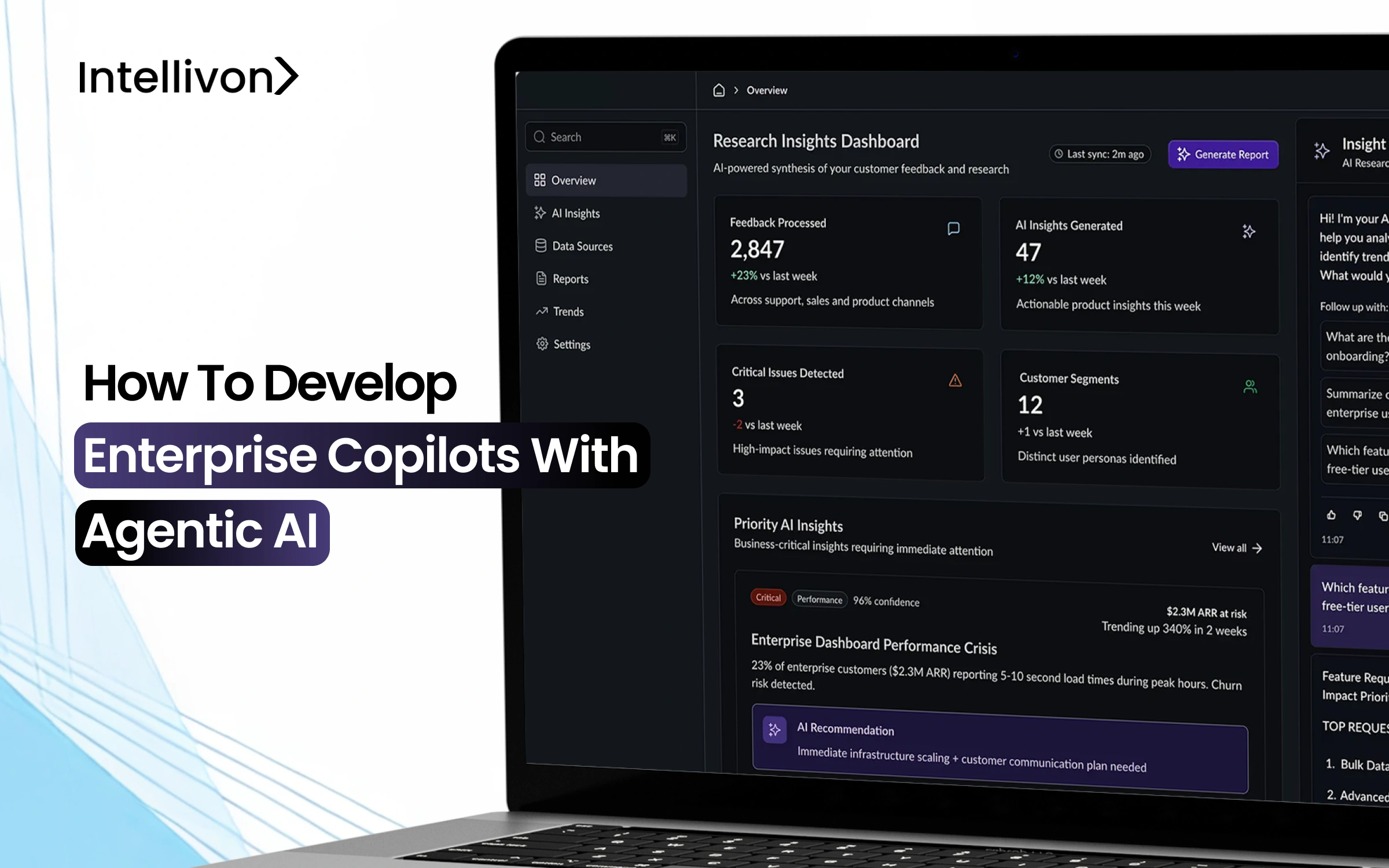
Enterprise copilots have quickly shifted from boardroom concepts to operational necessities. By 2026, Gartner predicts that 40% of large enterprises will run them as core infrastructure, not experiments. The real question for businesses isn’t whether to build copilots, but how quickly they can implement them to outpace competitors. Early adopters are already reaping benefits, faster decisions, streamlined operations, and the ability to scale without proportional headcount increases. Unlike generic AI tools that can draft emails or summarize reports, enterprise copilots are built for complexity. They integrate across workflows, respect compliance frameworks, and support high-stakes decision-making where accuracy and accountability matter most.
At Intellivon, we design copilots that act less like assistants and more like trusted colleagues. Powered by agentic AI, they don’t just respond to prompts but understand context, plan next steps, and execute tasks aligned with business KPIs and regulations. This approach turns copilots into true business multipliers, scalable, secure, and deeply embedded in how organizations operate. In this blog, we’ll share how we build these systems, why agentic AI is the backbone of their effectiveness, and what makes enterprise copilots fundamentally different from consumer-facing AI.
What Are Enterprise Copilots with Agentic AI?
An enterprise copilot is more than an assistant. It is an AI-powered collaborator designed to support employees in decision-making, automation, and innovation. Unlike generic tools, these copilots are built to handle the scale, compliance, and complexity of large organizations.
Enterprise Copilots vs. Standard Copilots
Standard copilots, like Microsoft Copilot or ChatGPT, are useful for general tasks such as drafting text, answering questions, or generating summaries. But they are not tailored for regulated, high-stakes enterprise environments.
Enterprise copilots, by contrast, are custom-built and domain-specific. They are designed to integrate into ERP systems, CRMs, compliance frameworks, and industry data sources. Every action they take is auditable, secure, and aligned with enterprise objectives.
Enterprise Copilots vs. Standard Copilots
| Aspect | Standard Copilots (e.g., ChatGPT, Microsoft Copilot) | Enterprise Copilots (Agentic AI-Powered) |
| Primary Use | Drafting text, answering queries, basic automation | Decision support, compliance automation, enterprise workflows |
| Customization | Limited, one-size-fits-all | Tailored to industry, domain, and business KPIs |
| Integration | Minimal integration with enterprise systems | Deep integration with ERP, CRM, SaaS, and legacy platforms |
| Compliance & Security | Basic privacy controls | Built-in audit trails, encryption, and regulatory alignment |
| Autonomy | Responds to prompts only | Plans, reasons, executes tasks, adapts continuously |
| Scalability | Individual productivity support | Enterprise-wide adoption across departments and geographies |
The Role of Agentic AI
Agentic AI is what makes enterprise copilots game-changing. Instead of responding passively, these copilots can:
- Plan: Break down tasks into subtasks.
- Reason: Evaluate data and context before suggesting actions.
- Act: Execute tasks using connected enterprise systems.
- Adapt: Learn continuously from outcomes and feedback.
This agentic foundation allows copilots to function not just as digital helpers but as strategic teammates, working alongside employees to improve efficiency, compliance, and decision quality.
Business Value: Why Enterprises Need Copilots Now
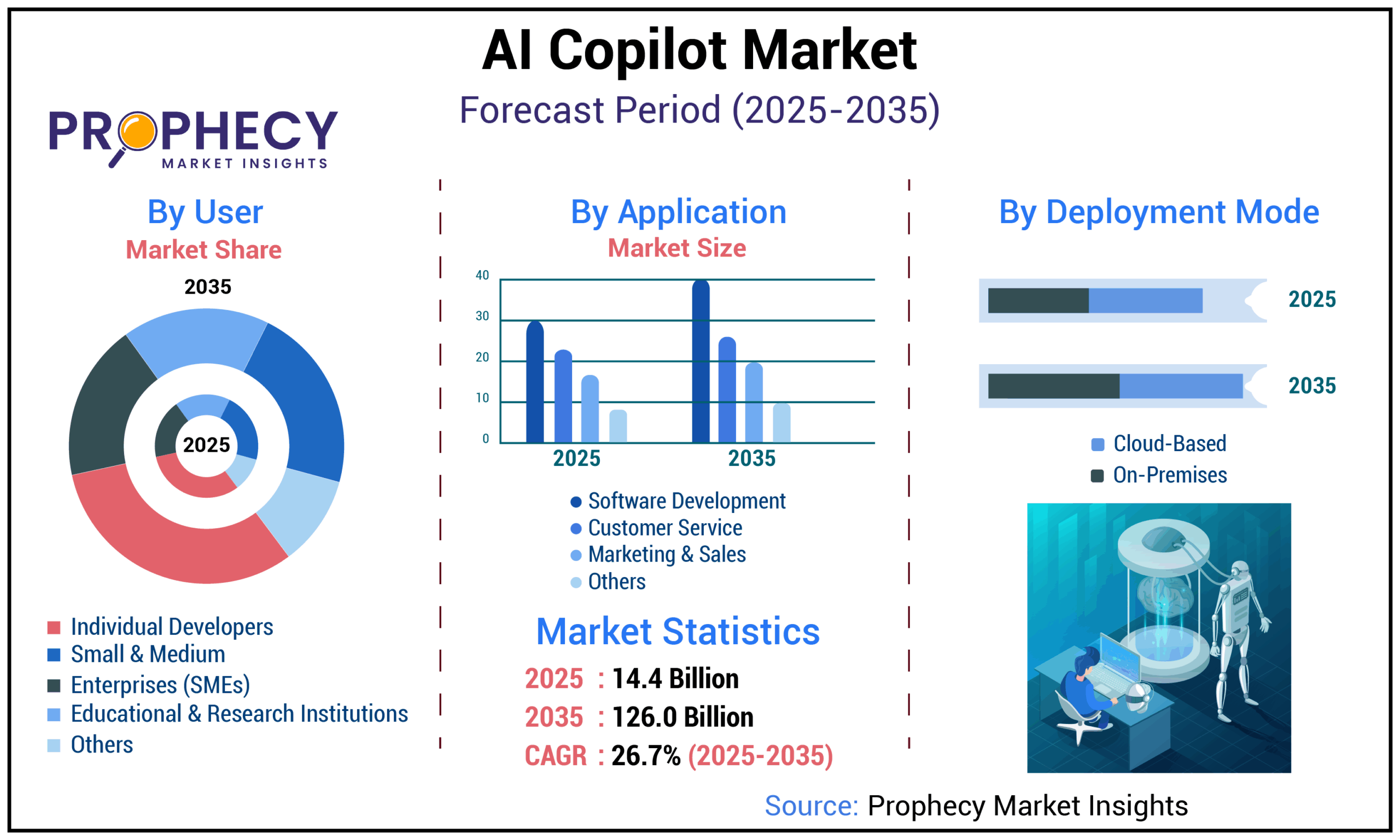
The enterprise AI market size reached approximately $14.4 billion in 2025 and is projected to grow to $126 billion by 2035, with a CAGR above 25%. Within this broader growth, AI copilots are emerging as one of the fastest-scaling segments, attracting significant enterprise investment and accelerating adoption timelines.
Adoption Momentum
- The AI copilot sub-market is projected to hit over $13 billion in annual revenue by the end of 2025, showing 150%+ year-over-year growth fueled by adoption in recruiting, sales, customer service, and workflow automation.
- 62% of organizations increased their generative AI spending in 2025.
- 36% of enterprises have deployed generative AI at scale or limited scale, reflecting rapid adoption momentum across industries.
Measurable ROI and Productivity Gains
- AI investments yield an average ROI of 1.7x across business operations.
- Enterprises see 26–31% reductions in operating costs and 40–45% efficiency gains in customer service, finance, and supply chain functions.
- Agentic AI projects (including copilots) are expected to grow 48% in 2025, with 62% of surveyed enterprises projecting ROI above 100%.
- Mature markets like the U.S. report average ROI between 171% and 192%.
- Companies with strong AI readiness achieve ROI milestones 45% faster than competitors, making copilots a competitive accelerant.
Strategic and Operational Benefits
- Copilots reduce decision latency and break down silos by connecting workflows across departments.
- They provide real-time, contextual assistance, enabling better resource allocation and more agile planning.
- Automating repetitive tasks frees employees for high-value work, with productivity boosts reported up to 40%.
Risk Mitigation and Compliance
- Copilots with built-in compliance and audit features reduce regulatory risk by enforcing consistent policy adherence across workflows.
- 77% of executives prefer proprietary AI models for better control of data privacy and security — copilots designed with these guardrails safeguard sensitive enterprise information.
Why Agentic AI Is the Backbone of Enterprise Copilot Development
Most generic copilots rely on single-model architectures because they can generate text or respond to prompts, but they often struggle with reasoning, multi-step tasks, and integration into complex enterprise workflows. That’s where agentic AI makes the difference.
What Is Agentic AI?
Agentic AI refers to AI systems designed to plan, reason, and act autonomously. Unlike standard models that only respond to inputs, agentic systems can break down goals into steps, evaluate context, and take actions across connected enterprise systems, all while keeping a human in the loop for oversight.
How Agentic AI Transforms Copilots
- Multi-Step Reasoning: Enterprise copilots can analyze data, validate compliance, and propose solutions in stages rather than in a single response.
- Autonomy with Oversight: They handle tasks independently but escalate sensitive decisions to humans, striking the right balance between efficiency and accountability.
- Enterprise Integration: Copilots built on agentic AI connect directly with ERP, CRM, HR, and compliance platforms, becoming active participants in workflows.
- Continuous Learning: These copilots improve over time by incorporating user feedback and adapting to changes in policies or business processes.
Single-Model vs. Agentic Copilots
A single-model copilot is like having a capable intern, which is helpful but limited in scope. An agentic copilot is closer to a trusted digital colleague: it collaborates across functions, enforces governance, and delivers reliable outputs at enterprise scale.
Single-Model vs. Agentic Copilots
| Aspect | Single-Model Copilots | Agentic AI-Powered Copilots |
| Task Handling | Responds to prompts; limited to single-step tasks | Breaks goals into subtasks; executes multi-step workflows |
| Reasoning Ability | Basic pattern recognition and response generation | Advanced planning, reasoning, and context awareness |
| Integration | Minimal integration; works as a stand-alone tool | Deep integration with ERP, CRM, HR, and compliance systems |
| Compliance & Security | Limited controls; dependent on platform settings | Built-in governance, audit trails, encryption, policy alignment |
| Autonomy | Reactive assistant only | Proactive collaborator with human oversight checkpoints |
| Scalability | Supports individuals or small teams | Scales across departments, geographies, and enterprise functions |
This agentic foundation is what makes enterprise copilot development not just a productivity initiative, but a long-term strategy for resilience and growth.
Core Components of an Agentic AI-Powered Enterprise Copilot
Enterprise copilots succeed when built on clearly defined layers. Each component has a distinct role, much like departments in an organization, and together they ensure copilots are intelligent, reliable, and enterprise-ready.
1. Large Language Models (LLMs)
LLMs provide the foundation for understanding language, context, and intent. In enterprise copilots, they are often combined with domain-specific models, such as financial risk engines or healthcare diagnostic models, to increase precision and relevance. This blend allows copilots to move beyond generic outputs and deliver insights tailored to enterprise needs.
2. Multi-Agent Systems
Rather than relying on a single model, enterprise copilots often include multiple specialized agents. A research agent may gather data, a compliance agent validates policies, and an execution agent carries out approved actions. This multi-agent design mirrors enterprise workflows, ensuring tasks are handled with both depth and accountability.
3. Knowledge Integration
Generative models are powerful, but they must be grounded in real enterprise knowledge. Retrieval-Augmented Generation (RAG), vector databases, and knowledge graphs give copilots access to current, accurate data. With this memory layer, copilots can pull policies, financial records, or customer histories in real time, improving both accuracy and trustworthiness.
4. Tool Integration
Copilots deliver impact only when they connect seamlessly to existing IT ecosystems. By integrating with ERP, CRM, HR, and SaaS platforms, they move from passive advisors to active participants. For example, copilots can update Salesforce records, initiate workflows in SAP, or automate ticketing in ServiceNow, driving real operational value.
5. Governance & Guardrails
Enterprises cannot afford copilots that operate without oversight. Governance frameworks ensure copilots comply with GDPR, HIPAA, SOX, and internal policies. Features like encryption, role-based access, and audit trails create accountability, protecting both sensitive data and enterprise reputation.
6. Human-in-the-Loop
For high-stakes workflows, copilots include human approval checkpoints. An underwriting copilot, for example, may draft policy terms, but final approval rests with a compliance officer. This design ensures that copilots enhance decision-making without replacing critical human judgment.
Together, these components form the backbone of enterprise copilot development, ensuring systems are not just intelligent but also scalable, secure, and trusted.
How Agentic AI-Powered Enterprise Copilots Work in Practice
For enterprise leaders, copilots become most tangible when you understand how they function in a real workflow. At their core, they operate much like a digital colleague: listening to a request, breaking it down into smaller actions, coordinating across departments and systems, and then presenting a trusted outcome with oversight built in. This structured flow is what transforms them from simple assistants into enterprise-grade collaborators.
Step 1: A User Issues a Task
The process begins when a user asks the copilot to perform an activity. This could be as simple as requesting a compliance-ready report or as complex as preparing a financial forecast. Instead of searching across multiple systems or compiling data manually, the user interacts directly with the copilot through natural language or a connected interface.
Step 2: The Copilot Breaks It Into Subtasks
Rather than attempting to solve the task all at once, the copilot decomposes it into logical steps. For example, generating a risk report may require gathering market data, cross-checking compliance rules, and preparing an executive summary. By distributing each step to the right agent, the copilot ensures that every part of the workflow is handled by a specialized capability.
Step 3: Multi-Agent Collaboration
These specialized agents then work together. A research agent pulls data from approved sources, a compliance agent validates actions against regulations, and an execution agent generates the output in the required format. This collaboration mirrors the way enterprise teams work internally, except that in this case, the “team” consists of digital agents coordinating seamlessly in real time.
Step 4: Data Retrieval and Verification
The copilot retrieves information from enterprise databases, ERP or CRM systems, and compliance frameworks using secure connectors. At the same time, it verifies that the data is accurate and up to date. This dual process of retrieval and validation reduces risk, ensuring that leaders receive outputs grounded in reliable information.
Step 5: Suggestion or Action Execution
Once the subtasks are completed, the copilot either presents a recommendation or carries out the approved action. In high-stakes scenarios, such as approving a large transaction or making a regulatory filing, the system pauses for human approval. This “human-in-the-loop” design ensures accountability and trust, giving executives confidence that automation won’t overstep critical decision points.
Step 6: Continuous Feedback and Learning
The process doesn’t stop once a task is completed. Every interaction is logged, outcomes are analyzed, and feedback is incorporated into future workflows. Over time, the copilot becomes smarter, more accurate, and more closely aligned with enterprise priorities. This feedback loop is what makes enterprise copilot development sustainable and future-proof.
By combining these steps, enterprises create copilots that act not just as assistants but as strategic collaborators, reducing manual effort, improving compliance, and speeding up decision-making without sacrificing oversight.
Industry-Wise Use Cases of Agentic AI-Powered Enterprise Copilots
Enterprise copilots are versatile and can be applied across industries wherever processes involve complex decision-making, compliance, or repetitive workflows. Below are industry-specific examples that show how copilots change the way enterprises operate.
1. Finance & Banking
A. Loan Approvals
A copilot reviews applicant data, pulls credit histories, applies internal lending policies, and creates a draft decision. Instead of analysts spending hours reconciling multiple data points, the copilot consolidates everything, highlights risk factors, and routes the recommendation to a loan officer for final approval.
B. Financial Close and Reporting
During the month-end close, a copilot reconciles ledgers, flags discrepancies, and prepares draft financial reports. It can also generate management summaries that link directly to underlying entries, ensuring transparency for auditors and reducing cycle times.
C. Treasury and Liquidity Management
Treasury teams rely on copilots to monitor cash positions, forecast liquidity needs, and recommend fund transfers. The system considers credit limits, fees, and upcoming obligations, allowing CFOs to act with speed and confidence.
2. Healthcare
A. Clinical Decision Support
Copilots synthesize patient history, clinical guidelines, and test results to recommend treatment options. Physicians receive structured suggestions backed by citations, allowing them to confirm or adjust while saving time in diagnosis and care planning.
B. Care Coordination
Managing referrals, pre-authorizations, and discharge planning becomes easier with copilots that update EHR systems and payer portals simultaneously. This reduces handoff delays and ensures continuity of care across providers.
C. Revenue Cycle Management
In billing workflows, copilots validate coding accuracy, check eligibility, and generate appeals for denied claims. This minimizes revenue leakage while reducing administrative burden for healthcare staff.
3. Insurance
A. Claims Assessment
A copilot processes photos, forms, and customer-provided data, compares them against policy terms, and screens for fraud indicators. It then drafts a settlement recommendation for adjusters to review, cutting down on claim resolution time.
B. Underwriting
Copilots gather external and internal data, assess risks, and generate draft coverage terms. They also document reasoning for regulatory purposes, helping underwriters make faster, more consistent decisions.
C. Agent Enablement
Insurance copilots help sales agents by generating personalized quotes, explaining trade-offs between policies, and suggesting next steps. This enables agents to focus more on client relationships than administrative work.
4. Manufacturing & Supply Chain
A. Predictive Maintenance
Copilots analyze sensor data, maintenance logs, and supplier inputs to predict potential equipment failures. They schedule planned downtime, order replacement parts, and alert maintenance teams before costly breakdowns occur.
B. Production Planning
Copilots optimize production schedules by balancing demand signals, available capacity, and material constraints. They can also simulate scenarios — such as supplier delays — and recommend contingency plans.
C. Supplier Risk Monitoring
Supply chain copilots evaluate supplier performance, financial health, and external risk signals like ESG alerts. They recommend re-sourcing or renegotiation strategies to reduce dependency on vulnerable suppliers.
5. Retail & E-commerce
A. Dynamic Pricing and Promotions
Copilots monitor demand patterns, inventory levels, and competitor activity to recommend price adjustments or targeted promotions. This helps retailers protect margins while staying competitive.
B. Catalog Management
Copilots enrich product catalogs by normalizing attributes, validating images, and filling missing metadata. This ensures accuracy and consistency across channels, leading to smoother customer experiences.
C. Service and Returns
In customer support, copilots guide service agents with recommended actions, automate approvals for eligible returns, and detect fraud patterns. This speeds up resolution times while safeguarding profitability.
6. IT & Enterprise Operations
A. DevOps Copilots
In IT operations, copilots monitor logs, detect anomalies, and propose fixes. They can even generate rollback plans or patches and create change tickets for approval, cutting downtime significantly.
B. Cybersecurity Response
Cybersecurity copilots triage alerts, correlate incidents across systems, and recommend containment steps. They also generate audit-ready reports to support compliance needs after an incident.
C. Knowledge Access
For IT staff, copilots retrieve SOPs, past resolutions, and technical documentation to answer queries. Over time, they update the knowledge base, making troubleshooting faster and more consistent.
Real-World Enterprises Already Benefiting from Agentic AI-Powered Copilots
Enterprises across industries are beginning to see measurable gains from deploying agentic AI copilots. These systems are production-grade tools improving efficiency, compliance, and decision-making.
1. Morgan Stanley

Morgan Stanley has deployed AI copilots that deliver “Next Best Action” recommendations to wealth advisors. These copilots combine machine learning with real-time market data and client profiles, providing personalized suggestions for investment strategies, portfolio adjustments, and timely outreach.
Instead of replacing advisors, the copilots augment their ability to analyze complex financial data quickly. Advisors retain final authority but gain a trusted assistant who helps them engage clients with more relevant, data-backed advice. This blend of automation and oversight demonstrates how copilots strengthen decision-making in highly regulated sectors like financial services.
2. Siemens
Siemens has introduced industrial copilots that monitor sensor data across production lines. Using generative AI and multi-agent collaboration, these copilots detect anomalies, predict equipment failures, and schedule preventive maintenance before disruptions occur.
Reports show that Siemens achieved up to a 40% reduction in unplanned downtime, a result that translates directly into higher efficiency and lower operational costs. By embedding copilots into daily plant operations, Siemens has turned predictive maintenance into a proactive, AI-driven workflow that scales globally across its industrial footprint.
Lemonade

Lemonade reimagined the claims process with its AI copilot, known as “AI Jim.” This system manages the end-to-end journey: extracting details from documents, running fraud detection checks, validating coverage, and issuing payments automatically.
In practice, this means some claims are approved and paid in just seconds, which is a dramatic shift from traditional multi-day processes. By automating claims while embedding fraud safeguards, Lemonade reduces operational costs and boosts customer trust through transparent, lightning-fast service.
Maersk
Maersk employs AI copilots within its logistics workflows to optimize global shipping operations. These copilots process real-time data on vessel locations, weather patterns, and port conditions, then recommend efficient routes and proactive adjustments.
By integrating route optimization copilots, Maersk improves delivery times, reduces fuel costs, and strengthens its ability to navigate supply chain disruptions. The result is not just incremental efficiency but a structural advantage in how the company manages its complex global logistics network.
Renault
Renault has applied AI copilots to support planning for electric vehicle (EV) charging infrastructure. These systems analyze traffic flows, geographic data, and energy demand forecasts to recommend optimal charging station locations and capacities.
Although Renault does not market them explicitly as copilots, the role they play is equivalent: acting as digital collaborators that manage complexity and inform critical infrastructure investment. For a company advancing EV adoption at scale, these copilots provide both strategic and operational value.
What unites these cases is how agentic AI copilots act as more than automation tools. They collaborate with human teams, navigate data complexity, and accelerate outcomes. From Siemens’ downtime reduction to Lemonade’s instant claims and Morgan Stanley’s personalized financial advice, copilots are already proving their enterprise worth.
How We Develop Enterprise Copilots with Agentic AI
At Intellivon, we’ve learned that building effective enterprise copilots requires far more than plugging in an AI model. It takes a structured process that balances automation with human oversight, integrates smoothly with existing IT systems, and demonstrates measurable ROI from the start. Our approach reflects this philosophy. Every copilot we build emphasizes governance, scalability, compliance, integration, and business value, which are the same principles that have helped our clients reduce costs, accelerate decision-making, and unlock sustainable growth.
Below is the step-by-step methodology we follow to ensure that every enterprise copilot is not only technically robust but also strategically aligned with organizational priorities.
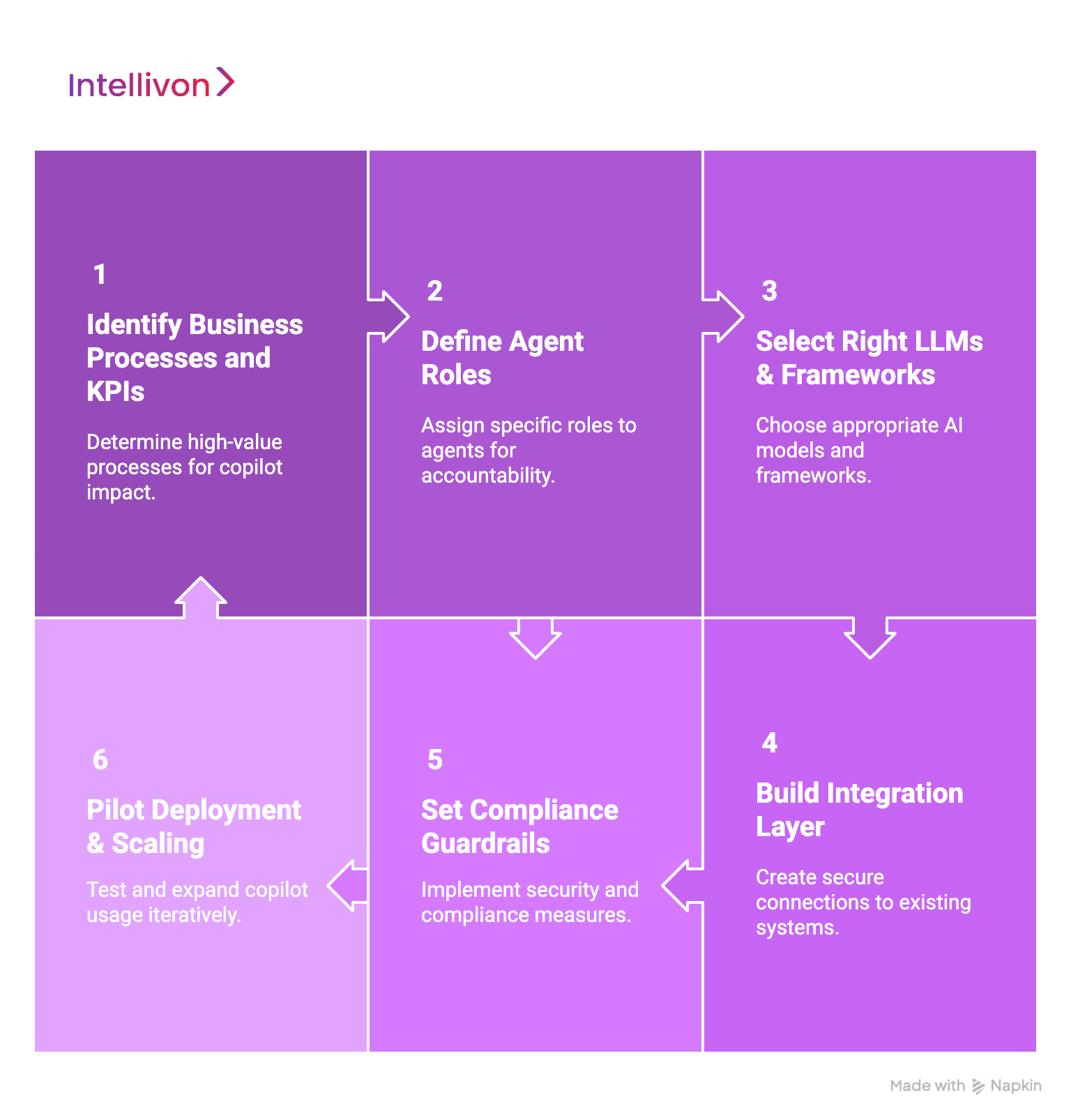
Step 1: Identify Business Processes and KPIs
Every copilot begins with clear business alignment. We work with enterprise leaders to identify high-value processes, such as compliance checks, financial reporting, or customer support, where copilots can deliver immediate impact.
Defining success metrics and KPIs upfront ensures the system is built with measurable outcomes in mind.
Step 2: Define Agent Roles
An effective copilot functions like a digital team, with each agent assigned a specific role. A research agent gathers information, a validator checks for accuracy and compliance, an executor carries out approved actions, and a compliance agent ensures adherence to policies and regulations.
By defining roles clearly, we create accountability and reduce overlap.
Step 3: Select the Right LLMs & Frameworks
Different copilots require different foundations. We combine general-purpose LLMs with domain-specific models to improve relevance and precision.
Frameworks like LangChain, Semantic Kernel, and AutoGen provide the orchestration needed for multi-agent collaboration, while ensuring adaptability as enterprise needs evolve.
Step 4: Build the Integration Layer
Copilots only add value when they work seamlessly with existing enterprise systems. We design secure integration layers, like APIs and data pipelines, that connect to ERP, CRM, HR, and compliance platforms. This allows copilots to access and act on real-time data without disrupting legacy infrastructure.
Step 5: Set Compliance Guardrails
From day one, we embed compliance, explainability, and audit trails into the architecture. Guardrails include role-based access, encryption, and automated policy enforcement, ensuring copilots align with GDPR, HIPAA, SOX, and other regulatory frameworks.
These safeguards build executive confidence and protect the enterprise’s reputation.
Step 6: Pilot Deployment and Iterative Scaling
We never deploy copilots in one sweeping rollout. Instead, we start with pilots in selected departments, measure impact against KPIs, and refine the system through feedback loops. Once validated, the copilot is scaled across functions and geographies, ensuring sustainable adoption without disruption.
This structured development process ensures copilots are not only intelligent but also enterprise-ready. It is capable of delivering measurable ROI while scaling securely with business growth.
Cost of Developing Agentic AI-Powered Enterprise Copilots
At Intellivon, we understand that enterprises require scalable copilots at reasonable prices. That’s why our pricing is customizable to your specific needs, instead of following a one-size-fits-all model. If costs exceed the planned budget, we collaborate with you to streamline the scope while preserving business value. For enterprises ready to scale aggressively, we extend copilots with advanced features, deeper integrations, and enhanced governance frameworks.
Estimated Phase-Wise Cost Breakdown
| Phase | Description | Estimated Cost Range (USD) |
| Discovery & Strategy | Requirement gathering, KPI mapping, compliance reviews | $6,000 – $12,000 |
| Architecture Design | Copilot blueprint, orchestration model selection, workflow mapping | $8,000 – $18,000 |
| Model & Tool Integration | Connecting LLMs, ERP, CRM, compliance platforms, APIs | $12,000 – $25,000 |
| Development & Customization | Building copilots, assigning agent roles, refining orchestration logic | $15,000 – $30,000 |
| Security & Compliance Setup | Encryption, RBAC, audit trails, regulatory alignment (GDPR/HIPAA/SOX) | $7,000 – $15,000 |
| Testing & Validation | Stress tests, human-in-the-loop validation, performance tuning | $7,000 – $15,000 |
| Deployment & Scaling | Rollout, monitoring dashboards, and governance setup | $6,000 – $15,000 |
| Ongoing Maintenance & Support | Workflow expansion, new copilot features, and continuous optimization | $5,000 – $10,000 annually |
Total Initial Investment Range: $50,000 – $150,000
Ongoing Optimization (Annual): $5,000 – $10,000
Factors That Influence Cost
The actual cost of enterprise copilot development depends on several factors, including:
- Complexity of IT infrastructure and legacy system integrations
- Number of copilots and workflows deployed
- Deployment model (cloud, on-premises, or hybrid)
- Data volume, governance, and security requirements
- Compliance mandates (GDPR, HIPAA, SOX)
- Level of customization vs. pre-built components used
Request a tailored quote from Intellivon’s AI engineers today. We’ll design an enterprise copilot platform aligned with your budget, growth plans, and compliance needs, built to scale as your business evolves.
Overcoming Challenges in Enterprise Copilot Development
Building enterprise copilots with agentic AI is not without obstacles. Many enterprises begin pilots but fail to scale due to gaps in integration, compliance, or adoption. At Intellivon, we address these challenges directly in our development process, ensuring copilots are both effective and sustainable.
1. Data Privacy and Compliance
Enterprises operate in heavily regulated environments. A copilot that mishandles sensitive data can create legal and reputational risks.
To mitigate this, copilots are designed with audit-ready frameworks, encryption, and access controls. Every action is traceable, ensuring compliance with GDPR, HIPAA, SOX, and other regulations from day one.
2. Integration with Legacy Systems
Most enterprises rely on decades-old ERP, CRM, and custom applications. Without integration, copilots remain siloed.
We solve this by building custom APIs and secure connectors that allow copilots to interact with existing platforms without costly infrastructure overhauls. This approach protects past IT investments while unlocking new value.
3. User Adoption and Change Management
Even the most advanced copilot will fail if employees do not trust or use it. Change management is critical.
Copilots must be introduced with training, intuitive interfaces, and human-in-the-loop design so that employees see them as enablers, not replacements. By positioning copilots as partners, adoption grows naturally.
4. Model Drift and Accuracy
AI models degrade over time if not updated, especially in dynamic industries like finance or healthcare.
We embed continuous monitoring and fine-tuning pipelines that detect when outputs deviate from expected accuracy. Feedback loops keep copilots aligned with enterprise needs, ensuring consistent value delivery.
By addressing these challenges upfront, enterprises move beyond pilots to deploy copilots that are secure, trusted, and scalable across departments.
Conclusion
Enterprise copilots built on agentic AI are no longer experimental technologies. They are becoming indispensable digital teammates that augment human expertise, streamline operations, and accelerate decision-making. The enterprises that adopt them early are already seeing measurable returns in efficiency, compliance, and competitive positioning.
For large organizations, the question is no longer whether to deploy copilots but how to develop them in a way that aligns with strategy, scales with growth, and meets compliance demands. The right solution provider will ensure copilots are not just cost savers but strategic growth enablers that evolve with your business.
Why Partner with Intellivon for Enterprise Copilot Development
At Intellivon, we bring 15+ years of experience building enterprise-grade copilots powered by agentic AI, which are secure, scalable, and aligned with business KPIs. We partner with global enterprises to design copilots that transform how organizations operate, making them more efficient, compliant, and competitive.
Why Partner with Intellivon?
- Tailored Enterprise Solutions: Every copilot is designed to fit your workflows, objectives, and compliance requirements.
- Security and Compliance First: Encryption, audit trails, and governance are built in from day one.
- Proven ROI Across Industries: Our copilots reduce costs, improve decision-making, and scale with enterprise growth.
- End-to-End Delivery: From discovery to enterprise rollout, we manage the full copilot development journey.
- Specialized Expertise: A team dedicated to agentic AI ensures your copilots deliver real, measurable business value.
Book a discovery call with Intellivon’s AI engineers today and see how enterprise copilots can unlock efficiency, compliance, and growth for your organization.
FAQs
Q1. What is an enterprise copilot?
A1. An enterprise copilot is an AI-powered digital collaborator that augments employees in decision-making, automation, and compliance-driven workflows. Unlike generic copilots, they are custom-built, domain-specific, and seamlessly integrated into enterprise systems like ERP, CRM, and governance platforms.
Q2. How does agentic AI improve copilots?
A2. Agentic AI equips copilots with the ability to plan, reason, and act autonomously. Instead of responding to isolated prompts, agentic copilots can break down complex tasks, coordinate multiple steps, and ensure compliance with human oversight, making them more adaptable and reliable for enterprise use.
Q3. What industries benefit most from enterprise copilots?
A3. Industries with high data complexity and compliance requirements see the greatest gains. This includes finance and banking (risk analysis, loan approvals), healthcare (clinical support, patient engagement), insurance (claims processing, underwriting), manufacturing (predictive maintenance, logistics), and retail (pricing, customer experience).
Q4. How much does it cost to build an enterprise copilot?
A4. The cost of enterprise copilot development typically ranges from $50,000 to $150,000+, depending on factors like system integrations, security requirements, the number of agents, and level of customization. Ongoing optimization usually adds $5,000–$10,000 annually.
Q5. Can copilots integrate with legacy enterprise systems?
A5. Yes. Copilots can integrate with legacy systems through custom APIs, secure connectors, and data pipelines. This ensures enterprises don’t need to replace existing IT infrastructure to benefit from copilots. Instead, copilots extend its value while modernizing workflows.