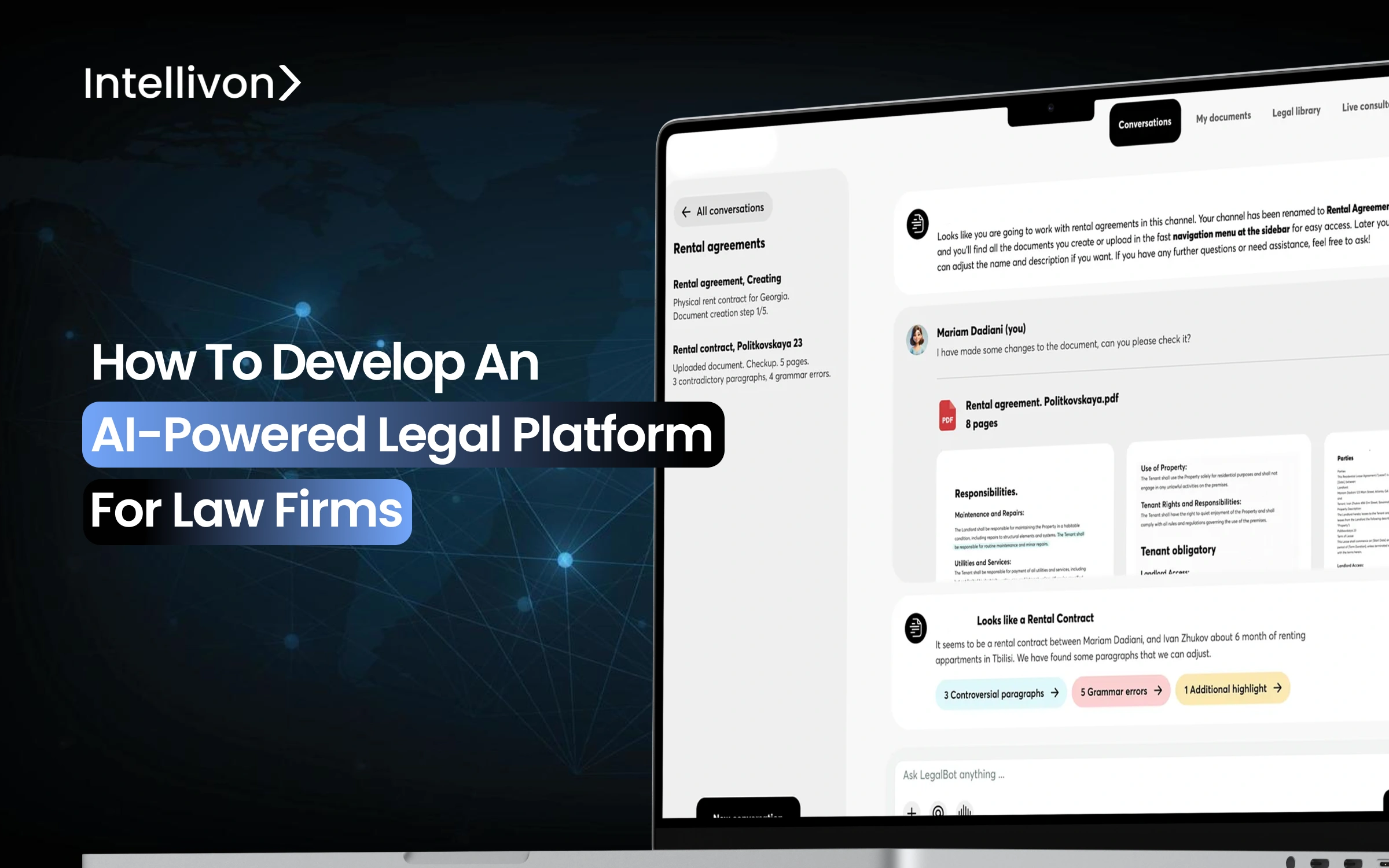
Law firms that follow traditional workflows are constantly strained under the weight of ever-growing case loads, complex regulations, and the demand for faster service delivery from clients. These firms produce thousands of legal documents, but most of them disappear into shared drives and document management systems, never to be seen again. This is where an AI-powered legal platform can reverse these issues. They are built specifically for law firms to dig through work, connect it with trusted legal sources, and surface what is needed with proper citations. A tailored platform like this can revolutionize operations, boost productivity, and deliver a significant edge over competitors.
We’ve spent years building these systems for leading law firms, turning their buried archives into accessible intelligence that lawyers actually use daily to close deals and win cases faster. In this blog, we’ll show you how AI-powered legal platforms work, what top firms are already doing, and how we develop such platforms for your firm responsibly.

What is an AI-Powered Legal Platform?
An AI-powered legal platform is best understood as an enterprise-grade operating system for law firms, designed to manage the full spectrum of legal work with intelligence layered across it. Unlike consumer chatbots or lightweight tools, it is designed from the ground up for scale, security, and compliance in complex legal environments.
At its core, this type of platform connects all the systems a firm already relies on, such as, document management systems (DMS) such as iManage or NetDocuments, eDiscovery platforms like Relativity and Everlaw, legal research databases, including LexisNexis and Westlaw, collaboration tools such as Outlook, Microsoft Teams, and SharePoint, and billing and timekeeping systems that capture client work and revenue.
By integrating these systems under a single AI-enabled layer, the platform allows lawyers to search, draft, review, and analyze with far greater speed and accuracy, while maintaining strict controls over privilege and confidentiality.
The difference between an AI-powered legal platform and standalone “AI tools” is simple. Tools assist with isolated tasks, often without context or governance. A platform brings everything together into one secure, auditable environment, where every output can be traced, verified, and aligned with the firm’s risk and compliance standards.
In practical terms, that means a lawyer isn’t just typing a query into a chatbot. Instead, they’re working inside a structured environment that pulls from the firm’s own knowledge base and trusted external sources. They also use retrieval-augmented generation (RAG) to ensure every answer is grounded in real documents. Additionally, the platform adds guardrails like privilege walls, source-linked citations, and human approval steps before work product is finalized.
For enterprise law firms, this distinction matters the most. This is because the platform is not running on an AI hype, but it is designed in a way to become the firm’s operating backbone. It supports daily legal work while protecting the standards of accuracy, confidentiality, and professionalism that clients expect.
Key Takeaways of the AI Legal Market
The global legal AI market is growing quickly. Valued at about USD 2.1 billion in 2025, it is projected to reach USD 7.4 billion by 2035, expanding at a 13.1% annual growth rate. This rise is fueled by increasing demand for AI in contract review, compliance, e-discovery, and litigation analytics across law firms and corporate legal teams.

- The legal technology market was USD 26.7B in 2023 and is projected to reach USD 46.8B by 2030, growing at a 10.2% CAGR.
- AI is the main driver of this growth, helping firms automate complex workflows, cut costs, and improve efficiency.
- By 2025, 70% of legal professionals expect to use AI tools extensively, but only 20% have a clear adoption strategy.
- Large firms are already deploying AI for contract management, risk assessment, predictive analytics, and compliance automation.
- Case studies show AI platforms can cut contract review times by up to 80% and reduce operational overhead significantly.
- Investment in LegalTech and AI remains strong, with acquisitions and funding fueling rapid innovation.
- Platforms that prioritize security, compliance, scalability, and cloud integration are emerging as enterprise favorites.
- North America and Europe lead in adoption, while Asia-Pacific is rapidly growing with demand for cost-effective AI legal services.
- These trends confirm a major opportunity for early adopters, making now the time for firms to invest in scalable AI platforms.
How These AI-Powered Legal Platforms Work
The strength of an AI-powered legal platform lies in how it reshapes daily workflows. Instead of disrupting existing processes, it enhances them by adding speed, accuracy, and safeguards that protect client privilege. The platform follows a structured cycle that mirrors the way lawyers already work, only with intelligence and governance built into every stage.
Step 1: Connect
The first stage is integration. The platform securely links to the firm’s core systems, including document repositories, case files, billing platforms, email archives, chat tools, and research databases. This single point of access removes the inefficiencies of searching across multiple systems. Sensitive data never leaves the firm’s environment, which keeps compliance intact and reduces risk exposure.
Step 2: Index
Once connections are established, the platform indexes all documents at the matter level. Scanned contracts and PDFs become searchable through optical character recognition (OCR). Metadata tagging and entity recognition add another layer of richness, making documents easier to retrieve. Every matter remains ring-fenced, ensuring information from one client or case never crosses into another.
Step 3: Retrieve
When a lawyer requests a precedent or searches for case law, the platform retrieves relevant material from internal knowledge bases and licensed research sources. Retrieval-augmented generation (RAG) ensures the AI works only with verified information. This approach reduces errors and grounds every answer in authentic statutes, rulings, or firm documents.
Step 4: Generate
After retrieval, the system synthesizes the findings into a draft. This could be a case summary, contract analysis, or research memo. By automating the first pass, the platform handles the heavy lifting of summarization while lawyers focus on strategic judgment. The result is faster delivery and more consistent output quality.
Step 5: Verify
No AI-generated content is accepted blindly. The platform enforces guardrails at this stage. Outputs come with source-linked citations, confidence thresholds filter out weak responses, and privilege walls block cross-client data exposure. These measures guarantee defensible results that meet the accuracy standards of legal practice.
Step 6: Approve
Control remains with the lawyer at all times. Drafts are reviewed, edited, and approved before becoming official work product. A human-in-the-loop approach ensures professional oversight, while full audit logs track every action. If work is ever challenged in court or regulatory review, firms have a clear record of how it was produced.
By following this structured cycle, firms shift from experimenting with AI to embedding it into practice. The outcome is measurable efficiency paired with the trust and accuracy clients demand. Instead of replacing lawyers, the platform empowers them to focus on higher-value judgment, advocacy, and client service.
How AI Enhances Legal Platforms for Law Firms
When applied correctly, AI changes the way firms manage information, deliver client service, and protect compliance. The real impact comes from embedding intelligence into daily workflows in ways that lawyers can trust and rely on. Below are the areas where AI makes a measurable difference.
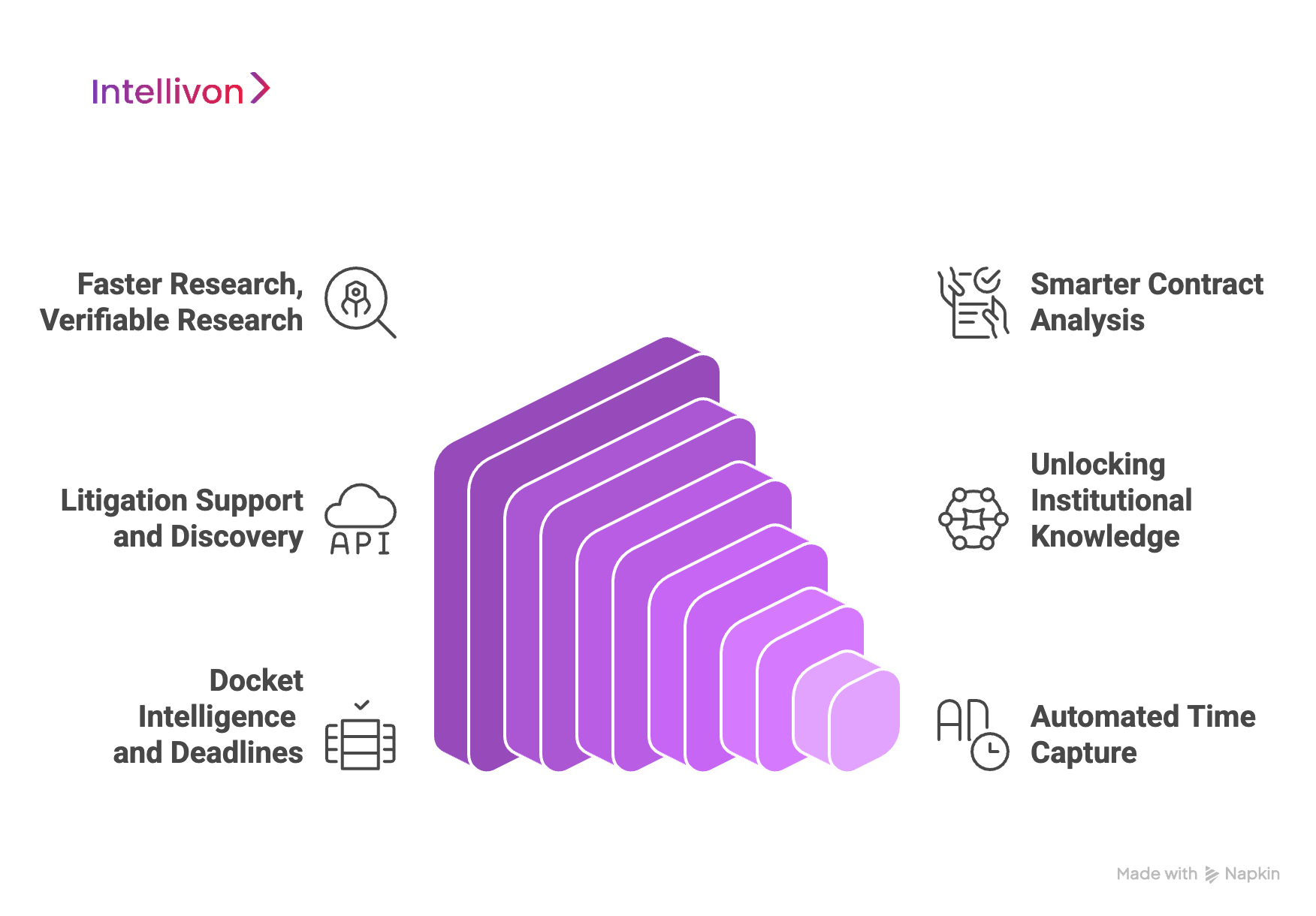
1. Faster, Verifiable Research
Legal research has always been one of the most time-consuming parts of practice. Associates often spend hours digging through case law, statutes, and commentary before they can advise a client. An AI-powered platform turns this process into an interactive experience, where awyers ask questions in plain language and receive answers linked directly to authoritative sources. Built-in citation checkers further reduce the risk of errors. The result is less time spent searching and more time applying insights to case strategy.
2. Smarter Contract Analysis
Large firms may process thousands of contracts each month, leaving plenty of room for oversight. AI platforms handle this volume by reading, comparing, and analyzing contracts at scale. They highlight clauses that stray from firm playbooks, flag risky language, and even suggest alternatives. Lawyers still control the final review, but they start from a stronger position with potential risks already surfaced. This speeds up turnaround while improving consistency and client outcomes.
3. Litigation Support and Discovery
Discovery can involve millions of documents in a single case. Reviewing this manually is both expensive and inefficient. AI platforms accelerate the process by classifying files, surfacing privileged materials, and generating summaries that explain relevance. Technology-assisted review (TAR) combined with natural-language processing allows teams to focus on litigation strategy instead of drowning in paperwork. Costs drop, and cases move forward faster without sacrificing accuracy.
4. Unlocking Institutional Knowledge
Every firm holds decades of valuable arguments, briefs, and transaction records. The problem is that most of this knowledge stays buried in archives. AI platforms change that by creating a “firm brain,” which is a searchable knowledge layer where successful arguments and precedents are instantly retrievable. Lawyers avoid duplicating past work, while new associates ramp up faster by learning from proven strategies. This turns hidden knowledge into a competitive advantage.
5. Docket Intelligence and Deadlines
Deadlines are one of the biggest sources of malpractice risk. Missing even a single filing can damage both the client relationship and the firm’s reputation. AI platforms reduce that risk by reading dockets, applying jurisdiction-specific rules, and automatically calculating filing dates. Attorneys receive proactive alerts, ensuring critical deadlines are never missed. This adds reliability to one of the most high-stakes aspects of legal practice.
6. Automated Time Capture
Accurate timekeeping directly impacts a firm’s revenue. Manual entry often misses significant hours or is logged inconsistently, creating revenue leakage. AI addresses this by passively tracking activity across documents, emails, and calls. It then generates billing-ready narratives without requiring extra work from attorneys. Firms gain stronger revenue protection, while clients appreciate clearer and more transparent invoices.
Together, these capabilities show how AI stops being a side tool and becomes part of the firm’s operating backbone. Lawyers remain in full control of decisions, but they work with stronger insights, fewer bottlenecks, and higher efficiency in every matter.
How Leading Law Firms Use AI-Powered Legal Platforms
The world’s largest firms no longer treat AI as an experiment. They are embedding it directly into everyday practice areas — from research and drafting to discovery and billing. Their adoption shows how AI can deliver measurable outcomes while preserving professional standards and client trust.
1. Research With Linked Authorities
Research has always consumed enormous time and resources. Traditionally, associates spent hours searching across databases for relevant statutes or precedents. Today, AI platforms transform this process. Lawyers ask questions in natural language and receive concise, sourced answers. Tools like Lexis+ AI and Thomson Reuters CoCounsel return results linked directly to statutes and case law. This creates a new standard where verified, source-backed research is expected by clients and considered non-negotiable by firms.
2. First-Pass Drafting and Clause Checks
Drafting no longer begins with a blank page. AI generates first-pass versions of memos, motions, and contracts, offering a structured starting point that lawyers can refine. The system also reviews clauses against firm playbooks, instantly flagging deviations that could create client risk. Global firms deploying Harvey have embedded this process across litigation and transactional practices. The outcome is faster turnaround, improved consistency across documents, and stronger risk management.
3. Contract Portfolio Review
Mergers and acquisitions demand a rapid review of thousands of agreements under tight deadlines. AI simplifies this by extracting key terms, identifying obligations, and flagging unusual clauses across entire portfolios. Lawyers spend less time combing through contracts and more time focusing on strategic issues. The process ensures accuracy, maintains consistency across high-value transactions, and reduces the pressure on legal teams working against the clock.
4. eDiscovery Review
Litigation can generate millions of documents, each requiring careful review. Handling this manually drains both time and budget. AI-enabled platforms such as Relativity and Everlaw accelerate the process. They classify files, surface privileged material, and generate plain-language summaries that explain why a document matters. This reduces review cycles, lowers discovery costs, and allows teams to prepare trial strategies more quickly.
5. Knowledge Management
Every firm holds decades of valuable arguments, briefs, and deal structures within its archives. Yet most of this knowledge goes unused because it is hard to access at scale. AI platforms change this dynamic. They act like a “firm brain,” retrieving proven strategies, prior arguments, and successful deal structures in seconds. Lawyers avoid duplicating work, deliver greater consistency, and help new associates learn faster by building on institutional knowledge.
6. Docket and Deadline Automation
Managing filing deadlines across jurisdictions is one of the most persistent malpractice risks. AI platforms reduce this exposure by reading dockets, applying jurisdiction-specific rules, and calculating filing schedules automatically. Lawyers receive proactive alerts, ensuring that deadlines are met without relying solely on manual tracking. This reduces errors, strengthens compliance, and builds client confidence that cases are being managed with discipline.
7. AI-Assisted Timekeeping
Timekeeping often creates inefficiencies and missed revenue. Manual entry leaves billable hours unrecorded, while delayed reporting creates inaccuracies. AI platforms solve this by capturing activities across emails, documents, and calls, then generating billing-ready narratives automatically. Lawyers spend less time logging hours, while firms protect revenue and deliver greater billing transparency to clients.
These examples highlight a clear shift that AI is moving from being a helpful add-on to becoming the operating backbone of leading firms. It accelerates routine work, reduces risk, and strengthens client relationships, all while keeping the final decisions firmly with lawyers. Firms adopting these platforms todayare setting new benchmarks for efficiency, compliance, and client service in the legal sector.
Key Features an AI-Powered Legal Platform Must Have
For a legal AI platform to succeed at enterprise scale, it needs more than sophisticated models. It has to combine intelligence with the structure, governance, and integrations that law firms rely on every day. The features below define what makes a platform ready for serious use.
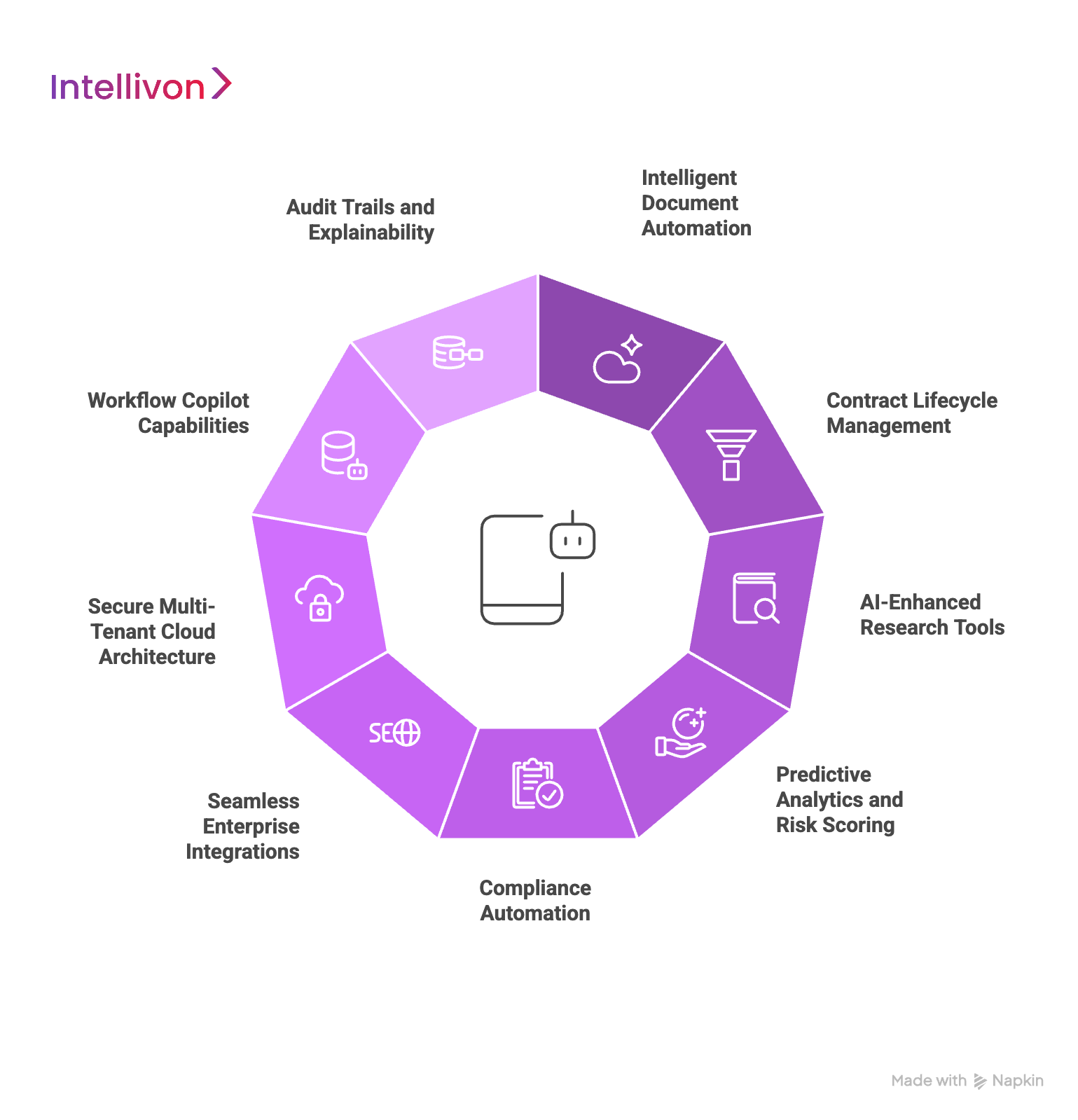
1. Intelligent Document Automation
The platform reads, classifies, and summarizes millions of documents at scale. It extracts entities, highlights obligations, and flags risks without losing legal context. Through this, lawyers gain faster visibility into case files, contracts, and discovery material.
2. Contract Lifecycle Management
The system supports every contract stage, such as drafting, negotiation, redlining, approval, and renewal. It compares language against firm playbooks and flags deviations instantly. Lawyers spend less time on manual reviews and keep contracts aligned with standards.
3. AI-Enhanced Research Tools
The platform grounds every answer in authority. It uses retrieval-augmented generation (RAG) with citation verification, so lawyers see both the synthesized answer and the statute or precedent behind it. This way, research becomes faster and more defensible.
4. Predictive Analytics and Risk Scoring
The system analyzes historical outcomes to flag litigation risks and estimate case timelines. It also scores clauses by exposure and gives lawyers foresight when advising clients. As a result, firms gain confidence and provide more transparent guidance.
5. Compliance Automation
The platform encodes bar rules and regulatory frameworks directly into workflows. Lawyers operate within ethical boundaries by default, while the system monitors for anomalies. Compliance stays consistent without adding extra workload.
6. Seamless Enterprise Integrations
The system connects with tools that firms already use. It integrates with iManage or NetDocuments for document management, Relativity or Everlaw for eDiscovery, Lexis and Westlaw for research, Microsoft 365 for collaboration, and billing platforms for revenue management. This ensures adoption happens smoothly instead of disrupting workflows.
7. Secure Multi-Tenant Cloud Architecture
The platform scales across global offices while protecting sensitive data. It applies encryption, regional data residency, and role-based access to keep client information secure in every jurisdiction.
8. Workflow Copilot Capabilities
The system works like a copilot, and not just a chatbot. It plans tasks, guides associates, and surfaces precedents at the right moment. Lawyers stay in control, while the platform reduces friction in daily work.
9. Audit Trails and Explainability
The platform logs every retrieval, draft, and approval automatically. It produces audit trails that hold up in discovery or regulatory reviews. Explainability features show how the system reached an output, giving lawyers confidence in every result.
At Intellivon, we design platforms around agentic AI. This means that our systems plan, adapt, and act within firm policy instead of offering static responses all by themselves. Combined with scalability, compliance-first design, and enterprise-grade support, our platforms operate as an extension of the practice, and not just another tool.
How We Develop AI-Powered Legal Platforms For Law Firms
At Intellivon, we see development as a transformation journey, and not just a technology rollout. Each stage is designed to ensure the platform aligns with a firm’s strategy, integrates seamlessly into existing systems, and operates with the highest levels of security and compliance. Here’s our extensive process.
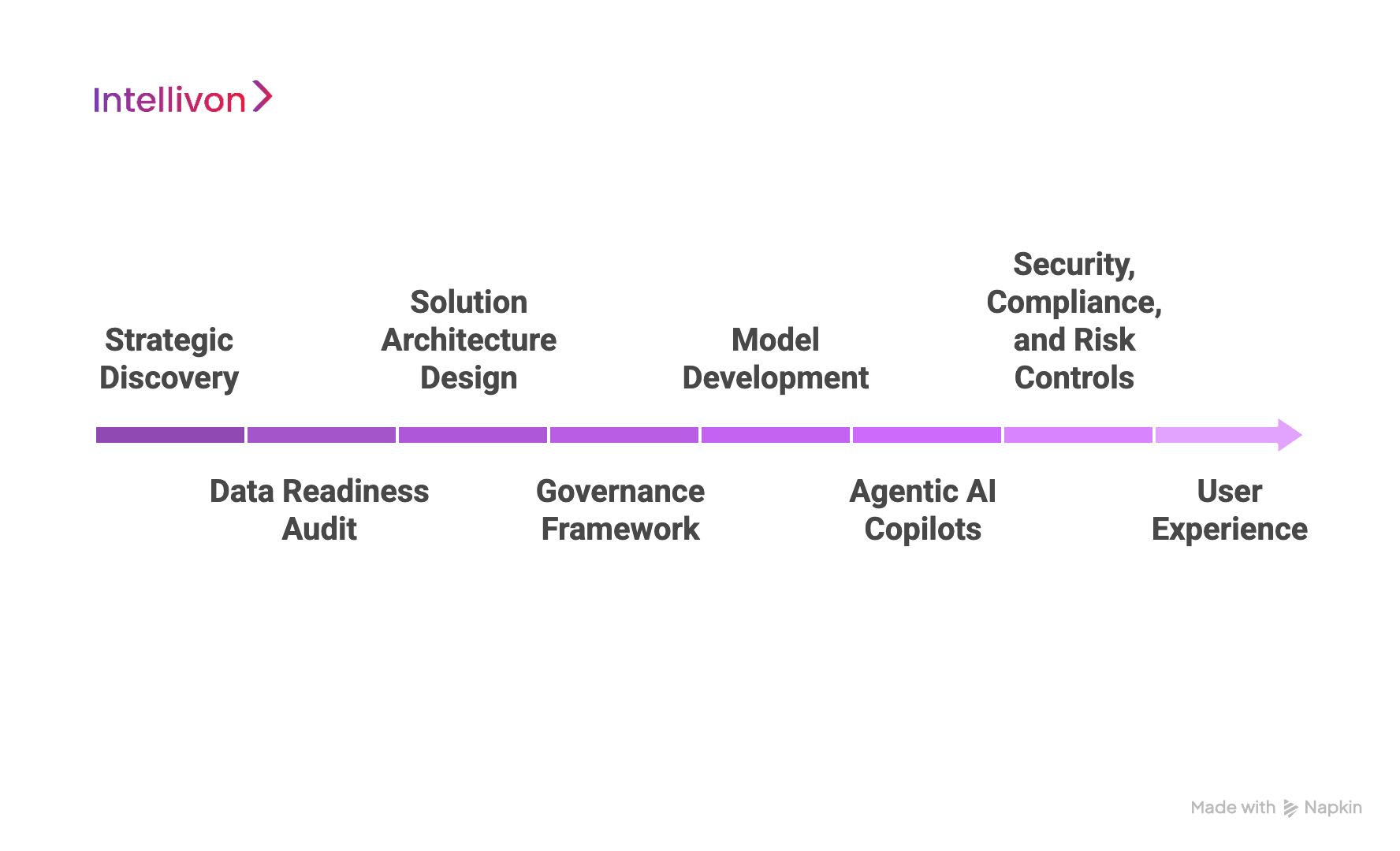
Step 1: Strategic Discovery
We begin with conversations across leadership, IT, and risk teams to define goals and priorities. This includes mapping practice-specific pain points, such as research inefficiencies or high discovery costs, and aligning them with measurable outcomes.
Step 2: Data Readiness Audit
Before building, we evaluate the current state of technology and data. This involves auditing DMS structures, email archives, and research workflows, while also assessing how well data is governed, secured, and standardized for AI integration.
Step 3: Solution Architecture Design
With requirements clarified, we design a modular, scalable, and secure architecture. Core layers include a centralized data lake, natural language processing engines, orchestration for AI agents, and firm-grade security frameworks. We ensure interoperability with existing enterprise systems so the platform complements, not disrupts, daily work.
Step 4: Governance Framework
AI’s performance depends on data quality. We develop pipelines that unify internal content (briefs, contracts, case files) with external legal sources. Governance policies are embedded to meet GDPR, HIPAA, and jurisdictional privacy laws. Privilege and client boundaries are protected through matter-level indexing.
Step 5: Model Development
We train and fine-tune models for core legal functions, such as document analysis, research, drafting, and decision support. A custom legal knowledge graph connects statutes, case law, and firm precedents, making retrieval and reasoning both precise and explainable.
Step 6: Agentic AI Copilots
Beyond models, we embed agentic AI copilots that guide workflows. These copilots plan tasks, recommend next steps, surface relevant precedents, and assist with drafting, always under human supervision. This approach moves beyond passive assistance to proactive workflow orchestration.
Step 7: Security, Compliance, and Risk Controls
At this stage, we implement advanced security measures, including encryption, access controls, and monitoring. Compliance is mapped against frameworks such as NIST AI RMF, ISO/IEC 42001, ABA guidance, GDPR, and the EU AI Act. We add audit trails, bias testing, and explainability so every output is defensible.
Step 8: User Experience
Finally, we deliver role-based interfaces tailored to partners, associates, and support teams. Adoption is driven through structured onboarding, CLE-eligible training sessions, and continuous support. Change management ensures lawyers view the platform as an extension of their practice, not a disruption.
This process ensures the platform is not just deployed but embedded into the fabric of the firm. At the end, what emerges is a system that scales securely, enhances productivity, and strengthens the client relationship without compromising professional standards.
Cost of Developing an AI-Powered Legal Platform
At Intellivon, we recognize that law firms need AI-powered platforms that are both secure and cost-effective. That’s why our pricing model is designed to be flexible and aligned with your requirements, not a one-size-fits-all package.
If costs risk exceeding your planned budget, we collaborate with you to streamline the scope while safeguarding the core value of knowledge management, compliance, and operational efficiency.
Estimated Phase-Wise Cost Breakdown
| Phase | Description | Estimated Cost Range (USD) |
| Discovery & Strategy Alignment | Requirement gathering, stakeholder interviews, KPI mapping, governance readiness assessment (ABA, GDPR, EU AI Act) | $6,000 – $10,000 |
| Architecture & Data Design | Platform blueprint, data pipelines, interoperability planning (DMS, eDiscovery, research, billing) | $8,000 – $14,000 |
| AI Model Development & Integration | Document AI, legal knowledge graphs, citation verification engines, RAG pipelines, system connectors | $12,000 – $20,000 |
| Platform Development & Customization | Dashboards, research copilots, contract intelligence modules, litigation support, role-based workflows | $14,000 – $22,000 |
| Security & Compliance Alignment | Encryption, privilege walls, audit trails, ABA guidelines, GDPR/EU AI Act compliance validation | $6,000 – $12,000 |
| Testing & Validation | Bias testing, hallucination control, citation audits, matter-wall breach simulations, performance tuning | $6,000 – $12,000 |
| Deployment & Scaling | Cloud rollout, regional data residency setup, multi-office rollout, monitoring dashboards | $5,000 – $10,000 |
Total Initial Investment Range: $50,000 – $100,000
Ongoing Optimization (Annual): $5,000 – $12,000
Factors That Influence Cost
The final investment depends on several variables:
- Data Sources: Number of integrations with systems like iManage, NetDocuments, Relativity, Lexis, and billing platforms.
- Model Complexity: From basic document search to advanced citation-verification engines and agentic AI copilots.
- Regulatory Scope: Coverage for ABA compliance, GDPR/EU AI Act readiness, and jurisdiction-specific privacy obligations.
- Deployment Model: Choice between cloud-native, hybrid, or on-premises depending on firm security preferences.
- Customization Depth: Whether the platform is modular with pre-built components or tailored with firm-specific workflows.
- Advanced Features: Multi-language support, predictive analytics, client reporting dashboards, and ongoing bias/accuracy monitoring.
Request a tailored quote from Intellivon’s AI engineers today. We’ll design a legal AI platform that aligns with your budget, strengthens compliance, and scales with your practice.
Top Law Firms Already Using AI Platforms
The largest global firms are already applying AI-powered legal platforms in specific, high-impact use cases. Their approaches demonstrate how these platforms deliver measurable outcomes while staying within the boundaries of compliance and governance.
1. A&O Shearman
After the merger of Allen & Overy and Shearman & Sterling, the firm adopted Harvey to unify research and knowledge work across its practices.
Harvey is being used for first-pass legal research, summarizing statutes, and generating due diligence reports. Associates can now retrieve statutes, case law, and precedent summaries in minutes. Internal benchmarks show research tasks that previously took hours now take a fraction of the time, freeing lawyers to focus on higher-value client work.
2. Latham & Watkins
With more than 3,000 lawyers globally, Latham secured a firmwide Harvey license to embed AI in both litigation and transactional workflows.
Lawyers are using Harvey to generate draft memos, perform clause comparisons in contracts, and prepare first-pass responses in regulatory filings. As a result, the firm has reported reductions in turnaround times for drafting tasks, allowing more projects to be completed with the same resources while maintaining quality standards.
3. Linklaters
Linklaters developed Legora, its in-house AI assistant, to support teams in reviewing and analyzing complex legal documents.
Legora helps analyze loan agreements, highlight unusual clauses, and cross-check against firm playbooks. It also supports internal knowledge management by retrieving prior case material. After using Legora, the firm has noted faster turnaround in financial transactions, especially in banking and capital markets, where speed and accuracy are critical.
Clifford Chance has integrated Microsoft Copilot across its Microsoft 365 ecosystem, while also experimenting with specialized AI tools for eDiscovery and contract analytics.
Lawyers can draft emails, summarize meeting notes, or generate case outlines directly in Word, Outlook, and Teams. AI also supports discovery reviews by filtering relevant documents. By embedding AI into familiar tools, adoption rates among staff are higher, reducing resistance and ensuring consistent usage across teams. Early pilots have shown measurable gains in efficiency without additional training burdens.
5. DLA Piper
As one of the largest firms worldwide, DLA Piper was among the first to test Microsoft Copilot and other legal AI integrations.
AI is used for litigation support, particularly in document-heavy cases, and for drafting standardized contracts across jurisdictions. The firm is also piloting AI-assisted time capture to reduce billing leakage. Early deployments have shown reduced time spent on document review and improved accuracy in billing records, increasing both client satisfaction and revenue protection.
These firms are already applying AI in research, drafting, review, due diligence, eDiscovery, knowledge management, and billing. The common theme is that AI is speeding up routine legal tasks while lawyers retain full control, ensuring compliance and defensibility.
How We Maintain Security in AI-Powered Legal Platforms
For any law firm, trust begins with security. Client matters involve sensitive data, privileged communications, and confidential strategies that must never be compromised. At Intellivon, we design AI-powered legal platforms with security and compliance woven into every layer, so firms can innovate without putting privilege at risk.
1. Protecting Access and Privilege
The first priority is making sure information stays where it belongs. Each matter is kept in its own secure index, preventing data from leaking across cases. Role-based access ensures lawyers and staff only see what they are authorized to view, while client-specific walls protect against cross-matter exposure. This keeps privilege intact, even when vast amounts of information are being processed by AI.
2. Encryption and Data Residency
We apply encryption both in transit and at rest, so whether data is being stored or transferred, it remains secure. Many firms also prefer to manage their own encryption keys, a capability we fully support. For clients in the EU or UK, data residency requirements are strictly observed, ensuring compliance with GDPR and the EU AI Act.
3. Safe Integrations
AI platforms don’t operate in isolation. They must connect to DMS, eDiscovery, research, and billing systems already in use. We ensure these integrations are made only through vendor-approved APIs and secured with single sign-on and private networking. This allows seamless interoperability without creating weak points in the firm’s security posture.
4. Governance and Auditability
Every interaction with the platform is logged, all the way from searches to AI-generated drafts, creating a full audit trail. This makes outputs defensible in court or under regulatory review. Our governance dashboards also allow compliance teams to monitor system activity in real time, giving firms transparency and control.
5. Guardrails for AI Outputs
AI outputs are only as valuable as they are reliable. That’s why we embed guardrails such as citation verification, confidence thresholds, and data loss prevention filters. Lawyers see not just the answer, but the sources behind it. Anything below an agreed confidence level is flagged for review, ensuring final responsibility always rests with the attorney.
6. Staying Ahead of Regulation
The legal industry faces a growing patchwork of AI-related regulations. From ABA guidance in the US to the EU AI Act and GDPR in Europe, compliance expectations are tightening every year. Intellivon builds platforms with these standards in mind from day one and updates them as frameworks evolve, so firms remain compliant without scrambling to adapt.
7. Continuous Monitoring and Response
Even the most secure systems require vigilance. We adopt a zero-trust approach, validate every access request, and provide incident playbooks for scenarios like privilege leaks or misclassification. Quarterly reviews with firm leadership ensure security, compliance, and governance remain aligned with both regulations and business priorities.
Security in AI platforms cannot be an afterthought. It must be engineered into the architecture and maintained through governance and oversight. At Intellivon, we combine legal expertise with enterprise-grade AI engineering to deliver platforms that are both innovative and defensible. This allows firms to scale AI responsibly, unlocking efficiency and insight without ever compromising client trust.
Conclusion
For large firms, the real question is how to adopt AI it responsibly, securely, and at scale. An AI-powered legal platform provides that path forward. By bringing research, drafting, discovery, knowledge management, and billing into one governed system, firms can finally tap into the value of the knowledge they already own while ensuring every output is accurate, auditable, and defensible.
The real transformation comes when the platform blends naturally into existing workflows. Instead of forcing new habits, it enhances the way lawyers already practice, giving them more time to focus on judgment, advocacy, and client relationships. That strengthens trust, not risks it.
Why Intellivon is the Strategic Choice for Enterprise AI in Legal
At Intellivon, we design enterprise-grade legal AI platforms that are secure, compliant, and tailored to the way global firms operate. Our approach combines advanced AI models, rigorous governance frameworks, and scalable architecture to help you deliver faster outcomes without compromising client trust or privilege.
Why Partner With Intellivon?
- Tailored Solutions: We align every platform with your firm’s unique workflows, client commitments, and jurisdictional requirements.
- Compliance-First Design: Built to meet ABA guidance, GDPR, and EU AI Act obligations from day one.
- Proven Legal Expertise: Our platforms support litigation, transactions, research, and knowledge management with measurable impact.
- Scalable Architecture: Cloud-native, API-driven, and integration-ready with DMS, eDiscovery, research, and billing systems.
Book a discovery call with Intellivon today. Let’s build a legal AI platform that safeguards privilege, accelerates workflows, and positions your firm as a leader in the next era of legal practice.
FAQs
Q1. What is an AI-powered legal platform?
A1. An AI-powered legal platform is an enterprise system that integrates with a firm’s document management, research, and billing tools while applying artificial intelligence to streamline research, contract analysis, discovery, knowledge management, and timekeeping. Unlike standalone tools, it provides a secure, governed environment designed for law firms at scale.
Q2. How do law firms use AI platforms in practice?
A2. Firms use AI platforms for tasks such as legal research with verified citations, contract review, M&A due diligence, eDiscovery, docket automation, and billing capture. Global leaders like Latham & Watkins, Linklaters, and Clifford Chance have already deployed AI in these areas, reporting faster turnaround times and improved accuracy.
Q3. How much does it cost to build an AI-powered legal platform?
A3. The cost typically ranges between $50,000 and $100,000 for an initial deployment, depending on integrations, model complexity, and customization depth. Ongoing optimization averages $5,000–$12,000 annually. Firms with complex data governance or multi-jurisdictional compliance needs may see higher initial investment.
Q4. Is AI in legal platforms compliant with ABA and EU AI regulations?
A4. Yes, but only when designed correctly. At Intellivon, every build is aligned with ABA Formal Opinions 512 and 477R, GDPR, and the EU AI Act. Features such as encryption, audit trails, bias testing, and privilege walls ensure compliance is embedded, not added later.
What are the main benefits of adopting a legal AI platform?
A5. Key benefits include faster research, reduced discovery costs, improved contract accuracy, stronger knowledge reuse, and better timekeeping. More importantly, these platforms allow firms to deliver services that are more cost-effective and client-focused without reducing professional oversight.
How long does it take to implement an AI-powered legal platform?
A6. Most firms see an MVP (minimum viable platform) deployed within 12 to 16 weeks, covering core use cases such as research and contract analysis. Full rollouts across litigation, transactions, and knowledge management typically occur over several phases, depending on firm size and adoption goals.