Healthcare companies face increasing pressure to engage patients around the clock while dealing with rising operational costs and staff burnout. Patients want quick answers to questions about appointments, medications, and insurance. Traditional support channels cannot keep up with modern expectations without significantly increasing staff numbers and expenses.
A healthcare-specific AI chatbot platform addresses these issues by offering smart, HIPAA-compliant chat experiences that manage routine inquiries, schedule appointments, send medication reminders, and assess patient concerns. This allows your clinical and administrative staff to concentrate on the complex cases that need human expertise.
As we have created enterprise-grade AI chatbot platforms for top healthcare organizations, at Intellivon, we make sure that our platforms are designed to integrate easily with existing EHR systems while meeting strict security standards. The platforms we build not only streamline conversations but also improve patient satisfaction, lighten the operational load, and provide measurable returns on investment for your organization. In this blog, we will discuss how we build these platforms from scratch.
Key Takeaways Of The AI Healthcare Chatbot Market
Healthcare organizations are increasingly deploying chatbots to strengthen patient engagement, streamline access, and establish continuous digital connections with prospective patients and members.
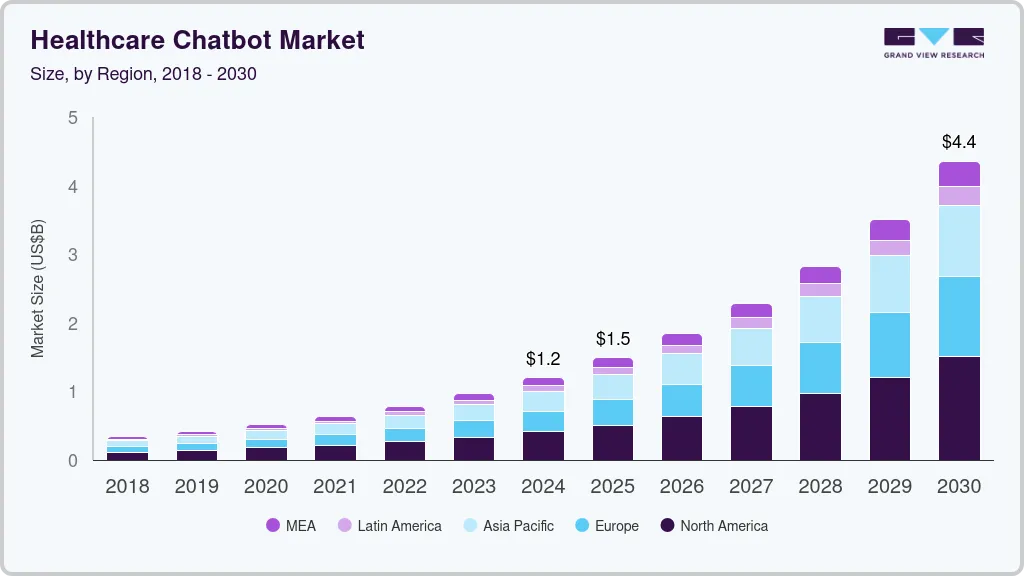
Market Growth & Scaling Drivers
- The healthcare chatbot market is expanding rapidly due to telehealth integration, deep EHR connectivity, and value-based care pressures to improve access while reducing administrative burden and cost-to-serve.
- Global market size stands at approximately USD 1.2 billion (2024–2025) and is projected to reach between USD 4.36–10.26+ billion by 2030–2034.
- Industry forecasts indicate sustained annual growth of 20–25%+, depending on market scope and methodology.
- CAGR estimates commonly range from 23% to 25%, driven by demand for 24/7 digital access, rising smartphone adoption, and reimbursement-aligned virtual care models.
- North America leads adoption due to a mature digital health infrastructure and sustained payer-provider investments.
- Asia-Pacific is witnessing accelerated growth driven by large-scale hospital IT modernization and mobile-first patient engagement strategies.
Emerging Enterprise Adoption Signals
- Payers are increasingly deploying chatbots for self-service deflection and member engagement optimization.
- Hospitals are institutionalizing chatbot-driven “digital front door” programs.
- Mental health chatbots are progressing toward clinical validation and regulated deployment pathways.
Why Large Enterprises Are Investing in Healthcare Chatbots
- Chatbots significantly reduce patient access friction and deflect high-volume routine interactions.
- They support enterprise operational efficiency targets while improving patient and member satisfaction metrics.
- As part of omnichannel engagement strategies, chatbots route users to appropriate levels of care.
- Automated reminders reduce no-show rates and improve appointment throughput.
- Continuous nudges support medication adherence and care plan compliance under value-based care models.
- With advanced NLP and deep EHR/claims context, organizations achieve faster triage, shorter wait times, and stronger first-contact resolution.
- These operational gains directly reinforce enterprise-scale ROI as deployments expand across departments and regions.
What Is an AI Chatbot Platform in Healthcare?
An AI chatbot platform in healthcare is an enterprise system that automates clinical and administrative conversations using NLP, EHR integration, and compliance-first security across digital channels.
Using clinical-grade natural language processing and business rules, the platform can triage symptoms, book appointments, answer coverage questions, send post-discharge instructions, and escalate to human teams when risk appears.
Unlike consumer chatbots, these platforms are built with HIPAA-grade security, audit trails, consent management, and governance controls. They operate across the web, mobile apps, WhatsApp, IVR, and contact centers. For large health systems, the chatbot becomes an orchestration layer that improves access, reduces call volume, and standardizes patient engagement at enterprise scale.
How an Enterprise Healthcare AI Chatbot Platform Works
An enterprise healthcare AI chatbot platform functions as a governed orchestration layer, not a standalone conversation tool. It securely connects users, clinical systems, and operational workflows in real time. Every interaction follows a controlled, auditable flow that prioritizes patient safety, compliance, and operational efficiency.
Step 1: Conversation Initiation Across Digital Channels
The patient, caregiver, or staff member initiates a conversation through the website, mobile app, patient portal, WhatsApp, or IVR.
The platform immediately captures the channel, device type, language preference, and session metadata. It routes the interaction into a secure enterprise conversation pipeline without exposing any protected data at this stage.
Step 2: Identity Verification and Consent Enforcement
The platform authenticates the user through SSO, OTP, biometric login, or portal credentials. It verifies patient identity, applies role-based access controls, and enforces consent policies for PHI usage.
All consent actions and access events are logged for audit and legal defensibility.
Step 3: Intent Detection Using Healthcare-Tuned AI
Clinical-grade NLP and LLM models analyze the user’s input to extract intent, symptoms, entities, and urgency.
The system classifies whether the request relates to triage, scheduling, billing, refills, follow-up, or clinical guidance. High-risk intents are instantly routed through stricter safety rules.
Step 4: Secure Data Retrieval
The chatbot retrieves real-time data from EHR, HIS, RCM, pharmacy, and payer systems using FHIR, HL7, and secure APIs.
Only the minimum necessary data is accessed. Every transaction is encrypted, logged, and governed under enterprise data policies.
Step 5: Decision Response Generation
Business rules, clinical protocols, and AI reasoning engines work together to determine the correct response or action. The platform may book an appointment, trigger a follow-up task, generate instructions, or prepare an escalation.
Responses are grounded using retrieval-based clinical knowledge to prevent hallucinations.
Step 6: Human-in-the-Loop Escalation When Risk Is Detected
If medical risk, uncertainty, or regulatory thresholds are crossed, the platform hands off the case to a nurse, agent, or clinician.
Conversation context and data are transferred securely to avoid rework and delays. This ensures patient safety without breaking digital workflow continuity.
Step 7: Continuous Learning and Governance
All interactions feed into analytics, quality monitoring, and model performance dashboards. The platform tracks accuracy, resolution rates, escalations, and compliance events. Models are retrained under strict governance to ensure clinical reliability over time.
An enterprise healthcare AI chatbot platform operates as a secure, intelligent workflow engine that connects users, data, and care processes in real time. By combining AI reasoning, system integration, and compliance-first governance, it delivers automation at scale without compromising clinical safety or regulatory trust.
Types Of AI Healthcare Chatbots
AI healthcare chatbots are not one-size-fits-all. Large enterprises deploy different chatbot types based on where automation, safety, and ROI matter most. Each type serves a distinct function across the patient, provider, and payer lifecycle. Understanding these categories helps healthcare leaders design the right chatbot stack for their organization.
1. Patient Engagement Chatbots
These chatbots act as the digital front door for hospitals and health plans. They handle appointment booking, FAQs, instructions, reminders, and basic health guidance.
They are widely used on hospital websites, mobile apps, and WhatsApp to reduce call-center load and improve access.
2. Clinical Triage & Symptom Assessment Chatbots
These bots support early-stage symptom capture and risk screening. They guide patients through structured clinical questions and route them to the right level of care.
They are used in emergency intake, virtual care, and primary care access programs under strict clinical governance.
3. Post-Treatment & Chronic Care Chatbots
These chatbots manage post-discharge follow-ups, medication reminders, recovery check-ins, and chronic disease nudges.
Hospitals and care management teams use them to improve adherence, reduce readmissions, and maintain continuity of care at scale.
4. Revenue Cycle & Billing Chatbots
These bots automate insurance queries, billing explanations, payment links, and prior authorization status.
They are used by hospitals and payer contact centers to deflect routine financial calls and accelerate revenue workflows.
5. Internal Operations & Staff Support Chatbots
These chatbots assist clinicians and staff with scheduling, IT support, HR queries, protocol lookup, and workflow guidance.
They are deployed inside hospital intranets and secure clinical systems to boost operational efficiency
Each type of AI healthcare chatbot solves a different enterprise problem. Together, they form a unified automation layer across access, care delivery, and revenue operations.
Enterprise Use Cases of AI Chatbot Platforms in Healthcare
Enterprise healthcare organizations deploy AI chatbot platforms to solve large-scale access, care coordination, and revenue challenges. These platforms are not limited to basic conversations.
When deeply integrated with EHRs, billing systems, and care delivery workflows, they operate as automation layers that touch nearly every stage of the patient and member journey.
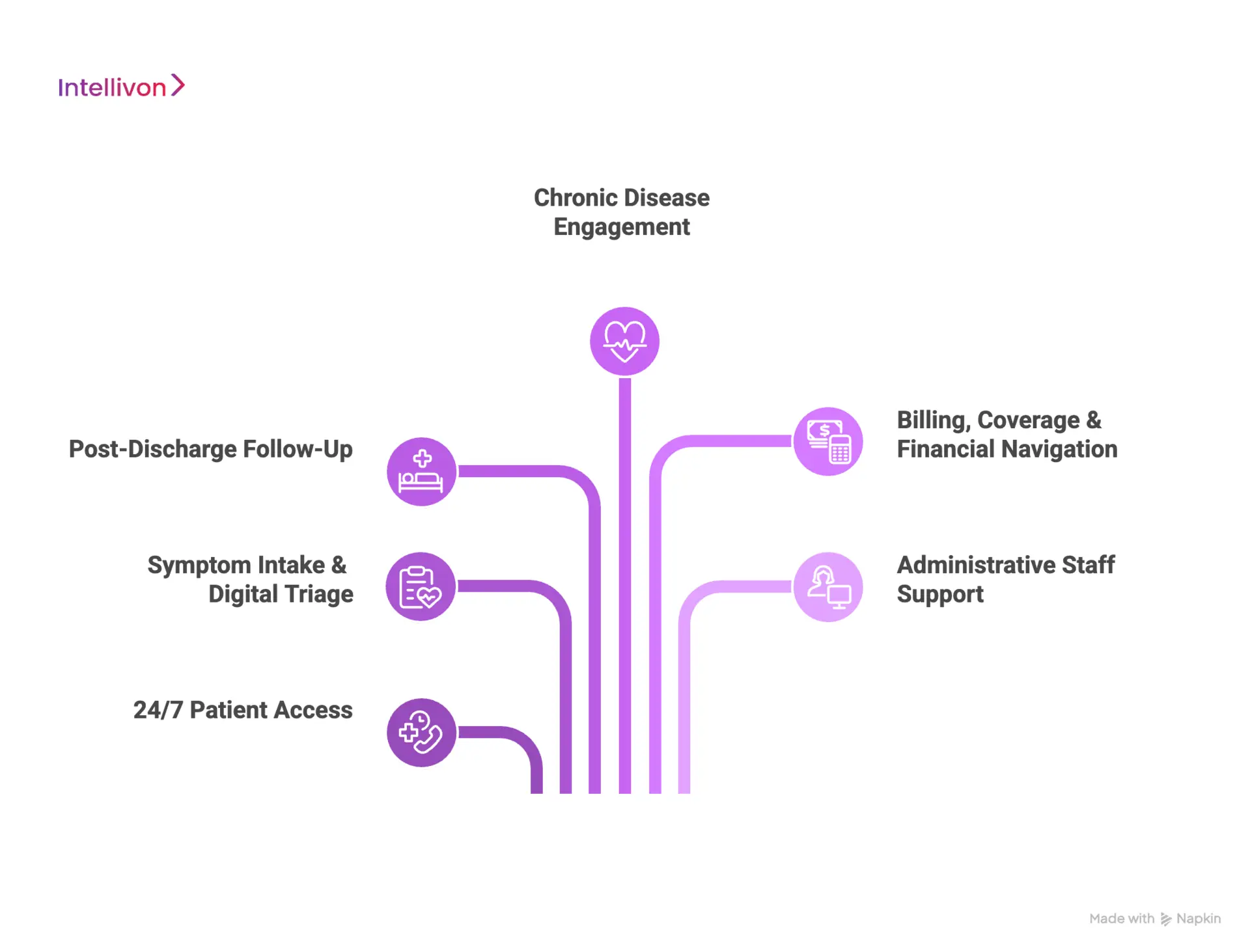
1. 24/7 Patient Access
AI chatbots serve as always-on digital access points for hospitals and health systems. They handle appointment scheduling, cancellations, rescheduling, referrals, and waitlist optimization in real time.
By connecting directly with EHR scheduling modules, they remove manual bottlenecks and reduce phone dependency. Large enterprises use this to stabilize front-desk load, improve appointment utilization, and deliver consistent access across locations and time zones.
2. Symptom Intake and Digital Triage
Chatbots guide patients through structured symptom collection before they enter care pathways. The platform standardizes intake data, applies triage logic, and routes patients to the appropriate care level.
Health systems use this to reduce emergency department congestion, speed up intake workflows, and improve clinical prioritization without increasing staff burden.
3. Post-Discharge Follow-Up
After discharge, chatbots automate daily check-ins, wound-care instructions, medication reminders, and red-flag symptom screening. The platform escalates only when risk thresholds are crossed.
Hospitals deploy this to reduce readmissions, detect complications earlier, and maintain continuity of care beyond the physical hospital stay.
4. Chronic Disease Engagement
Chatbots deliver continuous engagement for conditions such as diabetes, cardiac disease, respiratory disorders, and oncology care. They automate vital tracking prompts, medication adherence nudges, lifestyle coaching, and care-plan reinforcement.
Care management and population health teams use this to sustain long-term engagement between visits and improve value-based care performance.
5. Billing, Coverage, and Financial Navigation
Chatbots explain medical bills, verify insurance eligibility, track prior authorizations, answer coverage questions, and enable digital payments. They connect with revenue cycle and payer systems to provide real-time financial clarity.
Enterprises use this to reduce inbound billing calls, accelerate collections, and improve patient financial experience.
6. Administrative Staff Support
Inside hospitals, chatbots assist staff with shift scheduling, protocol lookup, IT requests, HR services, and internal workflows. They operate within secure intranets and clinical systems.
Health systems use this to reduce non-clinical workload on clinicians and improve back-office efficiency without expanding headcount.
These enterprise use cases show that AI chatbot platforms go far beyond basic patient interaction. When deployed correctly, they become execution engines across access, care delivery, population health, and revenue operations.
Post-op Chatbots Hit 83%+ Engagement With High Satisfaction
Hospitals and surgical centers are increasingly deploying AI-driven chatbots to support patients after discharge. These “post-op chatbots” offer follow-up, wound-care guidance, symptom monitoring, and reassurance at scale.
Early evidence shows they deliver high engagement and satisfaction, making them a powerful digital front door to improve care continuity and reduce burden on clinical staff.
Evidence of Strong Engagement and Satisfaction After Surgery
- A systematic review of perioperative and surgical-care chatbots covering 6,619 patients reported engagement rates between 35–83% and satisfaction scores of 60–82% on standard Likert scales.
- In a focused prospective study of patients undergoing elective hip arthroscopy, a chatbot named “Felix” reached 80% patient satisfaction, with 79% of patient questions managed appropriately.
- In that same study, out of 10 patient-reported concerns (potential complications), none led to adverse events, indicating that chatbot use did not compromise safety.
These numbers show that, when properly implemented, post-operative chatbots can maintain high patient involvement and approval.
How Chatbots Add Value to Post-Surgical Care
- Timely follow-up and reassurance: Many patients report worries or complications after discharge. Chatbots can check in automatically, providing reassurance or flagging when escalation is required, reducing unnecessary calls or visits.
- Reduced workload for clinical teams: Automating routine follow-ups, basic queries, and triage frees up nurses and physicians for higher-value tasks.
- Improved patient adherence and continuity: By maintaining regular contact post-discharge, chatbots help ensure patients follow recovery protocols, which boosts long-term outcomes and decreases readmission risk.
Real-World Use Cases
These examples show that chatbots work across different surgeries and care settings — from orthopaedic to general surgical pathways.
Enterprise Takeaway
Post-operative conversational agents offer a compelling balance between high patient engagement, satisfaction, and operational efficiency. For large hospital networks or multisite health systems, deploying chatbots can reduce follow-up burden, improve patient experience, and free up clinical resources, all while maintaining safety through appropriate oversight.
Given the early but strong evidence, post-op chatbot deployment stands out as one of the low-hanging, high-ROI use cases for enterprise-grade AI in healthcare. For an enterprise buyer, this is a tangible “quick win” that aligns with efficiency, patient satisfaction, and scalable patient engagement, making it a strategic starting point for broader AI chatbot adoption.
Key Features of an Enterprise Healthcare AI Chatbot Platform
An enterprise healthcare AI chatbot platform combines clinical-grade NLP, EHR integration, compliance-first security, workflow automation, and real-time analytics to operate safely at hospital scale. These features define whether a chatbot can scale across large healthcare organizations.
1. Clinical-Grade NLP
The platform uses healthcare-trained NLP and medical language models to understand symptoms, complaints, clinical terms, and intent with high accuracy.
This reduces misinterpretation, improves digital triage reliability, and supports safer patient interactions across diverse populations.
2. Deep EHR and Enterprise System Integration
Native integration with EHR, HIS, RCM, pharmacy, lab, and payer systems allows real-time access to schedules, records, orders, and billing data.
This enables the chatbot to execute workflows, not just answer questions.
3. Compliance-First Security and Data Governance
The platform enforces HIPAA, GDPR, and regional regulations through end-to-end encryption, role-based access control, consent management, immutable audit logs, and secure key management across all chatbot interactions.
4. Omnichannel Patient Engagement
The chatbot operates seamlessly across web, mobile apps, patient portals, WhatsApp, IVR, and contact centers. This ensures consistent access for patients and members across every digital touchpoint.
5. Human-in-the-Loop Clinical Escalation
When medical risk, uncertainty, or regulatory thresholds are detected, the chatbot escalates the interaction to nurses, agents, or clinicians. This protects patient safety while preserving automation efficiency.
6. Workflow Automation and Orchestration Engine
The platform triggers scheduling, follow-up tasks, reminders, billing workflows, and care coordination actions automatically.
It functions as a real-time execution layer across clinical and administrative operations.
7. Real-Time Analytics
Built-in analytics track resolution rates, escalation frequency, engagement levels, and compliance events. These insights guide continuous optimization, governance audits, and performance reporting.
These features transform a chatbot from a simple conversational interface into a governed enterprise automation platform. For large healthcare organizations, this feature set is what enables safe scale, regulatory trust, and measurable operational ROI.
Enterprise-Grade Architecture of an AI Chatbot Platform for Healthcare
An enterprise healthcare AI chatbot platform uses a layered architecture that unifies user channels, AI intelligence, EHR integration, security, and compliance governance into a single, scalable system.
Each layer performs a distinct role while working as part of a unified orchestration fabric.
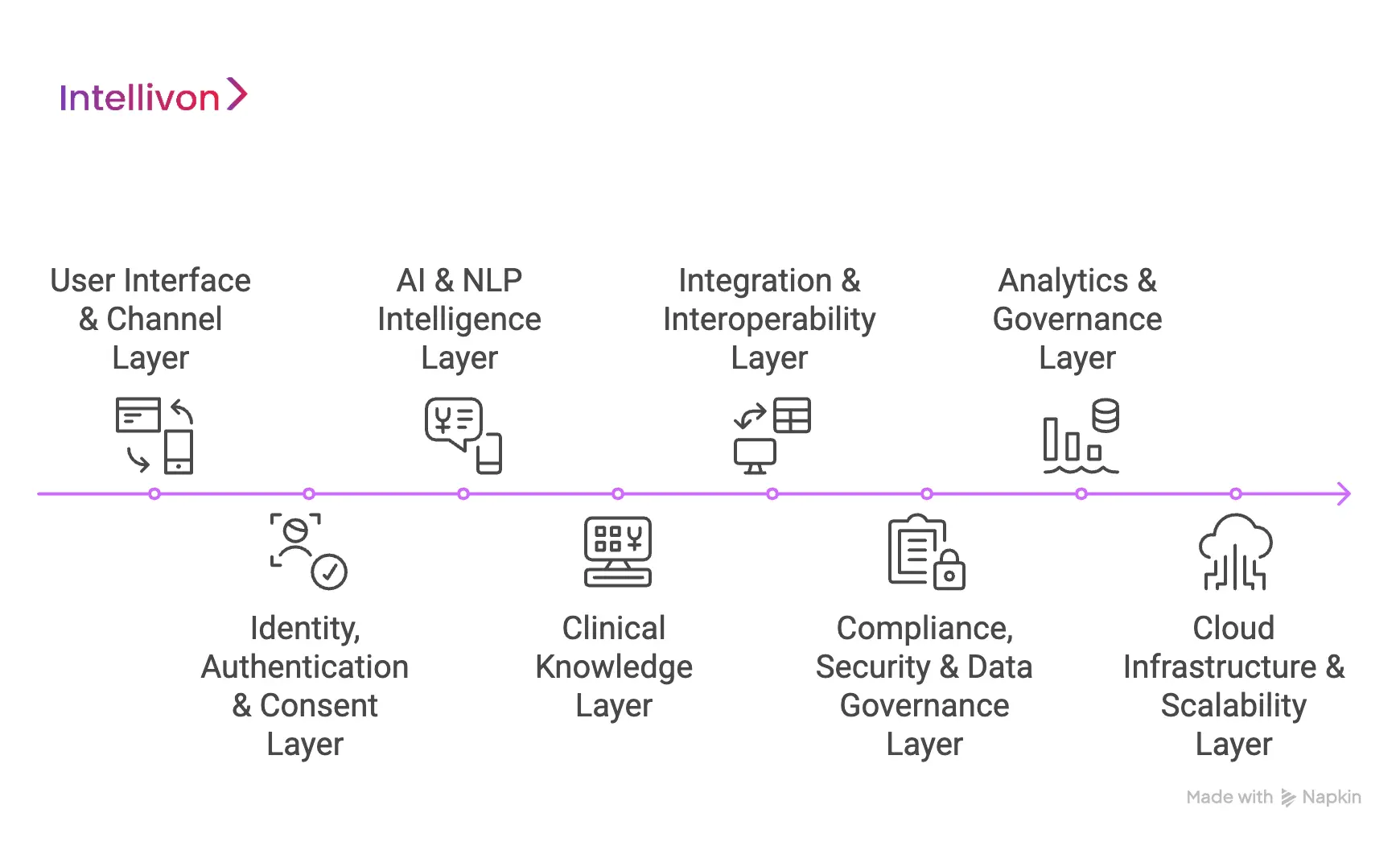
1. User Interface & Channel Layer
This layer manages all patient, caregiver, and staff interactions. It supports web chat, mobile apps, patient portals, WhatsApp, SMS, IVR, and contact center consoles. Enterprises use this layer to deliver a consistent digital front door across every access point.
2. Identity, Authentication & Consent Layer
This layer verifies user identity using SSO, OTP, biometrics, or portal credentials. It enforces role-based access and captures explicit patient consent for PHI usage. All access events are logged for audit and legal defensibility.
3. AI & NLP Intelligence Layer
This layer houses healthcare-trained NLP models, LLMs, and intent classifiers. It interprets symptoms, extracts clinical entities, and determines urgency.
Retrieval-Augmented Generation (RAG) grounds responses in verified medical content to prevent hallucinations.
4. Clinical Knowledge Layer
This layer contains triage protocols, care pathways, billing rules, and operational logic. It ensures every response aligns with clinical guidelines, payer policies, and enterprise workflows.
5. Integration & Interoperability Layer
This layer connects the chatbot to EHR, HIS, RCM, pharmacy, lab, telehealth, wearable, and payer systems.
It uses FHIR, HL7, DICOM, and secure APIs to enable real-time data exchange without exposing core systems.
6. Compliance, Security & Data Governance Layer
This layer enforces HIPAA, GDPR, and regional regulations through encryption, tokenization, access controls, and immutable audit logs.
It also manages incident monitoring, breach detection, and regulatory reporting.
7. Analytics & Governance Layer
This layer captures engagement metrics, resolution rates, escalations, and AI performance. It supports compliance audits, operational reporting, and continuous model retraining under governance supervision.
8. Cloud Infrastructure & Scalability Layer
This layer provides high availability, disaster recovery, elastic scaling, and multi-region deployment. It ensures the platform remains stable during peak demand and large-scale enterprise rollout.
This layered architecture transforms an AI chatbot into a secure enterprise platform rather than a simple conversational tool. By separating intelligence, integration, compliance, and infrastructure, healthcare organizations gain scalability, governance, and long-term operational resilience.
Security & Compliance Requirements for AI Chatbot Platforms
Enterprise healthcare AI chatbot platforms must be built with HIPAA, GDPR, and clinical safety regulations embedded at the architecture level to protect patient data and ensure legal defensibility.
Healthcare chatbots operate on highly sensitive clinical and financial data. Any enterprise deployment must follow a compliance-first approach from design to production. Security and regulatory adherence are not add-ons. They are foundational requirements for safe at-scale adoption.
1. HIPAA & HITECH Compliance for PHI Protection
The platform must ensure strict protection of Protected Health Information (PHI). This includes end-to-end encryption, role-based access control, secure authentication, and continuous audit logging.
Business Associate Agreements (BAAs) are mandatory for all vendors handling PHI. Breach detection and reporting mechanisms must be built into the platform.
2. GDPR & Regional Privacy Regulations
For global enterprises, chatbots must comply with GDPR and regional data protection laws. This requires lawful data processing, explicit patient consent, right-to-access, right-to-erasure, and data minimization.
Cross-border data transfers must follow approved legal mechanisms and regional data residency rules.
3. FDA SaMD & Clinical Safety Oversight
When chatbots provide clinical guidance, triage, or treatment recommendations, they may fall under FDA Software as a Medical Device (SaMD) frameworks.
Enterprises must maintain clinical validation, version control, change management, and continuous performance monitoring to ensure patient safety and regulatory readiness.
4. EU AI Act & Medical AI Risk Classification
Under the EU AI Act, healthcare chatbots that influence clinical decisions fall into high-risk AI categories. This requires strict risk management, transparency, human oversight, dataset governance, and post-deployment monitoring.
Enterprises must prepare for audit-ready AI governance.
5. Audit Trails & Legal Defensibility
Every chatbot interaction must be traceable. The platform should maintain immutable logs of access, decisions, escalations, and data exchanges. These logs support regulatory audits, risk investigations, and clinical incident reviews.
6. Third-Party & Vendor Risk Management
Large healthcare systems rely on multiple vendors across AI, cloud, messaging, and analytics. Each third-party must undergo security assessments, penetration testing, and compliance validation to prevent supply-chain risk.
Enterprises must treat compliance as core platform infrastructure, not a checklist item. A compliance-first design protects patients, mitigates legal exposure, and enables safe, scalable adoption across hospital networks and payer ecosystems.
AI Models Used in Healthcare Chatbot Platforms
Enterprise healthcare chatbot platforms use a combination of clinical NLP, large language models, predictive analytics, and Retrieval-Augmented Generation to deliver safe, context-aware automation at scale.
Each model type plays a specific role in understanding intent, grounding responses, and supporting clinical decision workflows.
1. Clinical NLP Models
Clinical NLP models interpret medical language, symptoms, abbreviations, and patient phrasing with healthcare-specific accuracy. These models extract structured entities such as conditions, medications, durations, and severity from free text.
Enterprises use them to standardize intake, reduce documentation errors, and improve digital triage reliability.
2. LLMs for Conversational Intelligence
LLMs generate natural, human-like responses and manage complex multi-turn conversations. In healthcare, these models are fine-tuned or constrained to follow strict safety and compliance rules.
Enterprises use them to power patient communication, staff assistance, and guideline-driven interactions across channels.
3. RAG for Clinical Grounding
RAG connects the chatbot to verified medical knowledge bases, hospital protocols, and payer policies in real time.
The AI retrieves factual content before generating a response. This prevents hallucinations and ensures alignment with enterprise-approved clinical guidance.
4. Predictive Analytics & Risk Scoring Models
Predictive models assess patient risk, likelihood of escalation, and urgency of care. They analyze symptom patterns, historical data, and behavioral signals.
Health systems use these models to prioritize outreach, flag deterioration, and optimize resource allocation.
5. Speech Recognition & Voice AI Models
Speech-to-text and voice synthesis models power IVR and voice-based chatbots. They convert spoken input into structured clinical data and return natural voice responses.
Enterprises deploy these for call-center automation and accessibility-driven use cases.
6. Reinforcement Learning
Reinforcement learning models optimize chatbot behavior over time based on outcomes. They learn which flows resolve faster, which require human escalation, and how to personalize engagement.
Enterprises use this to continuously improve resolution and efficiency under governance control.
An enterprise healthcare AI chatbot platform is powered by a coordinated AI model ecosystem. By combining NLP, LLMs, RAG, predictive intelligence, and voice AI under strict governance, healthcare organizations achieve automation that is both intelligent and clinically safe.
How We Build Enterprise-Grade Healthcare AI Chatbot Platforms
At Intellivon, we treat every healthcare chatbot as critical infrastructure, not a side project. We start with your clinical and operational realities, then design a platform that fits your existing ecosystem. Here is a step-by-step rundown on how we build these platforms from the ground up:
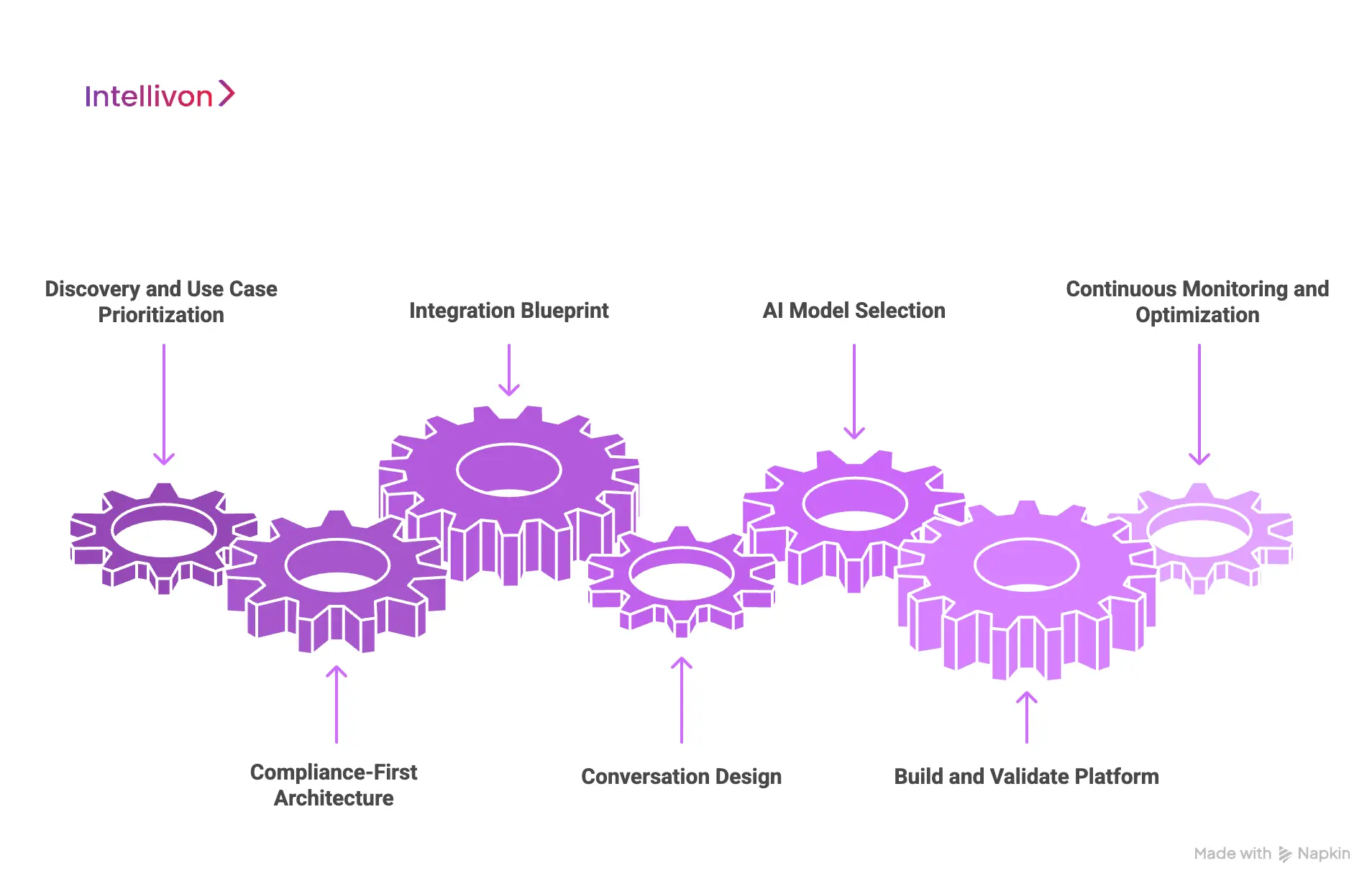
Step 1: Discovery and Use Case Prioritization
We begin with stakeholder workshops across clinical, operations, IT, and compliance teams. Together, we map high-value use cases such as access, triage, post-op follow-up, and billing support.
Then we score them by impact, risk, and integration complexity. This gives a clear, prioritized roadmap instead of scattered pilots.
Step 2: Compliance-First Architecture
Next, our architects and compliance experts define the target architecture with HIPAA, GDPR, and regional rules embedded from day one.
We design PHI boundaries, data minimization rules, consent flows, and audit logging requirements. Security, identity, and access controls are baked into the design, not patched later.
Step 3: Integration Blueprint
We then create a detailed integration blueprint for EHR, HIS, RCM, telehealth, CRM, and payer platforms. Our team works with your IT and vendors to align on FHIR, HL7, and API contracts.
This ensures the chatbot can actually execute workflows like scheduling, billing, and follow-up, rather than just answering questions.
Step 4: Conversation Design
Intellivon’s specialists design conversation flows around real clinical and administrative pathways. We define intents, decision trees, escalation rules, and red-flag conditions with your clinical leaders.
Safety rules and human-in-the-loop checkpoints are hard-wired into the flows so automation never outruns clinical governance.
Step 5: AI Model Selection
Our AI team selects and configures the right mix of clinical NLP, LLMs, and predictive models. We set up a RAG layer connected to your protocols, policies, and knowledge bases.
This keeps responses grounded in your approved content and reduces hallucination risk.
Step 6: Build and Validate Platform
We build the platform in a sandbox that mirrors your production environment. Then we run functional, integration, security, and performance tests with synthetic and real-world scenarios.
Clinical reviewers and compliance teams validate flows, wording, and decisions before any live exposure.
Step 7: Continuous Monitoring and Optimization
After go-live, we monitor engagement, resolution rates, escalations, and safety signals through governance dashboards. Our teams adjust models, flows, and rules based on real usage and regulatory changes.
This keeps the platform compliant, effective, and trusted as it scales across your network.
Intellivon’s framework turns AI chatbots from risky experiments into governed enterprise platforms. By combining compliance-first design, deep integration, and continuous optimization, we help large healthcare organizations deploy AI chatbots that deliver measurable ROI without compromising patient safety or regulatory trust.
Cost to Build an AI Chatbot Platform for Healthcare Enterprises
Building an enterprise healthcare AI chatbot platform is not a simple software deployment. It is a regulated digital access and automation infrastructure investment. Costs extend beyond conversation design into clinical AI models, deep EHR and payer integrations, cybersecurity, compliance validation, and high-availability system engineering.
At Intellivon, we design phase-wise cost models that align with healthcare capital planning cycles, regulatory obligations, and early ROI validation. Enterprises typically begin with a production-ready access and follow-up core and expand only after measurable operational impact is proven.
Estimated Phase-Wise Cost Breakdown
| Phase | Description | Estimated Cost (USD) |
| Clinical & Operations Discovery | Enterprise access workflow analysis, chatbot use-case prioritization, EHR mapping, regulatory scoping, ROI modeling | 6,000 – 10,000 |
| Platform Architecture & Program Design | Multi-layer chatbot architecture, scalability planning, security and compliance design, omnichannel deployment mapping | 8,000 – 14,000 |
| Core AI Chatbot Platform Build | NLP engine setup, conversation workflows, scheduling, triage, FAQ automation, escalation rules | 15,000 – 28,000 |
| EHR & Enterprise System Integration | One major EHR integration, scheduling module, secure API gateway, basic RCM or CRM linkage | 8,000 – 16,000 |
| AI & Knowledge Intelligence Layer (RAG) | Retrieval-augmented knowledge setup, protocol grounding, hallucination controls, triage logic | 5,000 – 12,000 |
| Security, IAM & Compliance Controls | HIPAA & GDPR alignment, encryption, identity access layers, audit logging, consent enforcement | 4,000 – 8,000 |
| Testing, QA & Clinical Validation | Functional testing, security testing, load testing, clinical safety validation | 3,000 – 6,000 |
| Pilot Deployment & Enterprise Training | Live rollout, staff onboarding, tuning, 30-day stabilization support | 4,000 – 6,000 |
Total Initial Enterprise Pilot Range
USD 50,000 – 100,000
Annual Maintenance and Optimization Costs
15–20% of the initial build cost per year
Approx. USD 7,500 – 18,000 annually
These costs sustain uptime, security patching, compliance updates, AI accuracy, and performance optimization as engagement volumes grow.
Hidden Costs Enterprises Should Plan For
Even with a controlled pilot budget, several scalable cost drivers must be anticipated early:
- Additional EHR, payer, pharmacy, and third-party integrations
- Expansion of AI scope from access automation into triage and chronic care
- Cloud compute and storage growth as patient conversations scale
- Regulatory documentation updates as healthcare AI laws evolve
- Clinical and contact-center team training and workflow redesign
- Identity resolution and patient matching improvements at scale
Planning for these early prevents uncontrolled cost escalation during multi-facility or multi-region rollout.
Best Practices to Stay Within Budget at Enterprise Scale
Large healthcare systems that control AI chatbot costs successfully follow a disciplined rollout approach:
- They start with one high-volume access or follow-up workflow only
- They avoid multi-EHR and multi-region expansion in phase one
- They enforce security and compliance from the first sprint
- They use modular architecture for low-risk expansion
- They track deflection rate, resolution rate, and call-center load weekly during the first 90 days
Contact us for a confidential cost estimate and enterprise architecture consultation.
We specialize in building enterprise-grade healthcare AI chatbot platforms with controlled budgets, compliance-first design, and measurable operational ROI, enabling scale without financial or regulatory risk.
Real-World Examples of AI Chatbot Platforms in Healthcare
Across global healthcare systems, AI chatbot platforms have moved from pilots to production. Large hospitals, payer networks, and digital health providers now use these platforms to automate access, triage, and patient engagement at scale.
The platforms below illustrate how enterprise-grade AI chatbots operate in real clinical environments.
1. Ada Health
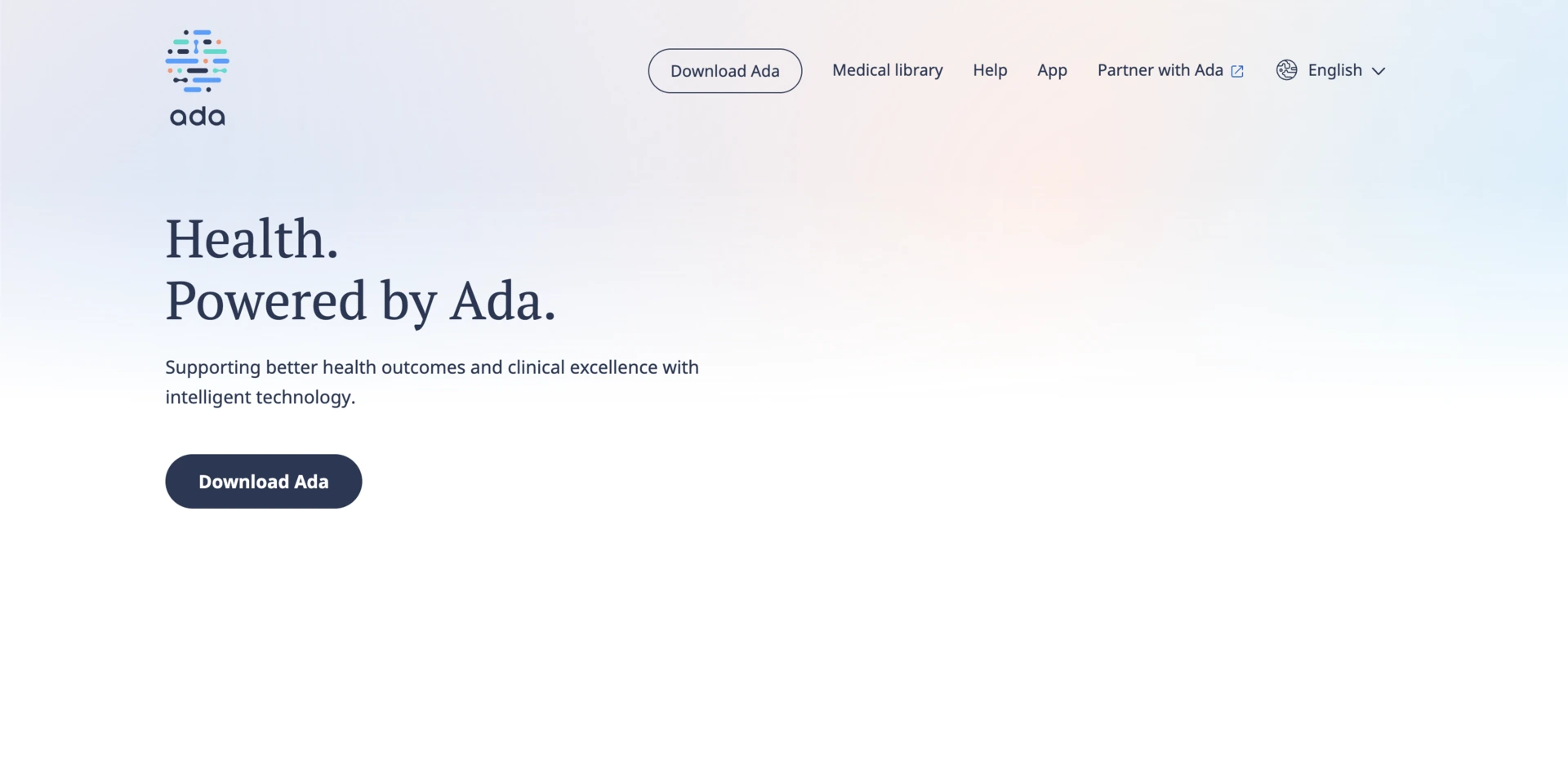
Ada Health is used by hospitals, payer networks, and digital health enterprises to power AI-driven symptom assessment and care navigation at scale.
Its AI engine uses probabilistic reasoning and a large medical knowledge graph to evaluate patient symptoms and predict likely conditions. The platform routes users to the appropriate level of care and integrates with telehealth and clinical workflows for seamless handoff.
Large healthcare organizations deploy Ada to reduce unnecessary emergency visits, improve digital triage accuracy, and standardize first-touch patient intake across regions.
2. Sensely
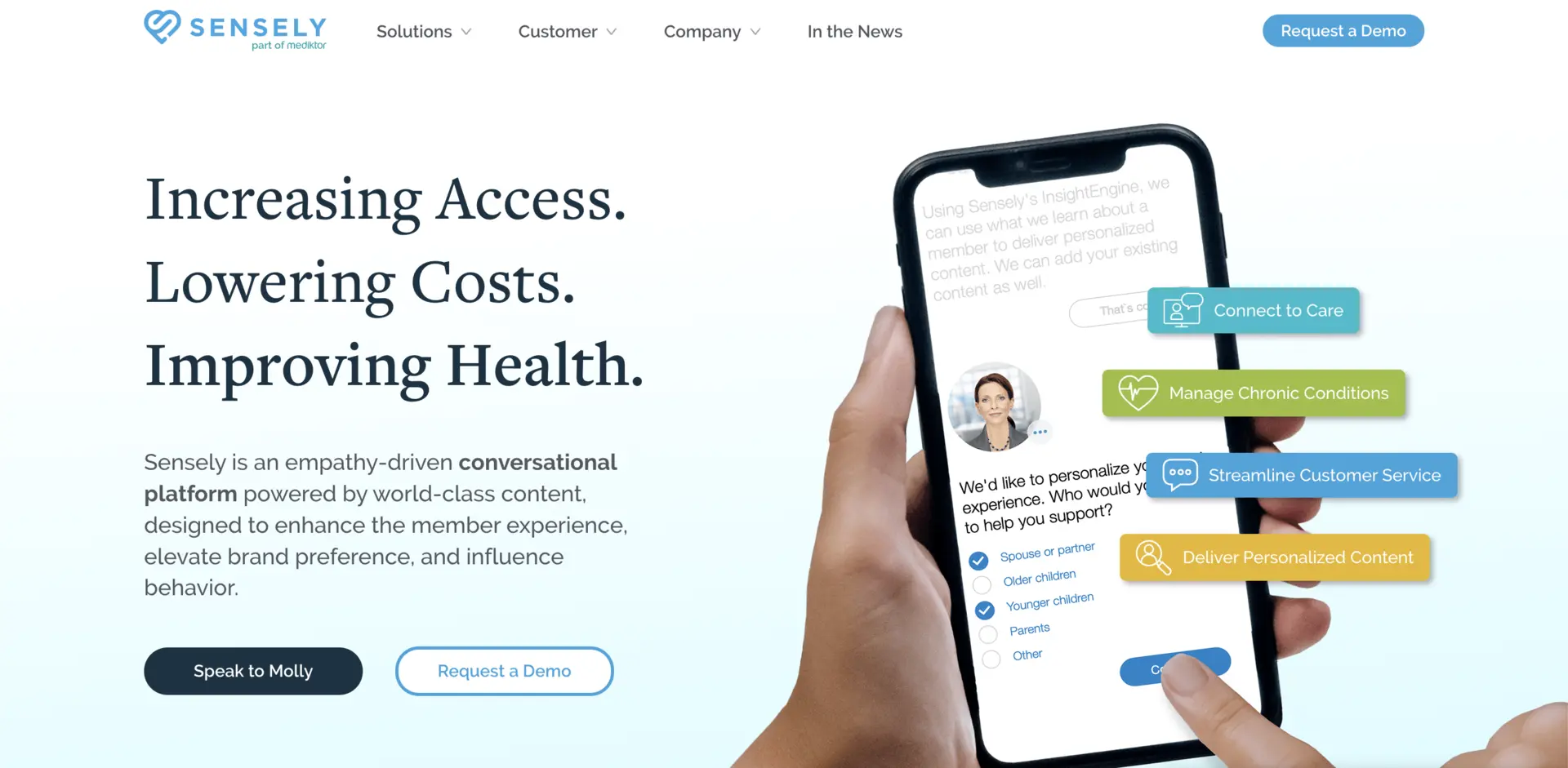
Sensely is adopted by hospitals, insurers, and disease management programs for triage, chronic care, and post-discharge engagement.
Its virtual nurse assistant uses NLP, voice AI, and clinical pathways to guide patients through symptom checks and follow-up routines. The platform integrates with care management systems and EHRs to support recovery monitoring and long-term condition management. Enterprises use it to sustain patient engagement outside clinical settings.
3. Buoy Health
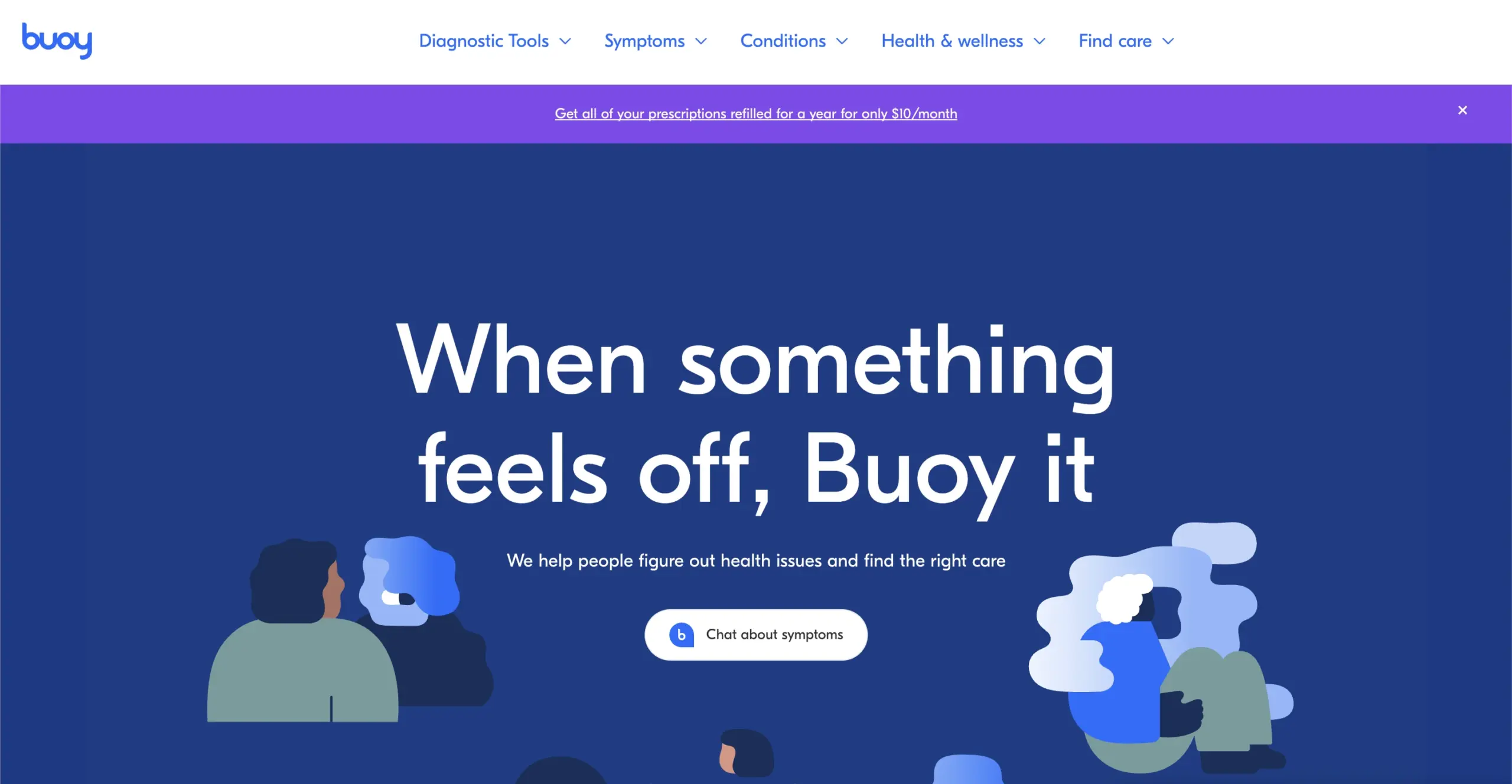
Buoy Health is widely used by healthcare providers, urgent care networks, and digital clinics for front-end symptom intake.
Its AI models analyze patient narratives using probabilistic reasoning and clinical datasets to determine likely conditions and care urgency. The platform routes patients to the right care option before a human interaction begins. Organizations use Buoy to streamline intake and improve first-contact resolution.
4. Your.MD (Healthily)
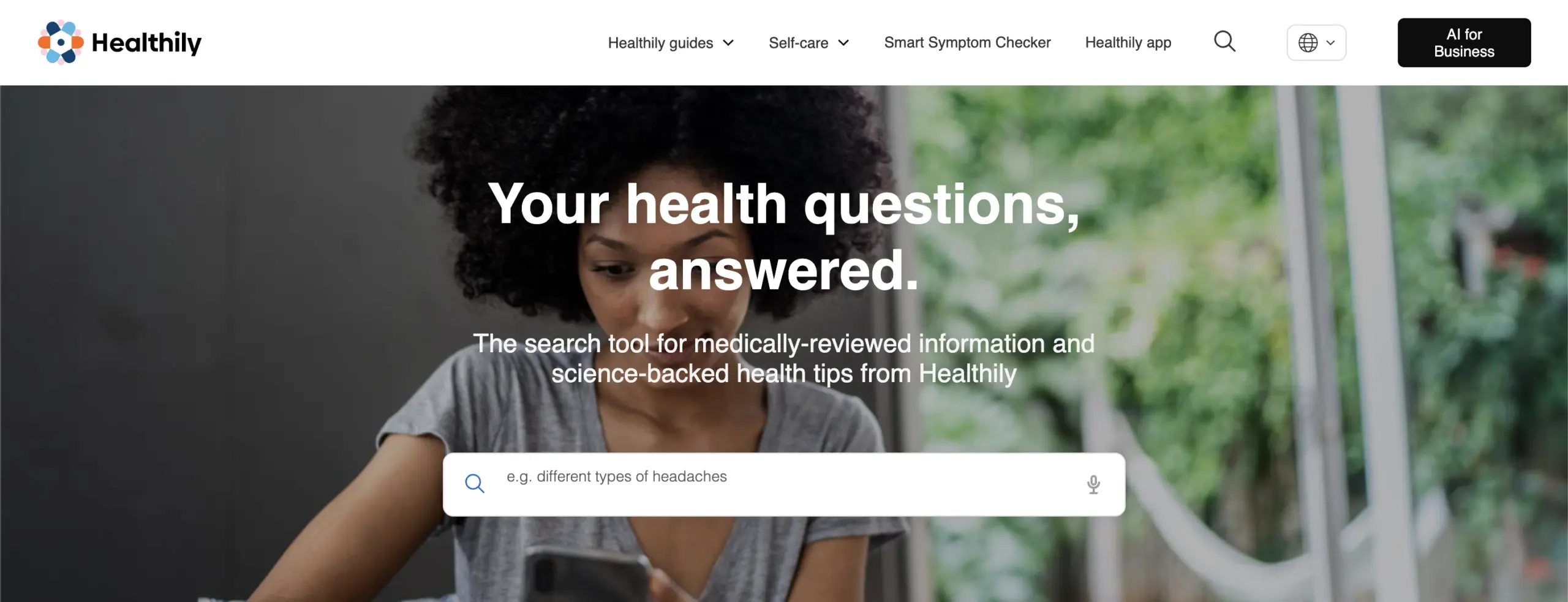
Your.MD, now known as Healthily, is used by population health programs, digital wellness providers, and public health organizations.
Its AI chatbot delivers symptom guidance, prevention education, and self-care pathways using evidence-based medical knowledge. The platform emphasizes scale, multilingual access, and mobile-first deployment. Enterprises use it to extend basic care access in low-resource or high-volume environments.
These platforms show how AI chatbots already operate inside real healthcare ecosystems. Each demonstrates a different enterprise use case, from national triage systems to chronic care engagement and digital access programs.
Conclusion
AI chatbot platforms in healthcare have moved far beyond experimentation. They now operate as the digital front door for large hospitals, payer networks, and integrated delivery systems. When built with the right architecture, AI models, and compliance controls, they improve access, reduce administrative burden, and strengthen care continuity at scale.
For enterprises, the real value lies in orchestration. A governed chatbot platform connects patient access, clinical triage, post-discharge care, revenue workflows, and internal operations into one intelligent automation layer. This is how organizations achieve sustained efficiency, higher patient satisfaction, and measurable ROI under value-based care pressures.
Build an Enterprise-Grade AI Chatbot Platform With Intellivon
At Intellivon, we build enterprise-grade healthcare AI chatbot platforms that unify clinical intelligence, secure patient engagement, EHR-driven automation, and compliance-first governance into one intelligent digital front-door system. Our platforms connect patients, providers, payers, and contact centers across web, mobile, IVR, and messaging channels without disrupting live hospital operations or care continuity.
Each solution is engineered for modern healthcare enterprises. It is compliant by design, resilient under peak access demand, interoperable across vendors, and built to deliver measurable operational and patient-experience ROI from the first deployment phase.
Why Partner With Intellivon?
- Compliance-First Architecture: Every deployment aligns with HIPAA, GDPR, FDA SaMD considerations, EU AI Act, and regional healthcare regulations with audit-ready governance embedded at every layer.
- Interoperability-Driven Platform Engineering: Native support for FHIR, HL7, DICOM, and secure enterprise APIs enables real-time integration across EHRs, telehealth platforms, RCM systems, payer gateways, and care management tools.
- Enterprise-Scale Patient Access Design: Our platforms support multi-hospital networks, multi-specialty service lines, and sustained high-volume patient interactions without performance degradation.
- AI-Embedded Clinical and Operational Intelligence: Built-in AI powers symptom intake, digital triage, scheduling automation, post-discharge follow-ups, billing navigation, and continuous engagement optimization.
- Zero-Trust Security Framework: Identity-first access controls, end-to-end encryption, immutable audit logs, and continuous threat monitoring protect PHI across all chatbot interactions.
- Hybrid Cloud and On-Prem Flexibility: Architectures support regulated hybrid deployments for enterprises with data residency, latency, or sovereign cloud requirements.
Book a strategy call with Intellivon to explore how a custom-built healthcare AI chatbot platform can transform patient access, reduce administrative burden, strengthen compliance, and scale digital engagement safely across your enterprise.
FAQs
Q1. Are AI chatbot platforms safe for use in hospitals and health systems?
A1. Yes. When built with clinical-grade NLP, human-in-the-loop escalation, encrypted data flows, and compliance-first governance, AI chatbot platforms are safe for regulated hospital environments.
Q2. Can enterprise healthcare chatbots integrate with EHR and hospital systems?
A2. Modern enterprise chatbots integrate directly with EHR, HIS, RCM, and telehealth platforms using FHIR, HL7, and secure APIs for real-time workflow execution.
Q3. What regulations apply to AI chatbot platforms in healthcare?
A3. Healthcare chatbots must comply with HIPAA, GDPR, regional privacy laws, and in clinical use cases, may also fall under FDA SaMD and EU AI Act requirements.
Q4. How long does it take to deploy an enterprise healthcare AI chatbot platform?
A4. A production-ready enterprise deployment typically takes 12–20 weeks, depending on compliance scope, integrations, and the number of workflows automated.
Q5. What ROI can large healthcare enterprises expect from AI chatbot platforms?
A5. Enterprises typically see ROI through reduced call-center volume, faster intake and scheduling, improved follow-up adherence, and lower administrative cost-to-serve.