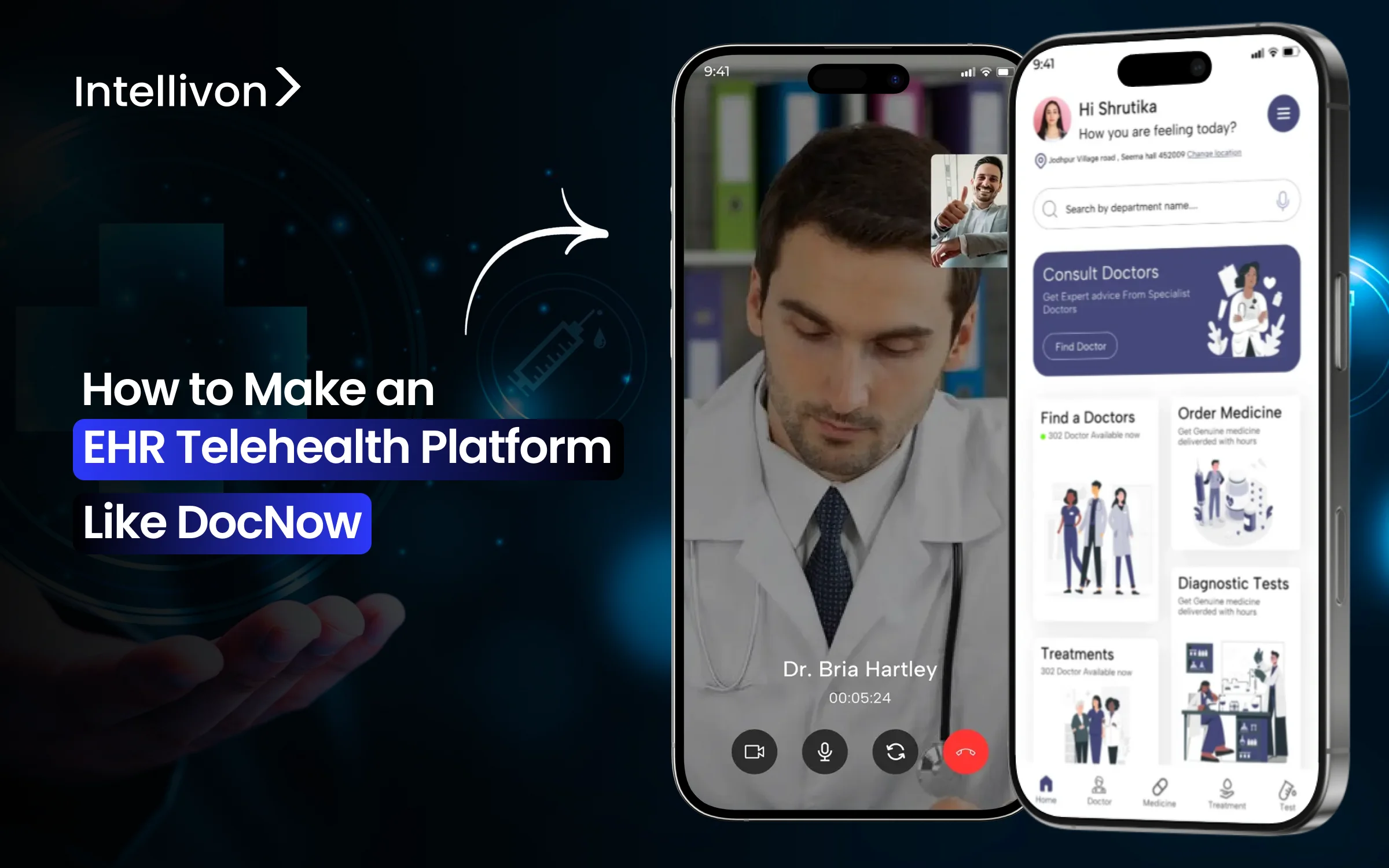
Telehealth has matured to a point where simple implementations no longer provide meaningful returns. Initial successes from basic virtual visits are giving way to important questions about continuity of care, clinician efficiency, and regulatory compliance. Healthcare organizations now expect telehealth to function like any other key clinical capability.
Platforms like DocNow show this shift by integrating telehealth directly into EHR systems. This approach ensures that virtual care works within the existing clinical, billing, and compliance structures, rather than outside of them. For large organizations, this integration decides whether telehealth becomes a scalable care option or an operational challenge.
At Intellivon, we create healthcare systems with a clear understanding of how clinicians operate under time pressure and regulatory demands. This blog explains how to develop an EHR telehealth platform like DocNow, focusing on workflow-driven design, interoperability, compliance, and the foundational elements needed for long-term enterprise growth.

Key Takeaways of the EHR Telehealth Platforms Market
According to Grand View Research, the global telehealth market reached an estimated value of USD 123.26 billion in 2024 and is expected to grow to approximately USD 455.27 billion by 2030.
This expansion reflects a projected CAGR of 24.68% between 2025 and 2030, fueled by widespread smartphone adoption, increasing digital health investments, stronger internet infrastructure, and rapid advances in healthcare technology.

Integration and adoption trends
- By 2024, over 85% of hospitals in developed markets had implemented EHR systems.
- More than three-quarters of these organizations had already adopted some form of telehealth.
- In smaller practices, EHR adoption exceeds 80%.
- Nearly all new telehealth implementations are designed to connect directly with existing EHR and practice-management systems.
Enterprise value and operational outcomes
- Deep EHR-telehealth integration removes duplicate documentation and fragmented records.
- Clinical data flows through a single longitudinal patient record across virtual and in-person care.
- This structure improves clinician efficiency, strengthens care coordination, and reduces administrative burden.
- Reported enterprise case studies show operational cost reductions nearing 30%.
- Per-provider ROI often reaches tens of thousands of dollars annually through automation and workflow optimization.
Key growth drivers and platform evolution
- Rising chronic disease prevalence continues to increase demand for ongoing virtual and hybrid care.
- Permanent reimbursement models for telehealth have stabilized enterprise investment decisions.
- Provider shortages are accelerating the adoption of virtual-first and asynchronous workflows.
- Next-generation platforms are layering AI, interoperability services, and data orchestration on top of core EHR systems.
- These platforms are evolving into the operating backbone for hybrid care across hospital, virtual, and home settings.
What Is an EHR Telehealth Platform Like DocNow?
DocNow is an EHR-integrated telehealth platform that enables virtual consultations, documentation, and follow-ups to occur directly within existing electronic health record workflows.
The platform connects scheduling, virtual consultations, clinical notes, and post-visit actions into a single workflow. Orders, prescriptions, and referrals created during the visit are written back to the EHR in real time. As a result, the patient record remains complete and auditable.
For healthcare enterprises, DocNow’s value lies in adoption and governance. Because telehealth activity lives within existing EHR controls, compliance, billing, and reporting workflows remain intact. This allows virtual care to scale as a core clinical capability, rather than a standalone service layered onto operations.
How DocNow Operates
EHR-integrated telehealth only works when the workflow is clean. Clinicians need the visit to feel like a normal encounter. Operations teams need every action captured for compliance and revenue. That is how platforms like DocNow are typically designed to run.
Step 1: Visit Triggered From Patient Chart
Care teams start a virtual visit from the existing appointment or patient record. This ensures identity, eligibility, and prior clinical context are already in place. It also prevents parallel records from being created.
Step 2: Pre-Visit Intake
Patients complete digital intake before the encounter. Symptoms, vitals (if available), medication updates, and consent are captured in structured form. Therefore, clinicians spend less time gathering basics during the call.
Step 3: Clinician Conducts Virtual Encounter
During the visit, the provider sees the chart, recent notes, labs, allergies, and care gaps. They can document while speaking, using standard templates and problem lists. This keeps the visit workflow familiar.
Step 4: Orders and Prescriptions Placed in Real Time
Clinicians place labs, imaging, prescriptions, referrals, and follow-up tasks during the encounter. Because the workflow is EHR-native, these actions route to existing downstream systems without manual handoffs.
Step 5: Documentation Is Completed
The visit note is finalized inside the same workflow. Codes, diagnoses, and supporting documentation remain tied to the encounter. In addition, audit trails capture who did what and when.
Step 6: Billing, Claims, and Reporting Run
Billing teams receive a complete encounter record with the required telehealth metadata. Charges flow through existing revenue cycle processes. Analytics teams can report on utilization, outcomes, and operational performance without reconciling multiple systems.
DocNow-style operations succeed because they reduce workflow friction. Every step stays anchored to the EHR record. That improves speed, adoption, and auditability. It also makes telehealth scalable across service lines, not limited to a single department.
Business and Revenue Models Of DocNow
DocNow follows enterprise-focused business and revenue models that align EHR-integrated telehealth adoption with clinical workflows, compliance requirements, and long-term operational scalability.

Business Models of DocNow
DocNow is positioned to sell into healthcare enterprises where telehealth must operate as core infrastructure, not a standalone tool. Its business approach reflects how large providers buy, deploy, and govern clinical platforms.
1. Enterprise Licensing Model
DocNow is typically licensed at the organizational or network level. This allows health systems to standardize virtual care across departments, locations, and specialties without per-user fragmentation.
2. EHR-Centric Deployment Model
The platform is deployed as an extension of the existing EHR environment. This lowers change management risk and accelerates clinician adoption by preserving familiar workflows.
3. Service-Line Expansion Model
Enterprises often start with a limited use case such as urgent care or follow-ups. DocNow then expands across specialties, enabling gradual scale without re-platforming.
These business models reduce procurement friction and align virtual care with long-term enterprise strategy rather than short-term pilots.
Revenue Models of DocNow
DocNow’s revenue structure reflects how value is delivered over time in large healthcare environments.
1. Subscription-Based Platform Fees
Health systems pay recurring fees based on deployment scope, number of service lines, or organizational size. This supports predictable budgeting and ongoing platform support.
2. Volume-Linked Usage Components
In some deployments, pricing scales with virtual visit volume or consult activity. This aligns cost with realized operational value rather than fixed seat counts.
3. Enterprise Add-On Modules
Advanced capabilities such as analytics, specialty workflows, or AI-assisted documentation are often offered as add-ons. Enterprises activate these as needs mature.
DocNow’s revenue models align platform cost with adoption, utilization, and clinical impact. This structure supports sustained ROI while allowing healthcare enterprises to scale telehealth at their own pace.
EHR-Linked Telehealth Can Reduce Response Times to 24 Hours
EHR-linked telehealth platforms reduce specialist response times to under 24 hours by embedding virtual consults directly into EHR workflows with complete clinical context and structured data.
Why Specialist Response Time Is an Enterprise Problem
Delayed specialist access remains one of the most persistent operational constraints in healthcare. For large systems, wait times are rarely caused by a lack of specialists alone. They are often the result of fragmented referral and communication workflows.
When telehealth operates outside the EHR, referrals move across disconnected systems. Clinical context is re-entered manually. Follow-ups depend on emails or task lists. As a result, response times stretch unnecessarily, even for low-complexity cases.
How EHR Integration Changes the Speed Equation
EHR-integrated telehealth removes friction from the consult process. Requests are created directly from the patient chart, with history, labs, notes, and medications already attached. Specialists can assess the case without asking for additional information.
Primary clinical research supports this shift. In a prospective pediatric eConsult study at a tertiary care center, the median specialist response time was just 0.9 days. Some consults were answered in under an hour. This level of speed is rarely achievable through traditional referral pathways.
The Hidden Cost of Split Telehealth Systems
Despite clear benefits, many organizations still rely on disconnected tools. In the U.S., only about one in four office-based physicians used an EHR-integrated telemedicine platform in 2021. At the same time, nearly 39% used telehealth systems that were not connected to the EHR.
This split creates invisible delays. Clinicians must duplicate documentation. Specialists receive incomplete information. Administrative teams spend time reconciling records. Over time, these inefficiencies erode trust in virtual care workflows.
What Faster Response Times Unlock for Enterprises
Reducing response times is not only about speed. It changes how care is delivered at scale. When specialists can respond within 24 hours, enterprises see benefits across clinical and operational metrics.
- Fewer unnecessary in-person referrals
- Better utilization of specialist capacity
- Faster care decisions without adding staff
- Improved clinician confidence in virtual workflows
These gains compound as telehealth volume increases.
Core Modules Required to Build a DocNow-Like Platform
A DocNow-like EHR telehealth platform requires tightly integrated clinical, interoperability, security, and operational modules that operate natively inside the EHR ecosystem.
Below are the essential modules required to build a DocNow-style platform that enterprises can deploy confidently.
1. EHR Integration and Clinical Context Engine
This module forms the backbone of the platform. It enables real-time access to patient demographics, problem lists, medications, allergies, labs, imaging, and prior encounters. Integration typically relies on standards such as FHIR, HL7, and SMART on FHIR, with secure APIs and event-driven updates.
The goal is continuity. Clinicians must enter a virtual visit with a full clinical context already available. Data created during the encounter must be written back to the EHR without delay or reconciliation. When this engine is weak, telehealth becomes fragmented and adoption suffers.
2. Virtual Care Delivery Layer
The virtual care layer supports synchronous video, audio, and asynchronous communication within the EHR workflow. This includes visit launch, session management, and secure messaging between patients and care teams.
Unlike consumer telemedicine tools, this layer must operate reliably within enterprise networks and clinical environments. It must support multi-participant visits, handoffs between providers, and failover scenarios. Most importantly, the experience should feel familiar to clinicians, not like a separate application.
3. Clinical Documentation and Order Management
This module handles structured note creation, diagnosis coding, and order placement during virtual encounters. Providers document using the same templates, problem lists, and workflows they use for in-person care.
Orders for labs, imaging, medications, and referrals must route through existing downstream systems. This ensures that virtual care produces complete, auditable records and supports accurate billing. Without this integration, telehealth creates administrative debt rather than efficiency.
4. Scheduling, Routing, and Care Coordination
DocNow-style platforms require intelligent scheduling and routing logic. This module manages appointment availability, provider assignment, and escalation rules based on clinical criteria.
It also supports follow-up coordination across virtual and in-person settings. Care teams can assign tasks, trigger reminders, and manage handoffs without leaving the EHR. As telehealth volume grows, this orchestration layer becomes critical to operational stability.
5. Compliance and Identity Management
Healthcare enterprises operate under strict regulatory requirements. This module enforces authentication, role-based access, consent management, and audit logging across all telehealth interactions.
Data must be encrypted in transit and at rest. Every action must be traceable. When telehealth is embedded inside the EHR, compliance becomes enforceable by design rather than policy. This is essential for scaling across regions, service lines, and regulatory environments.
6. Analytics, Reporting, and Operational Intelligence
This module provides visibility into utilization, response times, outcomes, and financial performance. Because data flows through a single system of record, analytics can be trusted without manual reconciliation.
Enterprises use these insights to optimize staffing, refine care pathways, and demonstrate ROI. Over time, analytics also support value-based care reporting and performance benchmarking across virtual and hybrid models.
A DocNow-like platform succeeds when its modules function as a unified system rather than isolated components. For healthcare enterprises, this modular yet cohesive design is what turns telehealth into a scalable, reliable care delivery channel rather than a temporary solution.
Architecture Of An EHR Telehealth Platform Like DocNow
A DocNow-style EHR telehealth architecture uses a layered design that embeds virtual care, interoperability, security, and analytics directly into the EHR ecosystem without disrupting clinical workflows.
Below is how a DocNow-style platform is typically architected at enterprise scale.

1. Experience Layer
This layer includes provider-facing EHR views and patient-facing portals or mobile apps. Clinicians launch virtual visits, review charts, document care, and place orders from within their familiar EHR interface. Patients access visits, messaging, and follow-ups through secure portals.
The experience layer prioritizes simplicity. It should feel like an extension of existing workflows, not a new application to learn. Adoption depends on how little friction this layer introduces.
2. Virtual Care Services Layer
This layer manages real-time video, audio, and asynchronous communication. It handles session orchestration, multi-party participation, connection resilience, and secure messaging.
Unlike consumer platforms, this layer must perform under enterprise network constraints and clinical uptime expectations. Reliability matters because virtual visits are clinical encounters, not convenience calls.
3. Clinical Workflow Layer
This layer coordinates scheduling, triage, routing, documentation flow, and follow-up tasks. It ensures that each virtual encounter moves cleanly from intake to completion.
Rules engines and workflow logic live here. They determine which provider sees which patient, when escalation occurs, and how tasks move across care teams. This orchestration is what enables scale without chaos.
4. Interoperability and Integration Layer
The integration layer connects the platform to the EHR and downstream systems. It supports standards such as FHIR and HL7, secure APIs, and event-driven updates.
This layer ensures bidirectional data flow. Clinical data flows into the virtual visit, and outcomes flow back into the EHR. When done correctly, there is no reconciliation or manual cleanup.
5. Data, Analytics, and Intelligence Layer
This layer aggregates encounter data, operational metrics, and outcomes. It supports reporting, performance monitoring, and value-based care analytics.
Because data originates from a single system of record, insights are reliable. Enterprises use this layer to track utilization, response times, and ROI across service lines.
5. Security, Compliance, and Governance Layer
Security and compliance span all other layers. This includes identity management, role-based access, encryption, consent tracking, and audit logging.
In DocNow-style architectures, governance is built into the platform rather than added later. This enables consistent enforcement of regulatory requirements across virtual and hybrid care models.
A layered architecture is what allows EHR telehealth platforms like DocNow to scale safely. Each layer serves a clear purpose while remaining anchored to the EHR.
How AI Enhances An EHR Telehealth Platform Like DocNow
AI enhances DocNow-style EHR telehealth platforms by improving triage, documentation, clinical decision support, and operational efficiency while keeping clinicians in control.
Below are the primary ways AI is applied within a DocNow-style architecture.
1. Intelligent Intake and Pre-Visit Triage
AI analyzes patient-submitted symptoms, vitals, and history before the visit begins. It structures unstructured inputs and flags potential risks or urgency levels for the care team.
This allows clinicians to enter the visit better prepared. It also helps route patients to the right provider or care pathway. As a result, response times improve without increasing staffing levels.
2. Clinical Documentation Assistance
During virtual encounters, AI supports real-time note creation by summarizing conversations and suggesting structured documentation elements. Clinicians retain full control over final notes.
This reduces cognitive load and documentation time. It also improves consistency across visits. When integrated into the EHR, documentation assistance enhances efficiency without creating compliance risk.
3. Care Gap Identification
AI continuously reviews patient data during the encounter. It can surface care gaps, guideline-based prompts, or relevant clinical history that may not be immediately visible.
These insights support decision-making without overriding clinician autonomy. In telehealth settings, where time is limited, this support improves confidence and care quality.
4. Post-Visit Automation
After the visit, AI helps automate follow-up tasks. This includes generating care summaries, triggering reminders, and prioritizing outreach based on risk signals.
For enterprises, this ensures continuity beyond the virtual encounter. It also reduces manual coordination work for care teams.
5. Operational Intelligence
AI analyzes telehealth utilization, response times, and workflow bottlenecks. Leaders gain visibility into where virtual care is effective and where adjustments are needed.
These insights support staffing decisions, service line expansion, and long-term planning. Over time, AI-driven analytics help optimize the economics of telehealth delivery.
AI enhances EHR telehealth platforms like DocNow by working quietly in the background. It improves speed, consistency, and efficiency while keeping clinicians in control. When applied thoughtfully, AI becomes an operational advantage rather than a clinical risk, helping enterprises scale virtual care with confidence.
How We Build EHR Telehealth Platforms Like DocNow
Intellivon builds EHR-native telehealth platforms by aligning clinical workflows, interoperability, security, and AI into a single enterprise-grade system designed for real-world scale.

1. Clinical and Operational Discovery
Every engagement starts with deep discovery. We work with clinical leaders, operations teams, and IT stakeholders to understand care pathways, referral patterns, documentation standards, and compliance constraints.
This phase defines what should happen before, during, and after a virtual visit. We map where delays occur today and where telehealth can remove friction. By grounding architecture decisions in real workflows, we avoid building systems that look good on paper but fail in practice.
2. EHR-Native Architecture and Interoperability Design
We design telehealth platforms to operate inside existing EHR ecosystems. Our teams define how data flows through FHIR, HL7, and secure APIs, ensuring bidirectional exchange without reconciliation.
Interoperability is treated as core infrastructure, not integration work done later. This approach preserves data integrity, simplifies audits, and allows telehealth workflows to scale across departments and facilities without breaking downstream systems.
3. Workflow-Embedded Virtual Care Development
Virtual care is built directly into clinical workflows. Clinicians launch visits from the patient chart, document in familiar templates, and place orders without leaving the EHR context.
We focus on minimizing clicks, reducing cognitive load, and maintaining consistency between virtual and in-person encounters. This design philosophy is critical for adoption. When workflows feel natural, clinicians use the platform. When they do not, adoption stalls.
4. Compliance, Security, and Governance by Design
Healthcare platforms must operate under strict regulatory scrutiny. We embed identity management, role-based access, consent tracking, and audit logging into every layer of the system.
Security and compliance are not added at the end. They shape architectural decisions from day one. This ensures platforms can pass audits, support multi-entity governance, and expand across regions without rework.
5. AI Enablement With Human Control
We integrate AI where it creates measurable value. This includes intake structuring, documentation assistance, triage support, and operational analytics.
All AI capabilities are governed. Clinicians remain in control of decisions. Models are explainable, monitored, and aligned with enterprise risk policies. This balance allows organizations to benefit from automation without introducing clinical or regulatory risk.
6. Phased Rollout and Enterprise Scaling
We deploy platforms in phases. Enterprises typically start with a high-impact service line and expand gradually. This reduces risk and allows teams to adapt workflows based on real usage.
Our platforms are designed to scale across specialties, locations, and care models. As adoption grows, performance, governance, and analytics scale with it.
At Intellivon, we build EHR telehealth platforms like DocNow with a long-term view. Our approach combines clinical reality, enterprise architecture, and governed AI. The result is a platform that delivers value early and continues to perform as virtual care becomes a core part of healthcare delivery.
Cost to Build an EHR Telehealth Platform Like DocNow
For healthcare enterprises starting with one or two high-impact virtual care pathways, such as follow-up visits, specialty consults, or virtual urgent care, an EHR-integrated telehealth platform can be built within a controlled, enterprise-ready budget. The deciding factor is not scope alone, but how deliberately the platform is phased.
At Intellivon, we structure cost models around leadership budget cycles, regulatory readiness, and near-term operational ROI. Instead of attempting a system-wide rollout upfront, we focus on building an EHR-native core that can scale safely across service lines.
Estimated Phase-Wise Cost Breakdown (EHR Telehealth Platform)
| Phase | Description | Estimated Cost (USD) |
| Clinical & Operational Discovery | Care pathway mapping, telehealth use-case prioritization, EHR workflow analysis, and regulatory scoping | 8,000 – 15,000 |
| Architecture & Interoperability Blueprint | EHR integration strategy, FHIR/HL7 workflows, security architecture | 12,000 – 22,000 |
| Core Telehealth Platform Development | Provider and patient workflows, virtual visit orchestration, and scheduling | 25,000 – 45,000 |
| EHR Integration & Data Sync | Bidirectional data exchange, chart context, orders, and documentation write-back | 18,000 – 30,000 |
| Security, IAM & Compliance Controls | Role-based access, encryption, audit trails, consent management | 10,000 – 18,000 |
| Clinical Analytics & Reporting | Utilization dashboards, response time tracking, operational KPIs | 8,000 – 15,000 |
| Testing, QA & Compliance Validation | Workflow testing, security testing, integration validation | 8,000 – 14,000 |
| Pilot Deployment & Training | Live deployment, clinician onboarding, workflow optimization | 10,000 – 18,000 |
Total Initial Investment Range:
USD 110,000 – 180,000
This range supports a secure, EHR-native telehealth platform deployed for one high-impact service line in a live clinical environment.
Annual Maintenance and Optimization
Ongoing costs cover infrastructure, EHR integration upkeep, security monitoring, performance optimization, and platform support.
- 12–20% of the initial build cost annually
- Approx. USD 14,000 – 36,000 per year
Costs remain predictable when interoperability and compliance are engineered correctly from the beginning.
Hidden Costs Healthcare Organizations Should Plan For
Even well-designed EHR telehealth platforms carry expansion-related cost variables:
- Scaling to additional specialties or care pathways
- New EHR versions or interoperability upgrades
- Regulatory documentation and audit updates
- Increased cloud usage as virtual visit volume grows
- AI enablement for documentation or triage
- Clinician training and workflow change management
Planning for these early prevents budget shocks during scale-up.
Best Practices to Stay Within the USD 100K–200K Range
Healthcare organizations that control telehealth platform costs typically:
- Start with one clearly defined, high-volume use case
- Avoid multi-EHR or multi-region complexity in phase one
- Use modular architecture to expand incrementally
- Enforce compliance and security from day one
- Track response times, adoption, and ROI during the first 90 days
This ensures the platform proves both clinical and financial value before larger capital deployment.
Talk to our healthcare platform architects to get a phased cost estimate aligned with your enterprise growth strategy.
Common Mistakes Enterprises Make When Building Telehealth Inside the EHR
Most enterprise telehealth failures stem from architectural and workflow decisions, not technology limitations, especially when telehealth is embedded inside the EHR.
Below are the most common mistakes we see, and how Intellivon addresses them.
1. Treating Telehealth as a Video Feature
Many organizations start by enabling video visits without redesigning surrounding workflows. Intake, documentation, orders, and follow-ups remain manual or disconnected. As a result, clinicians experience telehealth as extra work rather than integrated care.
At Intellivon, we design telehealth as a complete encounter lifecycle. Every step, from intake to billing, is embedded into the EHR. This ensures virtual visits feel identical to in-person workflows, driving adoption and long-term use.
2. Underestimating EHR Integration Complexity
Enterprises often assume basic API connectivity is sufficient. In practice, partial integration leads to missing data, reconciliation issues, and reporting gaps. These issues compound as telehealth usage grows.
Intellivon treats interoperability as core infrastructure. We design bidirectional data flows using FHIR, HL7, and event-driven models. This approach preserves data integrity and supports clean scaling across departments and facilities.
3. Ignoring Clinician Adoption
Telehealth platforms frequently fail when clinicians are asked to adapt to new tools rather than supported with workflow-native experiences. Resistance increases when documentation and navigation differ from in-person care.
We involve clinicians early. Intellivon maps real workflows and builds telehealth into existing EHR views and templates. This reduces training time and ensures adoption happens organically.
4. Adding Compliance as an Afterthought
Some organizations build functional platforms first and attempt to layer compliance later. This leads to audit risk, rework, and deployment delays, especially in regulated environments.
Intellivon embeds security, identity management, consent tracking, and audit logging from day one. Compliance is enforced by architecture, not policy, enabling safe expansion across regions and service lines.
5. Overbuilding Before Proving Value
Enterprises sometimes attempt to support every specialty and workflow in the first release. This increases cost, delays launch, and complicates governance.
We guide organizations to start small. Intellivon delivers phased rollouts focused on high-impact use cases. Once value is proven, we scale systematically without disrupting operations.
Telehealth success inside the EHR depends on execution discipline. Architecture, workflows, and governance must align from the beginning. Intellivon helps healthcare enterprises avoid common pitfalls by building EHR-native telehealth platforms that scale cleanly, comply consistently, and earn clinician trust.
How EHR Telehealth Platforms Like DocNow Generate Revenue
EHR telehealth platforms like DocNow generate revenue by embedding virtual care into reimbursable clinical workflows, reducing leakage, and improving utilization across enterprise service lines.

1. Reimbursable Virtual Encounters
When telehealth visits are documented directly in the EHR, they follow the same billing rules as in-person care. CPT codes, modifiers, and payer requirements are captured as part of the encounter.
This reduces claim rejections and delays. For enterprises, it turns telehealth into a reliable revenue channel rather than an experimental service.
2. Specialty eConsults Reduce Cost
EHR-linked eConsults allow specialists to review cases asynchronously. Many cases are resolved without an in-person visit, while complex cases are escalated appropriately.
This model preserves specialist capacity. It also generates reimbursable consult activity without overloading clinics, improving overall margin per specialist hour.
3. Reduced Care Leakage and Higher Retention
Integrated telehealth keeps patients within the health system. Follow-ups, referrals, and post-visit care are routed internally through the EHR.
This reduces leakage to external providers. Over time, retention improves lifetime patient value across service lines.
4. Operational Efficiency That Improves Margin
Automation of intake, documentation, scheduling, and follow-ups reduces administrative overhead. Clinicians spend more time on care, and support teams manage higher volumes without proportional staffing increases.
These efficiencies improve contribution margins even when reimbursement rates are flat.
5. Data-Driven Service Line Optimization
EHR-native platforms generate clean utilization and outcome data. Enterprises use this insight to expand high-performing telehealth programs and retire low-value workflows.
This allows leadership to allocate capital toward services that deliver both clinical and financial returns.
EHR telehealth platforms like DocNow generate revenue by embedding virtual care into the core of enterprise operations. When virtual encounters follow the same rules as in-person care, telehealth becomes a growth lever. For healthcare enterprises, this model supports sustainable expansion rather than short-term gains.
Conclusion
EHR-integrated telehealth has moved beyond convenience and experimentation. Platforms like DocNow show how virtual care becomes reliable when it operates inside the EHR, supported by clean workflows, complete clinical context, and enterprise-grade governance. When telehealth is designed this way, response times improve, clinician adoption increases, and virtual care fits naturally into existing clinical and financial operations.
For healthcare enterprises, this shift enables more than cost control. It creates a scalable foundation for hybrid care, supports new service models, and strengthens long-term patient relationships. The organizations that treat EHR-native telehealth as core infrastructure will be best positioned to deliver consistent, efficient, and sustainable care at scale.
Build Your EHR Telehealth Platform Like DocNow With Intellivon
At Intellivon, we build EHR-native telehealth platforms that operate as part of the core clinical infrastructure, not as add-on tools. Our platforms are designed to integrate deeply with existing EHR environments, enabling virtual visits, documentation, orders, and follow-ups to run through a single, governed system of record.
Each solution is engineered for enterprise healthcare delivery. Platforms are interoperable, compliant by design, resilient under real clinical volume, and built to deliver measurable operational and financial ROI as virtual care scales across service lines.
Why Partner With Intellivon?
- EHR-native platform design aligned with real clinical workflows and enterprise governance
- Deep interoperability expertise across HL7, FHIR, SMART on FHIR, and secure enterprise APIs
- Compliance-first architecture supporting HIPAA, GDPR, audit logging, and consent management
- AI-enabled efficiency for intake, documentation, triage, and operational analytics
- Scalable, cloud-native delivery with performance optimization and phased rollout control
Book a strategy call to explore how a custom EHR telehealth platform can improve adoption, accelerate care delivery, and support long-term enterprise growth.
FAQs
Q1. What is an EHR telehealth platform?
A1. An EHR telehealth platform enables virtual visits, documentation, orders, and follow-ups to occur directly inside the electronic health record, preserving clinical context and compliance workflows.
Q2. How is EHR-integrated telehealth different from standalone telemedicine tools?
A2. EHR-integrated telehealth operates within existing clinical workflows, while standalone tools require separate systems, duplicate documentation, and manual reconciliation.
Q3. How long does it take to build an EHR telehealth platform like DocNow?
A3. A production-ready EHR telehealth platform typically takes 4–6 months to build, depending on integration depth, compliance scope, and initial service lines.
Q4. Which EHR systems can support integrated telehealth platforms?
A4. Most modern EHRs support telehealth integration through standards like FHIR and HL7, including Epic, Oracle Cerner, MEDITECH, and other enterprise systems.
Q5. Is EHR telehealth compliant with healthcare regulations?
A5. Yes. When designed correctly, EHR telehealth platforms support HIPAA, audit logging, consent management, and payer requirements through native EHR governance controls.