Investing in agentic AI development for finance is one of the most significant infrastructure decisions a financial company can make today. The gap between early adopters and late movers is growing, and the cost of waiting is steadily rising. However, the actual cost of this investment and the factors that influence that cost are mostly not explained clearly enough for serious decision-makers.
The price range varies for good reasons. A specialized single-workflow finance agent is very different from a multi-agent system that manages treasury, compliance, fraud detection, and real-time reporting all at once. Treating these as the same type of investment can result in budgets that fall short or are unnecessarily high.
This blog clears up that confusion. It details the real cost structure of building agentic AI for financial operations, breaking it down by module, build stage, agent type, and the hidden factors that most teams discover only after a project begins.
At Intellivon, we have planned, designed, and implemented enterprise-grade agentic AI systems for financial settings where accuracy, compliance, and speed are essential. That experience informs everything you are about to read in this blog.

Why Finance Agentic AI Costs More Than Standard AI
Agentic AI in finance typically costs 20% to 50% more than standard AI systems. That is because it handles autonomous, multi-step decision-making and depends on more persistent infrastructure.
As a result, both build costs and ongoing operating costs increase. Orchestration, governance, compliance controls, and unpredictable workload spikes usually push the budget higher.
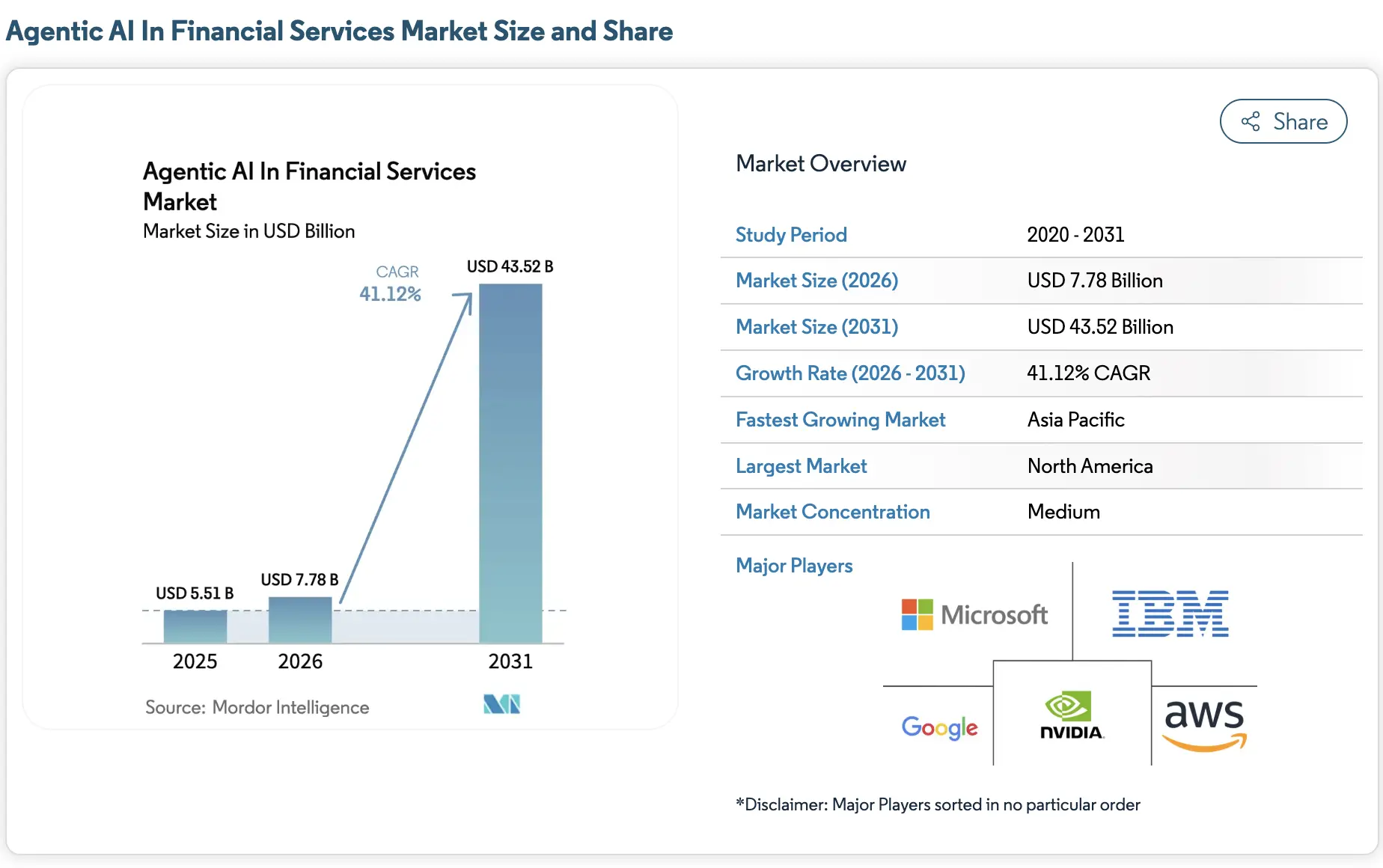
The agentic AI market in financial services is growing fast. It is estimated at USD 7.78 billion in 2026, up from USD 5.51 billion in 2025. Growth is expected to accelerate further. By 2031, the market is projected to reach USD 43.52 billion, expanding at a 41.12% CAGR from 2026 to 2031.
Investing in agentic AI means moving beyond simple bots to tools that actually perform tasks. While basic AI just answers questions, finance agents act as digital employees, which requires a more advanced and costly setup.
1. Finance Agents Do More Than Answer Prompts
Standard AI usually just finds information or summarizes files. In contrast, agentic systems complete full tasks like checking credit scores and calculating risks on their own.
Creating these “action steps” takes more time because engineers must teach the AI to make safe, logical choices without a human watching every move.
2. Real-Time Decision Systems Raise Build Complexity
Financial markets change in seconds, so the AI must be incredibly fast. Building a system that tracks live prices or spots fraud instantly adds to the cost.
This requires special tech “plumbing” to ensure the AI sees the latest data, making the development process more complex than building a standard app.
3. Compliance and Auditability Add Major Cost Layers
Mistakes in finance lead to heavy fines. Unlike a chatbot, a finance agent must explain exactly why it made a specific choice. A large part of the budget goes into building “safety rails.”
These features ensure the AI follows laws and stays within company rules, providing a clear trail for auditors to follow.
4. Why Integrations Shape the Final Budget
The AI is only useful if it can talk to your existing banking or accounting software. Connecting new AI to old systems is often the most expensive part of the project.
These custom connections ensure data stays secure while moving between programs, which is a key part of the agentic AI development cost fintech leaders plan for.
Higher costs reflect the shift from a tool that just speaks to one that actually finishes work. Investing in these foundations early creates a reliable system that grows with your business.
What Is Agentic AI in Finance?
Agentic AI in finance is a class of artificial intelligence that operates autonomously across complex financial workflows, like planning actions, executing decisions, and self-correcting based on live data.
Unlike standard AI that responds to prompts, agentic systems pursue defined financial objectives continuously, coordinating across multiple tools, systems, and data sources without waiting for human instruction.
Where Agentic AI Fits in Financial Operations
Agentic AI fits into finance by automating end-to-end workflows like loan approvals and fraud investigations. It delivers ROI by reducing manual hours by up to 80% and scaling operations without the need for additional headcount.
These agents act as autonomous team members who handle high-value tasks across lending, compliance, and wealth management.
1. Accelerating Lending and Credit Analysis
Traditional credit checks often take days of manual data entry and spreadsheet work. AI agents change this by automatically gathering tax forms, bank statements, and market data to calculate risk ratios instantly.
They create decision-ready summaries that highlight potential red flags for human reviewers. This shift reduces the time spent on manual “spreading” and allows teams to process more applications with higher accuracy.
2. Scaling Compliance and KYC Processes
Onboarding new clients is often a major cost center due to strict KYC and AML rules. AI agents manage this by extracting data from IDs and cross-referencing global watchlists in real time.
They only escalate irregular cases to humans, which shrinks onboarding times from days to minutes. This capability ensures that growth does not lead to higher regulatory risks or mounting labor costs.
3. Optimizing Fraud Detection and Investigations
Standard fraud systems often flag too many false positives, which creates a massive workload for investigators. Agentic AI addresses this by continuously scanning transactions and prioritizing alerts based on risk scores.
These agents provide a full, traceable record of their reasoning, ensuring that every action is audit-ready. By filtering out low-level noise, they allow fraud teams to focus on actual threats.
4. Modernizing Wealth and Asset Management
Wealth management firms use agents to deliver hyper-personalized investment strategies for high-net-worth clients. These systems monitor market shifts and proactively suggest portfolio adjustments based on specific client goals.
In back-office roles, agents handle account reconciliation and document validation without intervention. This level of support increases advisor productivity and ensures that client portfolios stay aligned with changing economic conditions.
Integrating these agents into your core workflows creates a more resilient and adaptive business.
Cost Breakdown of Finance Agentic AI by Module
Investing in agentic AI involves several distinct layers. Each module contributes to the overall intelligence and reliability of the system. Understanding these costs helps you allocate your budget effectively across the development lifecycle.
| Development Module | Estimated Cost Range (USD) | Primary Focus |
| Data Ingestion & Normalization | $25,000 – $60,000 | Cleaning and structuring financial data |
| Model & Orchestration | $40,000 – $100,000 | AI reasoning and multi-step logic |
| Core System Integration | $35,000 – $85,000 | Connecting to ERP, CRM, and Banking APIs |
| Compliance & Audit Trails | $20,000 – $50,000 | Regulatory safety and logging |
| Frontend & Control Panels | $15,000 – $40,000 | User interface and human-in-the-loop |
| Testing & Red Teaming | $20,000 – $45,000 | Security, bias checks, and stress testing |
1. Data Ingestion and Normalization Costs
Agents need clean data to make accurate decisions. This cost covers building pipelines that pull info from PDFs, spreadsheets, and live feeds. Engineers must normalize this data so the AI understands various formats consistently.
2. Model and Orchestration Layer Costs
This is the brain of your agent. Costs here go toward selecting the right models and building the logic that lets the AI plan tasks. It involves fine-tuning the system to handle complex financial reasoning without losing focus.
3. Core System Integration Costs
Your AI must talk to your existing software. This phase involves custom API work to connect the agent with your banking or accounting platforms. Securely moving data between these systems is a technical challenge that requires expert handling.
4. Compliance and Audit Trail Costs
Finance agents must be trackable. This module builds the logging systems that show why the AI made a specific move. It ensures your system meets legal standards and is ready for any official audit.
5. Frontend and Control Panel Costs
Managers need a way to watch and guide the AI. This cost covers the dashboard where you see what the agent is doing. It allows humans to step in and approve high-stakes actions when necessary.
6. Testing, Red Teaming, and Deployment Costs
Before going live, the AI must be stress-tested. Red teaming involves trying to trick the AI into making mistakes or leaking data. This step is vital to ensure the system is secure against cyber threats and bias.
Strategic planning around these modules ensures a high ROI. By working with Intellivon, you gain access to the expertise needed to build these complex layers efficiently and securely.
Cost by Build Stage: PoC, MVP, and Full Rollout
Scaling an AI project requires a phased approach to manage risk and capital. By breaking the build into stages, you can validate the technology before committing to a full-scale enterprise rollout.
Each phase serves a specific strategic purpose and carries its own price tag.
| Build Stage | Typical Timeline | Investment Range (USD) | Goal |
| Proof of Concept (PoC) | 3–6 Weeks | $20,000 – $45,000 | Validate the core AI logic |
| Minimum Viable Product (MVP) | 3–5 Months | $75,000 – $180,000 | Initial live system integration |
| Full Production Rollout | 6–12 Months | $250,000+ | Scale across the enterprise |
1. PoC Cost for a Narrow Finance Use Case
A Proof of Concept is a small-scale test designed to see if the AI can solve a specific problem. For example, you might test if an agent can accurately extract data from messy tax returns.
The cost covers basic model setup and testing with a small sample of your data. This phase proves the tech works before you spend money on deep software connections.
2. MVP Cost With Real System Integrations
The MVP is the first version that actually goes to work. This stage is more expensive because it involves connecting the AI to your live databases and software.
You are building the security layers and user interfaces needed for real employees to start using the tool. It moves the project from a lab experiment to a functional business asset.
3. Production Rollout Cost Across Teams
A full rollout means the AI is now a core part of your company. Costs at this stage include scaling the infrastructure to handle thousands of tasks at once. You will also invest in advanced monitoring, continuous model updates, and staff training.
This phase ensures the system is fast, reliable, and secure enough for every department to use daily.
When to Phase Investment Instead of Overbuild
Many leaders make the mistake of trying to build everything at once. This leads to wasted budget on features that users might not even need. Therefore, it is wiser to phase your investment based on clear performance milestones.
Only move to the next stage when the current version meets its goals. This lean approach keeps the project flexible and protects your capital.
Strategic growth depends on starting smart and scaling fast.
Cost by Agent Type in Financial Operations
The specific role an agent plays determines the complexity of its logic and the cost of its development. Simple research tools are generally more affordable, while agents that manage high-stakes transaction workflows require deeper investment in security and reasoning.
| Agent Type | Complexity Level | Average Build Cost (USD) | Primary Value Driver |
| Research & Analyst Support | Moderate | $30,000 – $55,000 | Speed of information retrieval |
| Treasury Workflow | High | $60,000 – $120,000 | Error reduction in payments |
| Compliance Monitoring | High | $50,000 – $95,000 | Risk mitigation and audit speed |
| Fraud & Exception Handling | Very High | $80,000 – $150,000 | Real-time threat response |
1. Research and Analyst Support Agents
These agents act as digital assistants for investment and market research teams. They scan thousands of news articles, earnings calls, and filings to find specific trends.
Because they primarily read and summarize data rather than moving money, they are faster and cheaper to build. The cost is mainly tied to setting up data scrapers and fine-tuning the AI to understand financial jargon.
2. Treasury Workflow Automation Agents
Treasury agents handle the movement of funds and cash management. They are more expensive because they must integrate directly with banking portals and ledger systems. These agents must follow strict rules for liquidity and payment timing.
Therefore, the budget includes heavy testing to ensure the AI never makes a double payment or misses a critical funding deadline.
3. Compliance Monitoring and Review Agents
Compliance agents continuously watch transactions for signs of money laundering or policy violations. They are built to understand complex regulatory frameworks and keep an updated record of every check they perform.
The cost reflects the need for high accuracy and a clear audit trail. These systems save money over time by reducing the need for large manual review teams.
4. Fraud and Exception Handling Agents
These are the most complex agents because they must make split-second decisions. When a transaction looks suspicious, the agent investigates it by comparing it to historical patterns.
If it finds an error, it manages the exception process automatically. High costs come from the need for real-time processing and the advanced logic required to lower false alarms.
5. Multi-Agent Finance Operations Systems
The most advanced enterprises use systems where different agents talk to each other. For instance, a research agent might flag a market shift, and a treasury agent then adjusts cash holdings based on that data.
Building these swarms of agents is a significant investment. However, it creates a fully autonomous department that can operate 24/7 without human fatigue.
Starting with a single agent type allows you to prove value before expanding into a multi-agent ecosystem. This modular approach ensures that each part of your operation becomes more efficient without requiring a massive upfront overhaul of your entire tech stack.
Real Finance Use Cases and Their Cost Range
Every financial use case has a unique set of technical hurdles that define the final price tag. From simple data matching to complex strategic forecasting, the level of autonomy you grant the agent will dictate the resources required for development and maintenance.
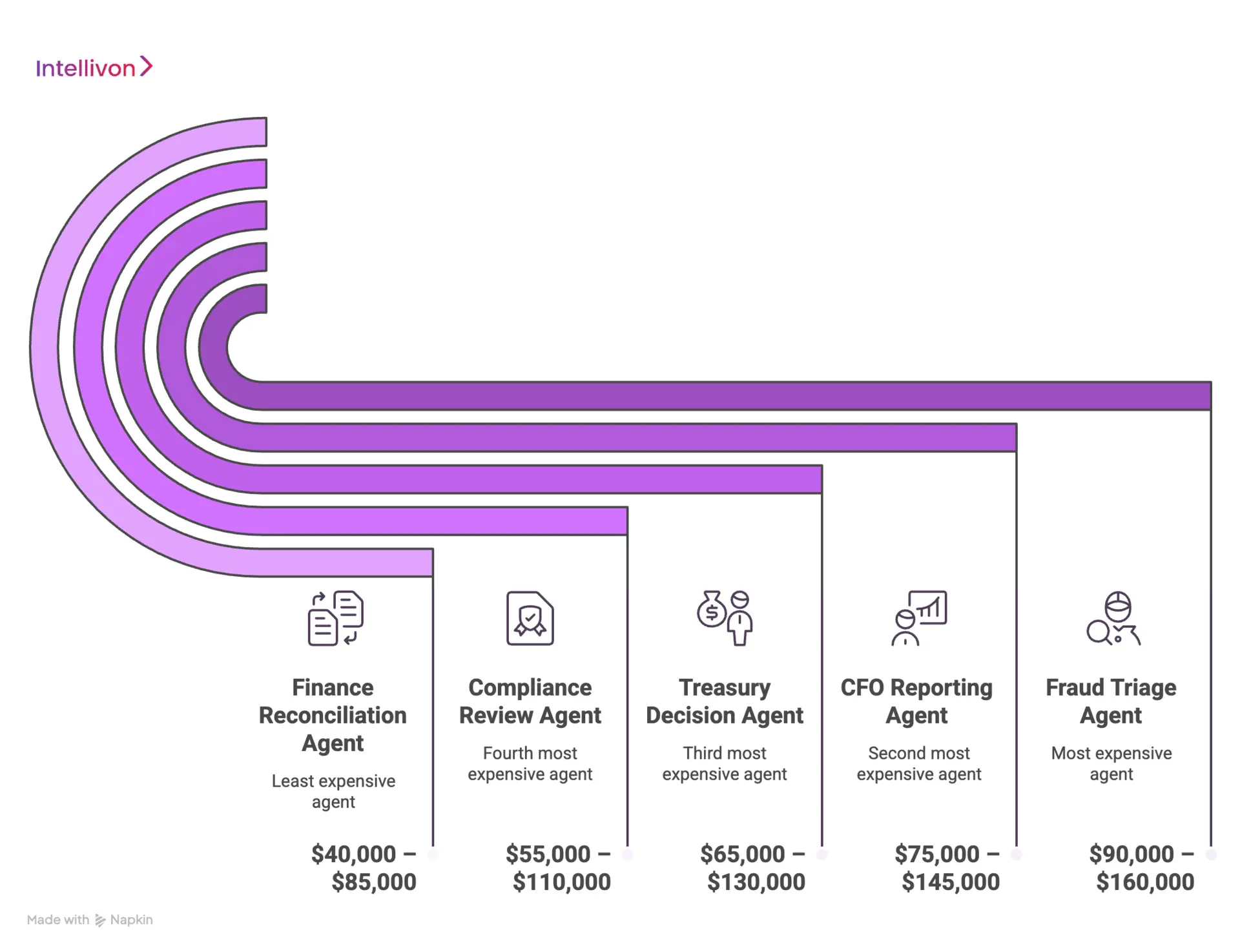
1. Treasury Decision Support Agent Costs
Treasury agents help liquidity managers decide where to move cash to maximize interest while maintaining safety. These systems analyze bank balances across multiple countries and currencies to suggest the best daily moves.
Because they deal with high-value movements, they require secure connections to core banking portals.
- Cost Range: $65,000 – $130,000 per implementation.
2. Finance Reconciliation Agent Costs
Reconciliation agents solve the headache of matching invoices with bank statements and ledger entries. They use vision-based AI to read messy receipts and natural language processing to understand why a payment might be short.
These agents significantly reduce manual labor in the back office by automatically flagging only the discrepancies that a human needs to see.
- Cost Range: $40,000 – $85,000 per implementation.
3. Compliance Review Agent Costs
These agents act as a first line of defense against regulatory breaches by scanning every transaction or customer file for red flags. They are built to understand specific local and international laws, ensuring your firm stays ahead of changing rules.
This proactive approach prevents costly fines and reduces the headcount needed for repetitive manual audits.
- Cost Range: $55,000 – $110,000 per implementation.
4. Fraud Triage Agent Costs
A fraud triage agent does more than just flag a suspicious card swipe; it investigates the context behind the alert. It may pull historical data or check social media signals to see if a transaction is legitimate before blocking a user’s account.
This complexity requires advanced reasoning and real-time data access to keep the customer experience smooth while protecting the bottom line.
- Cost Range: $90,000 – $160,000 per implementation.
5. CFO Reporting and Insight Agent Costs
CFO agents sit at the top of the information chain, pulling data from every department to create high-level strategic reports. They don’t just show what happened last quarter; they use predictive modeling to show where the company is headed.
Building these tools requires deep integration across all business units to ensure the insights are based on a single source of truth.
- Cost Range: $75,000 – $145,000 per implementation.
Selecting the right use case to start with is vital for demonstrating early ROI. Focusing on high-volume, repetitive tasks typically provides the fastest payback period for your investment.
This strategy allows you to build internal trust before moving toward more complex, multi-departmental agents.
What Enterprises Pay for in Agentic AI Development
Developing a financial agent involves specific engineering stages that transform a generic model into a specialized enterprise tool. Each stage carries a distinct price tag based on the depth of customization and the complexity of the financial data involved.
| Development Pillar | Estimated Cost (USD) | Primary Deliverable |
| Discovery & Design | $10,000 – $25,000 | Workflow maps and technical blueprints |
| Data Pipelines | $20,000 – $55,000 | Clean, real-time financial data streams |
| Agent Logic | $35,000 – $80,000 | Autonomous reasoning and task planning |
| Memory & RAG | $15,000 – $40,000 | Knowledge base and context retrieval |
| Security & Controls | $25,000 – $60,000 | Governance layers and safety guardrails |
| Dashboards & UI | $12,000 – $30,000 | Management console and oversight tools |
1. Discovery, Workflow Mapping, and Solution Design
Before a single line of code is written, architects must map out the existing financial workflows. This phase identifies exactly where an agent can add the most value and where it should stop.
It involves interviews with your team to ensure the AI logic matches your business rules, preventing expensive reworks later in the project.
2. Financial Data Pipelines and Data Preparation
AI is only as good as the data it can access. Developing secure pipelines to pull data from internal databases, cloud storage, and external APIs is a major task.
This part of the budget covers the cleaning and structuring of messy financial records so the agent can read them without errors or confusion.
3. Agent Logic, Orchestration, and Decision Layers
This is the core engine that allows the AI to plan and execute tasks. Orchestration logic tells the agent which tool to use and when to move to the next step.
Building these layers ensures the agent can handle complex, multi-part requests, like auditing a portfolio and then drafting a risk report, without losing track of the goal.
4. Memory, RAG, and Context Retrieval Systems
Agents need a way to remember past interactions and access specific company knowledge. Retrieval-Augmented Generation (RAG) allows the AI to search through your private documents securely.
This setup ensures the agent provides answers based on your actual data rather than generic information found on the internet.
5. Security, Governance, and Approval Controls
In finance, security is the highest priority. This investment builds the permission layers that limit what the agent can do. It ensures the AI cannot move funds or access sensitive payroll data without explicit human approval.
These controls are essential for meeting internal IT security standards and external regulations.
6. Dashboards, Observability, and Human Oversight
You must be able to see what your AI is doing in real-time. This cost covers the creation of observability tools that track every decision the agent makes.
It also includes the user interface where your staff can review, edit, or stop the agent’s actions, ensuring the human-in-the-loop remains a reality.
Focusing on these foundational elements ensures your AI is a stable asset rather than a risky experiment. By investing in these high-quality modules, you build a system that is ready for the rigors of a professional financial environment.
What Drives Agentic AI Costs Up in Finance
Several technical and operational factors can quickly push an AI budget beyond initial estimates. In the financial sector, these drivers usually stem from the need for absolute precision and the complexity of connecting modern intelligence with older infrastructure.
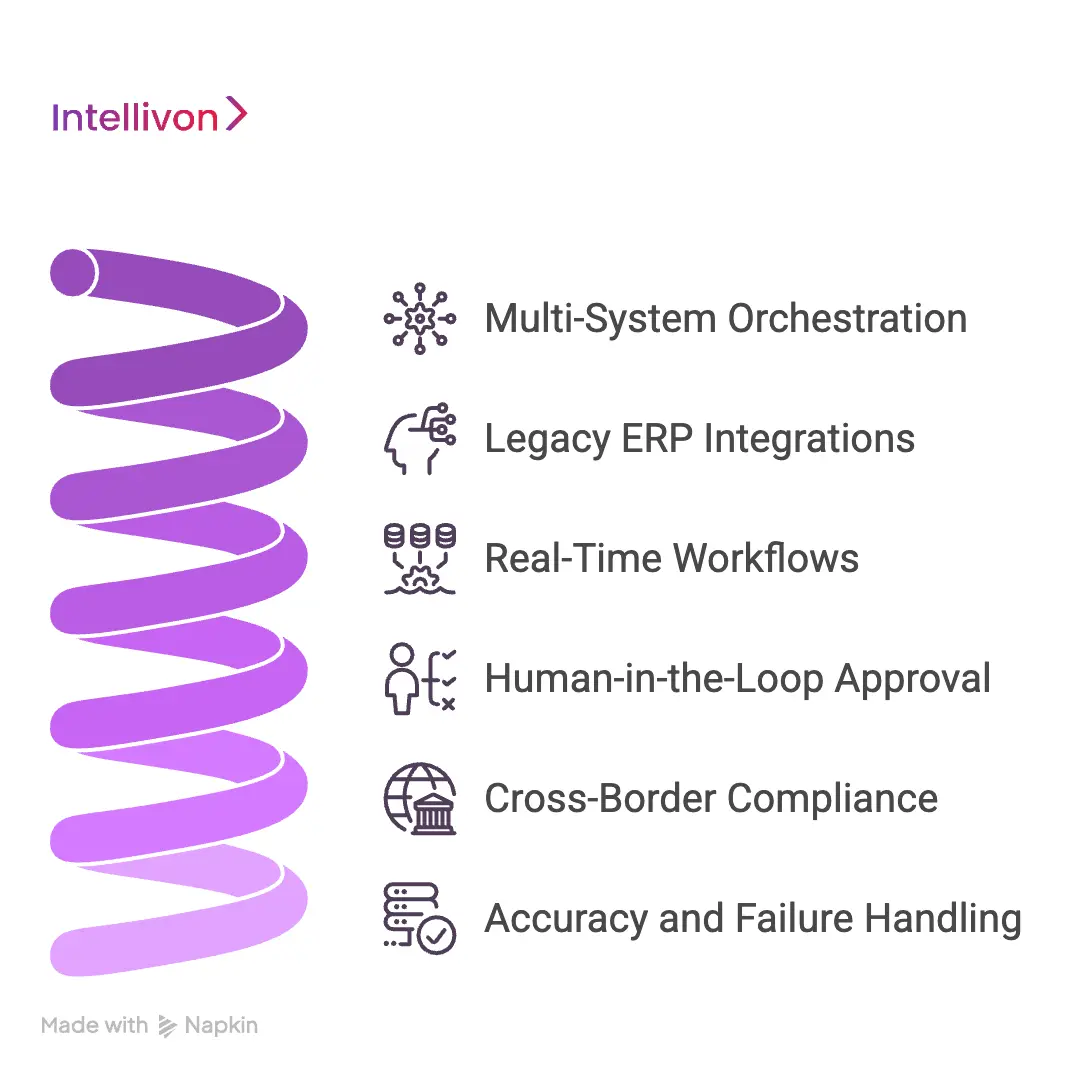
1. Multi-System Orchestration and API Depth
An agent that simply reads a file is inexpensive. However, an agent that must navigate five different software platforms to finish a task requires complex orchestration logic.
Each API connection adds a layer of testing to ensure the AI uses the right tool at the right time. Therefore, the more steps in your workflow, the higher the development and maintenance costs.
2. Legacy ERP and Banking Integrations
Many financial institutions rely on decades-old software that was never built for AI. Connecting a modern agent to these legacy systems often requires building custom middleware.
This process is time-consuming because engineers must create secure bridges that allow the AI to read and write data without crashing the original system.
3. Real-Time Workflows and Token Usage
Agents operate by thinking in loops, which consume tokens every time they process information. If an agent monitors live market feeds or high-frequency transactions, the ongoing API costs can rise significantly.
High-speed requirements also demand more expensive cloud infrastructure to keep latency low enough for professional use.
4. Human-in-the-Loop Approval
For high-stakes moves like wire transfers, you cannot leave the AI alone. Building the interfaces and logic for human approvals adds to the build time.
These safety checkpoints ensure a manager can review and sign off on AI decisions, which is vital for trust but adds complexity to the final software architecture.
5. Cross-Border Compliance
Operating in multiple countries means the AI must follow different sets of financial laws. Training the agent to recognize and apply these varying rules requires extensive fine-tuning and legal validation.
This expanded scope ensures the system stays compliant globally but increases the amount of specialized engineering needed during the build.
6. Accuracy, Fallback, and Failure Handling Design
In finance, a system cannot simply stop working if it hits an error. You must pay for fallback designs that allow the AI to fail gracefully or hand the task back to a human.
Building these safety nets ensures your operations never grind to a halt, though it requires more rigorous development and stress testing.
By understanding these cost drivers, you can better prioritize which features are essential for your initial rollout. Strategic planning around these factors ensures your project remains within budget while delivering the high-level performance your enterprise requires.
Hidden Costs Most Finance Teams Miss Early
Hidden costs in finance AI stem from data decay and architectural inefficiency. Teams should budget an additional 15% to 25% of the initial build cost for ongoing data maintenance, token optimization, and regular security updates to ensure the system remains reliable.
These overlooked expenses can impact the total cost of ownership if they are not planned for during the strategy phase.
1. Data Cleanup and Document Preparation
Many firms assume their data is ready for AI, but messy spreadsheets and scanned PDFs often require significant cleaning. Before an agent can function, engineers must build tools to structure this information.
This preparation stage is a recurring necessity as new types of documents enter your company’s ecosystem over time.
2. Token Leakage and Inefficient Agent Loops
If an agent is not programmed with strict logic, it may enter a “thinking loop” where it consumes thousands of tokens without finishing the task. This inefficiency leads to unexpected spikes in your monthly API bills.
Therefore, investing in prompt optimization early is essential to prevent your operating costs from scaling faster than your ROI.
3. Monitoring, Retraining, and Tuning Costs
AI models can experience “drift,” where their accuracy decreases as market conditions or internal data patterns change.
You must pay for continuous monitoring to catch these dips in performance. Regular tuning ensures the agent stays sharp and continues to make decisions that align with your current business goals.
4. Third-Party API and Model Usage Fees
Beyond the cost of the AI itself, you may need to pay for access to premium financial data feeds or specialized compliance databases. These third-party services usually charge per request or via monthly subscriptions.
These fees must be integrated into your financial model to get an accurate picture of daily running costs.
5. Security Reviews and Compliance Updates
Regulations in the financial sector shift frequently, and your AI must shift with them. This requires periodic security audits and software updates to ensure the agent still meets the latest privacy and data handling laws.
These reviews are vital for maintaining your license to operate and protecting sensitive client information.
6. Internal Enablement and Process Change Costs
The final hidden cost is the time it takes for your staff to adapt to new workflows. Employees need training to understand how to prompt the agent and how to audit their work.
Without this investment in human readiness, the AI may sit unused, which represents the highest hidden cost of all: a failed implementation.
Anticipating these expenses allows you to build a more resilient financial case for your AI initiatives. Planning for the full lifecycle of the agent ensures that your project delivers sustainable value without any late-stage budget surprises.
Cost Comparison: Agentic AI vs Traditional Automation
Choosing between standard automation and agentic AI is a decision between rigid efficiency and flexible intelligence.
While traditional systems are cheaper to start, they often hit a ceiling that only agentic workflows can break through.
| Feature | Traditional Automation (RPA) | Agentic AI Systems |
| Upfront Development | $15,000 – $40,000 | $75,000 – $200,000+ |
| Handling Ambiguity | Zero (Fails on errors) | High (Reasons through gaps) |
| Maintenance Needs | High (Breaks with UI changes) | Moderate (Learns from data) |
| Scalability | Linear (Needs more scripts) | Exponential (Handles new tasks) |
1. Rule-Based Systems vs Agentic Workflows
Traditional rule-based systems follow a strict if-this-then-that logic. They are excellent for moving data between two specific fields, but they break the moment a format changes. Agentic workflows use reasoning to handle these gaps.
If an invoice looks different than usual, the agent uses its intelligence to find the right information anyway. This reduces the number of times a human has to step in to fix a broken process.
2. Upfront Cost vs Long-Term Return
Standard automation is often cheaper to deploy because it requires less specialized engineering. However, these systems often become “technical debt” as your business evolves. Agentic AI carries a higher price tag at the start due to the need for advanced model orchestration and security.
Over time, the agent provides a better return because it can take on more complex roles, eventually replacing the need for multiple smaller automation scripts.
3. Where Conventional Automation Still Wins
There are still many areas where simple automation is the better financial choice. For highly predictable, repetitive tasks like basic data entry or generating standard weekly reports, an expensive AI agent is often overkill.
In these cases, conventional tools provide the fastest payback period because they are quick to build and easy to maintain without needing expensive API tokens.
4. Where Agentic AI Creates More Value
Agentic AI shines in “high-variance” environments like fraud detection, credit underwriting, or strategic forecasting. These areas require the system to make a judgment call based on many different data points.
The value here is not just in saving time, but in making better decisions that reduce risk and uncover new revenue. For these high-stakes roles, the extra cost of an agentic system is easily justified by the massive improvement in accuracy and speed.
Balancing these two approaches is key to a smart technology strategy. By using traditional tools for simple tasks and agentic AI for complex ones, you can optimize your budget while building a truly intelligent financial operation.
Build vs Buy: Which Is More Cost-Effective?
Choosing between a pre-made solution and a custom-built agent is a pivotal financial decision. While buying offers immediate access, building provides a proprietary asset that can become a core competitive advantage for your firm.
| Approach | Initial Cost | Speed to Market | Customization |
| Buy (SaaS) | Lower (Subscription) | Days/Weeks | Limited |
| Build (Custom) | Higher (Upfront) | Months | Unlimited |
| Hybrid | Moderate | Weeks/Months | High |
1. Where Off-the-Shelf Finance AI Falls Short
Standard AI products are designed to serve thousands of companies at once. This means they often lack the specific logic needed for your unique internal accounting rules or specialized investment strategies.
When a tool is too generic, your team ends up changing their workflows to fit the software, which can lead to hidden productivity losses that outweigh the lower purchase price.
2. Cost Risks of Vendor Lock-In
Buying a ready-made agent often means your data and logic live on someone else’s platform. Over time, subscription fees can climb, and moving your operations to a different provider becomes incredibly expensive and difficult.
This lock-in gives the vendor significant pricing power over your budget, making a cheap start much more expensive in the long run.
3. When Custom Development Makes More Sense
Building your own agent is the right choice when the task is a core part of how you make money. For instance, a custom credit scoring agent that uses your proprietary data stays entirely under your control.
You own the code, the logic, and the data security. This creates a long-term asset that does not require ongoing per-user license fees.
4. Hybrid Models for Faster Time to Value
A hybrid approach involves using existing AI frameworks as a foundation while building custom skills on top of them. This allows you to launch a functional agent quickly without starting from zero.
You get the speed of a purchased tool with the flexibility of a custom build, allowing you to scale the system as your budget and needs grow.
Deciding the right path requires a clear look at your long-term goals. While buying is a quick fix, building ensures that your AI remains a flexible, high-value part of your company’s intellectual property.
Custom vs No-Code vs Framework-Based Builds
The method you choose to build your agent defines the balance between upfront speed and long-term scalability. For financial leaders, the choice usually comes down to how much control you need over the logic and how much you are willing to spend on the engineering phase.
| Build Path | Average Build Cost (USD) | Monthly Operating Cost | Best For |
| No-Code / Low-Code | $5,000 – $15,000 | High (Platform Fees) | Simple internal prototypes |
| Framework-Based | $45,000 – $95,000 | Moderate (Token Usage) | Scaling mid-market operations |
| Bespoke Custom | $150,000 – $400,000+ | Low (Optimized Infrastructure) | High-security enterprise cores |
1. Low-Cost Options and Where They Break
No-code platforms allow you to drag and drop your way to a functional agent for as little as $5,000. This is a great way to test a simple idea with minimal investment. However, these tools often break when they hit complex financial data or high security standards.
They lack the deep customization needed to handle edge cases or multi-system handoffs, often leaving you with a tool that works 80% of the time, which is not enough for professional finance.
2. Framework-Led Builds for Mid-Market Speed
Using frameworks like LangChain or LlamaIndex allows developers to build agents using pre-existing components. This approach significantly lowers the development time because you are not reinventing the wheel for every feature.
It provides a professional-grade foundation that can be customized to your specific APIs and security protocols for a mid-range budget. This path is often the most cost-effective for firms that need enterprise power without the start-from-scratch price tag.
3. Custom Systems for Enterprise Finance Control
Large-scale enterprises often choose a fully custom-built to ensure total data ownership and performance. A bespoke system is designed specifically for your infrastructure, ensuring that the AI has zero latency and meets every one of your unique compliance standards.
While the initial cost can exceed $150,000, it eliminates the recurring tax of limited third-party platforms and gives you a proprietary asset that your competitors cannot replicate.
4. How to Choose the Right Build Path
The right path depends on your specific goal and your internal technical strength. If you are testing a new concept, a no-code PoC makes sense to save capital. However, if the agent will be handling live transactions or sensitive client data, moving to a framework or custom build is a necessity. Therefore, focus on your long-term roadmap rather than just the lowest entry price.
Selecting a build strategy is about managing both your budget and your future risk. By matching the development method to the complexity of the task, you ensure that your investment results in a tool that actually solves business problems without creating new technical headaches.
How to Reduce Development Cost Without Risk
To reduce agentic AI costs, focus on a modular design and a single high-impact use case. This strategy limits initial spending while creating a reusable technical foundation that makes future agents up to 40% cheaper to deploy.
By focusing on strategic planning and smart engineering, you can minimize waste and ensure every dollar spent directly contributes to your firm’s bottom line.
1. Start With One High-Value Finance Workflow
Attempting to automate every department at once is a recipe for budget bloat. Instead, identify one specific process, like invoice reconciliation or KYC verification, that is currently a bottleneck.
Starting small allows you to perfect the AI’s logic and prove the ROI to stakeholders before committing more capital. Once the first agent is successful, the lessons learned will make the next phase faster and more affordable.
2. Reuse Orchestration and Integration Layers
The most expensive part of building an agent is often the “plumbing” that connects it to your databases and security systems. If you design these layers to be modular, you can reuse them for multiple different agents.
For example, the secure bridge you build for a treasury agent can often be repurposed for a compliance agent. This “build once, use many” approach significantly lowers the long-term cost of expanding your AI ecosystem.
3. Keep Approvals Where Risk Is High
You can save on development time by not over-engineering the AI to handle 100% of every task. For high-risk financial moves, it is often more cost-effective to have the AI do the heavy lifting but stop for a human signature at the final step.
This reduces the need for extremely complex “zero-error” programming while still capturing the vast majority of the time-saving benefits of automation.
4. Design for Scale From Day One
Cutting costs by choosing cheap, non-scalable infrastructure is a mistake that leads to expensive reworks. Even if you start with a small pilot, ensure the underlying architecture can handle thousands of daily transactions.
Designing for scale from the beginning prevents you from having to tear down and rebuild your system once your team realizes how useful the tool has become.
5. Choose a Partner With Cost Transparency
The best way to avoid budget surprises is to work with a development partner who provides clear, itemized pricing. Look for a team that explains exactly where your money is going, from token usage estimates to engineering hours.
A partner that prioritizes transparency will help you navigate the trade-offs between speed, cost, and complexity, ensuring your project stays on track without hidden fees.
This is why many firms choose Intellivon, as they provide the clarity needed to manage high-stakes financial builds without the stress of unpredictable costs.
Conclusion
Strategic investment in agentic AI represents a fundamental shift from simple automation to autonomous operational excellence. While the initial development costs are significant, the long-term returns in accuracy and scalability create a clear competitive edge.
By focusing on modular builds and high-value workflows, financial leaders can effectively manage their budget. Ultimately, these systems transform cost centers into growth engines that future-proof your entire financial enterprise.
Build Finance Agentic AI With Intellivon
At Intellivon, finance agentic AI is built as an enterprise decision infrastructure, not as isolated AI workflows layered onto disconnected systems. The goal is to create a secure, scalable system that connects financial data, decision logic, approvals, and execution across your operations.
Each solution is designed around how finance teams actually work. As a result, your teams reduce manual effort, improve speed, and gain more control over high-value financial processes.
Our engineering approach combines agent orchestration, API-first architecture, and governance-first system design. This ensures seamless integration with ERPs, banking platforms, payment systems, internal finance tools, and data environments without disrupting ongoing operations.
Why Build With Intellivon
- Infrastructure-First Approach: We build agentic AI systems that support long-term scale, not short-term automation experiments.
- Built for Real Finance Workflows: Every system is mapped to actual financial operations, controls, exception paths, and approval structures.
- API-First, Integration-Ready Architecture: We connect your agents with core finance systems, data sources, and operational tools.
- Governance and Compliance by Design: Auditability, role-based access, human oversight, and risk controls are built into the architecture.
- Scalable Multi-Agent Engineering: We design systems that can evolve from one use case into a broader finance automation layer.
What You Can Build
- Treasury decision support agents
- Finance reconciliation agents
- Compliance review and escalation agents
- Fraud triage and investigation agents
- CFO reporting and insight agents
- Multi-agent financial operations platforms
Move From AI Interest to Financial Impact
If you are evaluating the cost of agentic AI for finance, the real question is not just what it costs to build. It is what kind of financial system you want to operate next year. The right architecture reduces inefficiency today while giving you a foundation to scale automation, control, and decision speed over time.
Talk to Intellivon’s consultants to scope your finance agentic AI roadmap, estimate development cost, and identify the right use case to launch first.
FAQs
Q1. How much does it cost to build a finance AI agent?
A1. Finance AI agent development typically ranges from $50,000 for a focused MVP to $300,000+ for enterprise-grade multi-agent systems. Cost is driven by compliance requirements, legacy system integrations, real-time processing needs, and the number of workflows automated. Financial services agents cost more than most industries due to auditability, explainability, and regulatory requirements built into every decision layer.
Q2. What hidden costs do finance teams usually miss?
A2. The most common surprises post-launch are token usage from inefficient agent loops, third-party API and model fees, data cleanup costs before deployment, and ongoing compliance maintenance. Monitoring infrastructure, retraining cycles, and internal change management also add up quickly. Teams that don’t budget for post-launch operations often spend as much in year one maintenance as they did on the initial build.
Q3. Is it better to build or buy a finance AI agent?
A3. It depends on your workflow complexity. Off-the-shelf tools work for standard use cases but fall short on deep ERP integrations, custom compliance requirements, or proprietary decision logic. Custom builds offer full control but require more time and investment. A hybrid approach, using vendor platforms for standard workflows and custom development for high-complexity processes, often delivers the best balance of speed and control.
Q4. How long does it take to build a finance AI agent?
A4. A proof of concept for a single finance workflow typically takes 4 to 8 weeks. A production-ready MVP with real system integrations takes 2 to 4 months. Full enterprise rollout across multiple workflows, compliance layers, and agent orchestration typically takes 6 to 12 months. Phasing the build by workflow priority reduces risk and allows ROI validation at each stage before further investment.