Key Takeaways:
-
Ambient AI documentation requires healthcare ASR, speaker diarization, LLM note generation, and specialty templates.
-
Epic or Cerner write-back, HIPAA controls, RAG patient history retrieval, and MLOps are core requirements.
-
Clinical validation, physician approval workflows, and ongoing monitoring ensure production-grade documentation accuracy.
-
Ambient AI documentation platforms cost $50,000 to $150,000 depending on specialty coverage and integration depth.
-
Intellivon builds ambient AI around secure workflows, physician approval, EHR integration, and measurable ROI.
Ambient AI documentation costs $50,000 to $150,000, depending on specialty scope and EHR integration depth. The platform needs three AI layers that work in sequence from conversation to clinical note. First, the ASR engine captures the physician-patient conversation in real time. Then the NLP layer structures the transcript, and the LLM generates the SOAP note.
LLM fine-tuning drives the most cost variation and is consistently underestimated in ambient AI builds. Moreover, without specialty-training data, the LLM produces generic notes that physicians rewrite anyway. AJMC found physicians spend 2 documentation hours for every hour of direct patient care. Consequently, specialty LLM fine-tuning is where the cost sits and where the ROI is earned.
Intellivon builds ambient AI documentation platforms for health systems and digital health companies. The approach, therefore, always defines specialty LLM fine-tuning requirements before ASR or NLP development begins. Accordingly, this blog covers ASR costs, LLM fine-tuning, EHR integration, and HIPAA compliance in full. By the end, every cost is named, and the build-versus-buy decision is clear.

How Much Does Ambient AI Documentation Cost?
The basic Ambient AI documentation cost usually ranges from $50,000 to $150,000 to build a focused first version. This price covers a simple phone or computer microphone setup, speech-to-text software, an AI that drafts medical notes, and a review screen for doctors.
However, connecting this software deeply into the main hospital databases or training it to understand complex surgeries will definitely increase the budget.
1. Ambient AI Documentation Cost by Build Scope
| Build Scope | Estimated Cost | Best For | What It Includes |
| Basic MVP | $50K–$75K | Testing the basic idea | Audio recording, text translation, transcript cleanup, basic medical note |
| Clinical Workflow MVP | $75K–$110K | One specific type of doctor | Special note templates, AI note drafting, doctor editing screen |
| HIPAA-Ready Pilot | $110K–$150K | Real hospital launch | Full patient data security, light tracking tools, basic launch |
Because of this, this initial budget is not meant to create a massive, nationwide system like Nuance DAX right away. Instead, the math works out perfectly when your project stays focused on simple, core features.
Therefore, you should begin with just one type of doctor or a single type of patient visit. As a result, your team can easily prove that the AI writes good notes:
- Doctors actually enjoy using the tool.
- The software saves time during long shifts.
- The system quickly saves the hospital money.
After you prove the software works safely in a small pilot program, you can then choose to expand it across the entire hospital network.
Fortunately, recent medical studies prove that automated note-taking software significantly reduces stressful paperwork for busy doctors. For instance, data published in JAMA Network Open confirms that these smart tools successfully cut down on physician burnout.
Additionally, real-world tracking by automated tools like Freed reveals that smart note software saves clinicians up to 2.5 hours every single day. Because of these savings, hospital networks can lower their extra paperwork costs quickly:
- Doctors spend far less time typing on keyboards.
- Medical charts get finished much faster.
- Clinicians spend more face-to-face time with patients.
For a deeper breakdown of how we calculate development phases and baseline medical tech architectures, check out our explicit guide on Cost to Build an AI Healthcare App.
To summarize, the $50,000 to $150,000 price range is highly realistic when your first version solves one specific paperwork problem well. However, the cost rises quickly if the platform tries to handle every medical specialty, every hospital database, and every document type on day one.
What Is an Ambient AI Documentation Platform?
An ambient AI documentation platform is a healthcare AI system that listens to clinical conversations and turns them into structured draft notes for physician review.
It combines audio capture, ASR, speaker diarization, medical NLP, LLM note generation, HIPAA controls, and EHR integration so clinicians can complete documentation faster and with fewer manual steps.
Core Platform Functions
To make this process work, the system runs several backend steps during and after the patient visit. Each step ensures the final note matches real medical standards:
- Audio Capture: Captures visit audio securely after getting patient consent.
- Speech-to-Text: Converts spoken clinical words into written text.
- Speaker Diarization: Separates speech from the doctor, patient, and caregiver.
- Medical NLP: Extracts symptoms, diagnoses, medications, orders, and follow-up details.
- LLM Note Generation: Drafts SOAP notes, progress notes, consultation notes, and after-visit summaries.
- Review Interface: Let’s let physicians review, edit, and approve the completed note.
- EHR Integration: Exports or writes the approved note directly back into the electronic health record.
- Analytics & Security: Tracks edits, stores audit logs, and monitors documentation quality.
What Makes It Different From Dictation
Many healthcare teams confuse ambient AI platforms with traditional dictation software. However, the technical differences between these two approaches completely change how a doctor works during a patient visit.
| Feature / Capability | Old-School Dictation Tools | Ambient AI Documentation Platforms |
| Doctor’s Role | Must stop and speak commands out loud into a microphone | Speaks naturally with the patient while the AI listens |
| Core Software Task | Simple speech-to-text translation of exact words | Listens to the whole visit and extracts clinical meaning |
| Note Structure | Requires manual formatting and typing to fix sentences | Automatically builds structured SOAP notes and charts |
| EHR Data Entry | Requires copy-pasting or manual typing into patient fields | Automatically exports data into correct electronic charts |
Old-school dictation tools only capture the exact words that a physician chooses to say out loud. In contrast, ambient AI documentation listens to the entire casual conversation and pulls out the real medical meaning to create a structured chart note.
Why Are Hospitals Using Ambient AI Documentation?
The global medical transcription software market is expanding quickly as hospitals shift to AI-powered documentation. According to market data from Mordor Intelligence, this specialized industry is projected to grow from $2.92 billion in 2025 to over $8.41 billion by 2032.
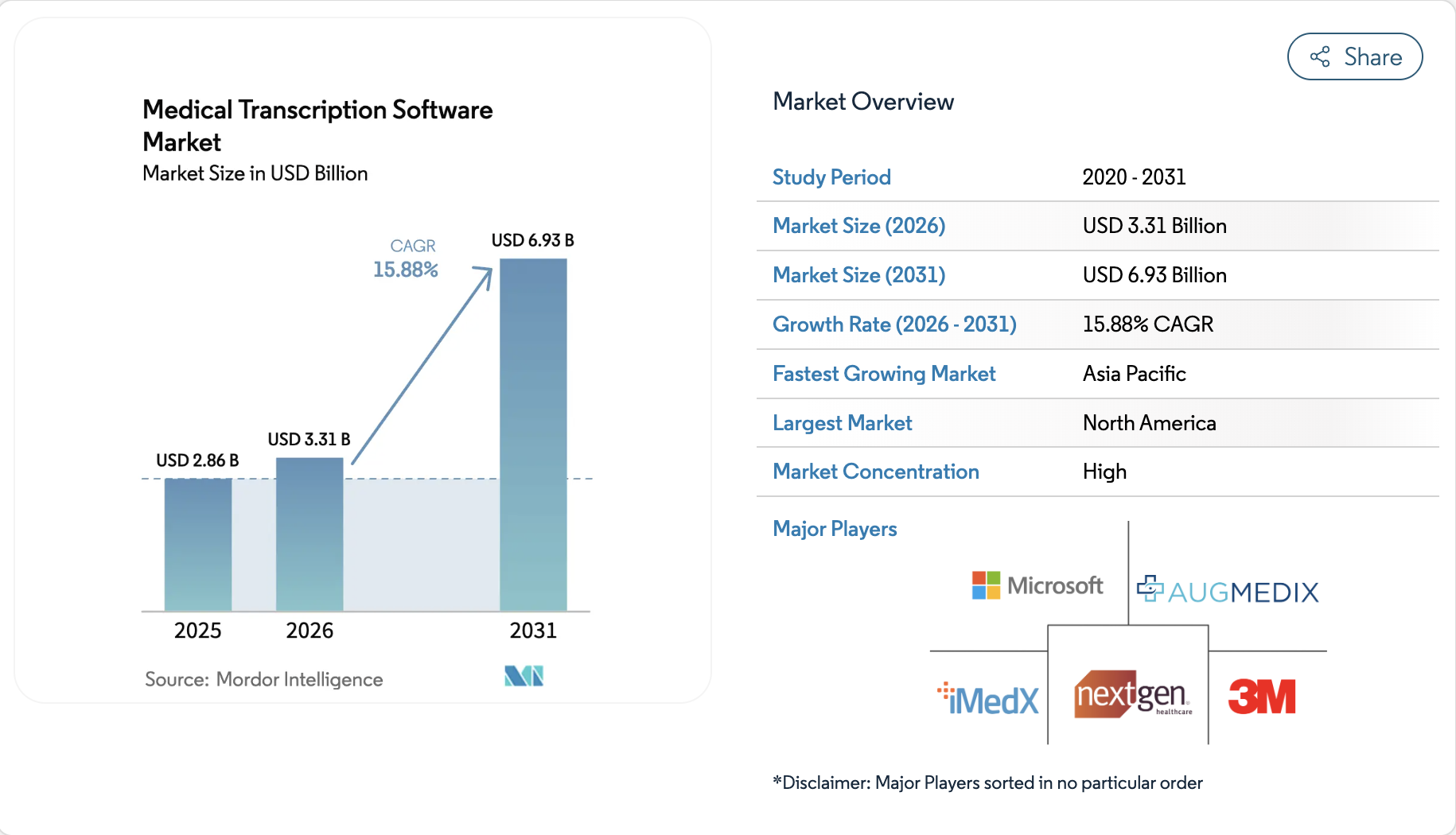
This rapid expansion is moving at a compound annual growth rate (CAGR) of 16.3%, heavily driven by major electronic health record (EHR) integrations. Within this space, ambient AI scribes have become the fastest-growing category:
- Cloud Dominance: Cloud-based software now holds 57% of the market share because it is much easier to scale across multiple hospital buildings.
- Enterprise Demand: Large hospital networks contribute the majority of industry revenue due to their urgent need for real-time, EHR-ready notes.
- Advanced NLP: Modern platforms now embed smart speech recognition tools directly into clinical workflows to stop manual typing.
1. Ambient AI Scribe Market and Adoption
Ambient AI scribes are a true breakout technology category that generated over $600 million in 2025 alone. According to tracking from Becker’s Hospital Review, this software segment is experiencing a massive 2.4x year-over-year growth rate.
Currently, between 30% and 40% of large health systems have deployed ambient tools, including major networks like Kaiser Permanente and UNC Health. For example, Kaiser Permanente successfully provided this AI documentation tool to thousands of active doctors systemwide:
- The technology was used in more than 2.5 million real-world patient encounters within a 14-month period.
- The rollout demonstrated high long-term usage across completely different medical specialties.
- Leading ambient scribe developers raised nearly $1 billion in investor capital in 2025 to meet this soaring enterprise demand.
2. 2026 Statistics for Hospital Leadership
Implementing an ambient AI scribe platform directly creates measurable operational changes for busy medical groups. For instance, data shows that these tools reduce overall documentation costs by 40% to 60% for mid-market practices.
Consequently, this drop saves a typical 75-provider medical practice up to $180,000 every single year. Furthermore, doctors using ambient scribes report a 9.3% increase in same-day appointment closures.
This speed opens up new calendar slots and gives patients much better access to urgent care. Because an estimated 77% of after-hours clinical work is just typing notes, ambient scribes solve a massive burnout problem:
- Clinicians spend far less time typing on their keyboards at home late in the evening.
- Hospitals protect their revenue by dropping clerical costs and reducing doctor turnover.
To summarize, custom ambient scribe platforms are now a strategic requirement for controlling costs and retaining happy doctors. At the same time, early adopters routinely see a total return on investment (ROI) within just 45 days of launching the software.
Ultimately, these systems prove that hospitals can simultaneously improve chart accuracy, protect patient data privacy, and eliminate hours of stressful data entry.
What Does Ambient AI Documentation Do During and After a Visit?
Ambient AI documentation supports the full documentation workflow before, during, and after a patient encounter. It can capture conversation, generate a draft note, support physician edits, create patient instructions, and move the final documentation into the EHR workflow. The goal is faster physician-approved documentation.
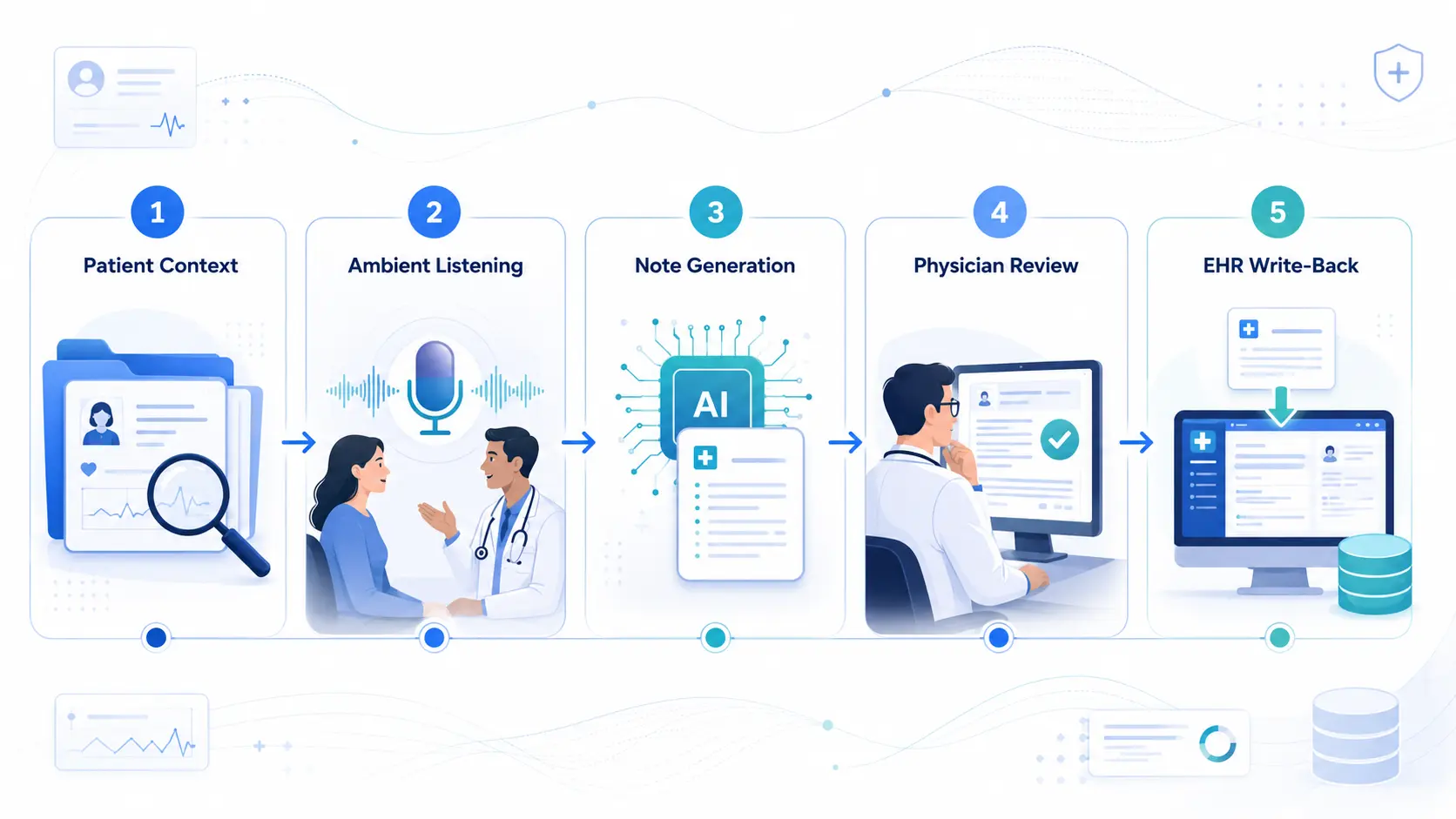
1. Before the Visit — Patient Context Retrieval
The platform can retrieve relevant patient history, medications, prior notes, allergies, problem lists, and care gaps when EHR access is available. Consequently, this step prepares the system with essential background data before the doctor even steps into the examination room:
- RAG patient history retrieval cost: Building Retrieval-Augmented Generation (RAG) pipelines to pull past charts securely.
- Patient context retrieval cost: Connecting the AI to real-time clinical databases safely.
- Data Matching: Aligning past medical files with the upcoming appointment schedule automatically.
2. During the Visit — Ambient Listening and Speaker Separation
The system captures the encounter while the physician speaks naturally with the patient. Therefore, speaker diarization helps separate clinician, patient, caregiver, and interpreter speech perfectly. This stage drives several infrastructure budgets:
- Automatic speech recognition healthcare cost: Paying for cloud-based speech-to-text engines that handle heavy medical terms.
- Medical vocabulary ASR cost: Training the system to recognize complex drug names and rare diseases.
- Real-time transcription cost: Processing live audio streams into text data with low latency.
- Noise cancellation clinical AI cost: Filtering out background sounds like air conditioners or crinkling paper.
3. After the Visit — Clinical Note Generation
The system turns the raw conversation transcript into a highly structured medical note. For instance, it may create SOAP notes, progress notes, consultation notes, discharge summaries, operative notes, or after-visit summaries. This stage drives your core generative budgets:
- NLP clinical note generation cost: Mapping everyday conversation into formal clinical syntax.
- LLM clinical documentation cost: Scaling Large Language Model tokens to parse long patient visits.
- Generative AI note drafting cost: Setting up specific logic to format different types of medical documents.
- Clinical note template training cost: Coding custom templates for specific medical fields like cardiology or pediatrics.
4. Before Signature — Physician Review
The physician reviews, edits, and approves the note before it becomes an official part of the medical record. As a result, this process creates an important safety layer and a valuable feedback loop. This stage involves specific interface budgets:
- Note editing interface cost: Designing clean web or mobile screens where doctors can quickly type changes.
- Physician approval workflow cost: Building secure digital signature buttons that lock the note.
- Human-in-the-loop clinical review cost: Running internal checks to verify text safety and guardrails.
- Documentation feedback loop cost: Saving doctor edits to help the AI learn what to fix next time.
5. After Approval — EHR Export or Write-Back
The approved note can be copied, exported, pushed into an active encounter, or mapped directly into structured fields. However, deeper EHR write-back costs more because patient, provider, encounter, timestamp, and note type must match correctly:
- Copy-Paste Framework: Letting doctors manually move notes with a single click, which costs less to build.
- Direct API Write-Back: Pushing the text directly into database rows via automated background scripts.
- Structured Mapping: Splitting the text note into distinct data fields like billing codes or vital signs.
For a deeper look at how this data moves safely through clinical workflows, check out our guide on how to Build AI-Powered EHR Systems.
The platform touches more than one single moment in the patient visit. That is why your technical cost planning must closely follow the actual clinical workflow, rather than only focusing on the AI model itself.
What You Can Actually Build for $50,000–$150,000
For $50,000–$150,000, you can build a focused ambient AI documentation MVP that captures visit audio, generates clinical notes, supports physician review, protects PHI, and measures documentation time savings.
You should not expect full multi-specialty automation, deep EHR write-back, or custom-trained clinical ASR inside this first budget.
1. $50K–$75K Build — Transcript-to-Note MVP
This basic version proves whether clinicians will actually use AI-generated notes in their daily workflows. Therefore, it focuses entirely on core speech processing and note drafting features:
- Secure Audio Upload: Clinicians use a mobile web app to record and upload visit audio safely.
- Managed ASR & Cleanup: The system uses standard automatic speech recognition healthcare cost APIs to convert speech to text.
- Note Drafting: Simple natural language processing (NLP) models run basic prompt templates to generate a standard SOAP note.
- Simple Review: Doctors get a basic note-editing interface to copy-paste completed notes into their existing charts.
Consequently, this path completely skips expensive EHR write-back integrations to save money. At Intellivon, we use this narrow scope to help clients prove their note quality quickly before spending heavily on advanced cloud features.
2. $75K–$110K Build — Specialty Documentation Pilot
This intermediate version adds specialty-specific template training, physician approval workflows, and significantly better text review controls. Because of these upgrades, it works beautifully for outpatient documentation, behavioral health, specialty follow-ups, or telehealth visits:
- Template Training: The AI learns specific formatting rules for unique fields like progress notes or discharge summaries.
- Advanced Tracking: The platform calculates a documentation feedback loop cost by monitoring exactly how doctors edit their notes.
- Patient Content: The system generates clear after-visit summaries alongside standard clinical note generation tasks.
- ROI Dashboards: Hospital leaders get a clear analytics screen that tracks total documentation time reduction.
Ultimately, our team uses this scope when a healthcare client already understands their target medical workflow. Building custom layouts makes the software much more valuable because it instantly matches how physicians naturally document.
3. $110K–$150K Build — HIPAA-Ready Controlled Release
This advanced version supports a small production pilot with enterprise security controls, audit logs, basic EHR integration, analytics, and deployment support. As a result, it stands as the strongest option for hospitals or health IT companies that need a highly credible internal pilot:
- HIPAA compliance cost ambient AI: The build includes active data encryption and strict role-based access controls.
- PHI protection ambient documentation: Zero-retention data rules ensure patient data disappears immediately after note generation.
- EHR Integration: The platform uses basic FHIR R4 integration documentation cost frameworks to send notes to systems like Epic or Cerner.
- Audit Trails: Automated background logs track every user click to satisfy strict healthcare vendor requirements.
Thus, our practitioners recommend this budget range for teams that want a serious, secure first release. The platform stays tightly focused on one department, but the code is architected to handle massive future expansion.
For a deeper look at how we design advanced data integration layers for healthcare networks, check out our guide on how to analyze 50+ Hospital EHR Integration Platform Costs.
To summarize, this clear price breakdown prevents common enterprise budgeting mistakes. Your first build should never attempt to copy every single feature from massive vendor platforms right away.
Instead, focus your initial investment on proving that your clinicians trust the text quality and that the app successfully cuts down on paperwork time.
What Is Not Included in a $50K–$150K Ambient AI Documentation Build?
A $50K–$150K ambient AI documentation build usually does not include deep EHR write-back, custom ASR training, multi-specialty rollout, on-premise deployment, SOC 2 readiness, or advanced coding automation.
These features require more engineering, validation, infrastructure, and stakeholder coordination than a focused MVP budget can support.
Features Usually Excluded From the First Build
To keep your initial project within a realistic budget, you must avoid expanding your technical goals too quickly. Therefore, the following advanced features are typically pushed to later versions of the platform:
- Full EHR Integrations: Deeply connecting the software to databases like Epic, Cerner, Meditech, or Athenahealth is completely excluded.
- Complex Care Settings: The software will not support multi-specialty workflows, emergency medicine, inpatient settings, or surgical documentation.
- Advanced Image Reports: Automated parsing for specialized fields like radiology or pathology report automation is not included.
- Custom Core AI Models: The budget skips domain-specific clinical LLM training, clinical language model training, and custom speech-to-text models.
- Local Infrastructure: Setting up an on-premises ambient AI cost model or private cloud infrastructure is completely pushed aside.
- Deep Compliance Audits: Achieving enterprise-level SOC 2 compliance and ambient AI readiness requires a separate security budget.
- Billing Code Automation: The first build avoids deep CDI integration, ICD-10 suggestions, and CPT code capture.
Importantly, these excluded features are not unnecessary pieces of software. Instead, they are simply later-stage platform investments that you should make only after your core AI note tool is fully proven.
Fortunately, separating these advanced tools keeps your initial rollout simple and safe. At Intellivon, we always advise clients to map these complex workflows out as a long-term plan rather than building them all at once.
For a deeper look at how to structure these advanced backend hospital connections later on, see our comprehensive guide on how much an EHR integration platform costs.
To summarize, this section protects your development article from overpromising on what a light budget can do. A highly focused initial build can still be incredibly valuable for your medical staff, but tech leaders must know exactly where the first budget ends.
What Drives Ambient AI Documentation Software Development Cost?
Ambient AI documentation software development cost is driven by six structural layers: audio capture, ASR, LLM note generation, specialty templates, EHR integration, and compliance.
Each layer adds explicit development cost because clinical documentation must be highly accurate, instantly reviewable, secure, and usable inside a physician’s real workflow.
Cost Driver Matrix
| Cost Driver | Cost Impact | Why It Matters |
| Audio Capture | Low to medium | Visit audio must be completely clear, legally consented to, and heavily encrypted. |
| ASR | Medium | Difficult medical vocabulary, heavy accents, surgical masks, and room noise affect text accuracy. |
| Speaker Diarization | Medium | The system must flawlessly separate clinician, patient, caregiver, and interpreter speech. |
| LLM Note Generation | Medium to high | Generated notes must be clinically structured, safe, and free from hallucinations. |
| Specialty Templates | Medium | Every medical specialty documents visits differently, using completely unique sentence formats. |
| EHR Integration | Medium to high | Building direct database write-back processes increases baseline cost and system complexity. |
| HIPAA Controls | Medium | Protected health information (PHI) requires military-grade encryption, RBAC, and audit logs. |
| Validation | Medium | Active physicians must fully trust the note text before adopting the app. |
To control your budget, your engineering team must realize that managing speech processing requires careful model routing. For example, a basic automatic speech recognition healthcare cost profile stays low when using standard cloud web APIs. However, the overall ASR model development cost rises quickly when you need to code custom filters:
- Medical Vocabulary: Adding a dedicated medical vocabulary ASR cost to recognize brand-name medications.
- Acoustic Challenges: Factoring in a noise cancellation clinical AI cost to clean up loud background noises.
- Speaker Separation: Budgeting for the speaker diarization cost, the clinical layer to split voices into clean transcripts.
Once the text transcript is clean, the platform routes that data into generative language engines. Consequently, your ongoing operational budget will track your chosen LLM clinical documentation cost parameters. For instance, basic generative AI note drafting cost matrices stay low when processing simple, short outpatient checkups.
Alternatively, running full NLP clinical note generation cost workflows for complex multi-page discharge summaries uses significantly more token data. Tech leads must also account for the human-in-the-loop review cost of the clinical interface to let doctors safely edit text errors before signatures.
For a deeper look at how to structure these data layers securely, see our guide on how to build a custom AI Healthcare Automation Platform.
Ambient AI Documentation Cost Breakdown by Development Phase
A focused ambient AI documentation build costs $50,000–$150,000, depending on scope, integration depth, and clinical validation needs. The first phase should prioritize a usable physician workflow, not a full enterprise platform. Ongoing maintenance usually costs 15%–25% of the initial build per year.
Phase-Wise Cost Table
The table below breaks down the estimated costs for each phase of building an ambient AI documentation platform. These numbers represent standard engineering resource allocations required to create a functional system:
| Development Phase | Estimated Cost |
| Discovery and workflow mapping | $5K–$12K |
| Audio capture and ASR setup | $8K–$25K |
| Transcript processing and diarization | $6K–$18K |
| LLM note generation | $12K–$35K |
| Specialty template training | $8K–$25K |
| Physician review interface | $8K–$22K |
| HIPAA baseline controls | $10K–$30K |
| Light EHR integration or export | $8K–$35K |
| QA and clinical validation | $6K–$20K |
| Pilot analytics and deployment | $5K–$18K |
| Total Estimated Build | $50K–$150K |
Ongoing Maintenance Cost
Annual maintenance usually equals 15%–25% of your initial software build cost. For instance, if your team builds a $100,000 MVP version, you should expect to spend $15,000–$25,000 per year on support.
This recurring operational budget covers several critical technical updates:
- Prompt Updates: Tweaking the AI instructions to keep note formatting crisp.
- Security Patches: Updating cloud code to protect patient records against new threats.
- Model Performance: Monitoring the AI text to stop errors or hallucinations from appearing over time.
To summarize, this phase-by-phase cost table should serve as your main planning tool before kicking off development. It gives your executive team a clear, predictable set of numbers and a practical roadmap to launch a pilot without overbuilding.
Therefore, setting up your budget this way allows you to achieve immediate clinical value while completely avoiding massive, unvetted upfront software licensing fees.
How EHR Integration Changes Ambient Clinical Documentation Platform Cost
EHR integration can keep your ambient clinical documentation platform cost near $50,000 or push it toward $150,000.
The main difference is integration depth. Copy-ready notes cost less, one-way write-back costs more, and structured EHR field mapping requires the most engineering and validation.
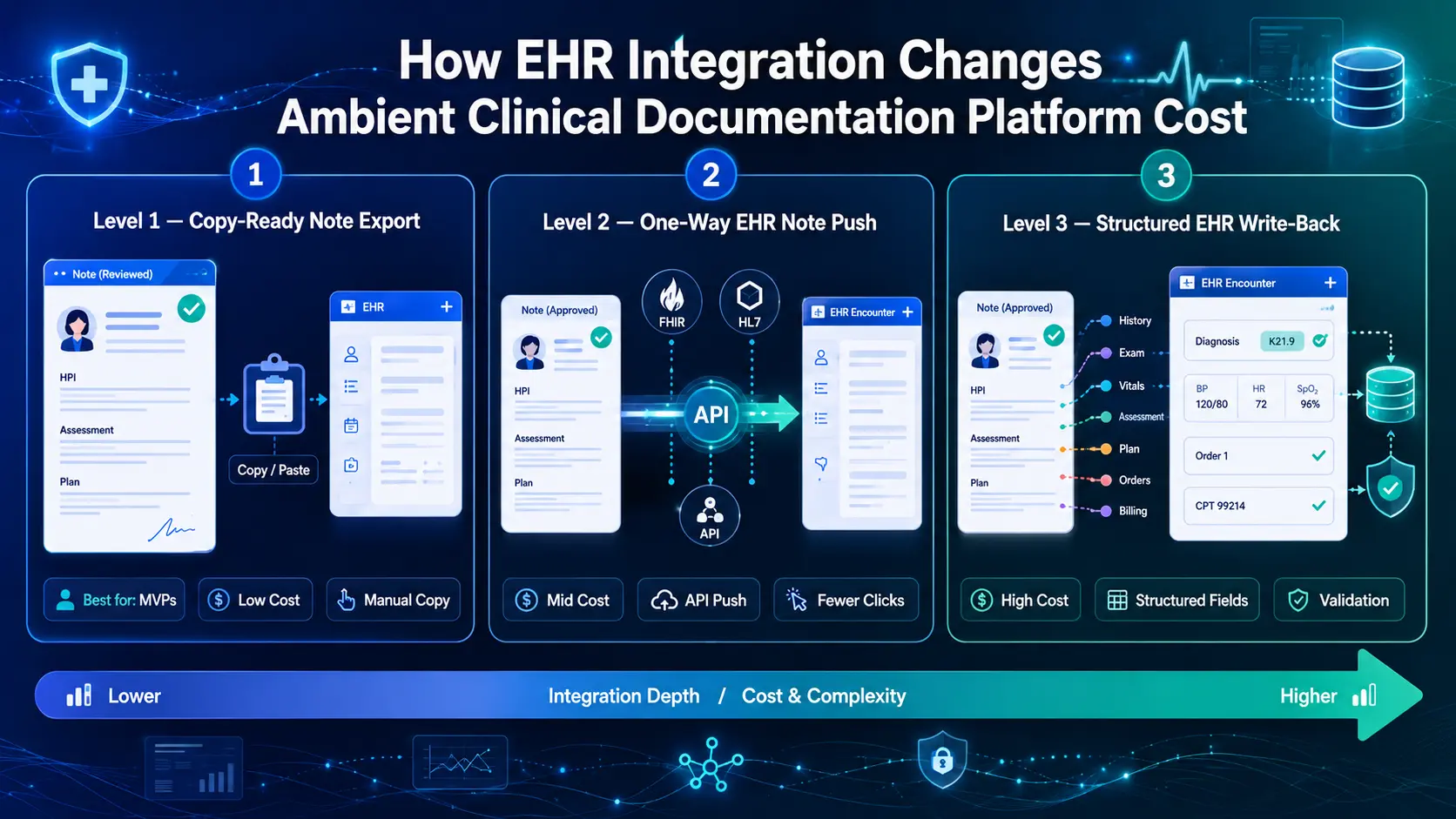
Level 1 — Copy-Ready Note Export
This is the lowest-cost option available for teams operating on a tight timeline or a restrictive initial budget. The AI generates a fully reviewed note that clinicians can simply copy and paste into the EHR.
Consequently, this level entirely avoids complex data mapping and vendor connection fees:
- Best For: Simple MVPs, small practices, early pilots, specialty validation, and low integration budgets.
- Engineering Needs: A basic web interface with a clear “Copy Note” button.
- Security Profiles: Low infrastructure risk because the software does not talk directly to external health record servers.
Level 2 — One-Way EHR Note Push
This intermediate option automatically sends the approved note into the correct patient encounter timeline without manual copy-pasting. It uses modern interoperability standards like FHIR R4, traditional HL7 protocols, or proprietary vendor APIs.
Therefore, this method requires a slightly larger software engineering budget to manage secure connections:
- Best For: Targeted department pilots, scaling health IT products, and controlled production releases.
- Technical Boundaries: Setting up background authentication keys to connect to vendor networks.
- Workflow Impact: Saves doctors multiple daily clicks by centralizing the final document path.
Level 3 — Structured EHR Write-Back
This advanced option maps text data into structured fields, distinct note sections, diagnosis codes, orders, or complex hospital billing workflows. It raises your overall EHR write-back integration cost significantly because the system must match patient, encounter, provider, timestamp, and note type perfectly.
As a result, your team will spend more time on backend data translation layers to prevent data corruption:
- Best For: Massive hospital networks, enterprise platforms, clinical documentation improvement (CDI) workflows, and long-term automation programs.
- Coding Complexities: Splitting sentences into discrete variables like vital signs or specific ICD-10 medical billing codes.
- Validation Overhead: Running long testing cycles to ensure the data drops into the correct electronic chart rows every single time.
For a deeper breakdown of EHR connectivity, see our guide on How to Integrate Ambient Scribes into Epic and Cerner.
The smartest first build often starts with simple note export or light one-way write-back features. Deep database integration should come only after your physicians fully trust the notes and your leadership can see real adoption data.
The Cost Layer Most Buyers Miss
The most overlooked cost layer is converting natural conversation into billable, reviewable, specialty-ready clinical documentation. A transcript simply records what people said during a visit.
A true clinical note must capture what matters, structure it correctly, support insurance coding, and give the physician a safe final review before signature.
1. Why This Layer Matters
Patients speak casually about their symptoms, but clinicians must document those concerns using formal medical terminology. Therefore, your software needs custom backend instructions to parse messy conversations accurately.
Specifically, the AI must convert casual speech into highly structured documents:
- Standard Layouts: Building clear SOAP notes, progress notes, and consultation notes.
- Care Transitions: Drafting structured discharge summaries and operative notes.
- Patient Content: Generating plain-language after-visit summaries and treatment plans.
- Billing Readiness: Organizing assessment and plan sections to support medical codes.
This complex data translation is exactly where your core AI clinical note generation development cost becomes meaningful.
2. What It Adds Technically
To handle this translation layer without causing dangerous text hallucinations, your engineering team must build specific software pipelines. Consequently, these features add direct development hours to your project timeline:
- Language Normalization: Mapping everyday phrases to formal medical vocabulary.
- Section-Aware Generation: Programming the AI to know exactly what belongs in the “Objective” section versus the “Subjective” section.
- Coding Integration: Accounting for an ICD-10 coding suggestion integration cost and a CPT code capture cost in an ambient AI layer.
- Revenue Auditing: Adding an HCC capture documentation cost and a CDI integration ambient AI cost interface to check note quality.
- Safety Workflows: Creating a documentation quality scoring cost script alongside a secure physician approval workflow cost button.
To summarize, neglecting this clinical translation layer is the fastest way to build an app that doctors reject. A basic transcript cannot safely serve as a legal medical chart note. For that reason, tech leaders must dedicate a clear portion of their budget to clinical language structuring and rigorous note verification interfaces.
Ambient AI Documentation: Build vs Buy Cost
Your ambient AI documentation build vs buy cost depends heavily on your clinician count, workflow control needs, EHR strategy, and specialty depth. Buying an existing product is much faster for smaller medical teams.
However, building a custom platform makes more sense when an organization wants owned workflows, total data protection, custom templates, and a lower marginal cost after the initial platform is launched.
1. Build vs Buy Comparison Table
The table below outlines how a custom software build compares directly against a pre-built vendor license over a standard enterprise timeline:
| Factor | Buy Existing Vendor | Build Custom Platform |
| Upfront Cost | Lower initialization fees | Higher initial development cost |
| Monthly Cost | Per-provider subscription seats | Lower ongoing server costs after build |
| Launch Speed | Fast deployment (weeks) | Slower rollout (months) |
| Template Control | Limited by vendor update timelines | Fully customized to your exact layouts |
| EHR Control | Dependent on vendor API agreements | Built directly to your native database flow |
| PHI Governance | Bound by vendor cloud contracts | Full architectural ownership of data rows |
| Best Fit | Speed-focused pilot programs | Owned infrastructure and massive scale |
| Cost Range | Monthly licensing fees per doctor | $50,000 to $150,000 upfront for an MVP |
2. When Buying Makes More Sense
Purchasing a pre-built subscription makes the most sense when your medical team needs a fast pilot, has fewer than 50 active clinicians, or completely lacks internal engineering bandwidth.
It also works perfectly when your primary goal is to simply test physicians’ appetite before funding a major software asset.
When analyzing a build vs Nuance DAX cost profile, or evaluating a build vs Abridge cost tier, you will find that these enterprise vendors typically charge between $200 and $600 per month for every single provider seat. Because of these flat recurring fees, a large rollout can quickly become a massive operational burden:
- Small practices avoid large upfront software engineering fees.
- The system deploys immediately without waiting for custom coding phases.
- Vendors handle basic server maintenance and model updates automatically.
3. When Building Makes More Sense
Alternatively, building a custom platform makes the most sense when your organization requires absolute specialty control, strict internal data governance, custom EHR workflows, or total digital product ownership.
For instance, when you compare a build vs Suki AI cost structure or a build vs Ambience Healthcare cost roadmap across a large health system, the long-term financial math shifts heavily in favor of development.
Over a three-year timeline, licensing fees for hundreds of doctors can easily surpass hundreds of thousands of dollars in recurring overhead. By building a custom platform, you create a permanent software asset that caps your recurring fees, resulting in a much higher custom vs vendor ambient AI ROI as your provider network expands.
How To Reduce Cost Without Weakening Compliance
You can reduce ambient AI documentation cost by narrowing the first workflow, using managed ASR, avoiding deep EHR write-back at the MVP stage, starting with one specialty, and using physician review instead of full automation. At the same time, cost reduction should never remove HIPAA controls, audit logs, or human approval.
1. Start With One Specialty
Focusing on one medical specialty drastically reduces prompt template complexity and validation cost. It also simplifies your clinician feedback loops significantly during the early launch phase.
Therefore, you should avoid building a multi-department platform on day one:
- Primary care and behavioral health make excellent, low-risk starting points.
- Outpatient specialty follow-ups feature highly predictable conversation patterns.
- Limiting your early scope prevents expensive engineering hours spent rewriting complex code.
2. Use Managed ASR First
Your initial ASR model development cost can easily be delayed to protect your budget. Using managed speech-to-text APIs lets your team test core note quality before investing in custom clinical ASR training costs.
Consequently, you avoid high early overhead while still gathering essential operational data:
- Third-party medical speech APIs handle basic accents and drug terms well.
- Your team completely skips upfront server hosting and specialized model training fees.
- You can delay paying an advanced retraining cost clinical ASR bill until your user base scales.
3. Avoid Deep EHR Write-Back at MVP Stage
Building copy-ready note text fields or a light documentation export tool proves real-world clinical value much faster. Deep structured write-back integrations require extensive testing and should only be tackled after user adoption numbers look strong.
As a result, your team can launch the app in weeks instead of months:
- A simple copy-to-clipboard button requires almost zero complex backend configuration.
- You bypass strict vendor security audits that stall early product momentum.
- Engineers can focus on refining AI text generation rather than debugging database errors.
4. Use Template Libraries Before Fine-Tuning
A high cost of LLM fine-tuning clinical notes can easily be completely avoided during your initial rollout. Standard prompt engineering workflows, well-structured text templates, and basic retrieval-augmented generation clinical cost controls are usually more than enough.
Thus, utilizing clever system prompts keeps your core data processing expenses very low:
- Pre-designed Markdown templates help shape messy conversations into clean SOAP notes.
- Engineers can update formatting rules in seconds without rerunning model training cycles.
- Your platform uses far fewer cloud computing tokens, lowering daily operational bills.
5. Keep Human Review Mandatory
Keeping physician approval workflows mandatory prevents unsafe automation errors and minimizes compliance risk. It also naturally creates the exact training data your system needs to improve note generation over time.
Therefore, the app should never try to send text directly into official records without a signature:
- Doctors serve as a final safety shield against unexpected text hallucinations.
- Every manual text edit shows engineers exactly where the AI prompts need adjustments.
- The system maintains a perfect, legally defensible audit trail for healthcare inspectors.
To summarize, the cheapest software build is definitely not always the safest software build. The right cost-reduction strategy protects your baseline data compliance while delaying expensive, complex features until your users fully adopt the platform.
How To Build Ambient AI Documentation Step by Step
To build ambient AI documentation safely, start with one clinical workflow, create the audio and ASR pipeline, generate structured notes with LLMs, add physician review, protect PHI, test accuracy, and deploy in a controlled pilot. Expansion should happen only after adoption and quality metrics improve.
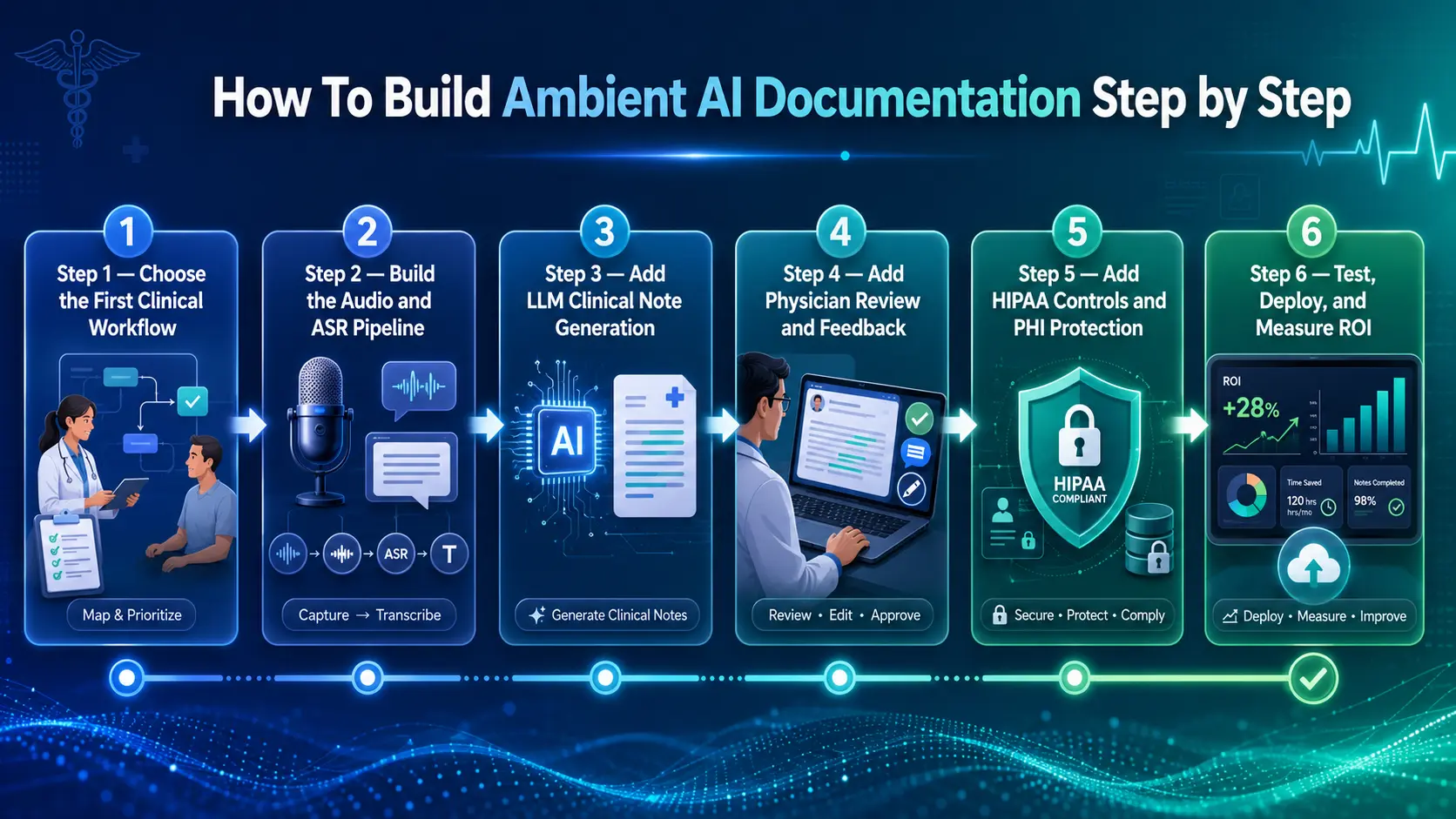
Step 1 — Choose the First Clinical Workflow
The first step is to choose one documentation workflow with high volume and a highly predictable note structure. This calculated focus keeps your initial MVP strictly inside the $50,000–$150,000 cost range and completely avoids early operational complexity.
Therefore, your team must define the clinical targets clearly before writing code:
- Map your target encounter types, note layouts, user permissions, and patient consent rules.
- Decide whether to fund an outpatient documentation AI cost blueprint or a behavioral health documentation AI cost structure.
- Calculate your baseline specialty-specific template cost variables to set accurate milestone goals.
At Intellivon, our practitioners always map the live clinical workflow out entirely before selecting underlying AI models. This practical method ensures the final software build stays firmly grounded in everyday doctor usage.
Step 2 — Build the Audio and ASR Pipeline
The second step is to securely capture patient visit audio and convert it into highly usable text. This engineering phase requires mapping out your audio upload framework, choosing transcription speeds, separating individual speakers, and handling complex medical vocabularies.
Consequently, you must balance user interface needs against your core development expenses:
- Determine if your deployment needs a web application cost ambient AI baseline or a dedicated mobile device integration cost.
- Decide if your target workflow demands a high real-time transcription cost structure or a simpler post-visit transcription cost model.
- Evaluate if your early pilot needs complex wearable microphone integration cost lines or standard multi-device support cost options.
To control expenses, we typically design this speech framework as a highly modular, decoupled software layer. This allows your team to launch fast using basic managed speech APIs while leaving space to add expensive hardware or custom models later.
Step 3 — Add LLM Clinical Note Generation
The third step is to program smart natural language processing tools to translate raw conversation transcripts into structured chart files. This generative layer drives your ongoing token overhead and shapes the final documentation your clinical staff will read.
Thus, your technical development tracking will focus on several key software elements:
- Balance your baseline LLM clinical documentation cost metrics against daily generative AI note drafting cost limits.
- Program the system instructions to handle specific SOAP note generation cost rules or progress note automation cost rules.
- Define the data layout parameters for custom clinical note template training cost metrics.
Our engineers build this particular text layer with strict review-first workflows at the core. The underlying AI drafts the medical note text, but the practicing clinician always remains completely accountable for signing the final record.
Step 4 — Add Physician Review and Feedback
The fourth step is to build a fast, secure physician approval workflow that keeps your automated notes safe. Creating this interface gives your development team direct access to real-world user feedback data.
As a result, your team will dedicate resource hours to building user-friendly editing screens:
- Budget for a clean note-editing interface cost profile that works beautifully on tablets and laptops.
- Account for an active documentation feedback loop cost script to capture how doctors alter text.
- Track your human-in-the-loop review cost and clinical metrics alongside a continuous learning documentation cost budget.
At Intellivon, we use this collected edit data to continuously refine your system prompts and document templates automatically. This strategy effectively turns everyday physician reviews into an automated, long-term product improvement loop.
Step 5 — Add HIPAA Controls and PHI Protection
The fifth step is to lock down all audio recordings, text transcripts, drafted charts, and user activity data. Strict HIPAA compliance controls must be treated as core infrastructure, rather than a security patch you add later.
Therefore, your architectural blueprint must feature military-grade safety protocols from day one:
- Calculate your data encryption ambient AI cost metrics and your role-based access control cost infrastructure.
- Set up a clear audit trail for the clinical documentation system to track every file read and write.
- Enforce absolute PHI protection ambient documentation guidelines to satisfy all vendor BAA requirements.
Our team builds these exact security layers directly into the base system architecture before any real patient data enters the app. Additionally, you can choose to defer a heavy private deployment cost for an ambient AI plan until you scale.
Step 6 — Test, Deploy, and Measure ROI
The final step is to thoroughly test note accuracy, deploy the code to a small pilot group, and measure your financial returns. The ultimate goal is to prove that the AI significantly reduces clerical workloads without reducing patient care safety.
Consequently, your launch team must monitor specific software validation and reporting tools:
- Track your upfront QA testing cost metrics alongside your real-world clinical validation cost and ambient AI hours.
- Build a dedicated documentation analytics dashboard cost interface to show performance data to hospital executives.
- Measure your ongoing time savings, reporting cost models, and your macro ROI measurement of ambient AI cost variables.
To ensure success, our practitioners deploy these custom systems inside highly controlled, department-specific pilot programs. Each localized rollout creates the solid, data-backed evidence your board needs to confidently fund an enterprise-wide expansion.
To summarize, following this structured, step-by-step development pipeline keeps your upfront financial investment safe and manageable. Building the app in logical, validated stages allows you to perfect note accuracy while protecting patient data.
Ultimately, this iterative roadmap ensures you create a highly valuable, custom software asset that your medical staff will actually trust and use daily.
How FDA Status, Clinical Validation, and Liability Shape Cost
Documentation-only ambient tools are not automatically regulated as medical devices because software classification depends completely on intended use and functionality.
1. Documentation and Clinical Decision Support Are Different
While administrative automation operates largely unregulated, adding intelligent analytical features triggers strict oversight from federal authorities:
- Documentation Features: Consequently, functions like multi-speaker transcript capture, text summarization, structural note formatting, physician-reviewed drafting, and basic administrative processing hooks escape intensive medical device classification.
- Decision Support Features: Conversely, tools that actively generate automated diagnosis suggestions, custom therapeutic treatment paths, real-time risk prioritization flags, medication selection assistance, or autonomous EHR order entry alter the platform’s risk profile.
- Regulatory Alignment: Therefore, the FDA’s revised January 2026 Clinical Decision Support Software Guidance outlines that clinician-facing CDS functions can qualify for non-device status or enforcement discretion only if they pass a four-criteria test.
2. Physician Approval Does Not Remove All Liability
Although health systems regularly rely on a clinician’s electronic signature as a final check, this operational workflow does not eliminate corporate exposure to systemic application failures:
- Attestation Risks: Because the signing clinician remains legally responsible for all documented text, hospital networks face significant malpractice litigation risks if inaccurate automated summaries subsequently cause patient harm.
- Text Vulnerabilities: Furthermore, LLM pipelines regularly introduce unverified, unsupported statements, omit critical patient complaints, mix up vital medication details, or apply wrong-speaker attributions.
- Compliance Exposures: As a result, software teams must build dedicated data pipelines to ensure generated notes never contain copied consent language without a real-world validation trail, preventing expensive chart amendment workflows and formal incident investigations.
3. Use Precise Compliance Language
To protect the enterprise from regulatory pushback, product teams must systematically ban deceptive marketing slogans in favor of auditable, legally precise terminology:
- Banned Slogans: Specifically, marketing assets must never utilize unverified phrases like “HIPAA certification,” “100% compliant,” “FDA exempt,” “zero hallucinations,” or “fully autonomous documentation.”
- Approved Terminology: Instead, technical documentation should deploy precise descriptions such as HIPAA-ready controls, BAA-supported infrastructure, SOC 2 Type II report, and HITRUST certification, where obtained.
- Legal Protections: Ultimately, system scoping requires an official FDA intended-use assessment, localized health system legal review, and an explicit framework designating the software strictly as a physician-approved documentation tool.
In short, a safe ambient AI platform must explicitly prove how it behaves through continuous engineering telemetry rather than merely listing static security features. Rigorous clinical validation and algorithmic governance protocols should therefore appear as dedicated line items in the development budget long before the pilot architecture reaches a real patient encounter.
What Current Clinical Evidence Shows About Savings and ROI
Ambient AI documentation shows consistent promise for clinician experience and cognitive burden, but measured documentation-time savings vary by product, workflow, specialty, adoption level, and study design.
1. Randomized Evidence Shows Different Product Outcomes
A formal pragmatic randomized clinical trial published in PMC demonstrated that administrative efficiency fluctuates heavily based on the specific software architecture deployed:
- DAX Copilot Performance: Achieved a marginal 1.7% reduction in time-in-note, a result that was not statistically significant.
- Nabla Performance: Secured a 9.5% reduction in overall time-in-note, establishing a statistically significant outcome ($P=0.02$).
- Secondary Metrics: Both structural solutions delivered valuable baseline improvements in overall physician task load, work exhaustion, and burnout.
2. Multisite Evidence Supports Burnout Reduction
A separate multicenter quality improvement study published in JAMA Network Open tracked clinical infrastructure updates over a 30-day deployment window:
- Cohort Scale: Evaluated 263 active physicians and advanced practice practitioners across six distinct healthcare delivery systems.
- Burnout Deficit: Adjusted multivariable models showed self-reported clinician burnout dropped from 51.9% to 38.8%.
- Workload Metrics: Delivered measurable reductions in cognitive task load along with immediate drops in after-hours documentation hours.
- Methodology Note: This evaluation relied on a pre-post quality-improvement design rather than a randomized product comparison.
3. ROI Must Be Measured Locally
Health systems evaluating ambient AI documentation cost parameters cannot rely solely on generalized vendor marketing sheets:
- Time Metrics: Monitor explicit changes in minutes per encounter, active time in note, and late-night “pajama time” charting.
- Quality Metrics: Track same-day chart closure rates, section-level edit percentage, and automated unsupported-statement rates.
- Volume Metrics: Quantify real-world clinician adoption curves, eligible encounters captured, additional visit capacity, and total Relative Value Units (RVUs).
- System Integrity: Audit administrative denial fluctuations, physician satisfaction indices, and systematic consent failure logs.
4. Edit Burden Is More Useful Than Generation Speed
Evaluating the true cognitive friction of an NLP note generation engine requires moving past superficial speed metrics:
- Correction Realities: An ambient model draft generated in 10 seconds frequently requires up to 10 minutes of manual clean-up.
- Quality Indicators: Tracking section-level Levenshtein edit distance reveals the accurate semantic quality of the underlying model.
- Adoption Gaps: Artificially low physician adoption rates frequently mask poor underlying software execution and layout anomalies.
- Final Accountability: Secure, signed-note precision within the EHR remains vastly more critical than initial text draft speeds.
The enterprise business case for infrastructure adoption should rely entirely on locally measured outcomes rather than the highest vendor statistic available.
Furthermore, achieving clinical value does not remove fundamental regulatory, validation, and malpractice responsibilities from hospital IT leaders.
Build Ambient AI Documentation With Intellivon
At Intellivon, we build ambient AI documentation platforms that help healthcare teams reduce documentation burden, protect PHI, and create physician-approved clinical notes faster.
Our approach connects audio capture, ASR, LLM note generation, specialty templates, HIPAA controls, EHR integration, and analytics into one production-ready workflow.
Why Partner With Intellivon?
- Clinical Workflow-First Development: Every platform is designed around real documentation workflows, note types, physician review steps, and specialty-specific requirements.
- HIPAA-Ready Architecture: We build PHI protection, encryption, access controls, audit logs, and secure deployment into the platform from the first release.
- AI Note Generation That Fits Physicians: Our LLM workflows support SOAP notes, progress notes, after-visit summaries, and specialty documentation that clinicians can review, edit, and approve.
- EHR Integration Without Overbuilding: We help teams start with the right level of integration, from copy-ready note export to light EHR write-back and future structured data mapping.
- Measurable ROI Dashboards: We design analytics for documentation time saved, physician edit volume, note closure speed, adoption, and pilot performance.
- Built for Expansion: Your first build can focus on one workflow, while the architecture stays ready for new specialties, deeper EHR integration, and advanced MLOps.
Book a strategy session with Intellivon today and explore how we can build a $50K–$150K ambient AI documentation MVP that reduces physician documentation burden while staying secure, compliant, and ready to scale.
Conclusion
Ambient AI documentation cost makes the most sense when tied to the first usable build. A focused MVP usually costs $50,000 to $150,000, depending on ASR, LLM note generation, physician review, HIPAA controls, and EHR integration.
Therefore, teams should start with one workflow, prove note quality, and measure adoption. After that, they can expand when clinical value, cost savings, and rollout readiness are clear before funding the next investment phase.
Things To Know About Ambient AI Documentation Cost
Q1. How much does ambient AI documentation cost?
A1. Ambient AI documentation cost usually ranges from $50,000 to $150,000 for a focused MVP or first controlled production build. The lower end covers transcript-to-note workflows. However, the higher end adds specialty templates, physician review, HIPAA controls, analytics, and light EHR integration, which makes the pilot safer and more clinically usable.
Q2. Can I build an AI medical scribe for under $100,000?
A2. Yes, you can build an AI medical scribe for under $100,000 when the scope stays narrow. For example, an under-$100K build can use managed ASR, one specialty, basic LLM note generation, copy-ready EHR export, and physician review. However, deep EHR write-back usually moves the budget higher.
Q3. How much does ambient AI documentation software development cost with EHR integration?
A3. Ambient AI documentation software development cost with light EHR integration usually falls near $90,000 to $150,000. Copy-ready note export costs less because it avoids deep system mapping. However, one-way EHR note push costs more, while structured Epic or Cerner write-back usually needs a separate integration budget.
Q4. What affects AI medical scribe development cost the most?
A4. AI medical scribe development cost is affected most by ASR accuracy, specialty templates, LLM note quality, physician review, HIPAA controls, and EHR integration. In addition, custom ASR training, multi-specialty support, private deployment, and coding automation increase cost because they require deeper engineering, testing, and clinical validation.
Q5. What is ambient AI documentation total cost of ownership?
A5. Ambient AI documentation total cost of ownership includes the initial $50,000 to $150,000 build, annual maintenance, ASR usage, LLM inference, cloud hosting, security updates, template improvements, support, and future integration work. Therefore, teams should budget annual maintenance at 15% to 25% of the initial build.
To Sum Up:
- A $50K ambient documentation build can prove transcript-to-note value, but it should not promise deep EHR write-back.
- The highest hidden cost is not transcription. It is turning conversation into signed, billable, specialty-ready documentation.
- Managed ASR and copy-ready notes are the fastest way to keep the first build under $100K.
- Physician edit volume is one of the best ROI signals because it shows whether AI actually reduced documentation work.
- Custom development becomes more attractive when vendor licensing grows across many clinicians and specialties.