Key Takeaways:
-
Agentic decision platforms coordinate AI models, business rules, data, tools, human approvals, and audit evidence together.
-
Leading options include custom partners, code-first frameworks like LangGraph and CrewAI, and managed cloud runtimes.
-
Deterministic policy gates, replayable traces, controlled tool permissions, and human escalation define regulated-industry requirements.
-
Production systems cost $70,000 to $300,000 and take 10 to 32 weeks, depending on complexity.
-
How Intellivon builds agentic decision platforms with HIPAA, DORA, and financial model-risk controls built into the architecture.
The agentic decision platform landscape splits into open-source frameworks, enterprise platforms, and custom-built partners. Each category serves a different use case and carries a different production readiness profile for regulated industries. At the same time, open-source frameworks like LangChain build fast but require significant additional engineering for governance and compliance. However, commercial platforms handle deployment better but constrain the custom decision logic that regulated industries need.
The evaluation criterion most comparison guides miss is production readiness for regulated environments, not feature richness. Consequently, governance barriers are the main reason agentic systems fail to reach production after platform selection. Gartner projects that over 40% of agentic AI projects will be canceled by 2027 due to weak governance. Platform selection is therefore what determines which side of that statistic an organization lands on.
This guide ranks the leading agentic decision platforms with Intellivon first for regulated production environments. Accordingly, this blog evaluates each platform against production readiness, governance capability, and compliance posture.
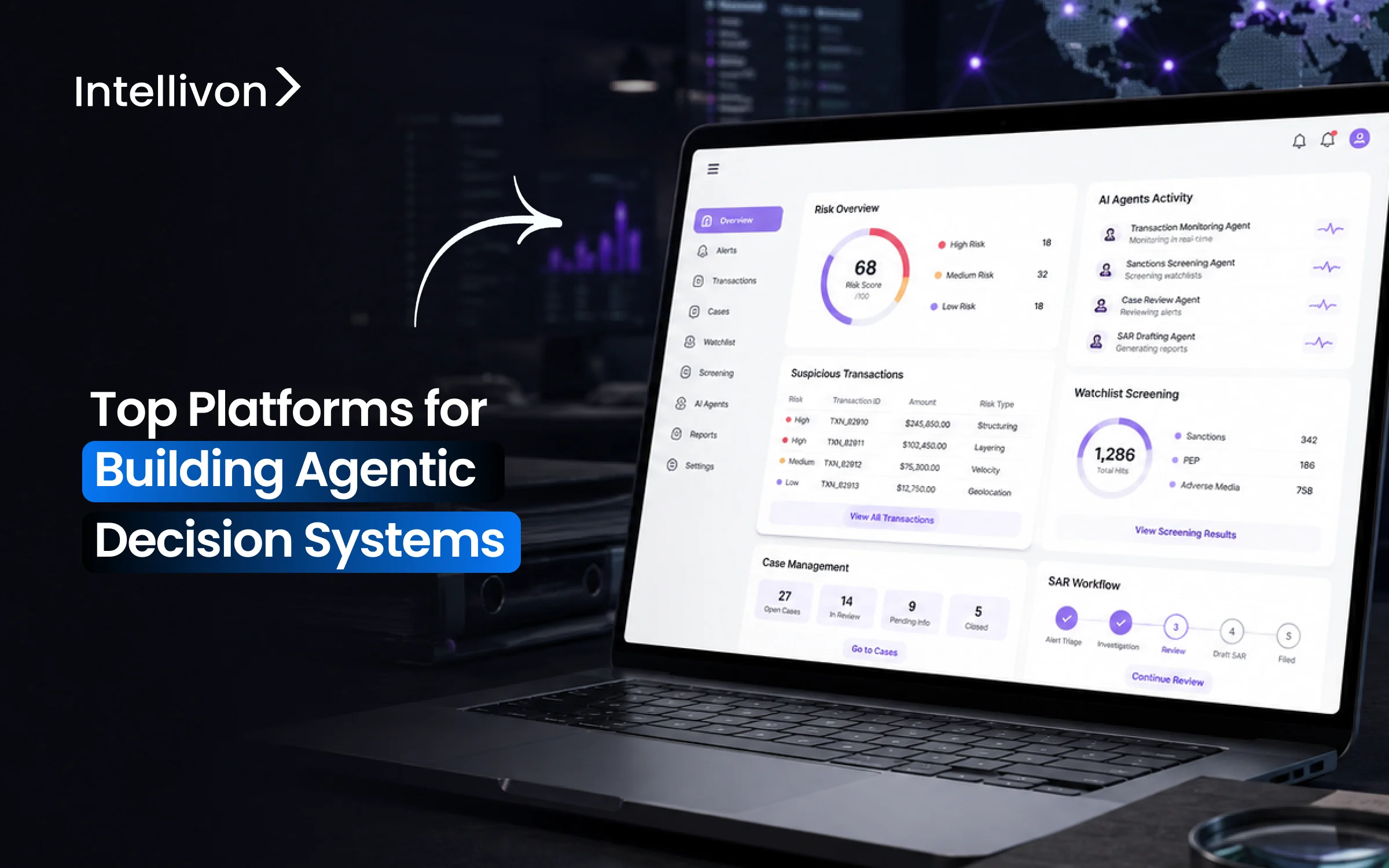
What Is an Agentic Decision Platform and Why Does It Matter?
An agentic decision platform orchestrates AI models, business rules, enterprise data, tools, human approvals, and audit evidence around specific operational decisions. Unlike standalone assistants, it maintains state across complex workflows to determine when the system may recommend, prepare, approve, escalate, or execute high-value transactions.
Consequently, enterprise infrastructure is shifting from simple automation to autonomous, compliant operations.
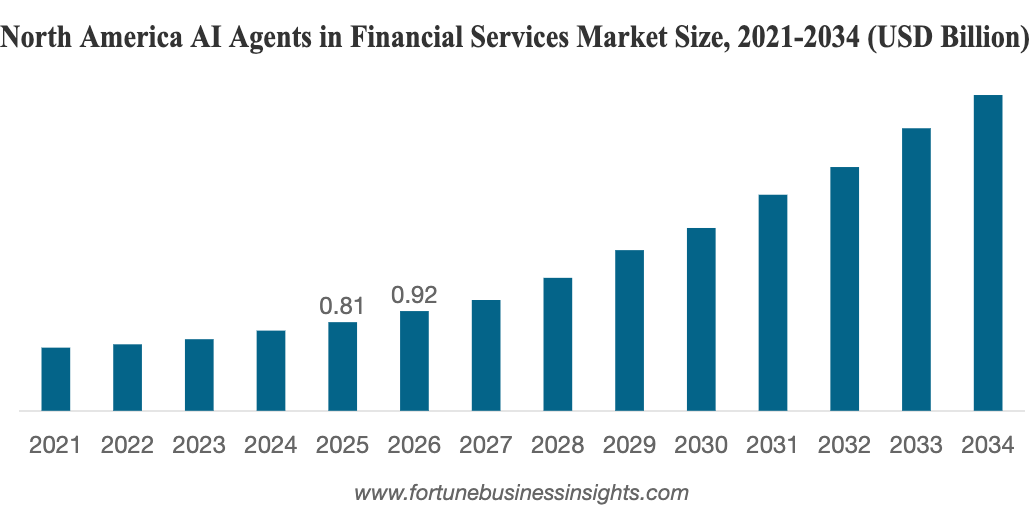
Enterprise technology teams are rapidly scaling their infrastructure to support autonomous workflows. Consequently, the global agentic decision platform market is projected to surge from $7.6 billion to roughly $10.8 billion. Furthermore, Gartner expects 40% of enterprise software applications to natively integrate task-specific AI agents.
1. How Goal-Directed Agents Turn Evidence Into Decisions
Goal-directed systems translate abstract business objectives into predictable outcomes by running a structured, multi-step execution loop. For example, in prior authorization or credit underwriting workflows, the platform runs the following lifecycle:
- Ingestion: Receives an operational objective and identifies required data points.
- Retrieval: Extracts structured records and unstructured evidence using semantic retrieval pipelines.
- Decomposition: Breaks the decision into distinct tasks for specialized planning agents.
- Execution: Applies deterministic business rules, calculates recommendations, and either executes the action or escalates it to human reviewers.
Consequently, every single decision step remains completely traceable, repeatable, and verifiable for compliance officers.
2. Why Decision Platforms Need Rules Beyond Orchestration
Orchestration controls the sequence of work, but it does not determine whether an action is legally, clinically, or financially permitted. Therefore, critical boundaries must exist outside of volatile model prompts:
- Prompt Isolation: Core eligibility rules, credit policies, and clinical criteria must live in hard-coded validation layers rather than prompt text to prevent model drift.
- Operational Gates: Transaction limits, jurisdiction rules, and approval thresholds must be governed by relational databases.
- Compliance Checks: Effective policy dates and segregation of duties must remain cryptographically verifiable.
We prioritize building explicit, programmatic validation gates that sit directly between agent workflows and production networks. For a deeper breakdown of building secure compliance frameworks, see our guide on Enterprise AI Development Frameworks.
How We Ranked the Top Agentic Decision System Platforms for Buyers
Evaluating an agentic decision platform requires looking past basic model access, agent counts, or simple demo speeds. Instead, a rigorous ranking framework must measure whether each option reliably supports controlled decisions, enterprise integration, human approval, and secure deployment.
Consequently, the scoring system focuses heavily on predictable production stability rather than superficial platform features.
1. Decision Governance and Human Approval Carry a 20% Weight
- Approval Gates: The platform must support explicit human-in-the-loop validation steps before triggering high-risk corporate actions.
- Audit Records: Systems must generate immutable audit logs that clearly separate model reasoning from deterministic policy decisions.
- Authority Controls: Infrastructure must enforce strict segregation of duties and authority thresholds across all autonomous steps.
2. Orchestration and Failure Recovery Carry a 15% Weight
- Stateful Workflows: Platforms must maintain reliable state checkpoints across long-running tasks and parallel execution sequences.
- Failure Recovery: The framework must provide native retry logic, pause-and-resume capabilities, and automated workflow replay features.
- Rollback Capabilities: Engineering teams need the ability to rollback failed multi-agent states without corrupting peripheral data systems.
3. Integration, Security, and Compliance Carry a 30% Weight
- Core Connectivity: Platforms require secure enterprise API adapters for legacy transactional networks and core data layers.
- Zero-Trust Security: Security architectures must mandate strict role-based access control (RBAC), end-to-end encryption, and private VPC deployment options.
- Regulatory Compliance: Systems must natively adapt to strict regulatory standards, including HIPAA, GDPR, SR 11-7, and FFIEC frameworks.
4. Models, RAG, and Memory Flexibility Carry a 15% Weight
- Model Independence: Platforms must allow seamless routing between commercial APIs and fine-tuned open-source language models.
- Memory Architectures: Frameworks need dedicated short-term, episodic, and semantic memory layers for persistent context control.
- Structured Retrieval: Systems must reliably combine vector searches with traditional structured database queries.
Ultimately, no single tool wins every category because architecture requires intentional trade-offs. Therefore, each upcoming platform profile details its specific structural advantage, primary limitations, and ideal enterprise buyer. This evaluation forms the baseline for analyzing the broader technology market.
Top Platforms for Building Enterprise Agentic Decision Systems
The selection criteria for a production-grade agentic decision platform must look past basic model access, agent counts, or simple demo speeds. Instead, enterprise buyers require framework stability, rigorous human governance, structural data isolation, and auditable failure recovery.
Consequently, this evaluation focuses directly on how each framework handles real-world transactional infrastructure and strict compliance demands.
For organizations seeking an end-to-end engineered system across architecture, enterprise interfaces, core systems integration, and automated testing, a custom development partner like Intellivon delivers complete production-ready solutions.
1. LangGraph and LangSmith: Best for Stateful Agent Orchestration
LangGraph delivers highly durable, graph-based execution control designed for complex multi-agent workflows that require persistent state tracking. Consequently, it has become the standard framework for technical teams building long-running corporate decision systems.
The system models processes as cyclic graphs, which allow agents to iterate on information loops until specific exit criteria are met.
- Durable Orchestration: Built-in persistence layers capture state checkpoints automatically after every single agent node execution.
- Human Interrupts: Native pause-and-resume mechanics allow the runtime to wait for manual corporate approvals before running transactional operations.
- Observability Integration: LangSmith provides immediate visibility via deep OpenTelemetry tracing, regression testing, and production prompt management.
The primary limitation of LangGraph is its lack of built-in business guardrails or specialized data management engines. Therefore, development teams must manually code their own policy layers, compliance ledger tools, and end-user enterprise interfaces.
Choose the LangGraph stack when your engineering team requires absolute, low-level control over graph state topologies, stateful multi-agent communication, and deep system tracing rather than a low-code out-of-the-box runtime.
2. Microsoft Agent Framework: Best for Azure Enterprise Workflows
The Microsoft Agent Framework stands as the unified, production-ready successor to both AutoGen and Semantic Kernel. It blends AutoGen’s dynamic multi-agent conversation patterns with Semantic Kernel’s type-safe telemetry and middleware infrastructure.
As a result, it provides .NET and Python engineering teams with a robust foundation for building secure enterprise-grade automated systems.
- Stateful Agent Harness: The framework features a native execution harness that manages shell operations, file systems, and token compaction.
- Azure Foundry Integration: The platform supports scale-to-zero serverless hosting, allowing idle background agents to consume zero active compute budget.
- Type-Safe Middleware: Programmatic interceptors allow developers to inject deterministic validation logic directly into the agent communication layer.
However, the framework introduces strong architectural alignment with the Azure cloud ecosystem and Entra ID authentication systems. Consequently, teams utilizing alternative cloud vendors will face significant infrastructure mapping friction during initial deployment pipelines.
Choose the Microsoft Agent Framework if your enterprise infrastructure is anchored in the Azure ecosystem, relies heavily on .NET backend codebases, and mandates native integration with Microsoft data fabrics.
3. Google ADK and Gemini Agent Platform: Best for GCP Workflows
The Gemini Enterprise Agent Platform, built on the evolution of Vertex AI Agent Builder and Vertex AI Agent Engine, provides a managed runtime optimized for multimodal reasoning tasks.
Supported by the code-first Agent Development Kit (ADK), it enables developers to rapidly assemble collaborative agent graphs within Google Cloud.
Therefore, it excels at processing mixed-media evidence streams like medical imaging or scanned corporate financial ledgers.
- Agent Development Kit: Programmatic Python APIs allow engineering teams to declare custom tools, set up sessions, and structure multi-agent networks.
- Sub-Second Scaling: The underlying Agent Runtime provides sub-second cold starts for rapid scaling during volatile transactional volume spikes.
- Memory Bank Architecture: The platform utilizes dedicated context layers to securely persist user data and historical execution traces across disjointed sessions.
Because this platform functions primarily as an infrastructure runtime, it does not supply out-of-the-box domain compliance packages. As a result, enterprise buyers must still build their own validation engines to handle industry-specific rules like clinical guidelines or financial underwriting laws.
Choose the Google ADK infrastructure when your application requires native Gemini model performance, multimodal ingestion pipelines, and managed GCP container scalability.
4. Amazon Bedrock AgentCore: Best for AWS Agent Infrastructure
Amazon Bedrock AgentCore provides a highly secure, serverless infrastructure runtime engineered to host framework-independent AI agents at scale. The platform isolates execution sessions inside secure boundaries while providing native connectivity to the broader AWS ecosystem.
Consequently, it reduces the DevOps burden of managing large clusters of autonomous containers manually.
- AgentCore Gateway: Enforces natural language boundaries by translating operational guidelines into deterministic Cedar access policies.
- Managed Knowledge Base: Uses an intelligent agentic retriever that plans multi-part queries across scattered data lakes like S3, SharePoint, and Confluence.
- Session Isolation: Every agent process runs inside a distinct, secure sandbox to prevent cross-tenant data leakage in multi-tenant SaaS environments.
While AgentCore simplifies cloud operations, it provides limited high-level business logic tools or audit interfaces. Enterprises will need to build external software layers to capture compliance evidence, manage user workflows, and display detailed decision audit trails.
Choose Amazon Bedrock AgentCore when your system architecture demands zero-trust session isolation, native AWS IAM security, and hands-off serverless scaling.
5. OpenAI Agents SDK: Best for OpenAI-Native Agent Workflows
The OpenAI Agents SDK is a minimalist, model-native orchestration framework evolved from the experimental Swarm blueprint. It specializes in coordinate-based workflows driven by fluid agent-to-agent handoffs and direct function calling. Therefore, it allows developers to build low-latency transactional systems centered on the GPT-4o model family.
- Native Handoffs: Built-in primitives allow individual specialist agents to seamlessly pass execution control to another agent mid-session.
- Minimalist Architecture: Avoids heavy graph abstractions by treating agents simply as instruction-driven entities equipped with tool loops.
- Model Context Protocol: Includes native MCP client connectivity, enabling swift integration with external databases and development environments.
However, the SDK lacks built-in vector memory, long-term persistence structures, or advanced deployment controls. Consequently, engineers must write custom code to scale these lightweight components into permanent, production-grade enterprise backends.
Choose the OpenAI Agents SDK if your system logic is built around OpenAI model patterns, fast agent handoffs, and direct tool loops without complex graph state requirements.
How Much Does an Agentic Decision Platform Cost to Build in 2026?
An agentic decision platform usually costs $70,000 to $300,000, depending on workflow complexity, agent authority, integrations, model requirements, data quality, compliance scope, deployment architecture, and validation depth.
Disclaimer: These figures serve as Intellivon editorial planning ranges rather than universal vendor prices, reflecting our actual delivery footprints for specialized agentic anti-money laundering (AML) and clinical loan-origination environments.
Consequently, budgeting requires understanding the distinct phases and deployment tiers that drive total investment up or down.
To help software engineering leaders evaluate their resource planning, the tables below outline the technical phase breakdowns and overall production tiers required to deploy an enterprise-grade agentic decision system.
1. Development Phase Budget Breakdown
| Development Phase | Cost Range | Key Architectural & Engineering Inclusions |
| Discovery & Workflow Mapping | $5,000–$15,000 | Decision inventory mapping, action authority matrix, baseline metric definitions, and initial risk assessment. |
| Architecture, Security & Governance | $8,000–$25,000 | Reference architecture, control-plane design, policy isolation architecture, threat modeling, and compliance mapping. |
| Agent & Orchestration Development | $20,000–$70,000 | Graph workflow topology, state persistence, handoff boundaries, model routing logic, human interrupts, and error recovery. |
| RAG, Data & Enterprise Integrations | $15,000–$55,000 | Semantic retrieval pipelines, vector storage integration, short/long-term memory engines, and core legacy API wrappers. |
| Testing, Audit Controls & Deployment | $12,000–$45,000 | Golden dataset evaluation, automated red-teaming, immutable audit trail generation, CI/CD pipelines, and hardening. |
2. Enterprise Platform Implementation Tiers
| Implementation Tier | Total Cost Range | Targeted Capabilities & Production Scope |
| Focused Agentic Decision MVP | $70,000–$110,000 | Single workflow, 1-2 coordinated agents, 2-3 standard integrations, basic RAG, human-approved actions, and base tracing. |
| Production Agentic Platform | $120,000–$210,000 | Multi-agent network, 5+ core system integrations, decoupled policy engine, human review queues, and full observability. |
| Regulated Enterprise Platform | $220,000–$300,000 | Multiple regulated workflows, complex legacy environments, private VPC hosting, validation support, and multi-region resilience. |
3. Post-Deployment Operational Costs
Annual platform maintenance typically demands 15% to 25% of the initial development cost per year. This ongoing investment covers continuous model evaluation, regulatory policy shifts, API integration updates, cloud monitoring, security regression tests, and model migration engineering.
Furthermore, enterprises must track independent variable costs separately:
- Model Ingestion: Ongoing model token volume consumption (such as GPT-4o or Claude 3.5 API calls).
- Cloud Infrastructure: Private container orchestration runtimes and dedicated vector database clusters.
- Data & Observability: Production observability licensing (e.g., LangSmith, Datadog) and third-party data validation fees.
Ultimately, a lower initial framework license often hides substantial internal engineering and custom integration costs down the road. Conversely, heavily managed platforms may reduce early operational tasks but significantly increase your long-term vendor dependency risks.
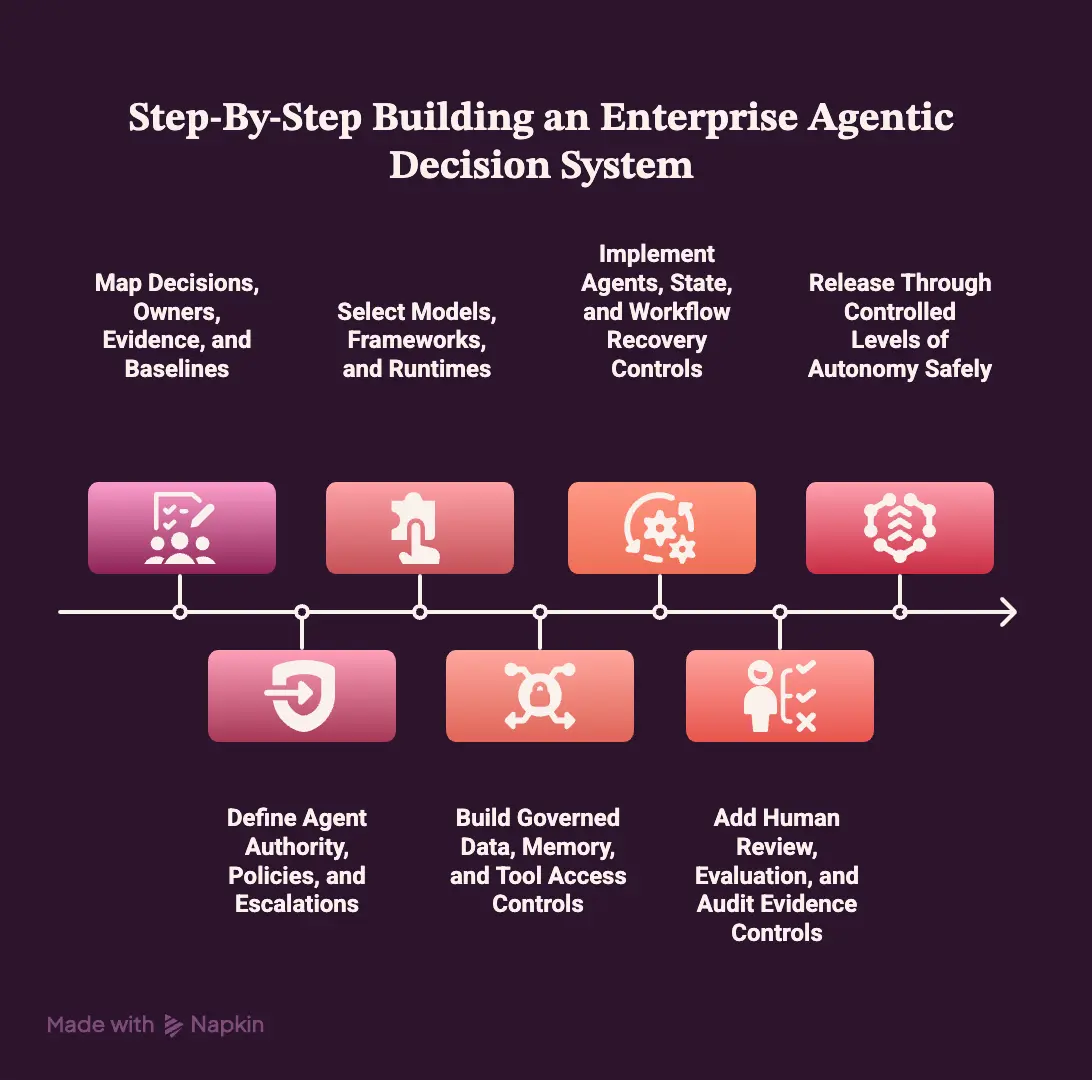
Building an Enterprise Agentic Decision System Step-By-Step
An agentic decision platform translates unstructured operational evidence into highly controlled, deterministic business transactions.
Unlike basic generative chatbots, these production-grade architectures isolate dangerous model outputs from core databases by enforcing strict execution governance, decoupled compliance guardrails, and immutable audit ledgers.
Phase One: Map Decisions, Owners, Evidence, and Baselines
Start by defining the business decision, its accountable owner, the evidence available at decision time, and the measurable cost of the current process. Consequently, engineering teams can establish a concrete performance baseline before writing code. This mapping phase isolates operational variables from the core system design.
- Workflow Mapping: Document the input-output paths, decision frequency, turnaround times, and specific systems of record.
- Value Definition: Calculate the exact financial cost of errors, define target business values, and identify affected operational users.
Intellivon begins with a thorough decision inventory before selecting models, tools, or agent frameworks. This baseline data allows the team to define exactly how much authority the future system should receive.
Phase Two: Define Agent Authority, Policies, and Escalations
Define whether each agent may recommend, prepare, request approval, execute a reversible action, or perform a material system change. Setting these explicit operational bounds prevents autonomous drift inside live environments. As a result, cognitive models remain confined to safe execution paths.
- Authority Scaling: Create strict authority tiers, configure prohibited actions, and enforce clear transaction limits.
- Escalation Logic: Map specific evidence requirements, designate manual approval owners, and script deterministic timeout behaviors.
Intellivon converts these requirements into an explicit decision contract connecting every action to a policy, permission, and accountable reviewer. This architectural barrier ensures compliance monitoring remains completely decoupled from model code. Consequently, the decision contract becomes the foundation for platform selection.
Phase Three: Select Models, Frameworks, and Runtimes
Select the stack only after understanding state, integrations, authority, compliance, latency, and operating requirements. Choosing an orchestration platform prematurely often introduces severe vendor lock-in risks. Technical teams should evaluate performance capabilities against long-term maintenance budgets.
- Ecosystem Verification: Shortlist two choices, run a proof of architecture, and test long-term state persistence mechanics.
- TCO Modeling: Review product lifecycles, estimate total ownership costs, and document clear model migration pathways.
Intellivon selects an established framework, managed runtime, model SDK, or custom orchestration layer based on the decision-risk profile.
For an analysis of custom infrastructure design, see our guide on Custom AI Solutions Development. The chosen platform must connect to governed data and restricted enterprise tools.
Phase Four: Build Governed Data, Memory, and Tool Access Controls
Agents should access validated data and narrowly scoped tools through controlled services rather than connecting directly to enterprise systems. Building isolated proxy abstraction layers protects sensitive transactional cores from erratic model outputs. Therefore, security teams can enforce zero-trust policies at the container boundary.
- Proxy Engineering: Build semantic retrieval pipelines, introduce rigid schema validation, and create secure API wrappers.
- Session Guarding: Configure data encryption, separate read-write access tokens, and enforce strict, contextual memory limits.
Intellivon keeps data, memory, policy, and tool layers independently testable. This modularity ensures engineers can update peripheral enterprise systems without breaking the primary multi-agent workflow graph. The governed foundation now supports controlled agent implementation.
Phase Five: Implement Agents, State, and Workflow Recovery Controls
Build the smallest number of agents required to complete the decision reliably and preserve clear responsibility. Minimizing agent counts reduces runtime latency and simplifies production debug streams. Consequently, developers can trace failure points without parsing complex agent-to-agent conversational feedback loops.
- State Graph Execution: Map narrow system roles, establish workflow states, and configure resilient agent handoffs.
- Fault Management: Store state checkpoints, apply hard retry limits, prevent recursive loops, and define compensating actions.
Intellivon starts with one tool-using agent and adds specialist agents only when separation improves security, evaluation, or scalability. This lean approach maintains predictable system states during heavy transaction volumes. The workflow must now expose decisions and evidence to qualified reviewers.
Phase Six: Add Human Review, Evaluation, and Audit Evidence Controls
Human reviewers need enough evidence to approve, reject, correct, or escalate the proposed action without recreating the entire investigation. Providing isolated context windows allows operators to verify complex reasoning paths efficiently. As a result, organizations maintain reliable human oversight over automated chains.
- Review Interface Design: Build interactive review queues, display core evidence flags, and expose the active policies applied.
- Audit Logging: Capture manual correction steps, record explicit override reasons, and pipe operational telemetry to LangSmith.
Intellivon designs review screens around evidence and policy, not a context-free approve-or-reject button. This ensures human interactions generate rich, auditable feedback datasets for continuous offline evaluation. The tested system can now progress through controlled production authority levels.
Phase Seven: Release Through Controlled Levels of Autonomy Safely
Increase agent authority only after the system meets measurable reliability, safety, cost, and recovery thresholds at the previous level. Phased deployment models significantly minimize systemic operational exposure during initial go-live pipelines. Therefore, teams can safely monitor live system performance against rigid service level objectives.
- Autonomy Hardening: Execute historical database replays, configure shadow modes, and restrict early rollouts to recommendation-only pipelines.
- Drift Monitoring: Define platform SLOs, configure rapid rollback toggles, and assign dedicated incident response owners.
Intellivon ties production gates to measurable decision quality, policy safety, tool accuracy, operating cost, and recovery performance. This disciplined validation methodology guarantees that autonomous execution scales safely within volatile enterprise parameters.
Success requires focusing on state persistence, data governance proxy layers, and strict authority controls rather than model size alone. Ultimately, decoupling your business policy engine from volatile prompt code is the only way to prevent autonomous operational drift.
Build a Production-Grade Agentic Decision Platform With Intellivon
Deploying a production-grade agentic decision platform with Intellivon ensures your organization moves far beyond fragile prototypes or preconfigured software bots.
We engineer dedicated decision architectures, deterministic policy controls, human-in-the-loop validation queues, and isolated enterprise data integrations specifically for highly regulated environments.
Consequently, your operational infrastructure achieves autonomous scale without compromising safety or regulatory compliance.
Our engineering methodology balances fluid multi-agent reasoning with the rigid structural governance that enterprise CTOs and risk officers demand.
1. Map Decision Authority First Before Choosing Frameworks
- Decision Inventory Audits: Document operational workflows, identify human process owners, and catalog necessary structured and unstructured evidence streams.
- Authority Matrices: Configure strict authority boundaries, clear financial transaction limits, and multi-tier operational risk classifications.
- Metric Baselines: Establish clear post-deployment success metrics, return-on-investment calculations, and rigorous business case validation strategies.
We prioritize mapping this functional blueprint before writing code or selecting runtime environments. This foundational structure ensures your business rules remain completely isolated from volatile language model prompts.
2. Build Governed Agent Workflows Securely Around Enterprise Systems
- Decoupled Policy Engines: Construct deterministic verification gates that evaluate agent behaviors against rigid compliance databases.
- Isolated Tool Gateways: Build secure API proxy wrappers to safely bridge autonomous graphs with core banking networks, ERP databases, or EHR systems.
- Persistent Context Fabrics: Deploy dedicated short-term, semantic, and episodic memory layers to maintain state across long-running transactional tasks.
Our architecture ensures that agents interact with critical systems of record only through controlled, token-validated microservices. Therefore, your core transactional databases remain entirely insulated from unpredictable model behaviors.
3. Validate Security, Compliance, and Production Performance at Scale
- Automated Red Teaming: Subject multi-agent conversational pipelines to adversarial injection testing and hallucination stress checks.
- Golden Dataset Evaluation: Run continuous regression tests using real-world operational histories to score output predictability.
- Performance Benchmarking: Optimize runtime latency spikes, compute costs, and automated exception compensation flows.
This exhaustive validation phase ensures your autonomous workflows generate clean, immutable audit evidence records for external compliance reviews.
4. Deploy With Monitoring, Human Review, and Clear Team Ownership
- Phased Automation Releases: Transition smoothly from offline historical replays into live shadow modes and recommendation-only pipelines.
- Production Observability: Configure deep OpenTelemetry tracing loops, automated drift detection alerts, and rapid, single-click rollback controls.
- Comprehensive Knowledge Transfer: Deliver extensive engineering documentation, incident response runbooks, and dedicated long-term technical support retainers.
We back every production deployment with a rigorous operational handoff to your internal IT and compliance teams. This collaborative process ensures your organization maintains complete, long-term ownership of its automated decisions.
5. Discuss Your Agentic Decision Platform Architecture
Accelerate your journey toward secure, autonomous enterprise operations. Partner with Intellivon to design and deploy a technically rigorous, compliance-ready decision framework engineered for production scaling.
True operational autonomy is not achieved by chaining models together, but by wrapping them in robust enterprise guardrails. Ultimately, collaborating with a development partner who treats AI as hard software infrastructure is the fastest path to achieving compliant ROI.
Conclusion
An agentic decision platform bridges the gap between language model reasoning and rigid enterprise compliance. Success requires moving past simple automation prototypes to build isolated data proxies, stateful workflow graphs, and decoupled policy engines.
Ultimately, prioritizing long-term total cost of ownership, strict human-in-the-loop oversight, and auditable failure recovery layers is the only way to deploy truly secure, autonomous transactional systems that protect core enterprise infrastructure from operational drift.
FAQs
Q1. Which Agentic Decision Platform Is Best for Enterprises Today?
A1. There is no universal winner among technology architectures. Therefore, choose LangGraph for code-first graph control, the Microsoft Agent Framework for Azure environments, or Google ADK for GCP pipelines. Alternatively, select Amazon Bedrock AgentCore for serverless infrastructure, or use LlamaIndex if retrieval-augmented generation dominates your core transaction workflows.
Q2. Should We Use One Agent or Build a Multi-Agent Architecture?
A2. Always start with a single tool-using agent when one bounded objective defines the target process loop. Consequently, you should only add specialized agents if task execution requires distinct data contexts or access permissions. Furthermore, remember that multi-agent orchestration significantly increases system latency, coordination errors, and production debug friction.
Q3. Can LangGraph or CrewAI Support HIPAA-Compliant Applications?
A3. These frameworks can support a HIPAA-aligned application layout, but neither option delivers built-in regulatory compliance natively. Consequently, the enterprise remains responsible for executing business associate agreements and managing physical data encryption. Therefore, you must build custom database proxies to safeguard protected health information from raw model access.
Q4. Can Agent Frameworks Meet Financial Model Risk Requirements?
A4. An orchestration framework can supply raw tracing data, state logs, and automated validation hooks. However, it cannot replace the independent validation, documentation, and outcome monitoring mandated by the 2026 Revised Guidance on Model Risk Management. Thus, compliance relies entirely on your external governance layers.
To Sum It Up
- An agent framework controls AI behaviour, while a decision platform controls business authority and evidence.
- The safest architecture separates probabilistic agent orchestration from deterministic policy enforcement.
- A $70,000 MVP can validate one bounded workflow, while regulated platforms usually require $220,000–$300,000.
- Model choice matters less than restricted tool use, human escalation, decision replay, and continuous evaluation.
- The strongest platform is the one your enterprise can validate, operate, change, and exit without losing control.