AI adoption has become a double-edged sword for enterprises today. On one side, there’s pressure to launch chatbots, analytics tools, and automation systems. On the other hand, these investments often create a patchwork of disconnected solutions. Instead of transformation, leaders face new silos, security concerns, and inconsistent results that frustrate teams and drain budgets.
The real answer is not adding more tools. It is orchestrating them effectively. An AI agent orchestration platform serves as the control hub, coordinating specialized agents, unifying data flows, and automating complex workflows with enterprise-grade governance. Companies like Target have used this approach to link inventory forecasting with personalized customer engagement, while JP Morgan Chase aligns fraud detection with compliance through orchestration.
At Intellivon, we help global enterprises take scattered AI initiatives and transform them into cohesive, scalable platforms. The result is efficiency, growth, and innovation at speed. In this blog, we’ll draw on years of building orchestration platforms to explain what an AI agent orchestration platform is, how it works in practice, core components and architecture patterns, and how we build them from the ground up.
What is an AI Agent Orchestration Platform?
An AI agent orchestration platform connects and manages multiple AI agents within a company. Instead of each agent working alone on tasks like customer service, fraud detection, or forecasting, the platform coordinates them as part of a unified system.
Think of it like a digital command center. It assigns tasks, shares the right context, and aligns results across different business functions. For instance, a sales agent may gather insights from a forecasting agent, which depends on a data quality agent. Without orchestration, these connections would fail or need constant manual management.
Standalone AI agents offer limited solutions like simply answering questions, handling claims, or automating simple tasks. However, when companies use them separately, they face inefficiencies and data gaps.
An orchestration platform solves this by linking agents into complete workflows.
From a company perspective, this means:
- Business processes run smoothly across systems like CRM, ERP, and compliance platforms.
- Data moves securely and consistently, cutting down on duplication and errors.
- Automation across departments is possible, connecting finance with operations or customer service with the supply chain.
In practice, it helps you view AI agents not as individual tools, but as a unified digital workforce that supports key business goals.
Why Enterprises Should Invest in AI Agent Orchestration Platforms
The case for AI agent orchestration is now strategic, not experimental. The market is growing quickly, with the agentic AI orchestration and memory systems market expected to reach USD 6.27 billion in 2025 and grow to USD 28.45 billion by 2030, with a compound annual growth rate of 35.32%.
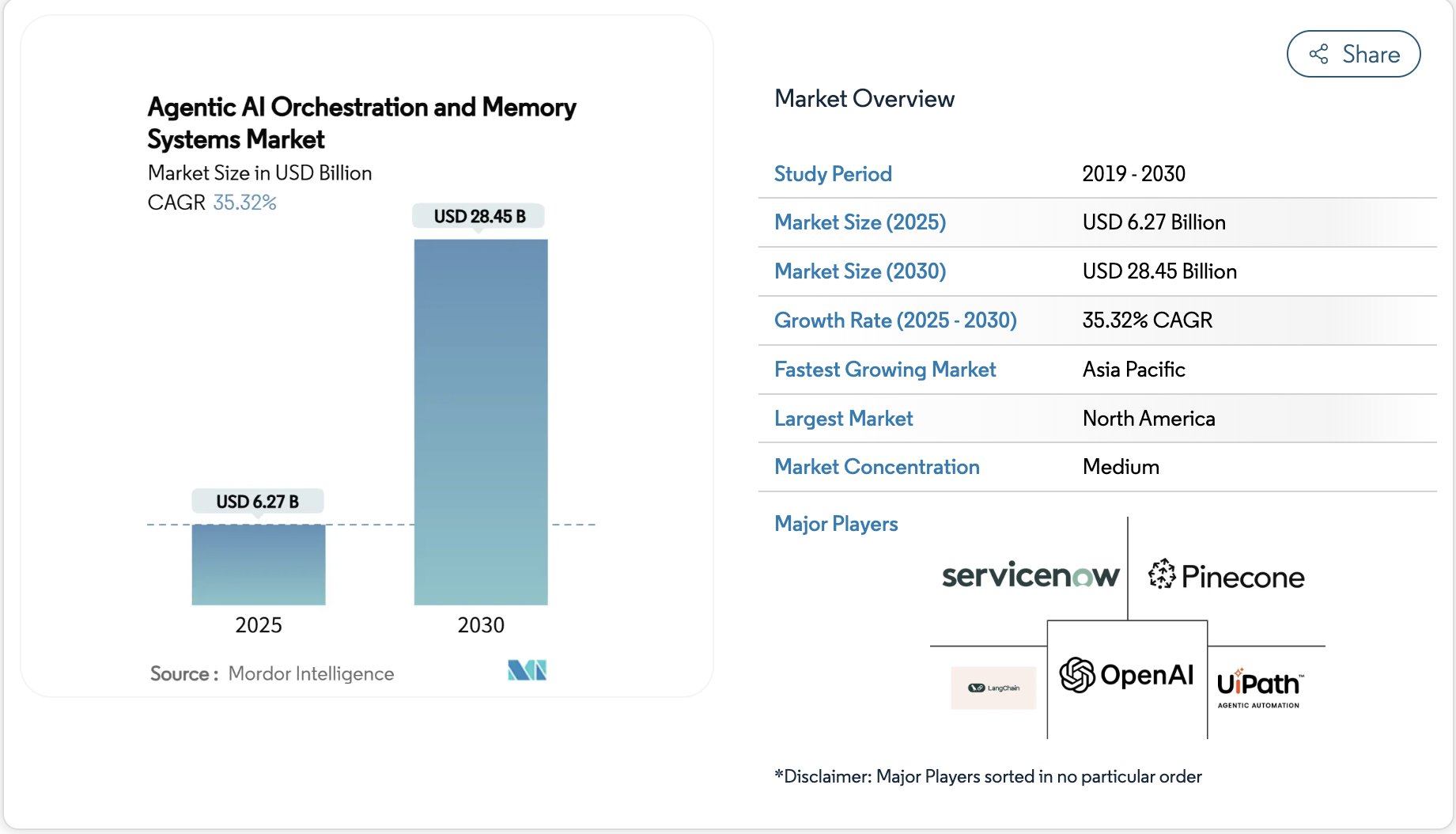
Since companies are shifting from pilot projects to full-scale orchestration, this change removes manual steps and cuts down on inefficiencies. This, in turn, transforms scattered AI tools into systems ready for enterprise use.
Enterprises investing in orchestration platforms are realizing measurable impact:
- Strong ROI: 62% of organizations expect more than 100% ROI from deploying agentic AI platforms, with an average projected ROI of 171%, and U.S.-based companies estimating even higher at 192%.
- Operational Efficiency: Up to 40% savings on labor costs, 20–30% higher productivity, and 42% less downtime in core operations.
- Industry Adoption: Rapid growth across BFSI, healthcare, IT/telecom, retail, and manufacturing sectors with complex workflows and strict compliance requirements.
- Market Drivers: Acceleration of digital transformation, cloud-native adoption, AI model complexity, and stricter regulatory mandates for audit trails and persistent memory.
- Enterprise Benefits: Automated workflow optimization, real-time AI model management, integrated analytics across agents, and greater scalability for evolving operations.
By 2025, nearly half of enterprises are expected to operationalize AI orchestration platforms as a way to manage AI complexity and unlock new efficiencies. With North America holding 41% of the market share, Europe at 27%, and Asia-Pacific surging through government-backed AI strategies, this shift is global and accelerating.
For decision makers, the opportunity is clear. Investing in AI agent orchestration platforms is about future-proofing AI initiatives, maximizing ROI, and sustaining competitive advantage in fast-changing markets. The companies that act now will be the ones setting industry benchmarks tomorrow.
How Does an AI Agent Orchestration Platform Work?
An AI agent orchestration platform functions like a conductor leading an orchestra. Instead of musicians, it manages specialized AI agents, each designed for a specific task, ensuring they work together smoothly. This creates a coordinated digital workforce that can handle complex workflows for large enterprises.
Step-by-Step Orchestration
- Task Assignment: The orchestrator receives a request, breaks it down, and assigns tasks to the appropriate agents.
- Context Sharing: It makes sure each agent has access to the necessary data, history, and company rules.
- Execution: Agents carry out their tasks, such as analyzing data, retrieving records, or interacting with users, without overlap or conflict.
- Result Aggregation: The orchestrator gathers outputs, checks them, and provides a unified response to the end system or user.
Real-World Analogy
Picture running a global business without department heads. Sales, finance, operations, and IT would operate independently of each other. Here, an orchestration platform serves as the executive layer, coordinating different AI agents like department heads managing teams. This seamless system ensures that agents not only fulfill their roles but also collaborate toward common enterprise KPIs.
End-to-End Workflow Example
For instance, a customer might file a claim through a portal. The orchestrator activates multiple agents: one verifies the customer’s identity, another checks policy details, a third assesses claim eligibility, and a fourth ensures compliance. The orchestrator then combines the results into a single decision, which is delivered smoothly back to the customer service platform.
By simplifying how AI agents work together, orchestration platforms turn disconnected tools into a reliable, secure, and efficient system suited for enterprises.
Core Components of AI Agent Orchestration Platforms
Behind every orchestration platform is a set of key building blocks that ensure scalability, reliability, and security. Understanding these components helps decision-makers assess whether a solution is truly ready for large-scale use.
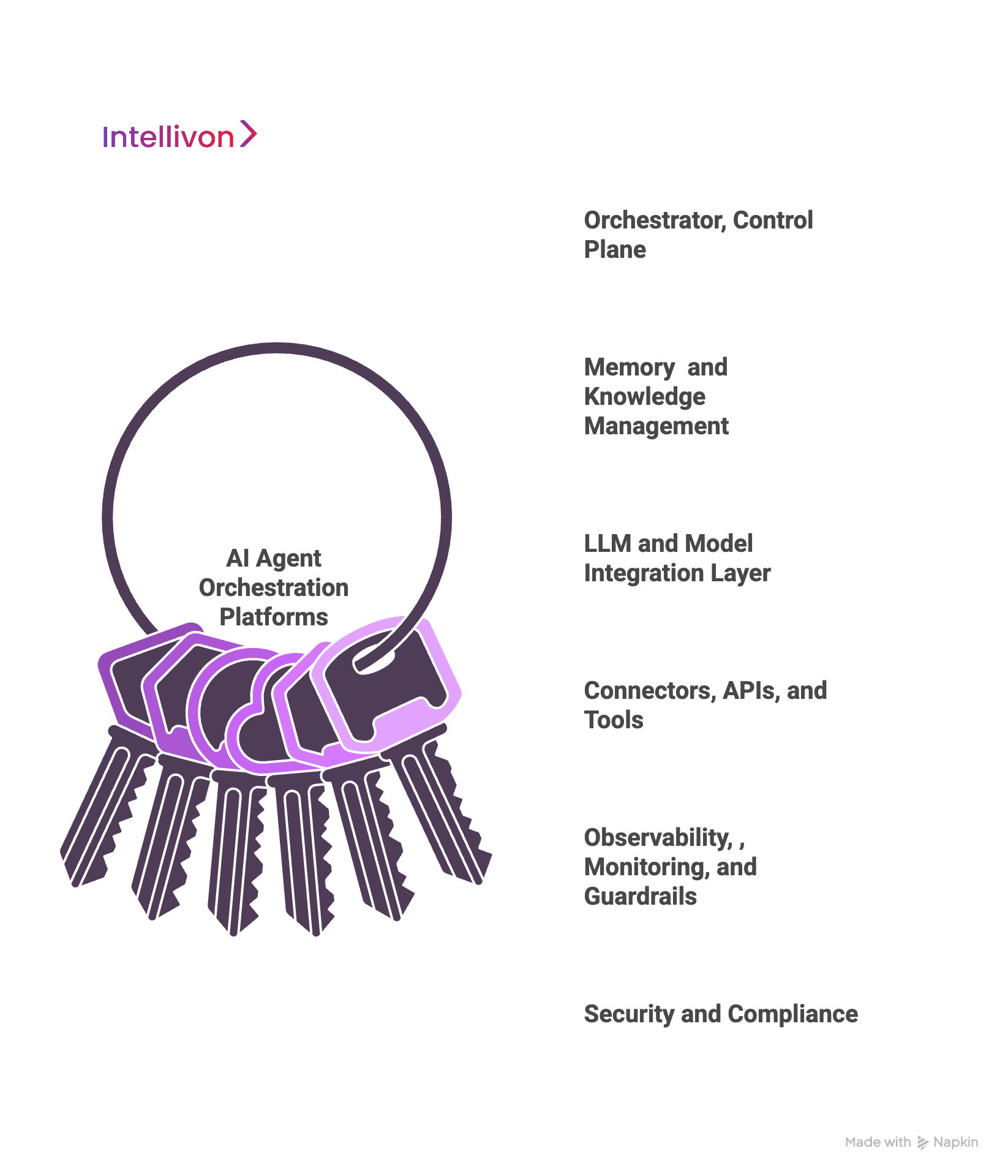
1. Orchestrator, Control Plane
This is the central part of the platform. It directs tasks to the appropriate agents, manages dependencies, and ensures smooth execution. Think of it as mission control, keeping every moving part in sync.
2. Memory and Knowledge Management
These platforms depend on persistent memory to avoid starting from scratch every time. Memory systems allow agents to recall previous interactions, maintain context, and reference company knowledge bases, ensuring consistent outcomes.
3. LLM and Model Integration Layer
Different workflows need different models, and this is where the integration layer plays an important role. It connects LLMs and specialized AI systems so the orchestrator can use the best model for each task.
4. Connectors, APIs, and Tools
Enterprise workflows cover CRM, ERP, compliance systems, and data warehouses. Connectors and APIs link these environments, enabling agents to work with real data without manual input.
5. Observability, Monitoring, and Guardrails
Businesses can’t depend on black-box automation. Observability dashboards offer insight into agent activity, while guardrails enforce policies, check outputs, and escalate to humans when necessary.
6. Security and Compliance
From encryption and role-based access to audit trails, the security layer ensures orchestration platforms meet requirements across regulated sectors like finance, healthcare, and insurance.
Data Flow in Action On the AI Agent Orchestration Platform
Imagine a customer submits a service request. Here’s how the orchestration platform handles it:
1. Input Request → Orchestrator
The control plane receives the request and breaks it into tasks.
2. Orchestrator → Memory System
It checks past interactions and company knowledge bases for context.
3. Orchestrator → Model Layer
The right AI model is chosen, whether it is an LLM or a specialized compliance checker.
4. Model Layer → Connectors & APIs
The model interacts with CRM, ERP, or other enterprise systems through secure connectors.
5. Outputs → Observability Layer
Results are monitored, validated, and flagged if something seems wrong.
6. Final Response → Secure Delivery
The orchestrator combines the results and sends them back through secure channels, keeping audit trails.
This flow ensures every request passes through a managed pipeline that balances automation speed with reliability suitable for enterprises.
Types of AI Agent Orchestration Patterns (and when to use them)
Not every enterprise requires the same orchestration style. The right pattern depends on business objectives, system complexity, and compliance obligations. Below are the most common approaches, along with guidance on when they deliver the most value.
1. Centralized Orchestration
A single orchestrator controls all agent activities and enforces policies across the system. It ensures that there is a single source of truth for workflows, ensuring consistency and accountability.
When to use: Best for highly regulated industries such as banking, insurance, or healthcare, where audit trails, compliance checks, and strict governance are essential. Use it when you need maximum control and clear visibility into every agent decision.
2. Decentralized Orchestration
Agents interact directly with each other, making local decisions without a central authority. This creates flexibility and adaptability in fast-changing environments.
When to use: Ideal for industries like retail, logistics, and e-commerce, where customer behavior and supply dynamics shift constantly. Choose it when your priority is speed, flexibility, and local optimization rather than central oversight.
3. Sequential Task Orchestration
Tasks are performed in a strict order, with each agent passing its output to the next in line. As a result, no step is skipped, and dependencies are handled correctly.
When to use: Valuable for structured, rule-heavy workflows such as insurance claim processing, regulatory compliance checks, or approval chains in finance. Select it when accuracy and process integrity matter more than speed.
4. Parallel or Multi-Agent Orchestration
Multiple agents work on different parts of a problem simultaneously, and the orchestrator merges the outputs into one result. This reduces waiting time and improves throughput.
When to use: Useful for scenarios that demand scale and speed, such as fraud detection in banking, high-volume customer support, or large data processing in manufacturing.
5. Event-Driven Orchestration
Specific events, such as a customer action, a system alert, or a sudden market fluctuation, trigger AI agents. They react instantly without waiting for scheduled workflows.
When to use: Effective for IT operations, cybersecurity, and telecom, where systems must be monitored around the clock.
6. Hybrid Approaches
Most enterprises blend patterns rather than relying on one. A centralized orchestrator may manage compliance-heavy processes, while parallel orchestration accelerates customer-facing services, and event-driven patterns handle system alerts.
When to use: Ideal for enterprises with diverse workflows and varying levels of risk and complexity. It ensures governance without sacrificing agility where flexibility is required.
By carefully selecting and combining these orchestration patterns, enterprises can align AI agents with their strategic priorities, whether it is reducing regulatory risk, improving customer experiences, or scaling operations at speed. Intellivon helps enterprises choose the right orchestration pattern for their goals, aligning use cases with KPIs to deliver measurable ROI.
How We Build Custom AI Agent Orchestration Platforms
Developing a high-quality AI agent orchestration platform requires a clear approach that balances technical execution with business needs. At Intellivon, we create ecosystems that grow, adapt, and deliver clear results. Below is our proven method, shaped by years of experience building orchestration platforms for large companies.
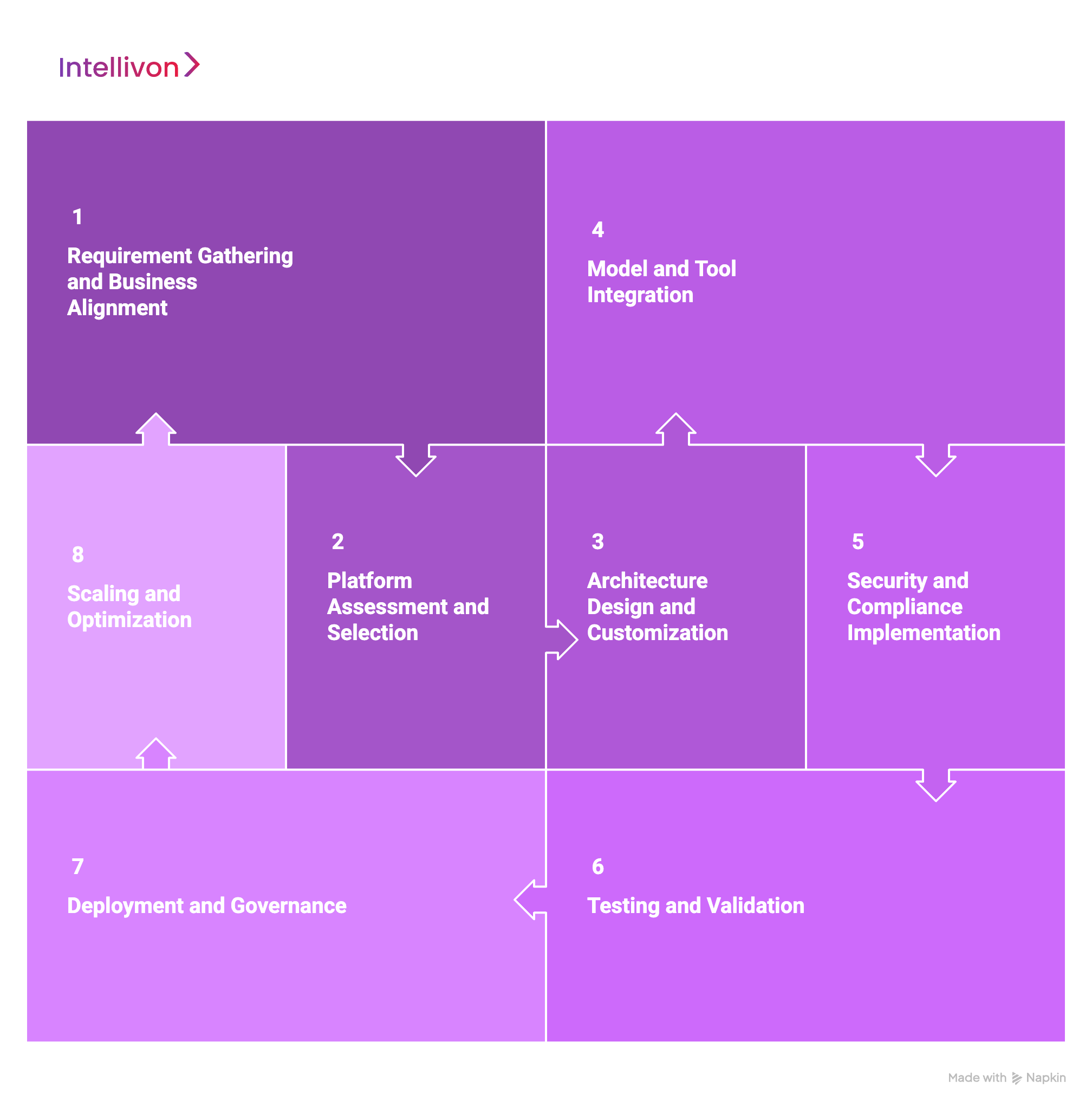
1. Requirement Gathering and Business Alignment
The first step is about clarity. We engage with executives and functional leaders to understand enterprise goals, current challenges, and the key performance indicators that indicate success. For a healthcare provider, it could mean improving diagnostic accuracy while complying with HIPAA.
By linking business goals to orchestration capabilities, we ensure the platform supports the most important outcomes. This initial alignment avoids wasted investments and helps technical success translate into real business value.
2. Platform Assessment and Selection
Since enterprises don’t start from scratch, they already have CRM, ERP, cloud platforms, and AI projects underway. Choosing the right orchestration framework involves carefully evaluating what is already in place, what needs to connect, and where the gaps are. For some organizations, a cloud-based deployment offers flexibility, cost savings, and global access. For others, strict data sovereignty rules require on-premises or hybrid models.
We assess scalability, governance, compliance needs, and ecosystem compatibility before making recommendations. This ensures businesses adopt the right foundation from the start, reducing rework and long-term costs. The outcome is a platform that fits seamlessly into your environment, avoiding disruptive changes.
3. Architecture Design and Customization
Once objectives and platforms are defined, we create the orchestration architecture. This blueprint shows how agents will interact, where memory systems will be located, and how security measures will function. Unlike generic solutions, our approach tailors workflows to fit the unique needs of each business.
For instance, in manufacturing, the orchestration might connect predictive maintenance agents with supply chain optimization tools to minimize downtime and boost efficiency. In insurance, it could link underwriting engines with claims processors and compliance agents to optimize operations while meeting regulatory requirements. Through this design phase, we ensure the system mirrors real-world workflows rather than imposing rigid templates.
4. Model and Tool Integration
The strength of orchestration lies in connecting various agents and systems. We integrate LLMs for natural language processing, specific AI for specialized tasks, and enterprise systems like ERP, CRM, and compliance platforms. The orchestrator becomes the central layer that ensures agents cooperate rather than function in isolation.
For a retail company, one agent might predict demand, another may personalize marketing efforts, and a third could optimize supply chain logistics. Without orchestration, these agents work independently, sometimes generating conflicting results. With orchestration, they align to improve inventory management, pricing, and customer interaction simultaneously, transforming separate initiatives into coordinated growth drivers.
5. Security and Compliance Implementation
In regulated industries, no solution can succeed without strong governance. That’s why we integrate security and compliance into the orchestration platform from the start. Encryption safeguards sensitive data both in transit and at rest. Role-based access controls ensure only authorized users can access certain agents. Comprehensive audit trails record every decision, making compliance with regulations like GDPR, HIPAA, or SOX much simpler.
This strategy transforms compliance from a hurdle into a competitive edge. Companies can innovate confidently, knowing that each orchestration workflow is protected by top-notch security standards.
6. Testing and Validation
No orchestration platform should launch without thorough testing. We simulate real-world scenarios, stress-test workflows, and ensure accuracy across various use cases. Testing also includes edge cases, like how the system responds when data is incomplete or inconsistent.
Involving humans in the validation process adds an extra layer of assurance. For example, in banking, an AI-driven compliance check might first be reviewed by compliance officers before it becomes fully automated. This combined approach ensures accuracy while maintaining trust in the system’s decisions.
7. Deployment and Governance Setup
After testing is complete, the platform moves to deployment across chosen environments, such as cloud, on-premises, or hybrid, while establishing governance structures. Dashboards provide executives with real-time insight into agent performance, decision accuracy, and overall system health. Clearly defined escalation paths indicate when and how humans should intervene, ensuring that automation does not sacrifice accountability.
The outcome is a platform that offers the advantages of automation while maintaining the oversight businesses need.
By following these steps, Intellivon ensures orchestration platforms become secure, scalable ecosystems that adapt to business priorities. For decision-makers, this means reduced operational friction, a faster time to value, and a foundation that supports innovation for the long term.
Cost of Building Custom AI Agent Orchestration Platforms
At Intellivon, we understand that enterprises need scalable solutions at reasonable prices. That’s why our pricing is customizable according to your specific needs, rather than a one-size-fits-all model. If certain costs stretch beyond the budget, we review requirements and streamline the scope. For enterprises ready to scale aggressively, we extend the platform with additional features and integrations.
Estimated Phase-Wise Cost Breakdown
| Phase | Description | Estimated Cost Range (USD) |
| Requirement Gathering & Business Alignment | Workshops, KPI mapping, compliance reviews | $5,000 – $10,000 |
| Platform Assessment & Selection | Infrastructure evaluation, deployment model choice (cloud/on-prem/hybrid) | $6,000 – $12,000 |
| Architecture Design & Customization | Blueprint design, workflow mapping, guardrail setup | $8,000 – $15,000 |
| Model & Tool Integration | Connecting LLMs, enterprise systems (CRM, ERP, compliance platforms) | $10,000 – $20,000 |
| Security & Compliance Implementation | Encryption, RBAC, audit trails, regulatory alignment | $6,000 – $12,000 |
| Testing & Validation | Stress-testing, human-in-loop validation, performance tuning | $6,000 – $12,000 |
| Deployment & Governance Setup | Rollout, monitoring dashboards, escalation paths | $5,000 – $10,000 |
| Scaling & Continuous Optimization | Ongoing optimization, agent additions, workflow expansion | $4,000 – $9,000 annually |
- Total Initial Investment Range: $50,000 – $100,000
- Ongoing Optimization (Annual): $4,000 – $9,000
This is a rough estimate for building an enterprise AI agent orchestration platform. Actual costs will vary depending on factors such as:
- Complexity of existing IT infrastructure
- Number of agents and workflows integrated
- Deployment model (cloud, on-premises, or hybrid)
- Security and compliance requirements
- Scale of enterprise operations and data volumes
- Level of customization vs. off-the-shelf components
Request a tailored quote from Intellivon’s AI engineers today and see how we can design an orchestration platform aligned with your goals and budget.
AI Agent Orchestration Platform Use Cases
AI agent orchestration has the greatest impact in industries with complex, multi-step workflows that demand security, compliance, and efficiency. Below are sector-specific use cases, each showing how orchestration transforms operations.
1. Finance and Banking
1. Fraud Detection in Real Time
Banks manage billions of daily transactions, and manual fraud checks are impossible at this scale. Orchestration connects transaction monitoring systems with identity verification agents and anomaly detection models. Together, they flag suspicious activity instantly, preventing losses and safeguarding customer trust.
2. Compliance Automation
Regulatory requirements like AML, KYC, and SOX vary across markets. With orchestration, compliance agents coordinate reporting, audit trails, and document validation. This reduces human error and ensures banks meet obligations without slowing business operations.
3. Customer Experience
Clients expect seamless service, from chatbots to payment systems. These platforms ensure customer service agents, advisory bots, and transaction processors share context. This improves satisfaction and strengthens loyalty.
Example: JP Morgan Chase orchestrates fraud detection with compliance workflows, cutting investigation time while maintaining strict regulatory alignment.
2. Insurance
1. Automated Claims Processing
The platform unifies agents for identity verification, policy validation, and settlement calculation. The result is faster claims with reduced operational overhead.
2. Risk Assessment for Underwriting
AI agent orchestration platforms integrate predictive models with third-party datasets, improving risk scoring and ensuring fair, data-driven premiums.
3. Policy Document Generation
Generating policies requires pricing alignment, compliance checks, and customer communication. These systems automate these workflows, producing accurate, compliant documents without delays.
Example: AXA uses orchestrated AI to speed up claims processing, improving settlement times while lowering costs across its global operations.
3. Healthcare
1. Patient Monitoring and Proactive Care
Hospitals manage vast streams of data from wearables, EMRs, and diagnostic tools. Orchestration unifies these agents to detect early warning signs and alert clinicians before emergencies occur.
2. Clinical Decision Support
Doctors rely on imaging, lab results, and medical guidelines. This solution ensures agents across these systems collaborate to provide precise, evidence-based recommendations. This improves diagnostic accuracy and reduces delays.
3. Claims and Billing Automation
Healthcare billing often suffers from errors and compliance risks. Orchestration integrates hospital systems with insurer platforms, streamlining claims submission and compliance reporting.
Example: Mayo Clinic employs orchestrated agents to unify diagnostic workflows, improving both patient outcomes and operational efficiency.
4. Retail
1. Demand Forecasting at Scale
Retailers must strike a balance between stock availability and cost efficiency. This is why these platforms connect forecasting agents, promotions data, and external market signals, enabling smarter decisions and fewer stockouts.
2. Personalized Customer Engagement
This platform coordinates marketing agents, recommendation engines, and customer profiles, ensuring personalized promotions reach the right people at the right time.
3. Supply Chain Orchestration
From warehouses to delivery trucks, retail supply chains are complex. Orchestration synchronizes logistics, vendor systems, and inventory management tools for smooth, end-to-end operations.
Example: Target uses orchestration to connect inventory forecasting with customer engagement, improving stock management and delivering tailored shopping experiences.
5. Manufacturing
1. Predictive Maintenance
Equipment downtime is costly. Orchestration unites IoT sensors, diagnostic models, and scheduling agents to predict failures and schedule repairs before breakdowns occur.
2. Quality Control Integration
Factories must maintain strict quality standards, which is why such AI agent-led platforms coordinate inspection systems, compliance agents, and production tools to ensure consistency and reduce recalls.
3. Supply Chain Optimization
Manufacturing supply chains stretch across borders. Orchestration connects planning, procurement, and logistics agents to maintain resilience and efficiency in dynamic environments.
Example: Siemens orchestrates predictive maintenance and quality control to cut downtime and improve throughput in its global factories.
6. IT and Customer Support
1. Automated Helpdesk Routing
Support centers receive thousands of tickets daily, and need to automate these endless manual processes. This platform enables triage agents, knowledge bases, and escalation workflows to work in sync, reducing response times.
2. Self-Healing IT Systems
Since enterprises cannot afford outages, orchestration empowers monitoring agents to trigger patching and remediation agents automatically, ensuring systems recover without manual intervention.
3. Service Orchestration Across Platforms
IT teams juggle infrastructure monitoring, feedback loops, and customer experience tools. Orchestration integrates these systems, creating a single, reliable support layer.
Example: ServiceNow applies orchestrated workflows to accelerate IT incident resolution, reducing downtime and freeing teams to focus on higher-value initiatives.
AI agent orchestration allows each of these industries to move beyond fragmented tools and adopt coordinated, intelligent systems. There is a clear takeaway: AI agent orchestration platforms are practical and proven drivers of efficiency, compliance, and growth.
Top AI Agent Orchestration Tools and Platforms
Choosing the right orchestration platform depends on enterprise priorities such as scalability, compliance, and integration flexibility. Below is an overview of the leading platforms shaping the market today.
1. IBM Watsonx Orchestrate
IBM’s WatsonX Orchestrate focuses on enterprise automation by connecting AI agents across HR, finance, and IT. It enables employees to offload repetitive tasks, such as onboarding, payroll queries, or IT support, while ensuring enterprise-grade governance.
Built on IBM’s WatsonX AI and cloud stack, it integrates with existing enterprise systems and provides strong compliance features, making it well-suited for regulated industries.
2. Microsoft Copilot Studio
Microsoft Copilot Studio builds on the Copilot ecosystem within Office, Dynamics, and Azure. It allows enterprises to design AI agents that work across productivity tools, CRM systems, and ERP environments.
With deep integration into Microsoft 365, it’s a natural fit for organizations already embedded in Microsoft’s ecosystem. Enterprises gain orchestration capabilities while benefiting from Microsoft’s security, governance, and cloud-native scaling.
3. Google Vertex AI Agent Builder
Google’s Vertex AI Agent Builder enables enterprises to create and manage AI agents that run on Google Cloud infrastructure. It supports orchestration across multiple models and provides connectors into BigQuery, Document AI, and Google Workspace.
Its strength lies in combining orchestration with powerful data analytics and machine learning capabilities, making it particularly valuable for data-intensive industries such as finance and retail.
4. AWS Bedrock AgentCore
AWS Bedrock AgentCore provides orchestration for agents built on top of Amazon Bedrock. It allows enterprises to combine multiple LLMs with serverless orchestration.
Enterprises can connect agents to databases, APIs, and AWS services, such as S3 and SageMaker. With Bedrock AgentCore, orchestration is designed for high-scale workloads where cost efficiency, elasticity, and global reach are priorities.
5. CrewAI
CrewAI is an open-source orchestration framework designed for multi-agent collaboration. It enables developers and enterprises to design workflows where specialized agents work together on shared goals.
CrewAI offers flexibility and customization for organizations that are willing to invest in building their own orchestration in-house. It’s especially popular among innovation labs and enterprises experimenting with cutting-edge orchestration strategies outside of vendor-locked ecosystems.
6. LangChain
This is one of the most widely adopted orchestration frameworks, built for chaining AI models, tools, and data sources into complex workflows. It provides flexibility to design highly customized orchestration flows and integrates with nearly every major LLM provider.
While often seen in prototyping, enterprises are increasingly adopting LangChain for production-grade orchestration when paired with strong governance layers.
7. Cognosys
Cognosys is a commercial orchestration platform that focuses on enterprise deployment of multi-agent systems. It provides built-in observability, compliance, and monitoring features, which make it more enterprise-ready than some developer-first frameworks.
Cognosys is tailored for organizations seeking rapid deployment of orchestration with guardrails and governance already included.
Each platform comes with its own strengths. Some, like IBM and Microsoft, prioritize compliance and enterprise integration. Others, like Google and AWS, focus on data-driven orchestration at scale. Open frameworks like CrewAI and LangChain provide flexibility for enterprises that want to experiment or customize orchestration deeply.
Comparison of Leading AI Agent Orchestration Platforms
| Platform | Pricing | Scalability | Compliance | Integrations | Customization |
| IBM Watsonx Orchestrate | Enterprise subscription; pricing on request | High; built for global enterprises | Strong (GDPR, HIPAA, SOX) | Deep integration with IBM Cloud, HR, Finance, IT systems | Moderate; customizable within IBM ecosystem |
| Microsoft Copilot Studio | Per-user or enterprise licensing | High; native in Microsoft Azure | Strong (Microsoft compliance framework) | Seamless with Microsoft 365, Dynamics, ERP | Moderate; best for Microsoft-based enterprises |
| Google Vertex AI Agent Builder | Usage-based pricing tied to Google Cloud | Very high; elastic scaling | Strong (global compliance standards) | BigQuery, Workspace, Document AI, API connectors | High; flexible orchestration and data-first workflows |
| AWS Bedrock AgentCore | Pay-as-you-go usage pricing | Extremely high; designed for large-scale workloads | Strong (AWS compliance and audit tools) | Full AWS ecosystem (S3, SageMaker, API Gateway) | High; strong flexibility for custom workloads |
| CrewAI | Open-source; free with implementation costs | Scales with infrastructure investment | Limited; compliance depends on enterprise setup | Flexible; requires developer integration | Very high; designed for in-house orchestration builds |
| LangChain | Open-source with enterprise support options | Scales with deployment setup | Limited; compliance layer must be added by enterprise | Very broad; connects to most LLMs and APIs | Very high; widely used for custom orchestration |
| Cognosys | Commercial subscription model | High; enterprise-ready deployment | Strong; includes observability and guardrails | Pre-built connectors and APIs | High; balances enterprise readiness with flexibility |
Role of RAG (Retrieval-Augmented Generation) in Orchestration Platforms
One of the biggest challenges businesses face when deploying AI agents is ensuring they operate with relevant and secure knowledge. LLMs are powerful, but they depend on the data they were trained on and cannot access proprietary information without a clear approach. This is where RAG becomes important in an orchestration platform.
How RAG Strengthens Orchestration
RAG allows AI agents to pull information from business data sources in real time and then use that knowledge to produce accurate outputs. Instead of relying solely on static model memory, RAG connects the orchestrator to knowledge bases, document stores, and APIs. This ensures that every AI agent’s decision is based on the latest business data.
When included in orchestration, RAG serves three key purposes:
- Context enrichment: Agents can retrieve relevant documents, customer histories, or compliance rules before taking action.
- Consistency across workflows: Multiple agents pull from the same authoritative sources, avoiding contradictions or mistakes.
- Secure knowledge handling: Data access is managed through enterprise-level permissions, making sure sensitive information remains protected.
Examples in Business Workflows
- Customer Support: A support agent powered by RAG can access a product knowledge base, past tickets, and account history before responding, leading to precise and personalized answers.
- Legal and Compliance: Orchestration with RAG allows document review agents to retrieve specific contract clauses or regulatory rules, helping ensure responses meet strict compliance standards.
- Healthcare: A diagnostic agent can consult updated medical guidelines and patient history, which lowers risk and improves care quality.
Without RAG, AI orchestration risks becoming inconsistent and unreliable because agents do not have access to business-specific knowledge. With RAG, businesses gain a scalable memory layer that connects every agent to the same source of truth.
This not only improves accuracy but also builds trust in automation across departments where decisions need to be clear and backed by evidence. Intellivon integrates RAG into orchestration platforms to help businesses access secure, knowledge-driven automation that grows with their needs.
Implementation Challenges and How We Overcame Them
Enterprises recognize the potential of AI agent orchestration, but scaling it comes with challenges. These challenges impact compliance, governance, and everyday workflows, and are not just technical issues. At Intellivon, we tackle these issues directly to make sure orchestration platforms provide lasting value.
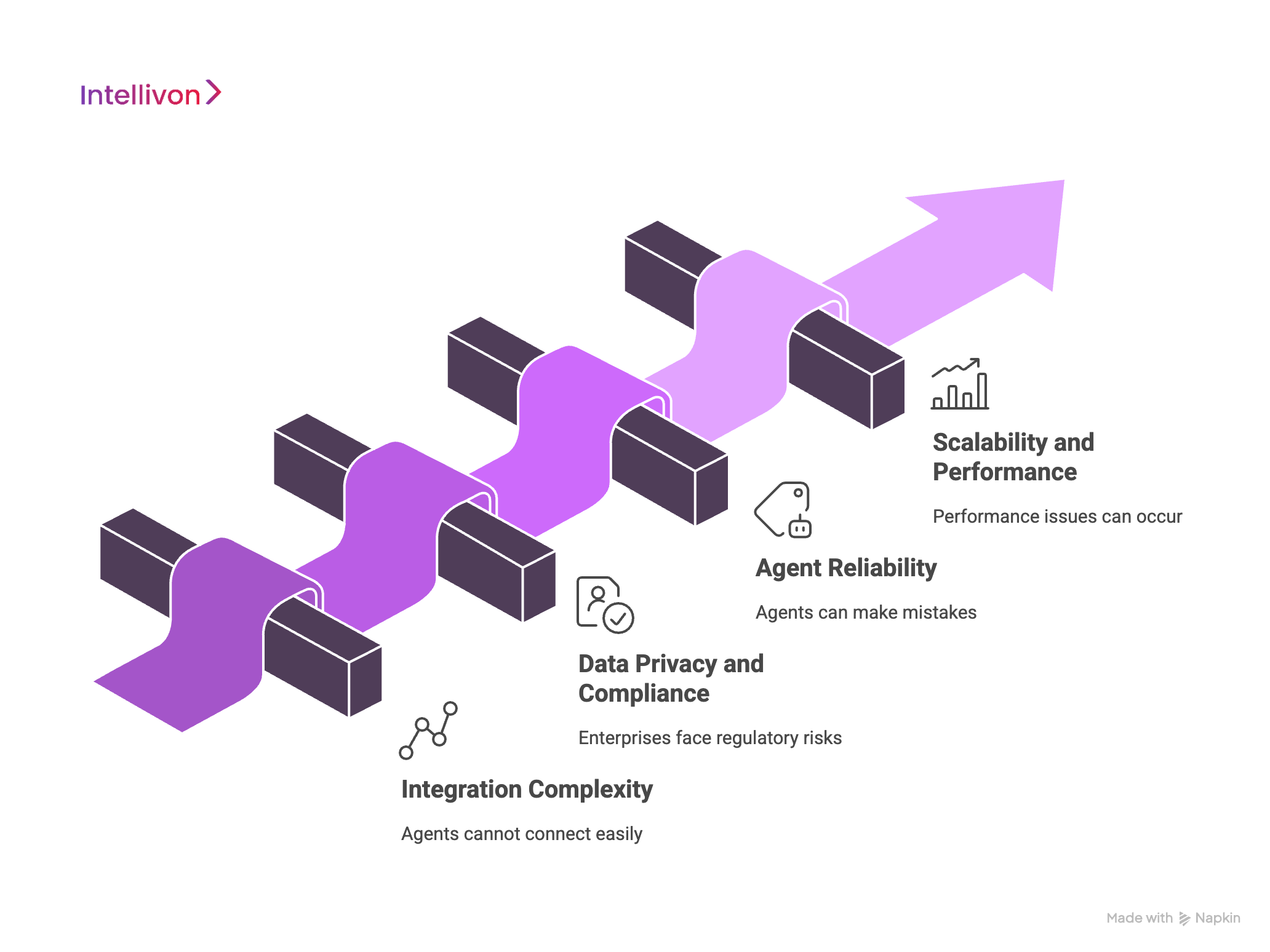
1. Integration Complexity
Most enterprises already use a combination of legacy systems, cloud platforms, and AI trials. Orchestration fails if agents cannot connect to these systems easily.
Our Solution: We develop strong connectors and APIs that link ERP, CRM, data warehouses, and compliance systems. This reduces integration difficulties and ensures agents work with real-time data instead of isolated information.
2. Data Privacy and Compliance
Industries with strict regulations face heavy requirements around GDPR, HIPAA, SOX, and other frameworks. Orchestration without built-in protections can put enterprises at risk.
Our Solution: Our experts incorporate enterprise-level encryption, role-based access control, and detailed audit trails into every layer of orchestration. This step makes sure all agent interactions are compliant and traceable, turning regulatory needs into a strength instead of a burden.
3. Agent Reliability
AI agents are powerful tools, but can make some grave mistakes. Without supervision, they might produce errors, misinterpret inputs, or fail in unusual situations.
Our Solution: Using a human-in-the-loop method, experts can verify critical outputs before scaling automation. Our experts test workflows under various conditions to ensure agents stay reliable amidst real-world complexity.
4. Scalability and Performance
Initial pilots usually operate in controlled environments, but expanding to thousands of workflows can cause performance issues. Enterprises need orchestration that can grow with demand and scale along with them.
Our Solution: We create cloud-native orchestration platforms that scale easily. By using containerization, monitoring tools, and performance enhancements, we ensure orchestration keeps up with enterprise growth.
For decision-makers, these challenges often lead to AI projects stalling after initial trials. With the right approach, they become manageable and can even turn into chances to improve governance and resilience. Intellivon provides enterprise orchestration platforms that eliminate integration barriers, safeguard sensitive data, ensure reliability, and scale effectively.
Conclusion
AI agent orchestration is now a must for businesses managing complex workflows. Without it, organizations face issues like scattered tools, isolated data, and increasing operational costs. With orchestration, they develop a unified digital workforce that promotes agility, efficiency, and innovation.
The benefits go beyond just cost savings. Orchestration allows companies to speed up their time-to-market, ensure compliance in regulated sectors, and discover new growth opportunities by connecting AI agents with strategic goals. It builds a foundation for ongoing innovation instead of relying on a series of separate pilots.
Companies that invest now will set themselves up to lead in the future. As adoption grows in finance, healthcare, retail, manufacturing, and IT, coordinated multi-agent systems are becoming essential to digital transformation.
Build Your Next AI Agent Orchestration Platform With Intellivon
At Intellivon, we bring years of experience building enterprise-grade orchestration platforms that are secure, scalable, and aligned with business KPIs. We partner with large enterprises to design systems that transform how enterprises operate.
Why Partner with Intellivon?
- Tailored Solutions: We align orchestration with your objectives, workflows, and compliance needs.
- Enterprise-Grade Security: Encryption, audit trails, and governance are built in from day one.
- Proven ROI: Our platforms reduce costs, improve productivity, and scale with enterprise growth.
- End-to-End Delivery: From requirement gathering to scaling, we manage the full journey.
Book a discovery call with Intellivon’s AI engineers today and see how an orchestration platform can unlock efficiency, compliance, and growth for your enterprise.
FAQs
Q1. What is an AI agent orchestration platform?
A1. It is a control system that coordinates multiple AI agents, ensuring they share context, work with enterprise data, and automate workflows securely and efficiently.
Q2. How does an AI agent orchestration platform improve enterprise workflows?
A2. It eliminates silos by unifying agents across departments. This creates seamless, end-to-end automation that reduces manual work, improves accuracy, and accelerates decision-making.
Q3. What industries benefit most from AI agent orchestration?
A3. Banking, insurance, healthcare, retail, manufacturing, and IT all gain value. These sectors rely on complex workflows, regulatory compliance, and data-heavy processes that orchestration simplifies.
Q4. Is AI agent orchestration secure for regulated industries?
A4. Yes. Enterprise-grade platforms include encryption, role-based access, and audit trails. These safeguards ensure compliance with frameworks like GDPR, HIPAA, and SOX.
Q5. Which is the best AI agent orchestration platform for large enterprises?
A5. The right choice depends on your existing systems, compliance needs, and scalability goals. Platforms like IBM WatsonX Orchestrate, Microsoft Copilot Studio, and custom-built solutions are often strong options. Or opting for a solution provider who can customize this platform to your needs.