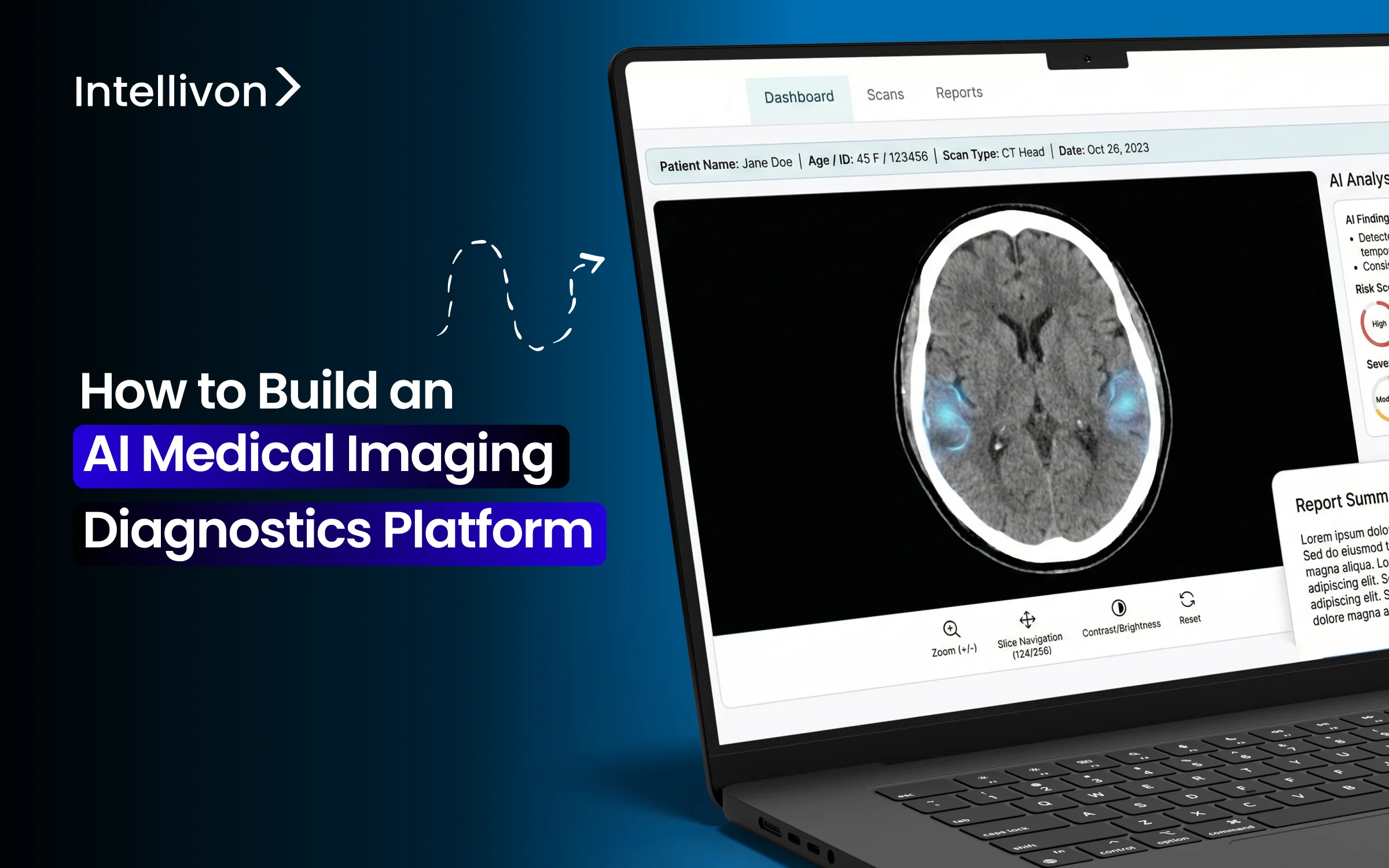
Imaging volumes are increasing across hospital networks, while the availability of radiologists, turnaround expectations, and quality standards are decreasing. This leads to delayed diagnoses, overwhelmed teams, and growing operational risks in departments that can least handle them.
To counter these bottlenecks, AI medical imaging diagnostics platforms automate routine screening tasks, prioritize urgent cases for quick review, and offer decision support that helps radiologists work faster and more accurately. They reduce turnaround times, catch findings that might otherwise be overlooked, and allow clinical teams to focus on complex cases that need human expertise.
At Intellivon, we have spent over a decade developing AI medical imaging diagnostic platforms that seamlessly integrate with PACS and EHR systems, fit clinical workflows, and comply with strict regulations, without compromising existing medical data. With this hands-on experience, we are using this blog to discuss how to build such a platform from the ground up.

Key Takeaways of the AI in Medical Imaging Market
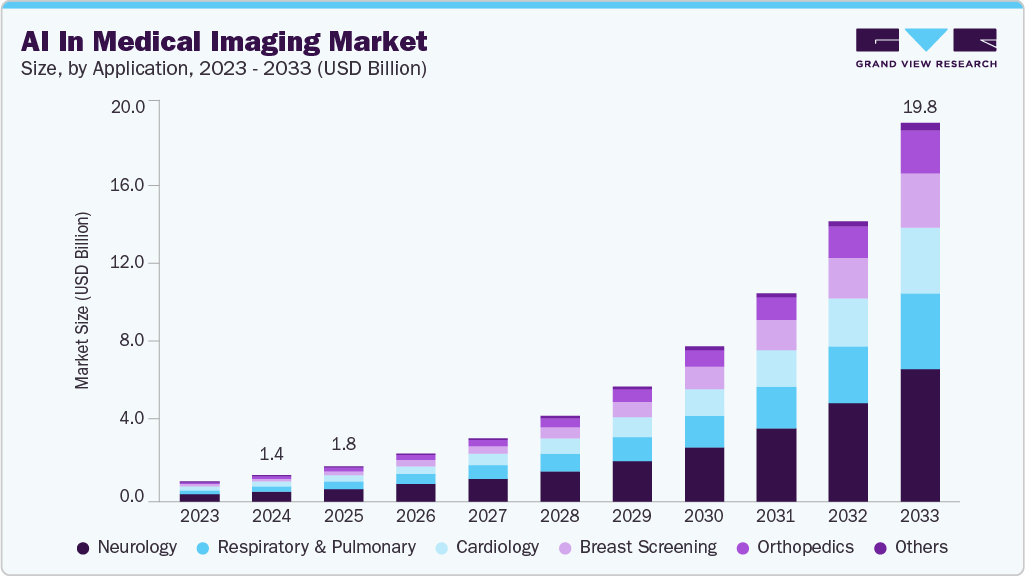
Investment in AI-powered medical imaging is scaling fast. What was a USD 1.36 billion market in 2024 is projected to grow to USD 19.78 billion by 2033, expanding at an annual rate of nearly 35%.
Growth Drivers:
- Imaging volumes continue to rise by multiple percentage points annually, while radiologist workforce growth remains largely flat. This imbalance is accelerating demand for automated detection, triage, and reporting tools.
- Chronic disease prevalence, expanded cancer screening programs, and aging populations are driving sustained growth in CT, MRI, PET, and X-ray studies, where AI medical imaging delivers the greatest impact.
- High-volume imaging workflows are emerging as the primary entry point for AI adoption at the enterprise level.
Technology and Infrastructure Readiness
- Advances in deep learning and multimodal models have significantly improved diagnostic reliability across complex imaging tasks.
- Cloud and hybrid delivery models now support enterprise-scale deployments, enabling centralized inference without replacing existing imaging infrastructure.
- Cloud-based solutions are projected to account for more than 40% of new AI medical imaging installations, driven by scalability and faster rollout cycles.
- API-first architectures and marketplace-based integrations with PACS, RIS, and EHR systems are reducing implementation friction for large healthcare organizations.
Cross-Workflow AI Adoption Momentum
- 71% of non-federal acute-care hospitals in the United States reported using predictive AI applications integrated with their EHRs in 2024, up from 66% in 2023.
- Adoption rates are highest among large hospitals and system-affiliated organizations.
- Hospitals with more than 400 beds report AI usage rates of approximately 90% to 96% across AI categories.
- Smaller hospitals report lower usage, ranging from approximately 53% to 59%.
- System-affiliated hospitals show more than 80% AI adoption, compared with approximately 31% to 37% among independent facilities.
Imaging-Specific AI Adoption Signals
- A 2024 survey of imaging leaders found that only 21% to 25% had implemented AI in medical imaging at the time of polling.
- However, more than 60% of respondents expect to implement imaging AI within the next five years, indicating a strong near-term expansion pipeline.
- Workforce shortages remain a key driver, with over 40% of executives reporting significant staffing challenges in medical imaging.
- These pressures are increasing enterprise willingness to adopt AI for triage, prioritization, and workflow automation.
Diagnostic Accuracy and Reliability
- A 2024 meta-analysis of AI-assisted dermatologic screening reported a pooled sensitivity of approximately 89.9% and a specificity of approximately 89.2% across clinical settings.
- Deep learning models applied to digital breast tomosynthesis achieved test-set accuracy exceeding 93%, with strong sensitivity, specificity, and F1 scores.
- In chest X-ray workflows, real-world evaluations show sensitivities and specificities approaching 100% for select pathologies such as fractures and pneumothorax, with AUC values near 0.99 to 1.00 in controlled environments.
- Advanced lung nodule detection models report detection and localization accuracies in the mid-90% to high-90% range, supporting use in second-read and triage roles.
Enterprise healthcare organizations are adopting it as a shared diagnostic infrastructure that can scale across hospitals, radiology networks, and service lines. Rising imaging demand, workforce constraints, and maturing regulatory frameworks are accelerating this shift from isolated pilots to governed, enterprise-wide platforms.
What Is an AI Medical Imaging Diagnostics Platform?
An AI medical imaging diagnostics platform is an enterprise system that applies computer vision and machine learning to analyze medical images and support clinical decision-making. It ingests imaging data from modalities such as CT, MRI, X-ray, ultrasound, and digital pathology, then detects patterns, flags abnormalities, and prioritizes cases based on risk. These platforms do not replace clinicians. Instead, they act as decision-support layers that improve speed, consistency, and diagnostic confidence.
In healthcare environments, these platforms operate as part of the existing imaging ecosystem. They integrate with PACS, RIS, and EHR systems, preserve radiologist workflows, and apply explainable AI models within governed, compliant pipelines. When designed correctly, an AI medical imaging diagnostics platform scales across facilities, supports quality metrics, and delivers reliable clinical insights without introducing disruption or regulatory risk.
How It Works
An AI-powered imaging diagnostics platform sits between scanners, PACS, and radiology workflows. It quietly ingests studies, runs models, and returns actionable findings inside the tools teams already use.
1. Image ingestion from scanners and PACS
The platform connects to CT, MRI, X-ray, PET, and ultrasound through DICOM and HL7 interfaces. Studies are auto-routed from existing PACS or modality worklists into the AI pipeline without changing current workflows.
2. De-identification, normalization, and pre-processing
Incoming images can be de-identified where required for privacy and research. The system normalizes formats, resolutions, and metadata, then applies pre-processing such as noise reduction and standardization.
3. AI inference on curated imaging models
Relevant algorithms are selected based on modality, body region, and clinical indication. Models run on GPUs or optimized cloud infrastructure to detect patterns, segment structures, and quantify lesions in near real time.
4. Triage, prioritization, and worklist augmentation
Findings with high suspicion scores are flagged for priority review. The platform augments radiology worklists with AI-derived tags, urgency indicators, and suggested study groupings.
5. Clinician review in native viewers
Radiologists see overlays, heatmaps, measurements, and structured suggestions inside their existing viewer or PACS. They control which AI outputs to accept, adjust, or ignore, keeping clinical authority firmly with the human expert.
6. Structured reporting and EHR integration
Accepted findings flow into structured report templates and radiology information systems. The platform pushes key results, measurements, and follow-up recommendations into the EHR to inform downstream clinical decisions.
7. Continuous learning, monitoring, and governance
Performance is tracked across sites, devices, and cohorts using real-world outcomes. Drift monitoring, version control, and audit logs help governance teams maintain safety, compliance, and explainability.
In practice, this workflow feels like a smarter, more responsive radiology stack, not a new standalone tool. The platform enhances existing systems so enterprises gain accuracy, speed, and standardization without disrupting core diagnostic operations.
Why Enterprises Are Investing in AI-Powered Medical Imaging
Healthcare enterprises are investing in AI-powered medical imaging because imaging operations sit at the intersection of revenue, risk, and care delivery. Imaging touches emergency throughput, inpatient length of stay, specialty service lines, and downstream procedures. When imaging becomes a bottleneck, the financial and operational impact is felt across the entire organization.
For enterprise leaders, AI medical imaging is less about technology adoption and more about stabilizing high-cost, high-risk diagnostic workflows at scale.
1. Reduce Operational Costs
Medical imaging is capital-intensive, labor-heavy, and difficult to scale efficiently. AI allows enterprises to extract more value from existing imaging infrastructure by improving throughput and reducing rework. Faster triage and assisted reads lower repeat scans, reduce delays, and improve scanner utilization, directly improving return on imaging investments.
2. Offset Workforce Shortages
Radiologist shortages and burnout have become persistent operating risks. Hiring alone cannot keep pace with demand. Enterprises adopt AI to absorb volume growth without proportional workforce expansion. Decision-support and prioritization tools help teams manage complexity while avoiding ballooning staffing costs.
3. Shorten Diagnostic Turnaround Time
Imaging delays ripple across clinical and financial workflows. Faster results accelerate admissions, interventions, procedures, and discharges. For enterprises, reducing diagnostic lag improves bed utilization, procedural scheduling, and service-line efficiency, all of which contribute to stronger revenue performance.
4. Standardize Diagnostics Across Facilities
Large healthcare organizations operate across multiple sites with varying practices and skill distributions. AI platforms help enterprises enforce consistent diagnostic standards across hospitals, imaging centers, and newly acquired facilities. This reduces variation, simplifies governance, and lowers enterprise-wide clinical risk exposure.
5. Reduce Malpractice Exposure
Diagnostic errors represent a significant source of financial and reputational risk. AI-supported detection, structured reporting, and audit trails help enterprises demonstrate defensible diagnostic processes. This strengthens quality metrics, supports accreditation requirements, and reduces long-term liability.
6. Support Scalable Growth
As enterprises expand service lines or geographic coverage, imaging demand grows faster than infrastructure refresh cycles. AI platforms allow organizations to scale diagnostic capability without replacing PACS, RIS, or EHR systems. This protects existing IT investments while enabling controlled, phased growth.
In practical terms, enterprises invest in AI-powered medical imaging because it improves margins, reduces risk, and increases operational resilience. When implemented as an enterprise platform rather than a point solution, AI becomes a lever for sustainable growth rather than a cost center.
AI Medical Imaging Gives 90% Diagnostic Specificity
AI medical imaging has reached a performance threshold that changes how enterprises evaluate risk and scale. Diagnostic sensitivity and specificity figures are no longer confined to research settings. They are now validated across real-world clinical workflows and multiple imaging domains.
1. 90% Specificity Reduces Enterprise Diagnostic Risk
Diagnostic specificity directly shapes false positives, follow-up costs, and clinical fatigue. A 2024 meta-analysis of AI-assisted dermatologic screening using clinical photographs reported a pooled sensitivity of 89.9% and specificity of 89.2%, with similarly strong performance across subgroups.
For enterprises, this reduces unnecessary downstream investigations while maintaining defensible diagnostic quality across large patient populations.
2. Population Screening Made Economically Viable
In digital breast tomosynthesis, deep learning models have demonstrated test-set accuracy above 93%, with strong sensitivity, specificity, and balanced F1 scores.
At scale, this level of performance supports population screening programs without proportionally increasing radiologist workload. For enterprise leaders, the value lies in improved coverage, lower variation, and better utilization of imaging resources.
3. Performance Supports High-Confidence Triage
Recent real-world chest X-ray studies show AI sensitivities and specificities approaching 100% for selected conditions such as fractures and pneumothorax. In some deployments, AUC values range from 0.99 to 1.00.
This makes AI suitable for enterprise triage use cases, where prioritization speed directly affects emergency throughput, patient flow, and hospital capacity.
4. Mid- to High-90% Detection Accuracy Enables Second-Read Models
Vendor and academic evaluations of lung nodule detection using advanced deep learning models, including YOLO-based architectures, report accuracy in the mid-90% to high-90% range for detection and localization.
For enterprises, this reinforces AI’s role as a second-read support layer. It lowers miss rates while preserving clinician authority, an essential balance for enterprise risk management.
Why These Numbers Change Enterprise Buying Behavior
Performance levels consistently above 90% shift AI medical imaging from experimental technology to governed infrastructure. They support ROI models tied to throughput, error reduction, and staffing efficiency.
More importantly, they give enterprise leadership the confidence to standardize AI usage across hospitals and imaging networks.
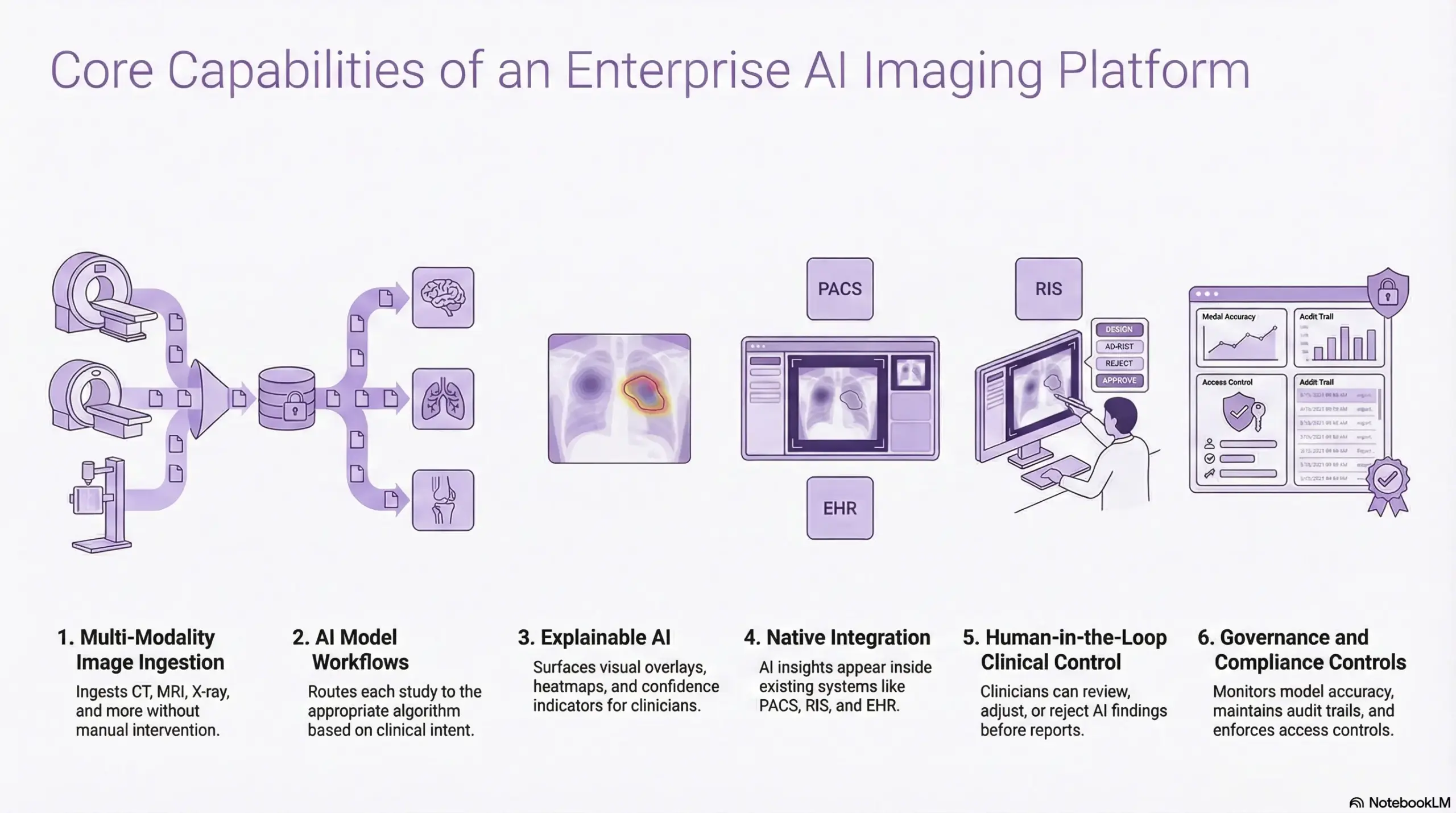
Core Capabilities of an Enterprise AI Imaging Platform
An enterprise AI imaging platform provides scalable image ingestion, governed AI inference, workflow integration, and compliance controls to support diagnostics across large healthcare systems.
These core capabilities separate enterprise-grade solutions from standalone AI tools.
1. Multi-Modality Image Ingestion
Enterprise platforms must ingest CT, MRI, X-ray, PET, ultrasound, and pathology data without manual intervention. They connect directly to scanners, PACS, and vendor-neutral archives using DICOM and HL7 standards.
This ensures imaging workflows remain uninterrupted while enabling centralized AI analysis across sites.
2. AI Model Workflows
Enterprises rarely deploy a single AI model. Platforms must route each study to the appropriate algorithm based on modality, anatomy, and clinical intent.
Workflows manage model versions, confidence thresholds, and execution logic, allowing organizations to scale AI usage without operational fragmentation.
3. Explainable AI
Black-box outputs do not scale in regulated environments. Enterprise platforms surface visual overlays, heatmaps, measurements, and confidence indicators that clinicians can understand quickly.
Explainability supports adoption, simplifies audits, and reduces resistance during system-wide rollouts.
4. Native Integration
AI insights must appear inside existing imaging and clinical systems like PACS, RIS, and EHR. Seamless integration ensures radiologists and clinicians do not switch tools or workflows.
For enterprises, this protects prior IT investments and accelerates adoption across departments.
5. Human-in-the-Loop Clinical Control
Enterprise platforms keep clinicians in control of final diagnostic decisions. Radiologists can review, adjust, or reject AI findings before they influence reports or downstream workflows. This safeguards accountability and reduces clinical and legal risk.
6. Governance and Compliance Controls
At scale, AI performance must be visible and governed. Enterprise platforms monitor model accuracy, track drift, maintain audit trails, and enforce access controls. These capabilities support long-term compliance, quality assurance, and safe expansion across healthcare networks.
Together, these capabilities allow healthcare enterprises to adopt AI medical imaging as governed infrastructure rather than experimental technology. Platforms that combine scale, integration, transparency, and control enable organizations to improve diagnostic efficiency without increasing operational risk.
Real-World Use Cases Across Enterprise Healthcare
Enterprise healthcare organizations deploy AI medical imaging platforms to improve diagnostic throughput, reduce risk, and standardize care across hospitals, imaging centers, and service lines.
The following use cases reflect where enterprises are seeing real operational and financial impact today.
1. Emergency and Acute Care Triage
In emergency departments, imaging speed directly affects patient flow and resource utilization. AI medical imaging platforms prioritize critical findings such as strokes, internal bleeding, fractures, or pneumothorax within seconds of image acquisition.
This allows emergency teams to act faster while radiology teams manage workload more effectively during peak demand.
2. Oncology Screening and Early Detection
Enterprises deploy AI to support large-scale cancer screening programs for breast, lung, and colorectal conditions. AI-assisted detection improves consistency and reduces missed findings during high-volume reads.
For healthcare systems, this enables broader screening coverage without proportional increases in specialist staffing.
3. Radiology Backlog Reduction
Large hospital systems often manage imaging backlogs across multiple facilities. AI assists with pre-reading, prioritization, and structured reporting support.
This shortens turnaround times while allowing radiologists to focus on complex cases, improving throughput across the network.
4. Workforce Augmentation
Radiologist shortages are a persistent enterprise risk. AI medical imaging platforms absorb volume growth by assisting with routine detections and measurements. This helps enterprises stabilize operations without escalating staffing costs or increasing burnout.
5. Standardization After Mergers
Following acquisitions or network expansion, diagnostic variability often increases. Enterprise AI platforms enforce consistent detection logic and reporting standards across sites.
This simplifies governance and reduces clinical risk during organizational growth.
6. Quality, Compliance, and Audit Support
AI platforms generate structured outputs and audit trails that support accreditation, quality reporting, and regulatory review.
Enterprises use these capabilities to reduce diagnostic variability, improve reporting consistency, and strengthen defensive documentation.
These use cases show why enterprises are deploying AI medical imaging as shared infrastructure rather than isolated tools. When applied to workflows that affect throughput, cost, and risk, AI delivers scalable value across clinical and operational domains.
Architecture of an AI Medical Imaging Diagnostics Platform
An enterprise AI medical imaging diagnostics platform architecture integrates secure image ingestion, scalable AI inference, workflow integration, and governance layers to support regulated, high-volume healthcare environments.
A well-designed architecture ensures performance, trust, and scalability across hospitals, imaging centers, and care networks. The following layers reflect how enterprise-grade AI medical imaging platforms are typically built.
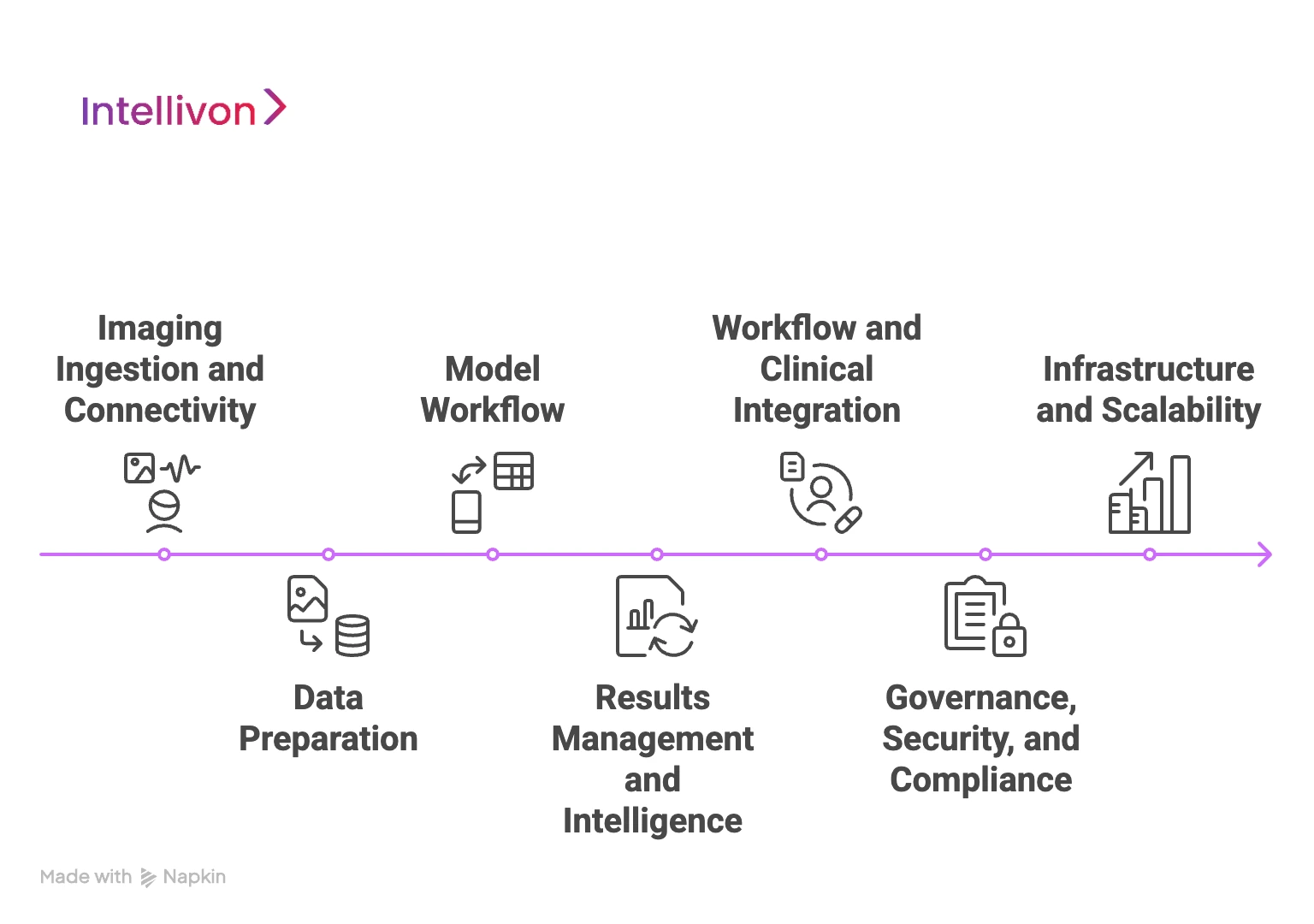
1. Imaging Ingestion and Connectivity Layer
This layer connects imaging modalities, PACS, and vendor-neutral archives using DICOM, HL7, and secure APIs. It ingests studies continuously without interrupting scanner operations or radiology workflows.
For enterprises, centralized ingestion creates consistency across facilities while allowing each site to operate independently.
2. Data Preparation Layer
Before analysis, images pass through normalization, quality validation, and optional de-identification processes. Differences in scanner vendors, protocols, and image resolution are standardized at this stage.
This improves model reliability and reduces variability when AI is deployed across large, heterogeneous imaging environments.
3. Model Workflow Layer
This layer manages how and where AI models run. It selects the appropriate algorithm based on modality, anatomy, and clinical context, then executes inference using governed compute resources.
Enterprises benefit from version control, predictable performance, and the ability to scale multiple AI use cases without operational sprawl.
4. Results Management and Intelligence Layer
Raw model outputs are converted into structured findings, visual overlays, measurements, and confidence scores. This layer ensures AI-powered results are clinically meaningful rather than technical artifacts.
For enterprises, it is where diagnostic intelligence becomes usable and defensible in real workflows.
5. Workflow and Clinical Integration Layer
AI insights are delivered directly into PACS viewers, radiology worklists, structured reports, and EHR systems. Radiologists and clinicians interact with AI outputs inside familiar tools.
This layer protects adoption by eliminating context switching and ensuring AI augments, rather than disrupts, daily operations.
6. Governance, Security, and Compliance Layer
This layer enforces access control, encryption, audit logging, and usage tracking across the platform. It monitors model performance, flags drift, and maintains documentation for regulatory review.
Enterprises rely on this layer to meet HIPAA, GDPR, and internal governance requirements at scale.
7. Infrastructure and Scalability Layer
The platform operates on cloud, on-premises, or hybrid infrastructure, depending on enterprise constraints. GPU orchestration, autoscaling, and high-availability design support fluctuating imaging volumes.
This allows healthcare organizations to expand AI usage without re-architecting core systems.
At the enterprise level, architecture determines whether AI medical imaging remains a pilot or becomes sustainable infrastructure. A layered, governed design enables healthcare organizations to scale diagnostic intelligence while protecting clinical workflows, data security, and compliance.
How AI Works in Medical Imaging Diagnostics
In enterprise medical imaging platforms, AI works by learning visual patterns from large datasets and applying governed, explainable intelligence to support diagnostic decisions at scale.
The goal is not automation alone, but reliable decision support that can be trusted across hospitals, clinicians, and patient populations.
1. Pattern Learning, Not Rule Matching
AI medical imaging systems rely on deep learning models trained on millions of labeled images. These models do not follow predefined rules. Instead, they learn visual patterns associated with clinical conditions such as lesions, fractures, or tissue changes.
This allows them to detect subtle correlations that are difficult to capture with traditional logic-based systems.
2. Modality and Anatomy-Specific Intelligence
Enterprise platforms do not use one universal model. They apply specialized models for different imaging modalities and anatomical regions.
A CT scan of the chest activates a different analytical pathway than a breast tomosynthesis study. This specialization improves accuracy and reduces misinterpretation across diverse use cases.
3. Probabilistic Output
AI outputs are expressed as probabilities, confidence scores, and measurements rather than binary conclusions. This probabilistic approach is critical for enterprise deployment.
It allows clinicians to understand risk levels and decide how heavily AI findings should influence diagnosis and reporting.
4. Explainability Embedded Intelligence
Modern platforms embed explainability directly into AI outputs. Visual heatmaps, segmentation outlines, and quantitative indicators show where and why the model flagged an area.
This transparency supports clinical trust and enables auditability for regulated environments.
5. Learning From Real-World Operation
After deployment, AI systems continue to adapt within strict governance boundaries. Performance trends, usage patterns, and population-level differences are monitored.
Enterprises use this insight to refine models, manage drift, and maintain consistent performance across facilities.
In medical imaging platforms, AI works by transforming raw images into consistent, explainable diagnostic signals. It complements clinician expertise rather than replacing it. When governed properly, this intelligence layer enables scale, reduces variability, and strengthens diagnostic confidence across the organization.
Security Readiness Of Medical Imaging Diagnostics Platforms
Enterprise medical imaging diagnostics platforms require security architectures that protect imaging data, control AI access, and maintain auditability across regulated healthcare environments.
Security readiness determines whether an AI platform can be deployed at scale without increasing operational or regulatory risk.
1. End-to-End Protection of Imaging Data
Medical images contain direct and indirect patient identifiers. Enterprise platforms protect this data through encryption at rest and in transit across ingestion, processing, and storage layers.
Access to images and AI outputs is restricted based on roles, clinical context, and organizational policies.
2. Identity, Access, and Role-Based Controls
Security-ready platforms integrate with enterprise identity providers. Role-based access ensures that clinicians, administrators, and AI operators only see what they are authorized to access.
This reduces exposure risk and supports internal compliance requirements.
3. Secure AI Inference and Model Access
AI models and inference services are protected as regulated assets. Enterprises control who can deploy, modify, or invoke models.
This prevents unauthorized experimentation, model misuse, or leakage in production environments.
4. Auditability and Activity Monitoring
Every interaction with imaging data and AI outputs is logged. Platforms maintain detailed audit trails covering access, model execution, and result usage.
These logs support compliance reviews, incident response, and internal risk assessments.
5. Data Segmentation and Isolation
Enterprise platforms segment environments for development, testing, and production. Patient data remains isolated from experimentation workflows. This separation ensures innovation does not compromise clinical safety or compliance.
6. Resilience and Incident Response
Security readiness also includes system reliability. Platforms are designed with redundancy, failover, and monitored response processes.
In the event of outages or threats, diagnostic operations continue without data loss or workflow disruption.
For enterprises, security readiness is the gatekeeper of AI medical imaging adoption. Platforms that embed protection, access control, and auditability into their core design allow organizations to deploy AI at scale without exposing patient data or operational integrity. Security-first architecture turns AI imaging from a risk into a trusted clinical capability.
How We Build Enterprise AI Medical Imaging Platforms
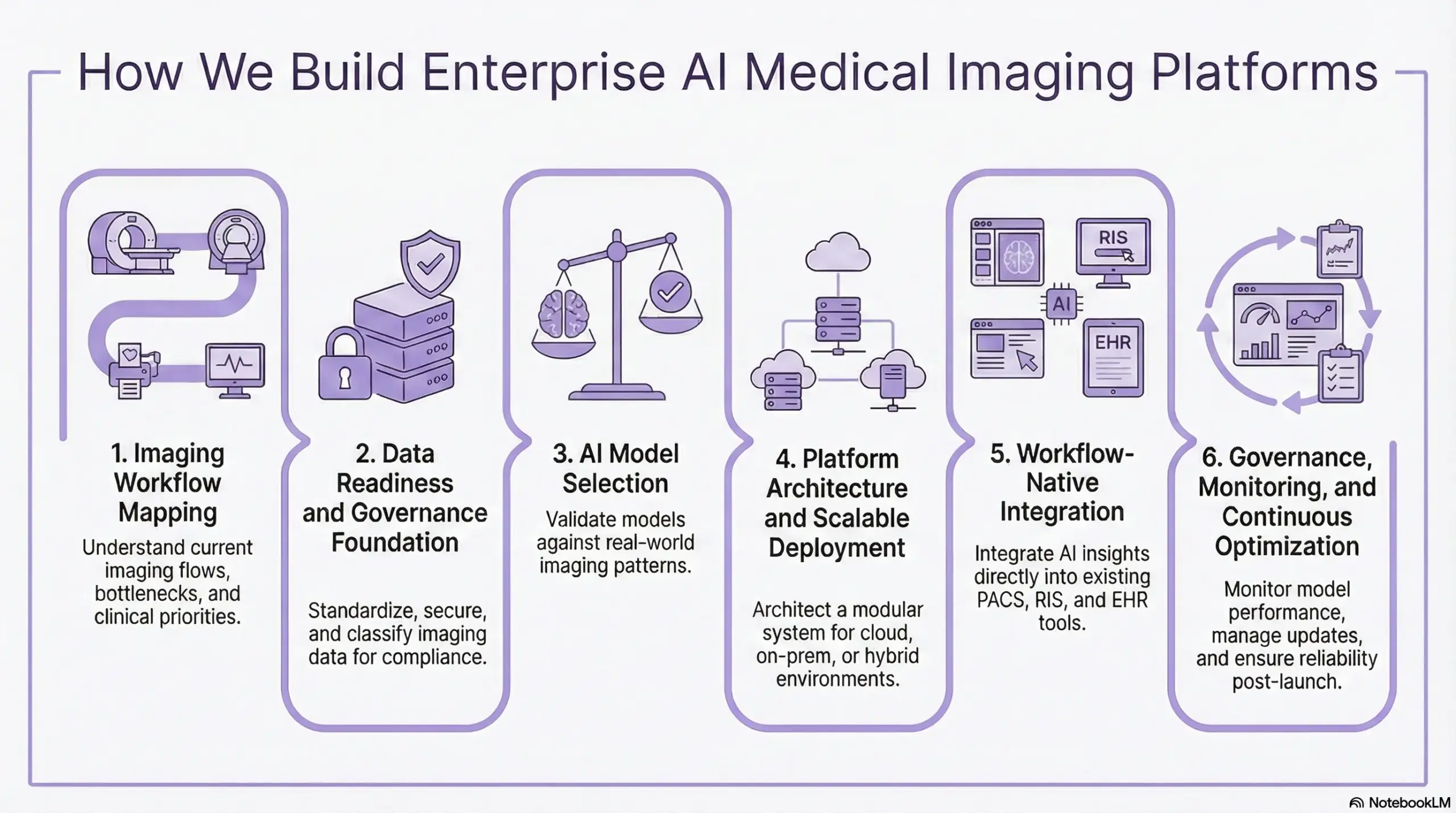
Intellivon builds enterprise AI medical imaging platforms using a compliance-first, workflow-native, and scalable architecture designed for real-world healthcare environments.
We approach imaging AI as an enterprise infrastructure that must integrate, scale, and remain defensible under clinical and regulatory scrutiny. Our build process reflects how large healthcare organizations actually operate.
1. Imaging Workflow Mapping
We begin by understanding how imaging flows through your organization today. This includes modality mix, PACS configurations, reporting practices, staffing models, and clinical priorities.
Our teams map imaging bottlenecks, risk points, and scale requirements before defining any AI scope. This phase ensures the platform aligns with real operational goals rather than abstract use cases.
2. Data Readiness and Governance Foundation
Before introducing AI, we assess data quality, acquisition variability, and governance controls. Imaging data is standardized, secured, and classified according to compliance requirements.
Where needed, we design de-identification and access policies that align with enterprise risk frameworks. Strong data foundations prevent performance drift and regulatory exposure later.
3. AI Model Selection
We select or develop AI models based on modality, anatomy, and diagnostic intent. Each model is validated against real-world imaging patterns rather than narrow research datasets.
Performance thresholds, confidence scoring, and explainability requirements are defined upfront. AI remains assistive by design, with clinical teams retaining full decision authority.
4. Platform Architecture and Scalable Deployment
We architect the platform as a modular system, not a single application. Ingestion services, inference engines, orchestration logic, and integration layers scale independently.
Deployment supports cloud, on-prem, or hybrid environments depending on organizational constraints. This allows enterprises to expand AI usage without re-architecting core systems.
5. Workflow-Native Integration
We integrate AI insights directly into existing PACS, RIS, and EHR environments. Radiologists and clinicians interact with AI outputs inside familiar tools, which include no parallel viewers and no duplicate reporting.
Adoption improves when AI fits invisibly into daily workflows.
6. Governance, Monitoring, and Continuous Optimization
After go-live, we monitor model performance, usage patterns, and drift across facilities. Versioning, audit logs, and access controls remain enforced throughout the lifecycle.
Updates are managed centrally to avoid fragmentation or uncontrolled change. This keeps the platform reliable as imaging volumes and use cases grow.
We build enterprise AI medical imaging platforms to last. We do this by combining clinical insight, platform engineering, and compliance-first design, and we help healthcare organizations deploy AI with confidence. The result is a diagnostic infrastructure that scales safely, delivers measurable value, and supports long-term growth across the enterprise.
Cost of Building an AI Medical Imaging Diagnostics Platform
For healthcare enterprises, hospital networks, and imaging service providers, the cost of building an AI medical imaging diagnostics platform depends far more on scope discipline and phased execution than on model sophistication alone. Organizations that start with a focused imaging use case, such as stroke triage, oncology screening, or chest X-ray prioritization, can launch a production-ready platform without excessive upfront spend. Costs tend to escalate when enterprises attempt to support every modality, condition, and workflow in the first phase.
At Intellivon, we structure AI medical imaging initiatives around phase-wise cost models aligned with enterprise budget cycles, compliance readiness, and near-term operational ROI. This approach limits capital risk while ensuring the platform remains scalable, governed, and compliant from day one.
Estimated Phase-Wise Cost Breakdown
Enterprise AI Medical Imaging Diagnostics Platform
| Phase | Description | Estimated Cost (USD) |
| Discovery & Imaging Blueprint | Imaging use-case definition, modality selection, workflow mapping, regulatory scoping | 15,000 – 25,000 |
| Platform Architecture & Data Design | Imaging ingestion architecture, PACS/EHR integration design, scalability planning | 20,000 – 35,000 |
| Imaging Ingestion & Preprocessing Setup | DICOM pipelines, normalization, data quality enforcement | 25,000 – 45,000 |
| AI Model Enablement & Validation | Model selection or development, accuracy benchmarking, and explainability configuration | 30,000 – 60,000 |
| Workflow Integration (PACS, RIS, EHR) | Viewer integration, worklist augmentation, reporting alignment | 18,000 – 30,000 |
| Security, IAM & Compliance Controls | PHI encryption, role-based access, audit trails, governance tooling | 15,000 – 25,000 |
| Testing, QA & Clinical Validation | Performance validation, workflow testing, safety checks | 12,000 – 20,000 |
| Pilot Deployment & Training | Live rollout, clinician onboarding, feedback-driven tuning | 15,000 – 25,000 |
Total Initial Investment Range:
USD 150,000 – 265,000
This investment supports a secure, compliant, enterprise-ready AI medical imaging platform for a single high-impact diagnostic program, such as emergency triage, cancer screening, or radiology workload prioritization.
Annual Maintenance and Optimization Costs
Ongoing costs cover cloud or hybrid infrastructure, model monitoring, compliance updates, integration support, and AI performance tuning.
- Estimated Annual Cost: 12–20% of initial build
- Approximate Range: USD 18,000 – 55,000 per year
When platforms are built using modular services and governed AI pipelines, these costs scale predictably as imaging volumes and use cases expand.
Hidden Costs Enterprises Should Plan For
Even well-scoped AI medical imaging platforms introduce additional cost factors over time:
- Expansion into new imaging modalities or anatomical regions
- Supporting additional AI models or diagnostic indications
- Increased GPU and cloud compute usage as imaging volume grows
- Regulatory updates impacting SaMD validation or audit requirements
- Model drift management across changing patient populations
- Ongoing clinician and radiology team training as adoption matures
Planning for these early prevents budget surprises during scale-up or system-wide rollout.
Best Practices to Stay Within Budget
Enterprises that control AI imaging costs most effectively tend to:
- Start with a single, high-impact diagnostic use case
- Limit modality and model sprawl in early phases
- Use modular, platform-based architecture
- Embed security and compliance controls from the start
- Track operational and financial ROI within the first six months
This phased approach ensures the platform demonstrates measurable value before broader capital investment.
Contact our experts at Intellivon. They can help define a tailored cost estimate and phased rollout aligned with your imaging strategy, regulatory environment, and long-term growth objectives.
Overcoming Challenges In AI Medical Imaging Diagnostics Platforms
Enterprise AI medical imaging initiatives fail most often due to integration, trust, and governance gaps rather than model accuracy alone.
Deploying AI medical imaging diagnostics at enterprise scale introduces challenges that are rarely visible during early pilots. These issues surface only when platforms interact with live clinical workflows, heterogeneous infrastructure, and regulatory oversight. Below are the most critical, non-generic challenges healthcare enterprises face—and how we address them through platform-first design.
Loss of Clinical Trust Due to Black-Box Outputs
Even high-performing AI models struggle with adoption when outputs lack transparency. In enterprise environments, clinicians disengage quickly if findings appear without visual context or confidence indicators. Over time, AI becomes ignored or bypassed rather than embedded into daily workflows.
How we solve it:
We design imaging platforms with explainability embedded at the intelligence layer. Visual overlays, measurements, and confidence scores appear directly inside existing PACS viewers. This keeps clinicians in control and builds trust through consistent, reviewable output.
2. Inconsistent AI Performance
Large healthcare systems operate across multiple scanners, acquisition protocols, and vendor configurations. Models that perform well in controlled settings often degrade when exposed to real-world variability, creating uneven results across facilities.
How we solve it:
Our platforms include robust preprocessing and normalization pipelines that standardize imaging inputs before inference. Combined with continuous monitoring and drift detection, this ensures reliable behavior across sites, vendors, and patient populations.
3. Poor System Integration
Many AI tools introduce parallel workflows, forcing clinicians to switch viewers or manage separate reports. This increases friction, slows reads, and undermines scalability across departments.
How we solve it:
We integrate AI outputs directly into PACS, RIS, and EHR environments. Findings appear inside existing worklists and reporting tools, preserving established workflows and accelerating enterprise-wide adoption.
4. Regulatory Exposure From Limited Auditability
Enterprise leaders often struggle to trace how AI influenced diagnostic decisions. Without strong audit trails, version history, and access logs, AI increases regulatory and legal risk rather than reducing it.
How we solve it:
Our platforms embed governance by design. Every model execution, interaction, and output is logged and traceable. This supports internal quality reviews, regulatory inquiries, and long-term compliance initiatives.
Difficulty Scaling Beyond Pilots
Many organizations succeed with a single AI use case but fail to expand further. Model sprawl, unmanaged updates, and inconsistent configurations create operational instability as adoption grows.
How we solve it:
We provide centralized orchestration, controlled deployment pipelines, and performance monitoring across all AI imaging use cases. This allows healthcare enterprises to scale confidently without losing control or consistency.
Enterprise challenges in AI medical imaging are rooted in platform maturity, not algorithm performance. When deployed with the right architectural controls, governance, and workflow integration, AI becomes a dependable diagnostic infrastructure. Our approach focuses on eliminating adoption friction so healthcare organizations can move from experimentation to sustainable, enterprise-wide impact.
Conclusion
AI medical imaging diagnostics platforms are no longer experimental technologies reserved for innovation labs. For healthcare enterprises, they are becoming an essential infrastructure that supports diagnostic scale, operational resilience, and risk control. When built with the right architecture, governance, and workflow integration, these platforms strengthen clinical consistency while improving the efficiency of high-cost imaging operations.
The enterprises that succeed will be those that treat AI as a platform investment, not a point solution. A phased, compliance-first approach enables measurable ROI while preserving trust and control. With the right execution partner, AI medical imaging becomes a long-term growth enabler that supports better outcomes, sustainable operations, and enterprise-wide transformation.
Build Your AI Medical Imaging Diagnostics Platform With Intellivon
At Intellivon, we build enterprise-grade AI medical imaging diagnostics platforms that combine clinical intelligence, scalable architecture, and governance-first design into one integrated diagnostic environment. Our platforms connect imaging modalities, PACS, RIS, EHR systems, and AI inference pipelines without disrupting live radiology or clinical workflows.
Each solution is engineered for modern healthcare enterprises. Platforms are compliant by design, resilient under high imaging volumes, interoperable across vendors, and built to deliver measurable diagnostic, operational, and financial ROI from the earliest deployment phases.
Why Partner With Intellivon?
- Compliance-First Imaging Architecture: Every platform aligns with HIPAA, GDPR, FDA SaMD considerations, and regional healthcare regulations, with auditability and traceability embedded at every layer.
- Workflow-Native AI Integration: AI insights appear directly inside existing PACS viewers, radiology worklists, structured reports, and EHR systems, preserving clinician workflows and adoption.
- Multi-Modality, Vendor-Agnostic Design: We support CT, MRI, X-ray, PET, ultrasound, and pathology across heterogeneous scanners and vendors, without locking enterprises into proprietary ecosystems.
- Scalable AI Orchestration: Modular inference pipelines allow multiple AI models to run reliably across facilities, service lines, and imaging volumes without operational sprawl.
- Explainable, Clinician-Controlled Intelligence: Visual overlays, measurements, and confidence scoring keep radiologists in control while improving consistency and throughput.
- Zero-Trust Security and Imaging Data Protection: End-to-end encryption, identity-first access controls, environment isolation, and continuous monitoring protect PHI across the imaging lifecycle.
Book a strategy call with Intellivon to explore how a custom-built AI medical imaging diagnostics platform can reduce risk, improve diagnostic efficiency, and scale intelligent imaging across your healthcare enterprise.
FAQs
Q1. What is an AI medical imaging diagnostics platform?
A1. An AI medical imaging diagnostics platform is an enterprise system that analyzes medical images using machine learning to support clinical decision-making. It integrates with PACS, RIS, and EHR systems to detect patterns, prioritize cases, and assist radiologists without replacing human judgment. These platforms are designed to scale across hospitals while meeting security, compliance, and governance requirements.
Q2. How accurate are AI medical imaging diagnostics platforms?
A2. Accuracy varies by use case and modality, but enterprise-validated AI imaging systems routinely demonstrate sensitivity and specificity near or above 90% for selected diagnostic tasks. AI is most effective when used as a decision-support or triage layer, where it improves consistency, reduces missed findings, and accelerates diagnostic workflows under clinician oversight.
Q3. How long does it take to build an enterprise AI medical imaging platform?
A3. A focused enterprise platform can typically be built and deployed in 4 to 6 months for a single high-impact imaging use case. Timelines depend on scope, modality coverage, integration requirements, and regulatory readiness. Most enterprises follow a phased rollout to validate ROI before expanding across additional use cases or facilities.
Q4. What integrations are required for AI medical imaging platforms?
A4. Enterprise AI imaging platforms commonly integrate with imaging modalities, PACS, RIS, EHR systems, and identity management infrastructure. Support for DICOM, HL7, FHIR, and secure APIs is essential. Seamless integration ensures AI insights appear inside existing workflows without disrupting clinical operations.
Q5. Is AI medical imaging compliant with healthcare regulations?
A5. Yes, when built correctly. Enterprise AI medical imaging platforms are designed to comply with HIPAA, GDPR, and applicable FDA SaMD requirements. Key compliance features include PHI encryption, role-based access, audit logs, model version tracking, and explainable outputs that support regulatory review and clinical accountability.