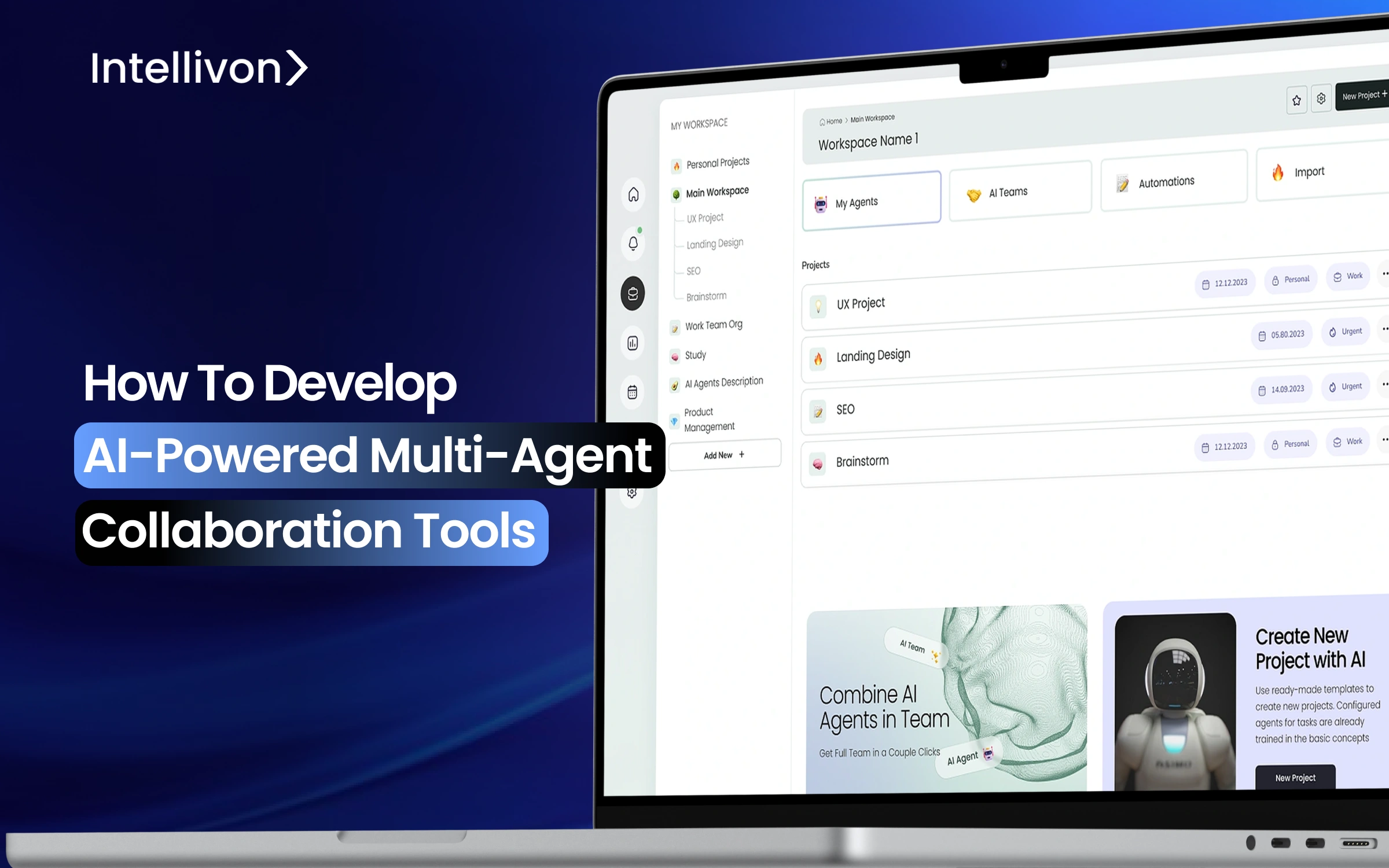
As a business leader, you might have seen your teams spend hours on manual tasks, trying to interpret inconsistent data, and come up with incomplete solutions. While traditional automation can solve this to a certain extent, it cannot keep up with the speed of today’s business needs.
The solution lies in AI-powered multi-agent collaboration tools, which perform tasks independently, collaborate across teams, and adjust to changing business conditions. AI-agents within these tools work across departments, identify patterns, and highlight opportunities or risks in real time. The outcome results in quicker operations, higher ROI, and significantly lower time-to-market deployments.
Through years of experience, Intellivon’s multi-agent tools have delivered gains in compliance, uptime, and customer engagement, turning difficult workflows into intelligent processes that drive real business value. Using this expertise, we will show you how we build, deploy, and scale these tools from the ground up.
What Are AI-Powered Multi-Agent Collaboration Tools?
At their core, AI-powered multi-agent collaboration tools are systems where multiple intelligent agents work together to achieve complex goals in businesses. Each agent is designed with a specific skill, such as analyzing data, checking compliance, managing workflows, or generating recommendations. When these agents collaborate, the business gains a coordinated digital workforce that can handle tasks faster, with greater accuracy, and on a larger scale.
Think of multi-agent development as building an internal team of AI specialists. Instead of relying on a single model that tries to cover everything, you use agents with defined roles and responsibilities. A research agent pulls data, a compliance agent validates it, a strategy agent suggests actions, and an execution agent carries them out. The power lies in how they communicate, share context, and build on each other’s work, much like teams in an organization.
For businesses, these tools are more than just automation. They become valuable assets that reduce decision delays, break down silos, and keep operations connected to business goals.
Why Enterprises Should Invest in Multi-Agent Collaboration Now
The market for multi-agent systems is moving at an unprecedented pace. Valued at USD 7.81 billion in 2025, it is projected to reach USD 54.91 billion by 2030, growing at a staggering 47.71% CAGR.
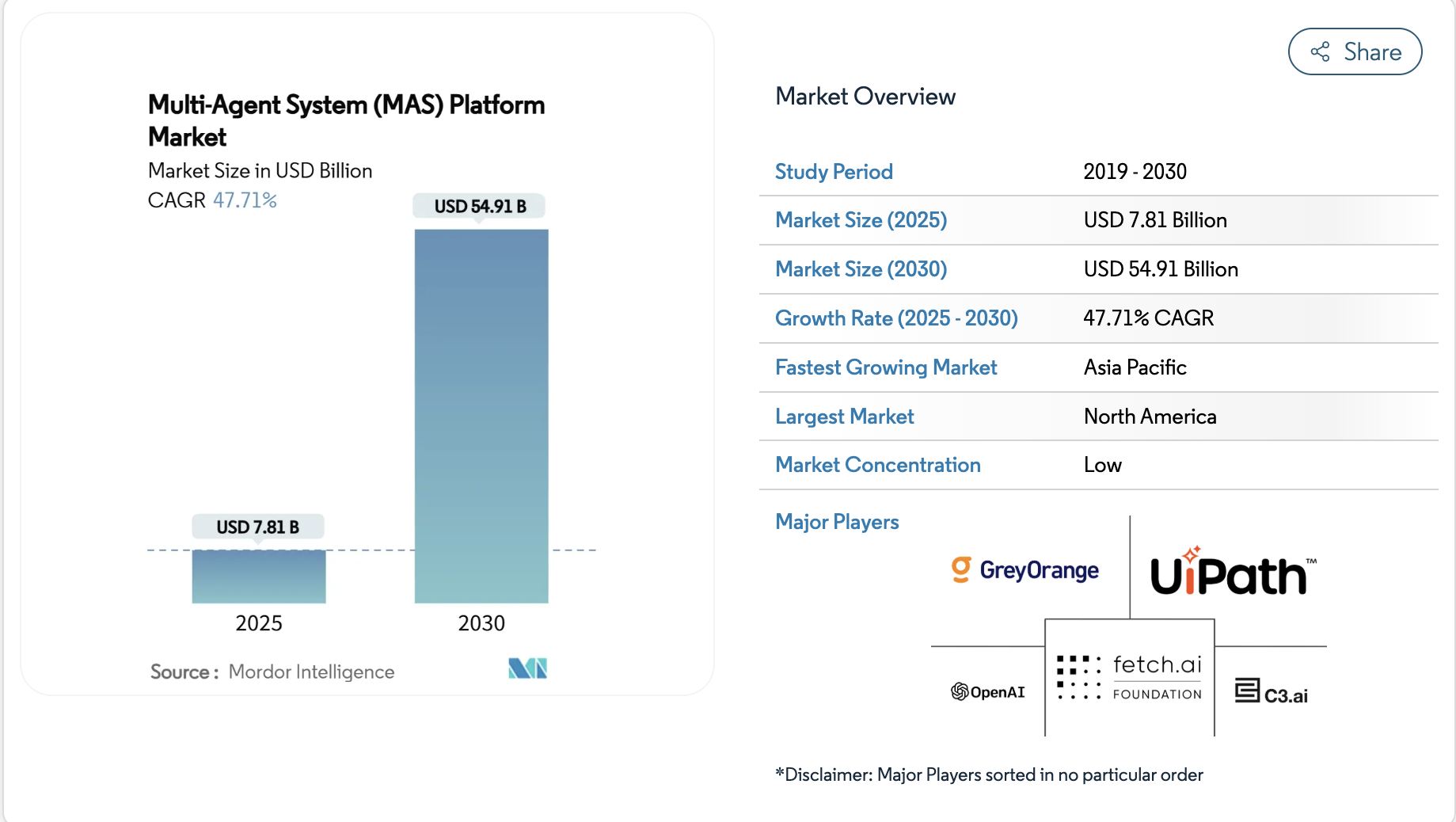
Explosive Adoption & Market Growth
- 85% of enterprises have adopted AI agents in at least one workflow in 2025.
- 78% of enterprises are using AI in some form.
- Deloitte projects 25% of enterprises using generative AI will deploy autonomous agents by the end of 2025, rising to 50% by 2027.
- Gartner predicts 33% of enterprise software platforms will feature agentic AI by 2028, up from just 1% in 2024.
- The global AI agent market is set to reach $7.6–$10.4 billion in 2025, with a CAGR of 45.8% through 2034.
Measurable ROI & Business Value
- Enterprises report ROI of 200–400% within 12–24 months of multi-agent AI implementation.
- Average annual savings range from $2.1 to $3.7 million per company.
- 66% of organizations deploying AI agents report higher productivity; 55% report faster decision cycles (PwC, 2025).
- Operational cost reductions exceed $7.9 billion annually from RAG-enabled agentic AI.
- Break-even often occurs within 24 months, with a five-year ROI above 125%.
Operational Improvements
- AI agents reduce average task or customer handle times by 40–60%.
- First-contact resolution rates improve by up to 30%.
- 83% of executives expect AI agents to boost efficiency and output by 2026.
- 69% cite better decision-making as the top benefit; 73% agree agents will be a competitive advantage this year.
Strategic Urgency
- Enterprises expect AI-enabled workflows to surge 8x by the end of 2025.
- AI-driven processes will grow from 3% to 25% of workflows.
- 46% of leaders worry about falling behind competitors without orchestrated agent strategies.
How Multi-Agent Collaboration Works in Enterprise Settings
For executives, the value of multi-agent collaboration systems is in how they actually operate inside the enterprise. To understand their impact, let’s take a look at how they work in an enterprise setting.
1. Orchestration Models Driving Coordination
Every system needs a structure. In multi-agent development, orchestration is how tasks are assigned and coordinated:
- Hierarchical orchestration: A manager agent directs worker agents, much like a project manager.
- Workflow orchestration (DAG): Agents complete tasks in a set sequence, where one output flows to the next.
- Hybrid orchestration: Combines both, balancing control with flexibility.
This orchestration layer is what allows enterprises to move from isolated pilots to systems that scale across functions.
2. Integrating with Enterprise Systems
Agents are only as useful as the data and tools they can access. Integration connects them to ERP systems, CRMs, supply chain platforms, and external APIs.
Frameworks like Anthropic’s Model Context Protocol (MCP) and Google’s Agent-to-Agent (A2A) protocol make these integrations secure and interoperable. For businesses, this ensures agents can operate seamlessly within existing IT ecosystems without expensive overhauls.
3. Human-in-the-Loop Oversight
No enterprise will hand over critical decisions entirely to AI. That’s why multi-agent systems are designed with checkpoints for human approval.
A claims agent in insurance may draft a payout decision, but a compliance officer can review it before execution. This human-in-the-loop design maintains trust and accountability while still reaping efficiency gains.
4. Governance and Security Layers
Governance matters as much as innovation in enterprises with complex data and workflows. Modern multi-agent platforms embed role-based access, audit trails, and data masking into their design. This ensures agents act within enterprise rules and remain compliant with regulations such as GDPR, HIPAA, or SOX. Governance is a part of the foundation, and not a bolt-on.
Multi-agent systems work because they mirror how enterprises already function: teams with defined roles, integrated systems, oversight, and governance. The difference is that agents don’t tire, don’t delay, and scale instantly when demand rises.
Core Components of AI-Powered Multi-Agent Collaboration Tools
Multi-agent collaboration tools succeed because they are built on well-defined layers, each handling a critical part of enterprise operations. Think of them as a digital organization chart, where every layer plays a distinct role in enabling scale, compliance, and measurable business value.
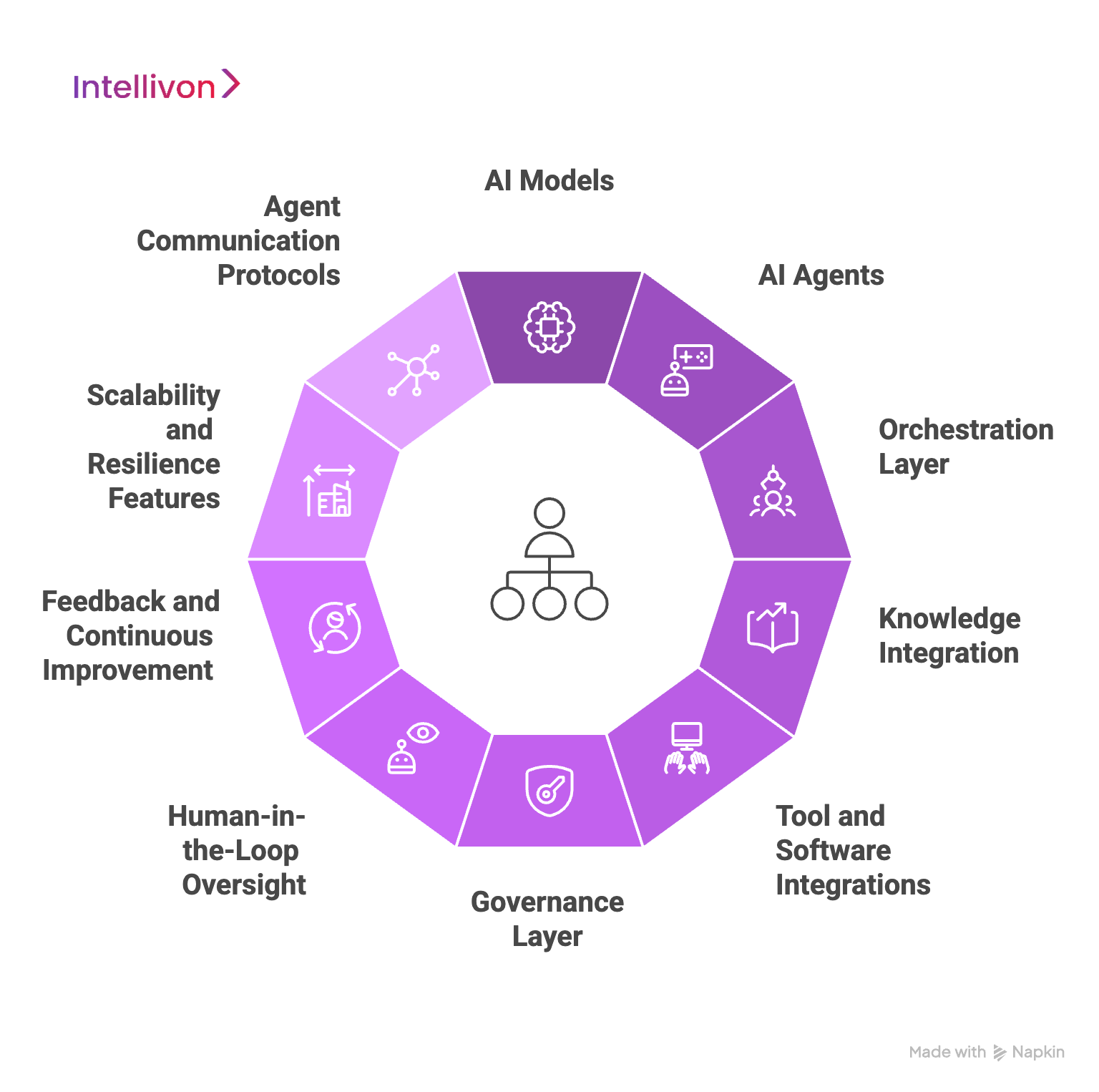
1. AI Models – The Brains
Large Language Models (LLMs) combined with domain-specific models form the reasoning layer. These models interpret data, understand context, and generate actionable insights. Enterprises often integrate a general-purpose LLM with specialized models, such as finance risk models or healthcare diagnostics, to enhance precision and relevance.
2. AI Agents – The Workers
AI Agents are the functional units of the system, each with a defined role. A research agent gathers critical data, a compliance validator ensures rules are met, an executor carries out actions, and a monitoring agent tracks quality. Together, they function as a digital workforce with clear responsibilities, much like teams within an enterprise.
3. Orchestration Layer – The Coordinator
The orchestration layer manages how tasks are assigned and coordinated so agents don’t work in isolation. Common patterns include:
- Hierarchical orchestration: A manager agent delegates tasks to worker agents, similar to a project manager overseeing a team.
- Workflow orchestration: Tasks flow in sequence, where one agent’s output becomes another’s input (directed acyclic graph or DAG).
- Hybrid orchestration: Combines workflow sequencing with hierarchical oversight for balanced control.
Most enterprises adopt hybrid orchestration, enabling scalable and adaptable collaboration.
4. Knowledge Integration – The Memory
Agents rely on enterprise knowledge to operate effectively. Retrieval-Augmented Generation (RAG), vector databases, and knowledge graphs provide this “memory,” allowing agents to pull relevant policies, financial data, or records in real time. This capability reduces errors and improves decision accuracy.
5. Tool and Software Integrations – The Hands and Eyes
For AI agents to deliver true business value, they must integrate with enterprise systems, like ERP, CRM, supply chain platforms, and SaaS applications. This allows them to perform real actions, such as updating Salesforce records or querying SAP databases. Without these integrations, they remain isolated assistants rather than enterprise enablers.
6. Governance Layer – The Guardrails
Governance is foundational in multi-agent systems, as it embeds security, access control, compliance, and audit capabilities from the start. Features like role-based access, data masking, and audit trails ensure agents operate within organizational policies and regulatory requirements such as GDPR, HIPAA, or SOX. This balances innovation with risk management.
7. Human-in-the-Loop Oversight
To maintain trust, enterprises add checkpoints where humans review or approve critical decisions. For example, a claims agent in insurance may draft a payout, but a compliance officer gives the final sign-off. Under the human-in-the-loop oversight feature, this model ensures accountability without compromising efficiency gains.
8. Feedback and Continuous Improvement
Multi-agent systems are designed to learn, and feedback loops ensure this happens. Feedback loops allow agents to refine performance over time, adapting to new data and evolving business contexts. This continuous improvement ensures long-term effectiveness.
9. Scalability and Resilience Features
Enterprise-grade systems use containerization (such as Docker, Kubernetes) and distributed architectures to scale dynamically. Additionally, load balancing and failover mechanisms provide resilience, keeping agents reliable even under peak demand or partial system failures.
10. Agent Communication Protocols
Secure, standardized protocols govern how agents exchange information and collaborate on the platforms. They support asynchronous communication and context sharing, enabling reliable collaboration without data loss or latency spikes.
Together, these layers form the backbone of multi-agent collaboration tools. They create systems that think, act, integrate, and scale while staying accountable and compliant. In the next section, we’ll see how these capabilities translate into industry-specific use cases that deliver measurable impact.
Industry-Wise Use Cases of Multi-Agent Systems
Multi-agent collaboration tools are not abstract concepts. They are already shaping how industries operate, delivering measurable ROI and operational resilience. Below are examples of how enterprises are applying them today.
1. Finance and Banking
A. Credit Risk Assessment
A network of agents can automate credit risk analysis by pulling financial history, cross-checking compliance rules, and simulating repayment scenarios. The compliance agent ensures regulatory accuracy, while the decision agent generates risk scores. Since financial data is highly sensitive, strict governance is built into the system.
B. Fraud Detection
Fraud detection agents monitor transactions in real time, flag anomalies, and cross-verify against historical fraud patterns. Another agent validates against compliance requirements before escalating, ensuring security teams get actionable alerts without disrupting the flow of legitimate payments.
C. Investment Advisory
Multi-agent systems combine market-tracking agents, portfolio analyzers, and compliance validators to provide advisors with tailored investment recommendations. Transparency and explainability are crucial so advisors can confidently present AI-informed advice to clients.
Example
Morgan Stanley’s “Next Best Action” platform enhances financial advisor recommendations, contributing to its 99% retention rate among top-tier clients.
2. Healthcare
A. Patient Engagement
Agents handle scheduling, reminders, and post-care follow-ups, reducing administrative load while keeping patients engaged. Because patient data is involved, these systems are designed with HIPAA-compliant safeguards to protect records at every step.
B. Clinical Decision Support
Diagnostic agents analyze symptoms and cross-reference with medical databases, while compliance agents ensure adherence to clinical guidelines. Doctors remain the final decision-makers, but the system gives them faster, evidence-based insights.
C. Hospital Logistics
Multi-agent systems optimize bed management, staffing, and equipment allocation. A forecasting agent predicts demand, while a scheduling agent aligns resources to meet it. Seamless integration with legacy hospital systems is key for adoption
Example
Cleveland Clinic uses AI-powered multi-agent collaborative tools to improve patient flow and reduce wait times across facilities.
3. Insurance
A. Claims Processing
Agents automatically extract claim data, validate it against policy details, detect potential fraud, and generate draft settlement decisions. Human adjusters step in only for exceptions, creating both speed and accountability in claims handling.
B. Underwriting
Underwriting agents evaluate applicant data, check external risk databases, and generate risk scores. Compliance agents ensure fairness and regulatory adherence, which makes regulators more confident in automated decision-making.
C. Fraud Detection
AI agents scan claims for anomalies, cross-check patterns across databases, and escalate to human investigators when needed. Balancing speed with accuracy is essential to avoid unnecessary delays for genuine claimants.
Example
Allianz applies AI-powered multi-agent systems for fraud detection across large claim volumes.
4. Manufacturing and Automotive
A. Predictive Maintenance
Sensor data feeds into monitoring agents that detect anomalies, while forecasting agents predict failures and schedule maintenance. These systems must operate reliably in real-time IoT environments where downtime can cost millions.
B. Supply Chain Optimization
Agents track inventory levels, supplier reliability, and logistics routes to optimize procurement and deliveries. Success depends on integration across supplier ecosystems, ensuring data moves freely between partners.
C. R&D and Design Simulation
Design agents simulate new prototypes, safety agents validate compliance, and cost agents evaluate production feasibility. High compute resources are required, but the payoff is faster time-to-market.
Example
BMW uses AI agent systems to accelerate vehicle design and test simulations.
5. Logistics and Retail
A. Route Optimization
Agents calculate real-time delivery routes by factoring in traffic, weather, and fleet availability. Decisions must be made with low latency to avoid delays across large distribution networks.
B. Dynamic Pricing
Pricing agents monitor demand, competitor prices, and inventory to adjust strategies dynamically. The system is designed to maintain compliance with fair pricing regulations while improving margins.
C. Catalog Management
Agents tag, categorize, and validate product listings against enterprise databases. Quality-control agents flag inconsistencies for review, ensuring cleaner data for e-commerce platforms.
6. IT and Enterprise Operations
A. DevOps Automation
Agents automate testing, deployment, and monitoring. A governance agent ensures every release follows security policies, reducing the risk of production failures.
B. Cybersecurity Monitoring
Threat-detection agents scan logs for anomalies, response agents trigger containment, and compliance agents document incidents. Effective tuning ensures fewer false positives that can overwhelm security teams.
C. Knowledge Management
Knowledge retrieval agents surface the right information to employees, while curation agents keep databases updated. Sensitive data is indexed securely to protect compliance.
Example
Deloitte uses AI-powered knowledge assistants to enhance consultant productivity across its global teams.
From finance to logistics, multi-agent systems are already proving their value. The next step is to examine enterprises that have successfully deployed these tools and the measurable outcomes they’ve achieved.
Real-World Enterprises Already Succeeding
The best way to see the value of multi-agent collaboration is through real deployments. Enterprises across industries are applying multi-agent development to streamline workflows, cut costs, and unlock new efficiency gains.
1. Lemonade
Lemonade has become well known for rethinking insurance with AI. Its claims workflow relies on a set of agents that extract documents, validate policy details, run fraud checks, and issue payments.
The result: some claims are approved and paid in under three seconds, with over 18 automated fraud checks applied instantly. This reduces loss adjustment expenses and accelerates customer satisfaction, which ensures measurable gains for both operations and growth.
2. Siemens Senseye
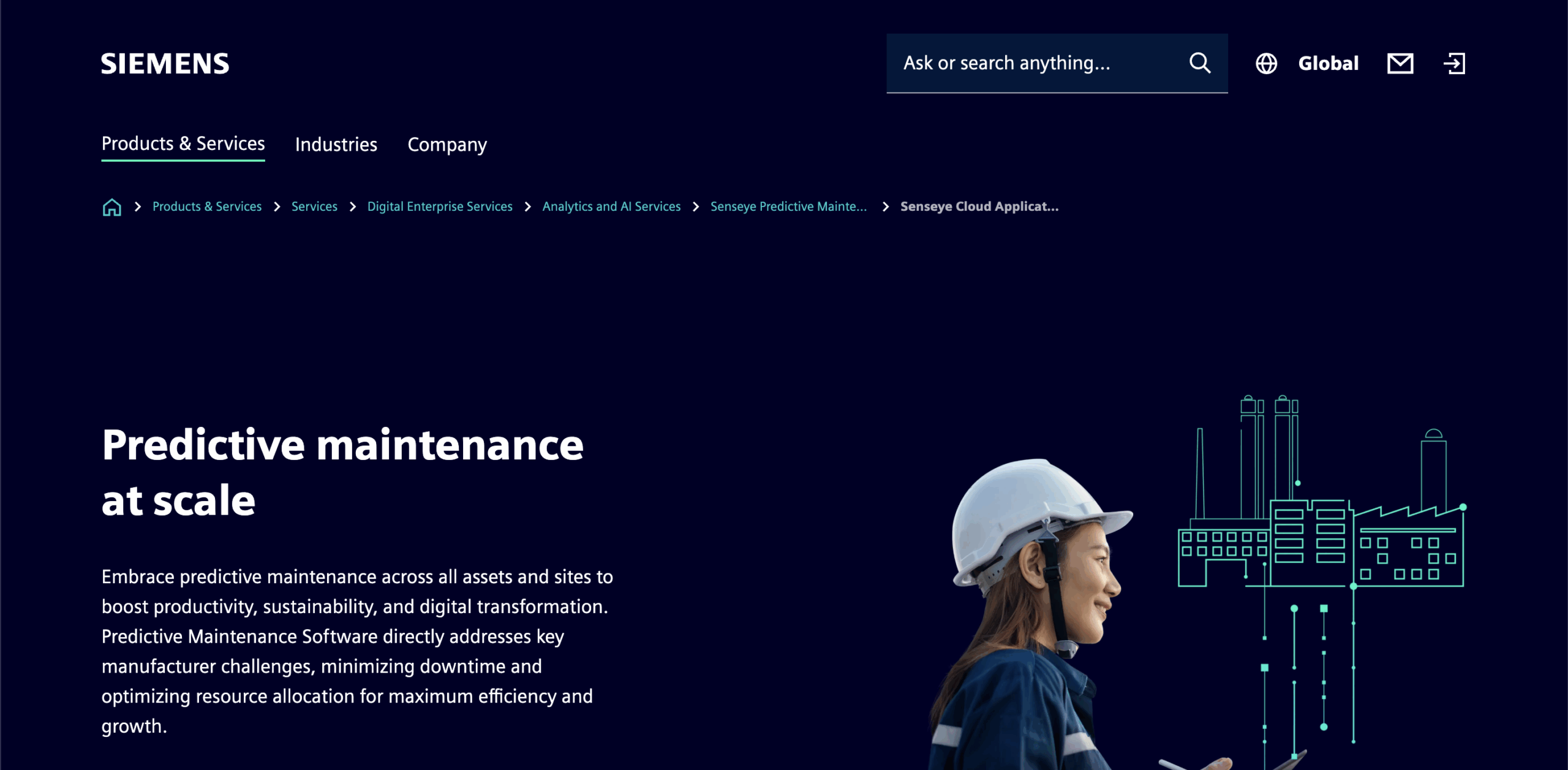
Siemens’ Senseye platform automates predictive maintenance for industrial clients by deploying monitoring, anomaly-detection, and scheduling agents across sensor data streams.
Reported benefits include a 50% reduction in unplanned downtime and 55% higher maintenance staff productivity. In heavy manufacturing, those numbers often equate to millions in avoided losses annually, with many clients achieving ROI in less than a year.
3. Lowe’s
Retailers deal with massive product data challenges, and Lowe’s tackled this with AI agents for catalog enrichment. One set of agents tags products, another validates attributes, and a quality-control layer flags inconsistencies.
The program delivered a 20% improvement in tagging accuracy and detected 60% more errors than manual processes. Cleaner data leads directly to better search relevance, smoother e-commerce experiences, and higher conversion rates.
4. QBE Insurance
QBE, one of Australia’s largest insurers, has piloted AI-driven underwriting assistants that use multi-agent logic to assess risk, validate against compliance frameworks, and generate policy recommendations. These systems speed up application reviews and reduce manual workloads for underwriters.
QBE has reported faster quote turnaround times and efficiency gains across commercial insurance lines, pointing to a strong economic case.
5. Manulife
Canadian financial services provider Manulife has invested in AI systems that act as advisor copilots. Agents analyze customer portfolios, cross-reference regulatory requirements, and surface personalized recommendations. Advisors remain in control, but the system helps reduce prep time and improve compliance accuracy.
Internal reports highlight improved advisor productivity and stronger customer engagement, benefits that directly support revenue growth.
These enterprises demonstrate that multi-agent systems are not confined to innovation labs. They are already embedded in real workflows across insurance, manufacturing, retail, and financial services, thereby delivering efficiency gains, measurable ROI, and competitive advantage.
How We Develop AI-Powered Multi-Agent Collaboration Tools
At Intellivon, we’ve seen that successful enterprise adoption of multi-agent systems depends on more than just writing code or connecting APIs. It requires a structured approach that balances automation with oversight, integrates seamlessly with existing IT infrastructure, and delivers measurable ROI from day one. Our process reflects this philosophy. Every solution we build emphasizes governance, scalability, compliance, integration, and business value, which are the same principles that have allowed our clients to reduce downtime, cut costs, and unlock millions in savings.
Below is the step-by-step approach we take to ensure that every multi-agent system is not just technically sound, but strategically aligned with enterprise priorities.
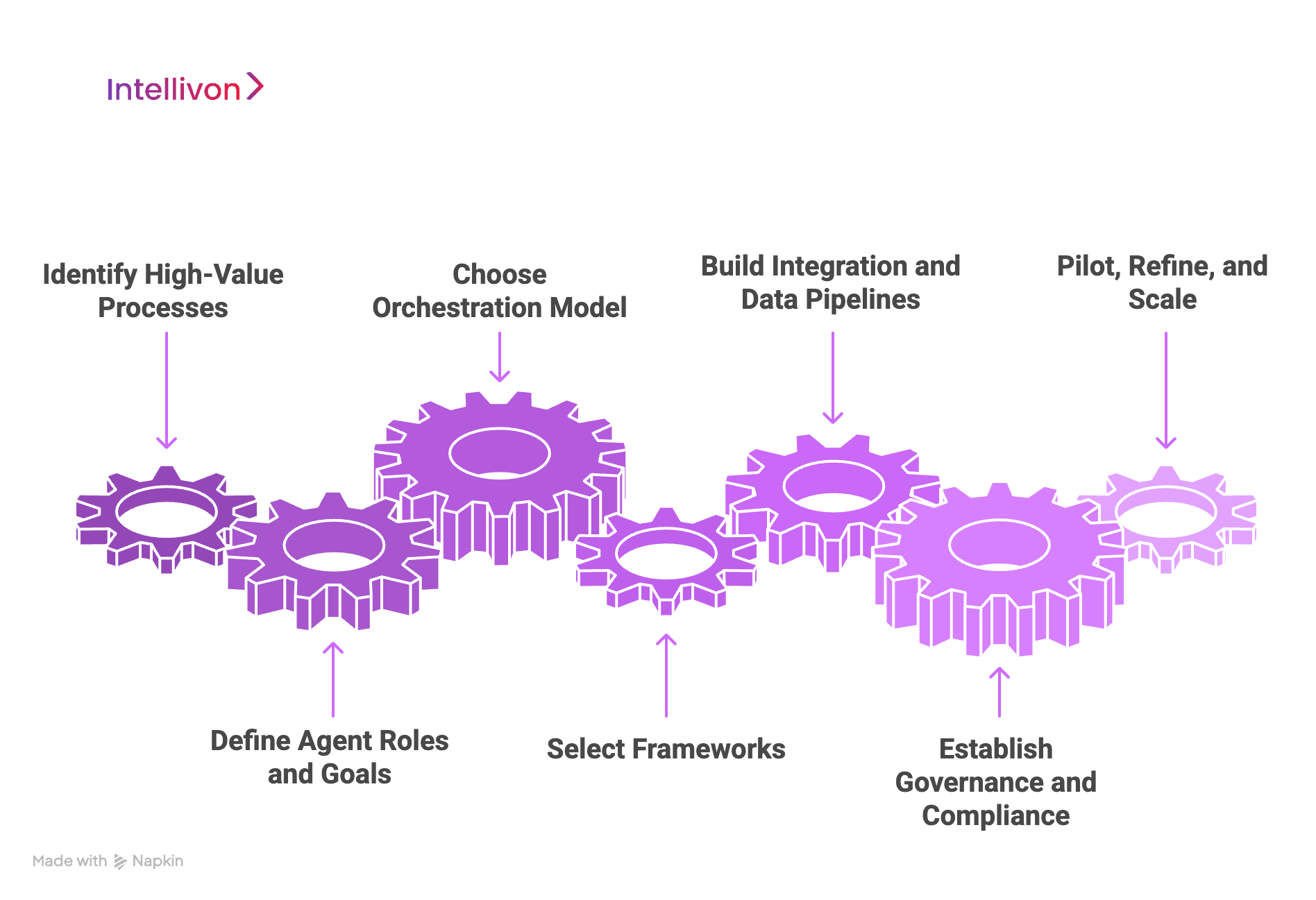
Step 1: Identify High-Value Processes for Automation
The first step is always business alignment. We work with enterprise leaders to map processes where multi-agent collaboration can generate the highest returns. These typically include labor-intensive areas like compliance monitoring, financial risk analysis, claims handling, or supply chain optimization.
By focusing on workflows with clear pain points and high costs, we ensure the system delivers measurable impact within the first 12–24 months.
Step 2: Define Agent Roles and Goals
In this stage, a research agent gathers structured and unstructured data, a compliance validator checks actions against policies and regulations, an executor carries out approved tasks, and a monitoring agent ensures accountability.
By defining roles and aligning them with business objectives, we avoid duplication of effort and create a system where every agent contributes to enterprise-wide outcomes.
Step 3: Choose the Right Orchestration Model
Some enterprises benefit from hierarchical orchestration, where a manager agent distributes tasks to worker agents, ensuring tight oversight. Others require workflow orchestration (DAG), where tasks move step by step through a chain of agents, ensuring predictable outcomes.
Many choose a hybrid orchestration model, balancing flexibility with control. The orchestration model is critical because it dictates efficiency, resilience, and how easily the system can scale across business units.
Step 4: Select the Frameworks
Framework choice determines how quickly the system can adapt and expand. We rely on proven platforms like LangChain for workflow automation, AutoGen for agent-to-agent communication, CrewAI for building role-based agent teams, and Semantic Kernel for integrating skills into enterprise software.
These frameworks allow us to combine modularity with enterprise-grade security, ensuring the system evolves alongside the business rather than becoming another rigid legacy tool.
Step 5: Build Integration and Data Pipelines
Integration is often the hardest part of enterprise AI, and the most important. Our engineers build robust data pipelines that connect agents with ERP, CRM, HR, and supply chain platforms.
Agents are given secure access to both structured and unstructured data, allowing them to act in real-time business contexts. The result: systems that don’t just analyze data, but execute actions directly within the enterprise’s operational fabric.
Step 6: Establish Governance and Compliance Guardrails
We embed role-based access controls, encryption, audit trails, and compliance frameworks from day one. This ensures alignment with regulations such as GDPR, HIPAA, and SOX.
Beyond compliance, these guardrails build executive confidence that the system is both safe and trustworthy. For many enterprises, governance is the deciding factor in whether a deployment scales company-wide.
Step 7: Pilot, Refine, and Scale Enterprise-Wide
We deploy controlled pilots to validate the system against enterprise KPIs. Pilots allow us to collect feedback, refine workflows, and fine-tune orchestration models. Once validated, the system is scaled department by department, geography by geography, ensuring adoption is smooth and sustainable.
This phased approach balances speed with stability and guarantees measurable impact at every stage of rollout.
This structured methodology is how Intellivon delivers multi-agent systems that are secure, scalable, and strategically aligned with enterprise goals. If your organization is exploring multi-agent development, now is the right time to act.
Book a free consultation session with Intellivon’s enterprise AI experts today, and discover how a tailored multi-agent collaboration system can streamline operations, reduce costs, and scale with your business.
Cost of Developing AI-Powered Multi-Agent Collaborative Tools
At Intellivon, we understand that enterprises need scalable AI solutions at reasonable prices. That’s why our pricing is customizable according to your specific needs, rather than following a one-size-fits-all model. If costs extend beyond the planned budget, we work with you to streamline the scope without compromising business value.
For enterprises ready to scale aggressively, we extend platforms with advanced features, deeper integrations, and enhanced governance frameworks.
Estimated Phase-Wise Cost Breakdown
| Phase | Description | Estimated Cost Range (USD) |
| Discovery & Strategy | Requirement gathering, KPI mapping, compliance reviews | $5,000 – $10,000 |
| Architecture Design | System blueprint, orchestration model selection, workflow mapping | $8,000 – $15,000 |
| Model & Tool Integration | Connecting LLMs, ERP, CRM, compliance platforms, APIs | $10,000 – $20,000 |
| Development & Customization | Building agents, setting roles, refining orchestration logic | $12,000 – $20,000 |
| Security & Compliance Setup | Encryption, RBAC, audit trails, regulatory alignment (GDPR/HIPAA/SOX) | $6,000 – $12,000 |
| Testing & Validation | Stress tests, performance tuning, human-in-the-loop validation | $6,000 – $12,000 |
| Deployment & Scaling | Rollout, monitoring dashboards, and governance setup | $5,000 – $10,000 |
| Ongoing Maintenance & Support | Workflow expansion, new agent additions, and continuous optimization | $4,000 – $9,000 annually |
Total Initial Investment Range: $50,000 – $100,000+
Ongoing Optimization (Annual): $4,000 – $9,000
Factors That Influence Cost
The actual cost of multi-agent development depends on several enterprise-specific factors:
- Complexity of IT infrastructure and legacy system integrations
- Number of agents and workflows to be orchestrated
- Deployment model (cloud, on-premises, or hybrid)
- Data size, volume, and governance requirements
- Security and compliance mandates (GDPR, HIPAA, SOX)
- Level of customization vs. use of pre-built components
Request a tailored quote from Intellivon’s AI engineers today. We’ll design a multi-agent collaboration platform aligned with your budget, goals, and compliance requirements. The system will be built to grow and accommodate as your enterprise grows.
Overcoming Challenges in Building Multi-Agent Collaboration Tools
Deploying AI-powered multi-agent collaboration tools in an enterprise environment comes with its challenges. What distinguishes successful projects from stalled pilots is how these challenges are managed. At Intellivon, we have developed methods that simplify processes, speed up adoption, and keep systems secure and effective.
1. Complexity of Orchestration
Coordinating multiple agents can quickly become overwhelming, especially when workflows cross departments and locations. Poor orchestration leads to duplicated work, missed handoffs, and operational bottlenecks.
Intellivon addresses this by using established orchestration frameworks that outline clear agent hierarchies, workflows, and escalation paths. This ensures agents work together smoothly while adapting to enterprise needs.
2. Data Integration Hurdles
Many enterprises rely on outdated systems and fragmented data sources, and wiithout integration, agents function in isolation.
We tackle this with custom-built connectors and secure APIs that allow agents to pull real-time data from ERP, CRM, HR, and compliance platforms. This creates a unified data layer that promotes consistency and accuracy across workflows.
3. Compliance Requirements
AI systems must meet regulations such as GDPR, HIPAA, and SOX. Without compliance, enterprises face legal and reputational risks.
Our experts incorporate audit trails, encryption, and policy alignment directly into the setup. This ensures every agent action can be tracked, verified, and reported. Compliance is not something added after deployment; it is built into the foundation.
4. User Adoption
Employees often resist new tools if they disrupt established workflows.
Intellivon addresses this with thorough training programs and change management assistance. By involving end-users early, customizing interfaces to their needs, and providing oversight, adoption becomes easier and resistance decreases.
5. Model Accuracy
AI agents are only as good as the quality of their outputs. Models need constant monitoring, fine-tuning, and updating as business contexts change.
We use performance monitoring dashboards and feedback loops to help enterprises identify drift, fix errors, and keep agents aligned with organizational goals.
With these safeguards, enterprises can move beyond pilot projects and confidently expand multi-agent collaboration across their operations.
Conclusion
Multi-agent collaboration tools are changing how businesses operate, compete, and grow. They reduce costs and downtime while improving compliance and decision-making speed. These systems have shown they can deliver clear returns on investment. For business leaders, the message is simple: the future of business efficiency and resilience will depend on well-organized networks of intelligent agents.
To achieve that future, companies need a solution provider who can do more than just implement technology. They need a partner who can securely integrate systems, ensure compliance from the start, design scalable structures, and provide measurable value within months, not years. Picking the right provider can mean the difference between a stalled pilot and a system that drives strategic growth.
Why Partner with Intellivon for Multi-Agent AI Development
At Intellivon, we design custom-built multi-agent AI-powered collaboration tools that are secure, scalable, and tailored to your business needs. Our solutions are built to align with enterprise priorities, delivering measurable impact from day one.
Why Partner with Intellivon?
- Tailored Enterprise-Grade Solutions: Every platform is designed around your objectives, workflows, and compliance requirements.
- Security & Compliance-First Design: We embed encryption, access control, and audit trails into the foundation of every deployment.
- Proven ROI Across Industries: From insurance to manufacturing, our systems consistently cut costs, accelerate decisions, and unlock new efficiencies.
- End-to-End Ownership: We manage the full journey — from discovery and strategy to deployment, scaling, and ongoing optimization.
- Experienced Team in Agentic Enterprise AI: Our experts specialize in designing and scaling agent-driven systems that integrate seamlessly with complex enterprise environments.
Book a discovery call with Intellivon today to explore how multi-agent AI can transform your enterprise operations.
FAQs
Q1. What are multi-agent collaboration tools?
A1. Multi-agent collaboration tools are AI-powered systems where multiple specialized agents work together to achieve enterprise goals. Each agent has a defined role, such as data retrieval, compliance validation, or execution, and they collaborate like a digital workforce. This approach makes enterprise operations faster, more reliable, and scalable.
Q2. How do AI agents work together in enterprises?
A2. AI agents coordinate tasks through orchestration models. A manager agent may assign tasks, or workflows may pass outputs from one agent to the next. Agents also share context using knowledge bases and vector databases, ensuring decisions are accurate and aligned with enterprise policies. Human oversight is built in for trust and accountability.
Q3. How much does it cost to build multi-agent collaboration tools?
A3. The typical cost of multi-agent development ranges between $50,000 and $100,000+, depending on complexity. Costs are influenced by the number of agents, integration with ERP or CRM systems, compliance requirements, and whether enterprises use cloud APIs or private models.
Q4. Can multi-agent tools integrate with legacy systems?
A4. Yes. One of the strengths of modern multi-agent collaboration is seamless integration with legacy platforms such as ERP, CRM, and HR systems. Through APIs, connectors, and secure data pipelines, agents can operate in existing environments without the need for costly infrastructure overhauls.
Q5. What ROI can enterprises expect?
A5. Enterprises typically report 200–400% ROI within 12–24 months of deploying multi-agent systems. Gains come from reduced manual workload, faster decision cycles, improved compliance, and lower operating costs. In addition, annual savings for large enterprises can reach into the millions by scaling multi-agent AI across departments.