Operational complexity is at a breaking point right now. Global supply chains span multiple continents, and regulatory requirements demand constant real-time accuracy. Yet many companies still use manual workflows driven by emails, spreadsheets, and constant human oversight. The result is costly delays, rising compliance risks, and decision-making that lags behind the fast market pace. Here, autonomous workflow automation software offers the solution that enterprises need now.
Unlike traditional rule-based automation or rigid BPM tools, these smart platforms learn from patterns, adjust to changing conditions, and solve exceptions without needing constant human involvement. They succeed by optimizing operations while sticking to strict compliance standards and integrating smoothly across different enterprise systems.
At Intellivon, we’ve developed our expertise by creating these advanced, enterprise-grade platforms. In this blog, we’ll explain how that knowledge leads to actionable strategies and successful implementations. We will explore critical features, industry-specific applications, and see how we build software that drives real business results.

Key Takeaways of the Workflow Automation Market
The global workflow automation market is scaling quickly. By 2025–2026, it is projected to reach between USD 19.6 billion and USD 23.77 billion, growing at a compound annual rate of 9.5% to 14%.
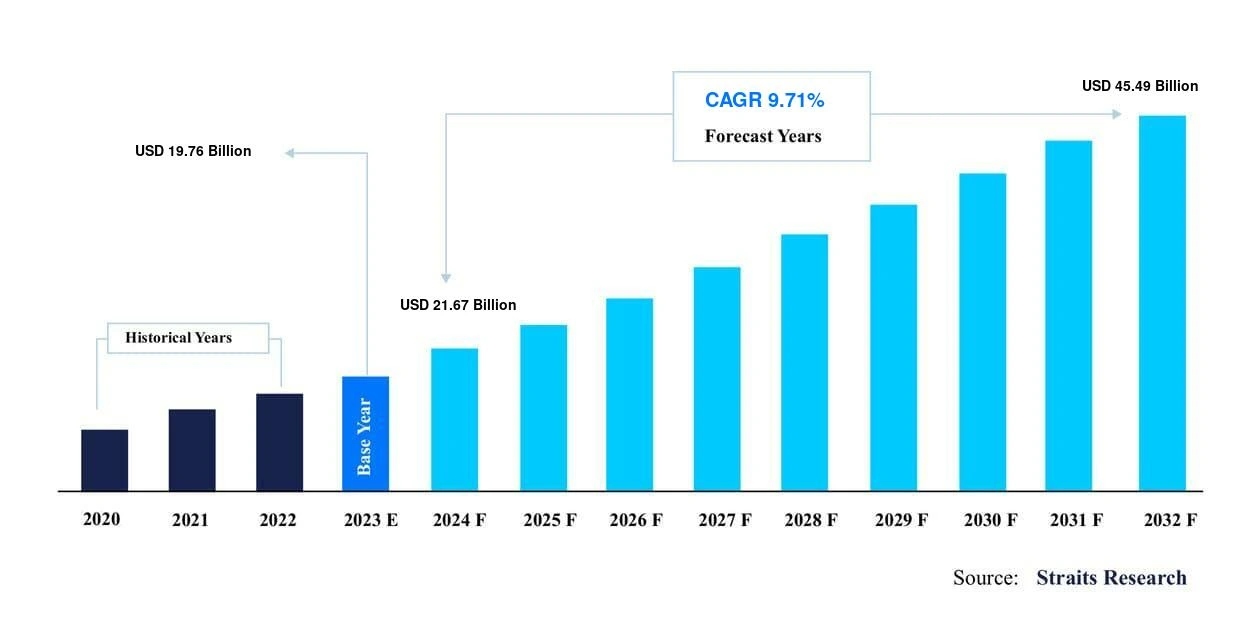
Growth is fueled by both large enterprises and SMBs seeking efficiency, cost control, and digital transformation at scale. Adoption is set to accelerate, with an estimated 85% of companies running automation across most core processes by 2029.
Adoption and Usage Trends
- Nearly 60% of businesses have automated at least one workflow.
- Only 4% report full end-to-end automation, leaving major room for growth.
- CFOs and technology leaders are expanding budgets to accelerate adoption.
- AI and hyperautomation (AI + RPA) will drive the next adoption wave.
Technological Drivers
- AI capabilities like ML, generative AI, and intelligent decision-making are central.
- Low-code/no-code platforms make automation accessible to non-technical teams.
- RPA integrated with AI, cloud, and analytics enhances scalability and speed.
Industry-Specific Insights
- Functions such as HR, finance, procurement, IT, and customer support gain measurable efficiency.
- Automation cuts costs by up to 35% and reduces manual work by 10–50%.
- Enterprises report annual savings in the hundreds of thousands.
- Generative AI-powered workflows could unlock trillions in economic value.
Competitive Advantage and ROI
- 75% of executives believe automation delivers a decisive competitive edge.
- Benefits include faster task completion, greater accuracy, and stronger compliance.
- Companies consistently see time savings, reduced costs, and higher productivity.
- Growth and customer experience directly improve with automation maturity.
Market Landscape and Investment
- Over 800 startups and 3,000 companies operate in this space globally.
- Investments in workflow automation now exceed USD 1.5 billion worldwide.
The trajectory dictates that workflow automation is shifting from optional to essential. For enterprises, the question is no longer whether to adopt, but how fast to scale. Those who embrace autonomy early will capture cost savings, efficiency gains, and competitive advantage that late adopters will struggle to match.
What is an Autonomous Workflow Automation Software?
At its core, autonomous workflow automation software for large enterprises is designed to think and act beyond static rules. It identifies, executes, and refines processes without needing manual direction. Unlike traditional tools, it responds to changing data, context, and exceptions in real time.
Several characteristics set it apart:
- These systems self-optimize, adjusting workflows continuously to improve efficiency.
- They are driven by context, meaning they respond based on the data environment instead of fixed triggers.
- They handle exceptions automatically and escalate issues only when necessary.
- This makes them strong in unpredictable business situations.
It’s important to differentiate this from other automation approaches. Business Process Management (BPM) focuses on designing and enforcing workflows, but usually requires significant manual oversight.
Rule-based automation performs repetitive tasks but struggles when data or processes change. Agent orchestration coordinates different bots or AI tools, but lacks a deeper decision-making layer.
Autonomous workflow automation merges these elements and scales them across the enterprise, connecting departments and allowing for faster, smarter decisions.
How Does Autonomous Workflow Automation Software Work?
Autonomous workflow automation software should be viewed as a set of capabilities, rather than just a toolkit. Each capability addresses business challenges where manual or semi-automated processes fall short.
1. Cognitive Process Mapping
Businesses often struggle to see how work moves across systems. Cognitive mapping discovers workflows by examining event logs, transactions, and user behavior.
This reveals hidden inefficiencies, duplicate approvals, or compliance gaps. Executives gain a real-time view of operational reality, making it easier to target important processes for automation.
2. Adaptive Decision Engines
Adaptive engines utilize machine learning to make adjustments to complex decisions as conditions change. For example, financial approval thresholds can change automatically with market fluctuations. The result is fewer bottlenecks, quicker decisions, and better risk management.
3. Cross-System Integration Fabric
Businesses depend on complex ecosystems, including ERP, CRM, finance, and custom-built applications. Integration fabrics connect these systems smoothly through APIs, RPA bridges, and event-driven connectors. This reduces friction when working across silos and allows automation to cover entire business functions instead of isolated tasks.
4. Autonomous Exception Management
Most automation fails when exceptions occur, leading to human escalation. Autonomous systems can learn from past resolutions and apply corrective actions automatically when similar issues arise. Human involvement is needed only for the most complex, high-risk cases. This frees staff for strategic work while keeping operations running smoothly.
5. Compliance-Aware Design
In regulated industries, compliance must be a priority. This is why autonomous workflow automation includes audit trails, role-based access, and encryption directly in processes. Every action is tracked, ensuring that compliance checks are ongoing rather than reactive. This reduces the burden of audits while strengthening governance.
6. Continuous Learning Layer
These systems improve with each cycle. A feedback layer captures performance data, outcomes, and exception patterns. The insights feed back into models, making workflows progressively faster, smarter, and more resilient. Over time, businesses evolve from basic automation to self-optimizing processes that match changing business needs.
Together, these capabilities create workflows that no longer depend on constant human oversight. They integrate, adapt, and refine themselves, providing businesses with the agility and resilience needed to operate at scale in uncertain markets.
Architecture for Autonomous Workflow Automation Software
Enterprises need a structured architecture to build a scalable, autonomous workflow automation software. An inside-out approach shows how each layer supports enterprise-scale automation and ensures reliability, compliance, and scalability.
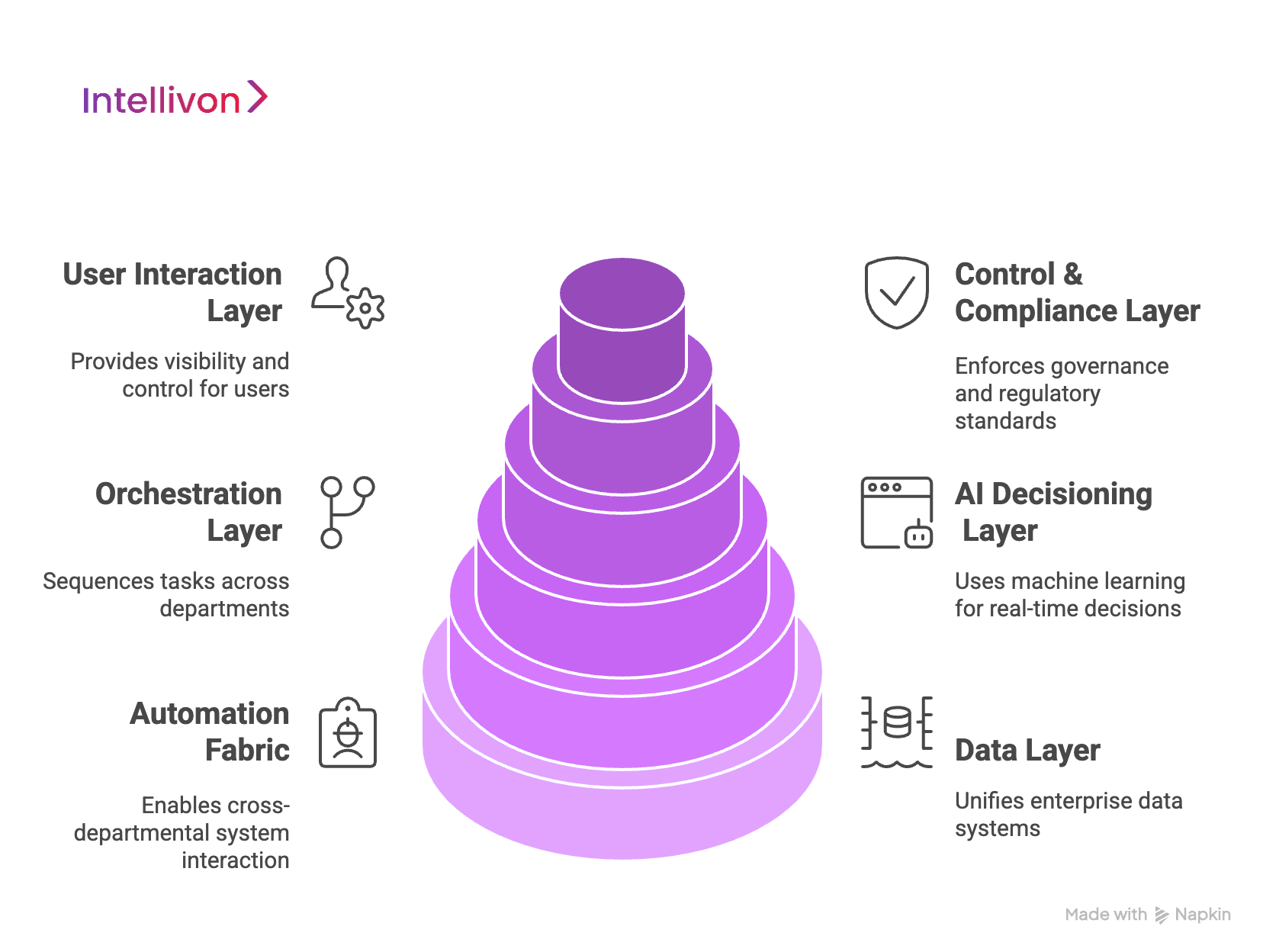
1. Data Layer
At the foundation sits the enterprise data layer. This connects ERP, CRM, finance, HR systems, and external APIs into a unified fabric. This layer also ensures workflows draw from accurate, up-to-date information across every department.
2. Automation Fabric
Above this, the automation fabric handles execution. Event buses, connectors, and RPA bridges enable interaction between modern and legacy systems. This layer removes silos by letting automation span across departments, regardless of platform age.
3. AI Decisioning Layer
Here, machine learning models, anomaly detectors, and optimizers make decisions in real time. Instead of relying on static rules, this layer learns continuously to drive accurate, timely outcomes.
4. Orchestration Layer
This is where cross-departmental workflows come together. The orchestration layer sequences tasks between finance, HR, supply chain, and IT. It ensures processes flow seamlessly, even when dependencies span multiple systems.
5. Control & Compliance Layer
Enterprises cannot afford gaps in governance. This layer enforces audit logs, role-based access controls, and encryption. Every action is tracked, ensuring workflows remain compliant with industry and regulatory standards.
6. User Interaction Layer
Finally, users need visibility and control. Dashboards and checkpoints allow leaders to monitor performance and intervene when needed. This ensures transparency while still reducing the burden of manual intervention.
Together, these layers create a scalable architecture where workflows run end-to-end, integrate legacy and modern systems, and remain compliant while adapting to change. At Intellivon, we design and implement this architecture for large enterprises, ensuring every layer is tailored to business needs. Our experience in integration, compliance, and AI-driven automation allows us to build systems that deliver both resilience and measurable ROI.
How We Develop Autonomous Workflow Automation Software
Enterprises need more than technology to succeed with automation. They need a clear roadmap that brings their vision to fruition and scales with them. At Intellivon, we use a seven-step process to ensure every deployment is practical, compliant, and scalable across the organization.
1. Process Intelligence Audit
The first step is to understand how work flows within the organization. We use process mining and data analysis to uncover inefficiencies, duplicated tasks, and areas with high manual intervention.
This helps leaders identify where automation can provide measurable ROI. By targeting the right processes from the start, we ensure that automation brings visible improvements instead of just isolated fixes.
2. Enterprise Integration First
Large enterprises rely on complex systems like ERP, CRM, HR platforms, finance systems, and custom-built applications. We prioritize integration with key systems without disrupting proprietary data. This creates an automation framework that connects all layers.
This approach reduces resistance from IT teams and maintains continuity in important operations. Our goal is to add autonomy without disrupting existing workflows.
3. Autonomy Design
Automation should go beyond fixed rules. We integrate machine learning models that allow workflows to adapt to changing conditions. For instance, we continuously update exception-handling rules based on past outcomes, which lowers the need for escalation.
Such a robust design makes workflows resilient, enabling them to respond to unexpected events without failing. By embedding intelligence into the workflow, enterprises become more agile at scale.
4. Compliance Safeguards
Regulated industries face strict governance requirements. Compliance is essential, whether dealing with SOX in finance, HIPAA in healthcare, or GDPR in global operations. We incorporate audit logs, encryption, and access controls directly into workflows. This ensures compliance checks occur continuously, rather than as an afterthought.
As a result, enterprises achieve automation that is both efficient and ready for regulation.
5. Human-in-Loop Enablement
Not every decision should be automated. We create checkpoints for managers and executives to step in during strategic or high-risk decisions. This finds a balance between autonomy and oversight, keeping human control over vital business outcomes.
Human-in-loop systems also build employee trust, making it easier to adopt across departments.
6. Scaling Roadmap
We recommend starting small, proving value, and then expanding. Pilots target high-impact workflows to yield quick wins and clear ROI. Once validated, we expand autonomy into related processes in finance, supply chain, HR, and IT.
This phased approach lowers risk while supporting sustainable adoption across the organization.
7. Continuous Optimization
Automation is an ongoing process. We establish continuous feedback loops that gather performance data, track exceptions, and assess business outcomes. These insights inform our models, refining workflows and enhancing their intelligence over time.
Enterprises benefit from systems that evolve, becoming more accurate and resilient with each cycle.
Using this seven-step method, we have assisted global enterprises in transforming workflows without sacrificing compliance or stability. By combining process intelligence with tailored integration and long-term optimization, we offer workflow automation software that scales with the enterprise and adapts to its future needs.
Overcoming Implementation Challenges in Enterprises
Deploying autonomous workflow automation in large companies is not a simple plug-and-play task. Complex systems, resistance within the organization, and governance pressures can slow down progress if there isn’t a clear plan. At Intellivon, we assist companies in overcoming these challenges with practical solutions.
1. Data Silos and Legacy Systems
Most companies use a combination of modern cloud platforms and old legacy systems. Data often remains isolated, making automation across departments tough.
We tackle this through a phased integration approach, using APIs, RPA bridges, and connectors that gradually merge fragmented systems. This allows automation to grow without forcing disruptive replacements.
2. Change Management
Automation can raise concerns among employees worried about job loss or a lack of control. Adoption improves when automation is seen as a co-pilot rather than a replacement.
Training programs, clear communication, and human-in-loop checkpoints build trust, showing teams that automation enhances their roles instead of taking them away.
3. Governance and Compliance Pressure
Regulated industries face strict oversight. Without a focus on compliance, automation projects risk rejection by auditors or regulators.
We create workflows with built-in audit trails, role-based access, and encryption. This makes governance ongoing, reduces regulatory friction, and strengthens the company’s resilience.
4. Balancing Scale with Cost Predictability
Companies want to scale, but leaders also need predictable costs. Large, upfront rollouts often lead to uncertainty about ROI.
We suggest modular deployments, starting with pilots to test the impact. This phased approach provides measurable ROI early and strengthens the financial case for wider adoption.
By addressing these challenges directly, companies can adopt autonomous workflow automation confidently. Intellivon’s structured approach ensures that implementation is not only technically sound but also accepted within the organization, financially predictable, and ready for regulators.
Industry-Specific Use Cases of Autonomous Workflow Automation Software
Autonomous workflow automation is not limited to one industry. Its impact spans regulated sectors, customer-driven industries, and operationally complex environments. Below are key sectors where autonomy delivers measurable value, along with real-world examples of how it works in practice.
1. Anti-Money Laundering (AML) and KYC Onboarding
Banks face constant regulatory scrutiny. Autonomous workflows can monitor transactions in real time, flagging anomalies and triggering dynamic investigations without manual intervention.
For example, FICO AML Manager uses machine learning to continuously refine detection models. It automates suspicious activity reporting, reducing compliance risk while enabling teams to focus on complex cases.
2. Autonomous Claims Resolution
Insurance workflows often slow down due to manual claim validation. Autonomous systems process claims end-to-end, validating documentation, calculating payouts, and escalating only exceptions.
Shift Technology’s Force platform applies AI-driven fraud detection and adaptive decision trees to automate much of claims handling, cutting cycle times while ensuring fraud detection remains sharp.
3. Clinical Documentation and Patient Scheduling
In healthcare, accurate records and scheduling efficiency are critical. Autonomous workflows transcribe clinical notes, update electronic health records, and adjust patient scheduling automatically.
Nuance Dragon Medical One integrates with EHRs to reduce manual input, while intelligent scheduling platforms like QGenda optimize appointments dynamically, freeing clinicians to focus on patient care.
4. Supply Chain Disruption Handling
Retail supply chains face constant disruption, from weather delays to demand spikes. Autonomous workflows detect risks early and reroute shipments automatically.
Blue Yonder’s Luminate platform uses AI to predict delays and optimize logistics in real time, helping retailers maintain service levels while lowering transportation costs.
5. Predictive Maintenance and Work Orders
Unplanned downtime can cripple production. Autonomous workflows analyze sensor data, predict equipment failures, and trigger maintenance work orders automatically.
Siemens MindSphere connects machines across plants, applying predictive analytics to schedule repairs before breakdowns occur. This reduces downtime and extends asset life, improving ROI on capital investments.
These use cases highlight the versatility of autonomous workflow automation across industries. By combining AI-driven intelligence with deep integration, enterprises can streamline operations, reduce risk, and scale efficiency, no matter their sector.
Top Autonomous Workflow Automation Platforms
The autonomous workflow automation market has matured with platforms designed to scale across global enterprises. Each solution brings unique strengths, from AI-driven decisioning to deep integration with legacy systems.
1. UiPath
UiPath has evolved from RPA into a full automation ecosystem. Its AI Center enables machine learning models to drive workflows beyond static rules. Enterprises use it to build end-to-end autonomous processes, from finance reconciliations to HR onboarding, with strong connectors for SAP and Oracle.
2. Automation Anywhere
Known for its cloud-native design, Automation Anywhere combines RPA, AI, and analytics in one platform. Its Bot Insight module provides real-time monitoring and feedback, enabling workflows to learn and improve continuously. Large enterprises benefit from its scalability and ease of deploying bots across global operations.
3. Blue Prism
Blue Prism focuses heavily on security and governance, making it a strong fit for regulated industries. Its Digital Exchange marketplace offers pre-built automations and AI integrations. Enterprises in finance and healthcare leverage its compliance-first design to ensure audit readiness while scaling autonomy.
4. WorkFusion
WorkFusion specializes in AI-driven automation for financial services and insurance. Its Intelligent Automation Cloud automates KYC, AML, and claims processes with embedded machine learning models. By combining rule-based tasks with adaptive decision-making, it delivers significant risk reduction in compliance-heavy environments.
5. Appian
Appian blends low-code development with automation, enabling enterprises to design, deploy, and adapt workflows quickly. Its strength lies in orchestration, linking AI, RPA, and human-in-loop checkpoints. Enterprises choose Appian when they need autonomy that can flex with evolving business requirements.
These platforms illustrate the diversity of the market. Some focus on compliance, others on scalability, and others on accessibility. The right choice depends on enterprise goals, existing systems, and industry-specific needs.
Conclusion
Autonomous workflow automation is no longer just a future concept. It is a present reality reshaping how large enterprises operate. By moving beyond fixed rules and manual oversight, organizations can create workflows that continuously adapt, resolve exceptions, and follow changing regulations. The result is more than efficiency; it is resilience, agility, and a strong foundation for long-term growth.
Leaders who invest in autonomy now will gain a competitive edge that late adopters will struggle to match. Whether in finance, supply chain, customer experience, or IT operations, businesses that embrace autonomous workflows will be able to scale quickly, accurately, and with confidence.
Build Enterprise-Grade Autonomous Workflow Software With Intellivon
At Intellivon, we bring years of experience building enterprise-grade workflow automation platforms that are secure, scalable, and aligned with business KPIs. We partner with large enterprises to design systems that transform how operations run across departments and functions.
Why Partner with Intellivon?
- Tailored Solutions: We align automation with your objectives, workflows, and compliance requirements.
- Enterprise-Grade Security: Encryption, audit trails, and governance safeguards are embedded from day one.
- Proven ROI: Our solutions reduce costs, accelerate decision-making, and scale in step with enterprise growth.
- End-to-End Delivery: From requirement gathering to pilot testing and enterprise rollout, we manage the entire journey.
Book a discovery call with Intellivon’s AI engineers today and see how autonomous workflow automation can unlock efficiency, compliance, and growth for your enterprise.
FAQs
Q1. What makes workflow automation “autonomous”?
Autonomous automation adapts in real time, learning from data and resolving exceptions automatically. Unlike rule-based systems, it continuously improves and requires minimal human intervention.
Q2. How is autonomous workflow automation different from RPA?
RPA automates repetitive tasks but struggles with exceptions. Autonomous automation uses AI and machine learning, allowing workflows to adapt, self-correct, and scale across entire enterprises.
Q3. What are the risks of deploying autonomous automation in regulated industries?
A3. The primary risks involve compliance and governance. These are mitigated with compliance-aware design, embedded audit trails, encryption, and continuous monitoring, features we build into every Intellivon solution.
Q4. Can autonomous workflow automation integrate with legacy ERP systems?
A4. Yes. Through APIs, RPA bridges, and event-driven connectors, automation integrates with ERP platforms like SAP and Oracle without requiring disruptive replacements.