Wearable data affects more than clinicians. When integrated correctly, it reshapes how organizations plan capacity, manage chronic populations, structure employer programs, and measure long-term outcomes. And when integrated poorly, it becomes another disconnected system competing for attention and budget.
Solutions like Samsung FindCare reflect this evolution. Wearables are no longer treated as peripheral tools. They are becoming upstream data sources that influence care coordination, workforce utilization, and preventive strategy.
At Intellivon, we build wearable-integrated platforms that align biometric data, AI intelligence, and care operations into a single governed system. These platforms succeed because they are designed as part of the enterprise core, not added at the edges. Based on this delivery experience, this blog walks through how to build such a platform from scratch and what enterprise leaders should evaluate at each stage.
Key Takeaways Of The Wearable Intelligence Platform Market
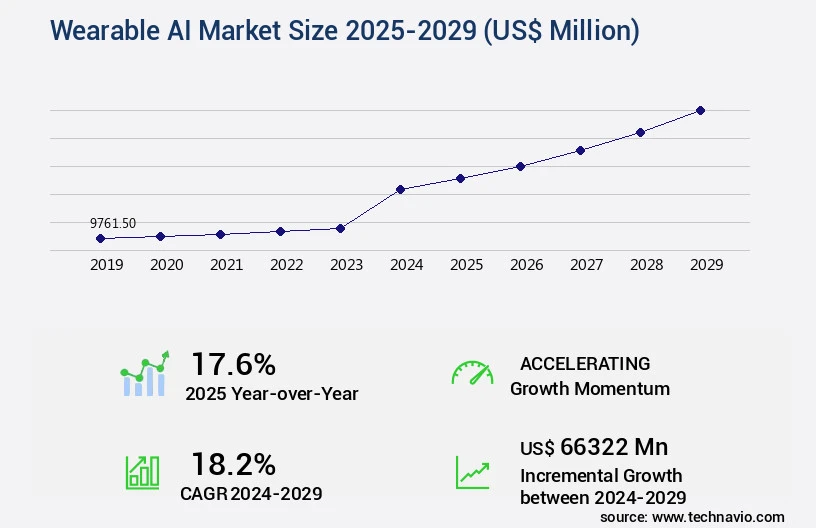
Market estimates suggest that wearable AI adoption will generate an additional USD 66.32 billion in value over the next five years, supported by a projected compound annual growth rate of 18.2%. The primary driver is increasing demand for continuous, personalized health insights that enable earlier intervention.
Market Insights:
Health Monitoring Demand
- Growing use of AI analytics for chronic conditions like diabetes and cardiovascular disease
- Increased emphasis on preventive care and early intervention through continuous vitals.
- Rising global chronic disease prevalence is driving real-time health monitoring demand
Technology Advancements
- On-device AI is improving processing efficiency and reducing latency by up to 30%
- Sensor fusion and miniaturized biosensors enabling predictive and longitudinal insights
- 5G and edge computing are strengthening reliability for continuous data transmission
Enterprise Expansion
- Adoption is expanding into worker safety, AR-enabled workflows, and operational monitoring.
- Deeper EHR integrations are accelerating enterprise adoption.
- North America leads the adoption with 38.5% market share, while Asia-Pacific shows rapid growth
Competitive Landscape and Market Direction
Key Market Leaders
- Apple, Samsung, Google (Fitbit), Garmin, Huawei, Xiaomi, Oura, and Whoop dominate key segments.
- Platforms increasingly span both consumer wellness and enterprise-grade use cases
Healthcare-Focused Innovation
- Shift toward subscription-based intelligence rather than device-only monetization
- Medical-grade biosensors growing at 26.8% CAGR, supporting fatigue, sleep, and chronic monitoring
Enterprise Opportunities Emerging From Wearable AI
ROI and Revenue Impact
- Enterprises reporting up to 30% operational efficiency gains across healthcare and manufacturing
- Subscription-driven health platforms creating predictable, recurring revenue streams
Healthcare Platform Integration
- Wearable-enabled RPM and CCM models are reducing care delivery costs
- Chronic care underutilization creates scalable opportunities for enterprise-grade platforms built by providers like Intellivon
What Is Samsung FindCare, the Wearable-Integrated Platform?
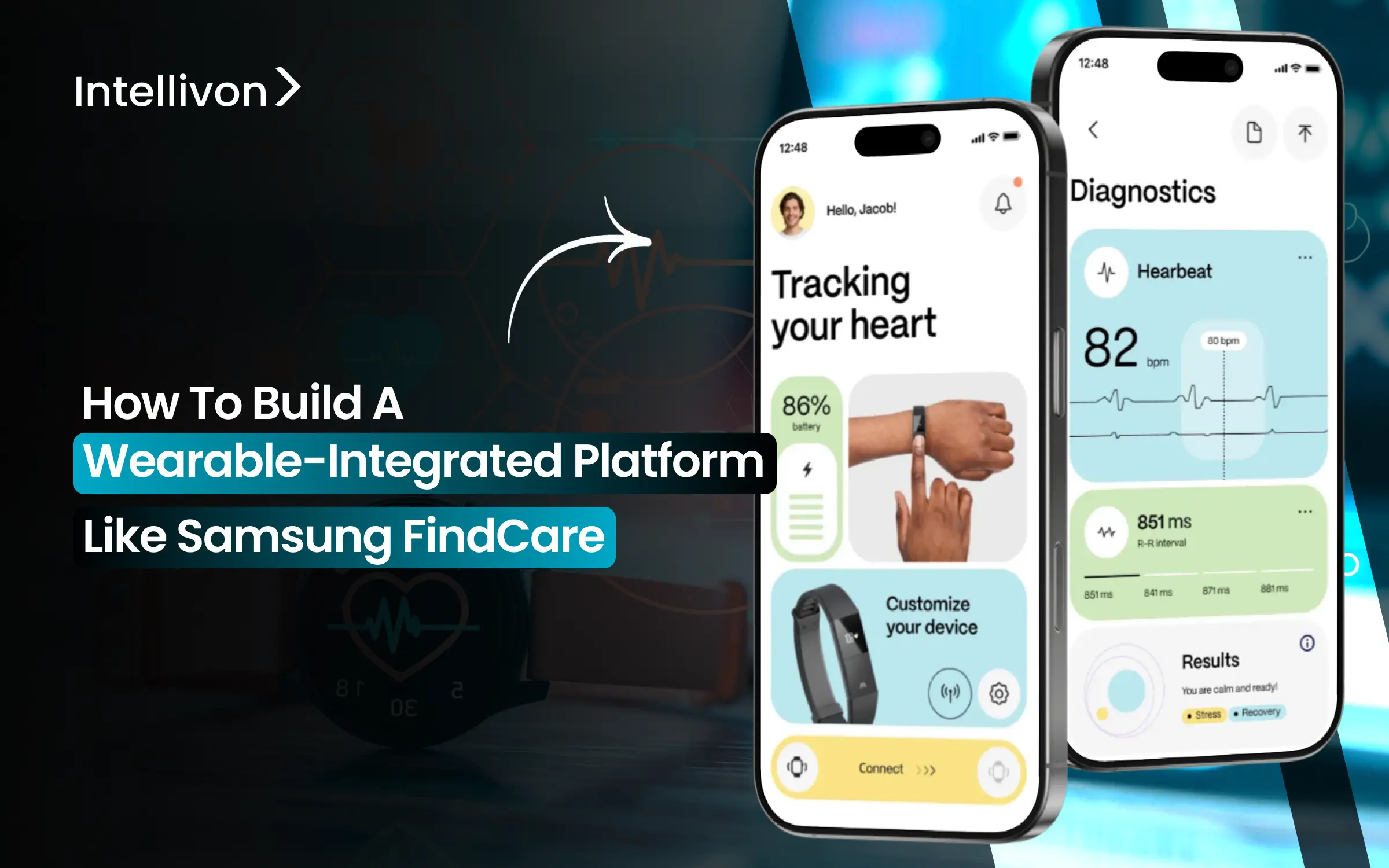
Samsung FindCare is positioned as a healthcare coordination platform built around wearable data, rather than a standalone wellness application. It connects signals from Samsung wearables into a broader health ecosystem where data can inform monitoring, guidance, and care pathways.
At its core, the platform aggregates continuous biometric inputs such as heart rate, activity patterns, and sleep indicators. These signals are contextualized using analytics to surface insights that are meaningful over time, not just at a single moment. The intent is long-term health visibility, not episodic tracking.
What differentiates a platform like Samsung FindCare is how wearable data is positioned upstream in the care journey. Data is designed to flow into services, providers, and health programs, rather than remaining locked inside consumer dashboards.
What Features Make Samsung FindCore Stand Out
Samsung FindCare differentiates itself through platform design choices that prioritize continuity, accountability, and enterprise integration. Instead of focusing on surface-level insights, it emphasizes how wearable signals can drive sustained health intelligence across time.
1. Continuous Biometric Intelligence
The platform captures ongoing vitals such as heart rate, activity, and sleep patterns. These signals are analyzed longitudinally, which allows trends and deviations to surface earlier than episodic measurements.
2. Context-Aware Health Insights
Data is interpreted in context rather than in isolation. This reduces noise and helps ensure insights reflect meaningful health changes, not short-term fluctuations.
3. Ecosystem Integration Readiness
FindCare is designed to connect with broader healthcare services and programs. Wearable data is structured to move into care coordination, monitoring services, and downstream health workflows.
4. Consumer-Grade Experience With Enterprise Intent
The interface remains simple for users, while the underlying architecture supports scale, governance, and future clinical integration.
What sets Samsung FindCare apart is not any single feature, but the way these capabilities work together. The platform shows how wearable data can be elevated from personal tracking to a reliable input for scalable health systems.
How Does a Wearable-Integrated Platform Like Samsung FindCare Work?
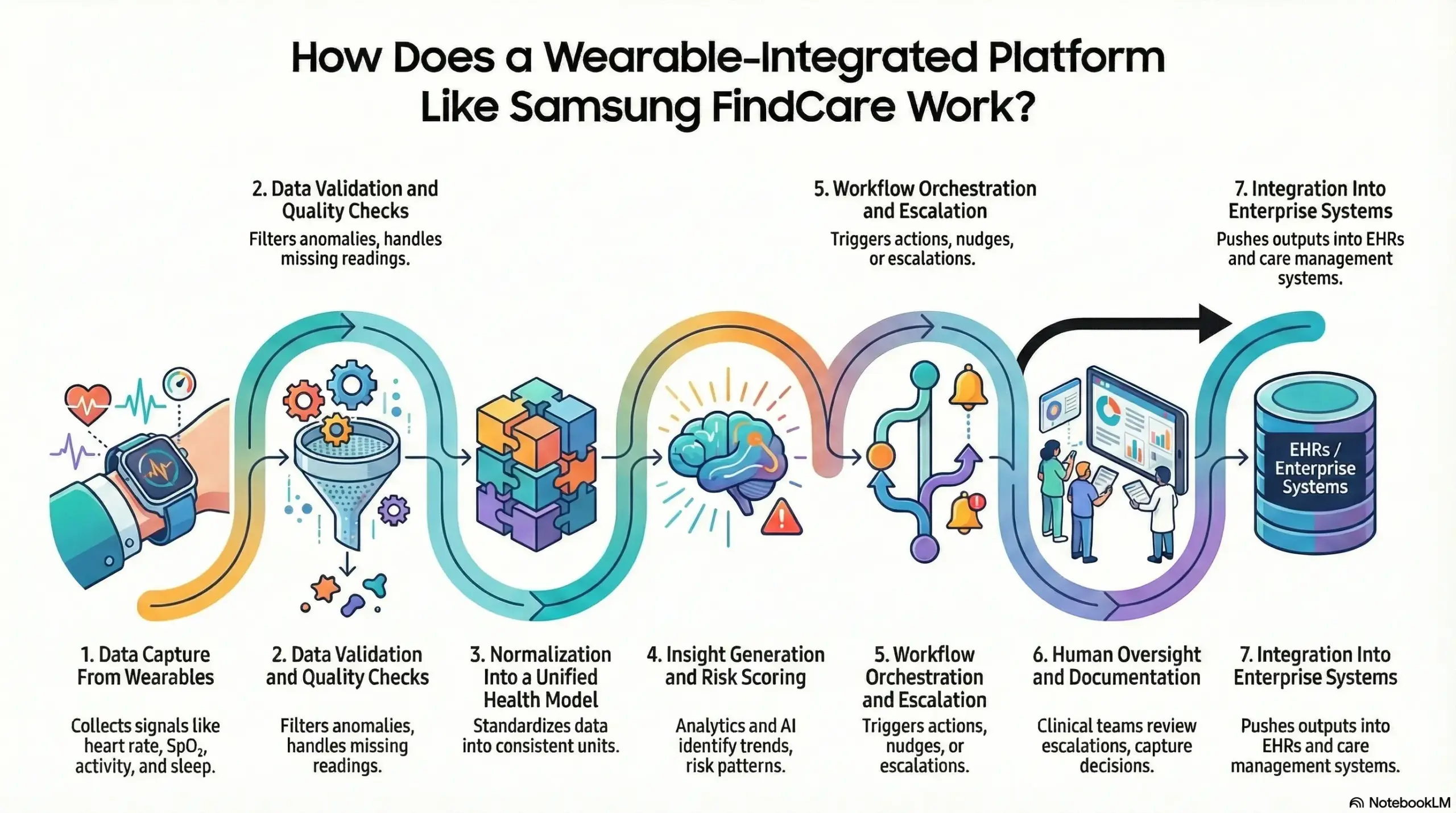
A wearable-integrated platform works by capturing biometric signals, validating and normalizing data, generating risk insights, triggering governed workflows, and closing the loop with follow-ups and documentation.
1) Data Capture From Wearables
Wearables collect signals like heart rate, SpO₂, activity, sleep, and sometimes ECG. The platform pulls these readings through device APIs or SDKs. It also timestamps and tags data to preserve context.
2) Data Validation and Quality Checks
Raw signals can be noisy. The platform filters anomalies, handles missing readings, and checks device integrity. This step reduces false alerts and improves trust.
3) Normalization Into a Unified Health Model
Different devices label and format data differently. The platform standardizes inputs into consistent units and schemas. This enables cross-device analytics and longitudinal tracking.
4) Insight Generation and Risk Scoring
Analytics and AI identify trends, deviations, and risk patterns. The platform converts data into interpretable outputs, such as deterioration risk or adherence signals. It also logs why an insight was triggered.
5) Workflow Orchestration and Escalation
Insights only matter when they route correctly. The platform triggers actions like nudges, care tasks, or escalations. Rules define who is notified, when, and under what thresholds.
6) Human Oversight and Documentation
Clinical or operational teams review escalations where needed. The platform captures decisions, overrides, and follow-up notes. This supports accountability and audit readiness.
7) Integration Into Enterprise Systems
The platform pushes relevant outputs into EHRs, RPM tools, analytics stacks, or care management systems. This prevents parallel workflows and preserves continuity.
The core mechanism is a closed loop. Wearable signals become validated data, data becomes insight, and insight becomes governed action. That is how platforms move from engagement features to enterprise-grade infrastructure.
Architecture of a Wearable-Integrated Platform Like Samsung FindCare
A complete wearable-integrated platform architecture includes device ingestion, signal processing, identity and consent, decision services, workflow orchestration, enterprise integration, and observability, with intelligence embedded throughout.
A platform like Samsung FindCare is not built as a single system. It is assembled as a set of tightly governed layers that work together to move wearable signals into trusted action. This architecture matters because most wearable initiatives fail after pilots, when scale, compliance, and operational ownership collide. Below is how successful platforms are structured in production environments.
1. Device and SDK Integration Layer
This layer connects the platform to wearables through OEM SDKs and device APIs. It manages pairing, authentication, firmware compatibility, and sync behavior.
More importantly, it establishes device trust, ensuring the platform knows which readings come from approved sources. Enterprises rely on this layer to avoid vendor lock-in while maintaining control as hardware ecosystems evolve.
2. Signal Ingestion and Stream Processing Layer
Wearable data arrives continuously, but not always predictably. This layer ingests events, buffers spikes, and supports both real-time and delayed synchronization.
It ensures reliability even when devices disconnect or networks fluctuate. Without this layer, platforms struggle to move beyond controlled rollouts.
3. Data Quality and Longitudinal Storage
Raw wearable signals are inconsistent by nature. This layer cleans data, standardizes units, aligns timestamps, and handles missing values.
It then stores data in a longitudinal model designed for trend analysis. This foundation is what makes insights defensible over time.
4. Identity and Policy Enforcement
This layer governs access and usage. It manages consent states, role-based access, and data retention rules. Every interaction is policy-driven, not manual.
In regulated environments, this is what allows wearable data to be used at scale without increasing risk.
5. Decision Services and Insight Logic
Action logic lives here. Most enterprises start with explainable rules and thresholds. Over time, pattern detection or predictive models may be added.
Every decision remains traceable. The output is not a prediction. It is a decision-ready signal.
6. Workflow Orchestration and Escalation
This layer converts signals into action. It routes tasks, triggers follow-ups, manages escalation paths, and controls timing.
It also prevents alert fatigue through prioritization and throttling. This is where trust is earned with operational teams.
7. Experience Layer for Users and Operations
Different stakeholders need different views. This layer supports member interfaces, care team dashboards, and operational tools.
Each experience reflects governed workflows, not raw data streams. Clarity here drives adoption without compromising control.
8. Enterprise Integration Layer
Wearable platforms must integrate into existing systems. This layer connects with EHRs, RPM, CCM, analytics, and identity platforms.
It ensures insights flow into current workflows instead of creating parallel processes. Integration determines whether value compounds or fragments.
9. Security, Monitoring, and Auditability
This layer provides observability across the platform. Logging, monitoring, audit trails, and incident readiness are built in.
It supports internal governance and external audits. Enterprises depend on this layer to operate the platform with confidence.
A wearable-integrated platform becomes enterprise-grade when architecture enforces trust, accountability, and continuity at every layer. When these components work together, wearable data stops being an experiment and starts functioning as a durable digital infrastructure that supports long-term growth.
How AI Adds Value To The Wearable-Integrated Platforms
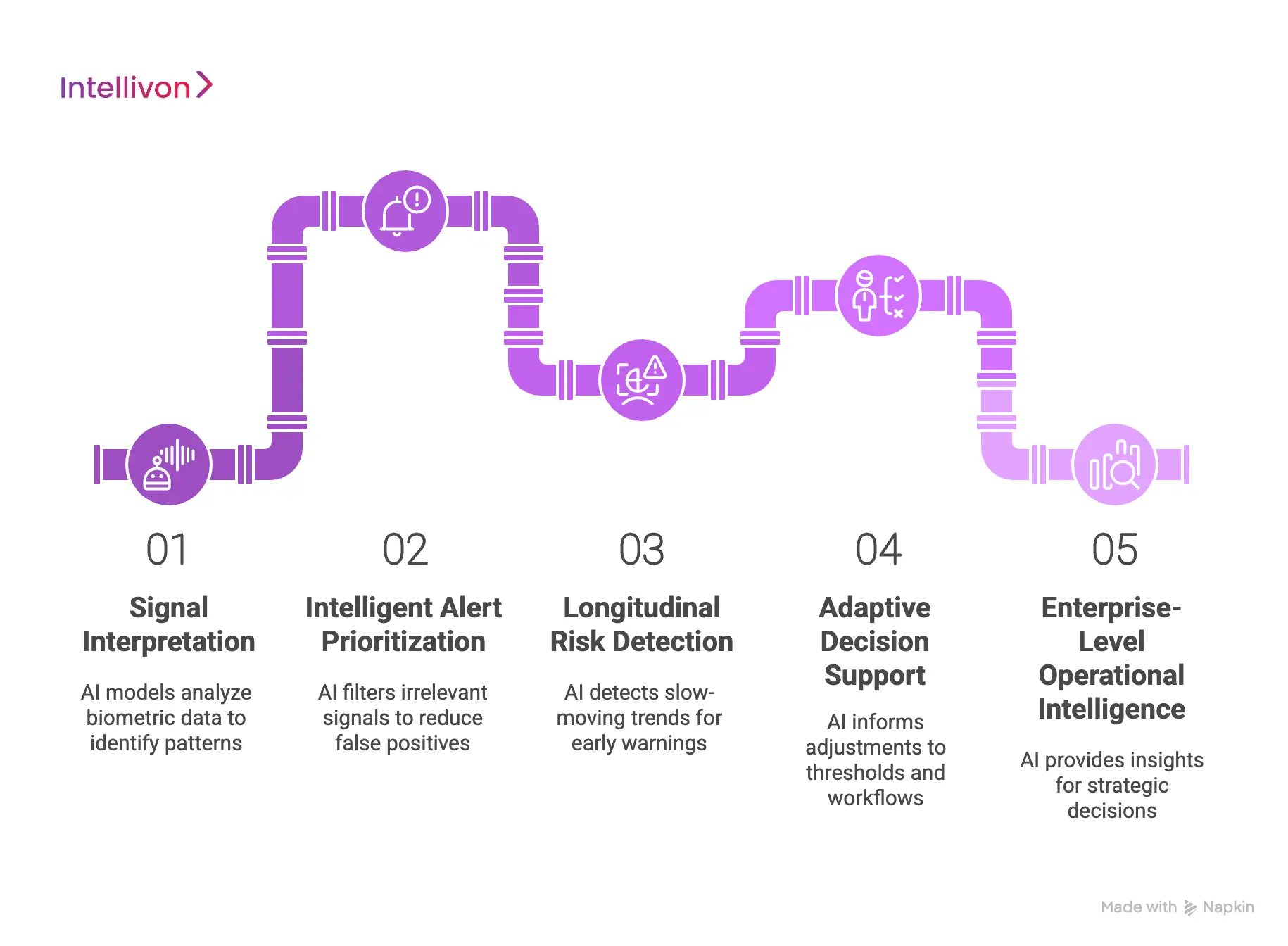
AI enhances wearable-integrated platforms by improving signal interpretation, reducing noise, identifying longitudinal risk, and supporting scalable decision-making within governed workflows.
Below are the areas where AI delivers measurable value when applied correctly.
1. Signal Interpretation
Wearables generate a constant flow of biometric data at a volume no team can manually analyze. AI models help interpret these streams by identifying meaningful patterns and deviations across time. This allows platforms to move beyond static thresholds and toward contextual understanding.
Instead of reacting to isolated readings, teams gain visibility into sustained changes that matter clinically and operationally.
2. Intelligent Alert Prioritization
Raw wearable data is inherently noisy. Motion artifacts, missed readings, and short-term fluctuations are common. AI helps filter out irrelevant signals and correlate data across multiple parameters.
This results in alerts that are fewer in number but higher in confidence. Operational teams spend less time triaging false positives and more time acting on issues that warrant attention.
3. Longitudinal Risk Detection
Many health risks develop gradually. AI is well-suited to detecting slow-moving trends that may not trigger traditional rules.
By analyzing weeks or months of data, AI can surface early warning signs tied to deterioration, non-adherence, or behavioral change. This supports proactive intervention without overwhelming teams with constant alerts.
4. Adaptive Decision Support
As platforms mature, AI can inform adjustments to thresholds and workflows based on historical outcomes. These insights help refine decision logic over time. Importantly, AI does not replace defined rules or accountability structures.
Human oversight remains central, with AI acting as an evidence layer rather than an autonomous decision-maker.
5. Enterprise-Level Operational Intelligence
AI also adds value at the program and population level. It helps enterprises understand engagement patterns, capacity utilization, and intervention effectiveness.
These insights inform staffing, program design, and investment decisions. This shifts wearable platforms from monitoring tools to strategic assets.
AI adds value to wearable-integrated platforms when it is applied with discipline. By improving interpretation, reducing noise, and supporting informed decisions, AI helps enterprises scale continuous health intelligence without sacrificing trust, governance, or operational control.
Use Cases Of Wearable-Integrated Platforms
Wearable-integrated platforms deliver the most impact when they are mapped to real operational problems. Enterprises that succeed do not deploy them as generic health tools. They align use cases to specific business, clinical, and workforce outcomes.
Below are the most common enterprise-grade applications where these platforms prove their value.
1. Chronic Disease Monitoring
Continuous wearable data supports ongoing management of conditions such as diabetes, cardiovascular disease, and respiratory disorders. Instead of relying on periodic visits, enterprises gain visibility into trends between encounters.
This enables earlier intervention, reduces acute events, and supports scalable RPM and CCM programs without expanding clinical workload proportionally.
2. Preventive Care and Early Risk Detection
Wearables help identify subtle changes before symptoms escalate. Shifts in sleep, activity, or heart metrics often signal emerging risk.
Enterprises use these insights to move upstream, focusing on prevention rather than late-stage intervention. Over time, this improves outcomes while controlling long-term costs.
3. Post-Acute and Recovery Monitoring
After procedures or hospital discharge, wearables provide continuous oversight without requiring in-person follow-ups. Deviations from recovery baselines are detected early.
This reduces readmissions, improves patient confidence, and optimizes post-care resource allocation.
4. Workforce Health and Fatigue Management
Beyond healthcare, enterprises apply wearables to monitor worker fatigue, environmental exposure, and physical strain.
This is especially relevant in manufacturing, logistics, and field operations. Platforms help prevent incidents, improve compliance, and support safer workforce planning.
5. Population Health and Employer Programs
Wearable-integrated platforms enable stratification across large populations. Enterprises can identify high-risk groups, measure engagement, and evaluate program effectiveness over time.
This supports employer-sponsored health initiatives and value-based care strategies.
6. Subscription Health Models
Wearable data strengthens digital therapeutics by providing continuous feedback loops. Enterprises use this data to personalize interventions and measure adherence.
Subscription-based intelligence models emerge, creating predictable revenue while improving care consistency.
Wearable-integrated platforms succeed when use cases are tied to enterprise outcomes, not novelty. By supporting chronic care, prevention, recovery, workforce safety, and population health, these platforms evolve from tracking tools into strategic infrastructure that delivers sustained operational and financial value.
How We Build Wearable-Integrated Healthcare Platforms
Enterprises do not fail at wearable platforms because of sensors. They fail because the platform is treated as a feature build instead of a governed operating layer. At Intellivon, we build wearable-integrated healthcare platforms as enterprise-grade systems that can survive scale, audits, and operational handoffs.
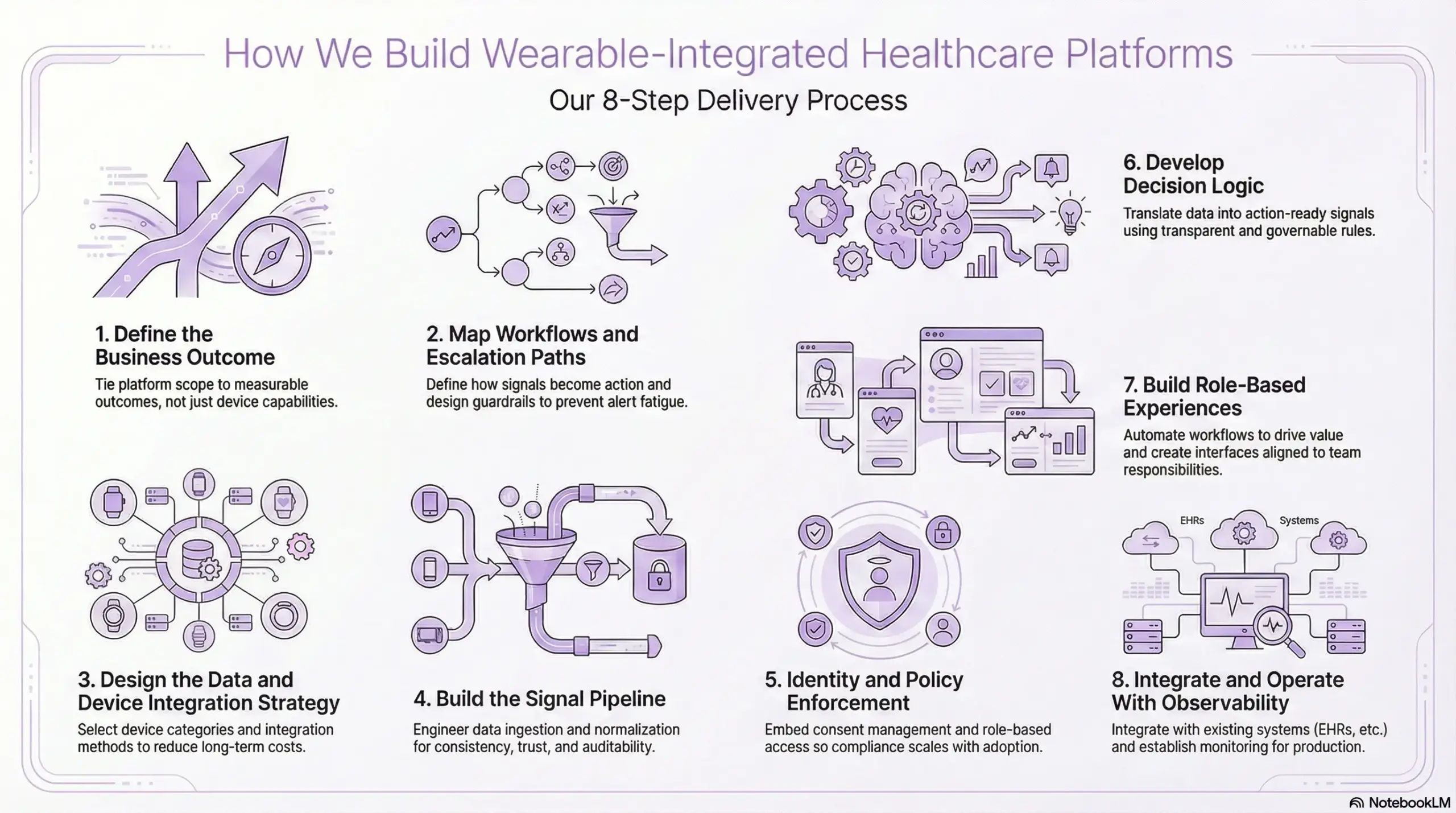
Below is the 8-step delivery process we use to take platforms from concept to production.
1) Define the Business Outcome
We start by clarifying what the platform must change inside the enterprise. This includes the target population, the workflow owners, and the economic goal.
Therefore, platform scope is tied to measurable outcomes, not device capabilities. Deliverables typically include use case priorities, success metrics, and a rollout model.
2) Map Workflows and Escalation Paths
Next, we map how signals become action. We define who reviews alerts, who owns follow-ups, and what escalation looks like across care and operations.
In addition, we design guardrails to prevent alert fatigue and unmanaged clinical risk. This step ensures the platform fits real operations, not slideware.
3) Design the Data and Device Integration Strategy
We select device categories, OEM integration methods, and ingestion patterns. We also define data frequency requirements and how the platform will handle intermittent sync.
As a result, the platform remains reliable even when devices behave unpredictably. This is where we reduce vendor lock-in and long-term integration cost.
4) Build the Signal Pipeline
We engineer ingestion, normalization, and longitudinal storage so data stays consistent across time. This includes de-noising, timestamp alignment, and unit standardization.
However, we also design for auditability, because data lineage matters in regulated environments. This layer is the foundation for trust.
5) Identity and Policy Enforcement
We embed consent lifecycle management, role-based access, and purpose-based data usage. Policies are enforced by the system, not by process documents.
Consequently, compliance scales with adoption rather than degrading over time. This step protects the enterprise as usage expands.
6) Develop Decision Logic
We implement decision services that translate data into action-ready signals. Most deployments start with explainable thresholds and rules, then add advanced pattern detection where it earns its place.
In addition, we log triggers, overrides, and outcomes to keep decisioning transparent. This makes the platform governable and defensible.
7) Build Role-Based Experiences
We build workflow automation for nudges, tasks, escalations, and follow-ups. We also deliver interfaces for members, care teams, and operations, each aligned to their responsibilities.
As a result, adoption grows without creating parallel work. Workflows drive value, not dashboards.
8) Integrate and Operate With Observability
Finally, we integrate with EHRs, RPM/CCM systems, analytics stacks, and identity frameworks. We then establish monitoring, audit logs, and operating controls for production readiness.
Therefore, the platform can be managed like enterprise software, not a pilot product. This is where long-term ROI becomes sustainable.
A wearable-integrated healthcare platform becomes a growth asset when it is built as governed infrastructure. Intellivon delivers these platforms with an enterprise delivery model that aligns technology, compliance, and operations from day one, so your organization can scale continuous health intelligence with control and confidence.
Cost Of Building A Wearable-Integrated Platform Like Samsung FindCare
Building a wearable-integrated platform does not require a heavy, front-loaded investment. Most enterprises begin with a focused, production-ready foundation that supports device ingestion, governed decision logic, and enterprise integrations. The platform then expands as adoption, use cases, and ROI become clear.
At Intellivon, we price wearable-integrated platforms based on platform maturity, not feature volume. This allows enterprises to launch early, validate impact, and scale with controlled technical, clinical, and financial risk.
Estimated Cost Breakdown (USD $50,000–$150,000)
| Cost Component | What It Covers | Estimated Range |
| Discovery and Platform Strategy | Use case definition, operating model, workflow ownership, KPIs, and phased rollout plan | $6,000 – $12,000 |
| Wearable and Device Integration | OEM SDK/API integration, device pairing, data sync logic, device trust handling | $8,000 – $18,000 |
| Signal Ingestion and Data Pipeline | Event ingestion, buffering, normalization, longitudinal data modeling | $8,000 – $20,000 |
| Decision Logic and Intelligence Services | Rules, thresholds, trend detection, explainable insights, decision traceability | $7,000 – $18,000 |
| Workflow Orchestration | Alerts, nudges, escalations, follow-ups, ownership, and timing controls | $6,000 – $15,000 |
| Identity, Consent, and Access Control | Role-based access, consent lifecycle, policy enforcement, audit readiness | $5,000 – $12,000 |
| Enterprise Integrations | EHR, RPM/CCM, analytics, identity systems, outbound data sync | $6,000 – $20,000 |
| Security, Compliance, and Observability | Logging, monitoring, audit trails, encryption, operational controls | $4,000 – $10,000 |
| Testing, Pilot, and Stabilization | QA, workflow validation, phased rollout, tuning, and optimization | $4,000 – $10,000 |
Typical Investment Ranges
- Focused MVP Platform: $50,000 – $80,000
Suitable for a single population, limited device scope, and core workflows. - Enterprise-Ready Phase 1 Platform: $90,000 – $150,000
Supports multiple device types, governed decision logic, integrations, and audit readiness.
Final cost depends on integration depth, governance requirements, and the number of workflows supported at launch.
Factors That Influence Cost
1. Device and Data Complexity
Supporting one wearable category is less expensive than managing multiple OEMs with different data behaviors and sync patterns.
2. Governance and Oversight Requirements
Basic monitoring costs less than platforms requiring explainable decision logic, enforced review, and full audit trails.
3. Integration Depth
Surface-level data exchange is cheaper than bidirectional EHR or RPM integration that must support continuity and documentation.
4. Workflow Sophistication
Simple alerts cost less than multi-step escalation, prioritization, and follow-up orchestration.
5. Analytics and Executive Visibility
Basic dashboards are inexpensive. Longitudinal insights and outcome attribution increase cost but strengthen ROI narratives.
How Enterprises Stay Within Budget
Enterprises control costs by phasing delivery. Most start with device ingestion, core decision logic, workflow ownership, and compliance controls. Once outcomes are validated, additional automation and use cases are layered in.
Equally important, KPIs must be defined early. Cost overruns usually come from unclear ownership or scope expansion mid-build. A strong foundation ensures wearable-integrated platforms scale through confidence, not correction.
Conclusion
Wearable-integrated platforms are no longer experimental initiatives. They are becoming core infrastructure for enterprises that want continuous visibility, proactive intervention, and scalable care delivery. When built with discipline, these platforms improve outcomes, strengthen operational control, and create new growth opportunities.
Success depends on architecture, governance, and workflow design, not devices alone. Enterprises that treat wearable integration as a long-term platform investment gain compounding value over time.
With the right strategy and execution, wearable data becomes more than insight. It becomes a dependable engine for smarter decisions and sustainable enterprise growth.
Build Your Wearable-Integrated Healthcare Platform With Intellivon
At Intellivon, we build wearable-integrated healthcare platforms as enterprise operating systems, not device-centric apps layered onto existing tools. Our platforms govern how wearable data is ingested, how signals translate into decisions, and how accountability is preserved across workflows, teams, and infrastructure.
Each solution is engineered for healthcare organizations operating at scale. Platforms are infrastructure-first and compliance-led, designed to support continuous monitoring, longitudinal insight, and governed intervention. As programs expand across populations, regions, and device ecosystems, data integrity, clinical oversight, and operational control remain intact.
Why Partner With Intellivon?
- Wearable-first platform architecture aligned with longitudinal care, operational ownership, and measurable outcomes
- Deep interoperability expertise across EHRs, RPM/CCM systems, identity frameworks, and enterprise analytics stacks
- Compliance-by-design delivery supporting HIPAA, audit readiness, role-based access, and policy-driven data usage
- AI-assisted decision support that strengthens prioritization and scale without replacing human judgment
- Enterprise delivery model with phased rollout, KPI-led validation, and controlled expansion across care programs
Talk to Intellivon’s healthcare platform architects to explore how an enterprise-grade wearable-integrated platform can fit into your existing ecosystem, protect sensitive health data, and scale continuous health intelligence with confidence.
FAQs
Q1. What is a wearable-integrated healthcare platform?
A1. A wearable-integrated healthcare platform is an enterprise system that ingests biometric data from wearables and converts it into governed, actionable intelligence. Unlike consumer health apps, it connects device signals to workflows, compliance controls, and enterprise systems such as EHRs, RPM, and care management platforms.
Q2. How is a wearable-integrated platform different from a fitness or wellness app?
A2. Fitness apps focus on individual engagement and surface-level metrics. A wearable-integrated platform is designed for scale, accountability, and continuity. It enforces consent, supports longitudinal data models, routes insights into workflows, and integrates with enterprise healthcare infrastructure to drive real outcomes.
Q3. Does building a wearable-integrated platform require AI from day one?
A3. No. Most successful platforms begin with rules-based decision logic and governed workflows. AI is introduced later to enhance pattern detection, prioritization, and scale. The value comes from data quality, governance, and workflow design first, not from deploying AI prematurely.
Q4. How long does it take to build a wearable-integrated healthcare platform?
A4. A focused MVP can be launched in 10–14 weeks when scope is clearly defined. Enterprise-ready Phase 1 platforms typically take 4–6 months, depending on device integrations, governance requirements, and integration depth with existing healthcare systems.
Q5. How does a platform like Samsung FindCare fit into enterprise healthcare ecosystems?
A5. Platforms like Samsung FindCare demonstrate how wearable data can act as an upstream input to care delivery. When integrated properly, they support proactive monitoring, RPM and CCM programs, workforce health initiatives, and population-level insights without creating parallel or fragmented workflows.