A new digital project may start with clear goals and a solid business case. However, delivery often slows down when existing systems must work together on a large scale. This is especially true when the integration logic is too closely linked to specific EHRs and every change requires rework across multiple interfaces. Over time, organizations spend more energy managing connections than improving care, operations, or growth.
This is exactly the issue an EHR-agnostic integration layer aims to address. It introduces a regulated, enterprise-controlled layer that exists between EHRs and applications. This setup separates how systems communicate from who those systems are, which means integration does not change every time a vendor updates or a new workflow is added.
At Intellivon, we view this layer as a regulated healthcare infrastructure rather than just middleware or a set of APIs. It is designed to function under real challenges, such as compliance, audit readiness, uptime, data integrity, and long-term scalability. This experience influences how we plan, implement, and evolve it across complex healthcare settings. This blog discusses how we build an EHR-agnostic integration layer that performs well in real enterprise situations, not just on architectural diagrams.

Why Enterprises Are Investing In an EHR Integration Layer
EHR-agnostic integration layers allow healthcare systems such as Epic, Cerner, and Allscripts to connect without being tightly bound to any single vendor.
This removes long-term dependency on one platform while making data exchange far easier to manage. As a result, organizations can reduce fragmentation across their IT landscape and build a more stable foundation for interoperability.
Spending on EHR integration services is rising fast, reflecting how critical system connectivity has become to healthcare operations. The market stood at USD 3.15 billion in 2024 and is expected to reach USD 7.82 billion by 2033, growing at over 10% annually, largely due to FHIR adoption and the shift toward cloud-native integration platforms.
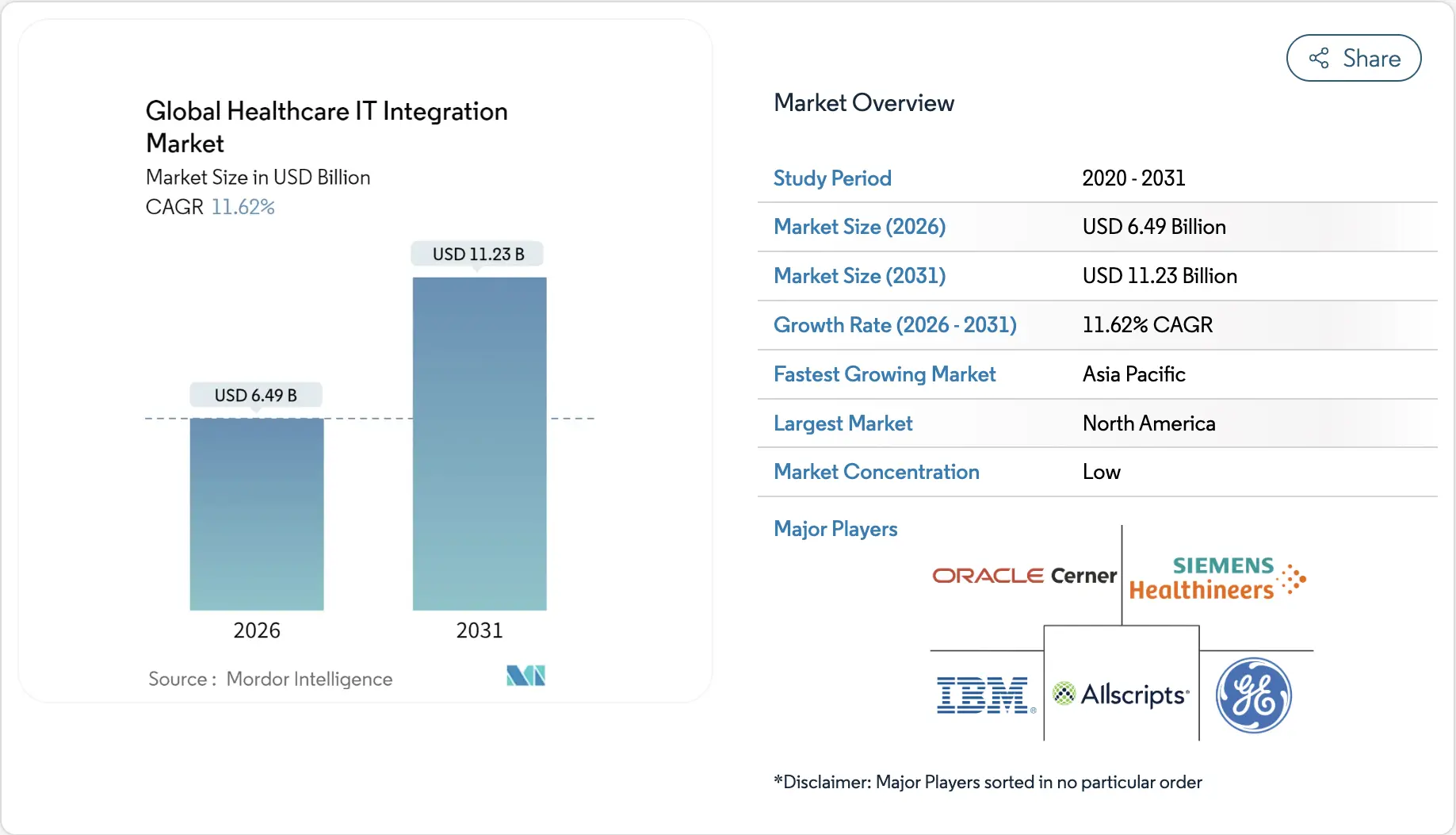
At a broader level, healthcare IT integration is projected to grow from USD 6.49 billion in 2026 to USD 11.23 billion by 2031. Within this, EHR interfaces already account for over 40% of total demand, underscoring how central EHR connectivity has become to digital health strategies.
Market Insights:
- FHIR API adoption now stands at 67% of organizations as of 2024. This shift is accelerating the move toward EHR-agnostic integration layers that can map legacy HL7v2 messages into granular FHIR resources while reducing compliance exposure under frameworks like EHDS.
- Value-based care models require real-time data flows across EHRs. Payers increasingly expect continuous clinical feeds from disparate systems, which is driving hospital-centric integrations designed for speed, traceability, and financial accountability.
- Telehealth and decentralized trials are expanding integration demands. These care models depend on vendor-neutral platforms that can support bi-directional data exchange with labs, wearables, and EDC systems without introducing new dependencies.
Enterprises invest in an EHR-agnostic integration layer because it turns integration from a recurring cost into a long-term advantage. It reduces dependency on individual vendors, shortens rollout cycles, and lowers compliance risk as systems evolve.
Over time, teams spend less effort fixing interfaces and more time scaling high-impact initiatives, which directly improves ROI while creating a more resilient digital foundation.
What Is an EHR-Agnostic Integration Layer for Enterprises?
An EHR-agnostic integration layer allows enterprises to connect systems without being tied to any single EHR vendor. It gives organizations control over how data flows, not just where it flows.
An EHR-agnostic integration layer is a platform that sits between EHRs and enterprise applications. It manages how systems exchange data without hardcoding logic to one vendor. As a result, enterprises can change, upgrade, or add EHRs without rewriting their entire integration stack.
This layer also enforces security, compliance, and data standards centrally. Therefore, integration becomes predictable and easier to scale. Over time, it turns fragmented connections into a controlled enterprise capability instead of a recurring problem.
How It Works
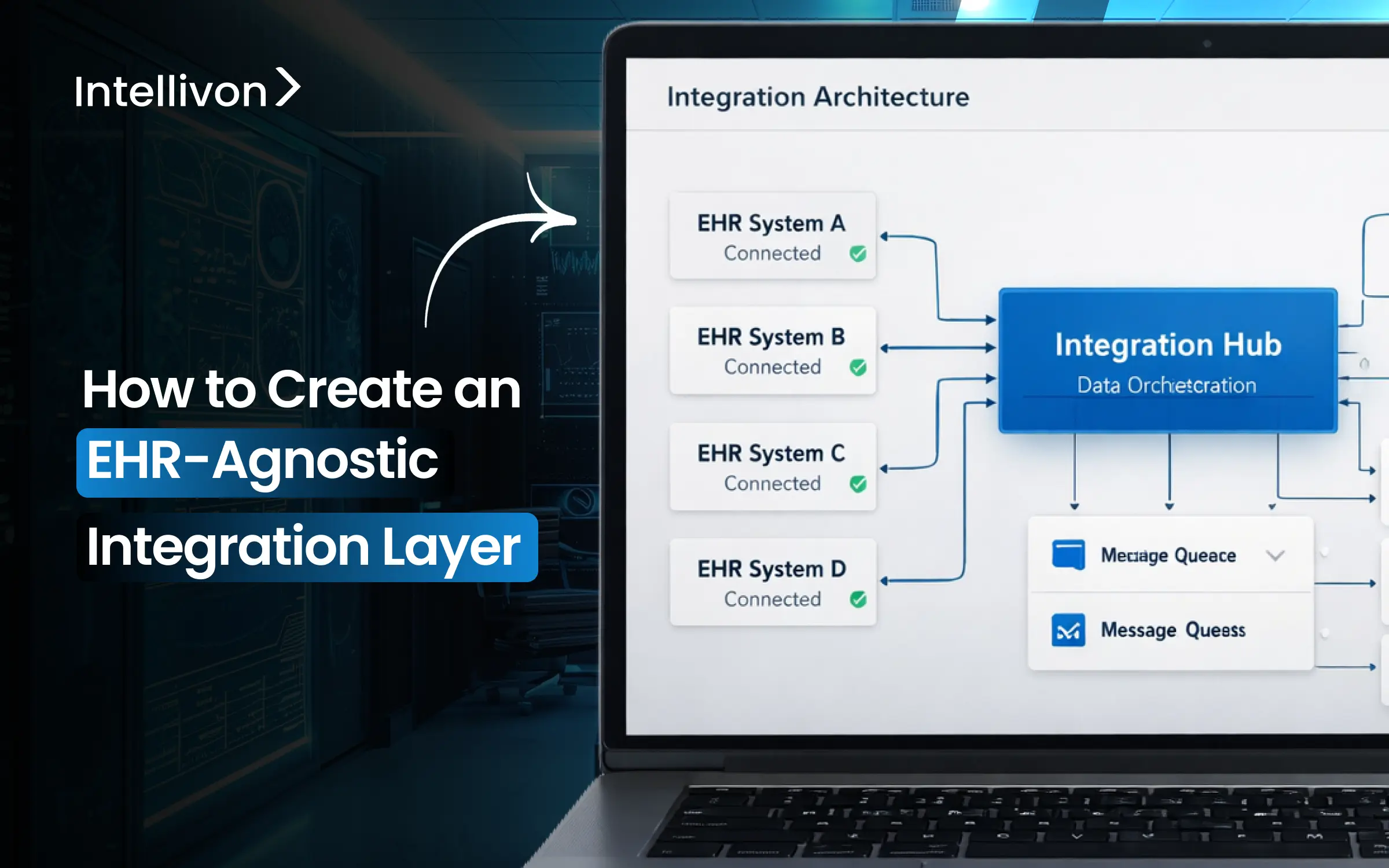
An EHR-agnostic integration layer works like a controlled bridge between EHRs and the rest of the enterprise. It helps apps get the data they need while keeping security, governance, and change management consistent. Therefore, teams can add new workflows without rebuilding integrations each time.
Where This Layer Sits
This layer sits between your source systems and your consuming applications. On one side, it connects to EHRs and other clinical systems.
On the other side, it serves apps, analytics, and partner connections through managed APIs and events. In addition, it becomes the place where you enforce rules once, instead of repeating them across every app.
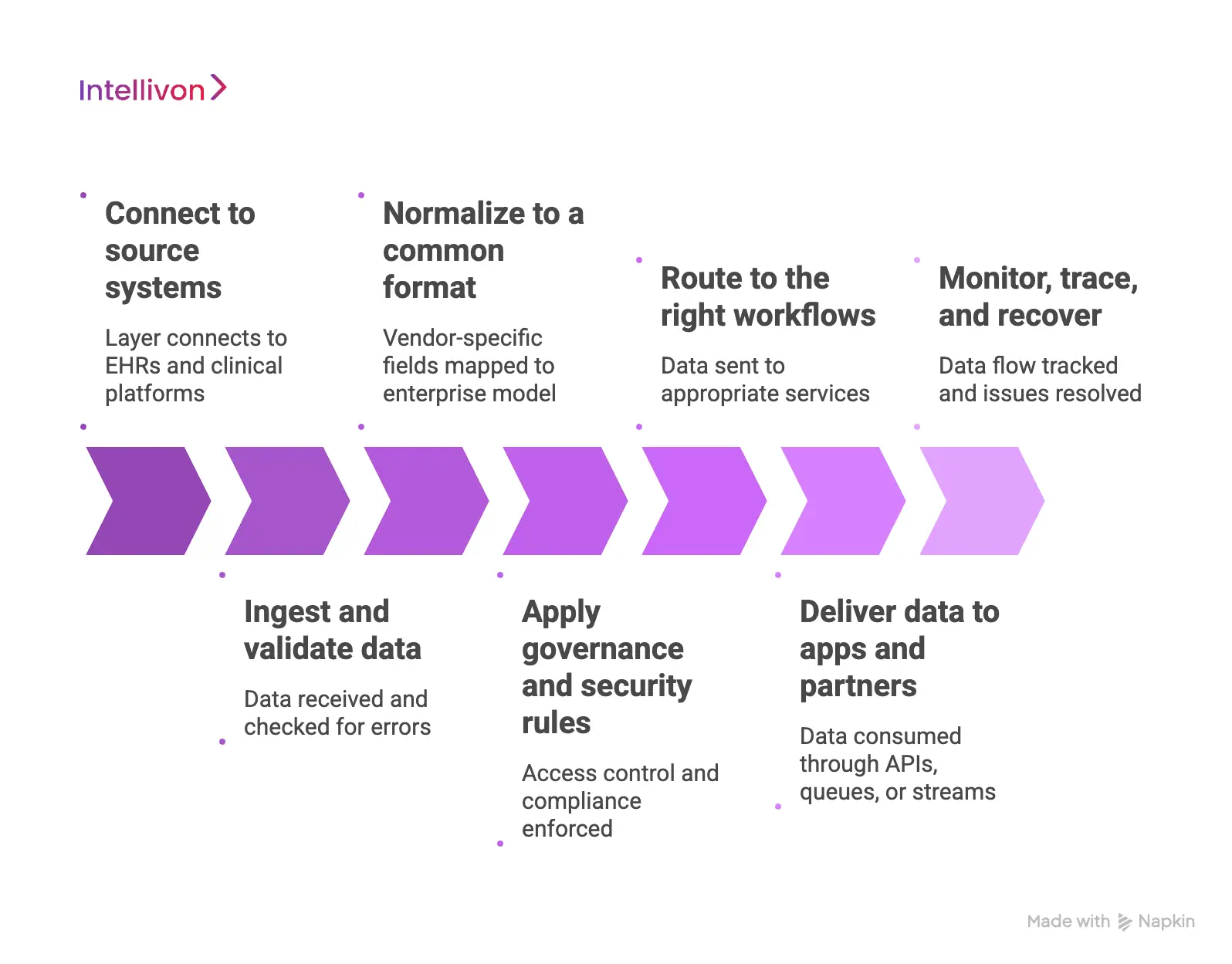
Step 1: Connect to source systems
The layer connects to EHRs and related platforms through APIs, HL7 messages, files, or events. However, it does not expose raw connections directly to every app.
Step 2: Ingest and validate data
It receives data, checks required fields, and flags errors early. Therefore, downstream apps do not break due to missing or malformed inputs.
Step 3: Normalize to a common format
It maps vendor-specific fields into a consistent enterprise model. As a result, apps can rely on stable structures even when EHR formats differ.
Step 4: Apply governance and security rules
It enforces access control, consent, audit logs, and data policies at the layer. In addition, it supports consistent compliance across teams and vendors.
Step 5: Route to the right workflows
It sends the right data to the right services based on business rules. For example, a discharge event can trigger care coordination, billing, and follow-up.
Step 6: Deliver data to apps and partners
Apps consume data through APIs, queues, or streams, depending on the use case. Therefore, the same layer can support real-time and batch workflows.
Step 7: Monitor, trace, and recover
It tracks data flow end to end and alerts teams when something fails. In addition, replay and retry features reduce downtime and manual fixes.
This layer sits at the enterprise boundary between systems and applications, so it becomes the single place to manage integration at scale. As a result, teams move faster, reduce rework, and stay compliant even as EHRs, vendors, and workflows change.
Why Do EHR-Agnostic Integration Layers Fail at Scale?
EHR-agnostic integration layers usually fail not because the idea is flawed, but because enterprise realities expose weaknesses in ownership, governance, and long-term design. When volume and complexity increase, these weaknesses become business risks rather than technical inconveniences.
Many EHR-agnostic integration layers look strong during early rollout when they support only a few workflows and limited users, but challenges appear as adoption grows across departments and partners.
The failures that surface are often structural rather than technical, which is why fixing them requires more than changing tools.
1. Lack of Clear Ownership and Operating Model
One of the most common reasons these layers fail is the absence of a clearly defined owner within the enterprise. When responsibility is spread across IT, digital teams, and external vendors, decisions slow down, and priorities become misaligned.
Over time, this creates confusion about who maintains, upgrades, or governs the layer, which weakens its reliability. As a result, teams often work around the layer instead of improving it, leading to parallel integrations that dilute its value.
2. Weak Data Governance and Policy Enforcement
Another critical issue emerges when governance is treated as an afterthought rather than a core design principle. While early-stage integrations may function without strict access controls or auditability, scale exposes these gaps quickly.
Sensitive data begins flowing across more users and partners, and without centralized enforcement, compliance risks grow silently. Eventually, this limits how confidently the enterprise can expand digital programs or external collaborations.
3. Hidden Vendor Coupling
Some EHR-agnostic integration layers fail because they are only agnostic in name, not in design. When the internal data structures mirror vendor-specific formats too closely, every EHR upgrade forces changes across the layer.
Instead of insulating the enterprise from vendor volatility, the layer becomes another surface for disruption. This leads to frequent rework and erodes the very stability the platform was meant to provide.
4. Limited Observability and Control
As integration volumes increase, the ability to see and understand what happens inside the layer becomes essential. Without strong monitoring, tracing, and alerting, failures are hard to detect and even harder to resolve.
Small issues can escalate into prolonged outages simply because teams lack visibility into root causes. Over time, this reduces trust in the platform and increases dependence on manual intervention.
5. Inability to Evolve with Business Change
Finally, many layers fail because they are designed for current workflows but not for future ones. Enterprises evolve through acquisitions, new care models, regulatory changes, and digital expansion, yet their integration platforms often remain static.
When the layer cannot adapt without major rework, it becomes a bottleneck rather than an enabler. At that point, scaling the business becomes harder than building new systems.
EHR-agnostic integration layers fail at scale, not because the idea is weak, but because enterprises underestimate what it takes to operate them as core infrastructure. When these foundations are built correctly, however, the same layer becomes a durable asset that grows stronger as the enterprise expands rather than more fragile.
What 83% API Adoption Means for EHR-Agnostic Integration
As healthcare APIs become widely adopted, integration is shifting from interface building to platform orchestration.
An EHR-agnostic integration layer ensures this API growth leads to control, not complexity, by governing how systems connect, evolve, and scale across vendors and workflows.
Why This Number Matters to Enterprises
When more than 80% of hospitals operate with API-enabled EHR technology, the conversation changes. Integration is no longer about whether systems can connect. It is about how those connections are managed, governed, and scaled.
APIs lower the barrier to accessing data. However, they also increase the number of access points across the enterprise. Without a unifying layer, each new API becomes another surface area for technical debt, security exposure, and operational risk.
For enterprise leaders, this creates a simple reality. API adoption without architectural control does not simplify integration. It shifts complexity into places that are harder to see and even harder to govern.
How APIs Are Reshaping Integration Models
APIs make data easier to expose, yet they do not define how that data should be used across systems. This gap becomes visible when:
- Different applications consume the same API in inconsistent ways
- Security policies vary across endpoints
- Compliance rules are enforced unevenly
- Monitoring is fragmented across tools
As a result, organizations often end up with faster access but weaker control.
An EHR-agnostic integration layer addresses this by sitting above the API level. It does not replace APIs. It orchestrates how APIs are used across the enterprise.
Why EHR-Agnostic Design Becomes Essential at This Scale
As API adoption rises, EHR-specific integration becomes a limiting strategy. Each vendor exposes APIs differently. Each upgrade introduces subtle changes. Over time, this forces teams to rewrite logic that should have remained stable.
An EHR-agnostic layer absorbs that variation. It allows applications to interact with consistent data structures and workflows, even when the underlying EHRs behave differently. This protects enterprise systems from vendor volatility and reduces rework during upgrades or migrations.
More importantly, it allows integration to evolve without being dictated by the pace or priorities of any single vendor.
What This Enables in Practice
With an EHR-agnostic integration layer in place, enterprises can:
- Add new applications without rebuilding core integrations
- Apply uniform security and compliance rules across APIs
- Monitor system behavior end-to-end, not API by API
- Maintain control as API volumes grow across departments
- Scale digital programs without multiplying maintenance effort
This is where API adoption translates into real operational advantage.
API adoption is a powerful enabler, but it does not guarantee architectural clarity. Without an EHR-agnostic integration layer, it often leads to faster complexity rather than faster outcomes.
Enterprises that treat APIs as building blocks, not as the architecture itself, gain a clear advantage. They convert widespread connectivity into a controlled, scalable, and compliant integration foundation that supports long-term growth instead of slowing it down.
Features Of An EHR-Agnostic Integration Layer
An EHR-agnostic integration layer succeeds when it combines technical capability with enterprise governance, operational reliability, and long-term flexibility across systems and vendors.
An effective EHR-agnostic integration layer is not defined by how many connectors it has, but by how reliably it supports growth, compliance, and system change.
The features that matter most are those that reduce long-term complexity while increasing control and predictability. These features shape whether the layer becomes a strategic asset or another fragile platform.
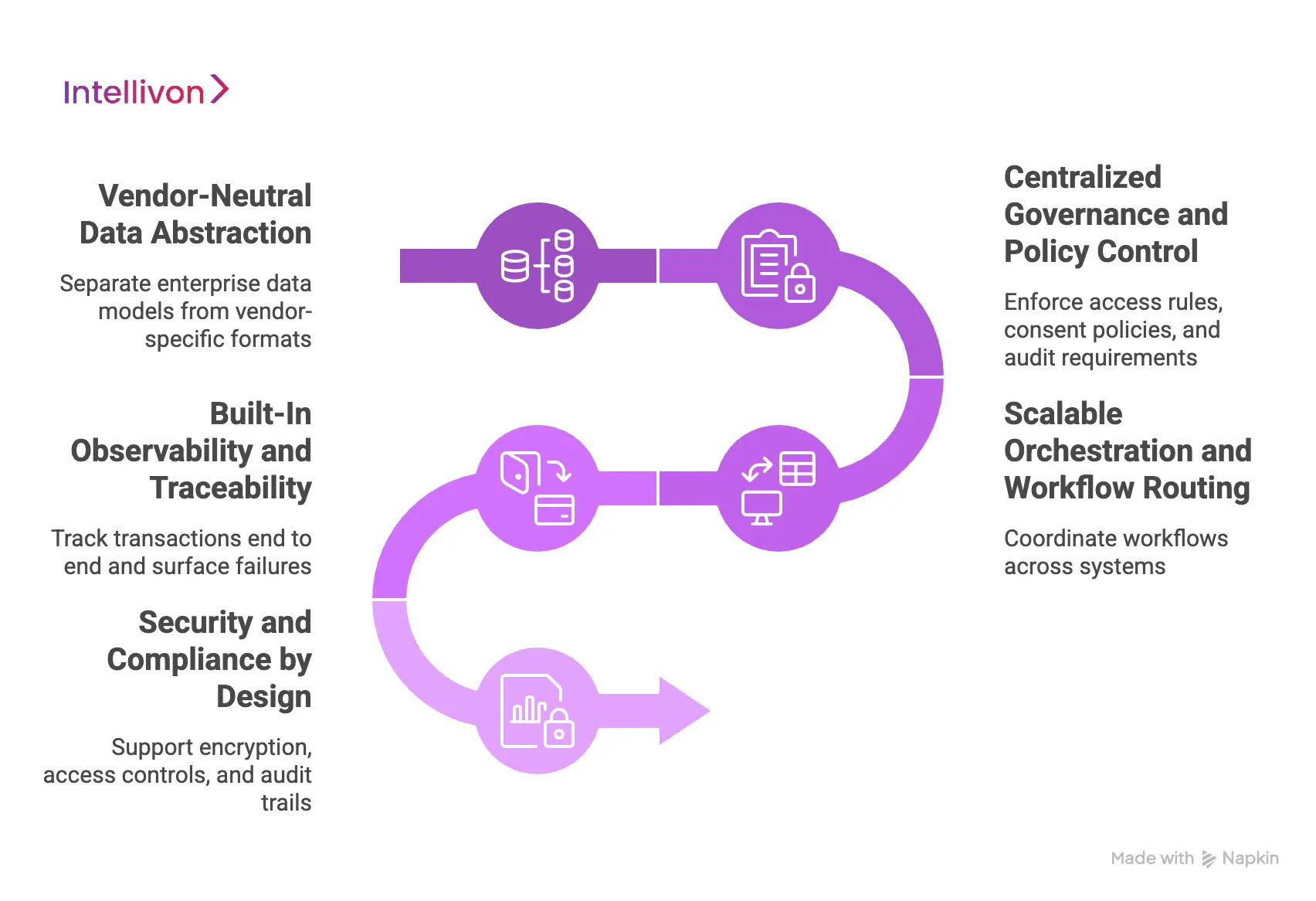
1. Vendor-Neutral Data Abstraction
A strong layer separates enterprise data models from vendor-specific formats so that applications never depend directly on how an EHR structures information. This allows systems to evolve independently while keeping integrations stable.
Over time, this reduces rework during upgrades and vendor changes. As a result, integration becomes resilient rather than reactive.
2. Centralized Governance and Policy Control
This layer becomes the place where access rules, consent policies, and audit requirements are enforced consistently. Instead of each application implementing its own controls, the enterprise applies them once at the integration level.
This improves compliance while simplifying application design. In addition, it gives leadership better visibility into how data is actually being used.
3. Scalable Orchestration and Workflow Routing
An EHR-agnostic layer must handle more than simple data movement. It should coordinate workflows across systems, such as triggering billing, care coordination, or follow-up actions from a single event.
As volumes increase, this orchestration ensures that business logic remains centralized and manageable. Therefore, complexity stays controlled even as use cases grow.
4. Built-In Observability and Traceability
Visibility into data flow is essential when integrations become mission-critical. A strong layer tracks transactions end to end and surfaces failures before they impact operations.
This reduces downtime and avoids long investigation cycles. Over time, observability builds confidence in the platform and supports faster decision-making during incidents.
5. Security and Compliance by Design
Security cannot be layered on after deployment. The integration layer must support encryption, access controls, and audit trails as native capabilities.
This ensures that sensitive health data remains protected as it moves across systems and partners. In addition, it simplifies regulatory audits and reduces exposure during expansion.
These features determine whether an EHR-agnostic integration layer becomes a stable enterprise foundation or another short-lived platform. When built correctly, it simplifies growth, reduces risk, and gives organizations long-term control over how their systems evolve.
Over time, this turns integration from a technical necessity into a strategic advantage.
What Architecture Enables an EHR-Agnostic Integration Layer?
An EHR-agnostic integration layer depends on a clear architectural foundation that separates vendor complexity from enterprise control, allowing systems to evolve without disrupting core operations.
An EHR-agnostic integration layer works only when its architecture is designed for long-term stability rather than short-term connectivity. The goal is not to connect more systems faster, but to control how systems interact as complexity grows.
Each architectural component plays a role in keeping integrations predictable, compliant, and scalable across changing EHR environments.
1. Edge Adapters for EHRs and External Systems
Edge adapters handle how different systems connect to the layer without exposing their internal complexity to the rest of the enterprise. They manage variations across HL7 v2, FHIR, X12, DICOM, and even custom data feeds in a controlled way.
As a result, changes in one system do not ripple across the entire platform. Over time, this protects enterprise workflows from vendor-specific behavior and frequent interface rewrites.
2. Canonical Data Model
A canonical data model defines how the enterprise represents information independent of any EHR or vendor format. It converts fragmented, inconsistent data into stable structures that applications can rely on.
This allows teams to build once and reuse across multiple systems. Therefore, true EHR independence becomes possible without forcing every application to understand vendor-specific fields.
3. Orchestration and Workflow Engine
The orchestration layer decides where data goes, when it moves, and how errors are handled. It manages routing, transformations, retries, and business logic in one place instead of spreading these rules across multiple applications.
This keeps workflows manageable even as volumes increase. In addition, it allows enterprises to change processes without redesigning integrations every time.
4. Policy and Governance Layer
This layer enforces rules around access, consent, audit, and data retention centrally rather than inside each application. It ensures that compliance is consistent across the entire integration landscape.
As more users and partners access data, these controls become essential. Over time, this prevents regulatory risk from growing unnoticed as integrations expand.
5. Observability and Monitoring
Observability gives teams visibility into how data moves through the integration layer in real time. It tracks transactions from source to destination and highlights failures early. This reduces downtime and simplifies troubleshooting.
In addition, traceability supports audits and builds confidence in the platform as it becomes mission-critical.
Together, these architectural elements turn an EHR-agnostic integration layer into a stable enterprise foundation rather than a fragile technical solution. When built correctly, the layer absorbs change instead of spreading it, allowing healthcare organizations to grow and adapt without losing control of how their systems work together.
How Should Standards Work in an EHR-Agnostic Integration Layer?
Standards such as HL7, FHIR, and X12 enable system connectivity, but an EHR-agnostic integration layer determines how these standards are governed, normalized, and applied at enterprise scale.
Standards are essential in healthcare integration, yet they do not solve complexity on their own. While they define how data can be exchanged, they do not define how that exchange should be controlled across an enterprise.
An EHR-agnostic integration layer ensures standards are used in a way that supports long-term stability instead of creating new forms of dependency.
1. Why Standards Alone Are Not Enough
HL7, FHIR, and X12 make it possible for systems to communicate. At the same time, they do not ensure consistency across different implementations. Each vendor interprets and extends standards in its own way.
As a result, two systems using the same standard may still behave very differently. Without a governing layer, enterprises end up managing variations instead of benefiting from standardization.
2. Where HL7, FHIR, X12, and DICOM Fit
Each standard plays a different role in the integration landscape. HL7 v2 remains common for clinical messaging, FHIR supports modern APIs and granular access, X12 enables financial and claims workflows, and DICOM handles imaging data.
An EHR-agnostic integration layer allows all of these to coexist without forcing the enterprise to choose one over the others. Therefore, organizations can modernize gradually instead of through risky, large-scale replacements.
3. Normalization Versus Direct Pass-Through
Not every data flow needs to be normalized, and not every message should pass through unchanged. The integration layer decides when to translate data into a canonical model and when to preserve its original format.
This balance allows applications to remain stable while supporting diverse workflows. Over time, this reduces unnecessary transformations and keeps performance predictable.
4. Avoiding Standard-Based Lock-In
Relying too heavily on one standard can create a different form of dependency. For example, building everything around FHIR alone may limit flexibility when other formats are required.
An EHR-agnostic integration layer avoids this by treating standards as tools rather than as the architecture itself. As a result, enterprises retain control even as standards evolve or regulations change.
Standards are critical, but they must be governed rather than followed blindly. When managed through an EHR-agnostic integration layer, standards become enablers of flexibility instead of constraints.
This allows healthcare organizations to scale integration while remaining independent of specific vendors, formats, or regulatory shifts.
How Do You Govern Data in an EHR-Agnostic Integration Layer?
Data governance in an EHR-agnostic integration layer ensures that information flows securely, consistently, and in compliance with regulations across systems, users, and partners.
As integration expands across systems and partners, controlling how data is used becomes just as important as moving it. An EHR-agnostic integration layer centralizes governance so that rules are applied once and enforced everywhere.
This reduces risk while allowing the enterprise to scale data access with confidence.
1. Enforcing Access and Identity Rules
A core function of governance is deciding who can access what data and under which conditions. Instead of embedding these rules inside each application, the integration layer applies them centrally.
This ensures that access remains consistent even when new systems are added. Over time, this prevents fragmented security models from emerging across the enterprise.
2. Managing Consent and Data Usage
Healthcare data often comes with strict consent requirements that vary by region and use case. The integration layer becomes the place where these consent rules are interpreted and enforced before data reaches any application.
As a result, enterprises can expand digital programs without constantly reworking compliance logic. This also makes audits easier and more predictable.
3. Maintaining Auditability and Traceability
Governance is incomplete without knowing where data has been and how it was used. The integration layer tracks data movement across systems and logs key actions in a consistent way.
This creates a reliable audit trail for regulators and internal teams. In addition, it helps resolve disputes or incidents with clear, verifiable records.
4. Controlling Data Retention and Residency
Different regulations require data to be stored, retained, or deleted in specific ways. The integration layer enforces these rules uniformly across all connected systems.
Therefore, data does not remain longer than it should or move where it should not. This reduces regulatory exposure while simplifying operational oversight.
Strong data governance transforms an EHR-agnostic integration layer from a technical platform into a trusted enterprise asset.
When governance is built into the layer itself, organizations can scale data access, support new partnerships, and meet regulatory demands without losing control over how their most sensitive information is used.
What Is Our Low-Risk Roadmap for an EHR-Agnostic Integration Layer?
At Intellivon, we do not approach integration as a one-time project or a narrow technical task. We treat it as enterprise infrastructure that must survive vendor change, regulatory pressure, and business expansion. Our roadmap focuses on delivering value early while protecting long-term stability and compliance.
Each phase is designed to build confidence before moving to the next, so scale never becomes a surprise.
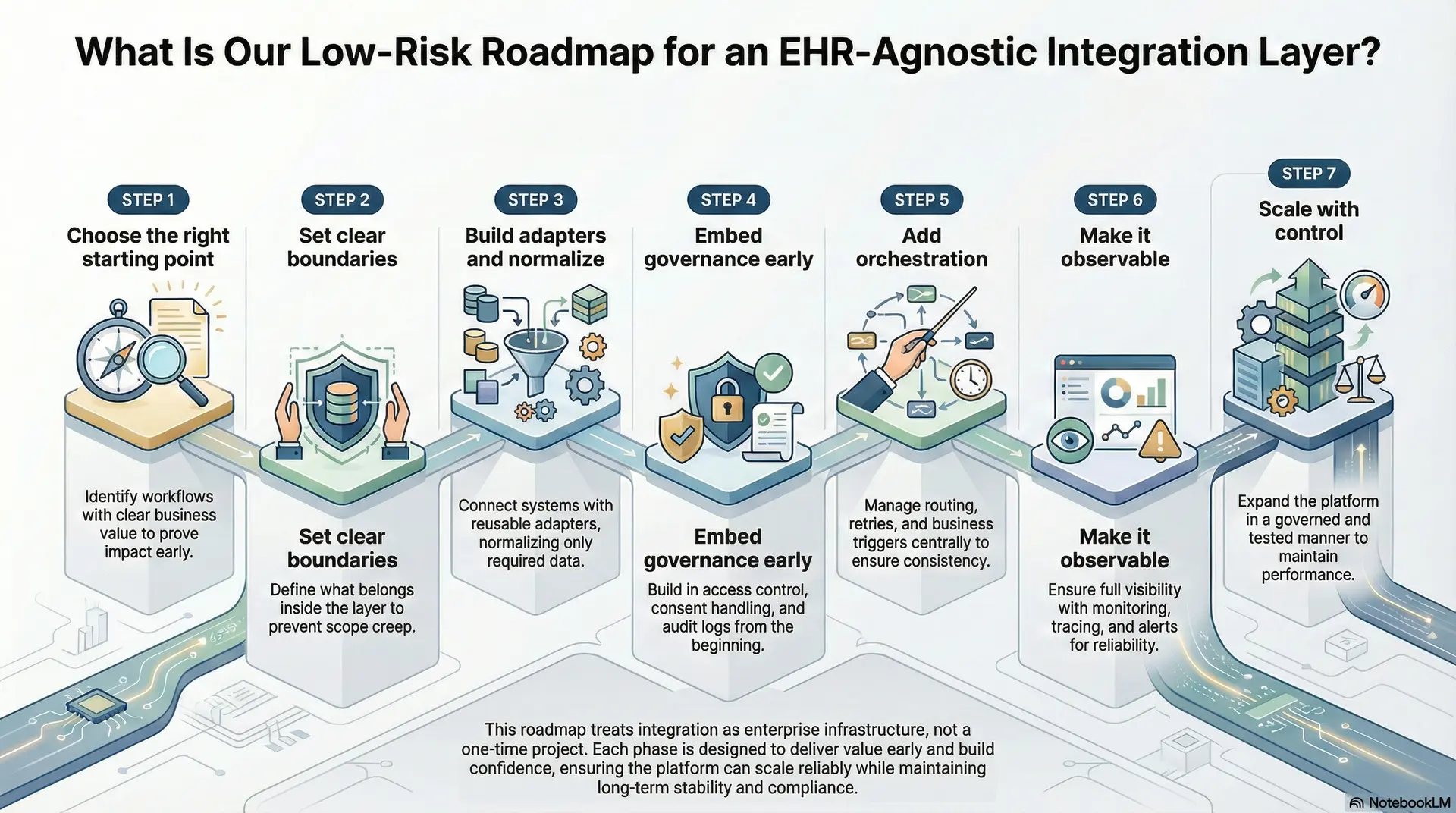
Step 1: Choose the right starting point
We begin by identifying workflows that carry clear business and operational value, so the layer proves its impact early. This ensures that the platform is seen as a business enabler rather than a back-office tool.
In addition, strong ownership forms naturally when teams see direct benefit from the first integrations. Typical starting points include lab results, referrals, admissions, discharge events, and claims triggers that already affect daily operations.
Step 2: Set clear boundaries
Before any system is connected, we define what belongs inside the integration layer and what remains outside it. This prevents scope creep and protects the platform from becoming another unstructured system.
Over time, these boundaries help the layer remain focused, stable, and easier to operate. At Intellivon, this step is critical because it keeps integration aligned with enterprise priorities rather than individual team demands.
Step 3: Build adapters and normalize
We connect EHRs and related systems using reusable adapters while normalizing only the data required for selected workflows. This keeps the platform lightweight without limiting future growth.
More importantly, it allows the layer to absorb vendor variation without passing complexity downstream to applications. As a result, teams can build and scale applications without worrying about how each EHR behaves internally.
Step 4: Embed governance early
We introduce access control, consent handling, audit logs, and retention rules from the beginning rather than adding them later. This ensures compliance is built into the platform rather than layered on as a fix.
In addition, it allows the integration layer to support external partners and new regions safely over time. At Intellivon, governance is treated as a foundation, not a feature.
Step 5: Add orchestration
Once core data flows are stable, we introduce orchestration to manage routing, retries, and business triggers centrally. This reduces duplication across applications and keeps logic consistent as scale increases.
Over time, it also reduces manual intervention and operational noise. As a result, workflows remain manageable even as transaction volumes grow.
Step 6: Make it observable
We ensure full visibility into how data moves through the layer using monitoring, tracing, and alerts. Without this, no integration platform can operate reliably at enterprise scale. At Intellivon, observability is treated as a launch requirement rather than an optional enhancement.
This allows teams to detect issues early and resolve them before they affect operations.
Step 7: Scale with control
After proving value in core workflows, we expand the platform across domains, partners, and regions in a controlled manner. Each expansion is governed and tested before release, so performance and compliance are never compromised.
Over time, this creates a platform that grows stronger as usage increases rather than becoming fragile. This is how we help enterprises scale integration with confidence.
This roadmap reflects how Intellivon builds EHR-agnostic integration layers that hold up under real enterprise pressure. By moving in clear phases and embedding governance, orchestration, and observability early, we help organizations grow faster without sacrificing stability or control.
What Use Cases Prove an EHR-Agnostic Integration Layer’s Value?
The real value of an EHR-agnostic integration layer becomes clear when it consistently supports high-impact workflows across clinical, operational, and business systems without increasing complexity or risk.
The strongest proof of an EHR-agnostic integration layer is not found in diagrams or architecture decks, but in how it performs across real workflows.. These use cases show where the layer delivers measurable value in everyday enterprise operations.
1. Clinical Workflow Integration
Clinical workflows depend on timely and accurate data moving across departments and care settings. An EHR-agnostic integration layer ensures that events such as admissions, discharges, lab results, and referrals flow reliably between systems without being tied to one vendor.
As a result, care teams receive consistent information even when multiple EHRs are involved. Over time, this improves coordination while reducing the effort spent reconciling data across platforms.
2. Revenue Cycle and Claims Processing
Revenue workflows often suffer when clinical and financial systems do not align. An EHR-agnostic integration layer connects billing, coding, and claims systems with clinical data in a controlled way.
This reduces delays, prevents mismatches, and improves audit readiness. In addition, it allows finance teams to adapt to payer requirements without forcing changes inside the EHR itself.
3. Patient and Partner Platforms
Patient portals, employer health programs, and partner platforms require secure and consistent access to healthcare data. An EHR-agnostic integration layer makes this possible without exposing raw EHR interfaces to external systems.
This improves security while simplifying partner onboarding. Over time, enterprises can expand digital offerings without rebuilding integrations for each new collaboration.
4. Data, Analytics, and AI Enablement
Analytics and AI systems rely on stable, normalized data across multiple sources. An EHR-agnostic integration layer provides this foundation by delivering consistent data structures regardless of where the information originated.
As a result, data teams spend less time cleaning inputs and more time generating insights. This also reduces bias that often comes from fragmented or vendor-specific data feeds.
These use cases demonstrate how an EHR-agnostic integration layer moves beyond connectivity to deliver real enterprise value. When built correctly, it supports growth across care delivery, operations, and innovation without adding complexity. Over time, it becomes a shared foundation that strengthens every system it touches.
What Mistakes Break an EHR-Agnostic Integration Layer?
Most EHR-agnostic integration layers fail not because the idea is wrong, but because avoidable design and operational mistakes weaken their ability to scale and remain reliable.
These mistakes often appear small at first, yet they grow into structural problems as adoption increases. Understanding and avoiding them is critical if the layer is meant to become a durable enterprise infrastructure rather than another temporary solution.
1. Treating the Layer as a One-Time Project
One common mistake is viewing the integration layer as a project that ends once initial workflows go live. This leads to short-term design choices that do not account for growth, vendor change, or regulatory pressure.
Over time, the layer becomes difficult to extend and expensive to maintain. At Intellivon, we build the layer as a long-term platform with defined ownership, upgrade paths, and continuous improvement baked into the operating model.
2. Embedding Vendor Logic into the Core
Another frequent issue arises when vendor-specific behavior is allowed to shape the core design of the layer. This defeats the purpose of being agnostic and causes every EHR upgrade to ripple across the platform. As a result, integration becomes reactive instead of stable.
Intellivon avoids this by isolating vendor complexity at the edges and keeping the core based on enterprise-defined data and workflows.
3. Ignoring Governance Until Scale
Many teams delay governance until integration volumes grow, assuming it can be added later without impact. However, once data begins flowing across departments and partners, retrofitting access control and auditability becomes costly and risky. This often slows down expansion and creates compliance gaps.
Our experts ensure governance is embedded from the first deployment, so scale never forces a redesign.
4. Overlooking Observability and Control
A layer that cannot be monitored or traced in real time will eventually lose trust across the organization. When issues occur and root causes are unclear, teams rely on manual fixes and workarounds.
Over time, this erodes confidence in the platform. Intellivon addresses this by making observability a core requirement, ensuring visibility, alerts, and traceability are present from day one.
5. Allowing Uncontrolled Expansion
As more teams adopt the integration layer, unstructured growth can turn it into another complex system rather than a simplifying one. Without clear boundaries and standards, integrations multiply without coherence. This reduces reliability and increases operational load.
At Intellivon, we control expansion through defined integration patterns and architectural guardrails that keep growth predictable and manageable.
These mistakes break EHR-agnostic integration layers not because they are technical failures, but because they undermine the layer’s role as enterprise infrastructure.
By designing for ownership, governance, isolation of vendor complexity, and operational visibility from the start, Intellivon helps organizations avoid these pitfalls and build integration platforms that remain stable as they scale.
Conclusion
An EHR-agnostic integration layer changes how enterprises think about connectivity, control, and growth. Instead of reacting to vendor limits or system changes, organizations gain a stable foundation that supports scale, compliance, and innovation together. Over time, this reduces operational friction and turns integration into a strategic asset rather than a recurring cost.
At Intellivon, we build these layers as enterprise infrastructure, not as short-term solutions. Our approach focuses on long-term stability, governance, and performance, so integration strengthens the business as it grows. When built correctly, this layer becomes a quiet but powerful enabler of sustained digital transformation.
Build an EHR-Agnostic Integration Layer With Intellivon
At Intellivon, EHR-agnostic integration layers are built as regulated healthcare infrastructure, not as interface tooling layered onto existing systems. Every architectural and delivery decision is designed to support long-term stability, compliance, and enterprise control rather than short-term connectivity alone. This ensures the platform holds up under real operational pressure, not just during early rollout.
As healthcare ecosystems expand across providers, payers, and partners, stability becomes critical. Governance, performance, and interoperability remain consistent even as transaction volumes and system diversity increase. Organizations retain control over data, workflows, and compliance without introducing fragmentation or regulatory exposure as they scale.
Why Partner With Intellivon?
- Enterprise-grade interoperability architecture built for regulated healthcare environments
- Proven delivery across providers, payers, and complex health platforms
- Compliance-led design with audit-ready governance and traceability
- Secure, modular infrastructure for cloud, hybrid, and on-prem deployments
- AI-enabled monitoring and automation with mandatory human oversight
Book a strategy call to explore how Intellivon can help you build and scale an EHR-agnostic integration layer with confidence and control.
FAQs
Q1. What is an EHR-agnostic integration layer in healthcare?
A1. An EHR-agnostic integration layer is a platform that allows healthcare systems and applications to connect without being tied to any single EHR vendor. It manages how data flows, applies governance, and keeps integrations stable even when EHRs change, upgrade, or expand.
Q2. Why do enterprises need an EHR-agnostic integration layer?
A2. Enterprises need this layer to avoid vendor lock-in, reduce rework during system changes, and maintain control as digital programs scale. It helps organizations grow across regions, partners, and care models without rebuilding integrations each time.
Q3. How is an EHR-agnostic integration layer different from traditional interfaces?
A3. Traditional interfaces connect systems directly and often depend on specific EHR formats. An EHR-agnostic integration layer sits above those connections and governs how systems interact, making integrations more flexible, secure, and easier to manage at scale.
Q4. Does an EHR-agnostic integration layer support HL7, FHIR, and other standards?
A4. Yes, it supports HL7, FHIR, X12, DICOM, and other standards, but it does not rely on any single one. Instead, it uses them as tools while keeping enterprise control and consistency across all data flows.
Q5. How long does it take to build an EHR-agnostic integration layer?
A5. The timeline depends on scope and complexity, but most enterprises start seeing value within a few months by focusing on high-impact workflows first. A phased approach allows early results while building a scalable foundation over time.