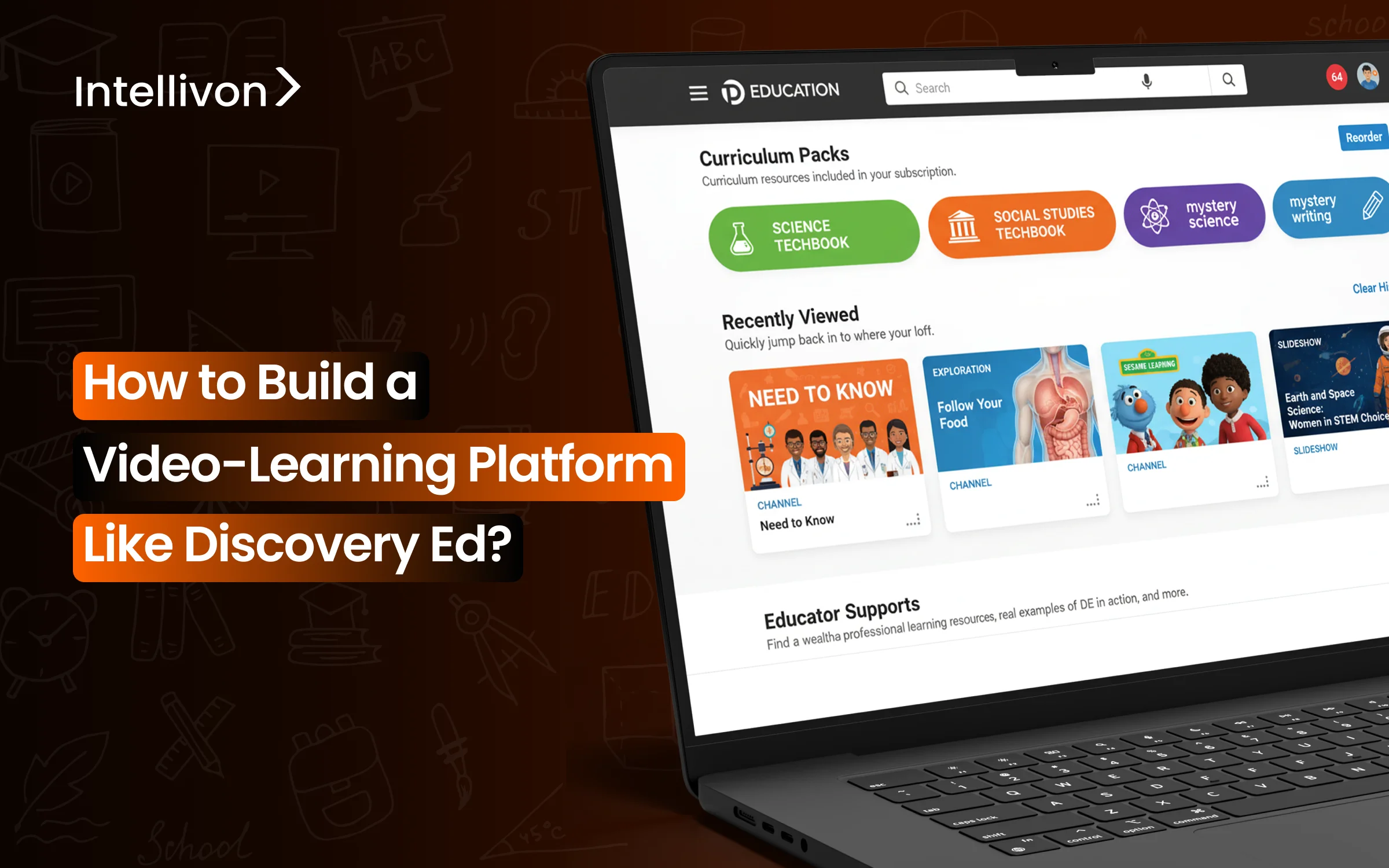
Video-learning platforms are now essential for schools, education networks, and learning organizations. What began as extra content has become vital digital infrastructure. It supports teaching, data analysis, compliance, and long-term results on a large scale. Schools need a unified system that connects everything without requiring teachers to become system administrators.
Discovery Education has set the standard by addressing the fragmentation issue on a large scale. It connects curriculum-aligned content, real-time analytics, standards tracking, and professional development into one platform that fits directly into existing district workflows. This offers a practical model for what enterprise-scale video learning should look like when it must work reliably for hundreds of thousands of users.
At Intellivon, we develop robust learning platforms based on the same principles used in large financial, healthcare, and government systems. This perspective shapes the framework you will find in this guide. In this blog, we will discuss how we build video-learning platforms like Discovery Ed from the ground up.

Key Takeaways From the Global Video Learning Platform Market
Video learning platforms have moved from supplementary tools to strategic digital infrastructure across education and corporate training.
The global video learning platform market was valued at approximately USD 2.5 billion in 2023 and is projected to reach USD 9.7 billion by 2032, growing at a 16.2% CAGR. Parallel forecasts estimate USD 2,576 million in 2024, expanding to USD 4,589.39 million by 2033, reinforcing long-term market momentum.
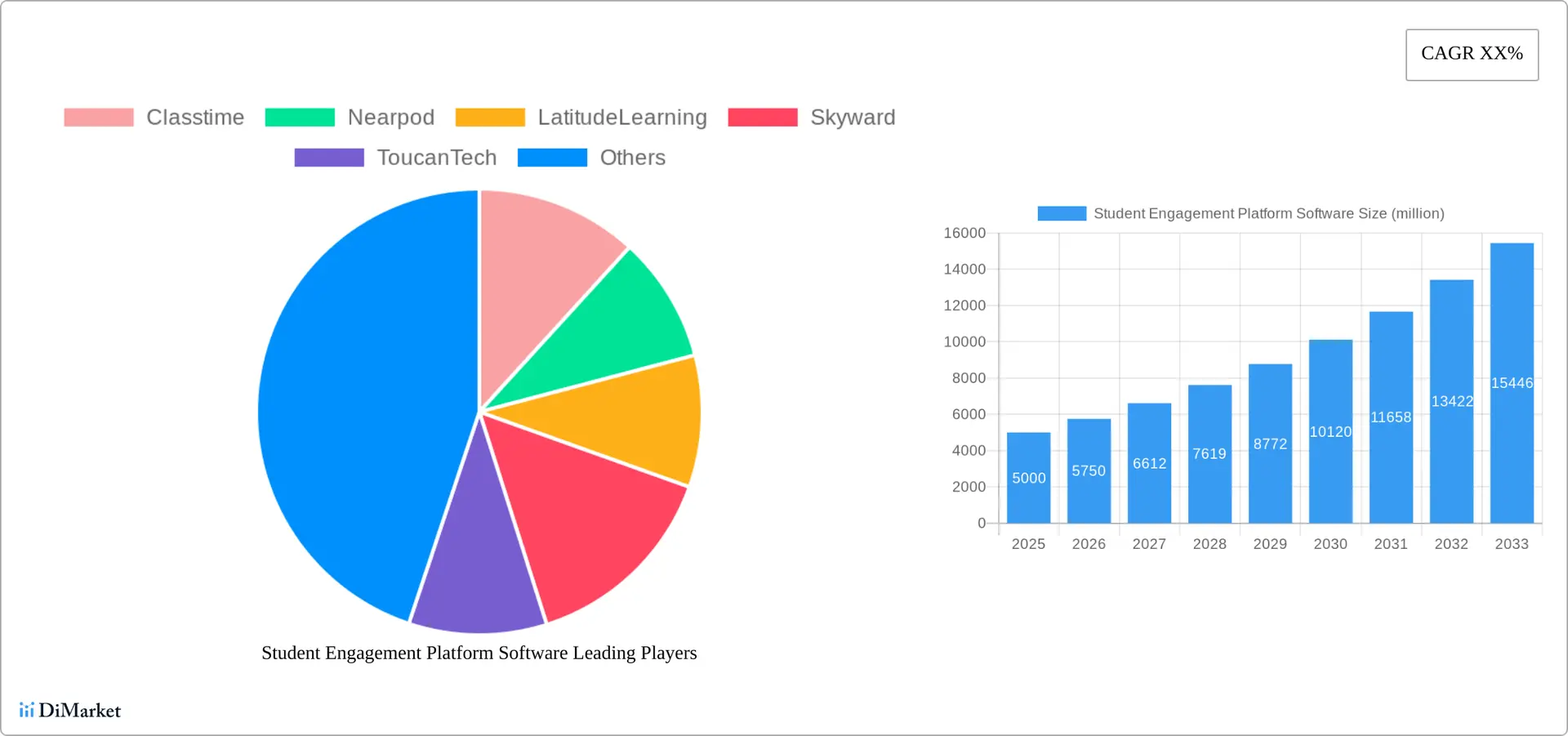
Market Snapshot & Growth Signals
- The broader online video platform ecosystem is projected to grow from USD 109.67 billion in 2025 to USD 430.61 billion by 2034, at a 16.41% CAGR.
- The education and e-learning segment within online video platforms is forecast to grow at a 17% CAGR, outpacing several other verticals.
- The global K-12 online education market stood at USD 171.5 billion in 2024 and is expected to surge to USD 2,248.36 billion by 2033, driven by large-scale digital adoption.
- The high school segment alone accounted for 39.4% of total K-12 online education revenue in 2024, supported by curriculum complexity and credit-based digital learning structures.
- The K-12 EdTech segment led overall education technology revenue in 2024 with a 39.40% share, fueled by game-based learning and immersive digital content.
- The global K-12 blended e-learning market reached USD 25.3 billion in 2023 and is projected to expand to USD 73.0 billion by 2030, at a 16.4% CAGR.
Corporate Training & Enterprise Video Adoption
- The global corporate e-learning market reached USD 104.32 billion in 2024 and is projected to touch USD 334.96 billion by 2030, growing at a 21.7% CAGR.
- In 2024, 88% of large enterprises reported active use of virtual classrooms, webcasting, and video broadcasting, confirming video as a default enterprise training medium.
- 84% of midsize businesses and 70% of small organizations also reported consistent video-based training adoption, indicating full-market normalization.
Emerging Trends Shaping the Next Phase of Video Learning
- AI-driven content personalization, automated tagging, and semantic video search are becoming baseline enterprise requirements.
- Over 52% of enterprises adopted AI-powered microlearning platforms in 2024, enabling adaptive delivery and skill-level personalization.
- Use of video-based micro modules has increased by 67% since 2022, reflecting a shift toward short-form, high-retention learning formats.
- VR and immersive media integration is gaining traction for lab simulations, vocational training, and experiential learning programs.
These data points confirm that video learning is no longer a content strategy decision. It is a long-term platform investment tied directly to digital infrastructure, workforce readiness, district modernization, and enterprise training ROI. Growth is being shaped by AI adoption, blended learning models, mobile-first usage, and compliance-driven buying behavior, making platform architecture and scalability core boardroom priorities.
Understanding The Discovery Ed Platform
Discovery Education operates as a full digital learning ecosystem rather than a simple video library. It combines curriculum-aligned content, classroom tools, analytics, and system integrations into one daily-use instructional environment.
The platform reaches tens of millions of students globally and serves millions of educators across K–12 systems. In U.S. districts that use the platform heavily, students consistently outperform in low-use classrooms on state benchmarks. That outcome data is one of the strongest signals behind its long-term institutional adoption.
What makes the platform powerful is not only the scale of its content library. It is the way content, instruction, and reporting stay connected inside a single workflow that works at the district scale.
How Does It Work?
Discovery Ed functions as a continuous instructional loop that connects access, content discovery, lesson delivery, and outcome measurement inside one platform.
Step 1: Secure Access and Automatic Class Setup
Teachers and students enter through district-connected single sign-on. Class rosters sync automatically from SIS systems. This removes manual setup and keeps identity, access, and reporting clean from day one.
Step 2: Finding Standards-Aligned Content
Teachers search by subject, grade, topic, or standard. The system uses deep metadata tagging to surface the right videos, interactives, and readings in seconds. Recommendations adapt based on curriculum alignment and prior usage.
Step 3: Building Lessons and Assignments
Selected resources are arranged into playlists or lesson flows. Teachers add guiding prompts, checks for understanding, and assignments without switching tools. Instruction stays centralized and structured.
Step 4: Delivering Content in Class and at Home
Lessons run in real time during class and remain available for revision, homework, or make-up work. The same lesson supports live teaching and asynchronous learning without duplication.
Step 5: Tracking Engagement and Learning Outcomes
Student activity feeds directly into dashboards. Teachers see completion, participation, and mastery at the individual and class levels. Leaders see usage and performance across schools and districts.
Step 6: Improving Instruction Through Data
Over time, the platform sharpens recommendations based on performance patterns. Districts identify what works, where gaps exist, and how to refine both content and teaching strategies.
Discovery Ed works because it closes the loop between content, instruction, and data. That closed-loop design is what turns video from media into active digital infrastructure for learning.
Business & Revenue Models of Discovery Ed
Discovery Ed operates on a platform-first business strategy rather than a content-publisher model. Its structure is designed for long-term institutional adoption, predictable renewals, and district-wide expansion.
The business and revenue mechanics work together to support scale, retention, and cross-sell across entire education systems.
Business Models of Discovery Education
This section explains how the platform is structurally positioned inside school systems and why it scales so effectively across districts and states.
1. District-Centric Enterprise Platform Model
Discovery Ed is sold and deployed at the district or state level, not to individual teachers or families. This positions the platform as shared digital infrastructure rather than a discretionary classroom tool.
Once adopted, it becomes embedded into curriculum planning, instruction delivery, and reporting workflows across multiple schools under one contract.
2. Platform-as-Core, Content-as-Layer Strategy
The platform itself acts as the operating layer. Content sits on top of it and can be updated, expanded, or replaced without changing the core system.
This allows Discovery Ed to continuously add new subjects, media types, and tools without disrupting district operations. For buyers, this lowers long-term platform-switching risk.
3. Ecosystem Expansion Through Integrated Products
Discovery Ed does not operate as a single-product company. It expands through connected offerings such as science curricula, STEM tools, real-world career content, and immersive labs.
Each new product strengthens account depth inside the same district rather than forcing repeated new customer acquisition.
4. Long-Term Institutional Lock-In Model
Once implemented, Discovery Ed becomes tied to curriculum pacing, teacher workflows, student access, and reporting systems. Over time, this creates high operational dependency.
This dependency is not contractual lock-in alone. It is workflow and data lock-in, which stabilizes retention across multi-year terms.
Revenue Models of Discovery Education
This section explains how that business structure translates into predictable, scalable revenue.
1. Per-Student Annual Licensing at District Scale
The core revenue stream follows a per-student, per-year licensing model executed at the district level. Pricing scales with enrollment size, grade bands, and enabled product modules.
This creates recurring, forecastable revenue rather than one-time content sales.
2. Multi-Year Contracting and Budget Cycle Alignment
Most contracts run across one to three years and align with district budget planning cycles. This makes revenue more resilient to short-term funding volatility.
Renewals are driven less by marketing pressure and more by operational dependency and administrative continuity.
3. Add-On Products and Modular Upsell
In addition to core platform access, districts purchase add-ons such as STEM labs, science techbooks, coding modules, and professional development tools.
This modular pricing structure increases revenue per district without requiring a full platform replacement.
4. Professional Development and Services Revenue
Discovery Ed also generates revenue from teacher training, curriculum support programs, and adoption services. These services accelerate usage and, in turn, protect renewal probability.
Services revenue strengthens both customer outcomes and long-term contract stability.
Discovery Ed’s business and revenue models are built for scale, not volume. By anchoring itself as core digital infrastructure and compounding value through modular expansion, it converts content delivery into a resilient, recurring platform economy.
How Microvideo Learning Shows 80% Completion Rates
Completion rates now sit at the center of every serious learning platform conversation. They no longer represent simple engagement. Instead, they reflect whether a digital investment actually changes instructional behavior at scale.
Traditional long-form video courses still average close to a 20% completion rate. In contrast, microvideo learning environments routinely reach completion rates near 80%. That gap has forced platform architects and education leaders to rethink how instruction should be structured in digital classrooms.
1. Microvideo Changes Learner Behavior
Microvideo learning breaks instruction into short, focused learning units that typically run between three and eight minutes. Each segment addresses one idea, one concept, or one skill. That simplicity changes how students approach learning.
Learners start more videos because the time commitment feels manageable. They continue because progress feels immediate. They finish because cognitive fatigue never has time to accumulate. Instruction fits naturally into classroom pacing instead of fighting it.
2. Cognitive Mechanics Behind the 80% Completion Shift
Human attention operates in short, effort-sensitive cycles. Microvideo learning aligns with that reality instead of working against it.
Short instructional bursts reduce working memory overload. Immediate feedback tightens the reward loop. Repetition becomes easier because replay carries no psychological weight. Learners return to unfinished lessons without resistance because each session feels contained rather than overwhelming.
This alignment between cognitive load and digital delivery explains why microvideo completion rates climb while long-form video stalls.
3. What High Completion Rates Change
When nearly every learner completes assigned video instruction, classroom dynamics shift in measurable ways. Teachers no longer guess whether students saw the material. They work with a reliable baseline of shared exposure.
Assessment data stabilizes because participation becomes consistent. Intervention becomes precise because non-completion now signals genuine learning risk rather than platform fatigue. Curriculum pacing strengthens because content delivery becomes predictable.
Completion stops being a statistic and becomes an operational control layer for instruction.
Key Takeaway
For organizations building Discovery-grade platforms, the completion gap carries a strategic warning. Platforms optimized for long-form video behave like streaming libraries. At the same time, platforms optimized for microvideo behave like learning operating systems.
The first struggles with sustained adoption. The second becomes embedded in daily instruction. Over time, this difference shapes contract renewals, district dependency, and long-term platform value.
Core Features Of A Video Learning Platform Like Discovery Ed
A Discovery-grade video learning platform unifies standards-aligned content, AI-driven discovery, teacher workflow tools, live classroom interactivity, student personalization, and district-wide system integrations into one daily-use instructional ecosystem.
These capabilities work together to reduce instructional friction, strengthen district-wide consistency, and convert digital content into measurable learning outcomes.
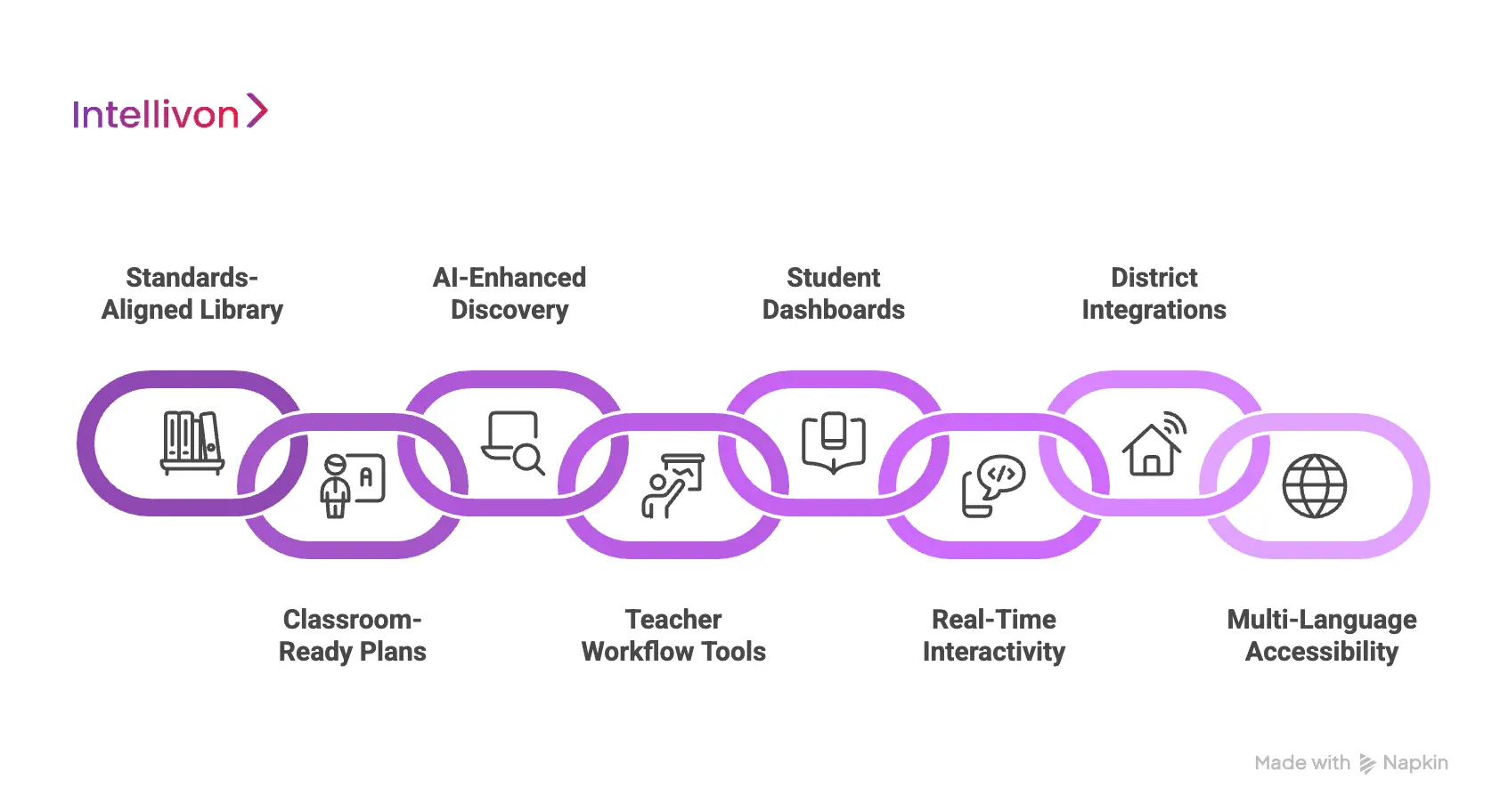
1. Standards-Aligned Library
The backbone of the platform is a large, continuously updated media library mapped directly to grade levels and curriculum standards. Teachers do not need to verify alignment manually. Every video already connects to defined learning outcomes.
This alignment is critical at the district scale. It ensures that students across multiple schools receive consistent instruction even when teaching styles vary. For leadership teams, it also simplifies curriculum governance and audit readiness.
2. Classroom-Ready Plans
High-performing platforms move beyond content distribution into instructional design. Each major asset is supported by ready-to-use lesson plans, classroom activities, and formative assessments.
This allows teachers to move directly from discovery to delivery without rebuilding instructional materials. Over time, this standardization improves pacing consistency across departments and reduces dependence on individual teacher planning capacity.
3. AI-Enhanced Discovery
AI-driven search shifts discovery from keyword matching to concept-based navigation. Teachers can explore by topic, skill, standard, or instructional objective rather than guessing search terms.
As usage grows, the system learns which resources perform best in similar classrooms. This gradually improves discovery accuracy, shortens planning cycles, and strengthens cross-school content reuse.
4. Teacher Workflow Tools
Teacher workflow tools convert the platform from a content library into an operational teaching environment. Educators create lesson playlists, assign work, monitor progress, and deliver feedback without switching systems.
This tight integration of planning, delivery, and assessment reduces administrative load. It also produces cleaner data, since every instructional action occurs within one reporting layer.
5. Student Dashboards
Students interact with the platform through individualized dashboards that surface assignments, progress indicators, and performance feedback. Learning paths adjust automatically based on completion and mastery patterns.
Personalization becomes an embedded process rather than a manual intervention. This supports remediation and enrichment at scale without increasing teacher workload.
6. Real-Time Interactivity
Real-time interactivity transforms video from passive observation into active instruction. Embedded questions, live responses, and instant checks allow teachers to assess understanding as learning unfolds.
This immediate feedback loop supports responsive teaching. Instruction becomes adaptive within the same lesson rather than reactive after assessments.
7. District Integrations
Enterprise platforms must integrate deeply with existing district systems. Discovery-grade platforms connect directly with learning management systems, student information systems, and identity providers.
Automated rostering, synchronized access controls, and unified reporting eliminate duplicate data entry. This also protects data integrity across multiple schools and administrative layers.
8. Multi-Language Accessibility
Built-in captions, transcripts, and language support ensure instruction remains accessible to linguistically diverse populations and students with accessibility needs.
For districts, this feature directly supports equity initiatives, regulatory compliance, and inclusive learning design without requiring parallel content creation.
Together, these core features turn video learning from digital content into an operational classroom infrastructure. The real differentiation lies in how seamlessly these capabilities work together at the district scale.
The Technology Architecture Behind a Discovery-Ed-Like Platform
A Discovery-grade video learning platform is built on a cloud-native, multi-tenant microservices architecture with adaptive video streaming, secure content delivery, AI-driven personalization, real-time analytics, and deep district system integrations.
At this scale, performance, reliability, and security are not features. They are design assumptions.
1. Microservices-Based Architecture
A Discovery-Ed-like platform typically runs on a multi-tenant cloud architecture where multiple districts share the same core infrastructure while keeping their data logically isolated. Each major function of the platform operates as an independent microservice.
This includes services for identity, content delivery, analytics, assessments, reporting, and recommendations. Because each service scales independently, the platform can absorb enrollment spikes in one district without affecting others. This architecture also allows faster updates, safer releases, and localized performance optimization across regions.
2. Video Encoding & Adaptive Streaming
Before any video reaches classrooms, it flows through automated encoding and transcoding pipelines. Original source files are converted into multiple resolutions and formats optimized for different devices and network conditions.
Adaptive streaming then selects the best possible stream in real time based on available bandwidth. A student on a school network may receive high-definition video, while a student on mobile data receives a lower bitrate stream without buffering. This ensures instructional continuity regardless of infrastructure variability.
3. CDN & DRM Layers
To deliver video at district and state scale, platforms rely on globally distributed content delivery networks. CDN edge nodes cache content close to users, reducing latency and protecting the core platform during peak usage windows such as school mornings.
DRM layers sit on top of the CDN. Content remains encrypted both at rest and during transmission. Access permissions follow district contracts, user roles, and licensing terms. This prevents unauthorized sharing while preserving performance for legitimate users.
4. Metadata Taxonomy
Every instructional asset is structured through a detailed metadata taxonomy. Videos are tagged by subject, grade level, standard alignment, concept type, difficulty, instructional use case, and accessibility attributes.
This tagging framework does far more than improve search. It powers curriculum alignment reports, AI recommendations, learning path construction, and district-level content audits. Without a robust taxonomy, discovery-grade platforms cannot support enterprise-scale governance.
5. AI Models for Content Recommendations
AI models continuously analyze how teachers assign content and how students interact with it. These behavioral signals drive recommendation engines that surface relevant resources based on context rather than generic similarity.
At the same time, skill-mapping engines connect activity data to defined competency frameworks. This enables the platform to track not just what content was viewed, but which skills were attempted, reinforced, or mastered across time.
6. Teacher Analytics & Real-Time Reporting
As instruction unfolds, engagement data streams into teacher-facing dashboards in near real time. Educators see who participated, who struggled with specific concepts, and where instructional gaps form during the lesson.
District leaders access aggregated analytics across schools and grade bands. These views support program evaluation, resource optimization, and intervention planning. Reporting is no longer retrospective. It becomes operational.
7. Integrations Layer
Deep system integrations allow the platform to function as part of a district’s existing digital ecosystem. Rosters sync automatically from SIS platforms. Identity and access flow through established SSO providers.
These integrations eliminate duplicate data entry, reduce IT overhead, and preserve data accuracy across academic and administrative layers. For large districts, interoperability is what determines whether a platform feels embedded or external.
A Discovery-Ed-like platform succeeds because its architecture is engineered for continuous scale, security, and data-driven instruction. When infrastructure is built correctly, video becomes dependable instructional infrastructure rather than fragile digital media.
AI Capabilities That Power Modern Video-Learning Platforms
Modern video-learning platforms use AI to automate content understanding, personalize learning paths, predict engagement risks, enforce real-time safety, and improve accessibility through voice and semantic technologies.
In enterprise-grade systems, these capabilities operate continuously in the background, influencing daily instruction without adding complexity for teachers.
1. AI-Generated Summaries
AI automatically converts raw video into structured instructional assets. It generates accurate transcripts, short concept summaries, and quick-check assessments tied to the core ideas in each video.
This reduces dependence on manual content preparation and accelerates lesson readiness. Teachers gain usable instructional material from every video without additional planning overhead.
2. Adaptive Learning Paths
Adaptive engines map each learner’s activity to underlying skill frameworks. As students complete videos and assessments, the system adjusts pacing, difficulty, and content sequencing in real time.
Learning paths evolve continuously instead of being reset between modules. This allows both remediation and acceleration to happen inside the same instructional flow.
3. Engagement Prediction Models
Predictive models analyze usage behavior, completion patterns, and response timing to identify early signs of disengagement. The system flags at-risk learners before performance gaps widen.
Teachers receive timely signals that support intervention while instruction is still in motion. This shifts support from reactive remediation to proactive guidance.
4. Real-Time Safety Monitoring
AI monitors content interactions for policy violations, inappropriate usage patterns, and abnormal behavioral signals. This is essential for platforms operating at district and state scales.
Automated moderation supports rapid response without constant manual oversight. Safety enforcement becomes continuous rather than episodic.
5. Voice Search & Semantic Indexing
Voice recognition and semantic indexing allow learners and teachers to search videos using natural language rather than fixed keywords. Closed captioning is generated automatically and refined through continuous learning.
This improves accessibility, speeds up discovery, and allows specific concepts to be located inside long video assets within seconds.
AI transforms video-learning platforms from static content systems into adaptive instructional engines. Its real impact lies in how quietly it improves personalization, safety, accessibility, and decision-making at scale.
How We Build Video-Learning Platforms Like Discovery Ed
Intellivon builds Discovery-grade video-learning platforms using a discovery-led blueprint, cloud-native architecture, AI-driven personalization, deep district integrations, and compliance-first engineering designed for large-scale education systems.
Every decision starts from how districts teach, govern, and report, then flows backward into architecture, content, AI, and integrations. Below is how we approach this step by step.
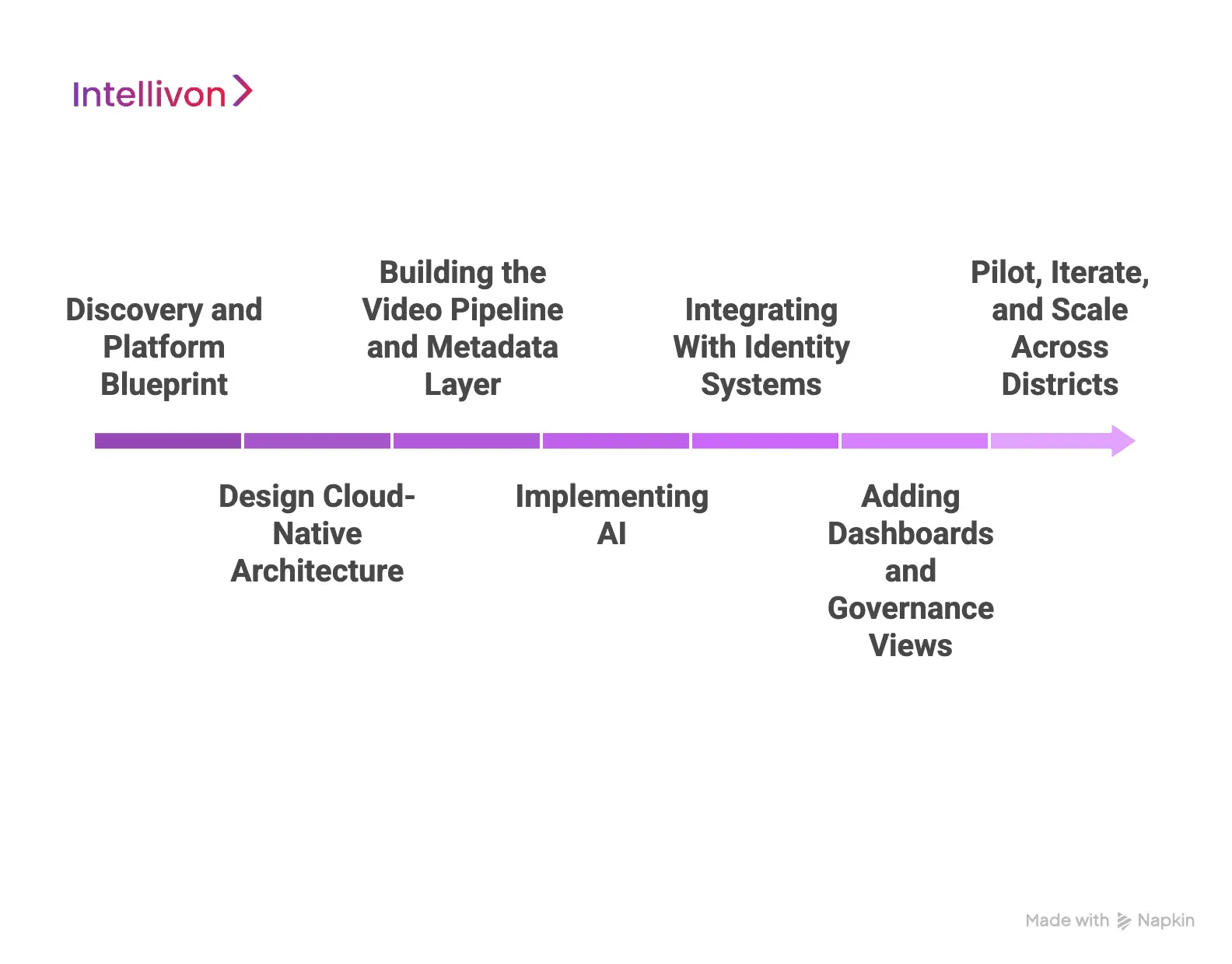
Step 1: Discovery and Platform Blueprint
We begin with a discovery phase that brings together academic leaders, IT, curriculum teams, and operations. The goal is to map how instruction currently flows, where content sits, and which systems already carry critical data.
From there, we define the platform’s role in that ecosystem. We agree on target use cases, priority subjects, adoption milestones, and non-negotiable compliance requirements. This becomes the blueprint for architecture, features, and rollout.
Step 2: Design Cloud-Native Architecture
Once the blueprint is clear, we design a cloud-native, multi-tenant architecture that can serve multiple districts on the same backbone. Each tenant keeps strict logical data separation while sharing a common, hardened infrastructure layer.
We define microservices for identity, content delivery, streaming, analytics, assessments, and AI. Capacity planning, failover behavior, and performance targets are set to handle school-hour peaks without degradation.
Step 3: Building the Video Pipeline and Metadata Layer
Next, we implement the video pipeline. Ingested content moves through encoding and transcoding workflows to generate multiple resolutions and formats for different devices and networks.
At the same time, we build the metadata taxonomy. Every asset is tagged with subject, grade, standard, concept, difficulty, and accessibility attributes. This taxonomy is what later powers precise search, recommendations, and curriculum reporting.
Step 4: Implementing AI
With content and metadata in place, we layer in AI. Models first support search and discovery, helping teachers find relevant resources by topic, standard, or instructional goal.
Then we introduce learner-side intelligence. Engines build skill profiles from activity and assessment data, adjusting sequencing and difficulty over time. The platform starts behaving less like a library and more like a personalized learning environment.
Step 5: Integrating With Identity Systems
Once the core platform works in isolation, we connect it to the district ecosystem. We integrate with SIS platforms for rostering, LMS systems for assignment flow, and SSO providers for access control.
This step is where the platform becomes usable at scale. Teachers sign in with existing credentials. Classes appear automatically. Data flows back into systems leaders already trust.
Step 6: Adding Dashboards and Governance Views
With infrastructure and integrations stable, we focus on the experience layer. Teachers receive planning tools, lesson builders, playlists, and grading workflows tailored to their day.
Leaders receive dashboards that show usage, completion, and performance across schools and grades. Governance features allow curriculum and compliance teams to oversee content and monitor standards coverage.
Step 7: Pilot, Iterate, and Scale Across Districts
We do not roll out everything at once. We start with pilots in selected schools or subjects, then observe real classroom behavior and feedback.
Insights from these pilots influence feature refinement, onboarding flows, and training programs. Only after this iteration do we scale across the full district or multi-district network.
This step-by-step approach is how we build platforms that stand beside Discovery Ed in capability, not just appearance. By treating the system as long-term infrastructure from day one, Intellivon delivers video-learning platforms that districts can rely on for years, not just one adoption cycle.
Cost Of Building A Video-Learning Platform Like Discovery Ed
Building a Discovery-grade video-learning platform requires sustained investment in video infrastructure, AI-driven content intelligence, district-scale integrations, and enterprise-level compliance. Unlike basic classroom tools, this category of platform must support heavy media traffic, continuous streaming, advanced analytics, and multi-year institutional contracts.
At Intellivon, we structure cost models around long-term platform ownership, not short-term feature delivery. Each budget is aligned with instructional scale, regulatory exposure, and backend workload. When organizations face capital constraints, we phase development without weakening security, performance, or compliance foundations.
Estimated Phase-Wise Cost Breakdown
| Phase | Description | Estimated Cost (USD) |
| Platform Discovery & Compliance Blueprint | Platform scope, video workflows, data flows, FERPA/COPPA/GDPR-K alignment, governance design | 8,000 – 15,000 |
| Cloud-Native Multi-Tenant Architecture | Microservices design, tenant isolation, IAM, encryption, and failover strategy | 12,000 – 20,000 |
| Video Ingestion, Encoding & Streaming Engine | Transcoding pipelines, adaptive bitrate delivery, storage optimization | 15,000 – 30,000 |
| Content Management & Metadata Framework | Video tagging, taxonomy, curriculum mappings, discovery logic | 10,000 – 18,000 |
| AI Search, Recommendation & Skill Mapping | Personalized discovery, skill profiling, learning path intelligence | 14,000 – 28,000 |
| Teacher Workflows & Lesson Delivery Tools | Playlists, assignments, feedback, and assessment handling | 12,000 – 22,000 |
| Student Dashboards & Personalization Layer | Progress tracking, mastery views, adaptive sequencing | 10,000 – 18,000 |
| SIS/LMS/SSO Integrations | OneRoster, Clever, ClassLink, PowerSchool, Canvas, SAML/OAuth | 8,000 – 14,000 |
| Security, DRM & Compliance Engineering | DRM, audit logs, breach detection, and least-privilege enforcement | 8,000 – 14,000 |
| Testing, QA & Security Validation | Load testing, penetration tests, and privacy validation | 8,000 – 12,000 |
| Pilot, Training & District Rollout | Pilot launch, educator onboarding, workflow optimization | 8,000 – 12,000 |
Total Initial Investment Range: $125,000 – $265,000 USD
Annual Maintenance & Optimization: 18–22% of initial build
Hidden Costs Organizations Should Plan For
- Video platforms carry operational costs that do not appear in early budget proposals. Integration complexity often expands once different SIS and LMS environments come into play.
- Compliance workloads also increase over time. District audits, privacy reviews, SOC documentation, and regulatory updates require continuous governance support.
- Cloud consumption grows with usage. Video streaming, real-time analytics, AI inference, and content scanning directly influence compute and storage costs.
- Change management is another overlooked cost. Teacher onboarding, training refresh cycles, and district support programs all require sustained funding to protect platform adoption and renewal.
AI model maintenance adds a longer-term layer. Recommendation engines, safety models, and language systems need periodic retraining as content libraries and user behavior evolve.
Best Practices To Avoid Budget Overruns
- Start with a clearly defined instructional scope. Launch with core video delivery, search, and teacher workflows before expanding into advanced analytics and personalization layers.
- Embed compliance and security at the architecture stage. Retrofitting privacy controls after district audits is significantly more expensive than building them in early.
- Use a modular, microservices-based design. This reduces future upgrade costs and allows controlled feature expansion without platform refactoring.
- Actively monitor cloud usage. Balance real-time processing with scheduled workloads to avoid unnecessary compute spikes and storage waste.
- Iterate with real classroom data. Feature refinement based on the lived teacher and student behavior prevents over-engineering unused capabilities.
Conclusion
Building a video-learning platform at the scale of Discovery Ed is not a feature-led exercise. It is a long-term infrastructure decision that touches content strategy, AI, data governance, integrations, compliance, and district-wide change management. When built correctly, such platforms become central to how instruction is delivered, measured, and improved across entire education systems. They shift video from passive media into an active instructional engine.
With its enterprise engineering depth, compliance-first architecture, and AI-led platform design, Intellivon helps organizations move from concept to scalable, district-ready execution with confidence and long-term sustainability.
Build a Discovery-Ed-Grade Video Learning Platform With Intellivon
At Intellivon, we design video-learning platforms as core instructional infrastructure, not media portals. Our systems bring together high-volume streaming, curriculum-aligned content management, AI personalization, and district-ready analytics inside one secure, reliable environment.
Each platform is built for enterprise-level demands. It stays stable under peak usage, respects strict privacy rules, and integrates cleanly with your existing SIS, LMS, and identity stack. From adaptive streaming to skill-aware recommendations, every layer is engineered to support real classrooms at scale from the very first deployment cycle.
Why Partner With Intellivon?
- Compliance-First Architecture: Aligned with FERPA, COPPA, GDPR-K, and district governance policies, with encryption, audit trails, and data isolation built into the core design.
- Enterprise Video Infrastructure: Cloud-native encoding, transcoding, and adaptive streaming pipelines that keep lessons smooth across devices, bandwidth levels, and regions.
- AI-Driven Discovery and Personalization: Search, recommendations, and learning paths powered by AI models that understand standards, skills, and classroom context.
- Teacher and Leader-Centric Workflows: Planning tools, lesson builders, dashboards, and reporting views shaped around how teachers teach and leaders make decisions.
- District-Wide Interoperability: Deep integrations with OneRoster, Clever, ClassLink, PowerSchool, Canvas, and Google or Microsoft identity to reduce friction and IT overhead.
- Scalable, Observable Cloud Operations: Multi-tenant resilience, elastic scaling, monitoring, and zero-downtime releases that support long-term, high-stakes instructional use.
Book a strategy call with Intellivon to explore how a Discovery-Ed-grade video-learning platform can become the backbone of your digital instruction strategy. We help you move from vision to a deployed, district-ready ecosystem with clear architecture, numbers, and timelines.
FAQs
Q1. What does it take to build a video-learning platform like Discovery Ed?
A1: Building a Discovery-grade platform requires secure video infrastructure, standards-aligned content workflows, AI-driven discovery, real-time analytics, and deep SIS/LMS integrations. It must also meet FERPA, COPPA, and district governance requirements from day one.
Q2. How much does it cost to build a video-learning platform at enterprise scale?
A2: Initial development typically ranges from $125,000 to $265,000, depending on streaming complexity, AI capabilities, and system integrations. Ongoing maintenance usually runs 18–22% of the initial build annually.
Q3. How is a video-learning platform different from a basic LMS?
A3: A video-learning platform manages high-volume streaming, content intelligence, and real-time engagement, while an LMS primarily handles assignments and grading. Discovery-grade platforms operate as instructional infrastructure, not just course managers.
Q4. What compliance standards must a video-learning platform meet for K–12 districts?
A4: Enterprise K–12 platforms must align with FERPA, COPPA, GDPR-K, state privacy laws, and district vendor-governance policies, including encryption, audit logs, role-based access, and secure data isolation.
Q5. How long does it take to build a Discovery-Ed-style video-learning platform?
A5: A full enterprise build typically takes 6 to 10 months, including discovery, architecture, video pipeline setup, AI models, integrations, security validation, and district pilot rollout with training.