When healthcare enterprises evaluate a billing integration platform, the conversation rarely starts with features. It begins with practical concerns around cost predictability, operational control, and long-term risk. As care models shift toward memberships, subscriptions, and employer-funded access, traditional claims-driven billing infrastructure starts to show strain. What once worked for episodic care struggles to support always-on access, real-time eligibility, and consistent financial governance.
Platforms like DialCare reflect a broader shift in how healthcare billing is designed. Billing moves closer to the core of the platform, governing access, payments, and accountability in real time. However, replicating this model demands a coordinated approach to architecture, compliance, integrations, and operational workflows that can scale without introducing hidden risk.
At Intellivon, we build enterprise-grade platforms where billing integration, clinical governance, automation, and core systems operate as a single environment. Through this experience, we are using this blog to discuss how we build these platforms from the ground up and how to maintain clinical and financial control as scale increases.

Key Takeaways of the Healthcare Billing Models Market
As billing moves closer to the core of care delivery and access management, enterprise spending in this space continues to accelerate. The global medical billing software market was valued at roughly USD 16.3 billion in 2023 and is on track to exceed USD 32 billion by 2030, growing at an annual rate of just over 10%. This growth signals more than software adoption. It highlights a structural move toward platforms that offer tighter integration, stronger governance, and greater financial control as healthcare models evolve.
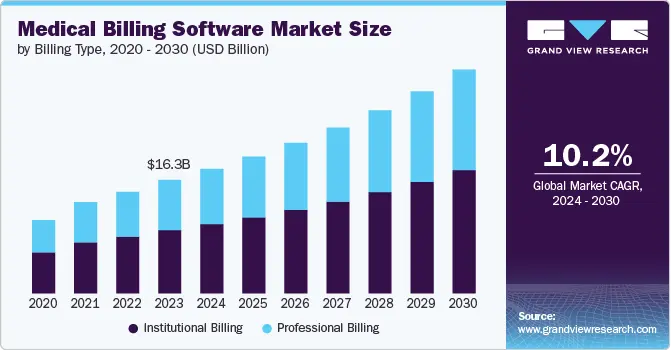
Market Insights:
- Fee-for-service pressure: FFS still accounts for 55% of billing models but is expected to fall toward 40% by 2030. It suits episodic telehealth yet drives 20–30% cost inflation from overutilization.
- Bundled payments growth: Bundled virtual care pricing is expanding at 25% year over year. Fixed episode-based models deliver 10–15% ROI through predictable costs and simplified reconciliation.
- Subscription and risk-based models: These models represent 15% share today and are projected to reach 25% by 2028 in DTC telehealth. Capitation reduces administrative costs by roughly 30%.
- Challenges and opportunities: EHR integration failures impact 30–50% of deployments, with seasonal outages driving 52–63% of complaints.
- Cloud-native AI and microservices improve prescription efficiency by up to 75% in hybrid environments.
Why Enterprises Are Moving Away From Claims-Based Billing Models
Claims-based billing was designed for episodic care delivered in controlled clinical settings. What once provided financial governance now introduces delay, cost volatility, and operational friction at scale.
1. Cost Undermines Financial Planning
Claims cycles stretch across weeks or months, making spend difficult to forecast. Denials, resubmissions, and payer variability add layers of uncertainty. For enterprises funding care at scale, this volatility weakens budget control and complicates long-term planning.
2. Administrative Overhead Grows
Claims processing demands constant manual intervention. Coding accuracy, documentation reviews, and reconciliation consume operational resources. As visit volumes rise, administrative effort often increases faster than care delivery itself, eroding efficiency gains.
3. Delayed Reimbursement Disrupts Cash Flow
Revenue arrives long after services are delivered. Payment delays force providers and platforms to carry financial risk while waiting on adjudication. This lag becomes a constraint when scaling virtual or subscription-based care models.
4. Misalignment With Modern Care Delivery
Claims systems were not built for memberships, bundled services, or always-available virtual access. Each interaction must be translated into billable events, even when care is continuous. This misalignment creates friction between clinical workflows and financial systems.
5. Limited Visibility Into True Cost and Utilization
Claims data arrives too late to guide real-time decisions. Enterprises struggle to link utilization patterns with cost outcomes quickly. Without timely insight, optimizing pricing, capacity, or access becomes reactive rather than strategic.
As care delivery evolves, claims-based billing increasingly acts as a constraint rather than a control mechanism.
What Is DialCare’s Billing Integration Platform
DialCare’s billing integration platform is designed to make healthcare access predictable and easy to manage. Instead of billing for every visit, it uses a membership-based model where users pay a fixed fee for access to care. Billing, eligibility, and service access are connected through one system, which removes the need for insurance claims for most interactions.
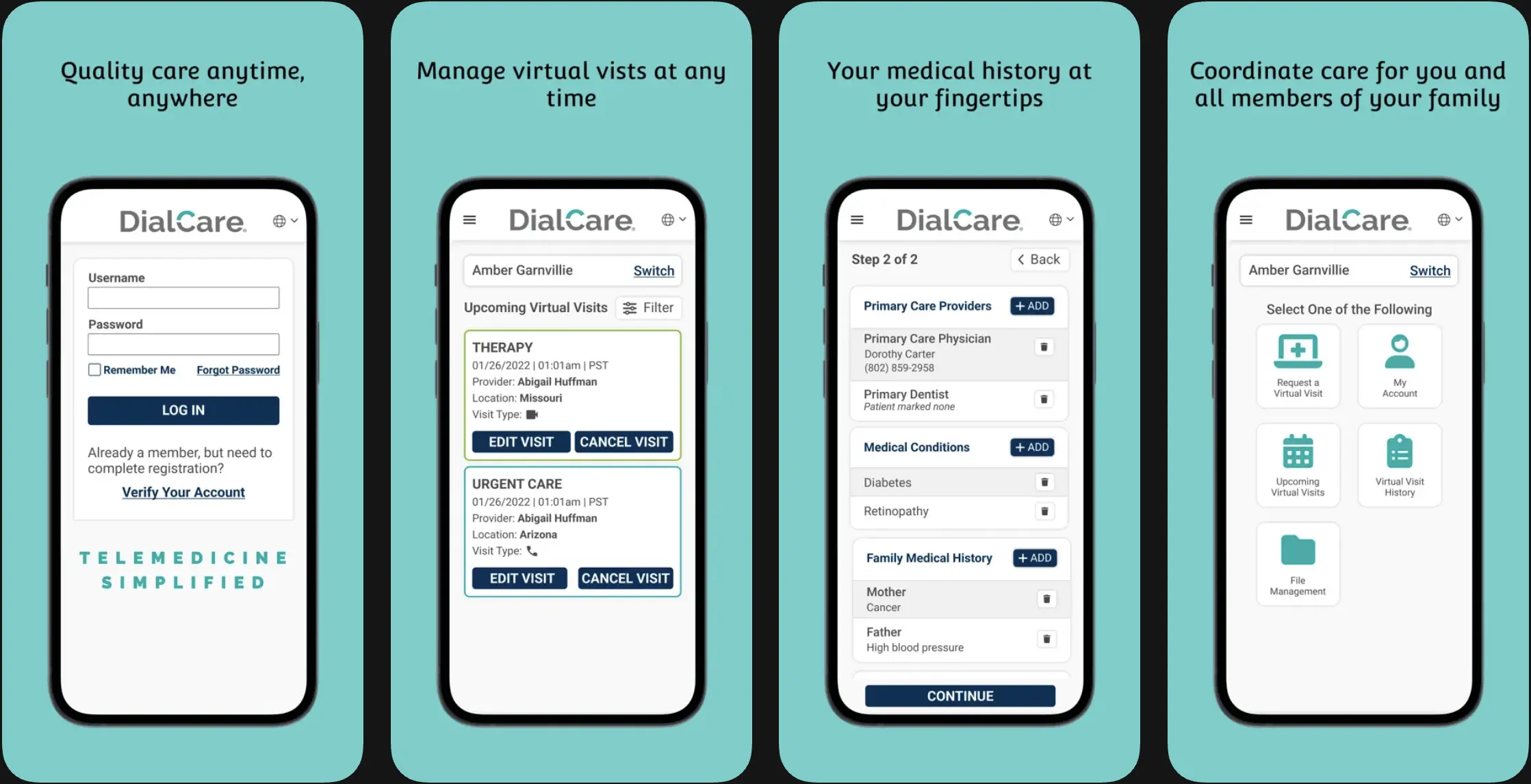
On the backend, the platform connects payment systems, care providers, and reporting tools into a single workflow. Usage is tracked in real time, allowing organizations to understand cost, engagement, and utilization without waiting for claims data. The result is a billing foundation that supports scalable virtual care while maintaining financial and operational control.
How It Works
A DialCare-style billing integration platform runs on simple logic, which includes billing status controls, access, and usage is tracked for reporting. The workflow below shows how it typically operates in enterprise environments.
1. Member Enrollment
The employer or member enrolls through a portal or benefits flow. The platform creates a member record and assigns the right plan.
2. Eligibility Check
When someone requests care, the platform checks eligibility in real time. It confirms the plan, coverage window, and access rules.
3. Payment and Billing
Billing runs on a recurring cycle. If payment is active, access stays open. If payment fails, the platform applies retries and defined grace rules.
4. Care Access and Routing
Eligible members are routed to the right service or provider. The platform logs the interaction and ties it to the member’s entitlement.
5. Usage Reporting
Utilization data is updated continuously. Enterprises see member activity, cost trends, and service demand without waiting for claims.
This model replaces slow claims cycles with real-time control. Enterprises gain predictable billing, cleaner operations, and clearer visibility into usage.
Features That Make DialCare A Leading Billing Platform
DialCare’s platform is built around real-world needs rather than theory. It combines integrated access, flexible payment structures, and deep reporting into a unified system that simplifies billing and supports virtual care at scale.
1. Unified Member and Payment Management
DialCare links member enrollment, subscription billing, and care access within a single workflow. Payments are tied to active membership status, reducing administrative steps and eliminating the delays common in claims processing. This creates predictable revenue flows and smoother eligibility checks.
2. Real-Time Access Control and Eligibility
The platform checks eligibility and payment status before any interaction, so members get the care they are entitled to without manual validation or claims adjudication. This improves uptime and reduces operational overhead.
3. Dynamic Reporting and Analytics
Enterprises can view utilization patterns, cost trends, and member engagement in near real time. This visibility replaces slow claims data with actionable insights for budgeting and capacity planning.
4. Integrated Provider Network
DialCare maintains a nationwide network of licensed clinicians, dentists, and specialists, all credentialed and connected through the platform. This integration reduces friction between care delivery and billing workflows.
5. Dedicated Support and Implementation
Enterprise clients benefit from in-house project management, custom reporting, and ongoing account support that ensures smooth implementation and adoption.
These core features position DialCare not just as a collection of services but as a billing integration platform that links financial control with care delivery, improving both operational efficiency and member experience.
Business Models That Make DialCare Stand Out
DialCare differentiates itself through business models that simplify billing while preserving access control and cost predictability. Each model is structured to remove claims dependency and align payment logic directly with how care is delivered.
1. Membership-Based Access Model
DialCare primarily operates on a subscription framework. Employers or individuals pay a fixed fee per member on a monthly or annual basis.
Once enrolled, members gain access to defined virtual care services without per-visit charges. Billing status determines access, which removes claims processing and stabilizes costs.
2. Employer-Sponsored Virtual Care Model
Enterprises often deploy DialCare as an employee benefit. Billing occurs at the employer level, while access is granted to eligible employees and dependents.
Enrollment and offboarding align with HR systems, ensuring billing updates automatically as workforce changes occur.
3. Bundled and Episode-Based Pricing Model
For select services, DialCare uses bundled pricing instead of itemized billing. A single fee covers an entire care episode, reducing administrative complexity.
This approach limits overutilization and simplifies financial reconciliation.
4. Direct-to-Consumer Subscription Model
DialCare also supports individual subscriptions outside employer plans. Users enroll directly, billing runs automatically, and care access is immediate.
Usage is tracked without relying on insurance workflows, enabling scalable growth.
These models succeed because billing, access, and governance operate as one system. Enterprises gain predictable spending, cleaner operations, and flexibility across multiple care delivery strategies.
How Billing Integration Platforms Like DialCare Generate Revenue?
Billing integration platforms generate revenue by aligning payments with access, not transactions. Instead of relying on claims volume, they focus on predictable, recurring income tied to membership and enterprise contracts. DialCare is a good reference point for how this model works in practice.
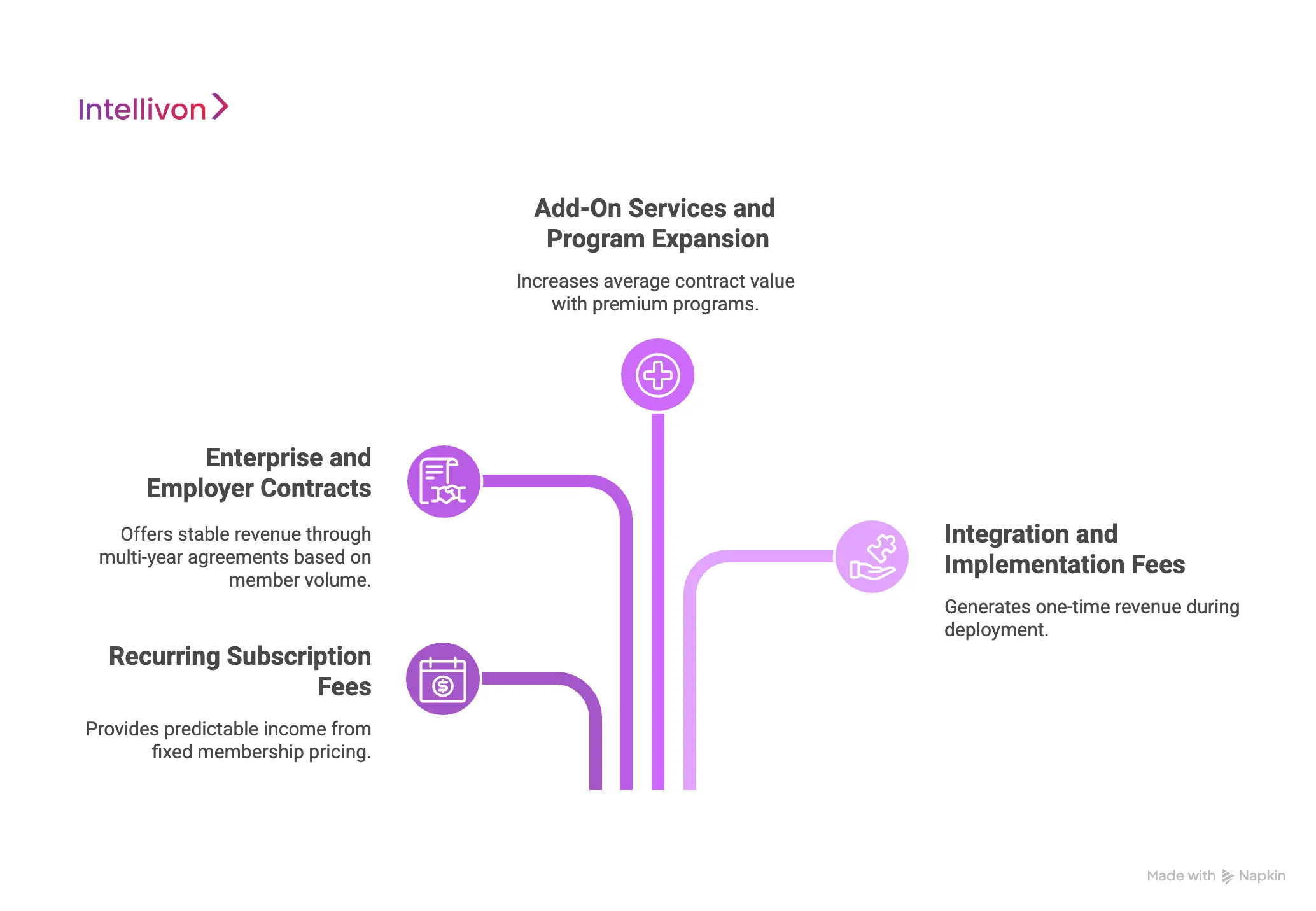
1. Recurring Subscription Fees
The primary revenue stream comes from fixed membership pricing. Employers or individuals pay a recurring monthly or annual fee per member for access to care.
Public market estimates place DialCare’s yearly revenue in the range of USD 7.5–13 million, largely driven by subscription-based plans across employer and consumer segments.
2. Enterprise and Employer Contracts
Healthcare enterprises often engage through multi-year agreements. These contracts are priced based on member volume and service scope.
Guaranteed minimums and tiered pricing help stabilize revenue as adoption scales across larger populations.
3. Add-On Services and Program Expansion
Some platforms generate incremental revenue through premium programs, expanded care offerings, or enhanced reporting.
These are layered onto the base subscription and priced separately, increasing average contract value without changing core billing logic.
4. Integration and Implementation Fees
Revenue is also generated during deployment. One-time fees cover integrations with HR systems, payment gateways, and enterprise platforms.
These fees reflect the complexity of onboarding and customization.
This revenue structure works because it favors stability over volume. By tying income to access and scale rather than claims throughput, platforms like DialCare build sustainable growth while maintaining financial control for enterprise clients.
What Business Problems Does a DialCare-Like Billing Integration Platform Solve?
Healthcare enterprises adopt billing integration platforms to regain control at scale. The pressure comes from financial volatility, operational drag, and governance gaps that grow as care delivery models evolve.
1. Cost Volatility and Budget Uncertainty
Claims-based billing creates unpredictable spend. Payment delays, denials, and payer variability make it difficult to forecast costs across large populations.
A DialCare-like platform replaces this uncertainty with fixed, recurring pricing models that support accurate budgeting and long-term financial planning.
2. High Operational Cost of Billing Management
Enterprises often carry heavy administrative overhead tied to billing workflows. Coding, reconciliation, and exception handling require constant manual effort.
As utilization increases, billing operations scale inefficiently. Integrated billing platforms automate these processes, lowering operational cost per member.
3. Revenue Leakage and Access Control Gaps
When billing systems operate separately from access controls, enterprises lose visibility and enforcement.
Services may be delivered without confirmed eligibility or active payment status. Linking billing logic directly to access rules reduces leakage and strengthens governance.
4. Limited Visibility Into Utilization and ROI
Traditional billing data arrives weeks after services are delivered. This delay makes it difficult to evaluate program performance or adjust pricing.
Integrated platforms provide near real-time usage and cost insights, enabling faster financial and operational decisions.
5. Inflexibility When Expanding Care Models
Employer-funded care, subscriptions, and bundled services do not fit well into the claims infrastructure. Enterprises struggle to launch new offerings without rebuilding billing workflows. DialCare-like platforms support these models natively, allowing expansion without added complexity.
From an enterprise perspective, billing integration platforms solve control, cost, and scalability challenges. They allow organizations to fund care predictably, operate efficiently, and expand services without increasing financial or operational risk.
Architecture Required to Build a Billing Integration Platform Like DialCare
A billing integration platform like DialCare is built on a layered architecture where access control, billing logic, payments, integrations, and compliance operate as separate but connected systems.
This design allows healthcare enterprises to manage subscriptions, eligibility, payments, and reporting at scale while maintaining financial predictability, auditability, and regulatory control.
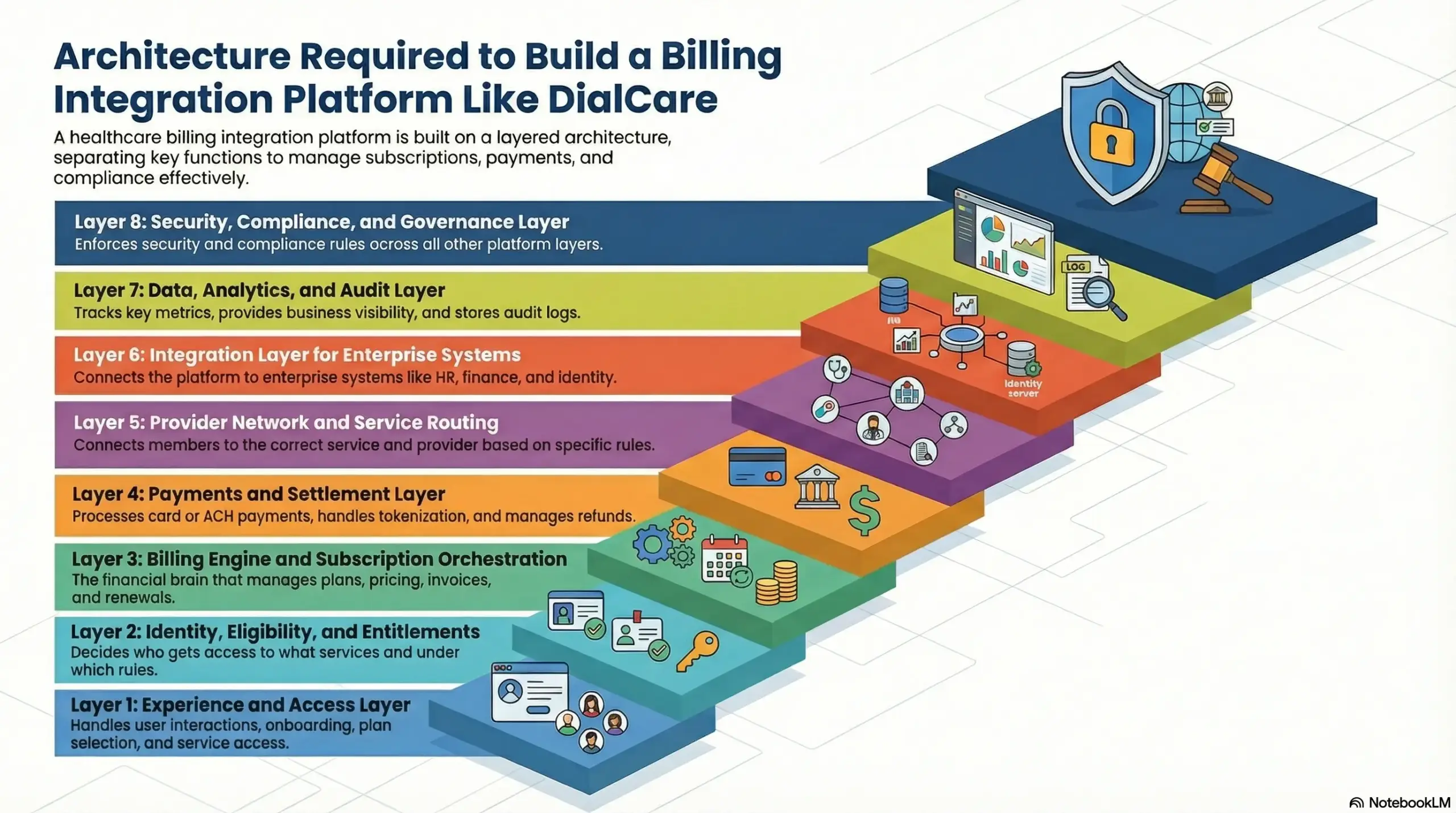
Layer 1: Experience and Access Layer
This is where employers, members, and internal teams interact with the platform. It handles onboarding, plan selection, member lookup, and service access entry points. It also enforces basic session rules and pushes users into the correct journeys.
A strong access layer reduces support tickets. It also prevents manual work from spilling into billing ops.
Typical tech, tools, and APIs
- Web: React, Next.js
- Mobile: Swift, Kotlin, React Native
- API gateway: Kong, Apigee, AWS API Gateway
- Auth UI flows: OAuth 2.0, OIDC, SSO widgets
Layer 2: Identity, Eligibility, and Entitlements
This layer decides who gets access, to what, and under which rules. It validates enrollment, plan tier, coverage window, and employer-specific policies. It also manages grace periods, offboarding, and dependent eligibility.
Most enterprise disputes trace back to weak entitlement logic. Therefore, this layer needs strong audit trails.
Typical tech, tools, and APIs
- IAM: Okta, Azure AD, Auth0
- Policy engine: Open Policy Agent (OPA)
- Directory and profiles: PostgreSQL, DynamoDB
- HR and benefits feeds: SFTP, SCIM, REST APIs
Layer 3: Billing Engine and Subscription Orchestration
This is the financial brain. It manages plans, pricing, invoices, proration, renewals, retries, credits, and cancellations. It also produces billing events that downstream systems can trust.
In an enterprise model, you need multi-tenant billing logic. Each employer may have unique cycles, pricing rules, and service bundles.
Typical tech, tools, and APIs
- Billing services: microservices with Java, Go, or Node
- Data store: PostgreSQL for ledger-grade records
- Workflow engine: Temporal, Camunda
- Messaging: Kafka, SNS/SQS, RabbitMQ
Layer 4: Payments and Settlement Layer
This layer processes card or ACH payments, handles tokenization, manages refunds, and records settlement status. It also supports payout logic when revenue is shared with provider networks or partners.
Payment processing must be isolated. You want clear boundaries for PCI scope and clean failure handling.
Typical tech, tools, and APIs
- Payment processors: Stripe, Adyen, Braintree
- ACH and payouts: Stripe ACH, Dwolla
- PCI controls: vault tokenization, HSM-backed key storage
- Webhooks: event ingestion, idempotency keys
Layer 5: Provider Network and Service Routing
This layer connects members to the right service and provider based on rules. It handles scheduling, availability, triage routing, and service eligibility checks. It also captures service events that drive reporting and contract performance.
Even if care delivery is handled by partners, this layer must control the workflow boundaries and data exchange.
Typical tech, tools, and APIs
- Scheduling: custom scheduler, Twilio, Zoom, Vonage
- Care workflows: FHIR-based APIs when needed
- Provider directories: NPI lookups, internal credential stores
- Event capture: service encounter events, webhooks
Layer 6: Integration Layer for Enterprise Systems
This is how the platform connects to the real enterprise environment. It syncs HR eligibility files, identity systems, financial reporting, and, in some cases, EHR touchpoints. It also manages versioning, throttling, and data mapping.
This layer prevents “custom integrations everywhere.” It keeps changes controlled.
Typical tech, tools, and APIs
- Integration patterns: REST, GraphQL, HL7, FHIR, where required
- iPaaS: MuleSoft, Boomi, Workato
- Data mapping: JSON schema, transformation pipelines
- Secure transport: mTLS, VPN, private links
Layer 7: Data, Analytics, and Audit Layer
This layer makes the business visible and defensible. It tracks utilization, cost per member, contract performance, and operational KPIs. It also stores audit logs for eligibility decisions and billing events.
Enterprises use this layer to justify ROI. Compliance teams use it to defend decisions.
Typical tech, tools, and APIs
- Warehouse: Snowflake, BigQuery, Redshift
- Streaming analytics: Kafka streams, Kinesis
- Observability: Datadog, Grafana, OpenTelemetry
- Audit logs: immutable event store, WORM storage
Layer 8: Security, Compliance, and Governance Layer
This layer cuts across everything. It enforces role-based access, data segregation per tenant, encryption, logging, retention, and breach response readiness. It also supports compliance reporting and internal controls.
If this layer is bolted on later, the platform becomes expensive to fix. Build it upfront.
Typical tech, tools, and APIs
- Secrets: HashiCorp Vault, AWS KMS, Azure Key Vault
- RBAC and ABAC: IAM policies, OPA
- Encryption: TLS, field-level encryption where required
- Compliance automation: audit-ready logging, policy-as-code
A DialCare-like billing integration platform works because its architecture stays clean and layered. Each layer has a clear job, clear boundaries, and traceable events.
What Integrations Are Required for an Enterprise-Grade Billing Platform?
Enterprise billing platforms depend on deep system integrations. These integrations ensure billing, access, compliance, and reporting remain synchronized as organizations scale across employers, providers, and regions.
1. HR and Benefits Administration Systems
These integrations determine who is eligible for care and when billing should start or stop. Enrollment updates, role changes, and terminations must flow automatically into billing rules.
When an employee leaves the organization, HR systems like Workday or ADP trigger immediate access removal and billing adjustments. Without this integration, enterprises continue paying for inactive members.
2. Identity and Access Management
Identity systems authenticate users and control role-based access. Billing platforms must integrate with IAM tools so payment and eligibility status directly influence who can access services.
SSO via Okta or Azure AD ensures only active, eligible users can log in. If a subscription lapses, access is restricted automatically and logged for audit review.
3. Payment Processing and Financial Systems
These integrations handle recurring charges, retries, refunds, and revenue reporting. They ensure billing records align with actual cash flow.
Platforms integrate with Stripe or Adyen for subscription billing, while syncing invoices and ledgers with ERP systems like NetSuite for finance reconciliation.
4. Provider and Care Delivery Platform
Care delivery systems must validate eligibility before services are rendered. They also need to send service events back to the billing and reporting layers.
Before a telehealth visit is scheduled, the platform checks billing status. Once the visit occurs, usage data is logged against the member’s plan.
5. Enterprise Reporting and Analytics
Leadership teams need visibility into utilization, cost trends, and ROI. Billing platforms integrate with analytics tools to provide near real-time insight.
Billing and usage events feed data warehouses like Snowflake, powering dashboards in Power BI or Tableau for executive reporting.
6. Compliance and Audit Systems
Regulated environments require traceability across billing, access, and data usage. Integrations ensure audit logs remain complete and defensible.
Billing decisions and access changes are streamed into SIEM tools, supporting HIPAA audits and internal compliance reviews.
Enterprise-grade billing platforms are only as strong as their integrations. When these systems work together, enterprises gain control, visibility, and confidence as they scale.
How Do DialCare-Like Platforms Ensure HIPAA Compliance?
DialCare-like billing integration platforms ensure HIPAA compliance by embedding security, access control, auditability, and data minimization directly into platform architecture rather than treating compliance as a policy layer.
HIPAA compliance becomes complex when billing systems control access to care. Platforms must protect patient data while supporting payments, eligibility checks, and enterprise integrations. DialCare-like platforms address this by treating compliance as a foundational design requirement, not a downstream process.
1. Minimum Necessary Access
These platforms separate clinical data, billing records, and operational metadata into distinct access zones. Each user role is restricted to the minimum data required to perform its function.
This approach limits exposure while supporting collaboration across finance, operations, and clinical teams.
2. Context-Aware Access Control
Access decisions combine user roles, employment status, plan eligibility, and session context. Changes in employment or enrollment status immediately affect access rights.
This prevents former employees or ineligible users from retaining system access beyond approved windows.
3. Encryption Across Data Lifecycle
Protected health information is encrypted during transmission, storage, and backup. Sensitive identifiers often receive additional field-level protection.
This ensures data remains unreadable even if infrastructure components are compromised.
4. Audit Trails
Every eligibility check, access grant, billing action, and rule change is logged with timestamps and user identifiers.
These logs create a defensible record that supports audits, investigations, and internal compliance reviews.
5. Secure Integrations
All third-party systems connect through secured APIs with scoped permissions. Business associate agreements define responsibility and data boundaries.
This limits downstream risk while allowing enterprises to extend platform functionality safely.
HIPAA compliance in DialCare-like platforms is achieved through architecture, not intention. By embedding controls directly into billing and access workflows, enterprises reduce risk, simplify audits, and scale confidently within regulated environments.
How We Build Billing Integration Platforms Like DialCare
Intellivon builds DialCare-like billing integration platforms through a phased process that aligns business models, entitlement logic, payment orchestration, integrations, and HIPAA-grade governance into one scalable platform.
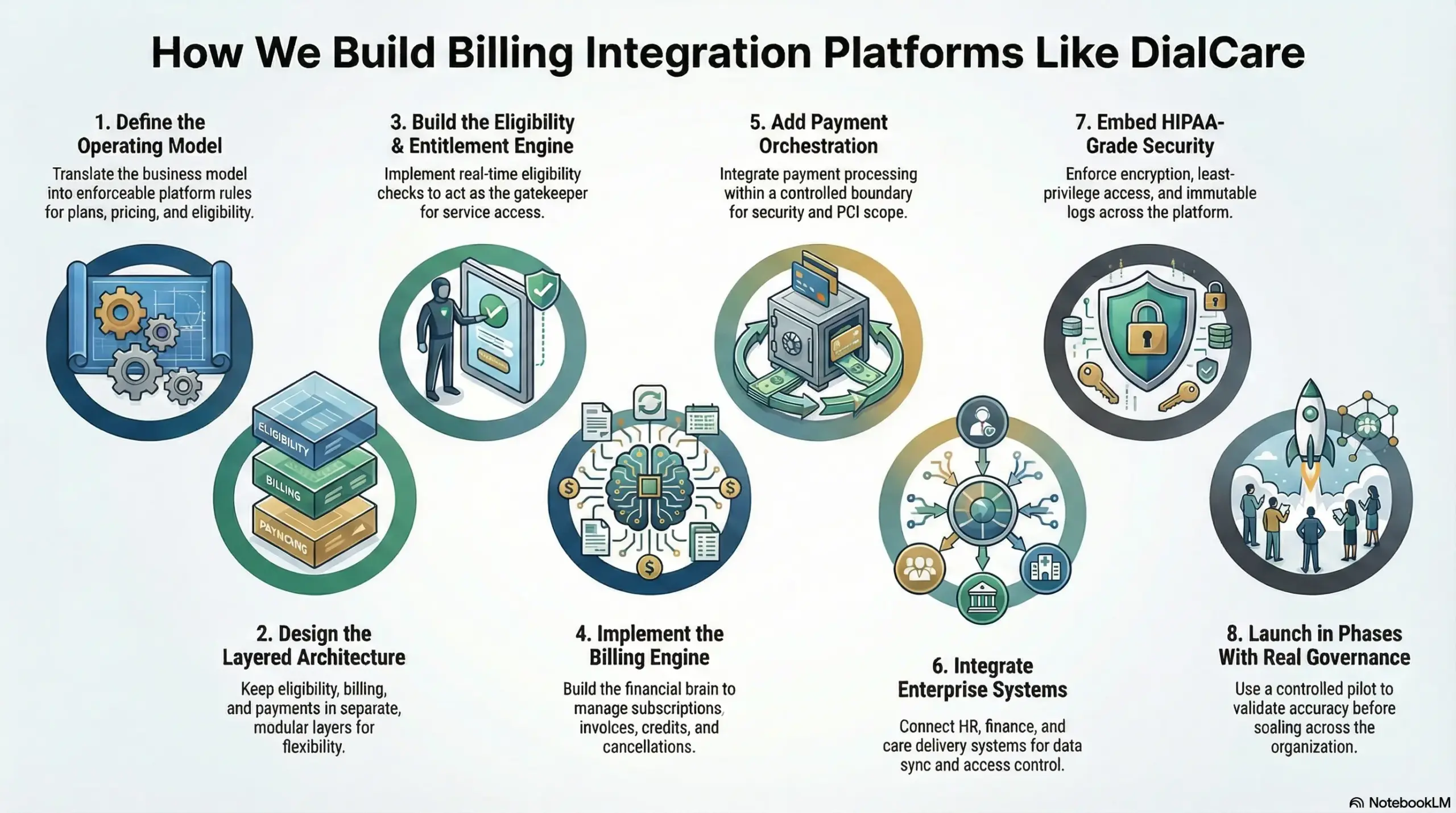
Step 1: Define the Operating Model
We start by translating the business model into enforceable platform rules. This includes plan design, pricing tiers, eligibility, ownership, and contract structure. We also define what “control” means for your enterprise, including auditability, leakage prevention, and reporting cadence.
Deliverables typically include entitlement rules, billing policies, exception handling, and a KPI framework tied to ROI.
Step 2: Design the Layered Architecture
Next, we design the platform as a set of clear layers. Eligibility and entitlements stay separate from billing, and billing stays separate from payments. Integrations and analytics remain modular, so you can add services without rebuilding the core.
This step also defines tenancy strategy, event flows, and data boundaries needed for HIPAA-grade segregation.
Step 3: Build the Eligibility and Entitlement Engine
We implement real-time eligibility checks, employer rules, dependent logic, and service entitlements. This engine becomes the gatekeeper for access, ensuring care delivery stays aligned with billing status and policy controls.
We also build full audit trails for every decision, including plan changes, access grants, and rule overrides.
Step 4: Implement the Billing Engine
We build the financial brain of the platform. This includes subscription cycles, invoices, proration, retries, credits, cancellations, and multi-tenant pricing. We design it for predictable behavior under scale, with idempotent workflows and clear reconciliation paths.
This is also where we define how usage data maps into billing and reporting without relying on claims pipelines.
Step 5: Add Payment Orchestration
We integrate payment processing in a controlled boundary to manage PCI scope. The platform handles tokenization, recurring charges, failure retries, refunds, and settlement status. If revenue must be allocated across provider networks or partners, we implement programmable settlement rules.
This creates a clean link between cash flow, access, and financial reporting.
Step 6: Integrate Enterprise Systems
We connect HR and benefits systems for eligibility sync, IAM for access control, finance tools for invoicing, and analytics platforms for ROI visibility. We also integrate care delivery systems to ensure eligibility is checked before service, and usage events are captured after service.
Integration design includes versioning, throttling, observability, and failure recovery to avoid brittle dependencies.
Step 7: Embed HIPAA-Grade Security
Security and compliance controls are implemented across the platform, not added later. We enforce least-privilege access, encryption across the data lifecycle, immutable logs, and tenant-level segregation. We also validate third-party controls through scoped permissions and governance workflows.
This step ensures the platform remains defensible under audit and resilient during incidents.
Step 8: Launch in Phases With Real Governance
We avoid “big bang” go-lives. We launch with a controlled pilot, validate billing accuracy, monitor payment performance, and pressure-test integrations. After stabilization, we scale across employers, regions, and service lines with measured change control.
This approach reduces operational shock while protecting financial and compliance integrity.
DialCare-like platforms succeed when billing, access, integrations, and compliance operate as one governed system. Intellivon builds these platforms to scale cleanly, stay audit-ready, and support new care models without creating financial or operational fragility.
What Does It Cost to Build a Billing Integration Platform Like DialCare?
Building a billing integration platform like DialCare does not require a monolithic, multi-million-dollar rollout on day one. Most enterprises start with a focused, scalable foundation that supports core billing, access control, integrations, and compliance, then expand in phases.
At Intellivon, we structure costs around platform maturity rather than feature overload. This ensures faster time-to-value while keeping financial and operational risk in check.
Estimated Cost Breakdown (USD 50,000–150,000)
| Cost Component | What It Covers | Estimated Range |
| Discovery & Platform Design | Business model alignment, KPI definition, architecture, compliance planning | $8,000 – $15,000 |
| Eligibility & Entitlement Engine | Enrollment logic, access rules, audit trails, employer policies | $10,000 – $20,000 |
| Billing & Subscription Engine | Pricing rules, invoices, renewals, proration, retries | $12,000 – $25,000 |
| Payment Orchestration | Payment gateway integration, tokenization, refunds, settlement logic | $8,000 – $15,000 |
| Enterprise Integrations | HR systems, IAM, finance tools, care platforms | $8,000 – $20,000 |
| Security & HIPAA Controls | Encryption, RBAC, logging, compliance readiness | $6,000 – $12,000 |
| Analytics & Reporting | Utilization tracking, financial dashboards, ROI visibility | $5,000 – $10,000 |
| Testing, Launch & Stabilization | QA, pilot rollout, post-launch fixes | $5,000 – $10,000 |
Typical MVP Range: $50,000 – $90,000
Enterprise-Ready Phase 1 Platform: $100,000 – $150,000
The cost of building a DialCare-like billing integration platform depends on how much control and scalability you need from day one. A phased approach allows enterprises to launch quickly, validate value, and expand without overcommitting capital or complexity.
Factors Affecting The Cost Of Building These Platforms
The cost of building a billing integration platform like DialCare is not driven by screens or features alone. It is shaped by architectural choices, compliance depth, and how tightly the platform must integrate with existing enterprise systems. Understanding these factors early helps avoid budget overruns later.
1. Scope of Billing and Subscription Logic
Costs increase as billing rules become more complex. Simple subscriptions are easier to implement than multi-tier pricing, proration, employer-specific cycles, and bundled services. Each additional rule adds testing and governance overhead.
2. Depth of Enterprise Integrations
Integrating one HR system is different from supporting multiple HR, IAM, finance, and care platforms. Custom data mapping, error handling, and versioning raise development effort as integration depth grows.
3. Compliance and Security Requirements
HIPAA-grade controls are non-negotiable, but their depth varies. Field-level encryption, immutable audit logs, and tenant isolation require more engineering than basic security configurations.
4. Multi-Tenant and Scalability Needs
Platforms designed for a single enterprise cost less than those supporting many employers, regions, or benefit structures. Multi-tenancy adds complexity to billing logic, data segregation, and reporting.
5. Analytics and Reporting Expectations
Basic dashboards cost less than real-time utilization tracking, financial forecasting, and executive-level ROI reporting. Advanced analytics require stronger data pipelines and storage.
How to Stay Within Budget Without Compromising Control
Enterprises stay within budget by phasing delivery. Start with core billing, eligibility, and compliance, then expand integrations and analytics once value is proven. Clear KPIs and strict change control prevent scope creep during execution.
Conclusion
Healthcare billing is no longer a back-office function. In modern care models, it governs access, cost control, and operational accountability. Platforms like DialCare demonstrate how billing integration can replace claims complexity with predictable economics and real-time governance. However, building such platforms requires more than payments or subscriptions. It demands disciplined architecture, deep integrations, and compliance-first execution.
When done right, billing becomes an enabler of scale rather than a constraint. At Intellivon, we help healthcare enterprises design and build billing integration platforms that support growth, protect compliance posture, and deliver measurable financial control as care delivery evolves.
Build Your Billing Integration Platform With Intellivon
At Intellivon, we build billing integration platforms as enterprise operating systems, not backend finance tools layered onto care workflows. Our platforms are designed to function as a governed financial and access layer, unifying eligibility, subscriptions, payment orchestration, enterprise integrations, and compliance controls into one controlled system.
Each solution is engineered for healthcare enterprises moving beyond claims-heavy billing models. Platforms are infrastructure-first, compliance-led, and built to support membership, bundled, and employer-funded care while delivering predictable costs, controlled access, and measurable financial ROI as services scale across populations and regions.
Why Partner With Intellivon?
- Billing integration architecture aligned with access control, entitlement enforcement, and predictable healthcare economics
- Deep interoperability expertise across HR and benefits systems, IAM, EHRs, payment gateways, and enterprise finance platforms
- Compliance-by-design platforms supporting HIPAA, audit readiness, role-based access, and data governance at scale
- Intelligent billing and payment orchestration enabling retries, settlements, revenue allocation, and real-time reporting
- Enterprise delivery model with phased rollout, KPI-driven customization, and long-term platform scalability
Talk to Intellivon’s healthcare platform architects to explore how a DialCare-style billing integration platform can replace claims complexity, strengthen governance, and support scalable virtual and hybrid care with confidence.
FAQs
Q1. What is a billing integration platform in healthcare?
A1. A billing integration platform connects eligibility, pricing, payments, and access control into one system. It replaces claims-heavy workflows with real-time billing logic that governs who can access care and how costs are managed.
Q2. How is a DialCare-style billing platform different from traditional medical billing?
A2. Traditional medical billing relies on claims and delayed reimbursement. DialCare-style platforms use membership or access-based billing, allowing enterprises to manage costs predictably without relying on insurance adjudication.
Q3. Can billing integration platforms work without insurance claims?
A3. Yes. These platforms are designed to operate without claims for most interactions. They use subscriptions, bundled pricing, or employer-funded access models while still maintaining financial and compliance controls.
Q4. How long does it take to build a billing integration platform like DialCare?
A4. A focused Phase-1 platform can be built in 8–12 weeks. Enterprises often launch with core billing, eligibility, and compliance features, then expand integrations and analytics in later phases.
Q5. Is a billing integration platform HIPAA compliant?
A5. When designed correctly, yes. Enterprise-grade platforms embed HIPAA controls into architecture, including role-based access, encryption, audit logs, and secure integrations, rather than relying on manual policies.