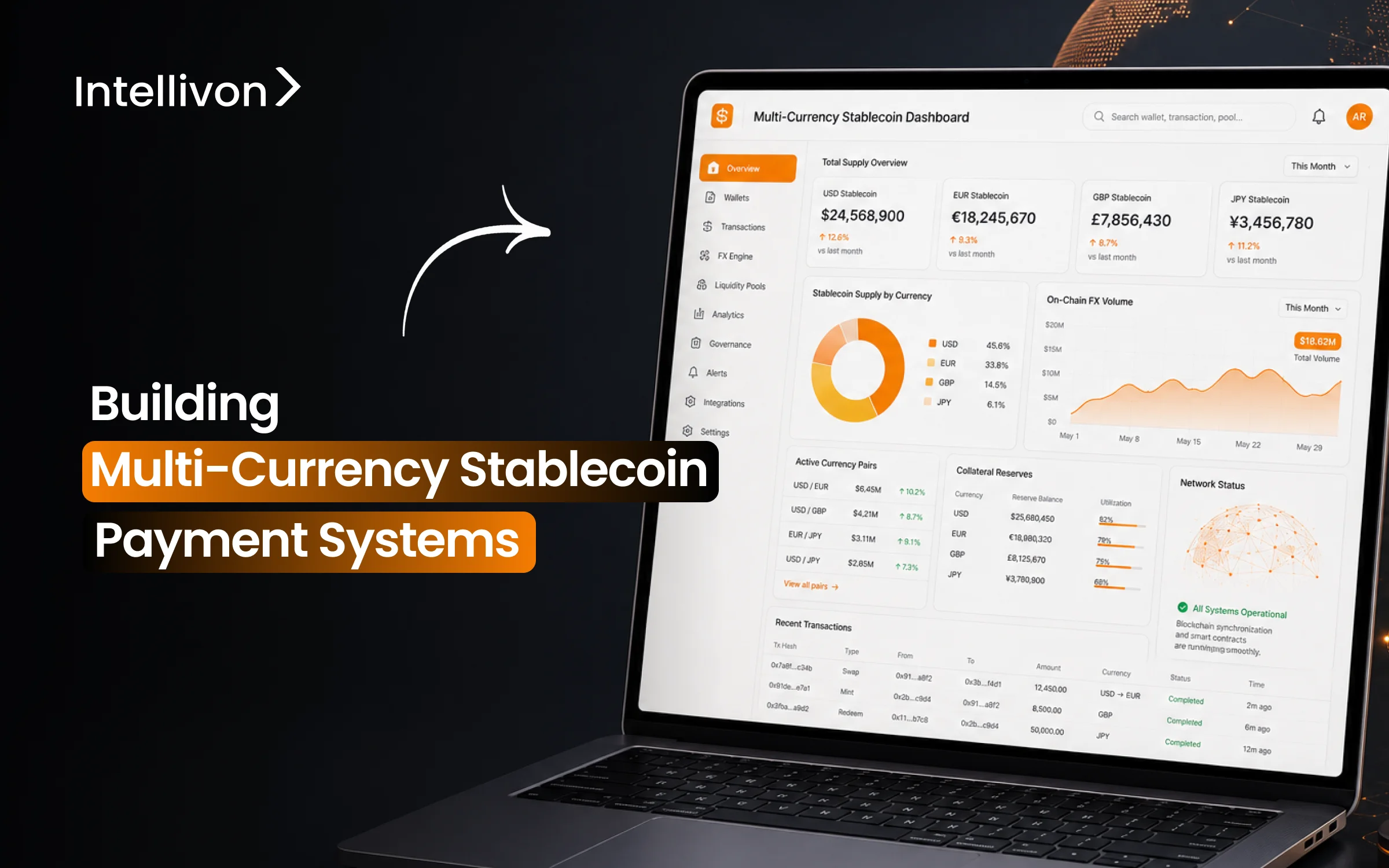
Key Takeaways:
- Multi-currency stablecoin payments require double-entry ledgers, MPC custody, FX rate-lock logic, and multi-chain routing.
- Fiat on-ramps, off-ramps, liquidity controls, Travel Rule messaging, KYC, AML, and sanctions checks are core requirements.
- Reconciliation, failover architecture, and operational controls must be proven before expanding currencies and networks.
- Focused corridor MVPs cost $70,000 to $110,000 while multi-region enterprise platforms reach $220,000 to $300,000.
- How Intellivon builds multi-currency stablecoin platforms corridor-first, then expands currencies, networks, and entities incrementally.
Multi-currency stablecoin payments settle across USDC, EURC, and other regional stablecoins without routing each currency pair through separate banking relationships. For a treasury team managing supplier payments across a dozen corridors, that single-rail approach replaces a dozen separate reconciliation processes.
However, settling in multiple stablecoins alone doesn’t fix reconciliation. Finance teams still need one ledger that matches every payment to an invoice, a corridor, and an FX rate, instead of chasing bank portals one currency at a time. In fact, finance teams spend 15 to 20 hours a month reconciling payment status across multiple bank portals. As a result, on $50 million in annual volume, that friction compounds to $2 million to $3.5 million a year, according to a 2026 cross-border payments analysis. Consequently, businesses that unify reconciliation into one ledger typically recover that cost within a year.
Meanwhile, multi-currency builds usually add each corridor as a separate integration, then struggle once volume climbs past a few markets. This blog covers FX orchestration, multi-chain settlement, reconciliation, and compliance in that order, starting with how currency selection actually works.

What Is a Multi-Currency Stablecoin Payment System?
A multi-currency stablecoin payments system is an enterprise-grade financial infrastructure that automatically routes, converts, and settles digital asset transactions across different fiat currencies and blockchain networks in real time.
Instead of relying on slow bank messaging rails, this system uses fiat-backed tokens to execute instant cross-border transfers.
It continuously manages real-time liquidity, foreign exchange rates, regulatory compliance, and automated double-entry ledger accounting without manual intervention.
1. A Practical Definition for Enterprise Buyers
At its core, an enterprise multi-currency crypto payment system lets your organization collect and report payments seamlessly across multiple fiat currencies, stablecoins, public blockchains, and legal entities.
At the same time, many providers market basic user interfaces as complete platforms, but true multi-currency functionality goes far beyond merely displaying balances for USDC, EURC, or USDT on a screen.
2. How It Differs From a Crypto Wallet
Building a production-ready multi-currency digital asset payment platform requires infrastructure that extends far beyond key storage.
| Component | Core Function | Primary Limitation | Enterprise Scope |
| Crypto Wallet | Stores private keys and initiates basic transfers | No automated accounting, routing, or compliance features | Handles single-address key security |
| Payment Gateway | Accepts a limited set of digital assets | Lacks multi-entity treasury management and dynamic FX | Front-end checkout integration |
| Payment Processor | Manages basic transaction workflows | Dependent on third-party liquidity providers | Standard transaction processing |
| Stablecoin Platform | Coordinates currencies, FX, liquidity, compliance, and ledger reporting | Higher initial build and architectural complexity | End-to-end enterprise payment orchestration |
3. The Three Main Operating Models
Modern stablecoin payment engine development supports three distinct operational models depending on your treasury architecture:
- Stablecoin-to-Stablecoin Settlement: The sender pays in a specific stablecoin (like USDC), and the recipient receives that exact asset directly on-chain within seconds.
- Fiat-to-Stablecoin-to-Fiat Settlement: The sender pays local fiat, which instantly converts to a stablecoin rail for cross-border transfer, and automatically converts to local fiat at the destination.
- Hybrid Treasury Settlement: The entire stablecoin conversion layer remains completely invisible to both the sender and recipient, who only interact with familiar local currency bank accounts.
While developer tutorials from providers like Circle demonstrate basic wallet creation and token swaps, building an enterprise-grade platform requires a robust orchestration engine that connects compliance, FX pricing, and multi-chain routing.
Why Enterprises Are Adopting Multi-Currency Stablecoin Payments
Legacy cross-border payment networks incur high fees, multi-day delays, and poor visibility. Traditional banking rails lock up capital and complicate international treasury operations.
Consequently, modern stablecoin infrastructure eliminates these bottlenecks with instant finality and continuous liquidity.
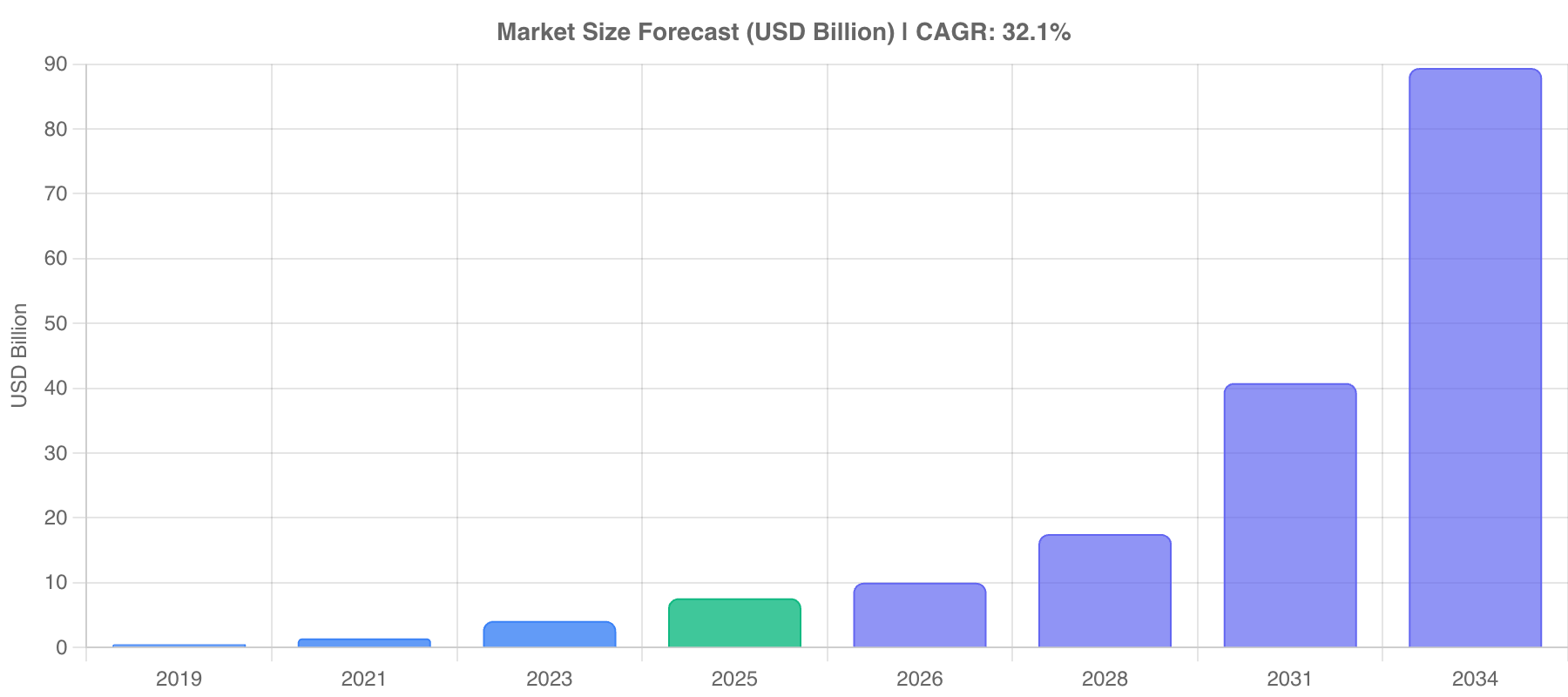
At the same time, the stablecoin payment infrastructure market is projected to reach $89.4 billion by 2034. In fact, it is expanding rapidly at a 32.1% CAGR. Enterprises adopt these payment rails to bypass correspondent banking friction.
For a broader explanation of enterprise adoption drivers, see our guide on Cost to Build a Stablecoin Payment Infrastructure Platform.
1. Faster Settlement Across Banking Hours and Time Zones
Public blockchains process and settle transactions 24/7/365 without weekend delays. However, technical teams must distinguish on-chain confirmation from local fiat delivery.
While digital assets settle in seconds on-chain, local bank delivery depends on local clearing windows.
2. Reduced Dependence on Prefunded Regional Accounts
Traditional international payouts require companies to maintain prefunded balance pools in target regions. This practice ties up substantial working capital across multiple Nostro/Vostro accounts.
Stablecoin infrastructure allows treasury teams to execute just-in-time funding. Capital moves into destination corridors seconds before payout, freeing idle corporate liquidity.
3. Better FX and Fee Visibility
Legacy wire transfers route through multiple correspondent banks, taking hidden spreads. This makes exact payout reconciliation difficult for corporate accounting systems.
Stablecoin payment engine architectures offer explicit programmatic quotes upfront. Network gas fees, FX spreads, and payout charges appear before execution.
4. Programmable Treasury and Payment Controls
Smart contracts allow developers to program strict corporate governance logic directly into payment flows. Therefore, payments execute automatically only when pre-defined conditional parameters are satisfied.
Engineering teams can enforce multi-signature authorization chains and automated treasury sweeps. Systems can also trigger milestone-based disbursements without manual oversight.
5. Enterprise Use Cases
Modern stablecoin payment rails serve various critical enterprise workflows:
- B2B Supplier Settlements: Paying international vendors instantly without paying high cross-border wire fees.
- Marketplace Seller Payouts: Disbursing earnings to global merchants on flexible, automated schedules.
- International Payroll: Sending cross-border employee salaries directly without multi-day banking delays.
- Merchant Settlement: Settling e-commerce transactions quickly to improve working capital turn rates.
- Intercompany Treasury Movements: Moving capital between global corporate entities without FX loss.
- Remittance and Embedded Finance: Powering instant, low-cost digital wallet transfers for users.
Multi-currency stablecoin rails transform cross-border operations from a slow cost center into an agile competitive advantage.
At the same time, they eliminate prefunding requirements, lower FX friction, and automate compliance through programmable treasury controls.
How Multi-Currency Stablecoin Payments Work End to End
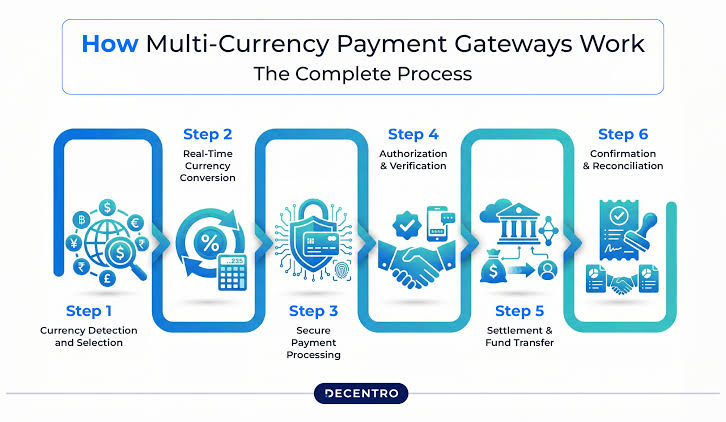
An end-to-end multi-currency stablecoin payment translates a local fiat instruction into an on-chain settlement before delivering local currency to the recipient. To understand this workflow, consider a UK buyer paying a Mexican supplier in MXN while funding in GBP.
The payment orchestration system coordinates messaging, FX conversions, compliance checks, and blockchain execution across both banking systems and distributed ledgers.
Step 1 — Payment Instruction and Currency Selection
The process begins when the UK buyer submits a payout request via an API or portal. Consequently, the payment engine ingests core parameters including the source currency (GBP), destination currency (MXN), amount, purpose, entity IDs, and corridor requirements.
- What this step involves technically: The API validates field structures, verifies beneficiary account details, and logs the instruction into an idempotent database. Thus, duplicate payment requests are prevented instantly.
- Intellivon’s approach: We build resilient API ingestion layers that map multi-currency ISO 20022 messages directly to internal double-entry ledger topics.
- Transition: Once the instruction is captured, the engine forwards the payload to the risk screening gateway.
Step 2 — Compliance and Eligibility Checks
Before locking in rates, the platform executes real-time risk controls. Specifically, it screens the UK sender and Mexican beneficiary against global sanctions lists, sanctions rules, and corridor limits.
- What this step involves technically: Automated systems evaluate wallet addresses using blockchain analytics, verify FATF Travel Rule compliance data, and perform automated KYC/AML checks.
- Intellivon’s approach: We integrate event-driven compliance engines that run parallel wallet and identity checks within 200 milliseconds.
- Transition: After passing compliance checks, the payment engine requests liquidity options for rate optimization.
Step 3 — FX Quote and Stablecoin Route Selection
Next, the routing engine calculates the most efficient liquidity path for GBP to MXN. Furthermore, it evaluates direct fiat options, fiat-to-stablecoin bridges, and stablecoin-to-stablecoin routes.
- What this step involves technically: The engine queries multiple liquidity providers, compares gas fees across chains like Ethereum or Solana, and locks a guaranteed FX quote.
- Intellivon’s approach: We design smart order routing engines that dynamically calculate slippage, fee structures, and network speed to select optimal corridors.
- Transition: As soon as the optimal route is selected, the platform initiates conversion and blockchain settlement.
Step 4 — Funding, Conversion, and Blockchain Settlement
In this stage, the platform executes a “stablecoin sandwich.” First, local GBP moves from the UK buyer to an on-ramp partner, converting to USDC. Next, USDC transfers on-chain to Mexico within seconds.
- What this step involves technically: Smart contracts execute on-chain transfers, while HSM or MPC custody modules sign transactions securely.
- Intellivon’s approach: We implement robust multi-chain orchestration engines with automated retry logic and depeg protection safeguards.
- Transition: While blockchain transaction finality occurs quickly, the payout engine must still complete local fiat distribution.
Step 5 — Off-Ramp and Local Fiat Delivery
Upon receiving USDC in Mexico, the local off-ramp partner converts the tokens into MXN. Subsequently, the funds enter the Mexican SPEI payment rail for final delivery to the supplier’s bank.
- What this step involves technically: The platform consumes webhooks from local payout partners to confirm local bank account settlement.
- Intellivon’s approach: We build cross-border stablecoin settlement infrastructure that tracks local clearing hours to optimize fiat payout times.
- Transition: Finally, once local funds land in the beneficiary’s account, the platform triggers automated reconciliation.
Step 6 — Reconciliation and Reporting
The transaction closes only when every internal and external record aligns seamlessly. For instance, the system matches the original GBP debit, FX spread, gas fees, and final MXN credit.
- What this step involves technically: The accounting engine updates the double-entry ledger, matches transaction hashes, and exports audit records into ERP platforms.
- Intellivon’s approach: We engineer automated stablecoin payment exception handling workflows that resolve missing webhooks or ledger discrepancies without manual effort.
- Transition: For a deeper breakdown of tracking data, see our guide on [LINK: AI Audit Trail Software for Financial Services].
Executing end-to-end multi-currency stablecoin payments requires uniting six distinct steps, from payment instruction to final off-ramp delivery. Building this multi-step execution flow requires scalable technical building blocks. Next, let us examine the core software layers that power this entire pipeline.
Multi-Currency Stablecoin Payment System Architecture
A production-ready stablecoin payment system architecture decouples financial workflows into modular, highly resilient services.
Instead of building a monolithic crypto integration, modern systems split customer interfaces, transaction orchestration, custody, and compliance into distinct layers.
This separation ensures high uptime, smooth multi-chain routing, and strict regulatory compliance as transaction volumes scale.
Key Architectural Layers Comparison
| System Layer | Primary Technical Responsibility | Core Enterprise Requirement |
| Experience & Access | Delivers SDKs, APIs, and administrative control consoles | Low-latency response times and strict RBAC controls |
| Payment Orchestration | Coordinates payment state machines, routing, and retries | Idempotent execution with 99.999% processing uptime |
| FX & Conversion | Streams real-time rates and executes atomic token swaps | Sub-second rate locking with minimal slippage |
| Internal Ledger | Maintains immutable double-entry balance records | High-throughput ACID compliance across all assets |
| Wallet & Custody | Secures cryptographic keys and signs transactions | MPC key management with policy enforcement |
| Blockchain Connectivity | Interacts with public and private blockchain RPC nodes | Automatic RPC failover and gas optimization |
| Compliance & Risk | Executes real-time KYC, AML, and Travel Rule checks | Sub-200ms screening latency prior to execution |
| Data & Observability | Captures audit trails, telemetry, and financial logs | Complete regulatory reporting and trace logging |
A robust multi-currency stablecoin architecture relies on eight decoupled layers working in harmony.
Therefore, isolating compliance, custody, orchestration, and ledgering ensures enterprise-grade security, rapid scaling, and seamless regulatory compliance.
Choosing Stablecoins, Blockchains, and Payment Corridors
Selecting assets and payment corridors before development is critical for long-term project success. Specifically, these choices directly determine your licensing exposure, operational costs, and system complexity.
However, making late architectural changes after deployment creates massive technical debt. Therefore, choosing compliant assets and scalable networks early ensures operational resilience.
1. Stablecoin Selection Criteria
Selecting stablecoins requires careful evaluation of asset safety and regulatory compliance. Consequently, technical engineering teams must evaluate several core parameters:
- Issuer Jurisdiction and Reserves: Assess reserve audit frequency, trust structures, and regulatory oversight.
- Liquidity and Redemption Access: Verify 1:1 fiat redemption speeds, market liquidity, and daily volume.
- Control Mechanics: Evaluate smart contract freeze features, blacklist controls, and compliance tools.
Tokens like USDC, EURC, PYUSD, and RLUSD offer distinct regulatory profiles. However, they serve as technical examples rather than automatic recommendations.
2. Blockchain Selection Criteria
Evaluating blockchain networks requires looking beyond theoretical throughput metrics. Furthermore, enterprise engineering teams evaluate production performance across nine primary metrics:
- Transaction Finality: Measure deterministic settlement speed rather than block production time.
- Network Costs: Calculate average gas fees during peak network congestion periods.
- Stablecoin Liquidity: Map native asset issuance across candidate blockchain networks.
- Node Reliability: Check validator distribution and RPC cluster operational stability.
- Custodian Support: Verify institutional MPC custodian integration across target chains.
- Monitoring Tools: Ensure compatibility with leading blockchain analytics platforms.
- Congestion History: Analyze historical network outages and chain halt risks.
- Geographic Adoption: Assess regional node density and transaction routing latency.
- Developer Infrastructure: Evaluate SDK quality, indexer availability, and tooling.
For example, leading candidate networks include Ethereum, Base, Solana, Polygon, Stellar, and XRPL.
3. Corridor Scoring Framework
In addition, technical teams should score each payment corridor using a standardized framework:
| Evaluation Metric | Technical Assessment Focus | Risk Impact |
| Regulatory Standing | Licensing requirements in origin and destination regions | High regulatory enforcement risk |
| Banking and Rails | On-ramp and off-ramp partner coverage | Payment settlement failure risk |
| FX Depth & Liquidity | Market maker depth and slippage tolerances | Margin erosion and quote losses |
| Compliance Overhead | Sanctions rules and Travel Rule requirements | Increased processing friction |
4. Fallback and Hybrid Rails
Production payment platforms cannot rely solely on public blockchain networks. Specifically, unexpected network congestion or RPC node failures can halt payment processing.
As a result, enterprise platforms must integrate traditional banking rails alongside stablecoins. In addition, combining ACH, SEPA, or SWIFT with stablecoins ensures reliable failover routing.
Asset, network, and corridor selection determines your platform’s regulatory exposure and speed. Therefore, building multi-chain connectivity alongside fallback fiat rails ensures continuous operational uptime.
Designing Multi-Currency Wallets, Custody, and Approval Controls
Building a secure wallet infrastructure requires balancing speed, accessibility, and asset safety. Therefore, engineering teams must carefully structure account segregation, key storage, and approval rules before launching production rails.
1. Omnibus Versus Segregated Wallets
Choosing between omnibus and segregated wallets directly affects system complexity and accounting clarity:
- Omnibus Model: Pools all customer funds into shared main wallets. This setup minimizes on-chain gas costs and simplifies liquidity management. However, it requires a rock-solid internal double-entry ledger to track individual user balances accurately.
- Segregated Model: Assigns distinct blockchain addresses to every customer or sub-entity. This approach provides clear asset isolation and simpler audit trails. Consequently, it increases total gas costs during regular balance sweeps.
2. MPC, HSM, or Third-Party Custody
Selecting a key management model depends on your team’s operational risk tolerance and regulatory needs:
| Custody Type | Security Mechanism | Operational Trade-off |
| Self-Managed HSM | Hardware appliances store keys securely on-premises | Maximum control, but high hardware maintenance overhead |
| MPC Infrastructure | Key shares are split across separate environments | High flexibility, fast signing, and zero single points of failure |
| Regulated Third-Party | Qualified custodians hold and protect private keys | Lower liability, but adds external vendor dependency |
| Hybrid Custody | Combines internal MPC signing with custodian backups | Balances daily payment speed with cold-storage protection |
3. Hot, Warm, and Cold Wallet Policies
Tiered wallet policies connect asset security directly to transaction velocity:
- Hot Wallets: Connected directly to the internet to process real-time payouts automatically. They hold minimal operational funds to limit risk exposure.
- Warm Wallets: Maintain operational reserves behind automated policy engines and multi-signature gates. They handle daily rebalancing while keeping private keys off public endpoints.
- Cold Wallets: Kept completely offline in deep storage to secure core reserves. Moving funds out of cold storage requires manual, multi-person authorization.
4. Multi-Entity and Role-Based Controls
To prevent insider fraud and unauthorized transfers, systems enforce strict policy engines. Therefore, enterprise platforms require maker-checker approval workflows, hard transaction limits, and entity-level permissions.
In addition, admins use address allowlists, time-window controls, and instant emergency freezes to lock assets if suspicious activity occurs.
5. Gas and Network-Fee Management
Managing gas fees smoothly prevents transaction failures during network spikes. Specifically, platforms deploy dedicated gas wallets to auto-fund user deposit addresses.
In addition, implementing gas sponsorship, batching outgoing payouts, and setting up automatic fee-recovery workflows keeps payment queues moving without manual intervention.
A tiered multi-currency stablecoin wallet infrastructure protects assets without slowing down payout speed. Combining MPC custody multi-currency wallet designs with strict internal approval rules keeps funds secure and fully auditable.
Building Compliance Into Every Currency and Corridor
Compliance cannot operate as a single generic API check. Specifically, regulatory requirements change based on assets, transaction types, and operating jurisdictions. Therefore, modern systems must adapt controls to each local corridor dynamically.
1. Customer and Business Verification
Robust verification forms the foundation of modern financial risk controls. Consequently, platforms must run initial onboarding and ongoing customer checks:
- Identity Verification: Validate individual KYC and business KYB records thoroughly.
- Corporate Structure: Identify ultimate beneficial owners across all corporate tiers.
- Risk Profiling: Assess source of funds and expected account activity accurately.
In addition, companies group accounts into distinct risk categories for ongoing monitoring.
2. Sanctions and Wallet Screening
Sanctions screening must execute during onboarding and before every transaction. As a result, compliance engines evaluate wallet exposures across public blockchains.
Specifically, the system flags connections to sanctioned entities or risky services. Furthermore, automated rules block transactions originating from prohibited geographic regions instantly.
3. Transaction Monitoring
Effective monitoring requires combining on-chain analytics with internal fiat accounting data. However, relying on blockchain risk scores alone provides incomplete context.
Therefore, systems must evaluate the underlying commercial purpose of each payment. In addition, merging off-chain data prevents false positives during routine high-value transfers.
4. FATF Travel Rule Data Exchange
Cross-border crypto transfers must comply with global FATF Travel Rule mandates. Specifically, virtual asset service providers must exchange key transaction information securely.
The sender platform gathers, stores, and transmits originator and beneficiary details. As a result, receiver platforms verify counterparty identities before releasing funds to local balances.
5. GENIUS Act and U.S. Stablecoin Controls
The GENIUS Act became U.S. law on July 18, 2025. Consequently, it established a federal framework for permitted payment-stablecoin issuers.
Under this law, issuers must maintain audited 1:1 liquid reserve backings. In addition, service providers must execute asset due diligence and guarantee clear user redemptions.
6. MiCA and European Currency Support
Operating within the European Union requires strict adherence to MiCA guidelines. Therefore, platforms issuing or processing e-money tokens must obtain proper issuer authorization.
Furthermore, regulated entities must satisfy strict reserve, capital, and redemption requirements. Consequently, crypto asset service providers must enforce full disclosure policies across European corridors.
7. Jurisdictional Rules Engine
Regulated platforms deploy customizable compliance engines to enforce local laws dynamically. Therefore, technical teams manage compliance rules across multiple system dimensions:
| Configuration Dimension | Core Enforcement Focus |
| Entity & Location | Enforces regional licensing rules by country and legal entity |
| Asset & Network | Sets specific transaction rules by stablecoin and blockchain |
| Transaction Context | Applies threshold limits based on customer type and payment purpose |
A modern multi-currency stablecoin compliance platform embeds dynamic KYC AML stablecoin payment controls directly into payment routing pipelines.
Combining Travel Rule multi-currency compliance with GENIUS Act MiCA stablecoin compliance ensures full regulatory coverage across every operational corridor.
Where AI Fits in a Multi-Currency Stablecoin Payment Platform
AI optimizes prediction, classification, and execution in complex payment networks. However, deterministic financial policies must always retain ultimate control over actual fund movements. AI enhances efficiency, but hard rules enforce system boundary limits.
1. Intelligent Payment Routing
Machine learning models continuously analyze available execution paths across diverse liquidity venues. Specifically, algorithms rank routes by cost, speed, failure probability, liquidity, compliance friction, and congestion.
However, the core policy engine enforces hard regulatory boundaries before ranking begins. As a result, non-compliant or restricted paths are eliminated automatically prior to evaluation.
2. Liquidity Forecasting
Predictive models evaluate historical settlement patterns to forecast future corridor demand accurately. Consequently, treasury teams optimize wallet funding across multi-currency accounts without prefunding excess capital.
Furthermore, algorithms forecast daily redemption needs and fiat payout capacity across partner banks. Therefore, platforms maintain optimal working capital while reducing idle balance costs significantly.
3. Fraud and Behavioral Anomaly Detection
Advanced ML models analyze complex graph features and account activity patterns in real time. In addition, systems evaluate device signals, beneficiary updates, transfer velocity, and transaction history.
As a result, anomaly engines flag suspicious behavior before funds reach public blockchains. Consequently, risk teams block high-risk attempts while legitimate transfers process without friction.
4. Depeg and Counterparty Risk Monitoring
Automated risk monitors track market prices and liquidity depth across primary stablecoin pools. Furthermore, models ingest redemption conditions, reserve disclosures, provider health indicators, and concentration risks.
If a stablecoin displays depeg indicators, the system triggers automated routing adjustments. Therefore, exposure shifts instantly toward fully backed, stable assets during market volatility.
5. Reconciliation and Exception Classification
Unmatched ledger entries often create operational bottlenecks during high-volume processing windows. Consequently, machine learning models classify payment exceptions and suggest likely underlying root causes.
However, these models operate strictly in a read-only advisory capacity. Specifically, AI recommends classification causes without altering core double-entry ledger records autonomously.
6. Explainability and Human Overrides
Every AI-assisted routing decision, risk block, or transaction escalation generates a clear reason code. Consequently, compliance officers and treasury managers can audit automated recommendations easily.
Furthermore, platforms maintain manual override paths for all automated risk classifications. Crucially, AI must never receive unrestricted signing authority or override transaction limits. In addition, AI cannot bypass sanctions policies or custody controls.
Integrating Banks, On-Ramps, ERPs, and Treasury Systems
A production-ready platform bridges public blockchains with traditional corporate financial infrastructure. Consequently, engineering teams must connect crypto payment rails directly into existing banking networks, accounting software, and treasury suites.
For a broader integration blueprint, see our guide on [LINK: Developing a Blockchain-Powered Cross-Border Payment Software].
1. Fiat On-Ramp and Off-Ramp Integration
Connecting fiat liquidity venues allows users to move seamlessly between local currencies and stablecoins:
- Bank Connections: Connect local transfer methods, virtual accounts, and payment processors.
- Liquidity Providers: Integrate institutional market makers to ensure deep order book liquidity.
- Automated Clearing: Use direct API hooks for rapid fiat settlement and clearing.
2. Bank and Payment-Rail Connectivity
Enterprise networks must connect directly to regional real-time payment systems worldwide. Therefore, platforms integrate ACH, SEPA, Faster Payments, SWIFT, and PIX rails.
Consequently, treasury teams manage global cash distributions without manual bank file uploads.
3. ISO 20022 Data Mapping
Traditional corporate banking systems rely on structured ISO 20022 messaging formats. Therefore, developers map ISO data fields to internal stablecoin payment events:
| ISO 20022 Message Field | Stablecoin System Data Point |
| Party & Account Info | Sender identity, beneficiary metadata, and wallet addresses |
| Purpose & Remittance | Commercial payment purpose codes and invoice identifiers |
| Status & Execution | Real-time transaction state updates and block hashes |
4. ERP and Treasury Integrations
Corporate finance teams require real-time synchronization between payment rails and core accounting platforms. Therefore, native connectors sync ledgers directly with platforms like SAP, Oracle, Microsoft Dynamics, and NetSuite.
Furthermore, integrations with Kyriba and Coupa streamline enterprise treasury management.
5. API and Webhook Design
Robust multi-currency stablecoin API development simplifies platform integration for external partners. Specifically, rest APIs manage payment quotes, beneficiary profiles, wallet balances, conversions, and compliance statuses.
In addition, signed webhooks push instant settlement updates and automated reconciliation exports securely.
6. Developer Portal and Sandbox
Accelerate partner onboarding by providing a comprehensive developer sandbox environment. Consequently, engineers can test synthetic assets, simulate bank rail events, and test API idempotency.
Furthermore, developers can execute webhook replays and configure test corridors before going live.
Seamless stablecoin payment network integration requires robust ISO 20022 messaging mapping and direct ERP connectivity. Building developer-friendly APIs ensures rapid deployment while streamlining enterprise stablecoin treasury integration.
How We Build A Multi-Currency Stablecoin Payment Platform
At Intellivon, we build stablecoin payment platforms as production-grade financial infrastructure rather than simple crypto checkout widgets.
We use an iterative, corridor-first methodology to ensure complete regulatory compliance, accounting precision, and continuous operational uptime.
Phase 1 — Define the First Use Case and Corridor
We start by targeting a single high-friction payment problem instead of attempting a multi-region global launch. This initial phase delivers a clear operational spec:
- Customer Profile: Define target sender and recipient entity types.
- Currency Pair: Select source fiat and target destination currency.
- Volume Metrics: Establish average payment values and expected monthly volumes.
- Settlement SLA: Set precise speed targets for end-to-end clearing.
- Corporate Structure: Identify all required legal entities and licensed partners.
Phase 2 — Complete Regulatory and Partner Mapping
Next, we map necessary licenses, banking rails, MPC custody providers, eligible stablecoins, liquidity partners, and local data-residency rules. This prevents expensive compliance revisions later in development.
Phase 3 — Design the Ledger and Payment-State Model
Before writing payment code, we design the double-entry accounting ledger. We map out internal balances, fee structures, status transitions, manual corrections, reversals, and edge-case exceptions.
Phase 4 — Build Core Wallet and Settlement Infrastructure
During this stage, our team implements secure MPC wallet architecture, automated gas management, transaction signing protocols, and multi-chain network adapters.
Phase 5 — Add FX, Liquidity, and Routing
We integrate market-data feeds, live quote aggregation engines, rate-locking mechanisms, smart path selection, and automated treasury rebalancing workflows.
Phase 6 — Integrate Compliance and Enterprise Systems
We link automated KYC/KYB screening, sanctions verification, and FATF Travel Rule messaging directly into client banking, ERP, and treasury systems.
Phase 7 — Test One Corridor in Production-Like Conditions
We run rigorous stress tests on the initial corridor before launching. Specifically, our engineers simulate volume spikes, network congestion, provider downtime, rate expirations, compliance holds, duplicate API calls, reconciliation breaks, and token depeg events.
Phase 8 — Launch, Measure, and Expand
We launch the live corridor once all performance thresholds are met. Subsequently, we expand to additional regional corridors only after confirming strict cost, speed, and audit targets.
| Platform Scope | Capability Level | Estimated Delivery Timeline |
| Focused MVP | Single corridor, single stablecoin, core ledger, basic compliance | 4–5 months |
| Production Multi-Currency | Multi-corridor, FX engine, ERP links, Travel Rule compliance | 6–8 months |
| Enterprise Multi-Region | Global multi-chain routing, AI risk engines, custom treasury suites | 8–12 months |
Building an enterprise blockchain payment system build requires a structured, multi-phase roadmap. A disciplined multi-currency stablecoin payment platform development approach ensures seamless stablecoin payment engine development without interrupting daily business operations.
Cost to Build a Multi-Currency Stablecoin Payment System
Building a multi-currency stablecoin payment system costs $70,000 to $300,000, depending on corridor coverage, custody, FX complexity, compliance scope, integrations, and availability requirements.
For a detailed view of infrastructure cost drivers, see our guide on [LINK: Cost to Build a Stablecoin Payment Infrastructure Platform].
1. Cost by Platform Scope
| Platform Scope | Estimated Cost | Typical Coverage |
| Focused Corridor MVP | $70,000–$110,000 | One or two currencies, one blockchain, managed custody, one on-ramp and off-ramp, standard compliance integrations |
| Growth-Stage Platform | $120,000–$200,000 | Three to five currencies, multi-chain support, FX routing, internal ledger, several corridors, ERP integration |
| Enterprise Multi-Region Platform | $220,000–$300,000 | Multiple entities, regions, currencies and chains, advanced liquidity controls, high availability, AI monitoring, deep compliance workflows |
2. Development Phase Breakdown
| Development Phase | Estimated Range |
| Discovery, Corridor, and Compliance Mapping | $8,000–$15,000 |
| Architecture and Workflow Design | $10,000–$25,000 |
| Ledger and Payment Orchestration | $20,000–$50,000 |
| Wallet, Custody, and Blockchain Integrations | $15,000–$40,000 |
| FX, Liquidity, and Routing Engine | $10,000–$35,000 |
| Compliance and Security Controls | $15,000–$40,000 |
| Banking, ERP, and Partner Integrations | $10,000–$45,000 |
| Testing, Pilot, and Production Hardening | $8,000–$20,000 |
Please note that maximum phase figures are not additive. Specifically, your chosen platform scope determines which workstreams require full investment.
Ongoing Operating and Maintenance Costs
Annual maintenance typically equals 15%–25% of the initial build cost. However, this estimate excludes variable third-party fees.
Specifically, teams must budget separately for custody, banking, blockchain gas, compliance data, liquidity, and transaction provider fees.
Build Multi-Currency Stablecoin Payment Infrastructure With Intellivon
Intellivon designs, builds, and deploys high-throughput, enterprise-grade stablecoin payment infrastructure. We help financial institutions and global enterprises transition from legacy settlement networks to modern blockchain rails safely and efficiently.
What Intellivon Builds
- Corridor-First Architecture: Tailored payment systems designed around specific regional corridor constraints.
- Multi-Currency Orchestration: Unified routing engines that manage cross-border flows across multiple fiat pairs and stablecoins.
- Double-Entry Ledgers: Immutable, high-speed core ledgers that ensure real-time financial reconciliation.
- MPC and HSM Custody: Institutional-grade wallet security infrastructure built with strict access policies.
- Stablecoin FX Workflows: Liquidity aggregation engines featuring dynamic rate-locking mechanisms.
- Compliance Systems: Automated Travel Rule, KYC/KYB, and sanctions screening integrations.
- ERP and Treasury Connectors: Direct, automated synchronization with SAP, Oracle, NetSuite, and Kyriba.
- AI-Assisted Routing: Smart transaction monitoring engines that detect anomalies and optimize routes.
How Intellivon Approaches the Build
We begin every engagement by analyzing your actual transaction flows, corridor economics, custody policies, and regional compliance obligations.
Consequently, we define operational and legal parameters before selecting specific blockchain networks, wallet protocols, or third-party vendors.
Proof Points
- 500K+ Engineering Hours: Deep hands-on experience developing complex financial software systems.
- Ex-MAANG Technical Leadership: Architecture designed by senior engineering leaders from top global tech firms.
- Production-First Development: Battle-tested systems engineered specifically for continuous uptime and high transaction throughput.
- Compliance-Ready Design: Platform architectures built from day one to pass strict institutional audits.
- Enterprise Integration Experience: Native connectors built specifically for legacy banking networks and ERP systems.
Talk to Intellivon about designing a multi-currency stablecoin payment system around your first currencies, corridors, entities, and settlement workflows. If you are ready to build your platform, contact Intellivon’s experts today to book a free strategy call.
Conclusion
Building an enterprise multi-currency stablecoin payment system delivers fast, low-cost global settlements. However, long-term success requires careful planning across wallet custody, FX routing, double-entry ledgering, and local compliance. By deploying a modular, eight-layer architecture, financial institutions eliminate single points of failure while maintaining strict regulatory coverage.
Consequently, businesses can safely scale cross-border payments, reduce operational friction, and expand into high-growth international corridors. Partner with Intellivon to accelerate your platform launch today.
FAQs
Q1. Which Stablecoins Should Regulated Multi-Currency Stablecoin Rails Support?
A1. Rather than focusing solely on market capitalization, teams must use a strict due-diligence framework. Specifically, evaluate issuers based on reserve transparency, regulatory licensing (such as MiCA compliance), on-chain liquidity depth, redemption mechanisms, and bankruptcy-remoteness. Consequently, this approach mitigates counterparty risk while ensuring predictable cross-border liquidity.
Q2. Does a Stablecoin FX Orchestration Platform Require Financial Licenses?
A2. Licensing requirements depend entirely on the platform’s underlying operational structure. If your architecture actively holds customer funds, executes fiat conversions, or provides custody, money transmitter licenses are mandatory. Conversely, non-custodial software orchestrators that route instructions through third-party licensed banks and liquidity providers can operate without direct money transmitter licenses.
Q3. Should We Build or Buy Stablecoin Cross-Border Payment Infrastructure?
A3. Decide based on workflow customization, volume expectations, and core strategic value. Buying third-party APIs accelerates early market entry for low-volume corridors. However, high-volume enterprises with unique treasury workflows should build custom infrastructure. Consequently, owning the stack grants total control over compliance data, margin structures, and provider integrations.
Q4. How Are Stablecoin Payments Reconciled With SAP, Oracle, or Treasury Systems?
A4. Reconciliation relies on linking double-entry ledger entries directly to external financial records. First, systems map unique on-chain transaction hashes to enterprise customer IDs. Next, platforms extract fee structures, exchange rate data, and settlement exports into ISO 20022 XML formats. Consequently, accounting engines automatically generate synchronized sub-ledger journals.
Q5. What Happens When a Stablecoin Depegs or an Off-Ramp Fails?
A5. Platforms prevent systemic failure through automated circuit breakers and real-time risk telemetry. Whenever a depeg event or off-ramp outage occurs, the engine triggers holding limits and sends urgent treasury alerts. Subsequently, system routing policies automatically shift payment flows to fallback liquidity providers or alternate stablecoins, preventing stranded funds.
To Sum It Up
- A multi-currency stablecoin platform is not a wallet with extra tokens. Its real product is the orchestration layer connecting FX, liquidity, custody, compliance, settlement, and accounting.
- Blockchain finality does not mean the payment is complete. Enterprise SLAs must measure when the beneficiary receives usable funds.
- The internal double-entry ledger should remain the financial source of truth, even when every settlement transaction appears on-chain.
- Most companies should build their orchestration and ledger layers while using licensed partners for custody, liquidity, and local payment rails.
- Adding a second currency often creates more than twice the complexity because it introduces new assets, FX pairs, corridors, regulations, providers, and reconciliation paths.