Key Takeaways:
-
Healthcare conversational AI allows patients and staff to carry out tasks using chat, voice, or SMS.
-
They use it in order to cut down on routine calls and make it easier for people to access healthcare services.
-
An AI, along with healthcare data, workflow logic, connections to the EHR, and human handoff, is all necessary for a working platform.
-
Patient safety, access control, and clinical review must all influence the development process right from the start.
-
Intellivon develops bespoke healthcare conversational AI platforms incorporating EHR integration, safety controls, and scalable workflows.
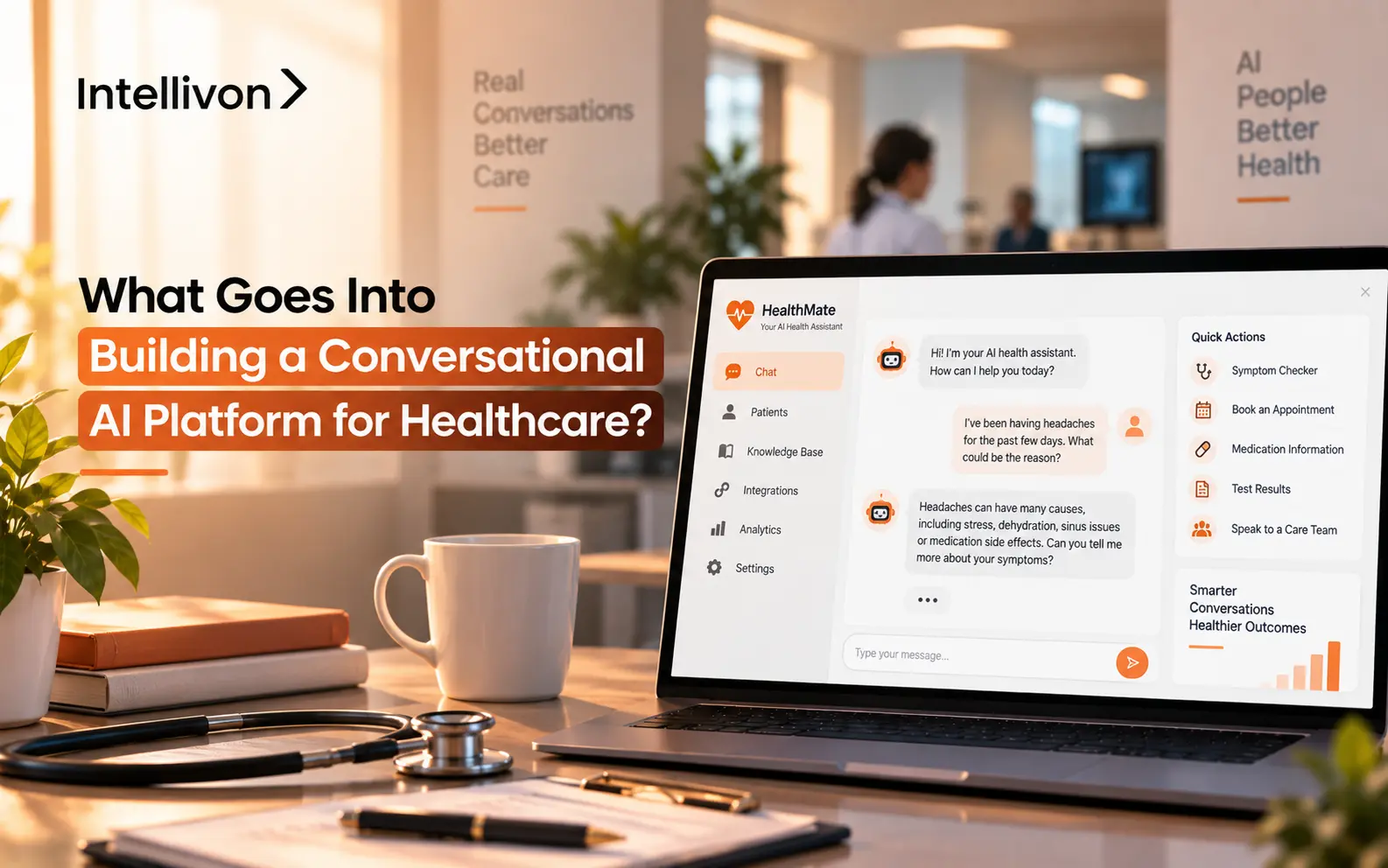
The development of a conversational AI platform in healthcare requires a clinical NLP engine, a retrieval system based on approved medical content, the ability to manage multi-turn conversations, integration with scheduling and refill systems, escalation rules that direct clinical questions to human agents, access for writing back to electronic health records, a HIPAA-compliant architecture, and a complete audit trail. All of these components are included in each platform that is deployed. The chat or voice interface that patients encounter is in fact the smallest element of the entire effort.
Three of the items take up the majority of the budget: EHR integration, compliance engineering, and clinical validation. These are engineering tasks that determine whether the platform is released. It is the scope that has a greater influence on cost than features do. Software that books appointments and answers questions about billing is regarded as administrative software, while that which interprets symptoms is similar to a regulated medical device and therefore the development has to be altered accordingly.
This blog includes all of that content: the complete architecture, the escalation design which makes the platform deployable, the FDA classification test, the Epic integration pathway, and the costs according to phase. A great deal of it is based on what Intellivon has picked up from building these systems.
What Healthcare Conversational AI Actually Is
Healthcare conversational AI is software that understands what a patient asks, pulls the relevant data from clinical systems, and then completes the task or hands it to a human. It works across chat, voice, and SMS.
Unlike a website chatbot, it acts inside real healthcare workflows: booking, refills, eligibility, and intake.
1. How it differs from a basic healthcare chatbot
A basic healthcare chatbot follows a fixed script. It shows menu options, matches keywords, and fails the moment a patient phrases something differently. Conversational AI instead interprets intent, holds context across turns, and connects to the systems that hold the answer.
The progression looks like this:
- Menu bots: Patients pick from preset buttons. No free text.
- Keyword bots: Patients type, but the bot matches words, not meaning.
- Intent-based assistants: The system understands the request, though it still cannot act on it.
- Conversational AI platforms: The system understands, retrieves patient data, and completes the task.
2. What happens after a patient sends a message
Every patient message moves through the same sequence. Each step either resolves the request or passes it forward. Consequently, a failure at any step becomes visible to the patient immediately.
- Patient asks a question in their own words
- The platform identifies what they want
- Identity gets verified when the request touches personal data
- Relevant healthcare data is retrieved from the EHR or scheduling system
- The system selects the matching workflow
- AI generates or selects a response
- The platform completes the action when policy allows it
- High-risk or clinical cases route to a human
3. What makes it a platform instead of one AI bot
One bot handles one job on one channel. A platform runs many workflows at once and keeps them consistent. Therefore, the patient experiences a single conversation while several systems work behind it.
A platform coordinates:
- Multiple workflows such as scheduling, refills, billing, and intake
- Data sources including the EHR, scheduling tools, and knowledge base
- Multiple models for intent, retrieval, and response generation
- Multiple channels: voice, chat, SMS, and portal
- Several healthcare systems, each with its own integration rules
Healthcare conversational AI understands, retrieves, acts, and escalates. A platform does all four across many workflows and channels at once. That coordination, not the chat window, is what you actually build.
Why Healthcare Enterprises Are Building These Platforms
Healthcare enterprises build these platforms to absorb the conversation volume their staff cannot. Call centers stay busy with routine requests, while patients expect service outside office hours. Conversational AI handles those requests directly, connects to the systems holding the answer, and then passes anything clinical to a person. As a result, the spending is operational, not experimental.
The numbers support that shift. The conversational AI in healthcare market is projected to reach USD 21.62 billion in 2026 and expand to USD 212.92 billion by 2036, at a CAGR of 25.7%, according to Future Market Insights.
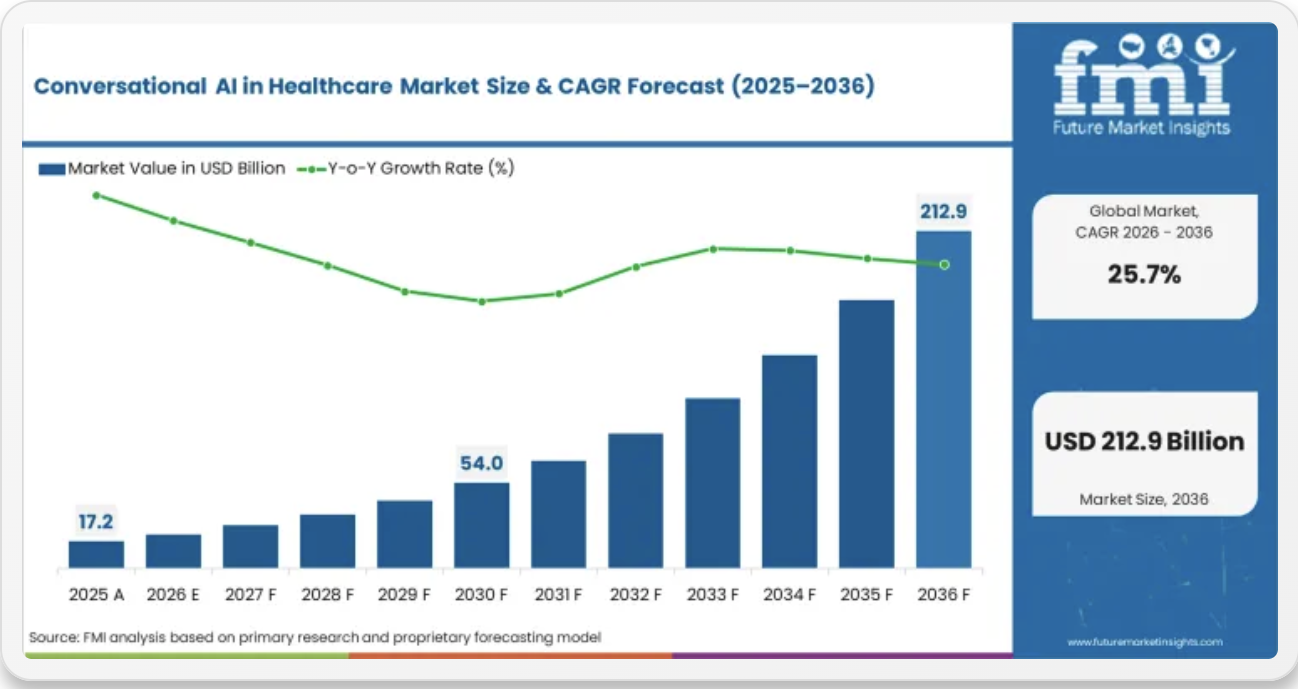
Notably, the United States grows at 21.9% over the same period, driven by virtual health assistants and chronic care management rather than pilots.
1. Patient demand is moving beyond office hours
Patients now expect healthcare access to work like banking or travel. For instance, they want to book a visit at 9 pm, check a balance on Sunday, and get an answer without waiting on hold. Consequently, availability has become a service expectation rather than a differentiator.
2. Administrative conversations consume staff time
Most inbound volume is repetitive and non-clinical. Moreover, staff spend hours on requests that follow the same path every time. Therefore, this is where automation pays back first.
The recurring conversations include:
- Appointment booking
- Appointment changes and cancellations
- Referral questions
- Insurance and eligibility questions
- Patient intake
- Billing questions
- Prescription status
- Care navigation
3. Healthcare systems want one entry point for patients
Separate bots for scheduling, billing, and FAQs force patients to guess which tool solves their problem. In practice, most guess wrong and then call anyway.
A single entry point removes that decision, because one conversation routes to whichever workflow fits the request.
4. Generative AI supports more natural conversations
Scripted bots break when a patient changes topic mid-sentence. Newer models hold context instead, so a patient can ask about a refill, switch to a billing question, and afterward return to the refill without starting over.
For that reason, older intent-only systems are being replaced rather than upgraded.
5. The market is moving toward workflow automation
Spending is shifting from answering questions to completing tasks. Meanwhile, different organizations apply it at different points in the patient journey. However, the common thread is that each system now acts on a workflow rather than describing one.
Current examples include:
- Hyro: Voice and chat agents handling patient access for health systems
- Ada Health: Patient-facing symptom assessment and care guidance
- Microsoft Dragon Copilot: Clinician-facing documentation inside the care workflow
- Abridge: Ambient capture of the patient visit into clinical notes
- Suki: Voice assistant for clinical documentation and dictation
- Nabla: Ambient assistant generating notes during consultations
Overall, enterprises fund these platforms because the volume is predictable and the work is repetitive. Patient expectations set the availability bar, while generative models finally make one entry point workable. Ultimately, the market is following that shift from answering questions toward completing tasks.
Where Conversational AI Fits Into Healthcare
Conversational AI fits wherever a healthcare conversation is repetitive, rule-bound, and tied to a system of record. In practice, that means scheduling, intake, navigation, referrals, billing, and medication support.
Higher-risk uses such as triage exist too, though they demand far stronger clinical controls. Meanwhile, clinician-facing assistants handle documentation rather than patients.
1. Patient scheduling and appointment management
Scheduling is the highest-volume use case, because every visit starts there. The platform checks real availability, matches the patient to the right provider, and then writes the booking back to the scheduling system.
Typical workflows include:
- Finding open appointments by provider, location, or date
- Booking, rescheduling, and canceling
- Filling canceled slots from a waitlist
- Sending reminders and confirmations
2. Patient intake and registration
Intake moves paperwork out of the waiting room. Patients complete demographics, insurance details, and pre-visit questionnaires through conversation instead of forms. Consequently, staff receive structured data before the visit rather than after it.
3. Care navigation
Patients often know their problem but not the right service. Therefore, navigation matters: the platform asks a few clarifying questions, then points to the correct department, location, provider, or next step.
4. Referral management
Referrals stall on missing information. Here, the platform answers status questions, lists required documentation, and guides patients toward the specialist. Additionally, it handles follow-up prompts when a referral goes quiet.
5. Billing and insurance support
Billing generates persistent call volume. The platform answers balance and coverage questions, explains payment options, and checks claim status. However, anything involving a dispute or exception still routes to staff.
6. Medication and chronic care support
Support here stays inside approved boundaries. The platform sends refill reminders, confirms prescription status, and delivers care-plan content written and signed off by clinicians. Importantly, it does not offer unrestricted medical advice.
7. Symptom assessment and triage
Triage is the highest-risk use case on this list. It requires clinical validation, tested escalation rules, and far tighter guardrails than any administrative workflow. For that reason, most organizations deploy it last, if at all.
8. Clinician and staff assistants
Not every use case faces patients. Clinician-facing assistants draft notes, retrieve chart information, and answer policy questions, which reduces documentation time rather than call volume.
Conversational AI fits best where volume is high, and rules are clear, which is why scheduling, intake, and billing come first. Triage belongs at the other end of that scale. Ultimately, the sequence you choose here determines how much clinical validation your build requires.
The Core Parts of a Healthcare Conversational AI Platform
A healthcare conversational AI platform has nine core parts: the interfaces patients use, identity checks, a conversation engine, AI models, a healthcare knowledge layer, a workflow engine, system integrations, a safety layer, and monitoring.
Each one sits between the patient’s message and the action taken. Consequently, removing any single part breaks the conversation somewhere the patient notices.
1. Patient and staff interfaces
Interfaces are where the conversation starts. Each channel carries its own technical constraints, so adding one is engineering work rather than configuration. However, the underlying logic stays shared across all of them.
Common entry points include:
- Web chat on the health system site
- Mobile applications
- Patient portals
- SMS and text messaging
- Voice through phone lines
- Contact center agent assist
2. Identity and access controls
The platform must confirm who is speaking before it shows anything personal. Therefore, verification happens the moment a request touches protected information.
General questions need no check, whereas a refill status or balance request does.
3. Conversation engine
This layer tracks what the user wants and where the conversation goes next. It holds context across turns, handles topic changes, and decides when enough information exists to act. In short, it manages the conversation rather than generating the words.
4. AI and language models
Models sit inside the platform, not on top of it. Different models handle different jobs, and the platform routes each request to the right one.
Typical model roles include:
- Understanding intent from free text
- Extracting details such as dates, providers, and medications
- Retrieving matching content from the knowledge layer
- Generating or selecting the final response
5. Healthcare knowledge layer
Answers come from approved sources only. This layer holds clinical content, enterprise policies, provider directories, and service information. Additionally, retrieval-augmented generation pulls from that content instead of letting the model answer from memory.
6. Workflow engine
This is where talking becomes doing. The workflow engine takes a confirmed request and runs the steps that complete it, such as booking a slot or submitting a refill. As a result, it also enforces what the platform is permitted to do without a human.
7. Healthcare system integrations
Nothing works without connections to the systems holding the data. Each integration carries its own standards, permissions, and reliability characteristics.
Platforms typically connect to:
- EHRs such as Epic and Cerner
- Scheduling and practice management systems
- Billing and revenue cycle platforms
- CRM and patient engagement tools
- Pharmacy and refill systems
8. Safety and governance layer
This layer decides what the platform is allowed to say and do. It applies guardrails, checks permissions, validates responses, escalates risky conversations, and writes an audit log for every turn.
9. Monitoring and analytics
Enterprises need visibility once the platform is live. Accordingly, monitoring tracks conversation volume, errors, workflow completion, escalation events, and response latency.
These nine parts turn a chat window into a working platform. Interfaces and models get the attention, yet the knowledge, workflow, safety, and integration layers carry the real weight. Ultimately, the cost of your build follows how many of these layers you need in production.
How the AI Understands Healthcare Conversations
The platform understands a healthcare conversation in four steps. First, it works out what the patient wants. Next, it pulls the important details out of the sentence. Then it translates those details into the terms clinical systems actually use.
Finally, it scores its own confidence and asks a question when that score is low.
1. Intent detection finds what the patient wants
Intent detection answers one question: what is this person trying to do? Patients rarely use the same words twice, so the system matches meaning rather than phrasing. Consequently, one intent covers dozens of ways of asking.
For example:
- “I need to change my appointment” maps to reschedule appointment
- “Where is my referral?” maps to referral status
- “I forgot my medication instructions” maps to medication information
2. Entity extraction finds important healthcare details
Knowing the intent is not enough to act. The platform also needs the specifics buried in the sentence. Therefore, extraction runs alongside intent detection on every message.
The details it looks for include:
- Medication names and dosages
- Symptoms described in plain language
- Dates and times, including vague ones like “next Tuesday”
- Provider names
- Clinic locations
- Insurance plans
- Appointment types
3. Healthcare terms need to be normalized
Patients and clinical systems speak differently. Someone says “water pill” while the EHR stores “furosemide.” Another says “my heart doctor” when the directory lists a cardiologist.
Normalization maps the first version to the second, because the workflow can only act on the term the system recognizes.
This matters most for:
- Medication brand names versus generic names
- Everyday symptom words versus clinical terms
- Casual provider descriptions versus directory entries
- Relative dates versus calendar dates
4. Confidence scores help the system avoid guessing
Every interpretation carries a confidence score. High confidence lets the platform proceed, whereas low confidence triggers a clarifying question instead of an assumption. In healthcare, guessing is the more expensive failure.
The system generally has three options:
- High confidence: Continue with the workflow
- Medium confidence: Ask the patient to confirm
- Low confidence: Hand the conversation to a human
5. LLMs should not control every decision
Generative models are good at language and unreliable at rules. For that reason, well-built platforms use them for understanding and phrasing, then hand the decision-making to components that behave the same way every time.
A typical split looks like this:
- LLMs: Interpreting free text and generating natural responses
- Classifiers: Flagging risk and routing to the right intent
- Deterministic rules: Deciding what is allowed without a human
- APIs: Retrieving and writing real data
- Structured workflows: Running the steps that complete a task
Understanding a healthcare conversation means finding the intent, extracting the details, and translating them into system terms. Confidence scores then decide whether to act, confirm, or escalate. Ultimately, the language model interprets the request while stricter components decide what actually happens.
How Clinical Knowledge Reaches the AI
Clinical knowledge reaches the AI through retrieval, not training. The platform stores approved healthcare content separately, then looks up the relevant passage before generating any answer.
Consequently, the model writes the response while the organization controls the facts inside it. That separation is what makes an answer traceable back to a document someone signed off on.
1. Healthcare AI needs approved information sources
A foundation model knows general medicine, but it does not know your organization. It cannot state your referral rules, your visiting hours, or which clinic handles a specific procedure. Moreover, its general knowledge carries no version history and no owner, which makes it indefensible in an audit.
2. RAG retrieves information before answering
Retrieval-augmented generation, or RAG, adds a lookup step before the model speaks. The platform searches your approved content, finds the closest match, and then passes that passage to the model as the basis for its answer.
The sequence runs like this:
- The patient asks a question
- The platform searches approved content
- Matching passages return to the model
- The model answers using those passages only
- The response links back to its source
3. Internal healthcare content can feed the platform
Most of what patients ask about already exists in writing somewhere. Therefore, the build often starts by consolidating that content rather than creating it.
Useful internal sources include:
- Care and discharge instructions
- Hospital policies
- Patient education material
- Service and department information
- Clinical protocols
- Referral rules
4. External medical sources need careful control
External content is acceptable when it is validated, versioned, and clearly scoped. Licensed drug databases and recognized clinical guidelines qualify.
However, open web sources do not, because nobody owns their accuracy and they change without notice.
5. Retrieval must be tested as carefully as the LLM
A correct model can still give a wrong answer if retrieval hands it the wrong document. For instance, pulling the adult dosing sheet for a pediatric question produces a fluent, confident, unsafe response.
Accordingly, retrieval needs its own test set and its own accuracy target.
Clinical knowledge reaches the AI through a controlled retrieval layer built on approved content. Internal documents usually form the base, while external sources need validation before entry. Ultimately, retrieval accuracy deserves as much testing as the model itself, because a bad lookup produces a confident wrong answer.
EHR Integration Makes the AI Useful
EHR integration turns a conversation into an action. Without it, the platform can describe how to book an appointment but cannot book one. With it, the platform reads real availability, confirms real patient records, and writes the booking back.
Consequently, integration depth, not conversation quality, decides whether the platform replaces a phone call or simply precedes one.
1. The AI first needs permission to access data
Access comes before data. The platform authenticates itself to the EHR, and then the EHR decides which records and actions that credential permits.
Therefore, two questions get answered on every request: who is asking, and what are they allowed to touch?
2. FHIR connects modern healthcare applications
FHIR is the standard modern EHRs use to share data over web APIs. It breaks healthcare information into defined pieces called resources, such as a patient, a medication, or an appointment.
As a result, an application can request one specific piece instead of an entire record.
3. SMART on FHIR controls application access
SMART on FHIR adds the permission layer around those APIs. It uses OAuth 2.0 to issue scoped tokens, so an application can read appointments without gaining access to lab results.
Additionally, it defines how an app launches inside the EHR or on its own.
4. HL7 still supports many hospital workflows
Older HL7 v2 interfaces remain live across most health systems. They carry admissions, transfers, and results messaging that has run reliably for years.
For that reason, many builds need both: FHIR for new conversational workflows and HL7 for the pipes already in place.
5. Scheduling requires several connected resources
A single booking touches multiple FHIR resources at once. Each one answers part of the question, and the workflow fails if any is missing.
Scheduling typically needs:
- Patient: Who the appointment is for
- Practitioner: Which provider is seeing them
- Schedule: That provider’s bookable calendar
- Slot: The specific open time
- Appointment: The booking itself
6. Reading data is easier than changing data
Reading is low risk, because a wrong read shows the wrong information and nothing more. Writing changes the system of record.
Consequently, showing available appointments takes a fraction of the effort that creating one does, and health systems review write access far more carefully.
7. Write-back needs extra validation
Every write needs guardrails around it, since a failed or duplicated action creates real cleanup work for staff.
Write-back requires:
- Rechecking availability immediately before committing
- Confirming patient intent explicitly
- Preventing duplicate bookings from repeated requests
- Recording the transaction with a full audit entry
- Handling API timeouts and failures without silent loss
8. Epic and Oracle Health need planned integration
Enterprise EHR integration is an architecture decision, not a final sprint. Epic runs developer registration through Vendor Services and lists apps in Showroom, where review alone takes weeks.
Meanwhile, Oracle Health carries its own process. Accordingly, both belong in the plan from day one.
EHR integration is what makes the platform act instead of advise. Authentication comes first, FHIR and HL7 move the data, and scheduling pulls several resources together. Ultimately, write-back is where the cost sits, because changing the record demands validation that reading never does.
Safety Must Be Designed Before The Platform Launch
Safety gets designed by deciding, in advance, what the platform may do and what it must hand to a person. That decision happens at the workflow level, not inside the model.
Consequently, escalation rules are written as fixed logic, tested against real patient language, and signed off by clinicians. Retrofitting this after launch means rebuilding the workflow engine.
1. Define what the AI is allowed to do
Permissions belong to workflows, not conversations. Each workflow gets an explicit boundary: book an appointment yes, interpret a symptom no.
Therefore, the platform cannot drift into new territory simply because a patient asked it to.
2. Separate normal requests from high-risk requests
Administrative requests make up the bulk of the volume and are safe to automate. A smaller set carries clinical risk and needs different handling. Accordingly, the platform classifies risk before it selects a workflow.
The split usually looks like this:
- Normal: Scheduling, billing, directions, forms, prescription status
- High-risk: Medication advice, urgent symptoms, crisis language, mental health distress
3. High-risk conversations need fixed safety rules
Escalation cannot depend on the model choosing well in the moment. Instead, high-risk triggers run deterministic rules that fire the same way every time. For instance, chest pain language routes to a human immediately, regardless of what the model would have said.
That matters because generative systems still miss emergencies. One widely cited Mount Sinai analysis found that ChatGPT Health under-triaged 52% of genuine emergencies, often steering people away from urgent care.
4. Low confidence should trigger another action
Uncertainty deserves a response, not a guess. When confidence drops below the threshold, the platform picks a safer path.
Available options include:
- Ask another clarifying question
- Return a predefined, approved response
- Retrieve more information before answering
- Transfer the conversation to staff
- Stop the workflow entirely
5. Clinical experts need to validate clinical workflows
Software testing confirms the system works as written. It cannot confirm the writing was clinically sound.
Therefore, clinicians review escalation triggers, approved responses, and edge cases before launch, and they re-review whenever content changes.
6. Long conversations need their own safety tests
Safety usually holds on the first turn and degrades later. Patients change topics, add symptoms mid-request, or reveal risk only after several exchanges. Consequently, test sets need full multi-turn conversations rather than isolated questions.
Safety design means fixing boundaries, classifying risk, and escalating through rules rather than model judgment. Clinicians validate the clinical logic, while low confidence triggers a safer action instead of a guess. Ultimately, multi-turn testing catches the failures single-question testing never will.
HIPAA Changes How the Conversational AI Platform Is Built
HIPAA changes the build because protected health information moves through nearly every component. Each channel, prompt, retrieval call, log file, and API request either carries PHI or must be designed not to.
Consequently, access control, encryption, and audit logging become architecture decisions made early. A signed vendor agreement covers the vendor’s obligations, not yours.
1. Map where PHI travels through the platform
Compliance work starts with a map, since you cannot protect a path you have not traced. PHI rarely stays where teams expect it. Therefore, the map covers every component that touches a patient message.
Trace PHI through:
- Chat interfaces and message storage
- Voice calls and recordings
- Transcription output from speech-to-text
- Prompts sent to the language model
- RAG retrieval queries and indexes
- API requests to connected systems
- Application and error logs
- Analytics and reporting pipelines
- EHR read and write connections
2. Vendors handling PHI may need BAAs
Any vendor that creates, receives, maintains, or transmits PHI on your behalf becomes a business associate under HHS rules, which means a signed BAA. That covers model providers, transcription services, telephony, and hosting.
However, the BAA covers their infrastructure only. De-identification, logging discipline, and leak prevention remain yours.
3. Access control starts with the architecture
Three permission types need separating from the start: patients, service accounts, and staff. Patients reach their own records only. Service accounts get scoped tokens limited to the workflows they run.
Meanwhile, staff permissions follow role, so a scheduler sees different data than a billing agent.
4. Healthcare AI needs complete audit trails
Audit logs answer what happened and why, months later. Accordingly, the platform records every consequential event rather than sampling them.
Capture:
- Data access events, including what was retrieved
- AI actions and the response returned
- API calls to connected systems
- Human overrides of an AI decision
- Escalations and their trigger
- System failures and timeouts
5. Encryption protects PHI in transit and storage
Encryption applies at every hop, not just the front door. TLS protects traffic between the patient, the platform, the model provider, and the EHR.
Meanwhile, stored transcripts, recordings, and retrieval indexes need encryption at rest with managed keys and defined retention windows.
6. FDA rules depend on what the platform does
Administrative automation and clinical functionality carry different regulatory weight. Booking appointments sits outside device territory.
However, a platform that delivers a specific diagnostic or treatment directive moves toward FDA oversight under the revised 2026 Clinical Decision Support guidance.
7. Voice systems also raise consent questions
HIPAA is not the only law involved. Voice deployments trigger state recording and consent rules, which vary. Therefore, disclosure language and consent capture belong in the conversation design itself.
HIPAA turns compliance into engineering: map PHI, sign BAAs, scope access, log everything, and encrypt at every hop. FDA exposure then depends on what the platform actually does. Ultimately, voice adds consent obligations that HIPAA alone does not cover.
How Healthcare Conversational AI Platform Is Built
A healthcare conversational AI platform gets built in nine phases, running from workflow mapping to post-launch improvement. At Intellivon, we sequence them deliberately: workflows and architecture first, conversation and knowledge next, then integrations, safety, testing, and a narrow launch.
Consequently, compliance and escalation work happens during the build rather than after it, which is where most rebuilds originate.
Phase 1: Map the workflow
We start by mapping the work, not the technology. Specifically, we sit with the people handling these conversations today and trace what actually happens on a call. Therefore, the output of this phase is a workflow map rather than a feature list.
We define:
- Users: Patients, schedulers, billing staff, clinicians, contact center agents
- Problems: Which conversations consume the most time and repeat most often
- Systems: Which EHR, scheduling tool, and billing platform hold the answers
- Risks: Where a wrong answer creates clinical or financial consequences
- Outcomes: What containment, deflection, or time saved needs to look like
Additionally, this phase produces the first regulatory decision. We classify each workflow as administrative or clinical, because that split determines how much validation the build needs later.
Phase 2: Design the platform architecture
Architecture then follows the workflow map. Once we know which systems must be touched and which risks must be contained, the technical choices narrow considerably.
Accordingly, we design the whole platform before writing production code.
Decisions made here cover:
- Channels: Which of chat, voice, SMS, and portal ship first
- AI components: Which models handle intent, retrieval, and generation
- Databases: Where conversation state, transcripts, and indexes live
- Integrations: Which EHR and enterprise connections are in scope
- Security: Where PHI travels and how access is scoped at each hop
- Infrastructure: Cloud region, HIPAA-eligible services, and scaling approach
Moreover, we map PHI flow during this phase instead of after it. As a result, encryption, logging, and retention get designed into the system rather than bolted onto a finished one.
Phase 3: Build the conversation engine
Next, we build the conversation engine, because everything else routes through it. It tracks what the patient wants, which details matter, and where the conversation goes.
Our work here includes:
- Intent handling across the phrasings patients actually use
- Entity extraction for medications, dates, providers, and plans
- Context management so topic changes do not reset the conversation
- Workflow routing from a confirmed request to the right process
- Escalation paths defined as fixed rules rather than model judgment
Notably, we write escalation logic at this stage on purpose. Otherwise, adding it later means reworking the routing layer, which is both slower and riskier.
Phase 4: Build the healthcare knowledge layer
Meanwhile, answers need approved sources. This phase consolidates that content and makes it retrievable. Much of it already exists across intranets, PDFs, and policy documents, so the work is often organization rather than authorship.
We prepare:
- Content: Care instructions, policies, service information, referral rules
- Retrieval: Chunking and indexing tuned for clinical phrasing
- Permissions: Which content is patient-facing and which stays staff-only
- Grounding: Every answer traceable back to its source document
Furthermore, we version the content from day one. That way, an answer given six months ago can still be explained during an audit.
Phase 5: Connect healthcare systems
With the engine and knowledge layer working, we then connect the systems holding real data. Integration is where scope expands fastest, so we sequence by value rather than by ease.
We typically integrate:
- EHRs: Epic and Oracle Health through FHIR, plus HL7 where needed
- Scheduling: Real availability, booking, and cancellation
- CRM: Patient records and engagement history
- Billing: Balances, coverage, and claim status
Importantly, we build read access first and write-back second. Because a write changes the system of record, it carries validation that a read never requires.
Phase 6: Add safety and compliance controls
Safety controls then get implemented as code. We do not treat this as documentation, since every control here has a runtime behavior attached.
Implementation covers:
- Authentication for patients, staff, and service accounts
- Permissions scoped per workflow, not per user session
- Audit logging across data access, AI actions, and overrides
- Guardrails that block out-of-scope responses
- Clinical escalation triggers reviewed by clinicians
Subsequently, clinicians validate the escalation set against real patient language. Software testing confirms the rules run; only clinical review confirms the rules are right.
Phase 7: Test real conversations
After that, we test complete patient journeys rather than isolated prompts. Single-question testing passes easily, whereas failures usually appear several turns in.
Our test sets include:
- Full multi-turn conversations with topic changes
- Ambiguous phrasing and incomplete requests
- Escalation triggers buried late in a conversation
- Integration failures, timeouts, and duplicate requests
Consequently, retrieval gets its own accuracy target. A correct model still gives a wrong answer when retrieval hands it the wrong document.
Phase 8: Launch one controlled workflow
We then launch narrow. One workflow, one channel, one department. This keeps the blast radius small while real patients exercise the system in ways test sets never do.
Early production tells us:
- Which intents get misrouted
- Where patients abandon mid-conversation
- How often escalation fires, and whether it fires correctly
- Where integration latency degrades the experience
Phase 9: Improve the platform from real usage
Finally, production data drives improvement. Failed conversations are the most valuable output of the first few months, because each one names a gap precisely.
We tune:
- Routing, using misclassified intents from real transcripts
- Retrieval, where the wrong document was returned
- Prompts, where responses were accurate but unclear
- Workflows, where patients dropped before completion
- Integrations, where latency or failure rates hurt containment
Building a healthcare conversational AI platform means sequencing nine phases so that safety, compliance, and integration are built in rather than added later. The conversation engine and knowledge layer come first, while integrations and controls follow.
Ultimately, a narrow launch and real production data do more for accuracy than any amount of pre-launch testing.
What It Costs to Build the Conversational AI Platform
A healthcare conversational AI platform usually costs $70,000 to $300,000 to build. At the same time, the range moves with workflow count, integration depth, and whether voice ships in version one.
Administrative platforms sit at the lower end, whereas clinical workflows and deep Epic integration push toward the top. Ongoing maintenance then runs each year separately.
1. Healthcare conversational AI platform cost by phase
| Phase | Cost range |
| Discovery and workflow planning | $8,000 to $20,000 |
| Architecture, security, and compliance | $10,000 to $35,000 |
| Conversational AI and RAG development | $18,000 to $65,000 |
| EHR and healthcare integrations | $15,000 to $85,000 |
| Voice, chat, and patient channels | $8,000 to $40,000 |
| Testing and clinical validation | $7,000 to $30,000 |
| Deployment and monitoring | $4,000 to $25,000 |
| Total build | $70,000 to $300,000 |
2. What each phase buys you
Discovery produces the workflow map and the administrative-versus-clinical classification. Architecture then covers PHI mapping, access design, and infrastructure choices. Meanwhile, AI and RAG development builds the conversation engine and knowledge layer, while integrations connect the EHR, scheduling, and billing systems.
Testing and clinical validation cover multi-turn conversation testing plus clinician review of escalation rules. Finally, deployment and monitoring establish the analytics and audit visibility enterprises require post-launch.
2. Ongoing maintenance after launch
Budget roughly 15% to 20% of the initial build cost each year. That covers content updates, model changes, integration maintenance, and monitoring.
Additionally, per-conversation inference and telephony costs scale separately with volume.
What pushes the cost toward $300,000
- Several workflows instead of one
- Deep Epic or Oracle Health integration with write-back
- Voice AI alongside chat
- Multiple patient channels
- Clinical rather than administrative workflows
- Heavy clinical validation requirements
- Enterprise deployment and security review
Get a phase-by-phase cost estimate for your specific workflows. Book a scoping call with Intellivon.
Build Your Healthcare Conversational AI Platform With Intellivon
Healthcare conversational AI builds run into trouble on the decisions that are hard to reverse: escalation rules written after launch, read-only EHR access that cannot complete a booking, and PHI paths mapped once the system already runs. Those decisions get made in the first two phases.
At Intellivon, we scope them before the build starts, then deliver in the phased sequence this article describes.
- Workflow classification first: We separate administrative from clinical workflows, because that split determines your validation cost and your FDA exposure.
- Proven EHR integration: Our team has delivered SMART on FHIR integrations against Epic, with real-time read and write-back of demographics, vitals, medications, and care plans.
- Escalation designed as code: We build fixed escalation rules into the routing layer during Phase 3, rather than retrofitting them after launch.
- Clinical review built into delivery: Clinicians validate escalation triggers and approved responses before anything reaches patients.
- Compliance engineered, not documented: We map PHI flow during architecture, then scope access, encryption, and audit logging around it.
- Phased delivery with fixed scope: Nine phases, each with defined deliverables, so cost and timeline stay visible throughout.
- Eleven years and 250+ AI builds: Across healthcare, fintech, and on-demand, with 200+ AI engineers in the US, UK, and India.
- Verified 5.0 rating on Clutch: Across 7 verified reviews, with reviewers citing HIPAA and GDPR adherence on healthcare work.
Building this platform is a sequencing problem before it is an AI problem. Get the workflow classification, escalation boundary, and integration depth right early, and the rest follows.
Talk to our healthcare AI team about which workflow to automate first and what it will cost to run.
Conclusion
Conversational AI platform development for healthcare comes down to sequencing. First, classify each workflow as administrative or clinical, because that decision drives validation cost and regulatory exposure. Next, build escalation rules and PHI mapping into the architecture rather than after launch.
Then connect the EHR properly, since write-back is what turns advice into action. Finally, launch one narrow workflow and improve from real conversations. Ultimately, the platforms that work are scoped carefully before anyone writes code.
FAQs
Q1. How is conversational AI different from a chatbot?
A1. A chatbot follows a fixed script and matches keywords, so it breaks when patients phrase things differently. Conversational AI instead interprets intent, holds context across turns, and connects to real systems. Consequently, it completes the task rather than describing it, which is the practical difference patients notice.
Q2. Can conversational AI connect with Epic?
A2. Yes, through FHIR APIs with SMART on FHIR handling permissions. Read access to appointments and demographics is straightforward. However, write-back is harder because it changes the system of record. Additionally, Epic registration runs through Vendor Services, and marketplace review alone takes several weeks, so plan that time in.
Q3. How much does healthcare conversational AI cost?
A3. A healthcare conversational AI platform typically costs $70,000 to $300,000 to build. Administrative platforms with one workflow sit at the lower end. Meanwhile, deep EHR write-back, voice, and clinical workflows push toward the top. Afterward, budget roughly 15% to 20% of the build cost annually for maintenance.
Q4. Does healthcare conversational AI need FDA approval?
A4. Usually not, provided the platform stays administrative. Scheduling, billing, and navigation sit outside device territory. However, a platform delivering a specific diagnostic or treatment directive moves toward oversight under the FDA’s revised 2026 Clinical Decision Support guidance. Therefore, classify each workflow before building it rather than afterward.
Q5. Can conversational AI safely store patient context?
A5. Yes, when context storage is designed as PHI from the start. That means encryption in transit and at rest, scoped access, defined retention windows, and audit logging on every read. Moreover, context stored in prompts, transcripts, and retrieval indexes counts too, which teams frequently overlook.
Q6. Should healthcare companies build or buy the platform?
A6. Buy when workflows are standard, you run a single EHR, and you need to launch inside four months. Build instead when the platform is the product you sell, when you serve customers across multiple EHRs, or when specialty clinical logic matters. Otherwise, licensing a vendor is genuinely cheaper.
Q7. How long does development usually take?
A7. Expect five to nine months for a first production workflow. Discovery and architecture take roughly six weeks, while the conversation engine, knowledge layer, and integrations consume the bulk of the timeline. Notably, Epic marketplace review runs in parallel, so sequence it early rather than at the end.