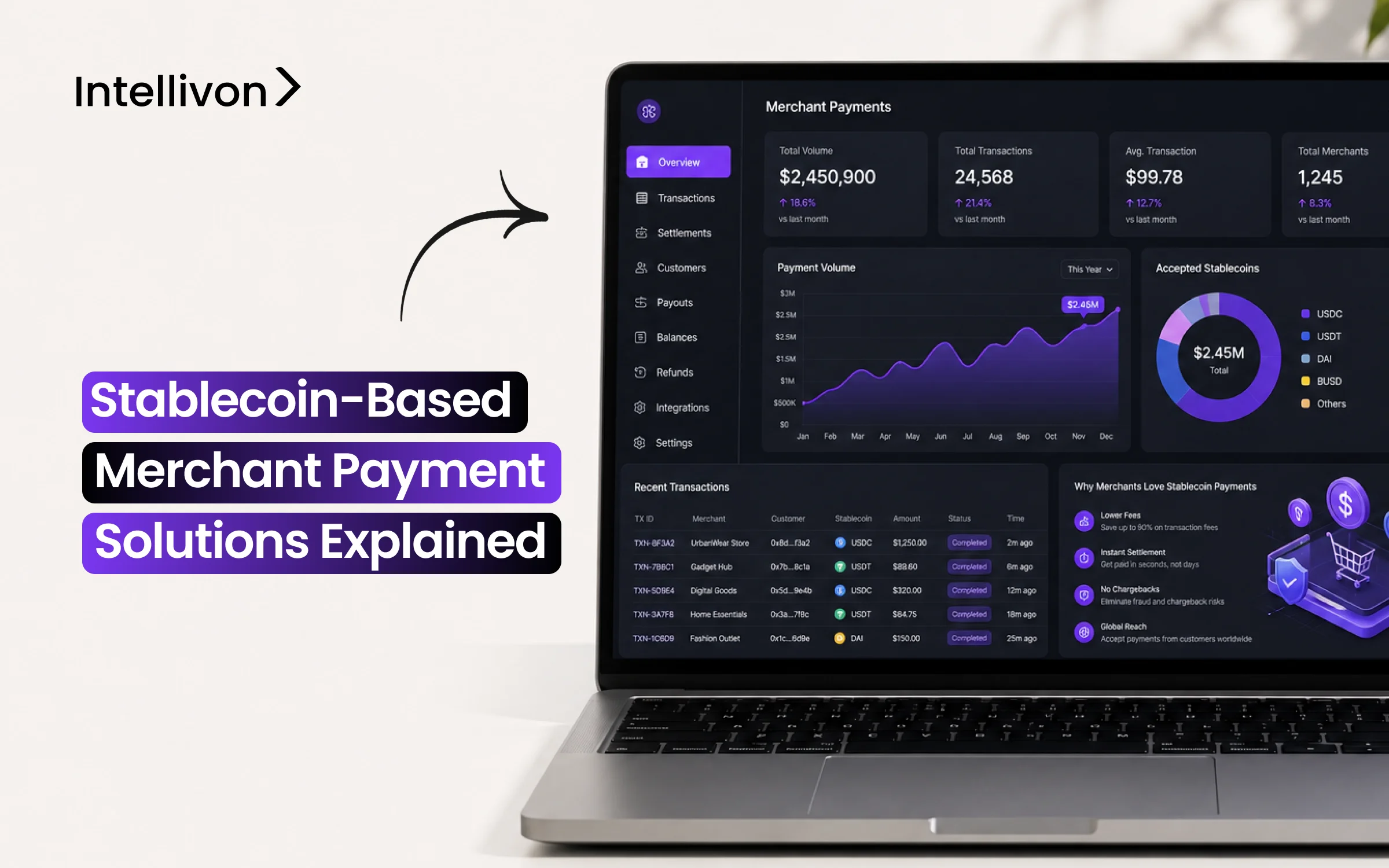
Key Takeaways:
-
Stablecoin merchant platforms accept payments via wallets, QR codes, e-commerce checkout pages, and payment APIs.
-
Transaction verification, wallet risk screening, internal ledger recording, and fiat or stablecoin settlement are core workflows.
-
Merchant KYB, blockchain monitoring, liquidity management, refunds, reconciliation, and reporting define production-grade requirements.
-
Focused implementations cost $70,000 to $120,000 while enterprise acquiring infrastructure reaches $220,000 to $300,000.
-
How Intellivon builds stablecoin merchant payment platforms as production payment infrastructure.
Stablecoin-based merchant payment solutions let a business accept USDC or USDT at checkout, settle instantly, and skip the chargeback system altogether. In fact, friendly fraud costs merchants real money even when a purchase was legitimate, and the customer simply changes their mind. The average chargeback in the US runs $110, and that’s before the lost merchandise gets added on.
Here’s the difference. Cards run on a pull model, where the merchant requests funds and a bank can reverse them on a customer’s word. Meanwhile, stablecoins run on a push model, so the customer sends funds directly, and once it settles, it’s final. Each disputed card transaction still costs a merchant $20 to $100 in processing fees alone, and as a result, global chargeback losses are on track to hit $41.69 billion by 2028, according to a 2026 merchant payments analysis. Consequently, merchants selling digital goods or shipping cross-border tend to see that fraud line disappear fast, often within a quarter.
However, refunds still need a real policy, since there’s no card network to lean on if a merchant gets one wrong. From here, this blog walks through gateway architecture, checkout integration, onboarding, and compliance.

What Are Stablecoin Merchant Payment Platforms?
A stablecoin merchant payment solution is software that lets businesses accept digital assets like USDC or USDT while automatically managing checkout, conversion, ledger records, and bank settlement.
Instead of just holding funds, these systems connect blockchain networks directly to traditional banking infrastructure.
Consequently, merchants can process global customer payments instantly, eliminate credit card interchange fees, and control whether they receive final payouts in crypto or local fiat currency.
1. Stablecoin Checkout Versus Stablecoin Settlement
Merchants can configure stablecoin architectures to handle frontend customer payments, backend settlement rails, or both depending on their operational needs.
| Model | Customer Payment | Merchant Payout | Key Advantage | Primary Use Case |
| Crypto-to-Fiat | Stablecoins (USDC/USDT) | Local Fiat (USD, EUR) | Eliminates crypto volatility and tax complexity for the merchant. | Mainstream e-commerce and retail brands. |
| Crypto-to-Crypto | Stablecoins (USDC/USDT) | Stablecoins (USDC/USDT) | Instant finality with zero banking fees or off-ramp delay. | Cross-border B2B platforms and Web3 merchants. |
| Fiat-to-Stablecoin | Credit Card / Bank Rail | Stablecoins (USDC/USDT) | Speeds up cross-border supplier payouts behind the scenes. | Global marketplaces and affiliate networks. |
| Stablecoin Card Rails | Card swipe (USDC-backed) | Conventional Fiat | Uses existing POS terminals without updating hardware. | Everyday retail point-of-sale environments. |
2. Why a Merchant Payment Platform Is More Than a Wallet
A simple digital wallet only stores private keys and signs transactions. In contrast, an enterprise payment platform automates the complex financial workflows required to run a real business.
- Payment Sessions & Order Matching: Generates unique, time-bound payment addresses for each cart checkout. As a result, the platform automatically links on-chain transfers to specific customer orders.
- Multi-Merchant Account Ledgers: Maintains double-entry internal ledgers for thousands of sub-merchants. Therefore, marketplaces can track balances, process platform fees, and manage payouts at scale.
- Payment Status Tracking & Webhooks: Monitors blockchain nodes in real time to catch incoming payments. Consequently, it fires instant webhooks to update inventory systems as soon as transaction finality occurs.
- Automated Refunds & Disputes: Manages controlled programmatic refunds directly to customer wallets. This setup eliminates manual key handling and prevents balance discrepancies.
- Fiat Off-Ramping & Liquidity: Integrates directly with banking APIs and liquidity providers. Thus, the system automatically converts incoming stablecoins to USD or EUR and initiates overnight ACH or FedWire payouts.
- Enterprise Reporting & Analytics: Exports standardized accounting statements, transaction logs, and tax data. As a result, finance teams can reconcile crypto receipts alongside traditional credit card processor statements.
- Automated KYC/KYB Compliance Controls: Runs automated Know Your Customer (KYC) and Know Your Business (KYB) checks on onboarding merchants. Furthermore, it screens receiving wallet addresses against sanction watchlists before processing funds.
Building a production-ready merchant platform requires connecting high-throughput blockchain RPC nodes directly with legacy banking rails.
For a deeper breakdown of how custom software bridges on-chain transactions with enterprise core systems, see our guide on [blockchain payment solution for ecommerce].
Why Merchants and Payment Platforms Are Adopting Stablecoin Payments
Merchants adopt stablecoin payment platforms to eliminate multi-day settlement delays, lower cross-border transaction fees, and remove traditional credit card chargeback risks.
By routing payments over blockchain networks instead of legacy card rails, businesses gain instant liquidity and automated multi-currency settlement. Consequently, platforms reduce operational costs while expanding direct access to international digital consumers.
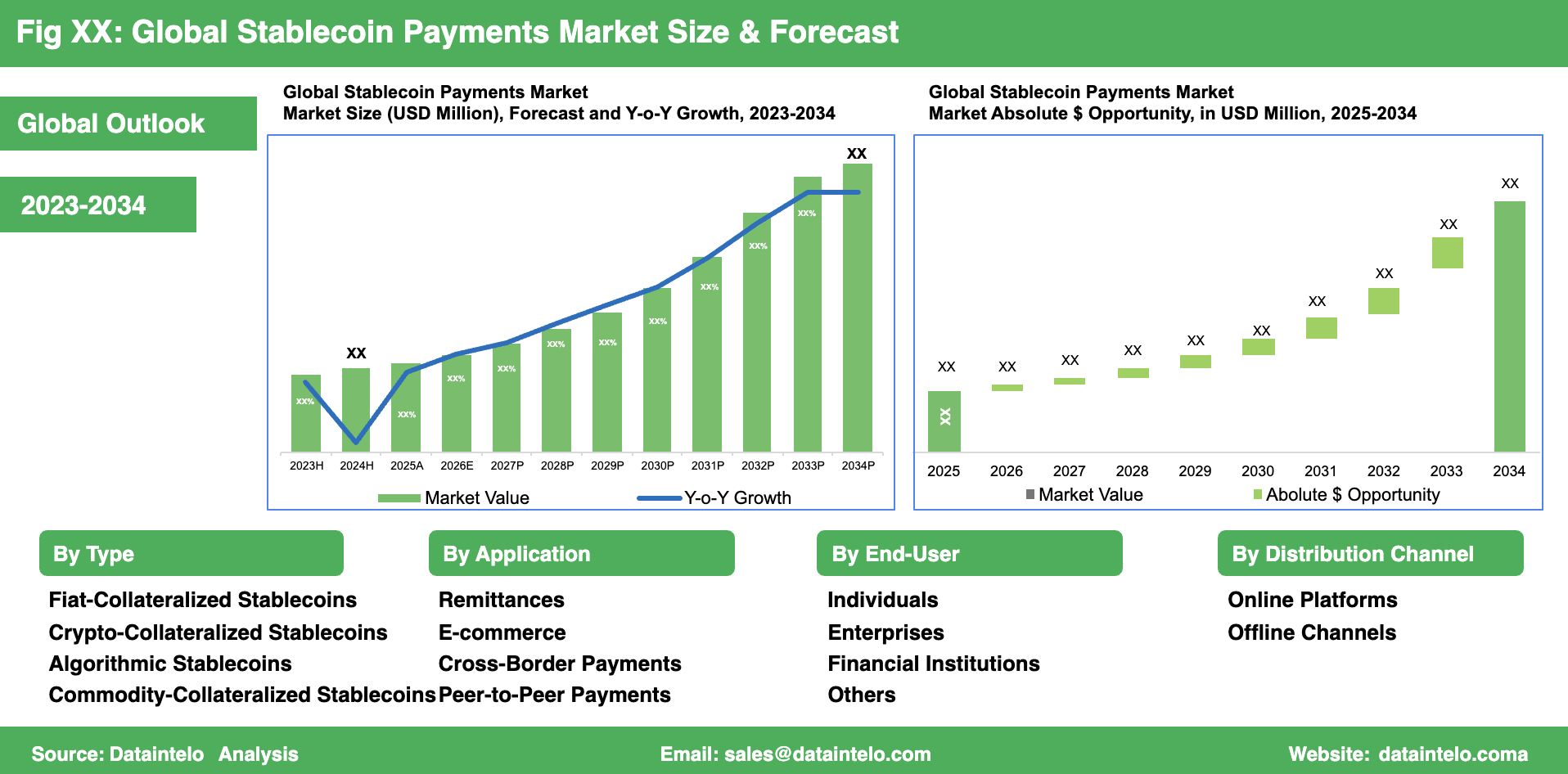
According to market research from Dataintelo, the global stablecoin payments market is expanding at a compound annual growth rate (CAGR) of 22.4% through 2033. This rapid growth reflects rising merchant demand for low-cost cross-border settlement. Furthermore, legacy financial providers are actively integrating blockchain rails to modernize global trade.
1. Faster Access to Merchant Funds
- Real-time settlement: On-chain transactions finalize in seconds, eliminating multi-day bank holdbacks.
- 24/7 liquidity: Funds clear on weekends and holidays without relying on ACH settlement windows.
2. Lower Costs in High-Friction Corridors
- Cross-border e-commerce: Replaces 3% to 6% international card fees with flat network costs.
- B2B payouts: Eliminates correspondent bank charges on global transfers.
3. Reduced Chargeback Exposure
- Zero card chargebacks: Irreversible transactions eliminate friendly fraud, though merchants must handle customer disputes programmatically.
4. New International Customer Segments
- Global USDC/USDT holders: Connects merchants to inflation-hedged buyers without international credit cards.
5. Programmable Merchant Settlement
- Automated payouts: Smart contracts split marketplace fees and release escrow funds instantly upon order delivery.
Adopting stablecoin rails grants merchants instant liquidity and fee protection that legacy networks cannot match. To achieve these benefits securely, engineering teams must build a well-architected infrastructure.
Which Stablecoin Merchant Payment Model Should You Use?
Choosing the right stablecoin merchant payment model depends on your transaction volume, legal structure, and engineering capacity. Businesses can accept funds directly via self-hosted wallets, deploy hosted payment gateways, or build fully custom processing architectures.
Consequently, evaluating operational needs across settlement speed, reporting requirements, and wallet control ensures you select an infrastructure that scales efficiently.
1. Direct Merchant Wallet Acceptance
- Best for: B2B invoice processing, low-volume merchants, and crypto-native teams with technical wallet expertise.
- Core limitations: Requires manual accounting reconciliation, creates private key security risks, and lacks automated refund mechanisms or operational scalability.
2. Managed Crypto Payment Gateway
- Best for: E-commerce stores, direct-to-consumer (D2C) brands, international SaaS providers, and merchants requiring automatic fiat off-ramping.
- Gateway responsibility: Hosted payment gateways manage customer payment sessions, generate temporary deposit addresses, monitor blockchain node confirmations, execute automatic fiat conversions, and deliver unified transaction reporting.
3. Custom Stablecoin Checkout Platform
- Best for: Independent software vendors (ISVs), payment service providers (PSPs), large marketplaces, and enterprise retailers with proprietary checkout flows.
- Custom advantages: Delivers total control over user experience, eliminates per-transaction gateway fees, enables custom smart contract routing, and integrates deeply with enterprise resource planning (ERP) systems.
4. Stablecoin Merchant Acquiring Platform
- Best for: Payment facilitators, merchant services providers, and fintech platforms that onboard and process payments for thousands of sub-merchants.
- Required capabilities: Platform architectures must include sub-merchant ledger management, automated Know Your Business (KYB) verification, risk tiering, customizable fee schedules, rolling reserves, automated settlement runs, sub-merchant dashboards, and exportable tax reporting tools.
5. Hybrid Card and Stablecoin Model
- Best for: Enterprise retailers seeking liquidity benefits without altering the consumer point-of-sale experience.
- Operational mechanism: Customers continue paying via familiar credit cards, Apple Pay, or debit rails at checkout. Meanwhile, the backend processing platform uses stablecoin settlement rails behind the scenes to execute instant, low-cost liquidity sweeps and inter-company cross-border settlements.
For a deeper breakdown of how enterprise financial platforms build compliant, scalable automated backends, see our guide on AI Audit Trail Software for Financial Services.
Selecting the optimal deployment model sets the foundation for your payment architecture. Next, engineering teams must evaluate the underlying blockchain network parameters to ensure high throughput, predictable fees, and instant transaction finality.
Stablecoin Payment Gateway Architecture for Merchant Platforms
A stablecoin payment gateway architecture integrates customer checkout interfaces, real-time transaction state engines, off-chain accounting ledgers, and secure wallet infrastructure.
Instead of relying solely on public blockchains for ledger storage, enterprise gateways maintain private internal ledgers to track fee splits, pending balances, and instant off-ramp conversions.
Consequently, this modular design guarantees sub-second response times, complete regulatory auditability, and high-throughput reliability.
Key Architecture Layer Trade-Offs
| Architecture Layer | Core Function | Primary Operational Risk | Performance Benchmark |
| Payment Orchestration | Session locking & FX quotes | Race conditions & duplicate callbacks | Sub-200ms API latency |
| Off-Chain Ledger | Balance tracking & fee splits | Balance mismatch across subaccounts | Zero double-entry drift |
| Wallet & Custody | Key management & transaction signing | Key compromise or unauthorized spend | Hardware-level isolation |
| Node Connectivity | Event listening & confirmation | RPC rate limits or network drops | 99.99% multi-provider uptime |
For a deeper breakdown of how enterprise architectures maintain secure financial records, see our guide on AI Audit Trail Software for Financial Services.
Building a modular architecture separates user interfaces, ledger tracking, and custody controls into isolated services. As a result, engineering teams can update blockchain networks or compliance rules without breaking core checkout flows.
This decoupling ensures high transaction throughput while maintaining enterprise compliance.
Designing a Stablecoin Checkout and POS Experience Customers Can Complete
Optimizing the stablecoin payment experience requires eliminating common crypto checkout errors such as network mismatches, dynamic exchange rate shifts, and underpaid transactions.
By establishing clear fiat-denominated pricing, automated address verification, and real-time transaction state indicators, platforms ensure frictionless customer checkout across mobile and physical retail terminals. Consequently, merchants achieve higher payment completion rates while streamlining reconciliation.
1. Keep Prices Fiat-Denominated
- Pricing display: Show primary prices in local fiat (USD, EUR) alongside the equivalent stablecoin amount, a clear network gas fee breakdown, and a guaranteed 15-minute FX exchange rate lock.
2. Prevent Wrong-Token and Wrong-Network Payments
- Safety controls: Enforce token contract allowlists, mandate chain validation protocols, trigger automatic wallet network switching via Web3 SDKs, and assign unique single-use deposit addresses per checkout session.
3. Handle Underpayments and Overpayments
- Tolerance rules: Set programmatic thresholds (e.g., ±$0.50) to complete orders automatically, fire dynamic payment requests for underpaid balances, or initiate automated wallet refunds for overpayments.
4. Design Confirmation States Properly
- Status tracking: Update interfaces in real time using clear status indicators: Awaiting Wallet Approval, Transaction Submitted, Payment Detected, Confirming, Paid, Underpaid, Expired, or Refunded.
5. Support Ecommerce, Mobile, and Physical Retail
- Omnichannel delivery: Deploy browser wallet extensions and Web3Modal for e-commerce, utilize mobile wallet deep-links and dynamic QR codes for point-of-sale (POS) displays, and maintain audit trails for both remote and customer-present transactions.
Stablecoin POS System
| Checkout Channel | Primary Interface | Completion Mechanism | Primary Friction Point |
| Desktop E-Commerce | Browser Extension / Modal | Direct RPC Wallet Injection | Network switching delays |
| Mobile Web | App Deep-Link | WalletConnect / Native App Launch | Application context switching |
| In-Person POS | Dynamic Terminal QR Code | Mobile Camera Scan & Sign | Inconsistent network connectivity |
For a deeper breakdown of building compliant, seamless checkout interfaces, see our guide on stablecoin payment user experience design.
Implementing strict front-end checkout validation shields customers from costly payment errors and minimizes manual merchant support interventions.
Stablecoin Merchant Compliance, Security, and Operational Resilience
Integrating stablecoin merchant payments requires balancing strict regulatory frameworks with high-availability technical infrastructure. Rather than treating compliance as an afterthought, enterprise platforms incorporate risk screening, key management, and node redundancy directly into their core codebases.
Consequently, this security-first architecture shields merchants from financial loss, wallet exploits, and regulatory sanctions.
1. Merchant KYB and Risk Classification
- Onboarding controls: Verifies corporate registrations, beneficial owners (UBOs), corporate bank accounts, expected transaction volumes, and prohibited merchandise through automated Know Your Business (KYB) checks.
2. Customer and Wallet Risk Controls
- Real-time screening: Filters incoming customer wallet addresses against sanctions lists, flags interactions with crypto mixers, and monitors transaction velocity to block illicit transfers.
3. Licensing and Regulatory Perimeter
- Jurisdictional scope: Differentiates self-accepting merchants from payment facilitators, fund transmitters, and custodial acquirers, requiring tailored money services business (MSB) licensing based on operating jurisdictions.
4. Travel Rule Applicability
- VASP compliance: Applies Financial Action Task Force (FATF) Travel Rule data exchange requirements exclusively when transactions involve regulated virtual-asset service providers (VASPs) rather than unhosted peer-to-peer wallets.
5. PCI DSS Scope
- Data security boundary: Pure stablecoin rails eliminate card-data handling obligations; however, Payment Card Industry Data Security Standard (PCI DSS) compliance remains mandatory if platforms integrate card-funded fiat on-ramps or shared payment pages.
6. Wallet and Key Security
- Key management: Safeguards assets using Multi-Party Computation (MPC), Hardware Security Modules (HSMs), multi-signature approvals, strict hot-wallet balance limits, and automated withdrawal allowlists.
7. Platform Reliability
- Operational uptime: Ensures continuous availability via multi-RPC provider failover, queue-based transaction execution, idempotent APIs, and smart contract re-org handling mechanisms.
8. Stablecoin and Counterparty Risk
- Risk mitigation: Monitors stablecoin depeg events, limits issuer concentration, maintains multi-bank off-ramp connections, and sets fallback liquidators to prevent settlement freezes.
| Risk Domain | Primary Threat Vector | Mitigating Engineering Control | Regulatory Benchmark |
| Sanctions Compliance | Illicit wallet interaction | Real-time address screening APIs | OFAC / FATF Guidelines |
| Key Management | Single point of key failure | MPC / HSM threshold signatures | SOC 2 Type II Standards |
| Platform Uptime | RPC provider downtime | Multi-node failover & queue retry | 99.99% Availability SLA |
For a deeper breakdown of building compliant, enterprise-grade financial systems, see our guide on merchant blockchain payment compliance.
Establishing robust compliance and resilience protocols shields your payment platform from regulatory penalties and security breaches. Once infrastructure safeguards are active, engineering teams can estimate the financial investment required to build and maintain the platform.
Where AI Improves Stablecoin Merchant Payment Operations
AI acts as an optimization layer for stablecoin payment platforms rather than a core processing requirement.
While basic smart contracts execute on-chain transfers, AI models automate operational tasks like fraud detection, dynamic liquidity routing, and checkout conversion tracking.
Consequently, incorporating machine learning reduces manual oversight and cuts transaction overhead for high-volume merchants.
1. Merchant Risk Scoring
- Input variables: Analyzes business incorporation data, corporate bank history, processing velocity, and wallet risk signals.
- Predictive evaluation: Assesses historical refund patterns, sudden geographic traffic spikes, and structural account setting updates.
- Model selection: Deploys gradient-boosted decision trees (XGBoost), logistic regression, and hybrid rules engines to output dynamic risk scores.
2. Transaction Anomaly Detection
- Pattern tracking: Flags abnormal wallet clustering, repeated micro-underpayments, and unauthorized geographic IP shifts in real time.
- Fraud mitigation: Identifies account takeover indicators, coordinated wallet attacks, and anomalous customer refund requests.
- Model selection: Uses Isolation Forests, autoencoders, and graph-based neural networks to detect complex, multi-wallet fraudulent schemes.
3. Intelligent Network and Liquidity Routing
- Execution optimization: Evaluates real-time gas prices, target network confirmation times, and RPC provider availability.
- Financial efficiency: Compares stablecoin liquidity pools, off-ramp conversion spreads, and individual merchant payout preferences.
- Smart routing: Automatically directs checkout transactions to the lowest-cost, fastest blockchain network meeting merchant policy constraints.
4. Liquidity Forecasting
- Capital planning: Predicts daily fiat off-ramp demand, chain-specific token requirements, and rolling refund reserve needs.
- Volume modeling: Projects merchant payout spikes around weekends, holidays, and promotional sales events.
- Reserve management: Rebalances treasury funds programmatically to prevent off-ramp settlement freezes or unexpected liquidity shortfalls.
5. Checkout Conversion Analytics
- Friction identification: Tracks drop-offs during Web3 wallet connection steps, network-switching prompts, and quote timeouts.
- Drop-off analysis: Measures abandonment rates driven by unexpectedly high gas fees or complex mobile deep-linking flows.
- UX optimization: Highlights precise technical checkout bottlenecks to guide user interface redesigns and boost payment success rates.
| Operational Domain | Primary AI Model / Technique | Core Optimization Metric |
| Merchant Risk Scoring | Gradient-Boosted Decision Trees | False positive reduction rate |
| Anomaly Detection | Isolation Forests & Autoencoders | Sub-second fraudulent transaction flags |
| Liquidity Routing | Multi-Armed Bandit / Reinforcement | Average gas & FX cost reduction |
For a deeper breakdown of how machine learning models maintain compliant financial records, see our guide on AI Audit Trail Software for Financial Services.
AI tools must always operate within strictly defined policy boundaries. Machine learning models should recommend actions or automate low-risk workflows, but they must never independently alter merchant settlement destinations.
How to Build a Stablecoin Merchant Payment Platform
Building an enterprise-grade stablecoin merchant payment platform requires moving beyond basic smart contract deployments. At Intellivon, we build production-ready payment systems by treating the blockchain as an external clearing house while maintaining an off-chain, double-entry financial ledger as the source of truth.
Consequently, our end-to-end engineering roadmap ensures sub-second API performance, enterprise auditability, and seamless fiat banking integration.
Here is the exact step-by-step engineering methodology Intellivon follows to architect, build, and deploy custom stablecoin payment rails for marketplaces, payment service providers (PSPs), and enterprise retailers.
Phase 1 — Define the Merchant Payment Model
Building an enterprise platform begins by establishing operational boundaries long before writing smart contracts.
- Strategic alignment: We help engineering leaders decide between single-merchant, multi-tenant marketplace, or PSP acquiring architectures, while establishing payout rules for local fiat versus native stablecoins.
- Technical scoping: Our team defines target jurisdictions, custody preferences (MPC versus non-custodial), initial asset support (USDC/USDT), and blockchain network selection based on throughput requirements.
- Intellivon approach: We map out merchant workflows, daily settlement liabilities, and regulatory perimeters before choosing individual blockchain tools. This prevents costly architectural refactoring during later regulatory audits.
- Forward transition: Once the operating perimeter is established, we map the underlying financial state machine and database schema.
Phase 2 — Design the Ledger and Payment Architecture
A resilient payment gateway requires a high-performance database layer capable of tracking complex balance splits.
- System blueprints: We draft end-to-end API contracts, data models, threat models, and real-time state machine diagrams to govern payment session lifecycles.
- Core ledger engine: Our engineers build an off-chain, double-entry accounting ledger to isolate pending balances, merchant liabilities, platform commissions, and network fee allocations.
- Intellivon approach: We treat the internal database as the ultimate financial source of truth and the public blockchain as a delayed settlement rail. Therefore, double-entry balance checks happen instantly off-chain without waiting for block confirmations.
- Forward transition: With the core ledger designed, our teams begin building the customer-facing checkout components.
Phase 3 — Build the Merchant and Checkout MVP
The initial build phase focuses on delivering a functional checkout pipeline for a targeted, high-value merchant segment.
- Core MVP scope: We construct hosted checkout modals, dynamic Web3 wallet connection adapters, time-bound payment sessions, USDC acceptance rails, and real-time transaction status listeners.
- Operational interfaces: Our engineers deliver a foundational merchant management dashboard alongside manual or scheduled batch settlement execution tools.
- Intellivon approach: We intentionally restrict initial releases to one primary merchant archetype and two high-throughput networks (such as Base or Solana). This keeps deployment focused while validating core payment session mechanics.
- Forward transition: After establishing basic payment execution, we integrate mandatory regulatory screening and banking rails.
Phase 4 — Add Compliance, Conversion, and Reconciliation
Scaling payment volume requires connecting on-chain activity with traditional banking systems and automated compliance controls.
- Integrations: We connect automated Know Your Business (KYB) verification providers, real-time wallet address sanction screening tools, and fiat off-ramp banking APIs.
- Enterprise workflows: Our teams integrate automated bank payout systems (ACH/FedWire), programmatic customer refund interfaces, operational management consoles, and ERP/accounting software sync connectors.
- Intellivon approach: We design compliance workflows that execute in parallel with checkout sessions, ensuring real-time address screening adds zero friction to the end-user experience.
- Forward transition: With banking and compliance rails active, we subject the platform to rigorous financial and network stress testing.
Phase 5 — Test Financial and Blockchain Edge Cases
Blockchain networks introduce asynchronous edge cases that traditional card processing software never encounters.
- Edge case simulation: We subject the payment engine to duplicate webhook calls, dynamic quote expirations, wrong-network transfers, incorrect token deposits, underpayments, overpayments, and delayed block confirmations.
- Resilience validation: Our quality assurance engineers simulate public blockchain reorganizations, RPC provider rate-limiting spikes, off-ramp liquidity failures, and dropped webhook retries.
- Intellivon approach: We build automated fault-injection suites that trigger synthetic network failures during active checkout sessions, proving the payment state machine recovers without data loss.
- Forward transition: Once edge-case stability is proven, we prepare the system for live production deployment under controlled conditions.
Phase 6 — Pilot With Controlled Merchant Volume
Transitioning to live production requires a guarded rollout to protect capital and systematically monitor network performance.
- Controlled deployment: We launch the platform with a select group of pilot merchants, enforcing strict per-transaction volume caps and restricting operations to low-risk geographic corridors.
- Oversight protocols: Our operations team runs daily double-entry ledger reconciliations, performs manual compliance checks on high-value transfers, and maintains active incident response protocols.
- Intellivon approach: We maintain dedicated engineering support throughout the pilot phase, directly analyzing real-time node logs and webhook latency metrics alongside merchant operational teams.
- Forward transition: After hitting pilot performance targets, we unlock full platform automation to support global scale.
Phase 7 — Scale Merchant Acquiring and Settlement
The final engineering phase automates manual management tasks, enabling the platform to onboard and process payments for thousands of sub-merchants.
- Automated capabilities: We deploy automated merchant underwriting, dynamic pricing tier management, rolling reserve calculations, multi-chain intelligent transaction routing, and sub-second instant payout sweeps.
- Advanced optimization: Our engineers integrate AI-assisted risk scoring models, enterprise SLA monitoring dashboards, and detailed multi-currency tax reporting tools.
- Intellivon approach: We configure automated rebalancing scripts across off-ramp liquidity pools, ensuring the platform maintains continuous payout availability even during massive processing volume spikes.
Following this modular development roadmap ensures your stablecoin payment platform delivers enterprise reliability and compliance from day one.
To budget effectively for this engineering effort, leadership teams must review the explicit cost breakdowns across development phases.
Stablecoin Merchant Payment Platform Development Cost
A stablecoin merchant payment platform costs $70,000 to $300,000, depending on merchant count, checkout channels, custody, supported networks, fiat settlement, compliance depth, and enterprise integrations.
Cost Breakdown by Component
| Engineering & Functional Component | Estimated Budget | Key Included Deliverables & Capabilities |
| Discovery, Compliance Mapping, & Architecture | $8,000–$20,000 | Use-case discovery, regulatory-perimeter mapping, payment-flow design, ledger architecture, threat modeling, and technical specifications. |
| UX, Merchant Dashboard, & Checkout | $10,000–$30,000 | Hosted checkout modal, embedded widgets, Web3 wallet connection adapters, merchant dashboard, operations console, and POS terminal interfaces. |
| Payment APIs, Ledger, & Orchestration | $20,000–$60,000 | Payment sessions, state machine, internal double-entry ledger, dynamic fee handling, webhook delivery, refund engine, and settlement workflows. |
| Wallet & Blockchain Integration | $12,000–$35,000 | Custody provider integration, deposit address generation, real-time block monitoring, node/RPC connectivity, confirmation policies, and multi-chain support. |
| KYB, AML, & Compliance Controls | $10,000–$35,000 | Merchant onboarding workflows, automated wallet screening, sanctions checks, transaction monitoring, case management tools, and audit logs. |
| Fiat Conversion & Merchant Settlement | $10,000–$35,000 | Liquidity provider integrations, FX conversion engines, automated bank payouts (ACH/Wire), settlement schedules, treasury controls, and reconciliation. |
| Security, Testing, & Production Deployment | $10,000–$30,000 | Penetration testing, key-management validation, load testing, disaster recovery protocols, live monitoring setups, and production CI/CD deployment. |
Implementation Tiers
| Platform Scale & Target Tier | Cost Range | Target Capabilities & Production Scope |
| Focused Merchant MVP | $70,000–$120,000 | Single-tenant or focused merchant segment, hosted web checkout, 1–2 blockchain networks, USDC acceptance, manual/scheduled settlements, basic compliance. |
| Multi-Merchant Payment Platform | $120,000–$200,000 | Multi-tenant merchant architecture, e-commerce and POS mobile support, multi-chain routing, automated fiat off-ramps, automated KYB/AML screening. |
| Enterprise PSP or Acquiring Platform | $200,000–$300,000 | Full payment service provider infrastructure, dynamic liquidity routing, instant fiat payouts, white-label merchant portals, AI-assisted risk scoring, custom ERP/accounting integrations. |
Ongoing Platform Maintenance
Annual maintenance, infrastructure monitoring, regulatory compliance updates, dedicated node hosting, and continuous feature improvements usually require 15%–25% of the initial development cost per year.
Planning a stablecoin merchant payment product? Download the Stablecoin Merchant Platform Cost and Architecture Checklist to compare checkout, custody, compliance, settlement, and integration requirements before scoping development.
Build a Stablecoin Merchant Payment Platform With Intellivon
Intellivon engineers custom, production-ready payment gateways that seamlessly integrate public blockchain settlement directly into your core tech stack.
Whether you are launching an e-commerce checkout modal, expanding point-of-sale capabilities, or building a multi-tenant payment service provider (PSP) platform, Intellivon delivers end-to-end engineering across the complete payment lifecycle:
- Stablecoin Checkout & POS: Modular web checkout UI, embedded widgets, mobile wallet deep-linking, and dynamic retail POS QR generation with local fiat-denominated pricing and guaranteed FX quote locks.
- Merchant Onboarding: Frictionless self-service merchant portals paired with automated KYB verification, ultimate beneficial owner (UBO) checks, corporate bank account validation, and risk tiering.
- Payment APIs & Orchestration: High-throughput, idempotent payment APIs paired with an off-chain double-entry accounting ledger to manage pending balances, platform fees, and merchant liabilities.
- Multi-Chain Routing: Seamless multi-chain asset acceptance (USDC, USDT, EURC) across high-speed networks with automatic RPC failover and transaction status listeners.
- Fiat & Stablecoin Settlement: Flexible settlement engines supporting dynamic fiat off-ramping (ACH, FedWire, SEPA), native stablecoin wallet payouts, and automated treasury reserve balancing.
- Refunds & Reconciliation: Programmatic resolution engines for underpayments and overpayments, automated customer refund workflows, and real-time ledger balance matching.
- Compliance Automation: Real-time customer wallet sanctions screening, anti-money laundering (AML) controls, transaction velocity monitoring, and FATF Travel Rule messaging integration.
- AI Risk & Intelligent Routing: Governed machine learning models for real-time transaction anomaly detection, merchant risk scoring, dynamic gas fee optimization, and off-ramp liquidity forecasting.
- Enterprise Integrations: Turnkey connectors for accounting software, ERP platforms, core banking rails, and payment gateway infrastructure.
- Production Monitoring: Enterprise 24/7 node health tracking, automated re-org handling, fallback liquidity triggers, and dedicated SLA monitoring dashboards.
Intellivon helps payment companies, marketplaces, ecommerce platforms, and enterprise merchants turn stablecoin acceptance into governed payment infrastructure. Start with an architecture and cost assessment based on your merchant model, settlement requirements, jurisdictions, and expected transaction volume.
Conclusion
In summary, integrating stablecoin merchant payments transforms legacy card rails into near-instant, low-cost global settlement infrastructure. However, achieving enterprise-grade reliability requires bridging decentralized blockchains with centralized double-entry accounting and strict regulatory compliance.
Ultimately, by deploying fiat-denominated checkouts, automated KYB and wallet screening, and intelligent liquidity routing, platforms effectively mitigate volatility and settlement friction. Consequently, forward-thinking fintech leaders who adopt governed, multi-chain payment architectures today will secure a decisive competitive edge in modern global commerce.
FAQs
Q1. Do Merchants Need a Crypto License to Accept Stablecoin Payments?
A1. Generally, merchants accepting stablecoins directly for their own goods operate outside traditional money transmitter licensing. Conversely, platforms that custody, convert, transmit, or settle funds for third-party sellers enter strict regulatory perimeters. Therefore, organizations must separately evaluate custody, money transmission, conversion, and geographical acquiring responsibilities before launching payment infrastructure.
Q2. Should Merchants Accept USDC or USDT?
A2. Rather than selecting a single token, platforms should deploy a multi-asset strategy based on market demands. USDC offers stronger regulatory alignment and banking acceptance in North America, whereas USDT maintains massive global exchange liquidity. Consequently, decisions should weigh target customer demographics, geographic corridors, reserve transparency, and supported blockchain networks.
Q3. How Do Stablecoin Refunds Work Without Chargebacks?
A3. Because blockchain transactions are irreversible, merchants must execute a distinct outbound transfer rather than reversing an existing ledger entry. First, the platform verifies the original payment and screens the destination address. Subsequently, the system creates dual-entry ledger records and issues the refund transaction, producing an immutable on-chain hash.
Q4. Can Stablecoins Support Subscription Payments?
A4. While blockchains lack native recurring debit mechanisms, platforms can simulate subscriptions through smart contract allowances or delegated wallet permissions. Alternatively, merchants can utilize prepaid balance models, off-chain pre-authorizations, or specialized recurring payment protocols. As a result, customers enjoy seamless automated billing while retaining cryptographic control over their assets.
Q5. What Happens When a Customer Uses the Wrong Blockchain Network?
A5. To prevent asset loss, checkout interfaces should validate chain IDs and automatically prompt network switching before execution. However, if funds are sent to an unsupported network, retrieval requires direct access to non-custodial private keys. Consequently, cross-chain recovery remains technically complex, time-consuming, and should never be guaranteed to customers.
To Sum It Up
- Stablecoin merchant payments reduce card-style settlement friction, but they transfer more responsibility for refunds, error prevention, and customer recourse to the payment platform.
- A blockchain transaction hash is not a merchant ledger; scalable platforms still need double-entry accounting and order-level reconciliation.
- The cheapest blockchain network can become the most expensive option when wallet adoption, liquidity, support workload, and failed checkout attempts are included.
- AI improves fraud detection, routing, and liquidity forecasting only after the payment-state model and ledger are accurate.
- A production stablecoin merchant payment platform costs $70,000–$300,000 because checkout represents only one layer of the build.