Key Takeaways:
-
AI transcription data becomes analytically useful only after speaker separation, clinical entity extraction, and terminology normalization are complete.
-
NLP extracts clinical entities mapped to ICD-10, CPT, SNOMED CT, LOINC, and RxNorm before any analytics can begin.
-
FHIR/HL7 integration combines transcription data with EHR, claims, lab, pharmacy, and operational data in one healthcare data warehouse.
-
De-identified data supports population health, quality reporting, revenue cycle analysis, and executive dashboards across the enterprise.
-
How Intellivon builds the integration and analytics engineering layer for these platforms, costing $70,000 to $300,000.
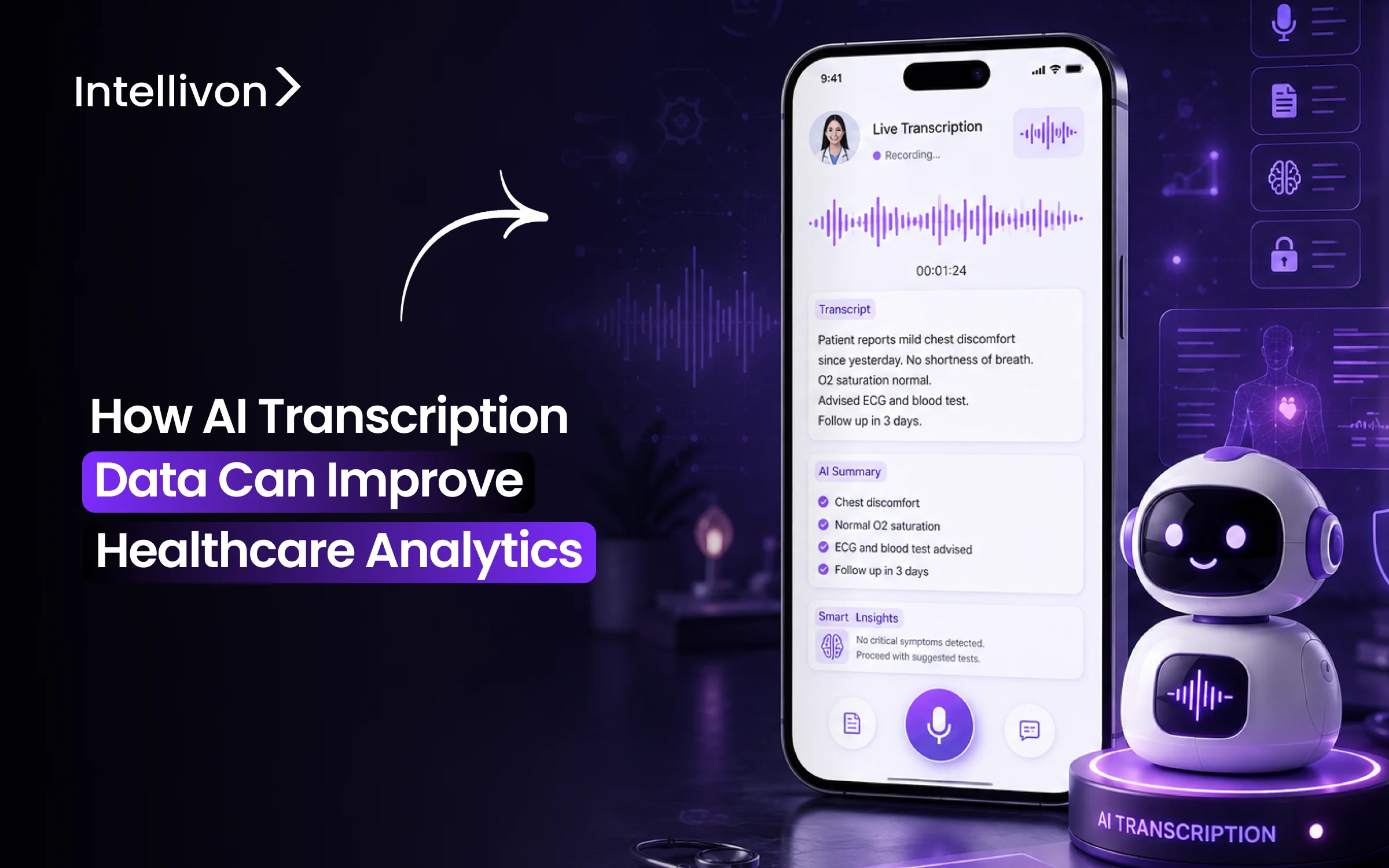
AI transcription data can improve healthcare analytics, but most health systems use it for faster notes. In fact, roughly two-thirds of hospitals running Epic had adopted ambient AI documentation by mid-2025, according to an AJMC analysis cited in a 2026 industry guide. However, almost none of them treat the underlying transcript as structured data worth analyzing on its own.
That gap matters because a transcript already contains diagnoses, medications, and symptoms in raw form, before a coder or an analyst ever touches it. For instance, NLP extraction can pull that data out and map it to ICD-10, SNOMED, and LOINC codes automatically. Meanwhile, this same pipeline feeds population health dashboards, HCC coding accuracy, and quality measure reporting, not just the note itself. As a result, health systems sitting on months of ambient transcription data are sitting on an analytics dataset they haven’t touched yet.
In this blog, we’ll cover how to extract structured clinical concepts from transcription data, then build the pipeline into your EHR and data warehouse. Additionally, we’ll walk through population health, quality reporting, and revenue cycle analytics, along with HIPAA de-identification requirements and what this build costs.

What AI Transcription Data Means for Healthcare Analytics
AI transcription transforms raw clinical conversations into structured intelligence, giving analytics teams access to data previously lost in unrecorded dialogues. Instead of treating ambient listening tools solely as administrative note generators, health systems can turn spoken interactions into measurable data points.
Consequently, this AI transcription data healthcare analytics guide defines how spoken consultations become standardized, machine-readable assets for enterprise reporting.
1. Raw Conversation Data
Raw conversation data captures the direct acoustic and conversational stream during a medical visit. Furthermore, this foundation provides the necessary audit trail for every downstream clinical insight.
- Acoustic Audio Streams: Multi-channel ambient audio recordings captured at 16 kHz or higher sample rates.
- Granular Timestamps: Word-level start and end offsets mapped across the entire encounter timeline.
- Speaker Diarization: Automated separation that attributes speech tokens specifically to the clinician, patient, or caregiver.
- Token Confidence Scores: Acoustic model probability values assigned to each transcribed word to flag potential errors.
- Utterance Segmentation: Contextual tagging that distinguishes subjective patient concerns from objective clinician statements.
Therefore, preserving raw conversational signals ensures that downstream models have the context required to verify clinical intent.
2. Transcript and AI-Generated Clinical Data
Converting acoustic signals into draft documentation requires separating verbatim transcripts from synthesized clinical summaries. As a result, this processing layer organizes unstructured dialogue into distinct clinical documentation drafts.
- Verbatim Transcripts: Word-for-word text containing natural pauses, false starts, and conversational interruptions.
- Cleaned Clinical Transcripts: Filtered dialogue stripped of non-clinical filler words while retaining full medical context.
- Synthesized SOAP Notes: Structured clinical summaries arranged into Subjective, Objective, Assessment, and Plan formats.
- Extracted Clinical Entities: Unlinked mentions of conditions, dosages, and procedures pulled directly from dialogue blocks.
- Suggested Billing Codes: Preliminary ICD-10 and CPT code suggestions generated for downstream coder review.
However, raw transcripts and narrative notes still function as free text rather than queryable database records.
3. Analytics-Ready Clinical Data
Analytics-ready clinical data converts free text into normalized, ontology-mapped database entries. Ambient extraction platforms like Autoscriber demonstrate that spoken encounters contain critical clinical signals that must be mapped to standard terminologies before running population-level queries.
- Diagnoses & Symptoms: Clinical conditions mapped directly to standardized SNOMED CT and ICD-10 concept identifiers.
- Medications & Dosages: Prescribed pharmaceuticals, potencies, and administration schedules normalized to RxNorm standards.
- Procedures & Tests: Diagnostic and surgical actions mapped to uniform CPT and LOINC codes.
- Vitals & Lab Mentions: Discrete numeric values extracted alongside spoken baseline ranges.
- Social History & SDOH: Spoken housing instability, food insecurity, and transportation barriers translated into standardized Z-codes.
- Treatment Plans & Follow-ups: Explicit care instructions and scheduled specialty referrals converted into discrete tabular fields.
Importantly, conversational data captures spoken observations rather than verified clinical truth, which requires validation before population health modeling. Consequently, structuring these conversational signals unlocks longitudinal insights that traditional electronic health records routinely miss.
How Clinical Conversations Become Analytics-Ready Data
Transforming ambient dialogue into structured clinical intelligence requires an automated, multi-stage data pipeline.
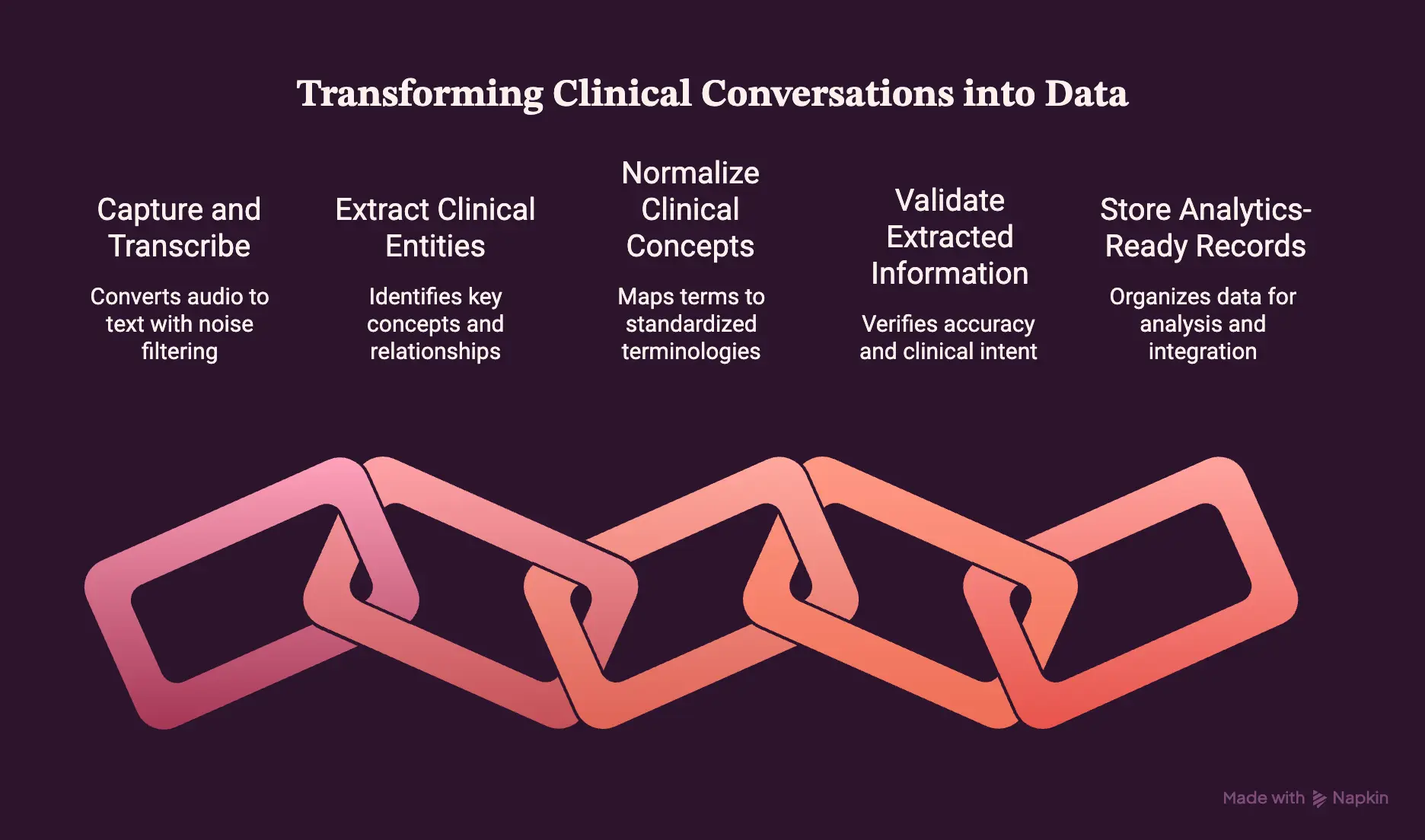
Free-form physician-patient discussions cannot feed predictive models or dashboards until they undergo acoustic processing, entity extraction, ontology normalization, and verification.
Consequently, this AI clinical transcription data analytics guide outlines the pipeline that converts spoken encounters into queryable database assets.
Step 1 — Capture and Transcribe the Clinical Encounter
Acoustic processing captures multi-speaker audio and converts raw sound waves into time-aligned, speaker-attributed text.
Additionally, acoustic models must filter ambient hospital noise while maintaining high accuracy for diverse clinical accents.
- Ambient Audio Capture: Multi-array microphones capture room dialogue without requiring doctors to hold dictation devices.
- Clinical Speech Recognition: Domain-specific acoustic models translate complex pharmacological and anatomical terms into verbatim text.
- Speaker Diarization: Neural networks separate clinician, patient, and caregiver speech into distinct conversational tracks.
- Noise Suppression & Timestamps: Filters remove background alarms and exam table rustling while generating word-level millisecond timestamps.
Therefore, clean transcription establishes the reliable textual baseline required for semantic parsing.
Step 2 — Extract Clinical Entities With NLP
Natural language processing models parse conversational transcripts to identify discrete clinical concepts and their semantic relationships. Furthermore, these models determine whether a mentioned condition is active, historical, suspected, or explicitly ruled out.
- Named Entity Recognition (NER): Deep learning models detect diseases, anatomical sites, and planned interventions.
- Symptoms, Diagnoses & Medications: Contextual parsers separate subjective complaints from objective assessments and extract drug names, dosages, and frequencies.
- Procedures & Measurements: Algorithms capture spoken vital signs, diagnostic tests, and scheduled surgical procedures.
- SDOH & Relationship Linking: Dependency parsing extracts social determinants of health and connects prescribed drugs directly to their indicated conditions.
As a result, unstructured conversational dialogue transforms into linked clinical entities with semantic meaning.
Step 3 — Normalize Clinical Concepts
Extracted entities must map directly to standardized clinical terminologies to enable cross-patient querying and aggregation.
For instance, a conversational phrase like “high blood sugar” cannot remain free text if analytics engines must aggregate diabetes trends across millions of records.
- SNOMED CT & ICD-10-CM: Normalizes clinical findings, symptoms, and diagnoses into standardized semantic identifiers for risk adjustment.
- CPT & LOINC: Standardizes diagnostic procedures, surgical interventions, laboratory observations, and spoken vital metrics.
- RxNorm & HCC: Resolves brand names and potencies to precise drug codes, mapping chronic conditions to Hierarchical Condition Categories.
Consequently, uniform coding transforms subjective verbal phrases into queryable database records across disparate health systems.
Step 4 — Validate the Extracted Information
Automated validation protocols verify that extracted entities reflect accurate clinical intent before reaching enterprise data stores.
Furthermore, combining probabilistic machine learning scores with deterministic business rules prevents inaccurate clinical assumptions from entering the warehouse.
- Dual-Confidence Scoring: Validation pipelines multiply acoustic confidence with entity extraction scores to evaluate data quality.
- Source-Span Attribution: Every extracted code links back to the exact conversational sentence and timestamp for complete auditability.
- EHR Reconciliation & Rule Checks: Logic layers verify medical plausibility and cross-reference newly extracted concepts against existing patient problem lists.
Thus, multi-layered validation ensures downstream analytics models consume only verified, high-confidence clinical assertions.
Step 5 — Store Analytics-Ready Records
Validated clinical entities load into standardized database schemas designed for both single-encounter retrieval and longitudinal analysis.
Therefore, standardized interoperability formats, particularly Fast Healthcare Interoperability Resources (FHIR), ensure these conversational datasets integrate cleanly with external enterprise systems.
The Office of the National Coordinator for Health Information Technology (ONC) emphasizes that FHIR provides a standardized mechanism for efficiently exchanging clinical and administrative healthcare data.
- FHIR Resource Generation: Extracted clinical concepts map directly into standard resources like Condition, MedicationRequest, and Observation.
- Encounter & Longitudinal Schemas: Stores transactional visit records while aggregating multi-encounter patient timelines into cloud data warehouses.
- Columnar Analytics Integration: Formats transformed clinical tables into Parquet files optimized for high-speed SQL analytics engines.
Ultimately, structuring conversation data into standardized FHIR resources unlocks immediate use cases across population health, revenue cycle management, and clinical quality reporting.
Which Transcription Data Should Healthcare Analytics Trust?
Healthcare analytics teams cannot treat all ambient outputs as equal, because transcription data reflects spoken dialogue rather than validated medical truth. Consequently, achieving meaningful AI medical transcription analytics improvement requires establishing a strict data trust hierarchy.
Therefore, analytics engines must segment raw conversational text from physician-verified and EHR-reconciled records.
Transcription Data Table
| Data Version | Permissible Analytics Use |
| Raw Transcript | Speech model QA, conversational pattern research, acoustic benchmarking |
| AI Structured Output | Candidate analytical features, preliminary care-gap flagging |
| Clinician-Reviewed Output | High-confidence clinical decision support, provider workflow metrics |
| EHR-Reconciled Record | Production clinical analytics, quality reporting, risk adjustment |
1. Raw Speech Is Evidence, Not Ground Truth
Spoken conversation captures real-time dialogue rather than definitive diagnostic conclusions. Furthermore, patients often express uncertainty, state approximate symptom dates, or mispronounce medication names during consultations.
- Patient Speculation: Captures subjective concerns and family member statements that clinicians may explicitly dismiss later.
- Conversational Contradictions: Documents unverified self-reports that require objective clinical testing to confirm.
Therefore, raw acoustic outputs must serve as supporting evidence rather than standalone clinical facts.
2. Clinician Corrections Are Valuable Analytics Data
Tracking physician edits to AI-drafted notes creates a rich feedback loop for operational monitoring. Recent clinical evaluations from institutions like UCSF Health highlight that ambient notes often require substantial clinician edits before sign-off.
- Model Drift Tracking: Measures how clinician modifications vary across medical specialties and software versions over time.
- Terminology Failure Detection: Identifies unmapped clinical slang, regional accents, and specialized acronyms.
For a deeper breakdown of tracking model performance, see our guide on Healthcare LLM Evaluation Metrics.
3. Preserve Data Provenance
Every analytical feature stored in the data warehouse must maintain end-to-end lineage back to the spoken encounter. Thus, robust governance prevents unverified ambient extractions from corrupting downstream quality scores.
- Complete Auditability: Links every quality metric back to the exact audio timestamp and clinician sign-off.
- Regulatory Compliance: Ensures analytical conclusions withstand strict compliance audits and clinical validation checks.
Ultimately, enforcing provenance ensures clinical analytics platforms consume only verifiable, high-integrity medical intelligence.
Architecture for AI Transcription Healthcare Analytics
Enterprise health systems require an end-to-end data pipeline to transform ambient clinical conversations into secure, governed analytics assets. Without a unified technical framework, spoken encounter data remains isolated within separate recording applications.
Consequently, this healthcare AI transcription data analytics design establishes a scalable, multi-tier architecture that links multi-source conversational capture directly to enterprise data lakes and business intelligence tools.
Architectural Layer Table
| Architectural Layer | Core Technologies & Components | Primary Function & Output |
| 1. Ingestion Layer | Nuance DAX, Abridge, Suki, Nabla, Telehealth WebRTC, Audio APIs | Secure streaming and batch ingestion of raw audio, JSON payloads, and diarized transcripts |
| 2. Intelligence Layer | Clinical ASR, Biomedical LLMs, Named Entity Linking, Rules Engine | Contextual entity extraction, medical ontology mapping, and dual-confidence scoring |
| 3. Integration Layer | Epic, Oracle Health (Cerner), FHIR R4 APIs, HL7 v2, Master Patient Index | Patient identity resolution, encounter ID mapping, and EHR record reconciliation |
| 4. Lakehouse Layer | Databricks, Snowflake, Apache Spark, AWS S3, Azure Data Lake, BigQuery | Medallion data modeling (Bronze/Silver/Gold) and longitudinal patient event storage |
| 5. Application Layer | Power BI, Tableau, Looker, Qlik, Custom React Dashboards, Embedded EHR UI | Self-service reporting, real-time clinical alerts, and executive population health visualization |
Ultimately, this modular architecture bridges conversational capture tools and enterprise decision-makers. By establishing governed pipelines from raw speech to visual dashboards, healthcare organizations turn ambient documentation investments into scalable operational intelligence.
What Clinical Intelligence Can Be Extracted From Transcripts?
Clinical conversations contain rich diagnostic signals that never make it into finalized EHR check-boxes. At the same time, when natural language processing parses ambient dialogue, it extracts discrete medical concepts and maps them to standard ontologies.
Consequently, unlocking clinical insights from AI transcription data that healthcare leaders need requires transforming conversational signals into structured, high-value analytical outputs.
Clinical Intelligence Transcript
| Conversation Signal | Structured Output | Primary Analytics Value |
| Symptoms Discussed | SNOMED CT concept | Disease progression and early intervention tracking |
| Spoken Diagnoses | ICD-10-CM / HCC code | Accurate risk adjustment and RAF score precision |
| Medication Conversations | RxNorm identifier | Drug adherence monitoring and reconciliation analytics |
| Laboratory Values | LOINC code | Longitudinal biomarker tracking and disease control |
| Planned Procedures | CPT code | Real-time charge capture and procedure volume forecasting |
| Housing / Food Insecurity | SDOH Z-code | Population risk stratification and equity analytics |
| Patient Hesitation / Doubt | Sentiment / Intent score | Patient engagement, trust, and shared decision-making |
| Specialist Referrals | Referral event entity | Care coordination and network leakage reduction |
| Follow-Up Instructions | Care plan milestone | Care gap closure and 30-day readmission prevention |
1. Clinical Entity and Relationship Extraction
Extracting individual words via Named Entity Recognition (NER) provides incomplete clinical context. Therefore, advanced NLP pipelines must extract semantic relationships to connect dependent medical variables accurately.
- Medication to Dosage: Links the specific drug entity directly to its prescribed strength, route, and dosing frequency.
- Symptom to Duration: Connects reported complaints directly to their onset timeline and severity trajectory.
- Condition to Severity: Maps diagnostic terms to clinical modifiers like acute, chronic, mild, or decompensated.
- Procedure to Indication: Binds diagnostic tests directly to the underlying clinical condition justifying medical necessity.
- Drug to Adverse Reaction: Links reported patient side effects to the specific offending pharmaceutical agent.
Thus, relationship mapping preserves clinical context, turning isolated phrases into coherent medical histories.
2. Structured Versus Inferred Data
Healthcare analytics platforms must rigorously distinguish between explicitly stated clinical facts and AI-inferred diagnostic conclusions. Therefore, unverified machine inferences should never enter production data lakes without clinician validation.
- Explicit Facts: Verbatim diagnostic confirmations, prescribed dosages, and spoken lab values confirmed by the physician.
- Inferred Conclusions: Probabilistic suggestions generated by AI models based on symptom patterns or medication discussions.
Consequently, maintaining strict boundaries between confirmed facts and AI inferences protects downstream clinical models from unverified diagnostic assumptions.
Where AI Transcription Data Creates the Most Value
Ambient transcription data delivers measurable enterprise value by surfacing clinical, financial, and operational signals trapped in unrecorded dialogue. At the same time, rather than simply archiving encounter text, analytics platforms extract structured variables to power downstream reporting engines.
Consequently, exploring these high-impact AI transcription healthcare analytics use cases demonstrates how health systems leverage conversational data across diverse clinical domains.
1. Population Health and Chronic Disease Analytics
Capturing subtle disease markers directly from ambient dialogue enables earlier clinical intervention across large patient populations. Therefore, applying AI transcription data to population health analytics helps care teams identify deterioration in conditions like diabetes, COPD, heart failure, and hypertension.
- Symptom & Progression Tracking: Identifies worsening shortness of breath, escalating pain, or unmanaged neuropathy before emergency admissions occur.
- Lifestyle & Behavioral Signals: Extracts unspoken dietary habits, physical limitations, and early behavioral health concerns from conversational context.
- Longitudinal Risk Monitoring: Aggregates multi-visit symptom trajectories to flag decompensating patients across primary care networks.
Thus, proactive conversational tracking shifts population health management from reactive treatments to preventive interventions.
2. Care Gap and Preventive Care Analytics
Conversational analytics surfaces preventive care discussions that clinicians frequently discuss but omit from structured EHR drop-down menus. However, these transcript signals must cross-reference historical claims and lab results before finalizing care gap closures.
- Preventive Screenings: Identifies documented patient refusals, outside mammograms, or upcoming colonoscopy discussions.
- Immunization & Counseling: Flags spoken vaccine hesitancy, nutritional counseling, and smoking cessation advice for targeted follow-up.
Consequently, reconciling spoken preventative discussions with structured health records prevents redundant outreach and improves outreach accuracy.
3. Quality Measures and Value-Based Care
Conversational intelligence enriches clinical quality reporting by verifying whether care teams followed established clinical practice guidelines. Furthermore, ambient data supplements formal CMS quality reporting and HEDIS measures with auditable documentation evidence.
- Guideline Adherence: Verifies whether clinicians performed required diabetic foot exams, depression screenings, or cardiovascular risk counseling.
- Documentation Completeness: Flags missing clinical specificity required to satisfy value-based quality metrics prior to encounter sign-off.
As a result, health systems achieve higher compliance scores while reducing manual chart abstraction burdens.
4. Risk Stratification and Predictive Analytics
Integrating conversational features into existing risk models dramatically improves early prediction of clinical decompensation and emergency utilization.
For a deeper breakdown of building predictive clinical models, see our guide on Predictive Patient Analytics and Machine Learning.
- Predictive Feature Extraction: Extracts early non-adherence admissions, repeated vague complaints, and unaddressed psychosocial distress.
- Multi-Modal Data Fusion: Merges conversational risk markers with historical claims, laboratory trends, and prior hospitalization patterns.
Therefore, multi-modal predictive models identify rising-risk patients months before acute events manifest.
5. CDI, Coding, and Revenue Cycle Analytics
Ambient transcription accelerates clinical documentation improvement (CDI) by identifying missing diagnostic specificity and under-coded comorbidities in real time.
For example, ambient platforms like Suki position conversational data as a structured input to automate ICD-10, HCC, and CPT coding workflows.
- HCC & RAF Optimization: Detects spoken chronic conditions to ensure accurate Hierarchical Condition Category capture and appropriate risk adjustment.
- Denial Prevention & Charge Capture: Verifies that documented clinical severity directly supports billed CPT evaluation and management codes.
Thus, automated coding cross-checks reduce documentation queries while protecting health systems from downstream audit clawbacks.
6. Operational and Provider Analytics
Analyzing operational metrics derived from ambient consultations uncovers systemic workflow bottlenecks without turning into intrusive clinician surveillance. Instead, these metrics focus on optimizing clinic scheduling and reducing administrative documentation burdens.
- Encounter Efficiency: Measures true face-to-face consultation duration versus documentation time across distinct clinical specialties.
- Workflow Optimization: Identifies specific note templates or specialty workflows that trigger excessive manual physician editing.
Consequently, operational leaders can rebalance scheduling templates and optimize EHR configurations to alleviate physician burnout.
7. Research, RWE, and Health Equity Analytics
Extracting de-identified conversational markers unlocks rich Real-World Evidence (RWE) datasets for clinical trials and epidemiological research.
Furthermore, strict governance models ensure that extracted social determinants of health (SDOH) support equitable care delivery.
- Clinical Trial Cohort Discovery: Identifies potential clinical trial candidates based on nuanced symptom descriptions and treatment failure histories.
- Health Equity Monitoring: Analyzes spoken transportation, housing, and food security barriers to address systemic care disparities.
Ultimately, turning ambient conversations into structured, governed analytical assets bridges clinical operations, financial sustainability, and clinical research.
HIPAA, Privacy, and Data Governance Requirements
Secondary analytics on ambient recordings introduce significant regulatory and privacy challenges for healthcare organizations. Spoken consultations contain sensitive personal narratives alongside explicit medical details.
Consequently, this ambient AI transcription healthcare analytics design outlines the governance protocols required to safeguard conversational data while maintaining regulatory compliance.
1. Treat Audio and Transcripts as PHI
Acoustic recordings and raw clinical transcripts constitute Protected Health Information (PHI) under federal law. Therefore, health systems must enforce strict administrative, physical, and technical safeguards across the entire capture lifecycle.
- Business Associate Agreements (BAAs): Enforce strict legal liability across all downstream cloud vendors and third-party transcription APIs.
- Granular Access & Encryption: Mandates AES-256 encryption at rest, TLS 1.3 in transit, and role-based access controls for audio assets.
- Audit Logging & Retention Policies: Maintains immutable access logs and enforces automated data purge schedules once clinical notes are finalized.
Thus, treating conversational streams as core PHI prevents unauthorized data exposure across enterprise networks.
2. De-Identify Data Before Secondary Analytics
Population health and machine learning initiatives require scrubbing direct identifiers from conversational text before analytical processing.
At the same time, the U.S. Department of Health and Human Services (HHS) explicitly establishes Safe Harbor and Expert Determination as the two approved HIPAA de-identification methods.
- Safe Harbor Implementation: Automatically removes all 18 specified direct identifiers, including patient names, geographic locations, and exact visit dates.
- Expert Determination Method: Applies statistical and scientific principles to verify that re-identification risk remains negligible for complex datasets.
- Free-Text Scrubbing: Employs specialized Named Entity Recognition (NER) models to redact accidentally spoken identifiers embedded within unstructured dialogue.
For a deeper breakdown of building compliant clinical pipelines, see our guide on HIPAA-Compliant Ambient AI Scribe Architecture.
3. Separate Clinical Care From Secondary Uses
Healthcare organizations must strictly isolate real-time patient documentation workflows from secondary analytics, research, and machine learning pipelines.
- Direct Care Isolation: Restricts real-time encounter notes solely to immediate clinical documentation, care coordination, and billing.
- Secondary Use Segregation: Requires explicit data governance approval and anonymization before routing transcripts to quality reporting, operational analytics, or model training.
Consequently, clear purpose limitation frameworks prevent clinical data misuse while ensuring compliance with institutional review boards.
4. Build Complete Data Lineage
Maintaining granular audit trails ensures health systems can trace any downstream analytical metric back to its original conversational context.
- Provenance Tracking: Logs the source encounter ID, acoustic model version, and exact LLM prompt configuration used during processing.
- Validation & Edit Auditing: Records clinician modifications and downstream data warehouse transformations for complete regulatory auditability.
Ultimately, rigorous data lineage guarantees that enterprise analytics remain transparent, auditable, and fully compliant with evolving healthcare privacy mandates.
How Intellivon Builds AI Transcription Analytics Platforms
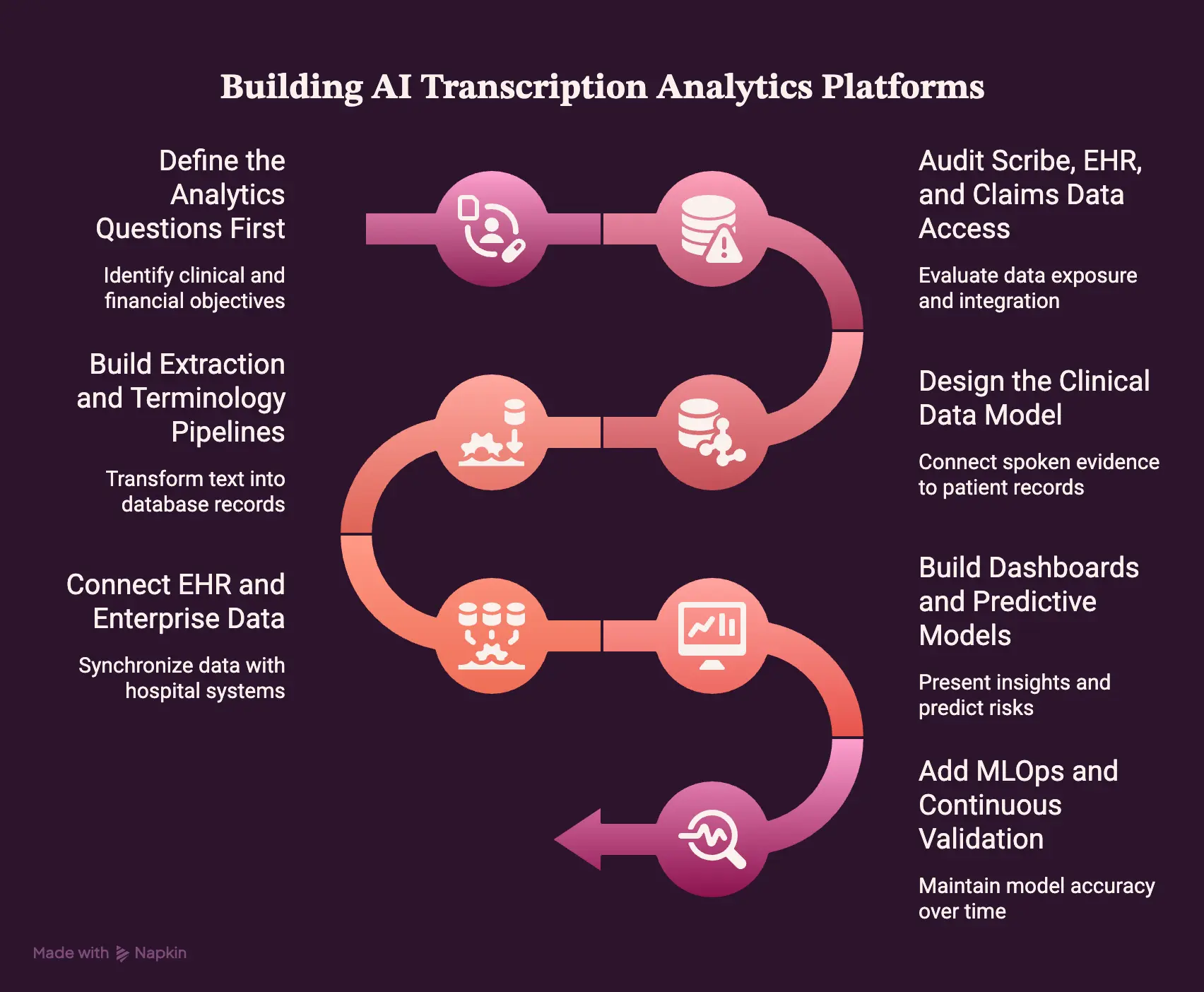
Engineering enterprise platforms that turn ambient dialogue into clinical intelligence requires bridging speech recognition, medical ontology mapping, and data warehouse architecture. Instead of treating transcription as a simple dictation tool, technical teams must build governed data pipelines.
Consequently, this guide to AI transcription clinical data analytics in 2026 details how Intellivon engineers enterprise-grade analytics platforms that transform conversational audio into queryable assets.
Step 1 — Define the Analytics Questions First
Platform engineering begins by identifying specific downstream clinical and financial objectives rather than ingesting raw dialogue indiscriminately.
Furthermore, defining core analytical questions early establishes the required data schemas and validation thresholds.
- Population Health Targets: Tracks longitudinal chronic disease markers across diabetes, hypertension, and heart failure cohorts.
- Quality & Reporting Goals: Automates evidence extraction for CMS clinical quality reporting and HEDIS measure adherence.
- Revenue Cycle Focus: Identifies under-documented comorbidities to optimize Hierarchical Condition Category (HCC) coding accuracy.
- Operational Benchmarks: Measures true consultation durations, referral leakage rates, and documentation burden metrics.
Therefore, Intellivon anchors pipeline design to concrete healthcare metrics, ensuring that every extracted entity directly supports measurable institutional outcomes.
Step 2 — Audit Scribe, EHR, and Claims Data Access
Building a scalable analytics layer requires auditing what data existing ambient transcription systems and electronic records actually expose. Additionally, engineering teams must evaluate vendor-specific APIs, streaming capabilities, and payload schemas.
- Ambient Vendor Auditing: Evaluates webhook event structures, audio retention policies, and JSON extraction payloads from tools like Nuance DAX, Abridge, Suki, and Nabla.
- Clinical Data Access: Assesses integration endpoints across EHR systems, historical claims databases, and pharmacy benefit feeds.
Thus, Intellivon audits client infrastructure to identify API constraints, security barriers, and integration pathways before writing ingestion code.
Step 3 — Design the Clinical Data Model
A robust data model connects spoken conversational evidence to unique patient records while maintaining strict clinical context. Moreover, schemas must preserve data lineage to support downstream clinical validation audits.
- Entity Relationship Mapping: Links encounters, patients, and providers directly to extracted concepts, clinical evidence spans, and validation statuses.
- Provenance Schemas: Records acoustic timestamps, model version numbers, and clinician review logs for every normalized medical concept.
For a deeper breakdown of designing intelligent clinical systems, see our guide on Building Smart EHR Systems with AI Capabilities. Intellivon structures relational schemas that bridge high-volume conversational inputs with existing hospital master indexes.
Step 4 — Build Extraction and Terminology Pipelines
Transforming unstructured clinical text into database records requires combining machine learning models with deterministic medical terminology services. Furthermore, multi-stage pipelines ensure that extracted text resolves to standard code systems.
- Multi-Stage Extraction: Combines domain-specific ASR, biomedical natural language processing, and clinical LLMs to extract symptoms, diagnoses, and treatments.
- Ontology Mapping Services: Maps extracted entities deterministically to SNOMED CT, ICD-10-CM, CPT, LOINC, and RxNorm code sets.
Consequently, Intellivon implements strict deterministic validation layers, preventing generative hallucinations from entering production data warehouses.
Step 5 — Connect EHR and Enterprise Data
Extracted conversational datasets must synchronize with core hospital information systems through standardized healthcare interoperability protocols. In addition, integration layers reconcile spoken observations with confirmed patient histories.
- Interoperability Standards: Connects conversational data pipelines to enterprise systems using HL7 v2 messaging and FHIR R4 resources.
- Enterprise Lakehouse Integration: Routes structured clinical events into cloud storage platforms, including Snowflake, Databricks, AWS, and Azure.
Therefore, Intellivon integrates conversational pipelines directly into existing enterprise data lakes, linking spoken encounter data with lab results, claims, and pharmacy feeds.
Step 6 — Build Dashboards and Predictive Models
The presentation layer delivers conversational insights directly to clinical, operational, and financial stakeholders through intuitive visual interfaces. Additionally, data science teams use normalized conversational variables to build predictive clinical risk models.
- Enterprise BI Dashboards: Publishes real-time clinical and operational KPIs to Microsoft Power BI, Tableau, and custom web interfaces.
- Predictive Risk Modeling: Combines conversational deterioration signals with longitudinal EHR histories to predict 30-day readmissions and rising-risk patients.
For a deeper breakdown of developing healthcare automation infrastructure, see our guide on How to Build an AI Healthcare Automation Platform. Intellivon designs role-based clinical dashboards that embed directly into existing physician workflows.
Step 7 — Add MLOps and Continuous Validation
Maintaining model accuracy over time requires continuous monitoring infrastructure that tracks real-world performance shifts. Furthermore, automated validation pipelines catch acoustic and semantic drift across clinical specialties.
- Continuous Model Auditing: Tracks token accuracy, clinician note edit rates, inference latency, and API compute costs across production environments.
- Drift & Bias Detection: Monitors specialty-specific terminology shifts, regional accent performance, and unexpected changes in code extraction confidence.
Ultimately, Intellivon deploys enterprise MLOps frameworks that continuously benchmark models, ensuring healthcare organizations maintain reliable, compliant, and cost-effective clinical intelligence platforms over time.
Cost to Build an AI Transcription Analytics Platform
A custom AI transcription analytics platform typically costs $70,000 to $300,000, depending on data-access complexity, EHR integrations, clinical NLP depth, analytics scope, and whether predictive models are included.
At the same time, health systems must evaluate integration pathways, pipeline automation, and regulatory constraints before deployment.
Consequently, engineering costs correlate directly with data volume, terminology complexity, and architectural breadth.
Development Cost Phase
| Development Phase | Estimated Cost |
| Discovery & Analytics Requirements | $5,000 – $15,000 |
| Scribe, EHR & FHIR Ingestion Pipelines | $15,000 – $55,000 |
| NLP & Clinical Entity Extraction | $15,000 – $65,000 |
| Warehouse & Lakehouse Architecture | $10,000 – $45,000 |
| Dashboards & Data Visualization | $10,000 – $45,000 |
| Security, Governance & Validation | $10,000 – $35,000 |
| MLOps & Production Deployment | $5,000 – $20,000 |
| Advanced Predictive Analytics (Add-on) | Up to $20,000 additional |
| Typical Project Range | $70,000 – $300,000 |
What Pushes the Cost Toward $70K
Deploying a streamlined analytics platform with constrained scope keeps initial engineering investments near the lower baseline. Furthermore, single-source architectures require less custom middleware and data harmonization.
- Single Transcription Input: Ingests structured JSON payloads from a single ambient listening vendor.
- Unified EHR Target: Synchronizes with one electronic health record system via standard batch exports.
- Batch Processing Pipelines: Processes audio transcripts overnight rather than requiring real-time event streaming.
- Standard Medical Ontologies: Limits entity extraction to direct ICD-10 and CPT coding without deep custom relationship mapping.
- Out-of-the-Box BI Dashboards: Implements pre-built visualization templates in Power BI or Tableau.
Therefore, organizations with centralized data environments can deploy functional analytics platforms efficiently.
What Pushes the Cost Toward $300K
Complex multi-facility health systems require scalable architectures capable of handling disparate EHRs and advanced clinical predictive models.
Additionally, real-time streaming and custom NLP training significantly increase development requirements.
- Heterogeneous Clinical Environments: Integrates simultaneously across multiple EHR platforms like Epic and Oracle Health (Cerner).
- Real-Time Streaming Interoperability: Uses low-latency FHIR R4 event streams and bi-directional HL7 data exchange.
- Multi-Modal Data Harmonization: Unifies conversational transcripts with historical claims, pharmacy benefit data, and lab feeds.
- Custom NLP & SDOH Extraction: Trains custom language models to detect specialized clinical sub-domains and social determinants of health.
- Predictive ML & Enterprise Governance: Deploys readmission prediction algorithms alongside automated Safe Harbor de-identification and audit trails.
As a result, enterprise-scale initiatives require comprehensive engineering to ensure compliance and multi-system resilience.
Implementation Timelines and Ongoing Maintenance
Engineering timelines range from 14 to 20 weeks for a focused Minimum Viable Product (MVP) to 24 to 36 weeks for an enterprise-wide multi-EHR deployment.
Moreover, health systems should budget approximately 15% to 25% of the initial build cost annually for ongoing operations. This recurring investment covers cloud infrastructure hosting, API integration maintenance, continuous MLOps model monitoring, annual terminology code set updates, compliance audits, and new dashboard development.
Planning an AI transcription analytics program?
Use Intellivon’s healthcare AI architecture assessment to map data sources, integrations, analytics use cases, compliance controls, timeline, and expected build cost before development begins.
Carefully assessing technical prerequisites, data pipeline complexity, and operational scope ensures that investments in conversational analytics deliver measurable clinical and financial ROI.
Build an AI Transcription Analytics Platform With Intellivon
Healthcare organizations already deploying ambient transcription tools capture massive volumes of rich conversational data every day.
Furthermore, Intellivon engineers custom analytics infrastructure that works directly with your existing ambient tools. These include Nuance DAX, Abridge, Suki, Nabla, or proprietary systems, without requiring you to replace your current clinical documentation technology.
- AI Transcription & Clinical NLP Pipelines: Ingest multi-vendor conversational payloads and raw audio into secure, automated processing workflows.
- Entity Extraction & Terminology Mapping: Normalizes extracted clinical concepts deterministically to SNOMED CT, ICD-10-CM, RxNorm, CPT, and LOINC ontologies.
- EHR & Interoperability Integrations: Connects data pipelines seamlessly across Epic, Oracle Health (Cerner), FHIR R4 APIs, and HL7 feeds.
- Scalable Lakehouse Infrastructure: Builds modern cloud data architectures across Snowflake, Databricks, AWS, Azure, and Google Cloud.
- Custom Analytics & BI Dashboards: Delivers role-based visualization layers across Power BI, Tableau, Looker, and custom React interfaces.
- Predictive Clinical Risk Models: Trains advanced machine learning algorithms on longitudinal conversational markers to forecast readmissions and care gaps.
- HIPAA Governance & De-Identification: Implements automated Safe Harbor and Expert Determination pipelines to protect PHI during secondary analysis.
- MLOps & Drift Monitoring: Deploys continuous monitoring frameworks to track model accuracy, clinician edit patterns, and pipeline latency.
Planning to turn your clinical transcription data into measurable healthcare intelligence?
Talk to Our Healthcare AI Team
Get a practical architecture, timeline, integration plan, and 70,000–300,000 development estimate tailored to your organization’s specific clinical use case.
Conclusion
The strategic value of ambient AI does not end when the physician signs the note. Instead, unrecorded dialogue becomes a governed clinical data stream that enriches the entire health system. Transforming speech into validated concepts, standardized records, and longitudinal analytics drives proactive clinical and operational decisions.
By connecting these pipelines to population health, quality reporting, and revenue cycle management, health systems turn ambient conversations into measurable intelligence. Furthermore, implementing an autoscriber analytics insights data visualization platform unlocks the full analytical potential of everyday clinical interactions.
FAQs
Q1. Can AI transcription data be used for population health analytics?
A1. Yes, applying AI transcription data to population health analytics allows health systems to track chronic disease progression and detect unaddressed care gaps early. By converting conversational dialogue into structured SNOMED CT and ICD-10 concepts, analytics teams can identify rising-risk patient cohorts across large populations before acute complications develop.
Q2. Do hospitals need access to raw transcripts for analytics?
A2. Not always. Most clinical, quality, and operational analytics use cases only require validated, ontology-mapped structured entities with timestamp provenance. However, advanced clinical research, model drift benchmarking, and NLP quality assurance still require access to raw transcripts and conversational audio spans to verify underlying algorithm accuracy.
Q3. Should hospitals build or buy an AI transcription analytics platform?
A3. Hospitals should buy off-the-shelf reporting modules if their documentation relies on a single vendor with basic reporting needs. Conversely, organizations should build a custom platform when integrating multi-vendor ambient tools with disparate EHRs, claims data, custom predictive risk models, or proprietary clinical quality measures.
To Sum It Up:
- A clinical transcript is not analytics-ready data. Therefore, the valuable layer begins when every extracted concept has normalization, confidence, provenance, and validation attached to it.
- The biggest analytics opportunity in ambient AI is not documenting what happened. At the same time, it is recovering clinical signals that traditional structured EHR fields never captured.
- Raw conversational data should rarely become analytical ground truth without clinician or EHR reconciliation.
- The difference between a $70,000 transcription analytics build and a $300,000 enterprise platform is usually integration depth, clinical NLP complexity, governance, and predictive modeling.
- Hospitals should negotiate transcription-data access before they design analytics around an ambient AI vendor.