Key Takeaways:
- Telemedicine app development covers discovery, patient and provider applications, video infrastructure, EHR APIs, compliance, and post-launch support.
- Core architecture requires API-first services, a WebRTC video layer, FHIR/HL7 interoperability, secure cloud infrastructure, and observability controls.
- HIPAA, BAAs, state telehealth rules, licensure, prescribing rules, and reimbursement compliance shape the regulatory architecture requirements.
- Enterprise telemedicine platforms cost $70,000 to $300,000, with 4-12 month timelines depending on integration and regulatory scope.
- How Intellivon builds telemedicine platforms as regulated care-delivery infrastructure, not video applications with healthcare features added later.
Telemedicine app development succeeds or fails on one thing most teams underestimate. Connection reliability. Up to 88% of users abandon a healthcare app after one poor experience, according to a 2025 telehealth video platform guide, and 91% of telehealth leaders report video call disruptions at least occasionally. In fact, a dropped call during a consultation doesn’t just frustrate a patient. It costs the visit entirely.
However, video infrastructure is only the visible part of the problem. Behind a stable video layer, the app still needs EHR synchronization, ePrescribing that meets DEA rules for controlled substances, and scheduling that doesn’t break under real patient volume. Meanwhile, state telehealth law and interstate licensure requirements shift the architecture depending on which states a provider practices in. As a result, teams that treat compliance as a launch-week checklist end up rebuilding core workflows months later.
In this blog, we’ll cover video and infrastructure architecture, EHR and FHIR integration, ePrescribing, remote patient monitoring, and compliance across HIPAA and state telehealth law. Additionally, we’ll break down what a production-ready build actually costs.
What Is a Telemedicine App and How Does It Actually Work?
A telemedicine app is a dedicated digital health platform that connects patients and licensed clinicians for remote clinical care. Beyond simple video calls, it coordinates identity checks, clinical records, e-prescribing, and medical billing inside one system.
Consequently, enterprise telemedicine app development services build compliant software architectures rather than generic messaging tools, hospital portals, or wellness trackers.
1. What Patients Can Do Inside a Telemedicine App
Patients use the application to manage their entire medical journey directly from a mobile device or browser.
- Complete telemedicine patient onboarding through automated government ID and biometric verification.
- Submit the telemedicine patient intake workflow alongside digital insurance card scans.
- Match with in-network clinicians, book appointments, and enter a telemedicine virtual waiting room.
- Join encrypted video sessions, send asynchronous messages, and pay visit copays.
- Download active e-prescriptions, review diagnostic lab results, and track care plans.
2. What Doctors Can Do Inside the Same App
Clinicians rely on the provider dashboard to evaluate patients, maintain clinical accuracy, and streamline daily administrative tasks.
- Review past medical histories, active drug regimens, and allergy warnings instantly.
- Manage daily appointment queues while conducting live audio-video medical consultations.
- Generate telemedicine clinical documentation, structured SOAP notes, and voice-dictated summaries.
- Route electronic prescriptions directly to retail or mail-order pharmacies.
- Order diagnostic tests, issue specialist referrals, and monitor connected device vitals.
3. How One Virtual Visit Flows Through the App
Each consultation follows a standardized sequence that bridges patient intake with clinical and financial execution.
- Intake & Verification: The patient completes digital registration, insurance verification, and symptom intake.
- Triage & Queue: The engine runs telemedicine provider matching and places the patient in the queue.
- Clinical Encounter: The doctor admits the patient from the waiting room for the live consultation.
- Care Orders: The clinician signs the SOAP note, e-prescribes medication, and orders diagnostic labs.
- Billing & Follow-Up: The system updates the central EHR, submits the insurance claim, and schedules follow-ups.
Because this operational sequence links clinical decisions to backend billing, building it requires an architecture centered on compliance and interoperability.
How Fast Is the Telemedicine Market Behind App Demand?
The broader global telemedicine market reached $141.19 billion in 2024 and grew to $169.45 billion in 2025. Furthermore, research from Grand View Research projects that this sector will hit $380.33 billion by 2030, representing a 17.55% compound annual growth rate.
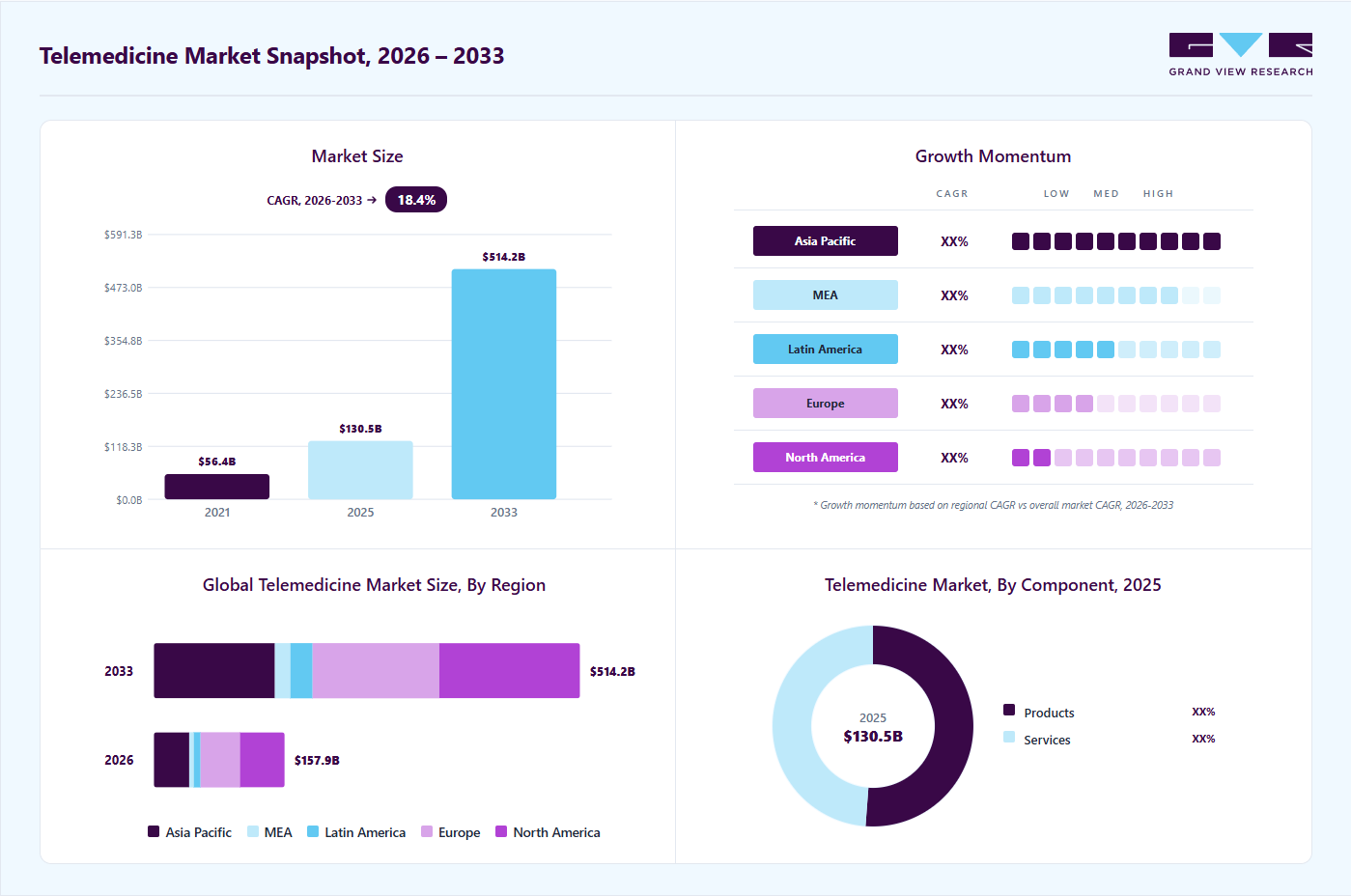
Crucially, web and mobile platforms generated 78.90% of total revenue in 2024. Therefore, this digital shift directly drives enterprise demand for telemedicine app development services.
Several structural shifts accelerate this sustained market expansion:
- Chronic disease prevalence and aging populations consistently require continuous digital touchpoints.
- Consequently, severe clinical shortages push health systems toward hybrid-care delivery models.
- Meanwhile, commercial payers and employer health plans now mandate virtual care coverage.
- In addition, widespread smartphone adoption transforms on-demand virtual access into a standard expectation.
Specialized clinical segments are capturing significant market share alongside general virtual visits:
- Real-time telemedicine platforms and asynchronous store-and-forward messaging networks.
- High-demand virtual specialties, particularly telepsychiatry, teledermatology, and telecardiology.
- Remote patient monitoring (RPM) systems that automatically link medical devices to clinical dashboards.
Because software delivery captures the majority of this revenue, health systems must deploy applications capable of handling complex clinical workflows securely.
Why Leading Companies Are Investing in Telemedicine Apps
Strategic buyers and health systems commit billions to acquire and expand telehealth capabilities. Rather than building simple video endpoints, these organizations invest to own longitudinal patient data, care navigation, and pharmacy pipelines.
Consequently, modern telemedicine app development services focus on complete digital delivery ecosystems.
Leading Companies Investing In Telemedicine Apps
| Company | Public Investment | Strategic Outcome |
| Amazon / One Medical | $3.9B Acquisition | Unified physical primary clinics with 24/7 on-demand virtual care and pharmacy routing. |
| Cigna / Evernorth / MDLIVE | $2.0B Acquisition | Integrated virtual care directly into payer networks to reduce total cost of care. |
| Google Cloud / Amwell | $100M Investment | Backed scalable cloud infrastructure with integrated AI translation and automated triage. |
| Teladoc Health | $124M+ Capitalized R&D | Demonstrates that mature telehealth software requires continuous engineering rather than one-time development. |
| Mayo Clinic | Primary Care On Demand | Deployed an enterprise-grade mobile platform with direct EHR synchronization and 24/7 care access. |
These capital transactions prove that virtual care is no longer a standalone commodity. Instead, enterprise platforms serve as the operational hub for primary care, chronic disease management, and remote diagnostic monitoring.
For a deeper breakdown of compliant data workflows, see our guide on Healthcare Data Interoperability and FHIR Integration.
Top 5 Telemedicine Apps to Benchmark in 2026
Evaluating market leaders helps technical leaders define competitive feature sets, compliant data pipelines, and scalable architectures.
These five benchmark applications demonstrate how comprehensive telemedicine app development services bridge patient demand with operational healthcare workflows.
1. Teladoc Health
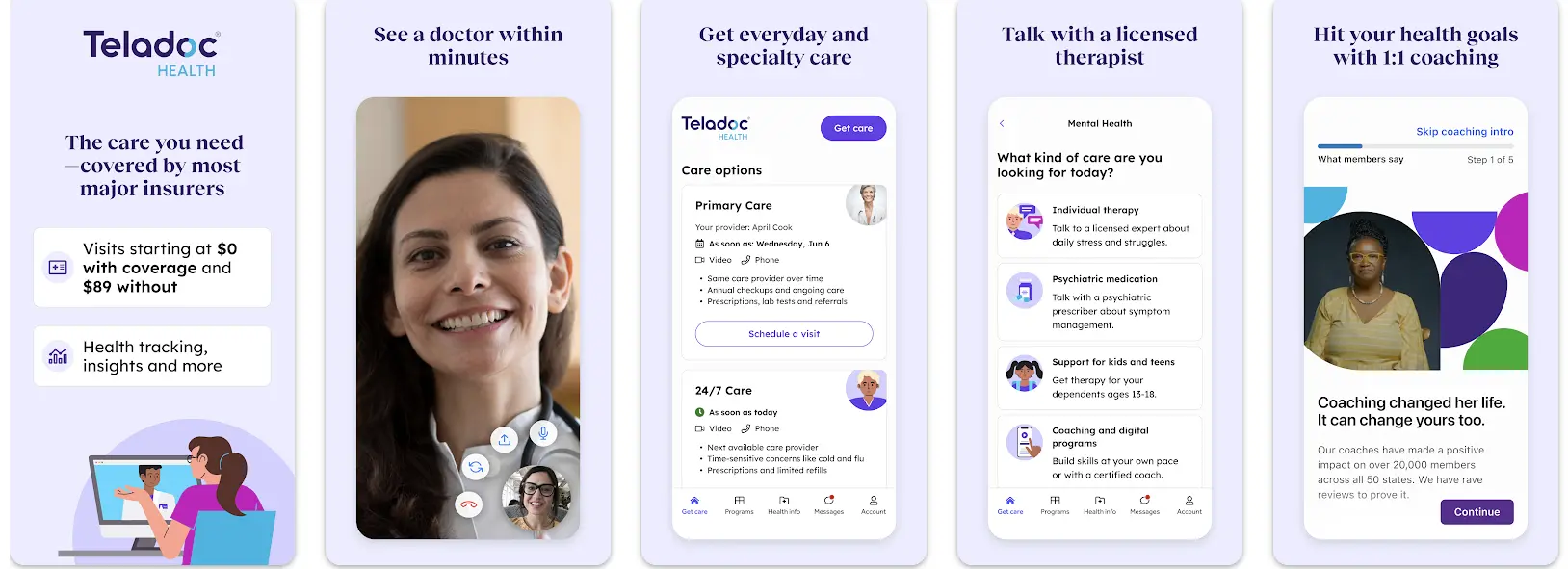
Teladoc Health operates as the enterprise standard for full-spectrum virtual care and chronic condition management. Over 100 million Americans currently have access to its services through employer and health plan integrations.
Furthermore, the platform serves over 50% of Fortune 500 companies and 60% of top U.S. hospital networks. The company continues to roll out Teladoc One, an integrated platform that unifies virtual primary care, mental health, and connected device data via ambient AI tooling.
2. MDLIVE
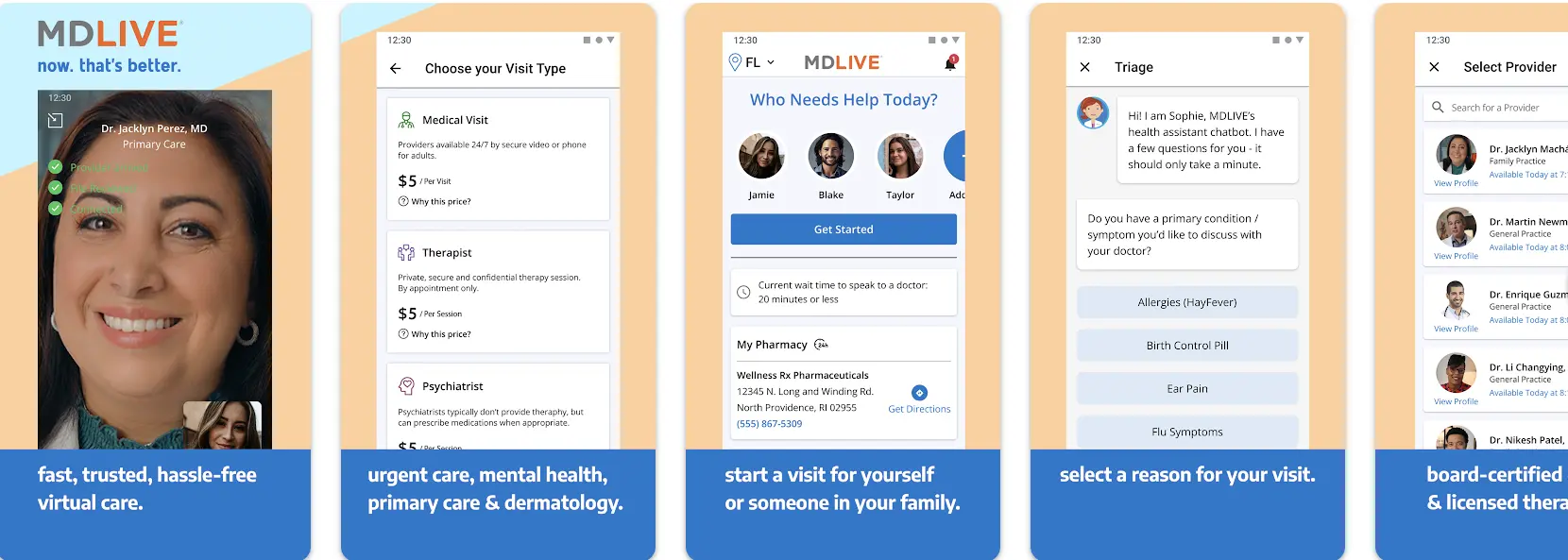
MDLIVE, an Evernorth company within Cigna, delivers high-volume urgent care, dermatology, and behavioral health. More than 60 million individuals maintain coverage for MDLIVE through payer contracts and corporate benefits programs.
Consequently, its architecture excels in automated eligibility checks, real-time copay collection, and rapid physician matching across high patient volumes.
3. Amwell
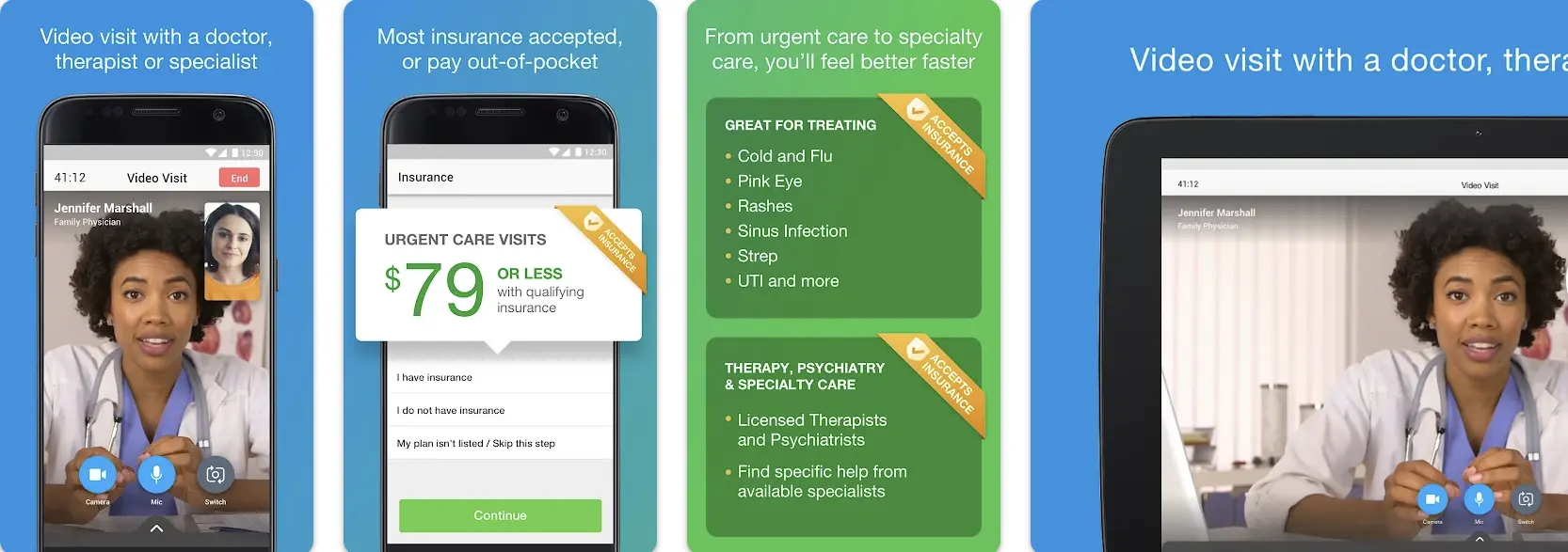
Amwell provides modular telehealth infrastructure that supports direct-to-consumer visits and enterprise white-label hospital deployments. Its software delivers 24/7 consultations across psychiatry, pediatrics, and women’s health with integrated e-prescribing.
Additionally, health systems deploy Amwell’s software directly into their existing digital portals, preserving their native provider branding and EHR connectivity.
4. Doctor On Demand by Included Health
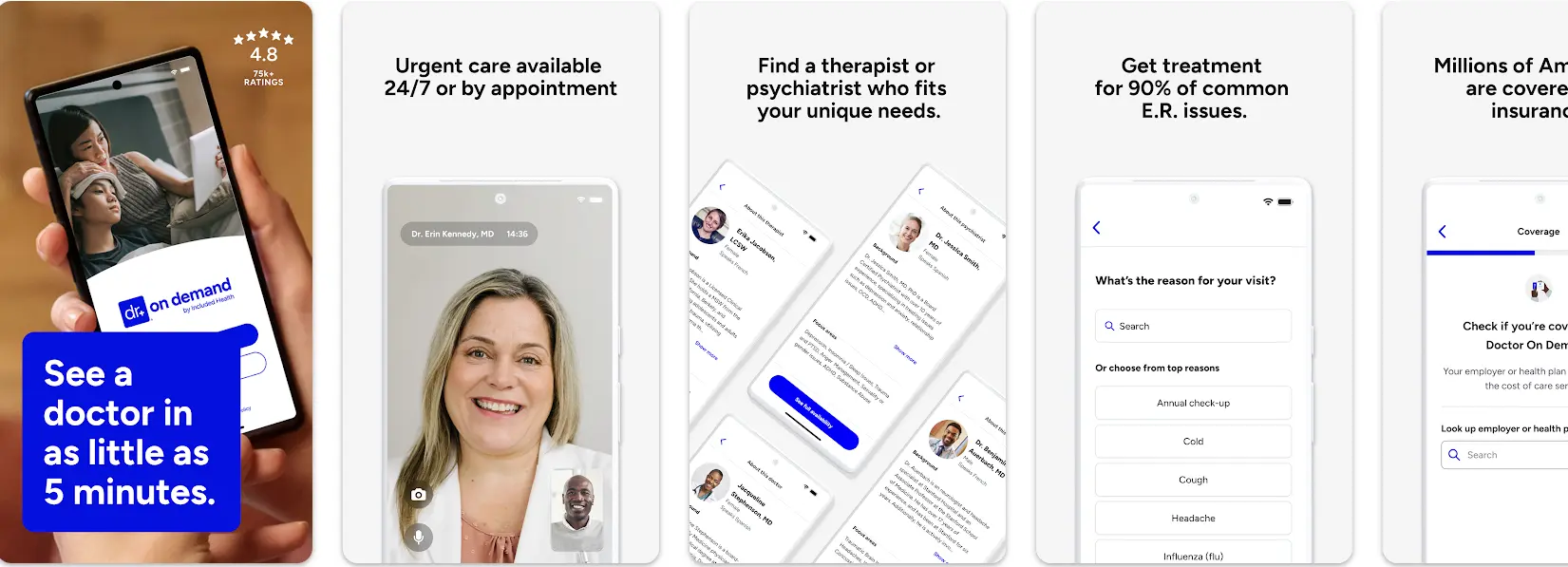
Doctor On Demand offers scheduled and on-demand clinical encounters across smartphones, tablets, and web browsers. Operating under Included Health, the platform unifies urgent care, preventive screenings, chronic disease tracking, and comprehensive psychiatry.
Therefore, its architecture stands out for synchronized clinical note generation and care-navigation routing between virtual therapists and primary doctors.
5. Amazon One Medical
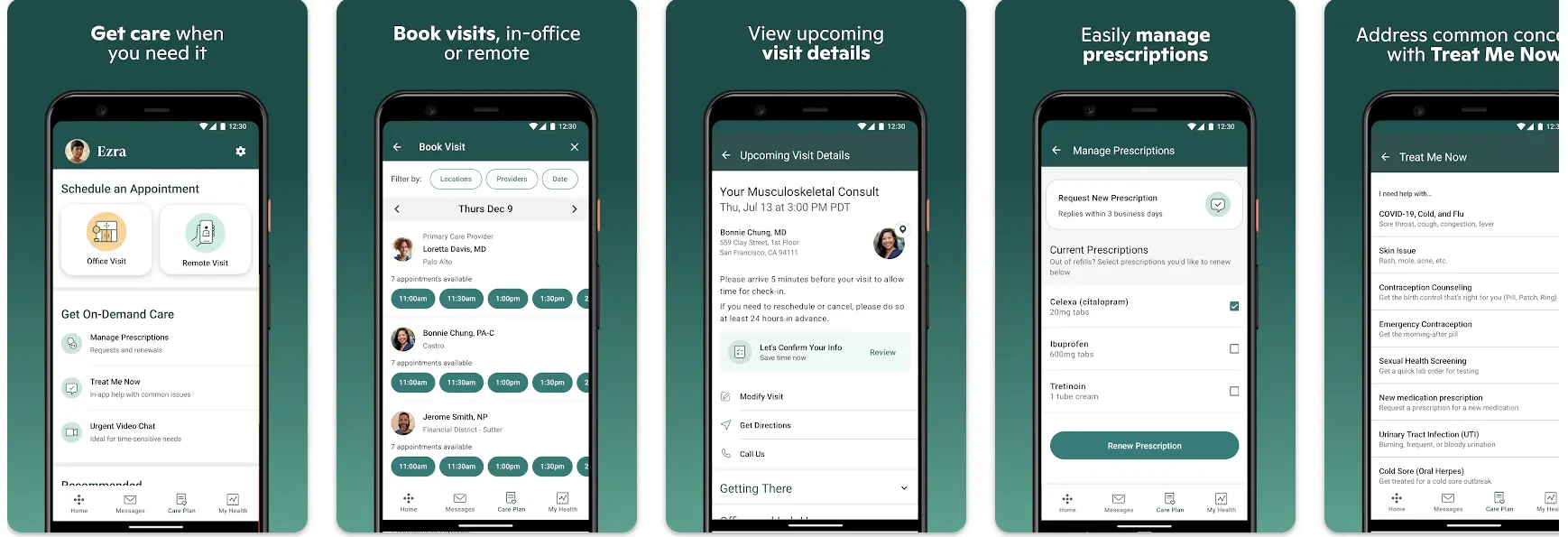
Amazon One Medical benchmarks the modern hybrid care delivery model. It connects physical clinic scheduling with continuous virtual access, direct clinician messaging, and Amazon Pharmacy fulfillment.
At the same time, patients access transparent, on-demand virtual care starting at $29 for asynchronous direct messaging and $49 for live video visits.
The product lesson is clear: modern platforms must expand beyond isolated video calls into longitudinal care applications that combine access, data, pharmacy, messaging, AI, monitoring, and follow-up.
For a deeper breakdown of building unified clinical workflows, see our guide on Enterprise Healthcare App Architecture and Security.
Which Telemedicine App Model Should You Build?
Platform architecture starts directly with your clinical delivery model rather than your underlying technology stack. Choosing the wrong framework inflates infrastructure overhead and complicates regulatory compliance across state lines.
Consequently, specialized telemedicine app development services engineer custom data pipelines tailored to clinical workflows, reimbursement structures, and patient touchpoints.
1. Synchronous Telemedicine Apps
Synchronous platforms power real-time, bidirectional audio and video consultations between patients and licensed healthcare providers.
- Deliver scheduled or on-demand sessions for urgent care, primary care, telepsychiatry, and pediatrics.
- Rely on ultra-low latency WebRTC streaming protocols, automated bandwidth adaptation, and synchronized virtual waiting rooms.
- Intellivon deploys optimized WebRTC signaling servers paired with TURN/STUN relays to guarantee sub-200ms latency on mobile networks.
Next, asynchronous models offer a different operational framework for non-emergency clinical evaluations.
2. Asynchronous Telemedicine Apps
Asynchronous store-and-forward systems allow clinicians to review patient-submitted diagnostic data outside of a scheduled live encounter.
- Handle high-resolution image evaluations for teledermatology, diagnostic lab interpretations, and structured intake questionnaires.
- Involve secure clinical document pipelines, zero-knowledge encryption, and automated triage notification queues.
- Intellivon builds asynchronous messaging backends that parse and index structured clinical data directly for physician review.
In contrast to single encounters, continuous patient oversight demands integrated hardware streaming pipelines.
3. Remote Monitoring Telemedicine Apps
Remote patient monitoring platforms continuously capture and analyze physiological biometric data from connected hardware and mobile wearables.
- Process high-throughput telemetry streams for continuous glucose (CGM), blood pressure, SpO2, and cardiac monitoring for telecardiology.
- Trigger automated threshold alerts, trend analytics, and compliance audit logs aligned with CMS RPM billing codes.
- Intellivon implements time-series database architectures that ingest device telemetry and automatically flag out-of-range vital signs.
Beyond pure virtual monitoring, complex health systems frequently need to bridge digital workflows with physical facilities.
4. Hybrid Telemedicine Apps
Hybrid platforms combine live virtual visits, asynchronous messaging, remote monitoring, and in-person physical clinic scheduling into one unified system.
- Unify scheduling across brick-and-mortar clinics, diagnostic lab interfaces, and mail-order pharmacy distribution networks.
- Support varied monetization strategies, including employer per-member-per-month (PMPM) contracts, direct-to-consumer fees, and white-label SaaS licensing.
- Intellivon engineers modular API-first hybrid platforms that unify scheduling, diagnostic order routing, and enterprise EHR data into a single pane of glass.
Selecting your clinical model defines the baseline technical specifications for your platform features, cloud architecture, and third-party integrations.
For a deeper breakdown of building specialized digital care platforms, see our guide on Mental Health App Trends to Watch in 2026.
Core Features Every Enterprise Telemedicine App Needs
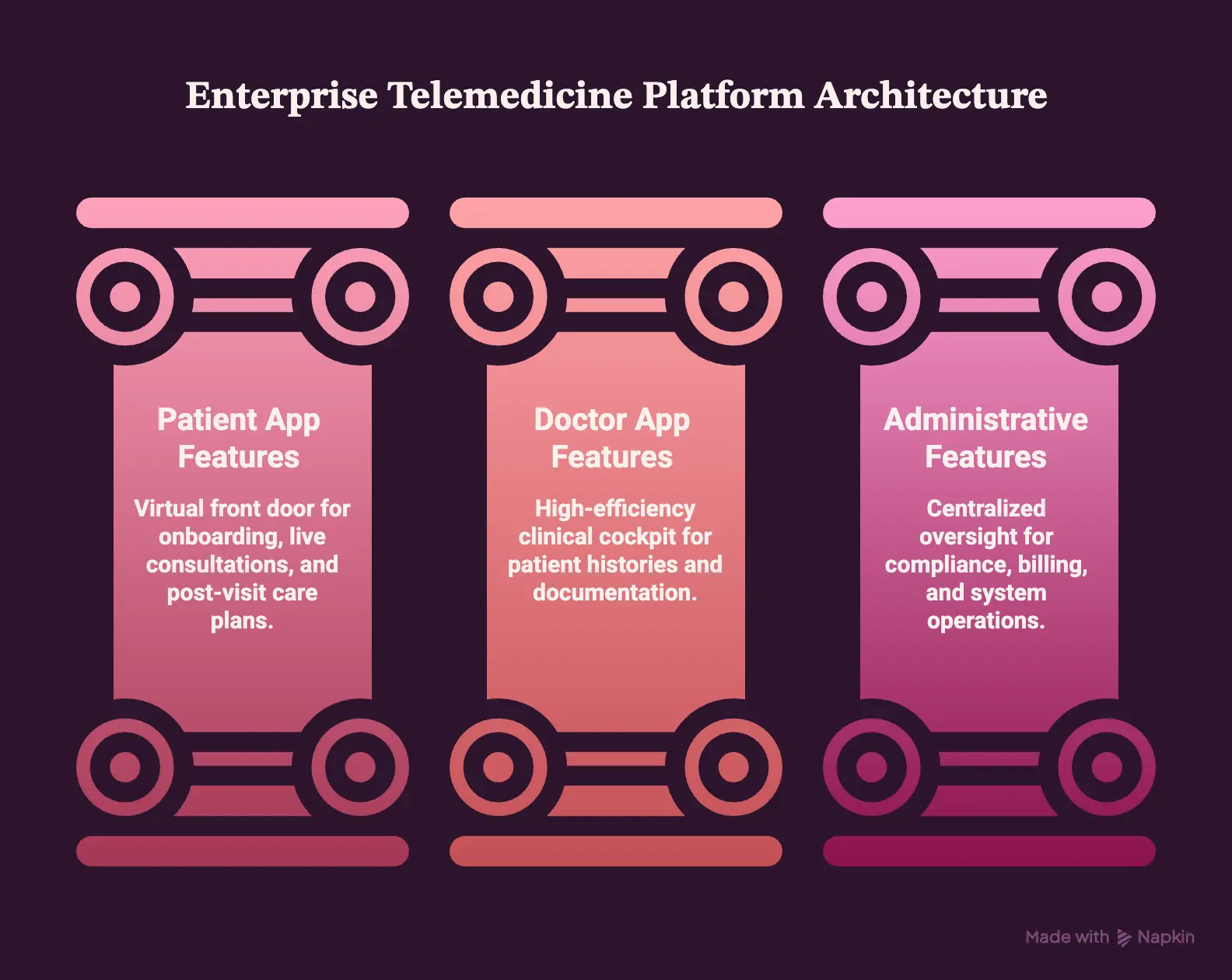
Enterprise telemedicine platforms require three dedicated user experiences: a consumer-grade patient portal, an efficient clinician workspace, and an administrative command center.
Therefore, balancing user experience with strict clinical protocols directly influences total telemedicine app development cost and features.
Consequently, professional telemedicine app development services structure platform modules around the distinct operational responsibilities of each user role.
1. Patient App Features
The patient interface serves as a virtual front door that guides users through onboarding, live consultations, and post-visit care plans.
Technically, this client requires biometric authentication (FaceID/TouchID), dynamic form-rendering engines, and WebRTC video integration capable of sub-200ms latency.
Furthermore, it embeds payment SDKs for instant copay processing and secure push notification channels for appointment reminders.
- Onboarding & Verification: Automated identity proofing via government ID scanning, multi-factor authentication, and digital insurance card OCR ingestion.
- Intake & Scheduling: Dynamic clinical symptom questionnaires, real-time doctor directory search, automated timezone-aware calendar booking, and SMS/push appointment reminders.
- Virtual Care Delivery: High-definition WebRTC video/audio sessions, synchronized telemedicine virtual waiting room, and end-to-end encrypted asynchronous direct messaging.
- Health Records & Settlement: In-app access to active e-prescriptions, diagnostic lab results, imaging reports, digital copay processing via Stripe/Apple Pay, and care plan tracking.
Next, clinicians require specialized interfaces designed to eliminate documentation friction during patient encounters.
2. Doctor App Features
The provider interface functions as a high-efficiency clinical cockpit, giving clinicians real-time access to patient histories and documentation tools.
Technically, this portal integrates with underlying EHR systems via FHIR R4 APIs, speech-to-text processing engines, and pharmacy networks. In addition, it embeds automated clinical decision support (CDS) hooks to alert providers to adverse drug interactions in real time.
- Patient & Schedule Management: Filterable daily appointment queues, synchronized provider availability calendars, and emergency care escalation routing.
- Clinical History Access: Instant chart retrieval covering historical diagnoses, immunization records, active drug regimens, and documented allergy warnings.
- Encounters & Documentation: Split-screen video consultations, structured telemedicine clinical documentation with dynamic SOAP templates, and voice dictation.
- Ambient AI & Orders: Integrated ambient AI note summarization, one-click electronic prescribing, direct diagnostic lab orders, and specialist referral dispatching.
While clinical tools handle patient care, administrators need centralized visibility over compliance, billing, and system operations.
3. Administrative Features
The administrative console provides health system operators with global oversight of provider licensing, financial clearinghouses, and platform compliance.
Technically, this portal requires role-based access control (RBAC), immutable audit logging databases, and bidirectional integrations with clearinghouses for EDI 837 claim submission and EDI 835 remittance processing. Moreover, it aggregates distributed platform metrics to track system uptime and clinical throughput.
- Workforce & Credentialing: Provider state medical license validation, DEA registration tracking, automated credentialing expiration alerts, and granular role permissions.
- Operational Triage: Health system-wide patient queue management, automated load-balanced provider dispatching, and live customer support escalation tooling.
- Financial & Revenue Cycle: Automated insurance eligibility checks (EDI 270/271), claims adjudication workflows, copay reconciliation, and multi-tier billing reporting.
- Governance & Analytics: Comprehensive HIPAA-compliant audit logging, platform utilization reporting, clinician productivity analytics, and average wait-time monitoring.
Structuring these three functional tiers guarantees that clinical safety, patient usability, and regulatory governance operate synchronously across the enterprise.
For a deeper breakdown of building compliant healthcare backends, see our guide on Healthcare Data Security and HIPAA Architecture.
How Telemedicine App Architecture Works End to End
The user-facing mobile app represents merely the presentation layer of a complex clinical distribution system. Therefore, behind every screen, an orchestration framework manages identity, real-time media routing, clinical data pipelines, and external integrations.
Consequently, comprehensive telemedicine app development services establish a decoupled, multi-tier infrastructure that guarantees sub-second responsiveness, fault isolation, and uninterrupted regulatory compliance.
Architectural Component Overview
Building an enterprise virtual care system requires clear separation across frontends, microservices, clinical integrations, and compliant infrastructure.
| Architectural Layer | Core Technologies & Protocols | Primary Operational Responsibility |
| Frontend Clients | Swift (iOS), Kotlin (Android), React Native, Flutter, Next.js (Admin) | Delivers role-based user interfaces, hardware biometric access, and local session caching. |
| Gateway & Auth | Kong, Envoy, OAuth 2.0, OpenID Connect, SMART on FHIR | Manages API rate limiting, routing, SSL termination, and granular role-based access control (RBAC). |
| Core Services | Node.js, Go, Python (FastAPI), Redis, Kafka/RabbitMQ | Powers appointment scheduling, asynchronous messaging, queue management, and visit state machines. |
| Media & AI Layer | WebRTC, Twilio Video, Daily.co, Agora SDK, Whisper, Ambient LLMs | Handles adaptive video/audio streaming, STUN/TURN traversal, and real-time clinical speech-to-text. |
| Interoperability | FHIR R4 APIs, HL7 v2 MLLP, CDS Hooks, Surescripts, Redox Engine | Normalizes and exchanges clinical data bidirectionally with EHRs, labs, and clearinghouses. |
| Data & Compliance | PostgreSQL (Encrypted RDS), AWS S3 (ePHI Storage), HashiCorp Vault | Enforces AES-256 at-rest encryption, zero-knowledge keys, and immutable HIPAA audit logging. |
| Cloud & DevOps | AWS/Azure, Docker, Kubernetes (EKS/AKS), Terraform, Datadog | Manages autoscaling, zero-downtime CI/CD deployments, distributed tracing, and automated failover. |
This multi-layer blueprint serves as the foundational telemedicine platform development architecture guide for engineering scalable virtual care applications.
Furthermore, implementing a custom telemedicine app development architecture isolates failure domains so that a third-party EHR slowdown never drops an active WebRTC video consultation.
For a deeper breakdown of engineering high-throughput, fault-tolerant infrastructure, see our guide on Web Development Best Practices for Building Scalable Applications.
EHR, ePrescribing, RPM, and Payment Integrations
A telemedicine application functions effectively only when it integrates directly with hospital health records, national pharmacy networks, diagnostic laboratories, and payment processors. Without these automated pipelines, clinicians waste valuable time manually re-entering records across disconnected platforms.
Consequently, enterprise telemedicine app development services engineer bidirectional integrations that synchronize clinical, diagnostic, and financial data in real time.
1. Epic, Oracle Health, MEDITECH, and athenahealth
EHR interoperability bridges isolated video consultations with a hospital’s core clinical record system.
- Involves configuring RESTful FHIR R4 API integration, legacy HL7 v2 integration design, and OAuth 2.0 authorization pipelines.
- Executes SMART on FHIR integration to embed virtual visit workflows and CDS Hooks integration design for real-time diagnostic alerts.
- Enforces deterministic patient-matching algorithms to write back signed consultation notes directly into hospital charts without creating duplicate records.
- Intellivon engineers FHIR proxy adapters that normalize disparate EHR payloads into standard JSON resources, ensuring accurate two-way chart synchronization.
For a deeper breakdown of interoperability, see our guide on How to Build an EHR Integration Platform for Hospitals.
Next, clinicians must be able to prescribe medications safely during the virtual visit.
2. ePrescribing and Pharmacy Integration
Electronic prescribing systems route validated prescriptions directly to retail and mail-order pharmacies.
- Connects the application directly to the Surescripts national network using NCPDP SCRIPT standards.
- Delivers automated drug-allergy checks, real-time medication history retrieval, and electronic prior authorization (ePA).
- Meets strict DEA EPCS requirements for controlled substance prescribing using two-factor biometric authentication.
- Intellivon integrates secure Surescripts gateways with embedded formulary checks, allowing clinicians to route prescriptions in two clicks.
Once medications are ordered, diagnostic testing pipelines must be established.
3. Lab and Imaging Integration
Diagnostic interfaces enable clinicians to order tests and review patient results directly within the virtual encounter workspace.
- Generates electronic laboratory requisitions for national diagnostic networks like Quest Diagnostics and Labcorp.
- Ingests digital lab results and diagnostic panels automatically via structured HL7 ORU message feeds.
- Coordinates radiology imaging orders and securely displays DICOM imaging files inside the provider web portal.
- Intellivon implements automated HL7 result-parsing pipelines that match incoming laboratory reports to patient encounters instantly.
In addition to episodic lab tests, continuous patient monitoring requires hardware connectivity.
4. Remote Patient Monitoring Integration
Remote patient monitoring pipelines ingest continuous biometric streams from Bluetooth and cellular medical hardware.
- Integrates blood pressure cuffs, continuous glucose monitors (CGM), pulse oximeters, and smart scales via Bluetooth Low Energy (BLE).
- Normalizes incoming time-series telemetry streams into standard FHIR Observation resources for longitudinal tracking.
- Employs automated anomaly detection algorithms that trigger clinical alerts when vital signs cross critical safety thresholds.
- Intellivon builds high-throughput IoT ingestion microservices that process raw device telemetry and update provider dashboards in real time.
For a deeper breakdown of connected-care integration, see our guide on How Do Hospitals Integrate Wearable Health Data into EHR Systems.
Finally, all clinical encounters must link directly to financial clearinghouses.
5. Billing, Insurance, and Payment Integration
Financial integration modules manage the complete revenue cycle, from initial patient eligibility checks to final claim settlement.
- Executes automated insurance eligibility checks using real-time EDI 270/271 clearinghouse transactions.
- Processes patient copays, deductibles, and self-pay balances securely through Stripe and Apple Pay integrations.
- Generates standard EDI 837 professional medical claims containing accurate CPT, HCPCS, and ICD-10 diagnostic codes.
- Intellivon implements automated claims-scrubbing engines that validate billing codes before submission, significantly reducing payer rejection rates.
Connecting these clinical, diagnostic, and financial integrations establishes a unified platform that eliminates duplicate data entry and protects healthcare revenue.
For a deeper breakdown of enterprise digital health infrastructure, see our guide on Best Cloud-Based EHR for Multi-Clinic Systems.
Where AI Fits Into Modern Telemedicine App Development
Integrating artificial intelligence into telemedicine requires categorizing models by risk profile and clinical impact rather than deploying generic generative tooling. Administrative automation carries minimal liability, while diagnostic suggestions demand rigorous validation.
Consequently, specialized telemedicine app development services architect multi-tiered AI pipelines that isolate operational tasks from regulated medical decision support.
1. Administrative AI
Administrative AI automates non-clinical tasks to eliminate front-desk bottlenecks and reduce appointment cancellations.
- Optimizes provider scheduling, predicts patient no-shows, and runs telemedicine ML patient matching across provider networks.
- Parses unstructured digital intake responses, standardizes patient demographic forms, and automates real-time triage FAQs.
- Intellivon implements lightweight classification algorithms and deterministic routing pipelines that streamline patient onboarding without processing sensitive diagnostic data.
Next, clinical AI assists providers by identifying diagnostic patterns and calculating patient risk scores.
2. Clinical Workflow AI
Clinical workflow AI evaluates patient telemetry to highlight potential care gaps and support diagnostic decisions.
- Powers telemedicine AI symptom checker design and patient triage prior to consultation.
- Executes continuous telemedicine AI risk stratification and detects anomalies across real-time biometric streams.
- Triggers active telemedicine AI clinical decision support alerts to prevent dangerous drug interactions.
- Intellivon deploys containerized inference engines that evaluate patient data against clinical safety thresholds, alerting physicians only when vitals deviate from normal baselines.
Beyond real-time clinical alerts, documentation assistance significantly reduces provider administrative fatigue.
3. Ambient AI Documentation
Ambient documentation technology captures clinical dialogues and structures them directly into medical charts.
- Transcribes consultations using specialized medical speech-to-text engines paired with Nuance DAX-style workflows.
- Generates structured SOAP notes and patient summaries through telemedicine NLP clinical note design.
- Integrates directly with core EHR interfaces for one-click physician review, sign-off, and write-back.
- Intellivon integrates secure ambient listening microservices that generate draft SOAP notes, requiring direct physician validation before committal to medical records.
Operating clinical AI requires strict governance frameworks, including human-in-the-loop validation, automated drift monitoring, and comprehensive audit trails to prevent hallucinations.
For a deeper breakdown of implementing compliant healthcare models, see our guide on Building Smart EHR Systems with AI Capabilities.
Telemedicine App Security and Compliance Requirements
Security and regulatory compliance serve as foundational architectural constraints rather than downstream operational checklists. Failing to isolate electronic protected health information (ePHI) or misinterpreting regional licensing rules can trigger civil monetary penalties and halt clinical operations.
Consequently, enterprise telemedicine app development services engineer strict technical safeguards directly into data ingestion, media streaming, and session authentication layers.
1. HIPAA and PHI Protection
The Health Insurance Portability and Accountability Act establishes mandatory federal standards for safeguarding patient data across digital environments.
- Enforces the HIPAA Privacy and Security Rules across all digital touchpoints through signed Business Associate Agreements (BAAs) with every third-party cloud vendor.
- Implements AES-256 data encryption for storage, TLS 1.3 for media transmission, and mandatory multi-factor authentication (MFA) for privileged access.
- Mandates granular role-based access control (RBAC), automatic session timeouts, and immutable audit logs that record every PHI access event.
- Intellivon deploys zero-trust security perimeters with automated credential rotation and real-time SIEM alerting to prevent unauthorized ePHI access.
For a deeper breakdown of health-app security, see our guide on HIPAA-Compliant AI Healthcare App Development.
Beyond data privacy safeguards, virtual care delivery must align with state-specific legal frameworks.
2. Telehealth Consent and State Requirements
State telehealth policies govern provider licensing boundaries, informed consent protocols, and regional prescribing authority.
- Collects and logs verifiable digital telehealth informed consent forms prior to initiating any live virtual encounter.
- Enforces interstate medical licensure verification and tracks Interstate Medical Licensure Compact (IMLC) participation across clinical rosters.
- Configures dynamic state-specific medical record retention rules and clinical intake protocols directly within platform onboarding flows.
- Intellivon builds dynamic geofencing and credential-matching engines that automatically route patients only to clinicians licensed in their specific physical jurisdiction.
In addition to state medical rules, prescribing protocols require strict federal adherence.
3. Controlled Substance Prescribing
Federal statutes govern how clinicians evaluate patients remotely before prescribing schedule II–V controlled substances.
- Integrates identity-proofing protocols that comply with the Ryan Haight Act and DEA electronic prescribing standards.
- Accommodates the DEA and HHS telemedicine controlled-substance flexibilities, which currently extend temporary prescribing exceptions through December 31, 2026.
- Isolates prescribing logic inside configurable workflow engines rather than hard-coding static parameters into the application codebase.
- Intellivon engineers modular e-prescribing rules engines that update clinical restriction policies instantly as federal regulatory mandates shift.
Finally, platform encounters must satisfy structured reimbursement criteria to ensure reliable payment capture.
4. CMS and Reimbursement Logic
Healthcare reimbursement frameworks dictate how virtual encounters are documented, coded, and billed to public and private payers.
- Automates CPT and HCPCS billing code assignments paired with correct Place of Service (POS) indicators, including POS 02 and POS 10.
- Validates interactive audio-video duration thresholds and remote patient monitoring (RPM) data-collection minimums prior to claim submission.
- Separates statutory legal mandates like HIPAA from third-party operational security frameworks like SOC 2 Type II and HITRUST CSF.
- Intellivon implements dynamic billing rule microservices that adapt to evolving CMS reimbursement policies without requiring major system refactoring.
Enforcing these four compliance layers ensures that your virtual care infrastructure remains secure, legally defensible, and audit-ready across all jurisdictions.
For a deeper breakdown of managing enterprise risk and regulatory validation, see our guide on Custom AI Governance Software vs. Off-the-Shelf Tools.
How We Develop a Telemedicine App From Idea to Launch
Building an enterprise-grade telemedicine app requires a phased development methodology that unifies clinical safety, technical architecture, and regulatory compliance. Moving into production without structured validation leads to expensive system refactoring and security vulnerabilities.
Therefore, our telemedicine app development services follow a disciplined six-stage engineering framework to take your product from concept to nationwide deployment.
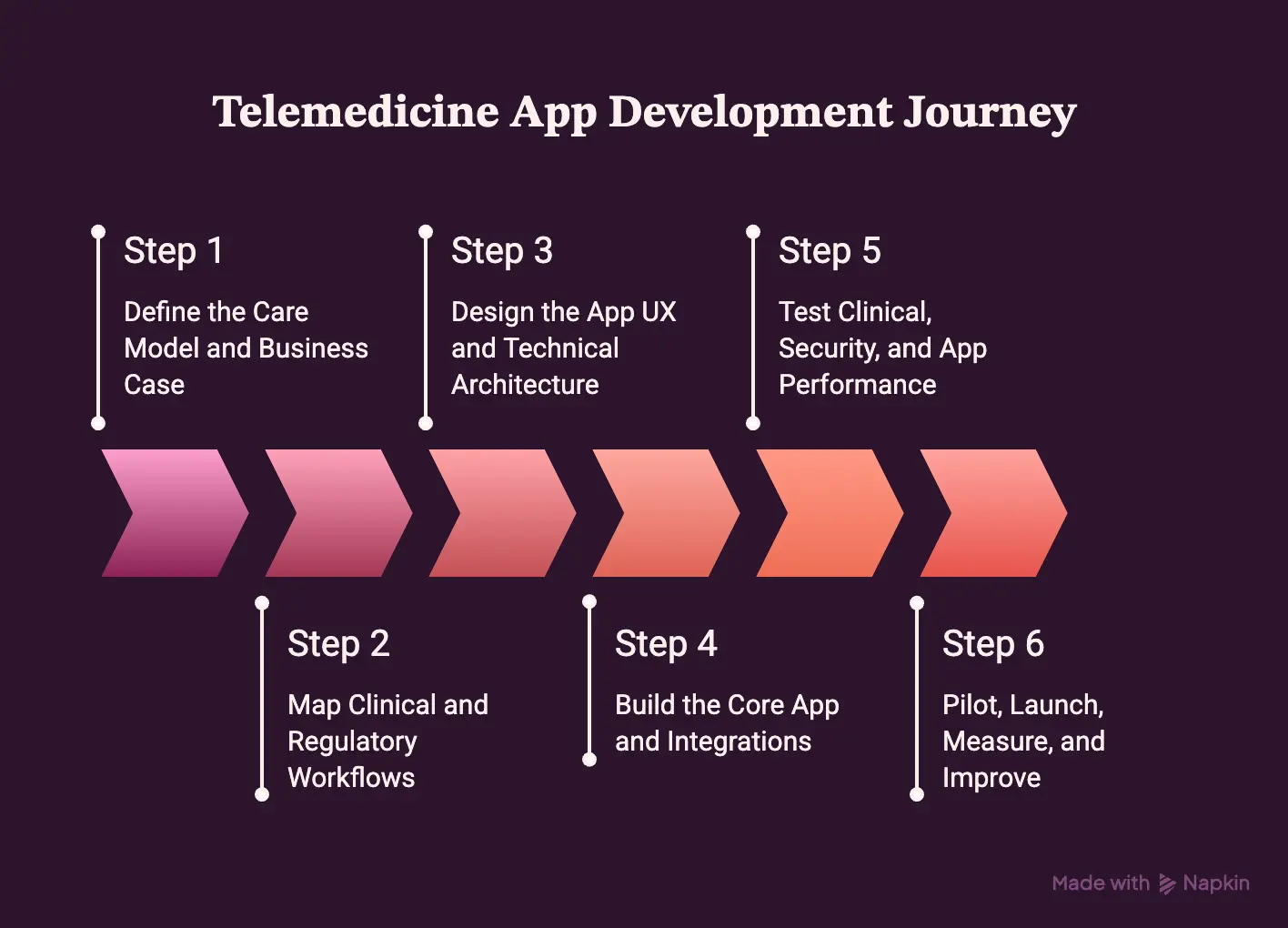
Step 1 — Define the Care Model and Business Case
Defining your clinical delivery framework and commercial objectives establishes the operational foundation for your platform.
Technically, this step identifies your target patient demographics, supported clinical specialties, geographic footprint, and core care delivery mechanisms.
Furthermore, it defines your primary monetization structure, whether through fee-for-service billing, monthly subscriptions, or employer per-member-per-month (PMPM) contracts.
- Determine clinical specialties, geographic scope, and clinician network requirements.
- Establish primary consultation models across synchronous video, asynchronous messaging, or connected remote monitoring.
- Model expected reimbursement pathways and project your target return on investment.
At Intellivon, we begin every engagement by analyzing clinical workflows and financial logic, ensuring that software architecture supports real-world care delivery from day one.
Once the business foundation is established, we map the underlying clinical pathways and regulatory constraints.
Step 2 — Map Clinical and Regulatory Workflows
Mapping clinical and legal workflows guarantees that the software enforces statutory compliance at every stage of the patient journey.
This step establishes the operational pathways for patient intake, digital consent capture, clinician licensing verification, and medical record documentation.
Moreover, it produces a comprehensive compliance matrix covering HIPAA, DEA controlled substance rules, and state-specific telehealth mandates.
- Map complete user journeys across intake, triage, virtual visits, electronic prescribing, diagnostic lab routing, and billing.
- Define digital informed consent protocols and multi-state medical licensure validation rules.
- Construct an immutable compliance matrix detailing data privacy boundaries and role-based access permissions.
Intellivon builds standardized clinical process maps and data flow diagrams that align technical logic with state-by-state medical board regulations.
With clinical pathways defined, our team designs user interfaces and core technical foundations.
Step 3 — Design the App UX and Technical Architecture
Designing intuitive user interfaces and decoupled system architecture ensures seamless usability and reliable scalability.
This phase translates clinical pathways into interactive wireframes, clinical dashboards, API contracts, and scalable cloud infrastructure designs. Additionally, it establishes WebRTC media routing protocols, database schema boundaries, and encryption models across all microservices.
- Create high-fidelity wireframes and interactive prototypes for patient mobile apps and provider web portals.
- Define RESTful and FHIR-compliant API contracts, real-time WebSocket events, and database relational schemas.
- Architect multi-region cloud infrastructure, container orchestration topologies, and zero-trust security perimeters.
Intellivon creates responsive, accessible interfaces that minimize clinician documentation friction while maintaining clear, intuitive navigation for patients of all ages.
Following architectural sign-off, our engineering teams begin constructing core applications and integrations.
Step 4 — Build the Core App and Integrations
Constructing the core platform involves developing mobile applications, web portals, and microservice backends alongside vital healthcare integrations.
Technically, this phase implements patient mobile apps in Swift, Kotlin, Flutter, or React Native alongside robust microservices in Go, Node.js, or Python. Furthermore, it integrates WebRTC media servers, Surescripts e-prescribing, diagnostic laboratory feeds, and bidirectional EHR interfaces.
Applying proven telemedicine app development best practices prevents technical debt during rapid scaling.
- Develop native or cross-platform mobile apps for iOS and Android with embedded hardware biometrics.
- Engineer decoupled backend microservices to manage scheduling, messaging, visit state machines, and billing.
- Implement bidirectional integrations with EHRs, Surescripts, diagnostic lab networks, and payment gateways.
Intellivon builds modular, API-first healthcare software using clean architectures that isolate video streaming, clinical data pipelines, and third-party dependencies into independent services.
Once the core build is complete, the platform undergoes comprehensive clinical, technical, and regulatory testing.
Step 5 — Test Clinical, Security, and App Performance
Rigorous multi-layer testing validates that the platform meets strict medical safety, data privacy, and reliability standards before live patient use.
This phase executes end-to-end automated unit tests, EHR sandbox data synchronization checks, and real-world clinical user acceptance testing (UAT). Additionally, it involves simulated network degradation, low-bandwidth video optimization, and third-party penetration audits to identify potential vulnerabilities.
- Execute automated unit, integration, and regression test suites across all microservices and mobile builds.
- Conduct clinical user acceptance testing with practicing physicians to validate documentation speed and ease of use.
- Perform low-bandwidth packet-loss simulations, stress testing, and third-party HIPAA security penetration audits.
Intellivon subjects every virtual care platform to simulated low-bandwidth conditions and EHR sandbox testing, ensuring reliable video streaming and data write-backs under constrained network environments.
With security and system performance validated, the platform proceeds to a structured pilot rollout.
Step 6 — Pilot, Launch, Measure, and Improve
Launching through a controlled pilot allows your team to validate operational workflows, gather clinical feedback, and refine system performance prior to full deployment.
This final stage executes a phased market release using a defined telemedicine app development roadmap for 2026 to onboard initial clinical cohorts safely. During this rollout, technical and operational teams monitor video connection stability, documentation turnaround times, and claims adjudication rates to optimize performance continuously.
- Deploy the platform to a controlled pilot cohort of patients and providers to validate operational workflows.
- Track critical performance indicators, including visit completion rates, documentation times, and video connection stability.
- Iterate on user feedback, optimize claims acceptance rates, and scale infrastructure for nationwide clinical rollout.
Intellivon establishes real-time observability pipelines and monitoring dashboards that track platform health, helping you continuously refine performance and support sustainable organizational growth.
Executing these six structured phases ensures that your virtual care platform transitions from an initial concept into a compliant, enterprise-grade clinical software ecosystem.
Telemedicine App Development Cost: 70,000 – 300,000
Enterprise telemedicine app development generally costs $70,000 to $300,000 depending on mobile scope, clinical integrations, video complexity, AI requirements, security controls, and deployment scale.
In particular, choosing between basic cross-platform minimum viable products and deeply integrated clinical ecosystems directly dictates overall resource allocation.
Consequently, specialized telemedicine app development services establish transparent stage-gate budgets aligned with architectural milestones and compliance thresholds.
Cost Breakdown by Application Scope
Platform scope defines the complexity of clinical data pipelines, interface designs, and infrastructure tiers.
| App Scope | Estimated Cost | Best For | Typical Deliverables |
| Focused Telemedicine MVP | $70,000 – $120,000 | Initial clinical pilot testing | Cross-platform mobile app, WebRTC video, basic scheduling, Stripe payments, and HIPAA compliance controls. |
| Integrated Multi-Feature App | $120,000 – $200,000 | Scaling digital health clinics | Dual native apps (iOS/Android), asynchronous messaging, Surescripts e-prescribing, and bidirectional FHIR R4 EHR write-back. |
| Enterprise-Grade Custom App | $200,000 – $300,000 | Health systems & hospital networks | Multi-facility scheduling, ambient AI documentation, continuous RPM IoT pipelines, multi-state licensure engines, and clearinghouse billing. |
Phase-by-Phase Engineering Investment
Engineering budgets are distributed across specialized discovery, user experience, secure backend development, and compliance validation phases.
| Development Phase | Cost Range | Key Engineering Activities |
| Discovery and Compliance Mapping | $5,000 – $15,000 | Clinical pathway mapping, state telehealth regulatory scoping, and technical architecture definition. |
| UX/UI and Workflow Design | $8,000 – $20,000 | Accessible patient wireframing, provider split-screen dashboards, and clinical design system prototyping. |
| Backend and Architecture Engineering | $15,000 – $55,000 | Microservices development, PostgreSQL ePHI databases, role-based access controls, and REST/GraphQL APIs. |
| Mobile and Web App Engineering | $15,000 – $50,000 | Native Swift/Kotlin or Flutter client apps, offline caching, and responsive administrative web portals. |
| Video and Secure Messaging | $8,000 – $25,000 | WebRTC signaling implementation, TURN/STUN relay routing, dynamic bandwidth adaptation, and encrypted chat. |
| Clinical Interoperability Integrations | $10,000 – $50,000 | Epic/Oracle Health FHIR connectors, Surescripts e-prescribing gateways, and diagnostic lab result pipelines. |
| AI Capabilities and Automation | $5,000 – $30,000 | Ambient AI documentation models, clinical NLP summarization pipelines, and automated symptom triage. |
| QA, Security Audits, and Deployment | $4,000 – $25,000 | HIPAA penetration testing, automated regression testing, low-bandwidth simulations, and cloud CI/CD setup. |
However, exact budget allocations vary based on specific build parameters. Therefore, these modular component ranges should not simply be summed at their maximum values.
Furthermore, several critical technical variables drive pricing adjustments across implementations:
- Platform Diversity: First, building separate native iOS and Android applications increases development effort compared to cross-platform Flutter codebases.
- Interoperability Depth: Additionally, integrating deep bidirectional Epic or Oracle Health write-backs demands greater governance and sandbox validation than standalone architectures.
- Regulatory Controls: Moreover, multi-state clinician licensing engines and strict DEA electronic prescribing standards introduce specialized compliance rules.
- Data Streams: Finally, streaming continuous remote patient monitoring (RPM) biometric data requires dedicated high-throughput IoT ingestion pipelines.
Ongoing Operational and Maintenance Costs
Operating a live telemedicine platform requires continuous engineering oversight to preserve security, maintain API integrations, and support user growth.
As a result, health systems should budget approximately 15% to 25% of the initial development cost annually for ongoing application maintenance.
In addition to core software updates, teams must account for variable third-party operational expenses:
- Cloud Infrastructure: For instance, managed AWS or Microsoft Azure hosting with HIPAA Business Associate Agreements (BAAs).
- Usage-Based Media: Similarly, WebRTC, Twilio Video, or Daily.Co session minutes incur variable monthly rates.
- Communication Feeds: Furthermore, dedicated SMS appointment notifications and push delivery gateways scale with volume.
- Inference and Licensing: Lastly, medical speech-to-text API calls, ambient LLM tokens, and Surescripts network transaction fees fluctuate by usage.
For a deeper breakdown of infrastructure scoping and investment planning, see our guide on the Cost to Build an AI Healthcare App.
What ROI Are Telemedicine Apps Delivering in Practice?
Telemedicine does not produce a fixed, universal ROI percentage across every organization. Instead, its economic return depends on whether virtual care replaces more expensive facility visits, expands clinical throughput, reduces patient expenses, or captures incremental reimbursable revenue.
Consequently, evaluating telemedicine app development services requires examining verified clinical and operational financial data rather than marketing assumptions.
Published Clinical ROI and Cost Reduction Evidence
Peer-reviewed clinical studies demonstrate measurable cost reductions across hospital encounters, patient travel, and surgical specialty follow-ups.
| Study & Clinical Setting | Sample Size | Published Economic & Operational Result |
| Penn Medicine | 163,308 Encounters | Across common conditions, mean 30-day episode charges were $96.60 for telemedicine vs. $509.21 in-person (a $412.62 reduction) with 23% fewer subsequent visits. |
| Moffitt Cancer Center | 25,496 Visits | Virtual care saved oncology patients $147.40 to $186.10 per visit in travel costs, with lost-productivity savings totaling approximately $1.64 million. |
| Orthopedic Follow-Up | Randomized Trial | Video visits reduced clinical personnel costs by 25%, supported 172 additional annual patients, and saved €73,056 when applied to 10% of outpatient cases. |
| Teleorthopedics Triage | Outpatient Cohort | Digital triage and remote consultation pathways produced an average 48% cost reduction, saving roughly $130 per evaluated clinical case. |
However, clinical leaders must also evaluate the broader utilization counterpoint. For instance, a comprehensive Medicare cohort study published in JAMA Network Open found that hospital service areas with high telehealth utilization experienced $164.99 higher total costs per beneficiary per semester.
This occurred primarily because virtual visits expanded overall healthcare access rather than directly substituting for in-person consultations.
Therefore, achieving a positive financial return requires engineering systems that eliminate administrative overhead, prevent care duplication, and route patients to the most cost-effective care setting.
Why Intellivon for Telemedicine App Development Services
Building production-ready virtual care platforms requires engineering teams that understand clinical data pipelines, compliance boundaries, and scalable cloud infrastructure.
Rather than relying on generic software developers, health systems partner with Intellivon to deploy secure, bidirectional clinical architectures that deliver measurable operational improvements.
- Deployed an AI-driven, HIPAA-compliant virtual care platform for a multi-site provider network.
- Engineered secure WebRTC video, automated intake, and smart clinical routing on AWS, FastAPI, and Kubernetes.
- Delivered a 35% reduction in pre-visit preparation time through intelligent intake automation.
- Achieved a 28% improvement in virtual visit handling time across active clinical encounters.
- Reduced post-visit documentation effort by 40% using integrated ambient clinical NLP pipelines.
- Integrated deep Epic SMART on FHIR write-back workflows and continuous RPM IoT device streaming.
- Built zero-trust security perimeters with HashiCorp Vault key management and immutable audit trails.
- Unified consumer-grade mobile applications with regulated backend clinical infrastructure into one cohesive system.
Whether you are launching an initial clinical pilot or scaling a multi-specialty health system platform, our engineering teams build software that performs reliably in production.
Book a Free Strategy Call with Our Healthcare AI & Engineering Experts to map your clinical architecture, evaluate integration workflows, and calculate an accurate development roadmap.
Conclusion
The core challenge of modern virtual care is not simply embedding video into a mobile window. Instead, successful telemedicine app development services must seamlessly synchronize patient access, provider schedules, video feeds, ambient documentation, e-prescribing, lab orders, EHR synchronization, payments, and RPM streams under strict HIPAA governance.
With enterprise budgets spanning $70,000 to $300,000, healthcare leaders requiring custom clinical workflows, deep interoperability, and compliant AI should treat their telemedicine application as durable, strategic healthcare infrastructure rather than an isolated, one-time mobile development build.
FAQs
Q1. What makes enterprise telemedicine platform development costs increase?
A1. Total enterprise telemedicine platform development cost escalates primarily when connecting bidirectional EHR write-backs and Surescripts e-prescribing networks. Furthermore, implementing continuous RPM data streams, ambient AI documentation, dual native mobile apps, and multi-state compliance rules significantly increases engineering scope. Consequently, enterprise-grade security controls, high-availability cloud infrastructure, and extensive sandbox testing further drive initial investment.
Q2. Should a telemedicine app use WebRTC or a video SDK?
A2. Managed video SDKs like Twilio or Agora provide pre-built infrastructure, making them ideal when time-to-market and predictable maintenance matter most. Conversely, deploying custom WebRTC media servers requires substantial upfront engineering and ongoing maintenance. Therefore, engineering custom WebRTC is justified only when massive concurrent session volume or specialized media pipelines make commercial SDK licensing economically impractical.
Q3. How difficult is Epic integration for a telemedicine app?
A3. While FHIR R4 standardizes technical data interfaces, it does not eliminate the operational complexity of healthcare integration. Specifically, teams must still navigate App Orchard onboarding, OAuth 2.0 security, complex clinical data mapping, and rigorous sandbox testing. Additionally, health systems enforce strict clinical governance before granting two-way write-back access to live patient charts.
Q4. Can telemedicine apps prescribe controlled substances in 2026?
A4. Yes, but prescribing remains subject to strict compliance rules and state-level restrictions. Currently, DEA and HHS temporary telemedicine flexibilities extend through December 31, 2026, permitting remote prescribing of schedule II–V medications without prior in-person evaluations. However, engineering teams must maintain configurable workflow engines because federal regulatory policies may evolve following this expiration date.
Q5. Should healthcare enterprises build or buy telemedicine apps?
A5. As a general rule, healthcare organizations should purchase off-the-shelf software for generic, commodity video visits. However, custom telemedicine app development services become essential when competitive advantage depends on proprietary clinical workflows, ambient AI summarization, deep multi-EHR interoperability, or specialized chronic care pathways. In those strategic scenarios, building custom platform software ensures long-term operational autonomy.
To Sum It Up
- The telemedicine market is projected to grow from $141.19B in 2024 to $380.33B by 2030 at 17.55% CAGR, while mobile/web delivery already represents the dominant delivery model.
- Amazon’s $3.9B One Medical acquisition, Cigna’s $2B MDLIVE acquisition, and Google’s $100M Amwell investment show that virtual-care apps are becoming strategic healthcare assets, not temporary pandemic tools.
- A 2026 JAMA study found telemedicine episodes averaged $96.60 in charges versus $509.21 for in-person care, showing how strongly economics can change when virtual care substitutes more expensive delivery.
- A 70K–300K telemedicine app only creates ROI when its architecture connects the virtual visit to the rest of care, and EHRs, prescriptions, billing, diagnostics, monitoring, and follow-up.