

Key Takeaways:
- First let’s consider the way in which people watch, whether it’s a live sports app, a course library or a telehealth service, all of these require a setup.
- Most teams don’t set up their own video delivery services. Instead, they use ready-made ones for streaming, storage, and CDN delivery.
- Streaming companies have various methods of making money. CuriosityStream earns money through subscriptions and licensing, while Plex obtains its income from advertisements, and Kanopy is financed by libraries and institutions.
- The cost of a video streaming app may vary from $70,000 to $300,000, meaning that adding support for video and smart TVs, having to deal with large traffic spikes, and introducing more stringent security measures usually result in a higher cost.
-
We find out what the client needs and then go on to develop the app, the backend, the integrations, the analytics, and any AI features that are intended to have a purpose.
The longer it takes for a video to start, the greater the loss to the streaming service, and it is only after the number of customers who cancel their subscriptions starts to increase that most engineering teams come to realize this. This is the issue with which a company that develops video streaming applications has been engaged. It is essential to realize that in order to create a successful video streaming platform, one must deal with transcoding, CDN routing, and playback on a variety of different devices. Additionally, if any of these elements are mishandled, it will be reflected in the audience retention figures.
It doesn’t follow that employing a development company will retain viewers. However, retention is improved when startup time and rebuffering are properly engineered. Studies have found that startup times exceeding two seconds cause a great many viewers to leave, whereas platforms which take less than one second to start are regarded as excellent.
We have developed streaming platforms for those companies which had switched from using a ready-made player to setting up their own infrastructure. The approach remains unchanged in that retention is the result of the way transcoding, CDN, and player logic are designed together well before the AI recommendation stage is introduced. This blog outlines the streaming architecture, the transcoding and CDN strategy, the DRM and compliance measures, the AI recommendation system, and the total cost of building such a platform.
What Does a Video Streaming App Development Company Build?
A video streaming app development company builds content ingest, processing, storage, delivery, playback, monetization, and analytics as one connected system. The viewer app sits at the very end of this chain.
Because of that, scoping a build around screen count alone skips the parts that actually drive cost.
The Viewer App Is Only the Front End
The app your users open is the last stop in a much longer pipeline. As a result, everything before it decides whether the video actually plays well.
- First, content moves through ingest, where raw video enters the system from uploads or live sources
- Next, it passes through processing, where files get transcoded into multiple formats and bitrates
- Once processed, video sits in storage, ready to be pulled by a delivery network
- Then, delivery pushes that video to viewers through a CDN, so it loads fast anywhere in the world
- After that, playback happens inside the viewer app, admin portal, and video CMS that manage what users see
- Meanwhile, a backend and set of APIs connect all of this to media services running behind the scenes
- Finally, analytics, payments, and identity systems track usage, handle billing, and confirm who’s watching what
Each piece depends on the one before it, so slow ingest creates delays that carry through every later stage.
For this reason, an experienced build treats the app as one part of a much larger pipeline, with the front end representing a small share of total engineering effort.
Media Infrastructure and Product Infrastructure Are Different
Streaming platforms actually run on three separate systems working together. Because these systems get treated as one, early cost estimates often fall apart.
1. Media Plane
- First, ingest, encoding, and packaging turn raw footage into streamable formats
- Then, origin servers and CDN delivery get that video to viewers quickly
- Meanwhile, playback logic decides which quality to serve based on the viewer’s connection
2. Product Plane
- This includes user accounts, profiles, and personalized recommendations
- It also covers search and watchlists that help viewers find content
- In addition, billing and entitlement systems control who can access what
3. Control and Operations Plane
- For example, CI/CD pipelines ship updates without downtime
- Meanwhile, observability tools catch problems before viewers notice
- Finally, security, autoscaling, and incident management hold up during real traffic spikes
Since these three planes call for different engineering skills, a team strong in mobile development often needs a separate specialist for video encoding and CDN tuning.
Therefore, staffing a streaming build usually means assembling more than one type of engineering talent from the start.
Live, VOD and Interactive Video Need Different Systems
Video format changes what needs to be built underneath it, so each type carries its own latency and infrastructure demands.
- Video on demand (VOD) content is pre-processed and stored, so it plays instantly once requested
- However, linear or live streaming delivers video in real time, so delays anywhere in the pipeline become visible immediately
- Because of this, live events need extra capacity planning, since viewer counts can spike within minutes
- Meanwhile, interactive WebRTC sessions support two-way video, which calls for a different setup than live or VOD alone
- Finally, hybrid platforms combine two or more of these formats, which adds coordination between separate media pipelines
As a result, format choice shapes latency targets, storage needs, and total build cost early in planning.
A serious development quote depends on traffic patterns, latency needs, media processing complexity, and monetization requirements, not screen count. Therefore, any quote skipping this scope early in the conversation is likely missing the factors that actually drive the final number.
Why Enterprises Are Building Owned Streaming Products in 2026
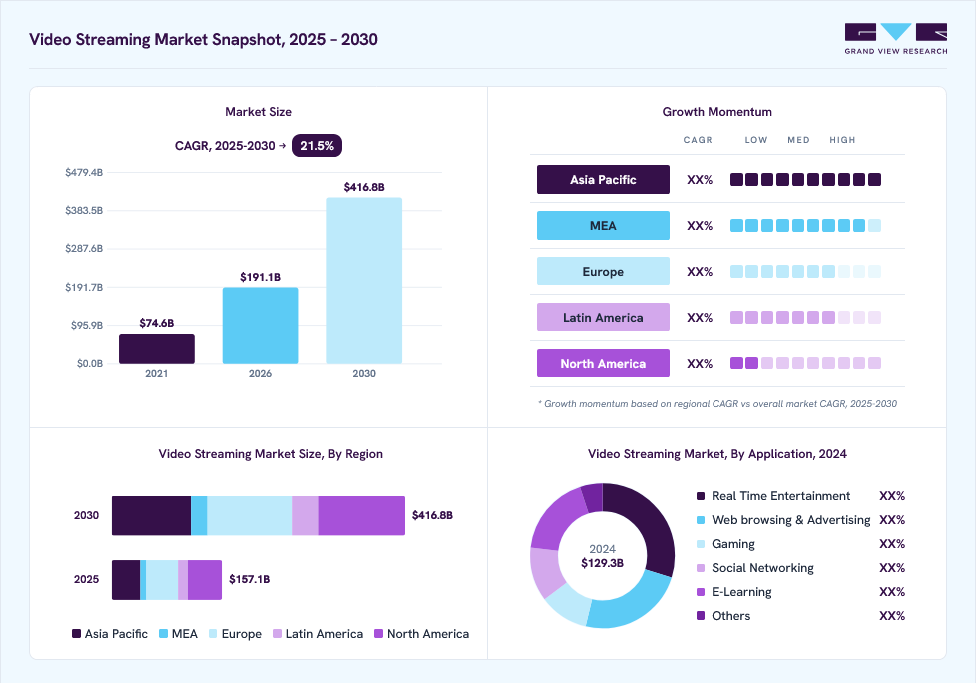
Enterprises are building owned streaming products because the video streaming market is projected to reach $191.1 billion in 2026 and $416.8 billion by 2030, growing at a 21.5% CAGR.
This growth is not limited to entertainment. Media, sports, education, healthcare, and enterprise learning are all building direct video relationships with their audiences instead of renting one.
Data Has Strategic Value
Owning the platform means owning the data behind every view. That data becomes a strategic asset rather than just a usage log.
- Viewing history shows exactly what content keeps an audience engaged over time
- Engagement signals reveal drop-off points, so teams can fix weak spots in content or product
- Search behavior surfaces what viewers want but cannot always find
- Subscription data connects viewing patterns directly to revenue and renewal risk
- Advertising signals become more valuable because they come from real, consented first-party interactions rather than third-party estimates
- Content performance data guides future production and licensing decisions with real evidence
Because this data sits entirely inside the company’s own systems, it can be used freely across product, marketing, and content teams. Third-party platforms rarely offer this same level of access or control.
2. Owned Platforms Give Companies More Control Over Monetization
An owned platform lets a company combine several revenue models instead of being locked into one. This flexibility often determines how quickly a streaming product becomes profitable.
- Subscriptions provide predictable, recurring revenue
- Advertising adds a second revenue stream without raising subscriber cost
- Pay-per-view (PPV) works well for live events and one-time premium content
- Bundles combine content types to increase average revenue per user
- Licensing lets a company sell its content library to other platforms
- B2B contracts open enterprise revenue streams that consumer-only apps cannot access
Because these models can run side by side, companies are not forced to pick just one. As a result, a platform can adjust its mix as its audience and goals shift over time.
3. Video Products Now Extend Far Beyond Entertainment
Video streaming has moved well past entertainment alone. Each industry now has its own specific streaming requirements.
| Sector | Streaming Requirement |
| Media | VOD, DRM, and subscriptions |
| Sports | Live streaming with high concurrency and low latency |
| EdTech | Chapters, transcripts, and LMS integration |
| Healthcare | Secure, real-time video |
| Enterprise learning | SSO and analytics |
| Fintech | Secure education and advisory video |
| News | Live streaming with rapid publishing |
Meanwhile, the technology layer behind these platforms is growing just as fast as the content itself.
The online video platform (OVP) market alone is valued at $17.08 billion in 2026, which confirms there is a substantial market built specifically around managing and distributing video, separate from the content itself.
How 5 Growing Video Streaming Apps Perform and Monetize
Five streaming platforms outside the usual “biggest apps” list show how real monetization strategies perform at scale.
CuriosityStream leans on licensing, Nebula on niche loyalty, Dropout on community tiers, Kanopy on institutional buyers, and Plex on free, ad-supported viewing.
Together, these five offer useful growth benchmarks for any enterprise weighing its own streaming strategy.
Video Streaming Apps Comparison
| Platform | Positioning | Monetization | Performance Signal |
| CuriosityStream | Factual and documentary content | SVOD, licensing, AVOD | $71.7M 2025 revenue |
| Nebula | Creator-owned premium video | Subscriptions, originals | Direct subscribers up 3x+ since 2023 |
| Dropout | Independent comedy | SVOD, Superfan tier | $6.99/mo, $129.99 Superfan |
| Kanopy | Library and education streaming | Institutional, B2B | 4,000+ libraries |
| Plex | Free streaming and FAST | AVOD, premium | 42M+ MAUs |
1. CuriosityStream — Diversifying Beyond Subscription Revenue
CuriosityStream built its business on factual and documentary content, then expanded well past a typical subscription model.
In 2025, the company generated $71.7 million in revenue, up 40% year over year, largely because content licensing grew almost as fast as its direct subscriber base.
- Direct subscribers still generate steady, recurring revenue
- Partner distribution extends reach without new production spend
- Content licensing, including deals tied to AI training, has scaled quickly
- AVOD and FAST channels add a separate advertising revenue stream
Enterprise lesson: Content can generate revenue through more than subscriptions alone.
2. Nebula — Niche Creators Can Support Premium Streaming
Nebula was built by independent creators who wanted more control over their own platform, instead of relying on ad revenue from larger sites.
That creator-first structure has paid off, since direct subscribers have more than tripled since 2023.
- More than 200 creators contribute exclusive content
- Original programming gives subscribers a reason to stay
- Creator ownership keeps incentives aligned with retention
- Growing revenue is now funding studio and production expansion
Enterprise lesson: A mass-market catalog is not required when audience affinity runs deep.
3. Dropout — Community Loyalty Can Beat Catalog Size
Dropout runs a small, tightly focused comedy platform, priced at $6.99 a month with a $129.99 annual Superfan tier.
Its catalog is far smaller than most competitors, yet its community stays remarkably loyal.
- Ad-free programming keeps the viewing experience consistent
- Monthly and annual plans serve different buyer types
- Superfan tier adds merchandise and live event access
- Community engagement drives renewal more than content volume
Enterprise lesson: Subscription tiers should add value at the top, without locking essential content behind them.
4. Kanopy — The Viewer Does Not Have to Be the Buyer
Kanopy sells access to libraries and universities instead of individual viewers, which makes it a useful model for B2B streaming.
The platform now works with more than 4,000 libraries, reaching 158 million cardholders worldwide.
- Institutions purchase access, not individual subscribers
- Usage-based pricing replaces standard consumer billing
- Content is sold in packages built for institutional needs
The same logic applies directly to hospital education, corporate learning, and professional association content.
Enterprise lesson: The economic buyer and the video viewer can be different people.
5. Plex — Free Viewing Can Support Advertising Economics
Plex built its growth around free, ad-supported streaming rather than a paywall. That approach now reaches more than 42 million monthly active users across over 180 countries.
- AVOD and FAST channels generate revenue without subscription cost
- Programmatic advertising scales with audience growth
- First-party viewer data strengthens ad targeting over time
- Premium features add an optional second revenue layer
Enterprise lesson: A paywall is not the only way to monetize engagement.
6. What These Five Streaming Businesses Teach New Entrants
- CuriosityStream shows content economics can diversify beyond subscriptions
- Nebula shows niche audiences can support premium pricing
- Dropout shows community drives retention more than catalog size
- Kanopy shows the buyer and viewer can be different people
- Plex shows free viewing can still generate real commercial value
These five platforms prove that monetization does not follow one fixed formula. Licensing, community tiers, institutional sales, and ad-supported viewing all work when matched to the right audience.
Therefore, revenue strength comes from picking the model that fits the content and buyer, not from copying the biggest name in the category.
Video Streaming Features That Drive Revenue and Retention
A streaming platform earns revenue and retention through seven distinct feature groups, not one long list of add-ons.
Playback, discovery, retention, live engagement, content management, accessibility, and safety each serve a different business goal.
Therefore, grouping features this way also makes it easier to decide what belongs in an early build versus a later phase.
1. Playback Features
Playback features control how smoothly a viewer actually watches content, so this group has the biggest direct impact on churn.
- Adaptive bitrate streaming adjusts quality automatically based on connection speed
- Playback speed controls let viewers watch faster or slower
- Captions and subtitles support accessibility and non-native speakers
- Chapters let viewers jump to specific sections instantly
- Picture-in-Picture keeps video playing while viewers browse other content
- Casting sends playback to a TV or connected device
- Offline download supports viewing without an internet connection
- Background playback keeps audio running when the app is minimized
- Buffer recovery prevents playback from stalling during network drops
2. Discovery Features
Discovery features determine whether a viewer actually finds content worth watching, which directly affects session length.
- Search lets viewers find content by title, topic, or keyword
- Categories organize content into browsable groups
- Recommendations surface content based on viewing behavior
- Trending sections highlight what other viewers are watching now
- Metadata powers accurate search results and recommendation accuracy
- Related videos keep viewers engaged after one video ends
3. Retention Features
Retention features bring viewers back to the platform instead of losing them after one session.
- Profiles let multiple viewers personalize their own experience
- Watchlists let viewers save content for later
- Continue watching picks up playback exactly where a viewer left off
- History gives viewers a record of what they have already watched
- Notifications alert viewers to new content or live events
- Favorites let viewers mark content they want to revisit
4. Live Engagement Features
Live engagement features turn a one-way broadcast into an interactive experience, which matters most for sports, news, and events.
- Chat lets viewers talk to each other during a live stream
- Reactions give viewers a quick way to respond in real time
- Polling collects viewer opinions during a live event
- Q&A lets viewers submit questions to hosts or speakers
- Live captions support accessibility during real-time broadcasts
- DVR lets viewers pause and rewind a live stream
- Replay makes a live event available on demand afterward
5. Creator and Content Management Features
Content management features sit behind the scenes, so they rarely show up in a demo, but they shape how efficiently a team can publish and manage video.
- Video CMS organizes and manages the full content library
- Multipart upload supports large file uploads without failure
- Resumable upload picks up an interrupted upload instead of restarting it
- Metadata editing keeps titles, descriptions, and tags accurate
- Thumbnails give each video a clear, clickable preview image
- Scheduling publishes content automatically at a set time
- Chapters get added during the upload and editing process
- Watermarking protects content from unauthorized redistribution
- Rights management controls who can access or license specific content
6. Accessibility and Localization
Accessibility features are not optional additions, since they directly affect who can legally and practically use the platform.
- Captions support viewers who are deaf or hard of hearing
- Closed captions can be turned on or off by the viewer
- Multilingual subtitles support international audiences
- Translated metadata helps content surface in local-language search
- Audio descriptions narrate visual content for blind or low-vision viewers
- Keyboard accessibility supports viewers who cannot use a mouse or touchscreen
7. Safety and Family Features
Safety features protect younger viewers and keep the platform compliant with content regulations.
- Parental controls restrict access based on account settings
- Content ratings label videos by age appropriateness
- Reporting lets viewers flag inappropriate content
- Moderation reviews flagged content and removes violations
- Age restrictions block specific content from underage viewers
8. MVP vs. Growth vs. Enterprise Feature Table
Feature scope changes significantly across budget tiers, so matching features to budget early prevents scope creep later.
| Budget Tier | Feature Scope |
| $70K–$120K (MVP) | Core playback, basic search and categories, single-profile accounts, continue watching, basic captions |
| $120K–$200K (Growth) | Adaptive bitrate at scale, recommendations, multiple profiles, watchlists, notifications, multilingual subtitles, basic live streaming |
| $200K–$300K (Enterprise) | Full live engagement suite, advanced content management, DRM, multi-platform casting, parental controls, moderation tools, advanced analytics |
Streaming features fall into clear functional groups, each tied to a specific business outcome like retention, discovery, or compliance. Consequently, the budget tier determines how much depth each group gets, not whether a feature group exists at all.
Early builds should prioritize playback and discovery, while live engagement and advanced management scale in later phases.
Choose Live, VOD, or Hybrid Before Designing Architecture
Choosing between live, VOD, or hybrid delivery is the first architecture decision, since each model needs a different technical foundation underneath it.
Specifically, VOD relies on asynchronous processing and storage, while live streaming depends on real-time encoding and redundancy. Interactive video, meanwhile, needs peer-to-peer infrastructure entirely.
Therefore, getting this choice right early prevents expensive rework later, because retrofitting live capability onto a VOD-only system is far harder than building for both from the start.
1. VOD for Prerecorded Content
VOD systems process content after upload, so speed depends on transcoding efficiency rather than real-time performance.
- First, uploaded video enters an asynchronous transcoding pipeline
- The pipeline then converts files into multiple formats and bitrates
- Once processed, video is stored in object storage for long-term access
- Meanwhile, CDN caching speeds up repeated playback across regions
- Finally, offline playback lets viewers download content for later use
2. Live Streaming for Broadcast Experiences
Live streaming pushes video to viewers in real time, so every part of the pipeline runs under active time pressure.
- First, RTMP or SRT ingest brings the live feed into the system
- Next, live encoding converts that feed into streamable formats instantly
- Packaging then prepares the stream for playback across different devices
- In addition, DVR functionality lets viewers pause and rewind live content
- Meanwhile, redundancy protects the stream if one server or path fails
- Finally, concurrency planning ensures the system holds up under sudden viewer spikes
3. Real-Time Video for Interactive Sessions
Real-time video supports two-way interaction, which neither VOD nor standard live streaming is built to handle.
- First, WebRTC powers low-latency, two-way video communication
- From there, an SFU architecture routes multiple video streams efficiently between participants
- As a result, two-way audio and video allow live back-and-forth interaction
- Meanwhile, participant state tracks who is connected, muted, or speaking at any moment
4. Hybrid Platforms Combine Several Delivery Models
Hybrid platforms mix live, VOD, and sometimes real-time video within one product, since different parts of the user journey call for different formats.
- For example, recorded classes are often paired with live tutoring in edtech platforms
- Similarly, live sports are paired with instant replay in broadcasting
- In healthcare, telehealth sessions are paired with recorded patient education content
- Likewise, live events are paired with an on-demand library for later viewing
Because each use case pulls from more than one model, hybrid platforms need architecture that supports all of them without duplicating infrastructure.
5. Streaming Model Decision Matrix
Each delivery model trades off latency, scale, interaction, and cost differently. Therefore, matching the model to the actual use case matters more than defaulting to the most feature-rich option.
| Model | Latency | Scale | Interaction | Cost | Ideal Use Case |
| VOD | Not time-sensitive | High, via CDN caching | None | Lower | Course libraries, media archives, patient education |
| Live | Seconds of delay | High, needs load planning | Limited, one-way | Moderate to high | Sports, news, live events |
| Real-time (WebRTC) | Sub-second | Limited by SFU capacity | Full two-way | Highest | Telehealth, live tutoring, virtual consultations |
| Hybrid | Mixed, depends on component | High, across combined systems | Mixed | Highest overall | Edtech, healthcare, sports broadcasting |
Live, VOD, and real-time video each solve a different problem, so the right architecture depends entirely on how content will actually be consumed.
Hybrid platforms, while more complex, are often necessary once a product needs more than one of these delivery types.
Choosing the model first keeps every later architecture decision aligned with actual business need.
How Video Streaming Architecture Works From Upload to Playback
A working streaming platform moves video through eight connected layers, starting at upload and ending at playback on a viewer’s screen.
Each layer hands off to the next, so a weak link anywhere in the chain slows down the entire system. Understanding these layers first makes every later technology decision easier to evaluate.
Layer-By-Layer Architecture Table
| Layer | Core Function | Common Tools |
| Ingest and Upload | Accepts recorded and live content | Multipart/resumable upload, RTMP, SRT |
| Processing and Transcoding | Converts raw video into playable formats | FFmpeg, AWS MediaConvert |
| Packaging and Origin | Prepares content for player requests | HLS, MPEG-DASH, CMAF |
| CDN and Edge Delivery | Delivers content globally with low latency | CloudFront, Cloudflare, Akamai, Fastly |
| Video Player | Decodes and displays video to viewers | Shaka Player, hls.js, AVPlayer, Media3 |
| Product Backend and API | Connects video to the broader product | REST/GraphQL, identity, billing, search |
| Microservices and Events | Scales specific components independently | Message queues, event buses |
| Cloud and DevOps | Runs and scales the entire system | AWS, Google Cloud, Docker, Kubernetes |
| Monitoring | Tracks performance and playback quality | Datadog, Prometheus, QoE analytics |
Each of these 9 layers depends on the one before it, so weak points anywhere in the chain affect the whole viewing experience. Additionally, cost and complexity scale with traffic and feature needs, not with team size alone.
Therefore, a platform built on this full picture avoids the costly rework that comes from treating streaming as just a player integration.
How Streaming Apps Monetize Through SVOD, AVOD and TVOD
SVOD, AVOD, and TVOD each require a different technical foundation, not just a different pricing label. Specifically, SVOD depends on subscription and entitlement syncing, while AVOD depends on an ad delivery stack. TVOD, meanwhile, depends on transaction-level access control.
Because most platforms eventually combine two or more of these models, the entitlement system underneath needs to support all of them from the start, rather than being bolted on later.
1. SVOD Requires Subscription and Entitlement Synchronization
SVOD works only when billing status and content access stay perfectly synced at every moment. Otherwise, a lag between the two directly causes support tickets and churn.
- First, monthly and annual plans need separate billing cycles and renewal logic
- Renewals then trigger automatically, so access continues without manual steps
- Trials, meanwhile, need a clear cutoff that switches to paid access or expiry
- Similarly, upgrades and downgrades must update entitlements immediately, not after the next billing cycle
- Even so, cancellations should still honor access through the end of a paid period
- Finally, grace periods give a short window for failed payments before access is cut
2. AVOD Needs an Advertising Delivery Stack
AVOD depends on a full advertising stack. In other words, a video player with occasional ad breaks inserted is not enough on its own.
- First, VAST handles the actual ad delivery and playback instructions
- VMAP, meanwhile, schedules ad breaks across a full video timeline
- Server-side ad insertion (SSAI) then stitches ads directly into the video stream, which improves reliability
- Client-side ad insertion (CSAI), by contrast, loads ads separately within the player itself
- Programmatic ads also connect the platform to real-time ad marketplaces
- For measurement specifically, VPAID is now deprecated, so platforms should use SIMID for interactive ad units and OMID for viewability and verification instead
3. TVOD and PPV Need Transaction-Level Entitlements
TVOD and pay-per-view require entitlements tied to a single transaction, rather than an ongoing subscription.
- For instance, sporting events often use PPV to monetize one-time, high-demand access
- Similarly, online courses can sell individual modules through the same transaction model
- Concerts and live conferences also fit naturally into a one-time purchase structure
- Premium premieres, in addition, let studios monetize new releases before wider availability
4. Freemium Can Create an Acquisition Funnel
Freemium models use free access as a way to convert viewers into paying subscribers over time.
- First, a free catalog gives new users a reason to try the platform
- A separate premium catalog then creates a clear reason to upgrade
- Meanwhile, limited previews let viewers sample premium content before committing
- Finally, upgrade triggers, such as content locks or watch limits, prompt conversion at the right moment
5. Hybrid Monetization Needs One Entitlement System
Hybrid models combine subscription, PPV, ads, and premium membership within a single platform, which only works if entitlements are managed centrally.
For example, a sports platform might combine a base subscription, PPV access to marquee events, an ad-supported free tier, and a premium ad-free membership.
Because a viewer’s access level can change at any moment, a single entitlement system must track all four models at once.
Without this, viewers risk losing access they already paid for, or worse, accessing content they never purchased.
6. Payment Architecture
Payment architecture connects monetization models to real transactions, taxes, and reconciliation.
- First, Stripe remains a common choice for web-based subscription and PPV billing
- Meanwhile, Apple App Store and Google Play handle in-app purchases on mobile, each with their own revenue share rules
- Tax calculation, in addition, must adjust automatically based on viewer location
- Invoices then need to be generated for both consumer and B2B transactions
- Refunds also require clear policies tied to each monetization model
- Finally, subscription reconciliation keeps internal records aligned with what payment processors actually report
SVOD, AVOD, TVOD, and freemium each solve monetization differently, but all four depend on the same underlying entitlement and payment architecture.
Building this system to support multiple models from the start avoids costly rework as monetization strategy evolves. Ultimately, payment accuracy and entitlement sync protect revenue more than the pricing model itself.
Where AI Creates Real Value in Video Streaming Products
AI adds real value in streaming when it improves discovery, quality, and efficiency, not when it replaces core system logic.
Each use case below works best as a supporting layer, since entitlement and billing systems still need deterministic, rule-based logic underneath.
1. AI Recommendation Engines Improve Discovery
- First, collaborative filtering surfaces content based on similar viewers
- Behavioral signals then refine suggestions over time
- Meanwhile, content embeddings match viewers to similar titles
- Finally, ranking orders results by predicted relevance
For a deeper breakdown of personalization, see our guide on recommendation engine development.
2. Semantic Search Finds Content Beyond Exact Keywords
- First, embeddings capture meaning, not just matching words
- From there, vector search retrieves conceptually related content
- In addition, metadata and transcripts improve search accuracy further
3. AI Can Generate Captions and Translations
- First, speech recognition converts audio into text captions
- From there, multilingual subtitles expand reach automatically
- Even so, translation review keeps accuracy high before publishing
4. AI Can Generate Metadata and Chapters
- First, scene detection identifies natural break points
- Transcript summarization then produces short descriptions
- Meanwhile, topics and timestamps improve navigation and search
- Finally, title suggestions speed up content publishing
5. Multimodal AI Can Support Content Moderation
- First, image and video classification flags risky content
- In addition, speech analysis adds another moderation signal
- As a result, flagged items enter a moderation queue for human review
6. AI Can Predict Churn and Engagement
- First, watch frequency signals ongoing interest
- Similarly, incomplete sessions often flag early disengagement
- Meanwhile, search activity and content affinity refine predictions further
7. AI Can Detect Streaming Quality Problems
- First, buffering patterns reveal delivery weak points
- Similarly, device-specific failures highlight compatibility issues
- Finally, regional CDN anomalies and bitrate drops get flagged early
8. What AI Should Not Control
AI should never replace deterministic entitlement checks, DRM, billing, or critical access-control logic. Instead, these systems require guaranteed accuracy, not probabilistic output.
AI strengthens discovery, quality, and content operations, but it still stays a supporting layer, not the system of record. Therefore, entitlement, billing, and DRM logic must remain deterministic to protect revenue and access control.
How Intellivon Builds a Streaming App From Strategy to Launch
Building a streaming platform follows eight connected stages, from defining the business model through load testing under real network conditions.
Each stage feeds directly into the next, so skipping ahead usually means paying for rework later. Intellivon runs this process the same way for every streaming build, regardless of industry or scale.
1. Define the Business and Revenue Model
Every streaming build starts by mapping the business model before writing a line of architecture, since technical decisions without this context tend to miss the mark.
- First, audience definition shapes device priorities and content strategy
- Content type then determines whether the platform leans live, VOD, or hybrid
- Monetization choice, meanwhile, decides how entitlements and billing get structured
- Devices and regions also influence CDN and localization needs
- Finally, KPIs give the team a way to measure whether the build is actually working
Intellivon ties every architecture decision back to measurable usage and revenue targets from day one, rather than treating technical scope as separate from business outcomes.
As a result, engineering choices stay accountable to the metrics that actually matter to leadership.
2. Define Traffic, Latency and Reliability Requirements
Once the business model is set, traffic and reliability requirements determine how much infrastructure the platform actually needs.
- First, concurrent viewer estimates shape server and CDN capacity planning
- Similarly, peak load scenarios, such as live events, reveal worst-case demand
- Meanwhile, latency targets differ sharply between VOD and real-time interactive video
- In addition, uptime requirements guide redundancy and failover design
- Finally, expected viewing hours inform long-term storage and bandwidth cost
Intellivon builds these numbers from real usage projections, and not assumptions. Otherwise, underestimating peak load becomes one of the most common reasons launches fail under pressure.
3. Design Streaming and Application Architecture
With requirements defined, architecture decisions translate business needs into an actual technical blueprint.
- First, live versus VOD selection determines the core pipeline structure
- Next, protocol choice, such as HLS or CMAF, affects compatibility and cost
- Meanwhile, CDN and origin setup shape delivery speed and reliability
- Similarly, transcoding strategy balances quality against processing cost
- Databases and APIs then connect every layer of the product
- Finally, cloud provider selection rounds out the full technical stack
Intellivon treats architecture as a direct extension of the business goals set in step one. Therefore, every technical choice maps back to a measurable outcome rather than a default preference.
4. Design Viewer, Admin and Creator Workflows
Product workflows, unlike backend architecture, directly shape how viewers and internal teams actually experience the platform day to day.
- First, web and mobile UX design determines how easily viewers can find and watch content
- In addition, a video CMS gives internal teams control over publishing and content management
- Meanwhile, search functionality helps viewers locate content quickly
- Similarly, billing workflows connect directly to the monetization model chosen earlier
- Finally, content workflows define how new material moves from upload to publish
Intellivon designs these workflows around actual team size and content volume. Otherwise, an oversized admin system slows teams down just as much as an undersized one limits growth.
5. Build the Media and Backend Layer
At this stage, the platform’s core engineering work actually begins, connecting every system defined in earlier steps.
- First, upload systems handle both creator and live content ingestion
- Next, processing pipelines transcode and package video for delivery
- Meanwhile, APIs connect the frontend, backend, and media systems together
- Authentication then verifies user identity across every session
- In addition, entitlements enforce exactly what each user is allowed to access
- Finally, payments integrate billing directly into the entitlement system
Intellivon builds this layer with production traffic in mind from the start, rather than a version that works only in a demo environment.
6. Build Web, Mobile and TV Applications
Platform rollout should follow actual audience demand, not an assumption that every device needs day-one support.
- First, web applications often launch using React or Next.js
- From there, mobile apps follow using Swift and Kotlin, or React Native and Flutter for shared codebases
- Finally, TV applications extend to Roku, tvOS, Fire TV, and Tizen or webOS based on audience data
Intellivon sequences platform rollout by where the target audience actually watches. Otherwise, building for every device simultaneously often delays launch without improving early adoption.
7. Add DRM, Analytics and AI
Once the base streaming workflow proves reliable, DRM, analytics, and AI layers get added on top, rather than built in parallel from day one. This sequencing matters, because adding these systems too early can slow down core testing and delay the actual launch.
As a result, Intellivon integrates these layers only after playback, billing, and entitlements are already stable in production.
8. Load Test Real Network Conditions
Before launch, the platform gets tested against real-world network failures, not just ideal conditions.
- First, weak bandwidth and packet loss simulate poor viewer connections
- Similarly, device switching tests confirm playback holds up across changing conditions
- Meanwhile, peak concurrency testing verifies the system under maximum expected load
- In addition, origin and CDN failure tests confirm redundancy actually works
- Finally, DRM and payment error testing catches failures before real viewers do
Intellivon runs this testing phase as a standard step before every launch. Otherwise, a platform that only works under perfect conditions is not actually production-ready.
Each of these eight steps builds directly on the one before it, so sequencing matters as much as the individual technical decisions.
A platform built this way holds up under real traffic, not just in early demos. Intellivon follows this same process across every streaming build, adjusted for the specific audience, content type, and monetization model involved.
Video Streaming App Development Costs $70K–$300K in 2026
A custom video streaming product within the scope covered in this guide generally requires a $70,000–$300,000 development investment, depending on streaming model, device coverage, concurrency, DRM, integrations, AI, and security requirements.
This is a custom-development range, however, not a claim that every hyperscale OTT ecosystem can be built for under $300K.
Instead, it reflects what a focused, production-ready streaming platform typically costs when scoped around real business requirements rather than unlimited feature ambition.
Video Streaming App Development Cost Table
| Development Area | Typical Range |
| Discovery and architecture | $5K–$15K |
| UX/UI | $8K–$20K |
| Backend and APIs | $15K–$45K |
| Media pipeline | $15K–$45K |
| Web/mobile clients | $20K–$60K |
| DRM/security/billing | $8K–$30K |
| QA/load testing | $8K–$25K |
| Advanced AI/CTV/integrations | $15K–$75K |
| Typical total scope | $70K–$300K |
Because project scope varies so widely, the maximum values across every row should not simply be added together. Instead, each project draws from this table based on its own streaming model, platform coverage, and feature depth.
1. $70K–$120K Streaming MVP
An MVP at this budget typically focuses on proving the core product before adding advanced features.
- First, VOD delivery covers the core content experience
- Web and mobile clients then reach the primary audience
- A managed CDN handles delivery without heavy custom infrastructure
- Basic subscriptions support initial monetization
- Analytics and an admin CMS round out day-one operations
2. $120K–$200K Growth Product
At this tier, the platform expands beyond MVP scope to support real growth.
- Live streaming adds real-time content alongside VOD
- DRM, in addition, strengthens content protection
- Stronger personalization improves discovery and retention
- More integrations connect the platform to broader business systems
- Higher concurrency support also handles larger, more active audiences
3. $200K–$300K Enterprise Streaming Product
At the top tier, the platform supports complex, large-scale requirements across every layer.
- Hybrid live and VOD delivery covers the full range of content types
- Multi-platform delivery then extends reach across web, mobile, and TV
- Multi-DRM support protects content across every major platform
- Enterprise identity systems manage access at organizational scale
- AI adds personalization, moderation, and quality monitoring
- Advanced observability and complex integrations round out enterprise readiness
4. What Drives Development Costs Up
Several specific requirements push a project toward the higher end of the range.
- WebRTC adds real-time, interactive video complexity
- Smart TV apps, similarly, require separate development for each platform
- DRM implementation adds licensing and integration cost
- Complex ad tech, in addition, requires programmatic and measurement infrastructure
- Large concurrency demands heavier infrastructure investment
- AI features add both development and ongoing model cost
- Multi-region infrastructure then increases both complexity and hosting cost
- Healthcare compliance, finally, adds security, audit, and architecture requirements
5. Ongoing Maintenance Cost
Ongoing maintenance typically runs 15% to 25% of the initial build cost annually. This range, however, covers software maintenance only, not the full cost of media infrastructure.
6. Streaming Infrastructure Costs Are Separate
Beyond development, ongoing infrastructure costs run separately and scale directly with usage.
- Storage costs grow with content library size
- Transcoding costs then scale with upload volume and bitrate ladder depth
- CDN and egress costs rise with total viewing hours
- DRM licensing adds a recurring per-platform cost
- Observability tools add a smaller, ongoing monitoring cost
- Third-party APIs, finally, add cost based on usage volume
7. Total Cost of Ownership
Total cost of ownership combines several categories, not just the initial build.
- Development covers the upfront build cost
- Maintenance then covers ongoing software updates and fixes
- Infrastructure adds the recurring hosting and delivery cost
- Licensing covers DRM, codecs, and third-party tools
- Operations, finally, covers the team and processes running the platform day to day
8. Development Timeline
Timelines scale with scope, so a focused MVP moves faster than an enterprise build.
- A focused MVP typically takes roughly 3 to 5 months
- A growth product then takes roughly 5 to 7 months
- A larger enterprise build generally takes 6 to 9 months or more
Development cost scales with streaming model, device coverage, and feature depth, not with any single line item.
Why Enterprises Work With Intellivon on Video Streaming Builds
Enterprises work with Intellivon because architecture gets scoped before any feature gets estimated, not the other way around.
1. Architecture Is Scoped Before Features Are Estimated
Every engagement starts by defining what the platform actually needs to handle, both technically and financially.
- First, concurrency requirements shape server and CDN capacity
- Latency tolerance then determines whether live, VOD, or real-time architecture applies
- Content and admin workflows, in addition, get mapped to actual team size
- Monetization model shapes how entitlements and billing get structured
- Compliance requirements, where relevant, get built in from day one
- Finally, traffic economics get modeled so cost scales predictably
2. Proven Media Infrastructure Is Used Where It Makes Sense
Custom effort goes toward what differentiates the product, not toward rebuilding commodity infrastructure.
Transcoding, CDN delivery, and DRM licensing run on proven, established systems, while custom engineering focuses on workflows, entitlement logic, and product experience.
This keeps cost focused on real differentiation instead of solved problems.
3. Custom Engineering Focuses on Product Advantage
Custom development concentrates on parts a competitor cannot simply buy off the shelf.
- Business-specific workflows reflect how the organization actually operates
- Entitlement logic, similarly, matches the exact monetization model in use
- Analytics get shaped around metrics that matter to that business
- Recommendations then get tuned to the platform’s own content and audience
- Integrations connect to existing internal systems
- Regulated workflows, where applicable, meet specific compliance requirements
4. AI Is Added Around Defined Outcomes
AI gets integrated for specific outcomes, not applied broadly as a marketing feature.
- Recommendations improve discovery based on real viewing behavior
- Semantic search, in addition, finds content beyond exact keywords
- Content classification supports moderation at scale
- Analytics then surface patterns in engagement and retention
5. Intellivon Has Adjacent Real-Time Video Experience
Intellivon’s healthcare work includes two platforms directly relevant here. An AI-driven, HIPAA-compliant telemedicine platform uses encrypted WebRTC, identity governance, and real-time multimedia for secure clinical video.
Similarly, an AI-assisted mobile endoscopy platform combines real-time video, edge inference, and computer vision for low-latency clinical workflows.
Both are documented in Intellivon’s healthcare material, and both draw on the same real-time video and security expertise a streaming build requires.
6. Production Monitoring Continues After Launch
Monitoring continues after launch as an ongoing part of the engagement.
- Performance monitoring tracks playback quality and stability
- Usage monitoring then reveals how audiences actually engage
- Cost monitoring keeps spend aligned with real traffic
- AI model monitoring, where applicable, tracks accuracy over time
- Scaling adjustments follow as traffic grows
Intellivon scopes architecture around real usage and revenue requirements, uses proven infrastructure where it makes sense, and reserves custom engineering for real differentiation.
Direct real-time video and healthcare compliance experience shape how every streaming build gets planned.
Build Your Video Streaming App Around Real Demand
Before development begins, it helps to know how many people will watch, how much latency they can tolerate, and which devices matter most. From there, monetization and expected cost per streamed hour become clearer.
Intellivon uses these requirements to scope the application, architecture, AI components, and infrastructure before engineering begins.
Conclusion
Choosing between live, VOD, or hybrid delivery shapes every technical decision that follows, from architecture through cost. Specifically, a custom build typically runs $70,000 to $300,000, depending on concurrency, DRM, AI, and compliance needs.
Because of this, Intellivon scopes architecture around real usage and revenue targets before engineering begins, so the platform holds up under actual traffic. Ultimately, the right foundation now saves costly rework later.
FAQs
Q1. How Much Would Intellivon Charge to Build Our Video Streaming App?
A1. Cost typically falls between $70,000 and $300,000, depending on streaming model, device coverage, and DRM needs. Because scope varies widely, Intellivon maps concurrency, monetization, and compliance requirements first. As a result, the final estimate reflects the actual platform, not a generic package price.
Q2. How Long Would Intellivon Take to Launch Our Streaming Product?
A2. Timeline depends directly on scope. A focused MVP typically takes 3 to 5 months, while a growth product takes 5 to 7 months. Enterprise builds, meanwhile, generally take 6 to 9 months or more, since additional platforms and compliance work extend the timeline.
Q3. Can Intellivon Build on Mux, AWS or Cloudflare Instead of Starting From Scratch?
A3. Yes, Intellivon builds on proven infrastructure like AWS, Cloudflare, or Mux wherever it fits the use case. This approach keeps custom engineering focused on differentiation instead of rebuilding commodity infrastructure. Therefore, cost stays lower without sacrificing reliability or performance.
Q4. Can You Replace Our Existing Streaming Platform Without Rebuilding Everything?
A4. Often, yes. Intellivon audits existing architecture first, then identifies which components can stay and which need replacement. This way, migration happens in phases rather than as one disruptive rebuild, which reduces downtime and protects existing viewer data throughout the transition.
Q5. How Would You Design Our Platform for Peak Viewer Traffic?
A5. Peak traffic planning starts with concurrency modeling based on expected live events or launches. From there, CDN capacity, autoscaling, and origin redundancy get sized accordingly. Consequently, the platform holds up under real spikes instead of failing during the moments that matter most.
Q6. Can You Build Web, Mobile and Smart TV Apps From One Backend?
A6. Yes, a shared backend and API layer typically supports web, mobile, and TV clients simultaneously. Meanwhile, each platform gets its own frontend built for that device’s constraints. This structure keeps development efficient while still delivering a native experience on every platform.
Q7. Can Intellivon Add AI Without Rebuilding Our Streaming Platform?
A7. Usually, yes. AI features like recommendations, search, and moderation typically integrate through APIs on top of existing infrastructure. Because entitlement and billing logic stay untouched, AI gets added without disrupting core platform stability, provided the existing architecture supports the added workload.
How Would Intellivon Protect Our Premium Video Content?
A8. Content protection combines multi-DRM support, token-based authentication, and signed URLs. In addition, geo-restriction and IP-based access controls limit unauthorized viewing. Together, these layers protect premium content across devices, which matters most for licensing agreements and high-value exclusive releases.

