Key Takeaways:
-
AI governance enables pharmaceutical companies to use AI safely when it comes to drug safety.
-
It is up to the pharmacovigilance teams to make safety decisions, not just the AI teams.
-
The teams using AI should be in charge of managing the model’s performance, carrying out testing, and dealing with any technical problems.
-
Human experts ought to examine decisions that are of a high risk and intervene if necessary.
-
Learn how Intellivon develops governance systems that monitor AI, risks, approvals, and monitoring.
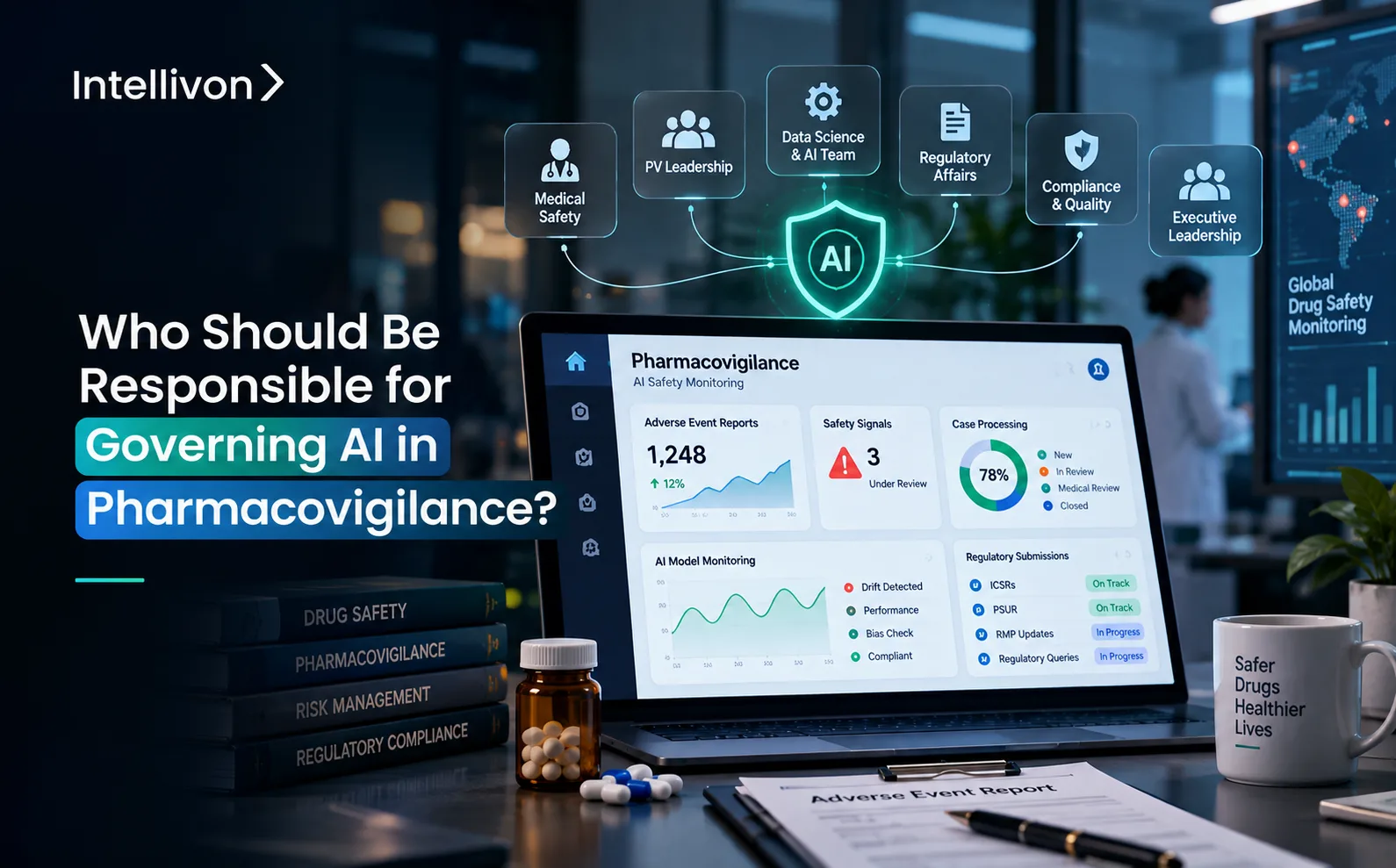
The marketing authorization holder will always be responsible for pharmacovigilance AI governance, but within the company the main responsibility lies with the PV process owner. The IT and data science teams provide support to that owner; yet they must never be held ultimately accountable. Rather, governance functions as a shared system of clearly defined decision-making rights among the areas of drug safety, quality, data, and medical review.
This is important since a large number of safety teams currently make use of AI when carrying out case intake, literature screening, and signal review. However, few of them can accurately identify the individual who gives the final approval in instances where a model fails to detect a serious case. Also, oversight should vary depending on the specific use case because suggestions regarding coding involve a lower level of risk than decisions relating to causality or signals.
The blog therefore sets out the responsibilities associated with each role, demonstrates how to manage vendor AI, and explains what regulators expect each owner to prove. It also details the cost of establishing a governance layer, step by step. Since at Intellivon we design governed AI for regulated healthcare organizations, this ownership model illustrates how accountability performs in actual production, not just in policy.
What AI Governance Means in Drug Safety
Pharmacovigilance AI governance is the set of people, rules, controls, and systems a drug sponsor uses to manage AI across safety work. In practice, it decides who approves each AI tool, what that tool may do, and how humans stay in control.
As a result, every AI output affecting patient safety has a clear, named owner.
1. AI Governance Is More Than an AI Policy
Many sponsors publish a responsible AI policy and consider governance finished. However, a policy only states intentions, while governance controls the systems that actually process adverse event cases. Therefore, real governance answers seven operational questions:
- Who can approve a new AI use case
- What the AI is allowed to decide or suggest
- Which data sources it may use
- How its performance gets tested before and after launch
- When a human reviewer must step in
- How every change gets documented
- When the system must be paused or stopped
2. Governance Follows AI Throughout Its Lifecycle
AI governance does not end at launch. Instead, the CIOMS Working Group XIV report frames oversight across the full AI lifecycle, from defining requirements to routine use. Each stage carries its own controls.
2.1 Before AI Development Begins
The team defines the business purpose, risk level, intended users, permitted data, and which decisions the AI may influence.
2.2 Before AI Goes Into Production
Next, QA leads validation, testing, security checks, and human review design before formal go-live approval.
2.3 While AI Is Being Used
Once the system is live, owners track performance, drift, incidents, reviewer overrides, and audit records for every processed case.
2.4 When AI Changes or Is Retired
Finally, updates trigger revalidation and version control, while retired systems keep their records for inspection.
In short, pharmacovigilance AI governance turns a written policy into controlled, owned decisions at every lifecycle stage. However, defining the stages is only half the work. The harder question is who owns each one.
Where AI Is Already Used in Pharmacovigilance
AI already supports five core pharmacovigilance areas: case processing, literature monitoring, signal detection, aggregate reporting, and safety analytics. In practice, these tools extract data, flag patterns, and draft documents for expert review. As a result, governance applies to live systems handling regulated safety data. Therefore, mapping each use case shows exactly what needs an owner.
1. Adverse Event Intake and Case Processing
Case processing is the biggest AI target. According to IntuitionLabs, it consumes up to two-thirds of a company’s PV budget. Common uses include:
- Adverse event extraction
- Duplicate detection
- Case classification
- MedDRA coding support
- Narrative generation
- ICSR workflow automation
2. Medical Literature Monitoring
Safety teams must screen thousands of articles for reportable events. For example, one validated system filtered 55% of irrelevant articles while targeting 99% recall. Reviewers then focus only on likely relevant papers.
3. Drug Safety Signal Detection
Machine learning scans safety databases for unusual drug and event patterns. It then ranks potential signals, so experts review the strongest first. However, medical reviewers still decide whether a signal is real.
4. Aggregate Safety Reporting
AI also supports periodic reports that summarize safety data over time. Specifically, it assists with:
- PSURs
- PBRERs
- Safety summaries
- Evidence extraction
- Draft preparation
5. Safety Analytics and Workflow Automation
Automation increasingly manages the daily flow of safety work, including dashboards, case prioritization, workload routing, and quality checks. For instance, one vendor reports that automated triage cuts per-case triage from 30 minutes to under a minute.
In short, AI now shapes workflows tied directly to patient safety and regulatory reporting. Accordingly, the CIOMS XIV paper discusses case processing, information retrieval, and data analysis among its example use cases.
Why Pharma Enterprises Are Adding AI Governance
Pharma enterprises are adding pharmacovigilance AI governance because AI now handles real safety work, not just experiments. As a result, AI errors can affect adverse event reports, signal reviews, and patient safety. Meanwhile, accountability still rests with the company, not the algorithm. Therefore, governance gives every AI decision a named owner, a documented control, and a clear human checkpoint.
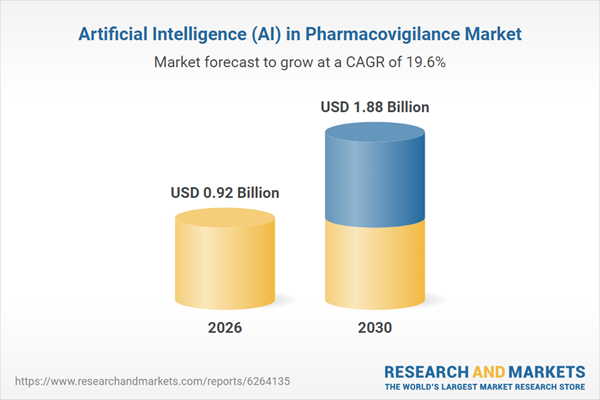
Market growth explains the urgency. Research and Markets values the AI in pharmacovigilance market at $0.92 billion in 2026. It projects $1.88 billion by 2030, a 19.6% CAGR. As a result, AI is reaching more safety teams, and every new deployment needs clear ownership.
1. AI Is Moving From Pilots Into Daily Safety Work
A failed pilot stays contained, but a live system touches real cases. According to IQVIA, AI became increasingly central to PV, safety, and regulatory workflows in 2025. Consequently, governance and risk-based validation became 2026 priorities.
2. More Automation Creates Larger Safety Consequences
AI authority in drug safety usually grows in four steps:
- Manual support
- AI recommendations
- Automated workflows
- Increasingly autonomous actions
Thus, the more authority AI receives, the clearer its ownership must become.
3. Regulators Expect Traceable Safety Processes
The CIOMS XIV principles advise naming a governance body that oversees the AI lifecycle and assigns accountable people. So enterprises must show:
- What the AI was designed to do
- Which version was used
- How it was validated
- Who approved it
- How humans reviewed outputs
- What happened when performance changed
4. Generic Enterprise Governance Is Not Enough
Corporate AI policies usually cover privacy, cybersecurity, and responsible use. However, IQVIA argues that regulated healthcare needs more than one-size-fits-all governance. Pharmacovigilance also needs controls for:
- Patient safety
- Adverse event reporting
- Medical judgment
- Signal detection
- Inspection readiness
- Safety system validation
5. Enterprises Need AI Without Losing Human Control
Companies want faster case processing and less repetitive work. Still, automation cannot blur who owns a safety decision. Governance protects those speed gains while humans keep final judgment.
6. Vendor AI Creates Another Accountability Problem
Many enterprises rely on safety platforms, CROs, hosted LLMs, or extraction tools. For example, Veeva’s Falcon Safety is designed to manage intake across E2B-compliant systems, including Oracle Argus and ArisGlobal LifeSphere. Governance therefore defines what the vendor controls and what the sponsor still owns.
In short, enterprises are not building governance just to satisfy AI rules. They need it because AI now performs regulated safety work, while accountability stays human and organizational.
Why AI Ownership Becomes Difficult in Drug Safety
AI ownership becomes difficult in drug safety because one AI system crosses many teams, vendors, and decisions at once. As a result, technical control, safety judgment, and regulatory accountability often sit in different places.
Meanwhile, the system itself keeps changing after launch. Therefore, sponsors must decide who owns what before an inspector asks.
1. Several Teams Touch the Same AI System
A single AI-assisted safety workflow rarely belongs to one department. For example, it may involve:
- Pharmacovigilance
- Medical safety
- Data science
- IT
- MLOps
- Quality
- Regulatory affairs
- Legal
- Cybersecurity
- External vendors
2. Technical Ownership Is Not Safety Ownership
The team that trains or maintains a model controls how it works. However, that team does not automatically own the safety decision the model supports.
Instead, seriousness, causality, and reportability calls stay with qualified safety experts.
3. Outsourcing Does Not Remove Accountability
A CRO or technology vendor may perform the work. Still, regulatory responsibility stays with the sponsor. EMA states that marketing authorization holders keep full responsibility when they subcontract PV activities.
They also remain ultimately responsible for validating PV processes supported by electronic systems.
4. AI Changes After Deployment
Governance cannot end at go-live. In fact, the CIOMS guidance calls for monitoring well beyond launch. That matters because several things can shift:
- Models and versions
- Prompts
- Input datasets
- System integrations
- Vendors and their updates
- Regulatory requirements
In short, ownership blurs because many teams touch AI, vendors perform the work, and systems keep changing. Yet regulatory accountability never leaves the sponsor.
Pharmacovigilance Must Own AI Accountability
Pharmacovigilance must own AI accountability because safety decisions carry regulatory consequences that technical teams cannot answer for. Specifically, the marketing authorization holder stays legally responsible, while the relevant PV process owner owns each AI workflow.
Meanwhile, AI teams own technical performance, and Quality provides independent challenge. As a result, every AI output has one accountable safety owner.
1. The MAH Retains Ultimate Responsibility
Regulatory responsibility comes first. According to the EMA, a marketing authorization holder may subcontract PV activities but keeps full responsibility for its PV system. Therefore, no vendor contract or CRO agreement can transfer that ultimate accountability.
2. The PV Process Owner Owns the AI Workflow
For AI inside pharmacovigilance, the accountable owner should sit within the PV function using it. Similarly, industry guidance places primary accountability with the PV process owner, rather than IT or data science. For example:
- ICSR processing owner for case processing AI
- Signal management owner for signal AI
- Literature surveillance owner for literature AI
- Aggregate reporting owner for reporting AI
3. The QPPV Provides System-Level Oversight
EU rules require a Qualified Person Responsible for Pharmacovigilance, a named individual accountable for the PV system.
However, the QPPV should not operationally own every algorithm. Instead, the role oversees whether the whole PV system, including its AI, works properly.
4. AI Teams Own Technical Performance
AI engineers and data scientists should own:
- Model development
- Technical testing
- Deployment
- Version control
- Performance metrics
- Technical incidents
However, building the system does not give them the final say on pharmacovigilance judgments.
5. Quality Provides Independent Challenge
Quality teams check whether governance actually works in practice. Otherwise, builders and business owners would grade their own work. So QA independently reviews validation evidence, audit trails, and change records.
Who Owns What in Pharmacovigilance AI
| Role | Owns | Does Not Own |
| MAH | Ultimate regulatory responsibility | Daily AI operations |
| PV process owner | Workflow outcomes and intended use | Model code and infrastructure |
| QPPV | System-level PV oversight | Individual algorithm management |
| AI and data science teams | Technical performance and versions | Final safety judgments |
| Quality | Independent verification | Building or running the AI |
| Vendors and CROs | Contracted tasks and evidence | Regulatory accountability |
In short, the MAH holds legal responsibility, and PV process owners own AI workflows. Meanwhile, technical teams run the models, and Quality independently confirms the arrangement works.
AI Risk Should Decide the Level of Oversight
AI risk should decide the level of oversight because PV AI tools vary widely in how much they can affect patient safety. For example, a document router carries far less risk than a signal prioritization model.
Therefore, identical governance for every tool wastes effort on low-risk systems. Meanwhile, it can leave high-risk decisions without enough control.
1. Low-Risk AI Can Use Lighter Controls
Some AI tools support administrative work without touching safety conclusions. If they fail, the errors are usually visible and easy to correct. As a result, periodic review and basic documentation are often enough. Examples include:
- Document classification
- Internal search
- Administrative routing
2. Medium-Risk AI Needs Stronger Review
Other tools handle data that feeds regulatory reports. In these cases, a missed or wrong data point can delay an expedited ICSR or distort a case record. So human verification, validation evidence, and ongoing accuracy monitoring become necessary. Examples include:
- Case extraction
- Duplicate detection
- Literature screening
- Coding recommendations
3. High-Risk Uses Need Direct Safety Oversight
Some AI outputs shape medical and regulatory judgments. Here, errors can hide a real safety concern or trigger an unnecessary one. Consequently, qualified safety experts must review every output before anyone acts on it. Examples include:
- Signal prioritization
- Seriousness assessment support
- Causality-related analysis
- Benefit-risk analysis
- Regulatory safety conclusions
4. Autonomy Should Decrease as Consequences Increase
The CIOMS XIV report ties the intensity of oversight to the level of risk. Specifically, oversight depends on how high-stakes the decision is and how independently the AI operates.
CIOMS also separates human-in-the-loop from human-on-the-loop models:
- Human-in-the-loop: humans take part in every decision cycle.
- Human-on-the-loop: the system runs autonomously while a human monitors it.
| AI Use | Risk | Human Oversight |
| Document routing | Low | Periodic review |
| AE extraction | Medium | Human verification |
| Signal prioritization | High | Safety expert review |
| Benefit-risk conclusion | Very high | Human decision |
In short, oversight should match what each AI tool can affect. Accordingly, low-risk tools get lighter controls, while high-stakes safety decisions stay firmly in human hands.
Human Review Must Match the Safety Risk
Human review must match the safety risk because “human oversight” only works when the right person reviews the right output at the right point. In practice, oversight ranges from approving every AI output to monitoring automated tasks and stopping failing systems. Therefore, sponsors must pick the model deliberately for each use case. Otherwise, oversight becomes a compliance phrase instead of a real control.
The CIOMS XIV principles describe three oversight modalities for pharmacovigilance: human-in-the-loop, human-on-the-loop, and human-in-command. The right choice depends on the scope, extent, and intensity of human intervention a task needs.
1. Human-in-the-Loop for Direct Review
With human-in-the-loop, a person approves the AI output before it affects the process. For example, a medical reviewer confirms a seriousness assessment before the case moves forward. This model suits high-risk decisions such as causality or signal evaluation.
2. Human-on-the-Loop for Supervised Automation
With human-on-the-loop, AI performs approved tasks on its own. Meanwhile, humans monitor results, sample outputs, and handle flagged exceptions. As a result, this model fits medium-risk work, such as duplicate detection, where errors can be caught through monitoring.
3. Human-in-Command for Intervention
With human-in-command, the organization keeps final authority over the AI system itself. As Soterius explains, the organization must keep the authority to approve use, change controls, and intervene when risks become unacceptable. Specifically, a named person can restrict, override, suspend, or disable the system.
4. Human Review Must Avoid Automation Bias
Adding an “Approve” button does not create real oversight. In fact, CIOMS warns PV professionals about automation bias and confirmation bias when using AI. Reviewers who see fluent, confident outputs all day tend to approve them without checking. So effective review requires source verification, realistic workloads, and audits of how often reviewers actually correct the AI.
5. PV Staff Need AI Training
CIOMS also calls for training, change management, and readiness strategies as AI reshapes PV roles. Training should cover:
- Model limitations
- Appropriate reliance
- False positives
- False negatives
- Escalation paths
- Human overrides
- Reviewing AI-generated content
In short, human oversight is a designed control, not a checkbox. Accordingly, sponsors should match the oversight model to the risk, guard against automation bias, and train reviewers to challenge AI outputs.
Governance Changes Across PV Workflows
Governance changes across PV workflows because each task carries a different safety impact, error pattern, and reviewer. For example, duplicate detection needs accuracy monitoring, while signal escalation needs medical judgment.
Therefore, applying one control set to every workflow either overloads low-risk tasks or underprotects high-risk ones. As a result, governance works best when it fits each step.
1. AI Governance for ICSR Processing
ICSR processing runs on strict regulatory deadlines. For instance, serious unexpected cases often must reach regulators within 15 days. So each processing step needs its own control, owner, and review method.
1.1 Case Intake and Extraction
AI pulls patient, drug, and event details from emails, forms, and call notes. However, extraction errors can make a valid case look incomplete. Therefore, reviewers verify extracted fields against the source document before the case moves forward.
1.2 Duplicate Detection
AI compares incoming reports to find the same event reported more than once. Still, a wrong merge can erase a genuine report from the safety database. As a result, teams regularly sample both merged and unmerged cases to confirm accuracy.
1.3 Coding and Classification
AI suggests MedDRA terms and case categories from reported verbatim text. Meanwhile, ambiguous terms carry a higher risk of wrong coding. So case processors review every low-confidence or ambiguous suggestion before accepting it.
1.4 Narrative Generation
AI drafts case narratives from structured and unstructured case data. However, generated text can sound accurate while including details the source never mentioned. Therefore, every sentence must trace back to source data before approval.
1.5 Submission Review
Submission is the final checkpoint before regulators receive the case. At this stage, errors become part of the official safety record. Consequently, a qualified person must review and approve every case before E2B submission.
2. AI Governance for Literature Monitoring
Literature AI balances screening effort against the risk of missing reportable articles. Therefore, the target recall rate must be agreed and documented before launch. The literature surveillance owner then remains accountable for that tradeoff.
2.1 Search Strategy
The search strategy decides which articles the AI ever sees. If key terms or databases are missing, relevant cases never enter review. So the literature owner approves search terms and sources, and documents every change.
2.2 Article Screening
AI filters out articles unlikely to contain safety information. For example, one validated system removed 55% of irrelevant articles while targeting 99% recall. Reviewers then spend their time on articles most likely to matter.
2.3 Reportability Assessment
Deciding whether an article describes a reportable case requires clinical judgment. AI can highlight relevant passages, patients, and suspected products. However, qualified safety experts make the final reportability decision.
2.4 Missed-Case Monitoring
Filtered-out articles can still contain real cases. Therefore, teams periodically recheck a sample of rejected articles to catch what the AI missed. Any pattern of misses then triggers model review or retraining.
3. AI Governance for Signal Detection
Signal work directly shapes regulatory and labeling decisions. Consequently, human review intensity rises at every step of the signal process. Each stage also needs a documented decision trail.
3.1 Pattern Identification
AI scans safety databases for unusual drug and event combinations. However, a detection method can miss signals or produce false alarms. So data scientists validate methods against known historical signals before use.
3.2 Signal Prioritization
AI ranks potential signals so experts review the strongest first. Meanwhile, deprioritized signals can quietly drop out of view. Therefore, the signal management owner approves ranking logic and reviews what the AI pushes down.
3.3 Medical Validation
A statistical pattern is not automatically a real safety concern. Safety physicians must assess clinical relevance, biological plausibility, and case quality. Only then can a signal be confirmed or closed.
3.4 Signal Escalation
Escalated signals can lead to label changes or regulatory communication. As a result, escalation decisions stay with the safety committee or accountable safety lead. Every decision also needs a documented rationale for inspectors.
4. AI Governance for Aggregate Reporting
PSURs and PBRERs combine large volumes of safety evidence over a reporting period. However, AI drafting speed can hide factual errors inside fluent text. So each reporting step needs verification before sign-off.
4.1 Evidence Retrieval
AI gathers case data, literature, and study results for the report. If retrieval is incomplete, the report’s conclusions may be wrong. Therefore, teams confirm the AI captured complete, correct data for the full reporting period.
4.2 AI-Assisted Drafting
AI can draft sections, summaries, and tables from retrieved evidence. However, prompt or template changes can alter outputs without anyone noticing. So prompts and templates sit under change control, like any validated configuration.
4.3 Fact Verification
Generated reports can contain wrong numbers, citations, or unsupported statements. Reviewers must check every figure and conclusion against source records. Otherwise, errors can reach regulators inside an official submission.
4.4 Final Medical Sign-Off
Aggregate reports carry medical conclusions about a product’s safety profile. Therefore, a responsible physician must sign the report. That person, not the AI, owns its conclusions.
5. AI Governance for Benefit-Risk Work
AI can model outcomes, summarize evidence, and surface subgroup patterns. Still, benefit-risk conclusions affect labeling, restrictions, and patient access. So accountable safety professionals must weigh the evidence and make the final judgment themselves.
In short, governance intensity should follow each task’s safety consequences. Accordingly, routine processing steps use verification and sampling, while signal and benefit-risk decisions stay with accountable experts.
2026 Rules Are Shaping PV AI Governance
PV AI governance in 2026 is shaped by several overlapping frameworks, not one AI law. Specifically, CIOMS XIV sets AI-specific principles, and GVP still governs the wider PV system.
Meanwhile, the EU AI Act adds broader AI obligations, while NIST AI RMF and ISO 42001 support operational governance. Therefore, sponsors need one map linking these rules together.
1. CIOMS WG XIV Provides the AI-Specific Foundation
CIOMS published its final AI in pharmacovigilance report in December 2025. Later, a 2026 Drug Safety paper summarized its seven guiding principles:
- Risk-based approach
- Human oversight
- Validity and robustness
- Transparency
- Data privacy
- Fairness and equity
- Governance and accountability
2. GVP Still Governs the Wider PV System
AI does not get its own separate rulebook inside pharmacovigilance. Instead, AI tools operate within the existing PV system and quality system that GVP Module I already covers. As a result, AI governance activities should sit inside current SOPs, audits, and quality reviews, not in a parallel system.
3. PSMF Documentation May Need AI Information
Inspectors often start with the pharmacovigilance system master file. Accordingly, CIOMS says AI components supporting PV activities should be properly documented, for example, in the PSMF in jurisdictions such as the EU. So sponsors should record each AI tool’s role, owner, and oversight model.
4. The EU AI Act Adds Broader AI Obligations
The EU AI Act applies across industries, not just pharma. However, whether a specific PV tool counts as high-risk depends on the individual system and how it is used.
Meanwhile, under the Digital Omnibus, Annex III high-risk obligations now start on December 2, 2027.
5. NIST AI RMF Supports Operational Governance
The NIST AI RMF is voluntary, but it gives PV teams a practical structure. Its four functions map neatly onto PV governance work:
- Govern: Set policies, roles, and accountability.
- Map: Define each AI tool’s context and PV use.
- Measure: Test performance, bias, and reliability.
- Manage: Respond to risks, incidents, and drift.
6. ISO 42001 Supports Enterprise AI Management
ISO/IEC 42001 sets requirements for an organization-wide AI management system. However, it complements GVP and CIOMS rather than replacing them. In fact, independent certification bodies issue certificates, not ISO itself.
In short, CIOMS and GVP define PV-specific expectations, while the EU AI Act, NIST, and ISO 42001 add enterprise AI structure. Together, they form one layered governance map.
A Governance Platform Makes the Model Operational
A governance platform makes the ownership model operational by turning roles, rules, and reviews into working software. Without one, PV teams track AI decisions across spreadsheets, emails, and SOP folders. As a result, evidence goes missing exactly when inspectors ask for it. Therefore, the platform links every pharmacovigilance AI tool to its owner, controls, and records.
Intellivon’s guide to what a complete AI governance platform for healthcare needs covers the broader category. This section focuses only on the pharmacovigilance-specific layer.
1. Central AI Inventory
Sponsors cannot govern AI they have not listed. In fact, a 2024 governance paper recommends that safety departments keep a central listing of all AI in use for audit purposes. Each inventory record should capture:
- Model
- Version
- Vendor
- Owner
- Intended use
- Risk level
- Approval status
2. Risk Assessment Workflows
Each new PV AI use case needs a structured risk review before development starts. The workflow scores the tool’s impact on ICSRs, signals, or aggregate reports, then assigns a risk tier. That tier automatically sets the required validation depth and human oversight model.
3. Validation and Approval Workflows
Validation evidence must reach the right approvers in the right order. For example, the PV process owner, QA, and model owner each sign off within the platform. Consequently, no AI tool reaches production without a complete, time-stamped approval trail.
4. Model Documentation
Inspectors expect clear documentation for every AI component. Moreover, CIOMS says AI supporting PV activities should be documented, for example, in the PSMF where EU requirements apply. So the platform keeps these records current:
- Model cards and intended use statements
- Training and validation datasets
- Known limitations and exclusions
- PSMF-ready AI summaries
5. Performance and Drift Monitoring
AI accuracy can quietly decline as case sources, languages, or products change. The platform therefore tracks metrics such as extraction accuracy, coding agreement, and literature recall against validated thresholds. When performance slips, alerts go straight to the model owner and PV process owner.
6. Human Override Tracking
Every reviewer correction is a valuable governance signal. For instance, frequent overrides on MedDRA coding may point to model weakness. Conversely, near-zero overrides may point to automation bias. So the platform logs who changed what, when, and why.
7. Vendor Governance
Many sponsors run AI inside Oracle Argus, ArisGlobal LifeSphere, or Veeva Safety. However, pharmacovigilance accountability cannot be outsourced to the vendor supplying the tool. Therefore, the platform tracks vendor validation packages, model update notices, and contract obligations in one place.
8. AI Incident Management
AI failures in drug safety need a defined response path, not an informal email thread. The platform routes incidents by severity and can pause affected workflows quickly. Common triggers include:
- Missed or misclassified serious cases
- Incorrect duplicate merges
- Hallucinated narrative content
- Unannounced vendor model changes
9. Audit and Inspection Evidence
Inspectors want to reconstruct how AI influenced any single case. CIOMS highlights traceability and version control as crucial for AI in pharmacovigilance. So the platform can export, on demand:
- Source documents and AI outputs per case
- Model version used for each decision
- Human review and approval records
- Change history and validation reports
10. MLOps and Safety-System Integrations
Governance only works when it connects to live systems. Accordingly, the platform integrates with MLOps pipelines, E2B(R3) submission flows, and safety databases. As a result, version data, approvals, and monitoring results update automatically rather than through manual entry.
In short, a governance platform turns PV ownership decisions into enforced, traceable workflows. Consequently, sponsors can show inspectors exactly how each AI tool was approved, monitored, and controlled.
What PV AI Governance Costs to Build
A custom pharmacovigilance AI governance system can cost $70,000 to $300,000, depending on workflows, integrations, validation, and monitoring requirements. For example, a single case processing tool sits near the lower end.
By contrast, multiple AI workflows across vendors and regions push costs higher.
PV AI Governance Cost Table
| Phase | What It Covers | Estimated Cost |
| 1. Governance discovery and risk design | AI use mapping, owners, risk tiers, oversight model | $6,000 to $15,000 |
| 2. AI inventory and approval workflows | Central AI register, sign-off flows, approval records | $12,000 to $35,000 |
| 3. Validation and monitoring tools | Validation evidence capture, performance dashboards, drift alerts | $15,000 to $55,000 |
| 4. PV system and MLOps integrations | Argus, LifeSphere, Veeva Safety, E2B(R3), MLOps pipelines | $15,000 to $75,000 |
| 5. Security and compliance testing | Access controls, audit trails, data protection, validation documents | $12,000 to $50,000 |
| 6. Deployment and enterprise rollout | User training, SOP alignment, multi-site launch | $10,000 to $70,000 |
| Total initial build | $70,000 to $300,000 | |
| Ongoing governance and maintenance | Model monitoring, vendor update reviews, revalidation, regulatory updates, support | 15% to 20% of initial build per year |
Integrations usually create the widest cost swing, especially with legacy safety databases. Meanwhile, maintenance covers the work that keeps governance current after launch, not new features. For example, it pays for revalidation when models change and updates when rules shift.
Get a Pharmacovigilance AI Governance Roadmap
Before committing budget, get a clear plan built around your safety workflows. Your roadmap includes:
- Ownership model
- AI use-case inventory
- Risk tiers
- Required controls
- Integration map
- MVP scope
- Budget estimate
Why Partner With Intellivon To Build A Pharmacovigilance AI Governance Platform
Most sponsors already run AI inside case processing, literature screening, or signal review. However, few can name who owns each AI decision when an inspector asks. That gap, not the AI itself, creates the biggest compliance risk. Therefore, the next step is turning your ownership model into a working, auditable governance system.
Intellivon helps pharma and biotech teams design and build pharmacovigilance AI governance that fits real safety workflows. Specifically, we help you:
- Map every AI tool across ICSR processing, literature monitoring, signal detection, and aggregate reporting
- Assign accountable PV process owners, technical owners, and QA reviewers for each workflow
- Set risk tiers that decide validation depth and human oversight levels
- Build approval, validation, and change control workflows with complete audit trails
- Monitor model performance, drift, and reviewer overrides against validated thresholds
- Track vendor AI updates from platforms such as Argus, LifeSphere, and Veeva Safety
- Integrate governance with your safety database, E2B(R3) flows, and MLOps pipelines
- Produce inspection-ready evidence aligned with CIOMS XIV, GVP, and EU AI Act expectations
Ready to know who owns every AI decision in your safety operations? Talk to Intellivon’s AI governance team and get a roadmap that shows your ownership model, required controls, and build budget before you commit.
Conclusion
Ultimately, pharmacovigilance AI governance works only when every AI decision has a named owner. The marketing authorization holder keeps legal responsibility, while PV process owners own each AI workflow. Meanwhile, technical teams manage model performance, and Quality independently verifies controls.
Moreover, oversight should scale with safety risk, from light review for routing tools to direct expert judgment for signals. Therefore, sponsors that assign ownership early and support it with a governance platform can adopt AI faster while staying inspection-ready.
FAQs
Q1. Does every PV AI system need the same governance?
A1. No. Instead, governance should scale with safety risk. For example, document routing tools may only need periodic review and basic documentation. By contrast, signal prioritization or causality support needs direct review by safety experts. Therefore, sponsors should assign risk tiers first, then match validation depth and human oversight to each tier.
Q2. Should the QPPV own every AI model?
A2. No. The QPPV oversees the wider pharmacovigilance system in the EU but should not operationally own every algorithm. Instead, the relevant PV process owner owns each AI workflow, while technical teams manage model performance. As a result, the QPPV keeps system-level oversight without becoming a bottleneck for individual models.
Q3. Can a CRO take responsibility for PV AI?
A3. A CRO can perform contracted AI-supported tasks and supply validation evidence. However, EMA states that marketing authorization holders keep full responsibility for their pharmacovigilance systems when subcontracting. Therefore, sponsors should define CRO duties clearly in contracts while still overseeing performance, change control, and audit evidence themselves.
Q4. Can AI make final drug safety decisions?
A4. Not for high-risk decisions. AI can extract data, rank signals, and draft reports. However, seriousness, causality, signal confirmation, and benefit-risk conclusions require qualified human judgment. Moreover, CIOMS emphasizes risk-based human oversight, so accountable safety professionals must make and document every final safety decision.
Q5. Who is responsible when an AI model fails?
A5. Legally, the marketing authorization holder stays responsible for the pharmacovigilance outcome. Internally, however, responsibility splits by role. The PV process owner handles safety impact, the model owner investigates technical causes, and Quality reviews control failures. Therefore, clear incident workflows prevent teams from blaming each other after a failure.
Q6. Does PV AI need to be documented in the PSMF?
A6. Where PSMF requirements apply, yes. CIOMS says AI components supporting pharmacovigilance activities should be appropriately documented, for example, in the PSMF in jurisdictions such as the EU. As a result, sponsors should record each AI tool’s purpose, owner, oversight model, and validation status for inspectors.
Q7. How often should PV AI models be revalidated?
A7. There is no single fixed interval. Instead, revalidation should follow risk and change. For example, model updates, new data sources, prompt changes, vendor releases, or performance drift should trigger review. Meanwhile, high-risk systems usually need more frequent scheduled checks than low-risk administrative tools.