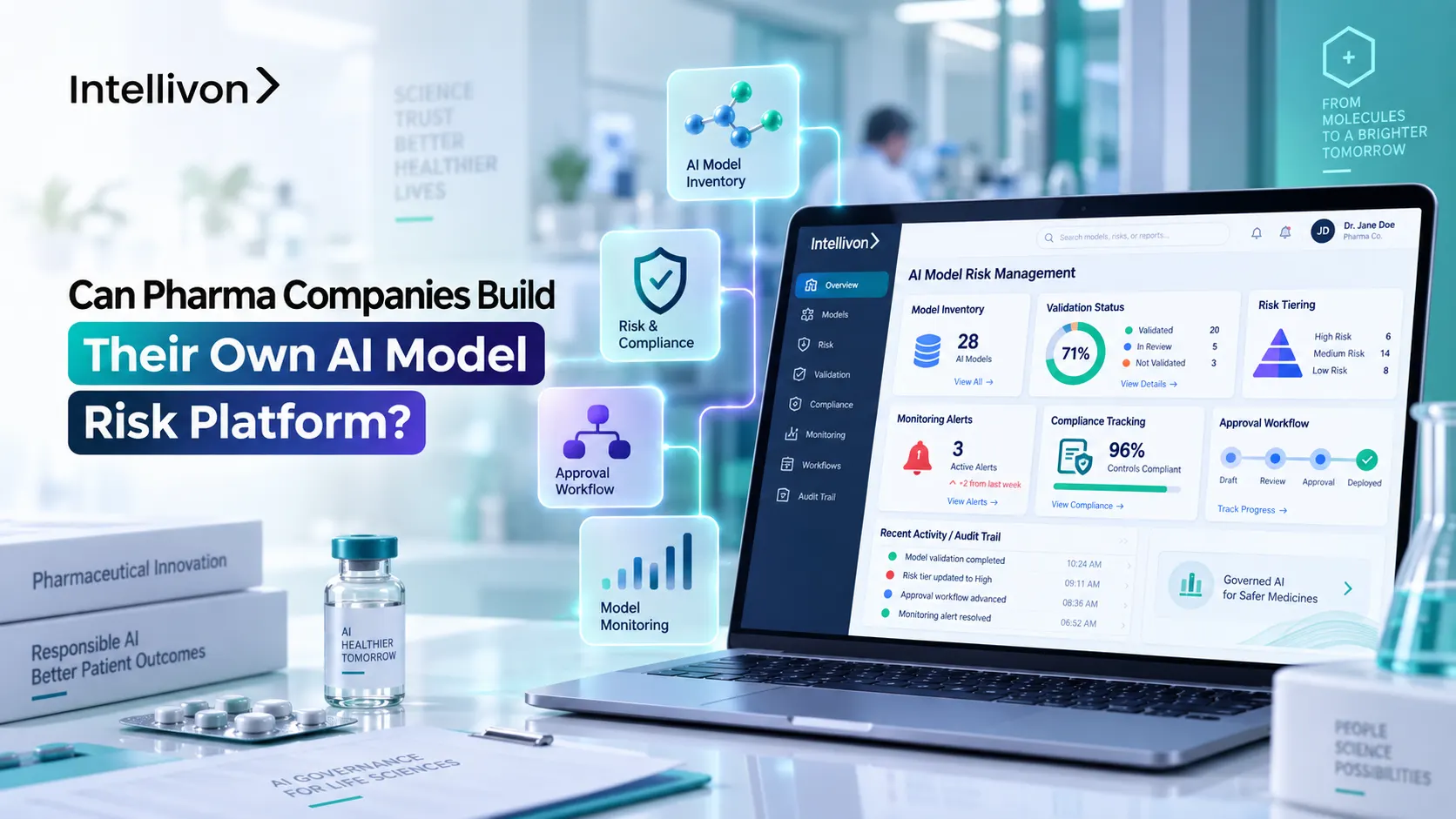
Key Takeaways:
-
In order to gain better control, pharmaceutical companies could establish their own AI model risk platform.
-
The platform maintains a record of the AI models, the risks associated with them, the owners, the approvals, and the performance.
-
This enables pharmaceutical teams to meet their FDA, GxP, audit, and validation requirements.
-
The price of custom platforms usually varies between $70,000 and $300,000 according to the features and integrations.
-
Learn how Intellivon creates custom AI risk platforms for the pharmaceutical industry, taking into account the systems and workflows that are currently in use.
Yes, pharma companies can build their own AI model risk platform, and many should. In particular, building fits sponsors whose models support regulatory submissions, pharmacovigilance, or GMP decisions that vendor tools cannot govern cleanly. However, the real test is whether your model inventory, GxP exposure, and existing MLOps stack justify owning the control layer.
That said, a pharma AI model risk management platform must convert FDA credibility expectations into structured records, maintain Part 11 audit trails, and tier discovery models apart from drug safety models. Moreover, it has to govern the LLMs your CROs and vendors embed in services you already buy.
To help you decide, this blog covers risk tiering, platform modules, generative AI governance, phase-by-phase cost, and when buying beats building. Because each section stands alone, you can skip straight to the decision you face. Finally, Intellivon builds custom AI governance platforms for regulated enterprises, so these recommendations come from real build experience.

What Is an AI Model Risk Platform in Pharma?
An AI model risk platform in pharma is the system that tracks, classifies, validates, and monitors every AI model a company uses. In simple terms, it shows who owns each model, how risky it is, and whether it is still safe to use.
As a result, teams can prove control to regulators under FDA’s draft AI guidance.
1. What the Platform Actually Does
Think of the platform as the control center for every AI model across the company. Instead of scattered spreadsheets, each model gets one record that follows it from build to retirement. Specifically, that record covers:
- Model inventory: a single list of every model in use.
- Ownership: a named person accountable for each model.
- Risk classification: a tier based on patient and product impact.
- Validation: evidence the model works for its intended use.
- Approval: formal sign-off before the model goes live.
- Monitoring: ongoing checks for drift and performance drops.
- Documentation: model cards and reports ready for inspection.
- Audit history: a time-stamped log of every change.
- Model retirement: a controlled exit for outdated models.
2. What the Platform Does Not Replace
However, a model risk platform does not replace the systems pharma teams already run. Rather, it sits between them and connects their work.
a. MLOps Platforms
MLOps tools build, deploy, and run models technically. They answer whether a model works, not whether it is approved to work.
b. Quality Management Systems
A QMS manages controlled quality processes such as SOPs, deviations, and CAPAs. Yet it rarely understands how an AI model behaves.
c. GRC Platforms
GRC platforms track broad enterprise risk and compliance. By contrast, they lack the model-level detail validators need.
d. AI Model Risk Platforms
The model risk platform links AI development with risk, validation, quality, and regulatory oversight. In short, it is the bridge between these systems.
Overall, an AI model risk platform gives every pharma model an owner, a risk tier, and a traceable history. Meanwhile, it connects MLOps, QMS, and GRC tools into one defensible record.
Why Pharma Companies Are Building These Platforms
Pharma companies are building AI model risk platforms because AI now runs across the business, not just in research labs. At the same time, regulators expect traceable AI decisions, and generative and third-party models add risks spreadsheets cannot track. Consequently, a central control platform has become the only practical way to govern AI at enterprise scale.
The spending data confirms this shift. According to GMI, the AI governance market was worth $839.2 million in 2025 and is growing at a 31.4% CAGR through 2035. Meanwhile, Domino Data Lab reports that six of the top 10 pharma companies already run AI on its platform.

1. Pharma Companies Are Using More AI
AI has moved far beyond research teams. Today, it supports work across the entire drug lifecycle, including:
- Drug discovery and clinical development
- Pharmacovigilance and case processing
- Manufacturing and quality control
- Medical affairs and regulatory writing
- Commercial operations
- Generative AI assistants for daily tasks
2. One Company Can Now Have Hundreds of AI Systems
As AI portfolios grow, manual tracking breaks down. Spreadsheets go stale, email approvals get lost, and shared folders hide which model version is live.
As a result, nobody can quickly prove what a model does or who approved it.
3. Regulators Want More Traceable AI Decisions
FDA’s draft AI guidance and the joint FDA-EMA guiding principles set clear expectations. In particular, sponsors should show:
- Context of use
- Data quality
- Model performance
- Human oversight
- Documentation
- Lifecycle management
4. Generative AI Has Created New Types of Risk
Unlike traditional models, generative AI fails in ways accuracy scores miss. Key risks include:
- Hallucinated facts
- Sensitive data exposure
- Unapproved content
- Silent prompt changes
- Third-party foundation models
- AI agents taking actions
5. Third-Party AI Creates Another Governance Problem
Increasingly, pharma relies on models it never built. For example, vendor AI inside CRO and safety tools rarely appears in SOC 2 reports. Common sources include:
- Vendor APIs
- SaaS copilots
- Foundation models
- Embedded AI
- Commercial prediction tools
In short, AI growth, regulatory pressure, and new generative and vendor risks have outpaced manual governance.
Where Pharma Companies Are Using AI Today
Pharma companies use AI today across drug discovery, clinical trials, pharmacovigilance, manufacturing, medical and regulatory work, and internal generative AI tools. However, these systems do not carry equal risk.
A molecule screening model and a safety signal model may share code, yet their errors affect patients very differently. Therefore, knowing where AI runs comes before deciding how to govern it.
1. Drug Discovery and Research
Research teams adopted AI first, and discovery usually carries lower regulatory risk. Notably, FDA’s draft AI guidance excludes discovery models. Common uses include:
- Target identification
- Molecule screening
- Protein modelling
- Toxicity prediction
- Biomarker discovery
2. Clinical Trials
In clinical development, AI shapes who enters a trial and how results are read. As a result, errors can affect both patient safety and data integrity. Key uses include:
- Patient matching
- Site selection
- Recruitment
- Trial monitoring
- Endpoint analysis
- Risk prediction
3. Pharmacovigilance and Drug Safety
Drug safety carries some of the highest AI risk. For instance, some pharmacovigilance vendors now use agentic AI to triage cases in under a minute. Typical uses include:
- Adverse-event intake
- Case classification
- Literature monitoring
- Safety signal detection
- Case prioritization
4. Manufacturing and Quality
On the plant floor, AI supports GMP decisions. Meanwhile, FDA’s finalized Computer Software Assurance approach shapes how teams validate these tools. Uses include:
- Visual inspection
- Predictive maintenance
- Process monitoring
- Deviation analysis
- Quality prediction
5. Medical and Regulatory Work
Generative AI now drafts content that reaches regulators and doctors. Consequently, EMA’s reflection paper on AI stresses human oversight. Uses include:
- Document summarization
- Medical writing
- Regulatory drafting
- Knowledge search
- Literature review
6. Internal Generative AI Tools
Finally, most employees now meet AI through internal tools, such as:
- Copilots
- Enterprise search
- RAG systems
- Internal LLMs
- AI agents
In short, pharma AI ranges from lower-risk research models to high-risk safety and quality systems. Consequently, governance must match each model’s real impact rather than apply one rule to every system.
What a Pharma AI Model Risk Platform Must Track
A pharma AI model risk platform must track five core records for every model: a registry entry, a context of use, data lineage, a risk rating, and named owners.
Together, these records show what each model is, where its data came from, how risky it is, and who answers for it. Without them, inspectors can’t trace an AI decision.
1. Every AI Model Needs a Registry Record
The registry is the platform’s foundation. In practice, it gives every model one source of truth instead of scattered files. Each record should hold:
- Model name
- Model version
- Business owner
- Technical owner
- Vendor, if any
- Intended use
- Deployment environment
- Current status
2. Every Model Needs a Clear Context of Use
Context of use sits at the center of FDA’s credibility framework. Under FDA’s draft AI guidance, sponsors define a model’s role before assessing its risk. So, document:
- What the model does
- Uses it
- Decision it supports
- It can be used
- Where it cannot be used
3. Every Model Needs Data Lineage
A model is only as trustworthy as its data. Likewise, EMA’s reflection paper on AI links AI risk to data integrity. Track:
- Training data
- Validation data
- Production data
- External data
- RAG knowledge sources
- Data transformations
4. Every Model Needs a Risk Rating
Next, the risk rating turns classification into action. For example, a high-tier safety model needs independent validation and senior sign-off, while a low-tier research tool needs lighter review.
In banking, SR 26-2 now ties oversight to model materiality, a useful pattern for pharma. Therefore, the rating should automatically set validation depth, approval rules, and monitoring frequency.
5. Every Model Needs an Owner
Finally, accountability must sit with a person, not a department. Each owner answers for:
- Performance
- Validation
- Compliance
- Monitoring
- Changes
- Retirement
In short, these five records form the platform’s core data model. As a result, every model stays traceable, risk-rated, and owned from first deployment to retirement.
Core Features Pharma Companies Need in the Platform
Pharma companies need ten core features in an AI model risk platform: model inventory, risk classification, validation workflows, documentation, performance monitoring, drift detection, explainability, bias monitoring, audit trails, and third-party model management.
Together, these features cover each model’s full lifecycle. As a result, teams can prove every model is approved, working, and controlled.
1. AI Model Inventory
The inventory is a central record of every internal and third-party AI system. Consequently, teams always know what AI is running.
2. Model Risk Classification
The platform scores models through automated or guided questions. Specifically, it weighs use, impact, data, and regulatory relevance, following FDA’s risk-based approach.
3. Model Validation Workflows
Validation should run inside the platform, not over email. It should support:
- Test planning
- Evidence uploads
- Reviewer comments
- Findings
- Approval
- Revalidation
4. Model Documentation
Ideally, documentation builds itself from validation work. Key outputs include:
- Model cards
- Validation reports
- Intended use
- Limitations
- Data sources
- Performance evidence
5. Performance Monitoring
After launch, the platform checks whether models still perform as expected. Moreover, alerts should reach the named owner directly.
6. Drift Detection
Drift means a model’s real world has changed. Therefore, the platform should flag shifts in:
- Data
- Patient populations
- Inputs
- Outputs
- Performance
7. Explainability Tools
Explanations should fit the model and decision. For instance, safety reviewers need case-level reasons, while researchers may only need feature importance.
8. Bias and Fairness Monitoring
Where fairness risk exists, the platform tests results across relevant patient groups. Notably, a peer-reviewed critique of FDA’s draft calls for stronger bias mitigation.
9. Audit Trails
Every action needs a time-stamped, attributable record. So, log:
- Changes
- Approvals
- Overrides
- Validation decisions
- Model versions
- User actions
10. Third-Party Model Management
Finally, the platform tracks external AI providers and vendor model changes. After all, vendor AI often goes unreported in SOC 2 reports.
In short, these ten features give pharma teams one system to register, validate, monitor, and audit every model. Consequently, governance shifts from scattered documents to continuous, inspection-ready control.
How the Platform Manages the Full AI Lifecycle
A pharma AI model risk platform manages the full AI lifecycle in eight connected steps: register, classify, define validation, review and approve, release, monitor, review changes, and retire.
Each step feeds the next, so no model reaches production without an owner, a risk tier, and approved evidence. As a result, every AI decision stays traceable from first draft to final retirement.
Step 1: Register the Model
Every model starts with a registry record, created before any production use. This way, teams cannot quietly deploy AI that governance never saw. The first record should also capture vendor models, not just internal builds.
At registration, the platform should collect:
- Model name and version
- Business and technical owners
- Intended use and context of use
- Vendor or internal source
- Planned deployment environment
- Initial data sources
Step 2: Classify the Risk
Next, the platform scores the model’s risk through guided questions. In line with FDA’s draft AI guidance, risk depends on how much the model influences a decision and how serious that decision is. As a result, a safety signal model scores far higher than a literature search tool.
The platform should weigh impact across:
- Business operations
- Regulatory submissions
- Patient safety
- Product quality
- Data sensitivity
- Degree of human oversight
Step 3: Define Validation Requirements
Once the tier is set, the platform assigns matching validation requirements. In other words, higher-risk models receive stronger testing, while low-risk tools follow a lighter path. This mirrors the risk-based thinking behind FDA’s Computer Software Assurance approach.
Depending on tier, requirements may include:
- Performance testing against acceptance criteria
- Independent validator review
- Subgroup and bias testing
- Explainability evidence
- Stress and edge-case testing
- Human review sampling for generative AI
Step 4: Review and Approve the Model
After testing, the platform routes evidence to the right reviewers automatically. For example, a pharmacovigilance model goes to safety and quality, while a manufacturing model goes to quality and engineering. Meanwhile, every comment and decision stays attached to the model record.
The approval workflow should support:
- Technical review
- Quality review
- Regulatory review
- Safety review
- Findings and remediation tracking
- Electronic signatures under 21 CFR Part 11
Step 5: Release the Model
Only approved models move into authorized use. To enforce this, the platform connects to MLOps pipelines and blocks deployment until approval is recorded. Consequently, governance becomes a real control rather than a paperwork step.
At release, the platform should confirm:
- Approval status is complete
- The approved version matches the deployed version
- Usage limits are documented
- Monitoring thresholds are active
- Users are trained and authorized
- Rollback plans exist
Step 6: Monitor the Model
After release, the real work begins. Models degrade as data, patients, and processes change, so the platform checks performance continuously. Indeed, practitioners in GxP validation describe AI validation as an ongoing process, not a one-time event.
Monitoring should track:
- Performance against baseline
- Data and population drift
- Output changes
- Incidents and user complaints
- Human override rates
- Usage volume and scope
Step 7: Review Model Changes
Models rarely stay static, and every change can alter risk. Therefore, the platform treats retraining, new data, prompt edits, and vendor updates as change events. Depending on impact, each change triggers a light review or full revalidation.
Change events should include:
- Model retraining
- New or modified training data
- Prompt or instruction changes
- RAG knowledge source updates
- Vendor model version updates
- Expanded users or new use cases
Step 8: Retire the Model
Eventually, every model reaches the end of its useful life. At that point, the platform disables production use while keeping the full history intact. This matters because inspectors may still ask about past decisions years later.
Retirement should cover:
- Disabling production access
- Recording the retirement reason
- Naming a replacement model, if any
- Archiving validation evidence
- Retaining audit trails per retention rules
- Notifying affected users and systems
In short, these eight steps turn separate features into one controlled lifecycle. As a result, every pharma AI model stays registered, validated, monitored, and defensible from launch through retirement.
LLMs and AI Agents Need Extra Governance
LLMs and AI agents need extra governance because their outputs change with prompts, sources, and vendor updates, not just code. Unlike traditional models, they can hallucinate facts, leak data, and take real actions.
Therefore, a pharma AI model risk platform must track prompts and sources, test generative risks, control agent permissions, and log every action.
1. LLMs Need More Than Traditional Model Records
A standard registry record misses what shapes LLM behavior. So, for each LLM, the platform should also track:
- Foundation model
- Provider
- Model version
- Prompts
- Temperature
- Knowledge sources
- Safety settings
2. RAG Systems Need Source Tracking
Retrieval-augmented generation (RAG) answers depend on the documents it retrieves. Consequently, the platform should record which approved documents support each generated answer. That way, reviewers can confirm the answer came from controlled content.
3. Generative AI Needs Different Testing
Accuracy scores alone cannot validate generative AI. Instead, testing should cover:
- Hallucination
- Factual accuracy
- Groundedness in source documents
- Sensitive-data leakage
- Prompt injection
4. AI Agents Need Permission Controls
Agents do more than answer questions; they act. Therefore, the platform should track which tools, systems, and data each agent can reach. Notably, some pharmacovigilance vendors already use agentic AI to triage safety cases.
5. High-Risk Actions Need Human Approval
Some actions carry too much risk for full automation. For that reason, a person should review before an agent:
- Sends regulated information
- Changes records
- Approves content
- Submits information
- Triggers production workflows
This matches the human oversight emphasis in the joint FDA-EMA guiding principles.
6. Agent Actions Need Complete Logs
Finally, every agent step needs a traceable record. In practice, the log should capture the prompt, each action, the tools used, any approvals, and the final outcome. As a result, teams can rebuild exactly what happened during an inspection.
In short, LLMs and agents need records, tests, permissions, and logs that classical models never required. Consequently, platforms built only for traditional models are already incomplete in 2026.
Pharma Platforms Must Connect Existing Systems
Pharma AI model risk platforms must connect existing systems because the evidence they need already lives elsewhere. Models run in MLOps tools, approvals sit in quality systems, and data lineage lives in data catalogs.
Without integration, teams copy information by hand, and records drift apart. Therefore, building one is an enterprise integration project, not just another dashboard.
1. MLOps Platforms
MLOps tools already know what is deployed and how it performs. For example, Domino offers API-based integration with governance and risk systems. So, the platform should pull in:
- Deployments
- Models
- Versions
- Monitoring results
2. Quality Management Systems
Quality teams run controlled processes inside a QMS. As a result, AI records must stay in sync with quality records. Connect:
- Deviations
- CAPA
- Approvals
- Change control
3. Data Catalogs
Next, data catalogs already hold information the platform should not rebuild. Instead, bring in:
- Datasets
- Data owners
- Lineage
- Data classifications
4. Identity and Access Systems
Access must follow validation roles. For instance, the person who builds a model should not approve it. Therefore, connect identity systems to control who can:
- Develop models
- Validate models
- Approve models
- View model records
5. Security Systems
Meanwhile, AI incidents often begin as security events. So, link security tools to send prompt injection attempts, data leaks, and unusual access straight to model owners.
6. AWS and Azure AI Environments
Most pharma companies run models across more than one cloud. Similarly, IBM watsonx.governance governs models on AWS, Azure, and on-premises.
Consequently, the platform should monitor models wherever they run, without forcing teams to move workloads.
7. Private and Hybrid Environments
Finally, sensitive research, IP, and regulated workloads often stay off public cloud. For example, Domino supports hybrid and fully air-gapped deployments. Therefore, the platform must govern private and hybrid environments too.
In short, a pharma AI model risk platform only works when it connects MLOps, quality, data, identity, security, and cloud systems.
As a result, evidence flows automatically instead of being copied by hand. For deeper integration patterns, see Intellivon’s guide to healthcare IT integration platforms.
H2: Pharma Regulations Shape How the Platform Is Built
Pharma regulations shape how an AI model risk platform is built because each rule turns into a feature. FDA guidance requires context of use and credibility records, while Part 11 requires compliant audit trails and signatures.
Meanwhile, the EU AI Act, NIST AI RMF, ISO 42001, and privacy laws add further controls. Therefore, compliance must be designed into the platform from day one.
1. How Each Pharma Regulation Maps to Platform Features
However, not every rule applies to every model. Instead, obligations depend on what the model does and where it is used. The table below maps each requirement to the platform capability it drives.
| Requirement | What It Covers | What the Platform Must Build |
| FDA AI Expectations | AI supporting regulatory decisions on safety, effectiveness, or quality, under FDA’s draft guidance | Context of use records, risk scoring, credibility plans, documentation, lifecycle controls |
| FDA and EMA Good AI Practice | Ten 2026 principles across the drug lifecycle | Governance workflows, data controls, performance evidence, documentation, human oversight |
| GxP Requirements | AI used inside regulated GMP, GCP, GLP, or GVP workflows | Risk-based validation, change control, periodic review |
| 21 CFR Part 11 | Electronic records in FDA-regulated work | Secure records, audit trails, access control, electronic signatures |
| ICH E8 and ICH E9 | Clinical study quality and statistical principles | Controls for trial design models and statistical evidence |
| EU AI Act | Obligations based on the AI system and its use, with high-risk deadlines in 2027 and 2028 | Risk classification by use case |
| NIST AI RMF | Voluntary AI governance framework, not a pharma regulation | Mapped risk controls and governance structure |
| ISO 42001 | Certifiable standard for broader AI management | Policies, roles, and continuous improvement records |
| Privacy Rules | HIPAA, GDPR, and CCPA, only where personal or health data is involved | Data minimization, consent tracking, access limits, regional data controls |
Notably, EMA’s reflection paper on AI adds EU expectations across the same lifecycle. In practice, a platform should map one control to many rules. For example, a single audit trail can satisfy Part 11, GxP, and the EU AI Act together.
In short, pharma regulations decide which records, workflows, and controls the platform needs. Consequently, a shared control library keeps compliance manageable as rules keep changing.
How to Build a Pharma AI Model Risk Platform
Intellivon builds a pharma AI model risk platform in eight phases: map existing AI, design the risk framework, build the registry, add validation workflows, add monitoring, connect enterprise systems, pilot with real models, and expand.
Each phase delivers working software, not just documents. As a result, an MVP typically reaches users in 10 to 16 weeks, with production in 5 to 9 months.
Phase 1: Map Existing AI Use Cases
We never design modules before we know what needs governing. First, our team runs workshops with data science, quality, safety, regulatory, and IT leads. Together, we build a full picture of the current AI estate, including tools teams forgot to report.
During this phase, we identify:
- Models: internal builds, vendor tools, copilots, and agents
- Owners: business and technical leads for each model
- Data: training, production, and external sources
- Vendors: CROs, SaaS providers, and foundation model suppliers
- Risks: patient, product, regulatory, and data exposure
- Regulations: FDA, GxP, Part 11, EU AI Act, and privacy rules
Phase 2: Design the Risk Framework
Next, we turn that inventory into clear rules the platform can enforce. Our framework follows the influence and consequence logic in FDA’s draft AI guidance. Importantly, we also design a lighter track for discovery models the guidance does not cover.
In this phase, we define:
- Risk levels: tier definitions with real pharma examples
- Validation rules: required testing and evidence per tier
- Approval paths: which reviewers sign off at each tier
- Change triggers: events that force review or revalidation
Phase 3: Build the Model Registry
With rules agreed, we build the platform’s foundation. The registry becomes the single source of truth for every AI system. Moreover, we design the metadata structure so risk scoring can run automatically from it.
The registry build includes:
- Central model inventory
- Context of use schema
- Ownership and accountability fields
- Data lineage links
- Version history
- LLM fields for prompts, providers, and knowledge sources
- Role-based views for quality, safety, and data science teams
Phase 4: Add Validation Workflows
After that, we move validation out of email and shared folders. Our workflows match each tier’s rules from Phase 2, so reviewers see only what applies. At the same time, every action carries a Part 11-compliant audit trail and electronic signature.
This phase delivers:
- Test planning templates by tier
- Evidence upload and storage
- Reviewer comments and findings
- Remediation tracking
- Approval routing with electronic signatures
- Auto-generated model cards and validation reports
Phase 5: Add Monitoring
Once models are approved, the platform must keep watching them. So, we connect production telemetry and set alert thresholds with each model owner. In addition, monitoring results feed back into review triggers automatically.
We implement:
- Drift detection: shifts in data, populations, inputs, and outputs
- Performance tracking: results against validated baselines
- Incident logging: errors, complaints, and overrides
- Review triggers: automatic revalidation when thresholds are breached
- Generative AI checks: hallucination and groundedness sampling
Phase 6: Connect Enterprise Systems
Meanwhile, we integrate the platform with systems your teams already use. This step removes manual copying and keeps records consistent. For proven patterns, see our guide to healthcare IT integration platforms.
Typical integrations include:
- MLOps: deployments, versions, and deployment gates
- QMS: deviations, CAPA, and change control
- IAM: role-based access and separation of duties
- Data catalogs: datasets, lineage, and classifications
- Security tools: AI incidents and access alerts
- Cloud: AWS, Azure, private, and hybrid environments
Phase 7: Pilot With Real Pharma Models
Rather than launching everywhere at once, we pilot with a controlled set of AI systems. Usually, we pick a mix: one high-risk model, such as a safety or quality model, plus a few lower-risk tools. This way, the pilot tests every tier and workflow under real conditions.
During the pilot, we:
- Run models through the full lifecycle
- Collect feedback from validators and owners
- Measure review cycle times
- Fix workflow gaps before scale-up
- Confirm inspection readiness with quality teams
- Prepare validation documentation for the platform itself
Phase 8: Expand Across the Enterprise
Finally, we roll the governance model into more teams and use cases. Expansion follows risk, so high-impact functions such as pharmacovigilance and manufacturing come first. After that, we onboard commercial, medical, and internal generative AI tools.
Enterprise rollout covers:
- Onboarding additional business units
- Registering vendor and third-party models
- Adding agent permission controls and logs
- Training reviewers and model owners
- Setting periodic review schedules
- Handing over ongoing support and maintenance
For a wider view of these capabilities outside pharma, see our guide to AI model risk management software.
In short, Intellivon builds pharma AI model risk platforms in phases that each deliver usable controls. Consequently, teams gain inspection-ready governance early, then scale it safely across the enterprise.
Pharma AI Model Risk Platform Cost
A custom pharma AI model risk management platform typically costs $70,000 to $300,000 to build. A focused MVP for a small model inventory sits near the lower end.
By contrast, an enterprise platform with GxP workflows, agent controls, and deep integrations reaches the upper end. Overall, integrations and validation depth drive most of the difference.
1. Pharma AI Model Risk Platform Cost by Phase
The table below breaks the build into six phases, each with its own budget range.
| Development Phase | What It Includes | Cost Range |
| Discovery and Compliance Planning | AI inventory audit, regulatory mapping, risk framework | $8,000 to $20,000 |
| Platform and Architecture Design | Data model, workflows, cloud and security design | $10,000 to $30,000 |
| Model Registry and Governance Workflows | Inventory, context of use, ownership, approvals | $15,000 to $55,000 |
| Validation and Monitoring Features | Test workflows, evidence, drift, and performance tracking | $15,000 to $70,000 |
| Integrations and Security | MLOps, QMS, IAM, data catalogs, Part 11 controls | $15,000 to $80,000 |
| Testing, Training, and Rollout | Pilot, user training, platform validation, launch | $7,000 to $45,000 |
2. Annual Maintenance Cost
Plan for 15% to 25% of the initial build cost each year. In practice, that means roughly $10,500 to $75,000 annually for regulatory updates, integrations, and support.
3. What Pushes the Cost Higher
Several factors move a project toward the top of the range:
- More system integrations
- More model types, including LLMs
- Full GxP validation workflows
- Agentic AI permission controls
- Multi-region compliance, such as the EU AI Act
- Private or air-gapped deployment
- Advanced validation and bias testing
In short, most pharma teams should budget $70,000 to $300,000 to build, plus 15% to 25% each year to maintain. Consequently, scoping integrations and validation depth early keeps the budget predictable.
Why Founders Choose Intellivon To Build Pharma AI Risk Platforms
Founders choose Intellivon because pharma AI governance fails when compliance knowledge and engineering skill sit in different teams. Our engineers design registries, validation workflows, and audit trails with FDA credibility expectations, GxP, and Part 11 in mind from day one.
As a result, clients get inspection-ready controls that fit their existing systems instead of another disconnected dashboard.
- 11+ years of regulated software experience: Our teams have built custom platforms across healthcare, fintech, and AI-driven products, where audit trails and data privacy are non-negotiable.
- 250+ AI projects delivered: According to our Clutch profile, this work spans generative AI, LLMs, AI agents, and MLOps.
- Direct pharma AI experience: We have built AI solutions for drug discovery, so we understand how research models differ from GxP-critical models.
- Proven compliance automation results: In a verified Clutch review, one client reported manual compliance work dropped by over 70% after our AI compliance system went live.
- Model risk platform expertise: We have designed AI model risk management software covering inventory, tiering, validation, monitoring, and audit evidence.
- Modern AI governance built in: Our platforms govern LLMs, RAG systems, and AI agents, not just traditional machine learning models.
- Phased delivery with early value: We ship a working MVP in 10 to 16 weeks, then expand toward production in 5 to 9 months.
Not sure whether to build, buy, or extend what you already run? Talk to our team, and we will map your AI inventory, risk exposure, and integration needs. Then, you will leave with a clear scope, timeline, and cost range.
Conclusion
Pharma companies can build their own AI model risk management platform when AI touches submissions, safety, or GMP decisions. However, success depends on mapping models first, tiering risk honestly, and connecting existing systems. Meanwhile, budgets range from $70,000 to $300,000, plus 15% to 25% yearly maintenance.
Ultimately, the right choice hinges on your model inventory, GxP exposure, and integration needs. Therefore, start with an AI inventory, because every inspection-ready governance program begins with knowing what AI you run.
FAQs
Q1. Can pharma companies build their own AI risk platform?
A1. Yes, pharma companies can build their own AI risk platform, especially when models support submissions, pharmacovigilance, or GMP decisions. However, building works best with a clear model inventory, an existing MLOps stack, and a dedicated validation team. Otherwise, a vendor tool or hybrid approach may deliver faster value with less internal effort.
Q2. How much does a pharma AI risk platform cost?
A2. A custom pharma AI risk platform typically costs $70,000 to $300,000 to build. For example, a focused MVP sits near the lower end, while enterprise builds with GxP workflows and deep integrations reach the top. In addition, plan for 15% to 25% of the build cost each year for maintenance.
Q3. Does the platform replace GxP validation?
A3. No, the platform does not replace GxP validation. Instead, it organizes and enforces validation by storing test plans, evidence, findings, and approvals in one controlled system. Still, qualified reviewers design tests and give final sign-off. Moreover, the platform itself usually needs validation when it supports GxP-regulated decisions.
Q4. Do third-party AI models need governance?
A4. Yes, third-party AI models need governance just like internal ones. In fact, vendor APIs, SaaS copilots, and AI embedded in CRO or safety tools often escape standard vendor reviews. Therefore, the platform should record each vendor model, its intended use, its risk tier, and any updates that could change behavior.
Q5. How often should pharma AI models be reviewed?
A5. Review frequency should follow each model’s risk tier rather than a fixed calendar. For instance, high-risk safety or manufacturing models need continuous monitoring and frequent formal reviews. Meanwhile, lower-risk research tools can follow lighter periodic checks. Additionally, retraining, data changes, prompt edits, or vendor updates should trigger an immediate review.
Q6. Can the platform govern LLMs and AI agents?
A6. Yes, a well-designed platform can govern LLMs and AI agents. Specifically, it tracks foundation models, prompts, knowledge sources, and safety settings, then tests for hallucinations, data leakage, and prompt injection. For agents, it also controls tool permissions, requires human approval for high-risk actions, and logs every step.
Q7. Is custom software better than an AI governance tool?
A7. Custom software is better when your workflows, integrations, or deployment rules do not fit vendor templates. By contrast, off-the-shelf tools launch faster for teams with standard processes and smaller inventories. As a result, many pharma companies choose a hybrid: a custom governance layer built on top of existing MLOps platforms.