Key Takeaways:
-
So many problems in care coordination stem from simple things being overlooked, delayed, or passed on.
-
Agentic AI could be of some help there, but it’s better to begin on a small scale and start by improving one workflow.
-
The true advantage comes about when less hesitation occurs among referrals, follow-ups actually take place, and patients aren’t lost between the different teams.
-
There are still many instances in which someone has to take charge, particularly in the case of a complicated matter.
-
Learn how Intellivon can build around the systems a hospital already uses, instead of asking teams to change everything just to use AI
Yes, agentic AI can make a meaningful difference to hospital care coordination since it is able to monitor a patient’s complete record across all the departments at the same time, a task no individual human coordinator can manage. That is the true benefit. It’s not because it is smarter than a nurse, but rather because it never stops watching.
To begin with, the technology is effective at identifying a care gap before it results in a readmission, at locating a referral that had previously gone unnoticed, or at detecting a social need that a doctor never had the time to ask about. When given actual patient data and a specific task, it carries out these tasks more quickly than a coordinator doing so with a spreadsheet.
In this blog, we’ll cover what agentic AI actually automates in care coordination, what real hospital deployments show about readmissions and discharge outcomes, what it costs to build, and where the technology still falls short. Basically, everything a founder needs before pitching this to a health system.
As we go along, we’ll also be honest about the limits of technology. Since founders are presenting this to a health system, they need the complete picture and not just the highlights. Because Intellivon is experienced in building this type of software, we have led the charge in building several successful agentic AI platforms.

Why Hospital Care Coordination Is Still Hard to Manage
Hospital care coordination is hard because a single patient touches too many systems, teams, and handoffs for any one person to track. After all, physicians, nurses, pharmacy, scheduling, specialists, and payers all hold a piece of the same patient’s care, but they rarely see each other’s updates in real time.
Because of this, the gap between what each team knows is exactly where things start to fall apart.
1. One patient journey can involve several hospital teams
Even a routine hospital stay pulls in more people than most patients realize. On top of that, each of these teams works inside its own system, with its own priorities and its own notes.
- The attending physician sets the treatment plan
- Nursing staff manage day-to-day care and vitals
- Pharmacy checks and fills every medication order
- Scheduling books tests, imaging, and follow-ups
- A specialist joins for a single consult
- The discharge team plans the exit while the payer signs off
2. Important work gets lost between systems and teams
Since no one holds one shared view of the patient, work naturally slips through the cracks between departments. As a result, small delays quietly turn into missed care.
- A referral sits unopened in another department’s queue
- Follow-up call never gets made after discharge
- A discharge task shows complete in one system, not the other
- A lab result lands in the chart but never reaches the coordinator
3. Care coordinators spend too much time chasing updates
Instead of managing patients, many coordinators spend most of their day just hunting for information. Consequently, the job turns reactive instead of proactive.
- Calling departments to confirm a task actually happened
- Re-entering the same patient details across multiple systems
- Following up by hand on referrals and prior authorizations
- Piecing together one patient’s status from five different screens
4. Finding a care gap does not mean the gap gets closed
Hospitals already run dashboards that flag a care gap the moment it appears. Even so, a flag on a screen is not the same as a fixed problem, because someone still has to act on it.
- Someone still has to read the alert
- Someone still has to decide what to do about it
- At the same time, someone still has to follow through and confirm it’s actually closed
In fact, this isn’t a small problem either. According to CMS’s fiscal year 2026 Hospital Readmissions Reduction Program data, 240 hospitals, or 8.1% of those evaluated, were penalized for readmission rates above expected benchmarks, the first increase in five years.
Behind nearly every one of those penalties sits a coordination failure, which includes a missed follow-up, a discharge instruction that never landed, a gap nobody closed in time.
Why Hospitals Are Looking at Agentic AI in 2026
Hospitals are looking at agentic AI in 2026 because, quite simply, the easy administrative wins are running out, while budgets are finally catching up to the technology.
In other words, this isn’t early curiosity anymore. Instead, it’s a funded, board-level priority at most large health systems.
1. Healthcare organizations are moving beyond AI assistants
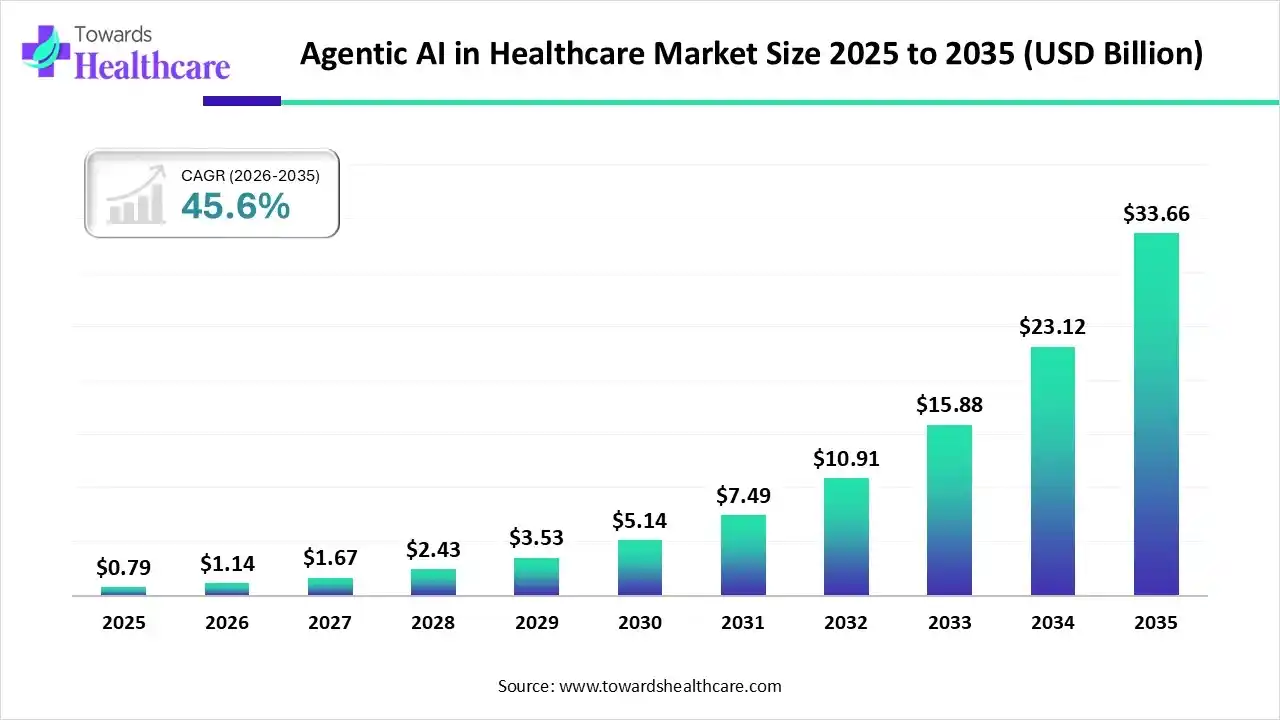
For years, healthcare AI stayed stuck at the chatbot stage. Now, however, that’s changing fast. In fact, the market data backs it up: the agentic AI in healthcare market is projected to grow from $1.14 billion in 2026 to $33.66 billion by 2035, a 45.6% CAGR, with North America leading adoption.
On top of that, budgets are catching up to this curve too. 98% of surveyed executives expect at least 10% cost savings within two to three years
- 37% expect savings above 20%
- Early adopters report over 20% savings, versus just 13% among leaders still watching from the sidelines
Even so, that gap between adopters and watchers is worth sitting with. After all, it’s not a small margin.
2. Care coordination is a natural place to test AI agents
Not every clinical workflow suits an agent equally well. Care coordination, though, checks nearly every box, since it’s repetitive, deadline-driven, spread across multiple systems, and easy to measure.
Because of that, it’s become one of the first places health systems point their agentic AI budget.
- Tasks repeat the same way for every patient, so the agent doesn’t need to improvise
- Deadlines are clear: a referral, a follow-up call, a discharge task, all have a due date
- Success is measurable: either the gap closed, or it didn’t
- Multiple systems already hold the data an agent needs to act on
3. Hospitals are already testing agents in real workflows
This isn’t theoretical anymore, and that’s the part worth underlining. For instance, Stanford Health Care partnered with Qualtrics to deploy agents that tackle conflicting care instructions and SDOH coordination.
Meanwhile, Atlantic Health worked with Artera to automate colonoscopy outreach calls, cutting manual call time by 38% within the first month.
Elsewhere, Persistent Systems built Health(AI)ntel specifically to orchestrate admissions, handoffs, and discharges, while CareImpact.ai’s CareAgent360 platform closes care gaps for value-based providers without adding staff, and Kore.ai runs similar agents inside provider contact centers.
Either way, none of these are pilots running in a lab. On the contrary, they’re live, in production, handling real patients today.
Altogether, this shift from experimentation to real budget is what separates 2026 from every AI cycle before it. Ultimately, hospitals aren’t asking whether agentic AI works anymore. Instead, they’re asking which workflow to point it at first, and that’s exactly the question the rest of this piece answers.
Where Agentic AI Can Improve Care Coordination Most
Agentic AI can improve care coordination most in the workflows that are repetitive, deadline-bound, and spread across systems, since that’s exactly where a human coordinator runs out of hours.
Below, we’ll walk through the seven areas where this actually plays out inside a hospital.
1. Discharge planning and post-discharge follow-up
Discharge is where coordination breaks down fastest, because so much has to happen in a narrow window. An agent, however, can track every piece at once and flag the moment something slips.
- Schedules the follow-up appointment before the patient leaves
- Tracks medication pickup and refill timing
- Confirms the patient understood their instructions
- Chases outstanding labs or tests still pending
- Coordinates transportation for the follow-up visit
- Reaches out again after discharge to check in
- Escalates to a human the moment a patient can’t be reached
2. Referral tracking and closed-loop referrals
Referrals rarely fail loudly. Instead, they just sit untouched. So an agent’s job here is to close that loop before it becomes a missed diagnosis.
- Routes the referral to the right specialist automatically
- Checks whether the appointment was actually booked
- Flags referrals that have stalled for too long
- Follows up directly with the patient if needed
- Confirms the specialist visit was completed
- Returns the results back to the originating care team
3. High-risk patient identification and follow-up
An agent can scan every patient’s data continuously, something no coordinator has time to do manually, and surface who needs attention first. Even so, the clinical call always stays with the care team, not the agent.
- Flags rising risk scores as new data comes in
- Prioritizes outreach based on urgency, not just workload
- Hands the final decision to a clinician every time
4. Preventive care and HEDIS gap closure
Spotting an overdue screening is the easy part. Closing it is where most tools stop short, and where an agent actually keeps going.
- Identifies overdue screenings from the patient record
- Initiates the approved next step, like scheduling
- Tracks the gap until it’s genuinely closed
5. Chronic disease care coordination
Conditions like diabetes, heart failure, and COPD involve dozens of small, ongoing tasks. Consequently, an agent can hold that whole picture over time instead of losing track between visits.
- Monitors medication adherence and vitals trends
- Tracks multiple unfinished actions across months, not days
- Flags when a patient’s plan needs clinician review
6. Social needs and community resource coordination
Clinical care alone doesn’t fix a housing or transportation problem. So this is where an agent connects the patient to something outside the hospital walls entirely.
- Screens for transportation and food insecurity
- Refers patients to housing or language assistance
- Connects patients to community-based organizations directly
7. Population health and value-based care programs
ACOs manage thousands of patients with the same-sized team every year. Because of that, an agent lets coordinators work through the full population instead of only the loudest cases.
- Segments the population by risk and program eligibility
- Surfaces which patients need outreach this week
- Scales coordination without adding headcount
Altogether, these seven workflows share one thing in common: clear tasks, clear deadlines, and a measurable finish line. That’s precisely why agentic AI fits here before it fits almost anywhere else in the hospital.
What Agentic Care Coordination Looks Like in Practice
In practice, agentic care coordination looks like a short, repeatable loop running quietly in the background: it notices unfinished work, checks the patient’s situation, takes an approved action, and confirms the outcome before closing the loop.
Nothing dramatic happens on screen. Instead, it plays out as one patient’s discharge, so let’s follow that loop step by step.
1. Step 1: The system detects unfinished care work
Every workflow starts the same way: something didn’t happen that should have. In this case, a patient was discharged three days ago, and their follow-up appointment still isn’t booked.
- A discharge without a scheduled follow-up
- A referral that’s gone quiet
- An overdue screening flagged in the record
- A risk score that jumped unexpectedly
2. Step 2: The agent checks the patient’s current situation
Before acting, the agent pulls only what it actually needs for this task, not the full chart. This matters because scope, not access, is what keeps this safe.
- Discharge instructions and diagnosis
- Insurance and scheduling preferences
- Any prior outreach already attempted
3. Step 3: It decides the next allowed action
Next, the agent maps what it found against a predefined set of permitted next steps. It doesn’t improvise outside that list, and it isn’t meant to.
- Book the follow-up directly if slots are open
- Send a reminder if the patient hasn’t responded yet
- Escalate immediately if the case looks urgent
4. Step 4: It carries out approved administrative tasks
Once it settles on a path, the agent actually does the work instead of just flagging it for someone else.
- Books the appointment and confirms the slot
- Sends the patient a message with the details
- Creates a task for the care team to track
- Routes anything requiring clinical judgment onward
5. Step 5: It brings uncertain cases back to a human
Even so, the agent isn’t built to push through uncertainty. The moment something falls outside its defined boundaries, it stops and hands off.
- The patient can’t be reached after repeated attempts
- The situation involves a clinical judgment call
- Data it finds is incomplete or conflicting
6. Step 6: The workflow stays open until it is completed
Meanwhile, the task doesn’t close just because the agent took an action. It stays open until the actual outcome is confirmed, not just attempted.
- The appointment must be kept, not just booked
- A message sent isn’t the same as a message read
- The loop only closes on a verified outcome
7. Step 7: The result returns to the hospital record
Finally, everything the agent did gets written back into the patient’s record, so nothing exists outside the system of record.
- The outcome updates in the EHR
- A timestamped log captures every action taken
- The care team can review exactly what happened and why
Altogether, this is the entire loop: detect, check, decide, act, escalate when needed, and confirm. It’s a straightforward sequence once you see it laid out, and that’s precisely what makes it trustworthy enough for a hospital to actually run.
What Results Are Hospitals Actually Seeing?
What hospitals are actually seeing is a mix of strong operational results and thin clinical proof, and that gap matters more than either number on its own.
So instead of repeating vendor claims, this section sticks to named studies and named deployments, because that’s the only way to separate what’s proven from what’s still promised.
1. Atlantic Health reduced staff time spent on outreach
As covered earlier, Atlantic Health’s partnership with Artera is one of the clearest operational wins on record so far. Within the first month, the AI agent cut manual outbound call time by 38%, freeing schedulers to handle complex cases instead of routine confirmations.
- 43% of contacted patients confirmed their identity through the agent
- 39% explicitly confirmed their upcoming appointment
- 7% used the agent to ask procedure-specific questions
2. AI agents can support review without replacing clinicians
A 2026 Stanford study tested an AI agent against physicians on 30-day hospital readmission reviews, and the results were genuinely encouraging. Even so, the study is careful to frame this as review support, not clinical replacement.
- The AI flagged 45% of readmissions as preventable, versus 47.5% from physicians
- Blinded quality ratings were statistically similar: 4.35 for AI, 4.20 for physicians
- No hallucinations were found during factuality review
- Cost per chart was $0.23, against a physician median of 15 minutes per case
3. Early clinical evidence is still limited
That said, one strong study doesn’t make a body of evidence. A scoping review published in npj Digital Medicine, part of the Nature portfolio, reviewed five databases and found only seven eligible studies of agentic AI in real clinical settings. Of those, just one actually involved real patients.
- Most studies remain exploratory or simulation-based
- Multi-agent oncology planning showed strong results, but wasn’t a randomized trial
- The field is moving faster than the evidence meant to support it
4. Operational gains are easier to prove than clinical gains
Here’s the distinction founders need to hold onto: “staff saved 38% of their time” is a measurable, provable claim. “Patients had better outcomes because of the agent” is a much harder one to prove, and right now, far fewer studies back it up.
- Operational metrics (time, cost, call volume) are easy to track and already proven
- Clinical outcome metrics (readmissions, mortality, complications) need larger trials still underway
- Pitching a hospital on outcomes alone risks overselling what the evidence currently supports
Altogether, the honest picture is this: agentic AI clearly saves staff time today, and it’s showing real promise on clinical review tasks. Full clinical outcome evidence, though, is still catching up, and that gap is exactly what any credible pitch to a hospital needs to acknowledge.
Which Care Coordination Tasks Should Stay Human?
Which care coordination tasks should stay human comes down to one simple rule: anything low-risk and repeatable can go to the agent, while anything involving clinical judgment, emotion, or ambiguity stays with a person.
So before any architecture gets built, this boundary needs to be settled first, because it shapes every design decision that follows.
1. Administrative follow-up can often be automated
Plenty of coordination work is purely logistical, and that’s exactly where an agent adds the most value with the least risk. Consequently, this is usually the first place hospitals hand off.
- Checking whether a referral or task status has changed
- Sending pre-approved reminder or confirmation messages
- Creating and assigning follow-up tasks automatically
- Coordinating appointment scheduling across departments
2. Clinical decisions need human approval
However, the moment a task requires medical judgment, the line is crossed, and the agent’s job shifts from acting to informing. In other words, it can surface information, but it shouldn’t decide what that information means.
- Interpreting lab or test results
- Adjusting a treatment or medication plan
- Deciding whether a symptom needs urgent escalation
3. Complex patient conversations still need people
Similarly, coordination isn’t only logistics. It’s also trust, and that’s harder to automate than a task list. Because of this, situations carrying real emotional or social weight belong with a person, not a script.
- Delivering difficult news or a serious diagnosis update
- Navigating a patient’s fear, confusion, or distress
- Untangling conflicting instructions from multiple providers
4. Agents need clear rules for when to stop
Perhaps most importantly, a well-designed agent isn’t judged by how much it can do. Instead, it’s judged by how reliably it recognizes what it shouldn’t do, and hands that off cleanly.
- Predefined triggers for escalating to a human
- A default to abstain when data is incomplete or conflicting
- No workaround that lets the agent push past its boundary
Altogether, the rule is straightforward: the more a task resembles logistics, the safer it is to automate, and the more it resembles judgment or trust, the more it needs a person. Founders who build this boundary in from day one avoid the harder problem of trying to bolt it on later.
How Agentic AI Connects With Hospital Systems
Agentic AI connects with hospital systems through a handful of established integration points, not a rip-and-replace of what’s already there.
So rather than sitting on top of a blank slate, the agent plugs into the EHR, existing messaging standards, and outside networks the hospital already relies on.
1. The EHR remains the main clinical system of record
To start, nothing about agentic AI changes where the official patient record lives. The EHR, usually Epic or a comparable system, stays the source of truth, while the agent simply reads from it and writes back approved updates.
- The agent never replaces the EHR’s role as the system of record
- It pulls only the data relevant to its specific task
- Every action it takes gets logged back into the same record
2. FHIR APIs give agents access to approved workflows
From there, FHIR is simply the standard format that lets an agent request specific pieces of patient data, like an appointment or a lab result, without needing a custom connection for every hospital.
- Structured, permissioned access to patient and encounter data
- No need for a one-off integration per health system
- Read and write actions stay scoped to what’s approved
3. HL7 still connects many existing hospital systems
Meanwhile, plenty of hospital infrastructure still runs on older HL7 messaging beneath the modern layer, so an agent has to speak that language too if it wants full visibility.
- Admissions, transfers, and discharge feeds still run on HL7
- Orders, results, and scheduling messages often use it too
- Ignoring HL7 usually means missing half the hospital’s data
4. Epic Compass Rose can remain the coordinator workspace
For Epic-based hospitals, Compass Rose already handles care plans, SDOH tracking, and community referrals.
An agent doesn’t need to replace that workspace. It can simply act underneath it, closing gaps Compass Rose flags but doesn’t automatically resolve.
5. External providers create the hardest coordination gaps
Finally, the toughest connections aren’t inside the hospital at all. Referral networks, payers, transport services, and outside clinics rarely share a common system, which is exactly where coordination still breaks down most often.
Put together, these five connection points explain why integration, not model quality, usually decides how far an agentic AI project actually gets.
When One Agent Is Better Than a Multi-Agent System
One agent is better than a multi-agent system whenever the workflow is narrow enough for a single focused tool to own from start to finish, and that covers most first builds.
So before reaching for a fleet of coordinated agents, it’s worth asking whether one well-scoped agent actually solves the problem already.
1. One workflow usually needs one focused agent first
To begin with, most care coordination problems are narrower than founders assume, and a single agent handling one clear task tends to outperform a complicated system built too early.
- Discharge follow-up is a clean, single-agent workflow
- Referral tracking rarely needs more than one agent either
- A focused agent is easier to test, trust, and explain
2. Multi-agent systems make sense across several departments
That said, complexity earns its place once a workflow genuinely spans multiple teams, systems, or handoffs that a single agent can’t reasonably own alone.
- Coordinating admissions, transfers, and discharge together
- Managing population health across an entire ACO
- Handling tasks that cross clinical and administrative boundaries
3. More agents also mean more testing and governance
However, every additional agent adds real, often invisible cost, since each one needs its own validation, monitoring, and failure handling.
- Each agent needs its own testing and validation cycle
- Handoffs between agents introduce new points of failure
- Governance and audit trails grow more complex with each addition
4. Hospitals should earn complexity through proven results
Because of that hidden cost, the safest path is to prove value with one agent first, then expand only once that workflow is actually working in production.
- Start with one bounded, well-understood workflow
- Expand to new agents only after the first is stable
- Let proven results justify the next phase of investment, not ambition alone
Altogether, the pattern holds across nearly every successful deployment: start narrow, prove it works, then grow. That’s also exactly how a phased build should be scoped from day one, and it’s the approach we walk hospitals through before a single line of code gets written.
Agentic AI Care Coordination Costs $70K to $300K
Agentic AI care coordination costs $70,000 to $300,000 to build, with the final number driven by how many workflows, integrations, and agents the system actually needs.
So rather than leaving that number vague, here’s exactly where it goes, phase by phase.
| Phase | Covers | Estimated Cost |
| Discovery and workflow mapping | Understanding existing coordination gaps, defining the first workflow | $7,000 – $15,000 |
| Architecture and agent design | Technical design, permissions, integrations, human approval rules | $10,000 – $25,000 |
| Agent development | Core agent logic and workflow functionality | $20,000 – $80,000 |
| EHR and API integration | Epic, FHIR, HL7, scheduling, payer, and external-system connections | $15,000 – $70,000 |
| Security and validation | PHI security, testing, auditability, failure scenarios | $10,000 – $45,000 |
| Pilot and production rollout | Training, monitoring, live testing, initial deployment | $8,000 – $65,000 |
| Total Initial Build | $70,000 – $300,000 |
1. What pushes the number up or down
Naturally, a single-workflow build with one EHR connection lands near the bottom of that range. A multi-agent system spanning several departments and outside systems pushes toward the top.
- One bounded workflow keeps costs near $70K
- Multiple EHR connections and departments push toward $300K
- Integration depth, not agent count alone, usually decides the final number
2. Annual maintenance usually adds 15% to 20%
Beyond the initial build, ongoing costs don’t disappear. Instead, plan for 15% to 20% of the build cost every year afterward.
- Model updates and prompt refinement over time
- Ongoing API and integration maintenance
- Continuous monitoring, evaluation, and compliance upkeep
Altogether, this range holds whether you’re scoping one referral-tracking agent or a full multi-department system, because the variables driving it are the same either way: workflow count, integration depth, and how much testing the compliance side demands.
How Intellivon Builds Agentic Care Coordination Systems
How we build agentic care coordination systems at Intellivon follows the same eight-step sequence every time, regardless of hospital size or specialty.
So rather than starting with the technology, we start with the bottleneck, and only bring in the architecture once that bottleneck is actually understood.
1. Step 1: Find the care coordination bottleneck
Every engagement begins with a real business problem, not a technology wishlist. Consequently, we spend real time here before touching architecture, since a poorly chosen starting point sinks the whole project’s credibility later.
- Identify where staff time is genuinely being lost
- Confirm the workflow repeats often enough to justify automation
- Rule out problems that sound valuable but are still too undefined to automate
2. Step 2: Measure the existing workflow
Next, we baseline the current process before writing a single line of code. Otherwise, there’s no honest way to prove improvement later.
- Current staff hours spent on the task
- Existing completion and follow-through rates
- Where delays or drop-offs happen most often
3. Step 3: Decide what the agent can and cannot do
From there, we define the autonomy boundary before any development starts, because this decision shapes everything that follows, not the other way around.
- What the agent can act on independently
- What always requires human approval first
- Clear escalation triggers built in from day one
4. Step 4: Map EHR and external integrations
Meanwhile, we map every system the workflow touches, since integration timelines, not engineering effort, usually determine the real launch date.
- Epic, FHIR, and HL7 connections where relevant
- Payer, scheduling, and messaging system access
- External providers and community resource networks
5. Step 5: Build one focused workflow first
Once the mapping is done, we build one workflow end to end rather than a platform-wide rollout, and we stay disciplined about that even when a hospital wants more.
- Discharge follow-up or referral tracking as a typical starting point
- No parallel workflows until the first is proven
- Autonomy stays conservative here, expanding later rather than walking back
6. Step 6: Test failures before expanding automation
Before anything goes near real patients, we deliberately test what happens when things go wrong, because a demo that works once isn’t the same as a system that holds up under messy, real-world use.
- Missing or conflicting data scenarios
- Unreachable patients and failed outreach attempts
- Escalation paths tested under realistic conditions
7. Step 7: Pilot against real coordination KPIs
After that, the workflow runs as a live pilot measured against the same numbers we baselined at the start, not vague satisfaction scores.
- Staff time saved versus the original baseline
- Task completion and closure rates
- Escalation volume against expected thresholds
8. Step 8: Add new agents only after results are proven
Finally, once a workflow is validated and stable in production, we expand one step at a time. Autonomy earns its way outward, and it’s never granted all at once, however well the pilot performed.
- Move the proven workflow into full production first
- Add new agents only after the first is stable
- Reassess permissions as each new workflow comes online
Altogether, this sequence is what keeps a care coordination build from becoming a stalled pilot or a rushed rollout that fails an audit.
We run it the same way for every hospital and health system we work with, because the order these steps happen in is what earns trust from clinical and compliance teams, and that trust is ultimately what decides whether an agent gets to keep doing real work.
Why Hospitals Work With Intellivon on Agentic AI
By now, the pattern should be clear: agentic AI doesn’t fix care coordination by itself. Instead, it fixes the specific workflows where a person is stuck chasing status updates instead of doing the harder work.
So the real decision isn’t whether to adopt this technology. It’s which single bottleneck is worth solving first.
- Agentic AI meaningfully improves care coordination, but only within a defined set of tasks
- Discharge follow-up, referral tracking, and risk stratification are the strongest starting points
- Real deployments like Atlantic Health and Stanford already show measurable, provable results
- Operational gains are proven today; full clinical outcome evidence is still catching up
- Clinical judgment, emotional conversations, and ambiguous cases should stay with people
- The EHR stays the system of record, agents plug into it, not around it
- One focused agent almost always beats a multi-agent system on day one
- A first build typically runs $70,000 to $300,000, scoped to one bounded workflow
Trying to figure out which workflow in your hospital would actually justify this investment is the hard part, not the technology itself. That’s exactly what we help founders and health systems map out at Intellivon before any code gets written.
Talk to our AI specialists about your Healthcare AI Agent build, and leave with a scoped workflow, not a generic pitch.
Conclusion
So, does agentic AI meaningfully improve hospital care coordination? Yes, but only within clear limits. It closes referral gaps, automates discharge follow-up, and flags high-risk patients faster than any human coordinator could alone. Even so, clinical judgment and difficult conversations still belong with people, not agents.
Ultimately, the hospitals seeing real results aren’t the ones chasing every use case at once. Instead, they’re starting narrow, proving one workflow works, and expanding only from there. That, in the end, is what separates a working system from another stalled pilot.
FAQs
Q1. Can agentic AI replace hospital care coordinators?
A1. No, and that’s not really the goal either. Instead, it takes over repetitive follow-up work like referral tracking and status checks, freeing coordinators to focus on complex cases. Clinical judgment, difficult conversations, and final decisions stay with people. So think augmentation, not replacement.
Q2. Which hospital workflow should use an AI agent first?
A2. Generally, discharge follow-up or referral tracking works best as a starting point, since both are repetitive, deadline-driven, and easy to measure. Consequently, they let you prove real results before expanding. Avoid workflows still too undefined to automate confidently; those come later, once the first agent is proven.
Q3. Can AI agents safely work with Epic?
A3. Yes, though write access needs real controls. Agents typically connect through FHIR APIs and read approved data first. Write-back actions, however, should require validation and, in many cases, human approval before anything updates the record. Most deployments therefore start with read-only access and expand into write permissions gradually.
Q4. Does agentic AI actually reduce hospital readmissions?
A4. Some verified deployments, like Vanderbilt’s, report real reductions, so the evidence isn’t purely promotional. Even so, the broader clinical evidence base remains thin, with few large-scale trials. Therefore, treat readmission numbers as promising rather than guaranteed, and expect results to vary by hospital, workflow, and patient population.
Q5. How is agentic AI different from workflow automation?
A5. Traditional automation follows fixed rules and breaks when something unexpected happens. Agentic AI, on the other hand, can assess a situation, decide the next step, and adjust when circumstances change. In short, automation executes a script, and an agent reasons through a task within defined boundaries.