Key Takeaways:
-
Pick out the part of the process that creates the most persistent issues on a daily basis.
-
The hardest part is linking AI with EHRs, payment systems, clinical data, and real actions.
-
You also need controls for PHI, approvals, audit logs, and when humans must step in.
-
Developing a custom healthcare AI platform usually costs between $70,000 and $300,000.
-
Intellivon designs these platforms using healthcare workflows, plus integrations, guardrails, and a slow rollout.
To build an agentic AI platform for healthcare, you need four components: a reasoning engine capable of planning a series of actions, agents that link to your EHR and scheduling systems via FHIR, guardrails that prevent the AI from carrying out actions outside its permitted scope, and a compliance layer that is incorporated from the very beginning rather than added on later.
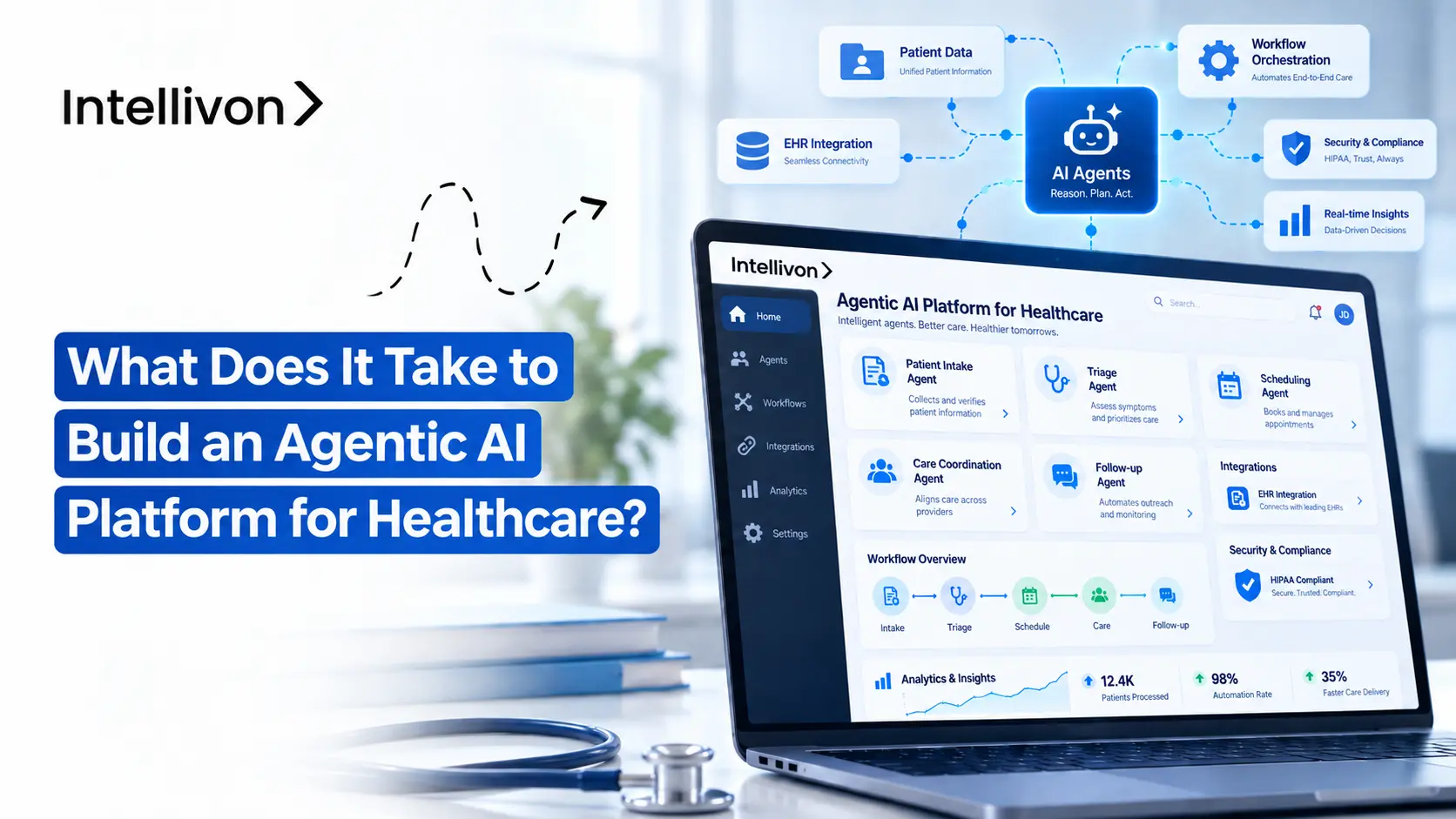
A chatbot responds to questions, whereas an agent carries out actions. For example, it looks at a chart, checks eligibility, drafts a prior authorization, and sends it for approval, all without a human having to click through each step. The difference is not merely one of appearance. When an AI system is capable of carrying out actual actions based on patient data, all the subsequent decisions are affected by this, whether it’s the framework you choose or the way you record what the agent did and why.
It is at this point that most teams encounter difficulties, since the same approach that works well with a chatbot breaks down as soon as autonomy is involved. This gap, which we have come across ourselves while developing similar systems at Intellivon for use in regulated healthcare environments, plays a major role in almost all of the recommendations that follow. This blog will extensively cover how we get it right and how we build agentic AI platforms for big pharma companies and multi-hospital networks from the ground up.
What a Healthcare Agentic AI Platform Actually Does
A healthcare agentic AI platform is software that can plan a multi-step task, pull approved patient data, call the right tools, and complete the work end to end, not just answer a question about it. That’s the core shift founders need to understand before anything else.
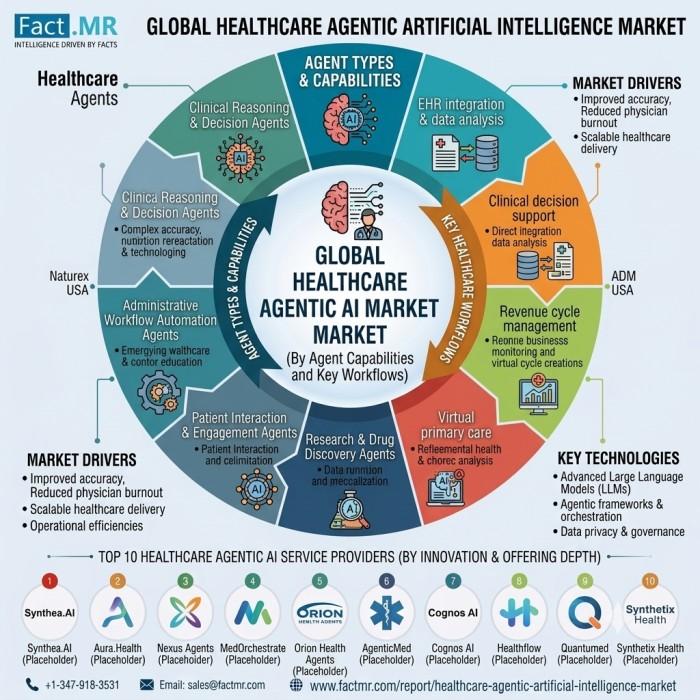
So why does this matter now? The agentic AI in healthcare market is projected to grow from $3.9 billion in 2026 to $24.6 billion by 2036, as hospitals move past isolated AI pilots into systems that actually coordinate work.
1. From AI Assistants to Agents That Complete Healthcare Work
Most healthcare AI still stops at answering. An assistant tells a nurse what a lab value means. An agent goes further, because it can act on what it finds.
- Reads the chart and pulls relevant history
- Checks eligibility or scheduling in real time
- Drafts, submits, and tracks the next step
- Hands off to a human only when needed
2. What Makes the Platform Agentic Rather Than Generative
Generative AI produces content. Agentic AI pursues a goal. That distinction comes down to a specific set of capabilities working together.
- A goal, broken into steps
- Memory across the task
- Tool calls to outside systems
- A feedback loop that checks its own work
3. Why the Platform Matters More Than a Single AI Agent
One agent solves one problem. But a platform is what lets ten agents share the same foundation instead of rebuilding it each time.
- Shared orchestration and integrations
- One security and compliance layer
- Centralized monitoring across all agents
- Governance that scales as agents multiply
In short, the platform is the difference between one useful agent and a system your whole organization can build on.
Why Healthcare Companies Are Building Agentic AI Platforms
Healthcare companies are building agentic AI platforms because the easy wins from basic automation are running out, while the work that’s left, including prior authorization, documentation, and care coordination, still eats hours every day. So the shift isn’t hype.
Instead, it’s a direct response to work that hasn’t gone away, no matter how many chatbots got deployed before it.
1. Administrative Work Is Moving Beyond Basic Automation
Scheduling bots and rule-based forms only get you so far. Once the task branches, like checking eligibility, chasing a denial, routing a request, it needs judgment, not just a script. That’s where basic automation quietly runs out of road.
- Scheduling across multiple providers and locations
- Prior authorization drafting and status tracking
- Revenue cycle follow-up on denied claims
- Document intake and patient access requests
2. Clinical AI Is Moving Closer to Real Workflows
Clinical AI used to sit on the sidelines, summarizing notes after the fact. Now, however, it’s stepping into the workflow itself, though always with a human still signing off before anything becomes final.
- Ambient documentation during patient visits
- Fast retrieval of relevant clinical information
- Care coordination across departments and teams
- Decision support that stays advisory, not autonomous
3. Healthcare Vendors Are Already Moving Toward AI Agents
And this isn’t a future bet, either. Innovaccer built Gravity, its healthcare intelligence platform, on AWS Bedrock AgentCore, while AWS separately launched Amazon Connect Health in March 2026 with agents for verification, documentation, and scheduling.
Oracle Health is moving in the same direction.
4. Custom Platforms Fill the Gaps Between Those Products
But off-the-shelf agents assume a generic workflow, and most health systems simply don’t run one.
- Proprietary approval chains and escalation rules
- Integrations with older, non-standard systems
- Organization-specific compliance policies
- Products that need to look different from competitors
In short, the big vendors solve the common cases, but the differentiated work still needs a custom build. So that gap is exactly where most founders reading this actually sit.
Core Features a Healthcare Agentic AI Platform Needs
A healthcare agentic AI platform needs seven core features to actually work: task planning, knowledge retrieval, memory, tool use, human escalation, audit logs, and ongoing monitoring.
Strip out any one of these, and the platform stops being agentic, because what’s left is just a script wearing an AI label.
1. Goal-Based Task Planning
An agent doesn’t just execute one command. Instead, it takes an outcome, like “get this claim approved,” and breaks it into steps on its own. As a result, planning is what actually separates an agent from a workflow tool.
- Breaks a goal into ordered sub-tasks
- Adjusts the plan when a step fails
- Decides which tool to call next
2. Clinical and Operational Knowledge Retrieval
Even so, an agent is only as good as what it can look up. That’s why retrieval matters: it pulls in payer rules, care protocols, formularies, and internal policy, so the agent isn’t guessing its way through a decision.
- Payer-specific prior auth requirements
- Clinical protocols and care pathways
- Organization-specific policy documents
3. Healthcare AI Agent Memory
Meanwhile, memory works on two levels. Short-term memory tracks the current task, while persistent memory carries context across visits, which means the agent doesn’t start from zero every single time.
- Task-level state for the current workflow
- Patient-level history across sessions
4. Tool Use and Function Calling
Once the agent knows what to do, it needs a way to actually do it. This is where tool calls come in, connecting the agent to the real systems that run your organization.
- EHR read and write functions
- Scheduling and claims APIs
- Messaging and notification tools
5. Human Review and Escalation
Still, the agent shouldn’t finish every task alone. On top of that, escalation rules define exactly when it hands off to a clinician or staff member instead of pushing forward on its own.
6. Audit Logs and Explainable Actions
Because every action needs a trail, logs capture what the agent saw, what it did, and why. Otherwise, nothing about the decision holds up during a review.
7. Continuous Agent Monitoring
Finally, agents drift over time. Which is exactly why monitoring matters: catching tool failures, hallucinations, and rising escalation rates before they turn into a real problem.
In short, these seven features are what turn a demo into something you can actually run in production. And together, they’re also what the next section’s architecture is built to support.
How the Healthcare Agentic AI Architecture Works
A healthcare agentic AI architecture works in eight layers, moving from what the user sees down to what keeps the whole system accountable.
So each layer depends on the one below it, which means once orchestration decides what needs to happen, everything underneath handles how it gets done safely.
The Eight Layers of a Healthcare Agentic AI Architecture
| Layer | What It Covers | Key Components |
| User and Workflow Experience Layer | Where clinicians, patients, and admin staff actually interact with the system. | Clinician applications, patient interfaces, admin dashboards, APIs |
| Agent Orchestration Layer | Routes tasks, tracks workflow state, coordinates agents, and manages retries under supervisory control. | Task routing, state management, retry logic, supervisory checkpoints |
| — Single-Agent Workflow Design | Used when one agent with several tools can complete the task end to end. | One agent, sequential tool calls, no handoffs |
| — Multi-Agent Healthcare System Design | Used when the workflow is complex enough that specialized agents should divide it. | Intake, coding, and escalation agents, each owning one piece |
| — Supervisor Agent Architecture | Keeps multiple agents coordinated without allowing uncontrolled agent-to-agent behavior. | A controlling agent, defined handoff rules, enforced boundaries |
| Reasoning and Model Layer | Decides how the agent thinks, plans, and formats its outputs. | Model selection, structured outputs, constrained reasoning |
| Healthcare Knowledge and RAG Layer | Grounds agent decisions in real clinical and organizational content. | Retrieval pipelines, clinical content, internal policies, source provenance |
| Memory and Workflow State Layer | Holds what the agent knows, both for the current task and across future sessions. | Session state, case state, persistent memory, retention and deletion rules |
| Tool and Integration Layer | Connects the agent to the real systems it needs to complete a task. | Function calling, EHR connections, scheduling and claims systems |
| Security and Policy Enforcement Layer | Defines exactly what the agent can do, and stops it the moment it tries to exceed that. | Identity checks, permissions, approval gates, action constraints |
| Observability and Governance Layer | Watches the system in production and catches problems before they compound. | Monitoring, logs, evaluations, alerts, drift detection, incident analysis |
So while each layer looks independent in this table, none of them actually work alone. The orchestration layer’s choice between single-agent, multi-agent, or supervisor design ripples through every layer beneath it, shaping how much memory gets stored and how tightly security locks things down.
Connecting AI Agents With EHRs and Healthcare Systems
Connecting AI agents to EHRs and healthcare systems takes seven distinct integration points: FHIR APIs, SMART on FHIR authorization, HL7 interfaces, CDS Hooks, vendor-specific Epic and Oracle Health access, payer APIs, and safe read/write controls.
So interoperability isn’t one connection, it’s a stack of them, each solving a different piece of the problem.
1. FHIR APIs for Structured Healthcare Data
FHIR gives agents a standard way to read structured data. Instead of guessing at formats, the agent pulls from defined resources.
- Patient, encounter, and observation resources
- Appointment, medication, and condition data
2. SMART on FHIR for Secure Agent Access
But structured data alone isn’t safe without access control. SMART on FHIR handles that layer directly.
- Authentication and token-based authorization
- Scoped permissions tied to user context
3. HL7 Interfaces for Existing Hospital Workflows
Meanwhile, most hospitals still run on older HL7 messaging underneath their modern systems, so agents need to speak that language too.
- ADT feeds for admissions and transfers
- Orders, results, and scheduling messages
4. CDS Hooks for Workflow-Based AI Support
Even so, an agent that only works outside the clinician’s screen is easy to ignore. CDS Hooks solve that by triggering AI support inside the workflow itself.
- Fires at defined points in a clinical encounter
- Surfaces guidance without a separate login
5. Epic and Oracle Health Integration
Because Epic and Oracle Health dominate the EHR market, vendor-specific work becomes unavoidable.
- Vendor APIs and sandbox testing
- Write-back permissions and workflow validation
6. APIs for Payers and Revenue Cycle Systems
On the financial side, agents also need direct lines into payer and billing systems.
- Eligibility checks and prior authorization
- Claims submission and payment tracking
7. Safe Read and Write Actions Across Healthcare Systems
Finally, every write action carries real risk, so this layer exists to contain it.
- Idempotent requests and pre-write validation
- Transaction logging with rollback on failure
In short, these seven integration points are what let an agent actually touch a health system safely, not just read about it. Get any one wrong, and the agent either can’t act or acts without a safety net.
Designing Agentic AI Around HIPAA and PHI Security
Designing agentic AI around HIPAA and PHI security takes six specific controls: limiting each agent’s data access, separating agent identity from user identity, encrypting data across the workflow, setting clear memory rules, building complete audit trails, and confirming BAAs across every vendor in the stack.
So security here isn’t a single checkbox. Instead, it’s a set of decisions made at each layer of the system.
1. Limit PHI to What Each Agent Actually Needs
An agent handling scheduling doesn’t need access to full clinical notes. So access should match the task rather than the platform.
- Minimum-necessary access per agent role
- Context isolation between unrelated tasks
2. Separate User Identity From Agent Identity
But an agent acting on a patient’s behalf still needs its own accountable identity, distinct from the human it’s acting for.
- Dedicated service accounts for agents
- Delegated authorization with scoped tokens
3. Encrypt Healthcare Data Across the Agent Workflow
Meanwhile, encryption has to follow the data everywhere it goes, rather than just where it’s stored.
- Data in transit and at rest
- Temporary state, vector stores, and logs
4. Set Clear Rules for Agent Memory and Data Retention
Even so, memory that’s useful for a workflow can quietly become a liability if it isn’t bounded.
- What the agent is allowed to remember
- How long healthcare data stays accessible
5. Build Complete Agent Audit Trails
Because every action needs to be reconstructable, audit trails have to capture the full chain rather than just the outcome.
- Who initiated the action
- What the agent accessed and which tool ran
- The person who approved the final step
6. Confirm BAAs Across the AI Technology Stack
Finally, a BAA with your cloud provider alone isn’t enough. Every vendor touching PHI in the pipeline needs one.
- Cloud, model, and database providers
- Observability and monitoring vendors
In short, these six controls are what keep an agentic system defensible under a real compliance review rather than just compliant on paper.
Keeping Autonomous Healthcare Agents Under Control
Keeping autonomous healthcare agents under control takes seven safeguards: hard boundaries on high-risk actions, human approval for consequential decisions, grounded outputs, validated tool calls, abstention when data is unclear, circuit breakers for abnormal behavior, and a clear separation between evidence and hidden reasoning.
So control is layered into every step the agent takes.
1. Set Hard Boundaries Around High-Risk Actions
Some actions simply shouldn’t be left to agent judgment. So these get blocked outright, regardless of context.
- Actions that require predefined authorization
- No exceptions based on agent confidence
2. Require Human Approval for Consequential Decisions
Even with boundaries in place, certain decisions still need a person in the loop before anything moves forward.
- Clinical recommendations and medication actions
- Sensitive patient communications and major EHR changes
3. Ground Agent Outputs in Approved Healthcare Sources
Because hallucinations carry real clinical risk, every output needs to trace back to something verifiable.
- Evidence retrieval before generating a response
- Hard constraints to approved source material
4. Validate Every Tool Call Before It Runs
But grounding the output isn’t enough if the underlying action itself is wrong. So every tool call gets checked first.
- Argument and patient identity validation
- Schema checks and business rule enforcement
5. Stop Agents When Data Is Missing or Conflicting
Meanwhile, an agent forced to answer anyway is more dangerous than one that pauses.
- Abstention instead of a forced guess
- Escalation when information conflicts
6. Add Circuit Breakers for Abnormal Agent Behavior
Even well-designed agents can misbehave, so the system needs a way to catch that in real time.
- Detection for looping or excessive tool calls
- Kill switches for unusual activity
7. Keep Clinical Evidence Separate From Hidden AI Reasoning
Finally, what a clinician sees should be evidence, not a black box’s internal thought process.
- Structured explanations with citations
- Action histories instead of exposed reasoning
These 7 safeguards are what keep autonomy from turning into unchecked risk. Together, they’re what make an agent something a health system can actually trust in production.
How Intellivon Builds Healthcare Agentic AI Platforms
Intellivon builds healthcare agentic AI platforms through eight steps: selecting the first workflow, mapping data and PHI exposure, defining agent roles, designing the architecture, building integrations, adding safety controls, running a pilot, and expanding gradually.
So the process moves from narrow and controlled to broader and autonomous, never the other way around, because in a regulated environment, the order those steps happen in matters just as much as the steps themselves.
1. Select the First Healthcare Workflow
Every build starts with one workflow, not a platform-wide rollout. So the first real decision is which workflow actually earns the effort of building an agent for it.
- Map business value against implementation effort
- Identify who actually uses the workflow daily
- Flag existing risks before automation touches them
- Rule out workflows that look valuable but are too undefined to automate yet
Because a poorly chosen first workflow tends to sink the whole project’s credibility, Intellivon spends real time here before any architecture decisions get made.
2. Map Data, Systems, and PHI Exposure
Once the workflow is picked, the next step is understanding exactly what data it touches. Because agent scope should follow data scope, not the other way around, this mapping happens before a single agent role gets defined.
- Identify every EHR, API, and database involved
- Locate payer systems and clinical knowledge sources
- Flag where PHI actually enters the workflow
- Document which systems need read access versus write access
This step also surfaces integration risk early, which matters, since integration timelines are usually what determine the real launch date, not engineering effort.
3. Define Agent Roles and Autonomy
With the data mapped, the design question becomes how much autonomy each agent actually needs. So this step decides between one agent handling the full task and several specialized agents dividing it up.
- Choose single-agent or multi-agent design based on workflow complexity
- Define exactly what each agent can and can’t do
- Set autonomy limits before any code gets written
- Assign clear ownership for each sub-task in the workflow
Even so, autonomy here starts conservative by design. Intellivon would rather expand permissions later than walk them back after something’s already gone live.
4. Design the Platform Architecture
From there, architecture turns those decisions into a real system. Each layer gets built with the previous step’s boundaries already baked in, rather than retrofitted after the fact.
- Orchestration, RAG, and memory layers
- Tool gateways and identity management
- Policy enforcement and observability built in from the start
- Clear separation between reasoning, action, and audit logging
This is also where the single-agent versus multi-agent versus supervisor decision from earlier gets implemented in practice, not just theorized about on a whiteboard.
5. Build EHR and Healthcare Integrations
Once the architecture is in place, integration work connects the agent to the systems it needs to actually act on. This is usually where timelines stretch the most, since health systems approve access on their own schedule, not the vendor’s.
- FHIR, HL7, and SMART on FHIR connectors
- Vendor-specific Epic or Oracle Health APIs
- Scheduling, billing, and payer system links
- Sandbox testing before any production connection goes live
Because each health system runs its own approval cycle, Intellivon typically starts this paperwork in parallel with earlier steps rather than waiting until the architecture is finished.
6. Add Safety and Human Approval Controls
Even with integrations working, nothing goes live without safety controls layered on top. So this step is where the guardrails from earlier sections get implemented in code, not just designed on paper.
- Permission boundaries and validation rules
- Escalation paths for consequential decisions
- Full auditability across every agent action
- Circuit breakers for abnormal or looping behavior
This step also tends to reveal gaps in the original agent role definitions, which is exactly why it happens before the pilot, not during it.
7. Validate the Platform in a Controlled Pilot
Before anything touches real patients at scale, the platform runs through a pilot. Because a demo that works once isn’t the same as a system that holds up under repeated, messy, real-world use, this stage is treated as non-negotiable.
- Test full workflow completion under real conditions
- Check for hallucinations and permission violations
- Confirm human override paths actually work
- Measure escalation rates against expected volume
Clinical and compliance reviewers sign off here too, since their approval is what actually clears the platform for production, not engineering testing alone.
8. Expand Agents and Autonomy Gradually
Finally, once a workflow is validated in production, expansion happens one step at a time. Autonomy earns its way outward, and it isn’t granted all at once, no matter how well the pilot performed.
- Move proven workflows into full production first
- Add new agents only after the first is stable
- Expand autonomy incrementally, not in one jump
- Reassess permissions as new workflows get added
In short, this eight-step process is what keeps a healthcare agentic AI platform from becoming a science project that never ships or a rushed build that fails an audit.
Intellivon runs it the same way for every engagement, because the sequence is what earns trust from clinical and compliance teams, and that trust is ultimately what determines whether an agent gets to keep doing real work.Healthcare Agentic AI Platform Development Cost
A custom healthcare agentic AI platform typically costs $70,000 to $300,000 to build. So where a project lands in that range comes down to workflow complexity, integration depth, and how many agents the system actually runs.
Cost Breakdown by Phase
| Phase | Estimated Cost |
| Discovery and Workflow Planning | $7,000 – $15,000 |
| Architecture and Compliance Design | $10,000 – $30,000 |
| Core Agent Development | $20,000 – $65,000 |
| EHR and Multi-Agent Integration | $20,000 – $80,000 |
| Security and Validation | $8,000 – $45,000 |
| Deployment and Production Setup | $5,000 – $65,000 |
| Total Initial Build | $70,000 – $300,000 |
1. Ongoing Platform Costs After Launch
Even after launch, the spending doesn’t stop. So plan for 15% to 25% of the build cost annually, covering maintenance, monitoring, integration upkeep, evaluations, and model changes.
2. What Pushes the Cost Toward $300,000
Several factors compound quickly once a project moves past the basics.
- Multiple EHR connections instead of one
- Multi-agent orchestration across departments
- Complex PHI flows and clinical validation requirements
- Private infrastructure and heavy custom integrations
- High-risk workflows needing extensive human oversight
3. What Keeps the First Release Closer to $70,000
On the other end, a few deliberate constraints keep the first release lean.
- One bounded use case instead of several
- Limited write access to core systems
- A single EHR connection to start
- Reliance on existing APIs instead of custom ones
- Standard cloud deployment with staged autonomy
In short, the range tracks directly with how much the platform touches and how much autonomy it’s given on day one.
Get the Healthcare Agentic AI Cost and Scope Checklist to map where your own build is likely to land before you talk to a development partner.
Build vs Buy for a Healthcare Agentic AI Platform
Buy for standard, well-solved workflows. Build when the workflow itself creates your competitive advantage, or when several systems need one shared control layer. So this decision is about how differentiated your actual product needs to be.
1. Buy When the Workflow Is Already Standard
Some workflows have been solved repeatedly by vendors already. So building your own version rarely adds value here.
- Mature scheduling and documentation tools
- Standard medical coding workflows
2. Build When Your Workflow Creates the Product Advantage
But once the workflow is the differentiator, buying flattens exactly what makes you competitive.
- Proprietary clinical or operational logic
- Custom patient journeys and unusual integrations
3. Build When Several Systems Need One Agent Control Layer
Meanwhile, some organizations aren’t choosing between one workflow’s build-or-buy, they need a single layer spanning many.
- Reusable orchestration across EHR and payer systems
- One governance layer for CRM and communications too
4. Use a Hybrid Model for Faster Product Development
Even so, this isn’t strictly binary. Most efficient builds buy the infrastructure and rent the model, then custom-build the parts that actually matter.
- Buy foundation models and cloud infrastructure
- Custom-build workflows, permissions, and governance
5. Compare Long-Term Control Before Choosing Either Route
So before committing either way, it helps to see the tradeoffs side by side.
| Factor | Buy | Build |
| Time to launch | Weeks | Months |
| Upfront cost | Lower | Higher |
| Workflow flexibility | Limited | Full control |
| Data ownership | Vendor-held | Fully owned |
| Vendor dependency | High | Low |
In short, the right answer depends on whether the workflow is commodity or core to your product. And for most founders, the honest answer ends up being a hybrid of both.
Why Healthcare Teams Build Agentic AI With Intellivon
A healthcare agentic AI platform only earns its cost when it’s built around your actual workflow, not a generic template stretched to fit. So the real question is whether your build gets scoped, secured, and validated the right way from day one.
By now, this should be clear:
- Agentic AI does real work, not just conversation
- The right architecture depends on your workflow’s complexity
- EHR and payer integrations usually set your timeline, not engineering
- HIPAA and PHI boundaries need to shape design from the start, not get bolted on later
- Autonomy should expand gradually, never all at once
- Costs range from $70,000 to $300,000, driven by scope and integration depth
- Build vs. buy depends on whether the workflow is your differentiator
- A hybrid approach, buying infrastructure and building the differentiated layer, works for most founders
Intellivon has built exactly this kind of system for regulated healthcare environments, including SMART on FHIR integrations with Epic and clinical escalation logic that holds up under real compliance review.
Book a scoping call and leave with a phased build plan mapped to your actual workflow, not a generic estimate.
Conclusion
Building an agentic AI platform for healthcare comes down to one thing: matching autonomy to risk. So the platform, the architecture, the compliance controls, and even the cost all follow from that single decision. Consequently, the right move is starting with one bounded workflow, then expanding only once it’s proven in production.
Because ultimately, the founders who get this right aren’t the ones who move fastest, but rather the ones who scope carefully before writing a single line of code.
FAQs
Q1. How long does a healthcare agentic AI platform take to build?
A1. A bounded first workflow usually takes 3 to 5 months. So the real driver is EHR approval cycles, since each health system reviews access on its own schedule. A multi-agent build with several integrations, therefore, can stretch to 9 months before it’s production-ready.
Q2. Can healthcare AI agents safely work with PHI?
A2. Yes, but only with the right controls in place. So agents need minimum-necessary access, encrypted data flows, and full audit trails from the start. Without those safeguards, however, PHI exposure grows quickly, which is exactly why security has to shape the architecture, not get added afterward.
Q4. Can an AI agent write information back to an EHR?
A4. It can, though write access carries far more risk than reading. So every write action needs validation, approval gates, and rollback logic before it runs. Because of that added complexity, most platforms start with read-only access and expand into write permissions gradually, once trust is established.
Q5. Does every healthcare platform need multiple AI agents?
A5. No. A single agent with several tools is often enough for a contained workflow. So multi-agent design only makes sense once the task is genuinely too complex for one agent to own. Otherwise, adding agents just adds coordination risk without any real benefit to show for it.
Q6. How much does a healthcare agentic AI platform cost?
A6. Most builds run $70,000 to $300,000. So the number moves based on how many systems the platform integrates with and how many agents it runs. A single bounded workflow stays near the lower end, while multi-agent, multi-EHR builds push toward the top of that range.
Q7. What happens when an AI agent is unsure what to do?
A7. It should stop and escalate, not guess. So abstention is a deliberate design choice, not a failure state. Because a forced answer under uncertainty is more dangerous than a pause, well-built agents are designed to hand off to a human the moment confidence drops.
Q8. Should healthcare founders build agents or buy existing tools?
A8. It depends on whether the workflow is your differentiator. So standard tasks like scheduling are usually better bought, while proprietary workflows are worth building. For most founders, though, a hybrid ends up being the practical answer.