Key Takeaways:
- Basically, FHIR provides healthcare systems with a common method of sharing patient data rather than having to build everything from scratch.
-
It functions well with EHRs, apps, payers, and the more recent AI tools, but it doesn’t automatically resolve every integration issue.
-
Instead, most hospitals continue to use FHIR together with HL7 v2, CDA, DICOM, and other older systems rather than replace them all.
-
The difficult aspect typically arises when mapping the data, dealing with security issues, correcting the differences between vendors, and linking the existing workflows.
-
Intellivon assists businesses in creating the FHIR layer for the systems they currently have, which means the entire arrangement actually functions in practice.
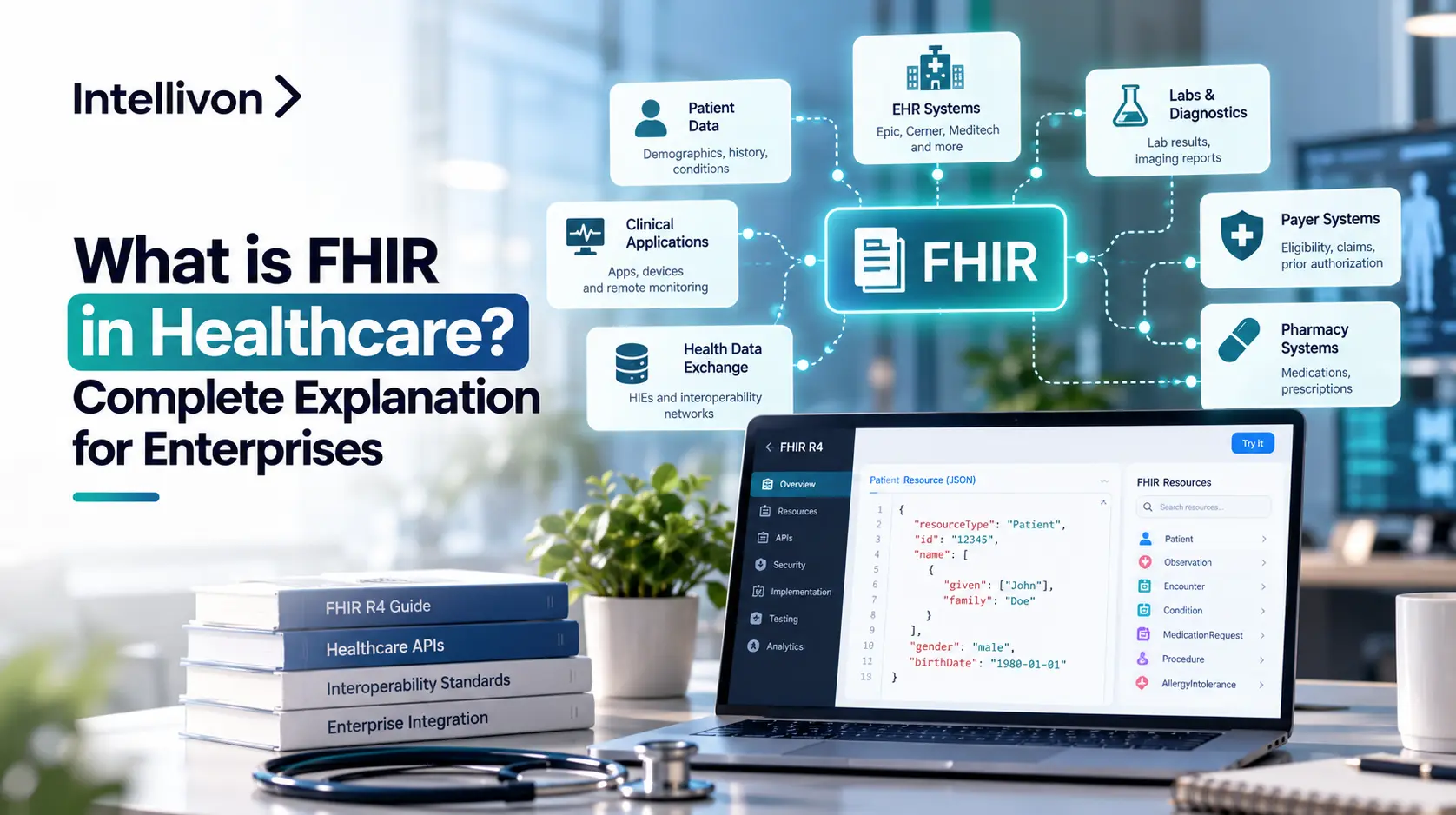
FHIR is the HL7 standard, namely the Fast Healthcare Interoperability Resources standard, which enables systems to exchange patient data via web APIs. Since it is based on the same REST and JSON technology as current web software, there is no longer a need to create a custom point-to-point interface in order to connect two systems.
FHIR is important to businesses for regulatory reasons since current federal rules are causing U.S. payers and certified EHR vendors to adopt FHIR-based APIs, with payers’ API deadlines being set for January 1, 2027. There is also a practical reason for this. Before analytics or AI projects can produce results across different departments, health systems need data that is shareable and structured. Without FHIR, each new connection would require another interface to be developed, tested, and maintained.
This blog outlines how FHIR works, which rules apply to your organization, the implementation costs in 2026, and when FHIR is not the right choice. Because our team at Intellivon develops FHIR and HL7 data pipelines for healthcare organizations, we also cover where the standard falls short.
Why FHIR Matters More to Health Systems in 2026
FHIR matters more to health systems in 2026 because regulators, EHR vendors, and patient apps now depend on the same API standard for data exchange. HL7’s latest published State of FHIR survey found that 73% of respondents reported FHIR as either mandated or formally advised, well beyond experimental projects.
ASTP data shows inpatient hospital adoption of FHIR-based apps for patient health information access reached 69% in 2024, while outpatient adoption reached 64%.
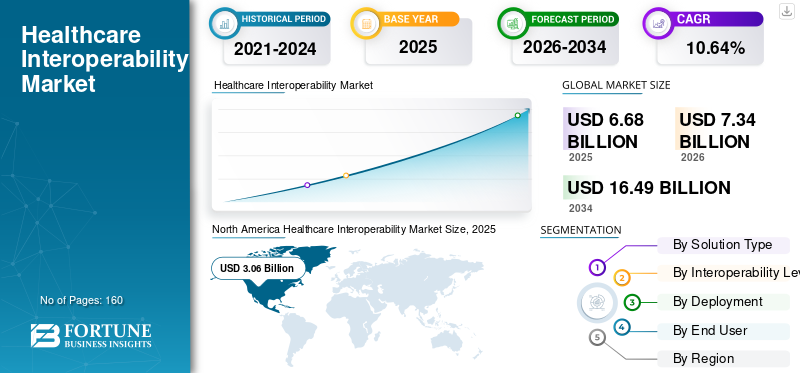
In 2025, the global healthcare interoperability market was worth USD 6.68 billion and is expected to grow from USD 7.34 billion in 2026 to USD 16.49 billion by 2034, which represents a CAGR of 10.64% over the forecast period.
1. Healthcare Has More Data but Not One Shared Language
Health systems now collect data across dozens of disconnected platforms. As a result, each system describes the same patient in a different format.
- EHRs hold clinical notes, orders, and histories.
- Lab and pharmacy systems store results and prescriptions.
- Payers keep claims and authorization records.
- Devices and telehealth tools produce continuous readings.
- Patient apps, AI platforms, and analytics systems add formats of their own.
2. Federal Rules Have Made API Access More Important
Federal policy now treats API access as a baseline expectation. However, obligations differ between payers, providers, and EHR vendors.
- The 21st Century Cures Act and ONC interoperability requirements set standardized API expectations for certified health IT.
- The CMS Patient Access API rule requires affected payers to share certain information through FHIR-based APIs.
- CMS-0057-F adds further API duties for affected payers, due January 1, 2027.
3. FHIR Is Becoming Infrastructure for New Healthcare Products
Beyond compliance, product teams now build directly on FHIR. Consequently, it is becoming the data layer behind new healthcare software.
- Mobile health apps and remote patient monitoring read patient data through APIs.
- AI systems and decision support tools need structured inputs.
- Population health and analytics platforms pull data across sources.
- Patient engagement and payer-provider exchange reuse the same resources.
4. Interoperability Is Becoming a Larger Technology Market
Market research confirms the spending shift. Treat these figures as third-party estimates, not regulatory facts.
- One 2026 report values the global healthcare interoperability market at $4.47 billion in 2025.
- The same report forecasts $14.84 billion by 2035, roughly 3.3 times larger.
FHIR matters because regulation, EHR APIs, patient access, analytics, and healthcare AI now converge on structured, API-based exchange. Fragmented data created the need. Federal rules and new products are making the standard hard to avoid.
What FHIR Actually Changes Inside a Healthcare Enterprise
After adopting FHIR, a healthcare enterprise stops building a custom interface for every system connection and starts exchanging data through one shared, API-based structure. Applications request specific records, such as a patient record or a lab result, instead of receiving entire documents.
Teams then build new products on predictable data formats. However, FHIR does not erase differences between vendors, workflows, or data quality, so integration work shrinks rather than disappears.
1. FHIR Gives Systems a Common Structure for Health Data
FHIR organizes health data into small, named building blocks called resources. HL7 describes resources as modular components forming FHIR’s basic exchange model. Common examples include:
- Patient: demographics and identifiers.
- Encounter: a visit or admission.
- Observation: lab values and vitals.
- Condition: diagnoses and problems.
- MedicationRequest: prescriptions and orders.
- Coverage and Claim: insurance and billing.
- DiagnosticReport: imaging and lab reports.
2. FHIR Lets Applications Request Specific Data
Older exchange methods often move one large clinical document at a time. FHIR lets an application ask only for what it needs.
- One app requests a Patient and receives only that record.
- Another requests Observation to show lab results.
- A third requests MedicationRequest for active prescriptions.
- As a result, less data moves, and access rules are easier to apply.
3. FHIR Makes Healthcare Data Easier for Modern Apps to Use
FHIR runs on familiar web technology, so general software teams can work with it. HL7’s specification supports structured exchange through modern web-based technologies.
- REST and HTTP carry requests and responses.
- JSON and XML formats hold the data.
- Web APIs connect EHRs, apps, and analytics tools.
- Developers reuse common web tools instead of niche healthcare ones.
4. FHIR Does Not Automatically Make Every System Compatible
A standard format does not guarantee compatible systems. Therefore, practitioners report that most FHIR behavior stays consistent across vendors, yet vendor-specific differences still need adapters and exceptions.
- Missing or incomplete data.
- Different workflow meanings for the same field.
- Local terminology codes.
- Permission and consent limits.
- Vendor-specific behavior.
- Patient identity matching.
FHIR changes how enterprises structure, request, and reuse health data. It gives applications a common, web-based way to ask for specific records. At the same time, it does not fix data quality, vendor differences, or identity matching, so project plans must budget for those gaps.
How FHIR Moves Patient Data Between Healthcare Systems
When one healthcare system requests data from another through FHIR, the request travels as a short web call to a secure address. The sending system checks who is asking, then returns only the permitted records in a structured format.
At the same time, the receiving platform reads those records and puts them to work. In practice, this takes five steps, from exposing an endpoint to using the data inside an app, dashboard, or workflow.
Step 1: A Healthcare System Exposes a FHIR Endpoint
An endpoint is a secure web address where a system publishes its data. Any system that holds health data can offer one.
- An EHR publishes clinical records.
- Payer system publishes claims and coverage.
- A FHIR server stores data from several sources.
- A healthcare data platform combines and shares it.
Step 2: The Request Identifies the Needed Resource
The requesting system names the exact type of data it wants. Therefore, the sender returns a narrow answer, not an entire chart.
- Patient demographics.
- Lab results.
- Medications.
- Claims.
- Encounters.
Step 3: Authentication Controls Who Can Access the Data
Before sending anything, the server confirms the requester’s identity and permissions. Most FHIR systems rely on established security standards for this.
- OAuth 2.0 handles secure sign-in.
- SMART on FHIR applies that sign-in to health apps.
- Backend authentication lets approved systems connect without a person present.
- Scopes limit access, for example, to one patient or one data type.
Step 4: The Server Returns Structured FHIR Data
After the checks pass, the server sends back the data in a predictable format. Consequently, the receiving system can read it without custom translation.
- JSON is the most common format.
- XML is also supported.
- Resources can arrive individually.
- Related resources can arrive together in bundles.
Step 5: The Receiving Platform Uses the Data
The final step is where the exchange creates value. The receiving system turns the records into action.
- Populates a patient application.
- Updates a clinical dashboard.
- Runs clinical analytics.
- Feeds an AI model.
- Supports care coordination.
- Supports a payer workflow such as prior authorization.
A FHIR exchange follows one repeatable pattern: publish an endpoint, request a specific resource, verify access, return structured data, and put it to use. Security checks sit in the middle of that path, so only permitted data moves. The same five steps apply whether the sender is an EHR, a payer, or a data platform.
The Main Parts of FHIR Enterprises Need to Understand
Healthcare buyers need to understand nine FHIR components: resources, profiles, extensions, REST APIs, bundles, search, SMART on FHIR, terminology, and bulk export. Each one controls a business outcome, such as consistent data, secure app access, or population analytics.
You do not need to write code to evaluate them. Instead, you need to know what each part does and which vendor claims depend on it. Six of them deserve a closer look below.
Main Parts of EHR Enterprises
| Component | What it means | Why enterprises care |
| Resources | Standard healthcare data objects | Consistent structure |
| Profiles | Rules for using resources | Reduces variation |
| Extensions | Extra information not in the base resource | Supports specialized workflows |
| REST API | How apps request and exchange data | Modern connectivity |
| Bundles | Groups of resources | Larger transactions |
| Search | Query parameters | Targeted data retrieval |
| SMART on FHIR | App authorization pattern | Secure EHR-connected apps |
| Terminology | LOINC, SNOMED CT, ICD, and others | Shared meaning |
| Bulk FHIR | Population-scale export | Analytics and population health |
1. Resources Standardize the Building Blocks
Resources are the standard data objects, such as Patient or Observation. At the same time, they give every system the same basic structure.
- Fields carry the same names across vendors.
- Apps reuse one structure instead of many.
2. Profiles Reduce How Differently Organizations Use Them
Profiles add rules on top of resources. Consequently, two organizations fill in the same fields the same way.
- Required fields are defined.
- Allowed code sets are fixed.
- Fewer variations appear between systems.
3. Extensions Handle Data Outside the Base Model
Extensions add information the base resource does not hold. Specialized workflows therefore still fit inside FHIR.
- A specialty clinic can add its own fields.
- Too many custom extensions, however, reduce compatibility.
4. Bundles Move Related Data Together
A bundle packages several resources into one transfer. This suits larger transactions.
- One visit can carry its labs and medications together.
- One request replaces many separate calls.
5. SMART on FHIR Handles Application Access
SMART on FHIR is the standard sign-in pattern for apps connected to an EHR. It controls who sees what.
- Apps can launch inside the EHR.
- Patients and clinicians approve the access.
6. Bulk FHIR Supports Population-Level Data Exchange
Bulk FHIR exports data for whole patient groups at once. Analytics teams depend on it.
- Population health reporting.
- Loading a data lake for analytics and AI.
These components decide whether FHIR delivers consistent, secure, and usable data. Resources and profiles set the structure, SMART controls access, and bulk export feeds analytics. When evaluating a vendor, ask which of these parts it actually supports.
Where FHIR Fits Beside HL7 v2, CDA, and DICOM
No, FHIR does not replace the standards healthcare enterprises already use. Instead, it sits beside HL7 v2, CDA, DICOM, and X12, and each one still handles the job it was built for. For example, FHIR powers API-based exchange, while HL7 v2 moves event messages, CDA carries documents, DICOM carries images, and X12 carries claims.
Therefore, most enterprises run several standards at once. Consequently, the real task is deciding which standard handles which workflow.
| Standard | Best suited for | Common enterprise role |
| FHIR | API-based structured exchange | Modern applications and interoperability |
| HL7 v2 | Event-based messaging | ADT, orders, results |
| CDA / C-CDA | Clinical documents | Records and document exchange |
| DICOM | Medical imaging | Imaging workflows |
| X12 | Administrative transactions | Claims and payer transactions |
1. FHIR and HL7 v2 Often Run Together
FHIR does not mean deleting HL7 v2. In fact, most hospitals keep both running side by side.
- First, HL7 v2 keeps admissions, orders, and results flowing.
- Next, FHIR adds API access for new apps and partners.
- Likewise, Intellivon’s EHR integration work uses FHIR R4 where supported and keeps HL7 v2 for older workflows.
- As a result, teams modernize gradually instead of replacing everything at once.
2. FHIR Handles Data Differently From CDA
CDA exchanges whole clinical documents, whereas FHIR exchanges individual resources. As a result, FHIR lets a system request one data point without pulling an entire document.
- For instance, CDA suits record transfers such as a discharge summary.
- By contrast, FHIR suits targeted requests such as one lab result.
- Meanwhile, many organizations still exchange C-CDA documents alongside FHIR APIs.
- Therefore, the two often coexist in the same environment.
3. DICOM Still Owns the Imaging Workflow
FHIR is not the answer to everything. For example, medical images remain DICOM’s territory.
- Specifically, DICOM stores and transfers scans and imaging studies.
- In addition, FHIR can reference those studies through related resources.
- Consequently, imaging systems keep DICOM, while FHIR links the results to the wider record.
4. Enterprise Interoperability Is Usually Multi-Standard
Because each standard solves a different problem, enterprises rarely rely on one. Consequently, the practical goal is coordination, not replacement.
- First, FHIR connects apps, payers, and analytics.
- Second, HL7 v2 and CDA keep legacy workflows alive.
- Third, DICOM and X12 serve imaging and claims.
- Finally, an integration layer translates between them.
Overall, FHIR complements existing standards instead of replacing them. HL7 v2, CDA, DICOM, and X12 keep their roles, while FHIR adds an API layer for modern use cases. Thus, enterprises plan for a multi-standard environment, not a single-standard switch.
How FHIR Works With Epic, Oracle Health, and Other EHRs
FHIR adoption inside real EHR environments means each vendor publishes its own FHIR APIs, and each health system controls access to its own installation. Epic, Oracle Health, and other vendors support the standard, yet production access, available data, and workflows differ by organization.
Therefore, a vendor’s FHIR support is a starting point, not a finished integration. Consequently, enterprises must plan approvals, configuration, and testing for every environment they connect to.
1. Epic Exposes FHIR APIs but Production Access Is Organization-Specific
Epic publishes FHIR APIs, but each customer organization decides who connects. Epic’s documentation confirms that once a backend application moves beyond sandbox testing, the customer organization must configure access to its environment.
- First, buyers often assume that “Epic supports FHIR” means one integration works everywhere.
- However, it does not work that simply.
- Instead, each health system approves and configures access separately.
2. Oracle Health Supports FHIR Within Its Own Environment
Oracle Health also offers FHIR APIs, but they operate within its own platform and customer setups. Similarly, what you can reach depends on how that environment is configured.
- For example, supported resources and versions can differ from Epic’s.
- In addition, endpoints and access steps follow Oracle Health’s own process.
- Therefore, an Epic integration cannot simply be reused here.
3. Other EHR Vendors Expose Different FHIR Capabilities
Beyond the two largest vendors, FHIR support varies widely. Some vendors cover many resources, while others cover only a few.
- Specifically, check which resources each vendor actually exposes.
- Likewise, confirm which FHIR version and implementation guides it supports.
- Finally, verify read and write limits before planning workflows.
4. Vendor Support Does Not Remove Health-System Integration Work
Even with strong vendor APIs, every health system still has setup work. As a result, timelines depend on the organization as much as the vendor.
- Sandbox versus production: a working test does not equal live access.
- Organization approval: each customer must authorize the connection.
- Scopes: access is limited to specific data types.
- Endpoint differences: addresses and settings vary by site.
- Resource availability: not every field is populated.
- Implementation guides: sites may follow different rules.
- Workflow configuration: local processes change what data means.
Overall, EHR vendors expose FHIR, but production access belongs to each health system. Epic, Oracle Health, and others differ in capabilities, scopes, and setup. Thus, enterprises should budget integration effort per environment, not per vendor.
Where Enterprises Are Actually Using FHIR Today
Enterprises justify FHIR investment where shared data produces a measurable outcome: patient access, coordinated care, monitoring, payer exchange, population analytics, AI, and engagement. In each case, FHIR connects systems that previously held data in isolation.
Therefore, the strongest business cases start with a workflow problem, not a technology preference. The seven outcome areas below show where that investment pays off.
1. Patient Access Across Multiple Systems
Patients often see providers on different platforms. As a result, FHIR gives them one view.
- Patient-facing apps and portals pull records from several sources.
- Third-party apps build longitudinal records.
2. Care Coordination Across Providers
Care teams lose time when records do not travel. Consequently, FHIR links the pieces.
- Encounters, diagnoses, medications, and labs follow the patient.
- Referrals arrive with clinical context.
3. Remote Patient Monitoring With EHR Context
Device readings mean little without clinical history. Intellivon has published work on an RPM platform connecting continuous patient signals with Epic and FHIR-backed EHR data.
- Clinicians see vitals beside diagnoses.
- Alerts reflect each patient’s history.
4. Payer and Provider Data Exchange
Payers and providers still trade data through slow channels. However, FHIR APIs shorten that path.
- Claims and clinical data move through structured requests.
- Prior authorization and member access become electronic.
5. Population Health and Bulk Data Analysis
Analytics teams need whole patient groups, not single records. For that, Bulk FHIR exports data at scale.
- Risk stratification and quality reporting draw on shared data.
- Data lakes load faster.
6. Healthcare AI and Clinical Analytics
AI models depend on clean, structured inputs. Therefore, FHIR resources give them a consistent source.
- Models read labeled, standardized fields.
- Poor inputs still produce unreliable outputs.
7. Patient Engagement Platforms
Engagement apps fail when they lack clinical context. Likewise, live data makes reminders and coaching relevant.
- Apps show current medications and appointments.
- Messaging reflects real care plans.
Overall, FHIR earns its cost where data must cross system boundaries to change an outcome. Each use case ties to a workflow: access, coordination, monitoring, exchange, analytics, AI, or engagement. Thus, buyers should prioritize the workflow with the clearest gap.
What Enterprise FHIR Architecture Actually Looks Like
An enterprise FHIR architecture has six layers between existing systems and a working FHIR strategy: source systems, an integration layer, a FHIR translation and API layer, security and governance, an enterprise data layer, and applications.
Each layer has one job. Therefore, enterprises add FHIR on top of current systems instead of replacing them. Consequently, the main design decision is how data moves from source to application while staying consistent and controlled.
Layer-by-Layer Comparison
| Layer | Main components | Primary job | Standards and tools | Risk if skipped |
| Source systems | EHR, LIS, RIS, pharmacy, claims, devices, legacy apps | Hold original records | Vendor-specific | None; these already exist |
| Integration | Interface engine, vendor interfaces | Receive and route existing formats | HL7 v2, CDA, APIs | Broken feeds from legacy systems |
| FHIR translation and API | Mapping, validation, profiles, FHIR server | Convert data to FHIR resources | FHIR R4, profiles, terminology | Inconsistent data across apps |
| Identity and terminology | Patient matching, code services | Keep meaning consistent | LOINC, SNOMED CT, ICD | Duplicate patients, mismatched codes |
| Security and governance | Authorization, consent, role-based access, audit logs | Control and record access | OAuth 2.0, SMART on FHIR | Compliance and breach exposure |
| Enterprise data | FHIR repository, data lake, warehouse | Store standardized data | Bulk FHIR, analytics tools | Slow, siloed reporting |
| Application | Patient apps, AI, RPM, decision support, payer apps | Deliver outcomes to users | FHIR APIs | Data with no business use |
Overall, enterprise FHIR architecture layers a standard API model over existing systems. Source systems stay in place, integration and translation unify the data, and security governs every request. Thus, applications and AI receive consistent, controlled data.
Cloud FHIR Platforms Versus a Custom FHIR Layer
Most enterprises should start with a managed cloud FHIR service when needs are simple, and build a custom layer when integration is complex. Managed services from Microsoft, Amazon, and Google store and serve FHIR data well. However, they do not translate every legacy format or orchestrate every workflow.
Therefore, the right choice depends on how many systems, standards, and governance rules your organization must connect. In practice, many enterprises combine both.
1. Microsoft Azure Health Data Services
Azure Health Data Services is a managed healthcare data platform with a FHIR service. It suits organizations already built on the Microsoft cloud.
- First, it fits teams standardizing on Azure.
- Next, it handles FHIR storage and API access.
- Finally, it still needs connectors for older systems.
2. AWS HealthLake
AWS HealthLake stores health data as FHIR and connects it to analytics tools. Consequently, it suits analytics-heavy workloads.
- Specifically, it supports FHIR storage and querying.
- In addition, it feeds AWS analytics and machine learning services.
- However, it does not replace an integration layer for HL7 v2.
3. Google Cloud Healthcare API
Google Cloud Healthcare API supports FHIR alongside other healthcare data types. As a result, it works as a broader data infrastructure.
- For example, it can hold FHIR, HL7 v2, and imaging data together.
- Likewise, it connects to Google Analytics and AI tools.
- Even so, custom mapping remains your responsibility.
4. When Managed FHIR Services Are Enough
Managed services work when requirements are narrow. In these cases, building custom infrastructure adds cost without benefit.
- Standard data storage.
- Limited connectors.
- Straightforward cloud architecture.
- A small number of workflows.
5. When Enterprises Still Need a Custom Layer
Complexity pushes teams beyond managed defaults. Consequently, a custom layer sits on top, often alongside a managed service.
- Multiple EHR vendors and HL7 v2 translation.
- Payer and provider workflows.
- Custom profiles and terminology mapping.
- Proprietary systems and multi-region governance.
- Complex consent and AI pipelines.
Cloud FHIR Platforms Versus a Custom FHIR Layer
| Requirement | Managed service | Custom layer |
| Basic FHIR storage | Strong fit | Usually unnecessary |
| Multiple legacy systems | Partial | Strong fit |
| Custom workflow orchestration | Limited | Strong fit |
| Vendor-specific adapters | Limited | Strong fit |
| Bespoke AI pipelines | Possible | Often needed |
| Enterprise governance | Configurable | Fully customizable |
Overall, managed cloud FHIR services cover storage and standard access well. A custom layer earns its cost when legacy systems, vendor differences, and governance get complicated. Thus, the decision follows integration complexity, not platform preference.
FHIR Security Requires More Than a HIPAA Checkbox
Enterprises secure FHIR-based exchange by combining authorization, access limits, consent, audit trails, and governance, then mapping all of it to HIPAA obligations. FHIR itself does not make any system compliant.
Instead, it provides a standard way to request data, and each organization must control who asks and what they see. Therefore, security design belongs at the start of the project. Consequently, the seven controls below form the baseline.
1. OAuth 2.0 Controls Application Authorization
OAuth 2.0 lets an application prove it has permission before receiving data. As a result, passwords never pass between systems.
- First, the server issues a limited-time access token.
- Next, every request carries that token.
- Finally, expired or revoked tokens stop access.
2. SMART on FHIR Defines Healthcare App Access Patterns
SMART on FHIR applies OAuth 2.0 to health apps. Consequently, apps launch and connect the same way across compatible systems.
- For example, apps can launch inside the EHR.
- Likewise, patients can approve access to their own records.
- In addition, approved backend systems can connect without a user present.
3. Role and Scope Design Limits Data Exposure
Scopes and roles decide what each user or app may read. Therefore, narrow permissions reduce damage if credentials leak.
- Grant access to specific data types only.
- Limit apps to one patient where possible.
- Review permissions on a regular schedule.
4. Consent Must Follow the Patient and the Workflow
Patient consent rules must travel with the data. Otherwise, a record shared for one purpose gets reused for another.
- Capture each patient’s sharing choices.
- Apply opt-outs at every connected system.
- Record the purpose of each disclosure.
5. Audit Logs Must Record Data Access
Audit logs show who accessed what, and when. Moreover, they support investigations and compliance reviews.
- Log every request and response.
- Store logs where users cannot edit them.
- Alert on unusual access patterns.
6. Data Governance Must Cover Secondary Use
Data often leaves its original purpose. For this reason, governance rules must cover every reuse.
- AI training.
- Analytics.
- Research.
- Third-party applications.
7. HIPAA Still Applies to FHIR-Based Data Exchange
FHIR is a technical standard, not a compliance certification. Thus, HIPAA safeguards apply to FHIR data exactly as they apply to any protected health information.
- Complete a risk analysis for each FHIR system.
- Sign business associate agreements with vendors.
- Apply encryption and access safeguards.
Overall, FHIR security rests on layered controls: authorization, scoped access, consent, audit logs, and governance. HIPAA applies to FHIR data in full, because the standard certifies nothing by itself. Thus, enterprises must design and document these controls, not assume the standard supplies them.
What Enterprise FHIR Implementation Costs in 2026
Enterprise FHIR implementation typically costs $70,000 to $300,000 for the type of custom healthcare integration described in this article. This is Intellivon’s project-range framing, not an industry-wide or regulated price. Other guides quote far higher figures because they cover enterprise-wide API programs.
Your final cost depends on how many systems you connect, how much legacy data needs mapping, and which compliance controls apply. The table below shows how that budget splits by phase.
Enterprise FHIR Implementation Cost Table
| Phase | Estimated cost | What it covers | Main cost driver |
| Discovery and interoperability audit | $10,000 to $25,000 | System inventory, data flows, gap analysis | Number of systems and stakeholders |
| Architecture and data mapping | $15,000 to $35,000 | Target design, field-level mapping, profiles | Legacy HL7 and proprietary data |
| FHIR server and API layer | $15,000 to $45,000 | Server setup, APIs, validation | Scale, custom profiles, terminology |
| EHR and legacy integrations | $20,000 to $80,000 | Connections to Epic, other EHRs, older systems | Number of vendors and production access steps |
| Security and compliance controls | $10,000 to $30,000 | Authorization, consent, audit logging | Consent complexity and data governance |
| Testing and validation | $10,000 to $30,000 | Conformance, data quality, load testing | Data volume and workflow count |
| Production rollout and monitoring | $10,000 to $35,000 | Go-live, support, performance tracking | Number of sites and uptime needs |
| Ongoing maintenance | 15% to 25% of build, per year | Updates, monitoring, vendor changes | Vendor API changes and usage growth |
Not every project hits every maximum at once. A smaller scope sits near the low end of most phases, while a multi-vendor rollout pushes the heaviest phases higher.
Therefore, maintenance at 15% to 25% annually is Intellivon’s planning assumption, not an independently sourced benchmark.
Planning a FHIR rollout? Get a system and integration scope before committing to architecture.
When Enterprises Need a FHIR Development Partner
Outside engineering support becomes justified when a FHIR project stops being one API connection and starts spanning several systems, vendors, and compliance duties. Internal teams can usually handle one EHR and one use case without help. However, in practice, complexity grows quickly beyond that point.
Therefore, the seven signals below help you judge where your project stands. Consequently, the more you recognize, the stronger the case for a partner.
1. You Have More Than One EHR or Clinical System
Each system exposes different APIs. As a result, effort multiplies.
- First, every vendor needs its own connection.
- Next, each connection needs separate testing.
2. Legacy HL7 Must Coexist With FHIR
Older interfaces rarely disappear. Therefore, both formats must run together.
- For example, HL7 v2 feeds keep operating.
- In addition, mapping must stay accurate in both directions.
3. Multiple Vendors Interpret FHIR Differently
The standard allows flexibility. Consequently, vendors implement it differently.
- Specifically, resource fields vary by vendor.
- Likewise, adapters absorb those differences.
4. Patient Identity and Terminology Need Normalization
Records only help when they match the right patient. Otherwise, the same lab appears under different codes.
- First, patient matching must resolve duplicates.
- Then, code sets must align.
5. FHIR Data Must Power AI or Analytics
Models need clean, structured inputs. Thus, data quality becomes an engineering task.
- For instance, pipelines must validate every field.
- Meanwhile, bulk exports must scale.
6. Your Platform Must Work Across Multiple Health Systems
Each health system approves access separately. Consequently, one build rarely fits all.
- Moreover, every site has its own endpoints.
- Similarly, onboarding repeats per customer.
7. Production Security and Governance Exceed Internal Capacity
Live patient data raises the stakes. Therefore, controls need specialist design.
- In particular, consent and audit logging need depth.
- Also, governance must cover secondary use.
Overall, a partner becomes justified when systems, vendors, identity, AI demands, and governance stack up together. At that point, the project is no longer an API integration. It is enterprise healthcare infrastructure.
What Intellivon’s Healthcare Work Shows About FHIR
Yes. Intellivon’s published healthcare work covers the data and interoperability problems this guide describes: connecting devices to hospital EHRs, unifying longitudinal patient records, and merging data across departments. However, only one of the three projects below names FHIR directly.
The other two show the same integration challenges that FHIR addresses. Therefore, each example states what the source confirms, and nothing more. Consequently, readers can separate documented FHIR work from related healthcare data experience.
1. Remote Patient Monitoring With SMART on FHIR
An enterprise healthcare network needed continuous post-discharge visibility for cardiac and chronic patients. Intellivon built a cloud-native AI monitoring platform with SMART on FHIR-based EHR interoperability.
- First, it streams wearable vitals into centralized care dashboards.
- Next, it connects to hospital EHRs through SMART on FHIR.
- As a result, the client reported 35% fewer readmissions and 25% higher post-discharge engagement.
2. Predictive Platform Using Longitudinal EHR Data
A multi-region healthcare enterprise needed personalized recommendations from large volumes of patient history. Intellivon’s platform draws on millions of anonymized health records.
- It delivers real-time recommendations that update with each patient’s history.
- Likewise, it integrates with existing EHR systems under HIPAA requirements.
- The client reported 35% fewer readmissions in the first year.
- However, the source does not name FHIR.
3. Clinical Decision Support Across Fragmented Data
A healthcare provider made inconsistent decisions because patient data sat in separate departments. Intellivon’s decision support system merged that data into one workflow.
- Specifically, it brings multi-department data to clinicians in real time.
- Consequently, the provider reported 30% less decision-making time and 15% higher outcome accuracy.
- Again, the source does not name FHIR.
Overall, Intellivon’s published work shows hands-on experience with EHR integration, longitudinal data, and cross-department data problems. One project documents SMART on FHIR directly. Thus, readers can weigh the evidence for themselves.
Planning your own FHIR rollout? Book a scoping call and get a system and integration scope before you commit to architecture.
Conclusion
FHIR in healthcare gives enterprises one API-based way to exchange data across EHRs, payers, apps, and AI tools. However, it does not replace HL7 v2, CDA, or DICOM, and it does not fix data quality. Therefore, success depends on architecture, security, and scoped phases. Moreover, payer API deadlines arrive January 1, 2027.
Consequently, organizations should map their systems and data first, then decide between managed services and a custom layer
FAQs
Q1. Does FHIR Replace HL7 in Hospitals?
A1. No. FHIR is itself an HL7 standard, so the two are not rivals. In addition, HL7 v2 still carries admissions, orders, and results inside most hospitals. Therefore, health systems run both. FHIR adds API access for apps and partners, while v2 keeps event-driven workflows running until replacement makes sense.
Q2. Is FHIR Mandatory for US Healthcare Organizations?
A2. No, not every hospital must use FHIR directly. However, certified health IT must offer standardized FHIR-based APIs, and affected payers must build FHIR APIs, with more due January 1, 2027. Otherwise, broader adoption is voluntary. Consequently, your specific obligation depends on whether you are a provider, payer, or EHR vendor.
Q3. What Is the Difference Between FHIR and SMART on FHIR?
A3. No, they are not the same. FHIR structures and exchanges healthcare data through APIs. In contrast, SMART on FHIR adds an authorization and app launch framework around those APIs. As a result, SMART controls how apps sign in and what they can access, while FHIR defines the data they request. Most EHR apps use both.
Q4. Does Epic Support FHIR?
A4. Yes, Epic provides FHIR APIs. However, production access still depends on each customer’s environment. Epic’s documentation confirms that after sandbox testing, the customer organization must configure access. Moreover, available data varies. Therefore, one Epic integration does not work everywhere, and each health system needs its own approval, scopes, and setup.
Q5. Why Do FHIR Integrations Still Require Custom Development?
A5. FHIR standardizes the format, not every behavior. Vendors profile resources differently, and available data varies by site. In addition, terminology, workflows, permissions, and data quality differ across organizations. Moreover, legacy systems still need mapping. Therefore, engineers must build adapters, validation, and governance so FHIR data stays consistent and clinically usable.