Key Takeaways:
-
The majority of the best AI startups in the healthcare field begin by focusing on a single problem that actually needs to be solved.
-
While a good demonstration may be useful, hospitals are more concerned with whether it works in practice.
-
Compliance, clean data, integrations, and clinical proof all make an appearance quite early on.
-
Securing the first pilot is one thing, while achieving genuine enterprise growth from it is quite a different challenge.
-
Intellivon assists in properly developing the product, covering all aspects such as the AI and the integrations as well as security and scale.
An AI healthcare startup’s development is a success if the founders address one unmet clinical need. Additionally, they should also choose a regulatory route at an early stage, obtain legally permissible training data, and demonstrate value to the buyer, who then signs the contracts. A narrow focus is better than a broad platform since hospitals purchase solutions for specific and measurable problems.
After that, market leaders gain the trust of clinicians before attempting to expand their scale. The way you handle compliance and make data-related decisions has a greater impact on your budget than any particular model does. That is why this blog examines each decision in turn, starting with selecting your market and then moving on to funding, hiring, and budgeting your first build. It also indicates at various points where a custom engineering partner such as Intellivon can reduce the distance between idea and pilot.
Eventually, it warns you that making a custom build is the wrong decision, so that you can make your decision with clear sight before spending your budget.

What an AI Healthcare Startup Actually Looks Like
An AI healthcare startup is a company whose core product uses machine learning or generative AI to solve a specific clinical, administrative, or financial problem. The AI is the reason customers buy, not an add-on. For example, founders build tools that support diagnosis, automate documentation, or recover revenue.
Consequently, the company’s value depends on how well its models perform in real clinical workflows.
1. Where AI Fits Into a Healthcare Product
AI can power almost any layer of a healthcare product. However, strong startups pick one layer and build depth there.
- Diagnosis support: OpenEvidence helps clinicians query medical literature at the point of care.
- Clinical documentation: Similarly, Abridge turns patient conversations into structured notes.
- Patient monitoring: In addition, models flag risk from vitals and device data.
- Scheduling: Likewise, AI agents book, reschedule, and route appointments.
- Revenue cycle: Cohere Health processes over 12 million authorization requests each year.
- Workflow automation: Meanwhile, intake, referrals, and prior authorization need less manual work.
- Medical imaging: PathAI analyzes pathology images to support diagnosis.
- Patient engagement: Finally, Hippocratic AI builds agents for tasks like appointment preparation.
2. AI Healthcare Startup vs Regular Healthtech Startup
A regular digital health product organizes or moves information. In contrast, an AI healthcare product also learns from that information.
- Regular healthtech: Stores records, schedules visits, and sends data between systems.
- AI healthcare: By comparison, it predicts outcomes, such as readmission risk.
- AI healthcare: Moreover, it generates information, such as draft clinical notes.
- AI healthcare: Beyond that, it automates decisions and workflows, such as claim follow-ups.
- Key difference: As a result, model performance changes as the data changes.
3. AI Healthcare Startup vs. an AI Feature
Adding a chatbot to an existing healthcare app does not create an AI healthcare company. Instead, the AI must solve an important healthcare problem.
- AI feature: For instance, a chatbot answers basic questions inside a scheduling app.
- AI healthcare startup: By contrast, the model itself is the product customers pay for.
- Test one: First, would customers still buy the product if the AI were removed?
- Test two: Second, does the AI address a costly, measurable problem, such as denied claims or documentation time?
An AI healthcare startup builds its core product around models that learn, predict, or automate. Therefore, it differs from regular healthtech, which mainly organizes and moves data. Likewise, it differs from an AI feature because the AI itself must solve a meaningful problem.
Why AI Healthcare Startups Are Growing in 2026
AI healthcare startups are growing in 2026 because four forces now align. Clinical teams carry heavy manual workloads, usable health data keeps expanding, hospitals deploy AI in live workflows, and investors keep funding proven products. Together, these forces explain why new companies keep entering the market.
As a result, founders see real demand. However, that demand also attracts competitors, so newcomers need a focused problem and clear proof of value before they scale.
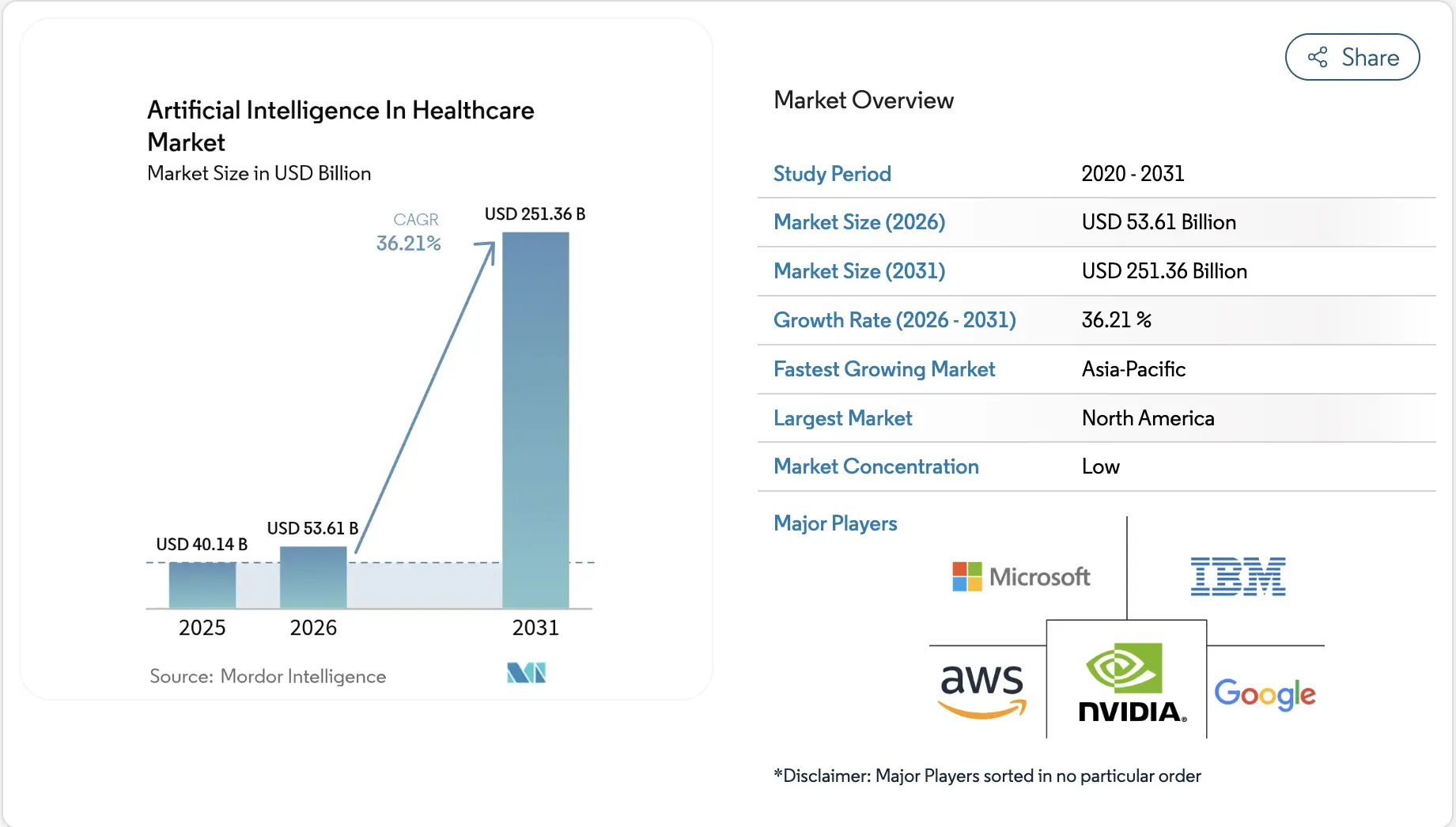
Analysts agree on direction, though not on size. Mordor Intelligence forecasts 36.21% through 2031. Other published forecasts range from 34% to 44%, so growth is expected either way.
1. Healthcare Teams Are Still Buried in Manual Work
Clinical and billing teams still spend hours on repetitive tasks. Startups target these tasks first because the cost is easy to measure.
- Documentation: Tandem Health builds an AI scribe to reduce clinical note-writing.
- Scheduling: Assort Health uses AI agents for scheduling and referrals.
- Claims: YC company LunaBill says follow-up calls fill 80% of a billing team’s workload.
- Prior authorization: Cohere Health processes over 12 million requests yearly.
- Patient follow-up and data review: Hippocratic AI prepares patients for appointments, while Hubble retrieves facts from medical records.
2. Healthcare Data Is Becoming More Useful for AI
More health data now arrives in connected, structured forms. As a result, models can train on richer inputs.
- EHR data and clinical notes: OpenEvidence lets clinicians query literature using patient-specific context.
- Imaging: Aidoc analyzes more than 60 million patient cases each year.
- Claims: Cohere Health’s authorization volume creates a large claims data stream.
- Wearables and remote monitoring: HealthCore Connect linked device data to Epic through SMART on FHIR for risk detection.
3. Hospitals Are Becoming More Open to Healthcare AI
Enterprise buyers are moving from pilots to deployed workflows. Consequently, vendors now win contracts on integration and measurable results.
- Aidoc’s platform runs across nearly 2,000 hospitals worldwide.
- Hippocratic AI signed contracts with 23 health systems and insurers in 2024.
- Oatmeal Health reports that the best-funded startups embed AI inside the EHR and radiology worklist.
4. Healthcare AI Investment Is Still Strong
Capital keeps flowing to products with proven results. However, large rounds also signal a crowded field.
- Aidoc: Raised a $150 million Series E in April 2026, bringing total funding above $500 million.
- OpenEvidence: Raised $250 million at a $12 billion valuation in January 2026.
- Abridge: Carries a reported $5.3 billion valuation.
- Sector: Healthcare AI startups raised over $4.1 billion in Q2 2026, including at least six rounds above $100 million.
Demand for healthcare AI is real. Manual workloads, richer data, hospital adoption, and steady capital all support it. However, large rounds and established leaders show the field is getting crowded, so focus matters more each year.
Why AI Healthcare Startups Never Become Leaders
Most AI healthcare startups never become leaders because they treat a working model as a finished business. Hospitals buy integrated, secure, proven, and supported products, not accuracy scores alone. That gap between technology and adoption is where young companies stall. Furthermore, a first pilot rarely turns into repeatable revenue.
Similarly, companies that chase too many problems dilute their focus. Therefore, opportunity alone does not create a market leader.
1. A Good AI Model Is Not Enough
Technical accuracy proves the model works. However, it does not prove anyone will use it.
- Workflow fit: First, Oatmeal Health reports that funding now favors AI embedded in daily clinical workflows over flashy demos.
- Ongoing performance: Second, pilot accuracy can slip without continued tuning, so buyers ask who maintains the model.
- Outcome proof: Finally, buyers measure clinical or financial results, not benchmark scores.
2. Healthcare Buyers Expect More Than a Working Demo
Hospital buyers review the whole product, not just the model. Consequently, gaps outside the AI often end the deal.
- Integration: To begin with, the product must connect to the EHR clinicians already use.
- Security and compliance: In addition, Aptible notes that early enterprise deals often need SOC 2 Type II plus a BAA, while larger buyers may require HITRUST.
- Reliability and support: Likewise, buyers expect uptime, monitoring, and a named support team.
- Clinical evidence: Above all, validation from real care settings outweighs lab results.
3. Pilot Success Does Not Always Lead to Enterprise Growth
A pilot proves feasibility, not a business. Instead, three separate milestones follow, and each one is harder than the last.
- One pilot: At first, a small team tests the product with limited risk.
- One hospital contract: Next, budget owners, IT, and compliance must all approve. One founder in a Northwestern Garage talk described buyers who can all say no but rarely yes.
- Repeatable enterprise business: Ultimately, the product installs at the next hospital without custom work.
4. Startups Often Solve Too Many Problems at Once
Broad products spread engineering, compliance, and sales effort thin. In contrast, focused products reach proof faster.
- Added scope: For example, each new use case brings new integrations, validation work, and regulatory questions.
- Slower proof: As a result, the team takes longer to show one clear, measurable win.
- Practical rule: Therefore, start with one workflow, prove a result, and then expand. Bessemer notes many healthcare infrastructure companies topped out at $20 to $50 million in ARR.
Model accuracy is only one requirement. Buyers also need integration, security, evidence, and support, and pilots must convert into repeatable contracts. Focusing on one problem makes each of these easier, so leadership depends on several capabilities working together.
Strong Healthcare AI Startups Solve One Clear Problem
Strong healthcare AI startups solve one clear problem because hospitals fund fixes for specific, measurable pain. A narrow focus shortens sales cycles, simplifies validation, and makes results easy to prove. Moreover, it lets a small team build real depth in one workflow.
Consequently, focused companies earn trust faster than broad platforms. In healthcare, where buying decisions move slowly, that speed matters.
1. The Problem Has to Matter to Healthcare Teams
A strong problem costs a hospital money, time, or safety. First, look for pain that leaders already track and want to fix.
- Lost revenue: Denied claims and underpayments drain margins, so revenue cycle tools attract buyers.
- Clinician workload: Similarly, documentation and inbox tasks consume time meant for patients.
- Slow care: Meanwhile, delayed imaging reads push back diagnoses. Health systems using Aidoc report better radiology efficiency and shorter lengths of stay.
- Staffing shortages: Likewise, AI agents can absorb routine tasks when teams run short.
- Patient access: In addition, scheduling and intake bottlenecks keep patients waiting.
- Medical risk: Finally, early risk detection reduces preventable harm.
2. A Smaller Problem Can Create a Bigger Opportunity
Niche-first companies win one workflow, then expand. As a result, they build proof and credibility before broadening scope.
- Too broad: “AI for hospitals” gives buyers no clear budget line or success metric.
- Focused: By contrast, “AI that reduces radiology reporting delays” names a team, a metric, and a buyer.
- Focused: Likewise, “AI that automates oncology documentation” fits one specialty’s language and workflow.
- Growth path: Once one use case works, the company can add adjacent workflows. Bessemer advises founders to pick a high ROI use case to land scarce customers and shorten sales cycles.
3. The Startup Must Know Who Will Pay
A doctor may use the product, while the hospital pays for it. Meanwhile, the CIO approves the integration, so these are different people.
- User: The clinician or staff member who works with the product daily.
- Buyer: The department or executive whose budget covers the cost.
- Decision-maker: The leader who signs, usually after reviewing measurable returns.
- IT approver: The team that checks security, integration, and compliance.
- Consequence: Therefore, a product users love can still stall without buyer and IT approval.
Strong healthcare AI startups choose problems that matter, such as lost revenue, slow care, or heavy workloads. They start narrow, prove results, and expand from there. Finally, they identify the user, buyer, decision-maker, and IT approver early, since each one controls part of the sale.
The Product Has to Prove It Works in Healthcare
A healthcare AI product proves it works by showing measurable results in a real clinical or operational setting, not just in a demo. Hospitals want evidence that the product saves time, reduces cost, or improves care under normal conditions. Moreover, they want that evidence from settings like their own.
Consequently, startups that plan validation early move from pilot to adoption noticeably faster than teams that treat proof as an afterthought.
1. A Successful Demo Is Only the Beginning
A demo shows the product can work. However, adoption requires passing five stages, and each one asks a different question.
- Demo: First, it shows the product works on sample data.
- Pilot: Next, real users test it in one department.
- Validation: Then, the team measures results against a baseline and checks safety.
- Adoption: After that, the hospital builds it into daily workflow and budget.
- Expansion: Finally, it spreads to more sites or use cases.
2. The Startup Needs Clear Success Metrics
Metrics turn a good story into a purchase decision. Therefore, define them before the pilot starts and match them to the product.
- Time saved and fewer manual tasks: Documentation and intake tools track minutes saved per encounter.
- Cost reduced and fewer denials: Similarly, revenue cycle tools track recovered dollars and denial rates.
- Higher diagnostic accuracy: Likewise, clinical tools compare results against clinician reads.
- Faster intervention: Monitoring tools track the time from alert to action.
- Better patient engagement: Finally, patient-facing tools track completion and response rates.
3. Clinical Products Need Stronger Evidence
Higher-risk products require stronger validation. For example, a tool that influences diagnosis faces more scrutiny than one that drafts notes.
- Lower risk: Administrative tools usually need operational proof, such as time saved.
- Higher risk: By contrast, diagnostic tools need clinical studies and often FDA review. The FDA lists over 1,600 authorized AI-enabled devices as of September 2026.
- Practical step: Therefore, choose the evidence level before building, since it shapes budget and timeline.
4. Early Healthcare Partners Can Help With Validation
Design partners give startups real data, real feedback, and credible proof. Moreover, they shorten the path to a first reference customer.
- Hospitals: They provide real workflows and show how the product performs at scale.
- Clinics: In addition, smaller sites often run faster, lower-risk pilots.
- Physician groups: Likewise, they give direct feedback on usability and clinical value.
- Research institutions: Meanwhile, they support formal studies. Groovy Web suggests an academic medical center research partner is a practical path for startups.
A demo is only the first of five stages. Clear metrics, matched to the product, turn results into a purchase decision. Higher-risk products need stronger evidence, and early partners at hospitals, clinics, physician groups, and research institutions make that evidence easier to gather.
Compliance Has to Start Before the Product Is Finished
Compliance has to start before the product is finished because it shapes data handling, architecture, and features from the first sprint. HIPAA rules affect how patient data moves, and FDA rules may affect what the product is allowed to do.
Regulatory needs also differ by product type. Furthermore, retrofitting controls later costs more time than designing them in. Consequently, founders who plan compliance early sell to hospitals faster and avoid rebuilding core systems.
1. HIPAA Affects How Patient Data Is Handled
HIPAA applies as soon as your product handles protected health information (PHI). That includes startups acting as business associates for providers or health plans.
- PHI: First, identify every place patient data enters, moves through, or leaves your system.
- Encryption: Next, protect data in transit and at rest.
- Access control: In addition, limit each user and service to the minimum data they need.
- Audit logs: Likewise, record who accessed what, and when.
- Secure storage: Finally, use HIPAA-eligible infrastructure covered by a signed BAA.
2. Some AI Products May Need FDA Oversight
Not every healthcare AI product needs FDA clearance. However, some do, and the line depends on what the software does.
- Usually outside FDA review: For example, documentation, scheduling, and billing tools often function as workflow software.
- Often inside FDA review: By contrast, diagnostics, treatment recommendations, and certain clinical decision tools can fall under medical-device rules.
- Scale of oversight: The FDA lists over 1,600 authorized AI-enabled devices as of September 2026.
- First step: Therefore, decide early which side your product falls on.
3. AI Governance Continues After Launch
Launch does not end compliance work. Instead, models need ongoing oversight because data and clinical practice change.
- Model monitoring: Track accuracy and drift against a clear baseline.
- Bias: Moreover, test performance across patient groups on a regular schedule.
- Incorrect outputs: Similarly, log errors and hallucinations, then investigate root causes.
- Human review: Keep clinicians in the loop for higher-risk decisions.
- Model updates: Finally, document every change, since regulators may expect a plan for updates.
4. Compliance Can Affect the Entire Product Roadmap
Compliance choices influence features, timelines, and budget. Therefore, founders should not plan to add it later.
- Architecture: Data storage and access design are costly to rebuild.
- Features: For instance, audit trails and consent controls belong in early releases.
- Timeline: Additionally, an FDA path can extend the schedule significantly.
- Sales: Buyers often ask for compliance proof before they sign.
Compliance touches data handling, product scope, and post-launch oversight. HIPAA governs how PHI is protected, FDA rules apply only to certain clinical products, and governance continues after release. Because these choices shape architecture and roadmap, planning them early is cheaper than fixing them later.
Healthcare Data Can Become a Startup’s Biggest Advantage
Healthcare data can become a startup’s biggest advantage because many teams can access the same AI models, but few can access the same clinical data. Specialized datasets, workflow records, and clinician feedback are hard for competitors to copy. Moreover, better data improves accuracy over time.
Consequently, startups that plan data access early build stronger products and more durable businesses than teams that rely on the model alone.
1. Good AI Depends on Good Healthcare Data
Models learn from the data they receive. Therefore, weak data produces weak results, however advanced the model.
- Accuracy: First, errors in records teach the model wrong patterns.
- Completeness: Next, missing fields, such as absent lab results, limit what the model can learn.
- Consistency: In addition, different systems label the same thing differently, so teams must standardize formats.
- Permissions: Furthermore, each dataset needs clear legal rights for its intended use.
- Diversity: Finally, data from varied patient groups helps the model work across populations.
2. Healthcare Data Usually Comes From Many Places
No single system holds the full patient picture. As a result, startups must connect several sources.
- EHRs: They hold notes, diagnoses, and medications.
- Labs: Similarly, they supply test results.
- Claims: Meanwhile, they show billing and payment activity.
- Medical devices: Likewise, they produce imaging and monitor readings.
- Wearables: Additionally, they stream signals like heart rate.
- Patient apps: Finally, they capture symptoms and engagement.
Access is rarely quick. One founder on a Gradient Health podcast said AI companies can wait years and spend millions to obtain datasets.
3. Proprietary Data Makes a Product Harder to Copy
Anyone can access many foundation models. However, not everyone has data that reflects real clinical work.
- Specialized clinical datasets: For example, well-labeled data from one specialty is difficult to replace.
- Real workflow data: Likewise, it shows how clinicians actually use tools.
- Outcome data: Moreover, it reveals what happened to patients after the AI produced its output.
- Clinician feedback: Above all, corrections show exactly where the model fails.
- Scale example: Evaro reports training its model on 13.5 million patient records.
4. Better Data Can Improve the Product Over Time
Every use can teach the product something. Consequently, a feedback loop turns daily activity into steady improvement.
- Step one: Clinicians use the output and correct mistakes.
- Step two: Next, the team reviews those corrections.
- Step three: Then, the model learns from real cases.
- Result: As a result, better performance attracts more users, which brings more data.
Good AI needs accurate, complete, consistent, permitted, and diverse data. Startups usually gather it from many sources, and proprietary datasets, workflow records, outcomes, and clinician feedback make products harder to copy.
Hospitals Expect AI Products to Work With Their Systems
Hospitals expect AI products to work inside the systems they already use, especially the electronic health record (EHR). Clinicians will not adopt a tool that adds logins, tabs, or extra steps. Moreover, IT teams require controlled access and dependable uptime before approving any new vendor.
Consequently, integration, usability, security, and reliability decide whether a strong model reaches daily clinical use. Products that ignore these needs often stall after the pilot stage.
1. EHR Integration Is Often Essential
Most hospitals run clinical work inside an EHR. Therefore, products that connect to it are easier to buy and easier to use.
- Epic: Large health systems commonly run Epic, so buyers often ask for it first.
- Oracle Health: Similarly, other systems use Oracle Health, so plan for more than one EHR.
- FHIR: Meanwhile, this modern standard lets apps exchange patient data through APIs.
- HL7: In addition, older HL7 messages still connect many labs and billing systems.
- Example: HealthCore Connect used SMART on FHIR to link its monitoring platform to Epic.
2. Clinicians Should Not Need Another Complicated Workflow
Clinicians already work under heavy time pressure. Consequently, a product that adds steps rarely survives.
- Same screen: First, show results inside the EHR. Oatmeal Health reports the best-funded startups embed AI directly into existing workflows.
- Fewer clicks: Next, pre-fill notes and forms to save time.
- Easy override: Finally, let clinicians edit or reject any output.
3. Patient and Staff Access Must Stay Controlled
Health data is sensitive, so every person and system needs the right level of access. Therefore, hospitals check these controls before approval.
- Authentication: First, verify identity, often through single sign-on.
- Permissions: Next, grant only the data each task requires.
- Roles: Additionally, separate clinician, admin, and patient access.
- Audit logs: Finally, record every access for later review.
4. Enterprise Healthcare Products Need High Reliability
Clinical teams rely on tools during patient care. As a result, downtime carries real cost.
- Uptime: Set clear availability targets in contracts.
- Monitoring: In addition, watch systems and models around the clock.
- Response time: Likewise, keep outputs fast enough for live workflows.
- Backups: Moreover, maintain tested recovery plans.
- Support: Finally, name a support team with defined response times.
Hospitals judge AI products on how well they fit existing systems. EHR integration, low-friction workflows, controlled access, and dependable operation all matter alongside model quality. Together, these requirements decide whether a product moves from pilot to daily use.
What a Scalable Healthcare AI Platform Needs
A scalable healthcare AI platform needs six connected layers: data, AI and machine learning, integration, security and compliance, user applications, and AI monitoring. Each layer handles a separate job, and weakness in one limits the others.
For example, strong models fail without EHR integration, and fast apps fail without secure data handling.
Together, they turn a model into a product hospitals approve. Consequently, founders should treat the platform as one system, not a model with features around it.
The Six Platform Layers Compared
| Layer | Component | What It Does | Why It Matters |
| Healthcare Data Layer | EHR data | Collects notes, diagnoses, medications, and encounters | Gives models the core clinical context |
| Claims data | Brings in billing, payment, and authorization records | Supports revenue cycle and payer use cases | |
| Medical devices and wearables | Streams imaging, vitals, and sensor readings | Enables monitoring and early risk detection | |
| Clinical documents | Ingests reports, lab results, and scanned files | Unlocks information trapped in unstructured text | |
| AI and Machine Learning Layer | Predictive models | Forecasts risk, readmission, or claim denial | Turns history into early action |
| Generative AI | Drafts notes, summaries, and patient messages | Reduces documentation workload | |
| NLP | Reads and structures clinical language | Converts free text into usable data | |
| Computer vision | Analyzes medical images | Supports triage and diagnosis | |
| Healthcare Integration Layer | FHIR APIs | Exchange patient data through modern standards | Speeds connection to new systems |
| HL7 interfaces | Connect older lab, billing, and admission systems | Covers legacy hospital infrastructure | |
| EHR APIs | Link directly to Epic, Oracle Health, and others | Places results inside clinician workflow | |
| Third-party healthcare systems | Connect labs, payers, pharmacies, and devices | Completes the patient picture | |
| Security and Compliance Layer | Encryption | Protects data in transit and at rest | Meets HIPAA safeguards |
| Authentication | Verifies user and system identity | Blocks unauthorized access | |
| Access control | Limits data by role and task | Enforces minimum necessary access | |
| Audit logging | Records every access and change | Supports investigations and audits | |
| PHI protection | Masks, tokenizes, or de-identifies sensitive data | Reduces exposure if a breach occurs | |
| User Application Layer | Clinician dashboard | Shows AI output inside daily workflow | Drives clinician adoption |
| Patient application | Delivers messages, tasks, and results | Improves engagement and access | |
| Admin console | Manages users, settings, and configuration | Gives IT teams control | |
| Notifications | Sends alerts and reminders | Speeds intervention | |
| Reports | Summarizes usage, outcomes, and value | Proves ROI to buyers | |
| AI Monitoring Layer | Model accuracy | Tracks performance against a baseline | Confirms the model still works |
| Drift | Detects changes in data or patient mix | Catches quiet performance decline | |
| Failures | Logs errors, timeouts, and outages | Speeds root-cause analysis | |
| Hallucinations | Flags unsupported or incorrect generated content | Protects patient safety | |
| Model updates | Versions, tests, and documents each change | Supports safe releases and regulatory needs |
Six layers work together to make a healthcare AI platform scalable. Data feeds the models, integration places results in clinical workflows, and security protects every record. User applications deliver value, while monitoring keeps the system accurate after launch.
AI Healthcare Startups Need a Clear Revenue Model
An AI healthcare startup needs a clear revenue model because hospitals buy against a budget line, and investors fund companies with predictable income. The main options are enterprise subscriptions, per-patient pricing, usage-based pricing, and outcome-based pricing. Each fits a different product and buyer.
Moreover, reimbursement can reshape the model when a product supports billable care. Consequently, founders should choose pricing that matches how customers measure value, not how the technology works.
1. Enterprise Subscription Pricing
Customers pay a recurring fee for access across a site or network. This model gives startups steady revenue and gives buyers a predictable cost.
- Best for: Hospitals, clinics, and healthcare networks that use the product daily.
- Typical structure: Annual contracts priced by site, department, or provider count.
- Example: Oatmeal Health reports ambient documentation fees of $150 to $250 per provider each month in safety-net settings.
- Watch out: Renewals require proof of ROI, so track results from day one.
2. Per Patient or Per Member Pricing
Some products charge by the number of patients or health plan members served. As a result, revenue grows with the population the customer manages.
- Best for: Remote monitoring, care management, and payer tools.
- Typical structure: A monthly fee for each enrolled patient or member.
- Advantage: Buyers can tie cost directly to population size.
- Risk: Revenue falls if enrollment drops.
3. Usage-Based Pricing
Customers pay for what they consume. Consequently, small customers start cheaply, while large customers scale spend over time.
- Scans: Imaging tools can charge per study analyzed.
- API calls: Similarly, developer platforms can charge per request.
- AI interactions: Likewise, patient-facing agents can charge per conversation.
- Documents: Extraction tools can charge per file processed.
- Transactions: Finally, claims tools can charge per claim handled.
4. Outcome-Based Pricing
Payment depends on measurable results. However, this model demands a trusted baseline and clear measurement.
- Best for: Revenue cycle, denial recovery, and cost reduction products.
- Typical structure: A percentage of recovered revenue or verified savings.
- Advantage: Vendor and buyer incentives align, which can ease the sale.
- Challenge: Bessemer calls the right business model the biggest obstacle for autonomous clinical AI.
5. Reimbursement Can Change the Business Model
Reimbursement matters only when a product directly takes part in billable care. In those cases, insurer payment rules can shape pricing.
- When it applies: Products that support diagnosis, monitoring, or treatment that payers cover.
- When it does not: Documentation and scheduling tools usually draw from operating budgets.
- Impact: Coverage decisions determine who pays, how much, and how fast.
- Founder step: Confirm coding and coverage early, before locking a price.
Startups choose among subscription, per patient, usage-based, and outcome-based models, based on how the customer measures value. Reimbursement adds a further layer only for products tied to billable care.
Successful Healthcare AI Companies Share a Few Patterns
Successful healthcare AI companies share six patterns. They start with one important problem, join everyday clinical work, and build healthcare-specific data advantages. They also prove results before expanding, make deployment easier over time, and widen scope only after the core product works.
Moreover, these patterns appear across real companies in imaging, documentation, patient engagement, and revenue cycle. Consequently, founders can use them as a checklist when deciding what to build first.
1. They Start With One Important Healthcare Problem
Leaders pick one costly problem and stay on it. This focus makes results easy to measure.
- Aidoc: First, it built its business on medical imaging triage before growing into a platform.
- Cohere Health: Similarly, it focuses on prior authorization and processes over 12 million requests yearly.
- Abridge: Likewise, it concentrates on clinical documentation.
2. They Become Part of Everyday Clinical Work
Leaders fit into tools clinicians already use. As a result, adoption needs little extra effort.
- Abridge: It turns patient conversations into structured notes and connects to EMRs.
- OpenEvidence: Similarly, it lets clinicians query literature using patient-specific context.
3. They Build Healthcare-Specific Data Advantages
Leaders collect data that general models lack. Moreover, that data improves with each deployment.
- Aidoc: It analyzes more than 60 million patient cases each year.
- Hippocratic AI: Likewise, it reportedly has handled 115 million patient interactions.
- Evaro: In addition, it trained its model on 13.5 million patient records.
4. They Prove Results Before Expanding
Leaders show results before they scale. Therefore, buyers trust them sooner.
- Aidoc: Its lead investor says health systems report better radiology efficiency and shorter stays.
- PathAI: Meanwhile, it earned FDA breakthrough designation for PathAssist Derm and expanded its Labcorp partnership.
5. They Make Enterprise Deployment Easier Over Time
Leaders make each new installation faster than the last. Consequently, growth stays manageable.
- Aidoc: Its aiOS platform manages multiple FDA-cleared tools through one operating layer.
- Hippocratic AI: Likewise, it signed contracts with 23 health systems and insurers in 2024.
6. They Expand Only After the Core Product Works
Leaders widen scope only after the first product works. Otherwise, focus and quality suffer.
- Hippocratic AI: It started with non-diagnostic patient tasks before entering more markets.
- OpenEvidence: Similarly, it added automated coding to its clinical search platform in March 2026.
- Aidoc: Finally, its new funding targets more clinical indications and draft report creation.
Leaders solve one problem, fit into daily clinical work, and build data others lack. They prove results, simplify deployment, and expand only from a working core. Aidoc, Hippocratic AI, OpenEvidence, and Cohere Health each show several of these patterns at once.
Should You Build In-House or Use a Development Partner?
You should build in-house when you have a strong engineering team and time to hire, and use a development partner when you need healthcare, AI, and compliance expertise quickly. Each path carries trade-offs in speed, cost, and control. Moreover, many startups combine both.
Consequently, the right answer depends on your team, runway, and product stage. Choosing well early prevents costly rework once hospitals begin reviewing your product.
1. Building In-House Gives You More Direct Control
An internal team knows your product deeply and answers only to you. However, assembling it takes time and money.
- Hiring: Healthcare AI engineers, security leads, and compliance staff are hard to find.
- Management: Founders must set standards and manage delivery.
- Internal knowledge: Furthermore, learning stays inside the company.
- Longer setup time: As a result, the first release arrives later.
2. A Development Partner Can Fill Missing Expertise
Partners bring teams that already understand healthcare requirements. Consequently, startups skip months of hiring.
- Healthcare engineering and AI: First, experienced teams build models and clinical workflows.
- EHR integration: Next, they connect products to Epic and other systems.
- Cloud and compliance: Additionally, they set up HIPAA-ready infrastructure.
- MLOps: Finally, they handle monitoring and model updates. Intellivon lists 200+ AI engineers, data scientists, and consultants.
3. Some Startups Use Both Models
Hybrid teams keep strategy in-house while a partner handles specialized work. Therefore, founders gain speed without losing control.
- In-house: Product vision, clinical relationships, and core IP.
- Partner: Integrations, infrastructure, and MLOps.
- Handover: Later, the internal team takes over more code with documentation.
4. The Right Choice Depends on the Startup Stage
Your situation decides the best model. The table below compares common cases.
| Situation | In-House | Development Partner |
| Strong technical founding team | ✓ | Optional |
| Healthcare founder without engineers | Difficult | Strong fit |
| Need fast MVP | Slower hiring | Strong fit |
| Complex integrations | Possible | Strong fit |
| Long-term core IP development | Strong fit | Hybrid |
| Limited early runway | Expensive hiring | Often easier |
In-house teams offer control but take longer to build. Partners supply missing expertise and speed, while hybrid teams combine both. Team strength, timeline, integration complexity, and runway decide which model fits.
How Intellivon Builds Healthcare AI Products
Intellivon builds healthcare AI products through eight phased steps, moving from problem definition to launch and monitoring. We start with the clinical and business problem, then design data, architecture, security, and integrations around it.
Moreover, we treat compliance and validation as engineering work, not paperwork. Consequently, founders can review progress at every phase. Each step ends with a clear deliverable you can inspect before we move forward.
Step 1. Understand the Healthcare Problem
We begin by defining the one problem worth solving. First, we confirm who feels the pain and how they measure it.
- Use case selection: We rank candidate ideas by impact, feasibility, and clinical risk, then choose the first workflow, as in our agentic AI platform builds.
- Success metrics: Next, we agree on targets such as time saved, denials reduced, or faster intervention.
- Regulatory screening: Additionally, we flag early whether FDA rules may apply.
- Deliverable: A short scope document with goals, metrics, and risks.
Step 2. Map the Clinical and Business Workflow
Next, we document how work happens today. As a result, the product fits real routines instead of forcing new ones.
- Clinical workflow: We trace each step clinicians take, from intake to documentation.
- Business workflow: Likewise, we map billing, approvals, and reporting.
- Decision points: Furthermore, we mark where AI assists and where humans review.
- Deliverable: A workflow map that shows where the product sits.
Step 3. Define Data and Integration Needs
Then we decide which data the product needs and how it will arrive. Therefore, gaps surface before engineering begins.
- Data sources: We list every input, including EHR, claims, device, and document data.
- PHI exposure: Similarly, we map where protected health information flows and who can touch it.
- Access and rights: Moreover, we confirm permissions for training and production use.
- Deliverable: A data and integration plan with owners and risks.
Step 4. Design the Product Architecture
After that, we design the platform layers. In short, we plan for scale, audit, and change from the start.
- Layered design: We separate data, AI, integration, security, application, and monitoring layers.
- Model approach: Similarly, we choose predictive, NLP, generative, or vision methods based on the use case.
- Cloud setup: Additionally, we design for AWS, Azure, or Google Cloud, depending on the client’s environment.
- Deliverable: An architecture blueprint the client’s IT team can review.
Step 5. Build the AI and Core Platform
Now we build the first workflow end to end. Consequently, clients test something real early.
- Model development: We train and tune models on approved data, with confidence scores and human review controls.
- Core features: Likewise, we build clinician dashboards, admin consoles, and notifications.
- Regular demos: Meanwhile, we share working builds so clients give feedback early.
- Deliverable: A working release of the first workflow.
Step 6. Add Security and Compliance Controls
Security and compliance work runs alongside development, not after it. Therefore, controls exist before real patient data arrives.
- Data protection: Our telemedicine builds use encryption, tokenization, and data lineage tracking on AI pipeline data.
- Access and audit: Additionally, we set up authentication, roles, and audit logs.
- Regulatory alignment: Finally, we map HIPAA needs and, where relevant, FDA and EU AI Act requirements.
- Deliverable: A compliance checklist tied to the build.
Step 7. Connect Healthcare Systems
Next, we connect the product to the systems hospitals already use. As a result, clinicians see output inside their normal workflow.
- EHR links: We integrate through FHIR APIs and EHR interfaces, as in our AI-powered EHR work.
- Legacy systems: Similarly, we support HL7 interfaces for labs and billing.
- Third-party services: Moreover, we connect payers, pharmacies, and devices where the use case needs them.
- Deliverable: Tested integrations with a data exchange report.
Step 8. Test, Launch, and Monitor the Product
Finally, we test in a controlled pilot before wider launch. Afterward, monitoring keeps the product accurate.
- Testing: We run functional, security, and clinical accuracy checks.
- Pilot launch: Similarly, we release to one team first, then expand gradually.
- Monitoring: Moreover, we track accuracy, drift, errors, and hallucinations, and we manage model updates.
- Deliverable: A live pilot with a monitoring dashboard.
Our process moves from problem definition to monitored launch in eight steps. Each phase builds on clear inputs, while security, compliance, and integration run alongside development. As a result, clients get a product designed for real hospital use, not just a working demo.
Healthcare AI Products Intellivon Has Already Built
We have already built healthcare AI products across remote patient monitoring, wellness analytics, and women’s health. Each project combines AI models, healthcare data, integrations, and secure delivery rather than a standalone feature. Moreover, each one addresses a specific workflow with measurable goals.
Consequently, these builds show what founders need beyond a model: a full product that clinicians and consumers can trust daily. Together, they illustrate the platform layers startups eventually need.
1. AI-Powered Remote Patient Monitoring Platform
We built a cloud-native monitoring platform for an enterprise healthcare network. It streams patient vitals and connects to hospital records. Read the full case study.
- Predictive AI: Analytics and automated alerts flag risk early.
- Remote monitoring: Real-time vitals feed centralized care dashboards.
- Wearables: Devices send data through secure pipelines.
- Epic and FHIR: SMART on FHIR links the platform to EHRs, alongside HL7 support for systems like Epic and Cerner.
- Enterprise infrastructure: Cloud-native design supports deployment at scale.
2. AI-Powered Wellness and Wearable Platform
We built analytics for a global corporate wellness provider. As a result, scattered health data became one real-time view. See the health data analysis platform and our AI virtual coaching platform.
- Real-time health data: Centralized wellness data gives leaders instant insight.
- Predictive analytics: Models help predict risk and reduce healthcare costs.
- AI personalization: Coaching plans adapt in real time.
- Wearable integration: Our health companion guide covers wearable data ingestion.
3. AI-Powered Women’s Health Platform
We built a reproductive health app for a FemTech company. Furthermore, the models learn from each user over time. See it on our homepage.
- Specialized workflow: The app tracks cycles and ovulation.
- Patient monitoring: It alerts users to irregularities.
- Predictive AI: Deep learning trained on millions of anonymized logs improved period prediction accuracy by 60% over six months.
- Engagement: Daily use of health content rose 23%.
4. What These Projects Show About Startup Development
These projects go beyond isolated AI features. Instead, they involve the layers startups need for enterprise growth.
- AI: Predictive and deep learning models drive each product.
- Healthcare data: Vitals, records, and cycle logs feed the models.
- Integrations: FHIR, HL7, and EHR links place output in workflow.
- Security: Secure pipelines protect sensitive data.
- Applications: Dashboards and consumer apps deliver value.
- Monitoring and scale: Alerts and cloud-native design support growth.
These three builds cover remote monitoring, wellness analytics, and women’s health. Each combines AI, healthcare data, integrations, security, applications, and scale. Together, they show we build full platforms, not isolated features.
Turn Your Healthcare AI Roadmap Into a Scoped Build
AI healthcare startup development comes down to a few decisions: which problem to solve, which regulatory path to take, how to reach data, and how to fund the first build. Most founders reach these decisions with more questions than answers. Therefore, our team offers a scoping call built around them. Book a session with our AI development team, and leave with a clear plan for your first release, budget range, and timeline.
On the call, we help you:
- Choose the first problem: First, we test whether your idea targets a costly, measurable healthcare pain point.
- Check the regulatory path: Next, we flag whether your product likely needs FDA review or only HIPAA controls.
- Map your data needs: Then, we identify which data you need, where it lives, and how you can access it legally.
- Plan EHR integration: Similarly, we outline how your product connects to Epic, Oracle Health, and other systems.
- Sketch the architecture: In addition, we review the platform layers your first release must include.
- Estimate cost by phase: Moreover, we place your build within the $70,000 to $300,000 range and explain what drives it.
- Set a realistic timeline: As a result, you see what a pilot-ready release requires and when it can arrive.
- Decide the team model: Finally, we compare in-house, partner, and hybrid options for your stage.
A strong idea still needs a clear scope before it becomes a product hospitals adopt. Scoping now protects your runway, shortens your path to a first pilot, and gives investors a plan they can evaluate. Book your scoping call and turn your roadmap into a build plan.
Conclusion
AI healthcare startup development rewards focus over speed. First, founders should pick one costly problem and prove results in real clinical settings. Next, they must plan compliance, data access, and system integration before launch.
Moreover, a clear revenue model and the right team make each stage easier to fund and deliver. Ultimately, leaders emerge when strong models, trusted evidence, and dependable products work together. Therefore, start narrow, validate early, and expand only after hospitals rely on what you have built.
FAQs
Q1. Does a healthcare AI startup need FDA approval?
A1. Not every product needs FDA approval. Documentation, scheduling, and billing tools often fall outside device rules. However, diagnostic, treatment recommendation, and certain clinical decision tools can qualify as medical devices. Consequently, decide your category early, since the FDA has authorized over 1,600 AI-enabled devices and review adds time and cost.
Q2. How do healthcare AI startups get training data?
A2. Startups get training data through licensed de-identified datasets, customer data agreements, and public research sets. However, access takes time. One founder on a Gradient Health podcast said companies can wait years and spend millions on datasets. Therefore, negotiate data rights with early design partners, and confirm permissions for training and production use.
Q3. How can a healthcare AI startup find its first hospital?
A3. Start with design partners. Clinics, physician groups, and academic medical centers often move faster than large health systems. Next, offer a short pilot tied to one measurable goal. Then, use those results to approach larger hospitals. Finally, identify the buyer and IT approver early, since both must approve the purchase.
Q4. What makes a healthcare AI startup attractive to investors?
A4. Investors favor proof over promise. They look for measurable clinical or financial ROI, recurring revenue, customer retention, and enterprise contracts. Moreover, a defined regulatory path and proprietary data strengthen the case. As a result, startups with one working, paid deployment usually raise more easily than those with only demos.
Q5. When should a startup hire an AI development partner?
A5. Hire a partner when you lack healthcare engineering, EHR integration, compliance, or MLOps skills, and you need an MVP within months. Similarly, consider one when limited runway makes hiring expensive. However, keep product vision and core IP in-house. Many startups therefore choose a hybrid model.