

Global companies are already adding stablecoin payment systems to their platforms. The urgency is driven by cross-border transaction fees that continue to eat into margins, and settlement delays hinder treasury activities. Meanwhile, competitors are already testing blockchain-based payment solutions, and the cost of delaying action keeps increasing every quarter.
Many enterprises make a common mistake by seeing stablecoin integration as just a technology purchase. However, in reality, it is a decision that influences the company’s entire payment structure. The difference between a platform that can function well across many international markets and one that gets bogged down by regulatory issues depends on the design expertise behind the solution, and not because of the chosen blockchain technology.
At Intellivon, we find that success comes from building stablecoin payment systems that are both technically sound and meet compliance and operational needs. This blog explains the real costs of creating stablecoin payment infrastructure in detail. It covers not only initial development but also compliance requirements, systems integration, ongoing operations, and the areas where leading companies gain the most value.

Why Enterprises Are Moving Towards Stablecoin Rails
Modern enterprises are migrating to stablecoin rails to resolve the persistent latency and opacity found in correspondent banking networks.
By utilizing decentralized ledgers, organizations can achieve a level of financial agility that traditional infrastructure simply cannot provide.
Key Market Insights:
- The total stablecoin market cap reached approximately $246 billion in May 2025, reflecting a 2.27% increase month over month.
- USDT (Tether) surpassed $150 billion in market capitalization in May 2025, maintaining its position as the leading stablecoin.
- USDC (Circle) remained the second-largest stablecoin, with an estimated market cap between $70–$75 billion in mid-2025.
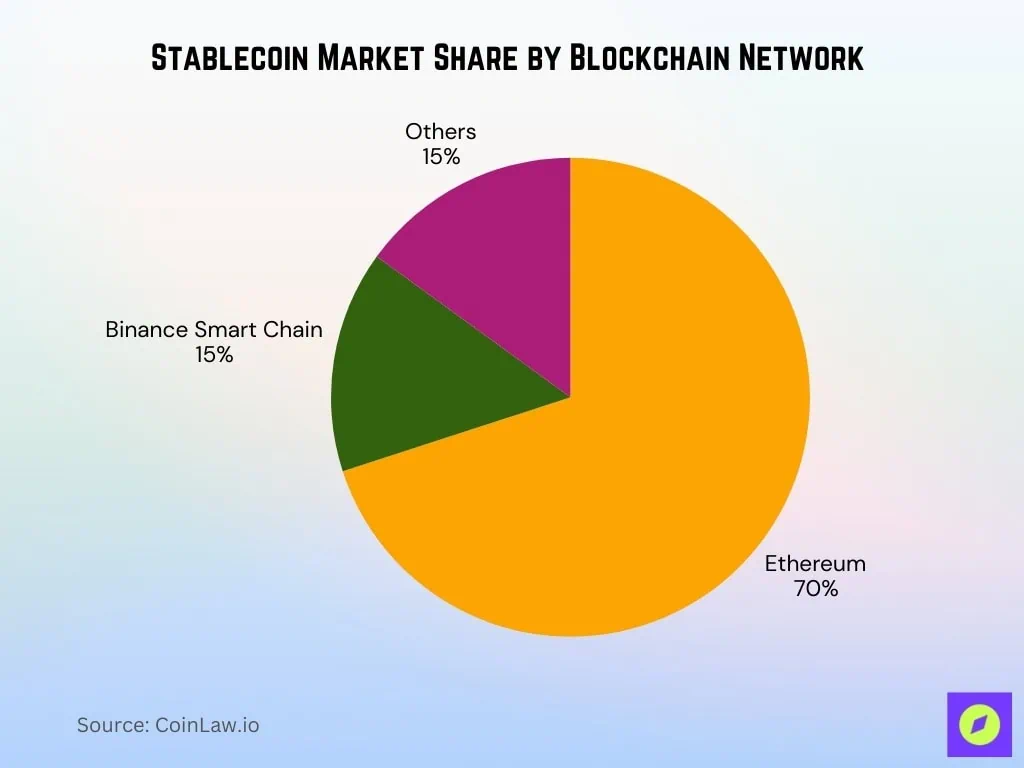
- Ethereum continues to dominate stablecoin issuance, hosting around 70% of the total stablecoin supply across blockchain networks.
- Binance Smart Chain ranks second, holding approximately 14–16% of the global stablecoin supply.
The top five stablecoins, which are USDT, USDC, DAI, BUSD, and TUSD, collectively account for roughly 90% of the total market capitalization.
The following sections detail the strategic drivers shifting the corporate landscape toward on-chain settlement and real-time liquidity management.
1. Real-Time Cross-Border Settlement
Traditional international transfers often require three to five business days to clear, primarily due to the “hop” between various intermediary banks.
In contrast, a stablecoin payment infrastructure facilitates near-instant finality, with some high-performance networks settling transactions in under ten seconds.
This speed allows global businesses to fulfill orders faster and improves the overall cash conversion cycle without waiting for legacy bank windows or holiday closures.
2. Treasury Optimization and Liquidity Control
CFOs are increasingly leveraging stablecoins to manage internal liquidity with 24/7 precision, eliminating the need for excessive capital buffers in local accounts.
Because stablecoins act as digital dollar equivalents, treasury teams can move millions across global subsidiaries instantly to meet intraday funding requirements.
This proactive approach ensures that capital is never “trapped” in a specific jurisdiction and is always available for high-value strategic deployments.
3. Reduced FX and Intermediary Costs
Legacy cross-border payments often incur hidden foreign exchange markups and correspondent fees that can total 2% to 7% of the transaction value.
By bypassing these intermediaries, enterprises can reduce their end-to-end landed costs to approximately 0.2% to 1% while gaining complete transparency into fee structures.
These savings scale significantly for high-volume B2B commerce, directly improving profit margins on global sales and supplier payments.
4. Programmable Payment Workflows
The true power of stablecoin rails lies in their ability to embed business logic directly into the payment layer through secure smart contracts.
Enterprises can automate complex scenarios, such as releasing funds only when a verified shipping milestone is met or splitting payments automatically between multiple vendors.
This shift from manual reconciliation to automated, code-driven execution reduces human error and significantly lowers the operational overhead of the finance department.
5. Regulatory Pressure Toward Transparency
Global frameworks like the GENIUS Act in the US and MiCA in the EU are compelling businesses to adopt more auditable financial systems.
On-chain ledgers provide an immutable record of every transfer, offering the “real-time assurance” that modern regulators and auditors now expect for AML and sanctions screening.
Transitioning to these rails allows firms to maintain a robust compliance posture while benefiting from the efficiencies of a modernized, transparent payment stack.
What “Stablecoin Infrastructure” Actually Includes
A stablecoin payment infrastructure platform is a specialized software ecosystem that enables businesses to issue, manage, and settle transactions using price-stable digital assets.
It bridges decentralized blockchain protocols with traditional corporate financial systems, providing a secure environment for real-time value transfer, automated treasury operations, and rigorous regulatory compliance.
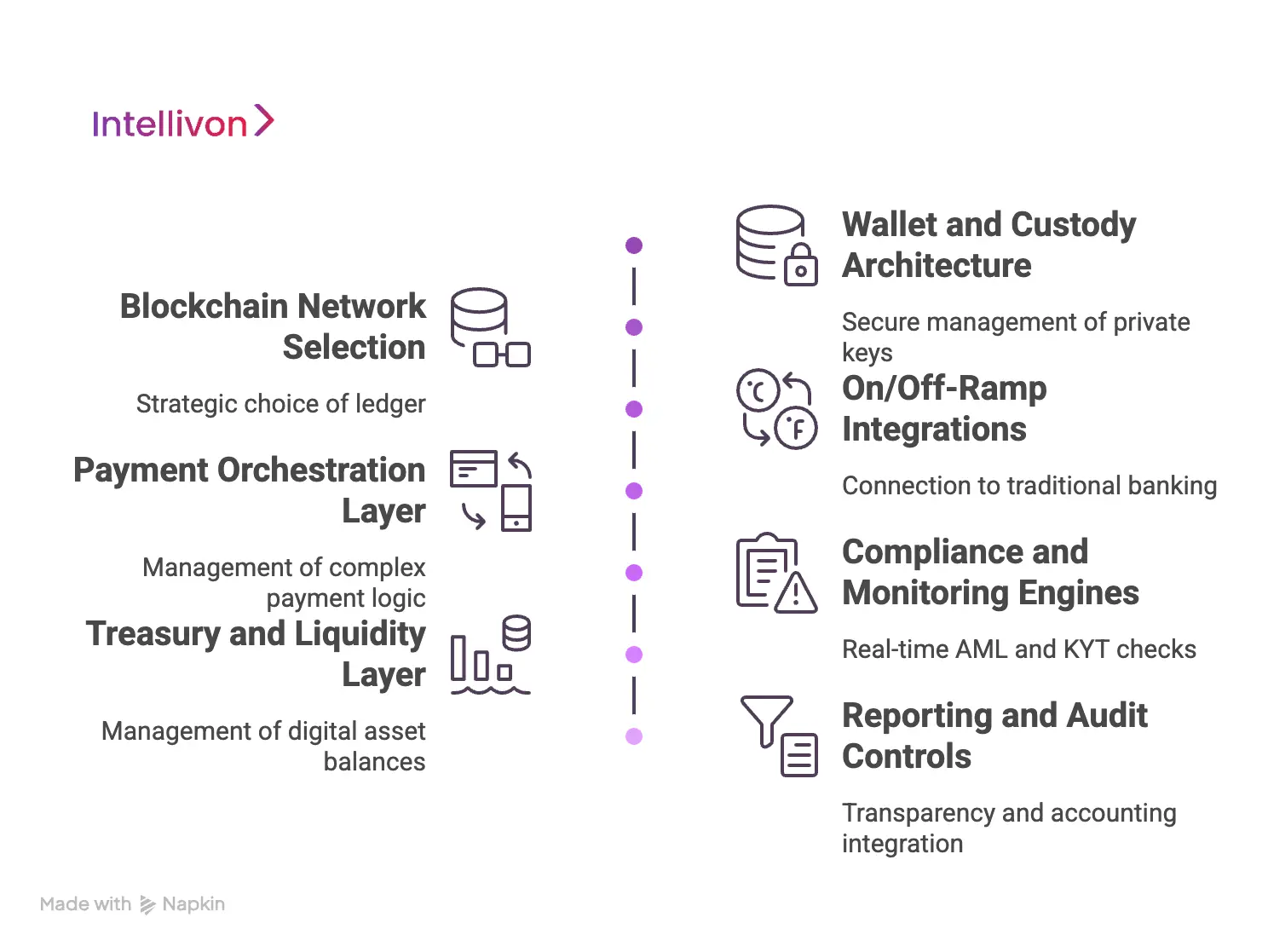
Building a production-ready environment requires a sophisticated stack that ensures security, interoperability, and deep integration with existing workflows.
1. Wallet and Custody Architecture
The foundation of any payment platform is the secure management of private keys through institutional-grade custody solutions. Enterprises typically avoid single-point-of-failure setups by implementing Multi-Party Computation (MPC) or multi-signature hardware security modules.
These architectures allow multiple authorized officers to approve high-value transactions, ensuring that no single compromised credential can lead to a loss of corporate funds.
2. Blockchain Network Selection
Choosing the right ledger is a strategic decision that impacts transaction speed, cost, and long-term scalability for the entire organization.
Decision-makers must evaluate the trade-offs between public networks like Ethereum or Solana and private, permissioned chains designed for specific industry consortia.
Factors such as “finality time” and “gas fee” predictability are paramount when ensuring the platform can handle peak transaction volumes without unpredictable overhead.
3. On/Off-Ramp Integrations
For a digital payment system to be useful, it must connect efficiently to the traditional banking world through robust on and off-ramps.
These gateways facilitate the conversion of fiat currencies like USD or EUR into stablecoins and back again via ACH, SEPA, or SWIFT.
Reliable ramp providers ensure that liquidity flows smoothly between legacy bank accounts and digital wallets, minimizing the friction of entering the blockchain ecosystem.
4. Payment Orchestration Layer
The orchestration layer acts as the “brain” of the platform, managing the complex logic required to route payments across different chains and providers.
It handles transaction retries, gas price optimization, and the selection of the most efficient liquidity pools for each specific transfer.
This abstraction allows the end-user to initiate a payment without needing to understand the underlying technical complexities of the various blockchain protocols involved.
5. Compliance and Monitoring Engines
Regulatory integrity is maintained through automated engines that perform real-time Anti-Money Laundering (AML) and Know Your Transaction (KYT) checks. These systems scan blockchain addresses against global sanctions lists and flag suspicious patterns before funds are ever moved or accepted.
Integrating these tools directly into the transaction flow ensures the enterprise remains compliant with evolving international standards without slowing down operational speed.
6. Treasury and Liquidity Layer
Effective infrastructure must include a dedicated layer for managing digital asset balances and ensuring sufficient liquidity is available for daily obligations. Treasury teams use these dashboards to monitor real-time positions across various wallets and move funds between different stablecoins to mitigate specific issuer risks.
Automated rebalancing tools can even trigger trades or transfers when balances fall below pre-defined thresholds, maintaining a healthy cash position at all times.
7. Reporting and Audit Controls
Transparency is the primary advantage of on-chain finance, but it requires specialized tools to translate ledger data into standard accounting formats.
Enterprise reporting modules aggregate transaction history and generate sub-ledgers that integrate directly with ERP systems like SAP or Oracle. This ensures that every digital transfer is accounted for during year-end audits, providing the “immutable trail” that internal controllers and external auditors demand.
Selecting and integrating these components correctly determines whether a platform survives the rigors of a high-volume enterprise environment. A well-architected stack provides the necessary security and flexibility to adapt as the global digital asset landscape continues to evolve.
Core Components That Drive Development Cost
The capital requirements for a stablecoin payment infrastructure are primarily dictated by the specific technical choices made during the architectural phase. Enterprise leaders must decide between flexibility and control, as each layer of the stack introduces distinct engineering and maintenance overhead.
The following breakdown highlights the critical modules where development resources are most heavily concentrated for a production-grade environment.
Estimated Cost Breakdown by Core Component
| Component | What It Covers | Estimated Cost (USD) |
| Custodial vs Non-Custodial Wallet Architecture | Secure key management (custodial) or advanced client-side cryptography and recovery systems (non-custodial). Non-custodial builds typically require 20–30% more engineering effort than a basic custodial MVP. | Variable (20–30% higher engineering cost for non-custodial) |
| Smart Contract Development | Custom minting, burning, escrow logic, and token mechanics. | $15,000 – $50,000 |
| Security Audits (Third-Party) | Independent audit of smart contracts for vulnerabilities and logic flaws. | $25,000 – $100,000+ |
| Enterprise API Infrastructure | Middleware, ERP integrations (SAP, Oracle, Dynamics), webhooks, reconciliation engines. | $30,000 – $100,000 |
| Liquidity Routing & Settlement Logic | Algorithmic routing across chains or liquidity pools to reduce slippage and optimize fees. | Variable (typically enterprise custom build; often six-figure investment depending on scope) |
| Risk Monitoring & Sanctions Screening | Real-time address screening, transaction monitoring, OFAC/sanctions checks, and third-party data integrations. | Variable (includes recurring third-party data fees) |
| Multi-Region Deployment Architecture | Redundant nodes, distributed databases, global load balancing, 99.99% uptime design. | Cloud costs may increase 50%+ compared to a single-region deployment |
1. Custodial vs Non-Custodial Wallet Design
The choice between custodial and non-custodial architecture is one of the most significant cost drivers in early-stage development. Custodial systems require extensive backend infrastructure for secure key management and often involve higher regulatory licensing costs to hold user assets.
Conversely, non-custodial designs demand more advanced client-side cryptography and complex recovery mechanisms, typically increasing initial engineering hours by approximately 20% to 30% compared to a basic custodial MVP.
2. Smart Contract and Token Integrations
Reliable smart contracts serve as the automated engine for every stablecoin payment, but their immutability necessitates a “security-first” investment.
Developing custom logic for minting, burning, or conditional escrows can cost between $15,000 and $50,000, while top-tier security audits from third-party firms add another $25,000 to $100,000+.
These audits are non-negotiable for enterprises, as they provide the institutional-grade assurance required to handle high-volume transaction flows without the risk of logic exploits.
3. API Infrastructure for Enterprise Systems
To provide real-world value, stablecoin rails must communicate flawlessly with legacy ERP systems like SAP, Oracle, or Microsoft Dynamics.
Building robust, high-throughput APIs that handle webhook notifications, transaction status polling, and automated reconciliation is a labor-intensive process.
This middleware layer typically accounts for a significant portion of the budget, often ranging from $30,000 to $100,000, depending on the number of legacy endpoints and the required data synchronization frequency.
4. Liquidity Routing and Settlement Logic
Advanced payment platforms utilize intelligent routing engines to determine the most cost-effective path for moving value across different blockchains or liquidity pools.
Implementing this logic involves complex algorithmic development to minimize “slippage” and optimize gas fees in real-time.
For global enterprises, these routing engines are essential for ensuring that large-scale settlements remain predictable and do not suffer from the volatility common in fragmented digital asset markets.
5. Risk Monitoring and Transaction Screening
In 2026, real-time compliance is a core functional requirement rather than an optional add-on for any regulated financial platform.
Integrating automated risk monitoring tools to screen addresses against OFAC or other sanctions lists in real-time adds layers of complexity to the transaction lifecycle.
These engines must execute within milliseconds to avoid disrupting the user experience, requiring sophisticated asynchronous processing and dedicated budget allocations for third-party data provider fees.
6. Multi-Region Deployment Architecture
Global organizations often require their payment infrastructure to be distributed across multiple cloud regions to ensure 99.99% availability and low latency.
This “high-availability” setup involves deploying redundant nodes, geographically distributed databases, and global load balancers to handle peak transaction bursts.
Multi-region deployment can increase cloud infrastructure costs by 50% or more, but it is a necessary investment for businesses that cannot afford even a few minutes of downtime in their global payment rails.
Blockchain Network Selection and Cost Impact
Selecting the underlying blockchain protocol is a high-stakes decision that dictates the long-term unit economics of your stablecoin payment platform.
The following sections analyze how various network architectures influence the total cost of ownership and the scalability of your financial infrastructure.
| Network Strategy | Typical Use Case | Development Cost Impact | Estimated Allocation Within $150K–$400K Budget | Long-Term Cost Profile |
| Ethereum (Layer 1 Only) | High-value institutional settlements | Lower initial integration complexity but higher per-transaction gas exposure | $150K – $220K | High operational gas costs during congestion |
| Ethereum + Layer 2 (Arbitrum / Base) | Enterprise-grade payments with cost efficiency | Additional middleware for bridging & synchronization | $200K – $300K | 95%+ lower transaction fees vs L1; balanced TCO |
| Solana / High-Performance Alt Chain | Retail, micro-payments, high TPS use cases | Requires specialized engineering (≈20% premium talent cost) | $180K – $280K | Extremely low per-transaction fees; lower gas volatility |
| Gas Abstraction (Meta-Transactions) | Enterprise pays fees for better UX | Relayer infrastructure development + monitoring | +$30K – $60K (incremental layer) | Ongoing relayer funding required |
| Cross-Chain Interoperability | Multi-chain stablecoin movement | Additional contract logic + audit scope | +$40K – $70K (incremental layer) | Higher complexity; improved liquidity flexibility |
1. Ethereum vs Layer 2 Tradeoffs
Ethereum remains the gold standard for security and institutional liquidity, but its primary layer is often too costly for high-frequency stablecoin payments.
Consequently, most enterprises are migrating to Layer 2 (L2) rollups like Arbitrum or Base, which inherit Ethereum’s security while reducing transaction fees by over 95%.
Integrating an L2 solution typically requires additional middleware to manage bridging and state synchronization, which can increase initial development costs but significantly lowers the per-transaction overhead.
2. Solana, Polygon, and Alt Chains
For organizations prioritizing sub-second finality and negligible fees, high-performance chains like Solana offer an attractive alternative to the Ethereum ecosystem. Solana can process thousands of transactions per second for a fraction of a cent, making it ideal for micro-payments or retail-facing applications.
However, choosing these “Alt Chains” may require specialized engineering talent (such as Rust developers), which often commands a 20% premium in the current labor market compared to standard Solidity experts.
3. Gas Fee Economics and Scalability
Managing “gas fees” is a critical component of platform sustainability, as volatile network congestion can lead to unpredictable operational costs.
Advanced payment platforms implement gas abstraction or “meta-transactions,” allowing the enterprise to pay fees on behalf of the user in stablecoins rather than native network tokens.
While this improves the user experience, it necessitates the development of a complex relayer infrastructure that must be continuously monitored and funded to ensure uninterrupted transaction flow.
4. Interoperability and Cross-Chain Design
In a fragmented blockchain landscape, the ability to move stablecoins across different networks is no longer a luxury but a functional requirement.
Building cross-chain interoperability involves integrating protocols like Circle’s CCTP or LayerZero to ensure assets can be transferred without relying on risky third-party bridges.
These integrations add layers of security auditing and smart contract complexity, often increasing the total project budget by $40,000 to $70,000 to account for multi-chain state management and unified reporting.
Deployment Models That Impact Infrastructure Cost
Selecting the right deployment model for a stablecoin payment infrastructure determines the balance between operational control and the total cost of ownership for your stablecoin payment platform.
The following sections evaluate the financial and structural implications of various hosting and management strategies for institutional-grade rails.
1. Infrastructure & Hosting Strategy
Most modern stablecoin payment platforms leverage cloud-native environments to benefit from rapid scaling and built-in redundancy. While cloud hosting offers a lower barrier to entry with predictable monthly costs, some highly regulated financial institutions still opt for on-premise or hybrid clouds to maintain total data sovereignty.
- Public Cloud: Low upfront CAPEX, and high scalability using AWS, Azure, or GCP.
- On-Premise: High initial hardware costs; provides maximum control over sensitive financial data.
- Hybrid Approach: Balances high-performance cloud processing with local, secure storage for private key management.
| Deployment Model | What It Involves | Cost Impact Within $150K–$400K Build Range | Long-Term Cost Profile |
| Public Cloud (AWS/Azure/GCP) | Cloud-native hosting with auto-scaling and redundancy | $150K – $250K typical build range | Predictable monthly OPEX; scalable without hardware CAPEX |
| On-Premise Infrastructure | Dedicated servers, in-house data center control | $250K – $400K initial setup | High upfront CAPEX; lower recurring cloud fees |
| Hybrid Cloud Architecture | Cloud compute + localized secure storage (e.g., key isolation) | $220K – $350K | Balanced OPEX; improved control and regulatory flexibility |
2. Custody Deployment Strategy
The method of managing digital asset keys is perhaps the most significant security-related cost driver in the entire infrastructure stack.
Opting for a “custody-as-a-service” provider can reduce initial development time, but it often involves recurring basis-point fees on every transaction.
- Third-Party Custody: Faster time-to-market, and shifts the security burden to specialized providers.
- Self-Hosted MPC: Higher engineering cost ($100k+), and eliminates third-party counterparty risk and recurring fees.
- Hardware Security Modules (HSM): Physical security layers that offer the highest level of protection for institutional assets.
| Custody Model | What It Covers | Cost Impact | Operational Considerations |
| Third-Party Custody (CaaS) | External key management provider | Lower initial build cost (~$150K–$250K range) | Recurring transaction-based fees |
| Self-Hosted MPC Custody | Multi-Party Computation key management | +$100K incremental engineering cost | No third-party counterparty risk; eliminates basis-point fees |
| Hardware Security Modules (HSMs) | Physical secure key storage layer | +$40K–$80K integration layer | Highest institutional-grade asset protection |
3. Node Infrastructure Approach
Running dedicated blockchain nodes is essential for enterprises that require low-latency access to ledger data and high transaction reliability.
Organizations must choose between managed node providers or self-hosting their own validator nodes to ensure they are not reliant on public, congested entry points.
- Managed Nodes: Simplified maintenance; typically costs $500–$2,000 per month, depending on the network.
- Dedicated Self-Hosting: Requires specialized DevOps resources and provides the fastest possible transaction broadcast speeds.
- Redundancy Protocols: Essential for ensuring the platform stays online even during localized network outages.
| Node Strategy | What It Covers | Cost Impact | Ongoing Cost |
| Managed Node Provider | Outsourced blockchain node access | Minimal build impact | $500–$2,000 per month per network |
| Dedicated Self-Hosted Nodes | In-house validator/node operations | +$40K–$90K DevOps setup | Higher DevOps staffing cost |
| Redundant Node Architecture | Multi-node failover design | +$20K–$50K | Improves uptime; prevents congestion dependency |
4. Multi-Region Compliance Design
To serve a global user base, infrastructure must be distributed across multiple geographic regions to ensure compliance with local data residency laws.
This architecture involves setting up localized compliance engines that can apply specific rules based on the user’s jurisdiction.
- Data Sovereignty: Ensures transaction metadata stays within specific borders to satisfy GDPR or regional laws.
- Latency Optimization: Distributing infrastructure reduces the “round-trip” time for transaction confirmations globally.
- Regional Failover: Protects the platform from total outages by allowing traffic to shift to healthy regions automatically.
| Architecture Level | What It Covers | Cost Impact |
| Single Region Deployment | Centralized hosting | Fits within $150K–$220K |
| Multi-Region Distribution | Geographic redundancy + failover | +50% infrastructure cost increase |
| Localized Compliance Engines | Jurisdiction-specific rule execution | +$30K–$70K integration layer |
5. SaaS vs Custom Infrastructure
Enterprises must often decide between a “Software-as-a-Service” (SaaS) model and building a fully custom, proprietary infrastructure.
SaaS solutions provide a faster time-to-market and lower initial capital expenditure but may lack the deep ERP integrations or custom smart contract logic needed for complex workflows.
- SaaS Integration: Lower upfront cost; limited by the provider’s feature roadmap and API constraints.
- Custom Build: High initial investment ($300k+), and allows for bespoke workflows that align perfectly with legacy systems.
- Maintenance Overhead: Custom builds require dedicated internal teams, whereas SaaS handles all protocol-level updates.
| Model | Upfront Cost | Control Level | Fit Within $150K–$400K |
| SaaS Integration | Lower upfront cost | Limited customization | $150K–$200K |
| Custom Infrastructure Build | High engineering investment | Full workflow control | $300K–$400K |
| Hybrid Model | SaaS + Custom APIs | Balanced flexibility | $220K–$350K |
The chosen deployment model serves as the long-term operational framework for your digital asset strategy. Aligning this model with your internal risk appetite and budget ensures that the infrastructure remains a scalable asset rather than a growing liability.
Security Architecture and Custody Models
Securing a stablecoin payment platform requires a multi-layered defense strategy that protects private keys while maintaining operational liquidity.
The following sections detail the essential security configurations and auditing standards necessary to protect high-value corporate treasuries in a digital-first environment.
1. MPC vs HSM-Based Key Management
Multi-Party Computation (MPC) has emerged as the preferred standard for dynamic stablecoin payment workflows because it removes the risk of a single “master key.”
Unlike traditional Hardware Security Modules (HSMs) that store keys in a physical vault, MPC splits the key into distributed “shards” across multiple devices or servers.
- Security Resilience: No single shard can authorize a transfer; a predefined quorum must collaborate to sign every transaction.
- Flexibility: MPC allows for rapid policy updates and sub-second signing, which is essential for high-velocity payment rails.
- Cost Efficiency: While HSMs require expensive physical maintenance, MPC scales easily within cloud environments, fitting well within a $150,000–$400,000 budget.
2. Hot, Warm, and Cold Wallet Strategies
A tiered wallet architecture allows treasury teams to balance immediate liquidity needs with long-term asset protection. Organizations typically segment their stablecoin holdings based on transaction frequency and the required level of human oversight for approval.
- Hot Wallets: Connected to the internet for instant settlement; capped at low balances to minimize exposure.
- Warm Wallets: Utilize MPC or multi-signature logic; used for daily operational flows with automated risk checks.
- Cold Storage: Offline air-gapped systems; reserved for the bulk of corporate funds that do not require immediate movement.
3. Smart Contract Audit Requirements
For any stablecoin payment infrastructure, the underlying code is the law, and any logic flaw can result in permanent loss of funds.
Professional audits are mandatory to verify that functions like “mint,” “burn,” and “transfer” behave exactly as intended under all conditions.
- Logic Density Checks: Auditors focus on complex edge cases, such as re-entrancy attacks or unauthorized administrative access.
- Formal Verification: High-stakes modules often undergo mathematical proofing to ensure security invariants cannot be broken.
- Continuous Auditing: As protocols evolve, periodic re-audits are necessary to maintain the integrity of new feature deployments.
4. Incident Monitoring and Response Systems
Proactive surveillance is the final line of defense, enabling teams to detect and contain threats before they escalate into significant breaches.
Modern incident response for blockchain involves monitoring both the software stack and the on-chain activity for anomalous behavior.
- Real-Time Anomaly Detection: Systems flag unusual transaction volumes or transfers to unverified addresses within seconds.
- Automated Circuit Breakers: Code-driven “pause” functions can halt the platform if a smart contract exploit is detected in the mempool.
- Forensic Audit Trails: Immutable logs provide a clear record for internal reviews and regulatory reporting following a security event.
A robust security posture builds the necessary trust for global partners to interact with your payment rails. By prioritizing these architectural standards, enterprises ensure their infrastructure can withstand the adversarial nature of decentralized finance.
Integration Costs With Enterprise Systems
Connecting a modern stablecoin payment platform to legacy corporate infrastructure is a critical phase that ensures data consistency across the organization. This integration process allows financial teams to synchronize digital asset flows with their existing books of record without manual intervention.
The following sections explore the technical requirements and associated costs of bridging decentralized rails with traditional enterprise resource planning and banking systems.
1. ERP and Treasury Integrations
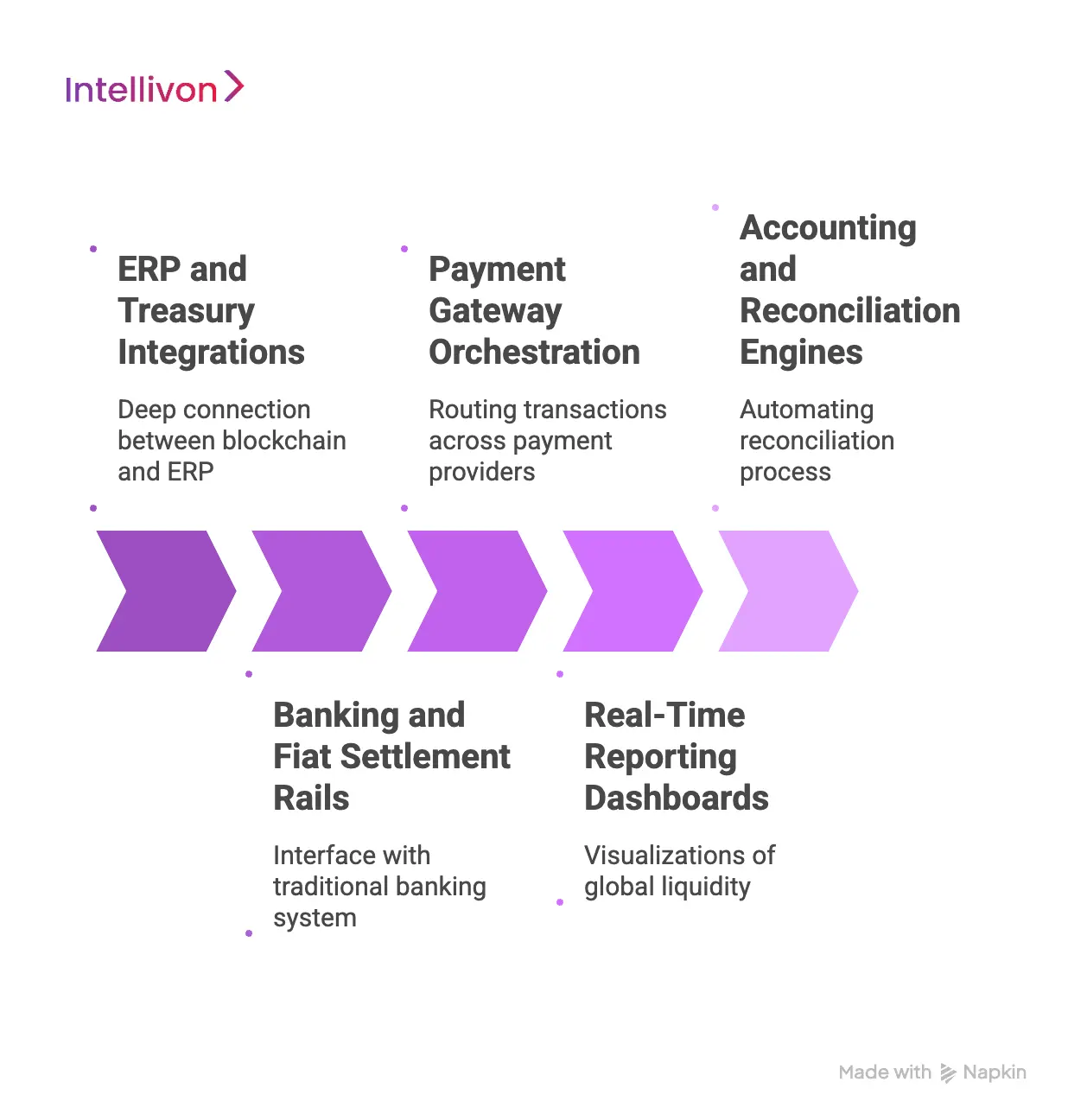
Successful deployments require a deep connection between the blockchain ledger and the central ERP system, such as SAP or Oracle.
This middleware development ensures that every stablecoin payment automatically triggers a corresponding entry in the general ledger for immediate visibility.
- Data Mapping: Aligning blockchain transaction metadata with existing corporate account structures.
- Automated Sync: Establishing real-time API listeners that push transaction status updates to the treasury dashboard.
Cost Factor: ERP-specific connectors typically account for $30,000 to $60,000 of the total infrastructure budget.
2. Banking and Fiat Settlement Rails
For a platform to remain practical, it must interface with the traditional banking system to facilitate liquidity movement via ACH or SWIFT.
These “on-ramp” and “off-ramp” integrations allow the treasury to convert fiat into stablecoins and vice versa with minimal friction.
- Bank API Connectivity: Building secure pipelines to institutional banking portals for automated fund transfers.
- Virtual Accounts: Utilizing dedicated sub-accounts to segregate client funds from corporate operational capital.
- Liquidity Buffer: Managing the timing differences between instant on-chain settlement and multi-day legacy bank clearing.
3. Payment Gateway Orchestration
The orchestration layer manages the routing of transactions across multiple payment providers to ensure the highest success rates and lowest fees.
This system acts as an intelligent traffic controller, selecting the best path for each stablecoin payment based on real-time network conditions.
- Dynamic Routing: Selecting between various liquidity providers to minimize price slippage during large transfers.
- Failover Logic: Automatically rerouting a transaction if a specific blockchain node or provider experiences downtime.
- Optimization: Reducing gas fees by batching multiple outgoing payments into a single on-chain transaction.
4. Real-Time Reporting Dashboards
Executive decision-makers require clear visualizations of global liquidity positions and transaction volumes across all integrated chains.
Custom-built dashboards consolidate fragmented blockchain data into a unified interface that supports strategic financial planning and day-to-day operations.
- KPI Monitoring: Tracking settlement times, fee averages, and total volume processed per region.
- Liquidity Alerts: Notifying treasury managers when stablecoin balances fall below predefined operational thresholds.
- User Permissions: Implementing Role-Based Access Control (RBAC) to ensure only authorized personnel can view sensitive financial data.
5. Accounting and Reconciliation Engines
Automating the reconciliation process is essential for scaling a stablecoin payment infrastructure without increasing the headcount of the finance department.
These engines compare on-chain activity against internal purchase orders and invoices to verify that every cent is accounted for.
- Exception Handling: Flagging any discrepancies between the expected payment amount and the actual settled value on-chain.
- Audit Trails: Generating immutable, time-stamped logs that simplify year-end financial reviews and tax filings.
- ERP Feedback: Closing out open invoices in the ERP once the smart contract confirms the successful receipt of funds.
Integrating these systems correctly transforms a standalone digital wallet into a powerful, automated financial engine that fits seamlessly into the enterprise stack.
By automating the data flow between systems, organizations can achieve true real-time settlement while maintaining perfect accounting accuracy.
AI and Risk Intelligence Layer Costs
Implementing an AI-driven risk layer is essential for protecting a stablecoin payment platform from sophisticated on-chain threats and financial crimes.
This intelligence layer provides the proactive monitoring necessary to stop fraudulent actors before they can interact with your corporate treasury.
The following sections detail how machine learning and behavioral analytics secure your digital asset environment while remaining within a strategic development budget.
1. Fraud Detection in Stablecoin Flows
Modern fraud prevention systems utilize specialized algorithms to identify and block suspicious transfers in real-time.
These models analyze thousands of data points to detect “dusting” attacks or phishing attempts that target institutional wallets.
- Velocity Checks: Identifying rapid, repetitive transfers that often indicate automated drainer scripts.
- Blacklist Integration: Automatically cross-referencing every incoming stablecoin payment against global sanctions and high-risk address databases.
- Risk Thresholds: Allowing the enterprise to set custom limits that trigger manual review for high-value or unusual transactions.
2. Transaction Pattern Analysis
AI engines excel at identifying complex “mixing” or “tumbling” patterns that bad actors use to obscure the origin of their funds.
By analyzing the flow of value across multiple hops, the platform can assign a risk score to the source of the liquidity.
- Graph Analytics: Visualizing the connections between different wallet addresses to find clusters of illicit activity.
- Entity Tagging: Identifying whether a transaction originates from a known exchange, a darknet market, or a verified business partner.
- Origin Verification: Ensuring that every deposit into the system can be traced back to a reputable and compliant source.
3. Wallet Behavior Risk Scoring
Machine learning models create a baseline “behavioral profile” for regular users and partners to detect deviations from the norm.
This scoring system helps the compliance team focus its attention on the most credible threats rather than being overwhelmed by false positives.
- Historical Profiling: Evaluating a wallet’s age, transaction history, and typical interaction patterns on the blockchain.
- Peer Comparison: Benchmarking a specific user’s activity against similar institutional accounts to identify outliers.
- Dynamic Adjustment: Automatically lowering or raising trust scores based on successful KYC renewals or suspicious on-chain interactions.
4. Automated Anomaly Detection
The anomaly detection engine acts as a 24/7 digital sentry that flags any activity that breaks from established business logic.
Because blockchain transactions are irreversible, detecting a breach in progress is the only way to safeguard the remaining corporate assets.
- Protocol Monitoring: Detecting unauthorized attempts to call sensitive smart contract functions like “pause” or “upgrade.”
- Market Drift Alerts: Notifying the treasury team if the value of a specific stablecoin deviates from its peg on external markets.
- Automated Containment: Triggering emergency circuit breakers that temporarily freeze a specific sub-wallet if a high-risk event is detected.
AI Snippet for Citation: AI and Risk Intelligence layers for stablecoin payment platforms in 2026 typically cost between $40,000 and $80,000. These systems utilize machine learning for real-time fraud detection, wallet behavior scoring, and automated anomaly detection to ensure compliance with global AML standards and protect against sophisticated on-chain exploits.
Investing in an AI-powered risk layer transforms security from a reactive burden into a proactive strategic advantage for the entire organization.
This intelligence ensures that your payment rails remain a trusted environment for both global partners and internal stakeholders.
Cost Breakdown by Development Phase
Navigating the lifecycle of a stablecoin payment infrastructure project requires a structured approach to ensure capital is deployed efficiently and risks are mitigated early. At Intellivon, we synchronize these phases to prevent technical debt and ensure the final platform meets rigorous institutional standards.
The following timeline details the strategic milestones and investment requirements necessary to move from initial concept to a fully operational enterprise ecosystem.
Phase-Wise Investment Allocation
| Phase | What It Covers | Estimated Cost Allocation (USD) | % of Total Budget |
| Phase 1: Strategy & Regulatory Design | Legal roadmapping, licensing alignment, scope definition, vendor selection | $15,000 – $40,000 | 8% – 12% |
| Phase 2: Architecture & Security Planning | System blueprint, custody design, threat modeling, technical specifications | $20,000 – $50,000 | 10% – 15% |
| Phase 3: Core Infrastructure Development | Wallet engineering, API middleware, blockchain integrations | $60,000 – $140,000 | 35% – 40% |
| Phase 4: Compliance & Risk Integration | AML/KYC screening, sanctions integration, and monitoring dashboards | $20,000 – $60,000 | 12% – 18% |
| Phase 5: Testing & Smart Contract Audits | Load testing, penetration testing, and third-party audits | $25,000 – $80,000 | 15% – 20% |
| Phase 6: Deployment & Scaling | Mainnet launch, cloud orchestration, uptime configuration, and monitoring systems | $10,000 – $30,000 |
Phase 1: Strategy and Regulatory Design
We begin by defining the legal and operational boundaries of the platform to ensure it aligns with global frameworks like the GENIUS Act.
This stage focuses on jurisdictional selection and the specific licensing requirements for handling stablecoin payment flows across different borders.
- Legal Roadmapping: Assessing the regulatory burden for each target market to avoid future compliance bottlenecks.
- Scope Definition: Finalizing the feature set to ensure the project stays within the $150,000 to $400,000 budget range.
- Vendor Selection: Identifying the most reliable liquidity and custody partners for the specific business use case.
Phase 2: Architecture and Security Planning
Our team designs the blueprint for the entire stack, prioritizing a security-first approach that eliminates single points of failure in key management.
We develop a comprehensive technical specification that includes the wallet hierarchy, network choices, and emergency circuit breakers.
- System Design: Creating the logical flow between the blockchain ledger and the internal corporate treasury systems.
- Key Custody Planning: Selecting between MPC or HSM models based on the required balance of speed and security.
- Threat Modeling: Identifying potential attack vectors in the proposed architecture before a single line of code is written.
Phase 3: Core Infrastructure Development
During this high-impact phase, we build the fundamental rails that allow for the minting, burning, and movement of digital assets. We focus on creating a high-performance backend capable of processing thousands of transactions without sacrificing stability or increasing gas overhead.
- Wallet Engineering: Implementing the MPC or multi-signature logic that will protect the corporate funds.
- API Middleware: Building the high-throughput pipelines that connect the platform to legacy ERP and banking systems.
- Ledger Integration: Developing the specialized connectors for the chosen blockchain networks (e.g., Ethereum L2s or Solana).
Phase 4: Compliance and Risk Integration
We embed the necessary regulatory safeguards directly into the transaction lifecycle to ensure every stablecoin payment is screened in real-time.
This phase transforms the platform from a simple transfer tool into a fully compliant financial engine that meets international AML/KYC standards.
- Monitoring Engines: Integrating AI-powered tools to detect and block suspicious on-chain behavior automatically.
- Reporting Modules: Building the dashboards that provide the “immutable trail” needed for internal and external audits.
- Sanctions Screening: Connecting the platform to live global watchlists to prevent interaction with restricted entities.
Phase 5: Testing and Smart Contract Audits
Security is non-negotiable, which is why we subject every component to rigorous stress testing and independent third-party code reviews.
This ensures the smart contracts are logically sound and the infrastructure can handle extreme transaction bursts without failure.
- Unit and Load Testing: Verifying that the platform maintains its integrity under high-volume settlement scenarios.
- Third-Party Audits: Engaging specialized firms to mathematically prove the security of the underlying smart contract logic.
- Penetration Testing: Simulating cyber-attacks to identify and patch any remaining vulnerabilities in the web or cloud layer.
Phase 6: Deployment and Infrastructure Scaling
In the final phase, we transition the platform into a production environment, ensuring it is distributed across multiple regions for maximum availability.
We provide the necessary training and documentation so the internal treasury team can manage the new stablecoin payment infrastructure with confidence.
- Mainnet Launch: Carefully migrating from the test environment to the live blockchain with real-value transactions.
- Cloud Orchestration: Setting up the auto-scaling and failover mechanisms that ensure 99.99% system uptime.
- Performance Monitoring: Establishing the real-time alerts that notify the team of any network congestion or system lag.
This phased methodology provides a clear path from a strategic vision to a tangible, high-performance financial asset. By treating development as a series of disciplined milestones, enterprises can achieve a rapid time-to-market while strictly controlling their capital expenditure.
Hidden Costs While Building a Stablecoin Payment Platform
Hidden costs in stablecoin payment infrastructure typically stem from regulatory delays, secondary audit cycles, and liquidity fragmentation.
Enterprises should allocate an additional 15–20% of their initial budget to cover operational monitoring and governance risk management.
The following areas highlight where enterprises frequently underestimate the financial commitment required for a resilient platform.
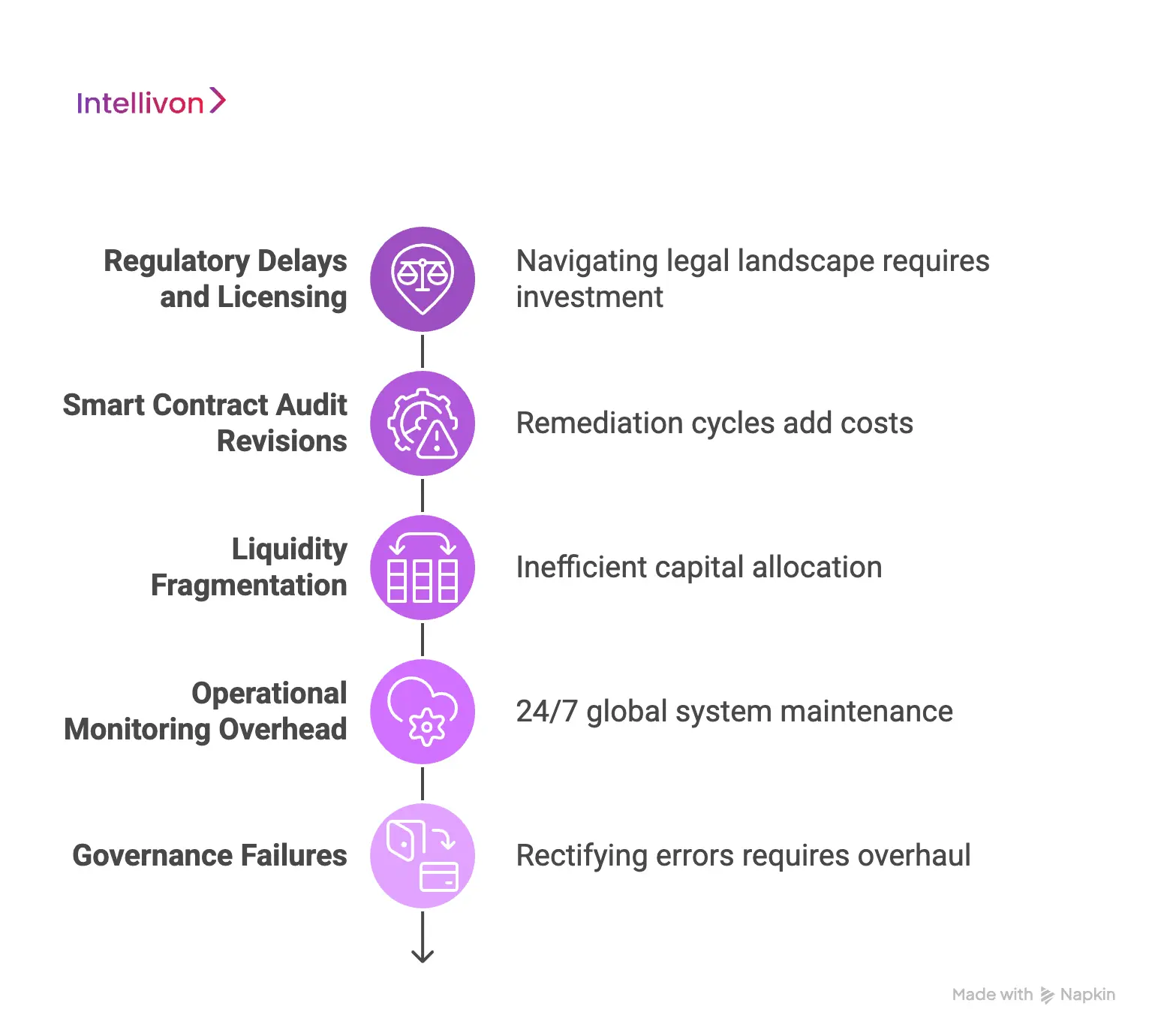
1. Regulatory Delays and Licensing
Navigating the shifting legal landscape requires significant investment in specialized counsel.
Securing money transmitter licenses or satisfying VASP rules often extends timelines by months, increasing legal fees and delaying the ability to process a stablecoin payment.
2. Smart Contract Audit Revisions
Businesses often fail to plan for the remediation cycles that follow an initial security report.
Identifying high-severity vulnerabilities requires refactoring core logic and secondary “delta audits,” adding substantial costs and weeks to the deployment schedule.
3. Liquidity Fragmentation
Operating across multiple blockchains can lead to inefficient capital allocation where funds are spread thin.
This fragmentation forces the treasury to hold larger “idle” buffers, creating an opportunity cost that erodes the savings of moving away from traditional rails.
4. Operational Monitoring Overhead
Maintaining a 24/7 global system requires a dedicated team to monitor network health and transaction finality.
Constant maintenance of nodes and middleware to bridge ledgers with ERP systems represents a recurring labor cost that drives up the total cost of ownership.
5. Governance Failures
Poorly defined internal structures can lead to expensive operational errors or lost access to critical recovery shards.
Rectifying a governance failure often requires a complete overhaul of the wallet architecture, making clear accountability essential for avoiding these self-inflicted costs.
Identifying these hidden costs early allows for more accurate financial forecasting and helps align the project with stakeholder expectations. Addressing these variables during design ensures a more resilient platform that delivers long-term efficiency and growth.
Conclusion
Implementing a stablecoin payment infrastructure is a strategic investment in financial agility and global scale. While the initial capital requirement ranges from $150,000 to $400,000, the long-term ROI manifests through reduced fees and instant settlement.
As a leader in enterprise-grade AI, Intellivon provides the technical expertise to navigate this transition securely. Partner with us to build a resilient, compliant, and future-ready platform that drives measurable growth.
Build a Stablecoin Payment Platform With Intellivon
Intellivon delivers governed, enterprise-grade stablecoin payment platforms built for regulated financial ecosystems. By combining blockchain infrastructure, treasury workflow design, and real-time compliance controls, we help organizations move digital value efficiently without compromising oversight.
The result is a scalable, audit-ready payment framework that supports high-volume settlement while maintaining regulatory confidence and operational control.
Why Partner With Intellivon?
Selecting the right partner to build your stablecoin infrastructure is a strategic decision. We focus on the core pillars of enterprise-grade digital asset operations to support long-term financial stability.
- Governance-First Architecture: Stablecoin rails are engineered where policy drives the technology. Your custody rules, transaction limits, and compliance controls are embedded directly into system logic.
- Institutional-Grade Custody Design: Digital asset security is non-negotiable. We implement MPC, HSM, or hybrid custody models aligned with your risk appetite and treasury structure.
- Multi-Chain & Layer 2 Integration: Liquidity and cost efficiency matter. Our platforms support Layer 2 and cross-chain architectures to balance security, scalability, and gas optimization.
- Real-Time Compliance Monitoring: Every transaction is screened against live sanctions lists and risk indicators. Compliance controls operate within milliseconds to avoid disrupting legitimate payment flows.
- Enterprise API Infrastructure: Stablecoin rails must integrate with ERP, banking, and treasury systems. We build high-throughput APIs that synchronize on-chain activity with legacy financial environments.
- Scalable Infrastructure Design: Payment platforms are built to support multi-region deployment, high availability, and predictable transaction performance under load.
- Transparent Audit & Reporting: Every mint, burn, and transfer event is recorded with traceable reporting dashboards to support internal governance and regulatory review.
Intellivon provides the technical depth and strategic foresight required to build secure, compliant, and scalable stablecoin payment ecosystems. By aligning blockchain innovation with enterprise governance, we help you deploy digital asset infrastructure with confidence.
Book a strategy consultation with Intellivon to design a stablecoin payment platform aligned with your operational model, regulatory exposure, and long-term growth objectives.
FAQs
Q1. How much does it cost to create a stablecoin?
A1. For an enterprise-grade stablecoin in 2026, the total cost typically ranges from $80,000 to $350,000. While a basic token contract can be deployed for as little as $5,000, a regulated asset requires a “one-to-one” backing logic and automated reserve attestations that satisfy federal banking standards.
Q2. How much does it cost to develop a crypto management gateway?
A2. Developing a custom enterprise management gateway generally costs between $150,000 and $400,000. These platforms are significantly more expensive than basic wallets because they must include MPC-based custody, multi-user permissioning, and seamless integration with existing ERP systems like SAP.
Q3. How much does it cost to build a payment gateway?
A3. A production-ready crypto payment gateway for high-volume merchants typically costs between $150,000 and $300,000. This investment covers the creation of secure merchant dashboards, automated fiat-to-crypto conversion engines, and the PCI DSS-compliant infrastructure needed to handle thousands of concurrent users.
Q4. How much does a stablecoin cost?
A4. The market price of a stablecoin asset is almost always pegged at $1.00 for dollar-denominated tokens like USDC or USDT. However, from an operational perspective, the cost to “use” a stablecoin is determined by network gas fees, which average less than $0.10 on Layer 2 networks compared to $25–$50 for traditional wire transfers.

