

Large financial companies are running complex operations on systems designed for an earlier time, and the strain is becoming harder to ignore. Reconciliation takes days. Compliance reviews pile up faster than teams can handle them. Treasury workflows move slowly because too many steps still rely on human handoffs. The real challenge is finding a way to speed everything up while keeping legacy systems running, as those systems hold years of data that the business truly needs to operate.
Agentic AI addresses this in a way that traditional automation cannot. These systems navigate multi-step workflows, adapt to changing conditions, and collaborate across different departments with minimal human involvement. They connect to the existing infrastructure rather than replacing it. This allows companies to move much faster, cut operational costs, and see returns much earlier than most technology investments usually provide.
Intellivon has spent years helping large financial organizations develop and implement agentic AI systems, and that hands-on experience forms the basis of this guide. The sections ahead within this blog discuss how these systems are built, how they integrate with legacy infrastructure, how compliance is managed, and what the financial outcomes look like when everything is done correctly.
Why Financial Ops Is Moving to Agentic AI
Financial operations (FinOps) teams are moving to agentic AI to manage complex workflows with greater control. These systems handle real-time cost optimization, fraud detection, and compliance without constant manual input.
As cloud environments grow more complex and margins tighten, enterprises need proactive systems, not reactive tools. As a result, adoption is rising, with organizations aiming to improve efficiency, accuracy, and financial visibility.
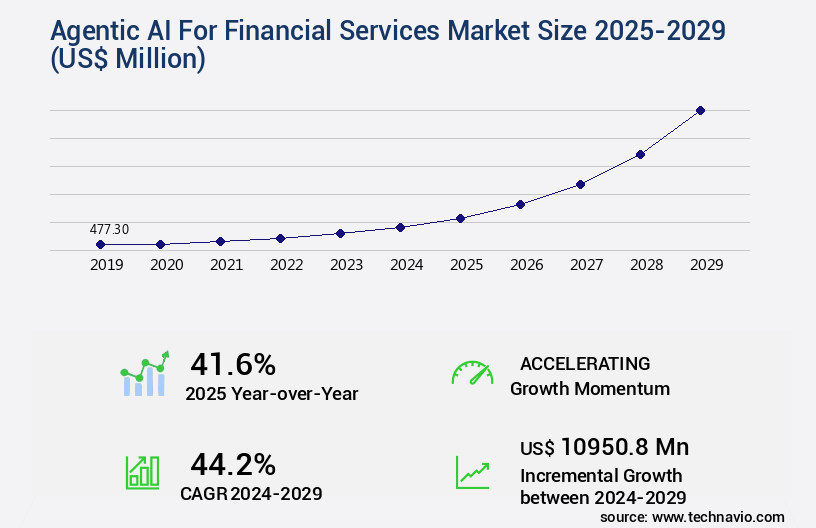
The agentic AI market in financial services is growing rapidly. It is expected to expand by USD 10.95 billion between 2024 and 2029, with a CAGR of 44.2%. This growth reflects rising enterprise demand for autonomous financial systems and scalable AI-driven operations.
Financial operations are undergoing a massive shift as traditional automation reaches its ceiling. Static workflows no longer keep pace with the speed of global markets and complex data.
Companies are now turning to agentic AI in financial operations to handle tasks that require judgment rather than just repetition.
1. Limits of Rule-Based Automation in Finance
Traditional software relies on “if-then” logic to process data. This approach works well for simple tasks like data entry or basic reconciliation. However, it breaks down when it encounters unexpected variables or messy data formats.
Financial markets are inherently unpredictable and require systems that can interpret context. Relying on rigid rules often leads to high error rates and manual overrides.
2. Why RPA Fails in Complex Financial Workflows
Robotic Process Automation (RPA) was a great first step for digitizing legacy systems. It struggles because it lacks the cognitive ability to understand “why” a transaction occurs. If a vendor changes an invoice layout, a standard RPA bot usually fails.
This creates a maintenance burden for IT teams who must constantly fix broken bots. In complex areas like tax compliance or cross-border settlements, RPA is simply too brittle.
3. Shift Toward Autonomous Decision Systems
The industry is moving toward systems that can act independently. Agentic AI does not just follow a path; it chooses the best path based on the goal. For example, an autonomous agent can handle credit risk assessment by weighing multiple shifting data points.
These systems learn from past outcomes and refine their logic over time. This reduces the need for human intervention in every single decision cycle.
4. Need for Real-Time Financial Intelligence
Waiting for end-of-month reports is no longer a viable strategy for growth. Leaders need a pulse on liquidity, risk, and spend in real-time. Agentic systems monitor transactions as they happen and identify anomalies instantly.
This capability allows for proactive adjustments rather than reactive troubleshooting. Instant intelligence ensures that capital is always allocated where it generates the most value.
5. How Enterprises Are Rebuilding Core Systems
Enterprises are replacing old middleware with agentic layers that connect disparate data silos. They are integrating large language models with internal financial databases to create a “thinking” infrastructure.
This transition allows teams to focus on strategy while the AI manages the heavy lifting of execution.
By adopting these intelligent systems, organizations move beyond simple efficiency and toward true operational resilience. The move to agentic AI is a fundamental shift in how finance creates value.
What Is Agentic AI in Financial Systems?
Agentic AI in financial systems refers to software that can understand financial data, make decisions, and take actions on its own. It connects with tools and systems to handle tasks like reconciliation, fraud checks, and reporting. As a result, teams spend less time on manual work and get faster insights, allowing them to focus on better financial planning and overall business growth.
Key Traits of Agentic AI in Finance
Agentic AI changes how financial operations run on a daily basis. Instead of following fixed rules, these systems can understand context, make decisions, and act across tools.
As financial workflows grow more complex, this flexibility becomes critical. Below are the core traits that define how agentic AI works in real financial environments.
1. Context-Aware Decision Making
Agentic AI understands the situation before acting. It looks at financial data, past actions, and current inputs together. As a result, decisions are not based on single rules but on the full context. This helps reduce errors in tasks like reconciliation or fraud checks.
2. Multi-Step Task Execution
Financial workflows rarely happen in one step. Agentic systems can break tasks into smaller steps and complete them in sequence. For example, they can validate data, match records, and update systems without manual input. This improves speed and consistency.
3. System-Level Integration
Agentic AI works across multiple systems at once. It connects with ERPs, banking APIs, and internal tools to complete actions. Therefore, teams no longer need to switch between platforms. This creates a more connected and efficient financial workflow.
4. Continuous Learning and Improvement
These systems improve over time by learning from past actions. They adjust based on new data, outcomes, and feedback. As a result, performance becomes more accurate with usage. This is important for areas like risk detection and forecasting.
5. Built-In Compliance and Guardrails
Financial operations require strict control. Agentic AI includes rules and limits to ensure safe execution. It can flag risks, stop actions, or involve humans when needed. This helps maintain compliance while still allowing automation.
Together, these traits make agentic AI turn financial systems into decision-driven environments that can adapt, act, and scale with business needs.
Difference Between AI Models and Agents
In financial operations, AI models and AI agents serve very different roles. An AI model analyzes data and provides outputs such as predictions, classifications, or summaries.
However, it does not take action. An AI agent builds on that model by making decisions and executing tasks across systems. This difference matters when moving from insight generation to actual financial execution.
Comparison: AI Models vs AI Agents in FinOps
| Factor | AI Models | AI Agents |
| Core Function | Analyze and generate outputs | Decide and execute actions |
| Role in Finance | Forecasting, anomaly detection | Reconciliation, payments, workflows |
| Action Capability | No direct action | Executes across systems |
| Context Handling | Limited to input data | Uses real-time and historical context |
| Workflow Ownership | Supports a step | Manages end-to-end processes |
| Integration | Standalone or embedded | Connected across tools and APIs |
| Example | Flags suspicious transaction | Investigates, verifies, and blocks it |
AI models help teams understand what is happening. AI agents take the next step and act on it. In financial operations, this shift reduces manual intervention and allows workflows to move from analysis to execution without delays.
Core Building Blocks of Agentic AI Systems
Building a reliable agentic system requires more than just a smart model; it demands a structured architecture. These layers work together to ensure the AI moves from simple chat interactions to high-stakes financial execution.
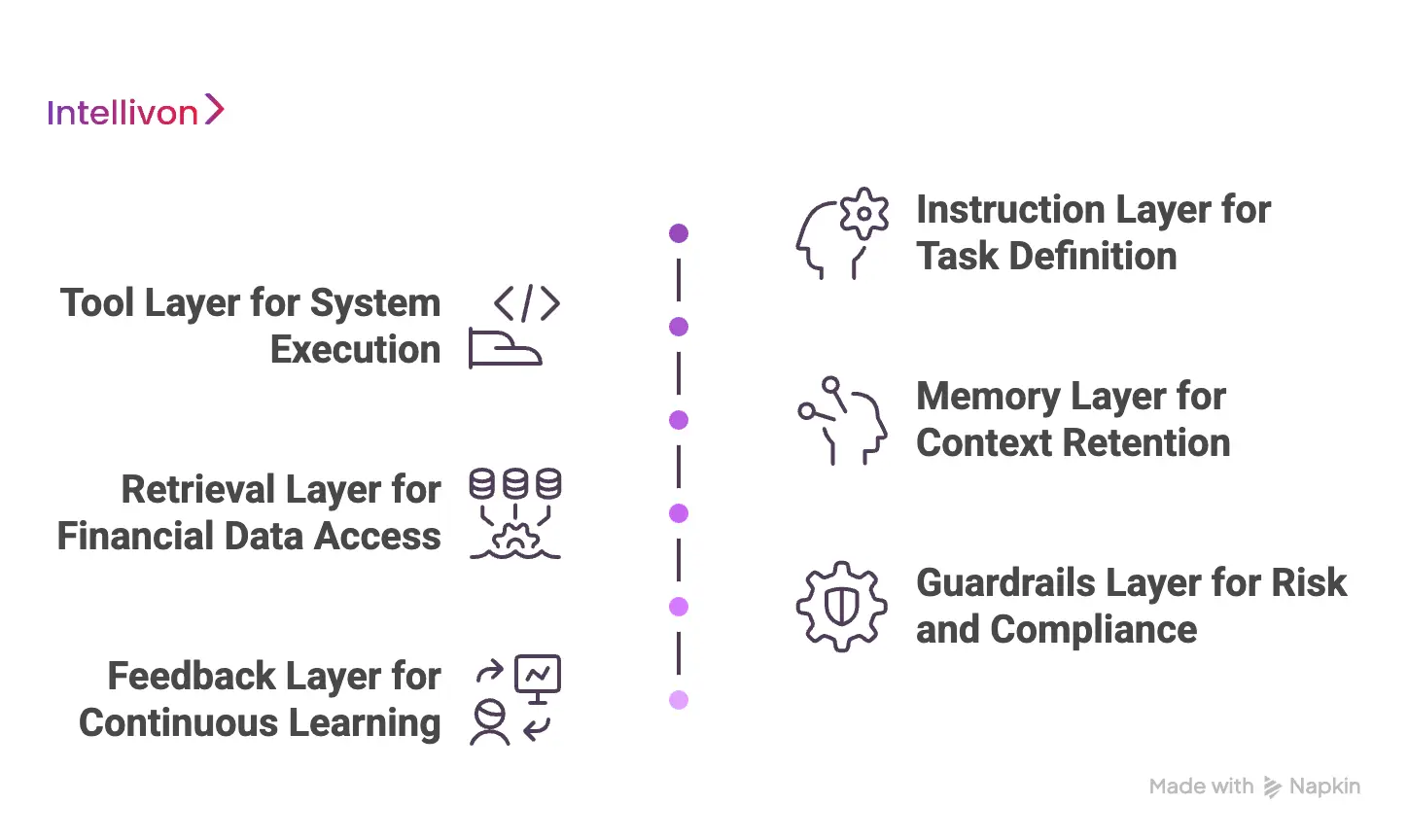
1. Instruction Layer for Task Definition
The instruction layer acts as the brain’s intent. It defines the specific goals, constraints, and personas the agent must adopt. In finance, this might include instructions to prioritize liquidity or flag specific tax discrepancies.
Clear task definitions prevent the AI from drifting off-course during complex multi-step processes.
2. Tool Layer for System Execution
Agents need hands to perform tasks, and the tool layer provides them. This involves connecting the AI to external APIs, ERP systems, or banking interfaces.
Therefore, the agent can move beyond analysis and actually initiate wire transfers or update ledger entries. This layer transforms a passive observer into an active operational participant.
3. Memory Layer for Context Retention
Financial operations often span weeks or months. The memory layer allows the agent to remember previous interactions and historical data points.
It ensures that a reconciliation task started on Monday carries the correct context into Friday’s closing. Without memory, an agent would treat every transaction as a brand-new, isolated event.
4. Retrieval Layer for Financial Data Access
This layer uses Retrieval-Augmented Generation (RAG) to pull facts from secure internal documents. It accesses real-time market feeds, internal audit logs, and regulatory databases.
Consequently, the agent’s decisions are grounded in the most current data available. This eliminates “hallucinations” by forcing the AI to cite its sources from your actual financial records.
5. Guardrails Layer for Risk and Compliance
Safety is non-negotiable in the enterprise. The guardrails layer sets “hard limits” on what the agent can do, such as transaction caps or mandatory human approvals.
It continuously monitors the agent’s output against compliance frameworks like SOC2 or GDPR. These safety nets ensure the system stays within legal and corporate boundaries at all times.
6. Feedback Layer for Continuous Learning
The final piece is a loop that evaluates the agent’s performance. Human supervisors provide corrections that the system uses to refine its future logic. Over time, the agent becomes more accurate as it understands the nuances of your specific business rules.
This constant improvement cycle creates a system that grows more valuable with every task it completes.
Financial Ops Use Cases for AI Agents
Moving from theory to practice, AI agents are already transforming specific high-friction areas of finance. These autonomous systems solve these issues by working across different software platforms simultaneously.
1. Accounts Payable and Invoice Automation
Managing invoices is often a bottleneck due to varying formats and manual data entry. AI agents can autonomously ingest invoices, verify them against purchase orders, and flag price discrepancies.
Furthermore, they can communicate with vendors via email to resolve missing information without human help. This turns a slow, manual process into a streamlined, touchless workflow.
2. Multi-System Reconciliation Workflows
Reconciling data between bank statements, internal ledgers, and ERP systems is notoriously tedious. Agentic AI in financial operations excels here by logging into multiple systems to match transactions.
When a mismatch occurs, the agent investigates the root cause instead of just reporting an error. Consequently, your team spends less time hunting for pennies and more time on high-level analysis.
3. Fraud Detection and Risk Monitoring
Static rules often miss sophisticated fraud patterns that evolve in real-time. Agents provide a dynamic layer of defense by analyzing behavioral data and transaction history concurrently.
They can instantly freeze suspicious accounts or trigger additional verification steps based on the level of risk. This proactive stance protects company assets while minimizing false positives that disrupt legitimate business.
4. Treasury and Liquidity Optimization
Managing cash flow across various entities requires a constant eye on market shifts and interest rates. AI agents monitor global bank balances and suggest optimal times for currency conversions or debt repayments.
They can even execute short-term investments based on pre-approved corporate policies. This ensures that your capital is never sitting idle when it could be earning a return.
5. Compliance and Audit Automation
Preparing for an audit usually involves weeks of gathering evidence and checking logs. AI agents simplify this by maintaining a continuous, “audit-ready” state through real-time monitoring of every transaction.
They automatically map financial activities to regulatory frameworks like Sarbanes-Oxley (SOX). Therefore, when auditors arrive, you have a complete, verified trail of every decision made by the system.
6. Financial Reporting and Data Validation
Generating accurate quarterly reports requires pulling data from dozens of departmental silos. Agents can automate this data collection and perform complex validations to ensure the numbers align perfectly.
If a department submits data that looks like an outlier, the agent queries the source system for clarification. This results in faster closing cycles and much higher confidence in the final financial statements.
Agentic Workflows vs AI Agents in Finance
Understanding the distinction between structured workflows and autonomous agents is vital for any strategic investment.
While both utilize LLMs, their approach to solving problems differs in flexibility and control.
1. What Are AI Workflows in Finance?
An AI workflow is a structured sequence of steps where the paths are predefined. You can think of this as a sophisticated roadmap where the AI handles specific tasks at each stop.
For example, a workflow might dictate that the AI first extracts data from a PDF, then summarizes it, and finally emails it to a manager. The sequence is rigid, ensuring that the process remains predictable and repeatable.
These are ideal for high-volume, standardized operations where consistency is the primary goal.
2. What Are AI Agents in Financial Systems?
AI agents operate with a higher degree of autonomy and reasoning. Instead of following a fixed map, an agent is given a destination and the tools to get there. It evaluates the environment, chooses which tools to use, and adjusts its strategy if it hits an obstacle.
In a financial context, an agent might be tasked with “reconciling all overdue accounts.” It then decides which databases to query and which vendors to contact without needing a step-by-step script.
3. Key Differences in Execution and Logic
The fundamental difference lies in how the system handles uncertainty.
Workflows are deterministic, meaning the same input always follows the same path. Agents are non-deterministic, using iterative logic to solve more “fuzzy” problems.
| Feature | AI Workflows | AI Agents |
| Logic Pattern | Linear and Predefined | Iterative and Goal-Oriented |
| Autonomy | Low (Follows a script) | High (Self-directing) |
| Handling Errors | Stops or flags for human | Pivots and tries new tools |
| Best For | Routine reporting | Complex investigations |
| Setup Speed | Faster to deploy | Requires more testing |
4. When to Use Workflows vs Agents
Choosing the right approach depends on the complexity of the task and the required level of oversight.
A. Use Case: Financial AI Workflows
Workflows are best for tasks where the rules are clear, and the stakes for deviation are high.
- Quarterly tax filings: Where strict adherence to forms is mandatory.
- Payroll processing: Where the steps never change from month to month.
- Standard data migration: Moving data between two known software versions.
B. Use Case: Financial AI Agents
Agents shine when the path to completion is not known at the start.
- Strategic competitive analysis: Gathering and synthesizing disparate market signals.
- Dispute resolution: Negotiating terms or identifying the source of a data leak.
- Portfolio rebalancing: Acting on real-time market volatility within broad risk parameters.
5. Why Enterprises Combine Both Approaches
Leading organizations rarely choose just one; they build hybrid systems. This “orchestration” allows an agent to manage several specialized workflows. For instance, a “Treasury Agent” might trigger a “Currency Conversion Workflow” once it detects a favorable exchange rate.
Therefore, the agent provides the strategic oversight, while the workflow ensures the execution remains compliant and accurate. This combination offers the best of both worlds: the agility of autonomous thought and the safety of structured execution.
By balancing these two methodologies, enterprises can build systems that are both creative and controlled. This dual-layered approach is the gold standard for scaling agentic AI in financial operations today.
Agentic AI vs RPA in Financial Systems
While many leaders treat RPA and Agentic AI as interchangeable, they represent two different eras of technology.
Understanding the gap between these two is the difference between a system that follows orders and one that solves problems.
1. How RPA Works in Finance Operations
Robotic Process Automation (RPA) is best described as a “digital macro.” It records a specific set of mouse clicks and keystrokes to mimic a human’s interaction with a software interface.
In finance, this usually involves moving data from an Excel sheet into an ERP like SAP or Oracle.
- Logic Basis: It relies on a fixed script that says, “If you see X, do Y.”
- Data Handling: It is highly efficient for high-volume, repetitive tasks where the data is 100% structured.
- Speed: RPA can process thousands of entries in seconds without fatigue.
2. Where RPA Breaks in Real Workflows
The primary weakness of RPA is its fragility. Because it navigates by “looking” at specific UI elements, even a minor software update can break the bot.
This creates “automation debt,” where IT teams spend more time fixing broken bots than they saved originally.
- UI Changes: If a bank changes the location of a “Submit” button, the RPA script will fail.
- Unstructured Data: It cannot handle data like a handwritten note on an invoice or an ambiguous email.
- Rigidity: It lacks the ability to “think” its way out of a scenario not covered in the code.
3. How AI Agents Handle Exceptions
Unlike RPA, AI agents use semantic reasoning to understand the goal of a task. If an agent encounters a new invoice format, it does not stop. It uses its underlying LLM to identify the “Total Due” field regardless of its placement.
- Autonomous Search: When a tax ID is missing, the agent can search other databases.
- Communication: It can draft a clarifying email to a vendor without human prompting.
- Pivoting: Agents handle the “messy” cases that usually force RPA to stop and wait for a human.
4. Learning and Adaptability Differences
The most significant contrast lies in the ability to improve over time. RPA is static, in the sense that it will make the same mistake a thousand times unless a developer rewrites its code. In contrast, agentic AI in financial operations incorporates feedback loops.
- Self-Optimization: The agent remembers human corrections for the next transaction.
- Context Awareness: It learns the nuances of your specific business rules over time.
- Accuracy: This means the system becomes more reliable the longer it runs in your environment.
5. Long-Term Scalability Comparison
Scalability in RPA often requires more infrastructure and more developers to manage a growing library of rigid scripts.
However, agentic AI scales by expanding its “toolset” and memory. Therefore, the total cost of ownership (TCO) for agentic systems often drops over time.
- Versatility: One single agent can handle diverse processes across accounts payable and treasury.
- Generalization: It generalizes logic rather than relying on thousands of unique scripts.
- Strategic ROI: The system evolves into a specialized team member rather than a simple tool.
Strategic Comparison Table
| Feature | RPA (Legacy Automation) | Agentic AI (Next-Gen) |
| Logic Basis | Fixed rules and UI coordinates | Reasoning and Semantic intent |
| Data Type | Strictly structured (Excel, CSV) | Unstructured (PDFs, Emails, Voice) |
| Exception Handling | Fails and alerts a human | Reasons through and pivots |
| Maintenance | High (Breaks with UI changes) | Low (Self-adjusting) |
| Intelligence | Task-oriented execution | Goal-oriented problem solving |
Choosing between these two depends on your process stability. For legacy systems that never change, RPA might suffice. However, for a growing enterprise facing variable data and shifting regulations, agentic AI is the only path to true operational scale.
Architecture of Agentic AI Financial Systems
Designing a robust system for financial operations requires moving beyond simple chatbots. A true enterprise architecture for agentic AI in financial operations must be modular, secure, and deeply integrated into existing fiscal workflows.
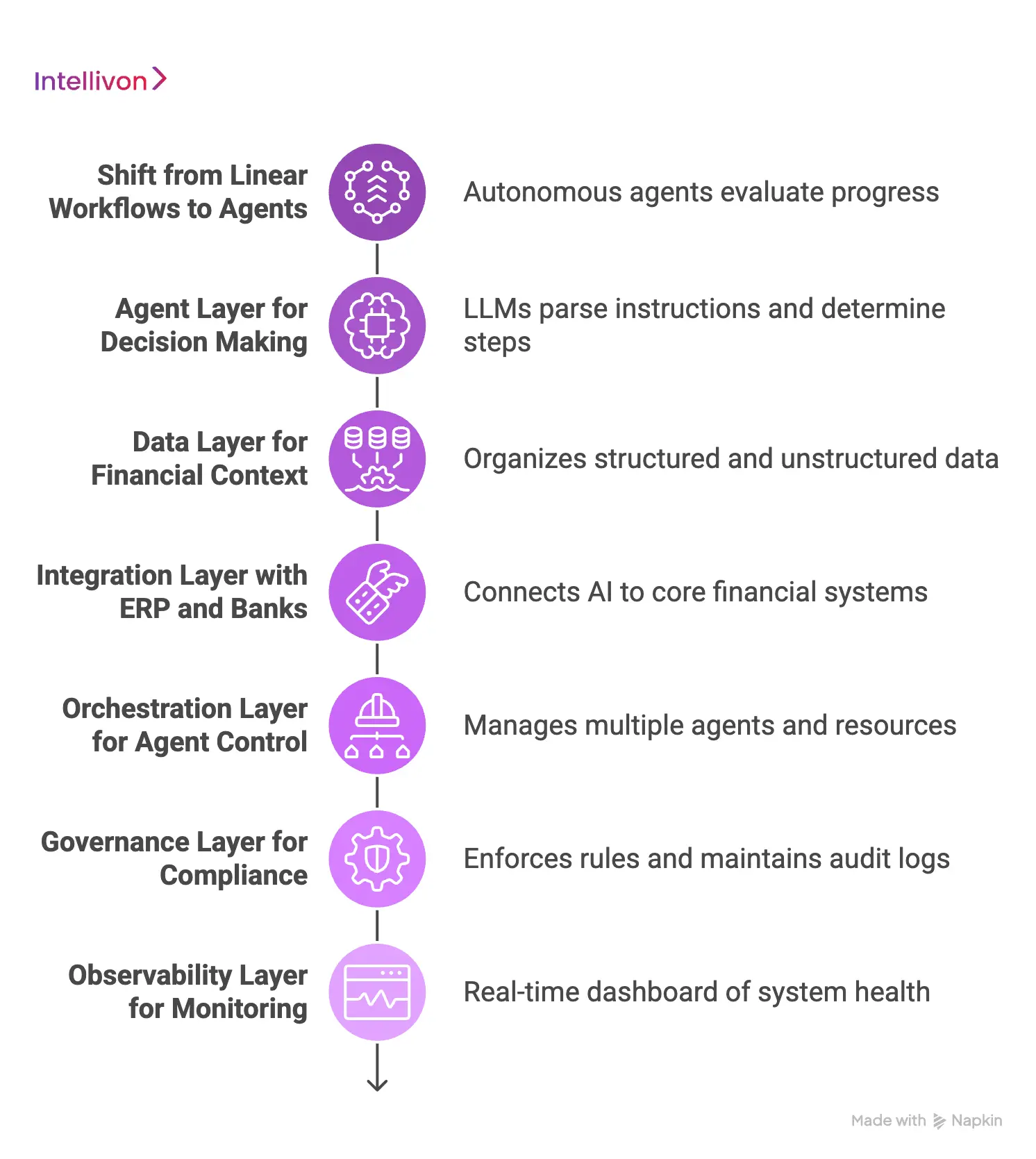
1. Shift from Linear Workflows to Agents
Traditional automation follows a straight line from start to finish. If step B fails, the entire process stops and waits for a human developer. Modern architecture replaces these rigid chains with autonomous agents that evaluate their own progress.
This shift allows the system to handle “fuzzy” logic, where the path to a solution isn’t always clear. Therefore, the architecture becomes a dynamic ecosystem rather than a static script.
2. Agent Layer for Decision Making
The agent layer serves as the “executive center” of the entire system. It utilizes LLMs to parse instructions and determine the necessary steps to complete a goal.
For example, if tasked with an audit, the agent decides which ledgers to pull and which anomalies to flag. This layer reasons through complex financial scenarios in real-time.
3. Data Layer for Financial Context
An agent is only as good as the information it can access. The data layer organizes both structured data from SQL databases and unstructured data from PDFs or emails. By using specialized embedding techniques, the system ensures the agent has a “long-term memory” of your company’s specific financial history.
Consequently, every decision the agent makes is grounded in your actual business context rather than generic training data.
4. Integration Layer with ERP and Banks
For an agent to be useful, it must have “hands” to take action. The integration layer connects the AI to your core systems like NetSuite, SAP, or global banking APIs.
This allows the agent to move beyond mere analysis and actually initiate wire transfers or update ledger entries. Secure API management ensures that these actions are performed within encrypted tunnels to maintain data integrity.
5. Orchestration Layer for Agent Control
Large enterprises often deploy multiple agents, one for taxes, one for payroll, and one for treasury. The orchestration layer acts as a “manager of managers,” ensuring these agents don’t conflict with one another.
It assigns tasks, manages shared resources, and ensures that the most efficient agent is handling the right problem. This prevents redundancy and optimizes the computational costs of running multiple AI models simultaneously.
6. Governance Layer for Compliance
In finance, “black box” logic is a significant legal risk. The governance layer enforces strict rules, such as spending limits and mandatory multi-factor authorization for large moves.
It also maintains a detailed log of the agent’s “chain of thought” for every action taken. Therefore, you can always trace exactly why an agent made a specific financial decision during a regulatory audit.
7. Observability Layer for Monitoring
The observability layer provides a real-time dashboard of the system’s health and performance. It tracks things like token usage, success rates, and the time taken to resolve financial exceptions.
If an agent starts showing signs of “drift” or declining accuracy, this layer triggers an immediate alert for human intervention. This ensures that the system remains reliable and predictable as it scales across your global operations.
Building this architecture is a strategic investment in the future of your financial operations. By layering these components correctly, you create a system that is both highly autonomous and strictly controlled.
Agent Design Patterns Used in Finance
Implementing agentic AI in financial operations requires more than a single model. It involves specific design patterns that allow AI to navigate the high-stakes, multi-step nature of corporate finance with precision and transparency.
1. Prompt Chaining for Multi-Step Tasks
Prompt chaining is a sequential design pattern where the output of one AI process becomes the input for the next. In finance, this is essential for tasks that require a “pipeline” of logic.
- Extraction: An agent first pulls raw data from an unstructured bank statement.
- Categorization: The next link in the chain labels these transactions by department.
- Summarization: Finally, a third prompt generates a high-level cash flow summary for leadership.
- Predictability: This method ensures each stage is verified before moving to the next, reducing the risk of compounded errors.
2. Routing Tasks Across Financial Systems
A router agent acts as a “traffic controller” for incoming data. It analyzes the intent of a request and directs it to the most qualified specialized system or model.
- Efficiency: Simple queries go to smaller, faster models, while complex risk assessments move to high-reasoning models.
- Specialization: It can route tax-related emails to a “Tax Agent” and invoice disputes to an “Accounts Payable Agent.”
- Dynamic Response: Consequently, the system avoids wasting expensive computational power on trivial tasks.
3. Parallel Execution of Financial Processes
Time is money in finance, and many tasks do not need to happen one after the other. Parallel execution allows multiple agents to work on independent sub-tasks simultaneously.
- Latency Reduction: When closing books, agents can reconcile dozens of different bank accounts at the same time.
- Consensus Building: You can have three separate agents analyze a loan application and compare their results to improve accuracy.
- Throughput: This pattern dramatically increases the speed of data processing across global entities.
4. Orchestrator and Worker Agent Model
This is a hierarchical pattern where one “Orchestrator” agent breaks a complex goal into smaller tasks for “Worker” agents to execute.
- Strategic Planning: The Orchestrator plans the roadmap for an entire quarterly audit.
- Delegation: It assigns the data collection, validation, and report writing to specialized workers.
- Quality Control: The Orchestrator reviews all worker outputs before presenting a final result to the human user.
5. Evaluator and Optimizer Feedback Loop
To ensure 100% accuracy in financial reporting, enterprises use a “double-check” pattern. An Evaluator agent critiques the work of a Generator agent, forcing it to refine its output until it meets a specific quality bar.
- Error Correction: If an Optimizer agent creates a financial projection, the Evaluator checks it for mathematical consistency.
- Iterative Refinement: The system loops until the data aligns with internal compliance standards.
- Reliability: This reduces the “hallucination” rate by creating a self-corrective internal audit.
6. ReAct Framework for Decision Systems
The ReAct (Reason + Act) framework allows agents to “think” out loud before taking an action. This provides a transparent “chain of thought” that is crucial for financial accountability.
- Thought: “I need to verify this wire transfer against the vendor’s previous history.”
- Action: The agent queries the ERP database for the vendor’s record.
- Observation: “The account number matches, but the amount is 20% higher than usual.”
- Refinement: The agent then decides to flag the transaction for human review rather than approving it.
| Pattern | Best Use Case | Business Impact |
| Chaining | Sequential data pipelines | High consistency |
| Routing | Diverse incoming requests | Cost optimization |
| Parallel | High-volume reconciliation | Reduced latency |
| Orchestrator | Complex, multi-day projects | Scalable management |
| ReAct | High-stakes decision making | Audit transparency |
These patterns transform a generic AI into a professional-grade financial system. By selecting the right pattern for the right task, organizations build AI that is not just smart, but strategically sound.
How Agentic AI Works in Finance Workflows
Transitioning from manual oversight to an autonomous system requires a clear, step-by-step operational flow. Unlike traditional software, agentic AI in financial operations follows a cognitive cycle that mimics a high-level financial analyst’s reasoning.
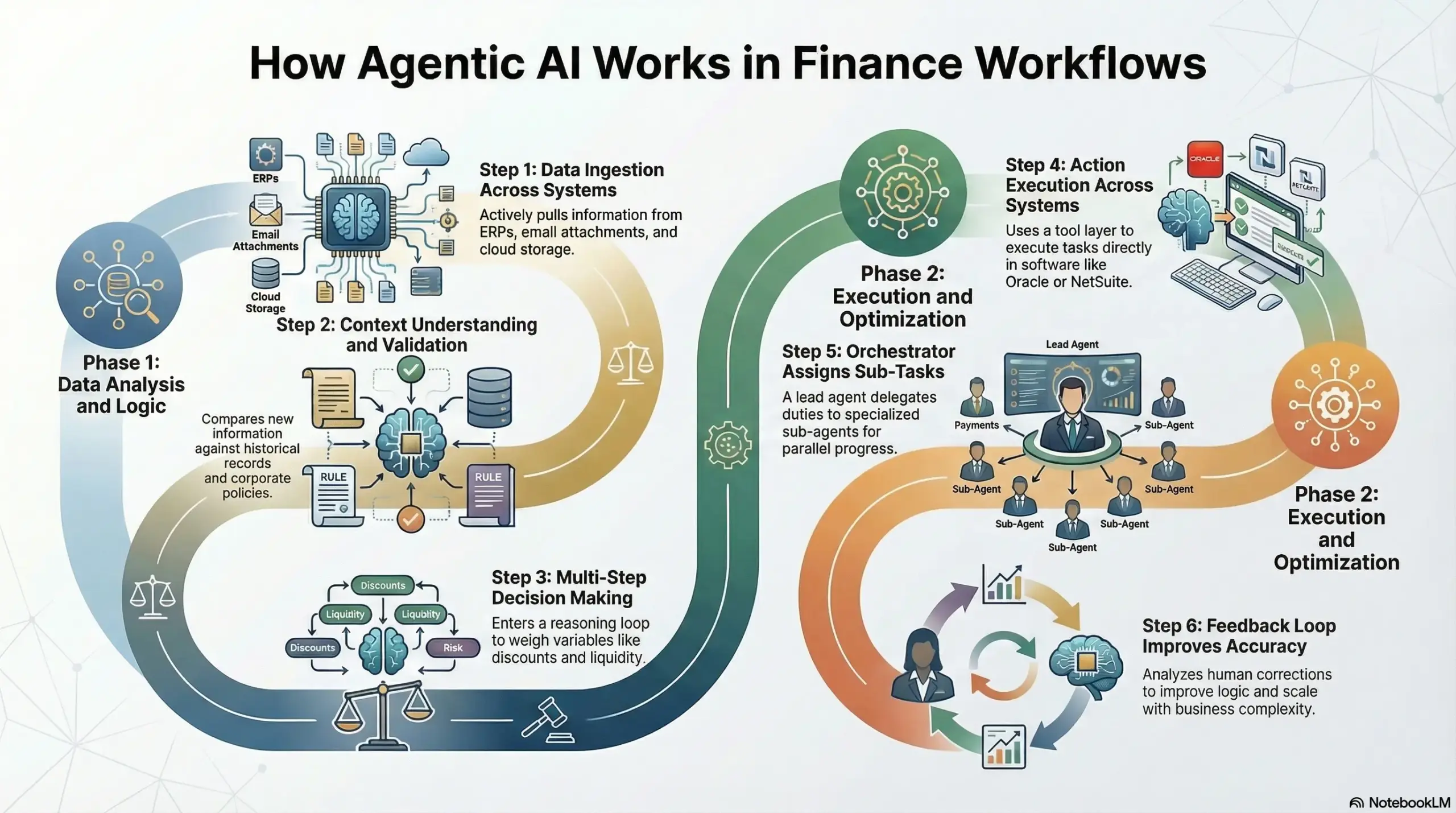
Step 1: Data Ingestion Across Systems
The process begins by gathering data from every corner of the enterprise. Agents do not just wait for structured CSV files; they actively “pull” information. They log into ERPs, scan email attachments, and query cloud storage for relevant documents.
- Multimodal Input: The system processes text, tables, and even images of handwritten receipts.
- Real-Time Sync: Data is ingested as it is created, ensuring the AI never works with stale numbers.
- Connectivity: Therefore, the agent maintains a global view of the company’s financial health at all times.
Step 2: Context Understanding and Validation
Once the data is inside the system, the agent must determine its meaning and accuracy. It compares the new information against historical records and corporate policies. If an invoice arrives from a “New Vendor,” the agent checks if that vendor has been vetted and approved.
- Cross-Referencing: The AI validates the data by looking for matching purchase orders or contracts.
- Anomaly Detection: It flags entries that look out of place before they ever hit the ledger.
- Semantic Search: This ensures the agent understands the “intent” behind a transaction, not just the raw digits.
Step 3: Multi-Step Decision Making
After validating the data, the agent enters a “reasoning loop” to decide the best course of action. It weighs different variables, such as payment terms, early-bird discounts, and current cash liquidity.
- Logic Branching: The agent asks, “Should I pay this now to get a 2% discount, or wait to preserve cash?”
- Risk Assessment: It evaluates the impact of each choice on the quarterly budget.
- Strategic Choice: Consequently, the decision is based on a complex calculation of ROI rather than a simple “yes/no” rule.
Step 4: Action Execution Across Systems
A decision without action is just a suggestion. In this stage, the agent uses its “tool layer” to execute the task. It may draft a wire transfer in a banking portal or update a line item in the company’s general ledger.
- API Integration: The agent speaks directly to software like Oracle, NetSuite, or Workday.
- Human-in-the-Loop: For high-value transactions, the agent prepares the work and waits for a manager’s digital signature.
- Transaction Logging: Every action is recorded with a timestamp and a clear reason for the audit trail.
Step 5: Orchestrator Assigns Sub-Tasks
For larger projects, a lead “Orchestrator” agent breaks the goal into smaller, manageable chunks. If the goal is “Complete the Month-End Close,” the Orchestrator delegates specific duties to specialized sub-agents.
- Task Delegation: One sub-agent handles bank reconciliation while another gathers expense reports.
- Resource Management: This prevents the system from becoming overwhelmed by a single massive task.
- Parallel Progress: It allows the enterprise to finish complex financial cycles in hours instead of days.
Step 6: Feedback Loop Improves Accuracy
The final step is the “learning phase,” where the system evaluates the outcome of its actions. If a human manager adjusts a decision the agent made, the agent analyzes that correction to improve its future logic.
- Continuous Learning: The system gets smarter with every transaction it processes.
- Precision Tuning: Over time, the need for human intervention drops as the agent aligns with the CFO’s specific preferences.
- Growth: This creates a self-optimizing engine that scales as your business complexity grows.
| Stage | Action | Enterprise Value |
| Ingestion | Collects all data | Breaks down silos |
| Validation | Checks for errors | Prevents fraud |
| Reasoning | Weighs options | Strategic allocation |
| Execution | Performs the task | Increases speed |
| Orchestration | Manages complexity | High-scale operations |
| Feedback | Learns from humans | Long-term accuracy |
This structured approach ensures that AI is not a “black box” but a reliable extension of your finance team. By following these six steps, enterprises can transition to a fully modern, agentic financial infrastructure.
Intellivon designs and implements these end-to-end agentic workflows, ensuring every step is optimized for your specific business goals. We bridge the gap between your current tech stack and the future of autonomous finance. Read on to see how we build these systems for your enterprise’s financial operations.
Multi-Agent Systems in Financial Operations
As enterprises scale, a single AI model is no longer enough to manage the vast complexities of corporate finance.
Modern organizations are moving toward multi-agent systems, where a “team” of specialized AI agents collaborates to solve high-level business goals.
1. Role of Specialized Financial Agents
In a high-performing finance department, roles are naturally divided by expertise. Multi-agent systems mimic this structure by deploying agents with narrow, deep capabilities.
This prevents “generalized” AI mistakes and ensures that each part of a transaction is handled by a subject-matter expert.
- Tax Compliance Agent: Focuses exclusively on regional tax laws and filing deadlines.
- Accounts Payable Agent: Specialized in invoice extraction and vendor verification.
- Treasury Agent: Monitors real-time liquidity and interest rate fluctuations.
- Example: When an international invoice arrives, the AP Agent extracts the data, while the Tax Agent calculates the appropriate VAT or GST based on the vendor’s location.
2. Coordination Between Multiple Agents
Coordination is what separates a group of disconnected bots from a functional team. Agents must “talk” to each other through a shared communication layer to pass data and context.
This ensures that one agent’s output perfectly matches another agent’s input.
- Data Handoffs: The AP Agent hands a verified invoice to the Treasury Agent for payment scheduling.
- Context Sharing: If the Tax Agent flags a regulatory change, all other agents in the system are instantly updated.
- Efficiency: Therefore, the system avoids redundant data entry and manual cross-checking.
3. Central Orchestrator Agent Explained
The Orchestrator is the “CFO” of the digital workforce. It does not perform the grunt work. Instead, it analyzes a high-level request and decides which worker agents are needed to complete it.
This layer provides a single point of control for human managers to interact with the entire system.
- Planning: It breaks down a goal like “Perform Year-End Close” into five hundred sub-tasks.
- Assignment: It selects the best specialized agent for each specific sub-task.
- Review: The Orchestrator gathers all finished work and performs a final sanity check.
- Example: A business leader asks, “What is our risk exposure in EMEA?” The Orchestrator calls the Market Data Agent and the Internal Audit Agent to generate a combined report.
4. Handling Conflicts Between Agents
In any complex system, different agents might propose conflicting actions based on their specific goals. For instance, a Growth Agent might want to reinvest cash, while a Risk Agent wants to hold it.
The multi-agent architecture includes “arbitration logic” to resolve these disputes based on your company’s core policies.
- Priority Ranking: Corporate safety rules always override aggressive growth targets.
- Human Escalation: If a conflict is too “gray,” the system automatically flags it for a human executive.
- Policy Guardrails: This ensures that no agent can take an action that contradicts the CFO’s standing orders.
5. Scaling Agent Systems Across Teams
Scaling agentic AI in financial operations does not mean adding more “chatbots.” It means expanding the ecosystem to include more departments and data sources.
As you add more teams, the system becomes more valuable because the shared “memory” of the organization grows.
- Modular Expansion: You can start with an AP Agent and later plug in a Procurement Agent without rebuilding the core.
- Cross-Functional ROI: Financial agents can eventually share data with Sales or Supply Chain agents for enterprise-wide intelligence.
- Global Reach: This allows a company in Kolkata to manage subsidiaries in London or New York with the same level of granular oversight.
| Role | Responsibility | Real-World Example |
| Orchestrator | Strategy and Management | Coordinating a full departmental audit. |
| Worker | Execution and Detail | Reconciling 5,000 bank entries in 10 minutes. |
| Evaluator | Quality and Compliance | Double-checking tax filings for 100% accuracy. |
By deploying these “digital teams,” leaders can finally step away from manual oversight. Multi-agent systems provide the scale and precision required to run a truly modern, autonomous enterprise.
Compliance and Risk in AI Finance Systems
In the world of high-stakes finance, innovation cannot exist without rigorous oversight. As enterprises deploy agentic AI in financial operations, the conversation shifts from “what can it do?” to “how can we prove it followed the law?”
Establishing a framework for digital accountability is the only way to move these systems from the lab to the ledger.
1. Regulatory Standards in Financial AI
Financial AI does not operate in a vacuum. It must adhere to established global standards like Basel III for banking, Sarbanes-Oxley (SOX) for corporate reporting, and the EU AI Act.
These regulations require that any autonomous system managing capital must be stable, fair, and secure.
- Data Residency: Financial data must often remain within specific geographic borders to comply with local laws.
- Anti-Money Laundering (AML): Agents must be programmed to recognize and flag suspicious patterns without bias.
- Bias Mitigation: Therefore, your AI must be regularly audited to ensure it doesn’t unfairly penalize certain demographics during credit risk assessments.
2. Importance of Explainable AI Decisions
For a CFO, “the AI said so” is never an acceptable answer. Explainable AI (XAI) ensures that every decision the agent makes is accompanied by a logical “chain of thought.”
If an agent denies a vendor payment, it must be able to cite the specific invoice discrepancy or policy violation that led to that choice.
- Transparency: Stakeholders can see exactly which data points the AI prioritized.
- Debugging: If an error occurs, your technical team can trace the logic to prevent it from happening again.
- Trust: Consequently, human leaders feel more confident delegating high-value tasks to an autonomous system.
3. Audit Trails for Autonomous Actions
In a manual system, a signature provides an audit trail. In an agentic system, every API call, data retrieval, and transaction must be logged in a tamper-proof ledger.
This creates a “black box” recorder for your financial operations, similar to those used in aviation.
- Immutable Logs: Using blockchain-style logging ensures that records cannot be altered after the fact.
- Timestamping: Every action is recorded down to the millisecond.
- Regulatory Readiness: This means that when auditors arrive, you can generate a complete report of every autonomous action with a single click.
4. Human-in-the-Loop Control Systems
Total autonomy is rarely the goal for enterprise finance. Instead, the most successful systems utilize “Human-in-the-Loop” (HITL) workflows. This design ensures that while the AI does the heavy lifting, a human remains the final authority on critical decisions.
- Approval Gates: The agent prepares a $50,000 wire transfer, but a human manager must click “Approve.”
- Exception Handling: When the AI encounters an “unknown” scenario, it gracefully hands the task back to a human.
- Strategic Oversight: This allows your team to focus on the 1% of complex cases while the AI handles the 99% of routine work.
5. Risk Thresholds and Execution Limits
To prevent “runaway” AI scenarios, enterprises set hard-coded risk thresholds. These are the digital guardrails that the agent cannot cross, regardless of its internal reasoning.
- Spending Caps: An agent might have the authority to approve invoices up to $5,000, but anything higher requires escalation.
- Velocity Checks: If an agent attempts to move money too quickly across multiple accounts, the system triggers an automatic freeze.
Managing risk rests in building the brakes that allow you to go fast safely. By embedding these compliance layers into your architecture, you turn AI into a trusted, bank-grade asset.
How We Build Custom Agentic AI Systems For FinOps
At Intellivon, we approach agentic AI as financial infrastructure, not as a feature layer. The focus is to design systems that can understand financial context, make decisions, and execute actions across workflows.
Each implementation is tailored to how your operations run today, while preparing them for scale. Below is the step-by-step process we follow to build production-ready systems.
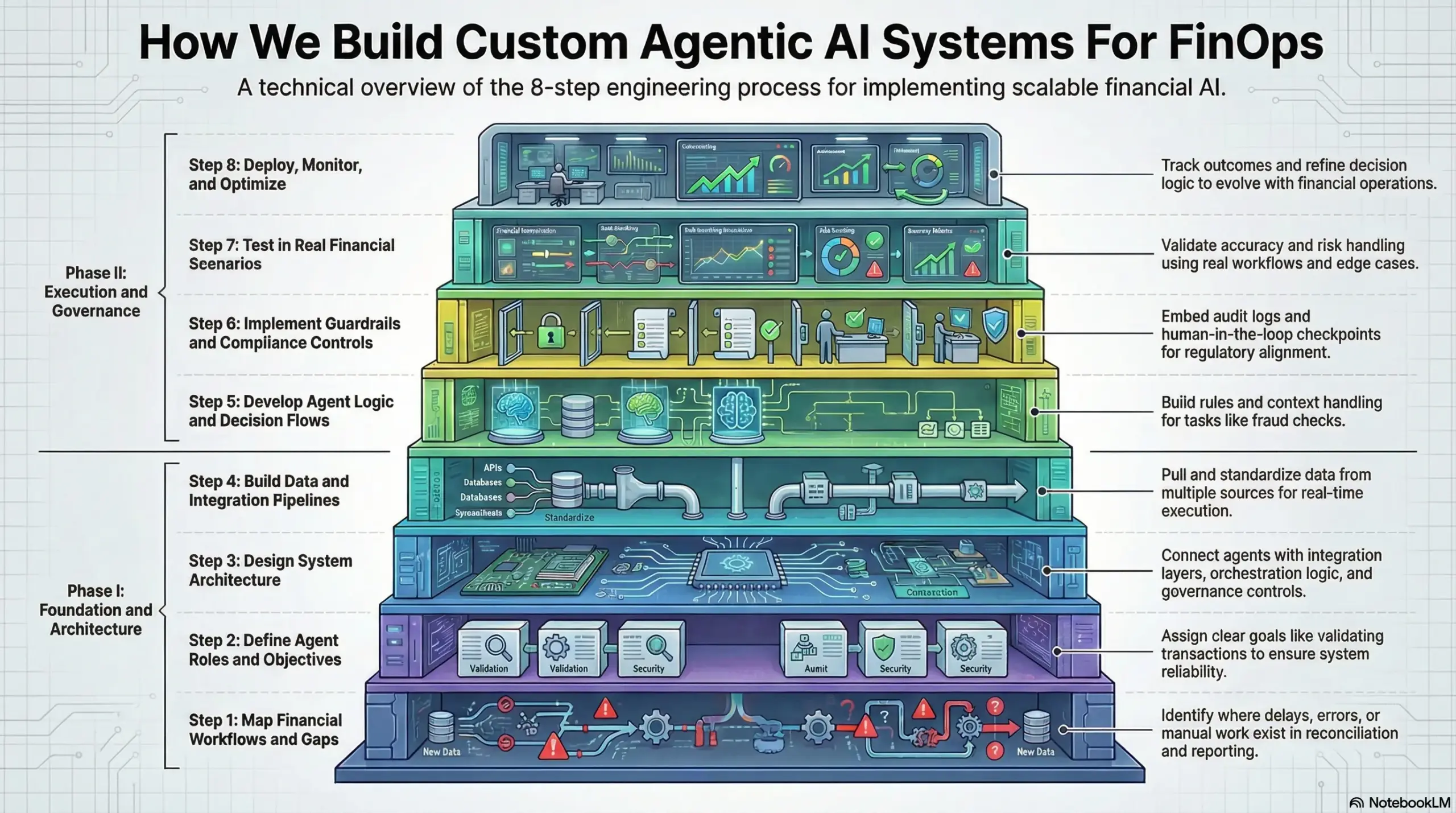
Step 1: Map Financial Workflows and Gaps
We start by understanding how your financial operations function today. This includes reconciliation flows, reporting cycles, and approval chains. We identify where delays, errors, or manual work exist. As a result, we define clear opportunities where agentic AI can deliver impact.
Step 2: Define Agent Roles and Objectives
Next, we break down workflows into specific agent responsibilities. Each agent is assigned a clear goal, such as validating transactions or monitoring anomalies. This ensures the system is structured and not dependent on open-ended prompts. It also improves reliability in financial environments.
Step 3: Design System Architecture
We design an architecture that connects agents with data, tools, and workflows. This includes integration layers, orchestration logic, and governance controls. Therefore, the system can operate across ERPs, banking APIs, and internal platforms without friction.
Step 4: Build Data and Integration Pipelines
Financial systems rely on accurate and timely data. We set up pipelines that pull data from multiple sources and standardize it for agent use. In addition, we integrate APIs for real-time execution across financial systems.
Step 5: Develop Agent Logic and Decision Flows
We build the logic that allows agents to think and act. This includes decision rules, context handling, and multi-step execution flows. As a result, agents can process tasks like reconciliation or fraud checks without manual intervention.
Step 6: Implement Guardrails and Compliance Controls
We embed compliance directly into the system. This includes audit logs, approval thresholds, and human-in-the-loop checkpoints. Therefore, financial actions remain controlled, traceable, and aligned with regulatory requirements.
Step 7: Test in Real Financial Scenarios
Before deployment, we test the system using real workflows and edge cases. This helps validate accuracy, performance, and risk handling. In addition, it ensures the system can manage exceptions without breaking processes.
Step 8: Deploy, Monitor, and Optimize
Once live, we continuously monitor system performance. We track outcomes, refine decision logic, and improve efficiency over time. As a result, the system evolves with your financial operations instead of becoming outdated.
This approach ensures agentic AI is not just deployed but fully embedded into financial operations. With the right structure, integration, and controls, enterprises move from manual workflows to intelligent, scalable financial systems.
Cost to Build Agentic AI Systems For FinOps
Building an agentic AI system for financial operations is not a fixed-cost exercise. It depends on how complex your workflows are, how many systems need integration, and how much decision-making autonomy the system requires.
Unlike basic automation tools, these systems operate across data, workflows, and execution layers. Therefore, cost is driven by architecture depth, not just AI models.
1. Key Factors That Influence Cost
Before estimating numbers, it is important to understand what drives investment:
- Workflow Complexity: Multi-step processes like reconciliation or treasury increase the scope
- System Integrations: ERPs, banking APIs, payment systems, and internal tools
- Agent Intelligence Level: Simple rule-based vs context-aware decision systems
- Data Infrastructure: Real-time pipelines, data normalization, and storage
- Compliance Requirements: Audit trails, approval systems, and regulatory controls
As these factors increase, both development effort and system design complexity grow.
- Estimated Cost Breakdown
| Component | Cost Range |
| AI Agent Development | $20,000 – $50,000 |
| Data Infrastructure Setup | $15,000 – $40,000 |
| System Integrations | $10,000 – $30,000 |
| Compliance and Security | $10,000 – $25,000 |
| Workflow and Interface Layer | $10,000 – $20,000 |
| Total Estimated Cost | $65,000 – $150,000 |
- What This Investment Actually Builds
This cost delivers a full financial operations system that can:
- Execute multi-step workflows without manual input
- Connect and act across financial systems in real time
- Maintain compliance with built-in controls and auditability
- Improve decision speed and reduce operational errors
As a result, enterprises move from fragmented tools to a unified decision system.
- Hidden Costs Enterprises Often Miss
Many teams underestimate the following areas:
- Integration complexity between legacy and modern systems
- Data quality issues that require preprocessing and validation
- Compliance layers needed for regulated financial actions
- Ongoing optimization as workflows evolve over time
Planning for these early helps avoid delays and rework.
- ROI Perspective for Financial Leaders
While the upfront cost may seem significant, the return is driven by:
- Reduced manual effort across finance teams
- Faster reconciliation and reporting cycles
- Lower error rates in financial processes
- Improved financial visibility for decision-making
Therefore, the investment directly impacts operational efficiency and financial control.
The cost to build agentic AI systems for FinOps reflects the shift from automation tools to intelligent financial infrastructure. When designed correctly, these systems deliver long-term value by improving speed, accuracy, and scalability across financial operations.
Conclusion
Building agentic AI systems for FinOps is an investment in long-term efficiency, not just automation. When designed as infrastructure, these systems improve accuracy, reduce manual work, and enable faster financial decisions.
Over time, they help enterprises scale operations with better control, visibility, and adaptability across evolving financial workflows and system environments.
Build Agentic AI Systems With Intellivon
At Intellivon, agentic AI systems are built as financial infrastructure, not as isolated automation tools. The focus is to create a unified system that connects data, workflows, and execution across your financial operations.
Each solution is designed around how your financial operations actually run. This includes reconciliation, reporting, compliance checks, fraud monitoring, and system integrations, all aligned within a single architecture.
Our engineering approach combines AI-driven decision systems with API-first, cloud-native architecture. This ensures seamless integration with ERPs, banking systems, payment gateways, and internal platforms without disrupting ongoing operations.
Why Build With Intellivon?
- Infrastructure-First Approach: We design systems that support long-term scale, not short-term fixes
- Deep Financial Systems Expertise: Built for real-world FinOps workflows and complexities
- API-First Architecture: Seamless integration across financial ecosystems
- Compliance Built In: Audit trails, controls, and approval layers embedded from day one
- End-to-End Ownership: From system design to deployment and continuous optimization
If your financial operations are still driven by manual workflows and fragmented tools, now is the time to rethink the foundation. Intellivon helps you build agentic AI systems that do not just automate tasks but transform how financial operations run at scale.
FAQs
Q1: How can agentic AI be used in finance?
A1: Agentic AI can manage complex financial workflows without constant manual input. It handles tasks like reconciliation, fraud detection, compliance checks, and reporting. In addition, it connects with financial systems to take actions in real time. As a result, teams reduce delays, improve accuracy, and gain better visibility across operations.
Q2: How can I create my own agentic AI?
A2: To build your own agentic AI, start by identifying key financial workflows that need automation. Then define clear agent roles, connect data sources, and integrate systems like ERPs and banking APIs. In addition, you need decision logic, orchestration, and compliance controls. For enterprises, working with a development partner ensures the system is scalable and reliable.
Q3: How can AI be used in financial services?
A3: AI is used across financial services to improve efficiency and decision-making. It supports fraud detection, credit scoring, risk analysis, customer support, and reporting. In addition, AI helps process large volumes of data quickly. Therefore, financial institutions can respond faster, reduce risk, and improve customer experience.
Q4: What are the 10 AI tools for finance?
A4: Some commonly used AI tools and platforms in finance include:
- DataRobot (predictive analytics)
- H2O.ai (machine learning platform)
- IBM Watson (AI and NLP solutions)
- Google Cloud AI (data and AI services)
- AWS AI/ML (scalable AI infrastructure)
- Azure AI (enterprise AI services)
- Kensho (financial analytics)
- Ayasdi (risk and compliance analytics)
- Zest AI (credit underwriting)
- Feedzai (fraud detection)
These tools support different parts of financial operations, from analytics to risk management.
Q5: What are the 6 applications of AI in finance?
A5: AI is widely used across key financial functions, including:
- Fraud detection and prevention
- Credit risk assessment
- Algorithmic trading
- Customer service automation
- Financial forecasting and planning
- Compliance and regulatory monitoring
As a result, organizations improve efficiency, reduce risk, and make faster decisions across financial operations.

