Key Takeaways:
-
Patient engagement automation requires appointment reminders, digital intake, segmentation, and secure messaging features.
-
Conversational AI, self-scheduling, waitlist automation, and care gap outreach define production-grade platforms.
-
FHIR/HL7 integration, consent management, HIPAA/TCPA controls, and MLOps ensure compliant deployment at scale.
-
Focused MVPs cost $70,000 to $110,000 while production platforms reach $180,000 to $300,000.
-
How Intellivon builds patient engagement platforms as compliant infrastructure, not disconnected appointment reminder tools.
Every missed appointment reminder costs more than the staff time spent making the call, since the visit itself often does not get rescheduled. That is the gap engagement automation development cost closes, with the number falling between $70,000 and $300,000, depending on channels and how much runs through AI.
Sending a reminder is the easy part, and most engagement platforms stop right there. The harder part is writing the result back into the EHR or scheduling system the moment a patient confirms, cancels, or reschedules.
Automated reminders cut no-show rates by 30 to 40% in most studies. At the same time, platforms that close the loop, backfilling a cancelled slot from a waitlist, capture revenue a one-way text message never could. Without that write-back capability, you have built a notification system, not an engagement platform.
Intellivon treats EHR write-back as a core requirement, not a stretch goal added after launch. This post breaks down every phase of engagement automation development cost, from conversational AI and scheduling to EHR integration and ongoing maintenance. By the end, you will know where that budget needs to go.

Why Engagement Automation Development Cost Ranges From $70,000 To $300,000
Total engagement automation development cost usually ranges from $70,000 to $300,000, depending on channel count, EHR integration depth, AI workflow complexity, compliance controls, reporting needs, and deployment scale.
A basic reminder-and-intake MVP costs far less than a multi-site platform with conversational AI, predictive outreach, billing communication, and full auditability.
Consequently, clear structural choices regarding data architecture, provider matching rules, and algorithmic complexity represent the primary drivers that scale your initial engineering budget up or down.
Phase-Wise Enterprise Development Cost Breakdown
| Development Scope | Best For | Expected Cost |
| Focused MVP | Appointment reminders, intake, basic messaging, simple dashboard | $70,000–$110,000 |
| Mid-Level Platform | Self-scheduling, secure messaging, care reminders, EHR sync, analytics | $110,000–$180,000 |
| Production Enterprise Platform | Conversational AI, multi-channel orchestration, care gaps, payments, multi-site governance | $180,000–$300,000 |
| Ongoing Maintenance | Monitoring, support, model updates, compliance reviews, channel optimization | 15%–25% of initial build yearly |
Planning your budget for a multi-facility roll-out? Download our interactive budget worksheet to instantly estimate your total development and engineering expenses across custom channels, specific EHR integrations, conversational AI models, compliance guardrails, and post-launch maintenance tiers.
1. Discovery And Workflow Mapping
Evaluating your operational architecture represents the first critical step of any custom enterprise software build. Skipping this deep initial exploration leads to mismatched software rules and expensive re-engineering cycles down the line:
- Clinical Alignment: Engineering teams must map every patient journey, front-desk scheduling workflow, and care team routing rule across your clinics.
- Operational Inputs: Technical leads review existing call center scripts, outreach scenarios, local appointment types, regional specialties, and required patient languages.
- Vendor Audits: Architects document your current communication software stack to safely plan for decommissioning or wrapping around legacy tools.
Therefore, this phase aligns your operational goals with clear software specifications. This clear blueprint prevents scope creep while holding early development timelines steady.
2. Architecture And Compliance Planning
Building a patient engagement automation architecture requires embedding strict federal regulatory guardrails directly into your core codebase. Protecting patient privacy and managing communication permissions cannot simply be treated as an afterthought:
- Data Protection: Engineers build a highly secure PHI patient engagement platform utilizing enterprise data encryption, role-based access controls, and immutable audit trails.
- Vendor Accountability: Security teams ensure that all system layers adhere to explicit BAA requirements patient engagement vendors must sign before handling clinical data.
- Consent Governance: Technical blueprints must map out custom consent management patient engagement cost structures alongside automated TCPA opt-out rules to prevent legal liabilities.
Consequently, this planning phase protects your healthcare network from catastrophic regulatory fines and data security failures. Developing a fully compliant system architecture guarantees smooth operations during future external security audits. Ultimately, investing in early compliance engineering shields your organization from the multi-million dollar liabilities common in modern healthcare data breaches.
3. Core Platform Development
Constructing your core communication engine establishes the primary interface where patients interact digitally with your medical network. This underlying engine coordinates all outbound messaging channels and matches incoming responses to the correct clinical file:
- Channel Orchestration: Software engineers factor in your baseline SMS engagement platform cost, automated phone outreach cost, and custom IVR system development cost.
- Patient Hubs: Development teams compute total patient portal enhancement cost variations alongside a dedicated, standalone secure messaging platform cost blueprint.
- Mobile Frameworks: If your product roadmap includes custom smartphone applications, architects isolate your long-term mobile app development cost patient engagement budgets early.
As a result, this unified channel layer prevents patients from receiving conflicting notifications from different clinics. It establishes a single, reliable digital touchpoint that scales effortlessly across thousands of active patient records. Building a reliable messaging core ensures high delivery success rates and fast response collection from consumers.
4. EHR, CRM, Portal, And Telehealth Integration
Linking your new engagement layer directly to your legacy transactional systems represents the most complex engineering stage of the build. True interoperability requires bi-directional data streams that update your central databases in real time:
- Clinical Records: Engineers map your core EHR integration patient engagement cost lines to securely sync scheduling data across Epic, Cerner, or regional systems.
- Marketing & Service: System architects integrate your central CRM integration patient engagement cost pathways with your broader marketing automation integration cost frameworks.
- Virtual Care: Development teams connect your telehealth integration patient engagement cost pipelines with automated video visit scheduling integration cost modules.
Therefore, achieving tight backend integration removes the need for manual data entry by your internal administrative staff. It ensures that any appointment change, digital intake form submission, or clinical update reflects instantly in the main chart. Maintaining this continuous data loop protects clinical accuracy while lowering the administrative burden across all operating sites.
5. AI Model Development
Introducing intelligent language layers transforms a basic notification program into a highly responsive, automated patient assistant. Custom models allow your platform to interpret natural text and resolve patient requests without involving human staff:
- Interactive Chatbots: Engineers scope your conversational AI patient engagement cost and AI chatbot patient engagement cost variables around your expected patient volume.
- Natural Language Processing: Developers isolate your patient virtual assistant development cost alongside custom natural language patient messaging cost algorithms to handle intent parsing.
- Generative Systems: Integrating advanced LLM patient communication cost structures and generative AI patient engagement cost guardrails enables the system to safely construct dynamic, contextual messages.
Consequently, this smart automation layer permits your system to handle complex patient conversations safely and autonomously. These custom algorithms parse user intentions to quickly confirm appointments, answer preparation questions, or triage urgent requests. Using tailored clinical guardrails guarantees that your automated patient communication remains consistently safe, helpful, and legally compliant.
6. Testing, Deployment, And Training
Transitioning a production-ready enterprise healthcare platform from a local staging sandbox into live hospital environments requires rigorous quality assurance. Every clinical workflow and data link must undergo strict validation before interacting with real patients:
- Technical Validation: QA specialists run exhaustive user acceptance testing (UAT), penetration testing, vulnerability scans, and multi-facility workflow testing cycles.
- Staff Enablement: Implementation managers deliver detailed call center training, provider training courses, and comprehensive analytics validation sessions to internal teams.
- Go-Live Support: Engineers oversee final patient-facing content reviews and provide on-site technical support during the initial roll-out phases.
This structured deployment model guarantees zero disruption to your daily clinical operations during the system launch. Training your internal staff ensures rapid organizational adoption and correct utilization of the new management dashboards. Ultimately, a smooth technical launch allows your hospital network to immediately begin recovering lost revenue from missed appointments.
Total engagement automation development cost ranges from $70,000 to $300,000. This pricing variance is directly driven by your chosen integration depth, compliance architecture, and AI capabilities.
What Is A Patient Engagement Automation Platform?
An enterprise patient engagement automation platform is a central system that coordinates digital patient communication across clinical, administrative, and financial teams. This infrastructure uses real-time health data to deliver targeted outreach across SMS, secure voice, and portals while strictly maintaining regulatory compliance.
Consequently, it ensures that large hospital networks deliver the correct message without overwhelming the patient or fracturing care team visibility.
1. It Is More Than A Reminder Tool
This enterprise platform coordinates complex, multi-stage patient actions instead of just sending basic text reminders. For example, the core software engine manages complex operational logic across your entire medical network, including:
- Self-Scheduling & Waitlists: Automated waitlist management automation cost mitigation via instant, algorithmic open-slot offers to high-risk patients.
- Digital Clinical Intake: Distribution of digital intake form automation links paired with secure digital consent automation and e-signature integration cost tracking.
- Financial Cleared Status: Automated insurance verification prompts alongside a real-time patient financial responsibility estimation cost calculator.
Therefore, this framework requires advanced workflow engines, explicit identity verification logic, and automated escalation paths. As a result, your system dynamically adapts to changing clinical schedules without dropping critical patient communications.
2. It Supports The Full Patient Journey
This infrastructure automates patient touchpoints continuously before, during, and after the point of care. Siloed systems often drop the ball between care episodes, but an automated platform maintains a continuous, compliant communication loop:
- Pre-Visit Preparation: Distribution of precise pre-visit preparation automation instructions and automated appointment reminder system cost efficiencies.
- Post-Discharge Continuity: Deployment of automated care plan reminders alongside targeted medication adherence reminder schedules to prevent readmissions.
- Long-Term Health Maintenance: Execution of chronic disease engagement automation and preventive care reminder automation to close clinical gaps.
Consequently, this continuous lifecycle dramatically lowers the resource strain on your internal clinical staff.
Understanding this complete lifecycle helps healthcare executives accurately evaluate their total engagement automation development cost before initiating code development.
3. It Connects Front Office, Clinical, And Revenue Workflows
The platform unifies the front office, clinical teams, and revenue cycle management branches into a single communication stream. Operational silos break down when patient data moves instantly across these core modules:
- Access Workflows: Seamless scheduling coordination backed by no-show prediction model cost reductions and online scheduling integration cost controls.
- Clinical Communication: Direct care team messaging integration cost management alongside automated delivery of personalized health content cost models.
- Financial Communications: Execution of patient billing communication automation coupled with targeted automated payment reminder cadences to lower days sales outstanding (DSO).
When these distinct departments speak with a single digital voice, patient satisfaction scores rise while administrative overhead drops.
This integrated design is why modern multi-site hospital coordination platform requirements prioritize cross-departmental data routing over isolated communication tools.
4. It Works Around The EHR, Not Instead Of It
The Electronic Health Record remains your absolute clinical source of truth at all times. Therefore, the automation platform functions as an intelligent, patient-facing engagement layer that wraps around your core databases:
- Data Ingestion: Continuous extraction of schedule, demographic, and clinical data via standard HL7 integration patient engagement cost pathways.
- Bi-Directional Sync: Writing patient-reported outcome collection data directly back into the chart through secure FHIR R4 patient API cost structures.
- Portal Coexistence: Extending native features to optimize total Epic MyChart integration cost variables and Cerner patient portal integration cost efficiencies.
This clear boundary ensures that clinical data remains completely secure and unaltered within the primary registry. Because this boundary directly affects engineering timelines, your chosen EHR integration patient engagement cost represents a major variable in your overall build budget. Maintaining this architectural separation keeps your core systems stable while allowing the patient-facing interface to iterate rapidly.
A true enterprise patient engagement platform is not a single app, but a connected infrastructure layer. It unifies clinical scheduling, digital intake, financial clearing, and post-care monitoring into a single compliant system.
Why Hospitals Need Engagement Automation
Hospitals need comprehensive software systems because increasing the raw volume of manual patient notifications does not create better clinical compliance. For example, the patient engagement solutions market is expanding rapidly from USD 29.33 billion to over USD 51.69 billion globally by 2030, according to industry data forecasts.
This massive 12% to 21% CAGR reflects an urgent demand to replace manual workflows with automated infrastructure that coordinates care without causing patient fatigue.
Therefore, a modern platform prevents fragmented outreach and protects internal medical staff from operational burnout across multiple facilities.
1. Manual Outreach Does Not Scale Across Patient Volume
Manual reminder phone calls and paper-based intake check-ins become unsustainably expensive as your patient panel grows. For instance, relying on administrative staff to manage back-and-forth scheduling coordination quickly drains internal clinical resources.
- Financial Leakage: The baseline no-show rate sits at a median of 23% for unreminded appointments, costing hospitals an average of USD 200 in lost revenue per missed slot.
- Administrative Strain: Manual outreach consumes more than 15 hours of staff time weekly, which translates to over 11,000 lost hours annually across a multi-facility hospital network.
- Operational Savings: Transitioning to digital patient outreach automation drops overall communication costs to under USD 0.40 per message, saving large networks up to USD 50 million annually.
Consequently, managing these workflows manually causes substantial financial loss while accelerating staff burnout. Transitioning to automated scheduling logic frees your coordinators for top-of-license tasks. This automated approach reduces appointment non-attendance rates to under 13% while recovering thousands in lost revenue.
2. Patient Communication Is Often Fragmented Across Systems
Medical enterprises frequently use separate software tools for patient portals, phone call centers, appointment reminders, and post-discharge satisfaction surveys. This architectural fragmentation means that patients receive disconnected notifications that completely lack unified contextual data.
- Clinical Risk: Communication failures contribute to over 80% of serious enterprise medical errors, resulting in USD 1.7 billion in malpractice costs and thousands of preventable deaths.
- Information Retention: Patients routinely forget between 40% and 80% of medical information immediately after an office visit, and nearly half of what they do recall is incorrect.
- Data Vulnerability: Over 72% of US hospital systems actively struggle with severe patient data gaps because only 30% have achieved optimal system interoperability.
When separate software modules do not share context, patient confusion and downstream clinical risks rise exponentially. Solving this core fragmentation requires engineering a single, unified orchestration layer that syncs message history directly with your underlying clinical databases.
3. Multi-Site Networks Need Consistent Engagement Rules
Multi-site medical systems require centralized corporate governance across dozens of ambulatory care centers and regional facilities. Without a unified multi-hospital network coordination platform, individual clinics deploy isolated communication rules that increase legal and operational risk.
- Compliance Liabilities: Disconnected communication silos complicate HIPAA compliance auditing and expose the enterprise to costly data management errors.
- Breach Expenses: The healthcare sector suffers the costliest data breaches of any global industry, averaging an astronomical USD 9.77 million per incident according to industry benchmarks.
- Volume Surge: Healthcare security breaches surged by 239% over a five-year period, exposing over 133 million sensitive patient records to malicious exploitation.
Therefore, leaving engagement configuration to individual local managers creates severe structural vulnerabilities. Using enterprise multi-hospital coordination software features allows corporate technology teams to enforce uniform security, consent, and audit trail standards globally. A centralized communication core integrates secure, role-based access controls and global opt-out management systems directly.
4. Patient Experience Leaders Need Measurable Action
Deploying a modern communication system must focus on tracking concrete consumer actions rather than simply confirming that text messages were sent. True operational optimization requires monitoring completed digital intake forms, closed clinical care gaps, and verified insurance authorizations.
- Performance Lift: Implementing automated multi-channel touchpoints drops overall clinic no-show rates by 35% to 40% compared to using a single appointment reminder.
- Consumer Preference: Over 85% of modern healthcare consumers explicitly prefer automated SMS notifications over traditional manual phone calls from clinic staff.
- Retention Growth: Actively engaged patients who receive automated care plan reminders are three times more likely to return for crucial clinical follow-ups.
As a result, your communication platform functions as a direct driver of your overall net revenue collection. Advanced engagement analytics dashboards visualize real-time compliance, completed check-ins, and direct financial return on investment. This detailed level of data visibility allows healthcare executives to make fast, budget-backed operational decisions.
Manual patient outreach damages clinical efficiency and drives up administrative costs. Modern hospital networks require a single, secure automated platform to cut no-show rates, protect data, and track real ROI.
What Workflows Should The Platform Automate First?
A patient engagement automation platform should prioritize the workflows that create the fastest operational value and net revenue recovery first. For most hospital networks, that means automating appointment reminders, self-scheduling, digital intake, compliance clearances, and post-discharge feedback loops.
Focusing on these high-impact administrative and clinical touchpoints allows organizations to realize rapid return on investment while immediately reducing the friction felt by internal scheduling teams.
Consequently, starting with these foundational elements creates a predictable roadmap that stabilizes daily clinic operations before expanding into more complex algorithmic workflows.
1. Manual Outreach Does Not Scale Across Patient Volume
Manual reminder phone calls and paper-based intake check-ins become unsustainably expensive as your patient panel grows. For instance, relying on administrative staff to manage back-and-forth scheduling coordination quickly drains internal clinical resources.
- Financial Leakage: The baseline no-show rate sits at a median of 23% for unreminded appointments, costing hospitals an average of USD 200 in lost revenue per missed slot.
- Administrative Strain: Manual outreach consumes more than 15 hours of staff time weekly, which translates to over 11,000 lost hours annually across a multi-facility hospital network.
- Operational Savings: Transitioning to digital patient outreach automation drops overall communication costs to under USD 0.40 per message, saving large networks up to USD 50 million annually.
Consequently, managing these workflows manually causes substantial financial loss while accelerating staff burnout. Transitioning to automated scheduling logic frees your coordinators for top-of-license tasks.
2. Patient Communication Is Often Fragmented Across Systems
Medical enterprises frequently use separate software tools for patient portals, phone call centers, appointment reminders, and post-discharge satisfaction surveys. This architectural fragmentation means that patients receive disconnected notifications that completely lack unified contextual data.
- Clinical Risk: Communication failures contribute to over 80% of serious enterprise medical errors, resulting in USD 1.7 billion in malpractice costs and thousands of preventable deaths.
- Information Retention: Patients routinely forget between 40% and 80% of medical information immediately after an office visit, and nearly half of what they do recall is incorrect.
- Data Vulnerability: Over 72% of US hospital systems actively struggle with severe patient data gaps because only 30% have achieved optimal system interoperability.
When separate software modules do not share context, patient confusion and downstream clinical risks rise exponentially. Solving this core fragmentation requires engineering a single, unified orchestration layer that syncs message history directly with your underlying clinical databases.
3. Multi-Site Networks Need Consistent Engagement Rules
Multi-site medical systems require centralized corporate governance across dozens of ambulatory care centers and regional facilities. Without a unified multi-hospital network coordination platform, individual clinics deploy isolated communication rules that increase legal and operational risk.
- Compliance Liabilities: Disconnected communication silos complicate HIPAA compliance auditing and expose the enterprise to costly data management errors.
- Breach Expenses: The healthcare sector suffers the costliest data breaches of any global industry, averaging an astronomical USD 9.77 million per incident according to industry benchmarks.
- Volume Surge: Healthcare security breaches surged by 239% over a five-year period, exposing over 133 million sensitive patient records to malicious exploitation.
Therefore, leaving engagement configuration to individual local managers creates severe structural vulnerabilities. Using enterprise multi-hospital coordination software features allows corporate technology teams to enforce uniform security, consent, and audit trail standards globally.
4. Patient Experience Leaders Need Measurable Action
Deploying a modern communication system must focus on tracking concrete consumer actions rather than simply confirming that text messages were sent. True operational optimization requires monitoring completed digital intake forms, closed clinical care gaps, and verified insurance authorizations.
- Performance Lift: Implementing automated multi-channel touchpoints drops overall clinic no-show rates by 35% to 40% compared to using a single appointment reminder.
- Consumer Preference: Over 85% of modern healthcare consumers explicitly prefer automated SMS notifications over traditional manual phone calls from clinic staff.
- Retention Growth: Actively engaged patients who receive automated care plan reminders are three times more likely to return for crucial clinical follow-ups.
As a result, your communication platform functions as a direct driver of your overall net revenue collection. Advanced engagement analytics dashboards visualize real-time compliance, completed check-ins, and direct financial return on investment. This detailed level of data visibility allows healthcare executives to make fast, budget-backed operational decisions.
Manual patient outreach damages clinical efficiency and drives up administrative costs. Modern hospital networks require a single, secure automated platform to cut no-show rates, protect data, and track real ROI.
The Architecture That Drives Patient Engagement Automation Cost
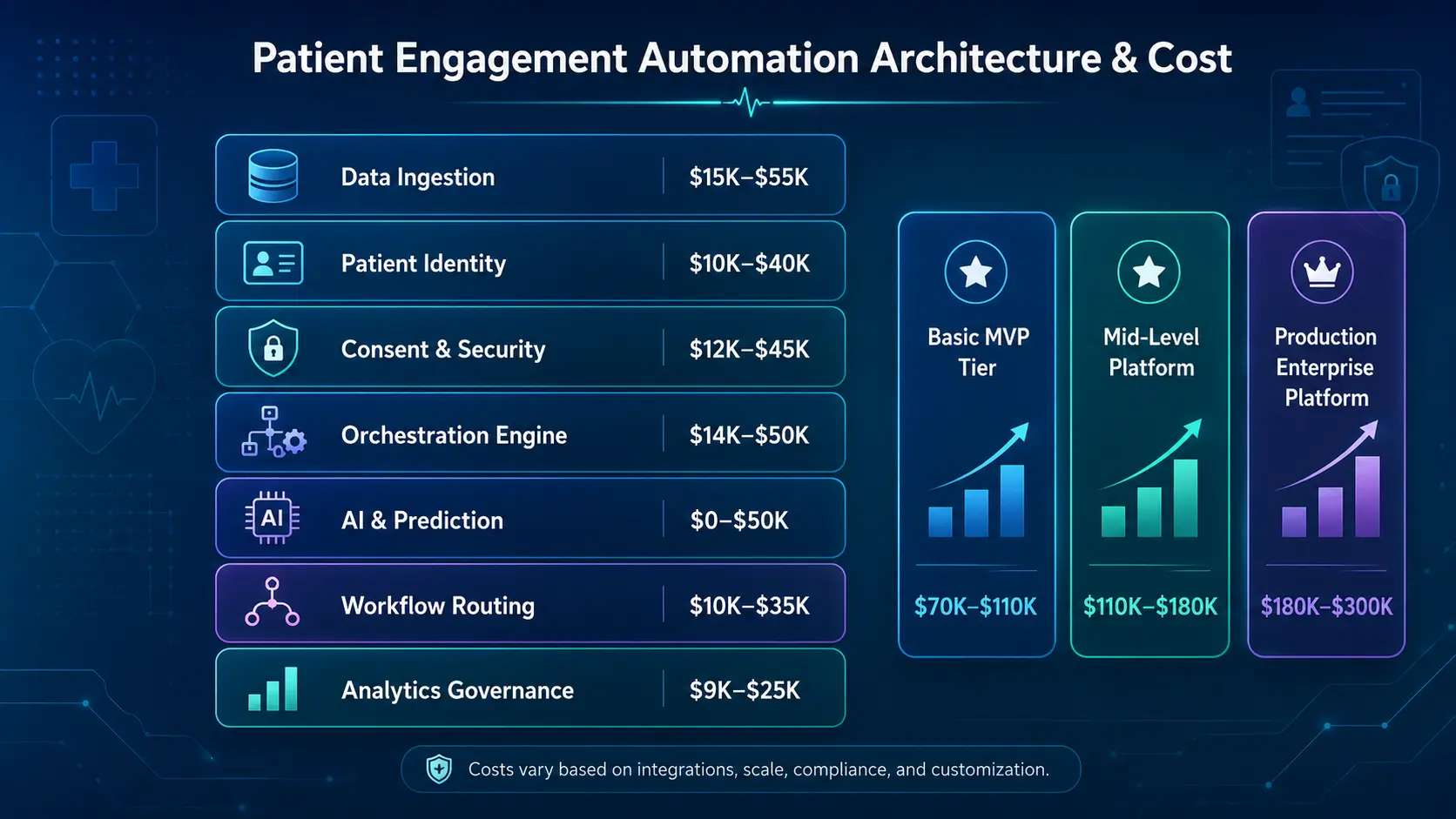
Patient engagement automation architecture consists of seven core layers: data ingestion, patient identity, consent and preference management, communication orchestration, AI assistance, workflow routing, and analytics governance.
Total cost rises rapidly when these layers must support multiple hospitals, disconnected EHR systems, dozens of native languages, massive transaction volumes, and real-time human escalation rules.
Consequently, selecting standard structural components instead of custom enterprise configurations represents the primary factor that keeps your development budget predictable.
Architecture Tier & Component Cost Breakdown
| Architectural Layer | Basic MVP Tier | Mid-Level Platform | Production Enterprise Platform |
| 1. Data Ingestion | $15,000–$22,000 | $22,000–$35,000 | $35,000–$55,000 |
| 2. Patient Identity | $10,000–$15,000 | $15,000–$25,000 | $25,000–$40,000 |
| 3. Consent & Security | $12,000–$18,000 | $18,000–$30,000 | $30,000–$45,000 |
| 4. Orchestration Engine | $14,000–$20,000 | $20,000–$32,000 | $32,000–$50,000 |
| 5. AI & Prediction | $0–$12,000 | $12,000–$28,000 | $28,000–$50,000 |
| 6. Workflow Routing | $10,000–$13,000 | $13,000–$20,000 | $20,000–$35,000 |
| 7. Analytics Governance | $9,000–$10,000 | $10,000–$15,000 | $15,000–$25,000 |
Layer 1 — Patient Data And Scheduling Ingestion
The foundational data layer manages continuous extraction loops across all legacy transactional databases across your entire health network. True operational visibility requires processing real-time administrative and clinical feeds simultaneously:
- Standard Protocols: Software engineers configure standard HL7 integration patient engagement cost lines and secure FHIR R4 patient API cost connections.
- Data Mapping: Real-time data streams unify complex appointment type mapping models with incoming insurance data and patient demographics registries.
- Clinical Feeds: System pipelines continuously monitor real-time clinical flags and care gap data to trigger automated health maintenance outreach campaigns.
Therefore, this underlying ingestion layer establishes a single clinical source of truth without altering primary database records. Maintaining clean data formatting across disparate sites stops synchronization conflicts from dropping active communications. Ultimately, a clean data foundation ensures high delivery accuracy when messaging large consumer groups.
Layer 2 — Patient Identity And Preference Management
The identity management framework reconciles user profiles across multiple facilities to prevent duplicate messaging and communications errors. This system guarantees that individual consumer records remain completely unified, even when records originate from different clinics:
- Profile Matching: High-performance database matching algorithms identify duplicate records and merge cross-facility histories securely.
- Preference Control: System logic factors in your total opt-in/opt-out management cost and localized language preferences across channels.
- Accessibility Design: Developers incorporate secure caregiver access structures alongside custom accessibility features and patient engagement cost provisions.
Consequently, this precise management block prevents your system from sending conflicting notifications to the same individual. It tracks explicit communication channel preferences to honor user choices across text, voice, and online interfaces. Respecting consumer communication preferences directly improves long-term engagement rates while dropping user complaints.
Layer 3 — Consent, Security, And Audit Controls
Embedding regulatory protection mechanisms inside your core communication logic keeps your data streams secure and audit-ready at all times. This compliance core isolates sensitive health records behind strict enterprise defense parameters:
- Regulatory Alignment: System engineering accounts for your entire HIPAA-compliant patient engagement cost requirements and strict TCPA opt-out rules.
- Access Management: Security architects deploy advanced data encryption patient engagement cost structures alongside granular role-based access patient engagement cost policies.
- Tracking Logs: Every system interaction writes to an immutable audit trail patient engagement platform history file for future forensic verification.
Therefore, this secure layer isolates your communication architecture from unauthorized data access or accidental information leakage. Enforcing consistent consent management policies prevents your network from contacting patients who have withdrawn their digital authorization. Ultimately, high-security engineering mitigates multi-million dollar regulatory liability exposures across your enterprise.
Layer 4 — Multi-Channel Orchestration Engine
The multi-channel distribution engine acts as the primary traffic controller for all outbound and inbound patient communications. This layout determines exactly how and when messages route to different devices:
- Infrastructure Costs: Developers calculate your baseline multi-channel orchestration cost alongside broader omnichannel patient engagement cost line items.
- Unified Channels: The central system controls automated text loops, standard emails, application push alerts, and secure portal message routing blocks.
- Voice Integration: Engineers wire automated phone outreach systems directly to custom IVR system development cost frameworks for voice-dependent demographics.
As a result, your organization avoids sending fragmented notifications from separate clinics simultaneously. This core engine controls the exact timing and frequency of delivery to prevent message fatigue. Unifying your delivery channels lowers total monthly messaging costs to pennies per interaction.
Layer 5 — AI Conversation And Prediction Layer
Integrating intelligent predictive models and conversation engines changes a basic notification tool into a highly responsive patient assistant. This layer interprets incoming language to resolve customer inquiries without human staff involvement:
- Smart Assistants: Tech leads compute total AI chatbot patient engagement cost variables alongside your patient virtual assistant development cost boundaries.
- Natural Language: Advanced LLM patient communication cost logic parses conversational intent to generate appropriate context-aware text responses.
- Risk Modeling: Data scientists build custom predictive engagement model frameworks and no-show prediction model cost metrics to flag missed appointment trends.
Consequently, these custom algorithms automatically prioritize and answer standard preparation and administrative questions around the clock. The predictive models analyze historical trends to identify which individuals are most likely to skip an encounter. This early intelligence allows your system to deploy targeted reminders to high-risk consumers well in advance.
Layer 6 — Workflow Routing And Human Escalation
The workflow routing layer ensures that any request the automated system cannot resolve instantly moves to the correct human team. This framework bridges the gap between automated software steps and physical clinical staff:
- Staff Routing: Automated triage rules transfer administrative questions to scheduling teams and balance billing requests to RCM agents.
- Clinical Escalation: Complex symptom queries route immediately to dedicated nurse lines and care coordinators for priority clinical review.
- Call Center Links: Unresolved conversational loops pass to live call center staff dashboards with a complete history of the digital chat.
Therefore, this escalation pipeline ensures that patients are never stuck in an unresolved automated loop. It protects patient safety by immediately highlighting high-risk keywords for manual review by trained medical professionals. Connecting automation to human operations keeps your daily clinic workflows highly responsive and completely safe.
Layer 7 — Engagement Analytics And Optimization
The reporting layer gathers delivery and behavior data from all active communication streams into a single management interface. This framework provides your executive team with real-time operational metrics across all operating centers:
- Delivery Tracking: Custom tracking scripts monitor raw message delivery rates, appointment confirmation percentages, and real-time reschedule updates.
- Operational Impact: Specialized dashboards visualize localized clinic no-show rates, care gap closure speeds, and post-discharge recovery compliance levels.
- Experience Metrics: System modules collect consumer patient-reported outcomes data alongside verified post-visit satisfaction scores.
Consequently, having clear data dashboards removes guessing games from your operational expansion plans. Experience leaders use these real-time analytics to check which message templates and communication channels yield the highest compliance responses. Tracking these metrics ensures clear financial return visibility across your entire system footprint.
Building an enterprise patient engagement architecture requires matching seven distinct software layers into a unified communication stream. The total engineering cost tracks with how tightly these modules link to your legacy systems.
Core Features That Change Patient Engagement Automation Cost
The biggest cost drivers are not the visible patient screens. They are the underlying workflow rules, database integrations, consent logic, message routing, AI supervision, analytics dashboards, and exception handling behind each specific feature.
A platform that only manages standard appointment reminders costs significantly less than one that also handles digital intake, active insurance eligibility checks, payment collection, clinical care plans, automated surveys, and multi-site campaign governance.
Consequently, prioritizing features into logical phases is what allows healthcare technology executives to maintain total control over their initial code development budgets.
Feature and Component Cost Table
| Feature & Workflow Category | Architectural Components Involved | Basic MVP Tier Cost | Mid-Level Platform Cost | Enterprise Multi-Site Cost |
| Automated Appointment Reminders | SMS engagement platform, automated phone outreach, IVR system development | $15,000–$25,000 | $25,000–$32,000 | $32,000–$35,000 |
| Self-Scheduling & Smart Waitlists | Online scheduling integration, self-scheduling platform, waitlist management automation | $20,000–$28,000 | $28,000–$35,000 | $35,000–$40,000 |
| Digital Intake & Pre-Visit Prep | Pre-visit preparation automation, digital intake form automation, e-signature integration | $18,000–$24,000 | $24,000–$30,000 | $30,000–$35,000 |
| Financial Responsibility Checking | Insurance verification automation, eligibility verification patient-facing tool, price transparency tool | $22,000–$28,000 | $28,000–$34,000 | $34,000–$38,000 |
| Billing Reminders & Collections | Patient payment plan automation, patient billing communication automation, automated reminders | $15,000–$20,000 | $20,000–$25,000 | $25,000–$28,000 |
| Post-Discharge & Chronic Care | Post-discharge follow-up automation, care plan reminders, medication adherence tracking | $25,000–$32,000 | $32,000–$38,000 | $38,000–$45,000 |
| Surveys, PROs, and NPS Loops | Patient-reported outcome collection, PRO survey automation, NPS tracking, service recovery routing | $12,000–$15,000 | $15,000–$18,000 | $18,000–$22,000 |
| Total Cumulative Allocation | Integrated System Optimization (Cross-Layer Testing & Deployment) | $70,000–$110,000 | $110,000–$180,000 | $180,000–$300,000 |
1. Automated Appointment Reminders
Deploying automated reminder channels establishes the entry-level baseline for your system engineering budget. The cost for this core notification layer scales with your overall channel count, message volume thresholds, and language localizations:
- Engineering Scope: Development ranges from $15,000 to $25,000 for basic systems, and up to $35,000 for advanced multi-site systems.
- Infrastructure Components: This module integrates your primary SMS engagement platform cost, automated phone outreach cost, and custom IVR system development cost fields.
- System Logic: Engineers deploy automated delivery verification rules, custom templates by specialty, and automated appointment reminder system cost tracking tools.
Therefore, this foundational layer removes the need for manual front-desk outreach calls entirely. It converts standard, one-way text blasts into two-way confirmation channels that capture patient responses automatically. Ultimately, setting up this basic module ensures immediate clinic calendar protection for an affordable initial software investment.
2. Self-Scheduling And Waitlist Automation
Enabling patient-facing calendar adjustments requires deep, bi-directional data pipelines that communicate directly with your clinical scheduling software. This layer must enforce strict provider scheduling matrices behind the scenes:
- Engineering Scope: Development ranges from $20,000 to $35,000 depending on the complexity of your internal facility slot-allocation logic.
- Infrastructure Components: The total self-scheduling platform cost unifies your automated appointment scheduling cost scripts with targeted online scheduling integration cost frameworks.
- System Logic: Architects write custom rules for slot matching, appointment limits by user, multi-provider availability checking, and waitlist management automation cost algorithms.
Consequently, this module allows consumers to securely claim open appointment slots around the clock without speaking to a live receptionist. If a user cancels, the automated waitlist engine instantly identifies high-risk matching candidates and broadcasts the open slot via text. This automated balancing process maximizes your total daily clinic capacity while reducing front-office administrative friction.
3. Digital Intake And Pre-Visit Preparation
Digitizing the intake pipeline requires building secure web forms that gather clinical information before a patient arrives at the clinic. This module replaces traditional clipboards and eliminates duplicate data entry for check-in staff:
- Engineering Scope: Development ranges from $18,000 to $30,000 based on form variations and your required EHR database write-back structures.
- Infrastructure Components: This track covers your total digital intake form automation cost alongside your broader patient intake automation cost and pre-visit preparation automation cost line items.
- System Logic: Developers configure secure digital consent automation steps, conditional field logic by specialty, data validation checks, and an e-signature integration cost tier.
Therefore, this framework ensures that all necessary clinical history and medical releases are completed, signed, and uploaded well in advance. Gathering this information early streamlines the check-in process and cuts down on patient wait times in the office. In the end, passing this administrative burden directly to the consumer allows your clinics to handle higher daily volume safely.
4. Financial Responsibility Communication
Integrating real-time financial checking modules into your communication flow helps eliminate unexpected billing surprises for patients. This module automatically verifies health insurance coverage and generates clear expense disclosures prior to an encounter:
- Engineering Scope: Development ranges from $22,000 to $38,000 due to the need for secure clearinghouse APIs and automated parsing logic.
- Infrastructure Components: This layer combines your insurance verification automation cost with a customer-facing eligibility verification patient-facing cost module.
- System Logic: Software engineers integrate a live patient financial responsibility estimation cost tool, price transparency tool cost engines, and good faith estimate automation cost logic.
Consequently, this financial transparency layer addresses federal compliance regulations while clearly explaining out-of-pocket costs to consumers. Verifying insurance status automatically reduces the time front-desk teams spend resolving eligibility issues before a visit. Resolving these coverage questions in advance protects your organization from unexpected claim denials and downstream payment disputes.
5. Billing Reminders And Patient Collections
Automating financial outreach channels speeds up outstanding debt collection and lowers your total billing overhead. This module delivers secure payment links directly to a patient’s mobile device immediately following a clinical encounter:
- Engineering Scope: Development ranges from $15,000 to $28,000 based on payment gateway integrations and custom payment arrangement engines.
- Infrastructure Components: This core financial setup accounts for your complete patient billing communication automation cost and automated payment reminder cost baselines.
- System Logic: Developers engineer a customizable patient payment plan automation cost framework, secure credit card tokenization, and real-time ledger balance updates.
As a result, offering simple, digital payment channels encourages faster collections from your consumers. This continuous collection loop shortens outstanding payment cycles while lowering the need for expensive third-party collection agencies. Over time, optimizing these automated collection streams drives a massive revenue cycle improvement ROI engagement across your entire medical enterprise.
6. Post-Discharge And Chronic Care Engagement
Building clinical engagement tracks extends your monitoring capabilities into the patient’s home between scheduled office visits. This module uses structured data rules to track recovery trends and encourage long-term adherence to treatment plans:
- Engineering Scope: Development ranges from $25,000 to $45,000 due to complex clinical escalation workflows and data security protocols.
- Infrastructure Components: This layer incorporates your total post-discharge follow-up automation cost and automated care plan reminders cost parameters.
- System Logic: Engineers map out custom medication adherence reminder cost structures, chronic disease engagement automation cost protocols, and nurse triage alert triggers.
Therefore, this proactive monitoring framework functions as a reliable clinical safety net for complex patient populations. If an individual flags a concerning symptom or misses a critical medication dose, the platform immediately escalates the record to an internal care coordinator. Staying connected with patients after discharge helps prevent avoidable complications and lowers expensive hospital readmission rates.
7. Surveys, PROs, And NPS Feedback Loops
Deploying automated feedback collection loops provides your experience leadership team with real-time quality and compliance insights. This module replaces slow, paper-based tracking methods with instant digital surveys delivered directly after an interaction:
- Engineering Scope: Development ranges from $12,000 to $22,000 depending on specialized analytics dashboards and service recovery logic.
- Infrastructure Components: This final module accounts for your complete patient-reported outcome collection cost and PRO survey automation cost tiers.
- System Logic: Software teams implement your central patient satisfaction survey automation cost rules, custom NPS survey automation cost triggers, and negative feedback routing alerts.
Consequently, this automated feedback loop helps you identify operational bottlenecks and track trends across all clinics simultaneously. Gathering clinically validated outcomes data gives your medical directors the exact metrics needed to measure overall care quality.
Feature selection dictates engineering complexity and total platform cost. Grouping features into logical development phases ensures a predictable rollout that drives fast administrative return on investment.
AI Features For Hospital Network Coordination And Patient Outreach
Advanced AI features for hospital network coordination must improve system prioritization, communication personalization, data routing, and outreach timing without executing unreviewable clinical decisions.
The safest engineering approach uses custom AI models for downstream patient segmentation, message drafting assistance, no-show risk prediction, care gap filtering, and multilingual translation while keeping all programmatic outcomes viewable by human administrators.
Consequently, anchoring your intelligent features to a human-in-the-loop review architecture prevents algorithmic hallucinations and preserves compliance across multiple medical sites.
AI Component Integration & Cost Matrix
| Intelligent AI Feature | Algorithmic Engineering Scope | Basic MVP Tier | Mid-Level Platform | Enterprise Multi-Site Tier |
| No-Show Prediction Models | Gradient boosting classifiers, lead-time tracking, localized signal weights | $0–$5,000 | $12,000–$18,000 | $18,000–$25,000 |
| Conversational AI Systems | Natural language processing intent parsers, staff escalation queues | $0–$8,000 | $15,000–$22,000 | $22,000–$30,000 |
| Natural Language Messaging | Context-aware LLM message drafting, approved template libraries | $0–$10,000 | $14,000–$20,000 | $20,000–$28,000 |
| Segmentation & Personalization | Rule engines, care gap prioritization, HEDIS outreach matching | $0–$7,000 | $11,000–$16,000 | $16,000–$22,000 |
| Multilingual & Accessibility | Translation APIs, reading-level controls, voice synthesizers | $0–$5,000 | $9,000–$14,000 | $14,000–$20,000 |
| Total AI Layer Allocation | Custom Model Training, Guardrail Deployment, and Optimization | $0–$12,000 | $12,000–$28,000 | $28,000–$50,000 |
1. No-Show Prediction Models
Deploying data-driven prediction modules allows hospital systems to anticipate schedule vacancies before they occur. These models analyze historical behavior patterns to flag high-risk appointments without requiring manual administrative analysis:
- Algorithmic Signals: Classifiers analyze booking lead time, historical attendance records, local weather inputs, transport barriers, and channel response frequencies.
- Operational Lift: Identifying potential missed slots allows the scheduling infrastructure to automatically move up waitlist offers to keep clinic density high.
- Budget Planning: Factoring in your custom no-show prediction model cost alongside broader no-show reduction automation cost fields protects early engineering milestones.
Therefore, this predictive step protects clinic revenue by surfacing calendar vulnerabilities up to 72 hours in advance. Rather than blasting reminders to every patient identically, the platform focuses communication frequency on individuals with high non-attendance risks. Ultimately, matching your reminder intensity to specific appointment risk tiers lowers message delivery costs while improving overall scheduling efficiency.
2. Conversational AI For Scheduling
Enabling intelligent voice and text assistants allows patients to modify their appointments using normal, conversational language. These interactive modules resolve scheduling updates automatically around the clock without consuming live call center resources:
- Intent Parsing: Natural language processing engines interpret user statements to accurately execute confirmations, cancellations, or reschedule requests.
- Fail-Safe Routing: If a patient expresses confusion or exhibits high frustration patterns, the script transfers the session to a live receptionist.
- Budget Planning: Engineering teams isolate your core conversational AI patient engagement cost variables alongside targeted AI chatbot patient engagement cost parameters.
Consequently, this automated assistant layer handles repetitive administrative traffic smoothly while keeping your support phone queues clear. Factoring a clear patient virtual assistant development cost baseline into your early product specifications ensures that your voice and text lines scale during peak volume surges. Providing responsive, self-service adjustment channels directly aligns with consumer access expectations.
3. Natural Language Patient Messaging
Using tailored language models allows your communication layer to draft dynamic outreach messages based on real-time consumer context. This framework ensures that text notifications feel personalized and helpful rather than cold or repetitive:
- Content Guardrails: System engineers connect generative engines directly to pre-approved clinical libraries to block unverified medical advice.
- Tone Adjustment: Sophisticated natural language patient messaging cost parameters enable the software to adjust wording based on clinical urgency or patient demographics.
- Compliance Control: Advanced LLM patient communication cost logic and generative AI patient engagement cost boundaries keep messaging focused on administrative tasks.
Therefore, this flexible text module prevents your organization from sending rigid, robotic notifications that patients quickly tune out. Implementing strict validation filters blocks text hallucinations before a message transmits to an end-user device. Maintaining centralized control over your template generation protects communication quality across your entire ambulatory network.
4. Patient Segmentation And Personalization Engine
The segmentation engine categorizes your consumer database based on real-time clinical parameters to deploy targeted health maintenance campaigns. This sorting logic ensures that patients receive outreach notifications directly relevant to their individual health status:
- Targeted Outreach: System rules trigger preventive care reminder automation and care gap closure outreach based on HEDIS tracking requirements.
- Dynamic Matching: The underlying sorting engine pairs chronic care cohorts with custom educational content based on age, diagnosis, and active medications.
- Budget Planning: Software architects track your central patient segmentation engine cost lines alongside your broader personalization engine cost patient engagement parameters.
As a result, your marketing and clinical compliance departments avoid sending generic notification blasts to your entire patient directory. Grouping users into precise cohorts ensures that wellness campaigns reach the exact individuals who need to schedule check-ups or laboratory screenings. This targeted approach raises response conversion rates while cutting down on communication fatigue.
5. Multilingual And Accessibility Automation
Integrating automated translation and structural accessibility tools ensures that your communication infrastructure reaches your entire demographic footprint equitably. This layer adapts presentation formats to accommodate language barriers or physical impairments automatically:
- Language Adaptation: Machine translation engines rewrite message notifications into the patient’s documented primary language while preserving local clinic context.
- Format Flexibility: System rules scale reading levels dynamically, present high-contrast options, and convert text templates into interactive voice scripts.
- Budget Planning: Implementation managers compute your total multilingual patient communication cost alongside language translation integration cost layers.
Consequently, this inclusive design layer prevents minor communication blockages from disrupting scheduled clinical care pathways. Factoring custom accessibility features patient engagement cost rules into your platform blueprint ensures compliance with federal health equity guidelines. Providing accessible channels increases overall intake form completion speeds among diverse patient groups.
6. Engagement Analytics
The centralized tracking layer compiles cross-facility behavior metrics into a unified performance dashboard. This analytics core gives executive experience leads complete operational visibility across all regional clinics and hospital centers:
- Network Oversight: Multi-hospital coordination platform features aggregate confirmation velocity, check-in completion timelines, and local cancellation patterns.
- Unified Features: Enterprise software capabilities allow administrators to see what features support multi-facility coordination across distinct operating regions.
- Budget Planning: System leads balance your ongoing engineering milestones against your total engagement analytics dashboard cost line items.
Therefore, having transparent performance metrics removes guesswork from corporate software expansion strategies. Hospital system coordination software capabilities ensure that you can compare patient interaction data across multiple sites simultaneously. Tracking these metrics provides executive leadership teams with clear, data-backed evidence of their administrative return on investment.
Implementing practical AI features focused on no-show prediction, automated scheduling, and cohort segmentation improves clinic density without sacrificing data safety. Keeping humans in the loop prevents algorithmic errors.
HIPAA, Consent, And Security Controls That Affect Cost
Regulatory and legal compliance architectures dictate the fundamental design of an enterprise patient communication platform. Because medical outreach involves Protected Health Information (PHI) and consumer data tracking, development costs scale according to your underlying system security.
For example, the Federal Communications Commission (FCC) enforces strict Telephone Consumer Protection Act (TCPA) consent revocation updates that mandate text opt-outs be processed within 10 business days.
Compliance Element & Component Cost Matrix
| Compliance Category | Required Code Implementation | Basic MVP Tier | Mid-Level Platform | Enterprise Multi-Site Tier |
| HIPAA Security Guardrails | AES-256 encryption, TLS 1.3 pipelines, tokenized database schemas | $12,000–$18,000 | $18,000–$25,000 | $25,000–$32,000 |
| TCPA Enforcement Engines | Time-of-day locks, automated STOP interceptors, outbound frequency caps | $8,000–$12,000 | $12,000–$16,000 | $16,000–$22,000 |
| Dynamic Consent Matrices | Multi-channel opt-in registries, historical revocation database logs | $10,000–$14,000 | $14,000–$20,000 | $20,000–$25,000 |
| Vendor & API BAA Rigor | Isolated webhook gateways, specialized enterprise compliance firewalls | $7,000–$10,000 | $10,000–$14,000 | $14,000–$18,000 |
| Immutable Audit Registries | Row-level database hashing, role-based security access profiles | $9,000–$12,000 | $12,000–$16,000 | $16,000–$22,000 |
| Total Compliance Allocation | Security Auditing, Core Safeguard Hardening, and Legal Validation | $12,000–$18,000 | $18,000–$30,000 | $30,000–$45,000 |
1. HIPAA Security Controls
Building a secure infrastructure layer requires safeguarding all health records from unauthorized exposure during transmission or storage. System engineers wrap your transactional pathways in enterprise-grade security protocols to prevent data interception:
- Data Masking: Databases use advanced AES-256 field-level encryption combined with TLS 1.3 transit tunnels to protect clinical and administrative payloads.
- Access Limits: The platform enforces strict minimum-necessary data routing logic to shield sensitive fields from non-essential messaging scripts.
- Lifecycle Rules: Automated data retention policies purge transient text histories from intermediate delivery logs according to your legal guidelines.
Therefore, this security foundation ensures that consumer information remains locked down across all cloud and on-premise environments. Implementing these technical boundaries guarantees that your platform protects a secure PHI patient engagement platform footprint at every stage.
2. TCPA Rules For Automated Calls And Texts
Enforcing telemarketing and consumer privacy regulations prevents your health system from executing unvalidated outbound messaging campaigns. The underlying text and voice dispatch logic requires hardcoded parameters to keep all communication strictly compliant with federal rules:
- Time-Zone Fences: Automated guardrails enforce time-of-day restrictions, blocking outbound marketing text delivery before 8 a.m. or after 9 p.m. in the consumer’s local zone.
- Keyword Traps: Centralized routers intercept words like STOP, END, and QUIT, instantly halting downstream notifications to prevent legal liabilities.
- Campaign Separation: Outbound text workflows separate transactional reminders from promotional marketing text streams to follow strict federal rules.
Consequently, this regulatory tracking layer lowers your overall TCPA compliance patient communication cost by preventing accidental text violations. Setting up these automated safety filters ensures that your outreach campaigns align smoothly with active federal consumer privacy mandates.
3. Consent And Preference Management
The preferences registry acts as the primary clearinghouse for all user authorization changes across your entire clinic footprint. This matrix dynamically tracks communication permissions to ensure that every outbound notification matches documented user choices:
- Granular Opt-Ins: The database maintains explicit, multi-tier consent records that separate administrative scheduling texts from clinical care updates.
- Caregiver Delegation: Security workflows store verifiable proxy permissions, permitting authorized family members or legal guardians to handle forms.
- Channel Routing: Routing engines check preferred outreach avenues, converting text reminders into automated voice scripts based on documented choices.
As a result, having a centralized permission database protects your communication lines from messaging consumers who have explicitly withdrawn their permission. Tracking permission updates in real time reduces consumer complaints while lowering your opt-in opt-out management cost overhead.
4. Business Associate And Vendor Requirements
Maintaining complete data compliance requires evaluating every external service provider that connects to your primary communication network. Every point of connection must execute strict legal and technical accountability agreements before processing sensitive data:
- Downstream Validation: Engineers review the compliance posture of linked SMS aggregators, voice carriers, cloud databases, and translation engines.
- Agreement Tracking: Corporate security teams ensure that all third-party systems sign binding BAA requirements patient engagement vendors must fulfill globally.
- Isolated Gateways: Custom proxy layers prevent external text APIs or analytics scripts from accidentally caching unencrypted patient indicators.
Therefore, this vendor governance layout closes potential security loopholes at the boundary lines of your platform architecture. Restricting raw data exposure across your connected systems preserves an unbroken chain of custody for all patient records.
5. Audit Trails And Compliance Reporting
The recording layer acts as an unalterable registry that documents every system action for future corporate and regulatory inspections. This framework registers all text dispatches, form submissions, database access events, and preference updates instantly:
- Hashed Records: Audit logs use row-level database hashing to verify that past communication logs remain completely unaltered and authentic.
- Role Security: Custom security profiles combine with role-based access patient engagement cost tracking to verify which internal employee viewed a file.
- Dashboard Analytics: Compliance managers use secure, real-time visualization dashboards to pull performance logs and consent histories for external auditors.
Consequently, having a clear reporting pipeline reduces your overall corporate data encryption patient engagement cost by simplifying compliance monitoring.. Keeping reliable system logs guarantees complete transparency while proving your compliance status to external regulators.
Implementing explicit HIPAA security guardrails, automated TCPA keyword filters, and immutable audit logs converts standard text scripts into high-security infrastructure. This legal protection lowers risk across your network.
Build Vs Buy Patient Engagement Automation: Where Custom Makes Sense
Custom patient engagement automation makes sense when your specific workflows, EHR environments, communication rules, patient populations, or multi-site governance needs exceed what a vendor platform can configure. Buying works for simple, off-the-shelf text reminders.
Alternatively, building is required when engagement automation must connect scheduling, digital intake, billing systems, clinical care gaps, custom AI models, and regional compliance structures across complex hospital operations.
1. Buy When You Only Need Basic Reminders
Purchasing a pre-built software subscription represents the most cost-effective path when your operational goals do not extend past simple notifications. Off-the-shelf utilities excel at executing linear, low-complexity communication routines without demanding internal engineering resources:
- Turnkey Mechanics: Turnkey platforms deliver basic SMS reminders, simple email alerts, and binary appointment confirmation triggers right out of the box.
- Low System Overhead: These systems wrap easily around standard practice databases using basic integrations, completely avoiding complex code development phases.
- Operational Trade-offs: The software offers limited customization potential, leaving your clinics bound to the vendor’s rigid template libraries and predetermined data routing paths.
This approach is ideal for single-specialty medical groups or ambulatory centers with highly predictable schedule rules. However, relying on fixed SaaS templates becomes a functional bottleneck when your operations require multi-system data coordination.
2. Build When You Need Workflow Ownership
Constructing an enterprise-grade platform is necessary when your clinical operations span multiple facility layers, complex provider matrices, and custom clinical sub-specialties.
Custom engineering permits your technical teams to design communication logic around your physical clinic footprint rather than forcing your staff to adopt restrictive software parameters:
- Bespoke Logic: Engineers hardcode custom self-scheduling logic, dynamic provider matching rules, localized multi-language preferences, and unique clinic hours directly.
- System Convergence: Codebases bridge disjointed administrative tracks by tying digital intake form automation directly to financial cleared statuses and automated care plan reminders.
- Strategic Continuity: Your business retains complete intellectual property ownership over your custom engagement analytics dashboards and proprietary predictive engagement models.
Therefore, building a tailored system ensures that your communications interface adapts fluidly to real-time administrative changes across your regional branches.
3. Partner When You Need Compliance-Ready Custom Development
Engaging an experienced, enterprise-focused technical development firm bridges the operational gap between initial product planning and live production deployment.
Relying on an outside engineering partner bypasses the steep overhead costs and long timelines associated with building an internal development squad from scratch:
- Deep Domain Expertise: Specialized engineering teams arrive with pre-vetted architectures optimized for FHIR R4 patient API data exchanges and HL7 pipeline connections.
- Security Validation: Outside specialists embed strict data encryption parameters, granular role-based access rules, and unalterable audit logging frameworks directly into your core systems.
- Lifecycle Management: Technical experts deploy automated MLOps pipelines to monitor, refine, and update custom no-show prediction models without interrupting clinical staff.
Consequently, this collaborative engineering method accelerates your deployment timeline while driving down your overall initial capital risk. It guarantees that your platform meets stringent federal privacy guidelines before interacting with a live patient panel.
4. Avoid Custom Builds When Internal Ownership Is Weak
Embarking on a custom software build is a high-liability corporate strategy if your administrative leadership lacks the long-term resources to maintain system governance.
Bespoke communication platforms fail when no dedicated internal group owns the ongoing system configurations:
- Content Decay: Automated outreach engines quickly lose their effectiveness if no internal experience group regularly updates message templates or clinical instructions.
- Operational Shifts: The platform breaks down if clinic teams modify physical booking processes without updating the underlying software scheduling rules.
- Regulatory Drift: Automated loops fall out of compliance if your internal legal teams fail to update consent structures when regional privacy laws shift.
As a result, custom development demands a permanent operational commitment from your clinical, technical, and compliance departments. If your health system cannot allocate full-time product managers to audit communication scripts, buying a limited vendor subscription remains the safer option.
ROI Metrics That Justify Patient Engagement Automation Cost
Patient engagement platform ROI should be measured through comprehensive operational, financial, and consumer experience metrics rather than simple message delivery volume alone.
The strongest key performance indicators include verifiable no-show reduction rates, automated slot-recovery velocities, digital intake completion speeds, inbound call deflections, portal activation metrics, revenue cycle accelerations, clinical care gap closures, patient-reported outcomes (PRO) collection rates, Net Promoter Score (NPS) jumps, and post-discharge follow-up compliance levels.
Consequently, framing your software performance around clear clinical and administrative savings allows healthcare organizations to build a rock-solid, data-backed business case for capital investment.
1. No-Show Reduction ROI
Mitigating empty calendar slots targets the most immediate source of financial leakage within outpatient networks. Transitioning to automated reminder sequences recovers significant administrative revenue that would otherwise be permanently lost:
- Financial Recovery: Implementing automated, multi-tiered digital reminders drives a 20% to 40% reduction in clinic no-shows, recovering up to $40,000 annually even for small specialty practices.
- Capacity Optimization: Automated waitlist logic automatically broadcasts newly opened slots to matching high-risk candidates, keeping your daily clinician density high.
- Operational Balance: The platform offsets your up-front no-show reduction automation cost by converting unconfirmed appointments into active check-ins for pennies per transaction.
Therefore, this protective mechanism guarantees that your outpatient clinics maximize their billable utilization rates around the clock. Lowering your missed-visit rates directly protects downstream operational efficiency without increasing your front-office outreach staff requirements.
Ultimately, optimizing these scheduling communication paths drops your automated appointment reminder system cost to an easily justified operational baseline.
2. Staff Time And Call Deflection ROI
Automating routine front-office workflows creates substantial labor efficiencies by shifting administrative steps directly to self-service digital channels. This transition eliminates repetitive manual tasks, allowing your internal coordination teams to work at the top of their clinical license:
- Resource Reclamation: Shifting from manual phone outreach to digital touchpoints reclaims more than 15 hours of staff time weekly per clinic, saving large networks up to 11,000 operational hours annually.
- Workflow Deflection: Digital portals and smart voice lines handle routine check-in questions, prescription refill updates, and pre-visit form verifications automatically.
- Turnover Acceleration: Completing administrative paperwork prior to the encounter shortens physical waiting room delays and increases overall room utilization.
Consequently, your organization reduces its administrative processing overhead while completely stabilizing front-desk workloads. Reclaiming these administrative hours saves healthcare networks thousands in redundant operational expenses while reducing staff burnout scores across all operating locations.
Eliminating back-and-forth scheduling coordination helps your internal medical secretaries focus on higher-value patient navigation tasks.
3. Revenue Cycle Improvement ROI Engagement
Integrating financial transparency matrices directly into your patient outreach loop speeds up collection velocities while reducing downstream billing friction. Delivering clear out-of-pocket cost estimates before a visit helps patients manage their medical balances predictably:
- Collection Velocity: Using targeted patient billing communication automation coupled with automated payment reminder cost lines accelerates outstanding account collections by up to 8%.
- Administrative Relief: Automating your insurance verification automation cost structures removes eligibility tracking backlogs from your front-office teams before care begins.
- Regulatory Alignment: Deploying a real-time patient financial responsibility estimation cost tool ensures complete corporate compliance with federal price transparency tool cost mandates.
Therefore, resolving coverage questions early prevents unexpected claim denials and minimizes the volume of manual billing disputes your team must handle later. Providing accessible, digital payment plan options encourages higher collection compliance rates among modern healthcare consumers.
Over time, optimizing these automated financial communication channels drives massive revenue cycle improvement ROI engagement across your enterprise.
4. Care Gap Closure ROI Patient Engagement
Deploying targeted outreach campaigns allows population health departments to automate preventive screening compliance for massive patient directories. This automated outreach identifies and activates outstanding care requirements without consuming manual nursing resources:
- Preventive Screenings: Automated logic distributes preventive care reminder automation texts to schedule routine immunizations, mammograms, and wellness exams based on HEDIS metrics.
- Chronic Monitoring: Dedicated tracking scripts execute chronic disease engagement automation cost protocols to ensure regular lab checks for high-risk panels.
- Retention Growth: Actively engaged consumers who receive structured care gap closure outreach patient engagement notifications are three times more likely to return for crucial follow-up care.
As a result, your health network improves its quality scores under value-based care agreements while driving appropriate service utilization. Grouping users into precise clinical cohorts ensures that wellness reminders reach the exact individuals who need them most. Consistently closing clinical care gaps prevents avoidable medical complications, protecting your organization from expensive readmission penalties down the line.
5. Patient Satisfaction Improvement ROI
Modern consumer loyalty tracks directly with communication clarity, system convenience, and accessibility across your digital touchpoints. Moving away from rigid, fragmented notification systems prevents patient friction while lifting your long-term retention scores:
- Experience Tracking: System modules collect real-time consumer feedback via automated NPS survey scripts and CAHPS-style surveys immediately after a visit.
- Service Recovery: The platform triggers instant operational alerts for practice managers whenever a patient logs a negative score, enabling immediate intervention.
- Inclusive Reach: Implementing a comprehensive multilingual patient communication cost blueprint ensures equitable, accessible outreach across your entire community demographic.
Consequently, delivering personalized health content cost models directly to a patient’s mobile device builds high trust and long-term brand loyalty. Satisfied consumers are far less likely to migrate to competing medical groups, protecting your multi-million dollar patient lifetime value baselines.
Ultimately, tracking these qualitative experience shifts provides executive leadership with clear evidence of their patient satisfaction improvement ROI.
Measuring patient engagement platform ROI requires linking operational time savings, recovered no-show revenue, accelerated financial collections, and value-based care quality scores into a single performance framework.
Build Patient Engagement Automation Platforms With Intellivon
Intellivon helps healthcare organizations build patient engagement automation platforms when generic messaging tools cannot support complex outreach, intake, scheduling, care gap reminders, secure communication, AI workflows, and compliance needs.
With 500K+ engineering hours, ex-MAANG engineering leadership, and healthcare AI expertise, Intellivon builds platforms designed for real patient action, not passive notifications.
1. We Understand That Patient Engagement Is An Operational System
Patient engagement is not just SMS reminders or chatbot replies. It affects scheduling, intake completion, no-show reduction, care gap closure, payment communication, follow-up reliability, and patient satisfaction.
Intellivon builds engagement platforms around these real workflows so every automation connects to a measurable patient or operational outcome.
2. We Build For Healthcare Complexity From Day One
Healthcare engagement platforms must work across EHRs, patient portals, scheduling systems, CRM tools, billing workflows, consent records, and communication channels.
Intellivon designs the infrastructure around FHIR R4 APIs, HL7 feeds, secure messaging, SMS, IVR, audit logs, role-based access, encryption, and deployment monitoring so the platform can operate safely in production.
3. We Know Where AI Improves Patient Action
AI can help healthcare teams predict no-shows, segment patients, personalize reminders, automate intake, support multilingual communication, route escalations, and guide chatbot workflows.
However, Intellivon treats AI as controlled infrastructure, not a shortcut. Every AI workflow includes guardrails, approved content, performance monitoring, and human review where needed.
4. We Design Platforms For Multi-Site Healthcare Operations
Hospital networks, ambulatory groups, specialty practices, and healthcare SaaS companies often need local workflow flexibility with centralized governance.
Intellivon builds platforms that support different appointment types, patient groups, provider workflows, locations, and care journeys while keeping consent, reporting, security, and communication standards consistent across the organization.
5. We Help Teams Prove ROI Beyond Message Delivery
A patient engagement platform should prove more than open rates. It should show fewer missed appointments, higher intake completion, faster follow-up, better care gap closure, reduced manual outreach, and stronger patient response.
Intellivon builds analytics into the platform so operations, clinical, and leadership teams can see what is actually improving.
Why Healthcare Teams Choose Intellivon
- 500K+ engineering hours across enterprise AI and software systems
- Ex-MAANG engineering leadership for complex platform architecture
- HIPAA-ready healthcare AI architecture for PHI-heavy workflows
- Experience with AI, LLMs, MLOps, agentic workflows, and full-stack platform development
- Complex healthcare integrations across EHRs, APIs, portals, and workflow systems
- Production-first development for real users, not demo-only automation
- Custom build capability when standard patient engagement tools cannot match workflow needs
Talk to Intellivon about building a secure patient engagement automation platform that reduces manual outreach, improves patient action, and scales across real healthcare operations.
Conclusion
Patient engagement automation development works best when cost, workflows, compliance, and integrations are planned together from the start. Moreover, the right platform connects reminders, intake, secure messaging, care gap outreach, payments, analytics, and EHR data into one reliable system.
As a result, healthcare teams can reduce manual outreach, improve patient response, protect consent, and scale communication across facilities without creating fragmented tools or unnecessary operational burden after launch for teams.
Things To Know About Engagement Automation Development Cost
Q1. How much does engagement automation development cost?
A1. Engagement automation development usually costs $70,000–$300,000 for a custom patient engagement automation platform. For example, a focused MVP with reminders, intake, consent, and dashboards costs $70,000–$110,000. However, production builds with AI messaging, EHR integration, payments, care gap outreach, and multi-site governance cost $180,000–$300,000.
Q2. How long does patient engagement automation development take?
A2. A focused patient engagement automation MVP usually takes 10–16 weeks. However, a production platform takes 4–8 months because teams must validate EHR integration, consent rules, AI workflows, TCPA safeguards, secure messaging, analytics, and multi-site rollout. Therefore, timelines grow when communication channels and facility rules increase.
Q3. What features support multi-facility coordination?
A3. Multi-facility coordination needs centralized campaign templates, site-level workflow rules, shared consent logic, role-based routing, patient identity matching, facility dashboards, and audit trails. Together, these features standardize patient engagement across hospitals and clinics. However, they still allow each site to manage local workflows, appointment types, and patient groups.
Q4. How much does EHR integration patient engagement cost?
A4. EHR integration for patient engagement usually costs $20,000–$70,000 inside the full platform build. For example, one-way scheduling or demographic sync stays near the lower range. However, FHIR R4, HL7, Epic MyChart, Cerner portal integration, CRM sync, and bidirectional workflow updates push costs higher.
Q5. What does ongoing maintenance cost after launch?
A5. Ongoing maintenance usually costs 15%–25% of the initial build per year. This covers platform support, monitoring, API updates, message template changes, compliance reviews, AI model monitoring, reporting updates, security patches, and channel optimization. As a result, a $200,000 platform may need $30,000–$50,000 annually.
To Sum Up
- Patient engagement automation only reduces no-shows when it connects reminders to scheduling rules, rescheduling paths, and waitlist recovery.
- The most expensive part of patient engagement automation is usually not the chatbot. It is the EHR, consent, routing, audit, and exception-handling layer behind it.
- A $70,000 MVP can prove value, but a $300,000 platform is often needed when hospitals add AI, care gaps, billing communication, and multi-site governance.
- Hospitals should not build custom engagement automation unless they can own content, compliance rules, workflow updates, and performance optimization after launch.
- Multi-hospital coordination is the missing SERP angle because enterprise engagement fails when every site runs patient communication differently.