Key Takeaways:
-
Vendor risk management platforms tier suppliers by risk, automate questionnaires, and track compliance evidence continuously.
-
Continuous cyber monitoring, financial health checks, ESG signals, and remediation workflows define production-grade capabilities.
-
AI scoring, SOC 2 parsing, HIPAA BAA tracking, DORA mapping, and fourth-party risk visibility are enterprise requirements.
-
Focused MVPs cost $70,000 to $120,000 while enterprise TPRM platforms reach $180,000 to $300,000.
-
Intellivon builds vendor risk management as regulated infrastructure with defensible scoring logic and human-reviewed AI recommendations.
Third-party vendor relationships carry regulatory and financial risk that annual questionnaires alone cannot manage. Because of that, vendor risk management software development starts with the risk scoring engine first. That engine tiers vendors by category and assigns scores across cybersecurity, financial, and ESG domains. From there, continuous monitoring, due diligence, and compliance tracking all connect to that scoring foundation.
The core architecture decision for this platform is continuous monitoring versus periodic assessment. Without continuous monitoring, annual reviews leave 364 days of blindness between assessments. SecurityScorecard found that 35.5% of all 2024 data breaches originated through third-party vendors. Building continuous monitoring into the architecture from day one, therefore, closes that exposure gap entirely.
Intellivon builds vendor risk management platforms for healthcare and financial services organizations. These platforms handle regulatory requirements spanning HIPAA, FDA, OCC, FFIEC, and DORA simultaneously. As a result, this blog covers risk scoring, monitoring architecture, AI models, and healthcare compliance.
What is a Vendor Risk Management Platform?
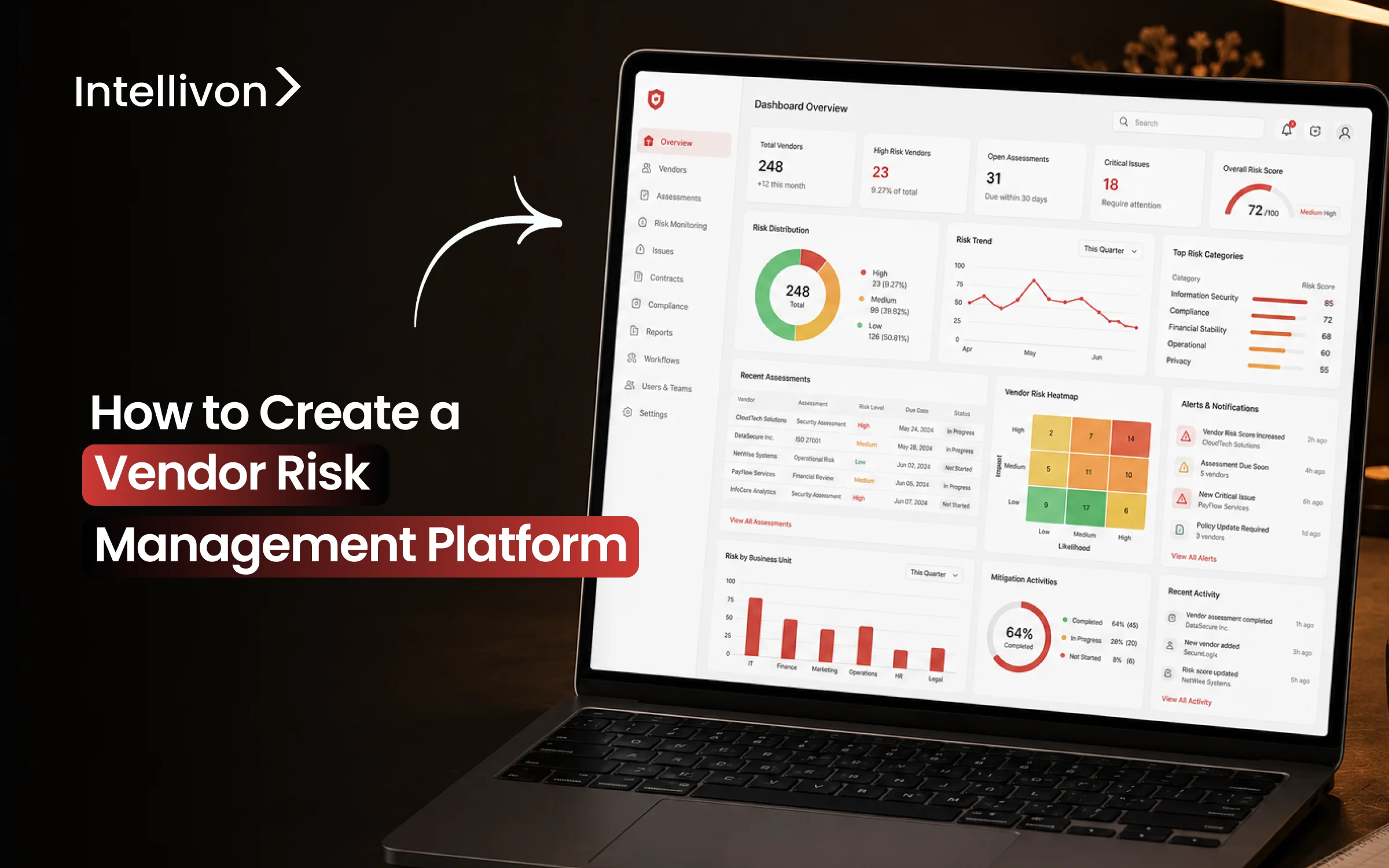
A vendor risk management platform is enterprise software that centralizes, automates, and monitors the security, financial, and regulatory risks introduced by third-party suppliers. At the same time, it replaces manual spreadsheets with automated security questionnaires, continuous threat intelligence feeds, and compliance tracking.
For highly regulated sectors like healthcare and fintech, this infrastructure ensures external partners strictly adhere to mandates like HIPAA, DORA, and SOC 2 before accessing corporate networks or sensitive data.
Why Regulated Enterprises Need Vendor Risk Infrastructure Now
Regulated enterprises must invest in automated vendor risk infrastructure because third-party exposure directly dictates an organization’s cyber resilience, data privacy, operational continuity, and compliance status. The global third-party risk management market was valued at $7.4 billion in 2023 and is projected to reach $20.6 billion by 2030, growing at a compound annual rate of 15.7%.
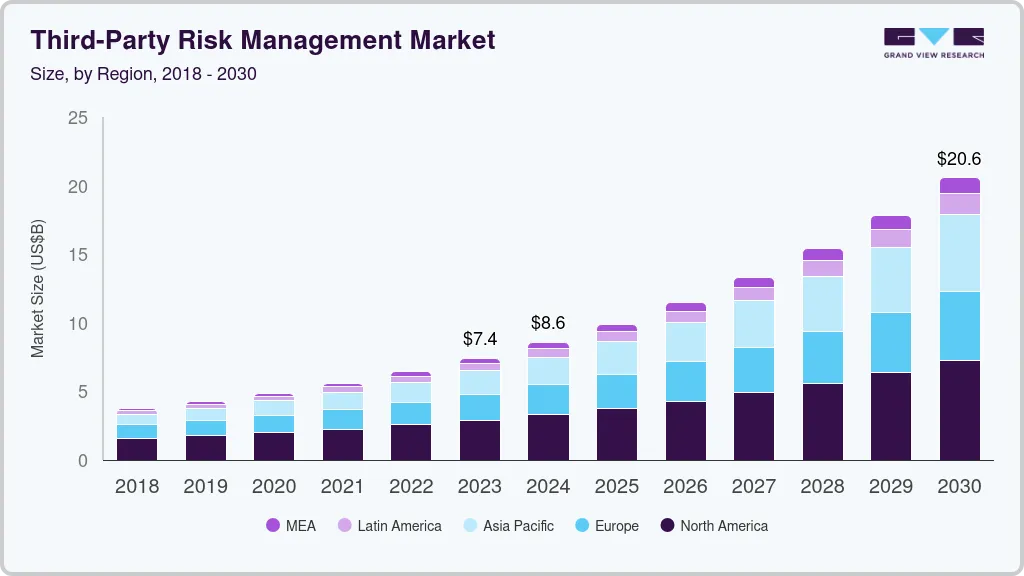
This rapid growth demonstrates how quickly dedicated software is maturing from an optional procurement tool into a non-negotiable layer of corporate infrastructure.
1. Third-Party Risk Is No Longer A Procurement Sidebar
Modern vendors act as direct extensions of your internal software ecosystem, meaning their digital vulnerabilities inherit access to your most protected enterprise environments.
- Outside suppliers regularly connect directly to core banking workflows, cloud database clusters, and internal API routing architectures.
- Inadvertent backdoors expose protected health information (PHI) within electronic health record (EHR) software and interrupt high-volume fintech payment flows.
- Relying on periodic manual audits fails to secure these highly fluid, continuous data transmissions against modern supply chain exploits.
2. Regulators Expect Lifecycle-Based Vendor Oversight
Federal oversight bodies have updated their expectations to enforce structured, end-to-end accountability across the entire lifespan of an outside partnership.
- Joint guidelines from the OCC and FDIC dictate that traditional point-in-time assessments are insufficient, mandating a complete, repeatable lifecycle risk framework.
NTT Data - Because the OCC explicitly notes that diverse third-party relationships carry varying risk profiles, platforms must support automated, tiered vendor oversight.
NTT Data - Built-in tiering and segmentation workflows ensure your risk and compliance teams allocate intensive due diligence resources to high-impact, critical network vendors.
3. Healthcare Vendors Carry PHI And Patient Operations Risk
Hospital networks, pharmaceutical companies, and medical device manufacturers must secure intricate operational supply chains while keeping data handling perfectly auditable.
- Healthcare Data Privacy Vendor Risk Management: Centralizes the constant monitoring of administrative, physical, and technical safeguards across your entire digital supply chain.
- EHR Vendor Risk Compliance Tracking Software: Automatically audits data access points and tracks credentials for external integrations interacting with critical patient care systems.
- PHI Vendor Data Handling Compliance Platform: Enforces strict encryption validation and records real-time activity metrics to verify how external data processors manage patient records.
- HIPAA BAA Vendor Compliance Tracking Platform: Automatically schedules, executes, and archives Business Associate Agreements (BAAs) to ensure legal and regulatory alignment during supplier onboarding.
4. Fintech Vendors Carry ICT And Operational Resilience Risk
Financial institutions face zero-tolerance mandates regarding data security, business continuity, and the structural stability of their technology providers.
- Fintech Vendor Risk Management Platform Build: Unites decentralized supplier information into an auditable engine designed to withstand intensive regulatory examinations.
- DORA Digital Operational Resilience Vendor Compliance: Embeds specialized automated alerting systems to log information and communication technology (ICT) vulnerabilities across cross-border financial systems.
- FFIEC Vendor Management Compliance Platform: Automates repetitive security questionnaire distribution and scores supplier controls against federal information technology guidelines.
- Basel III Operational Risk & OCC Alignment: Integrates quantitative risk scoring models into procurement flows to measure and track vendor financial health and concentration risks.
The modern regulatory landscape makes it entirely clear that manual third-party tracking is an immediate liability. Establishing automated tiering, real-time alerting, and multi-framework tracking forms the foundation for secure operational scale.
Building this capability effectively requires a systematic look at the core software features that translate policy mandates into automated application workflows.
Build Vs Buy Vendor Risk Platform Decision Rules
Organizations must decide whether to purchase commercial off-the-shelf (COTS) software or develop a custom system based on the unique complexity of their vendor ecosystem.
Purchasing a third-party risk management (TPRM) platform makes sense when your operational workflows rely on standard questionnaires, conventional compliance scoring, and basic dashboard reporting.
Conversely, custom vendor risk management software development is required when your underlying risk logic, regulatory workflows, data integrations, or domain-specific compliance protocols act as a primary driver of strategic business value.
1. Buy When Your Vendor Reviews Are Mostly Standard
When your assessment processes mirror standard industry frameworks, commercial platforms provide immediate time-to-value without engineering overhead.
- Market alternatives like OneTrust, ProcessUnity, Archer, ServiceNow VRM, UpGuard, Panorays, and BitSight offer mature, standardized infrastructures out of the box.
- These systems excel at distributing static questionnaires, tracking basic vendor certifications, and generating high-level executive security summaries.
- Choosing a standard package avoids long development pipelines if your primary goal is checking the box for standard security compliance.
2. Build When Risk Logic Is Specific To Your Business
Custom software becomes necessary when generic tools cannot handle complex, industry-specific compliance realities without requiring expensive, brittle customizations.
| Operational Priority | Custom Platform Engineering Advantage |
| Hospital Vendor Credentialing | Integrates directly with Joint Commission systems to verify real-time clinical access compliance. |
| FDA Vendor Qualification | Tracks hardware, raw materials, and software components through strict medical device supply chains. |
| Bank Outsourcing Risk | Embeds multi-layer calculation models that adhere precisely to OCC and FFIEC operational limits. |
| Asset Manager Concentration | Dynamically tracks systemic portfolio risks across shared downstream tech providers. |
3. Use Hybrid When You Need External Risk Feeds
A hybrid approach lets you build core proprietary risk engines while ingesting specialized data streams through external telemetry interfaces.
- Custom-built platform APIs securely connect to outside threat feeds like BitSight, SecurityScorecard, Black Kite, or RiskRecon for immediate external perimeter visibility.
- The system pulls operational and financial ratings directly from RapidRatings or Dun & Bradstreet to flag hidden supplier bankruptcy liabilities early.
- Custom logic aggregates these feeds alongside real-time sanctions lists and threat intelligence APIs to calculate a single, unified risk posture.
3. Avoid Custom Development Without Program Ownership
Deploying tailored risk technology before establishing clear internal governance structures leads to expensive, underutilized enterprise infrastructure.
- Without dedicated risk analysts to manage remediation workflows, sophisticated automation engines simply generate a high volume of unaddressed critical alerts.
- If an organization lacks the internal bandwidth to act on vendor financial or security red flags, the platform becomes a costly administrative ledger.
- Consequently, strategic engineering investments must only proceed after executive leadership establishes clear accountability for third-party risk triage and mitigation.
Choosing the right path sets the stage for your overall engineering timeline and budget. If your strategic needs demand a custom engine, understanding the tactical build phases helps ensure delivery remains highly predictable and secure.
Vendor Risk Platform Architecture For Regulated Enterprises
An enterprise vendor risk management platform requires a decoupled, six-layer software architecture to successfully process complex compliance logic and high-throughput data feeds before any artificial intelligence features are integrated.
Each operational layer must maintain absolute data isolation, role-based access permissions, complete audit traceability, and bi-directional API capabilities to eliminate manual tracking bottlenecks.
This rigid architectural separation ensures that systemic core application failures do not corrupt underlying historical audit logs or interrupt continuous background monitoring processes.
Architectural Layer Table
| Architectural Layer | Core Technical Functionality & Responsibilities | Enterprise Infrastructure & Data Feed Tooling |
| Vendor Master Data | Maintains a single source of truth for corporate structures, matching tax IDs, mapping fourth-party sub-processors, and linking legal entities to physical processing locations. | PostgreSQL (JSONB relational schema), AWS Aurora Serverless, Neo4j Graph Database (for N-th party network visualization). |
| Workflow & Rules Engine | Orchestrates automated vendor risk onboarding, routes questionnaires based on tiering scores, manages approval queues, tracks SLA expiration timers, and schedules reassessments. | Camunda BPMN, Temporal.io (durable execution workflows), Apache Airflow (for batch assessment scheduling). |
| Evidence & Document Intel | Validates cryptographically signed files, stores SOC 2 reports, parses SIG questionnaire JSON structures, processes executed HIPAA BAAs, and archives historic policy evidence. | AWS S3 with Object Lock (WORM storage compliance), HashiCorp Vault (key rotation), Adobe Sign API, DocuSign API. |
| Continuous Monitoring | Ingests real-time attack surface telemetry, processes external threat intelligence feeds, monitors adverse media news sentiment, and tracks supplier bankruptcy indicators. | BitSight API, SecurityScorecard API, RapidRatings API, Dow Jones Risk & Compliance, Apache Kafka (streaming real-time alerting systems). |
| Reporting, API & Audit | Generates real-time risk heat maps, exposes webhooks for procurement tools, integrates corporate ERP financial suites, and records immutable, tamper-proof activity audit logs. | Amazon QuickSight, Power BI Embedded, SAP API Business Hub, Workday Prism Analytics, Logstash (centralized auditable event pipelines). |
Separating core infrastructure logic from external intelligence pipelines prevents downstream API outages from breaking internal vendor onboarding workflows.
Isolating the data architecture into decoupled layers preserves deterministic audit trails while allowing streaming threat APIs to scale independently. This structural decoupling ensures that high-volume external data ingestions can never corrupt or delay your core compliance and onboarding workflows.
Build The Vendor Data Model Before Building Workflows
A normalized data schema is the core foundation of vendor risk management software development because all downstream automated workflows and risk scores depend on clean relationship structures. Treating a supplier as a single flat row creates technical debt, turning the application into a glorified spreadsheet.
Instead, your relational database architecture must explicitly map the real-world linkages between legal entities, active service contracts, downstream sub-processors, and historic compliance evidence records.
Mapping Multi-Tier Supply Chain Dependencies
- Entity Relationships: One vendor often possesses multiple corporate subsidiaries, independent product lines, disparate data hosting facilities, and regional service contracts.
- Fourth-Party Risk Management Software: The data schema must map a multi-tier vendor risk mapping platform that traces data flow from your systems down to your vendors’ sub-contractors.
- Nth-Party Vendor Risk Monitoring Platform: Tracing downstream networks reveals systemic vulnerabilities where separate suppliers share the exact same underlying cloud infrastructure dependencies.
- Regulatory Compliance Controls: The model embeds custom metadata fields to automate GDPR vendor data processing compliance platform audits alongside localized CCPA tracking.
- Evidence Versioning: The database treats certificates and questionnaires as immutable, versioned audit artifacts rather than editable entries, preserving historical remediation records.
Building clean, hierarchical schemas prevents structural technical debt and ensures your platform maintains audit readiness over multi-year operational lifecycles.
Normalizing your vendor data schema into distinct relational entities prevents system decay and ensures automated risk scoring models ingest clean, structured inputs.
Add Continuous Monitoring Across Cyber, Finance, And ESG
Traditional annual reviews create dangerous security blind spots because supplier risk profiles change daily. Consequently, a modern vendor risk management platform must integrate active cyber telemetries, financial health alerts, and ESG compliance tracking into a single continuous pipeline.
Therefore, by streaming these external data feeds directly into a real-time vendor risk alerting system, risk teams can proactively mitigate third-party liabilities before they cause internal network breaches.
Streaming Multi-Domain Threat Intelligence
- Cyber Vendor Risk Management Software: The system maintains permanent API connections to ingest automated vendor data breach risk monitoring software feeds and live threat intelligence.
- Vendor Attack Surface Monitoring Software: Furthermore, the platform conducts non-invasive digital scans across public-facing vendor IP blocks to flag unpatched server vulnerabilities.
- Vendor Financial Health Risk Monitoring Software: Subsequently, integrating automated credit risk scoring APIs allows your procurement teams to monitor supplier insolvency indicators.
- Vendor Concentration Risk Analysis Software: This data layer automatically alerts corporate risk officers whenever multiple internal business units rely heavily on the same software subcontractor.
- CSDDD Vendor Supply Chain Due Diligence Software: Finally, the platform tracks Scope 3 vendor emissions risk tracking inputs to maintain strict global value chain compliance.
Continuous monitoring transforms corporate compliance from a seasonal checklist into a protective data barrier.
Replacing static, point-in-time reviews with automated multi-domain data streaming provides the continuous visibility required to prevent supplier vulnerabilities from damaging internal enterprise operations.
Use AI For Risk Prediction, Evidence Review, And Reports
Integrating AI into your platform accelerates vendor assessments, but you must treat it strictly as a workflow multiplier rather than an autonomous decision-maker. Consequently, predictive models excel at classifying risk tiers, extracting complex contract clauses, and drafting executive briefs.
However, the system must never permit an AI model to approve a vendor without human-in-the-loop oversight and explainable scoring criteria.
Therefore, establishing a rigorous data processing pipeline ensures your automated compliance processes remain fully defensible during annual regulatory audits.
AI Architecture: Operational Capabilities & Controls
| AI Workload Category | Technical Engineering Implementation | Primary Risk Control |
| Document Intelligence | NLP vendor contract risk document analysis parses unstructured PDFs to instantly isolate hidden subcontractor clauses and breach notification timelines. | Treat supplier records as untrusted inputs. Run secure, sandboxed text extraction to prevent adversarial exploits. |
| Predictive Modeling | A machine learning vendor risk classification engine uses historical audit trends to establish a predictive vendor risk scoring AI pipeline. | Mandate explainable AI frameworks. The system must explicitly document exactly which parameters drove a specific score. |
| Generative Automation | Generative AI vendor risk report generation synthesizes complex security feeds to automatically draft board-level summaries and audit narratives. | Enforce structural validation schema checks to intercept and block potential large language model hallucinations. |
| Model Governance | An MLOps vendor risk AI model pipeline continuously tracks performance, embedding active model drift detection vendor risk AI checkpoints. | Block autonomous approvals. All model outputs must route to a mandatory human-in-the-loop validation queue. |
Implementing rigorous MLOps practices guarantees that your automated scoring pipelines remain compliant under evolving algorithmic accountability mandates.
Deploying AI as an analytical assistant for document parsing cuts review times. Nevertheless, maintaining human validation queues and model drift tracking is vital to ensure absolute audit readiness.
Map Fintech TPRM Regulations Into Platform Logic
Fintech vendor risk platforms must systematically encode regional outsourcing laws, information and communication technology (ICT) resilience obligations, and data protection rules into core application logic.
Consequently, moving beyond basic checklists ensures your platform generates defensible regulatory evidence across the vendor lifecycle.
Therefore, embedding deterministic compliance rules directly into automated workflows allows financial entities to protect core networks while satisfying strict regulatory examinations.
Encoding Global Financial Frameworks
- OCC & FFIEC Expectations: The system deploys specialized OCC third-party risk guidance compliance software modules alongside an FFIEC vendor management compliance platform to enforce lifecycle checks across planning, due diligence, and termination.
- DORA Third-Party Oversight: To satisfy the Digital Operational Resilience Act (DORA), which entered into application on January 17, 2025, the software automates DORA digital operational resilience vendor compliance via standardized ICT registers and incident reporting.
- Basel III Operational Risk: Furthermore, an integrated Basel III operational risk vendor management engine tracks supplier control failures on a unified vendor operational risk management platform.
- Data Privacy Obligations: Finally, the schema automates regional privacy audits via an integrated GDPR vendor data processing compliance platform and unified CCPA vendor compliance management software.
Translating fluid financial mandates into deterministic database rules preserves operational integrity.
Encoding financial rules directly into software constraints ensures your platform actively blocks compliance violations rather than merely documenting them post-breach.
How To Build A Vendor Risk Management Platform In Phases
Developing an enterprise vendor risk management platform requires a highly structured, multi-phase roadmap to ensure that your data schemas, core compliance logic, and integrations mature in the correct operational sequence.
Therefore, breaking the development lifecycle into distinct, manageable phases minimizes technical debt and guarantees that your custom system remains completely stable under heavy operational loads.
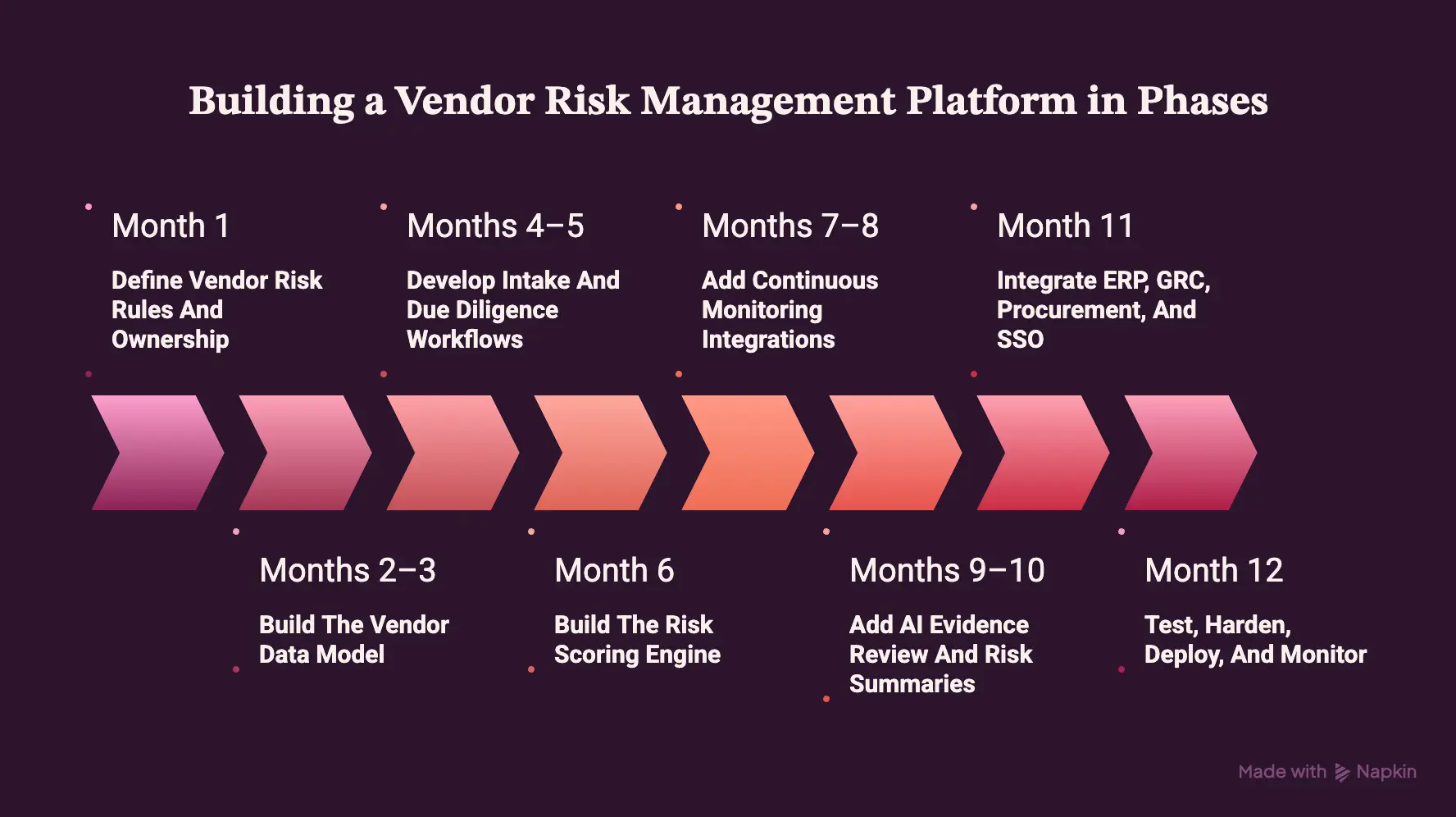
1. Phase 1: Define Vendor Risk Rules And Ownership (1 Month)
Before writing a single line of application code, you must establish a clear risk taxonomy, map business owners, define approval routes, and set vendor tiering metrics. This phase codifies your enterprise criticality rules, policy mappings, and escalation pathways.
At Intellivon, we always define these operational rules before engineering workflows to prevent the custom platform from merely digitizing unclear or broken governance.
2. Phase 2: Build The Vendor Data Model (Months 2–3)
This phase focuses entirely on engineering your core relational or graph database architecture to store complex, multi-entity relationships.
The backend data schema must seamlessly connect vendor master profiles, legal contracts, compliance evidence, active risk domains, incident records, user roles, and fourth-party sub-processor chains.
3. Phase 3: Develop Intake And Due Diligence Workflows (Months 4–5)
Here, developers construct the foundational intake forms, risk-based routing engines, internal reviewer queues, and external-facing supplier portals.
This stage establishes automated vendor risk questionnaire platform capabilities, allowing suppliers to securely upload documentation and complete standardized templates like SIG or custom security forms.
4. Phase 4: Build The Risk Scoring Engine (Month 6)
Engineers develop the algorithmic math engines required to calculate inherent risk, control maturity scores, weighted risk domains, and residual risk profiles.
The platform maps these outputs against your corporate risk appetite thresholds and visualizes the results on an interactive vendor risk heat map visualization dashboard.
5. Phase 5: Add Continuous Monitoring Integrations (Months 7–8)
This phase transitions your application from static point-in-time reviews to a continuous vendor monitoring platform development model.
Developers build event-driven pipelines that hook into external APIs to stream real-time data breach alerts, cyber ratings, financial health indexes, adverse media, and localized ESG telemetry.
6. Phase 6: Add AI Evidence Review And Risk Summaries (Months 9–10)
With core pipelines stable, you can safely deploy natural language processing models to perform automated contract risk document analysis.
This intelligence layer prefills questionnaire responses, flags high-risk legal clauses, drafts executive summaries, and routes complex remediation tasks to human-in-the-loop review queues.
7. Phase 7: Integrate ERP, GRC, Procurement, And SSO (Month 11)
To eliminate corporate data silos, engineers connect the custom platform to your existing procurement and financial infrastructure via an enterprise vendor risk platform API architecture design.
This phase delivers out-of-the-box integrations for platforms like SAP, Oracle, Coupa, ServiceNow, Archer, Okta, and Azure Active Directory.
8. Phase 8: Test, Harden, Deploy, And Monitor (Month 12)
The final phase focuses entirely on infrastructure hardening, absolute role-based access control validation, and enforcing a zero-trust vendor risk platform security design.
The engineering team deploys a comprehensive vendor risk platform, DevOps and CI/CD pipeline, executes intensive external penetration testing, and initiates production monitoring.
Developing a compliance platform in disciplined, sequential phases guarantees that every automated feature rests upon a clean, audit-ready data model.
Executing your platform development through clear, architectural phases keeps software engineering teams aligned with regulatory goals. This systematic progression guarantees that your final system delivers clear, defensible data insights that can withstand intensive enterprise-level audits.
Vendor Risk Management Software Development Cost: $70K–$300K
Vendor risk management software development costs range from $70,000 to $300,000, depending heavily on vendor volume, workflow complexity, AI features, and compliance depth. Consequently, a baseline minimum viable product (MVP) sits at the lower end of this scale.
Conversely, an enterprise platform tailored for highly regulated sectors requires a more intensive investment.
Therefore, understanding how your technical scope influences engineering hours allows you to budget accurately before kicking off development.
Financial Breakdown by Engineering Phase
| Development Phase | Core Engineering Deliverables | Estimated Cost Range |
| Discovery & Architecture | Risk taxonomy, relational data model, microservices setup, API blueprints, RBAC role matrices. | $18,000–$40,000 |
| Registry, Intake & Portal | Vendor master database, conditional intake forms, SIG templates, automated BAA tracking. | $33,000–$75,000 |
| Scoring & Dashboards | Inherent and residual risk engines, real-time heat maps, corporate KPI tracking modules. | $18,000–$45,000 |
| Integrations & Monitoring | Webhooks for SAP, Workday, Coupa, ServiceNow, Okta SSO, and continuous threat intelligence APIs. | $25,000–$60,000 |
| AI, Security & QA | NLP contract analysis, predictive engines, automated DevOps CI/CD pipelines, penetration testing. | $40,000–$100,000 |
Strategic Investment Cost Tiers
- Minimum Viable Product ($70,000–$120,000): Best for a centralized vendor registry, standardized questionnaire intake, basic scoring, and native dashboard reporting.
- Enterprise Platform ($180,000–$250,000): Optimized for healthcare or fintech workflows, custom third-party integrations, immutable audit trails, and continuous monitoring feeds.
- AI-Powered SaaS Platform ($250,000–$300,000): Supports multi-tenant vendor risk SaaS architecture deployment, white-label vendor risk management SaaS platform options, and predictive AI scoring.
Ongoing Maintenance Financial Expectations
Annual maintenance costs systematically average 15%–22% of your initial software development investment. This recurring expenditure is necessary to cover fluid compliance updates, external API maintenance, continuous AI model tuning, and cloud infrastructure hosting fees.
Establishing a clear architectural scope from day one prevents cost overruns and guarantees your budget aligns directly with your regulatory liabilities.
Build Vendor Risk Management Software With Intellivon
Regulated enterprises choose custom vendor risk management software development with Intellivon when our ecosystems demand tailored workflows, defensible scoring, and deep infrastructure integrations.
Consequently, our goal is never to copy an existing TPRM product. It is to build the precise third-party risk infrastructure your healthcare, fintech, or SaaS business actually requires.
Our Engineering Advantages
- Risk Architecture First: We map vendor lifecycles, risk tiers, and reviewer roles before engineering code to prevent digitizing unclear governance.
- Compliance & Integration Depth: Natively support HIPAA BAA tracking, DORA ICT risk registers, OCC oversight, and seamless ERP/SSO API integrations.
- Workflow-Driven AI: Deploy NLP contract risk document analysis to parse SOC 2 reports, prefill questionnaires, and draft board summaries.
- Production-Grade Delivery: Built by ex-MAANG engineers using zero-trust controls, automated CI/CD pipelines, and rigorous MLOps drift monitoring.
Talk to Intellivon’s vendor risk software experts to scope your platform, estimate your $70,000–$300,000 build, and decide whether custom development is the right move.
Conclusion
Vendor risk management software development works best when the platform starts with governance, not screens. First, define vendor ownership, risk tiers, evidence rules, and compliance obligations. Then, build the data model, workflows, scoring engine, integrations, monitoring layer, and AI review tools around that logic.
Therefore, the strongest platforms do more than collect questionnaires. They show who a vendor is, what risk they create, what changed, who reviewed it, and what must happen next.
FAQs
Q1. Is A SOC 2 Report Enough For Vendor Risk Management?
A1. A SOC 2 report helps validate infrastructure controls, but it is not enough by itself. Consequently, a comprehensive platform must also continuously evaluate operational criticality, active data access, insurance coverage, and dark web threat intelligence signals. Therefore, relying solely on point-in-time audits creates dangerous compliance blind spots between formal review cycles.
Q2. How Do You Reduce Vendor Questionnaire Fatigue?
A2. Deploying a single, massive security form across your entire supplier ecosystem inevitably causes extreme procurement friction. Instead, platforms must utilize an automated vendor risk tiering and segmentation engine to dynamically adjust questions based on vendor criticality. Furthermore, reusing historical evidence across similar assessment cycles dramatically shortens active review times.
Q3. Can AI Score Vendor Risk Reliably?
A3. AI can score third-party risk reliably, provided the underlying models deliver fully explainable decision pathways and transparent confidence metrics. Subsequently, natural language processing can classify complex documents, detect missing evidence clauses, and draft remediation roadmaps. However, high-risk operational approvals must always route to a mandatory human review queue.
Q4. What Integrations Matter Most In A Vendor Risk Platform?
A4. To eliminate fragmented corporate data silos, a vendor risk platform must seamlessly connect with your existing core architecture. This means prioritizing bi-directional API integrations with internal ERPs, procurement modules, GRC platforms, and Okta SSO. Additionally, regulated deployments require specialized EHR, global procurement organization (GPO), and streaming cyber rating telemetries.
Q5. How Should Platforms Handle Fourth-Party Risk?
A5. Tracking direct suppliers is insufficient when downstream sub-processors handle your sensitive datasets. Consequently, the platform data schema must ingest subcontractor disclosures, parse downstream SOC 2 reports, and map cloud infrastructure dependencies. Therefore, aggregating these multi-tier relationships automatically reveals hidden concentration risks where separate vendors share identical hosting perimeters.
To Sum Up
- Vendor risk platforms fail when teams build dashboards before defining vendor identity, risk ownership, and scoring rules.
- Questionnaire automation only works when questions change by vendor tier, data exposure, and regulatory scope.
- AI can reduce evidence review time, but it should not approve critical vendors without human review and audit trails.
- Healthcare and fintech buyers do not need generic TPRM. They need vendor risk logic mapped to PHI, BAAs, FDA, OCC, FFIEC, DORA, and operational continuity
- The real build-vs-buy question is whether vendor risk logic is strategic enough to own.