Key Takeaways:
-
AI spend analytics platforms ingest ERP, P2P, AP, card, contract, supplier, and ESG data into one layer.
-
Data cleansing, normalization, ML classification, anomaly detection, and savings tracking are core production capabilities.
-
Spend data lake, supplier MDM, taxonomy engine, natural language querying, audit logs, and MLOps define the architecture.
-
Custom platforms cost $70,000 to $300,000 depending on data volume, integrations, and dashboard complexity.
-
How Intellivon builds AI spend analytics as production spend intelligence infrastructure for regulated enterprises.
Enterprise spend data arrives from ERP, AP, and procurement systems in different formats and codes. AI spend analytics software development starts with building the spend taxonomy and classification engine first. That taxonomy standardizes supplier names, category codes, and cost centers across every source system. From there, ML models train on clean data and produce category assignments procurement teams can act on.
Without a unified taxonomy built first, ML models train against inconsistent category schemas across source systems. The result is overlapping, contradictory categories that produce dashboards procurement teams distrust and abandon. Sievo reports that AI spend analytics identifies savings 3 to 5 times faster than traditional methods. That speed advantage only materializes when the taxonomy underneath the AI is clean and consistent from the start.
Intellivon has over a decade of experience building AI analytics platforms for healthcare and financial services. The approach is always to build the spend taxonomy before any ML model training begins. This blog covers spend data architecture, classification model design, multi-source ERP integration, and HIPAA compliance for the platform development.
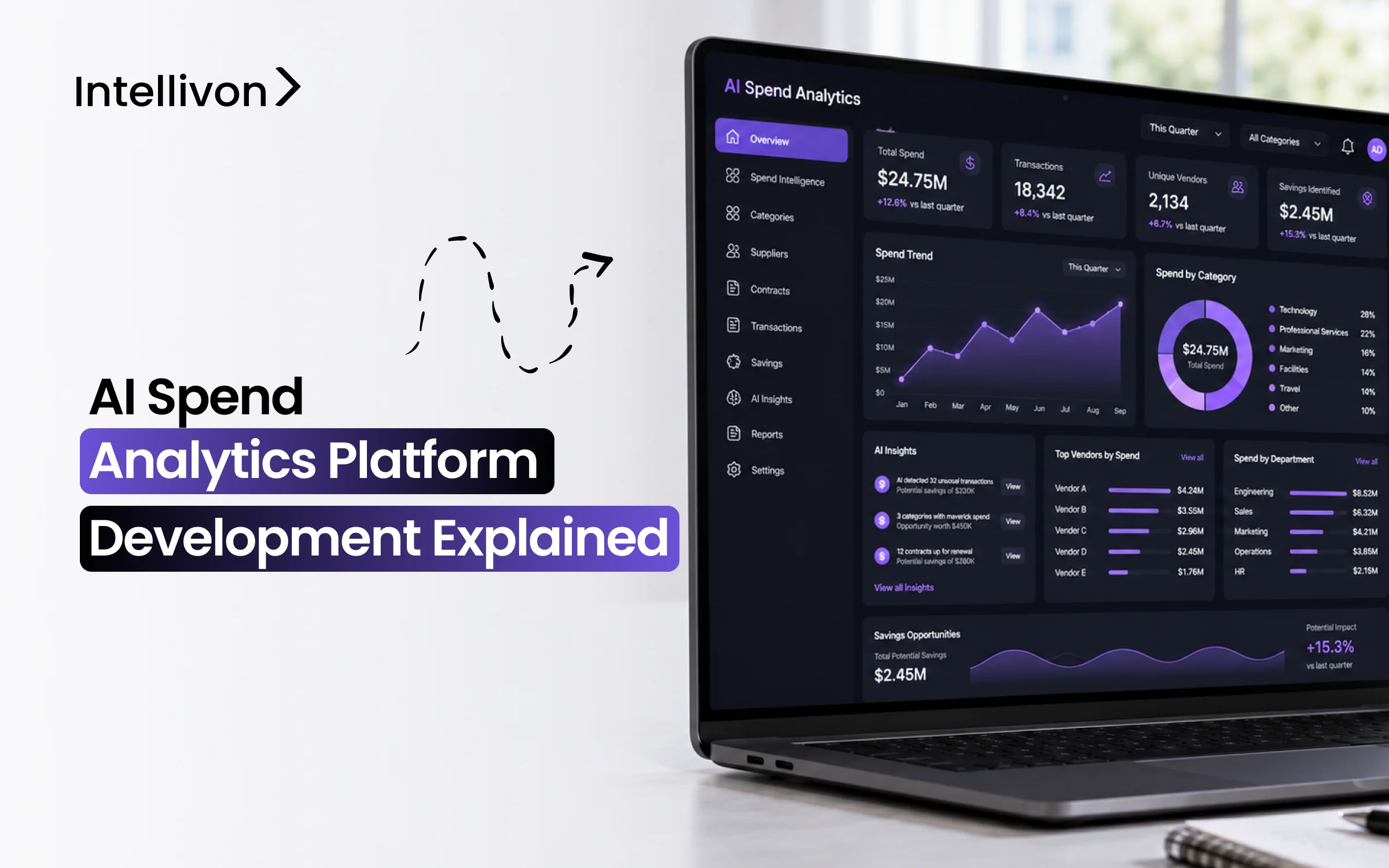
What Is AI Spend Analytics Software Development?
AI spend analytics software development is the process of engineering data pipelines, machine learning models, and automated classification engines that ingest, clean, and analyze enterprise procurement data.
This specialized software development transforms fragmented transactional data from multi-source ERP systems into structured intelligence to uncover savings opportunities, track supplier compliance, and eliminate maverick spend automatically.
AI Spend Analytics Software Vs Traditional BI Dashboards
Traditional business intelligence tools rely on manual rules to sort past purchasing data.
At the same time, modern AI-powered software uses machine learning to clean data and predict future savings opportunities automatically.
| Feature | Traditional BI Dashboards | AI Spend Analytics Software |
| Data Ingestion | Requires pre-cleansed, structured inputs from single sources | Automates multi-source spend data ingestion and aggregation |
| Categorization | Manual, static rules that fail when descriptions change | ML spend categorization model with NLP description sorting |
| Compliance Tracking | Retroactive reports that highlight errors after they happen | Real-time maverick spend detection and contract compliance monitoring |
| Insights | Static charts that show what the enterprise has already spent | Generative AI spend insight generation with automated recommendations |
Ultimately, this technical evolution shifts procurement from reactive viewing to proactive cost management. Therefore, enterprises use this automated intelligence to find leaks and negotiate better supplier rates instantly.
What The Platform Actually Does
An enterprise AI spend visibility platform development for enterprises automates multi-source spend data ingestion and aggregation to synthesize fragmented financial records. Consequently, the system runs real-time data cleansing engines, normalizes mismatched taxonomies, and constructs dynamic spend cubes.
Ultimately, this infrastructure populates real-time KPI dashboards, flags maverick buying anomalies, and accurately tracks ongoing procurement savings.
Where It Fits In Source-To-Pay
According to empirical research by The Hackett Group, a modern spend analytics platform occupies a unique position by running continuously in the background across the entire source-to-pay (S2P) lifecycle.
Therefore, it orchestrates comprehensive data pipeline connections across contract lifecycle management (CLM), upstream sourcing workflows, invoices, purchase orders, accounts payable, and travel expenses.
As a result, this continuous cross-process integration eliminates blind spots and provides data-backed intelligence for strategic vendor risk mitigation.
Why Enterprises Need AI Spend Visibility Platforms Now
The enterprise demand for automated cost control has catalyzed significant capital injection into this technology vertical. Consequently, according to the Spend Analytics Market Report 2026 by Research and Markets, the global spend analytics market size is valued at $3.63 billion in 2026 and is projected to scale rapidly to $6.63 billion by 2030.
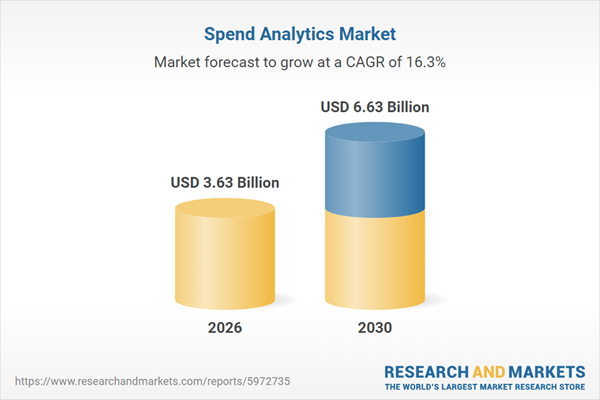
Therefore, this expansion reflects a robust compound annual growth rate (CAGR) of 19.3% during the forecast period.
Ultimately, this accelerating investment curve underscores how heavily large-scale global enterprises are prioritizing AI-driven procurement infrastructure to fortify operational margins against macroeconomic pressures.
1. Spend Data Lives Across Too Many Systems
Large enterprises struggle to maintain a unified truth because purchasing transactions occur across completely disconnected tech stacks.
Therefore, raw financial records remain deeply siloed inside distinct corporate environments, preventing executive leadership from executing comprehensive, cross-entity analysis.
- Transaction data is fragmented across core ERP deployments, including SAP, Oracle Fusion, Workday, and NetSuite.
- Procure-to-Pay (P2P) systems like Coupa, Ariba, and Jaggaer generate parallel invoices.
- Corporate credit cards, accounts payable tools, and T&E software logging ad hoc field payments.
- Contract Lifecycle Management (CLM) suites and external supplier portals hide critical unit-pricing tiers.
According to empirical research from The Hackett Group, procurement teams currently face an 8% workload increase alongside shrinking operating budgets.
As a result, manually logging into twelve different platforms to manually pull, format, and combine spreadsheets is completely unsustainable. Deploying an automated multi-source spend data integration platform resolves this specific technical operational bottleneck permanently.
2. Supplier Names Break Spend Visibility
Mismatched vendor nomenclature across databases severely distorts the true scale of an organization’s supplier concentration risks.
Consequently, without intelligent text normalization, a company will routinely overpay because its total purchasing leverage remains invisible to corporate negotiators.
- “IBM,” “IBM Corp,” and “International Business Machines” are recorded as separate legal vendors.
- Acquired subsidiaries and regional distributors maintain completely unique supplier identification codes.
- Data duplication affects 10% to 30% of corporate business records.
- Industry benchmarks published by Gartner indicate that poor data quality costs organizations an average of $12.9 million annually in lost efficiencies.
To fix this, an AI supplier spend consolidation engine runs natural language processing (NLP) to parse unstructured description strings.
Ultimately, the engine group links parent companies and their fragmented subsidiaries into a unified profile.
This clean master data allows corporate sourcing leaders to confidently renegotiate bulk contracts using their complete enterprise purchasing volume.
3. Maverick Spend Hides Inside Local Purchasing
Unapproved, off-contract buying quietly drains corporate profitability because local purchasers routinely bypass established corporate procurement channels.
Therefore, catching these highly distributed, small-scale non-compliance events requires continuous, automated monitoring at the transactional line-item level.
- Employees are purchasing directly from public digital storefronts instead of utilizing pre-negotiated corporate catalogs.
- Preferred supplier leakage occurs when local units select unvetted regional vendors out of habit.
- Contract compliance gaps are passing completely unnoticed by overworked corporate auditing teams.
- Maverick purchasing patterns account for up to 30% of total indirect corporate expenses.
An automated maverick spend detection and reporting AI systematically reads every outbound invoice to catch price variances instantly.
As a result, the system flags catalog bypass anomalies before accounts payable issues the final cash disbursement. This real-time visibility quickly forces distributed operations back into strict alignment with corporate-approved procurement frameworks.
4. Finance Needs Spend Data That Reconciles
Corporate financial officers cannot make accurate capital allocation decisions when spend reports fail to map precisely to structural ledger rules.
Consequently, financial leaders require highly granular multidimensional reporting models that accurately reconcile operational outlays directly against corporate budgets.
- Cross-border business operations require a continuous multi-currency spend analytics platform reconciliation.
- Complex multi-entity spend analytics consolidation across dozens of distinct global holding units.
- Eliminating internal balance distortions through automated, rules-based intercompany spend analytics software processing.
- Mapping real-time corporate outlays directly to specific cost centers, business units, and legal entities.
To address this, customized spend analytics dashboard builders dynamically synchronize raw supplier invoices with general ledger accounting strings.
Therefore, finance teams can confidently review margins without experiencing frustrating discrepancies between procurement tracking and actual bank balances. This operational cohesion provides the exact, auditable clarity required by modern CFOs during intense macro budgeting cycles.
As a result, data verified by enterprise sourcing groups like Tropic AI demonstrates that organizations implementing automated spend analytics regularly unlock a 10% to 25% reduction in total vendor costs.
This granular tracking firmly establishes the procurement department as a provable, numbers-driven center of corporate operational efficiency.
The Architecture Of An AI Spend Analytics Platform
An AI spend analytics platform architecture design comprises five distinct layers engineered to ingest, process, enrich, and visualize distributed transactional data. Therefore, the system operates as an enterprise-grade lakehouse that unifies multi-source data ingestion, automated machine learning classification engines, and real-time business intelligence interfaces.
Ultimately, this decoupled microservices architecture ensures high throughput, strict security compliance, and low-latency decision intelligence for cross-border corporate operations.
Architectural Layer Of The Platform
| Structural Layer | Core Technical Components | Strategic Enterprise Output |
| Data Ingestion Layer | ERP APIs, P2P connectors, AP feeds, EDI transactions, webhooks, streaming pipelines | Aggregates disparate operational logs from SAP, Oracle, and Workday into a singular, high-throughput ingestion queue. |
| Spend Data Lake & Warehouse Layer | Raw, cleaned, enriched, and modeled zones built via Snowflake, BigQuery, Databricks, or PostgreSQL | Establishes an immutable data lake architecture development center for multi-entity auditing and schema transformation. |
| Supplier Master Data Management Layer | Supplier deduplication engines, parent-child hierarchies, tax IDs, DUNS numbers, diversity and ESG metadata | Unifies fragmented vendor nomenclature into a single source of truth to track global supplier concentration risks. |
| Spend Taxonomy & Classification Layer | UNSPSC mapping, custom clinical category taxonomies, NAICS, CPV, GL codes, commodity hierarchies | Translates unstructured transaction descriptions into auditable category buckets automatically via machine learning. |
| Analytics, AI, & Workflow Layer | Dashboards, conversational NLP querying, anomaly alerts, savings tracking validation, audit history | Converts backend structured data into executive interfaces, natural language querying, and automated cost-reduction recommendations. |
Consequently, this multi-layered architectural approach completely eliminates the data silos that traditionally cripple manual procurement reviews.
As a result, software engineering teams can build highly resilient, auto-scaling spend intelligence platforms capable of handling multi-million-row accounting ledger datasets seamlessly.
Build The Spend Data Foundation Before AI Models
An enterprise AI spend data ingestion and aggregation engine requires a clean, structured underlying data repository to generate reliable cost predictions.
Therefore, building a resilient multi-source spend data integration platform foundation prevents machine learning models from training on fragmented vendor records or misaligned financial ledgers.
Ultimately, this foundational baseline ensures that downstream classification pipelines can accurately isolate hidden savings opportunities and trace multi-entity operational anomalies.
- Map Every Spend Source First: Software teams engineer pipelines to aggregate text files and API streams across diverse ERP networks, accounts payable registers, physical inventory ledgers, and corporate travel cards. For healthcare systems, this requires integrating GPO contract spend compliance analytics alongside pharmacy formulary databases and capital equipment logs.
- Normalize Spend Data Across Entities: The system processes raw invoices into standardized structural blocks by automatically executing currency harmonization, language translation, and matching units of measure. Consequently, the data normalization and cleansing engine maps localized facility IDs, departments, and regional payment terms to unified corporate dimensions.
- Cleanse And Enrich Supplier Records: Engineers deploy a spend data deduplication and enrichment pipeline that handles fuzzy matching algorithms and deterministic parent-child entity groupings. Furthermore, this supplier master data management platform layers on external metadata containing global sanctions, ESG indices, and minority-owned business certifications.
- Create A Spend Baseline: The pipeline isolates direct, indirect, clinical, non-clinical, and tail spend to establish a clear addressable cost baseline. As a result, the spend cube development phase cleanly excludes non-addressable categories like tax disbursements and regulatory licensing fees.
- Set Data Quality Scores: Every processed record receives automated data hygiene quality metrics that evaluate data completeness, classification confidence, and freshness parameters. This validation framework allows the platform to consistently calculate a reconciliation status score before pushing rows into predictive pipelines.
Consequently, rushing into machine learning training before establishing data hygiene rules will cause significant model drift and false anomaly alerts. As a result, constructing a clean, harmonized data lake architecture development layer remains the mandatory first phase of successful procurement software engineering.
How AI Spend Classification And Taxonomy Engines Work
An AI spend classification and analytics platform uses a hybrid processing framework to systematically structure multi-source purchasing data.
Therefore, the processing core combines rigid, deterministic logic rules with deep learning language models to clean, format, and bucket unstructured accounting records.
Ultimately, this algorithmic automation maps messy transaction lines directly to complex corporate taxonomies, maintaining high data accuracy while eliminating intensive manual procurement spreadsheet reviews.
1. Rules-Based Classification Still Has A Role
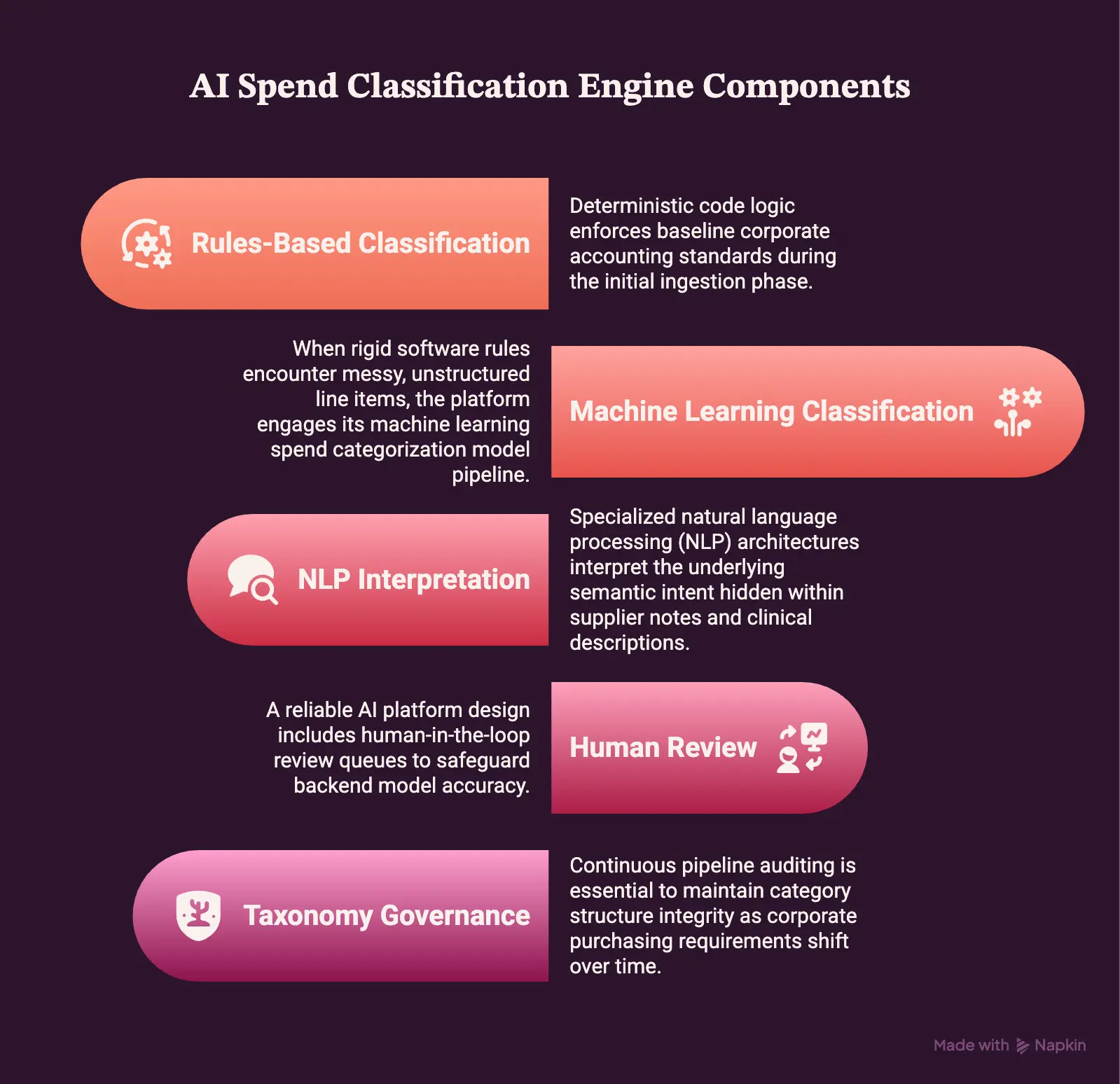
Deterministic code logic enforces baseline corporate accounting standards during the initial ingestion phase.
Consequently, developers program precise text filters to process transactions that contain perfectly matched system metadata fields.
Therefore, the engine maps transactions containing identical supplier IDs, verified catalog item codes, or pre-mapped general ledger strings directly to target commodity buckets without executing heavy machine learning calculations.
2. Machine Learning Classifies Ambiguous Spend
When rigid software rules encounter messy, unstructured line items, the platform engages its machine learning spend categorization model pipeline.
Therefore, the system transforms raw transaction text strings into dense vector embeddings to analyze semantic relationships.
Consequently, gradient-boosted trees and transformer neural networks run unsupervised clustering to isolate hidden patterns, assigning an explicit confidence rating score to every classified line item.
3. NLP Reads Descriptions And Invoice Lines
Messy invoice tables frequently contain fragmented shorthand abbreviations and unmapped inventory SKUs that break standard relational databases. To resolve this, specialized natural language processing (NLP) architectures interpret the underlying semantic intent hidden within supplier notes and clinical descriptions.
As a result, the deep learning classification module maps cryptic descriptions like “Stryker 4mm Lap” directly into highly specific medical commodity buckets automatically.
4. Human Review Protects Category Accuracy
A reliable AI platform design includes human-in-the-loop review queues to safeguard backend model accuracy. Consequently, any transaction falling below an established classification confidence threshold is routed instantly to localized category manager dashboards.
Therefore, procurement practitioners review anomalies, manually override misaligned records, and feed the verified training data back into the underlying model architecture to improve future classification passes.
5. Taxonomy Governance Prevents Model Drift
Continuous pipeline auditing is essential to maintain category structure integrity as corporate purchasing requirements shift over time. Therefore, the platform features native taxonomy version control to manage complex class-merge procedures and catalog modifications cleanly.
Consequently, MLOps spend analytics AI model pipelines run scheduled retraining sequences using category-owner approvals, preventing systemic model drift from corrupting global spend visibility dashboard outputs.
Consequently, blending machine learning models with human verification ensures completely accurate data mapping across thousands of transaction codes. As a result, finance leaders receive a clean, auditable database that permanently eliminates manual categorization bottlenecks.
Build The Spend Cube And Analytics Layer
Building the spend cube analytical framework moves an enterprise beyond simple flat reporting by constructing a multi-dimensional database structure. Therefore, this data modeling stage maps every financial transaction against intersecting operational axes like supplier, category, and cost center.
Ultimately, this deep structural visibility allows data engineering teams to feed clean, structured datasets directly into executive reporting interfaces and automated procurement tracking workflows.
- Spend Cube Design: Links transaction facts to dimensions across suppliers, facilities, contracts, and GL codes.
- Executive Spend Dashboards: Display real-time addressable spend, managed spend ratios, compliance, and budget variances.
- Category-Level Spend Analytics: Parses specialized expenses into vertical buckets like medical supplies, IT, and logistics.
- Tail Spend Identification: Isolates unmanaged, low-value, high-transaction vendor activity to find rapid consolidation opportunities.
- Self-Service And Natural Language Querying: Translates text to SQL safely, enabling narrative report automation and self-service dashboards.
Consequently, engineering a multi-dimensional spend cube ensures that transactional relationships remain instantly traceable across all corporate entities. As a result, procurement leaders get an actionable data foundation that reveals hidden leaks and drives permanent cash savings.
AI Models That Power Spend Intelligence
An enterprise spend intelligence platform relies on dedicated, production-grade machine learning algorithms rather than basic business logic scripts. Therefore, deploying specialized predictive and natural language models transforms messy, fragmented transaction strings into clean, actionable cash-saving workflows.
Ultimately, this algorithmic layer ensures that multi-entity corporations can automatically resolve vendor nomenclature errors, catch compliance leaks, and forecast future procurement budgets with extreme precision.
AI Model Architecture
| AI Model Architecture | Underlying Technical Strategy | Core Operational Output |
| Spend Classification | Supervised transformer networks, vector embeddings, and NLP string processing | Automatically classifies messy item, invoice, PO, and general ledger descriptions directly into target category taxonomies. |
| Supplier Consolidation | Probabilistic entity resolution, fuzzy text matching, and parent-company graph mapping | Merges highly fragmented supplier records into unified profiles to expose complete corporate purchasing leverage. |
| Maverick Spend Detection | Unsupervised isolation forests, clustering, and sequence anomaly detection algorithms | Instantly flags unapproved off-contract purchases, non-preferred vendors, split invoices, and policy exceptions before payment. |
| Savings Opportunity | Deterministic price variance models, regression analysis, and duplicate clustering matrices | Pinpoints immediate renegotiation targets, unexecuted volume rebate opportunities, and redundant vendor elimination targets. |
| Forecasting & Budgeting | Time-series forecasting models, category trend modeling, and market index regression | Project category-level spend movements and macro inflation patterns to optimize multi-entity budgeting. |
| Explainable Recommendations | SHAP feature importance scoring, business logic trees, and confidence intervals | Generates clear, text-based rationales explaining why an action was suggested to maintain internal audit compliance. |
Consequently, utilizing targeted algorithmic layers prevents system processing errors and minimizes false anomaly alerts across mass financial data streams. As a result, software developers can provide procurement teams with an auditable decision environment that actively uncovers millions in hidden operational waste.
ESG, Supplier Diversity, And Scope 3 Spend Analytics
Modern procurement requires tracking environmental and social impacts alongside financial margins. Therefore, deploying an ESG-integrated spend analytics platform aligns transactional outlays with regulatory mandates automatically.
Ultimately, this compliance-ready framework allows multi-entity enterprises to generate auditable disclosures while mitigating value chain risk.
- Supplier Diversity: Tracks certified minority, women, and local small business spend against master databases.
- Sustainable Spend: Maps purchasing transactions to supplier ESG scores to enforce green procurement policies.
- Scope 3 Emissions: Uses spend-based emissions factor models to build baseline carbon analytics.
- CSRD Support: Captures auditable approval histories to generate disclosure-ready exports matching EU mandates.
- Carbon Integration: Connects transactional logs with emissions libraries to populate real-time sustainability dashboards.
Consequently, embedding environmental and diversity metrics directly into transactional streams satisfies modern regulatory auditing protocols. As a result, supply chain directors transition to proactive, data-backed sustainability orchestration.
How To Build AI Spend Analytics Software In Phases
Executing an enterprise spend analytics system development roadmap requires a highly disciplined, multi-stage engineering approach to ensure data precision and absolute compliance.
Ultimately, this structured methodology systematically transforms fragmented, multi-entity corporate transactions into a secure, permission-aware network capable of driving measurable procurement cost reductions.
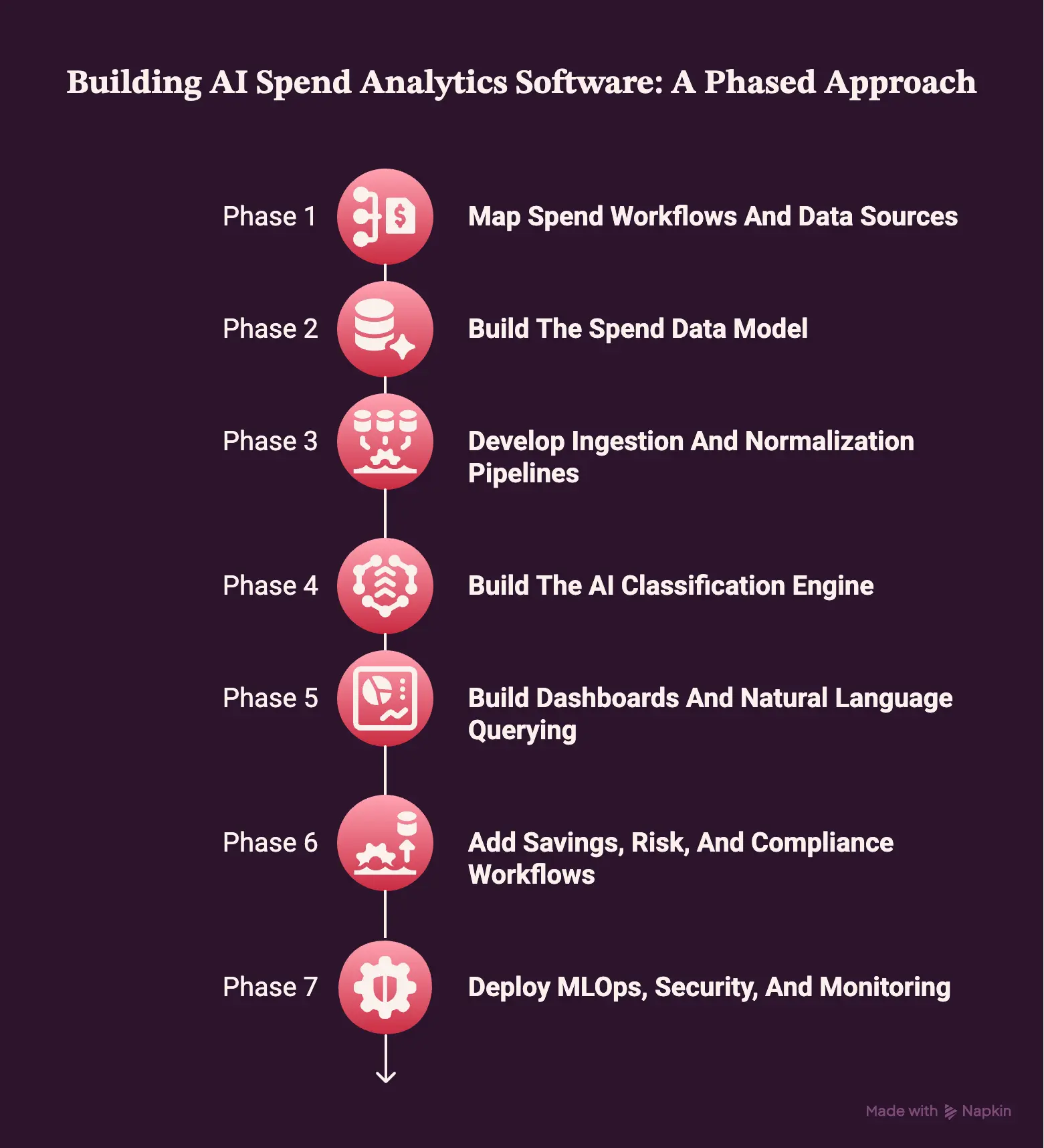
Phase 1: Map Spend Workflows And Data Sources
Engineering teams begin by comprehensively mapping the flow of capital and data across the entire corporate structure. Therefore, this initial step focuses heavily on documenting existing procurement, finance, accounts payable, sourcing, and contract workflows.
- Mapping deep operational workflows and clear data ownership lines before writing user interface code or training models.
- Documenting hidden data silos inside multi-site health systems, global fintech supply chains, and complex GPO contract networks.
- Preventing scope creep by ensuring technical pipelines align perfectly with realistic corporate auditing rules from day one.
Consequently, this upfront structural clarity protects downstream development milestones. As a result, technical teams avoid costly backend redesigns during API integration phases.
Phase 2: Build The Spend Data Model
Developers construct a robust, highly relational backend database schema designed to manage complex multidimensional transaction relationships effortlessly. Therefore, the data architecture establishes isolated, optimized tables dedicated to housing vendor profiles, raw line-item invoices, and purchase orders.
- Building data models to function as the core system of record for deep corporate intelligence, not an afterthought.
- Establishing relational integrity across multi-currency, cross-border transactions to ensure low-latency querying performance as data scales.
- Structuring specific tables for tracking multi-entity facilities, department allocations, GL codes, and compliance-ready ESG profiles.
Consequently, this foundational layout ensures data consistency across the platform. As a result, finance leaders can confidently run multi-entity consolidations without experiencing ledger alignment errors.
Phase 3: Develop Ingestion And Normalization Pipelines
Software engineers build automated data extraction pipelines to continuously harvest transaction records from disconnected corporate platforms. Therefore, the data layer deploys a resilient blend of real-time application programming interfaces (APIs) and scheduled batch transfers.
- Strictly isolating unrefined, raw data inputs from downstream cleaned data tables to preserve absolute immutable data lineage.
- Cleaning incoming fields by instantly performing currency harmonizations, metric unit normalizations, and initial validation checks.
- Eliminating data reconciliation discrepancies across core enterprise systems like SAP, Workday, NetSuite, and specialized P2P tools.
Consequently, internal compliance auditors can easily trace any transformed metric directly back to its original source invoice log. As a result, total data transparency is achieved across all integrated holding entities.
Phase 4: Build The AI Classification Engine
The engineering team integrates advanced machine learning models to automate the sorting of complex, unmapped procurement text strings. Therefore, the data processing layer combines deterministic, rules-based logic filters with deep learning natural language processing models.
- Combining rigid business rules with machine learning classification models so regulated teams can defend mapping logic.
- Routing transactions falling below target confidence margins to dedicated human-in-the-loop validation dashboards for manager verification.
- Optimizing underlying model parameters through continuous learning loops without introducing systemic taxonomy drift into databases.
Consequently, the taxonomy system translates messy description strings into clean commodity groups automatically. As a result, the platform maintains elite data accuracy while removing intensive manual spreadsheet reviews.
Phase 5: Build Dashboards And Natural Language Querying
Developers design the front-end user interfaces to present complex data intelligence through accessible, role-based visual components. Therefore, the application layer introduces a secure text-to-SQL translation semantic framework for executive financial reporting.
- Keeping natural language querying modules entirely permission-aware and strictly bound by row-level database security rules.
- Restricting user query scopes so regional managers can only query data points matching their specific cost centers.
- Automating narrative report generation and housing customized dashboards tailored to specific procurement oversight roles.
Consequently, this defensive engineering layout protects sensitive cross-entity corporate financial records from unauthorized internal views. As a result, enterprise data remains secure while maintaining total self-service data exploration.
Phase 6: Add Savings, Risk, And Compliance Workflows
The platform scales beyond basic information tracking by embedding proactive operational monitoring workflows directly into daily business operations. Therefore, backend modules monitor transactions against active contract repositories to flag price variances and catalog bypasses.
- Converting raw analytical insights into intelligently routed, automated operational tasks assigned to clear, accountable owners.
- Triggering automated tasks in a manager’s pipeline when the system detects a severe maverick spend event.
- Enforce strict procurement compliance by tracking realized savings, avoided costs, and preferred supplier contract adherence.
Consequently, direct automation ensures rapid corporate intervention before unapproved vendor payments clear accounts payable. As a result, leakages are eliminated before they impact net margins.
Phase 7: Deploy MLOps, Security, And Monitoring
The final development milestone establishes continuous integration, delivery pipelines, and comprehensive platform monitoring protocols to safeguard production environments. Therefore, DevOps engineers deploy real-time API performance trackers and model drift detection mechanisms.
- Treating enterprise AI spend intelligence as a critical, highly monitored production engine requiring continuous operational oversight.
- Incorporating automated log-gathering utilities to assemble continuous SOC 2 compliance evidence effortlessly across the infrastructure.
- Applying zero-trust security architectures and strict encryption protocols to safeguard clinical and financial data fields.
Consequently, this high-grade production readiness allows large corporate organizations to safely scale their custom deployments. As a result, enterprises maintain a highly resilient asset across heavily regulated global markets.
AI Spend Analytics SaaS Platform Development Cost: $70K–$300K
An AI spend analytics SaaS platform development cost model usually ranges from $70,000 to $300,000 to launch a production-ready enterprise solution. Therefore, the total capital investment fluctuates based on data source count, ERP complexity, AI classification depth, healthcare compliance protocols, and multi-tenant SaaS requirements.
Ultimately, this detailed financial breakdown allows chief procurement officers and technical decision-makers to weigh upfront development expenses directly against projected procurement savings and operational risk reductions.
Cost By Development Phase
| Development Phase | What It Covers | Estimated Cost Range |
| Discovery and Workflow Mapping | Mapping multi-source spend workflows, user roles, approval logic, and validation rules. | $8,000–$18,000 |
| Data Architecture and Spend Model | Building the spend data lake architecture development layer, supplier MDM, and spend cube schemas. | $12,000–$30,000 |
| Data Ingestion Pipelines | Constructing real-time ERP spend data integration architecture for SAP, Oracle, Workday, and P2P tools. | $18,000–$55,000 |
| Cleansing and Normalization Engine | Deploying a spend data normalization and cleansing engine for multi-currency record deduplication. | $12,000–$35,000 |
| AI Classification Models | Developing machine learning spend categorization models with NLP description classification. | $18,000–$60,000 |
| Dashboards and Reporting | Designing real-time spend visibility dashboards and customized spend analytics dashboard builders. | $15,000–$40,000 |
| GenAI Query and Narrative Layer | Engineering conversational AI spend analytics interfaces with secure text-to-SQL semantic layers. | $15,000–$45,000 |
| Healthcare and Fintech Compliance | Implementing HIPAA-compliant spend analytics platforms and specialized fintech security controls. | $12,000–$35,000 |
| SaaS Multi-Tenancy and Security | Establishing role-based access controls, tenant isolation layers, and zero-trust security tools. | $15,000–$45,000 |
| Testing, DevOps, and Launch | Executing continuous integration, MLOps model validation, and automated platform deployment. | $10,000–$25,000 |
Consequently, ongoing platform maintenance requires an annual budget of 15% to 25% of the initial build cost to handle model monitoring, cloud infrastructure tuning, and API updates.
As a result, this baseline ensures long-term system health while preventing classification accuracy degradation as new supplier variables emerge.
For a deeper breakdown of neighboring procurement system design expenses, see our guide on What Does It Cost to Develop Procurement Software?.
As a result, you can schedule a technical blueprinting session with our development team to map your ingestion requirements and receive a fixed-scope engineering estimate for your platform.
Security, Compliance, And Governance Requirements
Deploying an enterprise-grade zero-trust spend analytics platform security network requires strict data governance to safeguard corporate treasury files. Therefore, technical teams must implement defense-in-depth protocols to maintain internal auditing compliance across multi-entity operational structures.
Ultimately, this risk mitigation layer ensures that automated procurement tracking remains fully auditable, permission-aware, and regulation-ready.
- Role-Based Access Control: Segment database schemas automatically based on organizational roles. Consequently, Chief Procurement Officers retain global visibility while regional category managers only access localized department cost-center lines.
- Zero-Trust System Security: Enforce strict access constraints utilizing multi-factor authentication (MFA) and OAuth/OIDC single sign-on (SSO) protocols. Therefore, the microservices layer isolates multi-tenant SaaS computing environments with AES-256 data encryption across all processing states.
- Audit Logs and Explainability: Maintain an immutable trace log documenting every single machine learning classification, human override, and dashboard export. As a result, explainable AI recommendation models back every automated cost-reduction flag with transparent benchmark data.
- PHI-Safe Healthcare Architecture: Isolate data pipelines to prevent the ingestion of Protected Health Information (PHI). Furthermore, if clinical invoices trigger PHI strings, the pipeline routes records through a dedicated, BAA-compliant spend data management software cluster.
- Model Governance and MLOps: Track training data lineage systematically inside MLOps spend analytics AI model pipelines. Consequently, engineering teams run scheduled drift monitoring scripts to validate model parameters before deploying production taxonomy updates.
Consequently, embedding strict compliance frameworks directly into financial pipelines protects enterprises from costly regulatory data leaks. As a result, finance leaders safely gain deep spending visibility without compromising internal security protocols.
Build AI Spend Analytics Software With Intellivon
Build AI spend analytics software with Intellivon when your enterprise needs more than static dashboards over unrefined procurement data. As a specialized engineering partner, we develop custom, compliance-ready spend data architecture, deep machine learning classification models, and multi-source ERP integrations.
Ultimately, our systems operate as robust production-grade infrastructure, delivering clear cost-reduction analytics and audit-ready data visibility across highly regulated industries.
- Architecture-First Build: Engineers deploy an immutable spend data lake architecture development layer, supplier MDM, and dynamic multi-dimensional spend cube schemas.
- AI with Governance: Combines machine learning spend categorization models with NLP description classification, confidence scoring, and human review queues.
- Healthcare Spend Depth: Enforces GPO contract spend compliance analytics, pharmacy spend metrics, and PHI-safe, HIPAA-compliant spend analytics platform designs.
- Fintech Controls: Implements vendor concentration analytics, multi-entity spend analytics consolidation, general ledger mappings, and continuous audit trail logging.
- ESG & Scope 3 Analytics: Tracks diverse spend metrics alongside carbon accounting libraries for seamless CSRD spend data disclosure integration.
- Enterprise Integrations: Connects pipelines across SAP, Oracle Fusion, Workday, NetSuite, Coupa, Ariba, and core accounts payable tools.
- Production Engineering: Developed by veteran systems architects utilizing automated MLOps pipelines, continuous monitoring, and strict zero-trust security.
- Cost Clarity Upfront: Tailors production, integration, and compliance scopes cleanly within our transparent $70,000 to $300,000 custom development range.
Consequently, moving past brittle out-of-the-box templates secures a long-term data asset built precisely around your operational rulebooks. As a result, finance and procurement directors gain the unassailable transaction clarity required to protect operating margins.
Talk to Intellivon’s AI spend analytics software experts to scope your platform, estimate your build cost, and decide whether custom development is the right move.
Conclusion
Deploying an automated spend visibility infrastructure transitions procurement from a manual tracking bottleneck into a high-yield center for margin optimization. Therefore, replacing rigid spreadsheets with machine learning classification models resolves data fragmentation across disparate corporate systems completely.
Ultimately, establishing an auditable, multi-dimensional spend cube allows finance executives to enforce contract compliance and track realized savings accurately, protecting corporate capital reserves across all global operating units.
FAQs
Q1. Can AI Classify Messy Spend Data Accurately?
A1. AI can classify messy spend data only after cleansing, deduplication, normalization, and taxonomy design. Therefore, a safe platform combines rules, NLP, supervised models, confidence scores, and human review. Consequently, category judgment still needs procurement ownership because promising 100% automation over highly irregular datasets remains unrealistic.
Q2. Should We Build Or Buy An AI-Powered Spend Intelligence Platform?
A2. Buy when standard vendor features cover 80% of your use case. Conversely, build when custom GPO logic, clinical taxonomy, fintech vendor risk, or multi-ERP consolidation requires proprietary rules. Ultimately, the best choice evaluates five-year total ownership costs rather than simply comparing initial SaaS license prices.
Q3. Can Generative AI Safely Query Spend Data?
A3. Yes, but only when routing queries through a strictly governed semantic abstraction layer. Therefore, the large language model must never access backend databases directly. Consequently, developers deploy permission-aware text-to-SQL workflows, row-level security boundaries, and immutable query logging to safeguard internal financial data.
Q4. How Does AI Spend Analytics Support Scope 3 Reporting?
A4. The platform maps unstructured supplier transactions directly to standardized greenhouse gas protocol emissions factor libraries. Consequently, organizations utilize spend-based estimates to construct rapid, early baselines. Ultimately, procurement directors upgrade high-impact vendor categories to high-resolution hybrid or supplier-specific calculation methods as compliance data matures.
Q5. What Makes Healthcare Spend Analytics Different?
A5. Hospital procurement requires tracking GPO contract compliance, clinical preference items, formulary adherence, and facility-level cost variations. Therefore, generic platforms fail because healthcare spend analytics involves intricate operational layers. As a result, software systems must incorporate BAA-backed infrastructure and HIPAA-safe data segmentation architectures.
To Sum Up:
- AI spend analytics fails when teams build dashboards before supplier MDM, taxonomy governance, and spend data lineage.
- The biggest savings opportunities usually hide in supplier duplication, maverick spend, off-contract buying, and category fragmentation.
- Healthcare spend analytics needs GPO, clinical item, pharmacy, BAA, and FDA supplier logic from day one.
- Natural language querying is safe only when it sits on a governed semantic layer, not raw spend tables.
- A $70,000 MVP can prove classification and visibility value, but regulated enterprise builds usually move toward $220,000 to $300,000.