Key Takeaways:
- AI procurement copilot development combines LLMs, RAG procurement knowledge bases, and multi-agent orchestration.
- ERP procurement copilot integration, policy guardrails, and human-in-the-loop design are core production requirements.
- Agentic AI procurement copilot software development requires procurement knowledge graphs and source-to-pay workflow mapping.
- Focused MVPs cost $70,000 to $120,000, while production enterprise builds reach $180,000 to $300,000.
- How Intellivon builds autonomous procurement copilots around healthcare compliance, fintech vendor risk, audit trails, and production deployment.
An autonomous procurement copilot handles far more than supplier pricing queries and contract lookups. In practice, AI procurement copilot development starts with three architectural layers in sequence. First, a RAG layer grounds the copilot in procurement policies, GPO contracts, and supplier catalogs. From there, a guardrail layer constrains execution, and human-in-the-loop validation covers every high-value action before it commits.
The RAG layer separates a production-ready copilot from one that teams abandon after the pilot. When teams skip it, the copilot generates supplier terms and compliance rules from training data alone. Futurum Group shows 55% of enterprises name AI agent hallucination as their top adoption barrier. For this reason, building RAG and guardrail layers first is what makes the copilot deployable.
This guide approaches autonomous procurement copilot development from a production-readiness standpoint, not from a demo. Intellivon has spent over a decade building agentic AI systems where healthcare compliance is non-negotiable. Accordingly, this blog covers LLM architecture, RAG design, guardrail implementation, HIPAA compliance, and multi-system integration. By the end, a clear technical blueprint to commission this copilot closes the guide.
What Is An Autonomous Procurement Copilot?
An autonomous procurement copilot is an enterprise software platform. Specifically, this system automates your end-to-end source-to-pay lifecycle. Traditional software requires manual data entry. However, this platform uses large language models to automate workflows.
Therefore, it can independently manage inventory and analyze supplier contracts. Furthermore, the system processes purchase requisitions by using secure API integrations. As a result, it optimizes enterprise supply chain spend with human oversight.
1. Procurement Chatbot vs Copilot vs Autonomous Agent
Understanding the difference between early chatbots, copilots, and autonomous agents is critical for your technology strategy.
Specifically, this division determines whether your AI software simply references information or completely executes your supply chain workflows.
Architectural Comparison of Procurement AI Modalities
| Feature | Procurement Chatbot | Procurement Copilot | Autonomous Procurement Agent |
| Core Interaction | Passive Q&A interface | Guided user assistance | Independent workflow execution |
| Primary Technology | Basic intent recognition | RAG knowledge retrieval | Multi-agent orchestration |
| System Integration | Isolated data silos | Read-only ERP connections | Full write access P2P API integration |
| Autonomy Level | Low (Requires human prompt) | Medium (Human in the loop) | High (Human on the loop) |
| Example Use Case | Checking a policy limit | Drafting a purchase order | Resolving supplier exceptions |
While standard copilots streamline human productivity, task-specific autonomous agents completely absorb manual operations. According to recent Gartner research, forty percent of enterprise applications will feature task-specific AI agents by the end of 2026.
2. Why Procurement Needs Bounded Autonomy
Deploying an autonomous procurement copilot requires establishing strict operational limits to protect corporate capital. Therefore, enterprise systems operate on a model of bounded autonomy rather than total independence.
Specifically, the AI agent excels at processing high-volume, data-heavy tasks across multiple legacy systems. However, critical financial decisions must remain under direct human control.
- Draft and Compare: The platform generates natural language PO creation automation and compares complex supplier bids instantly.
- Route and Check: It handles intelligent approval routing copilot functions and runs automated procurement compliance monitoring copilot checks.
- Escalate Exceptions: The engine flags unexpected invoice pricing mismatches and handles procurement exception resolution copilot tasks safely.
- Restricted Actions: The copilot cannot independently authorize high-value transactions or alter master vendor records without human sign-off.
Ultimately, this dual approach maximizes efficiency while entirely eliminating financial and regulatory risk. For a detailed breakdown of creating secure business rules, see our guide on enterprise procurement AI assistant development.
3. Where It Fits In Source-To-Pay
An agentic AI procurement automation platform integrates across your entire procurement pipeline to eliminate manual data entry. Consequently, it transforms fragmented operational workflows into unified, intelligent systems.
Specifically, the platform monitors, updates, and orchestrates data across multiple enterprise resource planning (ERP) modules simultaneously. As a result, it accelerates cycle times from initial requisition to final vendor payment.
- Intake & Sourcing: The system ingests natural language requests to launch an immediate catalog search and recommendation copilot workflow.
- RFQs & RFPs: It uses an AI RFP generation copilot module to automatically draft technical requests and manage initial supplier responses.
- Supplier Onboarding: The engine orchestrates a supplier discovery copilot automation process while validating regulatory documentation instantly.
- Contracts & POs: The system uses a contract drafting AI copilot integration to analyze legal terms and automate natural language PO creation.
- Invoices & Spend: It powers autonomous spend classification copilot tools, which immediately flag anomalies and drive deep spend analysis copilot development.
- Risk & Renewals: A built-in supplier risk copilot monitoring feature tracks vendor performance metrics and alerts teams to upcoming contract renewals.
Therefore, this end-to-end integration ensures that your procurement knowledge base development remains updated in real-time across all departments.
Why AI Procurement Copilot Development Fails Without Context
AI procurement copilot development fails when the model sees only text and not procurement context. Every answer depends on supplier status, contract coverage, budget owner, approval threshold, category policy, facility rule, item master data, and current ERP state.
Without that context, the copilot gives confident but unusable answers. Specifically, industry research reveals that 95% of generative AI initiatives fail to achieve measurable profit-and-loss value because teams deploy tools without deep, domain-specific systems integration.
The enterprise demand for intelligent supply chain automation is accelerating rapidly. Specifically, Technavio market research reveals that the global AI procurement intelligence market is projected to expand by 14.46 billion dollars through 2029, compounding at a staggering growth rate of 42.9% annually.
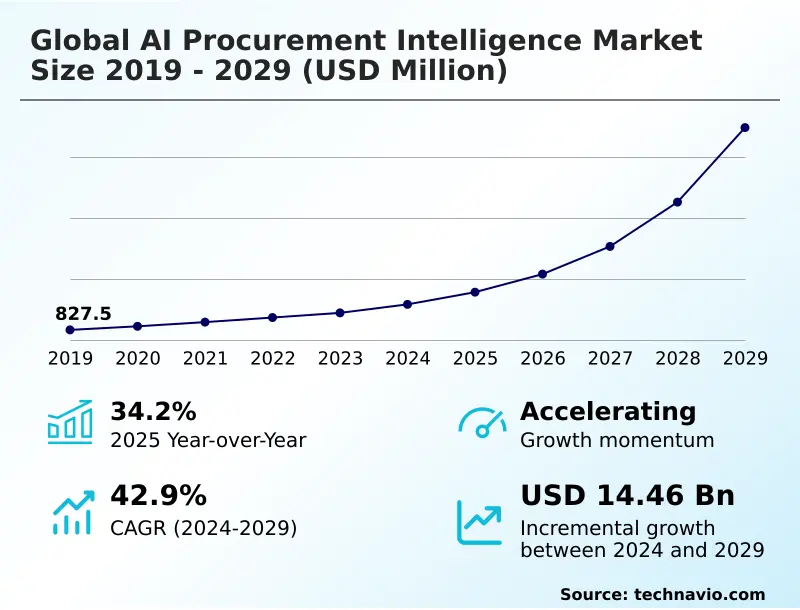
This surge highlights a widespread industry transition toward agentic workflow integration
1. The Copilot Must Know The Buyer’s Intent
Building a production-ready autonomous procurement copilot requires a dedicated procurement copilot intent recognition engine. This subsystem uses semantic classifiers and natural language processing (NLP) for procurement query understanding.
Consequently, it parses unformatted phrases into explicit, transactional commands within your ERP.
- Create an RFQ: The user types an intake request, triggering an autonomous procurement workflow orchestration loop.
- Compare Quotes: The system ingests external vendor bid documents to activate an AI bid evaluation copilot software pipeline.
- Check Supplier Status: It searches your supplier portal copilot integration to verify compliance credentials.
- Draft a PO: The copilot extracts line-item details to execute natural language PO creation automation.
Therefore, this processing ensures that your underlying model never acts on ambiguous assumptions.
2. The Copilot Must Know The Procurement Object
Your engineering team must map your business logic into a structured data taxonomy. This separates purchase requisitions (PR), purchase orders (PO), requests for quotes (RFQ), requests for proposals (RFP), agreements, and invoices.
Furthermore, each specific object must be bound to its respective facility, cost center, and unique approval routing tree.
- PR vs. PO Tracking: The architecture maintains separate state machines to avoid transaction duplication.
- Cost Center Boundaries: Every object links programmatically to a specific department budget, preventing unauthorized spend classification.
- Catalog vs. Off-Catalog: The system instantly differentiates structured catalog search entries from complex, off-contract line items.
- Approval Tree Mapping: Object parameters determine whether a document targets an advanced intelligent approval routing copilot path.
As a result, developers avoid broken object states during multi-system orchestration loops.
3. The Copilot Must Know The Current System State
A text-only large language model cannot track real-time changes in dynamic enterprise databases. Therefore, your deployment requires a continuous synchronization layer that exposes supplier onboarding status, contract expiration dates, and budget availability.
Without this real-time system state data, the copilot will inadvertently reference expired pricing or suggest unverified, uncredentialed vendors.
- Onboarding Verification: The model checks whether a vendor is active before drafting a transaction.
- Contract Lifecycles: It queries the contract management copilot integration to pull exact volume tiers.
- Real-Time Budgets: The tool verifies remaining quarterly budget allocations within SAP or Oracle.
- Invoice Mismatch Flags: It evaluates line-item pricing against open POs to catch immediate billing variations.
Consequently, your copilots always evaluate user inputs against the live production environment.
4. The Copilot Must Know What It Is Allowed To Do
To deploy safely, engineers must implement role-based procurement copilot access control directly inside the model’s orchestration loop.
This mechanism explicitly dictates what actions are fully automated, what require manual sign-off, and what are completely blocked. Defining these structural guardrails prevents costly security compromises and unauthorized corporate spend.
- Read-Only Operations: Searching internal knowledge bases requires no external transaction permissions.
- Draft-Only Actions: The copilot generates contract drafts, leaving them as pending reviews inside your system.
- Approval Requirements: High-value transactions trigger an automated, human-in-the-loop procurement copilot design sequence.
- Blocked Transactions: The system instantly halts any attempt to alter bank account routing numbers.
Thus, safety is managed by hardcoded rules rather than unpredictable prompts.
5. The Copilot Must Know When To Stop
Although generative AI can automate most sourcing tasks, complex processes like full request for proposal (RFP) evaluations cannot run entirely on autopilot.
This is because complex enterprise sourcing demands human nuance, strategic scope adjustments, and final stakeholder risk alignment. Knowing exactly when to halt automation and transfer control to a human buyer prevents catastrophic sourcing errors.
- Scope Judgment: Evaluating highly customized engineering or clinical services requires human domain experience.
- Stakeholder Review: Aligning multiple internal department heads around a final vendor choice remains a human process.
- Risk Evaluation: Assessing subjective supplier political positions or geographic supply chain vulnerabilities needs manual oversight.
- Final Vendor Selection: The system presents structured bid comparisons, allowing human executives to make final choices.
Therefore, your system design must focus on building precise friction points where the agent hands off cleanly to your sourcing team.
Contextual awareness is the dividing line between an expensive toy and a production-ready enterprise tool.
Indeed, independent engineering studies show that 88% of AI proofs of concept fail to scale into operational production because they lack real-world operational context.
The Enterprise Procurement Copilot Architecture
A production-ready enterprise procurement copilot architecture must operate across an integrated eight-layer cognitive stack. Specifically, this blueprint transforms a probabilistic, hallucination-prone large language model into a highly deterministic, safe corporate intelligence engine.
Each independent layer isolates a critical operational risk, preventing unsafe purchase actions, protecting sensitive data boundaries, and enforcing multi-system orchestration compliance.
Architectural Core: The Eight-Layer Cognitive Procurement Stack
| Layer | Technical Blueprint Name | Operational Responsibility | Enterprise Risk Mitigated |
| Layer 1 | Conversational Procurement Interface | Manages inbound multi-channel data ingestion (Teams, Slack, portal, email, and voice-enabled procurement copilot development). | Disjointed intake and fragmented user adoption. |
| Layer 2 | Identity, Role, and Permission Layer | Enforces single sign-on (SSO), role-based procurement copilot access control, and facility-specific spend limits. | Unauthorized transactions and corporate data leaks. |
| Layer 3 | Intent Recognition Engine | Uses NLP procurement query understanding and procurement copilot context management to classify tasks. | Misinterpreted user goals and execution routing failures. |
| Layer 4 | RAG Procurement Knowledge Base | Houses vector databases containing corporate purchasing policies, active contracts, and GPO agreements. | Hallucinated compliance answers and stale pricing data. |
| Layer 5 | Procurement Knowledge Graph | Maps complex relational entities including parents, suppliers, SKUs, facilities, and dynamic policy rules. | Disconnected system context and broken data lineages. |
| Layer 6 | Multi-Agent Procurement System | Orchestrates task-specific agents (Intake, RFQ, Contract, Compliance, Reporting) to resolve workflows. | Monolithic model bottlenecks and reasoning breakdowns. |
| Layer 7 | Tool-Using Workflow Layer | Connects the system to transactional APIs for ERP updates, PO generation, and CLM lookups. | Read-only limitations and manual execution bottlenecks. |
| Layer 8 | Governance and Audit Layer | Generates immutable execution logs, tool-call histories, model drift tracking, and reviewer edits. | Regulatory non-compliance and un-auditable AI drift. |
Forward-thinking technology leaders must build a multi-layered middleware architecture rather than deploy isolated, superficial chat overlays.
Designing this structural depth ensures that every automated transaction is securely validated, completely authenticated, and fully auditable across your entire supply chain ecosystem.
Build The RAG Knowledge Base Before Building Agents
An autonomous procurement copilot must never answer requests directly from its static base model memory. Instead, developers must engineer a retrieval-augmented generation (RAG) architecture that forces the system to pull facts from validated internal repositories.
Consequently, this design provides a deterministic data source base, entirely neutralizing hallucinations before an agent triggers a purchase action.
- Diverse Document Ingestion: The RAG layer unifies unstructured supplier files, active contracts, GPO pricing structures, internal policy playbooks, and critical regulatory documents like Business Associate Agreements (BAAs).
- ERP Document Processing: Advanced parsers ingest complex SAP exports to isolate table structures, extracting raw line-item quantities, units of measure (UOM), precise pricing columns, and delivery terms automatically.
- Structured Metadata Tagging: Every chunked vector is mapped with specific structural keys, including supplier ID, contract expiration dates, facility locations, and regional version numbers to ensure contextual tracking.
- Hybrid Search Routing: The retrieval pipeline fuses keyword matching with dense semantic vector searches. Furthermore, it applies hard metadata filters and cross-encoder reranking to ensure precise source citations.
- Temporal Context Filtering: The architecture uses document hierarchy flags to instantly suppress expired or superseded agreements. As a result, older, invalid contract data never pollutes active automated workflows.
Implementing a robust knowledge architecture is a non-negotiable prerequisite to deploying functional multi-agent automations. By grounding your language models in structured, real-time enterprise data, you establish an ironclad foundation for safe supply chain decision-making.
Design The Multi-Agent Procurement Copilot System
A multi-agent procurement copilot must split enterprise workflows into narrow, task-specific agents instead of relying on a single, monolithic large language model brain.
Specifically, this distributed architectural design assigns one defined operational responsibility, an explicitly restricted toolset, bounded retrieval parameters, and custom escalation rules to each distinct node.
Consequently, this engineering structure expands your system’s processing capabilities while safely preventing any single agent from wielding uncontrolled or un-auditable corporate purchasing power.
- Intake Agent for Guided Buying: This system captures ambiguous user requests, enforces category rules, matches internal catalog inventory, validates budget codes, and automatically drafts purchase requisitions.
- RFQ Agent for Supplier Quote Collection: The agent initiates requests for quotes, structures standardized communication templates, tracks supplier responses, and extracts data fields to prepare for immediate cross-vendor comparison.
- RFP Agent for Drafting and Review: It accelerates proposal drafting by reusing past enterprise templates, inserting strict statement-of-work (SOW) fields, and executing automated workflows for cross-functional legal and operations reviews.
- Bid Evaluation Agent for Response Scoring: This engine ingests irregular supplier Excel attachments, normalizes uneven pricing matrices, applies custom weighted matrices, and calculates average stakeholder scores while flagging missing details.
- Contract Agent for Clause Review: The module scans legal text to isolate payment timelines, identify renewal windows, evaluate termination rights, score liability exposures, and flag non-standard service level agreements (SLAs).
- Supplier Risk Agent for Compliance Checks: This component continuously reviews vendor insurance terms, tracks active regulatory certifications, evaluates financial health indices, and validates security paperwork, including SOC 2 reports and BAAs.
- AP Exception Agent for Invoice Matching: It handles automated procure-to-pay adjustments by identifying duplicate billing, flagging price variances, detecting missing receipts, and routing unmatched purchase order exceptions to human operators.
Segmenting your system logic into a collaborative multi-agent architecture is essential for deploying reliable supply chain automations.
According to recent Gartner supply chain technology trend research, collaborative multi-agent systems are emerging as a vital framework to automate complex, multistep enterprise processes while maintaining rigorous governance.
Core Features For The First Procurement Copilot MVP
The first procurement copilot MVP must prioritize high-volume, rules-bound workflows that feature explicit human review paths. By focusing engineering resources on transactional tasks rather than broad, unconstrained strategic choices, development teams can validate system performance safely.
This precise target approach proves measurable operational value immediately while strictly eliminating the risk of unauthorized corporate spend.
Functional Scope of the Procurement Copilot Minimum Viable Product (MVP)
| Feature Pillar | Technical MVP Deliverable | Core Integration Target | Operational Success Metric |
| Policy Q&A Engine | Dense vector search across buying playbooks, approval thresholds, and preferred supplier rules with precise source citations. | Document Management System / Vector Database | Zero hallucinated answers on standard purchasing limits. |
| Guided Buying Copilot | Semantic routing interface that directs requesters toward contracted inventory, active GPO options, and the correct facility approval paths. | Internal Item Master / Catalog Indexes | Greater than thirty percent reduction in off-contract maverick spend. |
| Natural Language PO Drafting | NLP parser that extracts item descriptions, line quantities, and facility codes from text blocks to generate clean ERP draft schemas. | ERP / P2P Transactional APIs (SAP, Oracle) | Complete elimination of manual form data entry for standard requests. |
| RFQ/RFP Generation | Modular drafting assistant that maps raw technical requirements and statement-of-work fields into predefined corporate sourcing templates. | Sourcing Application Suite / CLM | Less than a forty-eight-hour cycle time to generate compliant supplier bids. |
| Quote Comparison Engine | Data normalization utility that pulls irregular line-item variables from unstructured supplier Excel and PDF sheets into flat comparison views. | Document Extraction Pipeline (OCR / LLM) | Ninety percent reduction in manual data-entry collation timelines. |
| Contract Lookup Module | Read-only semantic query mechanism providing instant verification of termination parameters, renewal windows, and active payment terms. | Contract Lifecycle Management (CLM) Database | Instant clause verification with exact section and line-number links. |
| Intelligent Approval Routing | Deterministic business rules engine that maps multi-tier approvers based on calculated spend values, cost centers, and asset risk classification. | Workman Approval Workflows / Active Directory | Zero missed executive sign-offs across cross-departmental transactions. |
Designing an initial deployment around structured, read-and-draft tasks establishes immediate user trust without introducing transaction risk.
Consequently, this strict boundary keeps human buyers firmly in control while the core machine learning models continuously refine their underlying contextual accuracy.
Integrate The Copilot With Procurement Systems
A procurement copilot becomes useful only when it connects to the systems where procurement work already happens. Specifically, your integration layer must read data, write drafts, trigger workflows, and log every action across your existing IT infrastructure.
Consequently, this deep technical connection converts a basic conversational interface into a powerful transaction engine.
- SAP Procurement Copilot API Integration: The architecture uses secure endpoints to extract real-time purchase orders, track goods receipts, verify cost centers, and pull active master vendor data.
- Oracle Procurement Copilot Integration: This layer monitors live financial controls, triggers automated budget availability checks, and synchronizes purchasing documents directly across core accounting modules.
- Workday Procurement AI Copilot Integration: The integration orchestrates complex corporate spend requests, validates internal workforce-related purchasing limits, and automatically updates multi-tier department approval fields.
- P2P Platform Copilot API Integration: It connects directly with systems like Coupa and Ariba to automate catalog sourcing events, ingest supplier onboarding documentation, and manage high-volume transactional approval queues.
- Contract Management Copilot Integration: The system interfaces with your CLM repository to extract legal clauses, monitor active supplier obligations, and broadcast automated upcoming contract renewal alerts.
- Supplier Portal Copilot Integration: This pathway automates vendor interaction by pulling inbound bid submissions, verifying active compliance certifications, and ingesting unstructured supplier messaging logs.
- Microsoft Copilot Studio Procurement Integration: Developers build Teams-native front-end layouts for user communication while anchoring the heavy backend processing inside custom-built procurement agents.
True procurement automation requires deep integration with your transactional core. Consequently, independent technology reviews confirm that nearly 70% of enterprise digital transformation projects succeed only when platforms integrate smoothly with legacy systems.
Guardrails Decide Whether The Copilot Is Safe Enough To Use
Guardrails decide what the procurement copilot can see, say, recommend, and execute. Specifically, the system needs source citations, permission checks, tool limits, human approval, prompt injection defense, and immutable audit trails.
Without these strict programmatic controls, it can hallucinate non-existent contract terms, expose confidential supplier pricing, or trigger highly unsafe purchasing actions.
- Human-in-the-Loop Approval Design: The system configures strict approval thresholds based on spend values, supplier risk tiers, specific facility regulations, and total healthcare regulatory procurement copilot compliance impact.
- Tool Permission Design: Therefore, engineers strictly segregate system actions into distinct read-only lookups, draft-only generation pipelines, approval-required executions, and completely blocked master-data modifications.
- AI Hallucination Prevention Procurement Copilot: Furthermore, the model uses strict RAG citations, enforces high confidence scoring thresholds, mandates structured JSON outputs, and forces “cannot verify” text fallback responses.
- Supplier Document Prompt Injection Defense: Consequently, the ingestion pipeline treats external supplier PDFs, Excel bid files, and incoming emails as completely untrusted inputs to block malicious data overrides.
- Procurement Copilot Output Validation Framework: As a result, a deterministic validator confirms supplier names, calculated pricing arrays, quantities, contract IDs, item numbers, tax fields, and final approval paths before transmission.
- Procurement Copilot Audit Trail and Logging: Ultimately, the governance stack logs raw prompts, retrieved vector sources, the user’s role, tool-call payloads, approvals, rejections, edits, and final downstream ERP system updates.
Ironclad guardrails are the only mechanism that converts unpredictable AI into a safe, auditable financial system.
Consequently, the industry security telemetry indicates that 80% of enterprise AI adoptions mandate automated verification layers to mitigate severe operational hallucinations and protect corporate transactional security.
How To Build A Procurement AI Copilot In Clear Phases
The safest way to build a procurement AI copilot is to move from workflow discovery to data architecture, RAG, MVP workflows, integrations, guardrails, testing, and rollout. Specifically, this strategic sequence keeps the development team from building a polished chat interface before underlying procurement rules and system permissions are ready.
Consequently, this phase-based roadmap mitigates technical debt and protects enterprise data assets.
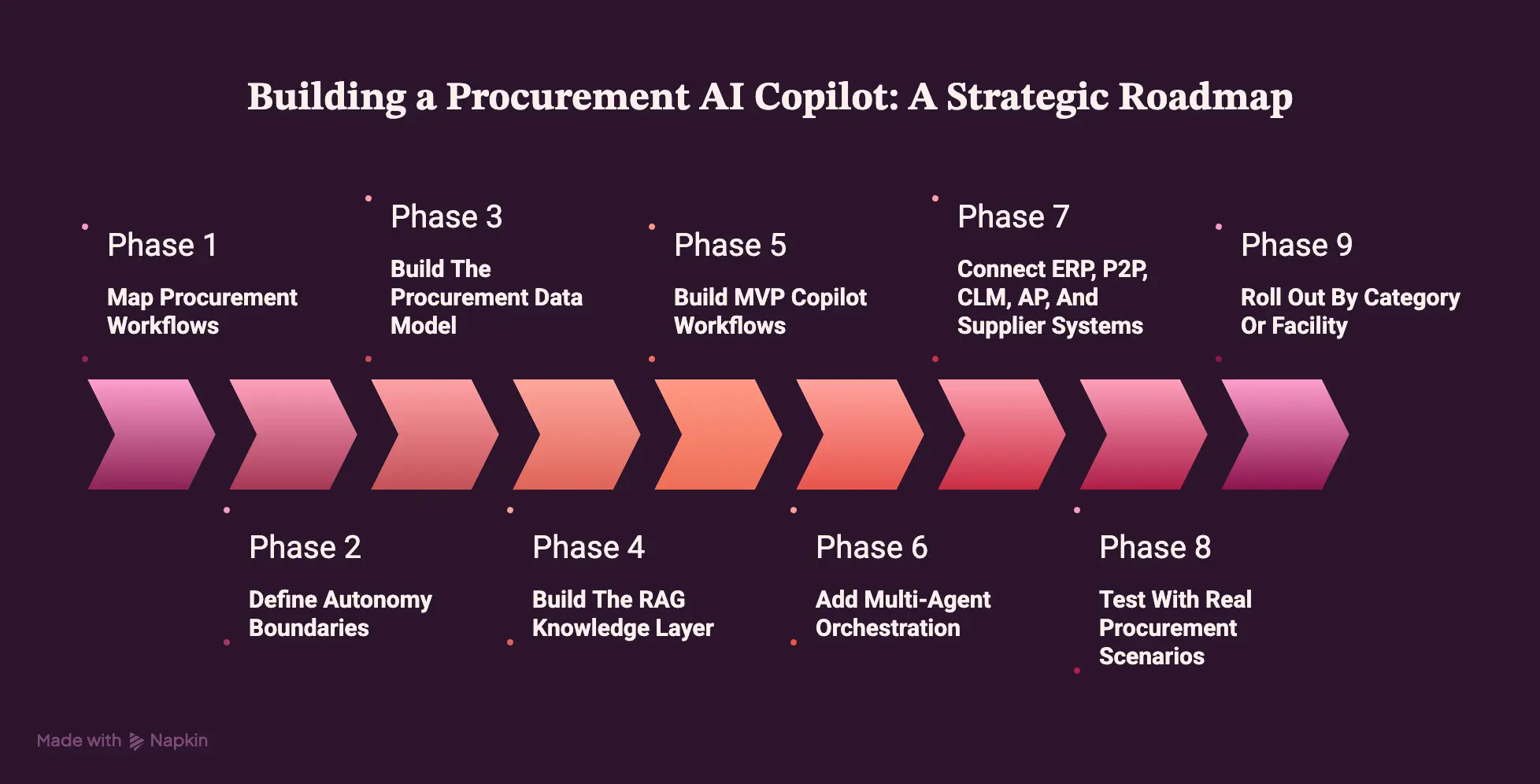
Phase 1: Map Procurement Workflows
Your engineering project must begin by thoroughly documenting your current supply chain bottlenecks. Specifically, you must map guided buying, sourcing, RFQs, RFPs, contracts, supplier onboarding, PRs, POs, invoices, renewals, and supplier risk tracking.
- Process Ingestion: Analyze manual operational touchpoints across all procurement departments.
- Bottleneck Identification: Isolate tasks where human buyers spend hours copying data between tools.
- Data Flow Mapping: Trace exactly how a purchase request transitions from entry to approval.
Phase 2: Define Autonomy Boundaries
Before writing code, your system architects must establish concrete operational limits. Therefore, you must decide exactly what the copilot can answer, draft, recommend, route, trigger, escalate, and never do.
- Deterministic Guardrails: Hardcode constraints preventing the AI model from making independent financial approvals.
- Escalation Logic: Program exact rules for when a task requires human intervention.
- Action Classification: Explicitly separate risk levels for lookups versus write-back database calls.
Phase 3: Build The Procurement Data Model
A robust taxonomy is mandatory for processing complex transactional objects. For this reason, engineers create entities for supplier, item, category, facility, contract, PR, PO, RFQ, RFP, invoice, approver, risk, and audit event data.
- Unified Graph Design: Link unrelated legacy software database tables into a single conceptual framework.
- State Machine Creation: Build backend trackers that closely monitor every stage of a purchase order lifecycle.
- Metadata Property Standardization: Define key-value pairs for tracking facility numbers and regional cost centers.
Phase 4: Build The RAG Knowledge Layer
Your language models need immediate access to your internal corporate playbooks to provide accurate answers. Accordingly, you must ingest policies, contracts, supplier records, templates, category playbooks, SOPs, GPO files, and compliance documents.
- Advanced Document Parsing: Use specialized pipelines to extract table matrices from complex PDFs.
- Vector Database Indexing: Store chunked text blocks using precise semantic embedding models.
- Hybrid Search Engineering: Combine traditional keyword matching with deep semantic vector lookups.
Phase 5: Build MVP Copilot Workflows
With the knowledge layer established, you can safely deploy your initial set of features. Specifically, start with policy Q&A, guided intake, RFQ drafting, quote comparison, contract lookup, and PO draft generation.
- Read-Only Deployment: Focus first on low-risk retrieval functions that do not write back to production systems.
- Draft Automation: Create workflows where the model generates purchase orders but keeps them pending human verification.
- Contextual Assistance: Allow buyers to query contract terms using standard conversation.
Phase 6: Add Multi-Agent Orchestration
As your platform scales, you must transition from a single chat model to a distributed network. Thus, add sourcing, contract, supplier risk, compliance, AP exception, and reporting agents.
- Task Specialization: Dedicate individual micro-agents to handle narrow, highly regulated operational processes.
- Agentic Routing: Implement message brokers that route tasks to the appropriate agent based on user intent.
- Inter-Agent Communication: Allow nodes to pass structured JSON data schemas between one another.
Phase 7: Connect ERP, P2P, CLM, AP, And Supplier Systems
Your system transforms from an informational assistant into an executable automation tool during this phase. Therefore, use APIs, middleware, event triggers, identity controls, and system-specific validation hooks.
- Secure API Orchestration: Build connection adapters for SAP, Oracle, Workday, and major P2P software.
- Token Authentication: Enforce individual user permission layers directly at the API gateway layer.
- Asynchronous Processing: Use message queues to handle heavy transaction loads without timing out.
Phase 8: Test With Real Procurement Scenarios
Engineers must subject the platform to stressful adversarial testing before launching into production. Specifically, use messy RFQ PDFs, supplier Excel files, expired contracts, non-approved vendors, duplicate invoices, and policy exceptions.
- Injection Vulnerability Audits: Attempt to override core system guardrails using malicious prompt text.
- Data Discrepancy Challenges: Feed mismatched invoice-to-PO files to verify that the system catches pricing variations.
- Performance Benchmarking: Validate text extraction accuracy and intent recognition precision across diverse files.
Phase 9: Roll Out By Category Or Facility
A sudden enterprise-wide rollout can introduce severe operational friction. Instead, start with one category, one facility, or one procurement workflow before launching an enterprise-wide rollout.
- Pilot Selection: Choose a single low-risk inventory category to run initial live testing.
- Feedback Integration: Gather continuous direct commentary from human buyers to refine system performance.
- Phased Scaling: Gradually expand access to additional manufacturing facilities or clinical networks.
Adhering to a highly structured, phase-based development approach protects your organization from critical architectural vulnerabilities. By methodically layering your data foundation before connecting active transactional tools, you ensure your platform delivers sustainable enterprise value.
AI Procurement Copilot Development Cost Breakdown
AI procurement copilot development usually costs $70,000 to $300,000, depending on workflow scope, integration depth, RAG complexity, agent autonomy, compliance controls, and SaaS architecture. Specifically, a focused MVP costs $70,000–$120,000, while an enterprise-grade autonomous procurement assistant costs $180,000–$300,000.
Real-world implementation data show that custom enterprise AI agent deployments consistently fall within this capital range depending on backend complexity.
Capital Allocation Across Development Phases
| Development Phase | Cost Range |
| Discovery, workflow mapping, and autonomy boundary design | $8,000–$15,000 |
| Data model, architecture, and security design | $12,000–$25,000 |
| RAG knowledge base and document processing | $15,000–$35,000 |
| Copilot UI and conversational workflow | $12,000–$28,000 |
| RFQ, RFP, quote comparison, and PO draft MVP | $20,000–$45,000 |
| Multi-agent orchestration and tool-calling layer | $25,000–$55,000 |
| ERP, P2P, CLM, AP, and supplier integrations | $25,000–$65,000 |
| Guardrails, audit logs, evals, and compliance controls | $18,000–$40,000 |
| Deployment, UAT, monitoring, and rollout | $10,000–$25,000 |
MVP Build Cost: $70,000–$120,000
This foundational tier focuses on automating high-volume information workflows with human-in-the-loop oversight. Specifically, it covers policy Q&A, guided buying, RFQ/RFP drafting, quote comparison, contract lookup, and 1 or 2 core integrations.
- Read-Only Data Access: The system references internal policy files and active vendor contracts without executing direct write-back API calls.
- Draft-Only Sourcing generation: The interface builds structured template files for quotes and proposals, leaving final submission to human buyers.
- Accelerated Release Timelines: Software teams bypass extensive multi-system orchestration logic to launch a functional framework within 60 days.
Enterprise Build Cost: $180,000–$300,000
This production tier introduces multi-system transaction execution across deeply integrated corporate environments. Therefore, it covers multi-agent orchestration, SAP or Oracle integration, CLM/AP workflows, audit controls, healthcare or fintech compliance, and production monitoring.
- Write-Back API Integrations: The agents securely interface with core transaction layers to alter real-time database records under strict rules.
- Custom Governance Modules: Engineering teams construct advanced verification layers to isolate sensitive regulatory environments like HIPAA or DORA.
- Adversarial Security Layers: The system employs real-time verification filters to intercept malicious injections found within third-party vendor documents.
AI Procurement Copilot SaaS Development Cost
Building a multi-tenant platform requires additional infrastructure to support isolated business clients simultaneously. Specifically, a white-label SaaS platform needs tenant isolation, admin controls, usage tracking, billing, role permissions, model routing, and customer-specific knowledge bases.
- Row-Level Tenant Isolation: Cryptographic security boundaries prevent independent customer accounts from viewing overlapping vector database chunks.
- Metered Consumption Monitoring: Built-in tracking tools log precise API token usage metrics across distinct tenant workflows for automated billing.
- Dynamic Access Administration: Super-admins configure bespoke role permissions and model selection behaviors for unique subscription tiers.
Ongoing Maintenance Cost
Organizations must budget for systematic post-launch upkeep to protect software stability. Consequently, use 15%–25% of the initial build per year for model monitoring, retrieval updates, integration changes, security patches, eval refreshes, and workflow improvements.
- Model Performance Audits: Software teams actively monitor intent classification scoring models to mitigate semantic drift over time.
- API Boundary Adjustments: Engineers refactor system connection adapters when core legacy ERP vendors update their standard integration endpoints.
- Vector Database Syncing: The underlying index gets regularly re-processed as internal buying playbooks and compliance rules update.
Strategic budgeting for an agentic procurement tool requires balancing initial development costs against long-term maintenance cycles. By mapping out specific software boundaries early, software leaders can secure clear ROI metrics while completely containing financial risk.
Build Autonomous Procurement Copilot Software With Intellivon
Build autonomous procurement copilot software with Intellivon when your enterprise needs more than a generic procurement chatbot. Intellivon is the dedicated engineering partner for RAG, multi-agent workflows, ERP/P2P integrations, healthcare procurement controls, fintech vendor risk, and production-grade AI governance.
Specifically, we deliver technically rigorous, compliance-ready platforms built to perform in live transactional environments.
Why Hire Intellivon
- Architecture-First Build: We engineer your system from the data layer up by deploying a robust RAG knowledge base, a structured procurement knowledge graph, multi-agent orchestration, tool permissions, audit logs, and workflow state management.
- RFQ and RFP Automation: The platform eliminates manual administrative friction by executing automated messy SAP PDF cleanup, supplier Excel collation, RFQ drafting, modular RFP templates, bid comparison matrices, stakeholder scoring averages, and quote normalization.
- Healthcare Procurement Depth: For highly regulated healthcare systems, our deployments embed specialized features including dynamic GPO pricing matching, automated BAA tracking, PHI-safe workflows, real-time vendor credentialing, clinical category rules, formulary workflows, and FDA/QMSR supplier controls.
- Fintech Workflow Control: To protect institutional capital, the platform enforces strict AP automation, continuous vendor risk tracking, automated SOC 2 evidence compilation, real-time DORA checks, AI contract review, third-party risk mapping, and invoice fraud detection filters.
- AI with Guardrails: We secure the model interaction loop by implementing multi-layered prompt injection defense, strict hallucination prevention, mandatory source citations, human-in-the-loop (HITL) approvals, downstream output validation frameworks, model drift monitoring, and automated MLOps pipelines.
- Enterprise Integrations: The platform connects natively into your existing enterprise software ecosystem including SAP, Oracle, Workday, Coupa, Ariba, Jaggaer, Ivalua, CLM databases, AP ledgers, external supplier portals, Microsoft Teams, corporate SSO, and spend analytics suites.
- Build Clarity: We guide your product roadmap transparently through a phased execution plan that encompasses initial MVP scope, phased enterprise rollout, multi-tenant SaaS architecture design, systems integration, and long-term maintenance planning within a predictable $70,000–$300,000 range.
- Production Proof: Our development success is anchored by elite, expert-led engineering squads composed of ex-MAANG engineers who bring more than 500,000 combined engineering hours in building HIPAA-ready architecture, customized AI agents, private LLM systems, and complex enterprise integration pipelines.
Talk to Intellivon’s AI procurement experts to scope your copilot architecture, estimate your build cost, and decide whether custom development is the right move.
Conclusion
Deploying a production-ready autonomous procurement copilot requires shifting from simple conversational interfaces to a multi-layered, deeply integrated technical stack.
Specifically, by anchoring your software architecture in a structured data taxonomy, robust retrieval-augmented generation networks, and deterministic execution boundaries, you neutralize severe compliance and hallucination risks.
Ultimately, this systematic blueprint converts advanced language model capabilities into a safe, highly auditable transactional tool that drives measurable, long-term supply chain value.
FAQs
Q1. Can AI Actually Help Procurement, Or Is It Mostly Hype?
A1. AI helps significantly when it targets specific manual work, such as RFQ drafting, supplier quote comparison, contract lookup, PO drafting, and invoice exception routing. Conversely, it fails when vendors sell broad, unintegrated platforms without system tools. Therefore, market skepticism exists because many buyers only see isolated demos rather than production systems.
Q2. Can AI Automate RFQ And RFP Writing?
A2. AI can draft RFQs and RFPs, reuse templates, structure supplier questions, and prepare first-pass documents. However, procurement and operations teams still need to review scope, technical requirements, evaluation criteria, and final language. Consequently, sourcing experts correctly warn that complex proposals fundamentally require human input and business judgment.
Q3. Can A Copilot Compare Supplier Quotes From Excel Files?
A3. Yes, if the system extracts supplier responses into structured fields first. Specifically, the copilot should collate Excel files, normalize units, compare price and delivery terms, share scorecards with stakeholders, average scores, and flag missing fields. As a result, this directly solves a widespread enterprise pain point around manual bid response collation.
Q4. Can A Copilot Clean Messy SAP RFQ Or PR PDFs?
A4. Yes, but it needs document extraction, table parsing, validation, and human review. Messy ERP/SAP PDFs often need quantity, UOM, pricing, item description, and delivery fields converted into clean Excel or structured RFQ data. Thus, this should be a core minimum viable product feature, not an afterthought.
Q5. Can A Copilot Create Purchase Orders Automatically?
A5. Yes, but only under strict conditions. Low-risk PO drafts can be generated automatically, but final submission should depend on spend limits, supplier status, budget validation, contract coverage, and approval thresholds. Furthermore, high-risk spend should always require multi-tier human approval.
Q6. Should We Build Or Buy A Procurement AI Copilot?
A6. Buy when you need simple drafting, policy Q&A, or standard productivity features. On the other hand, build when you need regulated procurement workflows, ERP/P2P actions, GPO logic, vendor risk metrics, quote normalization, immutable audit trails, and custom approval routing.
To Sum Up
- Procurement copilots fail when they answer questions without knowing contract status, supplier risk, approval rules, and ERP state.
- The first useful MVP is not “autonomous procurement.” It is RFQ drafting, messy document cleanup, quote comparison, contract lookup, and approval routing.
- Healthcare procurement copilots need GPO, PHI, BAA, vendor credentialing, and clinical category logic from sprint one.
- Fintech procurement copilots need vendor risk, SOC 2, DORA, contract controls, and AP fraud checks built into the workflow.
- A $70,000 MVP can prove value, but enterprise autonomy needs RAG, integrations, HITL controls, audit logs, and evaluation before scale.