Key Takeaways:
-
Unified treasury platforms connect bank accounts, ERP data, payment rails, FX exposures, and compliance workflows.
-
Bank API and SWIFT connectivity, ISO 20022 support, and real-time cash visibility are foundational requirements.
-
AI cash flow forecasting, payment hub workflows, hedge accounting controls, and audit-ready reporting define production capabilities.
-
Focused MVPs cost $70,000 to $120,000, while production enterprise builds reach $180,000 to $300,000.
-
How Intellivon builds unified treasury platforms as secure financial infrastructure with AI, MLOps, and role-based controls.
Managing cash across dozens of banking relationships in multiple currencies is a data consolidation problem first. Creating a unified treasury platform starts with the bank connectivity and data aggregation layer. That layer pulls real-time balances from every banking relationship into a single normalized data feed. From there, AI cash forecasting, FX risk management, and liquidity optimization all build on that foundation.
Without bank connectivity in place first, AI forecasting models run on stale, incomplete data. As a result, FX hedges and cash positions reflect yesterday’s reality rather than today’s. Deloitte’s 2024 Treasury Survey found 58% of treasury teams rank cash visibility as their top challenge. Building bank connectivity as the foundation is therefore what makes real-time visibility achievable.
This guide builds the unified treasury platform the way Intellivon approaches it for healthcare and financial services. The approach always starts with SWIFT connectivity and multi-bank data normalization before any forecasting model is built. This blog covers bank connectivity architecture, AI forecasting models, FX risk management, and regulatory compliance surrounding the development of this platform.

What Is A Unified Treasury Platform For Enterprises?
A unified treasury platform is a single, centralized software system that consolidates an enterprise’s fragmented cash management, payment processing, banking connectivity, and financial risk monitoring into one interface.
Instead of relying on isolated spreadsheets and disconnected bank portals, the platform aggregates real-time data from all corporate bank accounts, entities, and enterprise resource planning (ERP) systems.
This architecture gives finance leaders immediate visibility over global cash positions, automates cross-border payment workflows, and runs predictive liquidity models to mitigate foreign exchange and interest rate risks safely.
What Treasury Functions Should Sit Inside One Platform
A unified treasury platform consolidates your entire capital lifecycle to eliminate manual data aggregation and visibility blind spots.
At the same time, bringing these operations into one infrastructure allows finance teams to automate core cash movements and protect enterprise liquidity.
- Cash Visibility & Forecasting: Aggregates real-time cash position management software data across multi-bank account management software setups.
- Payment Factory & Banking: Connects a centralized payment hub treasury platform development plan directly to SWIFT connectivity treasury platform pipelines.
- FX Exposure & Hedge Accounting: Tracks real-time currency fluctuations and manages ASC 815 hedge accounting platform compliance automatically.
- Liquidity & Pooling: Automates physical cash pooling and notional pooling software development rules across multiple global subsidiaries.
- Investments & Debt: Monitors short-term investment optimization software limits, money market funds, and hospital network liquidity management platform debt instruments.
- Intercompany Lending & Reporting: Manages intercompany lending and netting platform balances while delivering automated board-level treasury reporting module outputs.
Why ERP Alone Cannot Solve Treasury Operations
Enterprise Resource Planning (ERP) systems function as excellent historical sub-ledgers, but they lack the real-time rails needed for active liquidity management.
At the same time, while an ERP tracks invoices and historical accounting data, it cannot actively manage intraday bank liquidity or volatile market risks.
- Static vs. Real-Time Data: ERP systems rely on batch processing, whereas treasury requires real-time cash position management software updates.
- Fragmented Bank Connectivity: ERPs require complex, static custom development for each bank, failing to offer open banking API treasury integration natively.
- Advanced Risk Vulnerability: Traditional general ledgers cannot compute complex AI FX hedging strategy optimization models or manage shifting commodity price risks.
- Manual Forecast Building: ERP cash flow forecasting AI platform modules lack machine learning treasury forecasting engine capabilities to run automatic variance analysis.
An ERP acts as your company’s financial rearview mirror, but a unified treasury platform provides the real-time windshield. At the same time, true liquidity control requires moving beyond historical accounting records into automated, multi-bank cash orchestration.
Why Enterprises Are Building Unified Treasury Infrastructure Now
Enterprise financial operations have reached a tipping point where legacy, disconnected applications can no longer handle macroeconomic shifts safely.
Therefore, escalating regulatory scrutiny, volatile currency markets, and decentralized business structures are driving corporate leaders to re-engineer their capital infrastructure completely.
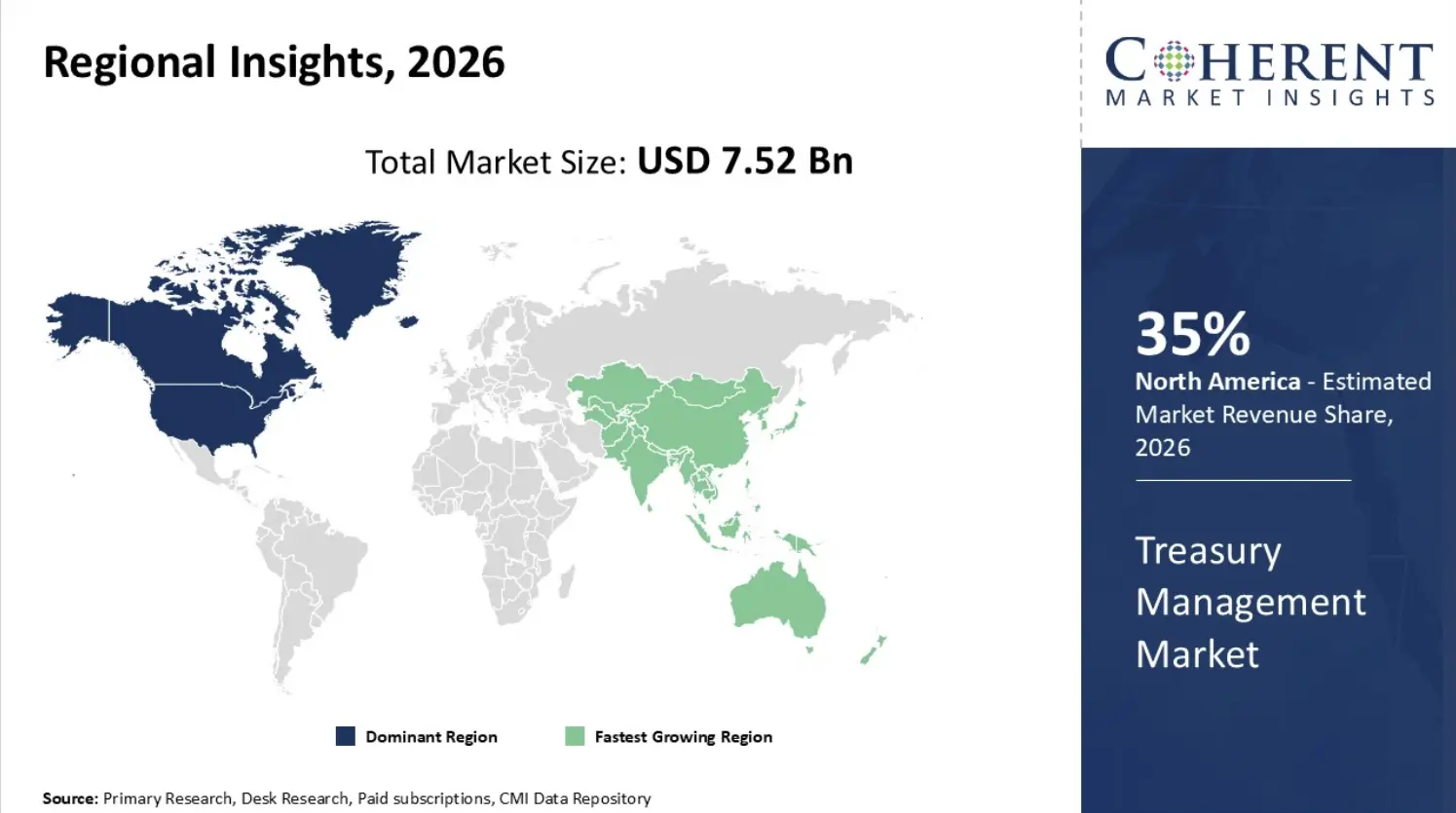
The global market clearly reflects this urgency, with the Treasury Management System Market Size projected to reach $7.52 billion in 2026 and surge to $18.83 billion by 2033, exhibiting a compound annual growth rate (CAGR) of 14.0%.
1. Treasury Data Still Lives Across Too Many Systems
Corporate cash information remains highly fragmented across a maze of disconnected internal networks and standalone enterprise applications.
As a result, relying on disconnected platforms forces finance teams to pull data manually from disparate core systems.
- Siloed Core Databases: Financial positions remain trapped within disconnected operational segments and isolated subsidiaries.
- Manual Sheet Dependency: Teams default to offline spreadsheet calculations, creating operational risks and breaking version control.
- Delayed Cash Visibility: Fragmentation across regional offices slows corporate capital aggregation down to weekly batch updates.
2. Real-Time Liquidity Has Become A Board-Level Requirement
Waiting days or weeks to understand global cash positions is no longer an option for corporate finance leaders.
Therefore, modern CFOs now expect to view their exact group liquidity positions instantly to make rapid, strategic funding adjustments.
- Intraday Cash Visibility: Leaders require dynamic balance tracking across all active accounts to prevent liquidity lockups.
- Strategic Capital Deployment: Immediate access allows treasurers to sweep idle balances into high-yield accounts instantly.
- Accelerated Executive Reporting: Board members expect real-time treasury data security and encryption design dashboards on demand.
3. Multi-Bank And Multi-Entity Operations Break Manual Treasury
Managing capital across multiple distinct subsidiaries, different time zones, and dozens of banking institutions rapidly breaks down manual workflows.
Furthermore, corporate networks scaling across global regions face extreme administrative overhead when handling hundreds of unique corporate bank accounts.
- Account Format Mismatches: Processing diverse bank statements manually creates massive data reconciliation bottlenecks.
- Inefficient Cash Concentration: Segmented banking structures leave idle capital trapped in non-interest-bearing regional entities.
- Complex Intercompany Accounting: Handling manual intercompany lending and netting platform records drives up internal compliance costs.
4. AI Forecasting Fails Without Clean Treasury Data
Deploying predictive machine learning models to optimize long-term cash positions is impossible without a standardized data foundation.
Consequently, enterprise technology teams often try to implement advanced forecasting engines directly on top of raw, unnormalized bank data streams.
- Data Code Inconsistency: Unstructured bank codes throw off predictive models and trigger false anomaly alerts.
- Flawed Predictive Baselines: Messy historical inputs undermine predictive liquidity management software and short-term cash forecasting automation accuracy.
- Model Drift Vulnerability: AI algorithms degrade quickly when digesting unvetted, erratic transactional data streams.
Uncoordinated treasury applications leave capital trapped in operational silos, turning liquidity management into a reactive guessing game. Upgrading to a unified cash infrastructure shifts your treasury from basic transaction logging to real-time asset orchestration.
Unified Treasury Platform Architecture: Core System Layers
An enterprise-grade unified treasury platform operates on a decoupled, six-layer event-driven architecture designed to transform raw financial data into secure, executable capital orchestration.
Consequently, by segregating data collection, ingestion rules, business logic engines, and compliance layers into discrete microservices, organizations can process high-volume multi-bank transactions safely without destabilizing their primary ERP records.
Architectural Layer Comparison
The table below breaks down the technical responsibilities, data types, and primary integration endpoints across the six fundamental system layers.
| Architectural Layer | Core Technical Focus | Data Formats & Protocols Handled | Primary System Endpoints |
| 1. Data Ingestion | Real-time multi-bank connectivity and data consolidation pipelines. | ISO 20022 (CAMT, PACS), SWIFT MT/MX, Open Banking APIs, SFTP. | Corporate Banks, SWIFT Network, ERP Sub-ledgers, Market Feeds. |
| 2. Data Normalization | Data translation, structural aggregation, and entity mapping. | JSON, XML, SQL Schemas, Custom ETL Pipelines. | Master Data Management (MDM), Regional General Ledgers. |
| 3. Real-Time Cash Engine | Intraday balance compilation and liquidity calculation logic. | Event Streams, In-Memory Ledger States, Key-Value Stores. | Treasury Cash Position Dashboards, Multi-Entity Consolidators. |
| 4. Payment Orchestration | Decentralized payment hub routing and automated factory rules. | RESTful APIs, Secure Webhooks, Tokenized Payload Formats. | Cleared Payment Rails, Bank Gateways, Internal Approval Workflows. |
| 5. AI & Risk Intelligence | Machine learning prediction and automated anomaly detection. | MLOps Data Pipelines, Python Vector Arrays, Analytical Models. | Risk Analytics Dashboards, Hedging Engines, Audit Warehouses. |
| 6. Governance & Security | Cryptographic compliance, RBAC limits, and internal security controls. | OAuth 2.0, SAML, TLS 1.3, AES-256, Hardware Security Modules. | IAM Providers, SIEM Systems, Regulatory Compliance Portals. |
Decoupling ingestion from your transactional execution layers keeps the core cash ledger safe from API timeouts and erratic banking downtime. This disciplined structural isolation ensures that your financial visibility remains uninterrupted during high-volume clearing cycles.
Build The Treasury Data Model Before Adding AI
Implementing advanced machine learning models without a standardized financial schema leads to broken predictions and algorithmic drift. Consequently, an enterprise must construct a rigorous relational structure that cleanses and connects fragmented transactional inputs before deploying analytical code.
True predictive intelligence depends on data structure, not math adjustments.
Core Architecture Components
- Multi-Entity Legal Mapping: Deploy multi-entity treasury consolidation software frameworks that connect global subsidiaries to a unified corporate chart. This enables seamless multi-subsidiary treasury management platform orchestration and regional treasury center platform development under one global treasury management platform design.
- Normalized Cash Flow Categorization: Standardize ledger classifications across operating, investing, financing, intercompany, payroll, vendor, tax, and grant activities. This uniform classification allows a machine learning treasury forecasting engine to trace liquid positions across highly diverse bank statement narratives.
- Treasury Master Data Layer: Centralize system records covering bank account metadata, authorized signatories, compliance limits, and FBAR/FATCA attributes. Furthermore, this layer tracks entity ownership rules and local jurisdiction compliance criteria automatically.
- Structured Forecast Ingestion: Map baseline working capital inputs, including accounts receivable (AR), accounts payable (AP), payroll cycles, debt maturities, and capital expenditures. As a result, the cash flow forecasting AI platform processes clean structural data to identify true seasonal cash patterns.
Feeding unstructured banking logs directly into an AI engine triggers immediate predictive failure.
Therefore, establishing a disciplined, standardized master data ledger remains the mandatory prerequisite for running secure, explainable cash forecasting systems.
Design Bank Connectivity, SWIFT, ISO 20022, And APIs
Modern corporate balance orchestration requires establishing resilient, automated pipelines directly between internal microservices and the global financial grid.
Consequently, by terminating reliance on disconnected manual portals, a unified architecture guarantees continuous visibility and strict regulatory message validation. True real-time treasury execution depends entirely on automated network connections.
Core Connectivity Protocols
- Hybrid Network Integration: Implement dedicated bank API integration channels for instant intraday polling alongside a SWIFT connectivity treasury platform connection for structural clearing. At the same time, use secure host-to-host file transfers and open banking API treasury integration layers to orchestrate multi-currency domestic sweeps.
- Mandatory ISO 20022 Migration: Deploy native parsing microservices for XML financial schemas to eliminate formatting rejections ahead of compliance enforcement dates. Consequently, the data bus processes pain.001 payment initiations and CAMT.053 statements to capture highly detailed remittance data.
- SWIFT gpi Tracking Automation: Embed unique end-to-end transaction reference (UETR) fields directly into outbound payment payloads to achieve real-time logistical delivery transparency. As a result, the tracker exposes intermediary bank fee deductions, transit latency, and processing exceptions automatically.
- Multi-Bank Control Room: Centralize distributed bank rails within a resilient, multi-bank data consolidation platform backed by defensive multi-bank account management software. This cockpit monitors connection health, tracks API latency, alerts on file validation failures, and triggers fallback routing rules automatically.
Overlooking structural financial messaging standards causes catastrophic cross-border clearing failures and costly manual repairs. Therefore, constructing a native, schema-validated connectivity layer guarantees that multi-bank transaction pipelines remain uninterrupted during major global settlement upgrades.
Build Real-Time Cash Visibility And Liquidity Control
Deploying real-time cash visibility and automated pooling systems allows large enterprises to optimize idle cash across fragmented environments safely. Consequently, by transitioning away from static spreadsheet reconciliation, finance teams can run dynamic concentration engines that consolidate working capital automatically while matching changing funding needs.
True balance control requires moving beyond historical reporting into automated, instant cash coordination.
1. Real-Time Cash Position Management Software
Managing enterprise capital effectively depends on maintaining a continuous view of global transactional balances. Therefore, this software layer processes continuous ledger updates to track precise opening positions, live intraday clearances, and expected end-of-day statements.
- Intraday Balance Consolidation: The system pulls live data to prevent transaction bottlenecks and minimize processing lag.
- Restricted Fund Isolation: As a result, the platform automatically separates trapped cash from your spendable liquidity pool.
- Available Capital Optimization: Treasurers use clean balance views to orchestrate dynamic corporate investment deployments safely.
2. Add Cash Pooling And Concentration Logic
Leaving enterprise funds scattered across disconnected regional subsidiaries severely dilutes your total corporate purchasing power. Accordingly, our architecture implements a flexible cash pooling and concentration platform that automates complex balance sweeps based on custom rules.
- Physical Pooling Automation: Microservices initiate automatic cross-border transfers to centralize structural cash balances into main sweeping hubs.
- Notional Pooling Software Development: The system calculates net interest positions across global accounts without executing physical fund movements.
- Target Balance Enforcement: Furthermore, automated workflows maintain pre-set operational funding floors across all regional bank accounts.
3. Add Short-Term And Long-Term Liquidity Planning
Relying on manual data entry to build financial projections creates severe blind spots and drives up corporate funding costs. Consequently, this module uses short-term cash forecasting automation and long-term liquidity planning software to transform historical data streams into clear, actionable funding timelines.
- Predictive Liquidity Management Software: Machine learning pipelines process past accounts receivable and accounts payable data to project future balances.
- Variance Analysis Cash Forecasting Platform: The engine continuously highlights discrepancies between past forecasts and actual settlements to improve future calculations.
- Macro Scenario Simulation: Treasurers adjust specific operational parameters to evaluate how sudden market changes will impact capital runways.
4. Track Liquidity Ratios For Financial Institutions
Regulated financial services firms must maintain transparent tracking frameworks to meet strict global capital requirements continuously. As a result, our architecture integrates specialized liquidity coverage ratio monitoring software alongside a dedicated net stable funding ratio management platform.
- Automated LCR Calculation: The software monitors high-quality liquid assets daily against a 30-day severe stress scenario to ensure Basel III Regulatory Compliance targets are met.
- Continuous NSFR Management: It tracks long-term funding profiles continuously to guarantee that stable funding structures match the maturity profiles of your assets.
- Compliance Risk Alerting: Therefore, automated guardrails notify the risk management committee immediately if sudden balance shifts threaten internal policy limits.
Fragmented cash visibility forces enterprise finance teams to maintain large, expensive capital buffers to handle unexpected regional shortfalls.
Therefore, upgrading to an automated, consolidated pooling framework releases trapped liquidity and maximizes interest yields across your entire corporate footprint.
Develop AI Cash Flow Forecasting And Prediction Models
Implementing machine learning within treasury operations converts financial logs into predictive pathways.
Consequently, by deploying specific algorithms, technology leaders replace manual spreadsheet guessing with automated liquidity runways. True predictive precision requires production-ready pipelines.
- Match financial use cases against precise machine learning models. Use statistical ARIMA for stable ledger balances. Meanwhile, utilize XGBoost networks to process volatile accounts receivable trends. Furthermore, use rules-assisted forecasts to capture known debt maturities perfectly.
- Train custom models on granular internal sub-ledger datasets rather than historical bank balances. The machine learning treasury forecasting engine must analyze purchase orders and payroll schedules. As a result, the cash flow forecasting AI platform flags future shortfalls early.
- Build continuous forecast-versus-actual variance metrics into your financial analytics dashboard. The software computes real-time confidence bands around liquid availability. Therefore, when cash shortfalls cross specific thresholds, the system fires automated liquidity gap alerts instantly.
- Establish a secure MLOps treasury AI model pipeline to monitor system performance continuously. Configure a model drift detection treasury AI platform microservice to flag shifting macroeconomic patterns. This infrastructure ensures your team receives explainable AI treasury recommendations.
Feeding unnormalized banking statements into neural networks triggers massive model drift. Therefore, establishing an isolated MLOps data pipeline ensures your forecasting models deliver highly reliable, executive-ready predictive scoring.
Add Hedge Accounting, Derivatives, And Compliance Controls
Enterprise transaction tracking platforms must embed strict compliance guardrails directly into their ledger execution microservices to minimize manual reporting errors. Consequently, by automating core regulatory reporting workflows and derivative valuation pipelines, finance teams prevent expensive regulatory penalties while managing market volatility safely. True capital protection depends on continuous compliance enforcement.
- Derivative Lifecycle Management: Deploy secure derivative management treasury software to orchestrate financial contract confirmations, market valuations, and margin settlements automatically. Furthermore, automated alerts track changing collateral requirements dynamically to protect available operating capital from sudden margin calls.
- Hedge Compliance Automation: Build built-in valuation engines to simplify complex IFRS 9 and ASC 815 hedge accounting documentation demands completely. As a result, companies eliminate structural valuation mismatches across volatile foreign exchange and corporate debt portfolios.
- Regulatory Reporting Generation: Integrate direct, schema-validated file pipelines to meet EMIR, Dodd-Frank, and MiFID II transaction reporting obligations. Therefore, your engineering teams avoid building expensive, custom in-house translation code for each unique international jurisdiction.
- Enterprise Financial Governance: Enforce strict SOX treasury compliance internal controls software rules across your distributed financial database layers automatically. Additionally, centralized data retention frameworks protect private transactional profiles to align with global GDPR treasury data management compliance guidelines.
Overlooking financial compliance schemas during initial platform development leads to catastrophic data validation rejections and regulatory exposure.
Therefore, anchoring your ledger logic within an immutable, rule-validated compliance layer guarantees secure audit readiness during high-volume global trading operations.
Add ESG, Sustainable Finance, And Climate Risk Controls
Modern financial infrastructure must integrate sustainability parameters directly into liquidity processing microservices to satisfy shifting institutional reporting mandates safely. Consequently, by automating green funding compliance, technology teams protect corporate capital from sudden regulatory penalties.
True transition risk mitigation depends on continuous policy enforcement.
- Sustainable Instrument Tracking: Deploy a flexible sustainable finance treasury platform backed by specialized green bond treasury management software. The system automates use-of-proceeds monitoring across municipal funding lines continuously. Therefore, teams generate clean ESG reporting packages without relying on slow manual data consolidation.
- Treasury Carbon Accounting: Integrate a dedicated treasury carbon accounting integration module to compute portfolio-level financed emissions automatically. The ledger incorporates PCAF treasury emissions tracking fintech frameworks to score environmental exposure. As a result, companies maintain defensible, transaction-backed baselines across investment holdings.
- Climate Risk Modeling: Run predictive liquidity stress testing under severe economic transition pathways seamlessly. The forecasting engine simulates weather impacts and localized insurance settlement delays. Consequently, treasurers adjust cash buffers preemptively to isolate cash flow positions from carbon price shocks.
- Investment Policy Guardrails: Enforce automated compliance checks across money market funds and commercial paper choices. The software screens counterparties against strict sustainability rules to block non-compliant securities automatically. This ensures short-term investments align with board-level risk limits.
Overlooking environmental data tracking during initial architecture development leads to major compliance gaps as reporting standards tighten. Therefore, anchoring liquidity workflows within a carbon-aware framework guarantees secure portfolio insulation.
How To Build A Unified Treasury Management System
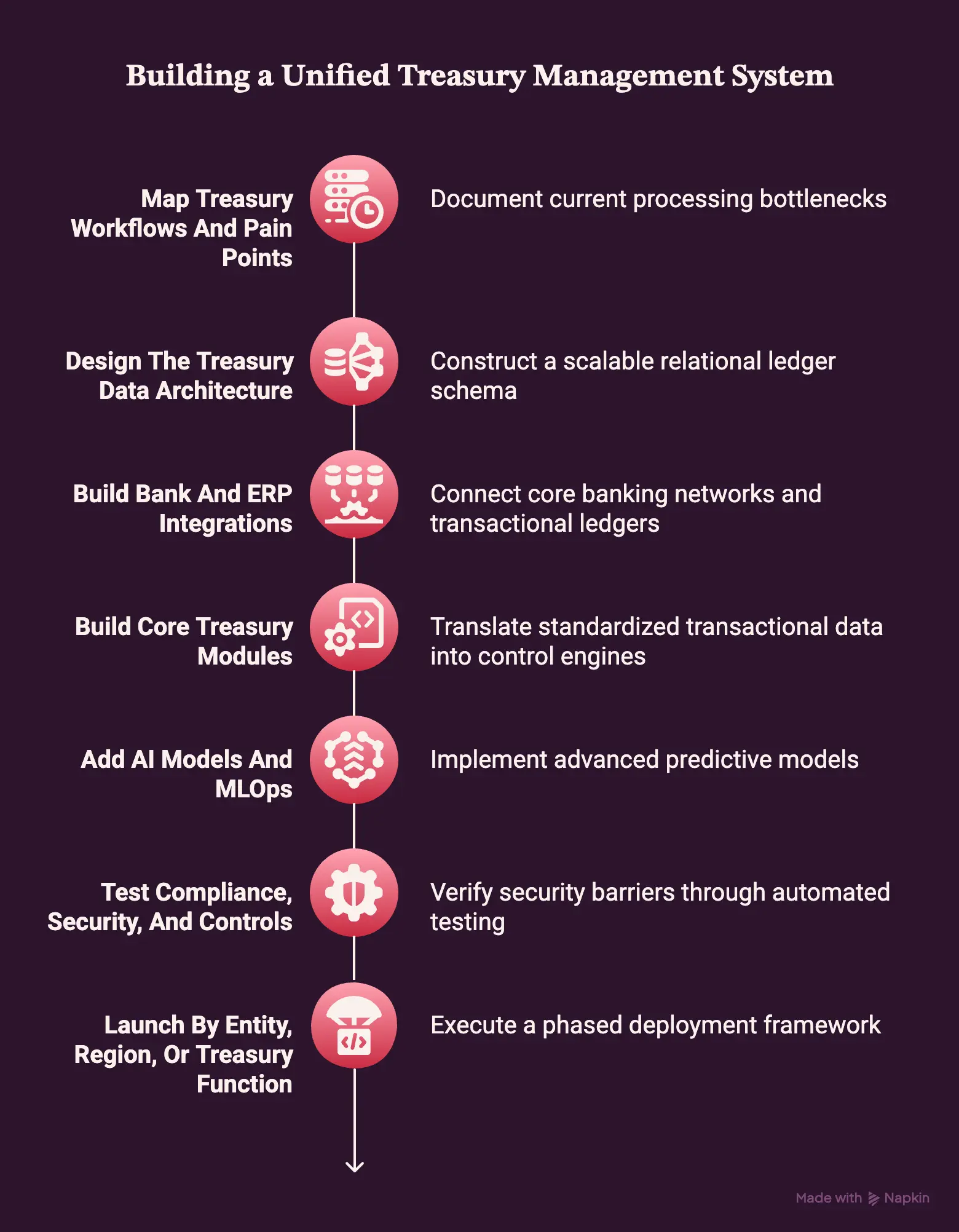
Building an enterprise capital orchestration framework requires moving systematically from workflow mapping to phased platform deployment. Consequently, by constructing a modular cloud-native architecture, technology leaders replace legacy manual processing with an integrated system that automates transactions without destabilizing daily core banking clearings.
Step 1: Map Treasury Workflows And Pain Points
Enterprise finance teams must document current processing bottlenecks across decentralized banking networks and global divisions comprehensively. As a result, this initial discovery phase isolates structural visibility blind spots, slow manual approvals, and complex currency calculations.
- Process Inefficiency Audit: Teams trace exactly how long daily multi-currency cash positioning task collections require across various isolated regional offices.
- Operational Risk Isolation: The analysis exposes high-value transactional dependencies resting on unsecured, unmonitored offline spreadsheet macro calculations.
- Reporting Latency Mapping: Treasurers calculate the precise processing time delays encountered when building board-level treasury reporting module outputs.
Step 2: Design The Treasury Data Architecture
Engineering teams must construct a scalable relational ledger schema capable of ingestion and processing before writing code. Therefore, establishing a rigid financial data architecture ensures complete data normalization across highly volatile international payment networks.
- Multi-Subsidiary Record Ledger: The database architecture builds unified entity mapping logic to organize a multi-subsidiary treasury management platform structurally.
- Remittance Schema Standardization: Engineers deploy normalized fields to digest complex incoming ISO 20022 messaging structures and older bank format strings.
- Audit Trail Encryption: The storage layer embeds cryptographic signing protocols to preserve critical system access logs and balance history records.
Step 3: Build Bank And ERP Integrations
Connecting core banking networks and transactional ledgers directly establishes the pipeline framework needed for real-time asset orchestration. Consequently, your platform architecture must communicate natively across legacy platforms and modern corporate finance webhooks.
- Enterprise ERP Connectivity: The connectivity bus configures an automated SAP Treasury and Risk Management integration alongside an Oracle Treasury Management API integration.
- Legacy System Coexistence: Developers build robust data exchange connections using an open Kyriba treasury platform API integration framework.
- Core Banking Harmonization: The platform establishes direct communication paths by supporting native FIS Integrity treasury integration and Finastra treasury platform integration modules.
Step 4: Build Core Treasury Modules
This core build phase translates standardized transactional data arrays into secure, automated liquidity control engines. Accordingly, developers deploy separate microservices to manage daily cash matching, high-volume clearings, and risk mitigation strategies.
- Automated Matching Engine: Code modules power an automated treasury reconciliation engine that validates incoming bank statement files against internal logs.
- Payment Factory Setup: A centralized payment hub treasury platform development plan handles high-value transfers across domestic clearings securely.
- Risk Mitigation Cockpit: The analytical layer launches specialized foreign exchange exposure management software to track shifting currency values dynamically.
Step 5: Add AI Models And MLOps
Implementing advanced predictive models allows large organizations to shift capital management from reactive tracking to proactive optimization. As a result, forecasting algorithms extract hidden patterns from clean operational records without requiring human data sorting.
- Predictive Ingestion Pipelines: The system implements an AI cash flow prediction model layer to project long-term liquidity planning software needs.
- Operational Anomaly Scanning: Specialized AI treasury anomaly detection software continuously reviews transactional payloads to catch external financial fraud signs instantly.
- Model Performance Monitoring: The infrastructure configures a model drift detection treasury AI platform microservice to alert when predictive logic degrades.
Step 6: Test Compliance, Security, And Controls
Enterprise banking platforms must verify security barriers continuously through automated testing scripts before processing live financial transactions. Furthermore, anchoring authorization logic deeply inside system microservices guarantees total data privacy protection across global operations.
- Access Control Isolation: The authentication layer enforces strict role-based access control treasury platform rules alongside zero-trust treasury platform security design principles.
- Regulatory Data Encryption: Field-level encryption mechanisms secure private customer and corporate financial details to satisfy GDPR treasury data management compliance.
- Filing Automation Verification: Testing routines validate the system’s ability to compile evidence for FBAR and FATCA treasury compliance automation pipelines.
Step 7: Launch By Entity, Region, Or Treasury Function
Executing a phased deployment framework eliminates the operational disruptions typically caused by high-risk, all-at-once software replacement methods. Consequently, technology leaders launch core software components incrementally across specific banking groups, regions, or individual modules.
- Regional Pilot Deployment: Engineering teams activate cash positioning capabilities within a single regional center before onboarding complex global subsidiaries.
- Controlled Connectivity Scaling: The connectivity control room activates multi-bank data consolidation platform pipelines one banking partner group at a time.
- Function Migration Sequencing: Teams deploy basic bank reconciliation automation software before activating advanced AI FX hedging strategy optimization models.
Rushing a complete system launch simultaneously across all global entities creates severe integration strain and risks operational blind spots. Therefore, utilizing a disciplined, phased rollout methodology ensures corporate transaction processing lines remain insulated from deployment interruptions.
Unified Treasury SaaS Platform Development Cost
Unified treasury SaaS platform development usually costs $70,000 to $300,000, depending on bank connectivity depth, ERP integrations, AI forecasting complexity, payment workflows, compliance requirements, and the number of entities.
Consequently, by mapping project specifications early, engineering teams control baseline development costs while building highly targeted financial infrastructure. True financial software budgeting requires balancing modular components against operational scale.
Cost Breakdown by Development Phase
The table below illustrates specific investment ranges required to construct a custom financial platform.
| Development Phase | Estimated Cost Range | Primary Cost Drivers |
| Treasury discovery and workflow mapping | $5,000–$15,000 | Number of operational entities and regional business processes mapped. |
| Data architecture and entity/account model | $10,000–$25,000 | Relational schema complexity and structural ledger mapping requirements. |
| Bank connectivity and ERP integration | $15,000–$55,000 | Total individual bank connections, host-to-host setups, and core endpoints. |
| Cash visibility and liquidity engine | $15,000–$40,000 | Intraday balance tracking speeds and automated balance pooling logic. |
| Payment hub and approval workflows | $20,000–$55,000 | Complexity of localized transaction clearing systems and dual-control layers. |
| AI forecasting and anomaly detection | $20,000–$60,000 | Data pipeline volume, custom forecasting algorithms, and MLOps testing. |
| Risk, FX, hedge accounting, and compliance | $25,000–$70,000 | Regulatory transaction recording rules and derivative valuation engine math. |
| Dashboards, reporting, and user roles | $10,000–$30,000 | Role-based permission controls and visualization granularity required by executives. |
| Testing, security, DevOps, and launch | $15,000–$45,000 | Penetration testing depth, zero-trust infrastructure setup, and deployment automation. |
MVP Build Cost
A focused MVP costs $70,000–$120,000 and should include cash visibility, basic bank integrations, ERP sync, simple forecasting, dashboards, and user roles. Consequently, this model targets small corporate groups wanting to validate multi-bank data consolidation platform pipelines rapidly without building high-cost modules early.
- Core Balance Aggregation: The software prioritizes automated cash visibility across a few selected tier-one commercial banking groups.
- Basic Ledger Synchronization: Developers configure localized data transfers to extract baseline balance information from a central ERP application.
- Essential Permission Management: The security layer establishes standard identity fields to separate basic viewing roles from system administrators.
Production Enterprise Build Cost
A production build costs $180,000–$300,000 and should include multi-bank connectivity, payment workflows, FX risk, hedge accounting evidence, AI forecasting, compliance controls, and audit trails.
Therefore, this comprehensive setup satisfies the strict transactional demands of scaling multi-entity international organizations safely.
- Advanced Payment Orchestration: The code runs a fully automated payment factory software development pipeline to handle global clearings.
- Predictive Financial Engineering: Analysts utilize an AI cash flow prediction models array backed by built-in anomaly detection layers.
- Continuous Compliance Enforcement: The architecture embeds strict ASC 815 hedge accounting platform capabilities alongside localized multi-jurisdiction compliance tracking.
Ongoing Maintenance Cost
Annual maintenance should be budgeted at 18%–25% of the initial build cost for bank API updates, security patches, model retraining, compliance changes, cloud costs, and support. As a result, accounting for these ongoing expenses preserves platform security and protects connection stability over long-term operations.
- Banking Connection Care: Dedicated monitoring ensures that multi-bank data consolidation platform endpoints adjust instantly to changing commercial bank formatting structures.
- Algorithmic Performance Auditing: Engineers watch system outputs continuously to prevent model drift detection treasury AI platform alerts from compromising forecasts.
- Cryptographic Vulnerability Patches: Regular testing cycles push field-level encryption modifications to maintain zero-trust treasury platform security design compliance continuously.
Budgeting software production phases based on modular functionality avoids over-engineering early architecture layers unnecessarily. Therefore, starting with an optimized MVP data pipeline ensures core business flows are validated before expanding into advanced risk-modeling integrations.
Need a Custom Cost Estimate for Your Treasury Architecture?
Get a detailed, tailored engineering breakdown for your enterprise cash management platform development guide project from the Intellivon engineering team.
Build Unified Treasury Platforms With Intellivon
Build unified treasury platforms with Intellivon when your enterprise needs more than a basic financial dashboard or template vendor module.
Consequently, our teams act as dedicated engineering partners for architecture-first treasury software, AI forecasting, fintech controls, healthcare treasury workflows, bank integrations, compliance automation, and production-grade platform engineering.
- Architecture-First Build: Establish a multi-subsidiary treasury management platform utilizing structured API gateway development and a multi-bank account management software structure.
- Healthcare Treasury Depth: Automate multi-entity medical cash tracking, hospital network liquidity management platform dynamics, grant fund management, and HIPAA-compliant treasury data management rules.
- Fintech Workflow Control: Construct a multi-tenant SaaS infrastructure featuring white-label tools, bank treasury management software development capabilities, and zero-trust security.
- AI With Governance: Deploy predictive liquidity management software using a machine learning treasury forecasting engine backed by explainable AI treasury recommendations.
- Enterprise Integrations: Streamline connectivity across SAP Treasury and Risk Management integration pipelines, Oracle Treasury Management API integration nodes, and SWIFT networks.
- Security and Compliance: Enforce SOX treasury compliance internal controls software, EMIR derivative reporting treasury compliance parameters, and FBAR and FATCA treasury compliance automation.
- Engineering Proof: Access a mature technical roster with over 500,000 engineering hours building production-ready fintech AI systems and MLOps platforms.
Partnering with specialized enterprise developers avoids the integration bottlenecks and functional limitations that frequently break rigid commercial banking software platforms. Therefore, selecting a custom, compliance-validated architectural approach guarantees your cash networks remain highly secure and agile as transaction volumes scale globally.
Talk to Intellivon’s treasury software experts to scope your platform architecture, estimate your build cost, and decide whether custom development is the right move.
Conclusion
Upgrading to a unified treasury platform marks a critical shift from manual transaction tracing to active capital orchestration. Consequently, consolidating fragmented banking rails, standardizing master schemas, and deploying ethical AI models allow enterprise technology leaders to secure total intraday visibility.
Therefore, constructing a dedicated data foundation protects liquidity, automates global payment pipelines safely, and guarantees that your financial operations remain fully compliant across shifting regulatory jurisdictions.
FAQs
Q1. Is AI Cash Forecasting Accurate Enough For Treasury?
A1. Algorithmic projections reach high executive accuracy levels only when foundational internal transaction records are perfectly standardized. Therefore, the system utilizes AI cash flow prediction models for short-term trend matching and automated variance analysis of the cash forecasting platform auditing. Treasurers must retain absolute manual oversight regarding final liquidity deployments, debt issuance, and currency risk actions.
Q2. Should We Build Or Buy A Unified Treasury Management System?
A2. Select commercial packages when standardized, out-of-the-box workflows satisfy your basic accounting logging needs cleanly. Consequently, choose custom development when transaction processes are highly proprietary, heavily regulated, healthcare-specific, or embedded into core product features. Furthermore, a hybrid wrapper platform optimizes operations when unifying disconnected legacy third-party tools.
Q3. What Integrations Does A Unified Treasury Platform Need?
A3. The architecture must establish direct, automated pipelines between your internal microservices layers and the external financial network. Accordingly, it connects bank APIs, ERP ledgers, and market data streams natively. The integration bus should also support direct SAP Treasury and Risk Management integration, Oracle connections, SWIFT routing networks, and global open banking gateways.
Q4. Why Do Treasury Teams Still Use Excel After Buying ERP?
A4. ERP platforms serve as excellent sub-ledgers, but they cannot handle intraday cash updates or automated bank clearing rules cleanly. As a result, finance teams revert to offline spreadsheets to patch real-time visibility gaps manually. Moving to an automated treasury management system development guide structure removes spreadsheet dependency by centralizing live transactional pipelines.
Q5. What Makes Healthcare Treasury Different?
A5. Medical networks balance complex financial cycles including volatile insurance payer timing, clinical claims, and rigid grant restrictions. Consequently, hospital networks require a dedicated hospital network liquidity management platform to segregate restricted funds from open capital safely. A generic TMS lacks the specialized logic required to track complex healthcare bond and debt management rules.
To Sum It Up:
- A unified treasury platform is not a cash dashboard. It is the operating layer that connects banks, ERPs, payments, risk, AI forecasting, and compliance into one governed treasury system.
- AI forecasting fails when treasury data is fragmented. The data model, entity hierarchy, bank feeds, and transaction tagging must come before model development.
- Healthcare treasury needs restricted fund logic, grant tracking, bond proceeds, and multi-entity liquidity controls that generic TMS content rarely explains.
- The safest build path is phased. Start with cash visibility and bank connectivity, then add forecasting, payments, risk, hedge accounting, and AI decision support.
- Custom development makes sense when treasury complexity is strategic. Otherwise, a standard TMS or hybrid wrapper may be the better investment.