

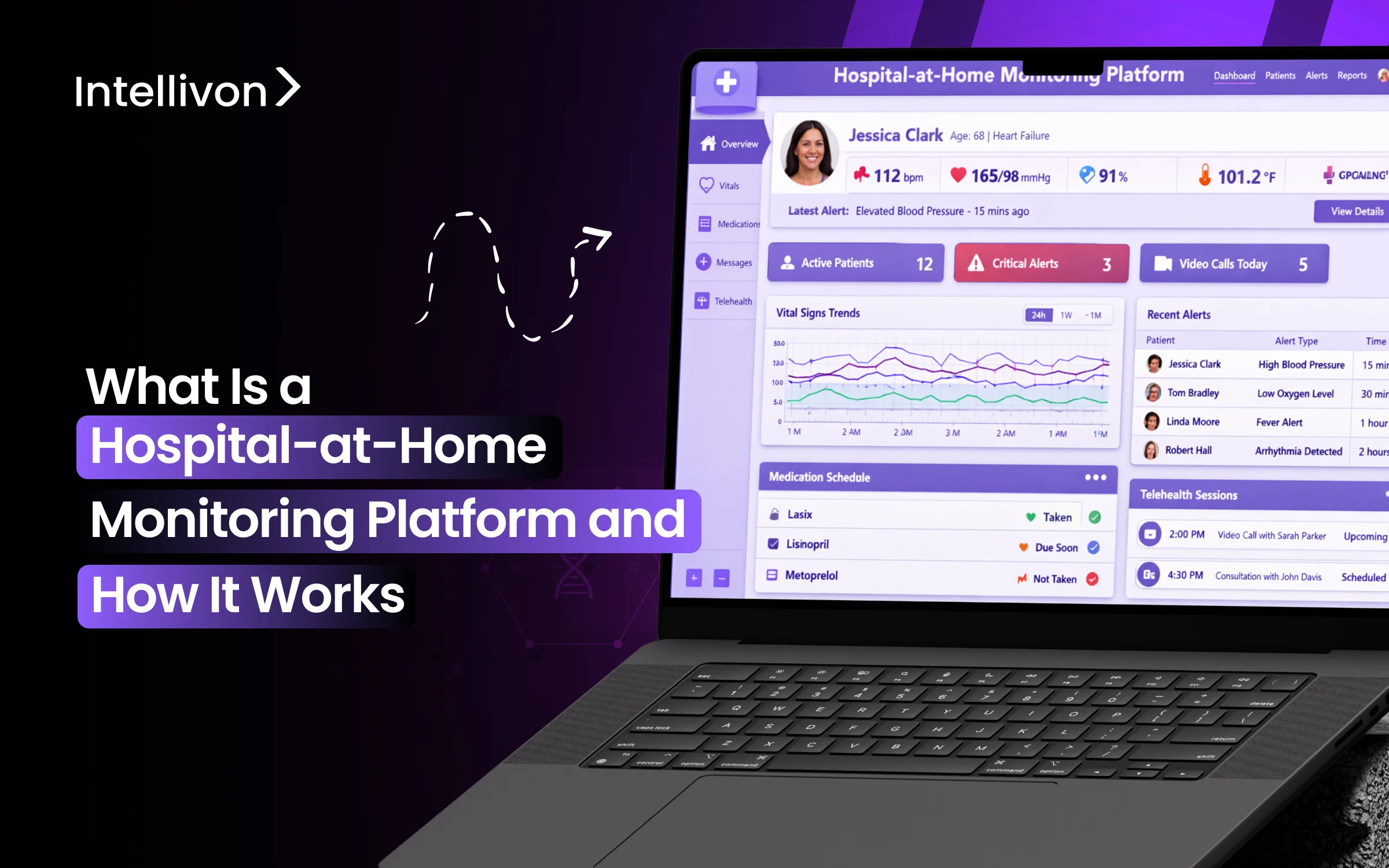
Patients today are resisting long hospital stays. Given the choice, most people recovering from surgery, managing a chronic condition, or stabilizing after an acute episode would prefer to be at home. However, wanting to be at home doesn’t automatically make home-based care safe or feasible. The gap between what patients desire and what providers can reliably offer at home has often come down to one critical factor, which is real-time clinical visibility. Without continuous monitoring, sending patients home early feels risky rather than an improvement in service.
This is where hospital-at-home monitoring platforms make a difference. They provide care teams with the same level of patient visibility outside the hospital that they would have on a monitored floor. Vitals, alerts, medication adherence, and clinical escalations all flow through a connected system that keeps providers in control, no matter where they are.
Intellivon develops these platforms at a large scale, combining AI-driven monitoring systems with solid healthcare compliance skills to help organizations turn home-based care into a dependable, revenue-generating service. In this blog, we explain what these platforms are, how they function, and what is needed to create one that actually delivers results.

Why Hospitals Are Shifting Toward Hospital-at-Home Care
Hospitals are increasingly adopting hospital-at-home (HaH) care to reduce pressure on hospital capacity and improve care delivery. These programs allow clinicians to treat eligible patients at home while maintaining continuous medical supervision.
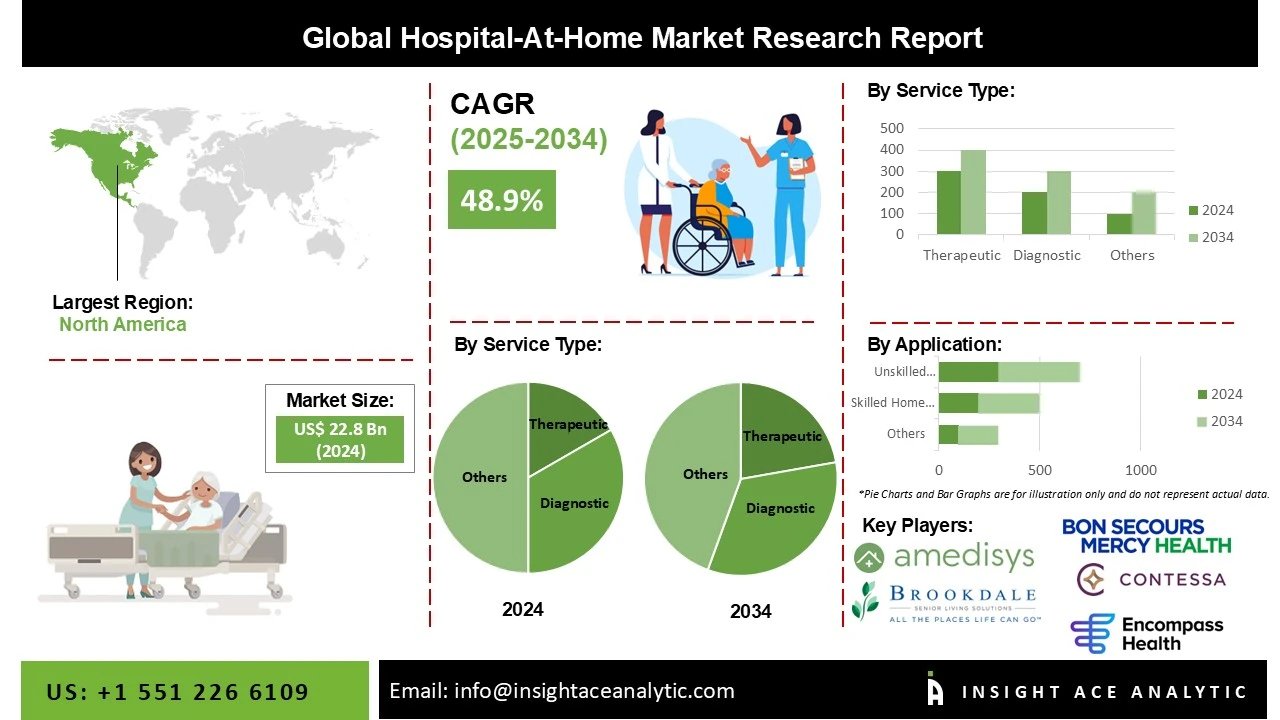
As a result, hospitals can lower treatment costs by 20–30%, improve patient satisfaction, and deliver better clinical outcomes through structured remote acute care programs. The global hospital-at-home market is valued at USD 22.8 billion in 2024. However, the rapid adoption of remote acute care programs is accelerating their growth worldwide.
As a result, the market is projected to reach USD 1,160.6 billion by 2034, growing at a 48.9% CAGR as hospitals expand home-based treatment models.
Traditional inpatient models are hitting a ceiling that physical expansion cannot fix. Therefore, health systems are pivoting toward “Hospital-at-Home” care to alleviate the pressure on brick-and-mortar facilities. This shift allows providers to deliver acute care in a patient’s residence while reserving expensive ICU beds for critical surgeries.
1. Hospital Capacity Challenges
Fixed hospital costs are soaring while bed availability remains dangerously low. For this reason, executives are looking for ways to lower the cost per episode of care.
Maintaining a patient in a traditional ward requires immense overhead for staffing and maintenance. However, moving acute care to the home environment slashes these overhead expenses significantly.
Furthermore, this model allows hospitals to manage higher patient volumes. Thus, the transition is a strategic move to preserve margins.
2. Remote Patient Monitoring
Advanced technology acts as the primary catalyst for this healthcare revolution. Remote patient monitoring (RPM) tools now provide clinical-grade data previously only available at the bedside. For instance, high-resolution sensors track vitals and detect anomalies in real-time.
Clinicians can then adjust treatments remotely via encrypted links. In addition, automated alerts ensure that signs of deterioration are caught instantly. Therefore, the home effectively becomes a high-tech extension of the hospital’s diagnostic suite.
3. Reduce Readmissions with Home Care
Readmission penalties are a major financial drain on modern healthcare systems. Hospital-at-home programs directly address this by smoothing the transition to recovery. Patients in home programs are often more mobile and less prone to hospital-acquired infections.
Moreover, care teams can monitor the patient’s living environment for risks. Consequently, this holistic oversight leads to a dramatic drop in readmission rates. By stabilizing patients where they live, providers ensure a more durable recovery.
4. Growth of Digital Hospital Infrastructure
The modern hospital is no longer defined by its four walls. Instead, it is becoming a distributed digital network of connected devices and command centers. This infrastructure allows for seamless data flow between the home and the clinical team.
Furthermore, integrating these streams into EHR systems ensures a single source of truth. As these platforms mature, they become the backbone of a resilient enterprise. Ultimately, investing in this digital foundation is essential for remaining competitive.
By decentralizing the site of care, enterprises gain the agility to scale capacity without massive capital expenditure. This digital-first approach ensures that hospital resources remain focused on high-complexity cases while maintaining a safe, constant presence in the home.
What Is a Hospital-at-Home Monitoring Platform?
A hospital-at-home monitoring platform is a sophisticated ecosystem of connected medical devices and integrated software. Consequently, this technology allows clinicians to track acute patients in their own residences with the same precision found in a traditional ward.
Furthermore, these platforms often include secure video conferencing for virtual rounds and medication management. By bridging the gap between the clinic and the home, the platform creates a seamless safety net for recovery. Ultimately, this digital infrastructure transforms a standard living room into a high-fidelity clinical environment.
This unified technical framework ensures that patients receive high-quality, continuous oversight during their most vulnerable recovery phases. As a result, healthcare enterprises can scale their operations effectively while maintaining rigorous clinical standards outside the hospital.
How Hospital-at-Home vs Telehealth Programs
Hospitals often use telehealth and hospital-at-home (HaH) programs to deliver care outside traditional hospital settings. However, these models serve very different clinical purposes.
Telehealth mainly supports consultations and follow-ups through video or digital communication. In contrast, hospital-at-home programs deliver full acute care services at a patient’s home, supported by remote monitoring, care teams, and clinical workflows.
Understanding this difference is important for healthcare providers planning digital care infrastructure.
| Factor | Hospital-at-Home (HaH) | Telehealth Programs |
| Primary Purpose | Deliver acute hospital-level care at home | Enable remote consultations and follow-ups |
| Type of Care | Continuous clinical monitoring and treatment | Virtual doctor visits and consultations |
| Monitoring | Real-time vital monitoring through devices | Usually no continuous monitoring |
| Clinical Team | Multidisciplinary care teams managing treatment | Physician or specialist consultation |
| Technology | IoT devices, monitoring platforms, and EHR integration | Video platforms and patient portals |
| Patient Conditions | Acute illnesses needing hospital-level supervision | Routine consultations or chronic follow-ups |
| Care Environment | Patient receives structured care at home | Patient connects remotely with clinician |
In short, telehealth expands access to clinical consultations, while hospital-at-home programs replicate hospital-level care outside the hospital building.
Therefore, healthcare providers building hospital-at-home services require advanced monitoring platforms, device integrations, and clinical workflows, not just video consultation tools.
How Hospital-at-Home Monitoring Platforms Work
The operational flow of a hospital-at-home platform is a disciplined orchestration of logistics, data, and clinical response. Therefore, it replaces the physical presence of a nurse with a continuous stream of high-fidelity digital intelligence.
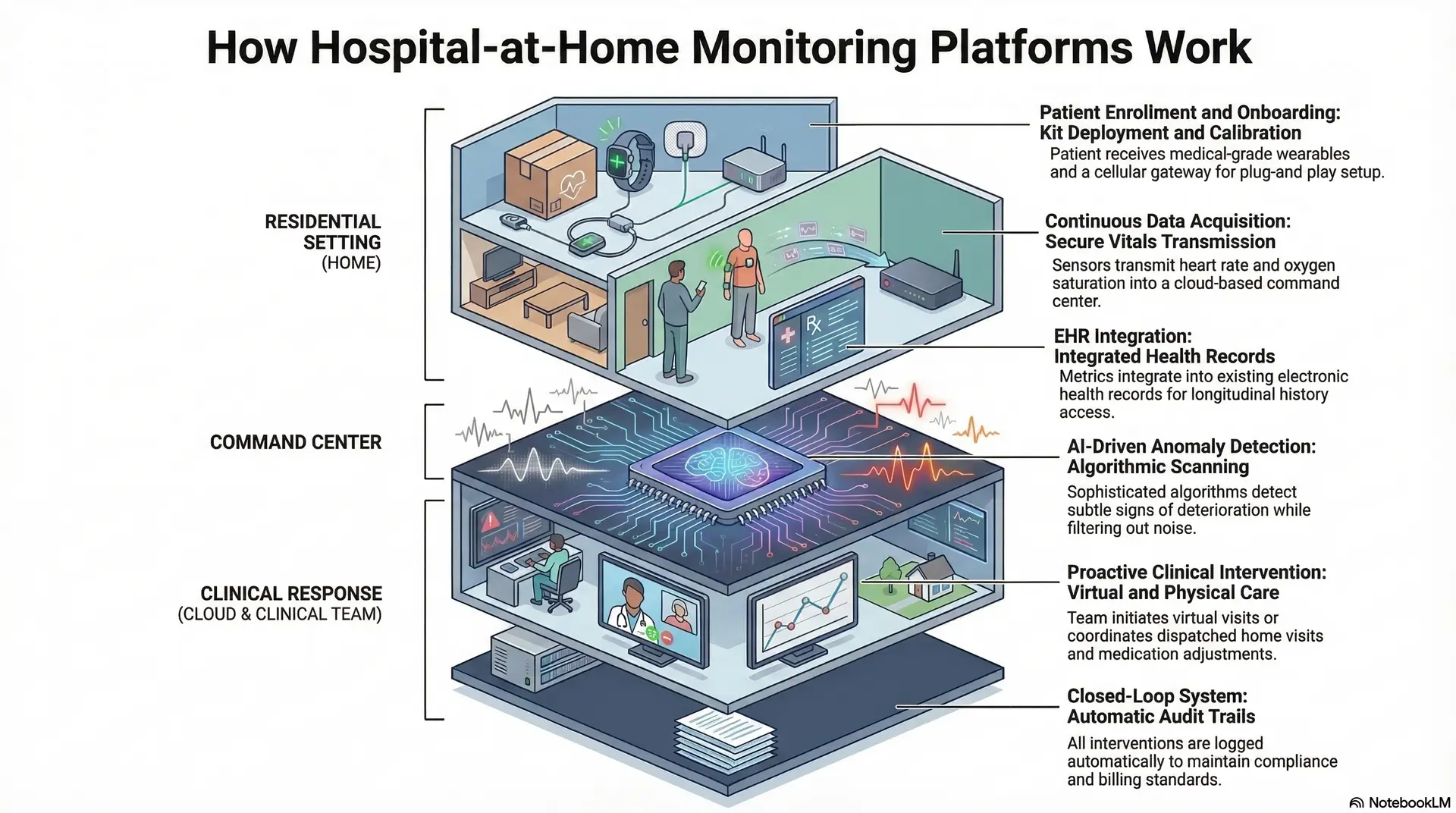
Phase 1: Patient Enrollment and Onboarding
The process begins when a clinical team identifies a candidate who is stable but requires acute-level oversight. Once enrolled, the patient receives a pre-configured kit containing medical-grade wearables and a cellular gateway.
Consequently, the setup process is “plug-and-play” to ensure that even non-technical users can initiate the connection. A dedicated technician or nurse often guides the patient through the initial calibration to ensure data accuracy.
Phase 2: Continuous Data Acquisition
Once active, the sensors begin transmitting vitals such as heart rate, respiratory rate, and oxygen saturation. This data flows securely into a cloud-based command center where it is processed in real-time.
Furthermore, the platform integrates these metrics directly into the hospital’s existing electronic health records. This ensures that the patient’s longitudinal history is always available to the treating physician. As a result, the care team maintains a constant pulse on the patient’s condition.
Phase 3: AI-Driven Anomaly Detection
The platform utilizes sophisticated algorithms to scan the incoming data for subtle signs of deterioration. For instance, it can detect a gradual increase in resting heart rate that might signal an infection.
When a threshold is crossed, the system automatically triggers an alert for the clinical command center. However, it filters out “noise” to prevent alarm fatigue among the nursing staff. Therefore, clinicians only intervene when the data suggest a genuine medical necessity.
Phase 4: Proactive Clinical Intervention
Upon receiving an alert, the care team initiates a virtual visit via a secure video link to assess the patient. If the situation requires physical care, the platform coordinates a dispatched home visit or adjusts medications remotely.
In addition, all interventions are logged automatically to maintain a strict audit trail for compliance and billing. This closed-loop system ensures that the patient never feels isolated during their recovery. Thus, the technology serves as a proactive bridge between the home and the hospital.
By following this rigorous digital workflow, enterprises can maintain the highest standards of safety while operating outside traditional walls. This systematic approach transforms remote monitoring from a simple data stream into a powerful, lifesaving clinical tool.
Key Components of a Hospital-at-Home Platform
An enterprise-grade platform is far more than a simple collection of medical gadgets. Instead, it is a unified technological architecture designed to replicate the safety and rigor of a clinical ward in a residential setting.
1. Remote patient monitoring device ecosystem
The foundation of any platform is the hardware that interacts directly with the patient. Therefore, providers deploy a curated ecosystem of medical-grade wearables and diagnostic tools tailored to specific patient needs.
These devices must be cellular-enabled to ensure connectivity without relying on the patient’s home Wi-Fi. Furthermore, the hardware should be ergonomically designed for continuous wear to maximize compliance. Thus, high-fidelity data collection starts with a reliable, user-friendly device layer.
2. Clinical monitoring and alert management system
Raw data is only valuable when it is translated into actionable clinical insights. Consequently, the platform features a centralized dashboard that aggregates vitals and prioritizes them based on severity.
This system uses intelligent alert logic to distinguish between a loose sensor and a genuine medical emergency. Moreover, it allows clinicians to manage high patient volumes by focusing their attention on the most critical cases first.
In addition, these dashboards provide the visual trends necessary for informed clinical rounds.
3. Patient engagement and care communication apps
Maintaining a human connection is vital for patient safety and satisfaction during remote recovery. Secure, HIPAA-compliant apps serve as the primary interface for daily check-ins and medication reminders.
Patients can use these tools to report subjective symptoms like pain levels or mood changes. Meanwhile, integrated video conferencing allows for immediate face-to-face consultations with the care team.
Therefore, the app functions as a digital lifeline, ensuring the patient never feels abandoned by the system.
4. Data integration layer with hospital systems
A hospital-at-home platform cannot exist as a data silo within a modern healthcare enterprise. For this reason, a robust integration layer is essential to sync remote vitals with the hospital’s Electronic Health Record (EHR).
By utilizing standard protocols like FHIR and HL7, the platform ensures that the entire care team has a single source of truth. This seamless flow of information prevents data fragmentation and reduces the manual entry burden on staff.
Ultimately, integration is what turns a remote tool into a core enterprise asset.
5. Clinical analytics and decision support tools
To move from monitoring to proactive management, platforms incorporate sophisticated clinical analytics. These tools analyze historical and real-time data to predict potential health declines before they occur.
For instance, they can flag a high risk of readmission based on subtle changes in patient activity and vitals. Furthermore, decision support modules provide clinicians with evidence-based recommendations for treatment adjustments.
This layer of intelligence empowers the care team to intervene earlier and with greater confidence.
This sophisticated multi-layer architecture ensures that every stakeholder, from the patient to the specialist, is supported by reliable data and clear communication. By investing in such a comprehensive system, enterprises build a future-proof foundation for truly decentralized healthcare.
Core Technologies Powering Hospital-at-Home Platforms
The efficacy of a remote acute care model depends entirely on the resilience of its underlying technology stack. Therefore, enterprises must invest in a robust architecture that ensures data integrity and clinical reliability at every touchpoint.
1. IoT medical devices for patient monitoring
The hardware layer serves as the primary gateway for all clinical intelligence. Consequently, platforms utilize a diverse range of medical-grade IoT sensors to capture continuous physiological streams.
These devices must provide hospital-level accuracy while remaining simple enough for patients to operate independently. Furthermore, modern sensors often feature edge-processing capabilities to filter out artifacts before transmission. Thus, the IoT ecosystem provides the high-fidelity telemetry required for acute home management.
2. AI models for risk detection and early alerts
Raw telemetry is overwhelming for clinical teams without an intelligent filtering layer. Therefore, sophisticated AI models analyze incoming data to identify patterns indicative of health deterioration.
These algorithms can detect subtle trends, such as an evolving electrolyte imbalance or respiratory distress, long before symptoms become visible.
However, these models are tuned specifically to minimize false positives and prevent alarm fatigue. As a result, clinicians can focus their energy on the patients who need it most.
3. Healthcare interoperability using FHIR and HL7
Data silos are the greatest enemy of clinical safety in a distributed care model. For this reason, modern platforms utilize FHIR and HL7 standards to ensure seamless communication with existing hospital systems.
This interoperability allows the remote platform to pull patient history and push real-time vitals back into the primary EHR. Moreover, it ensures that every specialist involved in the case sees the same data.
Ultimately, standardized data exchange is what makes the virtual ward a cohesive part of the hospital.
4. Cloud infrastructure for healthcare data pipelines
Managing the massive volume of data generated by 24/7 monitoring requires a high-performance cloud foundation. Consequently, enterprises rely on secure cloud environments to host their data pipelines and processing engines.
These systems must offer low-latency performance to ensure that clinical alerts are delivered in real-time. In addition, cloud infrastructure provides the elasticity needed to scale the program as patient enrollment grows.
Therefore, the cloud serves as the scalable nervous system of the entire monitoring operation.
5. Secure patient data management and compliance
Maintaining patient trust and regulatory standing is non-negotiable for any healthcare enterprise. For this reason, platforms incorporate end-to-end encryption and strict identity management to protect sensitive health information. This architecture must comply with global standards like HIPAA or GDPR to mitigate legal and security risks.
Furthermore, robust audit logs ensure that every data access point and clinical action is fully traceable. Thus, a rigorous security posture is the fundamental bedrock of a sustainable hospital-at-home program.
This technological convergence allows healthcare leaders to deliver complex care safely in a residential setting. By prioritizing these core technologies, organizations build a platform that is not only functional but also future-proof and enterprise-ready.
Key Features Of A Hospital-at-Home Monitoring Platform
The utility of a remote care system depends on specific functionalities that bridge the distance between the provider and the patient. Therefore, an enterprise-grade platform must offer features that prioritize clinical safety, operational transparency, and user engagement.
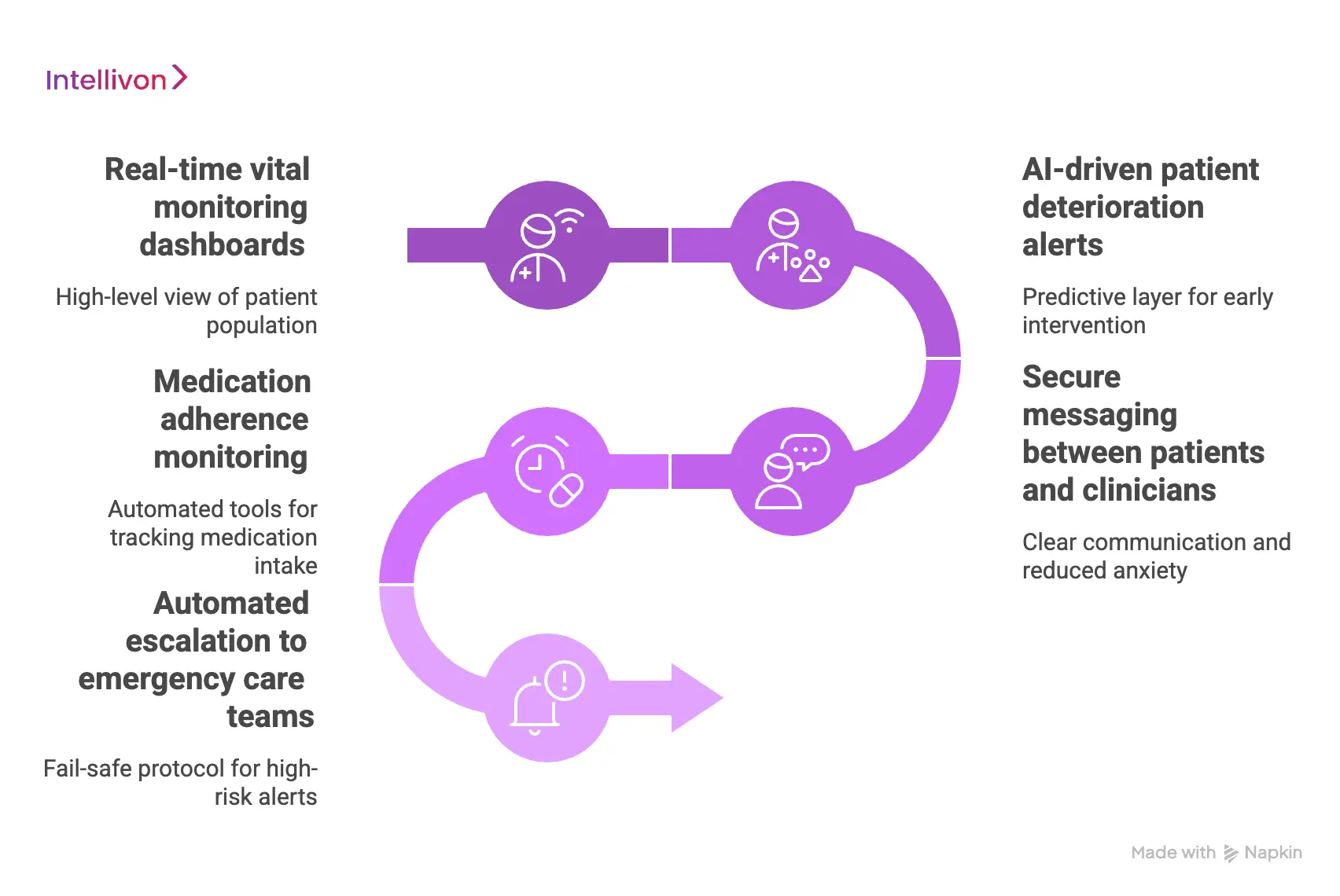
1. Real-time vital monitoring dashboards
Clinical teams require a high-level view of their entire patient population to maintain safety. Consequently, the platform provides real-time dashboards that aggregate vitals like heart rate and oxygen saturation into a single interface.
These displays allow nurses to spot trends across multiple patients simultaneously without switching screens. Furthermore, the data updates every few seconds to replicate the experience of an in-room monitor. Thus, the dashboard serves as the digital command center for the virtual ward.
2. AI-driven patient deterioration alerts
Manual monitoring of thousands of data points is impossible for human staff. For this reason, the platform uses AI to filter incoming telemetry for signs of clinical decline. These alerts trigger automatically when a patient’s metrics deviate from their unique baseline.
However, the system is designed to be intelligent enough to ignore temporary spikes caused by movement or exercise. In addition, this predictive layer gives clinicians the precious time needed to intervene before a crisis. Therefore, AI becomes a force multiplier for the medical team.
3. Secure messaging between patients and clinicians
Clear communication is the primary factor in maintaining high patient satisfaction and safety. The platform incorporates encrypted messaging that allows patients to ask questions or report symptoms instantly.
Unlike standard email, these channels are fully compliant with healthcare privacy regulations. Moreover, clinicians can send educational materials or instructions directly through the app to guide the recovery process.
This direct line of contact reduces patient anxiety and prevents unnecessary hospital visits. Consequently, it strengthens the bond between the patient and their care team.
4. Medication adherence monitoring
Managing complex drug regimens at home can be challenging for even the most diligent patients. Therefore, the platform includes automated tools to track and confirm medication intake. Smart dispensers or app-based reminders notify the patient when it is time for their next dose.
If a dose is missed, the care team receives an alert to follow up immediately. Furthermore, this data helps physicians understand if a lack of progress is due to treatment failure or non-compliance. Thus, adherence monitoring is a critical safeguard in the home environment.
5. Automated escalation to emergency care teams
In acute care, seconds often determine the difference between recovery and a tragic outcome. For this reason, the platform features a fail-safe escalation protocol for high-risk alerts.
If the system detects a life-threatening event, it can automatically notify local emergency services or the hospital’s rapid response team. This protocol bypasses traditional phone trees to ensure the fastest possible intervention.
In addition, the system provides the responding team with the patient’s exact location and latest vitals. Ultimately, this automation provides a level of security that manual home care simply cannot match.
By integrating these features, a monitoring platform moves beyond data collection and becomes a proactive care delivery tool. This comprehensive approach ensures that the “hospital” aspect of the program remains the primary focus, regardless of the patient’s physical location.
Hospital Systems That Integrate With Home Monitoring
For a hospital-at-home model to be truly “enterprise-grade,” it must not exist as a standalone application. Instead, it must weave directly into the existing digital fabric of the institution.
Therefore, seamless integration ensures that data flows without friction, maintaining the hospital’s operational integrity and clinical safety standards.
1. Electronic health record systems
The Electronic Health Record (EHR) remains the single source of truth for any healthcare organization. Consequently, the monitoring platform must feed real-time vitals and nursing notes directly into the patient’s primary chart.
This integration allows hospitalists to view home-based data alongside historical laboratory results and imaging. Furthermore, it ensures that discharge summaries and medication lists are always synchronized. Thus, a robust EHR link is the foundation of clinical continuity.
2. Clinical decision support systems
Modern hospitals rely on Clinical Decision Support (CDS) to maintain high standards of evidence-based care. For this reason, home monitoring data should trigger the same diagnostic alerts and safety checks as inpatient monitors.
If a remote patient’s potassium levels and heart rhythm suggest a specific risk, the CDS system should immediately prompt the physician with a recommended protocol.
Moreover, this integration helps reduce clinical variability across decentralized teams. Therefore, data-driven insights remain consistent, whether the patient is in a bed or a living room.
3. Nurse workflow and care coordination platforms
Nursing staff are already burdened by complex workflows and multiple software interfaces. Consequently, the monitoring platform must integrate with the communication tools that nurses already use daily.
This ensures that alerts from the home environment appear on the same mobile handsets or station consoles as inpatient call bells.
Furthermore, integrated task management allows for the efficient scheduling of home visits and virtual check-ins. As a result, the “virtual ward” feels like a natural extension of the physical unit.
4. Hospital analytics and reporting systems
To prove the ROI of a hospital-at-home program, executives need access to high-level performance data. Integration with hospital analytics platforms allows leadership to track key metrics like bed-day savings and readmission rates in real-time.
Moreover, this data enables the clinical team to identify which patient demographics are most successful in the home-based model.
In addition, these reports are essential for meeting regulatory requirements and maintaining accreditation. Thus, analytics turn raw patient data into strategic enterprise intelligence.
5. Insurance billing and reimbursement systems
A program is only sustainable if it can effectively capture revenue for the care provided. Therefore, the platform must integrate with the hospital’s Revenue Cycle Management (RCM) and billing systems.
This ensures that every virtual visit and remote monitoring hour is automatically coded and submitted for reimbursement. Furthermore, integrated systems can verify insurance eligibility for acute home care before the patient is even discharged.
Ultimately, this financial synchronization is what transforms a clinical pilot into a permanent, profitable service line.
This level of architectural integration ensures that the hospital-at-home program is a core component of the enterprise strategy. By connecting these critical systems, healthcare leaders can scale their operations with confidence and financial clarity.
How We Develop A Hospital-At-Home Monitoring Platform For Enterprises
Developing an enterprise-grade monitoring system demands a deep understanding of clinical risk and regulatory compliance.
Therefore, Intellivon utilizes a specialized, multi-phase methodology to build platforms that are both resilient and scalable.
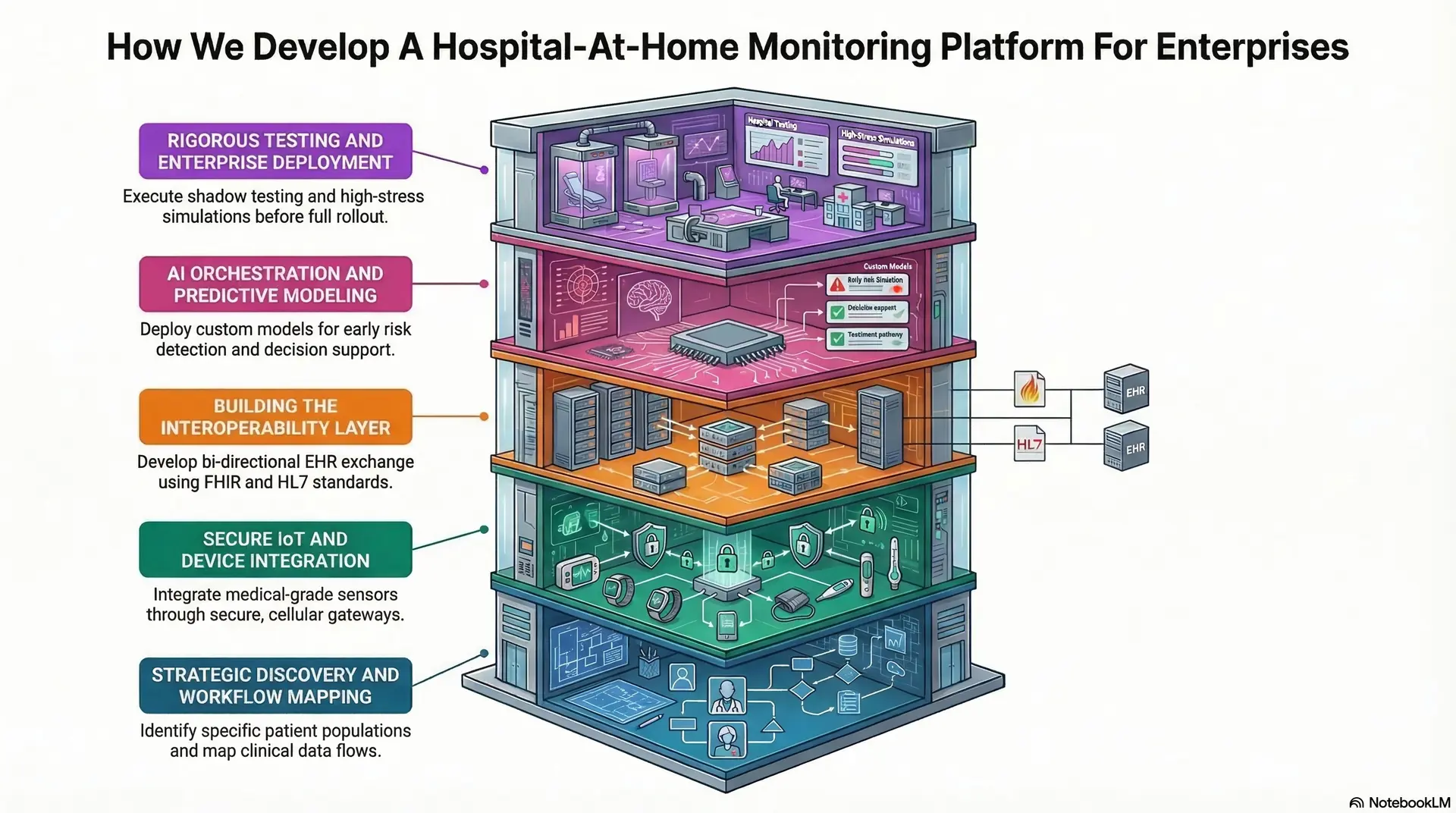
Phase 1: Strategic Discovery and Workflow Mapping
The first step in our process involves a comprehensive analysis of the hospital’s existing clinical workflows. Consequently, we identify the specific patient populations, such as those with heart failure or COPD, that will yield the highest ROI for at-home care.
We then map out exactly how data will flow from the home to the clinical command center. Furthermore, we define the key performance indicators that will measure the program’s success. Thus, the foundation is built on strategy rather than just technology.
Phase 2: Secure IoT and Device Integration
Once the strategy is clear, we focus on the hardware layer. We integrate a curated ecosystem of medical-grade sensors that communicate through a secure, cellular gateway.
This ensures that the platform remains independent of the patient’s home Wi-Fi, which is often unreliable. Moreover, we implement edge-computing protocols to ensure that data is encrypted at the source.
In addition, we verify that every device meets the necessary regulatory certifications for acute patient monitoring.
Phase 3: Building the Interoperability Layer
A monitoring platform is only effective if it talks to the rest of the hospital. Therefore, we prioritize the development of a robust interoperability layer using FHIR and HL7 standards.
This allows for the seamless, bi-directional exchange of data between the monitoring platform and the hospital’s primary EHR. Furthermore, we ensure that clinical alerts are integrated into the existing communication tools used by the nursing staff.
As a result, the “virtual ward” becomes a native part of the hospital’s digital environment.
Phase 4: AI Orchestration and Predictive Modeling
To move from reactive monitoring to proactive care, we deploy custom AI models designed for early risk detection. These algorithms are trained to recognize the subtle “digital biomarkers” that precede clinical deterioration.
However, we place a heavy emphasis on tuning these models to prevent alarm fatigue among clinicians. We also build decision-support tools that provide doctors with evidence-based recommendations in real-time.
Consequently, the care team can intervene earlier and with much greater precision.
Phase 5: Rigorous Testing and Enterprise Deployment
Before going live, the platform undergoes extensive “shadow testing” to ensure absolute reliability. We simulate high-stress scenarios to verify that the escalation protocols and data pipelines remain stable under load.
Once validated, we manage the full enterprise rollout, including staff training and technical support. Furthermore, we provide ongoing monitoring to ensure the system evolves alongside changing clinical needs. Ultimately, our goal is to deliver a turnkey solution that empowers hospitals to lead in the decentralized care era.
By following this disciplined development lifecycle, Intellivon helps healthcare leaders bypass the common pitfalls of digital transformation.
Cost to Develop a Hospital-at-Home Monitoring Platform
At Intellivon, hospital-at-home monitoring platforms are engineered as clinical infrastructure, not as dashboards layered onto remote patient monitoring tools. The objective is to create a system that enables hospitals to deliver continuous acute care at home while maintaining clinical oversight, safety, and operational control.
However, building a hospital-at-home platform requires more than connecting wearable devices. The system must collect patient data, process real-time health signals, trigger clinical alerts, coordinate care teams, and integrate directly with hospital EHR systems.
When implemented correctly, these platforms allow healthcare providers to treat patients safely outside hospital walls, reduce operational costs, and maintain clinical accountability through structured monitoring systems.
Estimated Phase-Wise Development Cost
| Phase | Description | Estimated Cost Range (USD) |
| Discovery & Clinical Workflow Design | Analyze hospital-at-home workflows, patient monitoring protocols, and care coordination processes | $7,000 – $14,000 |
| Patient Monitoring Platform Development | Build clinician dashboards, monitoring interfaces, and patient data visualization systems | $12,000 – $26,000 |
| Remote Device & IoT Integration | Integrate wearable devices, medical sensors, and home monitoring equipment | $10,000 – $22,000 |
| Real-Time Patient Data Pipeline | Develop streaming data pipelines for continuous vital sign monitoring | $8,000 – $18,000 |
| Clinical Alert & Escalation Engine | Implement automated alerts, risk thresholds, and care escalation workflows | $7,000 – $15,000 |
| EHR & Hospital System Integration | Integrate the platform with hospital EHR, clinical decision systems, and care coordination tools | $10,000 – $24,000 |
| Security & Healthcare Compliance | Implement HIPAA-grade encryption, access control, and healthcare data protection | $6,000 – $13,000 |
| Testing & Clinical Validation | Conduct monitoring accuracy testing, clinical workflow validation, and platform performance optimization | $4,000 – $9,000 |
| Deployment & Infrastructure Setup | Configure cloud infrastructure, monitoring services, and operational dashboards | $4,000 – $8,000 |
Total Initial Investment
$68,000 – $149,000
Ongoing platform maintenance typically requires 15–20% of the initial development cost per year. These costs support device integrations, monitoring system updates, security maintenance, and infrastructure scaling.
Timeline to Launch a Hospital-at-Home Platform
The development timeline depends on the number of monitoring devices, clinical workflows, and hospital systems involved.
| Phase | Estimated Timeline |
| Clinical workflow discovery | 2 – 3 weeks |
| Platform architecture design | 3 – 4 weeks |
| Device integrations & monitoring systems | 4 – 6 weeks |
| Clinical validation & testing | 3 – 4 weeks |
| Deployment & hospital onboarding | 2 – 3 weeks |
Typical development timeline: 3 – 5 months for an enterprise hospital-at-home monitoring platform.
Hidden Costs Hospitals Should Plan For
- Even well-designed monitoring platforms encounter operational challenges if indirect costs are ignored.
- Device ecosystem expansion often increases integration and management complexity.
- Monitoring data volumes grow rapidly as more patients join hospital-at-home programs.
- Infrastructure costs rise as real-time monitoring systems scale across hospital networks.
- Clinical workflow adjustments require training for nurses, physicians, and care coordinators.
- Compliance updates become necessary as healthcare data regulations evolve.
Best Practices to Avoid Budget Overruns
Based on Intellivon’s experience building healthcare monitoring systems, several strategies help hospitals control development costs.
- Define hospital-at-home clinical workflows before building the platform.
- Standardize the remote monitoring device ecosystem early in the project.
- Design real-time data pipelines that can scale across multiple patient groups.
- Integrate EHR connectivity directly into the platform architecture.
- Build modular monitoring systems to support new devices and care programs.
- Ensure strong data governance and patient data protection mechanisms.
Healthcare organizations planning to launch hospital-at-home programs can work with Intellivon’s healthcare platform engineers to design a monitoring infrastructure aligned with clinical workflows, regulatory requirements, and long-term digital care strategy.
Concluion
The transition toward decentralized acute care represents a fundamental shift in the global healthcare landscape. By prioritizing a robust monitoring infrastructure, enterprises can effectively solve capacity bottlenecks while significantly improving patient recovery outcomes.
Adopting this digital-first model is no longer a matter of choice but a strategic imperative for resilient health systems. Organizations that embrace these platforms today will define the standards of medical excellence for the next decade.
How Intellivon Builds Hospital-at-Home Monitoring Platforms
At Intellivon, hospital-at-home monitoring platforms are built as an enterprise clinical infrastructure, not as tools layered onto existing hospital systems. The goal is to help hospitals deliver acute care at home while maintaining full clinical oversight.
The platform manages the entire hospital-at-home workflow, including patient monitoring, device data ingestion, clinical alerts, care coordination, and EHR integration. As a result, healthcare providers can monitor patients continuously and scale hospital-at-home programs without compromising response times or patient safety.
Why Partner With Intellivon?
- Healthcare Platform Engineering Expertise: Our teams design digital health platforms that support complex hospital workflows, real-time patient monitoring, and large-scale healthcare data management.
- Advanced Patient Monitoring Infrastructure: We build systems capable of ingesting continuous data streams from wearable devices and home medical equipment without performance degradation.
- AI-Assisted Clinical Alert Systems: Our platforms include intelligent monitoring models that detect patient deterioration early and trigger alerts for clinical intervention.
- Secure Healthcare Data Architecture: Every platform is built with healthcare-grade security frameworks to protect sensitive patient data and support regulatory compliance.
- Deep Healthcare System Integrations: We integrate hospital-at-home platforms with EHR systems, clinical decision tools, and hospital data infrastructure.
Healthcare providers planning to launch hospital-at-home programs can partner with Intellivon to build a monitoring platform aligned with clinical workflows, patient safety requirements, and long-term digital health strategy.
FAQs
Q1. What is a hospital-at-home monitoring platform?
A1. A hospital-at-home monitoring platform is a digital system that allows hospitals to deliver acute care to patients in their homes. The platform collects patient data from medical devices, analyzes health signals in real time, and alerts clinicians when intervention is required. It also integrates with hospital EHR systems to ensure patient records remain synchronized with clinical workflows.
Q2. How do hospitals monitor patients at home?
A2. Hospitals monitor patients at home using remote patient monitoring (RPM) devices connected to a digital monitoring platform. These devices capture vital signs such as heart rate, oxygen levels, and blood pressure. The data is transmitted to hospital systems where clinicians track patient conditions and receive alerts if health indicators cross clinical thresholds.
Q3. What devices are used for home patient monitoring?
A3. Hospital-at-home programs typically use connected medical devices such as wearable ECG monitors, blood pressure monitors, pulse oximeters, glucose monitors, and digital thermometers. Some programs also use smart weight scales, respiratory monitors, and medication adherence devices to track patient health continuously.
Q4. How long does it take to build such platforms?
A4. Developing a hospital-at-home monitoring platform typically takes 3 to 5 months, depending on the number of monitoring devices, integrations, and clinical workflows involved. Enterprise platforms often require additional time for EHR integrations, compliance validation, and clinical testing.
Q5. What technologies power home monitoring systems?
A5. Hospital-at-home monitoring systems rely on IoT medical devices, real-time data pipelines, AI monitoring models, and cloud infrastructure. They also use healthcare interoperability standards such as FHIR and HL7 to integrate patient data with hospital EHR and clinical systems.

