Key Takeaways:
- AI model risk management software governs statistical models, machine learning, LLMs, RAG pipelines, and agents.
- Core capabilities include inventory, tiering, validation, monitoring, bias testing, explainability, approvals, and audit evidence.
- MRM platforms must connect with MLOps, data lineage, GRC, ITSM, IAM, and regulatory reporting systems.
- Development costs $70,000 to $300,000 with MVPs in 10 to 16 weeks and production in 5 to 9 months.
-
How Intellivon builds AI model risk management platforms as operational risk infrastructure, and not standalone compliance dashboards.
AI model risk management software covers two validation tracks that spreadsheet-based MRM cannot handle. Specifically, the first track handles quantitative validation including backtesting, drift detection, and performance metrics. The second track handles qualitative validation including conceptual soundness, assumption documentation, and use restriction management. From there, generative AI and LLMs add a third track covering hallucination monitoring and GPAI technical documentation.
The governance gap most enterprises face is not the quantitative track but the qualitative documentation track. Moreover, most MRM platforms automate performance monitoring but leave conceptual soundness and assumption documentation unstructured. Just 21% of organizations have mature agentic AI governance despite 74% planning rapid adoption. Consequently, an AI MRM platform built for traditional models alone is already incomplete before it goes live.
Intellivon builds AI model risk management software where all three validation tracks run in one platform. The approach therefore always maps the full model inventory before any MRM module is designed or built. Accordingly, this blog covers both validation tracks, generative AI governance, bias monitoring, and MLOps integration.
What AI Model Risk Management Software Actually Controls
AI model risk management software operates as a centralized control system that tracks every artificial intelligence asset across its operational lifecycle. It enforces strict protocols for registering, classifying, validating, approving, monitoring, updating, and retiring models.
Unlike general governance tools, this software turns abstract policies into enforceable technical controls and audit-ready evidence for regulated operations.
1. AI MRM Versus AI Governance and Model Observability
An enterprise AI strategy relies on four distinct systems working together. An AI MRM platform connects these layers without replacing them.
| System Type | Primary Focus | Key Functions |
| AI Governance | Strategic Policy & Ethics | Defines organizational principles, permitted AI use cases, and executive accountability. |
| AI MRM Software | Model-Level Risk Controls | Enforces validation workflows, tracks material changes, and generates regulatory evidence. |
| Model Observability | Technical Telemetry | Tracks real-time data drift, system latency, inference errors, and infrastructure health. |
| Enterprise GRC | Broad Operational Risk | Maps overall corporate obligations, enterprise risk registers, and business continuity. |
2. What Counts as a Model or Governed AI System
Regulated enterprises must govern any computational system that processes data to generate automated predictions, decisions, or content.
- Statistical & ML Models: Traditional regression, credit scorecards, and machine learning classifiers.
- Generative & Foundation Models: Large language models (LLMs), RAG pipelines, and fine-tuned base systems.
- Autonomous AI Agents: Multi-agent systems executing automated workflows and decision trees.
- Vendor & API Systems: Third-party AI tools, external APIs, and embedded software logic.
- Business Overlays: Post-processing rules, manual overlays, and decision adjustments.
For a deeper breakdown of organization-wide governance foundations, see our guide on How to Build a Robust AI Governance Framework for Enterprises.
3. How the Three Lines of Defense Use the Platform
The software enforces structural independence by providing role-specific workspaces and approval workflows across lines of defense.
- First Line (Developers & Owners): Registers models, submits technical documentation, and uploads training datasets.
- Second Line (MRM & Validators): Executes independent validations, logs conceptual flaws, and enforces risk limits.
- Third Line (Internal Audit): Reviews system logs, verifies compliance with policy, and validates control integrity.
- Executive Committees: Reviews model risk heat maps, approves high-risk deployments, and tracks remediations.
4. What Evidence the Platform Must Produce
To satisfy regulatory examinations, the platform automatically maintains an immutable, audit-ready paper trail.
- Model Inventory & Metadata: Complete model cards, version lineage, and dependency maps.
- Validation & Approvals: Independent validation reports, committee sign-offs, and use restrictions.
- Surveillance & Findings: Ongoing monitoring history, drift alerts, and automated remediation tracking.
- Regulatory Workpapers: Examination-ready packages tailored for SR 11-7, FDA, and EU AI Act audits.
AI model risk management software transforms compliance policies into active technical guardrails across your entire AI portfolio. Therefore, it gives risk teams full visibility while providing auditors with complete, unalterable proof of governance.
The next critical step is understanding how these internal controls align directly with federal regulations and global compliance standards.
Why Enterprises Need AI Model Risk Infrastructure Now
Enterprises require modern AI model risk management software because legacy spreadsheets cannot process the expanding volume, high velocity, and technical complexity of modern artificial intelligence deployments.
Although manual tracking methods were sufficient for static calculators, they now create severe compliance blind spots, expose organizations to regulatory penalties, and cause costly deployment bottlenecks.
Therefore, dedicated risk infrastructure replaces fragmented spreadsheets with automated validation workflows, continuous performance surveillance, and unified oversight across all business units.
1. Model Portfolios Are Expanding Beyond Traditional MRM
Furthermore, enterprise risk profiles now extend far beyond isolated statistical calculators, which means risk teams require a centralized control engine that governs diverse computational architectures:
- Classical Risk Systems: Traditional linear regressions, credit scoring tables, and actuarial models that require ongoing performance tracking.
- Machine Learning Pipelines: Deep learning classifiers, real-time fraud engines, and predictive maintenance algorithms that process streaming data.
- Embedded Vendor AI: Third-party algorithms embedded inside core banking software, enterprise resource planning platforms, and cloud HR tools.
- GenAI & Agentic Workflows: Large language models, Retrieval-Augmented Generation architectures, employee copilots, and multi-agent autonomous systems.
2. Spreadsheet MRM Breaks at the Evidence Layer
Managing enterprise AI portfolios through static spreadsheets creates severe operational risk during regulatory examinations. Specifically, manual tracking fails because static files cannot reconcile live model operations with dynamic compliance requirements:
As a result, spreadsheets fail to link real-time data drift alerts directly to assigned model owners, independent risk committee approvals, and structured remediation workflows.
3. The Business Case Comes From Cycle-Time Reduction
In addition, implementing a dedicated platform delivers immediate return on investment by accelerating model deployment timelines while simultaneously reducing manual administrative overhead:
- Registration Efficiency: Accelerates model intake from several weeks to hours by utilizing automated developer pipeline scanning.
- Validation Velocity: Reduces independent validation cycle times by 40% through automated statistical testing and dynamic report generation.
- Examination Readiness: Compiles full regulatory audit packages instantly, thereby eliminating hundreds of hours of manual document collection.
- Ongoing Oversight: Automates monitoring schedules, material change notifications, and overdue review alerts across all departments.
4. Rapid Adoption Reflected in Enterprise Growth
Industry data clearly confirms this rapid transition toward automated risk infrastructure.
For instance, the global AI model risk management market size is projected to reach $8.33 billion in 2026, expanding at a CAGR of 16.2% to hit $15 billion by 2030, according to Research and Markets.
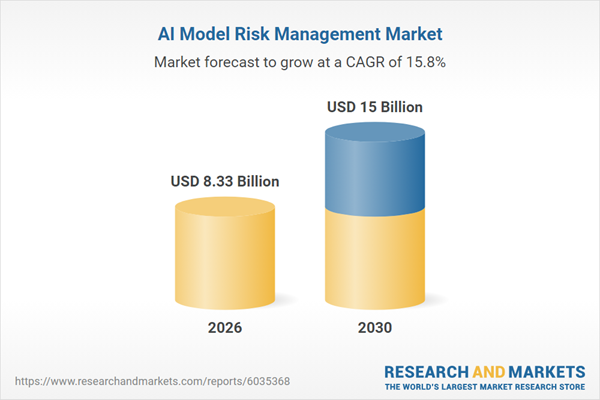
Ultimately, this growth demonstrates that organizations are aggressively replacing manual oversight with scalable technology as AI deployments accelerate.
Because manual governance methods cannot scale alongside modern AI portfolios, relying on them exposes your enterprise to significant compliance and operational liabilities.
However, implementing dedicated model risk infrastructure reduces validation cycle times, eliminates control gaps, and gives risk teams complete operational control.
Regulatory Requirements the Platform Must Operationalize
AI model risk management software translates complex regulatory mandates into automated technical guardrails.
Consequently, an enterprise MRM platform must automatically enforce compliance obligations across global financial, healthcare, and artificial intelligence standards.
1. SR 26-2 and OCC 2026-13 Banking Controls
The joint OCC 2026-13 and Federal Reserve SR 26-2 supervisory guidance supersedes legacy SR 11-7 rules, establishing updated standards for institutions with over $30 billion in assets. Therefore, the software must automate the following control areas:
- Development & Intended Use: Captures mathematical design, data quality attestations, and explicit design limits.
- Conceptual Soundness: Logs independent theoretical reviews and documents underlying algorithmic assumptions.
- Materiality Tiering: Scores risk dynamically using model exposure (portfolio size) and model purpose.
- Independent Validation: Enforces challenge workflows, quantitative stress testing, and backtesting protocols.
- Vendor Model Parity: Mandates third-party AI validation, monitoring, and governance at parity with internal models.
- Ongoing Surveillance: Tracks population stability and conceptual drift using dynamic alerting thresholds.
2. Fair Lending, Consumer, and Securities Obligations
Consumer protection and market regulations mandate targeted fairness testing and decision traceability based on specific operational use cases:
- ECOA & Regulation B: Mandates automated disparate impact analysis, proxy variable detection, and adverse action reasons.
- Fair Housing Act: Enforces demographic parity checks across automated property valuation and mortgage underwriting models.
- FCRA & CFPB Oversight: Tracks decision lineage to generate clear, legal explanations for consumer credit denials.
- SEC & FINRA Standards: Logs algorithmic trading parameters, market impact limits, and order execution audit trails.
3. EU AI Act and DORA Requirements
European frameworks enforce strict operational resilience and artificial intelligence safety rules across covered entities:
- EU AI Act Classification: Categorizes AI systems by risk tier and maintains technical documentation for high-risk tools.
- Data Governance & Logging: Tracks training data provenance, bias audits, and immutable event logs for regulatory inspection.
- Human Oversight Guardrails: Implements real-time override mechanisms and human-in-the-loop review triggers.
- DORA ICT Resilience: Monitors third-party AI service dependencies, cloud vulnerability exposures, and operational continuity plans.
4. NIST AI RMF and ISO 42001 Control Mapping
The platform aligns organizational governance with internationally recognized risk management and quality standards:
- Govern & Map: Defines risk appetite thresholds, policy management workflows, and comprehensive impact assessments.
- Measure & Manage: Integrates SHAP and LIME explainability metrics, performance tracking, and continuous mitigation workflows.
- ISO/IEC 42001 Standards: Generates systematic evidence for AI management systems, supporting continual improvement and audit certification.
For a detailed walkthrough on setting up multi-agent decision systems under regulatory frameworks, see our technical article on How to Develop Multi-Agent Orchestration for Finance.
5. FDA, ONC, and HIPAA Requirements for Healthcare
Healthcare deployments require strict patient safety controls, algorithmic transparency, and health data privacy protections:
- FDA PCCP Records: Documents Predetermined Change Control Plans, planned algorithmic modifications, and re-validation boundaries.
- ONC Predictive DSI Transparency: Discloses training data demographics, model validity, and clinical decision-support reliability.
- HIPAA & ePHI Controls: Enforces zero-trust access, data anonymization, and audit logging to protect sensitive health information.
Software operationalizes regulation by turning static policy documents into continuous technical controls. By unifying financial, consumer, European, and healthcare standards into a single platform, enterprises eliminate compliance blind spots and streamline regulatory audits.
How Banking and Healthcare MRM Requirements Differ
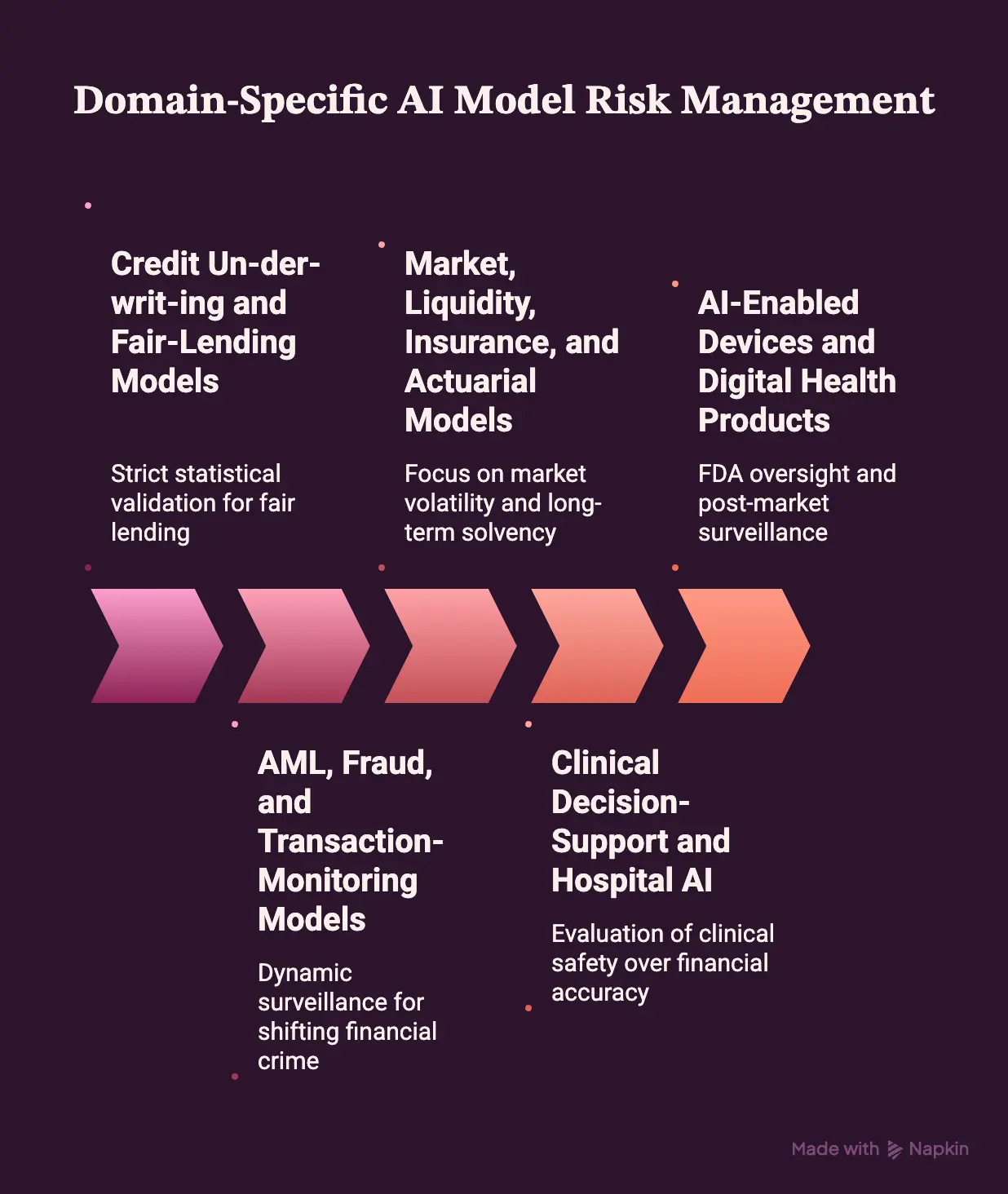
AI model risk management software must adapt to domain-specific risks rather than using a single generic framework.
Consequently, financial models focus heavily on consumer protection and economic loss, whereas healthcare models prioritize clinical safety and patient outcomes.
1. Credit Underwriting and Fair-Lending Models
Credit algorithms require strict statistical validation to ensure fair lending and financial stability. As a result, the MRM platform must monitor the following metrics continuously:
- Core Risk Parameters: Tracks Probability of Default (PD), Loss Given Default (LGD), and Exposure at Default (EAD).
- Accounting Standards: Validates CECL and IFRS 9 expected credit loss estimates across economic cycles.
- Fair Lending Verification: Enforces Disparate Impact Analysis, ECOA compliance, and proxy variable detection across protected classes.
- Decision Traceability: Generates compliant adverse-action reason codes for denied credit applications automatically.
For financial-services implementation examples, see our guide on AI Loan Origination Platform Development.
2. AML, Fraud, and Transaction-Monitoring Models
Anti-Money Laundering (AML) and fraud detection engines require dynamic surveillance to adapt to shifting financial crime typologies:
- Detection Efficiency: Measures false-positive rates, alert effectiveness, and investigator triage feedback.
- Threshold Governance: Logs all detection threshold modifications to preserve complete audit trails.
- Typology Coverage: Evaluates model scenario coverage against emerging financial crime patterns.
- Vendor Oversight: Enforces independent validation on third-party black-box transaction monitoring tools.
3. Market, Liquidity, Insurance, and Actuarial Models
Capital and trading models focus heavily on market volatility, tail-risk events, and long-term underwriting solvency:
- Stress Testing: Runs automated scenario analysis, historical backtesting, and Monte Carlo simulations.
- Trading Controls: Tracks order execution parameters, algorithmic trading latency, and real-time market impact limits.
- Insurance Analytics: Validates reserving, catastrophe risk calculations, and actuarial pricing algorithms.
4. Clinical Decision-Support and Hospital AI
Hospital AI systems directly impact patient outcomes, which means risk platforms must evaluate clinical safety over pure financial accuracy:
- Population Validity: Validates model calibration across specific hospital demographics and site-level equipment.
- Clinical Utility: Tracks subgroup performance, clinician override rates, and alert fatigue metrics.
- Safety Monitoring: Implements real-time safety tracking to prevent algorithmic misdiagnoses or treatment errors.
5. AI-Enabled Devices and Digital Health Products
Medical device software and digital health products must satisfy strict FDA oversight and post-market surveillance rules:
- Predetermined Change Plans: Tracks FDA PCCP boundaries, software updates, and re-validation triggers.
- Real-World Performance: Monitors post-deployment incident signals, user complaints, and diagnostic performance drift.
- Intended Use Compliance: Enforces clinical boundaries to prevent off-label software usage.
Although financial and healthcare AI share core governance requirements, their operational control metrics differ significantly. Consequently, an enterprise MRM platform must support flexible validation workflows tailored to specific industry risks.
Core Features of Enterprise AI Model Risk Software
Enterprise AI model risk management software delivers a unified control plane that connects model discovery, risk tiering, validation, and ongoing surveillance.
Rather than functioning as an assortment of disconnected tracking utilities, the platform integrates these core features into an automated, continuous governance lifecycle.
1. Core Features Table
| Core Control Area | Primary Functionality | Operational Impact |
| Discovery & Inventory | Scans code repositories, MLOps pipelines, and APIs to identify shadow AI. | Eliminates unmapped models and maintains an accurate inventory across cloud environments. |
| Metadata Registry | Stores model lineage, training datasets, owner attestations, and usage limits. | Replaces manual documentation with centralized, searchable model lineage. |
| Risk Tiering Engine | Evaluates financial exposure, decision autonomy, and regulatory classification. | Dynamically categorizes models into risk tiers to determine validation rigor. |
| Workflow Automation | Automates validator assignments, committee approvals, and exception sign-offs. | Accelerates approval cycles while ensuring complete, policy-driven handoffs. |
| Validation Workbench | Executes automated testing for SHAP/LIME explainability, bias, and stability. | Standardizes quantitative validation runs and automatically outputs comprehensive model cards. |
| Remediation & Audit | Tracks regulatory findings (MRAs/MRIAs), due dates, and immutable system logs. | Assembles examination-ready audit workpapers for regulatory reviews instantly. |
2. Automated AI Discovery and Model Inventory
The platform continuously monitors internal systems to maintain an accurate, real-time catalog of all operational artificial intelligence assets:
- Automated Scanners: Integrates with GitHub, GitLab, and enterprise MLOps pipelines to detect new model builds automatically.
- Shadow AI Detection: Scans network traffic and cloud environments to uncover unauthorized third-party vendor APIs and employee tools.
- Inventory Mapping: Links each discovered model asset directly to designated business owners, technical developers, and intended operational use cases.
3. Model Registry and Lifecycle Metadata
The registry functions as the authoritative repository for every model’s operational state, technical dependencies, and historical documentation:
- Lineage Tracking: Records underlying training datasets, feature store connections, code commits, and deployment locations.
- Operational Boundaries: Documents explicitly permitted applications, prohibited usage scenarios, and required compensating controls.
- Lifecycle State: Maintains complete version histories, current approval statuses, and scheduled annual review dates.
4. Risk Tiering and Model Risk Appetite
A flexible scoring engine automatically calculates model risk ratings based on customizable organizational risk appetite parameters:
- Multi-Factor Scoring: Evaluates decision materiality, potential financial loss, customer impact, and algorithmic complexity.
- Autonomy & Sensitivity: Factors in the degree of automated execution, reliance on sensitive data, and system reversibility.
- Proportional Governance: Automatically applies stricter validation requirements and higher-level approval gates to high-risk models.
5. Policy, Approval, and Committee Workflows
Automated governance workflows enforce policy compliance without delaying model development and deployment schedules:
- Structured Approvals: Manages sequential sign-offs across first-line developers, independent second-line validators, and risk officers.
- Committee Management: Automates risk committee agenda creation, decision logging, conditional approvals, and policy exception tracking.
- Escalation Triggers: Automatically alerts risk managers when model validations are overdue or when risk limits are breached.
6. Validation, Fairness, and Explainability Workbench
An integrated technical workspace allows validators to execute reproducible quantitative tests and generate comprehensive documentation:
- Reusable Test Suites: Runs standardized tests for statistical performance, data stability, robustness, and conceptual soundness.
- Bias & Fairness Analysis: Executes subgroup performance testing, disparate impact evaluations, and proxy variable identification.
- Explainability Artifacts: Integrates SHAP, LIME, and counterfactual metrics to document global and local decision logic.
7. Findings, Remediation, and Examination Readiness
The platform converts validation gaps and audit findings into tracked, actionable remediation workflows:
- Issue Tracking: Categorizes findings by severity, assigns clear ownership, and sets strict remediation due dates.
- Regulatory Compliance: Tracks Matter Requiring Attention (MRA) and Matter Requiring Immediate Attention (MRIA) resolution workflows.
- Audit Workspaces: Generates immutable, time-stamped audit logs and examination workpapers for internal and external auditors.
Connected risk features transform static compliance policies into an active, continuous defense system across your entire AI portfolio.
Consequently, risk teams eliminate operational bottlenecks while ensuring every model remains fully audited, tested, and compliant.
How Automated Validation Supports Effective Challenge
Automated validation tools streamline quantitative testing, but they do not replace independent human judgment. True effective challenge requires qualified validators to rigorously evaluate a model’s conceptual design, test its limitations, and question its underlying assumptions.
Therefore, AI model risk management software accelerates testing workflows while preserving strict second-line independence.
1. Conceptual Soundness and Assumption Review
Automated test suites cannot evaluate whether a mathematical approach aligns with a business use case. Consequently, validators use the platform to document qualitative challenges:
- Theoretical Foundations: Evaluates whether chosen algorithms accurately reflect underlying financial or clinical realities.
- Assumption Stress Testing: Documents core mathematical assumptions and tests model behavior when those assumptions fail.
- Boundary Enforcement: Maps explicit operational limitations to prevent models from running in unapproved environments.
2. Data Quality and Lineage Validation
The platform automatically verifies data integrity across development and production pipelines to prevent flawed inputs from compromising model outputs:
- Pipeline Integrity: Checks datasets for missing values, extreme outliers, target leakage, and point-in-time correctness.
- Distribution Parity: Identifies training-serving skew and verifies that training data reflects current operational populations.
- Privacy Protections: Audits data pipelines to ensure models do not inadvertently ingest prohibited protected-class variables.
3. Quantitative Performance Testing
The workbench executes standardized, reproducible test packages tailored to specific algorithmic architectures:
- Classification Metrics: Calculates AUC-ROC, Gini coefficients, Kolmogorov-Smirnov (KS) statistics, and F1 scores automatically.
- Regression Metrics: Measures Root Mean Square Error (RMSE), Mean Absolute Error (MAE), and output calibration curves.
- Stress Testing: Conducts automated backtesting, scenario analysis, and champion-challenger model benchmarking.
4. Independent Review and Validation Workpapers
To protect validator independence, the platform maintains strict access controls and role-based permissions:
- Role Separation: Prevents model developers from modifying validation workflows, editing test results, or closing findings.
- Reproducible Testing: Allows independent validators to re-run test scripts using isolated computational environments.
- Disagreement Logs: Preserves records of technical disagreements between first-line developers and second-line validators.
- Workpaper Generation: Compiles complete, time-stamped validation packages ready for regulatory inspection.
Automation excels at running statistical tests, detecting data anomalies, and assembling documentation rapidly. However, it cannot replace accountable expert judgment or independent validator oversight.
How To Build an AI Model Risk Management System
Implementing enterprise AI model risk management requires a disciplined, phase-based deployment.
Rather than attempting a disruptive company-wide rollout on day one, organizations achieve faster time-to-value by establishing core governance rules first, proving them on high-impact use cases, and systematically scaling platform integrations.
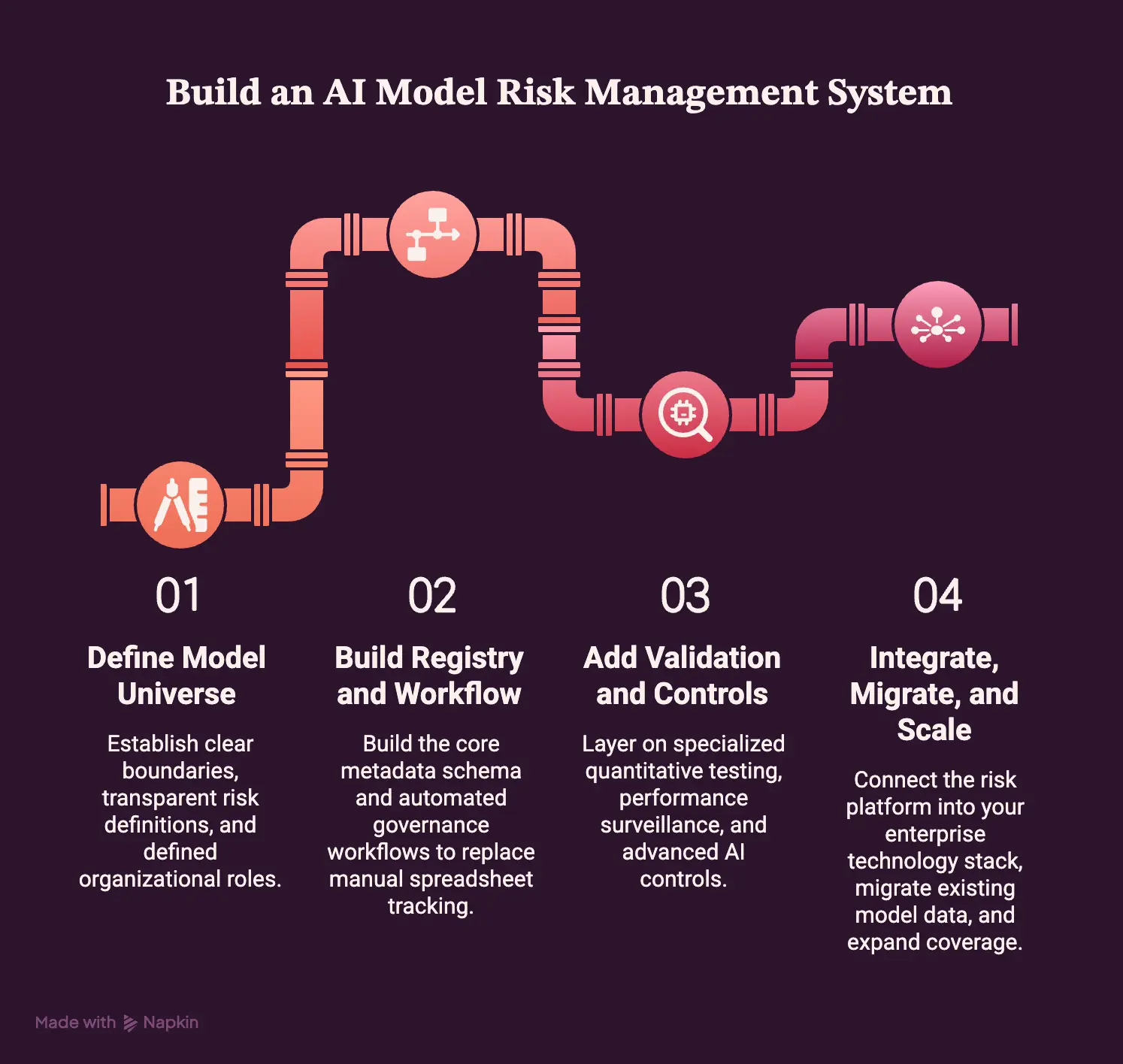
Step 1 — Define the Model Universe and Operating Model
Building a sustainable risk management framework begins with clear boundaries, transparent risk definitions, and defined organizational roles:
- Scope and Materiality: Define explicitly what constitutes a model versus a basic reporting script. Establish quantitative materiality thresholds based on operational impact and financial exposure.
- Governance Architecture: Formalize the three-lines-of-defense model to separate first-line developers from second-line independent validators and third-line auditors.
- Policy Foundation: Define risk taxonomy tiers, target model risk appetite limits, exception escalation paths, and mandatory evidence-retention schedules.
Intellivon Blueprint: Begin implementation within a single regulated business domain, such as credit decisioning or clinical triage. Proving the operating model on a representative portfolio prevents organizational fatigue and refines policies before company-wide rollout.
Step 2 — Build the Registry, Taxonomy, and Workflow MVP
Once policies exist, build the core metadata schema and automated governance workflows to replace manual spreadsheet tracking:
- Canonical Schema: Establish a centralized model inventory schema capturing business intent, technical dependencies, data lineage, and operational state.
- Risk Scoring Engine: Implement automated risk-tiering questionnaires to calculate dynamic model criticality and determine required validation rigor.
- Workflow Automation: Deploy automated approval gates, validator assignment queues, findings trackers, and audit history logs.
Intellivon Blueprint: Treat the model registry as your central system of record. Avoid building executive dashboards or reporting widgets before underlying metadata schemas, approval workflows, and evidence links operate reliably.
Step 3 — Add Validation, Monitoring, and AI Controls
After establishing the inventory foundation, layer on specialized quantitative testing, performance surveillance, and advanced AI controls:
- Quantitative Workbench: Integrate reusable test libraries for performance metrics, conceptual soundness checks, subgroup bias, and SHAP explainability.
- Production Surveillance: Configure continuous telemetry to detect data drift, concept drift, output degradation, and security anomalies in real time.
- Generative & Agentic Guardrails: Implement specialized evaluations for RAG retrieval quality, citation accuracy, LLM toxicity, and autonomous agent tool permissions.
Intellivon Blueprint: Configure distinct validation templates tailored specifically to credit, fraud, clinical, LLM, and third-party vendor models. Never force every system through a single generic checklist.
Step 4 — Integrate, Migrate, Pilot, and Scale
Finally, connect the risk platform into your enterprise technology stack, migrate existing model data, and expand coverage across business units:
- Infrastructure Connectors: Integrate directly with MLflow, Databricks, AWS SageMaker, Azure Machine Learning, Vertex AI, and enterprise data catalogs.
- Enterprise Systems: Link risk workflows into Jira, ServiceNow, Identity and Access Management (IAM), and enterprise GRC platforms.
- Migration & Expansion: Migrate legacy inventories, complete User Acceptance Testing (UAT), train all three lines of defense, and systematically onboard remaining business units.
Intellivon Blueprint: Run the new risk platform alongside legacy MRM processes during pilot testing. Parallel runs allow risk teams to reconcile records, verify data integrity, and build organizational confidence before retiring spreadsheets.
Building an enterprise AI model risk management system is an evolutionary process that transforms passive compliance into active operational oversight. By pairing an incremental rollout strategy with connected software controls, organizations achieve full regulatory readiness without sacrificing development speed.
AI Model Risk Management Software Cost and Timeline
Custom AI model risk management software usually costs $70,000–$300,000, depending on the model portfolio, validation depth, integrations, deployment environment, regulatory coverage, and GenAI control requirements.
1. Development Cost by Platform Level
| Platform Level | Cost Range | Appropriate Scope |
| Focused MRM MVP | $70,000–$110,000 | Registry, tiering, workflows, model cards, review calendar, basic reporting |
| Production MRM Platform | $120,000–$210,000 | Validation automation, monitoring, findings, explainability, integrations, audit evidence |
| Multi-Entity Enterprise Platform | $220,000–$300,000 | Multiple jurisdictions, hybrid deployment, advanced GenAI controls, complex integrations, extensive migration |
2. Development Phase Breakdown
- Discovery, Operating Model, and Control Mapping: $10,000–$20,000
- Model Registry, Workflow, and Evidence MVP: $35,000–$65,000
- Validation, Monitoring, and AI-Risk Services: $45,000–$90,000
- Integrations, Security, and Reporting: $35,000–$80,000
- Migration, Pilot, Training, and Rollout: $15,000–$45,000
Cost Scope Note: Phase maximums are not automatically additive. Total capital investment depends strictly on which specific services, connectors, and deployment controls enter your final statement of work.
3. Expected Development Timeline
- Discovery and Architecture: 2–4 weeks
- Focused MVP: 10–16 weeks
- Production Platform: 5–9 months
- Complex Multi-Entity Rollout: 7–10 months
4. Ongoing Operating Cost
Plan for approximately 15%–20% of the original build cost annually for maintenance, security updates, regulatory mappings, integration changes, monitoring infrastructure, and new model-type support.
Budgeting for an AI model risk management platform requires balancing initial engineering investment against long-term maintenance costs. Ultimately, starting with a targeted MVP protects capital while establishing an audit-ready foundation for your enterprise.
Build AI Model Risk Management Software With Intellivon
Intellivon builds AI model risk management platforms as connected enterprise infrastructure. Drawing on 11+ years of experience and over 500 successful enterprise AI engagements, our specialized engineering teams design scalable, secure architectures tailored specifically to your regulatory environment.
Consequently, the platform supports model owners, independent validators, second-line risk teams, internal audit, compliance leaders, and executive committees without forcing every model type through the same rigid control path.
Core Platform Capabilities
- Discovery & Registry: Automated model discovery, complete lifecycle inventory, schema mapping, and dynamic risk tiering.
- Governance Automation: Model-risk appetite alignment, policy enforcement, and independent effective-challenge workflows.
- Continuous Surveillance: Automated performance testing, real-time drift detection, subgroup bias analysis, and SHAP explainability monitoring.
- Advanced AI Controls: Specialized governance for LLMs, RAG applications, autonomous agent permission boundaries, and third-party foundation models.
- Ecosystem Integration: Bi-directional connectors for MLOps, enterprise data catalogs, GRC platforms, IAM, BI dashboards, and ITSM tools.
- Regulatory Readiness: Examination-ready workpaper generation, immutable audit logging, and board-level risk reporting.
- Flexible Deployment: Cloud-native, hybrid, or secure on-premises execution with specialized financial-services and healthcare control configurations.
Partnering with Intellivon ensures your MRM platform aligns technical automation with complex regulatory expectations. As a result, your organization eliminates manual compliance friction while maintaining complete control over its evolving AI portfolio.
Talk to Intellivon’s enterprise AI and model-risk engineering experts to define the architecture, implementation phases, integration scope, and realistic budget for your MRM platform.
Conclusion
Deploying custom AI model risk management software enables enterprises to balance rapid technological innovation with rigorous regulatory compliance. Consequently, automated discovery, dynamic risk tiering, and continuous surveillance transform static policies into active, operational guardrails.
Furthermore, establishing clear governance controls across both traditional statistical models and complex generative applications ensures complete audit readiness.
Ultimately, investing in scalable risk infrastructure protects organizational reputation, mitigates financial exposure, and empowers enterprise teams to deploy transformative artificial intelligence with absolute confidence.
FAQs
Did SR 26-2 Replace SR 11-7 and OCC 2011-12?
Yes, on April 17, 2026, the Federal Reserve and OCC issued SR 26-2 and OCC Bulletin 2026-13, replacing legacy guidance. However, organizations should migrate existing control mappings rather than discard prior MRM evidence. Consequently, teams retain historical audit trails while adopting the updated, materiality-driven supervisory expectations.
Which Models Should an Enterprise MRM Platform Govern?
An enterprise platform must govern traditional statistical models, machine learning algorithms, vendor solutions, and embedded tools. Furthermore, it should extend coverage to foundation models, RAG applications, and autonomous agents based on materiality and operational impact. As a result, risk teams maintain a unified inventory across all intelligent systems.
Can AI Automate Independent Model Validation?
Software efficiently automates statistical testing, data extraction, and workpaper assembly across validation pipelines. However, automated platforms cannot replace accountable human judgment or validator independence. Ultimately, qualified second-line validators must evaluate conceptual soundness, challenge assumptions, and retain final approval authority for all high-risk model deployments.
Can Enterprise AI MRM Software Govern LLMs and Agents?
Yes, modern governance platforms evaluate non-deterministic generative tools at the composite application level. Specifically, software tracks prompt versioning, tests RAG retrieval quality, enforces tool permission boundaries, and establishes action limits. Therefore, enterprises ensure real-time safety, guardrail compliance, and human oversight across complex agentic workflows.
How Does AI MRM Integrate With MLOps and GRC Tools?
AI MRM software connects via bi-directional REST APIs, webhooks, and real-time event streams. Consequently, the platform synchronizes metadata across MLOps registries, triggers ITSM remediation tickets, and enforces IAM role restrictions. Ultimately, this seamless integration connects technical development pipelines directly into broader enterprise GRC systems.
When Should an Enterprise Build Instead of Buy?
Enterprises should build a custom platform when managing proprietary workflows, highly custom integrations, or strict hybrid deployment restrictions. Conversely, commercial solutions suit standardized environments. Therefore, evaluate your three-year total cost of ownership alongside model portfolio complexity to select the most defensible, cost-effective architecture.
To Sum It Up
- The hardest part of AI MRM is not building the dashboard. It is creating an evidence backbone that connects every model, decision, test, approval, and change.
- Validation automation creates value only when it preserves independent challenge instead of turning review into a checkbox.
- LLM and agent risk must be assessed at the application level because the foundation model is only one component of the governed system.
- Integration and evidence requirements usually drive AI MRM development costs more than the visible user interface.
- A focused enterprise MVP can start at $70,000, while multi-entity platforms with advanced AI controls can reach $300,000.