

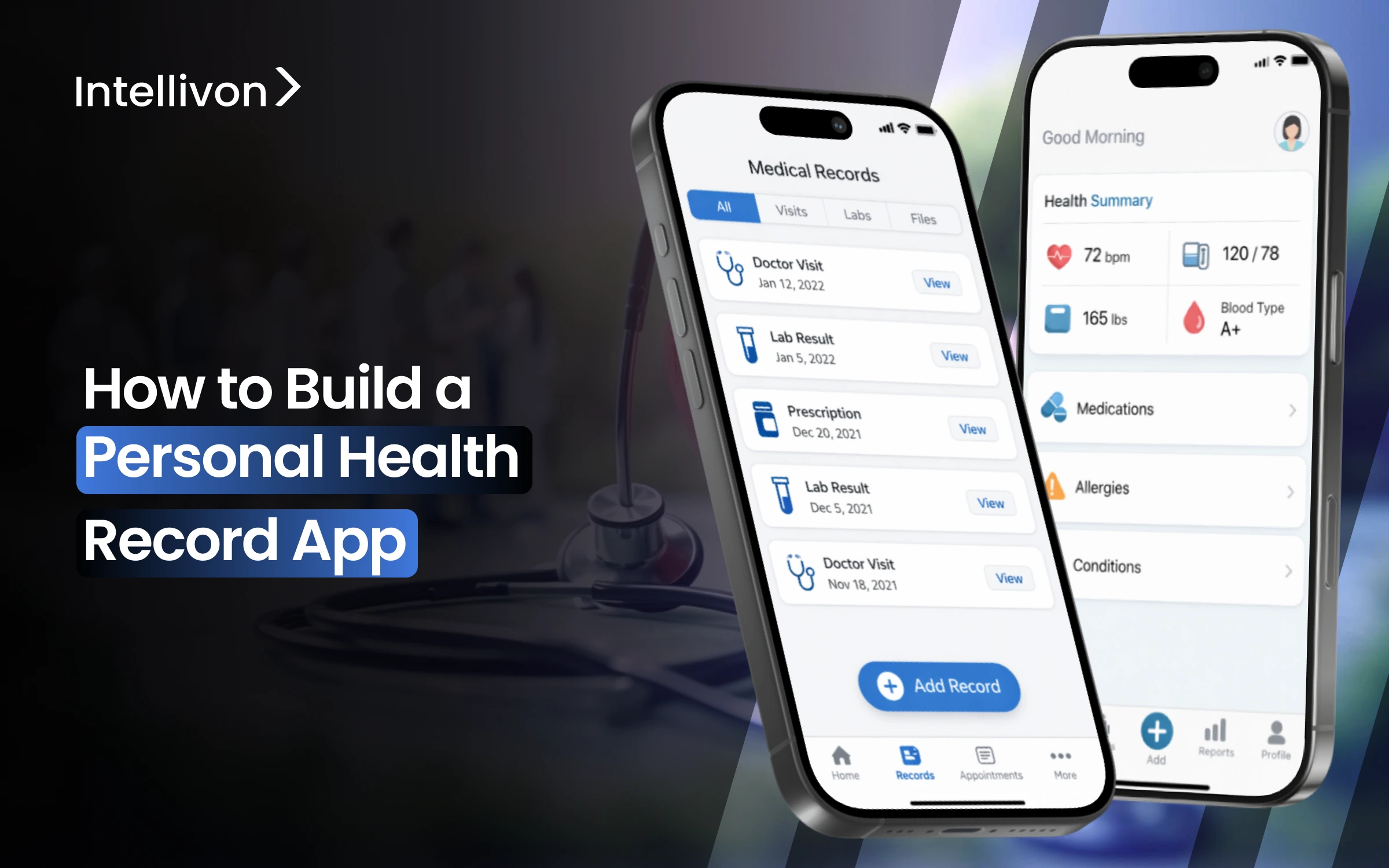
Building a personal health record (PHR) app means pulling medical data from hospitals, labs, pharmacies, and wearables into one place. Every healthcare system stores information differently, and every provider has its own sharing rules. Users want everything to sync automatically and stay available when they need it, especially during emergencies. The hard part is hiding this mess while keeping data secure.
What these apps need is encryption that protects records everywhere, connections to hospital systems using HL7 and FHIR standards, and controls that let users share their cardiac history with a cardiologist without exposing everything else. At the same time, these apps need offline access when there’s no internet. PHR apps are successful when they have systems that can handle conflicts when two labs report different test results, and export options so users aren’t trapped.
At Intellivon, we build PHR apps with interoperability and security built in from the start. Our integration setup handles data from any source. At the same time, encryption runs at every connection point. Drawing on this experience, in this blog, we will discuss how we build healthcare apps that actually consolidate someone’s complete health history.
Why Enterprises Are Investing in PHR Platforms
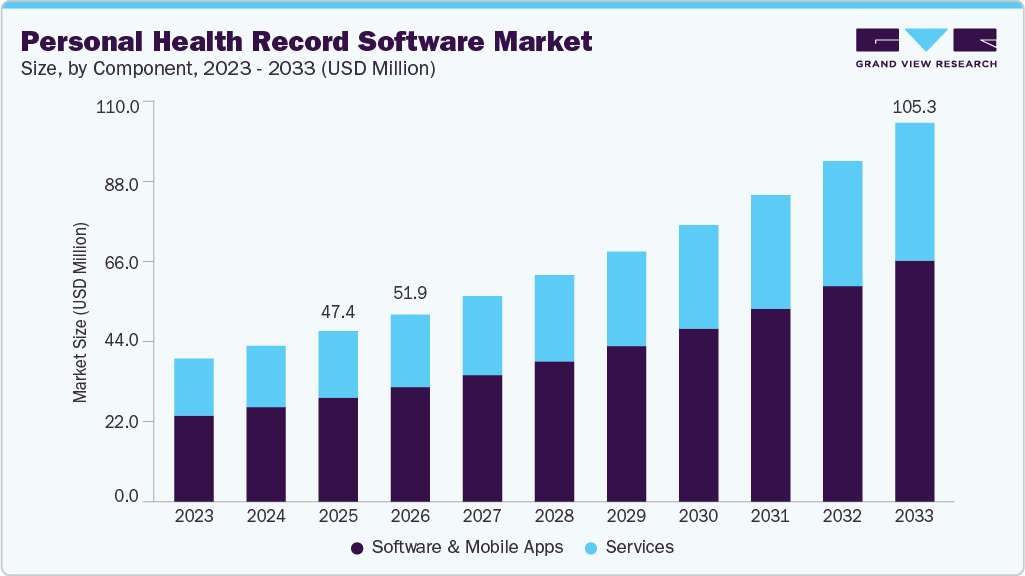
The personal health records (PHR) market is growing steadily as patients take greater control of their health data. As a result, digital health platforms increasingly rely on PHR systems as a core foundation.
The market is expanding at an estimated 10–11% annual growth rate. Therefore, the total market value is expected to cross USD 100 million by 2033. This growth is largely driven by wearable devices and telehealth adoption. In addition, tighter integration between remote care platforms and patient-owned records continues to accelerate demand.
Market Insights:
- Integrated PHRs hold a 42.15% market share in 2025 due to better data consolidation.
- These platforms combine data from EHR systems, labs, pharmacies, and wearable devices.
- Health monitoring features drive the fastest growth across PHR platforms.
- Wearable-based vital tracking supports ongoing management of chronic conditions.
- Therefore, demand continues to rise as chronic care shifts to long-term monitoring.
- The provider segment shows the quickest expansion among PHR users.
- Healthcare systems adopt PHRs to improve care coordination and meet compliance needs.
Why Are Healthcare Enterprises Investing In PHRs Now
Healthcare data now lives across hospitals, labs, pharmacies, insurers, and devices. As a result, enterprises are investing in personal health record platforms to bring this data together in one controlled layer.
1. One Continuous Patient Record
PHR platforms create continuity across providers, labs, pharmacies, and payers. Therefore, care teams no longer operate on partial or outdated information.
2. Fewer Gaps in Patient Journeys
Disconnected systems create delays and confusion for patients. PHRs reduce these gaps by keeping records accessible across touchpoints and over time.
3. Better Engagement and Long-Term Outcomes
When patients can see and share their health data easily, adherence improves. As a result, long-term outcomes become more predictable and measurable.
4. A Base for AI and Advanced Analytics
PHRs provide clean, structured data over time. This makes them a natural foundation for AI-driven insights, personalization, and population-level analytics.
5. Prepared for Data Portability Rules
Regulators increasingly require patient data access and portability. Therefore, PHR platforms help enterprises stay compliant without constant system rework.
At scale, PHR apps act as data aggregation and consent orchestration layers, not standalone tools. However, not all PHR apps are built for enterprise healthcare realities.
What Is a Personal Health Record App?
A personal health record app is a digital platform that allows individuals to collect, store, and manage their own health information in one place. It brings together data from hospitals, labs, pharmacies, insurers, and wearable devices.
Unlike hospital-controlled systems, the individual controls access and sharing. Therefore, records can move with the person across providers and care settings. These apps support documents, test results, medications, and ongoing health data. As a result, people maintain a continuous health history, while enterprises gain cleaner data, stronger consent controls, and better coordination across healthcare ecosystems.
How a Personal Health Record App Is Different
Healthcare systems often group many tools under “digital health.” However, these tools serve very different roles. Understanding these differences helps enterprises avoid building the wrong product for the wrong purpose.
| System Type | Who Controls It | Primary Purpose | Key Limitation |
| EHR (Electronic Health Records) | Healthcare provider or hospital | Clinical documentation and care delivery | Data stays within one organization |
| EMR Systems | Individual clinics or practices | Internal medical record keeping | Limited sharing outside the clinic |
| Patient Portals | Healthcare providers | View records, book visits, message clinicians | Read-only access with restricted portability |
| Wellness or Fitness Apps | Consumer | Track lifestyle and activity data | Not designed for clinical or regulated use |
| Personal Health Record Apps | Individual | Aggregate, manage, and share health data | Requires strong consent and governance design |
Why This Difference Matters
A personal health record app sits between patients and enterprises. Therefore, it acts as a data aggregation and consent layer rather than a clinical system. This position makes it essential for interoperability, long-term care continuity, and regulatory readiness.
Why 70%+ of Hospitals Still Lack True PHR Interoperability
Most hospitals now offer digital access to health records. However, access alone does not equal interoperability. True PHR interoperability means records move easily across systems, providers, and patient-owned apps. In practice, 70%+ of hospitals still lack true PHR interoperability. Here is why:
1. Data Lives in Silos
Hospitals rely on multiple systems for EHRs, labs, imaging, billing, and pharmacy data. As a result, records remain scattered across vendors and formats. Even when APIs exist, data often stays locked within organizational boundaries.
2. Interoperability Stops at the Portal
Many hospitals enable patient portals. However, these portals rarely support importing records from other providers. Therefore, patients still manage fragmented histories across multiple logins and apps.
3. Consent Is Hard to Manage at Scale
Sharing data across organizations requires precise consent controls. In addition, consent must be time-bound, purpose-specific, and auditable. Most legacy systems were never designed to handle this complexity.
4. Clinical Workflows Lag Behind Technology
Even when external data is available, clinicians do not always use it. Consequently, interoperability exists on paper but fails in daily care delivery.
Without true interoperability, PHR initiatives remain limited. Therefore, enterprises must treat PHRs as data aggregation and consent orchestration layers, and not simple patient-facing tools.
Core Functional Modules of an Enterprise-Grade PHR App
An enterprise-grade PHR app must function as a dependable system of record across the healthcare ecosystem. Therefore, it cannot be designed as a lightweight patient feature. Each module must support scale, compliance, and long-term evolution.
When these modules work together, the PHR becomes a governed data layer rather than a storage tool.
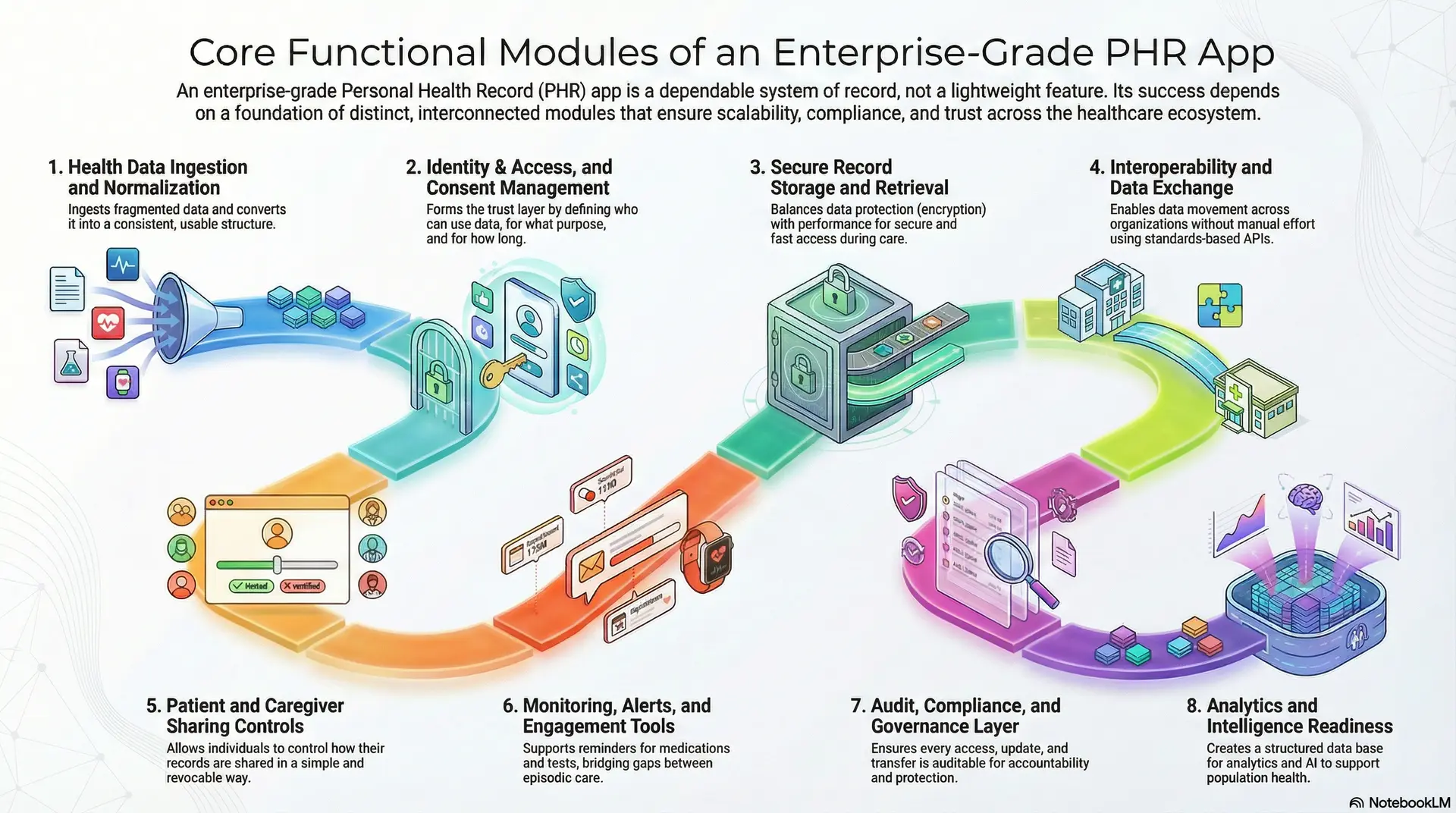
1. Health Data Ingestion and Normalization
Enterprise PHRs must ingest data from EHRs, labs, pharmacies, insurers, and connected devices. However, this data arrives in fragmented formats and varying quality levels.
Normalization converts it into a consistent structure over time. As a result, records remain usable across providers and care episodes. This also prevents duplication and data decay. Without normalization, longitudinal health views quickly lose value.
2. Identity, Access, and Consent Management
Identity forms the trust layer of a PHR platform. Therefore, access must be role-based, context-aware, and tightly controlled. Consent defines who can view or use data, for what purpose, and for how long.
In addition, consent actions must be logged and enforceable in real time. This ensures compliance while allowing controlled data sharing. Weak consent design often becomes the biggest scaling risk.
3. Secure Record Storage and Retrieval
PHR data must be encrypted at rest and in transit. However, security cannot slow access during care delivery. Therefore, storage systems must balance protection with performance. Version control preserves historical accuracy.
Backup and recovery ensure continuity during failures. Together, these controls protect patient trust and enterprise reliability.
4. Interoperability and Data Exchange
True interoperability enables data movement across organizations without manual effort. Therefore, enterprise PHRs rely on standards-based APIs and exchange protocols. These allow structured sharing with hospitals, labs, and partner platforms.
In addition, interoperability supports portability mandates. Without this layer, PHRs remain isolated and underutilized.
5. Patient and Caregiver Sharing Controls
Individuals must control how their records are shared. This includes providers, caregivers, and authorized third parties. Therefore, sharing must be simple, time-bound, and revocable.
Clear controls increase confidence and adoption. At scale, this also reduces administrative overhead for enterprises.
6. Monitoring, Alerts, and Engagement Tools
PHRs support reminders for medications, tests, and follow-ups. In addition, they capture ongoing health data between visits.
This maintains continuity of care. As a result, engagement improves without overwhelming clinicians. These tools bridge episodic care gaps.
7. Audit, Compliance, and Governance Layer
Every access, update, and transfer must be auditable. Therefore, logging cannot be optional. Governance ensures accountability across users and systems. This protects enterprises during audits and investigations. Strong governance also supports cross-border operations.
8. Analytics and Intelligence Readiness
PHRs generate structured, longitudinal data over time. Therefore, they form a strong base for analytics and AI. Insights can support population health, personalization, and operational planning. Importantly, intelligence remains governed. This ensures innovation without regulatory risk.
An enterprise-grade PHR app succeeds or fails based on its modular foundation. Each module solves a specific operational, regulatory, or scalability challenge. Therefore, gaps in any one area quickly surface as risk, cost, or stalled adoption.
Non-Negotiable Compliance To Follow In PHR Apps
Compliance defines whether a personal health record app can operate at enterprise scale. It is not a legal afterthought or a launch-phase task.
Instead, compliance shapes architecture, workflows, and data flows from the beginning. This is why enterprises treat compliance as a core system capability.
1. HIPAA, GDPR, and Regional Data Protection Laws
PHR platforms often serve users across countries and healthcare systems. Therefore, they must comply with multiple privacy laws at the same time. HIPAA governs how health data is stored, accessed, and shared in the United States.
At the same time, GDPR introduces stricter requirements around consent, data access, and deletion rights in Europe. In addition, many regions impose local health data rules. Enterprises must design adaptable compliance workflows rather than hard-coded rules. This flexibility prevents rework as regulations evolve.
2. Data Residency and Localization Requirements
Many countries require health data to remain within national or regional boundaries. As a result, infrastructure decisions cannot be centralized by default. Cloud environments must support regional storage, processing, and access controls.
Data replication must also respect jurisdictional limits. Ignoring residency rules can delay launches or force costly redesigns later. Therefore, residency planning must happen early.
3. Encryption and Security Standards
Encryption protects health data at rest and in transit. However, enterprise security goes beyond encryption alone. Key management must be secure and auditable. Access must be tightly controlled across users and systems.
In addition, secure backups and disaster recovery plans are essential. Together, these controls reduce breach risk and protect operational continuity.
4. Consent Enforcement and Access Control
Consent defines how health data can be used. Therefore, it must be granular, time-bound, and purpose-specific. Users should clearly see who has access and why. Consent changes must take effect immediately.
This prevents misuse and supports regulatory compliance. Weak consent enforcement often undermines trust and adoption.
5. Auditability and Traceability
Every data interaction must leave a trace. This includes viewing, editing, sharing, and exporting records. Audit logs must be tamper-proof and easy to review.
As a result, enterprises can respond quickly to audits or investigations. Traceability also strengthens internal governance and accountability.
6. AI Governance and Responsible Intelligence
When AI insights are added, governance becomes critical. Models must be explainable and monitored over time. Decisions should remain reviewable by humans.
In addition, bias and drift must be actively managed. This ensures AI adds value without introducing regulatory or ethical risk.
Compliance done well creates confidence for expansion, partnerships, and long-term growth. Enterprises that embed compliance into their PHR platforms reduce risk while unlocking new opportunities. This approach turns regulation into a strategic advantage rather than a constraint.
Technology Architecture for Building a Scalable PHR App
A scalable PHR app depends on clear architectural separation. Therefore, responsibilities must be distributed across well-defined layers.
This prevents compliance failures, performance bottlenecks, and costly redesigns later. When architecture is layered correctly, enterprises can expand regions, integrations, and features with confidence.
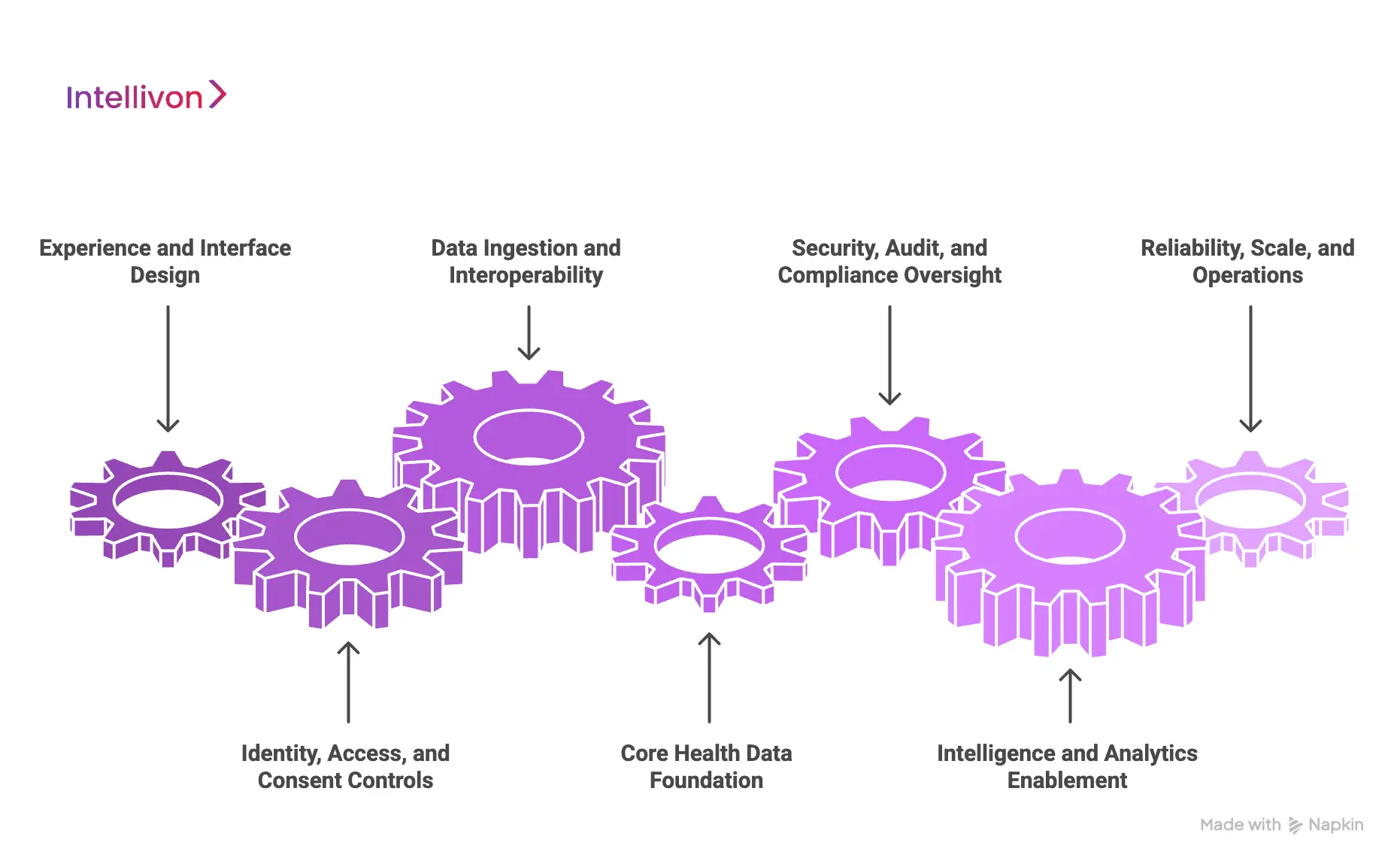
1. Experience and Interface Design
Patients and caregivers interact with the PHR through web and mobile interfaces. These experiences must remain fast, intuitive, and accessible. At the same time, enterprises require admin views for support and access review.
Clear workflows reduce errors during data entry and sharing. As a result, adoption improves without increasing operational burden.
2. Identity, Access, and Consent Controls
Access rules define who can view or share health data. Authentication must be strong and adaptable to different user roles. Consent should be granular, time-bound, and enforced across every workflow.
Therefore, permissions remain consistent even as integrations grow. Weak controls here quickly expose compliance risk.
3. Data Ingestion and Interoperability
PHR platforms must connect to EHRs, labs, pharmacies, insurers, and devices. Incoming data often varies in structure and quality. Validation and mapping are essential to maintain accuracy.
In addition, retry and error handling protect against data loss. This capability determines whether interoperability works in practice.
4. Core Health Data Foundation
Health records must be stored securely and remain easy to retrieve. Encryption, versioning, and normalization protect integrity over time. Records should form a continuous timeline rather than isolated files.
As a result, data stays useful across care episodes. This foundation supports long-term scalability.
5. Security, Audit, and Compliance Oversight
Every access and change must be recorded. At the same time, audit logs should be tamper-resistant and searchable. Policy enforcement ensures consistent behavior across systems.
Therefore, enterprises can respond confidently to audits or investigations. Strong oversight reduces legal and operational exposure.
6. Intelligence and Analytics Enablement
Structured data allows reporting and advanced insights. Analytics must respect consent and purpose limits. AI-driven features should remain explainable and monitored.
Additionally, human review is essential for higher-risk outputs. This keeps innovation aligned with regulation.
7. Reliability, Scale, and Operations
System stability matters as usage grows. Monitoring and alerts help teams detect issues early. Performance tuning ensures records load quickly. Cost controls prevent runaway infrastructure spend. Resilience protects enterprise reputation.
A layered approach keeps PHR platforms adaptable under real-world pressure. Each architectural area isolates complexity and limits risk. Therefore, enterprises can scale without disruption. When built this way, a PHR app becomes durable infrastructure rather than a short-term solution.
How You Should Use AI in Personal Health Record Apps
AI can add real value to personal health record apps. However, it is used with restraint and clear boundaries. In enterprise healthcare, AI should support understanding, efficiency, and continuity.
It should never replace clinical judgment or override consent. When applied correctly, AI strengthens the PHR without increasing risk.
1. Focus AI on Understanding, Not Diagnosis
PHRs hold large volumes of raw and unstructured data. AI works best when it helps organize and summarize this information. For example, it can group records by condition, highlight trends, or surface key changes over time.
Therefore, users and care teams understand histories faster. Diagnostic decisions must remain outside the PHR scope. This separation protects clinical safety and regulatory alignment.
2. Reduce Cognitive Load
Longitudinal records can overwhelm users. AI can simplify views by generating plain-language summaries of visits, labs, or medication changes. In addition, it can flag missing or outdated records. This improves usability without altering medical meaning. As a result, engagement increases while trust remains intact.
3. Data Quality and Consistency
Data enters PHRs from many sources. AI can detect duplicates, inconsistencies, or incomplete entries. Therefore, records stay cleaner over time. This improves downstream analytics and reporting. Enterprises benefit from higher data reliability without manual review at scale.
4. Enable Personalization Within Clear Limits
AI can tailor reminders, follow-ups, and content based on consented data. However, personalization must stay non-clinical. It should support adherence and awareness, not treatment decisions. Clear boundaries prevent misuse and regulatory exposure.
5. Govern AI With Transparency
Every AI function must be explainable and auditable. Users should know when AI is involved. In addition, enterprises must monitor performance and bias over time. Human oversight remains essential, especially as models evolve.
In PHR apps, AI works best as an assistive layer. It improves clarity, data quality, and engagement. When governed properly, it accelerates value without compromising trust or compliance.
How We Build Personal Health Record Apps
Enterprise PHR platforms fail when they are treated as software projects instead of regulated systems. At Intellivon, the build approach stays methodical and risk-aware. Each step exists to prevent downstream failures in compliance, interoperability, or scale.
The process moves deliberately because fixing healthcare platforms after launch is costly. This structure ensures the PHR remains viable long after deployment.

Step 1: Align With Enterprise Objectives
Every engagement begins with alignment on business goals, operating regions, and regulatory exposure. These inputs shape architectural decisions from the start. For example, data residency rules influence cloud strategy early. Clinical risk tolerance also informs feature boundaries.
As a result, delivery stays grounded in reality. This step prevents misalignment between product ambition and regulatory feasibility.
Step 2: Define Data Sources
PHR platforms touch many data sources across the ecosystem. These include EHRs, labs, pharmacies, insurers, and devices. Ownership and stewardship must be defined clearly for each source.
Therefore, responsibilities for accuracy, updates, and corrections remain clear. This step also informs consent design. Without it, data governance quickly breaks down.
Step 3: Design Consent and Access
Consent is treated as a system function, not a UI setting. Access rules define who can view, share, or revoke data. These rules are purpose-specific and time-bound. In addition, every consent action must be enforceable across integrations.
This prevents accidental exposure. Strong consent logic protects trust at scale.
Step 4: Architect Platform as Modular Layers
The platform is designed using a layered, modular approach. Each layer has a defined responsibility and limited scope. This prevents changes in one area from breaking others.
Therefore, new integrations or regions can be added safely. Modularity also simplifies audits and upgrades. Long-term flexibility is preserved.
Step 5: Integrate, Validate, and Normalize Data
Integrations are built using standards-based methods wherever possible. Incoming data is validated for accuracy and completeness. Normalization ensures consistency across sources and time.
As a result, records form a usable longitudinal history. This step protects downstream analytics and reporting. Poor data quality is addressed early.
Step 6: Embed Security, Audit, and Governance
Security controls are embedded across every layer. Audit logs track access, changes, and data movement. At the same time, governance policies enforce consistent behavior across systems.
Additionally, testing includes failure scenarios and misuse cases. Therefore, risks are surfaced before launch. Ongoing monitoring remains in place after deployment.
Step 7: Scale With Controlled Intelligence
Advanced analytics and intelligence are introduced only when the foundation is stable. Here, insights remain explainable and permissioned. At the same time, human oversight stays central to decision-making.
This prevents automation from introducing risk. As platforms grow, governance scales with them. Growth remains controlled and compliant.
Intellivon builds personal health record apps as a long-term healthcare infrastructure. Each step reduces risk while enabling scale. This approach turns PHR platforms into durable enterprise assets rather than short-lived digital products.
Cost Of Building A Personal Health Record App
At Intellivon, personal health record apps are built as a regulated health data infrastructure, not as simple document storage tools. The focus stays on creating a platform that can safely operate across providers, regions, and evolving regulations.
When budget constraints exist, scope is refined deliberately. However, security controls, consent logic, and auditability are never compromised. This approach prevents hidden remediation costs later. Predictability replaces rework, and long-term ROI remains intact.
Estimated Phase-Wise Cost Breakdown
| Phase | Description | Estimated Cost Range (USD) |
| Discovery & Compliance Alignment | Use case definition, data scope mapping, regulatory assessment, risk modeling, and KPI alignment | $6,000 – $12,000 |
| Secure Architecture Design | Layered architecture, identity and consent design, data flow mapping, and residency planning | $8,000 – $15,000 |
| Consent & Governance Design | Consent models, access rules, audit requirements, and governance workflows | $7,000 – $14,000 |
| Backend & Enterprise Integrations | EHRs, labs, pharmacies, insurers, identity systems, and interoperability services | $14,000 – $26,000 |
| Frontend & Role-Based Interfaces | Patient, caregiver, and admin interfaces with accessibility and security controls | $10,000 – $18,000 |
| Data Normalization & Longitudinal Records | Validation pipelines, record structuring, metadata tagging, and history management | $9,000 – $16,000 |
| Security & Privacy Engineering | Encryption, access control, audit trails, monitoring, and zero-trust enforcement | $9,000 – $16,000 |
| Testing & Compliance Validation | Functional testing, security testing, consent validation, and audit readiness | $6,000 – $11,000 |
| Deployment & Scale Readiness | Cloud deployment, observability, performance tuning, and failover planning | $7,000 – $13,000 |
Total initial investment: $80,000 – $170,000
Ongoing maintenance and optimization: ~15–20% of the initial build per year
Hidden Costs Enterprises Should Plan For
Even well-scoped PHR programs experience pressure when indirect cost drivers are overlooked. Planning for these early protects budgets, timelines, and compliance posture as adoption grows.
- Integration complexity increases with fragmented EHRs, labs, and third-party data sources
- Compliance overhead grows due to recurring audits, reporting, and regulatory updates
- Data governance requires ongoing consent validation, access reviews, and corrections
- Cloud costs rise with storage growth, data processing, and analytics workloads
- Change management includes onboarding support for patients, providers, and operations teams
- Continuous monitoring is required as data volume, risk, and scrutiny increase
Best Practices to Avoid Budget Overruns
Based on Intellivon’s experience delivering enterprise healthcare data platforms, these practices consistently lead to controlled costs and predictable outcomes.
- Start with a focused PHR scope before expanding regions or data sources
- Embed consent, auditability, and security directly into architecture
- Use modular components that scale without redesign
- Plan data normalization early to avoid costly rework later
- Maintain continuous observability across performance and compliance
- Design for regulatory evolution rather than one-time certification
Request a tailored proposal from Intellivon’s healthcare team to receive a delivery roadmap aligned with your budget constraints, compliance exposure, and long-term personal health record strategy.
Leading Examples Of Personal Health Record Apps
Several PHR platforms demonstrate how personal health records operate in real healthcare environments. However, they are built with very different assumptions. Some extend provider systems, while others prioritize individual control.
Reviewing these examples helps enterprises understand what scales, what monetizes, and where limitations appear.
1. Sync.MD
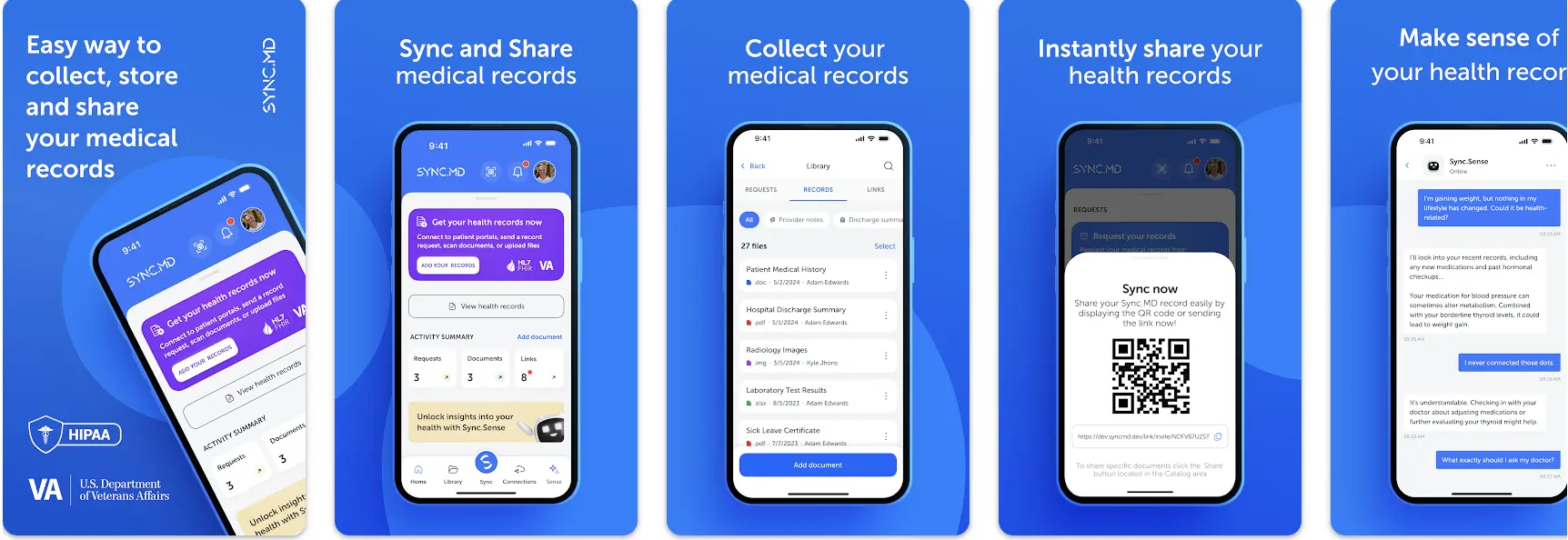
Sync.MD enables individuals to aggregate medical records from multiple providers into one secure profile. Users upload documents, import records, and control sharing with caregivers or clinicians.
Its AI features summarize records and surface key information before appointments. This reduces effort when reviewing complex histories.
Monetization relies on subscription plans for advanced insights and multi-profile access. The model avoids advertising and centers on user trust.
2. MyChart

MyChart functions as an extension of hospital EHR systems. Patients access lab results, medications, appointments, and clinician messages.
AI use remains minimal and focused on reminders and notifications. The platform avoids independent interpretation of data. Monetization happens through enterprise licensing and not end-user fees. At the same time, healthcare systems fund it as part of the patient access infrastructure.
3. Apple Health Records

Apple Health Records aggregates clinical data from participating providers directly onto iOS devices. Records appear in a unified timeline alongside device-generated health metrics.
Under Apple, AI highlights trends and changes over time rather than making decisions. Apple does not charge users for PHR access. Instead, the feature strengthens ecosystem loyalty and device adoption. Consequently, monetization remains indirect but strategic.
4. CareZone
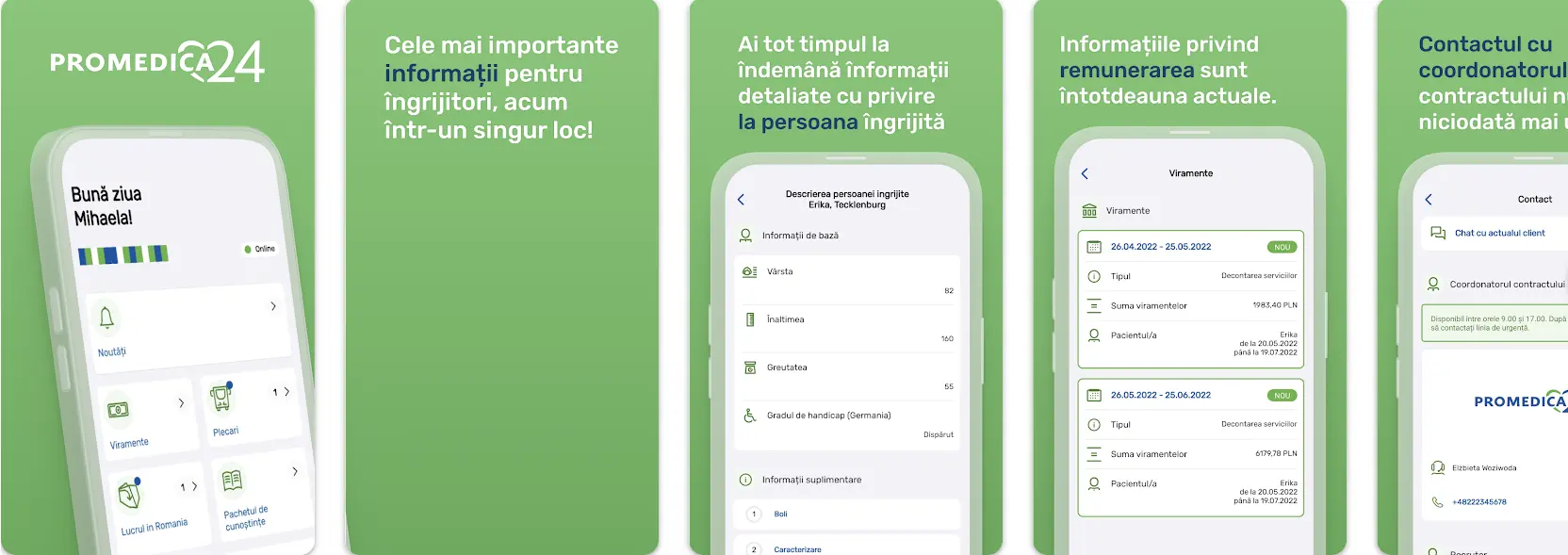
CareZone centers on medication management and personal record organization. Users scan prescriptions, set reminders, and store key documents. AI assists with categorization and adherence tracking.
At the same time, monetization combines subscription tiers and support services. While narrower in scope, it shows how focused PHR use cases can still deliver value.
These examples show that successful PHR apps are not built the same way. Some extend provider systems, while others act as independent data layers. Hence, it is clear that sustainable PHR platforms prioritize trust, governance, and long-term alignment over feature density.
Conclusion
Personal health record apps are becoming core infrastructure for modern healthcare enterprises. When built correctly, they improve data continuity, patient trust, and regulatory readiness. They also create a foundation for analytics and future intelligence without increasing risk.
However, success depends on disciplined architecture, strong governance, and clear boundaries. Enterprises that treat PHRs as long-term platforms, not quick products, gain lasting value. With the right strategy and execution partner, PHR apps shift from a compliance necessity to a scalable growth enabler.
Build a Personal Health Record Platform With Intellivon
At Intellivon, personal health record platforms are built as enterprise health data systems, not consumer-facing record vaults. Every architectural and delivery decision prioritizes data governance, consent enforcement, and regulatory resilience. This ensures PHR platforms operate reliably across providers, regions, and evolving compliance requirements, not just at initial launch.
As PHR programs expand across populations, data sources, and care models, stability becomes critical. Governance, performance, and interoperability remain consistent as scale increases. Organizations maintain control over sensitive health data without introducing fragmentation, compliance risk, or operational overhead.
Why Partner With Intellivon?
- Enterprise-grade PHR architecture designed for regulated, multi-provider healthcare ecosystems
- Proven delivery across healthcare platforms, digital health products, and data-driven care systems
- Compliance-by-design approach covering privacy, consent, auditability, and data residency
- Secure role-based access with full data lineage and traceability
- Governed AI enablement for insights, automation, and analytics
- Modular, cloud-native infrastructure built for phased and cross-region scaling
Book a strategy call to explore how Intellivon can help you build and scale a personal health record platform with confidence and long-term control.
FAQs
Q1. What is a personal health record app used for?
A1. A personal health record app allows individuals to store and manage their health data in one place. It aggregates records from providers, labs, pharmacies, and devices. As a result, health information stays accessible across care settings. Enterprises use PHRs to improve data continuity and patient engagement.
Q2. How is a personal health record app different from an EHR?
A2. EHRs are controlled by healthcare providers and tied to specific organizations. Personal health record apps are controlled by individuals. Therefore, data can move across providers and regions. PHRs focus on portability, consent, and long-term access rather than clinical documentation.
Q3. Are personal health record apps HIPAA compliant by default?
A3. No, PHR apps are not automatically HIPAA compliant. Compliance depends on architecture, data handling, and access controls. Enterprises must embed encryption, consent enforcement, and audit logging. Without this, regulatory risk increases quickly as usage scales.
Q4. Can AI be safely used in personal health record apps?
A4. Yes, when used with clear boundaries. AI can summarize records, improve data quality, and support engagement. However, it should not make clinical decisions. Strong governance and human oversight are required to ensure safety and compliance.
Q5. How long does it take to build an enterprise-grade PHR platform?
A5. Timelines vary based on scope and integrations. Most enterprise-grade PHR platforms take several months to build properly. Time is required for compliance design, data normalization, and testing. Rushing this process often leads to rework later.

