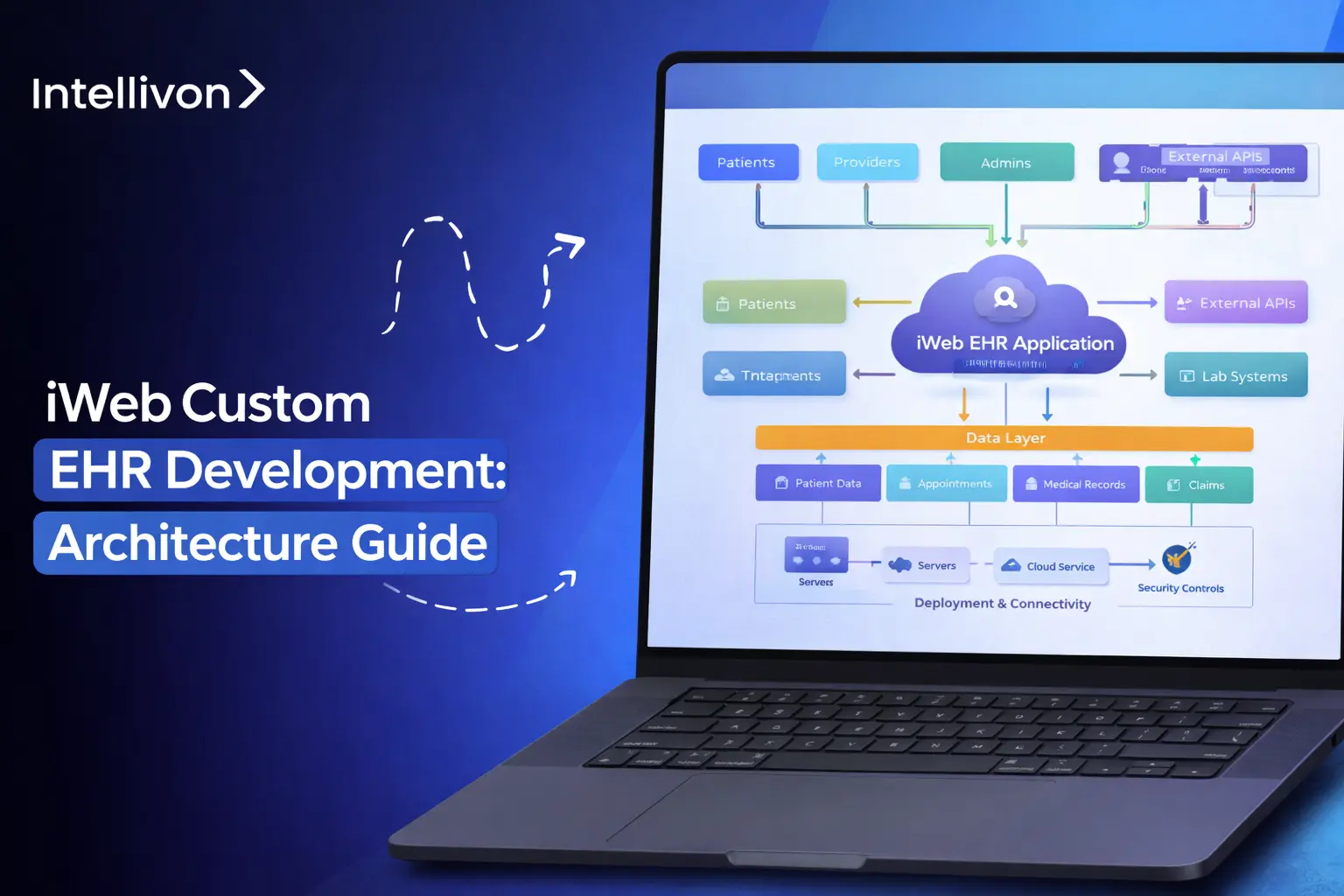
Healthcare technology has reached a point where platform design determines how advantageous and high ROI the enterprise will earn. iWeb custom EHR is at the center of that change. It is a system built specifically to meet the real operational needs of modern healthcare organizations, rather than being limited by off-the-shelf software. Understanding its structure explains why it performs differently and how enterprises can adopt it within their systems.
Most EHR platforms were made for documentation, and not for decision-making. However, iWeb’s custom EHR takes a different approach. It is designed for interoperability, built for growth, and organized to integrate AI capabilities as they develop. This design philosophy distinguishes it from traditional systems, and this blog will explore it in detail.
With significant experience in designing, extending, and updating custom healthcare systems, we examine each architectural layer of iWeb Custom EHR, from its data infrastructure to its readiness for AI. If you are looking into this platform or thinking about creating something similar, this is the essential foundation you need to grasp first.

The Real Problem With Today’s EHR Systems
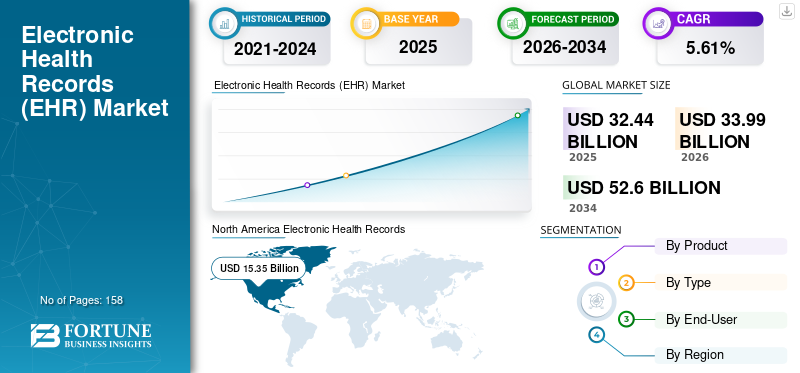
Today’s EHR systems struggle with usability, integration, and security. These issues slow clinicians down and impact patient care, even as the market reaches $33.99 billion in 2026, according to a report by Fortune Business Insights.
1. Usability and Clinician Burnout
Clinicians spend over two extra hours daily on EHR documentation. This directly contributes to burnout.
Around 75% of affected physicians link burnout to EHR usage. Satisfaction remains low, with only 38% of implementations meeting expectations.
The problem worsens after hours. When clinicians spend more than six hours weekly on EHR tasks, burnout risk triples.
2. Interoperability Failures at Scale
EHR systems still struggle to connect across platforms. Nearly 28% of implementations face interoperability issues.
At the enterprise level, fragmentation and mismatched standards create complexity. As a result, 96% of organizations report integration challenges.
Custom interfaces increase the burden. Each integration can cost between $50,000 and $200,000, pushing 60% of executives toward custom-built solutions instead of upgrades.
3. High Failure Rates in EHR Projects
EHR implementations often fail to deliver expected outcomes. Around 50–70% of projects miss goals, timelines, or budgets. According to KLAS data, only 38% of implementations succeed.
Large-scale failures highlight the risk. For example, the MD Anderson Epic rollout exceeded its budget by $266 million, accelerating the shift toward replacement strategies in 2026.
4. Security Risks and Rising Costs
Healthcare systems remain prime targets for cyberattacks. In 2025, 642 breaches exposed over 57 million records. The average cost per breach reached $7.42 million.
At the same time, high upfront investments and ongoing maintenance continue to strain budgets. Despite this, the market is projected to grow at a 5.61% CAGR, reaching $52.6 billion by 2034.
These challenges are not isolated. They reflect deeper architectural limitations in traditional EHR systems. As a result, enterprises are now shifting toward more flexible, interoperable, and scalable models.
iWeb EHR: A Shift From Systems to Infrastructure
An iWeb custom EHR architecture facilitates the convergence of clinical, financial, and operational data. By utilizing a modular, API-first design, healthcare enterprises can eliminate data silos, improve billing accuracy, and optimize resource management through a unified digital infrastructure.
Modern healthcare delivery demands a resilient foundation that treats data as a strategic asset rather than a locked resource.
1. What type of platform is an iWeb EHR system
An iWeb custom EHR is not a standalone product but a sophisticated software framework. It acts as a central nervous system for medical enterprises. This platform integrates patient data, provider schedules, and clinical notes into a single, high-performance environment. Unlike basic web tools, this infrastructure focuses on high availability and massive data throughput.
Building on iWeb architecture allows for deep customization. Business leaders can dictate exactly how data flows between departments.
This ensures that the technology adapts to the clinical team, rather than forcing doctors to change their habits for the software. At the same time, it provides the stability of an enterprise system with the agility of a custom-built solution.
2. From monolithic EHRs to composable platforms
Traditional EHR systems are often rigid systems that are difficult to update or modify. When one part of the system fails, the entire workflow often grinds to a halt. A composable platform breaks these functions into smaller, independent modules. This means you can upgrade your billing engine without touching your pharmacy module.
For an investor, this modularity reduces long-term technical debt. It allows an organization to scale vertically by adding more users or horizontally by adding new services like telehealth. This flexibility turns a static software purchase into a long-term infrastructure investment that grows with the market.
3. Why API-first changes healthcare system design
An API-first approach means the system is designed to talk to other software from day one. In healthcare, data silos are the biggest barrier to efficiency and patient safety. By prioritizing Application Programming Interfaces (API), an iWeb custom build ensures that lab results, imaging, and wearable data flow seamlessly into the patient record.
This design philosophy future-proofs the enterprise. As new AI diagnostic tools or remote monitoring devices emerge, they can be plugged into the core system effortlessly. You no longer need expensive, multi-year integration projects. Instead, the architecture remains open and ready for the next wave of medical innovation.
4. Connecting clinical, financial, and ops workflows
The true value of an integrated iWeb architecture lies in its ability to bridge the gap between patient care and business performance. When these three pillars work in unison, the enterprise gains a level of transparency that was previously impossible.
- Unified Data Streams: Clinical entries automatically trigger billing codes. This reduces manual entry errors and speeds up the reimbursement cycle.
- Operational Intelligence: Real-time data shows patient flow bottlenecks. Administrators can adjust staffing levels based on actual clinical demand.
- Financial Accuracy: Leadership gains a clear view of the cost per patient encounter. This allows for more precise budgeting and resource allocation.
- Clinical Consistency: Doctors spend less time on paperwork. Automated workflows ensure that every patient receives the same high standard of care.
By aligning these workflows, the platform transforms from a simple record-keeper into an engine for growth. This synchronization ensures that every clinical action is supported by operational efficiency and financial clarity.
Where iWeb Fits in Modern Health IT Stacks
Integrating iWeb custom EHR architecture into a modern health IT stack enables seamless cross-system workflows. By acting as a unification layer, it supports digital-first healthcare models, facilitates real-time data exchange, and allows for the phased extension of legacy systems to ensure enterprise-wide interoperability.
1. Replacing vs extending legacy EHR systems
Deciding whether to rip and replace or simply extend a legacy system is a high-stakes choice for any leader.
| Factor | Full Replacement Approach | iWeb-Based Extension Approach |
| System Strategy | Rebuild the entire EHR system from scratch | Extend the existing system with modern layers |
| Data Handling | Requires full data migration and validation | Retains existing databases and historical data |
| Implementation Risk | High risk of disruption and system failure | Lower risk with phased rollout approach |
| Time to Deploy | Long timelines (12–36 months typical) | Faster deployment through incremental releases |
| Operational Continuity | Potential downtime during transition | Minimal disruption to daily operations |
| User Experience | Improved after full rollout | Improved immediately through the interface layers |
| Cost Structure | High upfront capital investment | Distributed cost across phases |
| Scalability | Built into the new system architecture | Achieved through modular extensions |
| Flexibility | Limited by new system design choices | High flexibility with API-driven architecture |
| Integration Capability | Requires rebuilding integrations | Leverages existing systems with added APIs |
| Innovation Speed | Slower due to large system dependencies | Faster iteration and feature deployment |
| ROI Realization | Delayed until full implementation | Gradual ROI with each rollout phase |
An iWeb custom approach allows you to build a modern interface on top of stable, older databases. This strategy preserves your historical data while giving your staff a fast, intuitive experience.
By extending rather than replacing, you minimize the risk of operational downtime. You can roll out new features in phases, such as a mobile-first doctor portal or a patient scheduling app.
This balanced method protects your previous investments while moving your IT stack toward a more modern, responsive architecture.
2. Acting as a unification layer across systems
Enterprises often struggle with a “patchwork” of different software for labs, pharmacy, and imaging. An iWeb system acts as a unification layer that sits above these fragmented tools. It pulls data from various sources into a single, clean dashboard for the user.
This layer simplifies the complex reality of medical data. Instead of logging into five different portals, a clinician sees everything in one place. For the business, this means better data integrity and a clearer picture of how the entire organization is performing in real-time.
3. Supporting digital-first healthcare models
The rise of virtual care and remote monitoring requires a system that lives beyond the hospital walls. A digital-first iWeb EHR is built for the web, meaning it is accessible and secure from any location. This is essential for organizations expanding into home health or telehealth services.
Because the architecture is inherently cloud-ready, it scales as your patient volume grows. You can easily integrate wearable device data directly into the clinical record. This capability allows your team to provide proactive care, catching health issues before they require an expensive hospital visit.
4. Enabling real-time, cross-system workflows
Effective healthcare relies on speed and the immediate transfer of information between specialized departments. An iWeb custom build ensures that data moves as fast as the patients do, eliminating the lag times that stall care.
- Instant Notifications: When a lab result is ready, the system pushes an alert directly to the physician’s mobile device.
- Automated Transfers: Patient data moves automatically from the emergency room to the surgical suite without manual re-entry.
- Inventory Syncing: Usage of medical supplies during a procedure can trigger an automatic reorder in the supply chain system.
- Dynamic Scheduling: If a surgery runs over time, the system updates the recovery room staff and the next patient’s family instantly.
These interconnected workflows reduce the administrative burden on your highly skilled medical staff. By automating the “hand-offs” between systems, you create a seamless environment that prioritizes patient outcomes and operational velocity.
Inside iWeb Architecture: How the System Works
The strength of an iWeb framework lies in its internal logic and how it handles complex information. This architecture ensures that data remains secure and accessible while driving meaningful action across the organization.
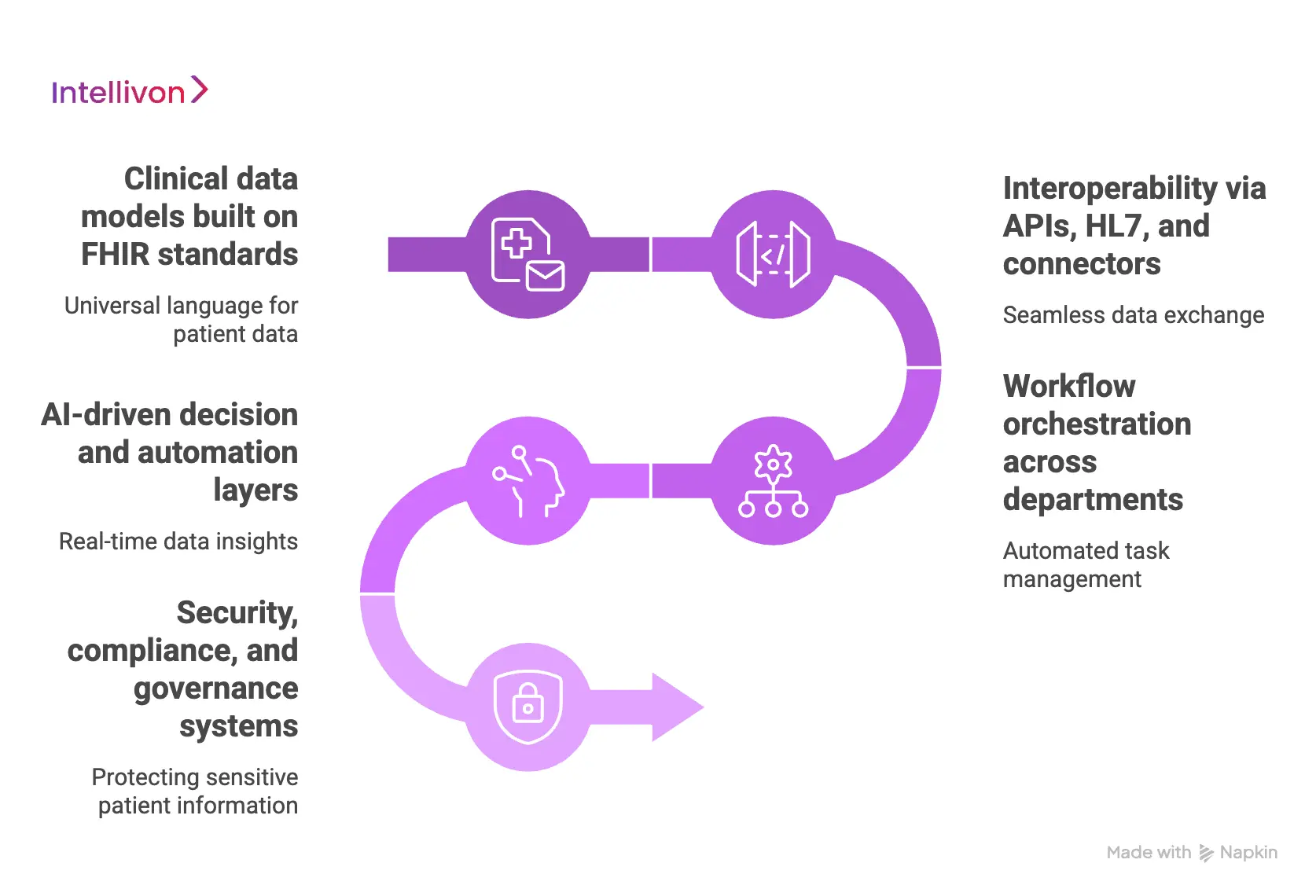
1. Clinical data models built on FHIR standards
Using FHIR (Fast Healthcare Interoperability Resources) ensures that patient data is stored in a universal language. This standard allows different healthcare applications to read and write information without losing context or accuracy.
By building on these models, your platform remains compatible with the global healthcare ecosystem.
2. Interoperability via APIs, HL7, and connectors
True connectivity requires a variety of digital bridges to link old and new technologies. Using a combination of modern APIs and traditional HL7 protocols, the system talks to labs, pharmacies, and external clinics.
These connectors eliminate manual data entry and ensure that every provider has a complete view of the patient’s history.
3. Workflow orchestration across departments
Workflow orchestration acts as the conductor of a digital orchestra, directing tasks to the right person at the right time. When a doctor signs a discharge order, the system automatically notifies the cleaning crew, the pharmacy, and the billing department.
This automation removes the friction that typically slows down hospital operations.
4. AI-driven decision and automation layers
Modern EHRs should help professionals make better decisions. AI layers can scan patient records to flag potential drug interactions or identify high-risk patients who need immediate attention.
These tools act as a secondary safety net, enhancing the clinical team’s expertise with real-time data insights.
5. Security, compliance, and governance systems
In a landscape of increasing cyber threats, the architecture must prioritize the protection of sensitive patient information above all else. This section of the platform ensures that every piece of data is handled according to strict legal and ethical standards.
- End-to-End Encryption: Data is scrambled both while it is being sent and while it is sitting on the server, making it unreadable to unauthorized parties.
- Role-Based Access: You can define exactly who sees what, ensuring that a receptionist cannot access the same medical files as a lead surgeon.
- Audit Trails: Every single action within the system is logged. This creates a permanent record of who accessed or changed data, which is vital for HIPAA compliance.
- Automated Backups: The system constantly saves copies of your data in secure, redundant locations to prevent loss during a hardware failure or natural disaster.
These governance layers provide the peace of mind necessary for scaling a large-scale healthcare enterprise. By embedding security into the core design, the platform protects both the patients’ privacy and the organization’s reputation.
End-to-End Workflow in iWeb EHR Architecture
A well-designed iWeb EHR architecture functions as a seamless digital loop, moving data from the initial patient contact through to final financial settlement.
This progression ensures no information is lost while every stakeholder stays informed through real-time system updates.
Step 1: Patient Intake and Identity Management
The journey begins when a patient interacts with the iWeb digital front door, whether through a portal or a check-in kiosk. The architecture uses advanced identity matching to pull existing records or create a new, secure profile.
This step ensures that clinical data is always attached to the correct individual across the entire enterprise network.
Step 2: Clinical Documentation and Real-Time Support
As the physician conducts the exam, the iWeb interface captures notes, vitals, and orders through an intuitive, high-speed dashboard.
Behind the scenes, the architecture cross-references this data with global medical standards and historical patient history. It provides subtle alerts for potential issues, helping the clinician stay focused on the patient rather than the screen.
Step 3: Integrated Diagnostic and Order Routing
Once an order is placed, the iWeb API-first design automatically routes it to the lab, pharmacy, or imaging center. There is no need for manual faxing or phone calls since the external systems receive the request instantly through secure connectors.
This connectivity reduces wait times and ensures that diagnostic results return to the patient’s chart the moment they are ready.
Step 4: Automated Coding and Financial Capture
As clinical tasks are completed, the iWeb orchestration layer translates these actions into standardized billing codes. This happens in the background, ensuring that the financial record matches the clinical reality without extra work from the doctor.
By capturing charges at the point of care, the organization significantly reduces revenue leakage and manual entry errors.
Step 5: Discharge, Follow-up, and Data Analytics
The workflow concludes with a structured discharge process that provides the patient with clear instructions and scheduled follow-ups. Simultaneously, the encounter data is fed into the iWeb central analytics engine.
Leadership can then review this data to measure clinical outcomes, department efficiency, and overall business health.
This end-to-end flow replaces fragmented manual tasks with a synchronized digital environment. By automating the transition between steps, the iWeb architecture improves both the provider experience and the quality of patient care.
When Enterprises Should Move to iWeb-Style Architecture
Moving to an iWeb-style architecture is essential for multi-hospital networks and digital-first platforms requiring unified data and scalable infrastructure. This framework supports complex specialty workflows and regional expansion by offering modular compliance, cloud-native scalability, and centralized data governance.
This shift is particularly critical when legacy systems begin to hinder clinical velocity or block regional expansion.
1. Multi-hospital networks need unified data
For large networks, fragmented patient records are a primary source of clinical risk and operational waste. An iWeb custom architecture creates a single source of truth across multiple physical locations. This ensures that a patient’s history is available instantly, whether they are in an emergency room or a specialized clinic.
By centralizing data, the enterprise can finally standardize care protocols. This consistency ensures high-quality outcomes regardless of which facility a patient visits.
2. Specialty care with complex workflows
Specialized medical fields often have unique data requirements that general EHRs cannot meet effectively. An iWeb-style system allows for the creation of custom data modules tailored to specific disciplines. For example, oncology or cardiology departments can capture precise variables without cluttering the interface with irrelevant fields.
By automating the unique hand-offs required in complex treatments, the architecture ensures no critical step is missed. This specialized focus improves both clinician satisfaction and patient outcomes in high-stakes environments where every second counts.
3. Digital-first and virtual care platforms
In the modern landscape, healthcare often begins on a smartphone rather than in a physical waiting room. iWeb-style architecture is built with a web-first mindset, making it the ideal foundation for telehealth. It allows for the seamless integration of video consultations and real-time data from wearable health devices.
This digital flexibility allows an enterprise to reach patients exactly where they are. The architecture can scale to handle thousands of concurrent virtual visits without compromising system stability.
4. Enterprises expanding across regions
Expanding into new geographic regions brings a host of regulatory and logistical challenges for any health system. An iWeb custom framework is designed to adapt to different regional requirements.
This includes varying privacy laws, localized billing codes, and specific language needs for diverse staff and patient populations.
- Localized Compliance: The system can be configured to meet specific regional data residency and protection laws automatically.
- Scalable Infrastructure: Cloud-native design allows for the rapid deployment of new server instances as the user base grows.
- Centralized Governance: Regional managers can oversee local operations while headquarters maintains a bird’s-eye view of global performance.
- Standardized Training: Even as the network expands, the core user interface remains consistent, reducing the cost of training new staff.
By building on a flexible architecture, the enterprise can move from local to global operations with minimal friction. This approach ensures that the technology remains a strategic asset for expansion rather than a technical barrier to entry.
Ultimately, this architecture transforms IT from a cost center into a powerful engine for institutional growth.
Why Integration-First EHR Strategies Fail
Many enterprises fall into the trap of “integration-first” strategies, attempting to force modern features onto aging foundations. While this appears cost-effective initially, it often creates a fragile ecosystem that struggles to meet the demands of high-growth medical organizations.
1. Vendor lock-in limits flexibility
When you rely on a single vendor’s ecosystem, you are forced to wait for their development roadmap to catch up with market needs.
An iWeb custom approach breaks this cycle by prioritizing open standards and data ownership. Without the constraints of a specific vendor, your organization can pivot quickly to meet new clinical demands.
2. Extension layers break at enterprise scale
The complexity of managing multiple “middleman” services becomes a significant technical burden for IT teams. These performance bottlenecks directly impact clinical efficiency.
A unified iWeb architecture avoids these issues by building scalability into the core design, ensuring the system remains fast and responsive regardless of the load.
3. Persistent data inconsistency issues
In an integration-heavy environment, data often lives in multiple places at once. If a patient’s address is updated in the billing module but not the clinical record, the resulting “data drift” creates operational chaos.
Solving this requires a “single source of truth” that only a custom-built infrastructure can provide. By centralizing the data model, you ensure that every change is reflected across the entire system instantly.
This reliability builds trust with your staff and ensures that your administrative and medical data are always in perfect sync.
4. Long-term cost of patchwork architectures
The true cost of a patchwork system is often hidden in maintenance and “technical debt.” Every time a vendor updates their software, your custom integrations may break, requiring expensive emergency repairs.
Over time, the budget spent on keeping the lights on far exceeds the cost of building a modern, resilient platform from the start.
- High Maintenance Fees: Managing a dozen different licenses and support contracts drains financial resources that could be spent on innovation.
- Security Vulnerabilities: Every integration point is a potential “door” for cyber threats. A fragmented system is significantly harder to secure than a unified one.
- Slow Time-to-Market: Launching a new service, like a remote monitoring program, takes months instead of weeks because of the complex backend plumbing required.
- Opportunity Cost: Your IT team spends its time fixing old problems instead of building new tools that drive revenue and improve patient satisfaction.
Investing in a custom iWeb architecture is a move from “fixing” to “building.” It allows your enterprise to stop wasting capital on fragile workarounds and start investing in a scalable platform that supports long-term profitability.
Core Capabilities of iWeb-Style EHR Architecture
An iWeb-style architecture provides the structural integrity required to transform fragmented data into a cohesive enterprise asset. This framework prioritizes high-performance data handling and adaptive logic to ensure the system evolves alongside the organization’s clinical and business needs.
1. Real-time interoperability across systems
True interoperability requires an immediate sync between disparate platforms. An iWeb custom build utilizes high-speed API gateways to connect laboratory information systems, imaging archives, and external pharmacy databases.
This ensures that a physician viewing a chart sees the most current results the millisecond they are verified, eliminating dangerous informational lags.
2. Configurable workflows at enterprise scale
Standard EHRs often force users into rigid, linear processes that don’t fit every department. The iWeb architecture allows for deep configuration, enabling a surgical unit and a pediatric clinic to use the same underlying data but through entirely different interfaces.
This flexibility ensures that the software supports the specific clinical path of each patient group without requiring expensive code changes.
3. AI-driven clinical decision support systems
Modern architecture must act as an intelligent partner to the clinician. By embedding AI layers directly into the data stream, the system can provide real-time alerts for drug-to-drug interactions or sepsis risks.
These decision support tools analyze millions of data points in seconds, offering evidence-based suggestions that enhance safety and reduce the cognitive load on medical staff.
4. Unified patient records across touchpoints
A patient’s journey often spans multiple departments and digital platforms. The iWeb framework anchors every interaction, from a mobile app check-in to an inpatient stay, to a single, persistent identity.
This unification prevents the creation of duplicate records and ensures that the clinical team always has a 360-degree view of the patient’s health history.
5. Embedded analytics and reporting engines
Decision-makers need more than raw data; they need actionable intelligence. The iWeb architecture integrates advanced reporting engines that pull data directly from clinical and financial workflows.
- Predictive Staffing: Analyze patient admission trends to optimize nursing shifts.
- Revenue Cycle Clarity: Track claim rejection rates in real-time to identify coding errors.
- Clinical Outcomes: Compare treatment efficacy across different hospital branches instantly.
- Resource Utilization: Monitor the usage of high-cost medical equipment to improve ROI.
By embedding these capabilities into the core architecture, the system becomes a primary driver of institutional efficiency. This data-first approach allows leaders to make confident, evidence-based decisions that fuel both clinical excellence and sustainable financial growth.
How Intellivon Enables iWeb EHR Architecture in Enterprises
Transitioning to a high-performance clinical environment necessitates a fundamental shift in how data is structured and moved.
Intellivon serves as the strategic partner that builds this foundation, ensuring your digital infrastructure is as resilient as your clinical mission.
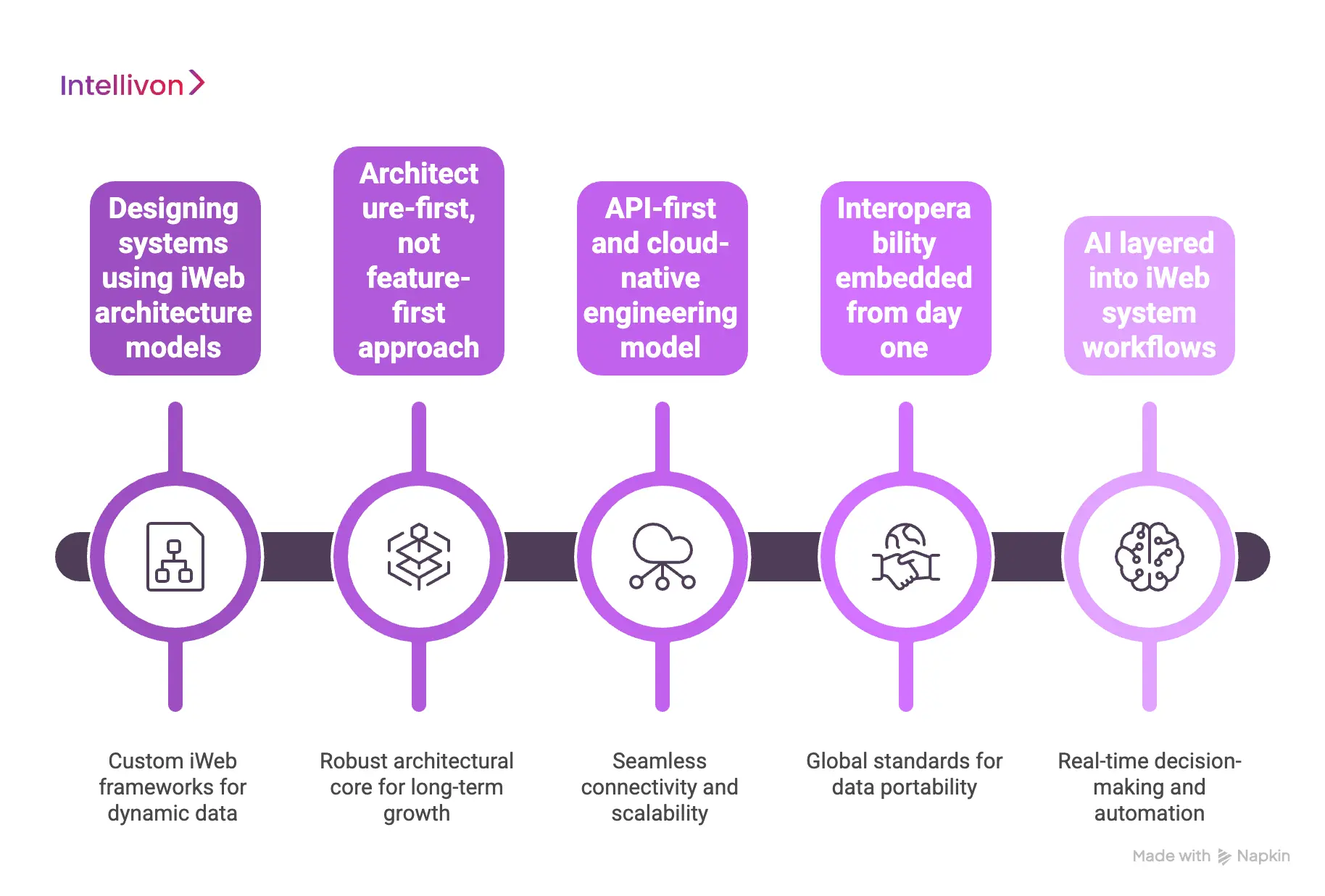
1. Designing systems using iWeb architecture models
We specialize in developing custom iWeb frameworks that treat healthcare data as a dynamic, flowing asset. Our team designs these models to eliminate the silos that traditionally trap patient information within single departments.
By centering the architecture on the user experience, we ensure that every click adds value to the clinical workflow. This bespoke design process allows your enterprise to maintain a “single source of truth” across every hospital wing and outpatient clinic.
2. Architecture-first, not feature-first approach
Most failures in health IT stem from chasing flashy features while ignoring the underlying structural integrity. At Intellivon, we prioritize a robust architectural core that can support decades of growth. We focus on data persistence, security protocols, and system uptime before layering on the user interface.
This methodology prevents the “technical debt” that often forces large organizations to rebuild their systems every few years. It ensures that your investment remains a stable platform for future innovation.
3. API-first and cloud-native engineering model
Our engineering philosophy centers on connectivity and massive scalability through cloud-native development. By building with an API-first mindset, we ensure that your iWeb EHR can talk to any laboratory, pharmacy, or wearable device from the moment of deployment.
This approach allows your organization to scale horizontally as patient volume increases without experiencing system lag. We utilize secure, redundant cloud environments that provide the high availability required for 24/7 medical operations.
4. Interoperability embedded from day one
We embed interoperability into the very DNA of the system. Intellivon utilizes global standards like FHIR and HL7 to ensure your data is portable and compliant with the broader healthcare ecosystem.
This deep integration allows for the seamless exchange of imaging, lab results, and referral notes across regional boundaries. By solving the connectivity puzzle at the start, we remove the friction that typically slows down patient care and administrative billing.
5. AI layered into iWeb system workflows
Intellivon positions advanced intelligence at the heart of the clinical experience to drive better decision-making.
We layer specialized AI models directly into the iWeb workflows to provide real-time support without disrupting the doctor’s focus.
- Predictive Diagnostics: Our systems flag high-risk patient trends before they escalate into clinical emergencies.
- Administrative Automation: We utilize AI to automate repetitive coding tasks, drastically reducing manual entry errors and speeding up the revenue cycle.
- Smart Scheduling: AI-driven engines optimize operating room usage and staff rotations based on historical patient flow data.
- Natural Language Processing: We integrate voice-to-text and data extraction tools to help clinicians document encounters faster and with greater accuracy.
These AI layers transform the EHR from a passive database into a proactive clinical partner. By choosing Intellivon, your enterprise gains a sophisticated, future-proof platform that turns complex data into a competitive advantage.
Security and Compliance in iWeb Architecture
Trust is the most valuable currency in healthcare. An iWeb architecture prioritizes this by embedding security into every layer of the system. This proactive design ensures that patient data remains protected while meeting the rigorous demands of global regulatory bodies.
1. HIPAA and global data privacy frameworks
Maintaining HIPAA compliance is a baseline requirement, but an iWeb system goes further. It is designed to adapt to various international standards, such as GDPR or local data residency laws. This flexibility allows your enterprise to operate across borders without fearing legal penalties or data mishandling.
By automating compliance checks, the system reduces the risk of human error. It ensures that every piece of information is handled with the highest level of care. This robust framework protects both the patient’s privacy and the organization’s legal standing.
2. Role-based access and audit logging systems
Not every employee needs to see every part of a patient’s medical history. An iWeb system uses granular, role-based access to ensure that staff members only see the data required for their specific job. A billing clerk, for instance, cannot access sensitive clinical notes intended only for the treating physician.
Furthermore, the system maintains a permanent, unchangeable record of every interaction. This audit logging identifies who accessed a file, when they viewed it, and what changes they made. This transparency is vital during internal reviews or official government audits, providing a clear trail of accountability.
3. Encryption and secure data exchange layers
Data is most vulnerable when it is moving between systems or sitting on a server. To counter this, an iWeb architecture utilizes advanced encryption for data “at rest” and “in transit.” This means that even if a breach occurs, the information remains unreadable and useless to unauthorized parties.
Secure exchange layers also ensure that when you share data with an outside lab or pharmacy, the “handshake” is fully protected. These digital tunnels prevent “man-in-the-middle” attacks and other common cyber threats. By prioritizing these layers, the architecture creates a fortress-like environment for sensitive health information.
4. Governance and compliance monitoring models
Modern healthcare governance requires more than just following rules; it requires constant vigilance. An iWeb-style system includes automated monitoring tools that scan for unusual activity in real-time. If a suspicious login attempt occurs, the system can instantly alert the IT security team or lock the affected account.
- Automated Threat Detection: AI-driven tools identify patterns that might indicate a cyber-attack before it causes damage.
- Policy Enforcement: The system automatically applies the latest security patches and updates without requiring manual intervention.
- Continuous Reporting: Leadership receives regular reports on compliance health, highlighting any areas that need attention.
- Disaster Recovery: Automated backups ensure that data can be restored quickly in the event of a system failure or natural disaster.
This comprehensive approach to governance allows your leadership team to focus on growth and care. You can rest easy knowing that the technical foundation is working around the clock to keep the enterprise secure.
By choosing a system with these built-in safeguards, you are investing in the long-term reputation and stability of your organization.
Scaling iWeb-Style EHR Systems Across Enterprises
Scaling a healthcare platform requires a digital foundation that stays fast, reliable, and easy to manage as your organization grows from one clinic to a global network.
1. Multi-tenant vs single-tenant architecture models
Choosing between these two models is a major strategic decision. Think of a single-tenant setup like owning a private house, where you have total control, but you pay for all the maintenance.
A multi-tenant setup is more like a modern apartment building, where everyone has their own private space, but they share the main plumbing and security, which makes it much cheaper and easier to update.
| Feature | Single-Tenant (Private House) | Multi-Tenant (Modern Apartment) |
| Data Privacy | Physically separate databases. | Logically separate (shared database). |
| Customization | Very high: change anything you want. | High: change settings within a framework. |
| Cost | Expensive; high maintenance per user. | Cost-effective; shared resources. |
| Updates | Slow: must update each site one by one. | Fast: update once for everyone at once. |
For most expanding enterprises, the multi-tenant model is the smarter choice. It allows you to roll out new features to every location instantly, ensuring your entire staff is always using the most advanced version of the software.
2. Managing high-volume patient data systems
As your patient list grows into the millions, your system must handle massive amounts of data without slowing down.
An iWeb architecture uses “data partitioning,” which is like organizing a massive library into smaller, easy-to-search sections. This ensures that a doctor searching for a record in London doesn’t have to wait for the system to sift through files from New York.
We also use “caching” to keep frequently accessed information ready for instant viewing. This means the most common tasks. By managing data this way, the platform stays snappy and responsive even during the busiest hours of the day.
3. Performance optimization and uptime strategies
In healthcare, “downtime” can be a clinical emergency. To prevent this, an iWeb-style system uses “redundancy.” This means there are multiple copies of the system running in different secure locations. If one server fails, another one takes over immediately without the staff ever noticing a problem.
We also use “load balancing” to spread work evenly across the network. Think of it like a traffic controller directing cars to the emptiest lanes to prevent a traffic jam. These strategies ensure your EHR is available 24/7, giving your team the reliable tools they need to save lives at any hour.
4. Global deployment and localization challenges
Expanding into new countries means dealing with different languages, currencies, and strict local laws.
An iWeb custom framework is built to be “location-aware.” This means the system can automatically switch its interface to the local language and adjust its billing to the local currency based on where the user is logging in.
- Regional Data Laws: The system can store data in specific countries to follow local privacy rules (like GDPR in Europe).
- Time Zone Syncing: All clinical entries are time-stamped correctly, no matter where the doctor or patient is located.
- Localized Care Plans: You can adjust medical templates to follow the specific health guidelines of a particular region.
- Cloud Scalability: Using global cloud providers allows you to “turn on” new regions in days rather than months.
By solving these global challenges at the architectural level, your enterprise can expand with confidence. You won’t have to worry about the technology holding you back as you move into new markets. This flexibility makes your platform a powerful tool for worldwide growth.
Integration Ecosystem in iWeb EHR Architecture
A modern iWeb architecture acts as a high-speed traffic hub for medical data, ensuring your enterprise is never a digital island. By prioritizing connectivity, this framework allows information to move as fast as the patients themselves across the entire healthcare landscape.
1. Labs, pharmacies, and diagnostic integrations
Connecting with labs and pharmacies is the most basic requirement for a digital health system. An iWeb-style platform uses secure data bridges to send orders and receive results instantly.
When a doctor orders a blood test, the lab receives the request in seconds. Once results are ready, they flow directly into the patient’s digital chart. This eliminates paper forms and prevents dangerous errors, such as a pharmacist misreading a handwritten prescription.
2. Insurance and billing system connections
Financial health depends on how quickly you communicate with insurance providers. The iWeb architecture includes built-in connectors that talk directly to clearinghouses. This allows the system to check a patient’s insurance eligibility before they walk into the exam room.
Once a procedure ends, the system packages clinical data into a clean claim, reducing payment delays and significantly improving your organization’s overall cash flow.
3. IoT and remote patient monitoring devices
Healthcare is moving out of the hospital and into the patient’s home. iWeb architecture is designed to handle constant data streams from IoT devices like smartwatches and glucose monitors.
The system can “listen” to these devices and alert a nurse if a patient’s sugar levels become dangerous. This allows your enterprise to offer remote care services that are highly attractive to both patients and investors.
4. Third-party healthcare apps and platforms
The medical world is full of specialized apps for mental health or advanced imaging. An iWeb custom system uses a “plug-and-play” model that lets you add these third-party tools whenever you need them.
You are never stuck with just one vendor’s tools. This flexibility ensures your technology stays relevant and allows your staff to always have the most powerful resources at their fingertips.
This open ecosystem transforms the EHR from a static database into a dynamic network. By bridging these gaps, the architecture ensures your enterprise remains connected to every critical player in the healthcare journey.
Conclusion
Selecting an iWeb custom EHR architecture is a definitive strategic shift for any modern healthcare enterprise. It moves your organization beyond the limitations of rigid legacy systems toward a flexible, data-driven future.
By prioritizing a modular and connected foundation, you ensure that your technology scales alongside your clinical ambitions. This structural investment reduces technical debt while significantly improving patient outcomes and operational efficiency for the long term.
Build a Custom EHR Architecture With Intellivon
At Intellivon, custom EHR systems are built as enterprise healthcare infrastructure, not as record-keeping tools layered onto disconnected systems.
Using iWeb-style EHR architecture as a reference model, we design platforms that enable interoperability, real-time data flow, and modular system expansion.
Each platform is designed around how your organization actually functions. This includes clinical documentation, scheduling, billing, integrations, analytics, and workflow automation, all aligned within a single architecture.
Our engineering approach focuses on API-first, cloud-native architecture combined with interoperability standards like HL7 and FHIR. At the same time, we layer AI capabilities across workflows to enable automation, predictive insights, and intelligent decision-making.
Why Build With Intellivon
- Infrastructure, Not Add-Ons: We design iWeb-based EHR architectures that replace fragmented systems with a unified platform, giving you full control over workflows, data, and system performance.
- Architecture-First Development: Every system is designed from the ground up, ensuring scalability, flexibility, and alignment with real clinical and operational workflows.
- AI-Layered Healthcare Systems: We embed AI across the architecture to support clinical decisions, automate workflows, and improve efficiency across the healthcare lifecycle.
- Built for Scale Across Enterprises: Our platforms support multi-hospital systems, clinics, and specialty networks with consistent performance, centralized control, and flexible configurations.
If your current EHR system feels fragmented, rigid, or difficult to scale, it is time to rethink the architecture. Talk to Intellivon’s experts to design a custom EHR system built for how your organization operates.
FAQs
Q1. What is iWeb EHR architecture?
A1. iWeb EHR architecture refers to a modular, API-first healthcare platform model used to design custom EHR systems. It connects clinical, operational, and financial workflows into a single, unified infrastructure. Unlike traditional EHRs, it supports real-time interoperability, scalable workflows, and AI-driven capabilities across healthcare environments.
Q2. How long does iWeb EHR development take?
A2. The timeline depends on system complexity and scope. A basic iWeb-style EHR platform can take 4–6 months, while enterprise-grade systems typically require 9–18 months. Timelines also vary based on integrations, compliance requirements, and whether the system is built from scratch or extends existing infrastructure.
Q3. What integrations are required for iWeb EHR?
A3. iWeb EHR systems integrate with multiple healthcare and operational systems. Common integrations include:
- EHR/EMR platforms
- Labs and diagnostic systems
- Pharmacy systems
- Insurance and billing systems
- Clearinghouses and payer networks
- Remote patient monitoring devices
- Third-party healthcare applications
These integrations are usually enabled through HL7, FHIR, and API-based connections.
Q4. How much does iWeb EHR development cost?
A4. The cost varies based on features, scale, and integrations. A typical iWeb-style EHR system can range between $50,000 and $300,000+. Costs increase with advanced requirements such as AI capabilities, complex integrations, multi-location support, and compliance frameworks.
Q5. Can iWeb EHR scale across hospitals?
A5. Yes, iWeb-style EHR architecture is designed for scalability. It supports multi-hospital networks, clinics, and distributed healthcare systems. With a modular, cloud-native approach, organizations can manage large patient volumes, standardize workflows, and maintain performance across locations without rebuilding the system.