Fraud never announces when it arrives. Instead, a fraudulent vendor can pass your procurement check, or a synthetic identity may clear your onboarding process. And by the time the damage becomes clear, the exposure is already serious. For fintech companies working in multiple markets, knowing who you do business with is a key risk decision. That’s why more organizations are shifting from fragmented checks to specialized KYB and KYC verification platforms.
However, most ready-made solutions were not built for the complexities of large enterprises. That is why they fail under high onboarding volumes, diverse compliance needs, and the challenge of integrating smoothly into existing systems. Creating a custom KYB and KYC verification platform that stands up to these demands requires thoughtful choices about design, data sources, automation, and compliance with regulations across borders.
At Intellivon, we collaborate with large enterprises to create and implement verification systems designed for growth and real-world operations. In this blog, we will explain how to build a KYB and KYC verification platform from the ground up.

Why Enterprises Can No Longer Rely on Legacy KYC & KYB Systems
Legacy KYC and KYB systems fail due to high manual intervention, lack of real-time data synchronization, and inability to detect complex fraud patterns. Modern enterprises require automated, AI-driven verification to reduce operational friction and ensure global regulatory compliance
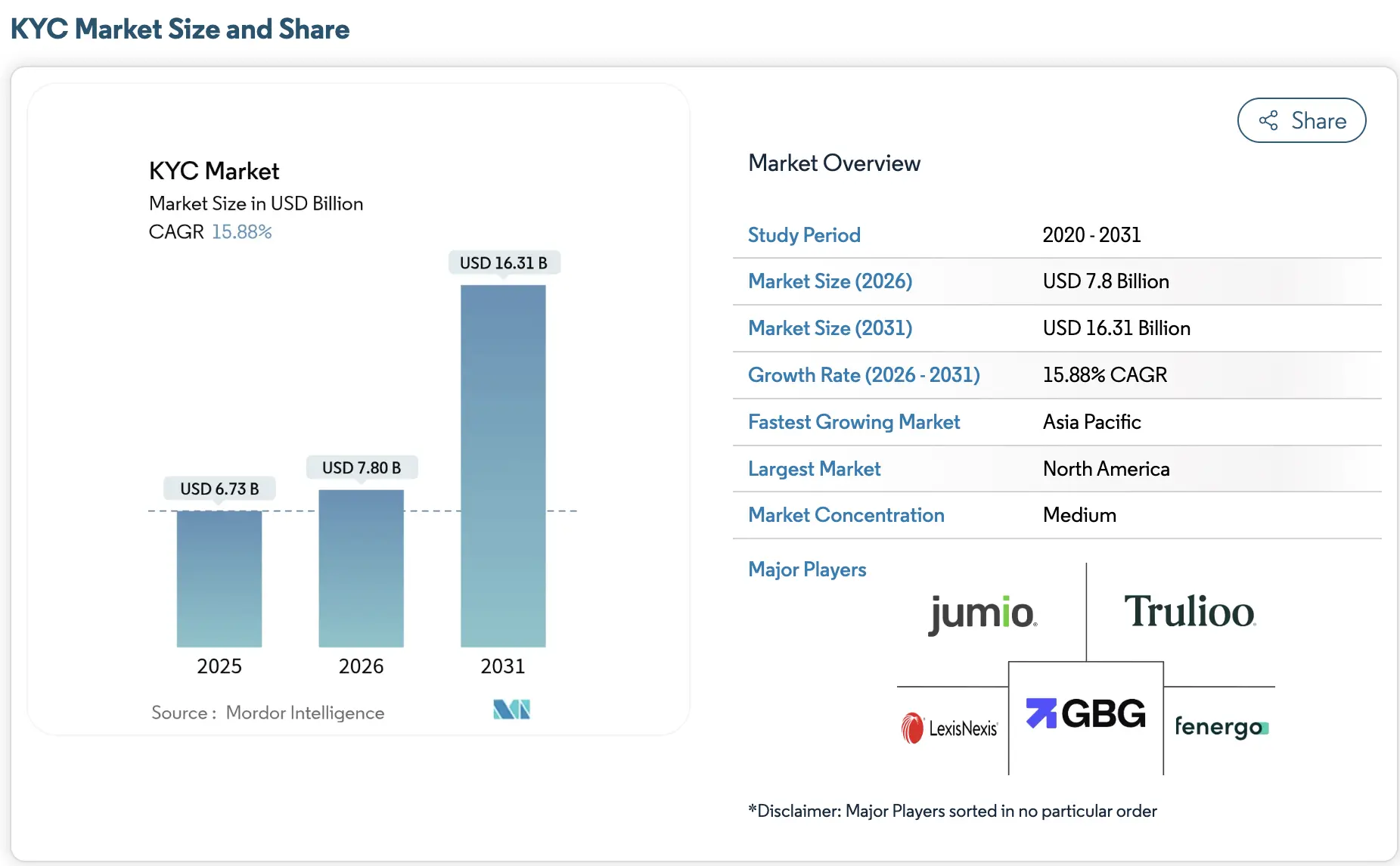
The KYC market will reach USD 7.8 billion by late 2026 and USD 16.31 billion by 2031. Therefore, massive regulatory fines are forcing enterprises to replace manual checks with real-time, AI-driven verification.
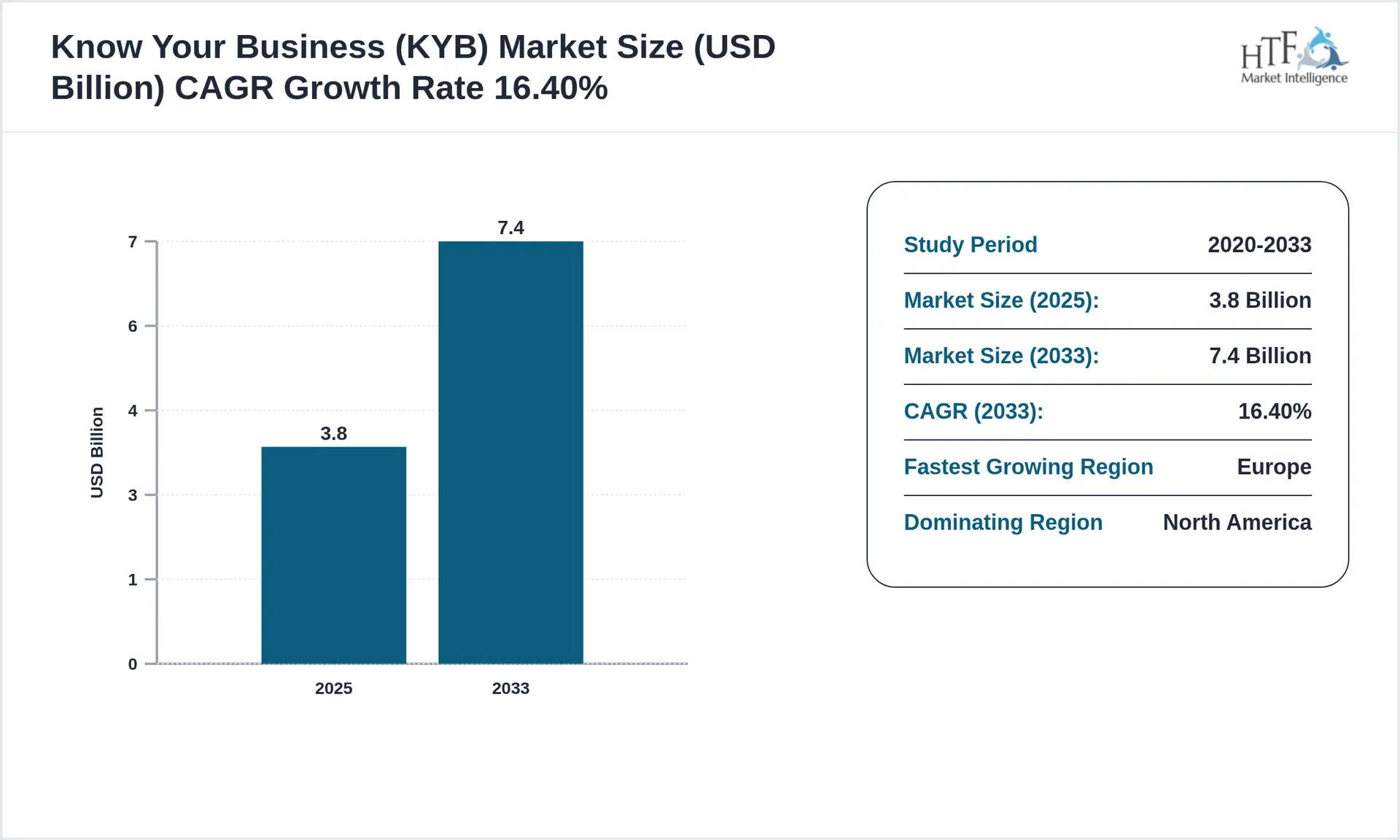
At the same time, the KYB compliance market will grow to USD 7.4 billion by 2033. Therefore, expansion in banking, fintech, and e-commerce is driving the urgent need for RegTech automation.
As digital fraud becomes more sophisticated, the gaps in older infrastructures turn into significant liabilities. Relying on outdated methods does more than just create technical debt.
It actively prevents your teams from making fast, data-driven decisions. Here is why enterprises can no longer rely on legacy KYC & KYB systems:
1. Fragmented Verification Creates Risk
Fragmented systems often force different departments to use separate tools for identity checks. When your customer data lives in disconnected silos, your risk profile remains incomplete. Therefore, this fragmentation makes it difficult to spot suspicious patterns across multiple accounts.
A lack of unified data flow means a red flag in one region might go unnoticed in another. Because of this, your organization takes on unnecessary exposure. Centralizing these processes is the only way to maintain a clear risk posture. Moreover, it ensures that your compliance team sees the same data across every branch.
2. Manual Due Diligence Slows Customer Onboarding
Manual workflows act as the primary bottleneck in enterprise growth. When high-value corporate clients wait weeks for background checks, they often look for more agile competitors. This delay directly impacts your time-to-revenue. Furthermore, it damages the initial brand experience for your most important partners.
In addition, manual processes are prone to human error. Even the most diligent teams can miss a detail in a massive corporate filing. By moving away from manual entry tasks, you allow your officers to focus on high-level strategy. Thus, automation turns a slow administrative task into a competitive advantage.
3. Compliance Exposure Increases
Regulatory requirements change almost daily. A company that passes a check today might become a liability tomorrow. Legacy systems usually perform “point-in-time” checks. Unfortunately, these leave you blind to changes that happen after the initial onboarding.
Without continuous monitoring, your enterprise remains vulnerable between audit cycles. You need a system that alerts you to changes in real time. This proactive approach ensures your compliance status remains current. Consequently, you avoid the need for constant, manual re-verification of every single client.
4. Siloed Data Increases Risk Visibility
Data silos prevent leadership from seeing the broad picture of organizational health. If your KYB data does not connect with your KYC data, you miss vital links. Specifically, you may fail to see the connection between corporate entities and their Ultimate Beneficial Owners (UBOs).
The UBO is the person who actually controls or profits from a legal entity. Without this visibility, you face major hurdles during internal audits. Leaders need a single source of truth to understand their business partners. Therefore, integration is a strategic necessity for modern risk management.
What is a KYB & KYC Verification Platform?
A KYB and KYC verification platform is an integrated system that verifies the identity of both individuals and business entities. It combines document checks, registry lookups, sanctions screening, and risk scoring into a unified compliance workflow.
Enterprises use it to meet regulatory requirements across jurisdictions while reducing manual onboarding effort.
KYC (Know Your Customer) focuses on verifying individual identities. KYB (Know Your Business) goes a layer deeper. It verifies the legitimacy of a business entity, its ownership structure, and whether it carries regulatory or financial risk.
Therefore, most enterprises don’t treat these as separate processes. They run together inside a unified verification workflow.
A fully functional platform typically includes these core components:
- Identity verification engine for individuals
- Business entity verification across registries and databases
- Document verification and authentication
- Sanctions and watchlist screening
- Risk scoring and decisioning logic
- Audit trail and reporting module
In addition, enterprise-grade platforms connect these components into a single automated workflow, rather than treating each as a standalone check.
What an Enterprise-Grade KYB & KYC Platform Must Actually Solve
A modern KYC & KYB verification platform must solve for automated UBO mapping and real-time jurisdictional risk detection. Effective solutions provide a unified risk profile that replaces fragmented data silos with a single, auditable system of truth for enterprise compliance.
Enterprises need more than a simple identity checklist to maintain global operations. Specifically, they require a KYC & KYB verification platform that manages complex legal structures. A true enterprise solution must solve the following issues:
1. Verifying Identity and Business Legitimacy
Verifying a business starts with confirming its legal existence through government registries. A robust KYC & KYB verification platform connects directly to these sources in real time.
Furthermore, it validates that the entity is active and in good standing. This step is critical because shell companies often mimic legitimate businesses to bypass security. Therefore, you must use a system that cross-references multiple data points for every new partner.
2. Mapping Ownership and Control Structures
Identifying the person behind a business is the most complex part of corporate due diligence.
Specifically, you must uncover the Ultimate Beneficial Owners (UBOs). A UBO is the real, living person who actually owns, controls, or profits from a company. Identifying them is like opening a set of Russian nesting dolls. You might see a corporate name on the outside, but the UBO is hidden at the center.
An advanced KYC & KYB verification platform unwraps these layers by pulling data from global registries instantly.
- Direct and Indirect Ownership: The system calculates total shares across multiple holding companies.
- Threshold Detection: It automatically flags individuals holding more than 25% ownership.
- Visual Hierarchy: You receive a clear map showing how a person exerts control.
- Hidden Links: AI detects patterns where one person controls several unrelated entities.
Many entities use layered corporate structures to hide these individuals across different borders. Consequently, an enterprise-grade tool maps these hierarchies visually to reveal the true controlling parties. This ensures you are not inadvertently doing business with sanctioned individuals.
3. Detecting Risk Across Jurisdictions
Global enterprises operate across different legal landscapes with varying compliance rules. A centralized KYC & KYB verification platform applies the correct regional logic automatically.
For instance, it might check for specific local licenses while focusing on tax filings in another country. Moreover, it monitors global watchlists and sanctions in hundreds of languages simultaneously. Thus, your compliance posture remains consistent regardless of where your partners are located.
4. Supporting Ongoing Monitoring (Not Only Onboarding)
Risk is not a static data point that stays the same after the first day. A business that appears safe today could fall under sanctions next month. Therefore, your KYC & KYB verification platform must provide continuous monitoring to catch these shifts.
Perpetual KYC (pKYC) systems alert your team to material changes without requiring a manual re-audit. This proactive approach prevents your firm from reacting to risks only after they cause damage.
5. Creating a Unified Risk Profile
Siloed information is a major threat to effective enterprise risk management. When data lives in separate systems, you lose the ability to see connected threats.
Specifically, a unified KYC & KYB verification platform brings all identity and activity data into one dashboard. This integration allows leadership to see the big picture of total exposure. Consequently, you gain a single source of truth that simplifies both internal and external audits.
Modern platforms must automate complex ownership mapping and provide real-time risk alerts across all global jurisdictions. By unifying data into a single profile, enterprises can eliminate operational silos and protect their global reputation.
Core Verification Engines Behind a Modern KYC & KYB Platform
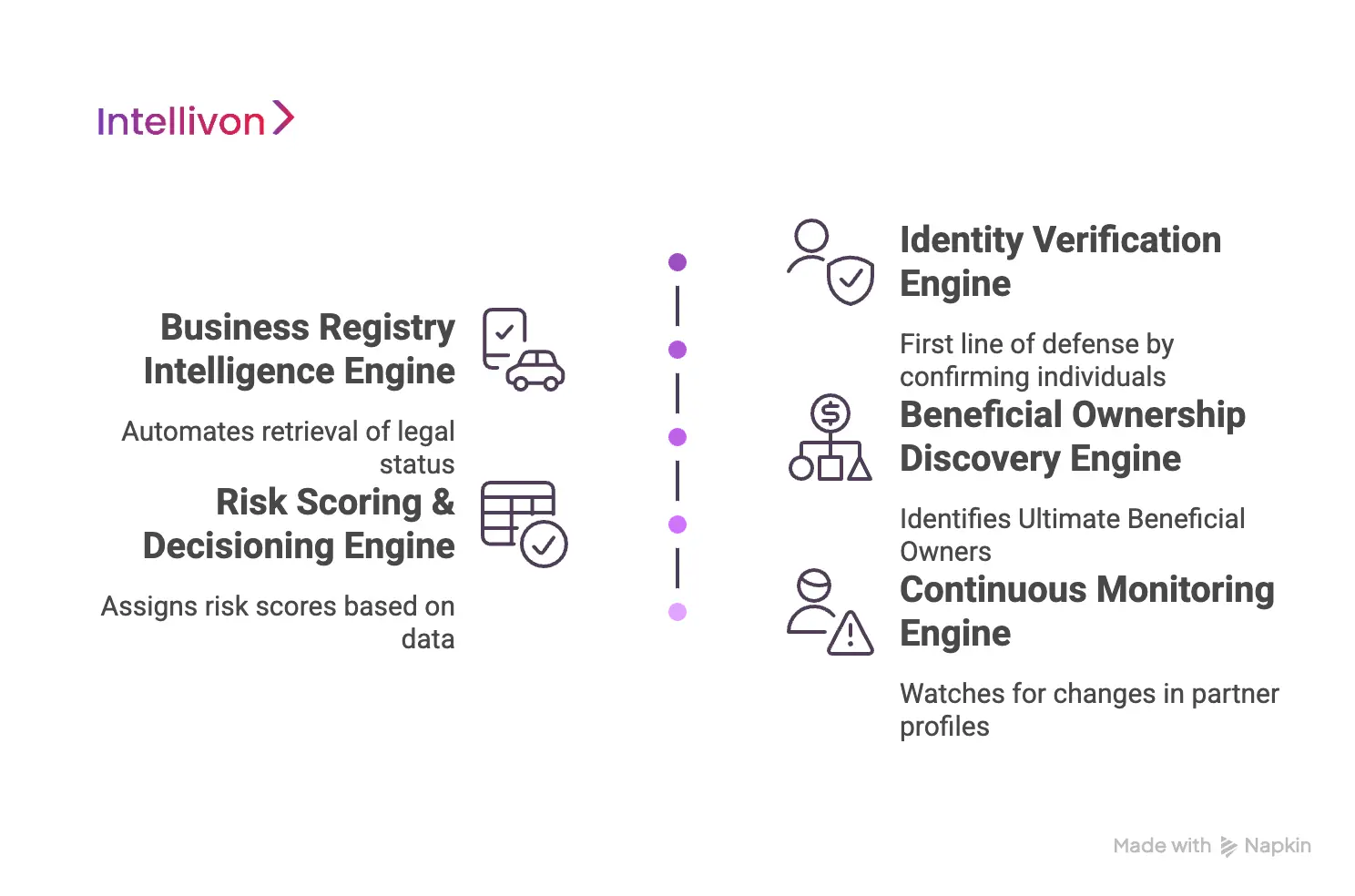
Modern KYC & KYB verification platforms utilize five core engines:
- Identity Verification
- Business Registry Intelligence
- Beneficial Ownership Discovery
- Risk Scoring
- Continuous Monitoring.
These modular components automate data ingestion and analysis to deliver real-time, auditable risk insights for global enterprises. Let’s go over these engines one by one:
1. Identity Verification Engine
This engine serves as the first line of defense by confirming that individuals are who they claim to be. Specifically, it uses advanced biometrics and document analysis to prevent identity theft.
A high-performing KYC & KYB verification platform must handle diverse ID formats from hundreds of countries.
- Biometric Liveness: The system ensures a real person is present, not a photo or deepfake.
- Document Authenticity: AI checks for altered text, forged holograms, or inconsistent metadata.
- Data Cross-Referencing: It matches ID details against authoritative global databases.
- OCR Technology: Optical Character Recognition extracts data instantly to eliminate manual entry errors.
2. Business Registry Intelligence Engine
Confirming the legal status of a corporate partner requires direct access to official government records. This engine automates the retrieval of “Certificates of Good Standing” and other vital filings.
Thus, it replaces the slow process of manually searching individual state or national registries. Furthermore, it ensures that the business is currently active and not a dissolved shell entity.
By integrating this intelligence, your KYC & KYB verification platform builds a foundation of trust before any transaction occurs.
3. Beneficial Ownership Discovery Engine
This engine specializes in “unwrapping” complex, multinational corporate structures. It identifies individuals who meet the legal definition of an Ultimate Beneficial Owner (UBO).
- Global Linkage: The engine connects entities across different jurisdictions to find hidden parents.
- Equity Calculation: It identifies anyone holding significant voting rights or capital.
- Control Mapping: The system flags directors and officers who exert significant influence.
- UBO Visualization: You receive a graphical map of the entire ownership chain.
4. Risk Scoring & Decisioning Engine
Once data is collected, the platform must determine if the risk is acceptable. This engine applies your specific internal risk appetite to the gathered information. Specifically, it assigns a numerical score based on geography, industry, and historical patterns.
Because every enterprise is different, this engine allows for custom rules and logic. Therefore, you can automate low-risk approvals while flagging high-risk cases for senior review. This balance ensures that your KYC & KYB verification platform remains both secure and efficient.
5. Continuous Monitoring Engine
Risk management does not end at the point of onboarding. Specifically, this engine watches for material changes in a partner’s profile 24/7. If a business suddenly appears on a sanctions list or changes owners, the system triggers an immediate alert.
- Sanctions Screening: Constant checks against OFAC, UN, and other global watchlists.
- Adverse Media: Real-time scanning of news for negative reports or legal issues.
- PEP Tracking: Monitoring for Politically Exposed Persons who may require extra scrutiny.
- Automated Re-triggers: The engine forces a new check if a significant risk threshold is met.
Modern verification engines automate the identification of individuals and complex corporate structures in real time.
By utilizing a KYC & KYB verification platform with integrated risk scoring, enterprises can make faster, safer business decisions. This modular approach ensures that your compliance workflows remain scalable and resilient against evolving global threats.
Global Regulatory Requirements Your Platform Must Support
A robust KYC & KYB verification platform must support FATF risk-based standards, EU AMLD6 directives, and U.S. FinCEN beneficial ownership rules. Modern solutions ensure global compliance through automated jurisdictional logic, cross-border data governance, and real-time sanctions screening.
Therefore, a platform that supports these specific frameworks is a strategic necessity. Moreover, staying ahead of these rules protects your brand reputation and ensures long-term operational stability.
1. FATF Risk-Based Approach Alignment
The Financial Action Task Force (FATF) sets the global standard for fighting financial crime. Their “Risk-Based Approach” (RBA) is the gold standard for modern compliance. This framework requires you to identify specific risks and apply resources where they are most needed.
- Dynamic Risk Assessment: The system updates risk scores as new data becomes available.
- Proportional Controls: You apply stricter checks to high-risk entities and simpler ones to low-risk ones.
- Resource Allocation: Your team focuses on complex investigations rather than routine data entry.
- Global Consistency: A unified platform ensures you follow FATF standards across all your international branches.
2. AMLD6 & EU Compliance Expectations
The European Union’s Sixth Anti-Money Laundering Directive (AMLD6) focuses heavily on corporate criminal liability. It expands the list of “predicate offenses” and toughens penalties for non-compliance.
Therefore, your KYC & KYB verification platform must handle the specific rigor of the EU’s Single Rulebook. It should integrate with the new Anti-Money Laundering Authority (AMLA) standards.
Specifically, it must automate the detection of linked transactions and verify beneficial owners across all EU member states seamlessly.
3. FinCEN & U.S. KYB Requirements
In the United States, the Financial Crimes Enforcement Network (FinCEN) mandates strict Beneficial Ownership Information (BOI) reporting.
Specifically, the 2016 CDD Rule remains a cornerstone of U.S. compliance.
- Ownership Identification: You must verify any individual with 25% or more equity.
- Control Prong: The system must identify a single individual with significant managerial responsibility.
- Initial Onboarding: FinCEN now allows streamlined verification at the first account opening.
- Certification Records: The platform must maintain a clear, auditable record of all ownership certifications.
4. APAC Regulatory Expectations
The Asia-Pacific region is a patchwork of diverse and rapidly evolving regulations. Regulators in hubs like Singapore and Hong Kong are moving toward proactive, AI-driven supervision.
Consequently, your KYC & KYB verification platform must be agile enough to handle local nuances. For instance, it may need to verify specific local tax IDs or GST filings. Moreover, it should provide real-time monitoring of regional sanctions and PEP lists to stay ahead of geopolitical shifts.
5. Cross-Border Data Governance Needs
Operating internationally means navigating a maze of data privacy laws like GDPR or CCPA. Specifically, you must ensure that sensitive identity data is stored and transferred securely. A modern platform uses localized data residency to comply with “sovereignty” rules in different countries.
- Data Encryption: All personal and corporate information must be encrypted at rest and in transit.
- Access Control: Only authorized personnel should see sensitive compliance documents.
- Audit Trails: The system logs every data access and modification for regulatory review.
- Privacy by Design: Compliance tools must prioritize data protection from the initial architecture stage.
Global compliance requires a platform that understands and automates the specific rules of different jurisdictions in real time.
By aligning with FATF, EU, and U.S. standards, enterprises can expand safely while avoiding multi-billion dollar penalties. This strategic alignment turns regulatory hurdles into a clear competitive advantage for your organization.
Key Features Of A KYB & KYC Verification Platform
A robust KYC & KYB verification platform must offer biometric identity checks, automated UBO mapping, and real-time sanctions screening. Key enterprise features include dynamic risk scoring and continuous monitoring to ensure perpetual compliance across global jurisdictions.
The following features work together to turn complex regulatory requirements into a streamlined digital workflow:
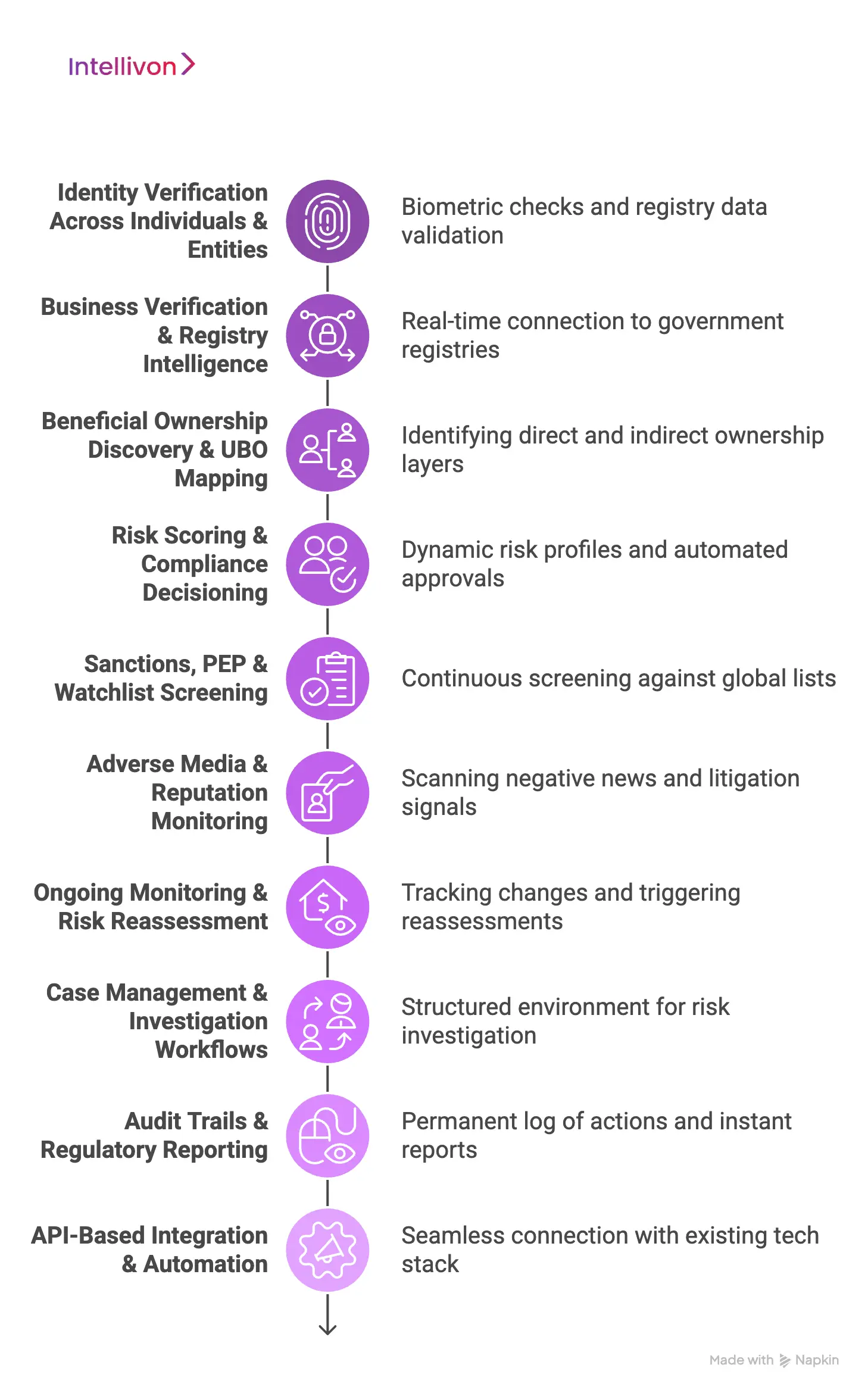
1. Identity Verification Across Individuals & Entities
Establishing trust starts with confirming the identity of both customers and business representatives. A modern KYC & KYB verification platform supports multi-layered validation. Specifically, it uses biometric checks and registry-backed data to confirm legitimacy.
- Document Validation: The system checks passports and IDs for forgery or tampering.
- Biometric Liveness: AI ensures a real person is present during the digital onboarding.
- Registry Cross-Referencing: Identity data is matched against official government records.
- Universal Support: It handles diverse ID formats from over 200 countries and territories.
2. Business Verification & Registry Intelligence
Validating the legal existence of a company is the cornerstone of KYB. Specifically, this feature connects to government and corporate registries in real time. Therefore, it confirms the operational legitimacy and jurisdictional standing of any partner. You can instantly see if a business is active, dissolved, or in a “struck-off” status.
Thus, your KYC & KYB verification platform prevents you from entering into contracts with non-existent or fraudulent entities.
3. Beneficial Ownership Discovery & UBO Mapping
Uncovering the people behind a business is vital for true risk management. This feature identifies both direct and indirect ownership layers. Specifically, it maps out controlling interests that often hide behind surface-level shareholder records.
- Layered Ownership: The system “unwraps” holding companies to find the final owner.
- Threshold Flagging: It highlights anyone with significant voting rights or capital.
- Visual Relationship Maps: You get a clear diagram of the entire corporate hierarchy.
- Control Identification: The platform flags directors who exert influence without direct ownership.
4. Risk Scoring & Compliance Decisioning
Not every business partner carries the same level of exposure. Therefore, a high-quality KYC & KYB verification platform assigns dynamic risk profiles to every entity. It analyzes ownership structures, geography, and industry exposure to generate a numerical score.
This allows your team to automate low-risk approvals while focusing on high-risk threats. Consequently, your compliance process becomes a strategic filter rather than a bottleneck for growth.
5. Sanctions, PEP & Watchlist Screening
Regulatory lists change every hour in our volatile global economy. Specifically, this feature continuously screens individuals and entities against global sanctions.
It also checks for Politically Exposed Persons (PEPs) and enforcement databases like Interpol. Moreover, the system uses “fuzzy matching” to catch intentional name misspellings.
Thus, your organization remains protected from the legal and reputational fallout of dealing with restricted parties.
6. Adverse Media & Reputation Monitoring
Official watchlists do not always tell the whole story. Therefore, a KYC & KYB verification platform must scan negative news and litigation signals. Specifically, it detects reputational risk through enforcement actions and media reports across all jurisdictions.
This “early warning system” helps you spot unethical behavior before it hits the headlines. Because it scans in multiple languages, you gain insights into local risks that global lists might miss.
7. Ongoing Monitoring & Risk Reassessment
Compliance is a continuous journey, not a one-time event. This feature tracks ownership changes and regulatory status shifts long after onboarding. Specifically, if a partner’s risk indicator changes, the system triggers an immediate reassessment.
- Ownership Shifts: Alerts when a new UBO enters the corporate structure.
- Status Changes: Notifies you if a business loses its “Good Standing” status.
- Sanction Hits: Triggers an immediate block if a partner is newly listed.
- Periodic Reviews: Automates the “refresh” cycle for long-term business relationships.
8. Case Management & Investigation Workflows
When the system flags a risk, your team needs a place to investigate. Specifically, case management tools enable compliance teams to review alerts and document decisions. This feature provides a structured environment for deep-dive research into complex entities. Therefore, every decision is supported by a clear internal rationale. Moreover, it allows for collaboration between different departments during high-stakes reviews.
9. Audit Trails & Regulatory Reporting
Transparency is the best defense during a regulatory exam. Consequently, a KYC & KYB verification platform must maintain a permanent log of every action taken. Every verification, decision, and risk change is recorded with a secure timestamp.
- Immutable Logs: Records cannot be deleted or altered by unauthorized users.
- One-Click Reporting: Generate comprehensive compliance reports for auditors instantly.
- Decision History: See exactly who approved a partner and which data they used.
- Version Control: Track changes to your internal risk policies over time.
10. API-Based Integration & Automation
A platform must play well with your existing tech stack to be truly effective. Specifically, API-based integration allows for a seamless connection with your onboarding systems. It can also talk to your transaction monitoring tools and internal risk engines.
Thus, you can build a fully automated flow from the moment a lead signs up. Therefore, your KYC & KYB verification platform scales naturally with your business without requiring more manual labor.
Modern verification platforms must offer a complete suite of tools from biometric checks to automated UBO mapping. By integrating real-time sanctions screening and audit-ready reporting, enterprises can manage global risk with total confidence. This modular feature set ensures that your compliance workflows remain agile, efficient, and rigorously secure.
Risk-Based Due Diligence: The Foundation of Scalable Compliance
Risk-based due diligence in a KYC & KYB verification platform uses tiered onboarding to balance security and speed. By automating policy-driven workflows, enterprises can apply Simplified Due Diligence (SDD) to low-risk entities while triggering Enhanced Due Diligence (EDD) for high-risk profiles automatically.
A modern KYC & KYB verification platform enables a risk-based approach (RBA) to solve the tension of anomalies that come with applying a “one-size-fits-all” approach. This strategy allocates your resources where they matter most. Consequently, you protect your firm without creating unnecessary friction for legitimate business.
1. Tiered Onboarding Based on Risk Profiles
A scalable system categorizes entities into risk tiers immediately upon data ingestion. Therefore, you can fast-track low-risk clients through a seamless digital journey.
- Low-Risk Tier: Requires basic identity and registry checks (Simplified Due Diligence).
- Medium-Risk Tier: Triggers standard verification, including full UBO mapping.
- High-Risk Tier: Mandates deep-dive investigations (Enhanced Due Diligence).
- Dynamic Adjustments: The platform moves entities between tiers if their behavior changes.
2. Configurable Due Diligence Workflows
Your compliance needs change depending on the product, region, or industry involved. Specifically, a flexible KYC & KYB verification platform allows you to build custom logic for different scenarios. For instance, a fintech partner may require stricter document validation than a local vendor.
Moreover, no-code workflow builders let your compliance team update these rules instantly. Thus, you remain agile in the face of shifting global regulations.
3. Escalation Paths for High-Risk Entities
Automation should handle the routine, but humans must manage the exceptions. When the system detects a high-risk signal, it must follow a clear escalation path.
This ensures that senior analysts or the CFO can review complex cases before approval.
- Flagging Sanctions: Immediate stop on onboarding for any direct matches.
- Adverse Media Alerts: Automated routing to a specialized review queue.
- Manual Overrides: Compliance officers can request additional “Proof of Wealth” documents.
- Audit Trails: Every decision is logged to ensure full transparency during regulatory exams.
4. Policy-Driven Compliance Automation
Modern platforms translate your internal compliance manual into executable code. This policy-driven automation ensures that every check follows your specific risk appetite.
Because the system applies these rules consistently, it eliminates the “human error” inherent in manual reviews. Furthermore, it creates a repeatable process that scales as your business grows.
Therefore, your KYC & KYB verification platform becomes a strategic asset that supports global expansion rather than a cost center.
Risk-based strategies allow enterprises to accelerate onboarding for safe clients while focusing deep scrutiny on high-risk threats. This balanced approach ensures that your KYC & KYB verification platform remains both efficient and rigorously secure.
How Intellivon Designs Your KYB & KYC Verification Platform
At Intellivon, we build high-performance compliance ecosystems that transform regulatory hurdles into competitive advantages. Specifically, our engineering teams focus on creating a KYC & KYB verification platform that scales with your global ambitions.
We move beyond basic data collection to provide a true intelligence engine. Therefore, our design process prioritizes data integrity, speed, and executive-level visibility. Moreover, we ensure that every automated workflow aligns perfectly with your internal risk appetite. Here is a step-by-step account of how we carry this out:
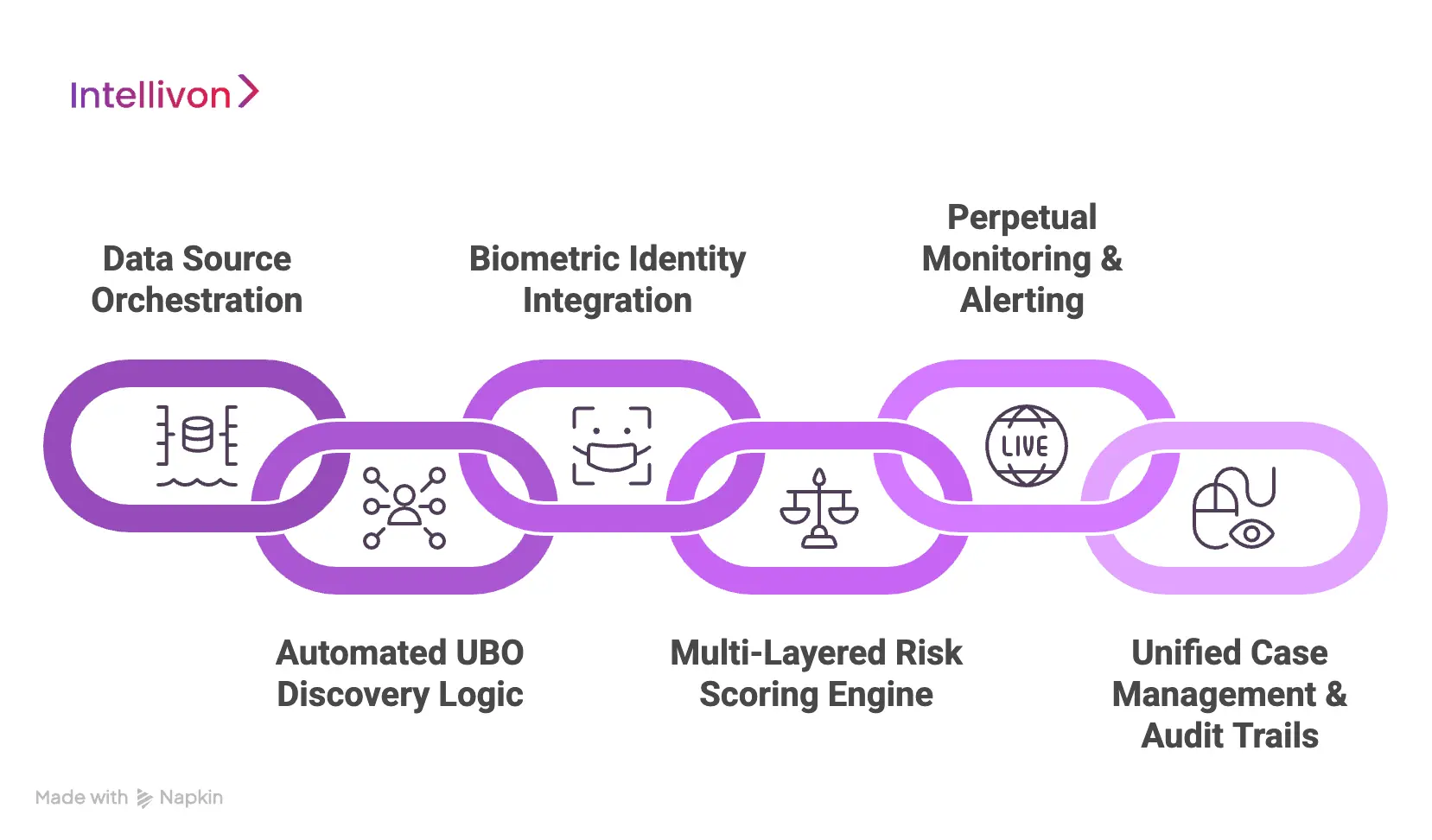
Step 1: Data Source Orchestration
We begin by connecting your infrastructure to authoritative global data streams. Specifically, we integrate directly with government registries and corporate intelligence databases. This ensures your KYC & KYB verification platform pulls the most accurate, real-time information.
- Registry Pipes: Direct connections to the Secretary of State and national business houses.
- Real-Time Data: Instant retrieval of “Certificates of Good Standing” and active filings.
- Global Access: A single API gateway to over 200 international jurisdictions.
- Data Integrity: Removal of static, outdated spreadsheets from your onboarding flow.
Step 2: Automated UBO Discovery Logic
Identifying the person behind a complex corporate structure is a core technical challenge. Therefore, we build advanced logic to “unwrap” multinational ownership layers automatically.
- Layer Calculation: The platform calculates ownership across various holding companies.
- Control Flagging: We identify directors and officers with significant managerial influence.
- Visual Mapping: We generate a clear graphical hierarchy for your compliance officers.
- Global Linking: Our engine finds connections between entities in different jurisdictions.
Step 3: Biometric Identity Integration
Verifying the individuals representing a business requires a multi-modal approach. Specifically, we integrate state-of-the-art biometric and document analysis tools.
- Liveness Detection: AI confirms a real person is present during the digital session.
- Anti-Spoofing: Protection against deepfakes, photos of screens, or high-quality masks.
- Document Authenticity: Scans for physical tampering or digital manipulation of IDs.
- OCR Automation: Instant data extraction from passports to eliminate manual typing.
Step 4: Multi-Layered Risk Scoring Engine
Every enterprise has a unique risk appetite that must be reflected in its tools. Consequently, we buid configurable scoring engines that analyze hundreds of data points.
- Custom Weighting: Assign higher risk to specific countries or high-cash industries.
- Automated Decisioning: Low-risk leads move through the sales cycle in seconds.
- Smart Flagging: High-risk entities route immediately to senior compliance experts.
- Audit Rationale: The system logs exactly why a specific risk score was assigned.
Step 5: Perpetual Monitoring & Alerting
Compliance is not a “one-and-done” event in a volatile global market. Specifically, we design your KYC & KYB verification platform to monitor your entire portfolio 24/7.
- Sanction Hits: Instant notification if a client appears on a global watchlist.
- Adverse Media: Real-time scanning for negative news or legal enforcement actions.
- Registry Changes: Alerts when a business loses its “Good Standing” status.
- Scheduled Re-Scans: Automated triggers for periodic due diligence refreshes.
Step 6: Unified Case Management & Audit Trails
The final step is centralizing all data into a single, auditable dashboard. Specifically, we build a unified environment where your team can investigate flags and document decisions.
- Central Dashboard: One view for all identity, ownership, and risk data.
- Immutable Logs: Every action is recorded with a secure, permanent timestamp.
- One-Click Reporting: Generate comprehensive compliance reports for regulators instantly.
- Collaboration Tools: Allow different departments to review high-stakes cases together.
Intellivon designs verification platforms that automate the identification of complex corporate owners and individual identities.
By integrating real-time monitoring and custom risk scoring, we help enterprises scale their global operations efficiently. This strategic engineering approach ensures that your organization remains protected, compliant, and ready for growth.
Common Pitfalls When Building KYC & KYB Platforms (And How We Solve Them)
Common pitfalls in KYC & KYB verification platforms include static data reliance and incomplete UBO mapping.
Intellivon solves these by integrating real-time government registry “pipes” and automated, multi-layered ownership discovery to ensure 100% auditable compliance. Here are some common mistakes that might come up while building these platforms and how we solve them:
1. Over-Reliance on Static Data
Many legacy platforms depend on secondary databases that only update periodically. Consequently, your team might approve a business based on data that is several months old.
This “data lag” creates a massive window for fraud or sanctions violations. If a business loses its legal standing, a static system will not catch it until the next refresh. Thus, your enterprise remains unknowingly exposed to significant regulatory risk.
- How We Solve It: We build direct API “pipes” to official government registries and corporate houses.
- Real-Time Validation: Your platform pulls fresh “Certificates of Good Standing” during every check.
- Data Accuracy: We eliminate the middleman to ensure you see exactly what the regulator sees.
2. Incomplete Ownership Mapping
Standard tools often fail to “unwrap” complex corporate hierarchies across multiple countries. Specifically, they may identify direct shareholders but miss the ultimate individual in control.
This leaves a blind spot where sanctioned entities can hide behind shell companies. Without a full view of the ownership chain, you cannot truly know who you are doing business with. Therefore, your firm remains vulnerable to “Anti-Money Laundering” (AML) penalties.
- Our Solution: We utilize advanced algorithms to map both direct and indirect ownership layers.
- UBO Visualization: Our platforms generate clear, interactive diagrams of the entire corporate structure.
- Threshold Detection: We automatically flag any individual crossing your specific ownership percentage limits.
3. Limited Monitoring Capabilities
A major pitfall is treating verification as a one-time event during onboarding. Specifically, many systems go dark once the initial check is complete. However, risk is dynamic and can change the day after a client is approved.
If a partner enters a new sanctioned jurisdiction, a static platform will never alert you. Consequently, you may continue processing transactions for a high-risk entity for months.
- How We Solve It: We design your KYC & KYB verification platform for “Perpetual KYC” (pKYC).
- 24/7 Scanning: Our engines monitor global watchlists and registry changes every single day.
- Automated Triggers: The system alerts your team immediately if a partner’s risk profile shifts.
4. Poor Workflow Design
Technical depth means nothing if your compliance team cannot manage the alerts effectively. Many platforms suffer from “alert fatigue” caused by too many false positives and messy interfaces.
This leads to human error and slows down the onboarding process for legitimate clients. Specifically, a lack of clear escalation paths means high-risk cases may sit in a queue for weeks. Therefore, poor design directly hurts your time-to-revenue and brand reputation.
- Our Solution: We build intuitive case management dashboards with clear, automated workflows.
- Smart Filtering: Our AI suppresses “noise” so your team only focuses on material risks.
- Audit-Ready Logs: Every decision is captured in a structured, easy-to-export format for regulators.
Enterprises often struggle with static data and incomplete ownership mapping when building compliance tools. Intellivon solves these issues by integrating real-time registry access and automated, multi-layered UBO discovery.
This proactive engineering ensures your KYC & KYB verification platform is both efficient and rigorously secure.
Conclusion
Building a KYB and KYC verification platform isn’t purely a compliance exercise. For enterprises operating across multiple markets, it’s a strategic infrastructure decision that directly affects how fast you grow, how well you manage risk, and how confidently you scale into new territories.
The organizations that get this right don’t just avoid regulatory penalties. They onboard faster, make sharper risk decisions, and build the kind of operational trust that holds up under scrutiny. However, getting it right requires architecture expertise, regulatory depth, and the judgment to balance automation with human oversight.
That’s precisely where Intellivon comes in. We design and build enterprise-grade verification systems that work in the real world, not just in demos. If your organization is ready to move beyond fragmented checks and build something that genuinely performs at scale, let’s talk.
Build A KYB & KYC Verification Platform With Intellivon
Intellivon provides a governed, AI-enabled KYC & KYB verification platform designed for global enterprises. By combining configurable workflows with provider-agnostic integrations, we deliver a scalable, audit-ready compliance infrastructure that reduces onboarding friction.
Why Partner With Intellivon?
Selecting a partner to build your KYC & KYB verification platform is a critical strategic decision. We focus on the six pillars of enterprise-grade compliance to ensure your long-term success.
- Governance-First Architecture: We build systems where policy drives the technology. Therefore, your internal compliance rules are hard-coded into every automated decision.
- Configurable Workflows: No two businesses have the same risk appetite. Specifically, our no-code builders allow you to adjust verification steps for different regions instantly.
- AI-Assisted Verification: We use machine learning to suppress false positives and highlight material risks. Consequently, your team focuses only on cases that truly require human judgment.
- Provider-Agnostic Integrations: We do not lock you into a single data vendor. Instead, we orchestrate the best government registries and ID tools into one unified “pipe.”
- Scalable Monitoring: Our infrastructure grows alongside your client portfolio. Specifically, we provide perpetual “pKYC” monitoring that alerts you to risk shifts in real time.
- Enterprise-Grade Auditability: Every click, change, and approval is logged in a secure, immutable ledger. Thus, you are always prepared for an unexpected regulatory exam.
Intellivon provides the technical depth and strategic foresight needed to navigate complex global compliance. Our governed, AI-assisted infrastructure ensures that your organization remains protected against evolving financial threats. By unifying data and automating ownership mapping, we help you build a more resilient and scalable enterprise.
Book a strategy call with Intellivon to design a KYC & KYB verification platform that reduces onboarding friction while strengthening your compliance control.
FAQs
Q1. What are the three main components of KYC and KYB?
A1. A robust KYC & KYB verification platform relies on three primary stages of due diligence. First, Customer Identification Programs (CIP) collect and verify the basic identity of the entity or individual. Second, Customer Due Diligence (CDD) involves assessing the risk level and identifying ultimate beneficial owners. Finally, Enhanced Due Diligence (EDD) or ongoing monitoring provides a deeper dive into high-risk profiles. Therefore, these three layers ensure that your enterprise maintains a complete and current risk posture.
Q2. What’s the difference between KYB and KYC?
A2. While both terms fall under anti-money laundering (AML) laws, they focus on different subjects. Specifically, KYC (Know Your Customer) verifies the identity of individual humans. It uses biometric data and personal government IDs to prevent identity theft. Conversely, KYB (Know Your Business) focuses on the legal legitimacy of corporate entities. It maps complex ownership structures to find the humans who actually control the firm.
Q3. How will you verify the KYB documents?
Modern platforms verify corporate documents by connecting directly to official government registries in real time. Specifically, the system pulls “Certificates of Incorporation” and “Certificates of Good Standing” to confirm a company’s legal status. Furthermore, AI-driven tools scan these documents for inconsistencies or signs of digital tampering. Because these checks happen through secure API “pipes,” they eliminate the need for manual, paper-based reviews. Consequently, you receive verified data that is 100% auditable and free from human error.
Q4. What are the four pillars of KYC?
A4. The four pillars of a strong KYC & KYB verification platform are the foundation of any regulatory program. These pillars include:
- Customer Identification Program (CIP): Confirming the identity of every client at the start.
- Customer Due Diligence (CDD): Identifying the beneficial owners and the nature of the business.
- Ongoing Monitoring: Watching for changes in risk or suspicious activity 24/7.
- Internal Controls: Creating a clear record of policies, audits, and decision-making for regulators.