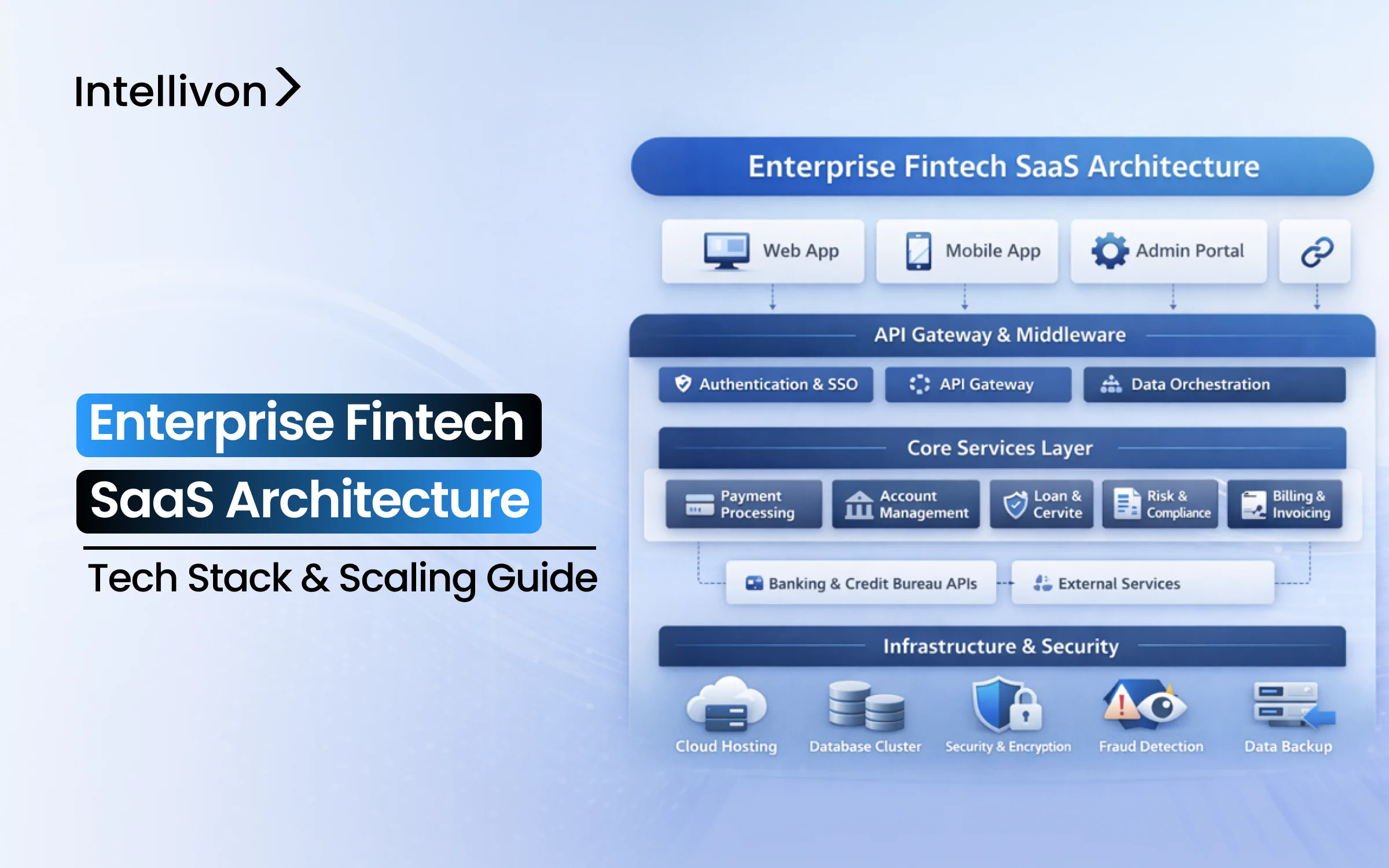
Enterprise fintech SaaS platforms rarely fail overnight. Instead, problems build up gradually, often because of early design decisions, quick growth, or systems that no longer match what the business needs. A setup that works well at launch may turn into a bottleneck as the business expands. Sometimes, compliance tools that solve one issue can expose gaps elsewhere.
These risks matter because a fintech SaaS platform supports every transaction, customer interaction, and regulatory need the business faces. If the core system doesn’t fit the company’s direction, hidden costs and problems can pile up until they’re too big to ignore. Building a strong platform means making smart choices at every level, from infrastructure and data pipelines to security, API setup, and methods for scaling up as demand grows. Each layer needs to hold up under real business pressure.
Intellivon helps fintech leaders navigate these decisions with a focus on long-term results. This blog outlines the entire architectural stack, scaling frameworks, and design principles that define high-performing enterprise fintech SaaS platforms designed for steady growth.

Why Fintech Platforms Are Moving to SaaS Architecture
Fintech platforms are shifting to SaaS architectures to scale faster and reduce infrastructure costs.
As digital transaction volumes rise, cloud-native platforms allow quicker innovation and easier system upgrades. In addition, SaaS models support AI and blockchain integrations while enabling subscription-based fintech services for payments, lending, and compliance.
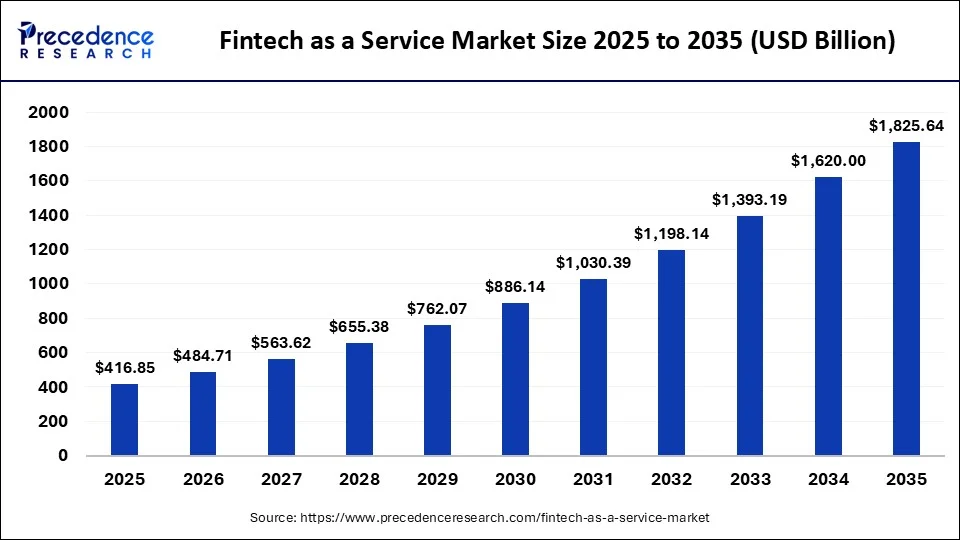
1. Limits of Monolithic Fintech Infrastructure
Legacy systems bundle all functions into a single, inseparable unit. Consequently, updating one feature requires redeploying the entire system. This process increases the risk of downtime and technical errors.
Furthermore, these rigid frameworks struggle to handle sudden transaction spikes. They lack the elasticity required for modern global markets.
2. SaaS as the Backbone
Software-as-a-Service provides the agility that modern finance demands. By hosting core logic in the cloud, firms access high-performance computing without capital expenditure.
This model ensures that security patches happen automatically. As a result, the platform remains compliant with global regulations. Therefore, resources can focus on customer experience rather than hardware.
3. Fintech SaaS Enables Product Scalability
Scalability in a SaaS environment is nearly instantaneous. When demand increases, the architecture automatically allocates more resources to handle the load. Developers can use microservices to scale specific functions independently.
This modularity ensures that high-traffic areas do not slow down the application. It allows for a surgical approach to infrastructure management.
Adopting flexible SaaS architectures ensures enterprises are equipped for long-term resilience. This technical pivot serves as the foundation for the next generation of financial services.
What Defines An Enterprise Fintech SaaS Architecture?
Enterprise Fintech SaaS Architecture is a cloud-based framework that handles large-scale financial operations. It uses modular microservices to manage payments, data, and security independently.
This design allows for rapid updates without system downtime. Therefore, it provides the reliability that modern corporations require. Strategic leaders use this infrastructure to achieve global scalability and maintain strict regulatory compliance.
SaaS vs Traditional Financial Software Systems
Financial institutions historically relied on traditional on-premise software systems to manage banking, payments, and financial operations. However, these systems were designed for internal use and limited integrations.
In contrast, SaaS platforms deliver financial capabilities through cloud-based infrastructure. As a result, organizations can scale services faster and integrate with modern fintech ecosystems.
Key Differences Between SaaS and Traditional Financial Software
| Feature | SaaS Financial Platforms | Traditional Financial Software |
| Deployment model | Cloud-based and accessible via the internet | Installed on the internal enterprise infrastructure |
| System updates | Updates are deployed automatically by providers | Updates require manual upgrades and downtime |
| Scalability | Infrastructure scales easily with demand | Scaling requires hardware and system upgrades |
| Integration capability | Designed for API-driven integrations | Integrations are complex and slower |
| Cost structure | Subscription-based pricing models | High upfront licensing and infrastructure costs |
| Accessibility | Accessible across regions through cloud platforms | Often limited to internal enterprise networks |
In practice, SaaS platforms provide greater flexibility and scalability for fintech systems. They allow organizations to deploy financial services faster while maintaining integration capabilities required for modern digital finance.
Core Layers of an Enterprise Fintech SaaS Platform
A modern fintech architecture relies on a modular approach to handle complex global transactions. This layered strategy ensures that each component remains secure and performs at its peak.
It provides the technical foundation needed to support high-growth financial products without friction.
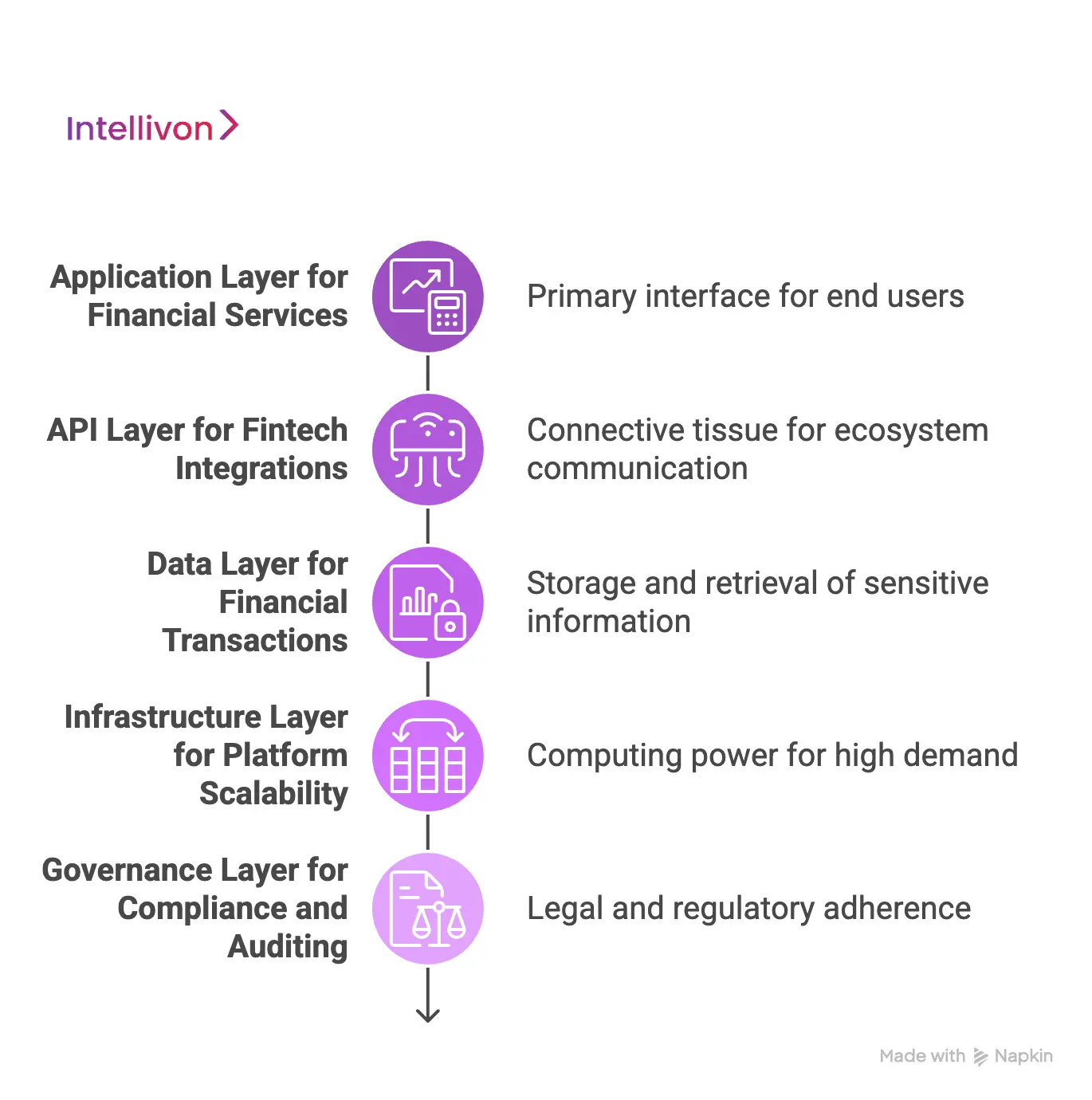
1. Application Layer for Financial Services
The application layer serves as the primary interface for the end user. It delivers specific financial tools such as mobile banking or investment dashboards.
This layer focuses on providing a seamless experience across multiple digital channels. Consequently, users manage their finances with high speed and total reliability.
2. API Layer for Fintech Integrations
The API layer acts as the connective tissue for the entire ecosystem. It allows internal services and external partners to communicate through standardized protocols.
This design simplifies the process of adding new payment gateways or credit tools. As a result, the platform becomes a versatile hub for diverse financial innovations.
3. Data Layer for Financial Transactions
The data layer manages the storage and retrieval of sensitive financial information. It utilizes distributed databases to ensure that records remain accurate across all nodes.
This consistency is vital for maintaining the integrity of the general ledger. Therefore, the enterprise avoids errors in balance reporting or transaction history.
4. Infrastructure Layer for Platform Scalability
The infrastructure layer provides the raw computing power needed for daily operations. It uses cloud-native tools to spin up resources during periods of high demand. This elasticity ensures that the platform never slows down during peak market hours.
Consequently, the business avoids the high costs of maintaining idle physical servers.
5. Governance Layer for Compliance and Auditing
The governance layer ensures that the entire platform follows legal and regulatory rules. It tracks every system change and transaction for future auditing purposes.
This transparency builds trust with regulators and protects the firm from legal risks. As a result, compliance becomes a built-in feature rather than an afterthought.
Each layer of this architecture works in harmony to deliver a superior financial service. This structured approach allows enterprises to scale with confidence in an increasingly complex market.
Technology Stack for Fintech SaaS Platforms
Selecting a technology stack is a high-stakes decision for any enterprise leader. This choice dictates the long-term agility and security of your financial ecosystem. A well-aligned stack ensures that your platform handles millions of transactions without compromising performance.
1. Backend Frameworks for Fintech Platforms
Java with Spring Boot remains a dominant choice for large-scale enterprise applications. Its robust security features provide a stable foundation for complex banking logic.
Many firms also adopt Go for its exceptional performance in high-throughput environments.
This language is effective for building microservices that require minimal latency. Consequently, developers can maintain a fast and reliable system.
2. Database infrastructure for financial systems
PostgreSQL is the industry standard for relational data in modern fintech. It offers the strict ACID compliance necessary for maintaining accurate transaction ledgers. Many enterprises also utilize Amazon Aurora for its high availability and automated scaling.
These systems ensure that every financial record remains consistent across the globe. Therefore, the business avoids errors in balance reporting.
3. Cloud platforms used in fintech SaaS
Amazon Web Services remains the leader for hosting enterprise-grade fintech solutions. Its vast array of specialized services for security makes it a reliable choice.
Microsoft Azure is also a strong contender for organizations integrated into the Microsoft ecosystem. Azure offers robust identity management tools that simplify user access control. This global footprint is essential for any enterprise seeking a worldwide presence.
4. Messaging and event streaming technologies
Apache Kafka is the gold standard for managing real-time data streams. It allows different services to communicate asynchronously to improve system resilience.
This technology is vital for processing live market data or triggering instant fraud alerts. As a result, the business reacts to events as they happen. It creates a more responsive environment for sensitive financial operations.
5. Observability and monitoring infrastructure
Datadog is a top choice for full-stack observability in cloud-native environments. It provides a unified view of metrics and logs in a single dashboard. This visibility is essential for identifying bottlenecks before they impact the end user.
Therefore, engineering teams maintain high service levels while reducing troubleshooting time. Robust monitoring is the final safeguard for your financial services.
The right technology stack acts as a force multiplier for your growth strategy. By investing in these proven tools, you create a resilient platform capable of leading the future of finance.
Multi-Tenant Architecture for Fintech SaaS Platforms
A robust multi-tenant strategy is the cornerstone of any scalable enterprise SaaS ecosystem. This architecture allows a single software instance to serve multiple distinct corporate clients while maintaining strict boundaries.
It provides the efficiency of shared resources alongside the security of isolated environments.
1. Shared vs isolated tenant infrastructure
Enterprise leaders must choose between pooling resources and dedicated environments for their clients. A shared model maximizes cost efficiency by running multiple tenants on common servers. In contrast, an isolated model provides dedicated compute and storage for each entity.
- Shared Pool: High resource utilization and lower operational costs.
- Siloed Infrastructure: Maximum security and easier regulatory compliance.
- Hybrid Approach: Shared application logic with isolated database layers.
2. Tenant data partitioning strategies
Data partitioning is critical for maintaining performance and security in a fintech environment. A “database-per-tenant” strategy offers the highest level of isolation and simplifies custom backups.
Alternatively, a “schema-per-tenant” model uses a single database instance but keeps data logically separate.
- Database Isolation: Prevents a failure in one client’s data layer from impacting others.
- Logical Partitioning: Reduces the overhead of managing thousands of individual connections.
- Row-Level Security: Enforces access controls within a shared table structure.
3. Performance isolation across enterprise clients
Performance isolation prevents a single “noisy neighbor” from consuming all system resources. In a multi-tenant setup, one client’s heavy processing should never slow down another’s dashboard.
Advanced load balancers and resource quotas ensure that every tenant receives its fair share of power.
- Resource Quotas: Limits CPU and memory usage per tenant.
- Rate Limiting: Prevents API abuse from affecting overall system stability.
- Dedicated Workers: Assigns specific background processes to high-priority clients.
4. Scaling infrastructure for global SaaS platforms
Scaling a global fintech platform requires a distributed approach to infrastructure. Deploying resources across multiple cloud regions reduces latency for international users.
This geographic spread also ensures that data residency requirements are met for different jurisdictions.
- Regional Clusters: Deploys partitioned stacks near the end-user location.
- Auto-Scaling: Dynamically adjusts capacity based on real-time transaction volume.
- Global CDN: Accelerates the delivery of static assets and encrypted files.
Managing multi-tenancy requires a delicate balance between operational cost and client security. This architectural foundation allows your fintech solution to grow into a global powerhouse.
Security Architecture for Enterprise Fintech SaaS
Security is the most critical pillar of any enterprise financial platform. A robust security architecture protects sensitive data while maintaining the speed of business operations.
It ensures that every transaction is verified and every user is authorized within a hardened digital environment.
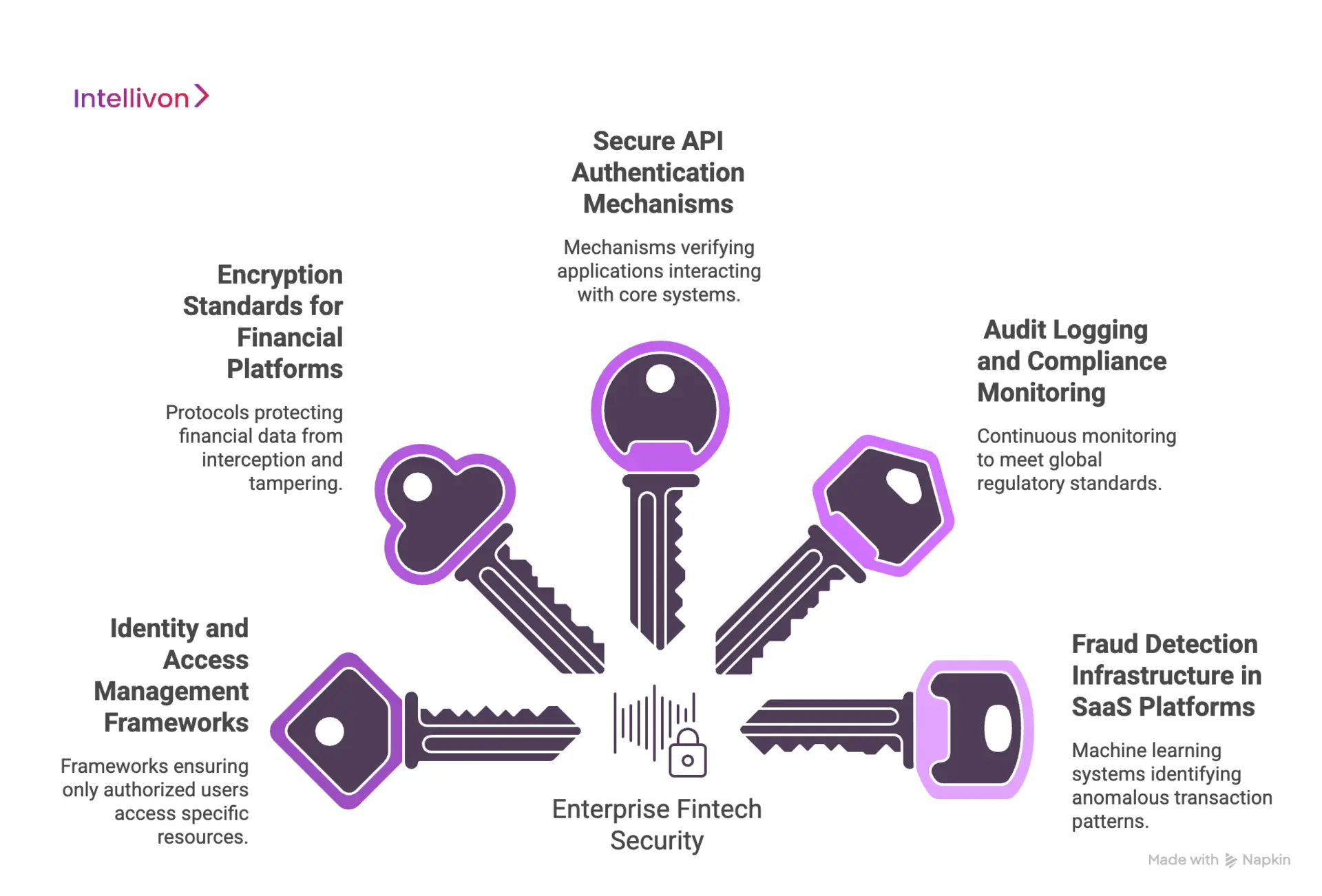
1. Identity and Access Management Frameworks
Identity and access management serves as the first line of defense against unauthorized entry. Modern platforms use Zero Trust architectures to verify every request regardless of its origin.
This framework ensures that users only access the specific resources required for their roles. Consequently, the business reduces the risk of internal data breaches.
- Role-Based Access Control: Grants permissions based on specific job functions.
- Multi-Factor Authentication: Requires additional verification layers for all logins.
- Single Sign-On: Simplifies user access while maintaining centralized security control.
2. Encryption Standards for Financial Platforms
Encryption protects financial data from being intercepted or tampered with during its lifecycle. Platforms must implement strong protocols for data both in transit and at rest.
Advanced standards like AES-256 ensure that even if data is stolen, it remains unreadable. Therefore, the enterprise maintains the highest level of confidentiality for its clients.
- TLS 1.3: Secures communication between the user and the server.
- Hardware Security Modules: Provide physical protection for cryptographic keys.
- Tokenization: Replaces sensitive credit card data with non-sensitive placeholders.
3. Secure API Authentication Mechanisms
APIs are the primary targets for modern cyberattacks in the fintech space. Implementing secure authentication ensures that only verified applications can interact with your core systems.
Using modern standards like OAuth 2.0 and OpenID Connect provides a secure way to manage these connections. As a result, the platform remains open to partners without compromising security.
- JWT Bearer Tokens: Provide a secure way to transmit claims between parties.
- Mutual TLS: Requires both the client and server to authenticate each other.
- API Key Rotation: Regularly updates credentials to minimize the impact of leaks.
4. Audit Logging and Compliance Monitoring
Continuous monitoring is essential for meeting global regulatory standards like PCI-DSS or SOC2. Audit logs capture every system change and transaction to provide a clear history of activities. This transparency is vital for identifying suspicious behavior and passing financial audits. Consequently, the firm avoids heavy fines and maintains its market reputation.
- Immutable Logs: Ensures that records cannot be altered or deleted.
- Real-Time Alerts: Notifies security teams of potential threats immediately.
- SIEM Integration: Consolidates logs into a central system for deep analysis.
5. Fraud Detection Infrastructure in SaaS Platforms
Modern fraud detection uses machine learning to identify anomalous transaction patterns in real-time. These systems analyze thousands of data points to flag potential money laundering or identity theft.
By automating this process, the platform protects users without slowing down legitimate transactions. This proactive approach is a key competitive advantage for any fintech leader.
- Behavioral Biometrics: Analyzes how users interact with the application.
- Velocity Checking: Limits the number of transactions within a short timeframe.
- Geofencing: Flags transactions originating from unexpected or high-risk locations.
A sophisticated security architecture transforms compliance from a burden into a strategic asset. By prioritizing these layers, your enterprise builds the trust necessary to lead the global financial market.
Integration Infrastructure for Fintech SaaS Platforms
A robust integration infrastructure serves as the central nervous system for any enterprise fintech application. It enables disparate financial systems to communicate and share data in real-time.
This connectivity allows your platform to offer a comprehensive suite of services through a single, unified interface.
1. Banking System Integrations
Connecting with core banking systems is a foundational requirement for modern fintech platforms. These integrations allow for real-time balance checks and historical transaction retrieval.
Most legacy banks use ISO 20022 standards to ensure data consistency across global borders. Consequently, your architecture must support these complex formats to maintain total accuracy.
- Core Banking APIs: Provides direct access to ledger data and account management.
- SWIFT Connectivity: Enables secure international wire transfers and messaging.
- Open Banking Protocols: Facilitates permissioned data sharing under PSD2 regulations.
2. Payment Network Integrations
Payment networks act as the rails that move money between different financial entities. Integrating with networks like Visa, Mastercard, or local UPI systems is essential for global reach.
This layer must handle high transaction volumes with sub-second latency to ensure a smooth user experience. Therefore, the enterprise gains the ability to process payments anywhere in the world.
- Card Schemes: Connects directly to global credit and debit networks.
- Real-Time Payments: Supports instant clearing systems like FedNow or SEPA.
- Digital Wallets: Integrates with popular mobile payment solutions for consumer ease.
3. Third-Party Fintech Service Integrations
Specialized third-party services provide essential features like identity verification and credit scoring. Integrating these tools via RESTful APIs reduces the need for custom internal development.
This “best-of-breed” approach allows your team to focus on core product innovation. As a result, the platform remains agile and competitive in a crowded market.
- KYC/AML Providers: Automates user onboarding and regulatory compliance checks.
- Credit Decisioning: Utilizes alternative data for more accurate risk assessment.
- Tax and Accounting: Syncs financial data with enterprise resource planning tools.
4. API Management for Partner Ecosystems
Managing a growing list of partners requires a dedicated API gateway for security and oversight. This layer enforces rate limits to prevent system abuse and ensure high availability.
It also provides a developer portal for easier documentation and onboarding of new collaborators. Consequently, the enterprise fosters a thriving ecosystem without increasing technical debt.
- Developer Portals: Offers sandboxes and documentation for external engineers.
- Usage Analytics: Tracks API performance and partner engagement in real-time.
- Security Policies: Enforces OAuth 2.0 and IP whitelisting for all endpoints.
5. Managing Fintech Integrations At Scale
Scaling integrations requires a modular approach to prevent a single failure from affecting the entire system.
Using message queues and circuit breakers ensures that the platform remains resilient during partner outages. Furthermore, automated testing pipelines verify that API updates do not break existing connections. This proactive management is vital for maintaining trust with your global enterprise clients.
- Circuit Breakers: Prevents cascading failures when an external service is down.
- Webhooks: Enable real-time event notifications for completed transactions.
- Idempotency Keys: Ensures that duplicate API calls do not result in double payments.
A well-designed integration layer transforms your fintech platform into a versatile financial hub. This connectivity ensures that your enterprise can adapt to new market demands with unmatched speed.
Scaling Enterprise Fintech SaaS Platforms
Scaling a financial platform requires more than just adding server capacity. It demands a sophisticated architecture that maintains data integrity during extreme traffic spikes.
This strategic approach ensures that your enterprise can grow globally without compromising on speed or reliability.
1. Horizontal Scaling for Transaction Systems
Horizontal scaling allows a platform to handle increased loads by adding more machine instances. This method is superior to vertical scaling because it avoids a single point of failure.
Financial systems use load balancers to distribute incoming traffic across these multiple nodes. Consequently, the application remains responsive even during peak market hours.
- Stateless Services: Enables any server to process any incoming request.
- Auto-Scaling Groups: Automatically adjust the number of active instances.
- Database Sharding: Splits large datasets across multiple database servers.
2. Event-Driven Architecture for Financial Workloads
An event-driven design allows different parts of the system to communicate asynchronously. This decoupling ensures that a delay in one service does not stall the entire platform.
Using message brokers like Kafka, the system can process thousands of events per second. As a result, the enterprise achieves higher throughput for complex financial workflows.
- Pub-Sub Models: Distributes data to multiple interested services instantly.
- Event Sourcing: Keeps a full history of all changes for auditing.
- Consumer Groups: Scales the processing of high-volume data streams.
3. Managing Latency in Financial Platforms
Latency can be the difference between a successful trade and a missed opportunity. High-performance fintech platforms utilize in-memory data grids to speed up access to frequently used information.
Minimizing the number of network hops between services also improves the overall user experience. Therefore, the platform delivers the real-time responsiveness that modern users expect.
- Edge Computing: Processes data closer to the user to reduce delay.
- Read Replicas: Offloads database queries to improve response times.
- Optimized Protocols: Uses gRPC or WebSockets for faster communication.
4. High-availability Infrastructure for Fintech SaaS
High availability ensures that financial services remain online around the clock. By deploying resources across multiple availability zones, the system survives localized hardware failures.
Automated health checks monitor the status of every component and reroute traffic as needed. Consequently, the business maintains the 99.99% uptime required for enterprise-grade trust.
- Multi-AZ Deployment: Protects against data center outages.
- Self-Healing Systems: Automatically restarts failed services.
- Global Load Balancing: Directs users to the healthiest available region.
5. Disaster Recovery for Financial Systems
Disaster recovery planning protects the enterprise against catastrophic events or data loss. This involves maintaining real-time backups and having a clear failover strategy in place.
Regular testing of these recovery procedures ensures that the team can react quickly during a crisis. As a result, the firm can restore operations with minimal impact on its clients.
- Point-in-Time Recovery: Restores databases to a specific millisecond.
- Cross-Region Replication: Syncs data to a distant geographic location.
- Pilot Light Strategy: Keeps a minimal version of the environment ready.
Strategic scaling transforms a growing startup into a resilient global powerhouse. This technical foundation provides the stability needed to lead the future of enterprise finance.
Common Mistakes in Scaling Fintech SaaS Architecture (And How We Fix It)
Scaling a financial platform requires a specialized approach that goes beyond standard software engineering. Many enterprises encounter avoidable hurdles that stall growth and compromise security.
Identifying these pitfalls early allows leadership to build a more resilient and profitable digital ecosystem.
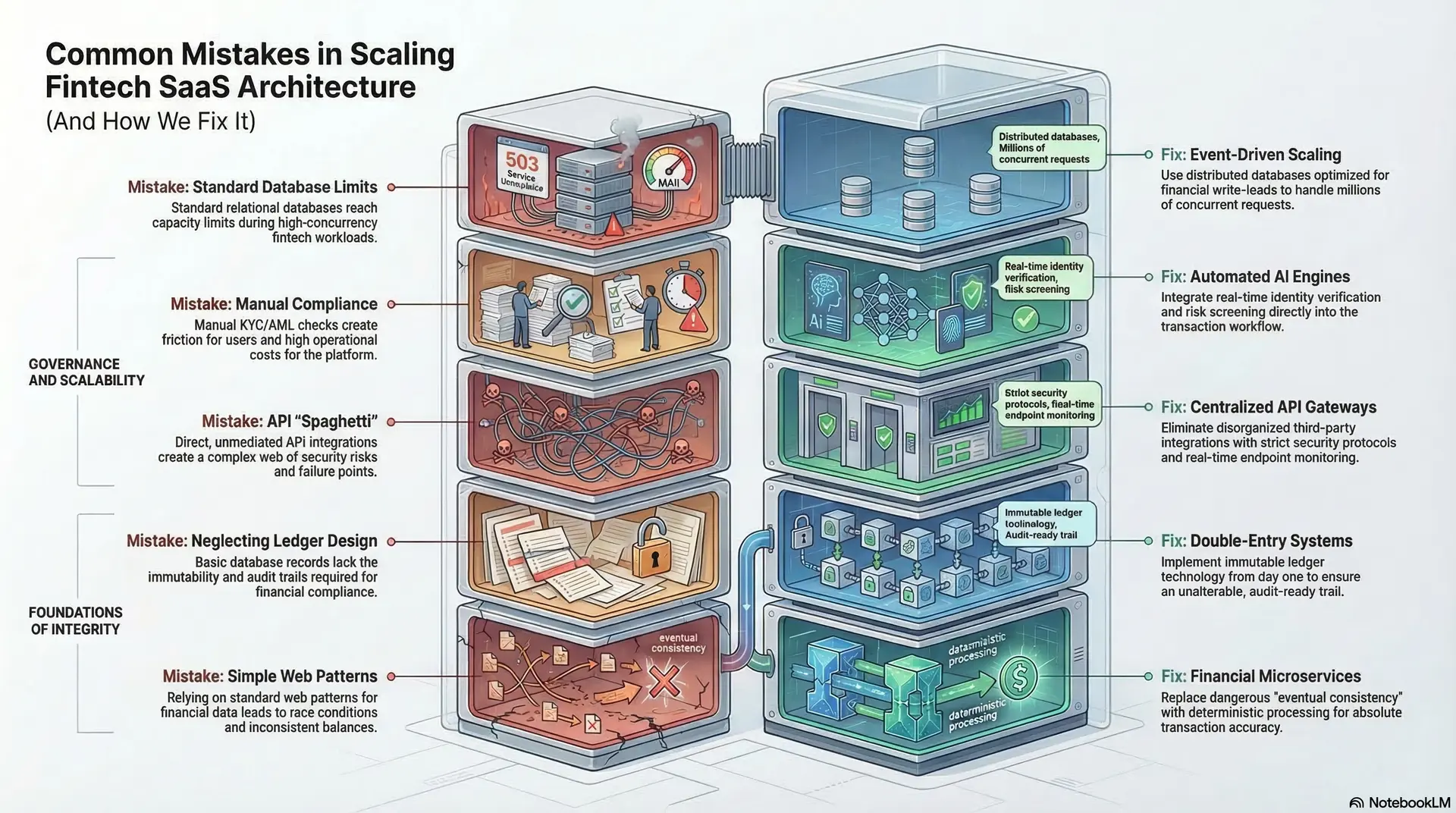
1. Treating Fintech SaaS as Simple Web Software
General web development patterns often fail when applied to complex financial systems. Most web applications prioritize “eventual consistency,” which is dangerous for a banking ledger. This lack of precision leads to reconciliation errors and significant data mismatches. Consequently, the business faces lost trust and potential legal liabilities.
How Intellivon Fixes It: We deploy purpose-built financial microservices designed for absolute data integrity. Our team implements deterministic processing to ensure that every transaction is recorded accurately. This provides the stability of a tier-one bank with the speed of a modern startup. Therefore, your platform remains reliable even under the most demanding conditions.
2. Ignoring Financial Ledger Design Early
Neglecting the core ledger architecture creates massive technical debt as the user base grows. Without an immutable record, the system becomes sluggish and prone to silent data corruption. As a result, the enterprise struggles to meet basic financial reporting requirements.
How Intellivon Fixes It: We build double-entry bookkeeping systems into the foundation of your SaaS architecture. Our immutable ledger technology provides a transparent and unalterable audit trail for every cent moved. This ensures that your platform is audit-ready from the very first transaction. Consequently, you can scale across borders without worrying about data integrity.
3. Poor API Governance Across Partners
Rapid expansion often leads to a disorganized mess of third-party integrations. Without central governance, each new partner adds a layer of complexity and potential security holes. This “spaghetti” integration style makes the platform difficult to maintain and very slow to update. Therefore, the enterprise loses its ability to innovate quickly in a competitive market.
How Intellivon Fixes It: We implement advanced API gateway solutions that centralize all partner communications. Our framework enforces strict security protocols and real-time performance monitoring for every endpoint. This allows you to scale your partner ecosystem without increasing your operational risk. As a result, you maintain total control over your digital borders.
4. Underestimating Compliance Infrastructure
Many leaders view compliance as a minor checkbox rather than a core architectural requirement. Failing to build automated compliance tools leads to manual bottlenecks as the business scales globally. This increases the likelihood of human error and heavy regulatory fines during audits. Therefore, the cost of compliance grows much faster than the actual revenue.
How Intellivon Fixes It: We integrate automated compliance engines directly into your transaction workflows. Our AI-driven tools handle identity verification and risk screening in real-time. This transforms compliance from a cost center into a seamless part of the user experience. Consequently, your business stays ahead of changing regulations without slowing down.
5. Weak Scalability Planning for Transactions
Failing to plan for sudden surges in transaction volume can lead to catastrophic system crashes. Many platforms use standard databases that cannot handle the write-heavy nature of financial workloads. When a market shift occurs, the system stalls and users lose access to their funds. As a result, the brand suffers significant and lasting reputational damage.
How Intellivon Fixes It: We utilize high-performance, distributed databases optimized for financial write-loads. Our architecture uses event-driven scaling to handle millions of concurrent requests without any latency. This ensures your platform remains fast and reliable during the most demanding market conditions. Therefore, you can confidently handle any level of transaction growth.
Avoiding these common mistakes is essential for building a market-leading financial platform. Partnering with experts who understand these nuances ensures your technology enables rather than hinders your growth.
Conclusion
Modern fintech success requires an architecture that balances rapid innovation with absolute security. Strategic leaders must move beyond legacy constraints to embrace modular, cloud-native systems. This transition ensures your enterprise remains agile in a competitive global market. Therefore, selecting the right technical foundation is the most critical step for long-term growth.
Intellivon provides the cutting-edge AI solutions and architectural expertise needed to build a future-proof financial ecosystem. We transform complex infrastructure challenges into scalable growth opportunities for your business.
Build an Enterprise Fintech SaaS Platform With Intellivon
At Intellivon, fintech SaaS platforms are engineered as enterprise financial infrastructure, not as simple cloud applications. Each platform is designed to deliver scalable financial services such as payments, lending, compliance automation, and financial data management through a secure, API-driven architecture.
Every solution is built for enterprise-scale financial operations. Fintech SaaS platforms must process high transaction volumes, integrate with multiple financial systems, and maintain strict governance across financial workflows. Our platforms are designed to ensure reliability, regulatory readiness, and long-term scalability for modern fintech ecosystems.
Why Partner With Intellivon?
- Governance-First Fintech Architecture: Platforms are built with embedded policy controls, audit logging systems, and role-based access frameworks to maintain oversight across financial services and operational workflows.
- API-Driven Financial Infrastructure: Our SaaS platforms expose core financial capabilities through secure APIs, enabling seamless integrations with banking systems, payment networks, and third-party fintech services.
- Multi-System Financial Integrations: Platforms integrate with core banking systems, payment processors, credit bureaus, identity verification providers, and financial data platforms without vendor lock-in.
- Scalable Cloud-Native Infrastructure: Architecture is designed to support growing transaction volumes, expanding client ecosystems, and global fintech deployments while maintaining platform stability.
- Compliance-Ready Financial Systems: We integrate KYC, KYB, AML monitoring, and regulatory reporting frameworks to ensure fintech SaaS platforms operate within global financial compliance standards.
- Secure Infrastructure for Financial Platforms: Platforms are built with strong encryption, secure authentication frameworks, and continuous monitoring systems to protect sensitive financial data.
Organizations exploring enterprise fintech SaaS platform development can work with Intellivon’s fintech specialists to design and deploy a secure, scalable, and integration-ready financial platform built for modern digital finance.
FAQs
Q1. What is fintech SaaS architecture?
A1. Fintech SaaS architecture refers to cloud-based financial platforms delivered as software services. These systems provide capabilities such as payments, lending, compliance, and financial data management through scalable, API-driven infrastructure.
Q2. How do fintech SaaS platforms scale transactions?
A2. Fintech SaaS platforms scale transactions using cloud infrastructure, microservices architecture, and event-driven processing. These technologies allow systems to handle increasing transaction volumes without disrupting platform performance.
Q3. What tech stack powers fintech SaaS platforms?
A3. Fintech SaaS platforms typically use cloud platforms, microservices frameworks, secure APIs, event-streaming systems, and scalable financial databases to support real-time financial operations.
Q4. How do fintech SaaS systems handle compliance?
A4. Fintech SaaS platforms integrate KYC, KYB verification, AML monitoring, regulatory reporting, and audit logging systems to ensure financial operations align with global compliance requirements.
Q5. How long does it take to build fintech SaaS?
A5. Building a fintech SaaS platform typically takes 9 to 18 months, depending on system complexity, integrations, compliance requirements, and platform scalability needs.