Fragmented care is one of the most costly challenges in healthcare today. When patients move from a primary care visit to a specialist or hospital stay, important information often gets delayed, repeated, or lost. The next care team is left without the full story, which slows down decisions, raises costs, and can lead to worse outcomes for patients. This lack of coordination leads to millions in extra costs each year, with avoidable readmissions, duplicate tests, and longer hospital stays.
Care coordination platforms are designed to fix this problem. They bring patient data together, simplify clinical routines, allow teams to communicate in real time, and give leaders the tools to make faster, better decisions. With the right setup, these platforms can reshape how an entire health system works.
At Intellivon, the focus is on helping large health organizations build strong, future-ready infrastructure. Experience shows what truly makes a difference and what simply adds more layers without real value. This blog explains how health systems improve care coordination in hospitals and how we build such platforms from scratch.
Why Care Coordination Fails in Health Systems Today
Current legacy frameworks often fail to meet modern patient demands. These gaps erode care quality and financial stability. Care coordination platforms connect providers, payers, and care settings through unified digital workflows. They streamline referrals, scheduling, and data sharing in real time.
As a result, health systems improve care continuity, support value-based models, and manage chronic conditions more effectively across the entire patient journey.
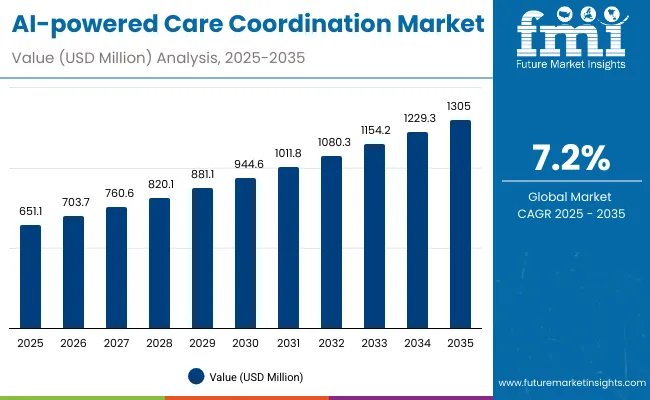
As a result, providers, payers, and digital health systems are investing more in coordinated, data-driven care delivery.
1. Fragmented EHRs limit care visibility
Electronic Health Records usually function as digital filing cabinets. They were not built for real-time collaboration. Consequently, data often stays trapped in departmental silos. This lack of transparency means clinicians make decisions using incomplete histories.
For an enterprise, this gap is a strategic liability. Specifically, leaders cannot optimize resources without a unified patient view. Furthermore, a fractured “source of truth” forces staff to hunt for data. This burden reduces the number of patients a facility can treat. Therefore, visibility is the first step toward clinical efficiency.
2. Disconnected care settings create delays
Recovery depends on smooth transitions between the hospital and home. However, these settings use different communication protocols. For example, a surgeon might issue instructions that a home nurse never sees. This friction creates a “dead zone” in the care cycle.
These delays are massive operational bottlenecks. In addition, communication breakdowns lengthen discharge cycles. This slows down bed turnover. Investors should see this “hand-off” problem as a high-value opportunity. Platforms that bridge these gaps turn delays into predictable workflows.
3. Manual workflows increase clinical risk
Many systems still rely on faxes and manual data entry. This reliance on human memory is a recipe for error. Specifically, one missed phone call can lead to a major clinical mistake. In a high-stakes environment, manual processes represent unmanaged risk.
Automation is the only logical way to mitigate these hazards. By using intelligent triggers, a system ensures no protocol is ignored. Furthermore, this shift reduces the cognitive load on clinicians. Therefore, they can focus on patients instead of paperwork. Reducing risk through technology is essential for any scalable platform.
4. Readmissions reflect coordination breakdowns
High readmission rates signal a failed coordination strategy. When a patient returns within 30 days, the transition home likely failed. Consequently, regulatory bodies now penalize these systems. These costs stack up quickly and hit profit margins.
Analyzing readmission data shows exactly where the chain snapped. Usually, the issue is a lack of follow-up. Moreover, systems fail to reconcile medications after discharge. Strategic leaders see these rates as a signal to upgrade. Implementing real-time monitoring can flip this trend. By addressing these failures, enterprises move toward proactive care.
What Is a Care Coordination Platform?
A care coordination platform is a centralized digital layer. It synchronizes data across every medical touchpoint. Specifically, it connects disparate health systems into one unified workflow. This technology moves beyond simple record-keeping. It actively manages the patient journey in real-time. Consequently, clinicians gain a high-definition view of every care transition.
Furthermore, these platforms automate the administrative burden. They use intelligent triggers to alert teams of critical changes. For example, a platform can flag a missed post-operative follow-up instantly. This proactive approach eliminates the traditional “dead zones” in healthcare. Therefore, it transforms fragmented care into a seamless, high-velocity operation.
Role of Real-Time Data in Care Delivery
Real-time data changes how care teams make decisions. Instead of reacting to outdated information, clinicians can act on current patient status, care progress, and operational signals.
As a result, health systems move from delayed coordination to proactive, continuous care management.
1. Enabling Immediate Clinical Decision-Making
Real-time data gives clinicians instant access to patient vitals, lab results, and care updates. This reduces dependency on manual communication and delayed reporting. Therefore, care teams can make faster, more accurate decisions at critical moments.
2. Improving Visibility Across Care Teams
Care coordination often breaks down due to a lack of shared visibility. Real-time data ensures that all stakeholders see the same patient information at the same time. As a result, providers, specialists, and care managers stay aligned throughout the patient journey.
3. Supporting Proactive Care Interventions
With continuous data streams, systems can detect early signs of deterioration or care gaps. Alerts and triggers notify teams before issues escalate. This allows health systems to intervene early and prevent complications or readmissions.
4. Reducing Delays in Care Transitions
Transitions between care settings are high-risk points. Real-time updates ensure discharge status, referrals, and follow-ups are immediately visible. As a result, patients move smoothly across care settings without unnecessary delays.
5. Enhancing Operational Coordination
Beyond clinical care, real-time data improves operational efficiency. Bed availability, staffing, and resource allocation can be monitored continuously. This helps hospitals optimize workflows while maintaining care quality.
Real-time data transforms care coordination from reactive to proactive. By enabling faster decisions, shared visibility, and early interventions, health systems improve both clinical outcomes and operational efficiency.
How Health Platforms Improve Care Coordination
Successful platforms convert fragmented data into a strategic asset. They replace silos with a fluid information stream. Consequently, every stakeholder operates from the same playbook. This alignment is critical for enterprise efficiency.
1. Unified patient data across care settings
A platform acts like a universal translator for medical records. It pulls files from different doctors and labs at the same time. Therefore, everyone sees the full medical history instantly.
This prevents doctors from ordering the same test twice. Furthermore, it ensures that specialists get primary care notes without any delay. This clear view is the backbone of a modern health business.
2. Real-time care plan visibility for teams
Old-fashioned care plans on paper become outdated very quickly. Modern platforms solve this by hosting live, digital plans. Every team member sees updates as they happen in real-time.
Specifically, if a therapist changes a goal, the doctor knows immediately. This constant sync keeps the entire staff focused on the same result. Essentially, it removes the guesswork from managing complex patient cases.
3. Closed-loop referral and follow-up systems
Many patient referrals get lost in a “black hole” of paperwork. A coordination platform creates a closed-loop system to track them. It follows a referral from the first order to the final report.
Consequently, the system flags any patient who fails to book an appointment. This visibility ensures that no one falls through the cracks. For an investor, this means better patient loyalty and higher revenue.
4. Automated workflows for care transitions
Moving a patient between facilities is always a high-risk moment. Automation simplifies this by starting specific tasks at exactly the right time. For example, the system sends discharge papers to the next clinic automatically.
In addition, it can schedule follow-up calls based on a patient’s specific risk level. These workflows take the boring paperwork off the nurses’ plates. Therefore, they can focus more on the actual patients.
5. SDOH integration into care decisions
Medical treatment is only one part of a person’s health journey. Social factors, like housing or food access, also play a huge role. Advanced platforms include this data in the daily clinical workflow.
Consequently, a social worker gets an alert if a patient has no ride to the clinic. Solving these problems early prevents expensive trips to the emergency room. This total approach is vital for any long-term health strategy.
Using these digital tools transforms how a health system functions day-to-day. It moves the focus from filing papers to delivering better results for everyone.
Step-by-Step Care Coordination Improvement Journey
Transforming a health system requires a deliberate, phased approach to digital adoption. Most organizations fail because they try to solve every problem at once. Consequently, a staged roadmap ensures that each layer of technology builds on a solid foundation. This progression turns a fragmented network into a high-performance clinical engine.
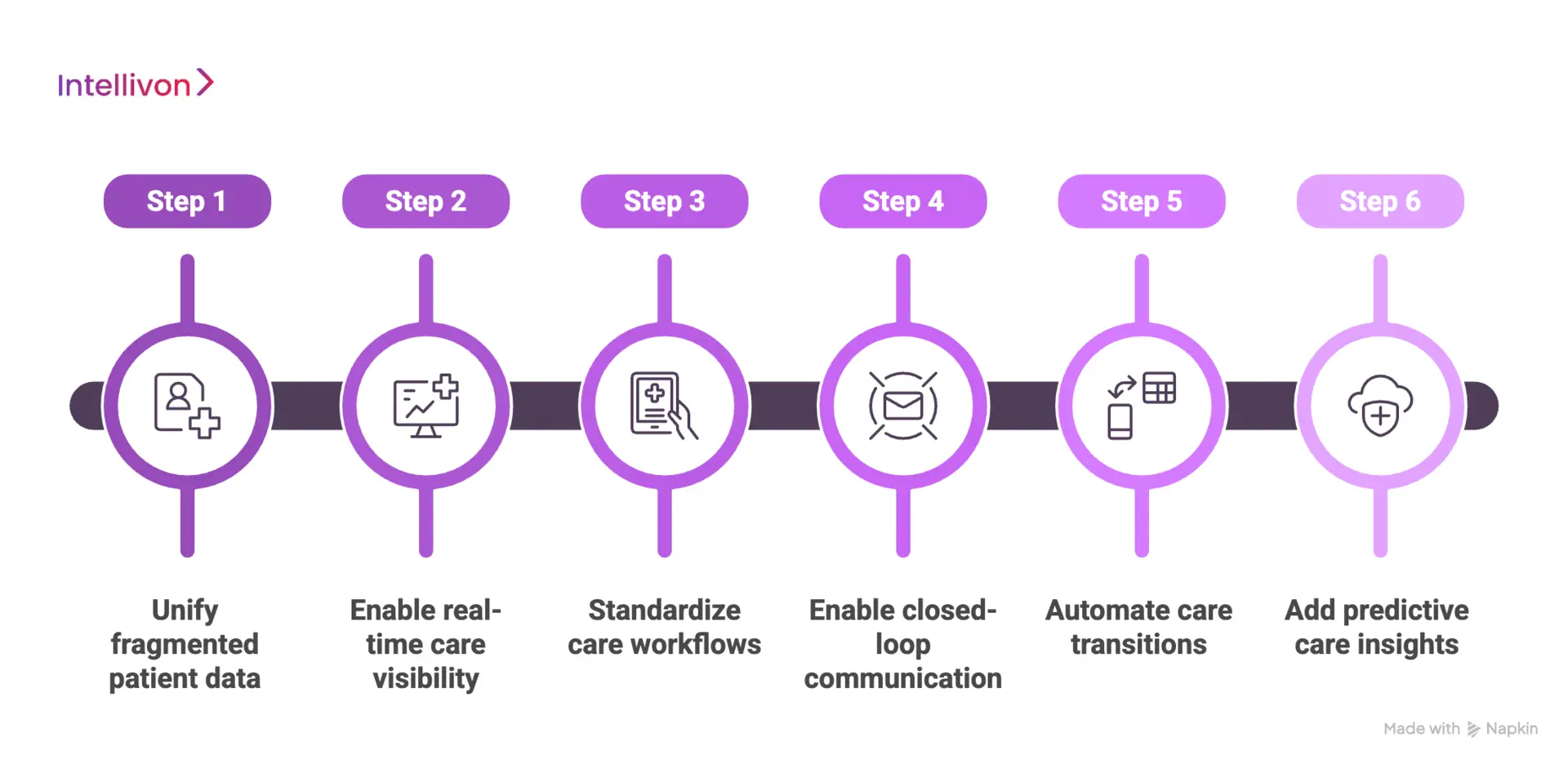
Step 1: Unify fragmented patient data
The first objective is to break down the existing data silos. You must integrate various EHR systems into a single accessible layer. Therefore, clinicians no longer have to log into multiple portals for one patient.
This step creates a “longitudinal” record that follows the patient everywhere. Furthermore, clean data is the fuel for every future automation. Without this unified base, any advanced tool will produce unreliable results.
Step 2: Enable real-time care visibility
Once the data is unified, you must make it visible in real-time. Specifically, every member of the care team needs to see the same dashboard. This transparency eliminates the need for constant status update meetings.
If a patient is admitted to the ER, the primary doctor should know instantly. In addition, this visibility allows for immediate resource adjustments. It essentially turns a reactive system into a live, breathing network.
Step 3: Standardize care workflows
Variability in care is a major driver of unnecessary costs. You must define and digitize standard protocols for common medical conditions. Consequently, every patient receives the same high level of care regardless of the facility.
These digital pathways guide the staff through the best clinical practices. Furthermore, standardization makes it easier to train new employees. It ensures that the “gold standard” of care is the default for the entire enterprise.
Step 4: Enable closed-loop communication
Communication often breaks down during patient referrals or specialist hand-offs. You must implement a system where every message requires a digital “handshake.” For example, a specialist must confirm they received the referral and the patient’s data.
This closed-loop approach prevents patients from being lost in the system. Moreover, it creates a digital audit trail for compliance and safety. Therefore, accountability becomes a built-in feature of the daily workflow.
Step 5: Automate care transitions
Moving a patient from a hospital to a home setting is the most vulnerable phase. You should automate the administrative tasks that trigger these moves. Specifically, let the system handle the transfer of records and the scheduling of follow-up visits.
This reduces the chance of human error during a high-stress discharge. Furthermore, automation ensures that home health providers have the data they need before the patient arrives. This creates a safer experience for the patient and a more efficient process for the hospital.
Step 6: Add predictive care insights
The final stage involves using AI to stay ahead of patient needs. Once your data is structured, you can use models to predict who might be readmitted. Consequently, your team can intervene before a crisis occurs.
For instance, the system might flag a patient who shows signs of rising blood pressure at home. This move from “sick care” to “preventative care” is where the highest ROI lives. It positions your organization as a leader in modern, data-driven medicine.
Following this roadmap allows an enterprise to scale without losing control of quality. It moves the organization away from manual chaos and toward a future of precision and efficiency.
Measurable Impact on Health System Operations
Investing in a coordination platform delivers clear, data-driven results for the entire enterprise. These systems move beyond theory by providing tangible improvements to the daily bottom line.
Consequently, leaders can see exactly how digital transformation pays for itself through efficiency. This section highlights the real-world gains that modern platforms achieve.
1. Reduction in hospital readmissions
Lowering readmission rates is one of the fastest ways to protect hospital margins. Specifically, coordination platforms help teams monitor high-risk patients after they leave the building.
Studies show that structured follow-up programs can reduce 30-day readmissions by up to 25%. Therefore, hospitals avoid the heavy financial penalties set by regulatory bodies. This shift ensures that the first treatment is the only treatment needed.
2. Faster discharge planning workflows
Manual discharge planning often keeps patients in beds longer than necessary. A digital platform automates the checklists and paperwork required for a safe exit. Consequently, some health systems have seen a 15% to 20% improvement in discharge speed.
This efficiency frees up beds for new emergency admissions immediately. Furthermore, it reduces the “boarding” time in the ER, which improves the flow of the entire hospital.
3. Improved referral completion rates
In many systems, nearly 40% of patient referrals are never actually completed. This “leakage” represents a massive loss of potential revenue and a risk to patient health. A coordination platform tracks every referral until the patient is seen by the specialist.
Specifically, automated reminders can boost appointment attendance by over 30%. Therefore, the health system keeps more patients within its own network of care.
4. Better utilization of clinical resources
Nurses often spend up to 35% of their shift on administrative tasks instead of patient care. Automation takes these repetitive duties off their schedule. Consequently, clinical staff can focus their expertise where it matters most.
This optimization reduces the need for expensive contract labor or overtime pay. In addition, it lowers staff burnout rates, which saves the organization money on hiring and training.
5. Higher patient satisfaction scores
Patients feel more secure when their care team communicates effectively. When transitions are smooth, “Hospital Consumer Assessment of Healthcare Providers and Systems” (HCAHPS) scores tend to rise.
Specifically, clear discharge instructions and quick follow-ups lead to much higher satisfaction ratings. Better scores often lead to higher reimbursement rates from insurance providers. Furthermore, a happy patient is far more likely to recommend the facility to others.
These metrics prove that better coordination is not just a clinical goal. It is a fundamental requirement for a profitable and sustainable health enterprise.
Key Features of Enterprise Care Coordination Platforms
To move beyond basic record-keeping, a platform must offer specific high-performance tools. These features transform a passive database into an active clinical partner. Consequently, they allow your staff to focus on high-value patient interactions.
This section breaks down the essential components that drive ROI in a modern health system.
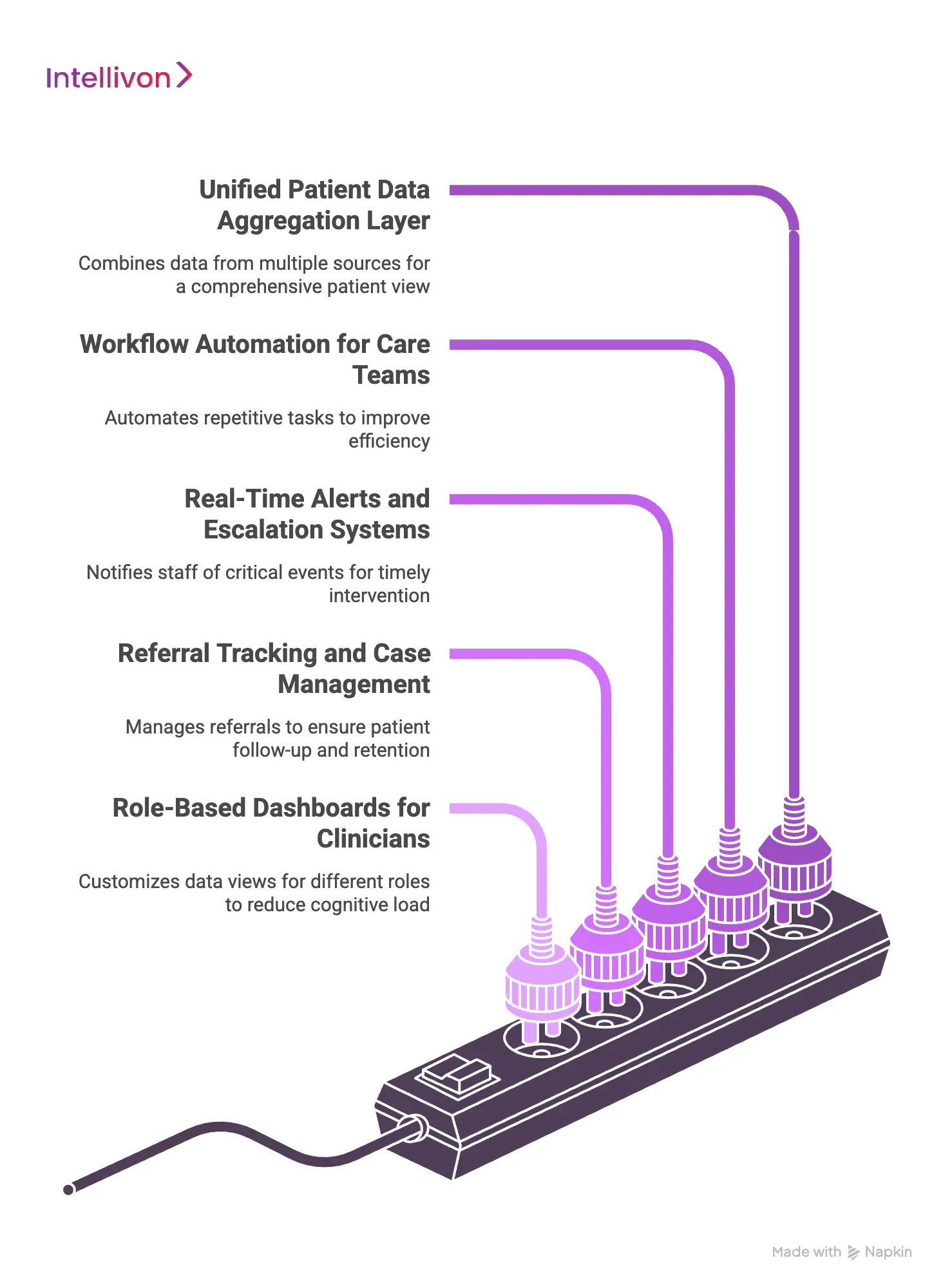
1. Unified patient data aggregation layer
The foundation of any platform is its ability to pull data from every source. This layer aggregates information from labs, pharmacies, and imaging centers simultaneously. Therefore, the clinician sees a single, longitudinal view of the patient’s history.
This prevents the need for manual data reconciliation between different departments. Furthermore, it ensures that every decision is backed by the most recent clinical evidence.
2. Workflow automation for care teams
Manual task management is a primary cause of burnout and inefficiency. An enterprise platform uses intelligent logic to automate repetitive administrative duties. For example, it can automatically assign a social worker to a high-risk discharge case.
This removes the “thinking time” usually required to route tasks manually. In addition, automation ensures that no step in a clinical protocol is missed. Essentially, it builds a safety net into the daily operations of the hospital.
3. Real-time alerts and escalation systems
Information is only valuable if it reaches the right person at the right time. Modern platforms feature real-time alert systems that trigger based on specific clinical events. Specifically, if a patient’s vitals drop outside a safe range, the bedside nurse and the specialist are notified instantly.
If the alert is not acknowledged, the system automatically escalates it to the next available supervisor. This proactive communication prevents minor issues from turning into major medical emergencies.
4. Referral tracking and case management
Managing referrals is often where health systems lose the most revenue. A robust platform tracks every referral from the moment the order is placed. Consequently, the system can send automated reminders to patients who haven’t booked their follow-up.
It also provides case managers with a bird’s-eye view of all active transitions. This level of oversight ensures that patients stay within your network for their entire recovery. Therefore, it stabilizes revenue while improving long-term health outcomes.
5. Role-based dashboards for clinicians
A surgeon needs different information than a floor nurse or a billing officer. Role-based dashboards filter the massive stream of data into relevant, actionable insights. This customization reduces the cognitive load on each staff member.
Specifically, a cardiologist sees heart-related metrics first, while a case manager sees discharge barriers. Furthermore, these dashboards allow leaders to monitor departmental performance at a glance. It turns raw data into a strategic management tool.
Integration with EHR and external systems
True coordination requires a platform that talks to every other piece of software. Specifically, it must feature bi-directional integration with your existing EHR. This means that data updated in the platform flows back into the permanent record automatically.
In addition, it should connect with external systems like home health portals or community social services. This “plug-and-play” capability is what makes a platform truly scalable across a large enterprise.
These features work together to create a unified clinical environment. They move the organization away from manual tracking and toward a future of automated precision.
Building Longitudinal Patient Record Systems
A longitudinal record is the definitive history of a patient’s health journey. It moves beyond the snapshot provided by a single hospital visit.
Consequently, these systems allow providers to see patterns that they might otherwise miss. This continuous view is the primary engine for high-quality care coordination.
1. Aggregating data across multiple systems
Most patients receive care from several different organizations over time. Therefore, a coordination platform must pull data from various EHR brands and lab systems. This aggregation layer acts as a central hub for medical information.
Specifically, it uses standardized protocols like FHIR to ensure that different machines can talk to each other. Furthermore, it cleans and organizes the data so that it is actually useful to a doctor. This unified base is the first step toward a true enterprise health network.
2. Structuring patient timelines and history
Raw data is difficult to read without a clear, chronological structure. A longitudinal system organizes every event into a visual timeline. Consequently, a specialist can see exactly how a patient’s condition has evolved over five years.
This history provides the context needed to make safer clinical decisions. In addition, it helps identify “frequent fliers” who may need more intensive social support. Therefore, a well-structured timeline turns data into a powerful diagnostic tool.
3. Handling unstructured clinical data
A large portion of a patient’s story is hidden in “unstructured” formats like faxed notes or PDFs. Modern platforms use AI to scan these documents and extract key medical facts. Specifically, they can identify a change in medication hidden deep within a discharge summary.
This capability ensures that no critical piece of information is left behind in a digital folder. Furthermore, it saves clinical staff from hours of manual data entry. It essentially makes the “invisible” parts of a medical record visible and searchable.
4. Ensuring real-time data synchronization
Data that is even an hour old can be dangerous in an emergency. Therefore, a coordination platform must sync in real-time across every connected site. If a patient receives a new prescription at a pharmacy, the primary doctor should see it immediately.
These low-latency updates prevent conflicting treatments and duplicate testing. Moreover, it ensures that the care team is always working with the most current facts. This level of synchronization is what separates a modern platform from a legacy database.
Building these systems allows an organization to move away from guesswork. It creates a reliable, high-definition map of every patient’s health.
Integrating SDOH Into Care Coordination
Clinical care only accounts for a fraction of a patient’s well-being. To manage population health, a platform must look beyond the hospital walls.
Consequently, integrating Social Determinants of Health (SDOH) into daily workflows is a vital business strategy. This approach turns a narrow medical view into a complete, human-centered operation.
1. Why SDOH impacts clinical outcomes
A patient cannot recover if they lack stable housing or nutritious food. Social factors drive up to 80% of health outcomes. Therefore, a perfect surgery can still fail in a high-stress environment.
Specifically, food insecurity often leads to poorly managed chronic diseases and frequent ER visits. Furthermore, a lack of transportation causes many missed follow-up appointments. Addressing these root causes is essential for reducing long-term costs.
2. Capturing social and behavioral data
Most health systems lack a formal way to record a patient’s social needs. Modern platforms solve this by using standardized screening tools during intake. Consequently, data on housing and literacy levels become part of the permanent record.
Specifically, using “Z-codes” allows this information to be tracked across the entire population. This structured data is the first step toward a precise intervention strategy. Furthermore, it helps administrators see which social gaps hit their budget hardest.
3. Connecting patients to community resources
Identifying a problem is not enough; the system must provide a solution. An enterprise platform should link directly to a network of local non-profits. For example, the system can automatically send a referral to a local food bank.
This closed-loop connection ensures that the “social prescription” is actually filled. In addition, it provides a digital audit trail to verify that needs were met. Therefore, the hospital becomes a hub for total community wellness.
4. Using SDOH for risk-based care planning
Advanced analytics combine clinical data with social data to predict future crises. Specifically, a patient with heart failure and no transportation has a higher readmission risk. Consequently, your team can prioritize these individuals for home-based care or remote monitoring.
This risk-based approach ensures that expensive resources go where they are needed most. Furthermore, it allows for a personalized care plan that a patient can actually follow. This strategic focus is the hallmark of a high-performing health system.
Integrating these social insights creates a more resilient and effective care model. It allows an organization to treat the whole person rather than just the symptoms.
Improving care coordination is no longer just a clinical goal. It is a vital business strategy for any health system that wants to grow. Transitioning from manual, fragmented processes to an automated platform protects your revenue and your staff. Specifically, it allows you to move away from reactive “firefighting” and toward a proactive, scalable model of care.
Governance and Compliance in Care Coordination Platforms
Data security is the foundation of trust in any health enterprise. A coordination platform must protect sensitive patient records while allowing for seamless team collaboration.
Consequently, robust governance ensures that innovation never compromises legal or ethical standards.
1. HIPAA-compliant data architecture
A platform must be built with security as a primary feature, not an afterthought. Specifically, all patient data must be encrypted both at rest and during transmission. This architecture prevents unauthorized access during complex data exchanges between facilities.
Furthermore, it ensures the organization meets the strict HIPAA standards for digital health records. Therefore, a secure build protects the health system from massive regulatory fines.
2. Role-based access and audit trails
Not every staff member needs access to every part of a patient’s file. Role-based access ensures that employees only see the data required for their specific job. Specifically, a billing clerk does not need to see sensitive mental health notes.
In addition, the system must maintain an immutable audit trail for every single data interaction. Consequently, administrators can track who viewed a record and when. This accountability is vital for maintaining internal discipline and legal safety.
3. Clinical governance frameworks
Technology must align with established medical protocols to be effective. A clinical governance framework defines the rules for how data is used in treatment decisions.
Specifically, it ensures that automated alerts follow the latest evidence-based guidelines. Furthermore, a dedicated committee should regularly review these digital pathways for accuracy.
This oversight ensures that the platform supports the expert judgment of doctors. Therefore, it maintains the highest standard of patient safety.
4. Data privacy across integrated systems
Sharing data with external partners like home health agencies introduces new privacy risks. You must ensure that every connected system follows the same high security standards. Specifically, a “Business Associate Agreement” (BAA) should govern every external digital handshake.
This prevents data leaks when information moves beyond the hospital’s own firewall. Moreover, it ensures that the patient’s right to privacy is respected at every stage of their recovery.
Strict governance turns a potential liability into a core strength for the enterprise. It allows for rapid scaling while keeping patient data and organizational reputation perfectly safe.
How We Build Care Coordination Platforms For Enterprises
Building a high-performance platform requires a balance of clinical logic and technical scale. At Intellivon, we follow a rigorous engineering process to ensure every deployment is secure, scalable, and intuitive.
Consequently, our roadmap moves from initial data strategy to full-scale AI integration. This structured approach minimizes deployment risks for large-scale health systems.
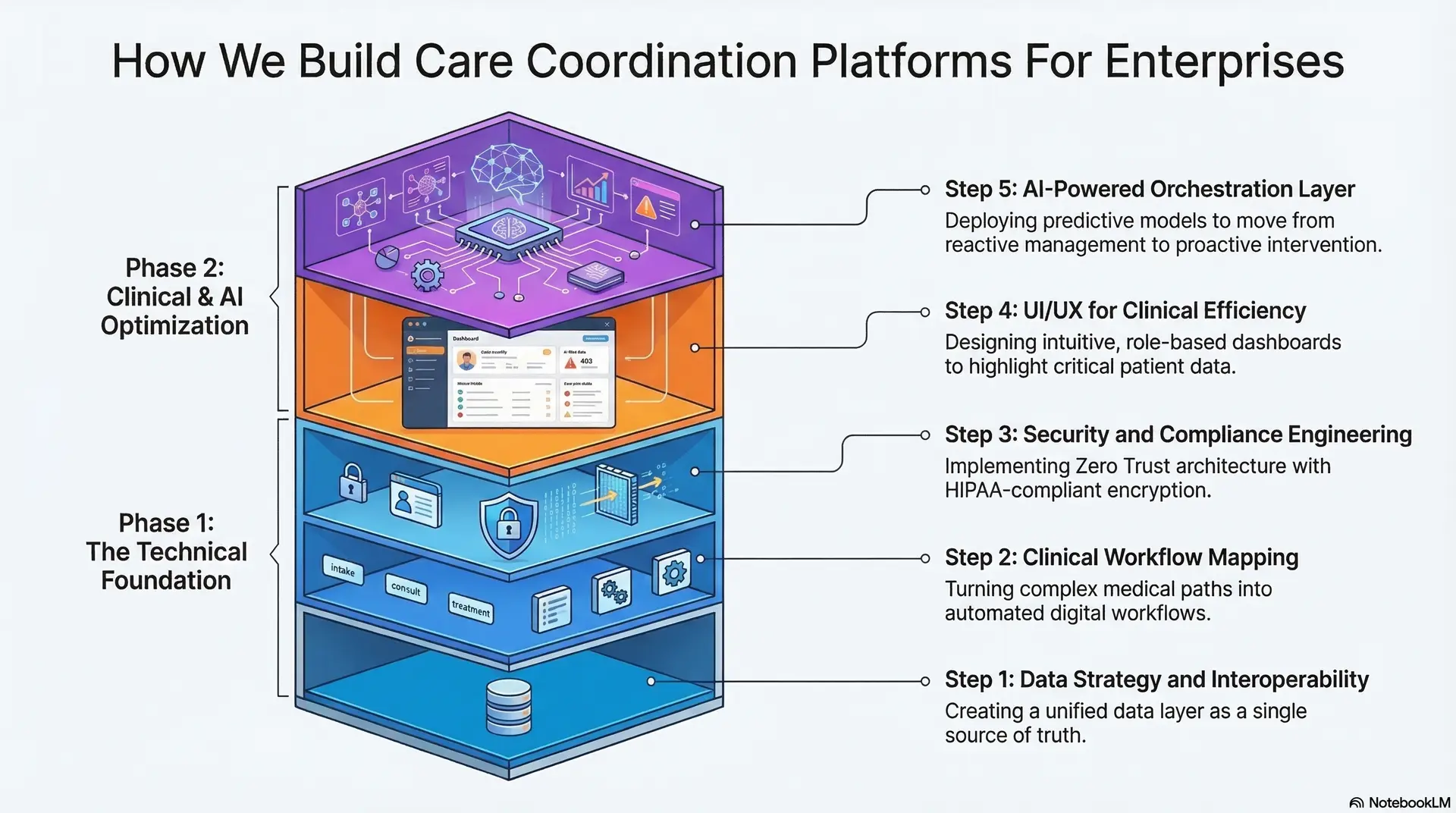
Step 1: Data Strategy and Interoperability
We begin by mapping your existing data landscape and identifying fragmented silos. Specifically, we establish secure connections to your EHR, laboratory, and pharmacy systems.
Therefore, we create a unified data layer that serves as a single source of truth. This phase ensures that information flows freely but safely across your entire enterprise.
Step 2: Clinical Workflow Mapping
Our team works with your clinicians to digitize their most successful manual protocols. Consequently, we turn complex medical paths into automated digital workflows.
This step reduces the administrative burden on your nursing and administrative staff. Furthermore, it ensures that your “gold standard” of care is applied consistently to every patient.
Step 3: Security and Compliance Engineering
We implement a Zero Trust architecture to protect sensitive patient information at every level. Specifically, we build in HIPAA-compliant encryption and granular role-based access controls.
This ensures that your organization remains fully compliant with federal and local regulations. In addition, we establish immutable audit trails to provide total transparency for your compliance officers.
Step 4: UI/UX for Clinical Efficiency
A platform is only effective if your staff actually finds it easy to use. We design intuitive, role-based dashboards that highlight the most critical patient data first.
Therefore, doctors and nurses spend less time clicking and more time caring for patients. This focus on usability is a key driver of high adoption rates across the enterprise.
Step 5: AI-Powered Orchestration Layer
In the final phase, we deploy intelligent triggers and predictive models. Specifically, we use AI to identify high-risk patients and automate the necessary care transitions.
This moves your health system from reactive management to proactive intervention. Furthermore, it allows you to scale your services without a linear increase in administrative costs.
Our structured roadmap ensures that your digital transformation is both safe and effective. We turn complex technical requirements into a streamlined, high-performance clinical engine.
Conclusion
Improving care coordination is no longer just a clinical goal. It is a vital business strategy for any health system that wants to grow. Transitioning from manual, fragmented processes to an automated platform protects your revenue and your staff.
Specifically, it allows you to move away from reactive “firefighting” and toward a proactive, scalable model of care. Consequently, this digital shift ensures long-term operational excellence and superior patient outcomes.
Build a Care Coordination Platform With Intellivon
At Intellivon, care coordination platforms are engineered as enterprise healthcare infrastructure, not as workflow tools layered onto disconnected systems. The objective is to create a unified coordination environment that connects clinical, operational, and patient data across the entire care continuum.
Our engineering teams focus on building interoperable, cloud-native architectures that integrate seamlessly with existing EHRs and healthcare systems. Therefore, organizations can scale coordination efforts across multiple facilities, providers, and care settings without compromising data consistency or performance.
Why Partner With Intellivon?
- Governance-First Healthcare Architecture: Platforms are built with embedded access controls, audit trails, and compliance frameworks. This ensures secure, accountable coordination across clinical and administrative workflows.
- Interoperable Data Integration Systems: We design integration layers that unify fragmented EHR data into a single longitudinal patient record. As a result, care teams have access to consistent, real-time patient information.
- Workflow Automation for Care Teams: Our platforms automate referrals, follow-ups, and care transitions. This reduces manual coordination effort and improves care continuity across providers.
- Scalable Infrastructure for Health Networks: Solutions are built to support large health systems with distributed care environments. Therefore, organizations can expand coordination programs without operational bottlenecks.
If your health system is looking to improve care coordination, reduce readmissions, and enable real-time clinical visibility, Intellivon can help you build a platform tailored to your operational needs. Talk to our team to design a scalable, interoperable care coordination platform for your health system.
FAQs
Q1. What is a care coordination platform
A1. A care coordination platform is a healthcare system that connects patient data, providers, and workflows across care settings. It enables real-time visibility, referral tracking, and coordinated care delivery.
Q2. How do platforms improve patient outcomes
A2. They reduce care gaps by enabling real-time data sharing, automated workflows, and timely interventions. As a result, patients receive faster, more consistent, and better-coordinated care.
Q3. What systems need integration
A3. Platforms typically integrate with EHRs, lab systems, pharmacy systems, billing systems, and external care networks. This ensures complete patient visibility across the care journey.
Q4. How long does it take to build
A4. A care coordination platform usually takes 6 to 12 months to build, depending on integration complexity, features, and scale of deployment.
Q5. What technologies power these platforms
A5. These platforms use cloud infrastructure, APIs, FHIR/HL7 standards, data analytics, and AI models. Together, they enable interoperability, automation, and real-time decision support.