Healthcare will undergo a significant change in 2026 because standard AI is shifting into Agentic AI. Medical apps with agentic AI will continuously monitor patients, predict risks early, and support actions before diseases progress, operations fail, or clinical delays happen. This move from reactive care to predictive, system-level intelligence is already changing how care will be delivered this year.
However, most healthcare AI projects still struggle to scale. This is not due to underperforming models, but because the systems surrounding them are not designed for regulation, trust, or practical use. ROI only appears when AI is part of core systems, secured against changing cyber risks, able to work with legacy systems, and managed as part of the overall technology framework, rather than as separate tools. As AI grows in medical settings, ensuring data privacy, regulatory compliance, and auditability is essential.
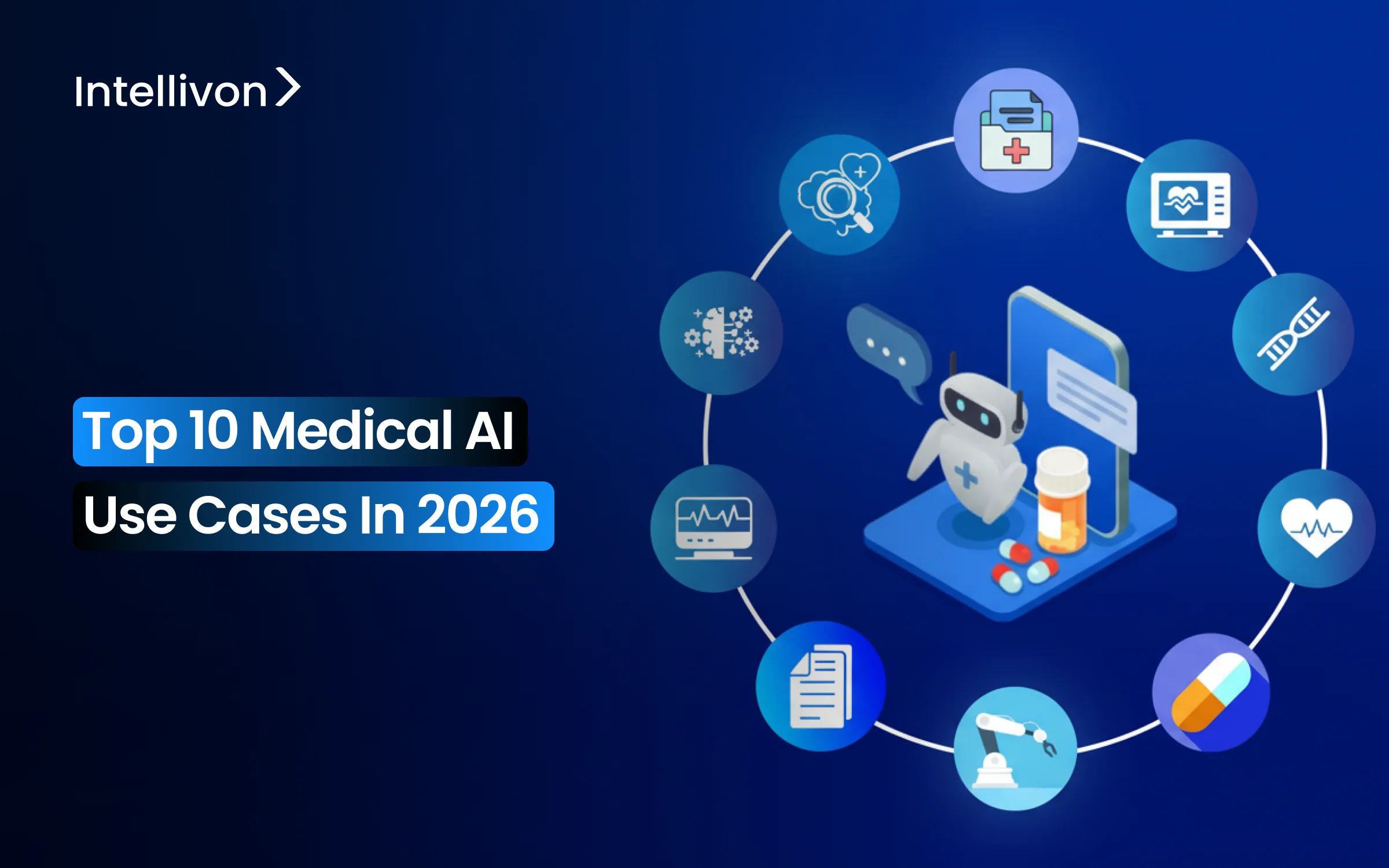
By 2026, successful enterprises will view medical AI as regulated infrastructure. At Intellivon, we assist enterprises in building medical AI platforms that adapt to these changes, scale safely, and stay ahead of regulatory and operational adjustments. In this blog, we will discuss the top 10 medical AI use cases for 2026 and demonstrate how we can help you develop these apps to achieve measurable ROI.
Agentic AI Is Reshaping The Medical Industry
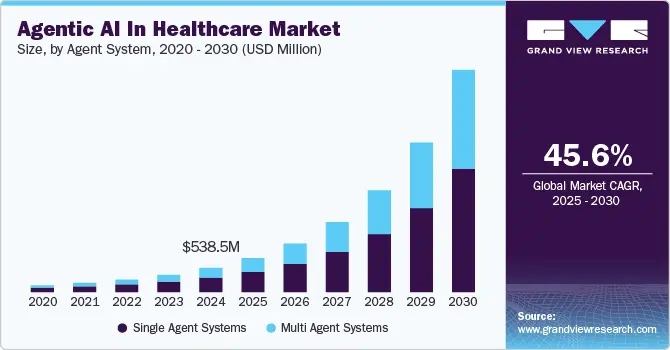
Agentic AI is moving the needle in healthcare applications faster than we thought. The global market was valued at around USD 540 million in 2024 and is expected to grow rapidly and reach USD 4.96 billion by 2030.
This growth is driven by a clear shift toward automation in areas that drain time and resources. In addition, healthcare organizations are under pressure to control costs while improving care quality. Agentic systems help by handling repetitive tasks and supporting faster, more accurate decisions. As a result, many enterprises now see agentic AI as a practical way to improve efficiency without compromising patient outcomes.
Key Applications of Agentic AI in Healthcare
- Clinical decision support: Autonomous agents analyze EHR data in real time to support diagnosis, risk scoring, and treatment planning, especially in oncology and complex care pathways.
- Patient monitoring: Virtual agents track wearable and remote monitoring data around the clock. This enables earlier intervention for chronic conditions such as COPD and heart disease.
- Drug discovery and R&D acceleration: AI systems simulate molecular behavior, identify promising compounds, and repurpose existing drugs. As a result, research timelines shorten significantly.
- Administrative automation: Agentic AI manages scheduling, revenue cycle workflows, claims review, and fraud detection. This reduces manual effort and operational delays.
Major Players Driving Agentic AI Adoption
Several large technology and healthcare companies are shaping this space. These include NVIDIA, Microsoft, GE HealthCare, Oracle, IBM, Google Health (DeepMind), Siemens Healthineers, and Philips. In addition, newer players such as Hippocratic AI and Thoughtful AI are focused specifically on healthcare workflows and automation.
Recent developments signal strong momentum. Microsoft introduced Dragon Copilot to support clinical and administrative workflows. Meanwhile, NVIDIA has expanded partnerships focused on genomics and healthcare AI infrastructure. Together, these moves show that agentic AI is becoming embedded in enterprise healthcare platforms.
Key Challenges Slowing Large-Scale Adoption
Despite rapid progress, adoption remains complex. Regulatory requirements such as HIPAA, the EU AI Act, and FDA approval processes demand transparency, auditability, and human oversight for high-risk use cases. These expectations increase design and compliance effort from the start.
Ethical concerns also play a role. Questions around accountability, bias, and data privacy often delay deployment. In addition, interoperability across legacy systems remains a major hurdle. However, governance frameworks are evolving to balance safety with innovation, making enterprise adoption more feasible over time.
What Qualifies as a “Real” Medical AI Use Case in 2026
In 2026, real medical AI use cases are regulated, deployed at scale, embedded into workflows, governed by human oversight, and able to show measurable enterprise impact.
Healthcare organizations are surrounded by AI ideas. However, only a small fraction translates into systems that operate reliably in real medical environments. By 2026, enterprises judge medical AI less by innovation claims and more by execution readiness.
The difference lies in how use cases are designed, governed, and integrated from day one.
1. Clear Regulatory Pathway
A real medical AI use case must align early with regulatory expectations. This includes FDA pathways, MDR requirements, and region-specific healthcare regulations. This is because enterprises cannot risk deploying AI that creates future compliance exposure.
2. Proven Deployment at Enterprise Scale
Pilot success is no longer enough. Use cases that qualify for 2026 already operate across hospitals, payers, or large patient populations. They perform consistently under real workloads, not controlled environments. Stability, uptime, and reliability matter more than novelty.
2. Embedded Into Clinical or Operational Workflows
AI delivers value only when people actually use it. Standalone tools often fail because they interrupt existing processes. Real use cases integrate directly into EHRs, imaging systems, and operational platforms. As a result, adoption feels natural rather than forced.
3. Human-in-the-Loop Accountability
Medical AI cannot function without clear ownership. Viable use cases support decisions but do not replace responsibility. Clinicians and operators remain accountable for outcomes. This approach protects patient safety and aligns with emerging regulatory expectations.
Measurable Clinical and Financial Impact
Finally, impact must be visible. Enterprises expect results within months and not years. This may appear as faster diagnoses, reduced workload, lower costs, or improved outcomes. Broad efficiency claims without evidence no longer pass scrutiny.
These criteria separate scalable medical AI from experimental ideas. Every use case discussed next meets these conditions, which is why they are positioned to deliver real value by 2026.
At-a-Glance View: Medical AI Use Cases and What Powers Them
Before going deeper into each use case, it helps to step back and look at the landscape as a whole. Enterprise leaders often need a quick way to understand where AI fits, what components are involved, and which parts of the organization are affected.
The table below offers that clarity. It shows how each medical AI use case connects to core systems, data, and governance layers.
| Medical AI Use Case | Primary Function | Core Data Sources | Key Enterprise Components |
| Acute imaging triage | Prioritize critical findings | CT, MRI, PACS | Imaging AI, workflow orchestration, and audit logs |
| Early warning systems | Predict patient deterioration | Vitals, labs, EHR | Predictive models, alert routing, clinical oversight |
| Sepsis risk prediction | Identify sepsis risk early | Labs, EHR, vitals | Regulated AI models, EHR integration, and monitoring |
| Ambient clinical documentation | Reduce documentation burden | Audio, EHR | Speech AI, NLP, clinical validation |
| Diabetic retinopathy screening | Detect referable disease | Fundus images | Autonomous AI, quality controls, reporting |
| Breast imaging support | Assist the radiologist’s decisions | Mammograms, PACS | Computer vision, risk scoring, workflow tools |
| ECG-based cardiac screening | Flag cardiac risk patterns | ECG signals | Signal processing AI, clinical review |
| Remote patient monitoring | Enable proactive intervention | Wearables, devices | Data ingestion, risk stratification, escalation |
| Medication safety AI | Prevent adverse drug events | Prescriptions, EHR | Decision support, rules engines, alerts |
| Administrative AI automation | Reduce operational friction | Claims, documents | NLP, workflow automation, compliance checks |
This overview highlights that each use case relies on data pipelines, workflow integration, governance, and accountability. As you review the individual use cases next, keep this structure in mind.
It explains why some AI initiatives scale smoothly while others stall before delivering real enterprise value.
Top 10 Medical AI Use Cases Enterprises Will Deploy In 2026
By 2026, medical AI use cases that survive at scale solve real operational problems, operate within regulatory constraints, integrate into workflows, and deliver measurable outcomes with clear human accountability.
The following use cases reflect where enterprise healthcare is actually investing. Each one addresses a pressing operational gap, applies AI with defined limits, and aligns with how care, risk, and compliance are managed today.
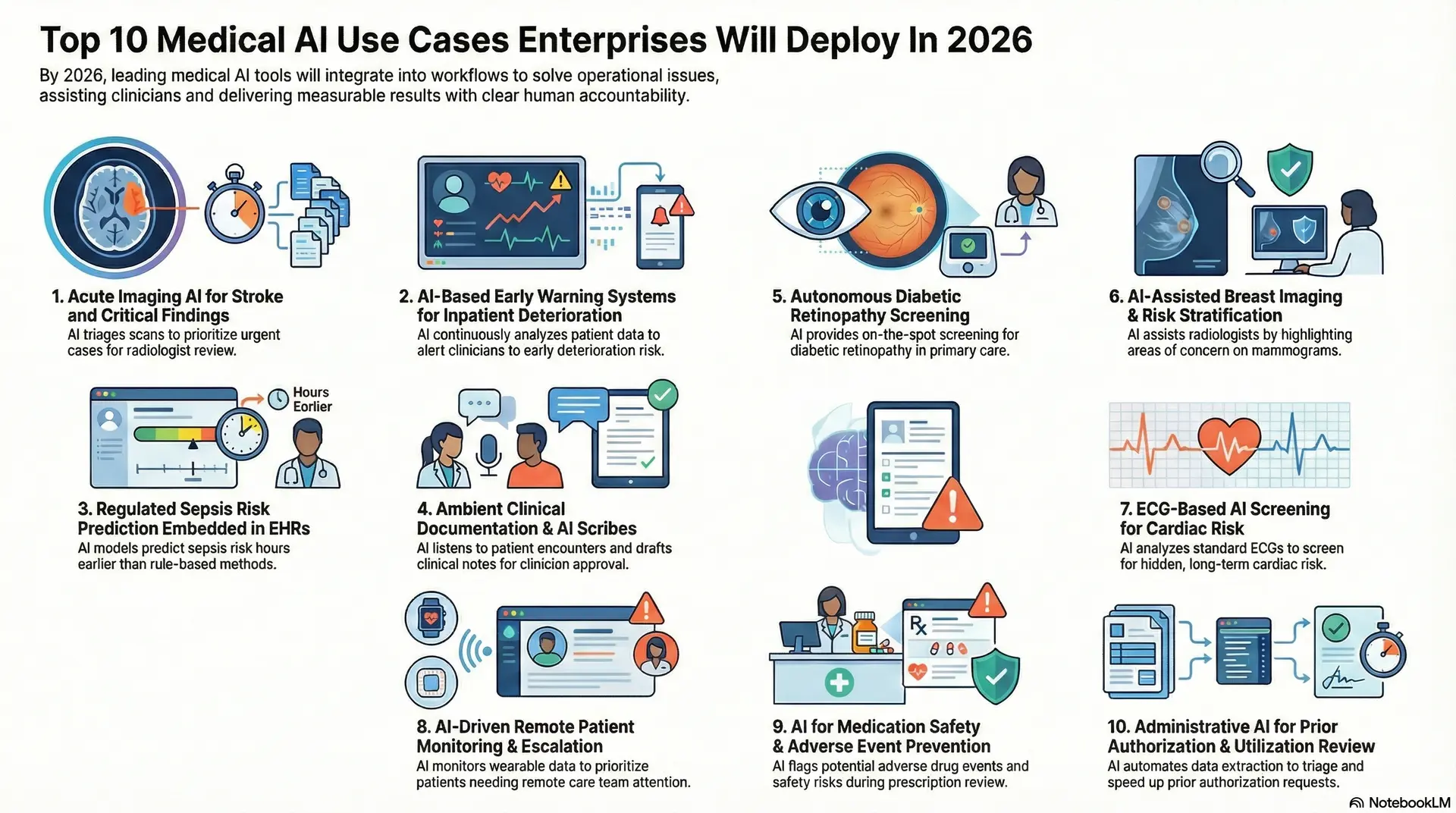
1. Acute Imaging AI for Stroke and Critical Findings
Acute imaging is one of the most time-sensitive pressure points in hospital operations. Rising scan volumes and uneven specialist availability still cause delays, especially during peak hours and night shifts. These delays directly affect outcomes in stroke and other critical conditions.
How AI Fits in the Workflow
AI functions as a triage layer within PACS systems. It analyzes scans as they arrive, flags suspected critical findings, and reorders worklists so urgent cases are reviewed first. It does not diagnose or trigger treatment.
Why This Is Real by 2026
FDA-cleared imaging triage tools are already in use across health systems. Adoption continues because faster prioritization improves response times without disrupting clinical accountability.
2. AI-Based Early Warning Systems for Inpatient Deterioration
Patient deterioration often goes unnoticed until escalation becomes urgent. Traditional early warning scores rely on static thresholds and periodic checks, which struggle to keep pace with complex inpatient environments and staffing pressure.
How AI Fits in the Workflow
AI continuously analyzes vitals, labs, and EHR data in the background to detect early risk patterns. When deterioration risk increases, alerts surface within existing clinical dashboards to guide attention and prioritization. AI does not direct care.
Why This Is Real by 2026
Hospitals are increasingly deploying AI-driven early warning systems to reduce ICU transfers and unexpected events. Clinical validation and EHR integration make this a scalable, operational necessity rather than an experimental tool.
3. Regulated Sepsis Risk Prediction Embedded in EHRs
Sepsis is difficult to detect early and remains a leading cause of inpatient mortality. Traditional screening relies on static rules that often miss early risk signals hidden in routine clinical data.
How AI Fits in the Workflow
AI models continuously analyze vitals, lab results, and patient history directly inside the EHR. When risk patterns emerge, alerts surface within existing clinician dashboards. AI does not recommend treatment or override judgment.
Why This Is Real by 2026
FDA-authorized sepsis prediction tools already exist and are being deployed in hospitals. Clinical studies show AI can identify sepsis hours earlier than rule-based methods, supporting safer and faster intervention
4. Ambient Clinical Documentation & AI Scribes
Clinicians spend hours each day on documentation, taking time away from direct patient care. Traditional methods of typing or dictation still leave clinicians with notes to finish after hours, contributing to burnout.
How AI Fits in the Workflow
Ambient AI tools listen during clinical encounters and draft structured notes that appear inside the EHR for clinician review. The clinician edits and approves the draft before it becomes part of the medical record. AI assists, but clinicians retain control.
Why This Is Real by 2026
Ambient AI scribes are already in use in multiple health systems and have been shown to reduce documentation burden and after-hours charting while improving clinician focus on patients. Early real-world evidence shows clinician satisfaction and time savings with these tools.
Clinician oversight remains essential. AI does not finalise documentation without review, preserving accuracy and accountability.
5. Autonomous Diabetic Retinopathy Screening
Diabetic retinopathy is a leading cause of preventable vision loss, yet screening rates remain inconsistent. Access to specialists is limited, especially in primary and community care settings, leading to delayed detection.
How AI Fits in the Workflow
Autonomous AI systems analyze retinal images captured in clinics and immediately assess whether referable diabetic retinopathy is present. The result is generated at the point of care, without waiting for a specialist review. AI performs screening only, not diagnosis or treatment planning.
Why This Is Real by 2026
This use case already has FDA authorization and reimbursement pathways. Autonomous diabetic retinopathy systems such as IDx-DR have demonstrated safe, effective screening in primary care, expanding access at scale.
Clinical referrals and treatment decisions remain clinician-led.
6. AI-Assisted Breast Imaging & Risk Stratification
Breast imaging volumes continue to grow, while radiology teams face staffing pressure and rising diagnostic complexity. Variability in interpretation also increases recall rates and follow-up burden.
How AI Fits in the Workflow
AI supports radiologists by analyzing mammograms to highlight areas of concern and assist with risk stratification. These insights appear directly within existing imaging workflows. AI does not make diagnostic decisions or replace clinical judgment.
Why This Is Real by 2026
Multiple FDA-cleared AI tools for breast imaging are already in clinical use. Studies show AI can improve detection support and workflow efficiency when used alongside radiologists. Adoption continues as systems integrate AI into routine screening programs.
Radiologists remain responsible for diagnosis and patient communication.
7. ECG-Based AI Screening for Cardiac Risk
Cardiac conditions often progress silently until symptoms become severe. Standard ECG interpretation focuses on present abnormalities, which limits early risk detection in large patient populations.
How AI Fits in the Workflow
AI analyzes ECG signals to identify subtle patterns associated with future cardiac risk, such as atrial fibrillation or reduced ejection fraction. These insights appear within existing ECG and EHR workflows to prompt further evaluation. AI flags risk only and does not provide diagnoses.
Why This Is Real by 2026
FDA-cleared AI algorithms for ECG-based risk detection already exist, supported by large validation studies. Health systems are adopting them because ECGs are low-cost, widely available, and easy to scale across populations.
Clinicians remain responsible for diagnosis and care decisions.
8. AI-Driven Remote Patient Monitoring & Escalation
Managing chronic patients at scale remains difficult as care shifts beyond hospital walls. Manual monitoring of device data often leads to delayed intervention and clinician overload.
How AI Fits in the Workflow
AI analyzes continuous data from wearables and home devices to identify risk patterns and prioritize patients who need attention. Alerts surface within care team dashboards, guiding outreach and escalation. AI supports prioritization but does not initiate care actions.
Why This Is Real by 2026
Remote patient monitoring is already supported by reimbursement frameworks, and AI-driven risk stratification is increasingly layered on top to improve efficiency. Health systems deploy these models to reduce readmissions and manage chronic care more predictably.
Care teams remain responsible for intervention decisions.
9. AI for Medication Safety & Adverse Event Prevention
Adverse drug events remain a major cause of patient harm and avoidable costs. Manual medication review struggles to keep pace with complex regimens, polypharmacy, and fragmented patient histories.
How AI Fits in the Workflow
AI analyzes prescriptions, lab values, allergies, and historical EHR data to flag potential interactions and safety risks. These alerts appear within prescribing and pharmacy workflows to support review. AI does not approve or block medications.
Why This Is Real by 2026
Hospitals and payers are increasingly deploying AI-supported medication safety tools due to clear quality and cost incentives. Research shows predictive models can identify adverse drug event risk earlier than rule-based systems, supporting safer prescribing at scale.
However, final prescribing decisions remain clinician-led.
10. Administrative AI for Prior Authorization & Utilization Review
Prior authorization remains one of the most resource-intensive and frustrating processes in healthcare. Manual reviews delay care, increase administrative costs, and create friction between providers and payers.
How AI Fits in the Workflow
AI extracts relevant clinical and administrative data from EHRs and documents, then triages authorization requests based on predefined rules and risk signals. Requests are routed to human reviewers with supporting context. AI does not approve or deny care independently.
Why This Is Real by 2026
Payers and regulators are actively pushing for automation to reduce authorization burden. Policy reforms and pilot programs already encourage AI-supported utilization review to speed decisions and improve transparency.
Final decisions remain human-led and fully auditable.
Taken together, these use cases show where medical AI is delivering real enterprise value by 2026. These use cases set the foundation for building medical AI platforms that support growth, resilience, and long-term operational confidence.
How AI Actually Functions Across These Medical Use Cases
In enterprise healthcare, AI functions as a governed support layer that analyzes data continuously, surfaces priority signals, and enables faster human decisions without removing accountability.
Before looking at outcomes, it is important to understand how AI operates across these use cases. In real medical environments, AI is not autonomous decision-making software. Instead, it acts as an intelligence layer designed to handle scale, speed, and complexity while keeping humans in control.
1. AI Operates as a Continuous Signal Engine
AI systems ingest data from EHRs, imaging platforms, devices, and administrative systems. They analyze this data continuously, not at fixed intervals.
As a result, risk patterns and anomalies surface earlier than manual review allows. This is especially important when teams are stretched thin.
2. AI Outputs Are Intentionally Constrained
Across all use cases, AI outputs remain limited by design. These typically include:
- Risk scores or probability indicators
- Alerts or prioritization flags
- Draft documentation or summaries
- Workflow routing suggestions
AI does not diagnose, prescribe, approve care, or trigger irreversible actions. Therefore, control stays with clinicians and operators.
3. AI Is Embedded Into Existing Workflows
Adoption depends on familiarity. AI insights appear inside EHRs, PACS, care dashboards, and operational tools already in use.
Because of this, teams do not need to change how they work. They simply gain better visibility at the right moment.
4. Governance Runs Alongside Intelligence
Every system includes logging, monitoring, and audit trails. Human oversight remains mandatory, and model performance is tracked over time. This ensures safety, compliance, and reliability as systems scale.
Across these medical AI use cases, intelligence supports decisions rather than replacing them. This balance between automation and accountability is what makes enterprise adoption possible by 2026.
Real-World Platforms Implementing These Medical AI Use Cases
By 2026, enterprise healthcare platforms and apps will embed medical AI directly into clinical and operational workflows to deliver regulated, scalable intelligence in real care environments.
The examples below show how medical AI use cases are implemented through production-grade applications already in use.
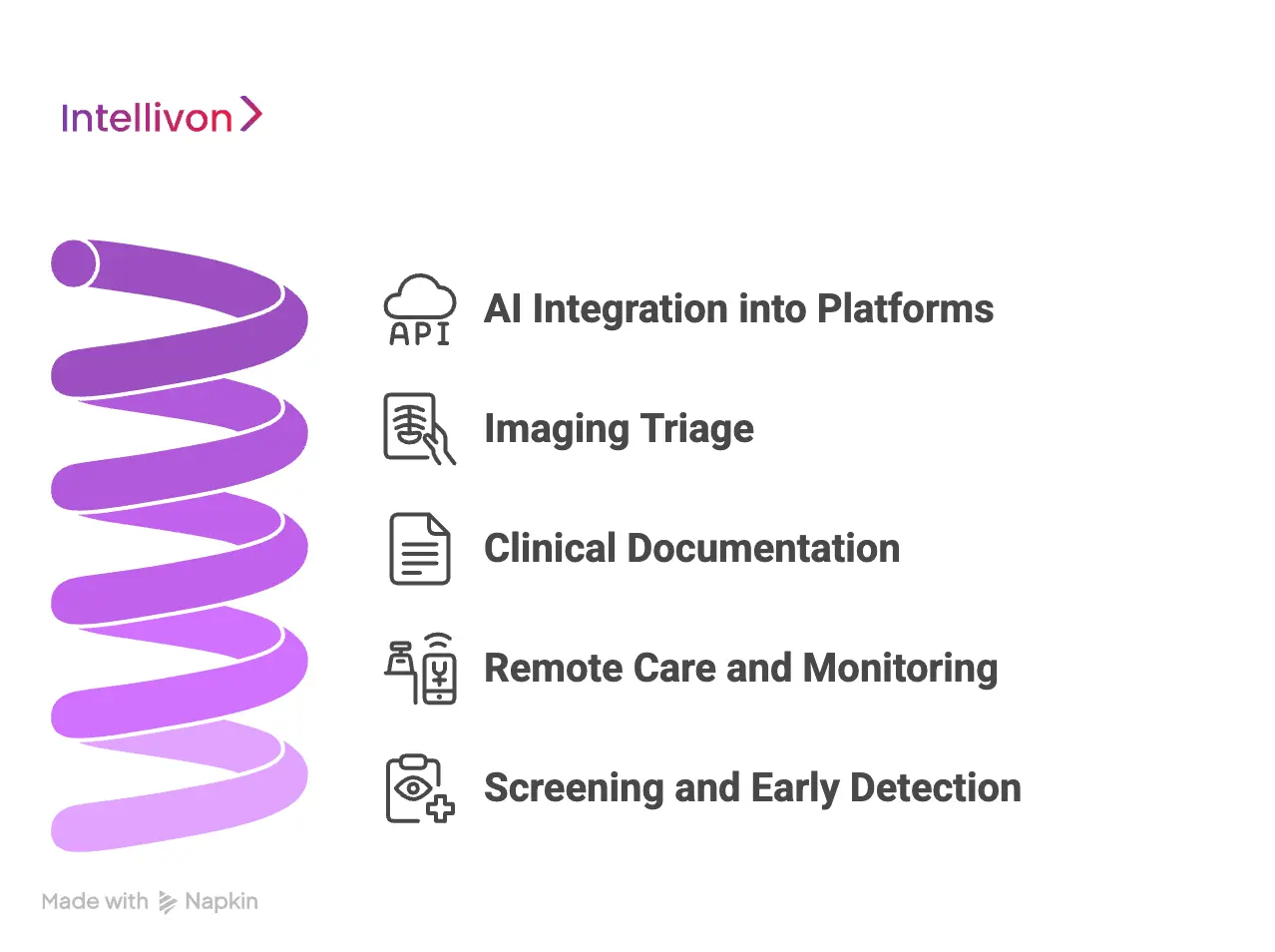
1. Imaging Triage Enterprise Platforms
Enterprise imaging platforms such as Viz.ai and Aidoc function as clinical workflow applications embedded within PACS environments.
They analyze scans as they enter imaging systems and flag suspected critical findings. As a result, urgent cases are prioritized faster without changing diagnostic ownership or clinical responsibility.
2. Clinical Documentation Enterprise Applications
Platforms like Microsoft Dragon Copilot and Sully.ai operate as enterprise documentation applications inside EHR workflows.
They generate draft notes from clinical conversations, which clinicians review and approve. These apps reduce documentation burden while preserving accuracy and accountability.
3. Remote Care and Monitoring Enterprise Platforms
Enterprise remote care platforms such as Current Health and Luscii use AI to analyze device and wearable data.
These apps support care teams by prioritizing outreach and escalation. They are used across hospital-at-home and chronic care programs at scale.
4. Screening and Early Detection Applications
Apps such as AIIMS MadhuNETrAI demonstrate how regulated AI screening tools operate in real clinical settings.
These enterprise apps expand access to early detection while routing follow-up care to clinicians.
These enterprise healthcare platforms and apps show how medical AI moves from concept to execution. Together, they reflect why medical AI in 2026 is defined by dependable enterprise adoption, not experimental apps.
Regulatory and Compliance Realities Shaping Medical AI in 2026
By 2026, medical AI platforms must meet strict regulatory, privacy, and governance requirements to operate safely, scale across regions, and earn trust from regulators and users.
As medical AI moves deeper into clinical and operational workflows, regulation becomes unavoidable. What once applied mainly to EHRs and health apps now applies directly to AI models, data pipelines, and decision-support systems.
In 2026, compliance is an ongoing operating requirement that shapes how medical AI platforms are designed, deployed, and scaled.
At-a-Glance: Key Regulatory Requirements for Medical AI Platforms
| Regulation / Framework | Region | What It Governs | Why It Matters for Medical AI |
| HIPAA | United States | Health data privacy and security | Protects patient data and access controls |
| FDA SaMD / AI-ML Guidance | United States | AI used as medical software | Defines approval, monitoring, and accountability |
| GDPR | European Union | Personal data protection | Controls consent, storage, and data rights |
| EU AI Act | European Union | Risk-based AI regulation | Classifies medical AI as high-risk |
| MDR (Medical Device Regulation) | European Union | Medical devices and software | Governs safety, validation, and post-market monitoring |
| ISO 13485 / ISO 62304 | Global | Quality and software lifecycle | Ensures controlled development and updates |
| Data Residency Laws | Global | Location of data storage | Affects cloud and cross-border deployments |
1. Patient Data Privacy and Security
Healthcare AI platforms must protect sensitive patient data at all times. Regulations such as HIPAA and GDPR require strict access control, encryption, audit logs, and breach reporting.
In addition, patients increasingly expect transparency around how their data is used. As a result, privacy-by-design is now a baseline requirement, not an enhancement.
2. Medical AI as Regulated Software
In many cases, medical AI qualifies as Software as a Medical Device. For instance, in the United States, the FDA expects defined intended use, clinical validation, and post-deployment monitoring.
In Europe, MDR imposes similar expectations. This means AI models cannot change freely without oversight, even after deployment.
3. Risk Classification and Human Oversight
Under the EU AI Act, most medical AI systems fall into the high-risk category. This requires explainability, documented risk management, and clear human oversight.
AI must support decisions and not replace them. Therefore, platforms must be designed with explicit accountability and escalation paths.
4. Continuous Monitoring and Auditability
Compliance does not end at approval. Regulators expect ongoing performance monitoring, bias detection, and audit readiness. Logs, version control, and model performance tracking are essential.
Without these, scaling AI across regions becomes difficult.
5. Cross-Border and Cloud Compliance
Medical AI platforms often operate across regions using cloud infrastructure. Data residency laws and regional regulations influence where data can be stored and processed.
Enterprises must design architectures that adapt to these constraints without fragmenting systems.
In 2026, regulatory compliance shapes every serious medical AI platform. Success depends on building AI systems that are secure, auditable, and governed from the start.
Challenges Enterprises Face When Deploying Medical AI Platforms
Most medical AI initiatives struggle at scale because workflows, governance, and ownership are not designed alongside intelligence.
Medical AI adoption usually begins with strong expectations. However, many programs slow down after initial pilots, not because the AI fails, but because real healthcare environments expose deeper gaps. These challenges tend to repeat across enterprises, regardless of geography or care model. Understanding them early makes the difference between stalled experiments and scalable platforms.
1. Fragmented Workflows and Low Adoption
Many AI systems are introduced as separate tools that sit outside core platforms such as EHRs, imaging systems, or care dashboards. As a result, teams must switch contexts or repeat work, which gradually reduces usage. Even accurate AI loses value when it interrupts daily routines. Over time, adoption fades quietly rather than failing loudly.
How Intellivon helps:
Intellivon embeds AI directly into existing enterprise workflows so insights appear where work already happens. This reduces friction and allows teams to use AI naturally as part of daily operations.
2. Unclear Accountability and Trust Gaps
When AI supports decisions, responsibility can become unclear across clinical and operational teams. Leaders often hesitate when ownership is not well defined, especially in regulated environments. Without trust, teams rely on AI defensively or ignore it altogether. This limits impact and slows organizational confidence.
How Intellivon helps:
We design platforms with clear human-in-the-loop controls and role-based access. Decisions remain owned by people, while AI provides support in a transparent and auditable way.
3. Regulatory and Compliance Complexity
Healthcare AI must operate within evolving regulatory frameworks that demand traceability, monitoring, and documentation. Many platforms treat compliance as an afterthought, which creates risk during audits or regional expansion. As a result, enterprises often pause growth to avoid exposure.
How Intellivon helps:
Intellivon follows a compliance-by-design approach, building governance, logging, and monitoring into the core architecture. This allows platforms to scale while remaining audit-ready
4. Scaling Beyond Pilots
Early pilots often perform well in controlled settings, but issues surface as usage grows. Performance can degrade, costs rise, and governance becomes manual. Without a scalable foundation, platforms struggle to move beyond limited deployments.
How Intellivon helps:
Our experts build modular, cloud-native platforms designed for phased expansion. Enterprises can scale AI use across teams and regions without rebuilding systems or increasing risk.
These challenges explain why many medical AI initiatives fail to reach full scale. Success requires platforms designed for real workflows, clear accountability, regulatory alignment, and long-term growth. With the right foundation, medical AI becomes a dependable infrastructure rather than a short-lived experiment.
How We Build Medical AI Platforms That Are 2026 Ready
A 2026-ready medical AI platform is built through a staged process that aligns data foundations, workflow integration, governance, security, validation, and scalable operations from day one.
Medical AI fails when teams treat it like a model deployment. Enterprises need a repeatable build process that survives audits, scale, and real-world workflows. At Intellivon, we follow a structured approach that keeps delivery practical while protecting long-term ownership. Each step reduces risk, and enterprises can move faster with confidence.
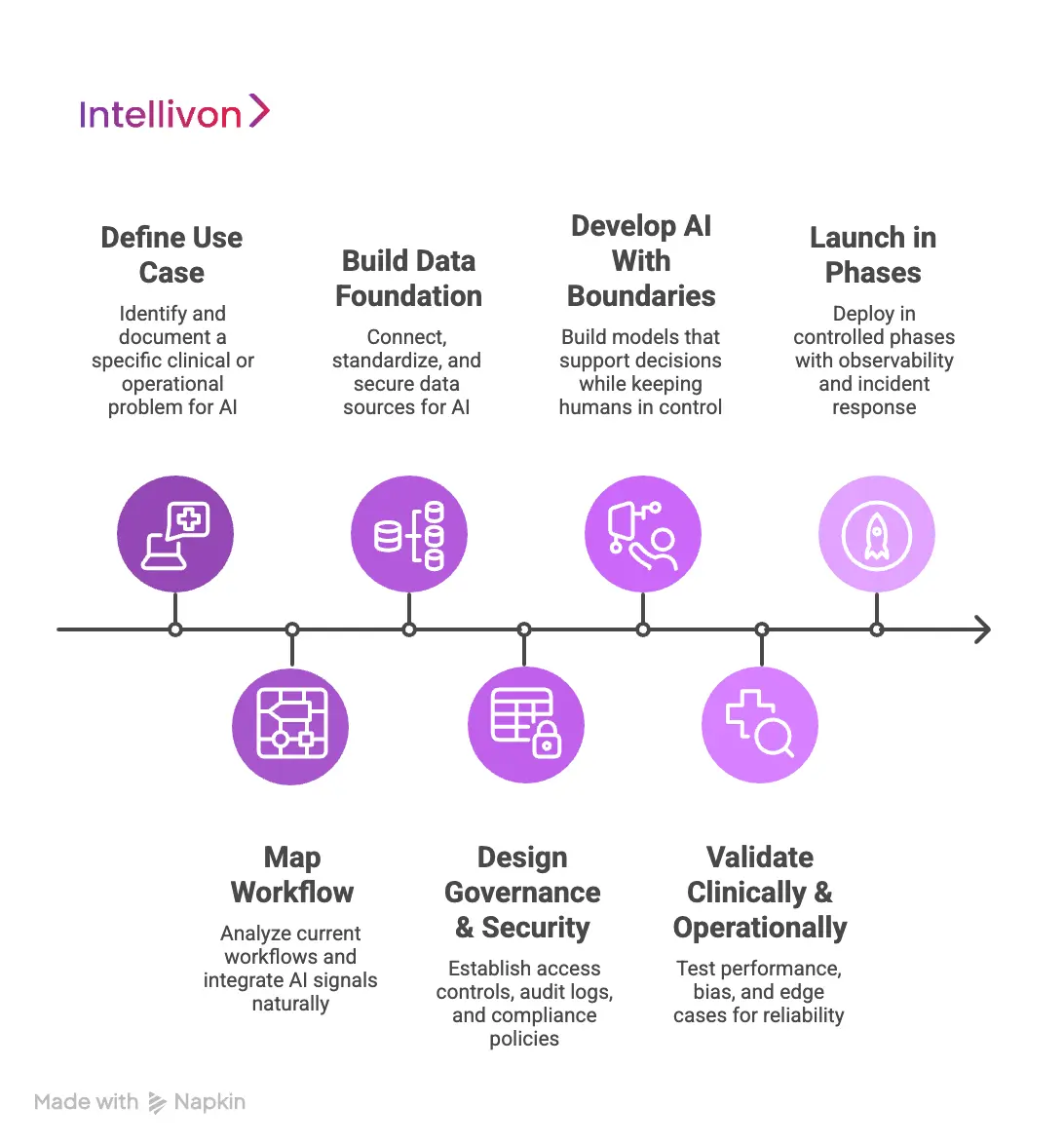
Step 1: Define the Use Case
We begin by narrowing the use case to a measurable operational or clinical problem. At the same time, we also define who uses it, where it sits in the workflow, and what decisions it can support.
In addition, we document what the system must not do. This prevents scope creep and sets clear accountability.
Step 2: Map the Workflow and Adoption Constraints
Next, we study the current workflow in detail, including handoffs, bottlenecks, and escalation paths. We identify where AI signals should appear so teams do not change how they work.
As a result, adoption becomes natural rather than forced. This is where most pilots fail, so we treat it as a core design step.
Step 3: Build the Data Foundation
We then connect the right data sources, such as EHRs, PACS, labs, devices, and claims systems. At the same time, we standardize data, enforce consent rules, and design for data quality and lineage.
In addition, we plan for interoperability so the platform can operate across sites and vendors. This creates a reliable base for any medical AI use case.
Step 4: Design Governance and Security Up Front
Before building models, we design governance. This includes role-based access, audit logs, encryption, and policy controls. We also define retention, residency, and data minimization rules based on region and deployment model.
Therefore, compliance becomes part of the platform, not a late-stage patch. This approach supports long-term regulatory alignment.
Step 5: Develop AI With Clear Boundaries
We build models that support decisions while keeping humans responsible. We define thresholds, escalation rules, and safe failure modes.
In addition, we ensure outputs are constrained, such as scores, alerts, or drafts, rather than autonomous actions. This improves trust and reduces operational risk.
Step 6: Validate Clinically and Operationally
We validate performance using clinical and operational metrics that matter to the business. At the same time, we also test for drift, bias, and edge cases, and we document results for audit readiness.
However, validation is not a one-time event. We plan to monitor and retrain rules early so the platform stays reliable after launch.
Step 7: Launch in Phases
Finally, we deploy in controlled phases, starting with the highest-value workflow areas. We set up observability, incident response, and change management so teams can operate the platform confidently.
In addition, we support continuous improvement based on real usage, not assumptions. This helps enterprises stay ahead as regulations, care models, and AI capabilities evolve.
A 2026-ready medical AI platform is not built by shipping a model and hoping adoption follows. It is built through disciplined workflow design, compliance-by-design governance, and scalable operations. Intellivon helps enterprises follow this path so medical AI becomes a reliable infrastructure that drives measurable ROI and long-term growth.
Conclusion
Healthcare is moving into a phase where medical AI must operate as dependable infrastructure rather than experimental technology. By 2026, enterprises that succeed will focus on systems that predict risk early, integrate naturally into workflows, and operate within clear regulatory boundaries. The value of medical AI will no longer be measured by novelty, but by stability, trust, and measurable impact.
Organizations that invest in governed, scalable platforms will unlock efficiency, improve outcomes, and reduce long-term risk. At Intellivon, we help enterprises build medical AI platforms designed for this reality, enabling growth, resilience, and confidence as healthcare continues to evolve.
Why Choose Intellivon To Build AI-Powered Medical Apps for 2026
At Intellivon, AI-powered medical apps are built as regulated healthcare platforms. Every architectural and delivery decision prioritizes clinical safety, data governance, and regulatory alignment. This ensures medical AI applications operate reliably across hospitals, payers, life sciences organizations, and digital health ecosystems, not just during early adoption.
As medical AI programs expand across care settings, populations, and regions, stability becomes non-negotiable. Organizations retain control over data, decisions, and accountability without introducing compliance risk, workflow disruption, or operational fragility.
Why Partner With Intellivon?
- Enterprise-grade medical AI architecture designed for regulated healthcare environments
- Proven delivery across clinical, operational, and population-scale healthcare platforms
- Compliance-by-design approach covering privacy, auditability, and regional regulations
- Secure, modular infrastructure supporting cloud, hybrid, and on-prem deployments
- Governed AI enablement with human oversight, monitoring, and lifecycle control
Book a strategy call to explore how Intellivon can help you build and scale AI-powered medical apps with confidence, control, and long-term enterprise value.
FAQs
Q1. What are the most important medical AI use cases in 2026?
A1. The most important medical AI use cases in 2026 focus on early risk prediction, workflow automation, and clinical decision support. These include imaging triage, sepsis prediction, remote patient monitoring, medication safety, and administrative automation. What makes them critical is their ability to scale safely within regulated healthcare environments.
Q2. How is medical AI different from AI features in healthcare apps?
A2. Medical AI refers to regulated intelligence systems embedded into clinical and operational workflows, not surface-level app features. These systems operate inside EHRs, imaging platforms, and care delivery tools. They support decisions while maintaining human accountability and regulatory compliance.
Q3. Is medical AI regulated in 2026?
A3. Yes, medical AI is highly regulated in 2026. Depending on region and use case, platforms must comply with FDA Software as a Medical Device requirements, HIPAA, GDPR, the EU AI Act, and medical device regulations. Compliance, auditability, and human oversight are mandatory for enterprise adoption.
Q4. What challenges do enterprises face when deploying medical AI platforms?
A4. Enterprises often struggle with workflow integration, unclear accountability, regulatory complexity, and scaling beyond pilots. AI models may work in isolation, but fail when governance and operations are not designed together. Successful deployment requires treating medical AI as long-term infrastructure.
Q5. How can enterprises build AI-powered medical apps that are future-ready?
A5. Enterprises should start with clearly defined use cases, embed AI into existing workflows, and design governance from the beginning. Platforms must support privacy, auditability, and human-in-the-loop controls. Partnering with an experienced enterprise AI provider helps reduce risk and accelerate adoption.