Key Takeaways:
-
Enterprise stablecoin wallets are governed platforms requiring custody, signing, transaction policies, and compliance screening.
-
MPC, HSM, multisig, or hybrid key management should match transaction volume and institutional governance requirements.
-
Architecture must include ledger reconciliation, compliance screening, and enterprise integrations alongside custody controls.
-
Custom platforms cost $70,000 to $300,000 with MVPs in 12 to 16 weeks and complex deployments in 24 to 40 weeks.
-
How Intellivon builds the orchestration and policy layer around institutional custody, compliance, and treasury systems.
An enterprise stablecoin wallet is the system that holds, moves, and authorizes company funds on a blockchain, without a single person controlling the private key. For a CISO, that authorization design is the real risk. A wallet built around one key, one person, is one phishing email away from a total loss.
However, choosing MPC or multi-sig alone doesn’t close that gap. The wallet also needs role-based governance, so a CFO can approve, a trader can execute, and an auditor can only view. Over $3.4 billion was lost to crypto exploits in 2025, and the largest breach, worth $1.5 billion, came from governance failures, not broken cryptography, according to a 2026 custody architecture analysis. As a result, enterprises that build role-based controls into the wallet from day one typically avoid that exposure entirely within the first year.
Wallet security usually gets framed as a cryptography question, MPC versus multi-sig, when the real failure point is almost always governance. This blog covers key management, custody architecture, multi-chain support, and compliance in that order, starting with how MPC and multi-sig actually work together.

What Is an Enterprise Stablecoin Wallet Platform?
An enterprise stablecoin wallet platform is clear, secure software that lets large companies hold, send, receive, and track digital dollars safely. Unlike a personal crypto app on a smartphone, this platform gives corporate finance teams total control over their cash flow.
Specifically, it combines multi-person approval policies, real-time compliance checks, and direct links to accounting software like SAP or Oracle.
How an Enterprise Wallet Differs From a Consumer Wallet
To understand the difference, imagine a personal checking account versus a corporate bank account with hundreds of employees.
At the same time, a consumer wallet gives one person full control over their funds, whereas an enterprise platform creates a safe, step-by-step workflow for entire finance departments.
| Operational Feature | Consumer Stablecoin Wallet | Enterprise Stablecoin Wallet Platform |
| User Access & Governance | One person holds the single key to the account. | Managers assign custom roles and permissions to different team members. |
| Transaction Approvals | Payments happen instantly with one tap and no oversight. | Payments require formal sign-off from multiple managers before sending. |
| Spending Controls | Users can send their entire balance at any time. | Companies set daily spending caps and per-payment limits. |
| Address Security | Users manually copy and paste recipient addresses. | System automatically blocks unapproved addresses to stop mistakes. |
| Compliance & Monitoring | No built-in checks or anti-fraud protection. | Software automatically screens every trade for fraud, sanctions, and money laundering. |
| Auditability & Reporting | Basic transaction history with no business context. | Complete records track which employee approved each payment for easy tax reporting. |
| Entity Management | Funds stay in one single bucket. | Finance teams easily separate balances for different business branches and sub-accounts. |
Common Enterprise Stablecoin Wallet Use Cases
Because stablecoins settle in seconds rather than days, companies use these platforms to replace slow, expensive international bank transfers.
- Cross-Border Supplier Payments: First, finance teams can pay overseas vendors instantly without paying high foreign exchange fees or waiting on bank clearance.
- Contractor and Payroll Disbursements: Next, HR departments can send thousands of international payroll payments at once with a single click.
- Treasury Transfers Between Subsidiaries: In addition, parent companies can move cash to global offices 24/7, even on weekends when traditional banks are closed.
- Marketplace and Customer Payouts: Furthermore, e-commerce platforms can automatically process fast customer refunds and seller payouts.
- Stablecoin Collections: Likewise, sales teams can collect digital payments directly from international clients without delay.
- Liquidity Management: Consequently, treasurers can easily rebalance corporate cash reserves to earn daily yield on idle funds.
- Tokenized Asset Settlement: Meanwhile, investment firms can buy and settle digital bonds or funds immediately.
- DAO Treasury Management: Similarly, decentralized organizations can manage community funds transparently through shared board approvals.
- Pharmaceutical and CRO Payments: Finally, healthcare companies can pay global clinical trial sites quickly as they hit research milestones.
To understand how automated intelligence accelerates complex workflows, see our guide on AI Agent Development for Enterprises.
In short, an enterprise stablecoin wallet is not just a digital vault for coins. Instead, it is a complete financial hub that links modern blockchain payments with traditional corporate accounting, strict security, and regulatory rules.
Why Enterprises Are Adopting Stablecoin Wallet Platforms
Enterprises adopt stablecoin wallet platforms to make global B2B payments faster, cut intermediary banking fees, improve balance visibility, and automate treasury controls.
Consequently, organizations running cross-border supply chains or international payroll can bypass slow correspondent banking chains completely. This structural shift allows corporate treasuries to manage global liquidity efficiently in a single unified platform.
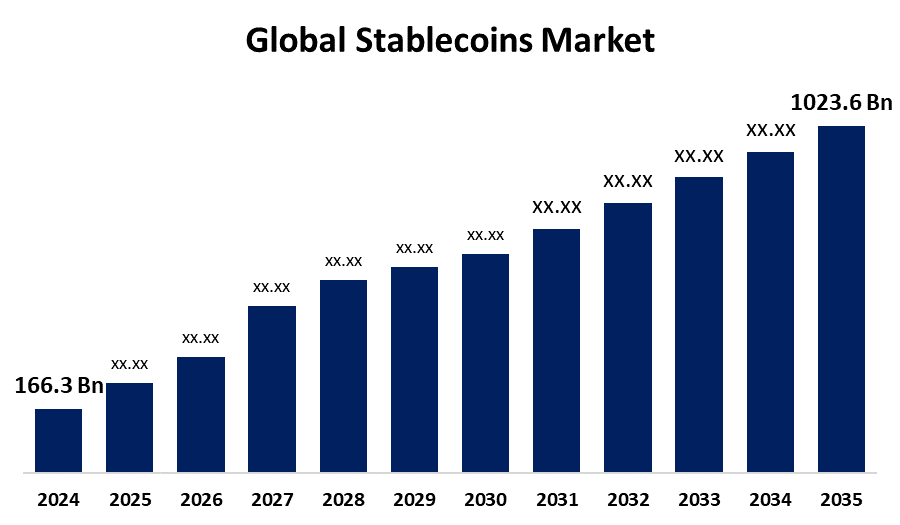
Market research highlights this rapid enterprise transition toward digital dollar rails. Specifically, the Astute Analytica Stablecoin Payment Infrastructure Report projects the market will expand from $3 billion in 2025 to $58 billion by 2035, growing at a 34.5% CAGR. Furthermore, real-world payments doubled as B2B settlement surged.
1. Faster Cross-Border Settlement
Unlike traditional wire transfers that take days to clear, stablecoin wallet platforms initiate and settle transactions directly on the underlying blockchain.
- No Bank Cut-off Times: Payments settle quickly without waiting for local bank operating windows or clearance queues.
- Weekend Settlement: Treasuries transfer capital freely on weekends and public holidays without artificial delays.
- Direct Blockchain Verification: Finance teams receive immutable, on-chain cryptographic proofs as soon as transactions finalize.
- Reduced Intermediary Chains: Suppliers receive usable funds directly into their secure wallets without passing through multiple correspondent banks.
2. Around-the-Clock Payment Operations
Traditional banking rails operate on rigid schedules, but global enterprise wallets maintain continuous payment operations 360 days a year.
- 24/7 Availability: Automated workflows process high-priority global transfers at any hour of the day.
- Weekend Treasury Rebalancing: Liquidity managers rebalance working capital across overseas subsidiaries without waiting for Monday morning.
- Emergency Vendor Payouts: Critical supplier obligations are fulfilled instantly to prevent supply chain disruptions.
- Global Payroll Delivery: International contractors and remote workers receive guaranteed disbursements right on schedule.
3. Lower Payment and Intermediary Costs
By replacing correspondent banking networks with direct digital dollar rails, enterprises significantly reduce the operational expenses of international commerce. Research from Boston Consulting Group on Stablecoin Payments confirms that moving funds on-chain eliminates multiple fee layers.
- Zero Correspondent Fees: Companies bypass lifting charges and intermediary bank deduction fees.
- Lower Foreign Exchange Markups: Finance teams save substantially by holding and settling directly in USD-pegged stablecoins.
- Reduced Manual Operations: Automated Maker-Checker policies eliminate labor-intensive manual payment processing.
- Minimized Prefunding: Real-time settlement removes the need to maintain expensive prefunded nostro accounts globally.
According to a report on B2B Stablecoin Infrastructure Growth by Dwellir, enterprise adoption is accelerating as institutions replace legacy wire rails.
4. Better Treasury Visibility
Managing liquidity across multiple international subsidiaries requires immediate, unified visibility into corporate cash balances. A study by Bessemer Venture Partners on Global Financial Infrastructure shows that enterprise treasuries are adopting on-chain tools for superior cash control.
- Real-Time Wallet Balances: Treasurers monitor exact cash positions across all active blockchain networks instantly.
- Consolidated Multi-Wallet Views: Centralized dashboards aggregate sub-accounts, departments, and international branches into one ledger.
- Automated Balance Sweeps: System rules automatically sweep excess subsidiary funds into yield-bearing treasury accounts.
- Instant Exposure Alerts: Security policies send real-time notifications if wallet balances cross predefined liquidity thresholds.
Enterprises are not adopting stablecoin wallets simply because blockchain payments are novel. Instead, they deploy them where continuous availability, lower fees, and programmable treasury controls solve concrete operational bottlenecks.
What an Enterprise Stablecoin Wallet Must Handle
An enterprise stablecoin wallet does not physically “store” digital tokens inside the app. Instead, it securely manages the cryptographic credentials and private keys that grant the authority to move assets recorded on a blockchain.
Consequently, as detailed in Stripe’s crypto security guide, these wallets act as the control center for constructing transactions, updating blockchain state, and executing business logic safely.
1. Corporate Treasury Wallets
- Global Cash Positioning: Finance teams track liquidity in real-time across multiple global sub-accounts and international branches.
- Intercompany Transfers: Parent entities move capital instantly between overseas subsidiaries without waiting for correspondent bank clearing cycles.
- Liquidity Rebalancing: Automated triggers shift idle stablecoin reserves into yield-bearing protocol positions or cash equivalents.
- Automated Balance Sweeps: Custom threshold rules sweep excess operational balances into cold storage or central treasury accounts overnight.
2. Enterprise Payment Wallets
- Supplier Payments: Companies settle vendor invoices globally within seconds while significantly cutting cross-border transfer fees.
- Global Payroll: HR platforms execute scheduled, bulk stablecoin distributions directly to international contractors without banking delays.
- Marketplace Payouts: E-commerce platforms automate instant, programmatic merchant disbursements triggered by order fulfillment events.
- Cross-Border Settlement: International trade partners complete direct delivery-versus-payment transfers without relying on SWIFT message chains.
3. Customer and Institutional Wallets
- Segregated Client Wallets: Financial institutions assign isolated address structures to each client to maintain strict legal segregation of funds.
- Omnibus Accounts: Operating platforms pool user deposits into a single master wallet while maintaining internal virtual subledgers for fast balance tracking.
- Embedded Custody: Consumer fintech apps embed background wallet creation using social logins or passkeys for a seamless user experience.
4. Industry-Specific Wallet Requirements
- Banks & Fintechs: Require strict white-label custody, omnibus subledgers, and automated FATF Travel Rule compliance integrations.
- Asset Managers: Demand multi-signature threshold signing, high-value transfer limits, and direct connection to tokenized real-world asset platforms.
- Pharma & Healthcare: Need immutable audit logs for milestone-based clinical trial payments and vendor procurement tracking.
- DAOs & Web3 Native Protocols: Require programmable governance engines with multi-party approval quorums to manage community treasuries transparently.
Ultimately, enterprise stablecoin wallets bridge raw blockchain cryptographic authority with corporate governance. By tailoring key structures to specific payment, treasury, or institutional workflows, companies maintain complete operational safety.
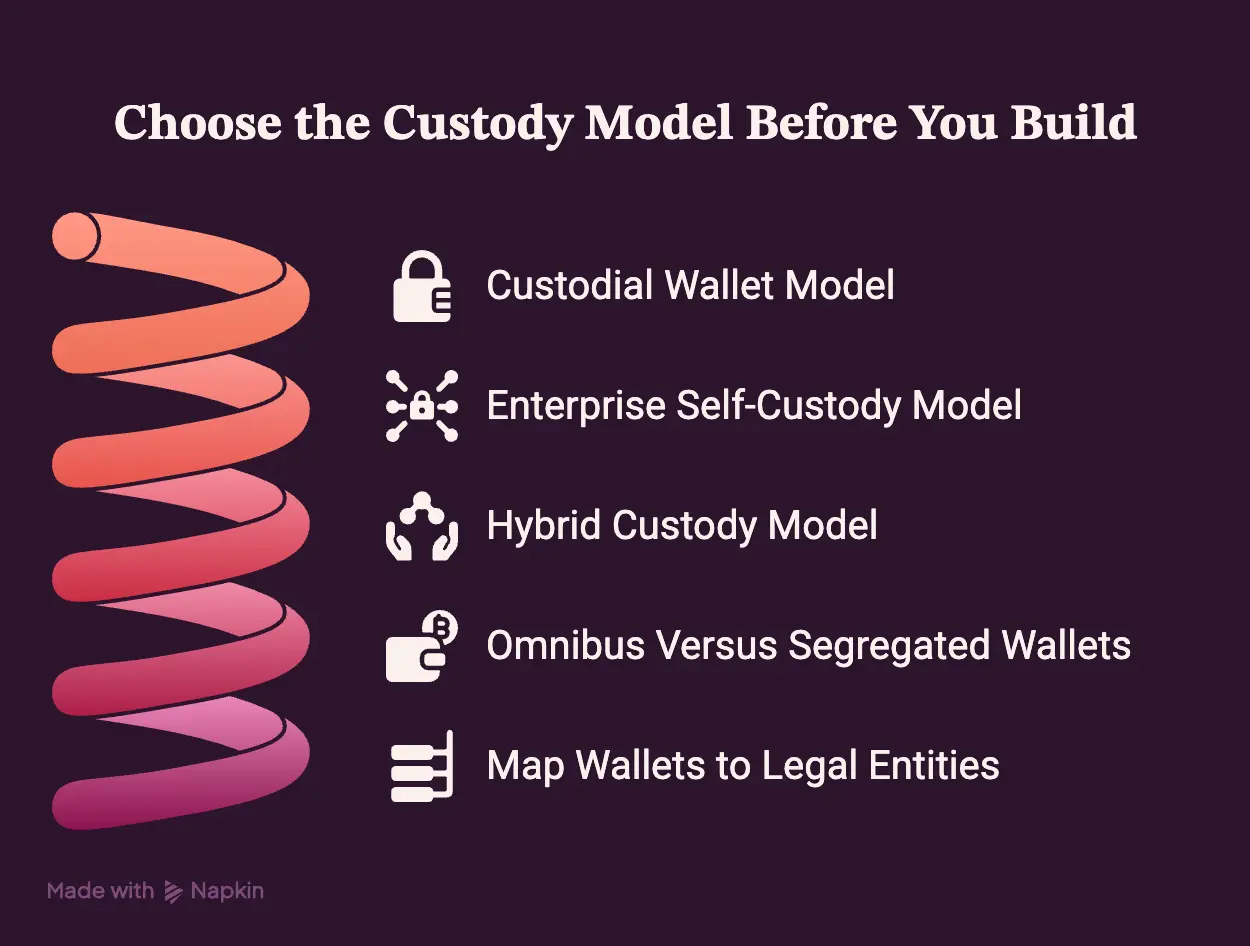
Choose the Custody Model Before You Build
Choosing your custody model is the foundational architecture decision that dictates regulatory liability, key control, and operational complexity.
Consequently, corporate treasuries and engineering leads must align on key ownership before writing a single line of wallet logic.
1. Custodial Wallet Model
Under a custodial model, a licensed third-party provider generates, secures, and executes transactions using private keys on your behalf.
- Turnkey Compliance: Simplifies licensing requirements by delegating fund safeguarding and AML/KYC execution to an accredited custodian.
- Low Operational Overhead: Reduces internal security engineering costs and shifts infrastructure maintenance to the provider.
- Single Point of Failure: Introduces counterparty risk and creates operational dependency on third-party platform availability.
2. Enterprise Self-Custody Model
In an enterprise self-custody deployment, your organization maintains exclusive cryptographic authority and complete control over private keys.
- Absolute Asset Sovereignty: Eliminates counterparty bankruptcy risk by retaining 100% direct control over corporate funds.
- Strict Security Demands: Requires internal key-share governance, custom disaster recovery protocols, and dedicated 24/7 security staff.
- Institutional Preference: Preferred by tier-one banks and large global treasuries bound by strict internal governance mandates.
3. Hybrid Custody Model
Hybrid models split signing authority between internal corporate approvers and an external infrastructure provider to balance safety with speed.
- Shared Signing Authority: Splitting key shares between corporate managers and security vendors prevents single-party asset movement.
- Configurable Policy Engines: Allows internal finance teams to enforce spending caps while using vendor co-signing for automated fraud checks.
- Segregated Risk Tiers: Organizes treasury assets by isolating daily hot-wallet operations from multi-signature cold storage vaults.
4. Omnibus Versus Segregated Wallets
Choosing between pooled omnibus accounts and segregated wallet addresses alters the off-chain.
- Omnibus Model: Pools corporate or client funds into a single on-chain master vault, relying on internal off-chain ledgers to track balances. While this drastically cuts gas costs, it increases internal accounting overhead and blast-radius risk.
- Segregated Model: Assigns distinct on-chain wallet addresses to each subsidiary, user, or business unit. This offers transparent auditing and isolates security threats, though it raises total on-chain transaction fees.
5. Map Wallets to Legal Entities and Funds Ownership
Designing a clear wallet hierarchy ensures seamless ERP reconciliation and legal isolation across multinational corporate structures.
- Group Treasury (Cold Reserve Vault): Holds global reserve capital under strict institutional multi-signature or HSM governance.
- Regional Treasury (Warm Operating Vault): Funds regional operational units and handles intercompany liquidity rebalancing automatically.
- Legal Entity / Business Unit (Hot Payment Wallet): Manages high-frequency supplier disbursements, local vendor payouts, and payroll operations.
Ultimately, your custody framework establishes the boundaries for security, legal exposure, and capital efficiency. Therefore, aligning key controls with corporate entity structures guarantees institutional compliance while retaining complete operational control over treasury assets.
Enterprise Stablecoin Wallet Architecture
An enterprise stablecoin wallet requires a modular, production-grade software stack that decouples administrative control from core cryptographic execution. Instead of relying on a single monolithic program, enterprise architecture distributes security across seven isolated functional layers.
Consequently, this defense-in-depth framework ensures complete regulatory compliance, fault tolerance, high transaction throughput, and absolute key isolation across global business operations.
Seven-Layer Enterprise Stablecoin Wallet System Architecture
To understand how these layers interact, the table below outlines the core components and institutional responsibilities of each tier.
| Architectural Layer | Core Functional Components | Institutional Operational Role |
| 1. User & Administration | Web portal, iOS/Android apps, SSO/SAML 2.0, WebAuthn/FIDO2 passkeys, and maker-checker approval queues. | First, it manages identity authentication, granular role-based access control (RBAC), and user work queues for manual payment sign-offs. |
| 2. Wallet Orchestration | Vault generation, hierarchy mapping, policy evaluation engines, batch payment processors, and automated sweepers. | Next, it coordinates financial workflows, enforces corporate spending limits, and automates balance rebalancing across organizational sub-ledgers. |
| 3. Compliance & Risk Engine | Real-time KYT transaction monitoring, wallet address whitelisting, FATF Travel Rule protocols, and automated SAR filing. | Meanwhile, it prevents illicit asset flow by screening counterparties against global sanctions databases and flagging high-risk transactions instantly. |
| 4. Signing & Key Management | Multi-Party Computation (MPC) TSS, FIPS 140-2 Level 3 HSMs, smart contract multi-sigs, and key rotation logs. | Crucially, it executes cryptographic signing without exposing raw private keys, eliminating single points of failure across hot, warm, and cold vaults. |
| 5. Blockchain Connectivity | Dedicated RPC nodes, failover load balancers, chain indexers, nonce management, and gas estimators. | Furthermore, it constructs raw transactions, broadcasts payloads to public blockchains, handles chain reorganizations, and monitors on-chain finality. |
| 6. Enterprise Integration | REST/gRPC API gateways, webhooks, Kafka event bus, and ERP/TMS connectors (SAP, Oracle, NetSuite). | In addition, it synchronizes on-chain payment settlements directly with internal accounting systems, general ledgers, and bank clearing rails. |
| 7. Infrastructure & Ops | Kubernetes orchestration, Terraform IaC, HashiCorp Vault secrets, Datadog monitoring, and immutable audit logs. | Finally, it ensures high operational availability, rapid multi-region deployment, disaster recovery, and automated SOC 2 compliance logging. |
For a deeper breakdown of building enterprise infrastructure, see our guide on MLOps and Infrastructure Engineering.
Ultimately, enforcing strict separation between these seven layers eliminates single points of failure and streamlines internal audits. As a result, this modular blueprint gives technical leaders total authority over key security, regulatory compliance, and cross-border payment speed.
MPC vs HSM vs Multi-Signature Wallets
Key management is the ultimate security foundation of an enterprise stablecoin wallet platform.
Rather than treating all key architectures equally, engineering leads must select between Multi-Party Computation (MPC), Hardware Security Modules (HSM), and smart-contract multi-signature setups based on their specific transaction frequency, governance complexity, and compliance boundaries.
Key Management Decision Table
To assist technical teams in evaluating architectural tradeoffs, the table below compares the primary key management choices against critical operational metrics.
| Decision Criterion | MPC Threshold Scheme | FIPS 140-3 HSM Module | Smart-Contract Multi-Sig |
| Key Storage & Execution | Distributed cryptographic key shares. | Hardware-isolated physical module. | Independent signer keys + contract. |
| Automation Readiness | High; ideal for continuous B2B payouts. | Medium to High; requires HSM API tuning. | Medium; limited by gas fees and latency. |
| Multi-Chain Support | Strong; works on any ECDSA/EdDSA chain. | Strong, but requires custom engineering. | Chain dependent; requires deployed contract. |
| On-Chain Governance | No; appears as a single signature on-chain. | No; appears as a single signature. | Yes; all signer approvals visible on-chain. |
| Recovery Complexity | Medium to High; requires backup share schemes. | Medium; uses physical backup hardware. | Medium; managed by updated key quorums. |
| Vendor Dependence | Moderate to High based on MPC provider. | Infrastructure dependent (AWS/Azure/Thales). | Low; relies on open-chain smart contracts. |
| Primary Best Fit | High-volume payment rails & active treasury. | Highly regulated banking environments. | Transparent DAO & board governance. |
Ultimately, selecting between MPC, HSM, and multi-signature setups requires balancing key isolation against operational agility.
While banks often mandate physical HSM isolation, high-volume treasury platforms typically deploy MPC to achieve both automated speed and zero single-point failure risks.
Choose Stablecoins and Blockchain Networks
Choosing stablecoins and underlying blockchain networks requires aligning corporate treasury needs with issuer transparency, regulatory status, and network reliability.
Rather than chasing market hype, engineering leads must evaluate reserve quality, transaction costs, and issuer freeze controls.
1. Stablecoin Selection Criteria
First, enterprises must evaluate asset-backed reserves, legal jurisdiction, and corporate redemption rails before supporting any digital dollar.
- Fiat Reserves & Redemption: For instance, USDC (Circle) and PYUSD (Paxos) offer monthly audited reserve breakdowns backed by short-term US Treasuries and cash.
- Regulatory Compliance: Meanwhile, USDC and EURC maintain European MiCA authorization, whereas USDT faces non-compliance risks in select jurisdictions.
- Issuer Controls: In addition, centralized issuers maintain freeze capabilities, which are essential for anti-money laundering enforcement.
2. Blockchain Network Selection
Next, selecting network rails involves balancing transaction finality, gas fees, and institutional tooling across different environments.
- Ethereum & L2s (Base, Arbitrum): While Ethereum provides maximum security, Base and Arbitrum deliver sub-cent transaction fees for high-frequency payouts.
- Solana & Stellar: Similarly, Solana offers rapid finality for B2B payouts, whereas Stellar excels in regulated cross-border corridors.
- Polygon & Avalanche: Furthermore, both networks deliver strong enterprise infrastructure, customizable subnets, and broad compliance-tool coverage.
3. Multi-Chain Wallet Design
A unified multi-chain wallet interface abstracts network differences so that finance teams can operate safely without manual errors.
- Unified Interface & Allow-Lists: Specifically, the interface consolidates multi-chain balances while restricting transfers exclusively to approved asset contracts.
- Chain-Specific Builders: Consequently, custom transaction builders handle distinct gas estimations, address validations, and nonce sequences automatically.
4. Cross-Chain Transfers and Bridge Risk
Crucially, enterprise systems must avoid lock-and-mint wrapped bridges due to severe smart-contract and liquidity fragmentation risks.
Instead, modern platforms rely on native issuer protocols like Circle’s CCTP v2 to burn and mint assets natively across supported blockchains.
Ultimately, aligning compliant stablecoins with low-cost, secure blockchain rails ensures reliable corporate payments. As a result, avoiding third-party bridge risks protects global treasury reserves from potential exploits.
Add Compliance to Every Wallet Transaction
Compliance cannot sit in an isolated dashboard added after launch. Instead, regulatory controls must embed directly into wallet creation, deposit funding, approval sign-offs, transaction signing, and external withdrawals.
Jurisdictional Compliance Table
| Jurisdiction | Primary Regulator & Framework | Core Wallet & Stablecoin Requirements |
| United Kingdom | FCA (PS26/10 & PS26/11 Cryptoasset Regime) | Mandates strict safeguarding for crypto custody, capital resilience, CASS asset rules, and fiat-backed stablecoin redemption controls. |
| Singapore | MAS (Payment Services Act & Stablecoin Framework) | Enforces licensed digital payment token (DPT) custody rules, reserve backing for SCS stablecoins, and strict AML key-isolation. |
| Hong Kong | HKMA (Stablecoins Ordinance Cap. 656) | Requires HK$25M paid-up capital, 100% liquid reserve backing, licensed VASP custody structures, and strict local record retention. |
To simplify global legal requirements, the table below compares core wallet compliance standards across major international financial hubs. For a deeper breakdown of integrating compliance engines, see our guide on Automated Enterprise Risk Management.
Ultimately, embedding regulatory checks directly into the key signing flow prevents illicit asset flows without bottlenecking legitimate transactions. As a result, automated compliance protects corporate treasury operations from severe regulatory penalties.
Connect the Wallet to ERP and Treasury Systems
Integrating stablecoin wallets with enterprise infrastructure turns blockchain events into auditable accounting workflows.
At the same time, technical leads must embed wallet connections directly into ERP general ledgers, Treasury Management Systems (TMS), and bank clearing rails.
1. ERP, TMS, and Banking Integration
First, automated webhooks sync transaction data directly with ERP platforms like SAP, Oracle, and NetSuite. System connectors translate on-chain settlements into standard journal entries across mapped chart-of-accounts.
Next, connecting TMS platforms like Kyriba or FIS provides real-time cash positioning and counterparty risk tracking. Corporate payment instructions route through enterprise governance workflows before triggering wallet signatures.
In addition, connecting fiat rails bridges local banking networks with digital dollar liquidity. Systems route fiat through ACH, SEPA, or SWIFT to mint or redeem stablecoins automatically.
2. ISO 20022 and Three-Way Reconciliation
Furthermore, embedding ISO 20022 payment metadata into wallet transfers connects legacy banking data with public ledgers. Transactions attach structured debtor, creditor, and invoice reference numbers directly to transaction hashes.
Ultimately, the wallet engine executes real-time three-way matching across blockchain hashes, internal wallet ledgers, and ERP invoice records.
Consequently, automated reconciliation resolves network fees, partial payments, and gas adjustments while ensuring total auditability across global treasury operations.
Where AI Helps (and Where It Should Not Control Funds)
AI enhances operational visibility and fraud detection within enterprise stablecoin wallet architecture. However, machine learning models must remain strictly advisory, leaving final signing authority to deterministic policy engines.
AI Operational Capabilities & Deterministic Boundaries
- Transaction Anomaly Detection: Machine learning algorithms analyze real-time transfer amounts, transaction frequencies, session behavior, and destination risk scores to flag suspicious payment requests before execution.
- Wallet and Counterparty Risk Scoring: Risk models aggregate blockchain analytics, sanctions proximity, jurisdiction exposure, and historical network relationships to evaluate counterparty safety dynamically.
- Stablecoin and Liquidity Monitoring: Predictive systems track peg deviations, exchange liquidity reserves, chain congestion, and issuer concentration risks to trigger automated treasury alerts.
- Treasury and Fee Forecasting: Predictive analytics evaluate historical payment volumes to forecast wallet funding needs, optimize sweep timing, and estimate network gas fees.
- Deterministic Policy Enforcement: Policy engines enforce hard spending rules, address whitelisting, and multi-sig quorums regardless of AI model outputs.
- Strict Human-in-the-Loop Safeguards: High-value payouts and flagged anomalies require explicit approval from designated human administrators.
- Restricted Signing Authority: Generative AI tools and probabilistic models must never possess direct key-signing privileges or unrestricted access to corporate vault funds.
Ultimately, AI excels at identifying subtle patterns and predicting operational bottlenecks across complex multi-chain networks. As a result, restricting artificial intelligence to analytical workflows protects enterprise treasury reserves from non-deterministic execution errors.
Enterprise Stablecoin Wallet Development Cost
An enterprise stablecoin wallet generally costs $70,000 to $300,000 to design, build, secure, integrate, and deploy.
Enterprise Implementation Cost Breakdown
To help budget engineering initiatives, the table below outlines typical phase costs based on functional scope and integration depth.
| Development Phase | Implementation Scope | Estimated Cost |
| Discovery & Regulatory Design | Operating model, legal jurisdictions, asset-control analysis, and functional specification. | $7,000 – $15,000 |
| Architecture & Security Planning | Custody design, vault hierarchies, threat modeling, disaster recovery, and system specs. | $8,000 – $20,000 |
| Core Wallet & Custody Build | Vault creation, MPC/HSM/multi-sig implementation, access control, and user permissioning. | $20,000 – $60,000 |
| Chain & Transaction Workflows | Multi-chain RPC connections, stablecoin contract support, gas optimization, and batch sweeps. | $12,000 – $45,000 |
| Compliance & Enterprise Systems | Real-time KYT/AML, Travel Rule rails, ERP connectors (SAP/Oracle), and reconciliation engines. | $10,000 – $90,000 |
| Testing, Audit & Deployment | Penetration testing, smart contract audits, CI/CD pipelines, observability, and rollout. | $13,000 – $70,000 |
| Total Project Investment | Scope-dependent total implementation range | $70,000 – $300,000 |
Controlled Enterprise MVP ($70,000 – $110,000)
- Target Scope: Single-entity treasury setup supporting one or two stablecoins on a single primary blockchain.
- Core Capabilities: Managed custody or turnkey MPC integration, basic multi-sig approval workflows, address screening, one basic ERP connector, and an administrative web portal.
Production Enterprise Wallet ($140,000 – $220,000)
- Target Scope: Multi-entity operations with hot and warm vault tiers running across two or three active blockchains.
- Core Capabilities: Advanced policy engine, automated Travel Rule exchanges, real-time transaction monitoring, direct ERP/TMS integrations, automated three-way reconciliation, and multi-region deployment.
Regulated Multi-Entity Platform ($230,000 – $300,000)
- Target Scope: Fully regulated institutional platform featuring hybrid MPC/HSM custody across hot, warm, and cold tiers.
- Core Capabilities: Multi-chain transaction orchestration, customer sub-wallet architectures, advanced compliance engines, custom banking liquidity connectors, predictive risk analytics, and high-availability infrastructure.
Ongoing Operational Expenses
- Annual Maintenance: Plan for annual software maintenance equal to 15%–25% of initial build costs.
- External Operating Vendor Fees: Budget separately for third-party custody subscriptions, blockchain analytics licenses, Travel Rule providers, dedicated RPC nodes, cloud hosting, and annual security audits.
Ultimately, aligning project scope with business priorities prevents unexpected cost overruns during production rollouts. As a result, engineering leads can launch a secure, compliant wallet platform within predictable budget boundaries.
Enterprise Stablecoin Wallet Implementation Roadmap
Building an enterprise-grade stablecoin wallet requires a structured execution framework that bridges cryptographic security, regulatory compliance, and corporate accounting.
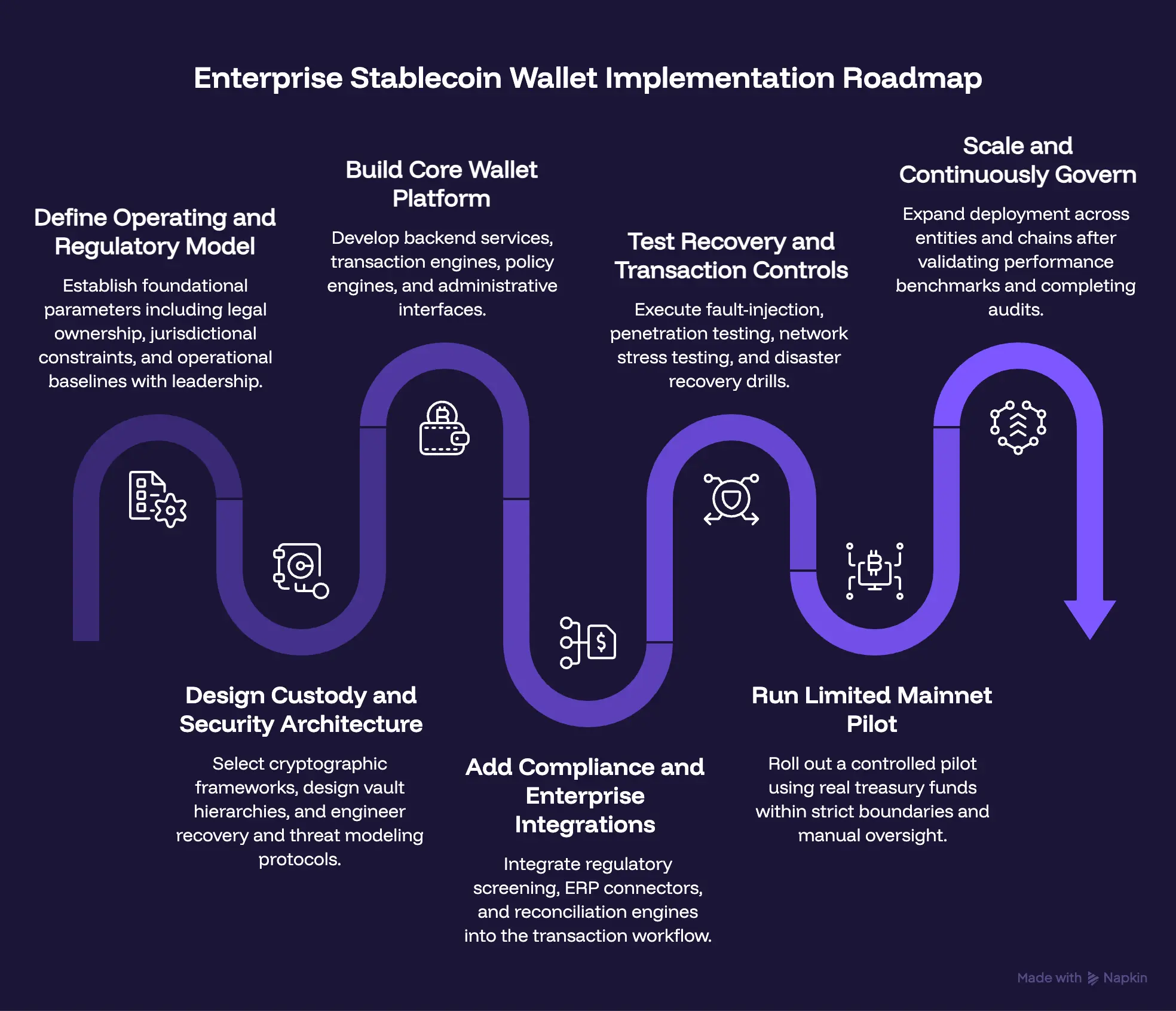
At Intellivon, we utilize a phased implementation methodology to design, build, and deploy custom wallet architectures without disrupting existing treasury operations.
Implementation Scope & Timeline Summary
To establish clear operational expectations, our engagement timelines scale based on architectural complexity, jurisdiction requirements, and integration depth.
| System Scope | Estimated Delivery Timeline | Core Milestones |
| Controlled Enterprise MVP | 12 – 16 Weeks | Single-entity architecture, single chain, basic MPC/Multi-Sig policy engine, and one accounting connector. |
| Production Enterprise Wallet | 20 – 28 Weeks | Multi-entity support, hot/warm tiers, 2–3 chains, Travel Rule compliance, and automated ERP reconciliation. |
| Multi-Entity Regulated Platform | 28 – 40 Weeks | Hybrid MPC/HSM vaulting, cross-chain orchestration, custom banking rails, sub-wallets, and high availability. |
1. Define the Operating and Regulatory Model
First, Intellivon engineers work alongside your executive leadership, legal counsel, and compliance officers to establish the foundational parameters of the wallet platform.
- Legal Ownership and Asset Control: We clarify who holds legal title to the funds, who maintains control over signing keys, and which corporate entities initiate or approve transfers.
- Jurisdictional & Asset Constraints: Our team maps target regulatory jurisdictions, selects supported fiat-backed stablecoins, and evaluates target blockchain throughput and fee dynamics.
- Operational Baselines: We document expected transaction volumes, peak throughput requirements, and maximum single-transfer thresholds to tailor system performance.
2. Design Custody and Security Architecture
Next, we establish the cryptographic foundations and security boundary models required to protect enterprise digital assets against internal and external threats.
- Custody Paradigm Selection: We design the optimal cryptographic framework—selecting Multi-Party Computation (MPC), Hardware Security Modules (HSM), Multi-Sig, or a hybrid architecture.
- Vault Hierarchy & Tiering: Our team designs hot, warm, and cold vault structures, assigning specific signing roles and spending limits to each tier.
- Recovery & Threat Modeling: We engineer quorum recovery strategies, key-share backup protocols, and complete threat models covering rogue insider attacks and compromised API credentials.
3. Build the Core Wallet Platform
After establishing security specifications, Intellivon engineers build the core backend services, transaction engines, and administrative interfaces.
- Wallet & Transaction Engine: We develop automated wallet creation services, sub-address indexing, balance trackers, and resilient blockchain RPC connector layers.
- Policy Engine & Workflows: Our developers configure custom policy engines that enforce velocity limits, time-locks, address whitelisting, and multi-tier approval chains.
- Administrative Interface: We deploy a secure role-based control portal for treasury administrators, operators, and compliance managers.
4. Add Compliance and Enterprise Integrations
In addition, we integrate regulatory software and enterprise systems into a unified transaction workflow.
- Compliance Embedding: We connect real-time KYC/KYB screening, blockchain analytics tools (KYT), sanctions checking, and Travel Rule protocols directly into transaction hooks.
- ERP & Banking Connectors: Our team integrates automated webhooks with SAP, Oracle, NetSuite, or Microsoft Dynamics, alongside ACH/SEPA fiat-rail on/off-ramps.
- Reconciliation Engines: We deploy automated matching software to link on-chain transaction hashes with internal ledger entries and ERP invoice records.
5. Test Recovery and Transaction Controls
Furthermore, before deploying to live mainnet environments, Intellivon executes rigorous fault-injection and penetration testing scenarios.
- Security & Exception Simulation: We simulate unauthorized payment attempts, compromised admin accounts, lost key shares, and high-value policy overrides.
- Network Stress Testing: Our engineers evaluate system resilience against chain reorganizations, RPC provider outages, gas fee spikes, and stablecoin peg deviations.
- Disaster Recovery Drill: We conduct full disaster-recovery simulations to ensure quorums can restore signing capabilities under emergency conditions.
6. Run a Limited Mainnet Pilot
To validate operational workflows safely, we roll out a controlled mainnet pilot using real treasury funds within strict boundaries.
- Controlled Scope: Pilot deployments run on a single legal entity using one primary stablecoin and one blockchain network.
- Supervised Execution: Transfers operate under strict transaction caps, mandatory manual oversight, and daily three-way ledger reconciliation.
7. Scale and Continuously Govern
Finally, Intellivon expands the wallet deployment across additional entities, chains, and business units only after key operational benchmarks are confirmed.
- Performance Validation: System expansion requires meeting strict targets for signing success rates, reconciliation accuracy, zero false-positive compliance halts, and low settlement latency.
- Audit & Adoption Completeness: We finalize audit logs, complete user training for treasury teams, and institute ongoing security and governance reviews.
Ultimately, executing wallet deployment through a structured roadmap mitigates technical risks while ensuring full alignment with enterprise accounting and regulatory standards.
Consequently, our clients launch resilient stablecoin infrastructure that scales seamlessly with global treasury growth.
Build an Enterprise Stablecoin Wallet With Intellivon
Deploying an enterprise-grade stablecoin infrastructure requires an engineering partner that understands how cryptographic primitives intersect with legacy corporate finance.
Rather than forcing your treasury into a single proprietary ecosystem, Intellivon builds custom, battle-tested wallet architectures tailored to your exact regulatory, operational, and security requirements.
Our Engineering Capabilities
- Custody-Neutral Architecture: We build vendor-agnostic frameworks that give you total control over your key infrastructure, preventing lock-in to any single provider.
- MPC, HSM, and Hybrid Implementations: Our engineers deploy flexible cryptographic setups—combining Multi-Party Computation, Hardware Security Modules, and multi-sig schemes based on your risk profile.
- Multi-Chain Transaction Orchestration: We design unified API rails to route payments, manage gas fees, and process batch sweeps seamlessly across multiple layer-1 and layer-2 networks.
- Embedded Compliance Engines: We integrate automated KYC/KYB, real-time transaction screening (KYT), sanctions checking, and Travel Rule protocols directly into transaction flows.
- ERP and Treasury Integration: Our team engineers automated connectors for SAP, Oracle, NetSuite, and Kyriba, alongside real-time three-way accounting reconciliation.
- Banking and On/Off-Ramp Connectivity: We bridge digital asset liquidity with traditional banking rails, automating SEPA, ACH, Faster Payments, and SWIFT settlements.
- AI-Assisted Fraud and Risk Analytics: We implement non-custodial machine learning tools to detect transaction anomalies, monitor peg stability, and optimize treasury liquidity.
- Enterprise Cloud and DevOps Rollout: We deliver high-availability, multi-region deployments equipped with rigorous security logging, automated failovers, and continuous audit trails.
Ready to design your stablecoin infrastructure? Book a free strategy call with Intellivon today to discuss your architectural requirements with our lead Web3 systems engineers.
Conclusion
Ultimately, deploying an enterprise stablecoin wallet transforms digital asset management from a speculative endeavor into a strategic operational advantage.
By carefully integrating a modular architecture, robust cryptographic custody, embedded compliance, and automated ERP reconciliation, corporate treasuries can achieve seamless global settlement.
Consequently, organizations eliminate reliance on manual processes while maintaining strict regulatory oversight. As digital financial rails evolve, investing in a secure, provider-agnostic wallet platform ensures long-term institutional resilience and treasury efficiency.
FAQs
Q1. Is MPC safer than a multi-signature wallet?
A1. Neither is universally superior; the choice depends on your chain and execution requirements. Specifically, MPC is ideal for off-chain flexibility, privacy, and supporting non-smart-contract blockchains. Conversely, Multi-Sig provides transparent, on-chain governance natively enforced on smart contract networks. Therefore, select MPC for multi-chain operations, or Multi-Sig for pure EVM transparency.
Q2. Should an enterprise support USDC, USDT, and EURC from launch?
A2. Instead of supporting every liquid asset immediately, begin exclusively with stablecoins and networks required by your confirmed payment corridors. Consequently, limiting launch assets reduces initial compliance overhead, liquidity fragmentation, and integration complexity. Therefore, expand your supported asset catalog only after establishing stable settlement volume across core business corridors.
Q3. How does an enterprise wallet connect with SAP or Kyriba?
A3. Connecting wallets to SAP or Kyriba relies on secure APIs and automated webhooks. First, webhooks trigger real-time balance updates and payment status changes. Next, system connectors map wallet addresses to specific chart-of-accounts. Finally, the integration engine generates journal entries automatically and executes three-way matching across invoice and transaction records.
Q4. What happens when an MPC key-shareholder leaves the company?
A4. When a key-shareholder departs, the system immediately revokes their administrative access privileges. Furthermore, the remaining quorum executes a cryptographic key-share rotation protocol. As a result, this process generates a new key-share for the replacement signer and invalidates the departed employee’s old share without changing the underlying blockchain address.
Q5. How do gasless stablecoin transactions work?
A5. Gasless transactions utilize ERC-4337 account abstraction or native EIP-712 meta-transactions. First, the user signs an off-chain authorization message. Next, a third-party paymaster or bundler submits the transaction on-chain and pays the network gas fee. Consequently, enterprises can sponsor end-user fees directly or deduct gas charges seamlessly in stablecoins.
To Sum It Up:
- An enterprise wallet is not secure because it uses MPC. It is secure when key shares, approval policies, recovery procedures, and human responsibilities work together.
- Multi-chain support can increase liquidity access while multiplying reconciliation, compliance, gas, and incident-response complexity.
- The most expensive wallet failure is often not a cryptographic breach. It is a valid transaction approved under a poorly designed business policy.
- Enterprises should automate stablecoin transfers only after proving they can stop, investigate, recover, and reconcile them.
- Buying custody infrastructure while building the policy and integration layer often provides a better balance than either full outsourcing or full self-custody.