Key Takeaways:
-
Stablecoins cut costs by removing middleman banks, currency conversion fees, and long waiting periods between payments.
-
Some costs like local payouts, compliance, custody, and infrastructure still remain and need careful planning upfront.
-
Claiming 90% savings is misleading because actual savings depend entirely on the specific payment route being used.
-
The biggest cost benefits appear in busy, expensive corridors where traditional bank transfers are slow and costly.
-
How Intellivon builds this: custom stablecoin payment platforms costing $70,000 to $300,000 based on routes and complexity.
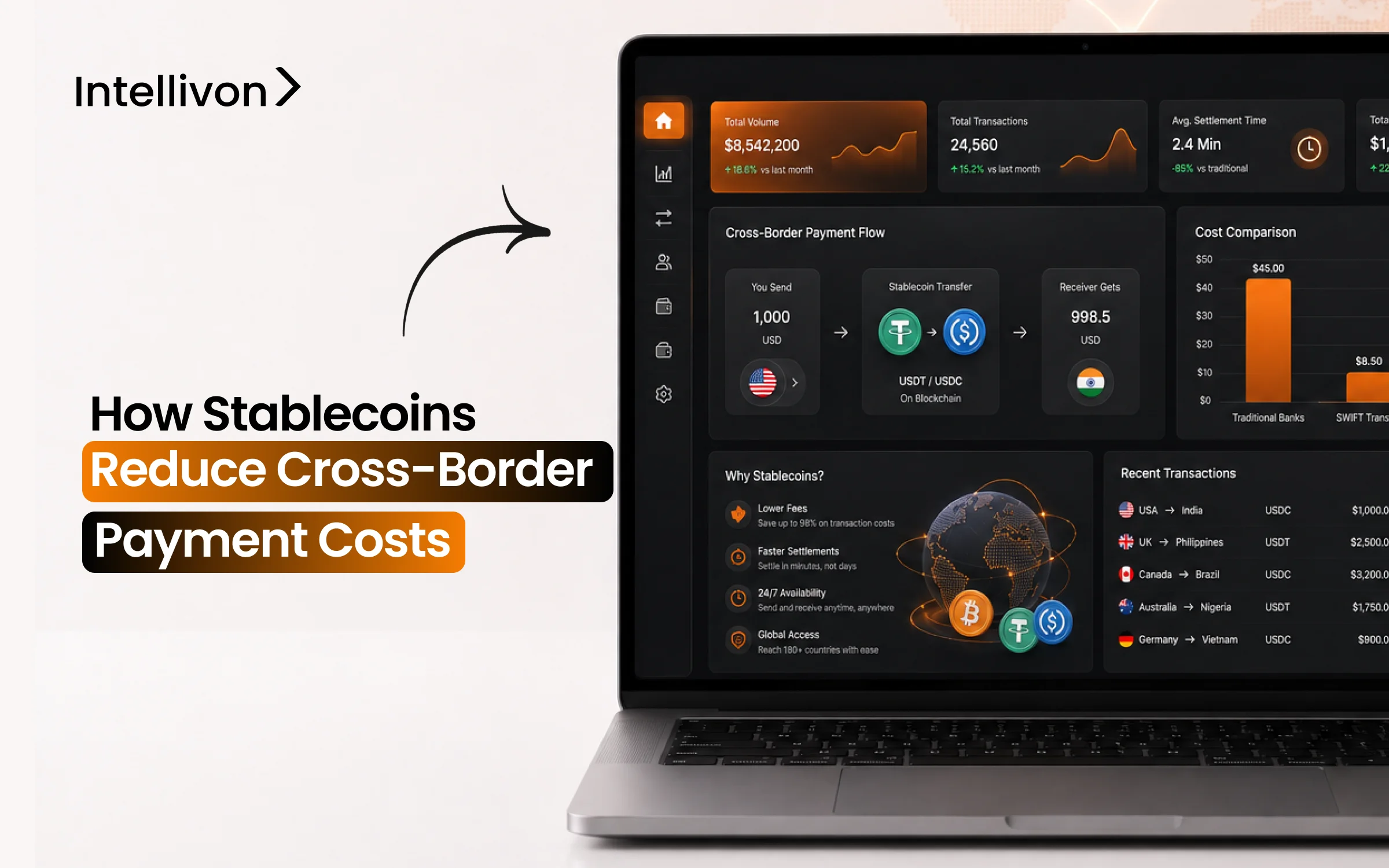
Cross-border payments stay expensive because of where the money sits. Every correspondent bank in the chain holds funds briefly and takes a cut, and meanwhile, pre-funded nostro accounts tie up capital that earns nothing while it waits. As a result, stablecoins cut that structure out entirely, since the payment moves directly through a single rail instead of a chain of intermediaries.
The numbers back that up clearly. Traditional wire transfers run 2% to 7% in true total cost once fees, FX spreads, and intermediary charges are added up, while stablecoin payments bring that down to 0.1% to 0.5%, according to a 2026 cross-border payments analysis. On $10 million in annual payment volume, that gap alone is worth $200,000 to $700,000 a year. Consequently, the savings scale directly with volume, which is exactly why treasury teams are running the numbers now.
This post breaks down the full cost structure on both sides, comparing correspondent banking fees against stablecoin gas and network costs. Then, it measures stablecoins against SWIFT, ACH, and card rails directly. From there, it shows how to calculate the real ROI for your own payment volume.

What Are Stablecoin Cross-Border Payments?
Stablecoin cross-border payments use fiat-backed digital tokens to settle transactions across blockchain networks rather than correspondent bank chains. By replacing legacy clearinghouses like SWIFT, this architecture enables instant global transfers.
Consequently, enterprises achieve continuous 24/7 liquidity while bypassing traditional wire markup fees.
1. The Stablecoin Payment Lifecycle
This lifecycle defines how value moves from a corporate bank account to an international vendor within minutes.
- Fiat Funding: The sender initiates a local currency transfer from their corporate treasury account.
- On-Ramp Conversion: A regulated provider converts the local currency directly into stablecoins such as USDC, USDT, or EURC.
- Blockchain Settlement: The stablecoin moves across a high-speed blockchain network like Solana, Polygon, or Ethereum Layer 2s.
- Off-Ramp Conversion: The receiving provider converts the incoming digital assets into the destination’s local fiat currency.
- Domestic Payout: A local clearing network, such as ACH or SEPA, delivers the funds straight to the recipient’s bank account.
2. What the “Stablecoin Sandwich” Means
This model wraps blockchain settlement between two standard fiat banking transactions for complete ease of use.
- Invisible Execution: The enterprise sender inputs fiat, while the international recipient receives fiat in their local bank account.
- Zero Asset Exposure: Neither party holds digital assets directly on their balance sheet, which eliminates cryptocurrency accounting complexity.
- Familiar Workflows: Finance teams use standard corporate bank interfaces because the underlying crypto infrastructure remains completely hidden.
3. The Participants in the Payment Chain
A modern stablecoin transaction replaces traditional intermediary banks with a specialized network of digital service providers.
- Issuer & Network: Entities like Circle issue tokens, while blockchains such as Solana process transactions.
- Custodians & Liquidity: Secure custody providers store private keys, while liquidity providers handle real-time asset conversions.
- On/Off-Ramps & Local Payouts: FinTech partners manage fiat-to-token exchanges and connect directly to regional bank rails.
- Compliance & Treasury Systems: Automated software executes Travel Rule checks, while enterprise systems reconcile payments.
Stablecoins replace the costly international settlement leg while preserving familiar enterprise banking workflows. Therefore, upgrading your backend rails delivers immediate speed and efficiency gains.
Why Enterprises Are Adopting Stablecoin Cross-Border Payments
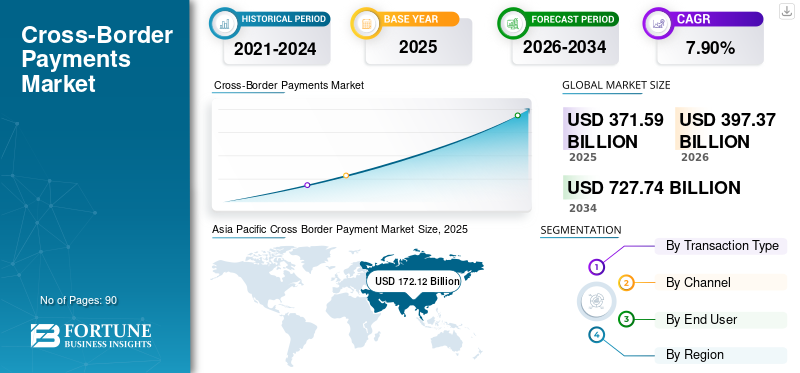
The global cross-border payments market is projected to grow at a 7.90% CAGR toward $727.74 billion by 2034.
Driven by this shift, enterprise finance leaders are replacing outdated banking rails with stablecoin settlement to eliminate hidden operational costs, unlock continuous cash flows, and access emerging markets efficiently.
1. Pressure to Lower All-In Payment Costs
Legacy wires conceal true settlement expenses inside foreign exchange spreads and intermediary bank fees.
Consequently, an EY-Parthenon study revealed that 41% of corporate adopters achieved over 10% in direct cost savings by shifting outbound B2B transfers to stablecoins.
2. Demand for 24/7 Settlement
Banking cut-off windows and weekend closures continuously delay critical international supply chain payments.
Furthermore, McKinsey payment data highlights that stablecoin settlement compresses multi-day payment delays down to seconds, enabling true 24/7 global treasury operations.
3. Better Treasury and Working-Capital Control
Trapping operational capital inside multi-day bank transfers forces companies to hold excessive idle cash.
As noted in BCG’s stablecoin infrastructure research, switching to instant $T+0$ digital rails eliminates destination pre-funding requirements and drastically frees up working capital.
4. Expansion into Difficult Payment Corridors
Traditional correspondent banking networks in developing economies often impose exorbitant fees and high failure rates.
Fortunately, World Bank global remittance data confirms that on-chain routing bypasses broken regional clearing chains entirely in markets across Latin America, Africa, and Asia.
5. API-Based Payment Infrastructure
Modern enterprise resource planning platforms require programmable, automated payout capabilities.
According to Circle’s institutional payments report, embedded stablecoin APIs allow treasury systems to execute automated payouts directly without manual bank file uploads.
Ultimately, enterprise adoption hinges on cash predictability and operational speed rather than speculative asset holding.
How Stablecoins Reduce Cross-Border Payment Costs
Stablecoin cross-border payments eliminate legacy financial intermediaries, replacing multi-hop banking routes with direct peer-to-peer blockchain settlement. By removing correspondent markups, hidden FX spreads, and multi-day delays, stablecoins reduce total enterprise payment costs by 40% to 80%.
Consequently, finance teams gain absolute fee predictability while releasing trapped working capital.
1. Elimination of the Correspondent Banking Chain
Direct blockchain settlement connects institutions without intermediate routing steps.
- Fewer Intermediaries: Transfers move straight between wallets, bypassing central clearinghouses.
- Fee Removal: Eliminates random processing deductions along the payment path.
2. Reduction of Lifting Fees and Beneficiary Deductions
Transparent transfer mechanics ensure exact invoice amounts arrive predictably.
- Predictable Delivery: Sent principals match received amounts, preventing short-paid invoices.
- No Deductions: Intermediary banks cannot subtract surprise lifting charges in transit.
3. Settlement Compression from Days to Minutes
Near-instant transaction finality shrinks counterparty risk and operational friction.
- Real-Time Settlement: Funds clear in seconds (T+0) versus multi-day wire delays.
- Lower Risk: Counterparty risk vanishes while overall cash velocity increases dramatically.
4. Reduced Requirement for Destination Prefunding
Just-in-time liquidity replaces heavy balance reserves in regional bank accounts.
- Zero Prefunding: Treasuries deploy capital only when executing specific invoices.
- Capital Efficiency: Frees up localized Nostro/Vostro cash pools for core operations.
5. Enhanced FX Pricing Observability
Programmatic API access surfaces real-time currency conversion rates before execution.
- Transparent Spreads: Platforms compare real-time rates across digital liquidity providers.
- Zero Hidden Markups: Explicit pricing models eliminate opaque bank exchange markups.
6. Lower Reconciliation Costs
On-chain transaction data automatically aligns with enterprise resource planning systems.
- Shared Ledger: Immutable transaction hashes allow automated ERP invoice matching.
7. Improved Economics for High-Volume Payments
Low, flat network fees unlock cost-effective micro-transfers and batch payouts.
- Flat Gas Fees: Blockchains charge cents per transaction rather than percentage-based charges.
The largest enterprise savings stem from dismantling multi-layered banking friction rather than lower network fees alone.
Stablecoin Cross-Border Payment Cost Breakdown
Enterprise stablecoin payments eliminate correspondent banking markups, but they are not entirely free. Total execution costs typically range from 0.25% to 1.5% of transaction volume depending on liquidity routes and custody architecture.
Specifically, B2B finance teams must evaluate the complete cost stack, from fiat conversion to compliance, rather than focusing solely on low blockchain gas fees.
Stablecoin Cross-Border Payment Cost Architecture
| Payment Layer | Typical Cost Range | Primary Cost Drivers |
| Fiat On-Ramp | 0.10% – 0.50% | Provider FX spreads, bank wire funding fees, minting charges. |
| Liquidity & Acquisition | 0.05% – 0.20% | Institutional volume tiers, market maker spread, swap slippage. |
| Blockchain Network (Gas) | $0.001 – $3.00 flat | Layer 1 vs. Layer 2 choice, network congestion, smart contract complexity. |
| Custody & Key Management | 0.02% – 0.10% AUM | MPC infrastructure, HSM hardware modules, insurance, signing fees. |
| Off-Ramp & Local Payout | 0.20% – 0.80% | Local bank clearing (ACH/SEPA/RTP), FX conversion, last-mile delivery. |
| Compliance & Monitoring | $0.05 – $0.40 / tx | Travel Rule messaging, KYB/KYC identity checks, sanctions screening. |
| Platform & API Infrastructure | $500 – $5,000 / mo | SaaS base tiers, virtual account creation, API call volume. |
| Operational Exceptions | 0.05% – 0.15% | Address repair, failed payouts, manual treasury intervention. |
Understanding the all-in payment waterfall prevents costly surprises and accurately highlights true operational savings over legacy bank wires. Therefore, finance leaders can optimize vendor routing across specific payout corridors.
Stablecoin vs Traditional Cross-Border Payment Costs
Comparing stablecoin payment rails with traditional channels requires evaluating all-in execution costs, settlement timelines, and operational mechanics. While legacy banking systems rely on multi-hop intermediary chains, stablecoin architecture replaces correspondent entities with direct on-chain finality.
Consequently, total corporate payment expenditures drop significantly across international corridors when comparing full all-in transaction costs rather than isolated gas fees.
1. Stablecoin vs SWIFT Wire Transfer
SWIFT functions as a messaging network that routes transactions through multiple correspondent bank accounts, incurring fees at each hop. In contrast, stablecoin architecture settles value directly peer-to-peer on an immutable public ledger.
| Cost & Operational Dimension | Traditional SWIFT Wire Transfer | Enterprise Stablecoin Rail |
| Initiation Fee | $25 – $50 flat fee per wire | $0 – $5 platform API dispatch fee |
| Intermediary Charges | $15 – $30 per correspondent bank hop | $0 (No correspondent intermediaries) |
| FX Spread Markup | 1.50% – 3.00% above mid-market | 0.15% – 0.50% via digital liquidity pools |
| Settlement Velocity | 1 to 5 business days ($T+3$) | Seconds to minutes ($T+0$) |
| Destination Prefunding | Requires prefunded Nostro/Vostro balances | Zero prefunding; just-in-time liquidity |
| Payment Traceability | Limited visibility via SWIFT GPI | Real-time immutable on-chain tracking |
| Repair & Exception Fees | $25 – $75 for manual wire corrections | Automated smart contract verification |
| Payment Reversibility | Irreversible after clearance (Manual recall) | Irreversible upon blockchain finality |
| Compliance Obligations | Batch manual sanctions screening | Automated real-time Travel Rule & KYB |
2. Stablecoin vs International ACH
International ACH combines domestic clearing houses with third-party currency conversion partners, resulting in slow execution. Conversely, stablecoin rails deliver immediate digital settlement before clearing through local domestic ACH networks at the destination.
| Cost & Operational Dimension | International ACH Network | Enterprise Stablecoin Rail |
| Upfront Wire/ACH Fee | $5 – $20 flat transfer fee | $0.10 – $1.00 on-ramp execution fee |
| Processing FX Markup | 2.00% – 4.00% embedded retail spread | 0.20% – 0.60% transparent liquidity spread |
| Settlement Timeframe | 2 to 4 business days | Immediate token transfer; same-day ACH payout |
| Operating Hours | Banking days and regional cutoff windows | Continuous 24/7/365 network availability |
| Batch Capabilities | High-volume support with slow processing | High-speed automated batch payouts via API |
| Reconciliation Overhead | High due to batch settlement delays | Low via deterministic transaction hashes |
3. Stablecoin vs SEPA Payments
The Single Euro Payments Area (SEPA) delivers low-cost Euro clearing within European borders. However, cross-border payments outside Europe require currency conversion, making stablecoin rails far more cost-effective for international Euro-to-fiat routes.
| Cost & Operational Dimension | SEPA / SEPA Instant Rail | Enterprise Stablecoin Rail (EURC / USDC) |
| Intra-Zone Fee | €0.00 – €1.00 per transfer | $0.01 – $0.50 blockchain gas fee |
| Cross-Border FX Markup | 1.00% – 3.50% outside Eurozone | 0.10% – 0.40% direct exchange rate spread |
| Geographic Reach | Limited to 36 European member states | Global coverage across all connected ramps |
| Currency Flexibility | Euro-denominated transactions only | Multi-currency stablecoin pairs (USD/EUR/BRL) |
| Settlement Speed | Under 10 seconds inside SEPA; multi-day outside | Sub-minute settlement across all worldwide routes |
4. Stablecoin vs Card Payments
Commercial card networks charge percentage-based merchant fees alongside cross-border assessments for global transactions. In contrast, stablecoins eliminate interchange overhead while offering instant settlement finality without chargeback risks.
| Cost & Operational Dimension | Commercial Credit / Debit Cards | Enterprise Stablecoin Rail |
| Merchant Processing Fee | 1.50% – 3.50% interchange fee | 0.20% – 0.50% total processing cost |
| Cross-Border Assessment | Additional 1.00% – 2.00% international fee | $0 (No card brand markups) |
| Settlement Delay | 2 to 3 business days for merchant funding | Immediate on-chain account funding |
| Chargeback Exposure | Vulnerable to disputations up to 120 days | Zero chargeback risk upon on-chain finality |
| Transaction Limits | Capped by corporate credit card lines | Unlimited transaction size scalability |
5. Stablecoin vs PayPal and Payment Service Providers
Traditional payment service providers (PSPs) offer convenience but extract high margins on international transactions through currency markups and withdrawal friction. Stablecoin integration gives enterprises full ownership of payment orchestration without closed-ecosystem lock-in.
| Cost & Operational Dimension | Legacy PSP (e.g., PayPal / Braintree) | Enterprise Stablecoin Rail |
| Transaction Percentage | 3.00% – 5.00% total transfer charge | 0.25% – 1.00% all-in execution cost |
| FX Spread Charge | 3.00% – 4.00% currency conversion markup | 0.15% – 0.50% competitive liquidity rate |
| Funds Withdrawal Cost | 1.50% instant withdrawal or standard delay | Direct off-ramp transfer into bank account |
| Account Risk | Arbitrary account holds and reserve freezes | Self-custody or enterprise-controlled wallets |
| Integration Architecture | Proprietary SDKs and walled-garden platforms | Open-source smart contract and API rails |
6. Stablecoin vs Western Union and MoneyGram
Legacy money transfer operators cater to retail cash remittances, resulting in steep charges for last-mile delivery in developing markets. Conversely, stablecoin infrastructure routes funds into local digital wallets or mobile money rails at fractions of the traditional cost.
| Cost & Operational Dimension | Money Transfer Operators (MTOs) | Enterprise Stablecoin Rail |
| Retail Remittance Fee | $5 – $40 per transaction | $0.50 – $3.00 total execution cost |
| FX Conversion Markup | 2.00% – 6.00% above market exchange rates | 0.30% – 1.00% off-ramp exchange rate |
| Payout Mechanics | Physical agent location cash pickup | Direct transfer to bank or mobile money wallet |
| Corridor Latency | Minutes to 3 business days | Sub-minute digital delivery to recipient |
| Global Remittance Average | 6.49% average cost according to World Bank | Under 1.50% total cost across all corridors |
Evaluating complete all-in transaction profiles reveals that enterprise stablecoins offer dramatic savings across international corridors. Therefore, modern finance teams can migrate high-volume corporate disbursements away from costly legacy channels.
How Stablecoin and Blockchain Choices Change the Final Cost
Token selection and blockchain choices dictate total execution costs and regulatory coverage. Consequently, enterprise payment platforms must evaluate liquidity, gas fees, and compliance suitability together.
For a deeper breakdown of multi-chain strategy, see our guide on Stablecoin Wallet Development for Enterprises.
1. USDC, USDT, EURC, PYUSD, and RLUSD
Token choices impact reserve transparency and institutional redemption access.
- Issuer Governance: Specifically, Circle, PayPal, and Ripple maintain cash-backed reserves under strict regulatory oversight.
- Redemption Access: Consequently, direct issuer minting portals eliminate secondary conversion spreads for enterprise payouts.
2. Ethereum
Ethereum offers maximum security and deep liquidity for enterprise treasuries.
- Deep Liquidity: For instance, Ethereum hosts massive liquidity pools for high-value intercompany settlements.
- Gas Volatility: However, variable mainnet gas costs spike significantly during periods of heavy network congestion.
3. Solana
Solana delivers high-throughput execution with sub-second settlement finality and near-zero transaction fees.
- Low Fees: Specifically, execution fees remain under $0.001 per transfer regardless of payment size.
- Operational Speed: Consequently, rapid block times provide immediate payment confirmations for high-volume vendor payouts.
4. Stellar and XRPL
Stellar and XRP Ledger provide built-in decentralized exchanges for low-cost cross-border currency routing.
- Native Pathfinding: For example, Stellar automatically converts base tokens into local fiat currencies during transfer.
- Fast Settlement: Additionally, deterministic ledger finality occurs within five seconds with negligible network overhead.
5. Polygon, Base, Arbitrum, and Optimism
Layer 2 scaling networks inherit Ethereum security while substantially reducing transaction execution fees.
- Cost Advantage: Specifically, Layer 2 networks process batch payouts at fees below five cents per transfer.
- Bridge Security: Consequently, enterprise systems must utilize canonical bridges to mitigate smart contract risk.
6. Multi-Chain Cost Routing
An automated routing layer evaluates real-time network conditions to choose optimal payment paths.
- Dynamic Routing: Specifically, routing engines direct smaller payouts to Layer 2s when Ethereum gas prices surge.
- Cost Optimization: Therefore, automated pathfinding minimizes slippage and optimizes total operational execution costs.
7. Stablecoin and Network Comparison
| Asset / Rail | Avg Fee | Finality | Liquidity | Best Fit |
| USDC (Ethereum) | $2.00–$20.00 | 15 sec | Deep | Treasury moves ($500k+) |
| USDC (Solana) | < $0.001 | < 1 sec | High | High-volume payouts |
| EURC (Base/Polygon) | $0.01–$0.05 | 2 sec | Moderate | Regional B2B invoices |
| USDT (Tron) | $1.00 | 2 min | High | Emerging market corridors |
| XLM (Stellar) | < $0.0001 | 3 sec | Corridor | Remittance routes |
Evaluating token assets alongside underlying network performance optimizes corporate payment pipelines. Consequently, dynamic multi-chain routing maximizes enterprise treasury savings.
For actionable technical blueprints, read How to Build a Stablecoin Payment Platform for Global Businesses.
Where Stablecoin Payment Cost Savings Are Highest
Cost reductions from stablecoin rails vary depending on market inefficiencies, local banking infrastructure, and intermediary density. Enterprise treasury teams capture the highest margins where cross-border frictions, currency volatility, and manual settlement delays inflate traditional operations.
Consequently, evaluating specific economic conditions identifies where migrating to digital asset rails yields maximum return on investment.
For actionable technical blueprints, read How to Build a Stablecoin Treasury Management Platform.
1. High-Volume B2B Supplier Payments
Legacy cross-border wire fees severely erode corporate profit margins on high-frequency international supply chain invoices.
- Full-Value Receipt: Specifically, on-chain transfers eliminate unpredictable correspondent intermediary deducts, guaranteeing complete invoice settlement amounts.
- Early-Payment Discounts: Furthermore, instant payment finality allows buyers to capture dynamic early-payment supplier discounts reliably.
2. Marketplace and Platform Payouts
Cross-border platform disbursements to thousands of international creators or sellers face oppressive fixed wire costs.
- Fixed Fee Reduction: For instance, replacing percentage-based card charges with low flat gas fees preserves marketplace unit economics.
- Automated Batching: Consequently, micro-disbursements become economically viable when processed through programmatic Layer 2 smart contracts.
3. Global Payroll and Contractor Payments
Distributing recurring international compensation through traditional banking networks subjects remote workers to high currency conversion fees.
- Dollar Preservation: Specifically, stablecoins protect contractor earnings against hyperinflation in emerging markets with volatile local fiat.
- Off-Ramp Flexibility: Additionally, batch API dispatches lower processing overhead while allowing workers to control local cash-out timing.
4. Treasury and Intercompany Transfers
Multinational corporations trap substantial capital in prefunded foreign Nostro accounts to support regional liquidity needs.
- Liquidity Unlocking: For example, 24/7/365 settlement allows instant intercompany rebalancing, drastically reducing destination account prefunding requirements.
- Weekend Clearance: Consequently, corporate treasuries eliminate weekend liquidity freeze risks inherent to traditional banking hours.
5. Remittance Corridors
High banking fees and physical distribution networks make retail remittance routes in developing markets excessively expensive.
- Last-Mile Efficiency: Specifically, combining stablecoin rails with local mobile-money networks bypasses costly physical agent infrastructure.
- Transparent Costs: Therefore, recipients receive higher net values by eliminating hidden retail FX markups on cross-border transfers.
6. Trade Finance, Supply Chain, and Logistics
Paper-based trade documentation delays cargo releases and creates cash flow friction across international shipping routes.
- Programmable Escrow: For instance, smart contracts automatically release escrowed funds upon digital proof of lading verification.
- Automated Reconciliation: As a result, supply chain partners reduce manual administrative overhead through deterministic ledger tracking.
7. Healthcare and Pharmaceutical Payments
Cross-border healthcare disbursements demand rapid execution across strict regulatory boundaries and diverse global research sites.
- Clinical Trial Funding: Specifically, stablecoins expedite global investigator disbursements, preventing research site delays.
- Emergency Supply Chains: Furthermore, instant settlement accelerates overseas medical equipment procurement during critical supply shortages.
8. Corridors Where Savings May Be Limited
Certain well-integrated payment environments offer minimal cost advantages over traditional domestic or regional clearing rails.
- Efficient Domestic Rails: Specifically, corridors served by low-cost regional systems like SEPA Instant offer negligible fee reductions.
- Local Liquidity Friction: Consequently, routes with illiquid local currencies or heavily restricted off-ramps offset on-chain execution savings.
Evaluating corridor-specific economic factors ensures enterprises target deployment where financial savings are highest. For integration strategies, read Stablecoin API Integration for Payment Apps.
Architecture for Cost-Optimized Stablecoin Cross-Border Payments
Maintaining long-term cost savings after a pilot requires a resilient, multi-layered enterprise architecture. Consequently, automated systems must continuously optimize routing, liquidity, and compliance across global corridors.
Architectural Components and Core Functions
| Architectural Module | Core Technical Capabilities | Primary Cost-Control Function |
| Multi-Rail Payment Orchestration | Routes payouts across stablecoins, SWIFT, ACH, SEPA, RTP, and local clearing rails. | Evaluates real-time all-in execution costs to select the cheapest compliant rail. |
| Corridor & Rules Engine | Enforces regional limits, supported assets, payout methods, and provider availability. | Prevents transaction failures and eliminates expensive manual intervention costs. |
| FX & Liquidity Engine | Compares live FX quotes, manages stablecoin inventory, and forecasts redemption demand. | Minimizes market price slippage and avoids prefunding liquidity shortages. |
| Wallet & Custody Layer | Integrates MPC, HSM, multisignature approvals, allowlists, and role permissions. | Secures treasury assets while removing third-party custodial markups. |
| Compliance Orchestration | Automates KYB, KYC, sanctions screening, Travel Rule data exchange, and monitoring. | Prevents costly regulatory fines and reduces manual compliance case review overhead. |
| Internal Ledger & Reconciliation | Double-entry subledger mapping fiat, stablecoins, fees, and beneficiary records. | Eliminates accounting errors and automates enterprise financial audits. |
| ERP, TMS & Banking Integrations | Connects SAP, Oracle, NetSuite, Dynamics, bank APIs, and payroll platforms. | Replaces manual payout uploads with direct enterprise resource planning feeds. |
| Payment Cost Analytics Dashboard | Tracks cost per payment, FX slippage, ramp fees, gas, and settlement time. | Identifies hidden fees and quantifies total savings against baseline banking costs. |
Targeted AI Models in Production Systems
| AI Model Type | Specific Operational Purpose | Financial Impact |
| Lowest All-In Cost Routing Model | Predicts real-time gas, FX, and partner fees across available payment paths. | Automatically selects the lowest-cost transaction execution route. |
| Liquidity & Demand Forecasting Model | Predicts corridor-level stablecoin and fiat inventory requirements. | Eliminates excess capital locking and reduces prefunding interest costs. |
| Anomaly & Fraud Detection Model | Identifies unusual transaction patterns and suspicious wallet address behaviors. | Prevents fraudulent disbursements and protects treasury reserves. |
| Provider-Pricing Drift Model | Detects hidden fee inflation and unexpected partner markup shifts. | Enforces strict vendor service-level agreements and fee terms. |
| Corridor Savings Forecasting Model | Projects future corridor-level cost reductions using historical volume data. | Guides treasury decisions on market expansion and rail selection. |
Note: Intellivon connects these routing, analytics, compliance, and treasury layers into a unified enterprise platform. Consequently, global businesses maintain maximum operational efficiency and predictable cost reductions at scale.
For further technical details, see our guide on Stablecoin Settlement Infrastructure for B2B Payments.
Cost to Build a Stablecoin Cross-Border Payment Platform
Developing an enterprise stablecoin payment platform typically requires an initial investment ranging from $70,000 to $300,000.
Overall project pricing varies based on corridor volume, key management selection, integration density, and jurisdiction requirements.
Project Tiers
| Platform Scope | Development Range | Suitable Deployment Criteria |
| Single-Corridor Pilot | $70,000 – $110,000 | One asset, managed custody, single ramp pair, basic management portal. |
| Multi-Corridor Platform | $120,000 – $200,000 | Multiple fiat ramps, automated routing, compliance automation, ERP integration. |
| Enterprise Infrastructure | $210,000 – $300,000 | Multi-chain orchestration, MPC key architecture, treasury controls, analytics. |
Development Phase Budget Breakdown
| Development Phase | Estimated Cost Range |
| Corridor Discovery & Cost Modelling | $5,000 – $15,000 |
| Solution Architecture & UX Design | $8,000 – $25,000 |
| Payment Ledger, Orchestration & Routing | $18,000 – $55,000 |
| Network, Custody & Ramp Integrations | $15,000 – $55,000 |
| Compliance, Security & Risk Controls | $12,000 – $45,000 |
| ERP, Treasury & Reporting Integrations | $8,000 – $40,000 |
| Testing, Pilot Support & Cloud Deployment | $4,000 – $25,000 |
Phase maximums accumulate when combining complex custody, multi-region compliance, and deep ERP integrations.
Furthermore, ongoing maintenance requires approximately 15% to 25% of initial build costs annually to cover security audits, provider API updates, regulatory modifications, and cloud infrastructure operations.
For detailed scoping guidance, consult our complete guide on the Cost to Build a Stablecoin Payment Infrastructure Platform.
Enterprise Stablecoin Payment Cost Reduction Strategy
At Intellivon, we ensure that digital asset deployment delivers immediate, measurable bottom-line value. Rather than starting with underlying blockchain code, our team begins by analyzing corridor economics, treasury workflows, and operating controls.
Consequently, we guide enterprise treasury leaders through a structured five-phase framework to reduce execution costs safely at scale.
Phase 1 — Audit Payment Corridors and Establish the Baseline
To begin, we examine your existing global payment corridors to identify structural cost inefficiencies. Specifically, our engineers aggregate historical transactional data across legacy banking rails, credit card processors, and money transfer operators.
- Friction Mapping: First, we flag corridors with high correspondent banking fees, wide foreign exchange markups, and long settlement delays.
- Prefunding Costs: Next, we calculate trapped liquidity costs in prefunded Nostro accounts supporting regional operations.
- Repair Workload: Finally, we measure administrative expenses tied to delayed payouts, manual fee reconciliations, and failed wire repairs.
Phase 2 — Define the Payment and Compliance Operating Model
Once baseline costs are clear, we establish a robust operating and risk framework. Because cross-border payments touch multiple regulatory jurisdictions, defining operational responsibilities prevents expensive compliance friction.
- Custody Framework: Specifically, we determine whether your business utilizes direct non-custodial wallets, multi-party computation architecture, or licensed custodial partners.
- Fiat Off-Ramping: Additionally, we structure local fiat payout partnerships to guarantee full-value delivery to end beneficiaries.
- Compliance Controls: Consequently, we integrate automated Know Your Business screening, sanctions checking, and Travel Rule protocols directly into the payout pipeline.
Phase 3 — Select Stablecoins, Networks, and Providers
Next, we evaluate blockchain assets and infrastructure partners using a rigorous quantitative scorecard. Instead of relying on general marketing claims, we select tokens and networks based on verified all-in execution performance.
- Token Selection: For instance, we compare regulated stablecoins like USDC, EURC, PYUSD, and RLUSD against local liquidity depth and redemption terms.
- Network Evaluation: Simultaneously, we score blockchains like Ethereum, Solana, Base, and Stellar based on real-time gas fees, block finality speed, and system uptime.
- Provider Fallbacks: Therefore, we integrate redundant fiat ramps and liquidity pools to ensure continuous operational uptime during market volatility.
Phase 4 — Launch One Controlled Corridor
After establishing technical integrations, we launch a controlled pilot on a single high-friction corridor. Starting with a targeted deployment minimizes operational risk while validating actual financial performance.
- Strategic Selection: Specifically, we select a pilot corridor featuring willing commercial counterparties, high fee friction, and clear regulatory guidelines.
- System Validation: During the pilot, we verify automated payout triggers, ERP subledger posting, and off-ramp settlement speeds in real-time.
- Feedback Loops: As a result, our team fine-tunes payment routing rules and compliance thresholds before scaling transaction volumes.
Phase 5 — Measure Savings and Expand Through Multi-Rail Routing
Finally, we analyze pilot metrics against your historical banking baseline before expanding across additional global routes. Once economic efficiency is proven, we deploy our multi-rail routing engine to automate corridor selection globally.
- Performance Tracking: Specifically, we track key metrics, including basis-point cost reductions, FX slippage, settlement finality times, and manual intervention rates.
- Automated Routing: Next, we activate dynamic routing algorithms that continuously select the cheapest compliant payment rail across stablecoins, SEPA, RTP, or SWIFT.
- Continuous Scale: Consequently, your organization systematically expands stablecoin coverage, unlocking maximum treasury working capital across every global operating market.
By prioritizing corridor economics over speculative tech choices, Intellivon provides a predictable path to lower payment overhead.
Build a Cost-Optimized Stablecoin Payment Platform With Intellivon
Transitioning from speculative pilots to cost-optimized production platforms requires rigorous financial engineering, regulatory alignment, and fault-tolerant infrastructure. Intellivon connects payment economics, compliance logic, treasury workflows, and production engineering into unified enterprise systems.
Core Execution Capabilities
- Corridor ROI Modelling: We audit legacy wire fees, FX markups, and float costs to model exact savings before development.
- Multi-Rail Orchestration: Our engines dynamically route disbursements across stablecoins, SWIFT, SEPA, and local rails based on live execution costs.
- Institutional Custody: We build custom MPC, HSM, or multisig architectures with role-based permissions and policy controls.
- Ramp Connectivity: We integrate licensed banking partners globally to ensure full-value local fiat deposits.
- Automated Compliance: We embed real-time KYB/KYC, sanctions screening, and Travel Rule protocols directly into payout flows.
- ERP Sync: We establish bidirectional sync with SAP, Oracle, and NetSuite to automate subledger reconciliation.
Ready to reduce global payment costs? Contact Intellivon’s team to schedule a corridor economics audit today.
Conclusion
Transitioning to stablecoin payment rails offers corporate treasuries a proven pathway to eliminate legacy wire fees, reduce foreign exchange markups, and unlock working capital.
Furthermore, by replacing sluggish correspondent banking chains with automated multi-rail routing, enterprises secure near-instant settlement finality across global corridors.
Consequently, deploying a compliant, cost-optimized digital asset infrastructure transforms cross-border disbursements into a sustainable competitive advantage. Ultimately, forward-thinking organizations that adopt stablecoin settlement today will lead the next generation of global financial efficiency.
FAQs
Q1. Are Stablecoin Cross-Border Payments Always Cheaper Than SWIFT?
A1. Not always. While stablecoins bypass SWIFT intermediary fees, total cost depends on payment size, bank pricing, FX spreads, and local off-ramp fees. Consequently, low-volume payouts or well-optimized bank corridors may favor traditional wires, whereas high-friction corridors with multiple correspondent banks yield significantly higher savings via stablecoin rails.
Q2. How Much Can Enterprises Save with Stablecoin Payments?
A2. Enterprise savings typically range from 15% to 80% per transaction depending on corridor friction and operational scale. Furthermore, an EY survey revealed that 41% of existing institutional users achieved cost savings of at least 10%. Ultimately, savings compound when replacing high-spread foreign exchange and prefunded Nostro accounts.
Q3. What Is the Cheapest Blockchain for Stablecoin Payments?
A3. The network with the lowest gas fee is not automatically the cheapest overall. Although networks like Solana, Stellar, and Layer 2s offer sub-cent execution, total cost includes off-ramp spreads, depth of liquidity, and provider fees. Therefore, choosing a chain requires balancing gas expenses against market slippage and local fiat connectivity.
Q4. What Compliance Is Required for Stablecoin Cross-Border Payments?
A4. Cross-border stablecoin transactions require robust KYB, KYC, AML, and automated sanctions screening. Additionally, enterprise systems must execute FATF Travel Rule data sharing, monitor wallet addresses for illicit activity, maintain secure custody frameworks, and ensure strict adherence to local currency rules and licensing obligations across every operating destination.
To Sum It Up
- A low blockchain fee does not guarantee a low-cost international payment; conversion and last-mile delivery often determine the final economics.
- Stablecoins create the strongest enterprise value when they reduce correspondent fees, FX spread, prefunding, and manual reconciliation together.
- The correct comparison is not gas versus a wire fee. It is stablecoin all-in cost versus the complete cost of the existing payment lifecycle.
- A multi-rail platform can route each corridor through the least expensive compliant option instead of forcing every payment onto one rail.
- Stablecoin adoption should begin with a corridor audit, not a blockchain selection exercise.