Key Takeaways:
-
Stablecoin payment platforms start with one business corridor, a regulated stablecoin, and a double-entry ledger.
-
KYC/KYB, AML, Travel Rule, MPC custody, fiat on/off-ramps, and ERP integrations define production-grade requirements.
-
Enterprises should build orchestration, ledger, workflow, and integration layers while using licensed partners for custody.
-
Focused MVPs cost $70,000 to $120,000 while multi-chain production platforms reach $130,000 to $300,000.
-
How Intellivon builds stablecoin payment platforms as regulated payment infrastructure, and not a crypto checkout feature.
A stablecoin payment platform moves money as digital dollars on a blockchain, so it skips banks in the middle. That one change matters a lot. If you’ve ever watched a supplier invoice sit stuck for four days, while a 3% currency fee quietly eats into your profit, you already know why the old way hurts.
Picking a blockchain and a coin is the easy part, but what really solves the problem is building compliance checks into the payment itself, and not adding them later. Companies that build in ID checks, fraud checks, and travel rule checks from the start see results fast. At the same time, cross-border costs often drop by 10% or more, according to EY-Parthenon’s 2025 survey, and most teams get their full investment back within nine months.
Compliance usually gets treated as a layer added on top, once the platform is already built, which is where most of these projects run into trouble. Intellivon builds it into the architecture from the start instead. This blog walks you through the process we use, which includes picking a blockchain, handling custody, settlement, and compliance, so you know exactly what it takes to move money worldwide without routing it through a bank.

What Is a Stablecoin Payment Platform?
A stablecoin payment platform is an enterprise orchestration system that processes and settles B2B transactions using fiat-pegged tokens. Instead of creating new digital tokens, this software connects existing assets like USDC or USDT into standard corporate payment systems.
Consequently, it acts as a reliable bridge between traditional accounting software and modern blockchain networks, enabling instant global settlements and simple currency conversions.
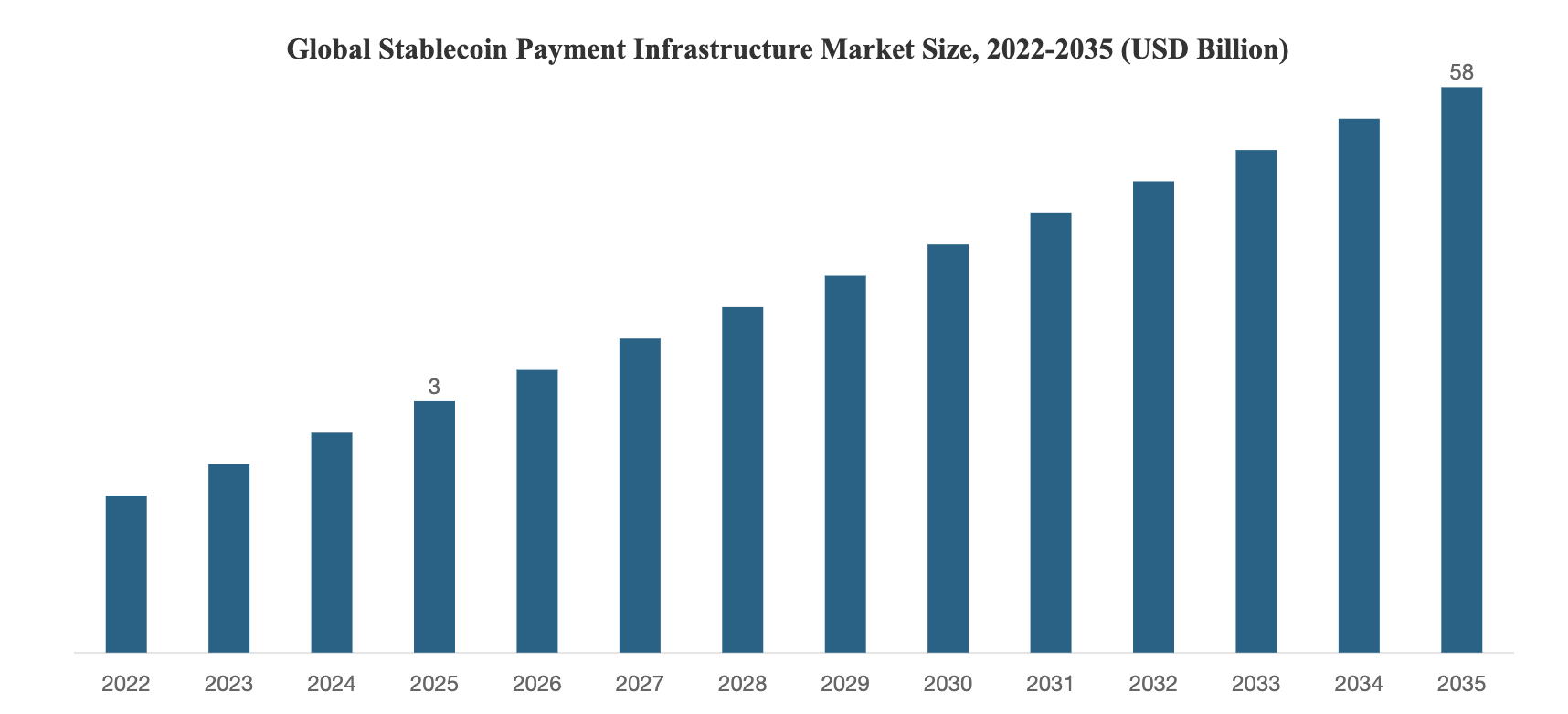
Driven by corporate demand for faster settlements, the stablecoin payment infrastructure market is projected to reach $58 billion by 2035, expanding at a rapid 34.5% CAGR. This momentum highlights how businesses are shifting away from traditional banking rails toward faster digital ledger platforms.
1. Stablecoin Payment Platform Versus Stablecoin Issuer
To choose the right technology strategy, executives must understand the operational and regulatory differences between issuers and payment platforms.
| Operational Capability | Stablecoin Issuer | Stablecoin Payment Platform |
| Primary Function | Mints and burns digital tokens against bank reserves. | Routes payments using third-party stablecoins. |
| Token Operations | Maintains 1:1 cash reserves and monthly attestations. | Manages gas fees and routes multi-chain transfers. |
| Fiat Access | Manages direct primary minting for major partners. | Integrates local banks for on-ramp and off-ramp conversion. |
| Custody Style | Controls master token contracts on blockchains. | Offers MPC-embedded wallets for corporate accounts. |
| Regulatory Focus | Governed by issuer charter rules like the US GENIUS Act. | Regulated via Money Transmission Licenses and BSA rules. |
2. Five Stablecoin Platform Models
Companies build different software setups depending on their specific operational needs:
- Merchant Payment Gateway: Processes online checkout payments while settling funds directly into fiat bank accounts.
- Cross-Border B2B Platform: Pays global vendors directly to bypass slow correspondent banking channels.
- Supplier Accounts Payable System: Automates batch vendor payments using programmable smart contracts.
- Treasury Settlement Engine: Moves cash instantly between international corporate subsidiaries without heavy FX fees.
- Embedded SaaS Platform: Offers white-label stablecoin rails inside existing B2B software products.
3. What the Platform Must Control
To maintain complete control over global transfers, the platform must manage every step programmatically:
- Identity & Onboarding: Verifies corporate identity (KYC/KYB) and checks wallet security.
- Execution & Routing: Handles payment instructions, transaction paths, and gas fee optimization.
- Compliance & Ledgering: Runs automated screen checks against sanctions lists while updating ERP ledgers.
- Settlement Verification: Coordinates bank conversions and confirms final on-chain receipt.
Ultimately, a stablecoin payment platform is an enterprise control system for global liquidity. Building this infrastructure requires careful smart contract design, strict compliance engines, and reliable accounting connections.
For a deeper breakdown of multi-chain routing strategies, see our guide on enterprise blockchain payment architecture.
Which Global Payment Use Cases Justify a Custom Build?
Custom stablecoin payment platform development for global businesses is justified when off-the-shelf payment gateways cannot handle complex multi-entity settlement, strict compliance rules, or deep corporate ERP workflows.
High-volume B2B enterprises deploy dedicated stablecoin platforms to cut intermediate bank fees, eliminate multi-day settlement delays, and bypass rigid FX spreads.
Consequently, by replacing traditional correspondent banking networks with direct digital ledger rails, companies regain full programmatic control over their global working capital and payout schedules.
1. Cross-Border Supplier and Procurement Payments
Custom platforms automate cross-border vendor payments by integrating invoice matching and purchase-order validation directly into smart contract workflows.
- Automated Disbursements: Executes milestone-based payouts for pharmaceutical ingredients, medical devices, manufacturing materials, and international tech vendors immediately upon delivery verification.
- Smart Currency Conversion: Automatically converts stablecoins into the vendor’s local fiat currency at the exact time of settlement, thereby minimizing foreign exchange exposure.
- ERP Ledger Sync: Syncs payment confirmations, invoice status updates, and fee breakdowns back into core enterprise accounting engines in real time.
2. International Payroll and Contractor Payouts
Managing high-volume global payouts requires automated batching engines alongside reliable local off-ramp access for remote workers and international contractors.
- Batch Execution: Dispatches thousands of individual payout transactions in a single batch, which drastically reduces overall network gas costs.
- Self-Serve Portals: Enables employees and contractors to link their preferred non-custodial or MPC wallets while choosing their desired ratio of stablecoins versus fiat currency.
- Automated Compliance: Handles tax reporting, tracks payout receipts, and automatically retries failed transfers using backup routing pipelines.
3. Intercompany Treasury Settlement
Multinational corporations use private stablecoin settlement rails to instantly transfer working capital between regional subsidiaries without paying traditional wire fees.
- Sub-Ledger Preservation: Preserves entity-level accounting ledgers while simultaneously updating global balance sheets in real time across 24/7 operating windows.
- Transfer Pricing Compliance: Enforces pre-set corporate approval limits, regulatory transfer-pricing rules, and treasury liquidity thresholds automatically.
- Netting and Clearing: Consolidates internal obligations across international units to execute single-net daily settlements, thereby reducing total cross-border capital movement.
4. Marketplace and SaaS Merchant Settlement
Digital marketplaces and SaaS platforms use custom stablecoin architecture to handle complex split payments, platform commissions, and automated seller payouts.
- Programmable Escrow: Holds buyer funds in secure smart contracts, releasing payouts to sellers only when delivery terms are met.
- Automated Revenue Splits: Deducts platform service fees instantly at the point of purchase before distributing the remaining funds to vendors.
- Flexible Billing Infrastructure: Supports recurring subscription invoicing, payment links, and white-label checkout APIs for merchant integrations.
5. Healthcare and Pharmaceutical Payment Workflows
Healthcare enterprises require specialized cross-border payment platforms to move funds securely across complex international supply chains and clinical trials.
- Supply Chain Procurement: Accelerates global payments for bulk raw materials, active pharmaceutical ingredients (APIs), and specialized medical equipment.
- Clinical Trial Settlements: Dispatches fast, low-fee stipends and operational disbursements to international clinical research organizations (CROs) and research sites.
- Insurer & Intercompany Transfers: Streamlines cross-border financial settlements between global hospital networks, reinsurance partners, and offshore corporate entities.
Note: These workflows manage purely financial operations and treasury transfers. Stablecoin rails do not replace clinical claims adjudication, patient billing frameworks, or health insurance reimbursement policies.
6. Corridor Qualification Scorecard
Before committing to a custom build, treasury teams must evaluate target payment routes against a structured qualification matrix:
- Transaction Cost & Speed: High current wire fees ($25–$75 per transfer) and multi-day clearing delays strongly favor stablecoin deployment.
- Payment Volume & FX Spreads: Monthly transaction volumes exceeding $1M with high currency conversion friction deliver rapid ROI.
- Banking Reliability & Off-Ramps: Unreliable local banking infrastructure or high correspondent bank drop-out rates justify digital ledger alternatives.
- Regulatory Clarity & Counterparty Readiness: Strong local VASP licensing frameworks and active supplier willingness ensure smooth platform adoption.
Ultimately, stablecoins offer their clearest advantage in high-friction, cross-border, closed-loop, or treasury-heavy payment environments. However, they may provide much less value where existing domestic payment rails are already inexpensive and immediate.
For a deeper breakdown of how custom financial engines integrate with automated auditing tools, see our guide on How to Develop a Blockchain Supply Chain Platform.
How to Choose Stablecoins, Networks, and Settlement Models
Choosing the right assets, blockchains, and settlement architecture requires aligning counterparty trust with operational efficiency.
Consequently, leaders must select token rails based on reserve transparency, network finality, and local banking integrations rather than market hype.
1. Stablecoin Selection Criteria
- Regulatory & Reserve Quality: Verify issuer licensing, reserve composition, attestation frequency, and direct redemption rights.
- Liquidity & Support: Assess regional market depth, off-ramp access, custodian integration, and historical depeg risks.
2. USDC, USDT, PYUSD, RLUSD, EURC, and DAI
| Stablecoin | Best-Fit Use Case | Main Consideration |
| USDC | Regulated enterprise and fintech flows | Strong institutional and banking support |
| USDT | High-liquidity global corridors | Evolving international regulatory review |
| PYUSD | PayPal merchant ecosystem payments | Limited network and corridor depth |
| RLUSD | Institutional settlement workflows | Ecosystem maturity and distribution |
| EURC | Euro-denominated cross-border trades | Full MiCA euro redemption compliance |
| DAI/USDS | On-chain decentralized operations | Complex collateral and governance risks |
Note: Algorithmic stablecoins carry severe depeg risks and must not serve as default enterprise settlement assets.
3. Blockchain Network Selection Framework
- Layer 1 (Ethereum, Solana, Tron, Stellar, XRP Ledger, Avalanche): Evaluated on transaction speed, sub-second finality, gas costs, and regional adoption.
- Layer 2 (Base, Arbitrum, Optimism, Polygon): Selected for low fees, Ethereum-level security, and strong institutional developer tooling.
4. Single-Chain Versus Multi-Chain Design
Starting an MVP on one or two chains avoids severe liquidity fragmentation. Conversely, multi-chain builds add complex node management, extra reconciliation paths, and broader attack surfaces.
5. Avoiding Unnecessary Bridge Risk
To prevent cross-chain exploit risks, teams should prioritize native token issuance first. Next, rely on issuer-backed transfer mechanisms or regulated liquidity providers before considering third-party bridges.
6. On-Chain, Off-Chain, and Hybrid Settlement
- On-Chain: Offers maximum audit transparency and immediate settlement.
- Off-Chain: Accelerates high-frequency internal balance transfers.
- Hybrid: Combines off-chain ledger netting with periodic on-chain finality.
Asset, network, liquidity, custody, and compliance decisions must be made together.
Stablecoin Payment Platform Architecture for Enterprises
To build stablecoin payment infrastructure for businesses that scales safely, engineering teams must deploy a modular, eight-layer architecture.
This layered design decouples client-facing payment initiation from low-level blockchain adapters and banking APIs, ensuring high system availability, strict regulatory compliance, and seamless enterprise ledger synchronization across multi-chain ecosystems.
Architecture Layer
| Architecture Layer | Core Functional Responsibilities | Key Technical Components |
| Layer 1: Experience & Initiation | Manages checkout flows, partner integrations, and payout interfaces. | REST/GraphQL APIs, SDKs, QR generators, invoice portals. |
| Layer 2: Identity & Compliance | Enforces regulatory gatekeeping and real-time transaction screening. | KYB/KYC engines, Travel Rule protocol adapters, OFAC screeners. |
| Layer 3: Payment Orchestration | Controls transaction routing, gas fees, and state transitions. | Idempotency engine, quote expiration timers, rail fallbacks. |
| Layer 4: Custody & Key Management | Secures cryptographic keys and authorizes on-chain signatures. | MPC key shares, HSM modules, multi-sig approval workflows. |
| Layer 5: Double-Entry Ledger | Maintains internal financial balances and audit-proof accounting. | Immutable debit/credit engine, FX spread tracking, sub-ledgers. |
| Layer 6: Blockchain Adapters | Normalizes multi-chain interactions and monitors network state. | Node RPC listeners, reorg handlers, smart contract listeners. |
| Layer 7: Fiat & Liquidity Rails | Coordinates banking partners, FX conversion, and treasury movement. | Virtual accounts, local clearing rails (ACH/SEPA), auto-rebalancers. |
| Layer 8: Observability & Data | Tracks system metrics, compliance logging, and operational alerts. | Prometheus metrics, ELK log stacks, automated settlement reports. |
This 8-layer architecture bridges complex distributed ledger networks with traditional enterprise accounting systems. Consequently, organizations achieve automated, real-time transaction finality without compromising security or regulatory oversight.
For a deeper breakdown of multi-agent software patterns, see our guide on How to Develop Multi-Agent Orchestration for Finance.
How a Stablecoin Payment Moves From Invoice to Settlement
Designing a custom stablecoin payment settlement platform development framework requires mapping every transaction lifecycle state from initial billing to final bank reconciliation.
Unlike simple wallet transfers, enterprise settlement orchestration guarantees absolute auditability, compliance verification, and ledger synchronization at each operational step.
Step 1 — Create the Payment Instruction
First, the system ingests payment parameters directly from an ERP or invoicing portal.
This instruction captures the payer details, beneficiary profile, invoice number, purchase order, target stablecoin asset, preferred blockchain network, and hard settlement deadlines.
Step 2 — Verify the Parties and Wallets
Next, the orchestration engine executes mandatory gatekeeping controls.
It automatically validates corporate KYB records, checks international sanctions databases, evaluates wallet risk scores, and confirms cross-border corridor eligibility before moving forward.
Step 3 — Generate the Quote and Route
Subsequently, the platform calculates exact execution costs.
It locks in the required stablecoin volume, foreign exchange conversion rate, estimated gas fees, platform service charges, and slippage tolerances, while setting a strict countdown timer on quote expiry.
Step 4 — Authorise and Broadcast the Transfer
Furthermore, the platform enforces governance rules prior to execution.
Once role-based approval limits, policy-engine checks, and Multi-Party Computation (MPC) key share signatures pass, the system broadcasts the signed transaction to the blockchain using unique idempotency keys.
Step 5 — Apply the Confirmation Policy
Crucially, submitting a transaction on-chain does not mean it is settled.
Therefore, the orchestration engine waits for a specific block-confirmation threshold, tracks chain-specific finality timers, handles potential block reorganizations, and triggers automated fallback routes if a transaction fails.
Step 6 — Post the Ledger Entries
Simultaneously, the internal double-entry accounting engine logs all financial activity.
It immediately writes balanced debits and credits across pending balances, confirmed assets, gas charges, FX spreads, counterparty liabilities, and corporate treasury accounts.
Step 7 — Convert, Pay Out, and Reconcile
Finally, the beneficiary receives the funds and chooses to hold the stablecoins, trigger an automated off-ramp into local fiat bank rails, or sweep them into long-term treasury custody.
Meanwhile, the reconciliation engine automatically matches the initial invoice against ledger postings, on-chain transaction hashes, FX rates, and bank clearing receipts.
This deterministic end-to-end flow transforms complex distributed ledger events into predictable, audit-ready enterprise accounting.
How to Build a Stablecoin Payment Platform
Understanding how to build a stablecoin payment platform requires following a phased enterprise stablecoin payment system development roadmap that prioritizes regulatory compliance and double-entry accounting before expanding features.
By executing this structured roadmap, organizations avoid common pitfalls such as liquidity lockups, uncoordinated multi-chain settlement failures, and non-compliance penalties across cross-border payment corridors.
Phase 1 — Define the Corridor and Business Case
Before writing code, engineering and treasury teams must map operating constraints, measure fee drag, and define strict performance targets for the initial payment routes.
Technical Work
- Map target payer and beneficiary jurisdictions to document local currency constraints and settlement windows.
- Measure current correspondent banking wire fees, intermediary drop fees, and foreign exchange spreads across existing corridors.
- Calculate daily transaction volumes and set maximum allowable settlement times for the new digital payment rails.
- Establish baseline return-on-investment (ROI) thresholds and define the exact scope for the minimum viable product (MVP).
Intellivon Approach
At Intellivon, we advise enterprise clients to start with a single, commercially meaningful payment corridor, such as US-to-Mexico or US-to-EU B2B supplier flows, rather than attempting to construct a global multi-asset platform from day one.
This focused approach validates real-world payment behavior, tests clearing integrations, and proves economic ROI before scaling system complexity.
Phase Deliverables
- Corridor Scorecard: Quantitative evaluation of transaction costs, settlement speeds, and FX friction.
- Business Requirements Document: Technical and functional specification for initial payment workflows.
- Volume Assumptions Model: Financial projections for daily and monthly transaction throughput.
- MVP Scope Map: Definition of core features required for the phase-one production launch.
This phase aligns business stakeholders on concrete financial metrics; once the corridor scorecard receives treasury approval, work transitions to establishing the legal and partner framework.
Phase 2 — Define the Regulatory and Partner Model
Because stablecoin transactions interact with local banking systems, this phase maps licensing obligations, Bank Secrecy Act (BSA) rules, and Virtual Asset Service Provider (VASP) guidelines across every target jurisdiction.
Operating Decisions and Technical Setup
- Determine custody model exposure (direct self-custody vs. regulated third-party institutional custody).
- Map money transmission license (MTL) requirements, FinCEN registrations, and European MiCA compliance mandates.
- Shortlist and integrate banking partners, local fiat clearing systems (ACH, SEPA, FedNow), and licensed on-ramp/off-ramp liquidity providers.
- Define strict data-residency, privacy (GDPR/CCPA), and regulatory reporting protocols for transaction metadata.
Intellivon Approach
Intellivon structures the regulatory architecture by partnering with established, licensed trust companies and liquidity providers.
Rather than assuming direct custody risks or applying for dozens of local licenses immediately, we build orchestrations that delegate fiat holding and direct token redemption to regulated partner entities, significantly reducing launch timelines.
Phase Deliverables
- Regulatory Perimeter Map: Legal breakdown of licensing requirements across all target jurisdictions.
- Responsibility Matrix (RACI): Clear assignment of compliance liabilities between the platform and external partners.
- Partner Integration Shortlist: Evaluated selection of banking, custody, and off-ramp providers.
- Compliance Control Catalogue: Detailed technical rules for AML, KYC, and sanctions screening.
Establishing the regulatory boundary ensures system compliance; the next step involves selecting the underlying blockchains, tokens, and cryptographic key infrastructure.
Phase 3 — Select the Stablecoin, Network, and Custody Model
Phase 3 selects the specific stablecoin assets, underlying blockchain networks, and cryptographic signing mechanisms that power the platform.
This technical selection balances sub-second transaction finality, network gas costs, and custodian integration depth against security threats and potential smart contract vulnerabilities.
Technical Work
- Evaluate stablecoins (USDC, PYUSD, EURC) against reserve transparency, historical peg stability, and market liquidity.
- Benchmark target blockchain networks (Ethereum, Base, Solana, Polygon, Arbitrum) on transaction speed, fee stability, and node reliability.
- Implement Multi-Party Computation (MPC) or Hardware Security Module (HSM) key management with multi-signature governance rules.
- Establish multi-tiered wallet architectures (hot, warm, cold) with automated sweep triggers and transaction velocity limits.
Intellivon Approach
We implement high-security MPC wallet architectures with multi-cloud key share dispersion. This design ensures that no single server or individual can unilaterally sign an on-chain transaction, providing enterprise-grade security while maintaining programmatic API control over payment execution.
Phase Deliverables
- Asset & Network Decision Record: Formal technical evaluation of selected tokens and chains.
- Custody Architecture Specification: Cryptographic design document for MPC/HSM key management.
- Wallet Policy Matrix: Defined approval hierarchies, spending limits, and automated sweep policies.
- Threat Model Document: Security analysis covering key compromise, depeg events, and smart contract risks.
Once cryptographic signing and network selections are locked in, development moves to the core ledger and payment execution engine.
Phase 4 — Build the Ledger and Payment Engine
Phase 4 constructs the central operational brain of the platform: a double-entry accounting ledger paired with an asynchronous payment state machine.
This critical infrastructure tracks asset balances, normalizes multi-chain transactions, and maintains an immutable internal audit trail independent of external blockchain explorers.
Technical Work
- Design an immutable double-entry accounting ledger to record pending, confirmed, fee, FX, and liability states.
- Build a deterministic payment state machine to manage transaction lifecycles, retries, timeouts, and idempotency.
- Develop multi-chain blockchain adapters to monitor block confirmations, track finality thresholds, and handle chain reorganizations.
- Implement fee calculation engines, automatic refund logic, and sub-second internal balance updates.
Intellivon Approach
Intellivon prioritizes building the internal double-entry ledger before developing any client-facing interfaces or checkout UI components.
Therefore, we treat the internal ledger, not external blockchain explorers or RPC node logs, as the absolute system of record for corporate financial reporting and auditability.
Phase Deliverables
- Core Payment APIs: REST/GraphQL interfaces for instruction creation, status tracking, and balance queries.
- Double-Entry Ledger Service: Isolated microservice managing balanced debit/credit accounting entries.
- Transaction Processing Engine: Asynchronous worker pipeline handling on-chain broadcasting and tracking.
- Administrative Operations Console: Internal dashboard for treasury monitoring and manual intervention.
Building a resilient internal ledger creates a solid accounting core, and Phase 5 connects this engine to external fiat rails and compliance screening tools.
Phase 5 — Add Fiat, FX, Liquidity, and Compliance
Phase 5 integrates external banking rails, automated foreign exchange (FX) routing, and automated compliance engines into the payment pipeline.
This layer automatically verifies corporate identities, screens wallet addresses against global sanctions databases, and converts stablecoins to local bank deposits in real time.
Technical Work
- Integrate API connectors for local banking networks (ACH, SEPA, Faster Payments) and fiat on-ramp/off-ramp providers.
- Implement real-time FX rate aggregation engines with automated spread calculations and quote lock-in timers.
- Build automated KYB/KYC verification flows, wallet risk scoring, and Travel Rule (FATF/IVMS 101) data exchange pipelines.
- Develop continuous transaction monitoring engines for automated sanctions screening (OFAC), Suspicious Activity Report (SAR) preparation, and anomaly detection.
Intellivon Approach
We build unified compliance decision engines that execute pre-funded checks in parallel.
Consequently, by running KYB, wallet risk scoring, and sanctions screening simultaneously before triggering on-chain transfers, our architecture prevents illegal transactions without delaying legitimate enterprise payouts.
Phase Deliverables
- Compliance Decision Engine: Automated service executing real-time screening and Travel Rule compliance.
- Liquidity & Treasury Dashboard: Real-time visibility into bank balances, stablecoin reserves, and FX exposure.
- FX Routing Service: API integration for real-time exchange rates and automated liquidity rebalancing.
- Automated Case Management Tool: Interface for compliance officers to review flagged transactions and generate SAR records.
With fiat, liquidity, and compliance engines operating, the platform must be hooked directly into enterprise resource planning (ERP) systems.
Phase 6 — Integrate Enterprise Systems
Phase 6 connects the stablecoin payment platform directly into core enterprise resource planning (ERP), treasury management, and accounting systems.
This seamless integration ensures that payment status updates, fees, and foreign exchange gains/losses automatically sync to internal general ledgers without requiring manual data entry.
Technical Work
- Build secure integration connectors for enterprise ERP systems including SAP, Oracle, NetSuite, and Microsoft Dynamics.
- Connect treasury management systems (TMS), procurement platforms, and automated payroll software via signed webhooks.
- Implement strict technical controls: idempotent request handling, automated retry queues, rate limiting, and tenant isolation.
- Map reference data schemas to maintain data lineage and enforce role-based access controls (RBAC) across corporate departments.
Intellivon Approach
Intellivon designs enterprise integrations around zero-trust security and absolute idempotency.
Therefore, we implement cryptographically signed webhooks and dead-letter queue recovery mechanisms to guarantee that network hiccups or ERP downtime never result in duplicate payouts or unrecorded ledger entries.
Phase Deliverables
- ERP Integration Connectors: Production adapters for major enterprise accounting systems.
- Webhook & Event Engine: Secure messaging framework for real-time payment notifications.
- Data Mapping Specification: Normalized schema mapping enterprise purchase orders to payment instructions.
- Role-Based Access Control (RBAC) System: Granular permission structures for finance and treasury operators.
System integrations complete the technical build; the final phase tests resilience under failure conditions before executing a phased production launch.
Phase 7 — Audit, Pilot, and Roll Out
Phase 7 subjects the entire platform to exhaustive security audits, chaos testing, and controlled pilot runs before launching full production operations.
This rigorous testing regimen validates smart contract security, verifies disaster recovery pipelines, and confirms that the system gracefully handles market volatility or network outages.
Testing Requirements
- Conduct third-party smart contract audits, penetration testing, and enterprise vulnerability assessments.
- Execute load testing and simulate extreme failure scenarios: node RPC outages, custodian downtime, stablecoin depeg events, and liquidity shortages.
- Test edge cases including block reorganizations, duplicate webhooks, failed bank off-ramps, and false-positive sanctions alerts.
- Implement a structured rollout sequence: sandbox testing, internal employee/treasury testing, closed counterparty pilots, and single-corridor production launch.
Intellivon Approach
We enforce a strict single-corridor pilot policy.
Before enabling additional corridors or blockchain networks, we require the platform to process live commercial transactions from onboarding to final bank reconciliation for 30 consecutive days without manual intervention.
Phase Deliverables
- Third-Party Audit Reports: Formal security, penetration, and smart contract audit certifications.
- Disaster Recovery Playbook: Step-by-step procedures for node failures, liquidity crunches, and key recovery.
- Pilot Operational Review: Comprehensive report analyzing transaction speed, costs, and reconciliation accuracy during the pilot.
- Production Deployment Sign-Off: Executive authorization for multi-corridor scaling.
For a deeper breakdown of enterprise blockchain deployment strategies, see our guide on How to Build an Enterprise Blockchain Platform Like Venom.
A production release should prove one corridor from onboarding through bank reconciliation before the platform adds more chains or countries. Consequently, expanding too early multiplies compliance, liquidity, and support problems before the core control system has stabilized.
Custody, Security, and Stablecoin Risk Controls
Securing an enterprise stablecoin platform requires protecting against private key compromise, issuer depegging, network outages, and compliance violations simultaneously.
Consequently, a production-grade risk strategy must combine multi-cloud cryptographic key management, continuous on-chain transaction analytics, and resilient fallback execution paths across the entire payment infrastructure.
Custodial, Non-Custodial, and Hybrid Wallets
| Feature | Custodial | Non-Custodial | Hybrid (MPC/Account Abstraction) |
| Regulatory Responsibility | High (VASP/CASP reporting) | Low (User self-regulates) | Shared / Delegated |
| User Experience | Seamless (Web2 logins) | Complex (Seed phrase management) | High (Passkeys / Social recovery) |
| Recovery Options | Centralized admin reset | Irrecoverable if keys lost | Threshold key share recovery |
| Transaction Speed | Instant (Off-chain ledger) | Subject to chain finality | Fast (Optimized signing queues) |
| Key-Management Burden | Fully managed by platform | Fully managed by end user | Distributed across participants |
| Integration Complexity | Moderate | Low | High |
| Best-Fit Business Model | B2B Marketplaces, SaaS | Self-sovereign DeFi rails | Enterprise B2B Cross-Border Payouts |
Enterprise security demands proactive defense against issuer insolvency, chain congestion, and fraudulent counterparties. Therefore, building multi-layered operational redundancy ensures uninterrupted, compliant settlement across all payment corridors.
AI-Powered Stablecoin Payment Platform Development
AI enhances predictive efficiency across cross-border settlement pipelines. However, AI acts purely as an intelligent assistance layer.
Consequently, probabilistic models provide real-time operational recommendations. Meanwhile, deterministic policy engines strictly govern all payment executions.
AI Capabilities and Operational Boundaries
- Fraud Detection: Models analyze transaction velocity, wallet networks, and account takeover signals.
- Intelligent Routing: Additionally, AI evaluates network fees, confirmation speeds, and liquidity depth.
- Route Approval: Ultimately, a deterministic policy engine validates and enforces the final route.
- Liquidity Forecasting: Furthermore, time-series models predict intraday stablecoin demand and payout obligations.
- Exception Triage: Similarly, AI matches incomplete invoice references without altering double-entry balances.
- Compliance Summaries: Subsequently, language models synthesize KYB data while preserving direct source citations.
- Strict Prohibitions: Nevertheless, AI models cannot sign transactions or modify ledger balances autonomously.
- Control Limits: Therefore, AI models cannot alter beneficiary addresses or override sanctions controls.
Recent research into agentic payments supports embedding policy controls directly at execution time. Therefore, using AI for intelligence while enforcing deterministic controls guarantees absolute platform integrity.
Stablecoin Payment SaaS Platform Development Cost
Stablecoin payment platform development costs between $70,000 and $300,000 for a focused enterprise software build, depending on corridor count, custody model, supported networks, compliance depth, liquidity integrations, and ERP requirements.
Cost by Development Phase
| Development Phase | Estimated Cost |
| Corridor discovery and regulatory mapping | $7,000–$15,000 |
| Architecture, product design, and threat modelling | $10,000–$22,000 |
| Ledger, wallet, and payment-engine development | $25,000–$65,000 |
| Stablecoin and blockchain integrations | $10,000–$30,000 |
| Fiat, FX, liquidity, and payout integrations | $10,000–$35,000 |
| KYC, AML, Travel Rule, and analytics integrations | $12,000–$35,000 |
| ERP, treasury, and accounting integrations | $10,000–$35,000 |
| Security testing, QA, pilot, and deployment | $10,000–$35,000 |
Cost by Platform Level
| Platform Level | Scope | Cost | Timeline |
| Focused MVP | One stablecoin, one network, one corridor, third-party custody | $70,000–$120,000 | 12–18 weeks |
| Production Platform | Two or three networks, fiat conversion, compliance automation, ledger and ERP integration | $130,000–$220,000 | 5–8 months |
| Enterprise SaaS Platform | Multi-tenant system, several corridors, advanced routing, AI monitoring, high availability | $220,000–$300,000 | 8–12 months |
Ongoing Costs and Boundaries
Additionally, organizations should budget 15%–25% of the initial software build annually for cloud infrastructure, node providers, monitoring, security patches, compliance updates, network integrations, re-audits, support, and ongoing platform enhancements.
Furthermore, this $70,000–$300,000 range covers software design, engineering, integrations, and deployment. However, it does not include external operational expenses:
- Regulatory application fees and outside legal counsel.
- Minimum regulatory capital requirements and stablecoin reserves.
- Prefunded corridor liquidity buffers.
- Custodian basis-point charges.
- Per-verification KYC costs and per-transaction blockchain analytics fees.
For a deeper breakdown of custody, blockchain, audit, and deployment costs, see our guide on Cost to Build a Stablecoin Payment Infrastructure Platform.
Build a Stablecoin Payment Platform With Intellivon
Successfully launching an enterprise payment system requires moving beyond simple token transfers to engineer compliant, production-grade financial infrastructure. Consequently, Intellivon partners with financial institutions, fintechs, and global enterprises to turn complex blockchain mechanics into reliable, audit-ready settlement rails.
Why Leading Enterprises Build With Intellivon
- Enterprise Payment Architecture: We engineer platforms around immutable double-entry ledgers, asynchronous state machines, multi-tier wallet policies, and automated reconciliation systems—treating the internal ledger as your absolute system of record.
- Regulated Workflow Engineering: We embed automated KYB/KYC verifications, OFAC sanctions screening, wallet risk scoring, Travel Rule data exchanges, and role-based approval limits directly into your transaction pipeline.
- Stablecoin and Network Orchestration: Our unified API layer abstracts multi-chain complexity, seamlessly handling gas estimation, block confirmations, reorg protection, and liquidity routing across USDC, PYUSD, Base, Solana, and Ethereum rails.
- AI-Assisted Financial Operations: We implement machine learning models within strict, deterministic guardrails—automating fraud detection, reconciliation exception triage, and liquidity forecasting while ensuring AI never modifies balances or signs transactions autonomously.
- Enterprise ERP Integration: We connect your stablecoin rails directly to SAP, Oracle, NetSuite, Microsoft Dynamics, and treasury systems using cryptographically signed webhooks and idempotent API connectors.
Ready to Build Your Payment Rail?
Discuss your stablecoin payment platform architecture, corridor strategy, and phased $70,000–$300,000 development roadmap with Intellivon.
Schedule an Engineering Consultation with Intellivon
Conclusion
Building a production-grade stablecoin payment platform requires balancing speed with strict regulatory compliance and financial auditability. By prioritizing a double-entry ledger, automated compliance checks, multi-chain orchestration, and deterministic policy controls, enterprise leaders can transform cross-border liquidity.
Consequently, executing a phased development roadmap ensures your platform proves real-world commercial ROI, minimizes liquidity risks, and delivers seamless, sub-second global settlement across every target trade corridor.
FAQs
Q1. Do We Need a Licence If We Never Custody Stablecoins?
A1. Operating a non-custodial model significantly reduces direct balance-sheet liability and asset exposure. However, non-custodial architecture does not automatically exempt platforms from regulatory oversight.
Ultimately, licensing requirements depend on who controls, transmits, or converts payments, which often triggers VASP, payment-service, money-transmission, AML, and Travel Rule obligations.
Q2. Which Stablecoin Is Best for a Global B2B Payment Platform?
A2. Selecting the optimal stablecoin depends on specific operational priorities. Choose USDC for institutional compliance, USDT where market liquidity dominates, EURC for euro settlement, PYUSD for PayPal ecosystems, or RLUSD for Ripple-based institutional flows. Consequently, platforms should only enable assets after thorough issuer, redemption, and regulatory review.
Q3. Should We Build on Ethereum, Solana, Base, or Stellar?
A3. Network selection requires balancing transaction throughput against ecosystem maturity. Select Ethereum for deep institutional liquidity, Base or other Layer 2s for low-cost EVM compatibility, Solana for high-throughput speed, or Stellar for specialized remittances. Ultimately, platforms must prioritize target corridor coverage and partner availability over theoretical network capacity.
Q4. What Happens When a Stablecoin Payment Is Sent to the Wrong Address?
A4. Because public blockchain transfers are inherently irreversible, lost funds cannot be recovered via traditional chargeback mechanisms. Therefore, platforms must actively prevent execution errors. Consequently, technical teams should implement strict beneficiary allowlists, real-time address format validations, interactive approval controls, pre-flight transaction simulations, low-value test transfers, and policy-based limits.
Q5. How Much Liquidity Does a Stablecoin Payment Platform Need?
A5. Calculating required platform liquidity involves analyzing peak daily payout volumes, conversion settlement delays, and holiday market exposure. Additionally, operators must account for corridor volatility, partner limits, and fiat buffers. Practically, maintaining a rolling buffer equal to one to three days of net payout demand offers an effective baseline.
To Sum It Up
- Stablecoin transfers may settle in seconds, but enterprise settlement is incomplete until the ledger, bank payout, invoice, compliance decision, and accounting entry reconcile.
- The blockchain with the lowest fee is not always the cheapest enterprise network. Liquidity, custody, analytics, off-ramp coverage, and operational support often matter more.
- Most enterprises should own their orchestration and ledger layers while using licensed partners for custody, fiat conversion, and regional market access.
- AI can improve fraud detection and liquidity planning, but deterministic controls must remain responsible for transaction approval and signing.
- A $70,000 platform can validate one corridor. A $300,000 platform must prove multi-tenant controls, high availability, compliance automation, and enterprise integration.