Key Takeaways:
- Epic Beaker API integration combines FHIR R4, HL7 v2, middleware connectivity, and SMART on FHIR authentication into one system.
- Core FHIR resources include DiagnosticReport, Observation, ServiceRequest, and Specimen alongside LOINC and SNOMED code normalization.
- HL7 v2 handles established laboratory transaction flows while middleware connects high-volume analyzers and clinical instruments.
- HIPAA, CLIA, and security controls are non-negotiable requirements across every integration layer and data exchange point.
-
Intellivon implements Epic Beaker integrations costing $70,000 to $300,000 depending on lab complexity, instruments, and workflow customization.
The Epic Beaker API gives external systems programmatic access to lab orders, results, and specimen data without querying Epic’s Clarity database directly. That access matters because Beaker doesn’t interface with lab analyzers on its own. Results travel through middleware layers first, according to a 2026 Epic Beaker technical overview, which adds real complexity to any integration built around it.
However, most teams underestimate that complexity until they’re mid-build. FHIR resources like DiagnosticReport and Observation cover standard lab results well, but HL7 v2 messaging still handles a large share of instrument and reference lab traffic underneath. Meanwhile, LOINC and SNOMED code mapping has to be right before an AI diagnostic tool or sepsis detection system can trust the data it’s pulling. As a result, integration timelines usually slip when that mapping work gets treated as an afterthought instead of a first step.
In this blog, we’ll walk through Epic Beaker’s API architecture, FHIR R4 and HL7 v2 integration patterns, SMART on FHIR authentication, and the clinical use cases where this data actually gets used.

What Is the Epic Beaker API and What Can It Access?
The Epic Beaker API is not a single, standalone endpoint. Rather, it represents the complete set of HL7 FHIR APIs, proprietary Epic web services, and interface specifications used to access laboratory data within Epic.
Consequently, external systems use these integration pathways to query lab orders, retrieve diagnostic results, and track specimen lifecycles across hospital networks and reference labs.
1. Where Beaker Fits Inside the Epic Laboratory Workflow
Because Epic Beaker operates as the native laboratory engine within Epic, it manages the full diagnostic lifecycle. Therefore, clinical data moves sequentially through several defined stages:
- Order Placement and CPOE: First, clinicians enter lab requests through computerized physician order entry, which Beaker validates against the laboratory compendium.
- Specimen Collection and Accessioning: Next, phlebotomists scan collection barcodes and assign accession numbers to maintain chain-of-custody tracking.
- Processing and Analysis: Meanwhile, laboratory instruments process samples across clinical chemistry, hematology, microbiology, and anatomic pathology benches.
- Result Verification: Subsequently, medical laboratory scientists verify numeric values, evaluate automated delta checks, and trigger reflex testing rules.
- Result Distribution: Finally, Beaker routes verified values to ordering clinicians, patient charts, and downstream clinical decision support alerts.
2. What Data External Applications May Need
When external applications connect to Beaker, they require structured clinical details at specific points in care. For this reason, Epic maps discrete laboratory elements into standardized data resources:
- Diagnostic Reports: High-level order status, interpretive summaries, and panel reports structured via the DiagnosticReport FHIR resource.
- Component Observations: Quantitative values, units of measure, reference ranges, and critical high/low flags structured via the Observation FHIR resource.
- Specimen and Order Metadata: Specimen sources, collection timestamps, and priority tags mapped through Specimen and ServiceRequest resources.
- Standardized Vocabularies: Standard laboratory terminologies, specifically LOINC codes for observations, SNOMED CT for pathology findings, and CPT codes for billing.
- Clinical Context: Ordering providers, performing laboratory locations, and patient demographics populated across Practitioner, Organization, and Patient resources.
3. Where API Access Ends and Interfaces Begin
Although modern REST APIs handle on-demand data exchange effectively, they do not replace high-throughput laboratory protocols. As a result, engineering teams must separate their architectural channels based on operational demands:
- FHIR REST APIs: Best suited for transactional queries, SMART on FHIR browser apps, and interactive clinical decision support tools.
- HL7 v2 Interfaces: Essential for real-time instrument automation, lab middleware connections, and high-frequency analyzer results using ORM and ORU feeds.
- Bulk Data Pipelines: Critical for large-scale clinical research, population health analytics, and AI model ingestion using Caboodle or Clarity extracts.
However, choosing the wrong integration pattern creates performance bottlenecks and message delivery failures. Therefore, understanding the exact architectural boundary between real-time FHIR endpoints and traditional interface engines is the essential next step.
Epic Beaker Integration Architecture: FHIR, HL7, and Middleware
Epic Beaker integration architecture relies on a hybrid design rather than a single protocol. Specifically, modern healthcare enterprises combine FHIR R4 REST APIs, HL7 v2 messaging pipelines, and specialized laboratory middleware to handle distinct operational workflows.
Consequently, this multi-tier architecture ensures reliable data exchange across web applications, high-throughput hospital analyzers, and external reference laboratories.
1. FHIR R4 for Application and Clinical Data Access
When external applications need real-time, on-demand clinical records, FHIR R4 provides the standard web framework. Therefore, engineering teams use Epic Interconnect servers to expose structured JSON resources securely:
- Modern REST Endpoints: Developers query standard endpoints over HTTPS to retrieve patient diagnostic histories and active orders efficiently.
- OAuth 2.0 and SMART Authorization: External web apps use SMART on FHIR user launches, while autonomous background microservices connect via backend system client credentials.
- Granular Resource Mapping: Applications access discrete laboratory entities directly, including DiagnosticReport, Observation, and ServiceRequest resources.
2. HL7 v2 for Laboratory Orders and Results
Although FHIR powers modern applications, HL7 v2 remains the workhorse for high-frequency transactional messaging. Furthermore, hospital interface teams rely on proven message standards to maintain real-time laboratory workflows:
- Bidirectional Order and Result Feeds: Interfaces route outbound orders via HL7 ORM messages and ingest inbound results through structured ORU feeds.
- Reference Lab Connectivity: External reference laboratories exchange bulk compendium orders and send-out test results over secure MLLP or VPN tunnels.
- Interface Engine Transformation: Integration engines like Mirth Connect or Rhapsody normalize segment variations before data enters the Beaker database.
3. Middleware for Analyzer and Device Connectivity
Direct API connections cannot handle the physical demands of high-volume laboratory hardware. For this reason, healthcare systems deploy certified laboratory middleware to bridge physical analyzers with Epic Beaker:
- Instrument Protocol Normalization: Middleware translates proprietary instrument driver outputs from chemistry, hematology, and microbiology analyzers into standardized Beaker formats.
- Point-of-Care (POC) Device Aggregation: Decentralized POC devices connect through centralized middleware managers to aggregate bedside testing results automatically.
- Automated Rules and Error Routing: The middleware layer executes automated delta checks, flags hardware communication errors, and reroutes rerun samples before sending verified data upstream.
4. Comparing Epic Beaker Integration Patterns
| Integration Path | Best For | Typical Data | Authentication / Transport | Key Constraint |
| FHIR R4 | Apps, CDS tools, patient portals, AI engines | Clinical reports, observations, order context | OAuth 2.0 / HTTPS (JSON) | API endpoint availability |
| HL7 v2 | High-volume transactional lab integration | Bidirectional orders (ORM) and results (ORU) | TCP/IP (MLLP) or HTTPS | Segment mapping complexity |
| Middleware | Automated analyzers, POC bedside devices | Raw instrument results, device telemetry | Vendor-specific protocols | Hardware driver variations |
| Hybrid | Enterprise health systems and academic medical centers | Unified orders, raw results, analytics feeds | Mixed protocol stack | Operational governance |
Ultimately, enterprise laboratories must avoid treating FHIR as a universal replacement for existing interface infrastructure. Instead, pairing FHIR endpoints with HL7 messaging and instrument middleware creates a dependable, high-performance integration ecosystem.
How Epic Beaker Maps Orders, Results and Specimens
Epic Beaker models laboratory diagnostics through an interconnected clinical data chain rather than isolated data points. Specifically, it maps real-world testing events into standardized data structures that link clinical intent, specimen logistics, and verified analytical findings.
Consequently, external applications can accurately reconstruct the entire lifecycle of a lab test by traversing these linked resources.
1. ServiceRequest Represents the Laboratory Order Context
The ServiceRequest resource captures the clinical intent behind a diagnostic order. Therefore, it establishes the foundation of the testing lifecycle before any specimen reaches the laboratory bench:
- Clinical Intent and Status: It defines the requested lab test panel, order intent, and current execution status from active to completed.
- Actor Identification: It explicitly binds the ordering clinician through Practitioner references and links the subject to a specific Patient record.
- Encounter Identifiers: It carries accession numbers, placer order numbers, and requisition identifiers to preserve tracking across external CPOE systems.
2. DiagnosticReport Groups the Resulted Diagnostic Work
Once the laboratory completes testing, the DiagnosticReport acts as the primary container for the completed diagnostic order. Furthermore, it organizes component-level details into an interpretable clinical document:
- Panel-Level Summaries: It aggregates multi-analyte panels, such as a complete metabolic panel or lipid profile, under a unified diagnostic heading.
- Order Linkage: It references the original ServiceRequest, confirming that the resulting parameters directly answer the initial physician requisition.
- Clinical Interpretations: It embeds high-level pathologist narratives, overall conclusion notes, and official verification timestamps.
3. Observation Contains the Individual Laboratory Results
The Observation resource stores discrete, component-level measurements generated by laboratory instruments. Because clinical interpretations depend on exact numerical boundaries, each observation holds comprehensive analytical context:
- Quantitative and Qualitative Values: It records discrete numeric values, text findings, units of measure, and established normal reference intervals.
- Interpretation Flags: It tags abnormal, critical high, or critical low values to trigger immediate downstream clinical decision alerts.
- Microbiology Hierarchies: It models isolate identifications, organism colony counts, testing methods, and antibiotic minimum inhibitory concentration (MIC) susceptibility panels.
4. Specimen Preserves the Sample Context
Without sample provenance, laboratory results lose critical diagnostic validity. For this reason, the Specimen resource maintains physical chain-of-custody data:
- Accession Mapping: It tracks unique barcode identifiers, container types, collection volumes, and laboratory accession numbers.
- Anatomical Sourcing: It details the anatomical collection site, collection method, and physiological sample type, such as serum, whole blood, or synovial fluid.
- Temporal Tracking: It records collection, receipt, and processing timestamps to evaluate sample stability and turnaround time metrics.
5. Conceptual Mapping: FHIR Resources to HL7 v2 Segments
While FHIR resources and HL7 v2 segments share core clinical concepts, they represent different architectural paradigms. The table below illustrates their conceptual relationship:
| Clinical Concept | FHIR R4 Resource | HL7 v2 Conceptual Equivalent | Technical Purpose |
| Lab Order | ServiceRequest | ORC / OBR segments | Transmits order intent, priority, and clinical indication |
| Diagnostic Report | DiagnosticReport | OBR result-level block | Groups verified findings and narrative diagnostic summaries |
| Component Result | Observation | OBX segment | Delivers discrete values, units, flags, and sensitivities |
| Specimen Data | Specimen | SPM / OBX sample fields | Tracks sample type, container, collection time, and accession |
| Patient Context | Patient | PID segment | Maintains patient demographics, MRN, and master identifiers |
| Clinician Context | Practitioner | PV1 / ORC provider fields | Identifies ordering, attending, and verifying clinicians |
Understanding this structural mapping prevents costly data truncation during integration design.
Consequently, engineering teams can build reliable data ingestion pipelines that preserve clinical context across both modern FHIR endpoints and traditional HL7 message feeds.
How to Integrate Epic Beaker API in Seven Steps
Integrating with the Epic Beaker API requires a structured sequence that spans clinical scoping, authentication setup, data translation, and failover engineering.
Consequently, engineering teams must align clinical stakeholders with technical specifications early to avoid costly scope changes during deployment.
By following these seven implementation steps, healthcare enterprises ensure their laboratory integration operates reliably in live clinical production.
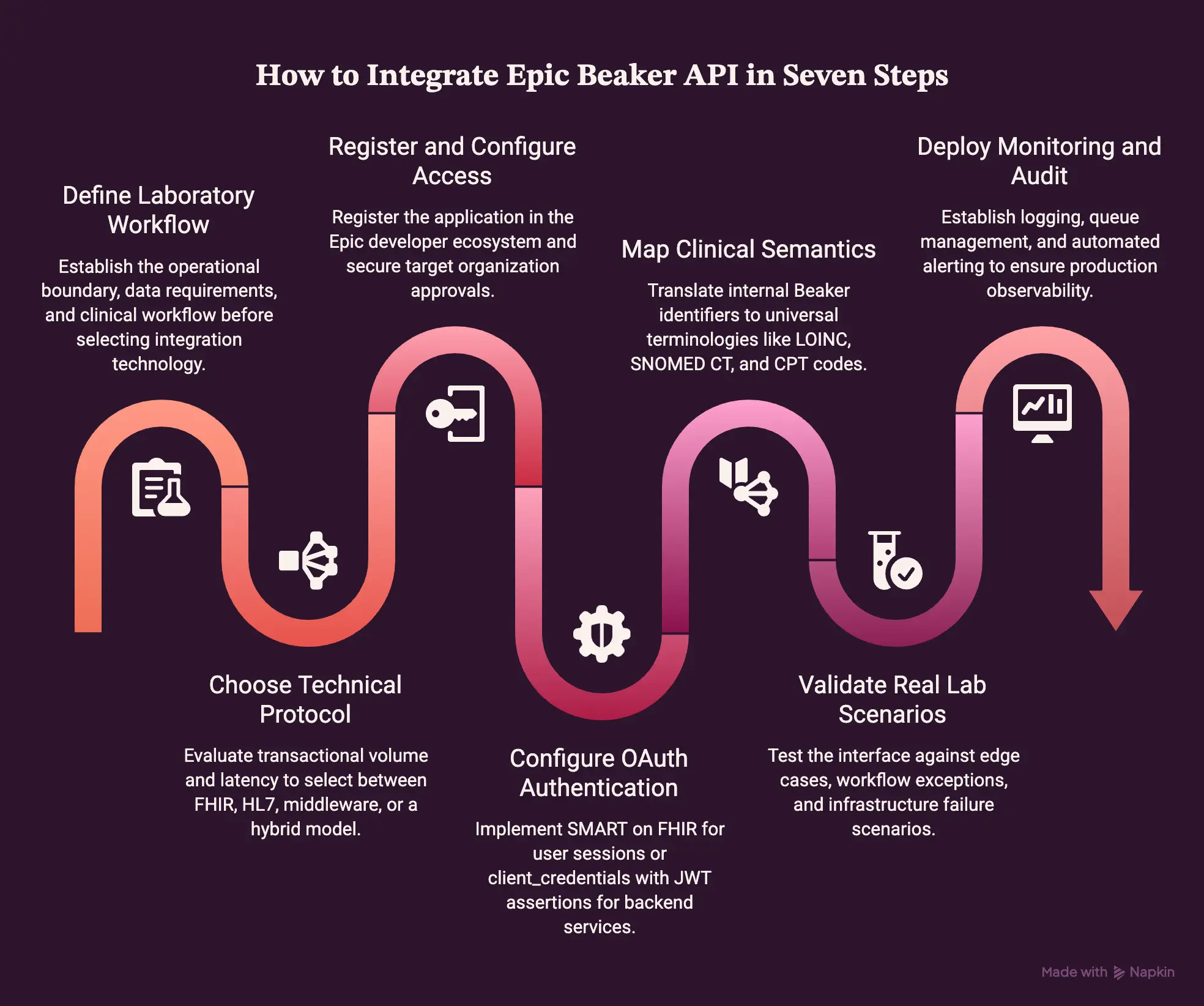 Step 1: Define the Laboratory Workflow and Data Contract
First, you must establish the exact operational boundary and data requirements of your application before selecting any integration technology.
Therefore, technical teams must explicitly define read-versus-write permissions, order-routing rules, real-time alerting triggers, and downstream analytics pipelines.
- Determine Access Directionality: Define whether your system requires unidirectional result reading, bidirectional order placement, specimen status tracking, or direct clinical decision support write-backs.
- Establish the Source of Truth: Clarify whether Epic Beaker, an external laboratory information system (LIS), or an instrument manager acts as the master record for each discrete data element.
- Document Latency Requirements: Identify whether your use case demands immediate millisecond notifications for critical STAT values or supports scheduled batch synchronization for historical reporting.
The Intellivon Approach: We establish the complete clinical workflow and binding data contract before writing a single line of API code, ensuring every data field maps directly to an approved clinical action.
Next, this established data contract dictates the transport protocols and architectural patterns required for your build.
Step 2: Choose FHIR, HL7, Middleware, or a Hybrid Model
Selecting the correct technical protocol prevents architectural bottlenecks and system failures across different laboratory workflows.
As a result, engineering teams must evaluate transactional volume, latency constraints, and write requirements rather than defaulting strictly to a FHIR-only design:
- FHIR R4 REST Endpoints: Select FHIR for user-facing browser apps, SMART on FHIR clinical decision support workflows, and lightweight cloud services querying discrete diagnostic resources.
- HL7 v2 Message Feeds: Implement HL7 v2 ORM order feeds and ORU result streams when handling high-volume, bidirectional transactional message routing between enterprise systems.
- Laboratory Middleware: Deploy dedicated middleware layers to handle proprietary instrument driver communications, sample normalization, and point-of-care analyzer aggregation.
The Intellivon Approach: We architect hybrid integration models that combine modern FHIR R4 endpoints for digital applications with HL7 v2 engines for analyzer hardware, avoiding the performance limits of pure API wrappers.
Once you select your architecture, you must provision developer access and establish your administrative foundation within the Epic ecosystem.
Step 3: Register the Application and Configure Epic Access
After choosing your technical stack, you must register your application within the Epic developer ecosystem and secure target organization approvals.
Consequently, moving from developer experimentation to hospital deployment requires completing specific administrative milestones:
- Vendor Portal Registration: Create your developer account on the openEpic portal to access public FHIR specifications, obtain non-production client IDs, and initiate test workloads.
- Sandbox Environment Testing: Validate initial HTTP queries, test schema parsing, and inspect mock laboratory responses against Epic’s public sandbox endpoints.
- Customer-Specific App Provisioning: Submit your application record to target health systems, configure organizational Interconnect base URLs, and coordinate security access approvals with hospital IT analysts.
The Intellivon Approach: We manage the administrative and technical provisioning pipeline alongside health system IT teams, accelerating client ID activation and environment readiness across testing tiers.
After securing client credentials, you must implement the appropriate OAuth 2.0 authorization flows.
Step 4: Configure SMART on FHIR and Backend OAuth
Authenticating against Epic requires implementing distinct OAuth 2.0 protocols based on whether an interactive clinician session exists.
Furthermore, background automated microservices require strict key configurations to maintain security compliance:
- User-Facing SMART App Launch: Direct clinician-facing apps through the standard SMART authorization code flow, passing launch context parameters to inherit active patient and encounter sessions.
- Backend System Authentication: Autonomous microservices must use the OAuth 2.0 client_credentials grant with asymmetric JSON Web Token (JWT) assertions signed by a private RSA key.
- 2026 JKU Key Requirements: In accordance with Epic’s platform standards, backend OAuth architectures utilize a JSON Web Key Set URL (JKU) so health systems can dynamically fetch public keys during validation, with customer environments enforcing local JKU configurations.
The Intellivon Approach: We build automated JWT signing pipelines with centralized JKU endpoints, ensuring seamless key rotation without requiring manual key updates across connected health system environments.
With secure authentication in place, you must normalize the clinical terminologies exchanged across your interface.
Step 5: Map Laboratory Codes and Clinical Semantics
Laboratory data requires precise semantic translation to prevent clinical misinterpretation across different healthcare institutions.
Therefore, technical teams must map internal Beaker identifiers to universal healthcare terminologies:
- Standardized Observation Mapping: Bind discrete laboratory analytes to specific LOINC codes and associate anatomic pathology findings with structured SNOMED CT concepts.
- Local Test Compendium Normalization: Translate hospital-specific orderable and resultable test numbers into standard billing CPT codes and external reference laboratory identifiers.
- Reference Intervals and Units: Map numeric reference ranges, abnormal flags (such as critical high/low), and standardized Unified Code for Units of Measure (UCUM) syntax.
The Intellivon Approach: We maintain terminology crosswalks within dedicated mapping tables outside core application logic, allowing clinical analysts to update test codes without modifying codebase logic.
Once clinical mappings are defined, you must thoroughly validate your interface across complex real-world edge cases.
Step 6: Validate the Integration Against Real Lab Scenarios
Testing must extend beyond standard success paths to ensure the interface functions safely under chaotic clinical conditions.
As a result, quality assurance workflows must simulate diverse laboratory operational scenarios:
- Diagnostic Result Edge Cases: Validate handling for normal values, critical out-of-range alerts, amended reports, corrected results, and preliminary microbiology cultures.
- Workflow Exception Testing: Test system resilience against cancelled physician orders, specimen collection delays, duplicate messages, and incomplete multi-analyte panels.
- Infrastructure Failure Scenarios: Simulate token expiration events, network latency spikes, interface engine dropouts, and temporary EHR downtime periods.
The Intellivon Approach: We execute synthetic, multi-variant testing suites across staging environments, verifying that data parsers handle malformed HL7 segments and unexpected FHIR null fields gracefully.
Finally, you must deploy monitoring controls to maintain data integrity and uptime once the interface goes live.
Step 7: Deploy Monitoring, Audit, and Recovery Controls
Operating an enterprise laboratory integration in production demands continuous observability and automated failure recovery.
Consequently, engineering teams must establish resilient logging frameworks to ensure continuous operational visibility:
- Queue Management and Dead-Letter Handlers: Implement message queuing with exponential backoff retries and dead-letter queues to catch failed transmissions without data loss.
- Structured Audit Logging: Maintain immutable audit logs tracking every message ID, API invocation, timestamp, and user context to satisfy HIPAA and CLIA compliance standards.
- Automated Reconciliation and Alerting: Configure real-time alerting thresholds for failed transactions, API error rates, and reconciliation monitors that verify order-to-result completion ratios.
The Intellivon Approach: We deploy end-to-end telemetry dashboards that track message latencies and queue depths in real time, alerting support engineers before minor failures impact clinical care.
Establishing these 7 integration steps guarantees a resilient technical foundation. Next, engineering teams must evaluate the specific FHIR endpoints, queries, and payload structures required to access discrete Beaker laboratory data efficiently.
Epic Beaker FHIR API Data Access and Query Design
Accessing laboratory data through the Epic Beaker FHIR API requires disciplined query structuring and resource traversal. Instead of executing broad, unindexed searches, production applications must query discrete FHIR endpoints using targeted clinical parameters.
Consequently, this targeted query design reduces server latency, prevents database timeouts, and ensures real-time access to laboratory orders and verified diagnostic reports.
1. DiagnosticReport and Observation for Lab Results
The DiagnosticReport and Observation resources form the core data retrieval pipeline for laboratory tests. Therefore, developers must structure their API queries to ingest both high-level diagnostic narratives and granular numeric measurements:
- Report Search and Status Filtering: Query DiagnosticReport?patient={id}&category=LAB to retrieve result panels, filtering explicitly by status parameters such as final, amended, or preliminary.
- Component-Level Retrieval: Extract linked result references from the report to query discrete Observation resources containing individual analyte values, reference ranges, and critical high/low flags.
- Microbiology Structure Ingestion: Parse complex microbiology reports where observations nest hierarchically to convey organism identifications, colony counts, and antibiotic susceptibility profiles.
2. ServiceRequest and Specimen for Order Context
Tracking a diagnostic test prior to result verification requires querying the original order requisition and its physical sample. As a result, technical teams link two upstream resources to establish complete operational context:
- Order Requisition Ingestion: Query ServiceRequest?patient={id}&category=108 to evaluate active laboratory orders, clinical indications, placer order numbers, and requisition priority statuses.
- Sample Provenance Mapping: Retrieve the linked Specimen resource via ServiceRequest.specimen to inspect collection container types, anatomical collection sites, and accession timestamps.
- Order Status Reconciliation: Monitor changes in ServiceRequest.status to identify cancelled, held, or delayed laboratory orders before specimens reach analytical benches.
3. Adding Patient, Practitioner, and Organization Context
Laboratory data lacks clinical utility without the accompanying provider and institutional metadata. For this reason, engineering teams resolve supporting FHIR resources to contextualize laboratory findings:
- Patient Context Resolution: Resolve Patient references to verify medical record numbers (MRNs), legal names, and demographic variables essential for calculating age-adjusted reference intervals.
- Practitioner Role Binding: Inspect Practitioner references to identify the ordering clinician, the verifying pathologist, and the designated recipient for critical abnormal alerts.
- Performing Organization Mapping: Query Organization references to capture performing laboratory CLIA license numbers, physical testing locations, and outreach billing identifiers.
4. Designing Queries for Production Rather Than the Sandbox
While sandbox environments permit loose query patterns, production hospital endpoints enforce strict performance throttles. Consequently, developers must optimize backend query design to maintain high system throughput:
- Compound Parameter Filtering: Always constrain searches using strict date windows (date=ge2026-01-01) and standardized terminology codes (code=[http://loinc.org](http://loinc.org)|2951-2) to avoid table scans.
- Compound Inclusions and Pagination: Use _include parameters like DiagnosticReport: result to retrieve parent reports and child observations in a single network round-trip, while properly handling link[rel=”next”] pagination tokens.
- Aggressive Reference Caching: Cache static reference data, such as hospital compendiums, performing laboratory profiles, and LOINC display names, in local memory to eliminate redundant API requests.
- Event-Driven Workflows Over Polling: Replace repetitive polling loops with event-driven subscriptions or interface triggers to prevent Interconnect server rate-limiting.
By optimizing FHIR query execution and caching static compendium tables, technical teams minimize overhead on clinical Interconnect servers. However, production readiness also demands strict compliance with OAuth 2.0 access scopes and hospital security governance.
Map LOINC, SNOMED, Units and Local Laboratory Codes
API connectivity without semantic normalization leaves downstream clinical applications unable to interpret laboratory data accurately. Specifically, raw database codes differ across health systems, regional facilities, and reference laboratories.
Therefore, engineering teams must standardize local orderables, clinical observations, and diagnostic vocabularies into universal medical terminologies to ensure algorithms and clinical decision support tools process laboratory values safely.
1. Normalize Test Catalog and Orderable Codes
Every hospital maintains internal test compendiums containing local acronyms and legacy order numbers. Consequently, integration teams must create bidirectional crosswalks between proprietary hospital catalogues and international standards:
- LOINC Mapping for Observations: Map every discrete laboratory analyte and orderable panel directly to standard Logical Observation Identifiers Names and Codes (LOINC) to enable universal interoperability.
- Compendium Harmonization: Consolidate local order codes with external reference laboratory test numbers to prevent mismatched test requests during send-out testing.
- Billing Code Alignment: Bind local laboratory orderables to Current Procedural Terminology (CPT) codes to ensure accurate billing translation during CPOE workflows.
2. Preserve Result Meaning
A numerical value lacks diagnostic utility if units of measure or baseline ranges become detached. For this reason, integration parsers must preserve the complete analytical context of every resulting observation:
- Unified Unit Standardization: Translate hospital-specific unit strings into the standard Unified Code for Units of Measure (UCUM) syntax to prevent unit conversion errors in downstream software.
- Demographic Reference Intervals: Capture age-adjusted, sex-adjusted, and gestational reference ranges directly alongside the raw numerical measurement.
- Abnormal Flags and Methods: Preserve critical high, critical low, and delta-check flags, while logging the specific analytical instrument method used during specimen analysis.
3. Handle Microbiology and Pathology Differently
Standard discrete numerical models fail when applied to complex pathology narratives or multi-tiered microbiology cultures. As a result, integration architectures must implement specialized data parsing rules:
- Structured Microbiology Hierarchies: Model organism identifications, isolate colony counts, and antibiotic minimum inhibitory concentration (MIC) sensitivities using discrete SNOMED CT terminology.
- Anatomic Pathology Narratives: Separate semi-structured gross descriptions, microscopic examination notes, and final histological conclusions to maintain clear diagnostic separation.
- Synoptic Reporting Integration: Ingest structured College of American Pathologists (CAP) synoptic pathology reports using standard SNOMED cancer staging codes.
4. Create Versioned Terminology Governance
Laboratory test compendiums evolve continuously as hospitals introduce new diagnostic assays and retire legacy instruments. Therefore, healthcare enterprises must establish strict governance processes to manage terminology changes over time:
- Centralized Mapping Engines: Maintain terminology translation tables within external configuration databases rather than hardcoding crosswalks directly inside application logic.
- Version Control and Auditing: Assign immutable version numbers to terminology maps, logging every code modification and approval timestamp to maintain clinical audit trails.
- Automated Compendium Syncing: Schedule automated weekly checks against health system compendium updates to flag unmapped local test codes before they cause downstream parsing errors.
Ultimately, robust semantic normalization transforms raw laboratory data into clean, computationally reliable clinical intelligence. Next, engineering teams must evaluate how this structured data powers real-time clinical workflows and advanced healthcare AI applications.
Epic Beaker API Use Cases Across Clinical Lab Workflows
Deploying the Epic Beaker API unlocks high-value clinical automations, advanced laboratory diagnostics, and enterprise analytics pipelines. However, different operational use cases require distinct architectural patterns, payload structures, and governance controls.
Consequently, engineering teams must align data access strategies directly with clinical risk profiles to deliver dependable healthcare software.
Laboratory Integration Use Case Table
| Use Case | Beaker Data Needed | Best Integration Pattern | Important Control |
| Sepsis Detection | Lactate, blood cultures, CBC, timestamps | FHIR REST + Event triggers | Latency and data completeness |
| AKI Detection | Longitudinal creatinine, eGFR trends | FHIR R4 Queries | Longitudinal baseline normalization |
| Antibiotic Stewardship | Microbiology isolates, MIC sensitivities | FHIR / HL7 + CDS Hooks | Organism and antimicrobial crosswalks |
| Reference Lab Automation | Outbound orders, returned result segments | HL7 v2 / Laboratory Middleware | Accession reconciliation |
| Digital Pathology AI | Case metadata, whole-slide IDs, synoptic notes | HL7 v2 Interface + FHIR API | Model validation and image linkage |
| Clinical Trials | Test requisitions, results, specimen metadata | FHIR R4 + Research Pipeline | Patient consent and protocol governance |
| Genomics & Precision Medicine | Molecular variants, panel reports, NGS data | Hybrid FHIR / Custom Web Services | Terminology versioning and file parsing |
| Population Health | Normalized diagnostic trends across cohorts | FHIR Bulk Data / Data Platform | Ingestion scalability and data hygiene |
| Patient Result Delivery | Finalized diagnostic reports, reference ranges | Native Epic / MyChart Integration | Institutional release delay policies |
| Lab Operations Analytics | Turnaround times, specimen statuses, test volumes | Caboodle / Clarity Data Pipeline | Timestamp consistency across benches |
1. Sepsis, AKI, and Clinical Decision Support
Predictive algorithms do not detect acute disease through magic; rather, they rely on deterministic, low-latency laboratory pipelines.
Specifically, sepsis risk engines combine serial serum lactate measurements, white blood cell counts, and blood culture statuses via event-driven FHIR calls.
Similarly, Acute Kidney Injury (AKI) algorithms monitor longitudinal serum creatinine shifts against baseline eGFR trends. Consequently, integration architectures must enforce sub-second response times and complete observation payloads to prevent delayed clinical interventions.
2. Antibiotic and Antimicrobial Stewardship
Automated stewardship platforms prevent drug-resistant hospital infections by cross-referencing culture results with active medication orders. Therefore, these systems query Beaker microbiology Observation hierarchies to inspect organism identifications and antibiotic sensitivities:
- Susceptibility Parsing: Systems extract minimum inhibitory concentration (MIC) values to identify multi-drug resistant pathogens rapidly.
- CDS Rule Execution: CDS Hooks evaluate whether an active broad-spectrum antibiotic aligns with confirmed bacterial susceptibilities.
- De-escalation Alerts: Integration triggers instantly notify hospital pharmacists to de-escalate therapies when narrower treatment options become available.
3. Clinical Trials, Biobanks, and Precision Medicine
Clinical research and personalized medicine depend heavily on structured specimen provenance and molecular test panels:
- Automated Trial Matching: FHIR search queries evaluate incoming diagnostic biomarkers to identify eligible clinical trial candidates automatically.
- Biobank Specimen Tracking: Integration pipelines link Beaker Specimen accession records with research biobank inventories to maintain cold-chain traceability.
- Pharmacogenomic Guidance: Genomic variant reports feed clinical decision support tools to prevent adverse drug reactions before physicians prescribe sensitive therapies.
4. Digital Pathology and AI Diagnostics
Modern pathology departments increasingly augment microscopic reviews with computer vision inference models. Consequently, integration engines bridge Beaker Anatomic Pathology (AP) cases with digital slide scanners:
- Slide Context Binding: Interfaces link Beaker accession numbers directly to whole-slide imaging (WSI) metadata.
- Inference Pipeline Ingestion: Pathologists review AI-generated tumor margin heatmaps and cellular quantification overlays directly alongside Beaker synoptic reports.
- Diagnostic Verification: Pathologists verify AI-assisted findings before Beaker writes final histological conclusions into the patient record.
5. Lab Quality, KPI, and Population Health Analytics
Finally, enterprise laboratory directors use structured Beaker data to optimize daily operations and monitor community health trends:
- Turnaround Time Tracking: Analytic pipelines monitor timestamps between specimen collection, laboratory receipt, and final result verification to eliminate testing bottlenecks.
- Critical-Value Escalation: Real-time dashboards track whether technicians acknowledge and communicate critical laboratory values within mandatory accreditation windows.
- Quality Reporting: Health systems extract normalized laboratory volumes to satisfy College of American Pathologists (CAP) and CLIA quality compliance audits.
Executing these advanced clinical use cases requires strict adherence to security boundaries and regulatory standards.
For a deeper breakdown of building enterprise healthcare integrations, see our guide on HIPAA-compliant healthcare software architecture.
Adding AI and Clinical Decision Support to Beaker Data
Integrating AI with Epic Beaker data requires an intermediate processing pipeline rather than direct model connections. Specifically, AI algorithms cannot process raw, unnormalized laboratory transactions without risking clinical hallucinations and false alerts.
Consequently, engineering teams must deploy a decoupled pipeline that normalizes data, extracts clinical features, executes model inference, and validates outputs before surfacing recommendations to attending clinicians.
1. Where the AI Model Should Sit
To ensure high availability and prevent clinical latency, machine learning models should reside outside the EHR within a dedicated inference layer:
- Ingestion and Normalization: First, the integration layer receives Beaker events via FHIR or HL7 feeds, mapping local lab codes to standard LOINC concepts.
- Feature Extraction Pipeline: Next, an intermediate rules engine aggregates longitudinal observations, calculating delta values, baseline shifts, and rolling ratios.
- Inference and Delivery: Finally, the AI model processes normalized feature vectors, sending validated predictions to CDS Hooks or embedded web cards within Hyperspace.
2. Separate Prediction From Clinical Action
Reliable healthcare software must clearly distinguish mathematical probability from automated clinical intervention. Therefore, systems must enforce deterministic review thresholds before taking operational action:
- Confidence Score Thresholds: Machine learning models generate probabilistic risk scores, which deterministic rules evaluate against strict organizational guidelines.
- Clinician Review Safeguards: The system surfaces diagnostic inferences as actionable recommendations rather than autonomous chart entries, requiring provider attestation.
- Configurable Escalation Paths: If risk scores exceed critical emergency thresholds, background services trigger immediate alerts to rapid response teams.
3. Design for Drift and Clinical Validation
Laboratory AI models degrade over time as hospital patient demographics, testing assays, and reagent formulas change. For this reason, engineering teams must maintain continuous validation controls in production:
- Site-Specific Baseline Testing: Health systems must validate model sensitivity and specificity against local historical patient cohorts before clinical activation.
- Continuous Drift Monitoring: In line with Epic’s data-sharing playbooks for validating AI features, teams must actively track data drift and rising false-positive rates.
- Model Versioning and Rollback: Maintain version-controlled model registries with instant rollback mechanisms to revert unstable models to previous validated checkpoints.
4. Determine Whether FDA/CDS Requirements Apply
Regulatory oversight depends strictly on the intended clinical use of your software rather than the underlying algorithm:
- Non-Device Clinical Decision Support: Systems that provide transparent, explainable recommendations allowing clinicians to independently review the underlying data generally remain outside FDA medical device enforcement.
- Software as a Medical Device (SaMD): If an algorithm autonomously analyzes complex pathology images or calculates definitive diagnostic verdicts without independent clinician review, it falls under FDA SaMD oversight.
- Institutional Governance Review: Clinical AI steering committees must review all model logic and intended use documentation prior to hospital deployment.
Deploying responsible, explainable AI ensures that algorithmic predictions improve patient outcomes without compromising safety.
However, running these predictive pipelines across production hospital networks also requires transparent budgeting, structured deployment phases, and clear operational cost models.
Secure Epic Beaker API Access for HIPAA and CLIA Workflows
Securing Epic Beaker API access requires technical controls that satisfy both HIPAA privacy standards and CLIA laboratory quality mandates. Specifically, integration architectures must enforce end-to-end data encryption, precise role-based authorization, and tamper-evident audit logging across every transaction.
Consequently, engineering teams must safeguard electronic Protected Health Information (ePHI) while preserving the analytical provenance required for clinical laboratory compliance.
1. Use Minimum-Necessary Data and Scopes
Under the HIPAA Privacy Rule, applications must restrict data consumption to the minimum necessary information required for their clinical function. Therefore, technical teams must design fine-grained OAuth 2.0 authorization scopes:
- Granular Scope Design: Avoid broad wildcard scopes like patient/*.read, requesting only specific resource-level permissions such as Observation. read or DiagnosticReport.read.
- Context-Driven Sessions: Bind clinician-facing applications to active launch tokens that restrict data access exclusively to the open patient and encounter.
- PHI Minimization Pipelines: Implement payload filtering layers that strip unrequested identifiers, such as Social Security numbers or full street addresses, before transmitting data to third-party microservices.
2. Build Auditability Into Backend Integrations
Autonomous backend services operate without interactive clinician sessions, creating specialized auditing requirements. For this reason, Epic enforces structured identity mapping to trace non-interactive API traffic:
- Epic Background User Mapping: When deploying backend OAuth applications, hospital client systems administrators must link your application’s client ID directly to a dedicated Epic audit user account.
- Immutable Transaction Logging: Capture every API request, response code, message identifier, requesting IP address, and cryptographic signature in tamper-evident log stores.
- Automated Security Monitoring: Stream access logs to centralized Security Information and Event Management (SIEM) systems to detect anomalous query spikes or unauthorized data extraction attempts in real time.
3. Protect Laboratory Result Integrity
Clinical laboratory regulations under CLIA require systems to preserve exact analytical integrity throughout the data lifecycle. As a result, integration pipelines must guarantee that no data corruption occurs during transit or transformation:
- Cryptographic In-Transit Security: Enforce TLS 1.3 encryption across all HTTPS endpoints and VPN tunnels, combined with AES-256 encryption for data at rest.
- Transformation Audit Trails: Log all message transformations between HL7 v2 segments and FHIR resources to verify that numerical values, decimal placements, and units remain uncorrupted.
- Amended Result Handling: Maintain deterministic error queues and reconciliation workflows to process corrected, amended, or cancelled laboratory reports without overwriting historical audit entries.
4. Govern Patient Result Release and External Access
Exposing laboratory findings through patient portals like MyChart requires balancing institutional release policies with federal 21st Century Cures Act information-blocking rules:
- Information-Blocking Compliance: Support automated, immediate result releases to patient-facing applications via FHIR endpoints to avoid regulatory non-compliance penalties.
- Sensitive Result Governance: Configure institutional release delays for sensitive diagnostic results, such as complex anatomic pathology or genetic test panels, to ensure clinicians review findings with patients first.
- Business Associate Agreements (BAAs): Execute formal BAAs, establish strict seven-year CLIA data retention schedules, and document formal breach notification
Maintaining airtight security and compliance controls protects healthcare organizations from severe regulatory liabilities. Next, engineering teams and laboratory leaders must evaluate the financial investment, infrastructure requirements, and phased timeline needed to complete an Epic Beaker integration build.
How Much Does Epic Beaker API Integration Cost?
A production Epic Beaker API integration typically requires a $70,000–$300,000 development budget in the scope model used for this guide, depending on data direction, HL7 and FHIR requirements, middleware, laboratory complexity, AI functionality, and the number of Epic environments or sites.
However, this represents an engineering project-scoping estimate rather than an Epic-published vendor price.
1. Epic Beaker Integration Budget by Phase
| Development Phase | Recommended Budget |
| Workflow Discovery and Integration Design | $8,000–$18,000 |
| Epic Access, OAuth, and Architecture Setup | $10,000–$25,000 |
| Core FHIR/HL7 Integration Development | $22,000–$60,000 |
| Lab Terminology and Workflow Mapping | $10,000–$35,000 |
| Middleware, Reference Lab, and Pathology Connectors | $10,000–$55,000 |
| Security, Validation, and Performance Testing | $5,000–$35,000 |
| Deployment, Monitoring, and Go-Live | $5,000–$22,000 |
| Optional AI and CDS Layer | $20,000–$50,000 |
1. Integration Project Scope Tiers
- $70,000–$110,000 (Focused Integration): Covers a single defined workflow with unidirectional read access, basic Observation retrieval, and limited local terminology mapping.
- $110,000–$200,000 (Enterprise Laboratory Integration): Implements hybrid FHIR and HL7 pipelines, bidirectional order workflows, middleware connections, and production telemetry monitoring.
- $200,000–$300,000 (Multi-Workflow or AI-Enabled Ecosystem): Connects multiple hospital sites, complex anatomic pathology streams, reference lab send-outs, and custom AI inference models.
2. Annual Maintenance Assumptions
As an Intellivon project-planning assumption, organizations should allocate 15–22% of the initial development budget annually to sustain production operations. Consequently, this recurring budget covers ongoing operational requirements:
- Routine Epic version upgrades and regression testing.
- Continuous interface queue monitoring and dead-letter recovery.
- Annual LOINC, SNOMED, and local compendium terminology updates.
- OAuth certificate rotation, JKU key updates, and security patches.
For a deeper breakdown of Epic-connected application economics, see our guide on [Cost to Build Epic-Integrated Healthcare Applications].
Ultimately, selecting the right architectural scope early ensures predictable development timelines and protects your deployment from costly scope expansion.
Build Epic Beaker Integrations With Intellivon
Connecting clinical laboratory workflows to modern applications requires disciplined healthcare engineering, not generic software development.
Intellivon builds and deploys production-ready integration infrastructure that bridges Epic Beaker with external laboratory information systems, diagnostic instruments, and predictive AI models.
- Epic and FHIR Integration Engineering: Direct configuration of FHIR R4 endpoints, SMART on FHIR authorization flows, and backend OAuth 2.0 architectures.
- Bidirectional HL7 Integration Layers: High-throughput interface engine pipelines handling HL7 v2 ORM order routing and ORU result delivery.
- Clinical Data Normalization: Robust terminology mapping services that translate local compendiums to standard LOINC, SNOMED CT, and UCUM units.
- AI and CDS Architecture: Decoupled inference pipelines and CDS Hooks that deliver real-time risk scores without clinical latency.
- Laboratory Middleware Connectors: Reliable bridges between physical analyzers, point-of-care devices, and enterprise LIS databases.
- HIPAA and CLIA-Ready Security: Granular scope design, backend Epic user audit mapping, and encrypted data pipelines.
- Multi-Variant Scenario Testing: Rigorous validation across amended results, partial panels, downtime intervals, and edge-case exceptions.
- Production Observability: Real-time queue telemetry, dead-letter monitoring, and automated reconciliation dashboards to guarantee uptime.
If your team is designing, scoping, or building an Epic Beaker integration, speak with an Intellivon integration architect to review your technical data contract.
Conclusion
Building a production epic beaker api integration rarely fails at fetching a single data payload. Instead, success depends on pairing FHIR APIs, HL7 feeds, and laboratory middleware to fit each workflow. Teams must preserve semantic terminology through rigorous validation and strict operational governance.
Consequently, executing within a standard $70K–$300K scope requires experienced engineering. Intellivon delivers the reliable, compliance-ready infrastructure your laboratory requires.
FAQs
Q1. Does Epic Beaker use FHIR R4, HL7 v2, or both?
A1. Epic Beaker uses both standards depending on the workflow. Specifically, modern applications and decision support tools use FHIR R4 REST APIs for on-demand clinical queries. In contrast, high-volume transactional workflows, such as bidirectional analyzer feeds and reference lab orders, rely on robust HL7 v2 messaging pipelines.
Q2. Can a laboratory analyzer connect directly to Epic Beaker?
A2. While some modern analyzers support direct HL7 interfaces, healthcare organizations typically deploy certified laboratory middleware instead. This middleware layer normalizes proprietary device protocols, handles point-of-care instrument aggregation, and executes automated delta checks. Consequently, routing hardware through middleware prevents direct analyzer traffic from overloading core Beaker database queues.
Q3. Which FHIR resources expose Beaker laboratory data?
A3. External applications retrieve laboratory diagnostic information by querying the DiagnosticReport and Observation resources. Additionally, systems query ServiceRequest and Specimen resources to inspect initial order requisitions and physical sample details. Finally, supporting Patient, Practitioner, and Organization resources provide critical demographic, ordering clinician, and performing laboratory context.
Q4. Can the Epic Beaker API write laboratory results back to Epic?
A4. Write availability depends entirely on the specific API endpoint and organizational customer build rather than blanket resource support. Although certain FHIR resources permit write transactions, production laboratory results typically write back through validated HL7 v2 ORU feeds. Therefore, engineering teams must verify local Epic specifications before assuming write capability.
Q5. What authentication does an Epic Beaker integration require?
A5. User-facing web applications require the SMART on FHIR authorization code flow. Meanwhile, autonomous backend services use the OAuth 2.0 client_credentials grant with asymmetric JWT assertions. Furthermore, backend production setups require a registered JSON Web Key Set URL (JWKS) and an explicit mapping to a customer Epic audit user account.
Q6. Does an AI application consuming Beaker results need FDA clearance?
A6. FDA oversight depends strictly on your software’s intended clinical use. If an algorithm independently analyzes pathology images to generate autonomous diagnostic verdicts, it falls under Software as a Medical Device (SaMD) regulations. Conversely, non-device clinical decision support platforms that provide transparent, explainable recommendations for independent clinician review generally do not require clearance.
To Sum It Up
- An Epic Beaker integration should not start with “Which API do we call?” It should start with “Which laboratory workflow are we changing?”
- FHIR, HL7 v2, and laboratory middleware solve different integration problems. At the same time, treating them as interchangeable creates unnecessary architecture debt.
- A lab result is only useful downstream if its test code, specimen, units, reference range, status, and clinical context survive the integration
- The $70K integration is usually a narrow data-access project. At the same time, the $300K integration is an operational platform spanning interfaces, mappings, validation, monitoring, and often AI.
- The best AI model cannot compensate for poorly normalized laboratory data or an unreliable result-delivery architecture.