Key Takeaways:
- Choose healthcare software partners based on clinical-domain fit, regulatory knowledge, integration evidence, and delivery maturity.
- HIPAA/BAA readiness, HL7/FHIR capability, Epic/Oracle Health integrations, cloud security, and AI governance are essential evaluation criteria.
- FDA, ONC, and CMS requirements are product-specific and should be assessed individually rather than applied universally across all builds.
- Custom healthcare software costs $70,000 to $300,000 with realistic development windows of four to nine months depending on complexity.
- Intellivon combines healthcare engineering, interoperability, and production AI as a development partner with clinical and compliance depth.
Choosing the right healthcare software development company matters more than most procurement teams realize, because healthcare IT projects overrun budget by a median of 33%, according to 2026 project failure data from KPMG. That gap rarely comes from bad engineers. It comes from a firm that didn’t understand HIPAA, FHIR, or FDA requirements until midway through the build.
However, technical skill alone doesn’t prevent that outcome. A firm needs to understand HIPAA, FHIR, and FDA requirements before the contract is signed, since compliance gaps found mid-build often force a full architectural rebuild. As a result, that rework is exactly what turns a six-month project into a year-long one.
Intellivon works on healthcare and fintech projects with compliance built in from day one, not retrofitted after launch. In this blog, we’ll walk through the evaluation criteria that actually predict a successful partnership, which includes clinical domain expertise, regulatory knowledge, engagement model, and pricing transparency.
What Is a Healthcare Software Development Company?
A healthcare software development company is a specialized engineering partner that designs, builds, validates, deploys, and maintains software specifically engineered for regulated clinical environments.
Consequently, these firms operate under strict technical constraints. They build systems that safely process protected health information (PHI), integrate with hospital record networks, and directly support medical decision-making.
Architectural Differences: General Agency vs. Healthcare Specialist
Standard IT agencies build commercial software using generic web patterns.
Conversely, a healthcare development specialist designs around clinical risk, strict interoperability frameworks, and federal data protection laws.
| Engineering Domain | General Software Agency | Healthcare Software Development Company |
| Workflow Scope | Standard user journeys | Clinical informatics and hospital operational workflows |
| Interface Standards | Basic JSON / REST APIs | HL7 FHIR (R4), SMART on FHIR, ANSI X12, and DICOM protocols |
| Data Protection | Standard TLS encryption | End-to-end ePHI controls, zero-trust policies, and field-level encryption |
| Quality Verification | Functional unit testing | Clinical workflow validation, edge-case safety tests, and load testing |
| AI Systems | Generic LLM wrappers | Governed clinical AI, ambient documentation, and validated decision support |
| Hosting & Cloud | Standard multi-tenant setups | Dedicated, BAA-covered infrastructure on AWS Healthcare or Azure Health |
| Maintenance Scope | Codebase bug fixes | FHIR interface updates, regulatory tracking, and AI model drift audits |
As a result, these specialists frequently build bidirectional Epic and Cerner EHR integrations, ambient AI scribes, revenue cycle automation tools, and remote patient monitoring (RPM) hubs.
For a deeper breakdown of the development lifecycle, see our guide on Healthcare Software Development: A Complete Guide.
Ultimately, choosing a domain-specific partner prevents costly refactoring when your system faces institutional IT audits.
Therefore, partnering with specialized engineering teams like Intellivon ensures your core clinical infrastructure remains compliant, reliable, and production-ready from day one.
Criteria for Choosing a Healthcare Software Company
Selecting a healthcare software development company demands a rigorous evaluation of technical execution, regulatory competence, and clinical domain expertise. Because consumer-grade engineering patterns break under hospital operational constraints, software mistakes risk patient safety and invite severe federal sanctions.
Therefore, healthcare procurement teams should benchmark prospective partners against seven specific architectural standards.
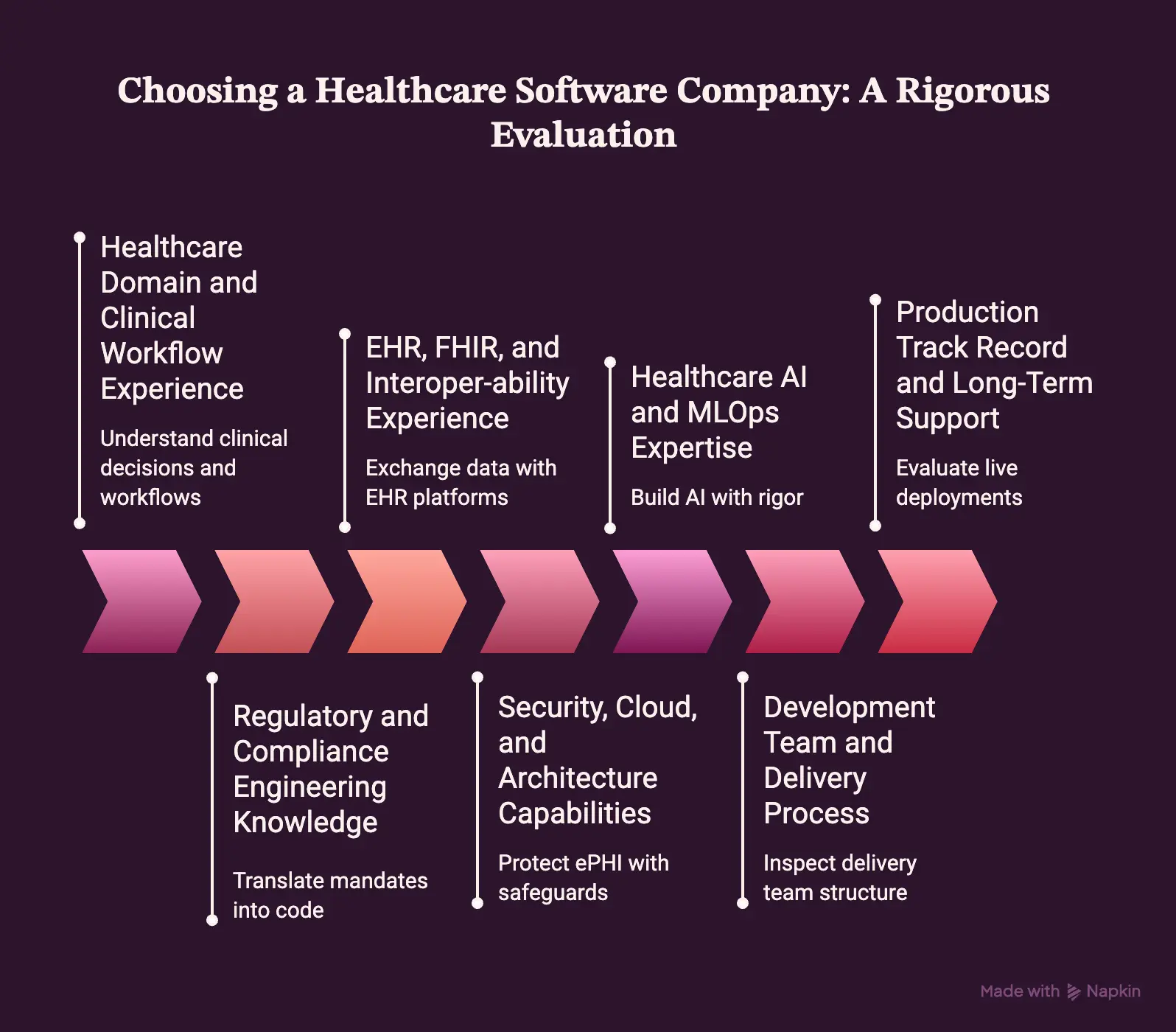
1. Healthcare Domain and Clinical Workflow Experience
Healthcare software cannot be designed in an architectural vacuum. Consequently, engineering teams must understand how clinical decisions, billing cycles, and operational handoffs occur in live hospital settings.
- Workflow depth: Verify past delivery in complex clinical domains, such as clinical decision support, radiology AI, or revenue cycle management (RCM), rather than basic wellness apps.
- Architecture impact: Demand that the vendor explain how a past architectural decision directly reduced physician cognitive load or prevented data entry errors.
- Clinical informatics: Confirm the team understands clinical terminology standards like SNOMED-CT, LOINC, and RxNorm to prevent dangerous downstream data corruption.
2. Regulatory and Compliance Engineering Knowledge
A competent healthcare engineering partner translates statutory mandates directly into functional code and infrastructure controls. Hence, their engineering patterns must reflect real-world federal enforcement realities.
- HIPAA/HITECH boundaries: Note that HHS designates a vendor as a Business Associate only when they create, receive, maintain, or transmit ePHI, necessitating strict BAA controls.
- Control mapping: Ask: “Show us how a specific HIPAA technical safeguard directly altered your database schema, encryption, and audit logging.”
- Regulatory frameworks: Confirm hands-on engineering experience with FDA Software as a Medical Device (SaMD) controls, ONC certification criteria, and GDPR where cross-border data flows exist.
3. EHR, FHIR, and Interoperability Experience
Enterprise interoperability demands far more than basic REST API connectivity. As a result, your partner must demonstrate production experience exchanging data with major EHR platforms like Epic, Oracle Health (Cerner), MEDITECH, and athenahealth.
- Interface standards: Require production proficiency in HL7 v2, FHIR R4, SMART on FHIR, CDS Hooks, C-CDA, and ANSI X12 EDI transaction sets.
- Conformance testing: Verify the vendor validates FHIR interfaces against official tools like the ONC Inferno framework.
- Resilience design: For a deeper breakdown of multi-system data synchronization, see our guide on [LINK: Healthcare Data Interoperability Platform Development].
4. Security, Cloud, and Architecture Capabilities
Under HHS guidelines, covered entities and business associates must implement strict administrative, physical, and technical safeguards to protect ePHI. Thus, system security must be embedded into the initial system topology.
- Access controls: Look for role-based and attribute-based access control (RBAC/ABAC), multi-factor authentication (MFA), and zero-trust network boundaries.
- Data protection: Verify field-level AES-256 encryption at rest, TLS 1.3 in transit, automated secrets rotation, and strict logging architectures that prevent accidental PHI leakage into debug logs.
- Infrastructure validation: Demand third-party SOC 2 Type II reports, HITRUST certifications, routine penetration test results, and clear Recovery Time/Point Objectives (RTO/RPO).
5. Healthcare AI and MLOps Expertise
Building healthcare AI requires far more engineering rigor than calling public LLM endpoints. For this reason, vendors must demonstrate robust model governance, data provenance, and continuous monitoring pipelines.
- Data isolation: Require contractual and technical guarantees: “Can our patient or clinical data be used to train or fine-tune any shared or foundation model?”
- Clinical validation: Evaluate de-identification pipelines, retrieval-augmented generation (RAG) hallucination guards, and subgroup bias testing.
- Supervised workflows: For detailed architectural patterns on governed clinical AI, see our guide on [LINK: How to Develop a Clinical Decision Support System].
6. Development Team and Delivery Process
Sales promises frequently unravel when projects transition to offshore or junior engineering pools. Accordingly, you must inspect the actual delivery team structure before signing a statement of work.
- Key personnel: Meet the named solutions architect, healthcare product manager, lead security engineer, and QA lead during procurement.
- Delivery transparency: Ask the defining operational question: “Which specific engineering leaders in this sales cycle will remain dedicated to our codebase post-signing?”
- Agile governance: Review sprint cadence, change-order protocols, risk escalation frameworks, and real-time backlog transparency.
7. Production Track Record and Long-Term Support
Case studies must reflect live enterprise deployments rather than static prototypes or abandoned sandbox pilots. Furthermore, real-world operational resilience reveals a vendor’s true engineering maturity.
- Production complexity: Evaluate client deployments based on daily active users, concurrent FHIR transactions, and sustained uptime in regulated clinical settings.
- Reference audits: Ask client references how the vendor responded when an EHR schema broke unexpectedly, scope changed mid-flight, or security audits flagged vulnerabilities.
- Lifecycle engineering: Confirm post-launch service-level agreements (SLAs), continuous patching protocols, and interface maintenance options.
At Intellivon, we approach every healthcare engagement through these seven rigorous benchmarks, ensuring engineering decisions protect patient safety and scale reliably across hospital networks.
How Intellivon Meets Healthcare Vendor Selection Criteria
Evaluating a healthcare software development company requires auditing empirical engineering evidence across domain knowledge, regulatory controls, production architecture, and delivery capability.
Consequently, Intellivon maps directly against this framework by unifying full-stack application development, data engineering, MLOps, computer vision, and healthcare-specific AI systems within a single, accountable delivery model.
1. Healthcare Engineering Goes Beyond App Development
Clinical software must align with complex hospital operational realities. Therefore, interfaces succeed only when built around clinical handoffs and provider cognitive load.
- Workflow scope: Intellivon builds provider-facing dashboards, patient portals, telemedicine engines, and imaging pipelines directly aligned with real clinical routines.
- Operational context: Systems are engineered to streamline triage, billing handoffs, and data aggregation rather than simply presenting isolated data screens.
2. AI and Full-Stack Engineering Sit Under One Delivery Model
Healthcare initiatives frequently stall when machine learning teams operate separately from core product engineers. Thus, housing both capabilities under one roof eliminates critical architectural friction.
- Unified pipelines: Intellivon integrates custom LLMs, computer vision algorithms, and MLOps directly into scalable web, mobile, and cloud environments.
- Buyer impact: This consolidated approach closes the risky capability gap between an initial AI prototype and the production software running it.
3. Security and Compliance Are Architecture Requirements
Healthcare software demands privacy controls embedded directly into system architecture. Hence, compliance serves as a foundational engineering constraint rather than an afterthought.
- Technical safeguards: Intellivon designs HIPAA-compliant environments with field-level encryption, zero-trust network policies, RBAC access controls, and PHI-sanitized logging.
- Verified execution: Third-party Clutch reviews routinely emphasize this disciplined focus on data privacy and security across regulated healthcare environments.
4. Intellivon Builds Beyond the Proof-of-Concept Stage
Deploying hospital-grade platforms requires engineering rigor long after initial model validation. Accordingly, enterprise viability depends on post-prototype infrastructure.
- Production scaffolding: Teams implement resilient API gateways, automated CI/CD pipelines, container orchestration, and continuous system monitoring.
- Sustained reliability: Managed sustenance and active MLOps governance actively monitor model drift, EHR schema updates, and interface health.
Ultimately, Intellivon delivers the highest ROI when healthcare organizations require AI, software engineering, and secure cloud infrastructure to operate as one unified system.
Healthcare Software Intellivon Has Already Built
Evaluating a healthcare software development partner requires reviewing production systems across workflow complexity, data sensitivity, and clinical deployment environments.
Consequently, healthcare procurement teams should inspect whether a firm has delivered software across diverse clinical, consumer, and administrative paradigms.
Intellivon has engineered distinct systems addressing specialized technical challenges across diagnostic computer vision, compliant telehealth, pediatric consumer UX, and enterprise healthcare CRM.
1. AI-Assisted Mobile Endoscopy Diagnostics Platform
Diagnostic imaging software operates under strict latency, precision, and clinician usability requirements. Therefore, we engineered a mobile-assisted procedural platform that harmonizes real-time video feeds with automated diagnostic support directly in procedural suites.
- Case study details: For a complete architectural breakdown, explore what we built in our deep dive on the AI-Assisted Mobile Endoscopy Diagnostics and Workflow Platform.
- Real-time mucosal analysis: We engineered low-latency computer vision models running frame-by-frame on edge devices to highlight anomalies during active endoscopic procedures.
- Automated clinical charting: We built direct pipelines that structure video metadata into standardized clinical reports, removing manual charting overhead for gastroenterologists.
- Why it matters: Building diagnostic support requires harmonizing clinical usability, data processing, and edge inference so physicians can operate without software interruption.
- Capability proven: Clinical AI, diagnostic computer vision, low-latency mobile engineering, and procedural workflow integration.
2. AI-Driven HIPAA-Compliant Telemedicine Platform
Virtual care delivery demands end-to-end data encryption, real-time multimedia synchronization, and resilient identity governance.
Hence, we engineered a compliant virtual consultation engine with security protocols embedded directly into network sockets and database layers.
- Case study details: To review the architectural framework we deployed, visit our case study on the AI-Driven HIPAA-Compliant Telemedicine Platform.
- Encrypted communication streams: We built low-latency, encrypted WebRTC video pipelines paired with automatic session termination and field-level encryption for consultation notes.
- AI-assisted clinical intake: We implemented automated clinical summarization models that extract intake data while generating immutable audit logs for protected health information (PHI).
- Why it matters: This project proves our healthcare experience extends beyond isolated models into end-to-end platforms where security, usability, and workflow design operate together.
- Capability proven: Regulated telehealth architecture, HIPAA/HITECH technical safeguards, secure WebRTC protocols, and bidirectional provider-patient workflows.
3. AI-Powered Child Care Engagement and Support App
Consumer-facing health applications require intuitive interfaces that drive sustained daily adherence.
Thus, we engineered a pediatric platform for parents and caregivers that bridges behavioral engagement with secure health data infrastructure.
- Case study details: Explore the complete product design in our deep dive on the AI-Powered Child Care Engagement and Support App.
- Personalized milestone tracking: We built interactive developmental dashboards backed by personalized recommendation algorithms that deliver guidance through asynchronous notification channels.
- Clinical export pathways: We designed structured observation logs that allow parents to export chronological developmental summaries directly into clinical formats for pediatric visits.
- Why it matters: Unlike hospital back-office systems, consumer health applications require high UX polish to prevent patient abandonment while maintaining data security.
- Capability proven: Patient and family UX design, personalized recommendation algorithms, mobile consumer architecture, and caregiver engagement workflows.
4. AI-Powered Healthcare CRM and Patient Engagement Platform
Enterprise health systems manage complex operational funnels that bridge marketing outreach, patient scheduling, and clinical follow-ups.
Accordingly, we built an enterprise healthcare CRM that coordinates communication across clinical and administrative boundaries without creating data silos.
- Multi-facility routing: We developed automated communication funnels that route incoming patient inquiries across distributed facility networks while managing scheduled follow-ups.
- Predictive no-show prevention: We engineered predictive machine learning models that detect cancellation risks and trigger automated re-engagement workflows to protect clinical capacity.
- Why it matters: This system shows our engineering covers operational enterprise pipelines that connect patient data, business logic, and automated communication.
- Capability proven: Healthcare CRM architecture, operational workflow automation, predictive patient segmentation, and enterprise data synchronization.
Intellivon Healthcare Engineering Proof Table
The following matrix summarizes how these live production systems map directly against key healthcare software capabilities:
| Intellivon Healthcare Project | Primary Technical Challenge | Core Capability Proven |
| Mobile Endoscopy Diagnostics | Low-latency inference on live video feeds | Clinical AI, computer vision, and procedural workflow design |
| HIPAA Telemedicine Platform | Encrypted real-time data flows and access control | Secure telehealth engineering, WebRTC, and ePHI protection |
| Child Care Support App | Sustained consumer engagement and usability | Caregiver UX, mobile architecture, and personalized AI |
| Healthcare CRM Platform | High-volume cross-channel operational funnels | Enterprise workflow automation, CRM, and patient lifecycle management |
Taken together, these projects matter more than a long portfolio of visually similar healthcare apps. They demonstrate proven delivery across clinical, consumer-facing, and operational software rather than a single narrow product type.
Because Intellivon builds across diverse regulatory and operational tiers, health systems gain an engineering partner prepared to navigate the full lifecycle of custom digital health development.
What Does Healthcare Software Development Cost in 2026?
Healthcare software development typically costs $70,000 to $300,000 for the project scope covered in this guide, depending on integrations, regulatory complexity, AI requirements, security, and deployment scale.
Consequently, engineering budgets fluctuate based on clinical risk classifications and interface depth. Therefore, health systems must evaluate capital expenditure across distinct technical milestones rather than accepting opaque lump-sum estimates.
Phase-Wise Development Cost Breakdown
The following breakdown outlines expected capital allocation across standard engineering phases.
However, these figures represent component ranges rather than strictly additive line items for every build.
| Development Phase | Expected Investment Range |
| Discovery & Healthcare Workflow Mapping | $8,000 – $20,000 |
| UX & Product / Technical Architecture | $10,000 – $25,000 |
| Core Application Development | $25,000 – $85,000 |
| EHR / API / Data Integrations | $15,000 – $50,000 |
| AI & Data Engineering (Where Applicable) | $15,000 – $60,000 |
| QA, Security & Clinical Validation | $10,000 – $35,000 |
| Deployment, Training & Launch | $5,000 – $20,000 |
Architecture Tiers and Deployment Scope
Project costs align directly with architectural complexity and third-party data dependencies. Specifically, implementations typically fall into three operational investment tiers:
- Focused Healthcare MVP ($70,000 – $120,000): Basic clinical or patient-facing applications with standard REST APIs and core HIPAA security safeguards.
- Integrated Healthcare Platform ($120,000 – $200,000): Multi-tenant platforms featuring bidirectional FHIR R4 interfaces, automated EHR synchronization, and advanced role-based access controls.
- Complex AI / Enterprise Healthcare Platform ($200,000 – $300,000): Hospital-wide deployments incorporating real-time computer vision, ambient clinical AI, predictive MLOps pipelines, and custom HL7 integrations.
Sustained Infrastructure and Lifecycle Maintenance
Post-launch operational costs require dedicated budgeting to maintain compliance and system uptime.
As an industry standard, plan to allocate approximately 15% to 25% of initial build costs annually.
These recurring funds cover managed infrastructure hosting, routine penetration testing, and security vulnerability patching.
Furthermore, maintenance budgets support ongoing EHR interface adjustments, ONC compliance updates, and continuous MLOps model drift monitoring.
How Intellivon Reduces Healthcare Development Risk
Healthcare software failures rarely happen because of a single bad code snippet. Instead, major project risks stem from hidden gaps between clinical workflows, regulatory constraints, and production infrastructure.
Intellivon minimizes development risk by embedding compliance boundaries, interoperability protocols, and governance standards directly into the software architecture from day one.
1. Risk Is Mapped Before Architecture Is Finalized
Engineering teams must identify operational bottlenecks before drafting system blueprints. Consequently, technical decisions follow clinical requirements rather than the other way around.
- Discovery mapping: We analyze clinical workflows, user personas, data flows, and protected health information (PHI) touchpoints upfront.
- Constraint alignment: Security policies, FDA/ONC regulatory exposure, and hospital hosting environments directly determine our database design.
2. Integrations Are Treated as Core Product Architecture
Healthcare platforms cannot operate as isolated data silos. Therefore, interface requirements must actively shape the foundational database schema early in development.
- Ecosystem coverage: We map EHR connections, HL7/FHIR feeds, laboratory data pipelines, pharmacy systems, and payer clearinghouses during discovery.
- Resilient data pipelines: Designing for messy, incomplete real-world clinical data early prevents costly architectural rewrites during hospital integration phases.
3. AI Is Used Where It Can Be Governed and Measured
Machine learning must never compromise clinical safety or data privacy. Hence, AI is deployed only where system outputs can be strictly validated and monitored.
- Governed architectures: We combine deterministic business rules with audited retrieval-augmented generation (RAG) and human-in-the-loop validation checkpoints.
- Full-lifecycle MLOps: Our engineering stack tracks confidence scores, model drift, versioning, and rollback mechanisms in production.
4. Production Readiness Is Designed During Development
Hospital software requires enterprise reliability long before launch day. Thus, operational performance is tested continuously throughout the build cycle.
- Automated pipelines: We implement automated CI/CD testing, static security analysis, disaster recovery protocols, and zero-trust cloud configurations.
- Lifecycle sustenance: Post-launch monitoring tracks system latency, API health, and continuous security patching under live clinical workloads.
Ultimately, engineering risk drops when clinical workflows, EHR integrations, data security, and cloud infrastructure are built together within one disciplined delivery model.
What Working With Intellivon Looks Like From Discovery to Launch
Navigating enterprise healthcare software development requires an engineering lifecycle that balances clinical precision, regulatory compliance, and rapid product iteration. Because unplanned scope adjustments inside hospital environments cause expensive deployment stalls, our delivery framework resolves operational and architectural risks sequentially.
Consequently, Intellivon guides health systems and digital health founders through a structured, six-stage engagement roadmap engineered specifically for regulated healthcare systems.
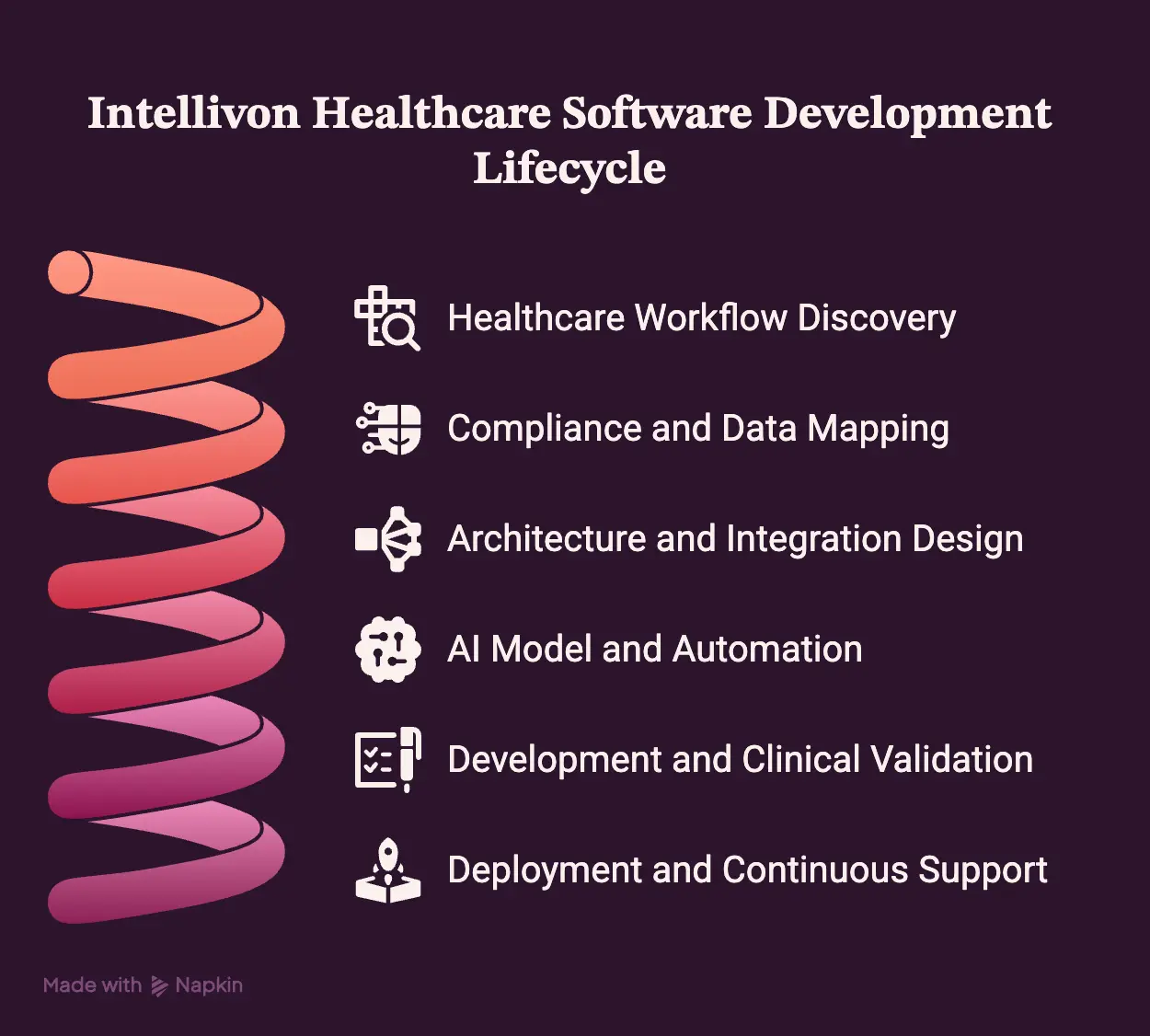
Step 1 — Healthcare Workflow and Requirements Discovery
Clinical software initiatives fail when engineering teams make assumptions about hospital routines. Therefore, we begin every project by embedding ourselves within the real-world operational context of your care teams and administrative staff.
- Operational mapping: We interview clinical informatics leads, physicians, nurses, and billing specialists to document exact operational bottlenecks.
- Systems audit: Our solutions architects catalog existing digital assets, patient data formats, legacy database structures, and third-party API dependencies.
- Outcome definition: We define quantitative success metrics, such as reducing patient wait times, cutting claim denial rates, or accelerating clinical documentation.
- Core deliverables: A comprehensive clinical requirements map, technical user personas, and a prioritized product scope document.
Step 2 — Compliance, Security, and Data Mapping
Federal healthcare compliance cannot be retrofitted onto an existing codebase without triggering extensive refactoring. Hence, we establish regulatory boundaries and data governance frameworks before writing initial application logic.
- PHI classification: We trace the complete lifecycle of electronic protected health information (ePHI) across intake, processing, storage, and transmission touchpoints.
- Regulatory alignment: Our compliance engineers establish clear Business Associate Agreement (BAA) responsibilities, HIPAA technical safeguards, and relevant ONC or FDA SaMD classifications.
- Access governance: We design zero-trust data access schemas, multi-factor authentication (MFA) protocols, and immutable audit trails for compliance reporting.
- Core deliverables: A formal compliance matrix, threat model analysis, and ePHI data flow architecture.
Step 3 — Architecture and Integration Design
Modern healthcare applications must interface reliably with legacy hospital records and modern cloud microservices. As a result, our architecture phase defines resilient interface layers that prevent system-wide data bottlenecks.
- Full-stack design: We specify responsive frontend frameworks, scalable microservices backends, and secure database schemas partitioned for healthcare multi-tenancy.
- Interoperability layers: Our engineers design FHIR R4 interfaces, HL7 v2 message parsers, and custom API adapters for major EHR vendors like Epic and Cerner.
- Cloud topology: We blueprint dedicated, BAA-covered virtual private clouds (VPCs) on AWS Healthcare or Azure Health with automated failovers.
- Core deliverables: A complete technical architecture specification, database schema diagram, and EHR integration blueprint.
Step 4 — AI Model and Automation Design
AI should be deployed only where it delivers measurable clinical or administrative utility. Thus, we focus on governed machine learning architectures that support human clinicians rather than unconstrained experimental models.
- Model selection: We match specific operational needs to validated computer vision, clinical NLP, predictive machine learning, or retrieval-augmented generation (RAG) models.
- Deterministic controls: Our teams pair probabilistic AI outputs with hardcoded clinical rules, confidence score thresholds, and mandatory human-in-the-loop validation checkpoints.
- Safety benchmarking: We construct specialized evaluation datasets to benchmark hallucination rates, diagnostic sensitivity, and demographic fairness before clinical testing.
- Core deliverables: An AI architecture blueprint, model governance policy, and validated performance evaluation framework.
Step 5 — Development, QA, and Clinical Validation
Translating blueprints into enterprise code demands continuous quality assurance across functional, security, and clinical dimensions. Accordingly, our engineering sprints emphasize automated testing alongside rigorous clinical workflow verification.
- Agile cadence: We run bi-weekly Scrum sprints with direct access to sprint backlogs, continuous staging deployments, and regular milestone demonstrations.
- Rigorous testing: Our QA pipelines execute automated unit tests, end-to-end integration tests, static code security analyses, and FHIR conformance validation.
- Clinical user acceptance: We conduct structured usability trials with practicing clinicians to verify that system interfaces minimize cognitive burden during patient encounters.
- Core deliverables: Production-ready source code, automated test suites, clinical validation reports, and third-party penetration testing sign-offs.
Step 6 — Production Deployment and Continuous Support
Launching healthcare software requires seamless transition management to prevent disruptions to patient care. Furthermore, sustained post-launch monitoring ensures systems remain secure, compliant, and performant over time.
- Managed cutover: We execute zero-downtime containerized deployments backed by automated rollbacks, comprehensive data migration protocols, and clinical staff training.
- Active MLOps & monitoring: Our operations teams monitor live inference latency, data drift, concept drift, and EHR schema modifications in real time.
- Managed sustenance: We provide ongoing HIPAA compliance patching, third-party API updates, infrastructure scaling, and continuous feature enhancements.
- Core deliverables: Live production platform, 24/7 infrastructure monitoring, MLOps telemetry dashboards, and continuous maintenance SLAs.
Ultimately, this six-stage engineering framework eliminates delivery surprises, ensuring your healthcare technology is technically robust, fully compliant, and clinically embraced from day one.
Build Healthcare Software With Intellivon
Planning a regulated healthcare software project? Intellivon helps healthcare organizations define architecture, interoperability, AI, security, and compliance requirements before committing development capital.
- Healthcare AI & Full-Stack Engineering: Unified delivery across LLMs, computer vision, web, and mobile systems.
- FHIR & EHR Interoperability: Production integrations with Epic, Oracle Health (Cerner), and athenahealth.
- Compliance-First Design: Architecture mapped to HIPAA, HITECH, FDA SaMD, and ONC standards.
- Data Security & PHI Governance: Zero-trust architecture, field-level encryption, and immutable audit logs.
- Clinical Workflow Focus: Interfaces engineered to reduce clinician charting load and administrative friction.
- Proven Delivery Record: Live deployments across endoscopy diagnostics, telehealth, and healthcare CRMs.
- Production MLOps Pipelines: Active telemetry tracking inference latency, model drift, and accuracy.
- Lifecycle Sustenance: Continuous regulatory patching, API updates, and enterprise cloud maintenance.
Consult with an Intellivon solutions architect to validate your clinical workflows and technical roadmap.
Conclusion
Selecting the right healthcare technology partner ultimately comes down to four fundamental principles. First, verify healthcare-specific domain evidence rather than generic application portfolios. Second, evaluate regulatory fit to ensure technical controls satisfy HIPAA and FDA requirements. Third, demand proven production interoperability across live FHIR and EHR environments.
Finally, secure long-term system ownership through active MLOps, security patching, and lifecycle maintenance.
When evaluating a specialized partner like Intellivon, the cheapest proposal is rarely the most useful comparison. In regulated clinical environments, integration failures and compliance penalties quickly erase initial savings.
Consequently, the better question is which vendor can prove their engineering maturity. Your partner must reliably build, integrate, validate, deploy, and maintain your specific healthcare software system.
FAQs
Q1. Does a healthcare software development company need a BAA?
A1. A healthcare software development company requires a Business Associate Agreement (BAA) only when it qualifies as a HIPAA Business Associate. According to official HHS guidelines, this status applies when developers create, receive, maintain, or transmit protected health information (PHI). Conversely, developing on synthetic data without real PHI access does not require a formal BAA.
Q2. How can I verify a company’s HL7 and FHIR experience?
You can verify HL7 and FHIR experience by reviewing live production implementations and custom Implementation Guides (IGs). Additionally, ask candidates to explain their data mapping, OAuth authentication, and retry error-handling architectures in detail. Finally, request technical client references to confirm how their engineers handled non-standard or incomplete clinical EHR feeds.
Q3. How should we evaluate an AI healthcare software company?
To evaluate an AI partner, inspect training data rights, PHI de-identification protocols, and retrieval-augmented generation (RAG) safeguards. Furthermore, confirm strict hallucination boundaries, demographic bias testing, and human-in-the-loop clinical validation controls. Lastly, ensure their engineering stack actively supports automated MLOps model monitoring, rollback protocols, and applicable FDA SaMD regulatory compliance guidelines.
Q4. Should we choose fixed price or a dedicated healthcare team?
Choose a fixed-price contract only when your functional scope, clinical workflows, and integration specifications are completely frozen upfront. Conversely, select a dedicated healthcare development team when building multi-phase enterprise platforms with evolving clinical requirements. This flexible model allows engineering teams to adapt rapidly to changing EHR interfaces and emerging clinical feedback.
Q5. Should healthcare software be built or bought?
Buy standardized commercial software for non-differentiating administrative workflows like general accounting or standard hospital staff scheduling. Conversely, build custom healthcare software for proprietary clinical decision algorithms, unique EHR workflows, and tailored patient engagement tools. Hybrid architectures deliver the highest ROI by combining commercial storage backends with custom, high-value clinical microservices.
Q6. Is an offshore healthcare software development company safe?
A6. Offshore development is entirely safe when governed by strict security standards, enforceable contractual safeguards, and zero-trust cloud controls. Specifically, verify that the vendor enforces field-level encryption, role-based access, and synthetic test datasets without storing local PHI. Ultimately, rigorous engineering discipline and healthcare domain experience matter far more than geographic location.
To Sum It Up
- A healthcare portfolio is only relevant when the regulatory and workflow complexity resembles your project.
- FHIR experience means little until a vendor can explain what happened during a production EHR integration.
- The strongest healthcare software RFPs score evidence, not promises.
- AI healthcare vendors should be evaluated on model governance and clinical workflow impact, not model access.
- Source-code ownership, data portability, and exit support should be negotiated before development begins, not when the partnership ends.