Key Takeaways:
-
A healthcare AI governance platform helps hospitals manage the approval and use of AI.
-
A complete platform records every model, owner, risk level, and system change.
-
It should monitor performance, bias, safety problems, and model drift after launch.
-
Strong platforms also handle vendor AI, generative AI, agents, and compliance.
-
Learn how Intellivon designs tailored governance platforms around healthcare systems and AI workflows.
A full AI governance platform for healthcare needs to manage every AI tool before launch, while it is used each day, and after every update. The AI governance platform records each tool, evaluates its risk, and tests it with your data before launch. After launch, the AI governance platform monitors accuracy and bias, logging every decision. Stops any changes that are not approved.
Most health organizations use a committee, a spreadsheet, and vendor test reports. At the time, AI scribes and chat tools spread faster than these reviews can keep up with. Because of this, these organizations cannot easily prove what a model did, who approved it, or if it still works safely.
This AI governance platform for healthcare requirements blog uses Intellivon’s work on building healthcare AI systems. Within this blog, we have made sure each section talks about the function of a capability, the specific rule it supports, and how much it will cost you to get it.
What Healthcare AI Governance Actually Means
Healthcare AI needs its own governance because its mistakes can harm patients, not just business results. For example, a wrong prediction can delay treatment, and a data leak can expose protected health information. Generic enterprise AI governance often focuses on security and cost, but it rarely covers clinical safety or bias across patient groups.
In addition, many healthcare AI tools come built into vendor products instead of being developed in-house. In fact, a Wolters Kluwer Health survey found that 40% of healthcare professionals and administrators had encountered an unauthorized AI tool. Therefore, healthcare AI governance must cover the following risks:
- Patient safety: A faulty model can miss a deteriorating patient or trigger unnecessary care.
- Clinical decision risks: Clinicians may trust an AI suggestion too much, especially during busy shifts.
- PHI exposure: AI tools that process patient records must follow HIPAA privacy and breach notification rules.
- Bias across patient groups: A model can perform well overall but poorly for certain ages, races, or sexes.
- Incorrect documentation: AI scribes can add details a clinician never said, and those errors enter the medical record.
- Regulatory obligations: Some clinical AI counts as a medical device under FDA rules, which adds testing and change controls.
- Vendor AI risks: Vendors may update models, so health systems should ask how each tool was validated and tested for bias.
In short, healthcare AI governance must protect patients, patient data, and clinical decisions at the same time. That is why a generic enterprise framework is only a starting point.
Why Healthcare Enterprises Need AI Governance Now
Healthcare enterprises need AI governance now because AI has moved from small pilots into daily clinical and business work. At the same time, generative AI and AI agents have created risks that older review methods cannot handle. Meanwhile, regulators and accreditors expect proof of oversight, so governance has become an operating need, not a side project.
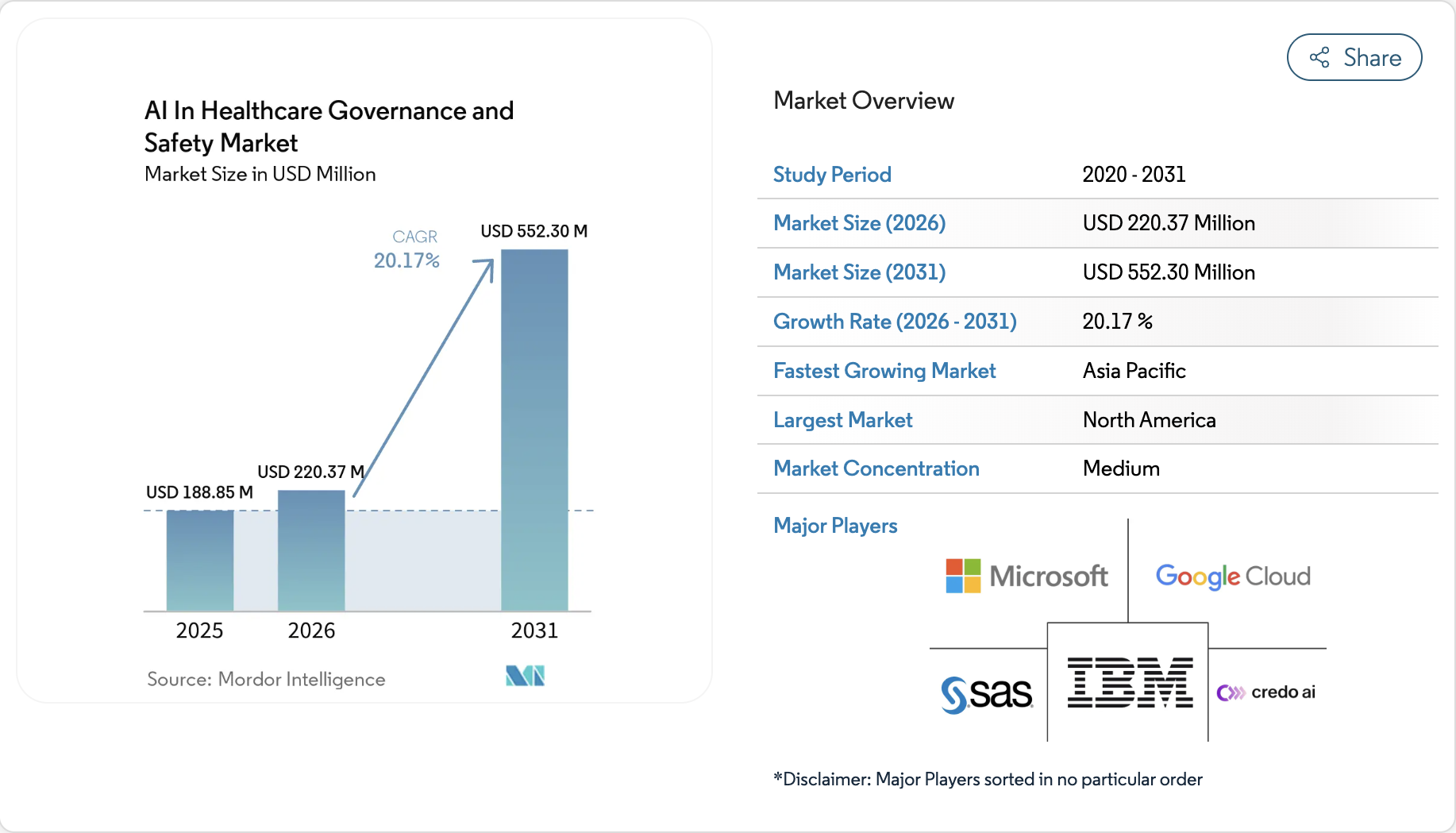
The spending data clearly reflects this urgency. According to Mordor Intelligence, the healthcare AI governance and safety market will reach about USD 220.37 million in 2026. It should then grow to USD 552.30 million by 2031, a 20.17% CAGR, with healthcare providers making up about half of current spending.
1. Hospitals Are Using More AI Across Daily Operations
Today, AI runs across clinical, financial, and operational work, not just pilots. For example, hospitals use AI for:
- Clinical decision support, radiology, and risk prediction
- Documentation, patient communication, and scheduling
- Revenue cycle management and prior authorization
- Drug discovery and operational forecasting
2. Generative AI Has Increased the Governance Problem
However, generative AI can answer the same question differently and sound confident when wrong. Therefore, older one-time approvals no longer work for:
- Chatbots, copilots, and internal knowledge assistants
- Clinical summarization and document-search (RAG) tools
- Ambient documentation that drafts clinical notes
3. AI Agents Can Now Take Actions
Meanwhile, some AI agents can now take actions, so enterprises must govern what AI may do, not only what it predicts. For example, agents can:
- Call APIs
- Update patient or billing records
- Trigger workflows
- Communicate with other systems
4. Regulations Now Expect Stronger AI Oversight
Alongside this growth, regulators expect clear proof of oversight. Key frameworks include:
- Joint Commission and CHAI responsible AI guidance
- FDA rules for AI-enabled devices
- ONC HTI-1, now under HTI-5 review
- HIPAA
- NIST AI RMF and ISO 42001
- EU AI Act, where applicable
5. Enterprises Need One Place to Manage AI Risk
Once dozens or hundreds of AI systems go live, scattered tools stop working together. In fact, piloting and governing one to three models has cost some health systems $1 million to $2 million. These tools usually include:
- Spreadsheets
- Vendor questionnaires
- Separate dashboards
- Policy documents
In short, AI now runs across healthcare enterprises while regulators demand proof of control. Therefore, one governance platform has become the practical way to manage that risk.
What an AI Governance Platform Does
An AI governance platform is software that tracks, tests, approves, monitors, and controls every AI system in a healthcare organization. In other words, it turns governance policies into daily actions.
For example, it can record who approved a model, watch how the model performs, and stop the model when it becomes unsafe.
1. A Central Record of Every AI System
First, the platform keeps one inventory of every AI tool in use, including vendor and EHR-built tools. The IHI recommends keeping an active list of all AI tools. Each record should show:
- Owner and intended use
- Vendor and model version
- Patient data the tool can access
- Current approval status
2. Oversight Levels Based on Risk
Next, the platform scores each system so reviewers focus where harm is most likely. For instance, a scheduling tool needs less review than a sepsis alert. Risk scores usually consider:
- Effect on clinical decisions
- Level of patient data exposure
- How much the AI acts on its own
- Whether FDA device rules apply
3. Testing and Approval Before Launch
Then, the platform manages testing on local patient data and sends results to the right approvers. For example, Epic’s Seismometer helps teams test model performance and fairness across patient groups. The workflow should include:
- Local accuracy and bias tests
- Clinical, legal, and security sign-offs
- Approval conditions and review dates
4. Monitoring After Deployment
After launch, the platform checks whether the AI still works safely in real use. The IHI shows why teams should check how often high-risk flags are correct, not just overall accuracy. Monitoring should track:
- Accuracy and alert quality
- Changes in data and performance over time
- Results across patient groups
- How clinicians use or override the tool
5. Evidence Storage for Audits
Meanwhile, the platform stores the proof that auditors and accreditors ask for. For example, CHAI offers a model card template that records a model’s intended use and risks. Stored evidence should include:
- Model cards and test results
- Approval records
- AI activity and decision logs
- Incident and compliance reports
6. Controls That Restrict Unsafe AI
Finally, monitoring only reports problems, while real governance acts on them. Similarly, FDA principles for AI device updates call for ways to detect, reverse, or stop harmful changes. A complete platform should support:
- Blocking deployment
- Suspending a model
- Rolling back a version
- Requiring human approval
- Removing tool permissions
- Retiring a system
In short, an AI governance platform records, rates, tests, monitors, and documents every AI system. More importantly, it can stop unsafe AI instead of only reporting on it.
The Core Parts of a Complete AI Governance Platform
A complete healthcare AI governance platform needs parts that control AI from first review to final retirement. Together, these parts show what AI exists, how risky each tool is, and whether it is safe to use.
In addition, they record who approved each decision and what happens when AI causes harm.
Healthcare AI Governance Platform Features at a Glance
| Platform Area | What It Controls |
| AI inventory | What AI systems exist |
| Risk classification | How much oversight each needs |
| Validation | Whether AI is safe enough to deploy |
| Monitoring | Whether performance changes |
| Bias controls | Whether outcomes differ across groups |
| Explainability | Why an AI decision was made |
| Audit trails | What happened and who approved it |
| Compliance | Which rules apply |
| Vendor governance | How third-party AI is managed |
| Agent controls | What autonomous AI can do |
| Integrations | Where governance data comes from |
| Incident management | What happens when AI creates risk |
The table is easier to use when you group these parts by when they matter. Some parts decide whether AI should go live at all. Others track AI behavior over time and prove that the organization stayed in control:
- Before launch: AI inventory, risk classification, validation, and vendor governance
- During use: Monitoring, bias controls, explainability, and agent controls
- For proof and response: Audit trails, compliance, and incident management
- Across every stage: Integrations that feed data into every other part
In short, a complete platform combines twelve parts that cover AI before launch, during use, and after problems occur.
Explainability Must Support Real Clinical Review
Healthcare organizations need explainability that helps a clinician, reviewer, or auditor understand an AI output quickly and act on it. However, one explanation style does not fit every tool.
Predictive models need feature evidence, generative AI needs source tracing, and AI agents need action histories. Together, this evidence also supports incident reviews.
1. Clinicians Need Useful Explanations
A technically correct explanation can still fail during a busy shift. For example, a long list of model inputs does not tell a nurse what to do next. Useful explanations should show:
- The top reasons behind the output
- How confident the model is
- What the clinician should verify
2. Different AI Systems Need Different Explanations
Explainability needs change with the type of AI. Therefore, the platform should store the right evidence for each system.
a. Predictive Models Need Feature-Level Evidence
Predictive models, such as sepsis or readmission alerts, should show which factors drove each score. For instance, methods like SHAP and LIME trace how an algorithm reached its result. Evidence should include:
- Top contributing factors per prediction
- Model version used
b. Generative AI Needs Source Traceability
Generative AI can sound confident even when it is wrong. As a result, reviewers must trace each answer back to its inputs:
- Retrieved sources
- Prompts
- Context
- Generated response
c. AI Agents Need Action Histories
AI agents can update records and trigger workflows, so reviewers must see each step. In fact, Greenway Health notes that agentic AI needs approval checkpoints and audit trails. Records should capture:
- What the agent saw
- What it decided
- Which tool it called
- What it changed
3. Explanations Should Support Incident Reviews
Later, the same evidence helps teams investigate adverse events or disputed decisions. Instead of guessing, reviewers can rebuild what the AI showed at the moment of care. This helps teams:
- Find the cause of harm
- Answer patient or payer disputes
- Decide whether to suspend the model
In short, useful explainability matches the type of AI and the person reviewing it. Moreover, stored explanations become the evidence teams rely on when something goes wrong.
Audit Trails Must Show the Full AI Decision History
A healthcare AI audit trail must let a team rebuild any AI-assisted decision months or years later. Specifically, it should show which model version ran, what data it used, and what it produced.
It should also show how clinicians responded, who approved the tool, and whether anyone changed the records afterward.
1. Record the AI Version Used
Models change often, so every output must link to the exact version that produced it. Otherwise, teams cannot tell whether a problem came from an old or new model. Include:
- Model name and version number
- Deployment date
2. Record the Input and Context
Next, the log should capture what the AI received. However, storing full patient records adds PHI risk, so many teams store secure references instead. Record:
- Input data or a secure data reference
- Prompts and retrieved sources for generative AI
- Workflow where the AI was used
3. Record the Output and Confidence
Then, the platform should save exactly what the AI showed the user. For example, a risk score without its confidence level can mislead a later review. Capture:
- The output shown
- Confidence score or risk level
- Explanation displayed
4. Record Clinician Actions and Overrides
Clinician responses show whether AI actually shaped care. In addition, frequent overrides can signal that a model is losing trust or accuracy. Log:
- Accepted, edited, or rejected outputs
- Override reasons
- Final action taken
5. Record Approvals and Policy Exceptions
Meanwhile, auditors will ask who allowed the tool and under what conditions. The Joint Commission and CHAI guidance recommend policies for AI review, procurement, and implementation. Record:
- Approvers and approval dates
- Conditions attached to approval
- Exceptions granted and their expiry dates
6. Keep Audit Evidence Tamper-Resistant
Finally, audit evidence only counts if nobody can quietly change it. For instance, ALIGNMT AI describes keeping an immutable record of AI inventory decisions and actions. Protect logs with:
- Write-once storage
- Role-based access controls
- Time-stamped change histories
A complete audit trail connects the model, data, output, human response, and approval behind every AI decision. As a result, organizations can prove control during audits, disputes, and incident reviews.
Third-Party AI Needs Its Own Governance Process
Third-party AI needs its own governance process because vendors control the model, its data, and its updates. Therefore, hospitals must review vendor AI before launch and track changes over time.
They should also reassess tools after major updates, flag missing evidence, and include vendor AI in incident reviews. Otherwise, purchased tools become the largest blind spot.
1. Review Vendors Before the AI Enters Production
Vendor claims are not proof, so reviews should happen before signing. In fact, Censinet reports that 40% of AI contracts are signed without security assessments. Every review should cover:
- Intended use
- Training data information
- Validation evidence
- Security controls
- PHI handling and business associate agreements
- Bias testing
- Change policies
2. Track Vendor Model Updates
A SaaS vendor can swap or retrain its underlying model without the hospital changing anything. As a result, a tool that passed review last year may now behave differently. The platform should track:
- Vendor version numbers
- Release notes and update dates
- Changes in live performance after updates
3. Reassess AI When Vendors Make Major Changes
Not every update needs a full review. However, major changes should trigger reassessment, such as:
- A new underlying model
- A new intended use or patient group
- New data sources or PHI access
4. Track Missing Vendor Evidence
A simple “approved” label can hide serious gaps. Instead, the platform should flag what is missing. The Joint Commission and CHAI advise asking vendors how they validated tools and evaluated bias. Flag:
- Missing validation or bias reports
- Expired security certifications
- Overdue vendor responses
5. Include Vendor AI in Incident Management
Vendor AI can cause harm just like internal AI. Therefore, incident workflows should cover:
- Reporting issues to the vendor
- Vendor response deadlines
- Suspending the tool when needed
In short, third-party AI needs review before launch, tracking during use, and reassessment after major changes. Moreover, the platform should show evidence gaps instead of hiding them behind an approval label.
Generative AI Needs Extra Governance Controls
Generative AI needs extra governance controls because it creates new text instead of choosing from fixed outputs. As a result, it can invent facts, leak patient data, or follow harmful instructions.
Normal model governance checks accuracy scores, but LLM governance must also test answers, sources, prompts, and retrieval systems every time the model or prompt changes.
1. Test Clinical Answers for Hallucinations
LLMs can sound confident even when they are wrong. In fact, researchers note that generative AI is especially vulnerable to hallucinations, bias, and misuse. Testing should include:
- Clinician-reviewed test questions for each use case
- Accuracy scoring on real clinical scenarios
- Retesting after every model update
2. Check Whether Answers Use Approved Sources
Next, the platform should confirm that answers come from trusted content. Otherwise, a tool may pull from outdated guidelines or unapproved websites. Checks should cover:
- Approved source lists
- Citation links in each answer
- Flags for answers without sources
3. Protect PHI in Prompts and Responses
Clinicians often paste patient details into prompts. Therefore, the platform must control where that data goes. Controls should include:
- PHI detection and masking
- Business associate agreements with LLM vendors
- Rules for storing prompts and responses
4. Detect Unsafe Prompts and Prompt Injection
Meanwhile, attackers can hide instructions inside documents or messages. The IAPP highlights data exfiltration and model poisoning as key generative AI risks in healthcare. Detection should flag:
- Hidden instructions in retrieved content
- Attempts to bypass safety rules
- Requests for data outside a user’s access
5. Track Model and Prompt Changes
A small prompt edit can change clinical answers as much as a new model. For example, Pacific AI runs the same test suite before release and against live systems. Track:
- Model version and vendor
- System prompt versions
- Test results before each release
6. Review How RAG Systems Retrieve Clinical Data
Finally, RAG systems search internal documents or records before answering. However, poor retrieval can return old policies or data a user should not see. Review:
- Retrieval accuracy
- Access permissions on indexed data
- How often source documents are refreshed
In short, generative AI governance must test answers, sources, prompts, and retrieval, not just model accuracy. Moreover, these checks must repeat whenever the model, prompt, or source data changes.
Ambient AI Needs Controls Around Clinical Notes
Ambient AI needs controls around clinical notes because these tools listen to visits and draft text that enters the permanent medical record. Therefore, governance must track where each note came from and keep the clinician in charge.
It must also record edits, check note quality, and manage patient consent before any recording starts.
1. Track Where the Generated Note Came From
Every note should show that AI helped create it. Otherwise, reviewers cannot tell AI-drafted content from clinician-written content. According to PI Tech, scribes should be inventoried and governed like any other AI system. Each note should link to:
- The scribe vendor and model version
- The visit recording or transcript reference
- The time the draft was created
2. Keep the Clinician in Control of the Final Note
AI scribes are documentation aids, so the clinician remains responsible for every signed note. However, busy clinicians may sign drafts without a careful read. Controls should include:
- Required review before signing
- Clear labels on AI-drafted sections
- No automatic signing or filing
3. Record Edits Before the Note Is Signed
Next, the platform should save what changed between the AI draft and the signed note. These edits show where the tool makes mistakes. Record:
- The original AI draft
- Clinician edits and deletions
- The final signed version
4. Monitor Documentation Quality
Meanwhile, quality can drop after vendor updates or in new specialties. For example, a scribe may add symptoms the patient never mentioned. Track:
- Edit rates by clinician and specialty
- Added or missing clinical details
- Errors found in chart audits
5. Manage Consent and Recording Requirements
Finally, recording a visit raises privacy and consent questions. In fact, HIPAA and privacy concerns are a major theme in clinician Reddit discussions about AI scribes. Manage:
- Patient consent capture
- State recording law requirements
- Rules for storing and deleting audio
In short, ambient AI governance tracks each note’s origin, edits, and quality while keeping clinicians accountable. Consent controls also protect patients before any recording begins.
AI Agents Need Permission and Action Controls
AI agents need permission and action controls because they do more than predict. They can open records, send messages, and trigger workflows on their own.
Therefore, governance must decide what each agent can reach, what it can change, and when a human must approve. It must also record every action and stop agents that break safety rules.
1. Give Every Agent Its Own Identity
An agent should never borrow a clinician’s login. Otherwise, nobody can tell whether a person or the AI made a change. Each agent needs:
- A unique agent ID
- A named human owner
- A defined purpose
2. Limit Which Systems an Agent Can Access
Next, give each agent access only to the systems its task requires. Notably, ONC’s HTI-5 proposal explicitly names autonomous AI systems as tools that access health data. Limit access to:
- Specific EHR modules and data types
- Billing and payer systems
- Outside APIs
3. Limit the Actions an Agent Can Take
Access to a system does not mean permission to change it. For example, a scheduling agent may read calendars but should not cancel surgeries. Define:
- Read-only actions
- Allowed updates
- Blocked actions, such as deleting records
4. Add Approval Steps for High-Risk Actions
Some actions are too risky to run without a person. In fact, Greenway Health notes that agentic AI needs approval checkpoints and exception handling. Require human sign-off before:
- Submitting prior authorizations
- Sending clinical messages to patients
- Changing orders or care plans
5. Record Every Agent Action
Meanwhile, every step should leave a clear record. As a result, reviewers can rebuild exactly what happened later. Log:
- Data the agent viewed
- Decisions it made
- Tools it called
- Records it changed
6. Stop Agents When Safety Rules Are Triggered
Agents can repeat one mistake across hundreds of records in minutes. So, the platform needs automatic stop controls, including:
- Pausing on unusual activity
- A manual shutdown switch
- Rolling back recent changes
7. Control Agent-to-Agent Delegation
Finally, one agent may hand work to another agent. However, the second agent should never gain more access than the first. Control:
- Which agents can delegate
- Which permissions pass along
- Full delegation chains in the logs
In short, AI agents need their own identities, limited access, approval steps, and complete action records. More importantly, the platform must stop an agent before one error spreads across patient records.
Healthcare Compliance Must Be Built Into the Platform
Healthcare compliance must be built into the AI governance platform because every rule asks for proof, not promises. For example, HIPAA requires activity logs, FDA expects controlled model changes, and accreditors expect ongoing monitoring.
Therefore, the platform should collect this evidence during daily work instead of rebuilding it before every audit.
1. HIPAA Protects the Patient Data Used by AI
The HIPAA Security Rule requires technical safeguards for systems that hold electronic PHI. So, every AI tool that touches patient data needs:
- Access controls and authentication
- Encryption based on risk analysis
- Audit controls
- Clear PHI handling rules
2. ONC Rules Increase AI Transparency Needs
ONC’s HTI-1 rule requires certified health IT to support 31 source attributes for predictive decision support tools. However, the HTI-5 proposal would remove them. Either way, keep records of:
- Intended use and training data
- Known risks and validation results
3. FDA Rules Affect Regulated Clinical AI
Some clinical AI counts as Software as a Medical Device (SaMD). For these tools, FDA’s PCCP guidance allows planned model changes without a new submission for each one. Track:
- Validation evidence
- Planned model changes
- Change impact assessments
4. Joint Commission Sets Expectations for Responsible AI Use
The Joint Commission and CHAI released the Responsible Use of AI in Healthcare (RUAIH) guidance in 2025. Although it is voluntary, it leads toward a planned AI certification. Prepare:
- A formal governance structure
- Monitoring and patient disclosure processes
5. CHAI Gives Health Systems Practical Guidance
Meanwhile, CHAI’s 2026 playbooks turn responsible AI principles into practical steps. Use them for:
- Governance workflows
- Model card templates
6. NIST AI RMF Supports Risk Management
The NIST AI RMF is voluntary guidance built on four functions. The platform should map controls to:
- Govern and Map
- Measure and Manage
7. ISO 42001 Supports AI Management Systems
ISO/IEC 42001 is an international standard that organizations can certify against voluntarily. It helps with:
- Documented AI policies and processes
- Independent proof for enterprise buyers
8. EU Rules Matter for Global Healthcare Companies
For AI in EU-regulated medical devices, high-risk obligations now apply from August 2, 2028. US companies selling into Europe should track:
- Which products reach EU markets
- Conformity assessment documents
In short, the platform should connect each feature to HIPAA, ONC, FDA, and accreditation expectations. As a result, compliance evidence is ready before an auditor asks for it.
What Building a Complete Platform Looks Like Step-by-Step
At Intellivon, we build a complete AI governance platform in eight layers, starting with an inventory and ending with lifecycle control. Each layer depends on the one before it. For example, monitoring cannot work until every model is registered and approved.
Therefore, we deliver the platform in phases, and each layer goes live before the next begins.
Intellivon’s Governance Platform Architecture at a Glance
We tie each build phase to a regulatory or audit milestone, as our AI governance cost breakdown explains. The table below shows what each layer includes and what it proves.
| Layer | What We Build | What It Proves |
| 1. AI inventory and documentation | Model registry, model cards, shadow AI discovery | Every AI system is known and owned |
| 2. Risk and policy management | Risk scoring, intake forms, policy rules | Oversight matches each system’s risk |
| 3. Validation and approval | Local testing, sign-off workflows | AI was safe before launch |
| 4. Runtime monitoring | Performance, drift, and alert tracking | AI still works in real use |
| 5. Bias and explainability | Subgroup metrics, SHAP, source tracing | Outputs are fair and explainable |
| 6. Compliance evidence | Audit trails, framework-mapped reports | Rules were followed |
| 7. EHR and MLOps integration | FHIR, Epic, and CI/CD connections | Governance data is complete |
| 8. Incident and lifecycle management | Suspension, rollback, retirement | Unsafe AI can be stopped |
1. AI Inventory and Documentation
First, we register every AI system, including vendor and EHR-built tools. We also build model cards from CHAI templates, so documentation does not depend on vendor PDFs. This layer includes:
- A central model registry
- Owner and intended use records
- Shadow AI discovery
2. Risk and Policy Management
Next, we turn written governance policies into rules the platform can enforce. As a result, a sepsis alert automatically gets more review than a scheduling tool. We configure:
- Risk scoring criteria
- Intake and review forms
- Policy rules for each risk tier
3. Validation and Approval
Then, we test each model on the client’s own patient data before launch. Where it fits, we extend open-source tools like Epic’s Seismometer instead of rebuilding them. We deliver:
- Local accuracy and bias testing
- Clinical, legal, and security sign-offs
- Approval conditions and review dates
4. Runtime Monitoring
After launch, we track how each model performs in daily use. Following IHI guidance, we check whether alerts are correct, not just overall accuracy. Monitoring covers:
- Performance and drift alerts
- Alert burden and override rates
- Named escalation owners
5. Bias and Explainability
Meanwhile, we build explanations that match each type of AI. Predictive models get feature evidence, generative AI gets source tracing, and agents get action histories. This layer includes:
- Subgroup performance dashboards
- SHAP-based explanations
- Prompt, source, and action logs
6. Compliance Evidence
Next, we map platform features to HIPAA, FDA, ONC, Joint Commission, NIST AI RMF, and ISO 42001. Consequently, evidence builds up during normal work instead of right before audits. We build:
- Tamper-resistant audit trails
- Framework-mapped reports
- Board and compliance dashboards
7. EHR and MLOps Integration
Governance only works with real data, so we connect the platform to clinical and engineering systems. For example, our team has delivered SMART on FHIR integrations with Epic for healthcare clients. We integrate:
- EHRs through FHIR APIs
- MLOps and CI/CD pipelines
- Identity and access systems
8. Incident and Lifecycle Management
Finally, we give teams the controls to act when AI creates risk. Instead of only sending alerts, the platform can stop or reverse unsafe AI. We build:
- Incident reporting workflows
- Suspension and rollback controls
- Retirement and archive processes
In short, Intellivon builds the platform in eight connected layers, from inventory to lifecycle control. Because each phase goes live before the next, clients get working governance early.
Healthcare AI Governance Platform Development Cost
A custom healthcare AI governance platform typically costs $70,000 to $300,000. The final price depends on how many AI systems you govern, which EHRs you connect, and how much clinical validation you need. By comparison, some health systems spent $1 million to $2 million running governance pilots for just a few models.
Cost Breakdown by Phase
| Phase | What It Covers | Cost Range |
| 1. Governance planning and architecture | Requirements, risk model, system design | $6,000 to $15,000 |
| 2. Inventory and workflow development | Model registry, intake, approvals | $12,000 to $35,000 |
| 3. Validation and monitoring | Local testing, drift, bias tracking | $15,000 to $55,000 |
| 4. EHR and MLOps integrations | FHIR, Epic, CI/CD connections | $15,000 to $75,000 |
| 5. Security and compliance testing | HIPAA controls, penetration tests, audit checks | $12,000 to $50,000 |
| 6. Deployment and enterprise rollout | Pilot launch, training, site rollout | $10,000 to $70,000 |
| Total | $70,000 to $300,000 |
1. Maintenance Usually Costs 15% to 20% Yearly
After launch, plan to spend 15% to 20% of the build cost each year. This ongoing spending covers:
- Regulatory updates and new governance rules
- New model types
- Integration maintenance
- Monitoring and security improvements
- Infrastructure
2. What Pushes the Project Toward $300,000
However, costs rise quickly as scope grows. Projects move toward the top of the range with:
- Multiple EHRs or multi-site health systems
- Large AI portfolios
- Agent governance and real-time controls
- Extensive clinical validation
- Private infrastructure
In short, most platforms cost $70,000 to $300,000 to build, plus 15% to 20% yearly upkeep. Integrations, scale, and agent controls drive the biggest differences. For a deeper breakdown, see our AI governance cost guide.
How Intellivon Builds AI Governance Platforms
Most health systems adopt AI faster than their committees can review it. As a result, governance often lives in spreadsheets until an audit or incident exposes the gaps. Intellivon takes a different approach.
We build governance into the platform’s architecture from the first sprint, so evidence builds up during daily work. Our approach includes:
- Phased delivery tied to regulatory and audit milestones
- Model registries that include vendor and EHR-built AI
- Local validation and bias testing on your patient data
- Drift, bias, and alert monitoring after launch
- SMART on FHIR integration with Epic and other EHRs
- HIPAA-aligned access controls, encryption, and audit trails
- Permission and action controls for AI agents
- A 5.0 Clutch rating across seven verified client reviews
Not sure which governance layers your organization is missing? Book a governance gap assessment with Intellivon’s healthcare AI team. You’ll leave with a clear build plan, timeline, and cost range.
Conclusion
Ultimately, an AI governance platform for healthcare turns scattered policies into daily control over every AI system. It records, tests, monitors, and stops AI before patients face harm. Meanwhile, regulators, accreditors, and enterprise buyers now expect proof that this control exists.
Therefore, start with the layer your organization lacks most, then build outward in phases. As a result, governance grows alongside your AI portfolio instead of chasing it. In short, proven control today prevents costly gaps tomorrow.
FAQs
Q1. What does an AI governance platform do in healthcare?
A1. An AI governance platform tracks every AI system a healthcare organization uses. First, it records each tool and scores its risk. Then, it manages testing, approvals, and monitoring after launch. It also stores audit evidence. Most importantly, it can suspend, roll back, or retire AI that becomes unsafe.
Q2. Does HIPAA compliance cover AI governance?
A2. No, HIPAA covers only part of AI governance. Specifically, it protects patient data through access controls, authentication, and audit controls. However, HIPAA does not require checking model accuracy, bias, or drift. Therefore, healthcare organizations still need separate controls for validation, monitoring, explainability, and managing model changes.
Q3. How often should clinical AI be revalidated?
A3. No single federal rule sets a revalidation schedule for all clinical AI. Instead, Joint Commission and CHAI guidance recommends risk-based monitoring and regular validation. In practice, high-risk tools need more frequent review. Revalidation should also happen after vendor updates, workflow changes, patient population shifts, or detected performance drift.
Q4. How should hospitals govern third-party AI?
Hospitals should review vendor AI before signing any contract. For example, they should request validation evidence, bias testing, security details, and change policies. After launch, they should track vendor updates and reassess tools after major changes. Finally, missing vendor evidence should appear as a flagged gap, not an approval.
Q5. Do AI agents need different governance controls?
A5. Yes, AI agents need extra controls because they take actions, not just make predictions. For instance, agents can update records, call APIs, and trigger workflows. Therefore, each agent needs its own identity, limited permissions, and approval steps for risky actions. Every action should also be logged and stoppable.
Q6. Can one platform support several AI regulations?
A6. Yes, one platform can support several regulations because many rules require similar evidence. For example, HIPAA, FDA guidance, NIST AI RMF, and ISO 42001 all value documentation, monitoring, and audit trails. As a result, one feature can support multiple frameworks. Mapping each feature to each framework helps prevent duplicate work.
Q7. When should healthcare companies build instead of buy?
A7. Healthcare companies should build when off-the-shelf tools cannot match their workflows. For example, building makes sense with proprietary models, multiple EHRs, agent governance, or a regulated medical device roadmap. However, organizations running only a few vendor tools may find buying faster and cheaper, at least at first.