Key Takeaways:
-
Enterprise AI governance platforms must inventory systems, assign risk tiers, automate approvals, and monitor drift and bias.
-
LLMs, RAG pipelines, agents, third-party models, and shadow AI require dedicated governance controls and oversight workflows.
-
Immutable decision evidence, audience-specific explanations, and multi-regulation control mapping are non-negotiable production requirements.
-
Focused custom platforms cost $70,000 to $120,000 while regulated production builds reach $120,000 to $300,000.
-
How Intellivon builds AI governance platforms as operational control infrastructure connected to MLOps, GRC, IAM, and enterprise reporting.
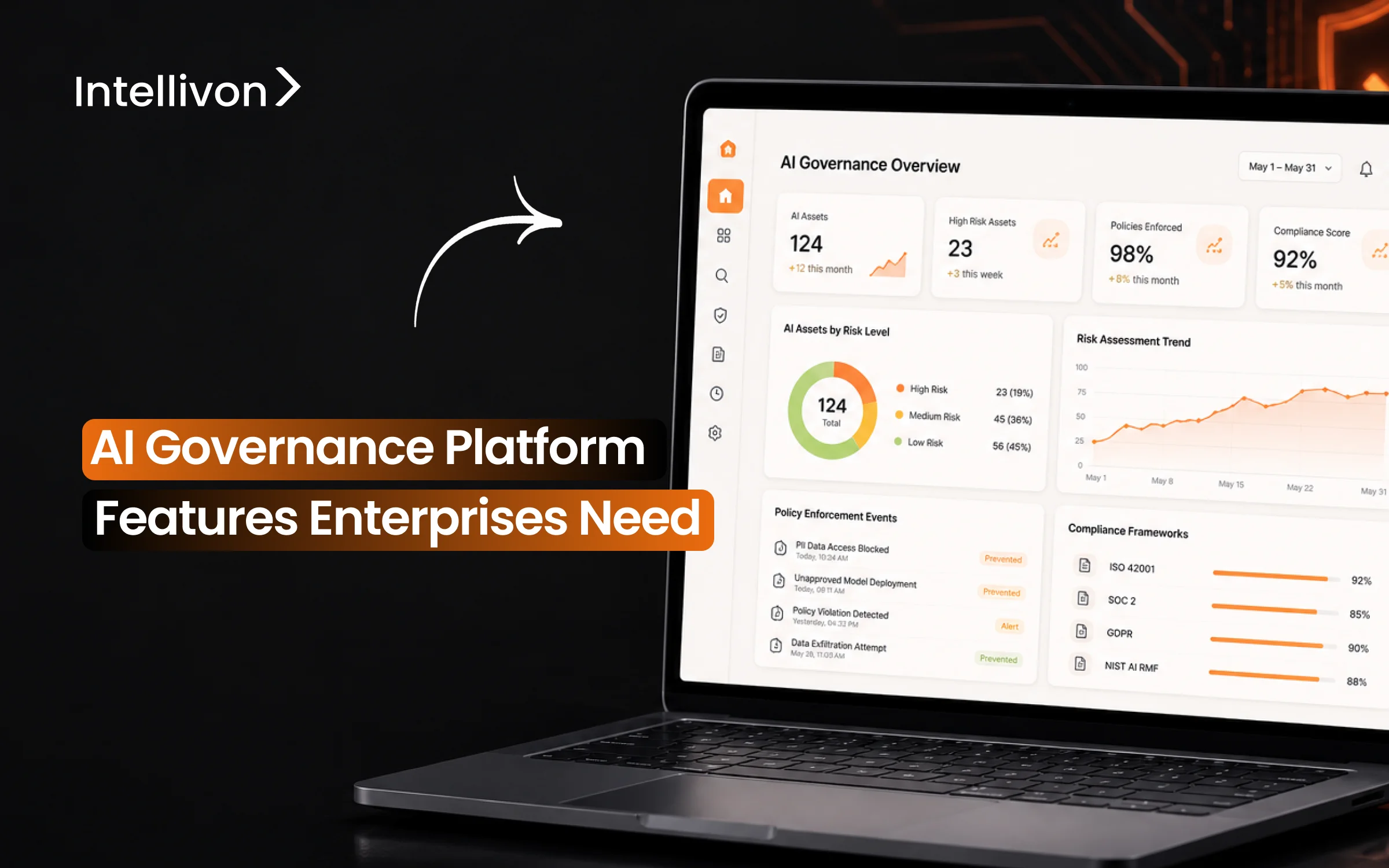
Every enterprise evaluating an AI governance platform eventually sees the same feature comparison matrix. In practice, the real differentiator is feature depth at examination points, not feature count. Specifically, AI governance platform features enterprises need fall into three distinct tiers. Tier 1 covers non-negotiables, Tier 2 covers common underdeliveries, and Tier 3 covers sector requirements.
The gap between listed features and production governance is almost always a Tier 2 problem. Moreover, platforms frequently list agentic AI governance as a feature but rarely deliver it adequately in production. Smarsh found 55% of enterprises actively deploy AI while only 26% have governance that keeps pace. Consequently, platform feature depth is what determines whether governance actually keeps pace with AI deployment.
Intellivon builds AI governance platforms for healthcare and financial services enterprises across all three feature tiers. The approach therefore always maps regulatory examination requirements before any feature is scoped or prioritized. Accordingly, this guide covers all three tiers with in-depth assessments across leading platforms.
What Enterprise AI Governance Platforms Must Control
An enterprise AI governance platform is an orchestration engine that unifies risk, compliance, accountability, and runtime controls across your model lifecycle.
However, it is not merely a data catalog, a model monitoring dashboard, or a standard GRC tool.
Consequently, this software enforces policy across four distinct operational layers, thereby ensuring every algorithm operates within strict, audit-ready legal and technical boundaries.
1. AI Governance Versus Model Risk Management
Model Risk Management (MRM) focuses primarily on quantitative development, statistical validation, and backtesting.
Conversely, AI governance expands far beyond MRM to enforce organizational accountability, ethical boundaries, vendor oversight, and regulatory evidence across the enterprise.
- Quantitative Scope vs. Enterprise Scope: While MRM evaluates mathematical soundness, governance determines whether a business use case is legally permissible under regulations like SR 11-7 or the EU AI Act.
- Third-Party Oversight: Furthermore, governance extends beyond internal quantitative models to evaluate black-box vendor APIs, open-source models, and commercial LLMs.
- Intellivon’s Practitioner Approach: As a result, we engineer custom governance frameworks that blend traditional MRM workflows with automated algorithmic oversight, while seamless risk-tiering engines integrate into existing validation software.
2. AI Governance Versus MLOps
MLOps tools build, deploy, version, and operate technical pipelines.
In contrast, an enterprise AI governance platform establishes the business rules, safety guardrails, and compliance gates that determine whether a model ultimately has permission to run.
- Policy Control: To achieve this, the platform inserts automated enforcement gates into CI/CD pipelines, thereby verifying model cards, risk scores, and approval status before production deployment.
- API-First Architecture: Additionally, it uses microservices, zero-trust security, and role-based access control (RBAC) to block non-compliant model builds automatically.
- Intellivon’s Practitioner Approach: Therefore, we build custom API bridges connecting MLOps tools directly to central compliance systems. For a deeper breakdown of automating deployment controls, see our guide on [LINK: MLOps Pipeline Security].
3. AI Governance Versus Data Governance
Data governance controls data quality, schemas, access rights, and retention policies.
On the other hand, AI governance tracks how models transform that underlying data into automated predictions, business decisions, and downstream operational impacts.
- Inputs vs. Outcomes: While data governance protects raw assets, AI governance actively governs algorithmic outputs, prediction drift, and societal impact.
- Lineage & Bias Monitoring: Consequently, it links data lineage directly to model decision logs, thereby detecting proxy variables and ensuring HIPAA, GDPR, or ONC compliance.
- Intellivon’s Practitioner Approach: Thus, we build unified metadata architectures mapping data lineage to decision logs, so clients can easily trace predictions back to source data during regulatory examinations.
4. The Four Layers of an Enterprise Governance Platform
A complete platform relies on a four-layer architectural model. Moreover, these layers map directly to the NIST AI Risk Management Framework functions: Govern, Map, Measure, and Manage.
- System-of-Record Layer (Map): Centralizes model inventories, metadata, training lineage, and model cards into a unified registry.
- Control Layer (Govern): Next, it orchestrates automated risk scoring, policy management, and multi-stage approval workflows.
- Runtime Layer (Measure & Manage): Simultaneously, it tracks live model drift, enforces real-time guardrails, and triggers alerts for human intervention.
- Evidence Layer (Govern & Manage): Finally, it captures immutable, cryptographic audit logs and generates examination-ready workpapers.
- Intellivon’s Practitioner Approach: Ultimately, Intellivon designs high-availability, containerized microservices architectures via Kubernetes, thereby delivering secure multi-cloud governance that scales alongside production AI.
An enterprise AI governance platform unifies model risk management, MLOps, and data governance into a single control plane across your entire algorithmic lifecycle.
By deploying a structured four-layer architecture spanning inventory, risk controls, live runtime guardrails, and audit evidence, organizations achieve continuous regulatory compliance without stalling production AI deployments.
AI Governance Platform Features Enterprises Need at a Glance
Choosing the right software can feel overwhelming when so many tools claim to solve algorithmic risk. However, identifying the essential features of enterprise AI governance platform systems helps you cut through market noise and build an audit-ready technology stack.
Consequently, this checklist summarizes the fifteen core capabilities every enterprise platform must deliver to protect your business.
AI Governance Platform Features
| No. | Feature Group | What the Platform Must Achieve |
| 1 | AI Inventory & Discovery | Automatically scans networks to identify internal, third-party, embedded, open-source, and shadow AI models. |
| 2 | Ownership & Documentation | Assigns accountable business owners and captures model purpose, core assumptions, known limitations, and usage rules. |
| 3 | Risk Assessment & Tiering | Automatically classifies models into risk tiers based on business impact, system autonomy, data sensitivity, and affected populations. |
| 4 | Lifecycle Workflow | Manages multi-stage approval gates from initial intake, testing, and validation through deployment, material changes, and retirement. |
| 5 | Independent Validation | Coordinates quantitative, qualitative, security, fairness, and business-use testing before any model enters production. |
| 6 | Continuous Monitoring | Tracks live performance in real time to catch data drift, concept drift, prediction errors, and unexpected behavior early. |
| 7 | Explainability | Generates clear global, local, and counterfactual explanations tailored for technical teams, business leaders, consumers, and regulators. |
| 8 | Bias & Fairness | Monitors model predictions continuously to detect disparate impact across protected groups, subgroups, and proxy variables. |
| 9 | Human Oversight | Defines explicit rules for human-in-the-loop reviews, manual decision overrides, safety escalations, and emergency model shutdowns. |
| 10 | Audit Trail & Lineage | Captures tamper-proof, cryptographic logs to reconstruct the exact data inputs, code, and reasoning behind any decision. |
| 11 | Compliance & Policy Mapping | Maps complex regulatory requirements like HIPAA, EU AI Act, and SR 11-7 directly to internal controls and evidence. |
| 12 | GenAI & Agent Governance | Enforces guardrails over prompts, RAG data, hallucinations, tool usage, memory, and autonomous multi-agent systems. |
| 13 | Third-Party AI Governance | Evaluates vendor risk, tests black-box APIs, inspects supply chain dependencies, and verifies compliance contracts. |
| 14 | Enterprise Integrations | Connects effortlessly to your existing MLOps tools, data warehouses, GRC software, IAM systems, and IT service desks. |
| 15 | Secure Deployment Architecture | Provides flexible deployment across private cloud, multi-cloud, hybrid, or on-premises environments with zero-trust security. |
In short, evaluating vendors against these fifteen core capabilities guarantees your organization covers both quantitative model health and enterprise compliance obligations.
Therefore, deploying a unified platform ensures your technology teams scale innovation without exposing the business to unmitigated operational or legal risks.
AI Inventory and Lifecycle Control Features
An AI model inventory management feature must act as an active, operational system of record rather than a static spreadsheet. Consequently, the platform continuously tracks algorithmic assets, ownership, and changes across their entire operational lifespan.
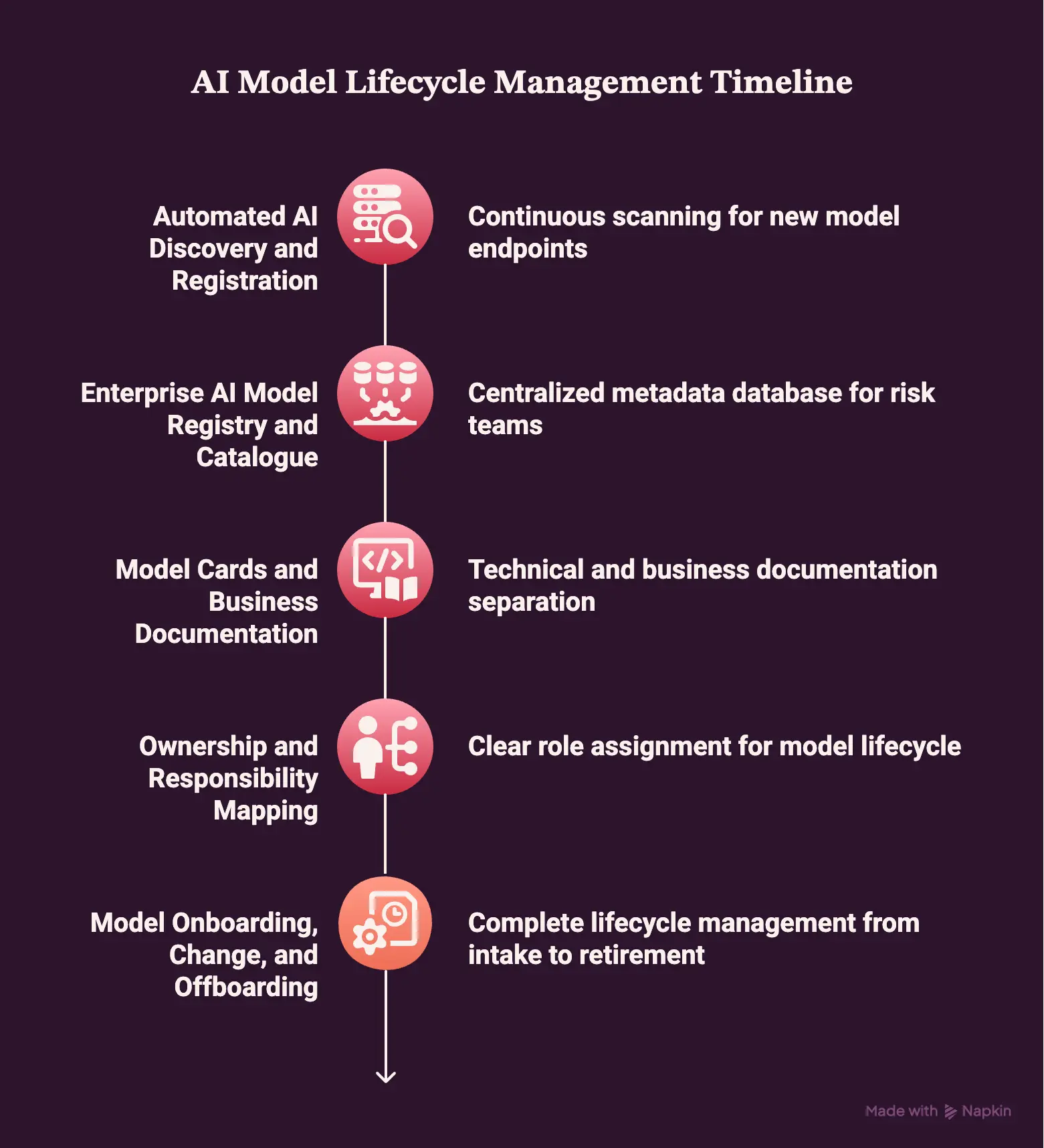
1. Automated AI Discovery and Registration
Static inventories miss shadow AI and third-party integrations. Therefore, modern platforms continuously scan enterprise environments to register new model endpoints automatically.
- Multi-Asset Scanning: Finds internal models, LLMs, RAG systems, embedded vendor tools, and autonomous agent frameworks across cloud accounts and API gateways.
- Pipeline Integration: Hooks directly into CI/CD workflows and code repositories to flag unregistered models before they go live.
- Broad Coverage: Discovers traditional algorithms, SaaS tools, rules engines, and AI-assisted employee workflows across the network.
2. Enterprise AI Model Registry and Catalogue
An enterprise AI model registry feature design centralizes vital metadata into a searchable database. Consequently, risk teams maintain full visibility into every active system.
- Core Metadata Tracking: Captures system identifiers, business sponsors, intended purpose, training data lineage, risk tiers, and validation status.
- Contextual Details: Records target populations, deployment locations, business processes, regulatory scope, and current approvals.
- Dependency Mapping: Tracks complex relationships between foundation models, fine-tuned adapters, vector databases, and downstream APIs.
3. Model Cards and Business Documentation
An AI model card management feature design separates technical specifications from business-facing governance rules. As a result, both engineers and compliance officers get clear, relevant information.
- Technical Documentation: Details network architecture, features, training methods, accuracy metrics, assumptions, limitations, and test results.
- Business Documentation: Outlines permitted use cases, prohibited applications, financial materiality, affected stakeholders, expected benefits, and escalation routes.
- Dynamic Syncing: Updates live performance metrics directly inside business-facing documentation to keep non-technical teams informed.
4. Ownership and Responsibility Mapping
Unclear ownership delays incident response when models fail. Therefore, governance software enforces clear responsibility mapping across the entire algorithmic lifecycle.
- Explicit Role Assignment: Identifies specific business, technical, risk, data, and validation owners for every system.
- Approval Controls: Assigns clear responsibility for compliance reviews, deployment sign-offs, and incident responses.
- Third-Party Oversight: Designates dedicated relationship owners to manage external vendors and commercial black-box APIs.
5. Model Onboarding, Change, and Offboarding
A complete AI model offboarding workflow feature design manages models from intake to retirement. Consequently, organizations prevent unmonitored systems from lingering in production.
- Lifecycle Management: Handles bulk imports, API registration, annual reviews, and use-case expansions seamlessly.
- Change Control: Tracks code updates, retraining records, and version histories while triggering new assessments for material changes.
- Deprecation Protocols: Automates archival workflows, retains compliance evidence, and safely redirects API calls during model shutdowns.
An operational AI inventory functions as the single source of truth that connects discovery, metadata cataloging, and lifecycle management across your entire model estate.
By enforcing explicit role ownership and structured onboarding-to-offboarding workflows, enterprises maintain full control and continuous visibility from initial development to model retirement.
Risk, Validation, Monitoring, and Change Control Features
An enterprise AI governance platform must combine four core risk management capabilities. Specifically, the system determines required controls, verifies model fitness, tracks live behavior, and triggers reassessments whenever underlying conditions change.
For a deeper breakdown of validation, risk tiering, and ongoing monitoring, see our guide on AI Model Risk Management Software for Enterprises.
1. Risk Intake and Classification
Risk assessment evaluates operational exposure across multiple technical dimensions. Consequently, platforms calculate risk scores based on decision impact, autonomy, reversibility, and data sensitivity.
- Exposure Metrics: Evaluate scale of use, customer proximity, financial materiality, and regulatory exposure.
- Vulnerability Scoring: Factors in vulnerable populations, human oversight gaps, and third-party dependencies.
2. Automated Risk Tiering
Automated classification assigns models to predefined governance paths. However, platforms must allow custom scoring rules rather than forcing rigid vendor taxonomies.
- Tier 1 (High-Impact / Safety-Critical): Systems with severe financial, safety, or legal consequences.
- Tier 2 (Material Impact): Models affecting customer decisions, patient outcomes, or financial metrics.
- Tier 3 (Operational Support): Internal tools assisting routine business decision-making.
- Tier 4 (Low Risk): Basic productivity tools and individual employee assistants.
3. Inherent, Residual, and Aggregate Risk
Risk platforms calculate exposure before and after applying internal controls. Consequently, leadership gains visibility into true residual risk and concentration exposures.
- Control Evaluation: Measures initial inherent risk alongside remaining residual risk accepted by business owners.
- Portfolio Concentrations: Identifies systemic risks stemming from reliance on shared foundation models or third-party APIs.
4. Independent Validation Workflows
Governance software coordinates validation tasks across independent reviewers. As a result, testing stays impartial and compliant with regulatory standards.
- Review Tracking: Manages validator assignments, independence checks, evidence requests, findings, and management responses.
- Approval Controls: Enforces sign-offs, conditional approvals, compensating controls, and remediation deadlines.
5. Quantitative and Qualitative Validation
Platforms combine numerical testing with qualitative reviews. This dual approach verifies conceptual soundness alongside raw statistical performance.
- Quantitative Tests: Runs backtesting, stress testing, scenario analysis, AUC-ROC, Gini, Population Stability Index, and F1 scores.
- Qualitative Reviews: Evaluates model assumptions, data suitability, intended purpose, and misuse risks.
6. Continuous Performance and Drift Monitoring
Post-deployment surveillance detects real-world degradation early. Therefore, real-time monitors track key health metrics continuously.
- Drift Analytics: Monitors model accuracy, data drift, concept drift, prediction drift, and calibration changes.
- Operational Health: Logs system latency, failure rates, cost per prediction, and overall outcome quality.
7. Retraining and Change-Control Triggers
When models degrade, platforms automatically initiate governed change workflows. Consequently, updates pass through proper approvals before reaching production.
- Metric Thresholds: Triggers alerts when drift metrics cross predefined tolerance limits.
- External Changes: Forces reassessments during vendor model updates, regulatory shifts, or material incidents.
Integrating automated risk tiering with independent validation workflows creates a closed-loop governance framework for enterprise AI models. Continuous drift monitoring and automated change triggers guarantee systems remain compliant and performant throughout their operational lifespan.
Audit, Compliance, and Policy Management Features
Enterprise AI governance platforms must move beyond simple policy documentation to provide continuous, audit-ready verification. Crucially, the central benchmark for any system is proving that every required control operated correctly at the exact moment an algorithmic decision occurred.
For a deeper breakdown of decision reconstruction, evidence schemas, and immutable logs, see our guide on AI Audit Trail Software for Financial Services.
Key Capabilities at a Glance
| Feature Area | Core Requirements & Sub-Capabilities | Functional Objective |
| Immutable Decision Audit Trails | Captures input references, model versions, context values, outputs, confidence scores, explanations, policy checks, human overrides, downstream actions, timestamps, and user identities. | Reconstructs individual algorithmic decisions fully for regulatory inquiries, internal reviews, or legal disputes. |
| End-to-End Lineage Tracking | Maps connections across data sources, transformation pipelines, feature stores, models, prompts, retrieval sources (RAG), APIs, applications, agents, decisions, and outcomes. | Provides complete visibility into data flow and dependencies across the entire algorithmic pipeline. |
| Tamper-Resistant Evidence | Supports append-only storage, hash chaining, cryptographic signatures, Write-Once-Read-Many (WORM) retention, legal holds, access logs, and automated evidence exports. | Prevents retroactive modifications to governance records and guarantees evidence integrity during regulatory audits. |
| Policy Library & Version Control | Manages policy templates, approval workflows, version history, effective dates, ownership, employee acknowledgments, exceptions, expiry dates, and attestations linked to technical controls. | Maintains an active, enforceable policy framework tied directly to underlying software guardrails. |
| Multi-Framework Compliance Mapping | Maps single technical controls simultaneously across EU AI Act, NIST AI RMF, ISO/IEC 42001, GDPR, HIPAA, FDA guidance, SR 26-2, DORA, SEC rules, and internal policies. | Eliminates duplicate work by allowing one operational control to satisfy multiple overlapping regulatory requirements. |
| Regulatory Change Monitoring | Connects regulatory intelligence feeds, tracks rule updates, performs control-impact analysis, assigns owners, tracks deadlines, and flags gap assessments for executive teams. | Automatically alerts risk teams when regulatory updates require changes to internal controls or evidence collection. |
| Examination & Audit Workspaces | Provides dedicated portals for evidence requests, workpapers, sampling, findings, MRAs/MRIAs, corrective actions, consent-order commitments, and closure evidence. | Streamlines external examination workflows and centralizes communication with regulatory auditors. |
| Board & Executive Reporting | Delivers real-time dashboards detailing inventory totals, high-risk systems, unvalidated models, overdue actions, drift incidents, bias findings, policy exceptions, and third-party exposure. | Translates complex technical model performance metrics into clear, actionable executive oversight summaries. |
A unified audit, compliance, and policy management engine transforms static regulatory requirements into continuous, automated evidence collection.
By pairing tamper-resistant audit trails with multi-framework compliance mapping, enterprise platforms ensure complete regulatory readiness while dramatically reducing examination overhead.
LLM, RAG, and Agentic AI Governance Features
Generative AI changes how governance software works. Unlike traditional models that return static predictions, agentic systems retrieve live knowledge, use external software tools, store long-term memory, and take autonomous actions.
Consequently, enterprise platforms must govern runtime behavior alongside written policies.
1. Foundation-Model Inventory and Dependency Tracking
Tracking external foundation models requires continuous visibility into third-party providers. Therefore, platforms record foundational assets, fine-tuning histories, and hosting environments inside a central registry.
- Provider Metadata: Logs model vendors, underlying versions, geographic processing regions, contract terms, and usage restrictions.
- Limitation Tracking: Preserves technical update histories, training-data disclosures, and known model weaknesses automatically.
2. Prompt and System-Instruction Governance
Prompts function as production code in generative applications. As a result, governance platforms store, test, and version control all instruction templates.
- Template Repositories: Manage system prompts, prompt versions, few-shot examples, safety rules, and expected output formats.
- Approval Controls: Records prompt test results, security evaluations, and formal approval histories before deployment.
3. RAG Governance
Retrieval-Augmented Generation (RAG) introduces risk at the document retrieval layer. Consequently, platforms monitor data index quality and access permissions continuously.
- Index Tracking: Audits source document repositories, vector embeddings, chunking rules, and metadata filters.
- Retrieval Health: Measures citation accuracy, flags stale documents, checks retrieval quality, and prevents sensitive data leakage.
4. GenAI Evaluation and Monitoring
Continuous evaluation guards against unpredictable language outputs. Thus, platforms evaluate live prompts and responses in real time.
- Output Quality: Tests for hallucination, groundedness, toxicity, bias, and output consistency across user queries.
- Security & Costs: Detects prompt injection, jailbreak attempts, sensitive data leaks, latency spikes, and unexpected token costs.
5. Agent Identity and Permissions
Autonomous AI agents require strict operational boundaries. Therefore, governance platforms assign distinct identities and execution limits to every active agent.
- Unique Identity: Assigns named owners, time-bound access credentials, and clear revocation controls to each agent.
- Granular Limits: Enforces data access boundaries, transaction caps, spending limits, and tool approval thresholds.
6. Runtime Action Governance
Recent practitioner discussions emphasize that written policies cannot stop bad API calls. Consequently, platforms inspect and intercept tool actions right before execution.
- Critical Action Gates: Intercepts high-risk operations like payments, clinical edits, trade executions, code deployments, and customer communications.
- Pre-Execution Checks: Evaluates proposed tool parameters dynamically to block policy violations instantly.
7. Agent Memory and Multi-Agent Lineage
When multiple agents collaborate, tracking decisions becomes complex. Hence, platforms record every intermediate step, memory write, and inter-agent message.
- Execution Logs: Track memory reads and writes, delegated tasks, planning steps, and final tool outputs.
- Error Auditing: Preserves failed actions, system escalations, and context transferred across agent networks.
8. Intervention and Shutdown Controls
Risk teams must retain absolute operational authority over autonomous systems. Therefore, platforms provide immediate manual override controls.
- Active Safeguards: Enables human-in-the-loop approvals, rate limits, spend caps, and instant tool blocking.
- Emergency Controls: Provides one-click system pauses, model rollbacks, credential revocations, and emergency kill switches.
Governing generative and agentic systems requires moving from static documentation to active runtime oversight.
By controlling prompts, RAG indexes, agent identities, and live tool executions, enterprises deploy autonomous systems safely while maintaining total operational control.
Third-Party, Open-Source, and Shadow AI Features
Enterprise AI governance must extend far beyond internally developed models. Because modern organizations rely heavily on commercial APIs, open-source repositories, and embedded SaaS features, governance platforms must cover technology the enterprise did not build.
External AI Control Capabilities at a Glance
| Feature Area | Core Requirements & Sub-Capabilities | Functional Objective |
| Third-Party Intake & Due Diligence | Evaluates vendor security, data retention policies, training transparency, sub-processor networks, data residency, validation access, and exit terms. | Prevents high-risk vendor models from entering enterprise workflows without rigorous preliminary vetting. |
| Vendor Evidence & Contractual Obligations | Links vendor risk scoring directly to contracts, SLAs, BAAs, Data Processing Agreements (DPAs), audit rights, and incident reporting timelines. | Guarantees that commercial terms enforce technical compliance and legal accountability across external providers. |
| Embedded SaaS AI Discovery | Scans and inventories hidden AI capabilities inside CRM, HR, EHR, analytics, customer support, and office productivity tools. | Uncovers undisclosed vendor AI features running silently within core business applications. |
| Open-Source & Dependency Governance | Tracks open-source model licenses, repository sources, software dependencies, security vulnerabilities, provenance, and AI Bills of Materials (AIBOMs). | Mitigates IP infringement, licensing violations, and supply-chain vulnerabilities in open-source components. |
| Shadow AI Detection & Approved Registers | Maintains approved tool lists, detects unvetted public AI usage, restricts sensitive document uploads, and maps controls to NIST, ISO 42001, and EU AI Act rules. | Blocks employee use of unsafe consumer tools while providing clear pathways to authorized alternatives. |
| AI Procurement Gates | Enforces mandatory governance reviews before software purchases, SaaS feature toggles, API connections, data uploads, or pilot launches. | Halts unauthorized AI investments before contracts are signed or company data is exposed. |
Governing external, open-source, and embedded AI ensures your enterprise maintains strict compliance standards across its entire supply chain. By pairing automated shadow AI discovery with mandatory procurement gates, organizations eliminate blind spots and protect proprietary data from unvetted third-party systems.
How to Prioritise AI Governance Platform Features
Organizations prioritize AI governance features through a phased roadmap balancing immediate regulatory mandates with technical maturity. Instead of deploying every control simultaneously, risk teams must sequence capabilities from foundational inventory management to advanced agent oversight.
This structured progression prevents operational paralysis and aligns platform investments directly with true portfolio risk.
Level 1 — Minimum Viable Governance
To begin, enterprises must establish foundational visibility before launching controlled AI deployments.
This baseline requires a central model inventory, clear ownership assignments, basic risk tiering, standardized documentation, and RBAC controls.
Additionally, manual approval workflows, policy mapping, and basic issue tracking establish immediate baseline accountability.
Level 2 — Regulated Production Governance
Next, scaling production models in regulated environments demands continuous verification. Organizations should integrate independent validation workflows, automated performance monitoring, drift detection, and explainability tools.
Furthermore, this stage introduces immutable evidence logs, multi-framework regulatory mapping, high availability, and direct MLOps pipeline integrations to block non-compliant releases automatically.
Level 3 — Advanced AI Governance
Finally, enterprise-wide automation and agentic deployments necessitate real-time control. This top tier adds automated asset discovery, real-time tool interceptors, agent permission limits, and multi-agent lineage tracking.
Moreover, advanced platforms automate RAG document governance, regulatory change tracking, cross-border compliance checks, AI supply-chain audits, and portfolio-wide risk aggregation.
Structuring platform adoption across these three distinct levels ensures risk teams focus on essential controls first. As a result, enterprises can scale their operational capabilities smoothly while keeping pace with advancing technology.
AI Governance Platform Development Cost
A custom AI governance platform costs $70,000–$300,000 when developed as a focused enterprise control system rather than a global, all-business-unit transformation programme.
Therefore, Intellivon’s current model-risk platform guidance uses the same $70,000–$300,000 range, with focused MVPs taking approximately 10–16 weeks and broader production platforms taking around five to nine months.
1. Cost by Platform Scope
| Platform Scope | Cost Range | Typical Features |
| Focused Governance MVP | $70,000–$120,000 | Inventory, ownership, risk tiering, approvals, documentation, basic audit trail |
| Regulated Production Platform | $120,000–$220,000 | Validation, monitoring, explainability, fairness, compliance mapping, enterprise integrations |
| Advanced Multi-Entity Platform | $220,000–$300,000 | Agent governance, runtime controls, multi-cloud deployment, advanced evidence, sector packs |
2. Cost by Development Phase
| Development Phase | Estimated Range |
| Governance Discovery and Architecture | $8,000–$15,000 |
| Inventory, Registry, Risk, and Workflows | $20,000–$45,000 |
| Monitoring, Validation, Explainability, and Fairness | $15,000–$55,000 |
| Compliance Mapping and Evidence Management | $10,000–$40,000 |
| Integrations, Security, and Deployment | $12,000–$75,000 |
| Pilot, Testing, Training, and Rollout | $5,000–$25,000 |
| Advanced Agentic or Multi-Region Controls | Additional $20,000–$45,000 |
3. Ongoing Platform Cost
Budget 15%–20% of the initial build annually for ongoing operating costs. This recurring budget covers security updates, integration maintenance, regulatory mappings, cloud infrastructure, performance monitoring, support for new model types, agent controls, and incident response.
Defining build costs upfront ensures clear capital allocation across development phases. Consequently, enterprises can balance initial deployment expenses with long-term platform maintenance effectively.
AI Governance Platform Implementation Roadmap
A successful platform implementation requires moving methodically from policy definition to continuous operational monitoring. Consequently, organizations must execute a structured roadmap to ensure enterprise-wide adoption without disrupting ongoing development.
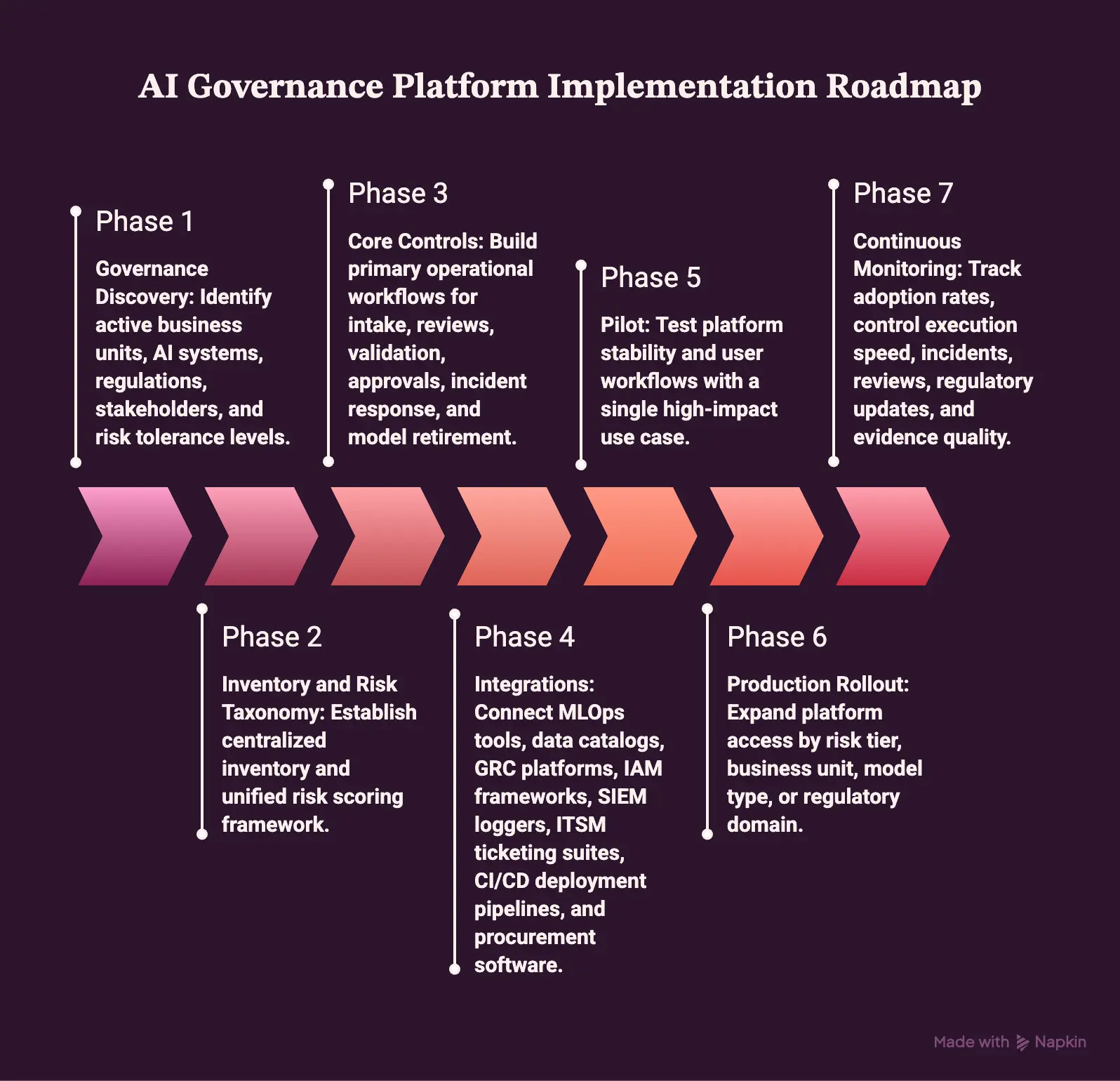
Phase 1 — Governance Discovery
To begin, organizations must identify all active business units, deployed AI systems, applicable regulations, internal stakeholders, and risk tolerance levels.
During this initial discovery, teams evaluate existing tools, approval processes, and audit expectations to establish clear operational baselines.
- Platform Objective: Map every existing policy and governance requirement directly to underlying software controls.
- Implementation Strategy: Convert written policies and standard operating procedures into a structured control matrix before writing code or selecting technologies.
Phase 2 — Inventory and Risk Taxonomy
Next, risk teams establish a centralized inventory alongside a unified risk scoring framework.
This step defines the metadata schema, model ownership structures, risk factors, custom scoring logic, and risk tier definitions required for consistent system classification across departments.
- Platform Objective: Ensure the classification system accurately categorizes diverse algorithmic architectures and business applications.
- Implementation Strategy: Test the proposed risk taxonomy against actual clinical, financial, operational, GenAI, and third-party use cases to validate scoring accuracy.
Phase 3 — Core Controls
Following taxonomy design, development turns to building primary operational workflows. This phase establishes intake forms, independent reviews, validation tasks, multi-stage approval paths, policy exception handling, incident response procedures, and model retirement sequences.
- Platform Objective: Standardize risk decision-making while ensuring full operational transparency.
- Implementation Strategy: Require every workflow step to generate an automated, immutable evidence record within the centralized storage repository.
Phase 4 — Integrations
Once core workflows operate, platforms must integrate directly into the broader enterprise software ecosystem. Consequently, engineers connect MLOps tools, data catalogs, GRC platforms, IAM frameworks, SIEM loggers, ITSM ticketing suites, CI/CD deployment pipelines, and procurement software.
- Platform Objective: Eliminate reliance on manual data entry by synchronizing model metadata and pipeline events automatically.
- Implementation Strategy: Automate evidence collection across existing development tools instead of building another standalone, manual compliance database.
Phase 5 — Pilot
Subsequently, the organization launches a controlled pilot to evaluate platform stability under real operational conditions.
This phase tests a single high-impact use case using live data feeds, actual model owners, assigned risk reviewers, automated alerts, formal approvals, and audit trail exports.
- Platform Objective: Validate system performance, user workflows, and integration pipelines before full-scale deployment.
- Implementation Strategy: Evaluate pilot performance against measurable technical acceptance tests rather than subjective stakeholder impressions.
Phase 6 — Production Rollout
After a successful pilot, enterprise-wide deployment begins in structured stages. Teams expand platform access by risk tier, business unit, model type, or regulatory domain while delivering targeted user training and establishing long-term support structures.
- Platform Objective: Onboard all organizational AI assets while maintaining strict governance oversight.
- Implementation Strategy: Roll out the highest-risk model portfolio first while managing new system additions through a controlled onboarding queue.
Phase 7 — Continuous Monitoring
Finally, governance enters an ongoing operational phase focused on sustained compliance and performance optimization.
Risk teams track platform adoption rates, control execution speed, unresolved incidents, overdue reviews, regulatory updates, and overall evidence quality.
- Platform Objective: Maintain continuous compliance alignment as algorithms, infrastructure, and legal obligations evolve.
- Implementation Strategy: Treat governance rules, risk scoring logic, and system integrations as actively maintained production software components.
Following a structured seven-phase roadmap transforms abstract governance mandates into a scalable enterprise capability. As a result, organizations achieve complete operational control while accelerating safe AI deployment across every business unit.
Build an AI Governance Platform With Intellivon
Intellivon engineers enterprise-grade control architectures designed to operationalize model risk management and regulatory compliance across complex technical environments.
At the same time, rather than offering rigid off-the-shelf software, Intellivon develops tailored platforms aligned directly with your operational requirements.
- Custom AI Inventory & Model Registry: Establishes a centralized system of record to track internal models, APIs, and embedded assets.
- Risk Classification & Validation Workflows: Automates risk tiering, validation pipelines, and approval gates across business units.
- Continuous Monitoring & Change Controls: Tracks performance drift, dataset bias, and unauthorized system modifications in real time.
- Explainability & Fairness Infrastructure: Integrates feature attribution algorithms and bias mitigation tools into model workflows.
- Immutable Audit & Decision Lineage: Generates tamper-resistant records capturing inputs, prompts, outputs, and human overrides.
- Regulatory & Industry Control Mapping: Maps technical controls directly to EU AI Act, NIST AI RMF, healthcare, and financial standards.
- LLM, RAG, & Agent Governance: Implements prompt safeguards, index checks, tool permission gates, and execution kill switches.
- Enterprise System Integrations: Connects seamlessly with MLOps pipelines, GRC frameworks, IAM, SIEM, ITSM, and EHR platforms.
- Flexible Deployment Models: Deploys natively across public cloud, private cloud, on-premises, or hybrid infrastructure.
Ready to turn your AI governance framework into a fully automated, audit-ready enterprise platform? Contact Intellivon’s AI engineering team today to scope your architecture and build a tailored control system.
Conclusion
Deploying an enterprise AI governance platform transforms static regulatory requirements into continuous, automated oversight. By integrating real-time monitoring, immutable audit trails, and strict agent controls directly into existing MLOps pipelines, organizations eliminate compliance blind spots while accelerating technical innovation.
As regulatory mandates tighten and autonomous systems scale, a robust, deeply integrated governance architecture ensures your enterprise maintains absolute risk control, operational transparency, and audit readiness across every algorithmic asset.
FAQs
Q1. What are the must-have AI governance software features enterprises should implement first?
A1. To begin, enterprises should deploy a minimum viable governance stack focusing on inventory, ownership, risk classification, approval workflows, documentation, access controls, audit history, and issue remediation. Subsequently, advanced capabilities like performance monitoring, explainability, fairness testing, and agent runtime controls should follow as high-risk systems scale into production.
Q2. Who should own an enterprise AI governance system?
A2. A successful system requires a cross-functional operating model led by executive leadership, such as a Chief AI Officer or Chief Risk Officer. Furthermore, while executives maintain macro oversight, individual AI systems still require dedicated, named owners across business, technical, risk management, data engineering, independent validation, and incident response roles.
Q3. What should an enterprise AI governance platform feature checklist include for an RFP?
A3. When drafting an RFP, enterprises should structure their requirements around the nine weighted categories outlined in this guide. Moreover, procurement teams should prioritize live technical demonstrations, sample evidence outputs, comprehensive API documentation, verified security architecture reviews, and rigorous proof-of-concept acceptance testing over simple vendor sales materials.
Q4. How should healthcare AI governance platform features differ from general enterprise software?
A4. Healthcare deployments demand specialized controls including clinical validation workflows, patient subgroup monitoring, and strict PHI data protections. Additionally, platforms must support native EHR and FHIR lineage tracking, predictive DSI transparency, real-time clinician oversight mechanisms, safety incident reporting, and alignment with FDA software lifecycle expectations.
Q5. Which fintech AI governance platform features enterprises need are most important?
A5. Financial services platforms must prioritize model materiality scoring, independent validation workflows, effective challenge tracking, and adverse-action explanations. Furthermore, institutions require comprehensive override logs, vendor model controls, real-time fraud monitoring, long-term evidence retention, and a distinct, specialized governance track for generative and agentic systems.
Q6. Can an existing GRC platform handle AI governance?
A6. Traditional GRC software effectively manages policy libraries, high-level risk registers, findings, and compliance evidence. However, it typically lacks native support for model telemetry, drift tracking, explainability algorithms, fairness testing, prompt engineering, RAG lineage, and real-time agent controls without extensive custom integrations or specialized extensions.
To Sum It Up
- An AI inventory without automated discovery becomes inaccurate as soon as teams add embedded SaaS AI, external APIs, or internal agents.
- A compliance dashboard is not evidence; every displayed status must link to a control, owner, test result, approval, and timestamp.
- Traditional model governance and agentic AI governance cannot share the same control design because agents can take actions, use tools, and retain memory.
- The most valuable governance integration is not another dashboard connection. It is the deployment gate that stops an unapproved system from reaching production.
- Enterprises should score governance platforms by evidence quality and enforceability, not by the number of regulatory frameworks listed on a product page.