Key Takeaways:
- Yes, conversational AI can improve engagement because it helps patients carry out real healthcare tasks.
-
Conversational AI is most effective when it is used for scheduling, setting reminders, carrying out follow‑ups, addressing care gaps, providing medication support, and managing chronic care.
-
The greatest benefits are achieved when conversational AI is connected to EHRs, patient portals, and scheduling systems.
-
Health systems ought to track the actions that have been completed, the number of patients who do not show up, care gaps, and the amount of staff time that is saved.
-
Learn how Intellivon develops AI platforms designed to engage patients featuring secure integrations, the option to involve humans, and scalable workflows.
Yes, conversational AI can achieve greater patient engagement on a large scale, but only if it carries out tasks rather than just answering questions. A system that books the appointment, closes the care gap, and then sends a message to your EHR is what advances engagement. It is only a system that merely answers questions that boosts your call center report.
Yet the majority of the builds fail at the second stage rather than the first. The founders approve the pilot, observe that the response rates are satisfactory, only to then encounter duplicate records, message fatigue, and escalation queues that have no staff assigned to them. It is the scaling that reveals the design, not the model. This year, the decision itself has become more difficult since Epic has included a patient-facing assistant in MyChart, which means your board will naturally want to know why you should be developing something.
At Intellivon, we are asked this question on a monthly basis, and the answer varies according to whether patient engagement is seen as your product or as your overhead. This blog will look at the changes that occur on a large scale, such as which workflows yield the highest return first, the build costs at each stage, and the areas where the technology actually fails.

What Conversational AI Means for Patient Engagement
Conversational AI means software that holds a natural back-and-forth with a patient and then finishes the task that conversation was about. For patient engagement, that shifts the unit of measurement. Engagement stops being messages sent and becomes actions completed.
At scale, it means doing that across hundreds of thousands of patients, multiple languages, and every system holding their records.
1. Conversational AI Goes Beyond Basic Healthcare Chatbots
A scripted chatbot matches keywords against a fixed decision tree. Conversational AI interprets what the patient actually wrote, including typos, slang, and context from three messages ago. Therefore, the patient never has to learn your menu.
- Scripted bot: fixed paths, “Reply 1 to confirm, 2 to cancel”
- Conversational AI: free text or speech, multi-turn memory, handles “actually can we move it to Thursday morning instead”
- The gap shows up the moment a patient asks something nobody scripted
2. Scale Changes What Patient Engagement Requires
At one clinic, engagement is a staffing question. Across a health system, it becomes an architecture question. Moreover, each variable below multiplies the others rather than adding to them.
- Patient volume and outreach frequency
- Sites, specialties, and provider schedules
- SMS, voice, portal, and app channels
- Languages and reading levels
- Distinct clinical and administrative workflows
- EHR, scheduling, billing, and pharmacy systems
3. How Conversational AI Differs From Basic Chatbots
A basic chatbot matches keywords and pushes patients down a fixed path. Conversational AI interprets intent, holds context across turns, and completes the task inside your systems.
Basic Chatbot vs Conversational AI in Patient Workflows
| Capability | Basic Chatbot | Conversational AI |
| Input handling | Menu taps, keywords, “Reply 1 or 2” | Free text or speech, typos, slang, mixed languages |
| Conversation memory | None, each message starts over | Multi-turn context across the full thread |
| Unexpected questions | Falls back to “I didn’t understand that” | Interprets intent and answers or routes it |
| System access | Read-only, links out to a portal | Write-back to EHR, scheduling, and billing |
| Task outcome | Sends the patient somewhere else | Books, reschedules, confirms, or files the response |
| Escalation | Dumps to a phone number | Hands off with the conversation history attached |
| Channel behavior | One channel, isolated | SMS, voice, portal, and app sharing one state |
| Maintenance | Manual script edits per new scenario | Tuned on real conversation data |
| Cost driver | Cheap to launch, expensive to expand | Higher build cost, lower cost per resolved task |
Conversational AI understands natural language and completes tasks inside real systems. Patient engagement measures whether patients act, not whether they were contacted. Scale is what forces those two things to be designed together.
Why Health Systems Are Investing in Conversational AI
Health systems are investing because the expensive failures happen between visits, rather than during them. Care plans break down when follow-up, handoffs, and communication fall through. Therefore, the spending targets coordination, not conversation. In fact, the PACT framework published in npj Health Systems estimates that care coordination failures cost the US health system $27 to $78 billion annually.
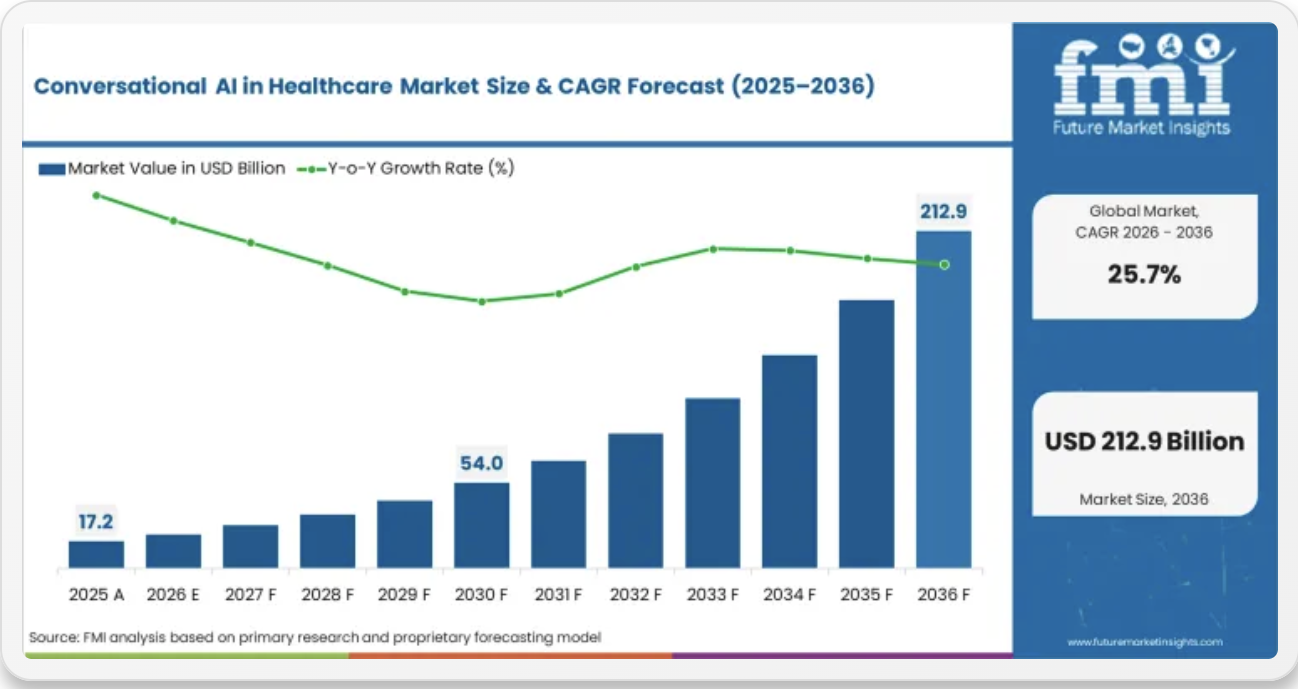
Meanwhile, the money is following that gap. The global conversational AI in healthcare market was estimated at $18.83 billion in 2025 and is projected to reach $59.12 billion by 2030, a 25.7% CAGR. Moreover, patient engagement and support alone account for roughly 29.5% of that market in 2026. Consequently, engagement is the largest application segment, rather than a side use case.
1. Patient Communication Extends Far Beyond the Visit
One appointment generates weeks of communication on either side of it. However, each of those touchpoints is also a place where a patient can quietly drop out. As a result, the communication load grows faster than the visit volume does.
- Scheduling and rescheduling
- Intake and pre-registration
- Visit preparation instructions
- Care plan explanation
- Discharge follow-up
- Medication and refill reminders
- Symptom monitoring
- Preventive and screening outreach
2. Manual Outreach Becomes Hard to Sustain at Scale
Staff absorb this work until they cannot. Call volume grows with the patient panel, but headcount rarely grows with it. Therefore, outreach gets quietly rationed instead of redesigned.
- Call centers triage inbound work and abandon outbound
- Front desks handle coordination between arrivals
- Nurses chase post-discharge patients by phone
- Care managers cover panels too large to call individually
3. Patients Expect Faster Two-Way Digital Access
One-way reminders assume the patient has nothing to say back. However, most patients do, and the reply path is usually a phone tree. Additionally, research on automated outreach shows that higher message volume pushes patients to opt out entirely.
- Voicemail gets ignored, especially from unknown numbers
- “Reply 1 to confirm” cannot handle “I need a different day”
- Portal logins add friction patients rarely accept
- Unanswered questions turn into no-shows or ED visits
4. AI Can Keep Routine Patient Journeys Moving
Health systems automate the predictable coordination, not the relationship. Specifically, PACT reframes the design question as whether the right action happens, gets confirmed, and is supported when it does not. Consequently, the measure of success shifts from messages sent to tasks completed.
- Confirms task completion instead of assuming it
- Escalates to a human when follow-through fails
- Leaves clinical judgment with clinicians
Health systems are funding conversational AI because coordination failures are measurable, expensive, and largely administrative. Manual outreach simply cannot scale with patient volume. Ultimately, AI earns its place by confirming that routine next steps actually happened.
How Conversational AI Changes the Patient Journey
Conversational AI changes the journey by turning outreach into a two-way loop that closes. Instead of a reminder landing and the patient figuring out the next step alone, the system asks, listens, acts, and confirms.
Therefore, the journey stops depending on whether staff had time to follow up. Instead, it depends on whether the task was actually completed.
1. Patients Can Respond Instead of Only Receiving Messages
A one-way reminder ends the conversation at delivery. Conversational AI, however, treats the reply as the point. Consequently, patients who would have ignored a notification now resolve the issue in the same thread.
- Reply in plain language instead of preset codes
- Ask a follow-up question without calling
- Flag a conflict the reminder never anticipated
- Correct wrong contact or insurance details on the spot
2. Routine Requests Can Be Completed Without Calling Staff
Most inbound calls are administrative. Moreover, they follow predictable patterns that do not need clinical judgment. As a result, the request can be finished inside the conversation rather than in a queue.
- Book, move, or cancel an appointment
- Complete intake and pre-registration forms
- Request a refill or check its status
- Get prep instructions, directions, or billing answers
3. Conversations Can Continue Outside Business Hours
Patients deal with health admin when they have a spare moment, which is rarely 9 to 5. Meanwhile, the front desk is closed. Therefore, after-hours capability changes who engages at all.
- Evening and weekend booking without a callback
- Post-discharge questions answered the night they come up
- Shift workers and caregivers reached on their schedule
4. Patient Context Can Shape the Next Best Action
Generic outreach treats every patient identically. Conversational AI connected to the record does not. Additionally, context determines what the system asks next, not just how it phrases things.
- Pulls the actual appointment, medication, or care plan
- Adjusts language, reading level, and channel preference
- Skips reminders for steps already completed
- Prioritizes overdue screenings and high-risk patients
5. Failed Actions Can Move to Human Teams
Automation should surface its own failures. Specifically, the system needs a confirmation rule and an escalation trigger for every task. Otherwise, silent non-completion looks identical to success.
- Escalates unanswered high-risk outreach to a nurse
- Hands off with full conversation history attached
- Routes clinical questions to a human immediately
The patient journey changes because engagement becomes a closed loop rather than a broadcast. Routine coordination finishes without staff, while exceptions reach people faster. Ultimately, the system reports what got completed, not what got sent.
Where Conversational AI Is Already Showing Results
Conversational AI is already producing published, named results at US health systems, not pilot anecdotes. Moreover, the strongest numbers come from administrative and outreach workflows rather than clinical ones.
Below are five deployments with reported figures. However, note that most are vendor- or health system-reported, and no independent benchmark has confirmed them across the industry.
1. Ochsner Health Simplified Appointment Rescheduling
More Than 14,900 Appointments Rescheduled
Ochsner patients used Epic’s Emmie inside MyChart to move appointments themselves. Consequently, staff stopped brokering routine schedule changes by phone.
- 14,900+ appointments rescheduled through the assistant
- Nearly 750 staff hours saved
- Epic reports the same assistant drove a 58% drop in billing-related messages at Rush University Medical Center
2. Weill Cornell Medicine Increased Digital Appointment Booking
Online Bookings Increased by 47 Percent
Weill Cornell deployed Hyro’s conversational layer across its digital front door. Therefore, more patients completed booking without reaching a call queue.
- 47% increase in online bookings
- 85%+ call deflection reported across Hyro client sites
- Novant Health cut patient wait times from eight minutes to under one minute
3. ThedaCare Automated Preventive Care Outreach
963 Care Gaps Closed Within Three Months
ThedaCare ran automated care gap campaigns across a 650,000-person community. Notably, the engagement rate tripled its manual baseline.
- 963 care gaps closed in three months
- ~30% of contacted patients started closure, versus ~10% answering calls
- 350 staff hours saved, 89% patient satisfaction, 7 weeks to go-live
4. Emory Healthcare Expanded Blood Pressure Self-Reporting
1,939 Quality Gaps Closed With Older Adults
Emory tested a voice AI agent with 2,000 adults, most over 65. Importantly, this contradicts the assumption that seniors will not engage.
- 1,939 quality gaps closed
- 68% met CMS Stars blood pressure thresholds
- Performance moved from 1-Star to 4-Star, presented at the American Heart Association
5. Advocate Health Expanded Chronic Care Outreach
Hypertension Outreach Reached 15,000 Patients
Advocate’s 69-hospital system contacted overdue hypertension patients in December 2025. Additionally, the agent disclosed it was AI at the start of every call.
- 15,000+ patients contacted in 12 days
- 274 abnormal readings routed to human clinicians
- ~400 unrelated health issues surfaced, creating a net-new access point
The pattern across all five is consistent: results come from outreach and coordination, not diagnosis. Each deployment routed clinical findings to humans. Ultimately, the measurable win was completed patient actions at a volume staff could never have called.
The Patient Journeys That Benefit Most From AI
Conversational AI helps most where the next step is predictable, administrative, and repeated thousands of times. Therefore, the six journeys below deliver returns first: scheduling, pre-visit, post-visit, medication, chronic care, and preventive outreach.
Each one has a clear task, a confirmable outcome, and an escalation path. Conversely, journeys that need clinical judgment belong with people.
1. Appointment Scheduling and No-Show Prevention
This is the fastest payback because the metric already exists in your EHR. Additionally, MGMA estimates no-shows cost a single physician practice roughly $150,000 a year.
a. Appointment Confirmation
- Two-way confirmation instead of a one-way reminder
- Captures the reason when a patient hesitates
b. Cancellation and Rescheduling
- Handles “can we move it” inside the same thread
- Books the replacement slot immediately
c. Waitlist Filling
- Backfills cancellations from a prioritized waitlist
- Protects slot utilization without staff calling down a list
2. Registration and Pre-Visit Preparation
Work moved before the visit shortens the visit. Moreover, incomplete registration is a leading cause of day-of delays and denied claims.
a. Digital Pre-Registration
- Completes intake forms by conversation, not PDF
- Works without a portal login
b. Insurance and Demographic Collection
- Verifies coverage and updates stale records
- Flags eligibility problems before arrival
c. Visit Instructions and Education
- Delivers prep steps at the right reading level
- Confirms the patient actually understood them
3. Post-Visit and Discharge Follow-Up
Most costly failures happen here. Specifically, the PACT framework ties $27 to $78 billion in annual US waste to coordination breakdowns after the encounter.
a. Follow-Up Appointment Scheduling
- Books the follow-up before the patient forgets
- Recovers patients who never returned
b. Recovery Check-Ins
- Structured questions on pain, healing, and side effects
- Logs responses back into the record
c. Symptom Escalation
- Routes concerning answers to a nurse, not a queue
- Passes the full conversation with the handoff
4. Medication and Refill Engagement
Roughly half of chronic disease patients do not follow their care plans. However, text-based interventions roughly double adherence odds.
a. Medication Reminders
- Timed to the prescription, not a generic schedule
b. Prescription Refill Outreach
- Triggers on refill gaps detected in pharmacy data
c. Adherence Follow-Up
- Asks why a patient stopped, then routes barriers
5. Chronic Care and Remote Monitoring
Chronic patients need contact between visits, which staff cannot sustain. Consequently, this is where AI extends reach furthest.
a. Diabetes Engagement
- Glucose check-ins, education, and supply reminders
b. Hypertension Follow-Up
- Advocate Health reached 15,000 patients in 12 days
c. Remote Patient Monitoring
- Collects readings and device data conversationally
- Flags abnormal trends for clinical review
6. Preventive and Population Health Outreach
Preventive work gets rationed because nobody has time to call everyone. Therefore, automation changes the reachable population, not just the cost.
a. Screening Reminders
- Mammography, colonoscopy, and annual wellness prompts
b. Care-Gap Closure
- ThedaCare closed 963 gaps in three months
c. High-Risk Patient Outreach
- Prioritizes by risk score rather than alphabetical lists
These six journeys share the same shape: a known next step, a confirmable action, and a human escalation path. That combination is what makes engagement measurable. Ultimately, start where the baseline metric already exists in your EHR.
How AI Keeps Patient Conversations Moving
Conversational AI keeps patient conversations moving through five steps that run in sequence. First, it reads intent. Then it pulls context, applies your rules, takes an action in a real system, and escalates whatever it cannot finish.
Consequently, the conversation ends in a completed task rather than a dead end. Skipping any one step is where most deployments stall.
1. Patient Intent Starts the Right Workflow
Intent recognition decides which workflow opens. A patient rarely says “I would like to reschedule.” Instead, they say “I can’t make Tuesday.” Therefore, the system has to classify meaning, not match keywords.
- Separates booking, refill, billing, results, and clinical questions
- Handles mixed requests in a single message
- Asks one clarifying question instead of guessing
- Routes clinical intent to humans immediately
2. Patient Context Shapes the Conversation
Without context, the assistant is a search box. With record access, it knows what the patient is actually referring to. Moreover, context determines what it should not ask.
- The specific appointment, provider, and location
- Active medications and open care plan tasks
- Channel, language, and reading level preference
- Steps already completed, so reminders stop
- Only the data the patient is permitted to see
3. Business Rules Control What AI Can Do
Rules are the guardrails, not the model. Specifically, they define the boundary between helpful and unsafe. Additionally, they keep the system inside your operational reality.
- Provider schedule templates and visit-type rules
- Insurance eligibility and referral requirements
- Topics the assistant may never answer
- Contact frequency caps to prevent message fatigue
- Consent and opt-out status checked before every send
4. System Actions Complete the Patient Request
This is the difference between an answer and an outcome. Answering is easy. Meanwhile, changing the record requires write access to the systems behind the conversation.
- Books, moves, or cancels in the scheduling system
- Writes intake responses into the EHR
- Submits refill requests to pharmacy workflows
- Logs the confirmation so the task is provably closed
5. Human Teams Take Over the Exceptions
Escalation is a design feature, not a failure. Notably, Advocate Health routed 274 abnormal blood pressure readings to clinicians during a single outreach campaign.
- Clinical concerns go straight to a nurse
- Unanswered high-risk outreach triggers a human call
- Handoffs carry the full conversation history
- Staff see why the AI stopped, not just that it did
Intent, context, rules, action, and escalation form one loop. Each step exists so the patient finishes what they started. Ultimately, a system that cannot act or escalate is answering questions, not driving engagement.
EHR Integration Decides Whether AI Can Scale
EHR integration decides whether patient engagement AI scales because volume exposes what the assistant cannot do. At 5,000 patients, staff covers the gaps by hand. At 500,000, those gaps become the system.
Therefore, an assistant that can read but not write pushes every unresolved conversation back onto the phones. Scale multiplies that overflow instead of absorbing it.
1. The EHR Remains the Source of Patient Context
Everything the assistant needs already lives in the record. Moreover, anything it invents outside the record becomes a liability. Therefore, the EHR sets the ceiling on how useful any conversation can be.
- Appointments, providers, locations, and visit types
- Encounters, orders, results, and care plans
- Medications, allergies, and problem lists
- Contact preferences, language, and consent status
2. Epic and MyChart Need Connected Workflows
Epic ships its own patient assistant now. Emmie handles chart questions, billing, and rescheduling inside MyChart. However, that covers Epic patients who use MyChart. Everything outside that boundary is still your build.
- Patients without a portal login or an active chart
- Populations spread across multiple EHRs after acquisitions
- Proprietary care protocols the native assistant does not run
- SMS and voice journeys that start before a chart exists
3. FHIR Connects Patient Data With AI Workflows
FHIR is the standard interface between your assistant and the record. Additionally, SMART on FHIR handles the authorization layer around it. Together, they define what the system can read and change.
a. Patient and Appointment Resources
- Patient, Appointment, Schedule, and Slot resources
- Provider availability and visit-type constraints
b. Communication and Care Plan Data
- CarePlan, Goal, and Task for follow-through
- Communication and CommunicationRequest for outreach history
c. Secure Write-Back to Source Systems
- OAuth 2.0 and OpenID Connect for scoped access
- Audit logging on every write
4. Read Access Alone Is Not Enough
Read-only integrations demo well and disappoint in production. Specifically, the patient gets an accurate answer and still has to call someone. Therefore, write-back separates engagement from deflection.
- Booking, moving, and canceling appointments
- Filing intake and demographic updates
- Recording responses so tasks close provably
- Triggering referrals, refills, and orders
5. Multi-System Workflows Create the Hardest Problems
One patient request often touches four systems. Meanwhile, each system has its own identity model and update timing. Consequently, this is where scale actually breaks.
- EHR and scheduling systems with different availability rules
- CRM and contact center holding separate conversation histories
- Pharmacy feeds updating on their own cycle
- Care management platforms with competing outreach queues
- Duplicate patient records producing conflicting messages
Engagement AI scales only when it can act inside the systems that hold patient truth. FHIR and SMART on FHIR provide that path, but only with write-back enabled. Ultimately, decide your integration depth before you design a single conversation.
Omnichannel Engagement Must Feel Like One Journey
Omnichannel engagement feels like one journey only when the conversation state moves with the patient. Each channel handles a different job, so patients switch between them constantly. Therefore, a patient who starts on SMS and finishes on the phone should never repeat themselves.
However, several health systems run four channels as four separate products, and patients notice immediately.
1. SMS Works Best for Short Patient Actions
Text is the only channel nearly every patient can use without setup. Moreover, it reaches smartphone-dependent, Medicaid, and limited-English-proficiency populations that portals often miss. Therefore, it carries the highest-volume workflows.
- Appointment confirmations and reminders
- Reschedules and waitlist offers
- Refill prompts and quick check-ins
- Opt-out rates for automated reminders sit around 2.5%
2. Voice AI Supports More Complex Conversations
Some patients will always call, and some conversations are too long to type. Additionally, voice handles accessibility needs that text cannot. Consequently, it absorbs overflow that the call center cannot staff.
- Call-center overflow and after-hours access
- Patients with low literacy or vision limitations
- Outbound outreach at volumes staff cannot dial
- Advocate Health reached 15,000 patients in 12 days this way
3. Patient Portals Work for Authenticated Tasks
Portals are right when identity and PHI depth matter. However, the login itself filters out patients. Therefore, reserve the portal for tasks that genuinely require authentication.
- Test results and clinical record questions
- Billing detail and payment history
- Secure messaging with the care team
- Epic’s Emmie operates inside MyChart for exactly this reason
4. Web Chat Helps Before Patient Authentication
Many patients are not patients yet. Meanwhile, they are on your site trying to find a provider. Consequently, web chat serves the pre-identity stage of the journey.
- Service and specialty discovery
- Location, hours, and insurance acceptance
- New patient booking without an account
- Handoff into an authenticated flow when needed
5. Multilingual Support Needs More Than Translation
Translating English scripts word for word produces technically correct, practically useless messages. Specifically, clinical meaning and reading level both have to survive the switch.
1. Health Literacy
- Target a sixth- to eighth-grade reading level per language
- Test comprehension, not translation accuracy
2. Medical Terminology
- Validate clinical terms with native-speaking clinicians
- Avoid literal translations of drug and procedure names
3. Language-Specific Escalation
- Route escalations to staff who speak that language
- Track resolution rates by language, not in aggregate
6. Context Should Follow the Patient Across Channels
This is the gap patients feel most. A patient replies to a text, calls the next day, and starts over. Therefore, one conversation state has to sit above all channels.
- One patient identity resolved across systems
- Shared conversation history on every channel
- Frequency caps applied across channels, not per channel
- Escalations carrying the full thread to staff
Each channel earns its place by doing one job well. What makes it feel like a single journey is shared identity, shared history, and shared frequency limits. Ultimately, design the state layer first, then decide which channels run on top of it.
HIPAA and Clinical Safety Shape Every AI Workflow
HIPAA and clinical safety shape every workflow because both constraints decide what the system is allowed to say, store, and do. They are architecture decisions, not a review step before launch.
Therefore, teams that design conversations first and add compliance later rebuild the data layer.
Moreover, the safety boundaries determine which questions the assistant answers at all.
1. Patient Conversations Can Contain PHI
Patients volunteer clinical detail even when you do not ask for it. Consequently, the entire conversation record becomes protected data. Additionally, the exposure extends well past the message itself.
- Full message and call transcripts
- Free-text symptom descriptions patients type unprompted
- Voice recordings and generated summaries
- System logs, analytics events, and model inputs
- Note that SMS containing PHI requires the patient to request it and be warned of the risks
2. AI Should Only Access the Data It Needs
Minimum necessary is a HIPAA principle and a practical safeguard. Specifically, scoping access limits the blast radius when something breaks. Therefore, permissions should be tied to the workflow, not the patient.
- Scheduling workflows see appointments, not clinical notes
- Refill workflows see medications, not billing history
- OAuth 2.0 scopes enforced per workflow
- Vendor contracts prohibiting model training on your data
3. Every Patient Action Needs an Audit Trail
If the system changed something, you must be able to prove what and why. Moreover, the proposed HIPAA Security Rule update moves further toward provable technical enforcement.
- Every read and write logged with a timestamp
- The reasoning and data behind each action retained
- Consent and opt-out status captured per message
- Escalation events recorded, including ignored ones
4. Clinical Questions Need Clear Safety Boundaries
This is where the real risk sits. A Mount Sinai analysis found ChatGPT Health under-triaged 52% of genuine emergencies. Therefore, production deployments restrict AI to administrative tasks and route clinical questions to people.
a. Medication Questions
- Answer logistics: timing, refills, pharmacy status
- Never answer dosing, interactions, or substitutions
b. Symptom Escalation
- Detect concerning language and stop the automation
- Hand off with the full transcript attached
c. Behavioral Health Risk
- Route immediately to trained human staff
- Never attempt assessment or reassurance
d. Emergency Requests
- Break the conversation and direct to emergency care
- Trigger a real-time alert to the care team
5. Human Review Still Matters in High-Risk Workflows
Clinician review is the standard safety net, though it is weaker than it looks. Notably, automation bias makes reviewers less critical of AI-drafted content. Consequently, review needs structure.
- Sample and audit conversations continuously, not just at launch
- Track escalation accuracy as a standing metric
- Require sign-off on any clinical content template
- Give staff a one-click override that retrains the system
Compliance and safety decide the shape of the product, not just its paperwork. Scope data access per workflow, log every action, and stop automation at the clinical line. Ultimately, build these boundaries before the first conversation flow, because reversing them costs far more.
How Intellivon Builds a Patient Engagement AI Platform
Intellivon builds patient engagement platforms in eight steps, and the sequence matters more than any single step. Mapping where patients drop off comes first, then the metrics that will judge the build.
Conversation design, architecture, and EHR access follow. Therefore, compliance gets settled early rather than retrofitted. Here is how each step runs.
Step 1: Map the Patient Engagement Gaps
The starting point is where patients stop responding rather than where staff feels busiest. Those two places are rarely the same. Consequently, this step often redirects the roadmap before anyone designs a conversation.
a. Review Existing Patient Journeys
- Trace scheduling, intake, follow-up, medication, and preventive outreach end to end
- Flag every point where the patient must act without help
b. Find High-Volume Communication Workflows
- Pull call volumes, message counts, and past campaign results
- Rank by volume and repeatability, not by visibility
c. Define the Patient Action to Improve
- Name one completed action per workflow, such as a booked follow-up
- Drop any workflow where completion cannot be measured
Step 2: Set Engagement Goals and Success Metrics
Baselines get captured before development begins. Without a pre-launch number, nobody can prove the platform worked. Moreover, this step is what protects the budget in year two.
a. Record Current Response and Completion Rates
- Measure reply rates, completion rates, and drop-off by channel
- Segment by age, language, and payer
b. Set No-Show and Care-Gap Targets
- Anchor targets to real cost, since no-shows run roughly $150,000 per physician annually
- Tie care-gap targets to HEDIS or Stars measures already being reported
c. Define Staff Time and Cost Benchmarks
- Record hours spent on outbound calls and confirmations
- Establish cost per completed action as the comparison metric
Step 3: Design the Patient Conversation Flows
Conversations get designed around tasks, not scripts. Every path has to end in something completed or escalated. Therefore, the exits get defined before the dialogue does.
a. Map Patient Intents
- Separate booking, refill, billing, results, and clinical intents
- Collect real patient phrasing from call transcripts, not invented examples
b. Design Multi-Step Conversations
- Handle the second and third turn, where most flows collapse
- Build recovery paths for unclear or mixed requests
c. Define Human Escalation Points
- Set an escalation trigger for every clinical or high-risk path
- Attach full conversation history to each handoff
d. Plan Multilingual Patient Flows
- Write flows natively per language rather than translating English
- Validate clinical terms with native-speaking clinicians
Step 4: Design the AI and Data Architecture
Architecture decisions here determine what the platform can legally and technically do later. Changing them after launch is expensive. Additionally, this is where PHI handling gets locked down.
a. Choose the AI Model and RAG Approach
- Ground responses in the patient record and approved content only
- Restrict generation on clinical topics to pre-approved language
b. Define Patient Context and Memory Rules
- Decide what context persists across turns and channels
- Set retention limits per data type
c. Design PHI Access Controls
- Scope access per workflow using OAuth 2.0 and SMART on FHIR
- Contractually block vendors from training on your data
d. Create Audit and Monitoring Layers
- Log every read, write, escalation, and consent check
- Build dashboards before launch, not after the first audit
Step 5: Connect EHR and Healthcare Systems
This step decides whether the assistant acts or only answers. Read-only integrations demo well and disappoint in production. Consequently, write-back scope gets agreed before build starts.
a. Integrate Epic or Other EHR Platforms
- Establish SMART on FHIR connectivity with real-time retrieval and write-back
- Account for vendor program and sandbox promotion timelines
b. Connect Scheduling and Registration Systems
- Respect provider templates, visit types, and eligibility rules
- Write bookings and cancellations directly into the source system
c. Add FHIR and Healthcare APIs
- Use Patient, Appointment, Slot, CarePlan, and Communication resources
- Handle HL7 v2 where FHIR coverage is incomplete
d. Connect CRM and Care Management Platforms
- Resolve one patient identity across systems
- Apply outreach frequency caps across every queue
Step 6: Build the Patient Engagement Channels
Each channel runs the same workflow rather than a separate product. Patients switch constantly between text, phone, and portal. Therefore, conversation state sits above the channels.
a. Build Web and Mobile Chat
- Serve pre-authentication discovery and new patient booking
b. Add SMS Conversations
- Carry the highest-volume reminders, confirmations, and reschedules
c. Add Voice AI Where Needed
- Cover call overflow, after-hours access, and accessibility needs
d. Connect Patient Portals Such as MyChart
- Reserve authenticated flows for results, billing detail, and clinical messaging
Step 7: Test Safety, Accuracy, and Patient Workflows
Testing covers safety and system actions, not just language quality. A fluent wrong answer is worse than no answer. Therefore, clinical boundaries get adversarially tested.
a. Test Multi-Turn Conversations
- Probe interruptions, corrections, and mixed requests
b. Validate EHR Actions and Write-Back
- Confirm every booking, update, and cancellation lands correctly
c. Test Clinical Escalation Rules
- Red-team symptom, medication, and emergency language
d. Run HIPAA and Security Testing
- Penetration testing, access scoping review, and audit log verification
e. Test Across Languages and Patient Groups
- Check comprehension by language, age band, and reading level
Step 8: Launch, Measure, and Scale the Platform
Launch happens on one population, one workflow. Expansion waits for proof. Notably, ThedaCare went live in seven weeks on a single care-gap workflow before scaling.
a. Run a Limited Production Pilot
- Start with one clinic, service line, or campaign
b. Track Patient Action Completion
- Report completed actions, not messages delivered
c. Monitor Escalation and Failure Rates
- Watch silent non-completion as closely as errors
d. Improve Weak Conversation Paths
- Tune on real transcripts, weekly at first
e. Add New Patient Journeys Gradually
- Expand only after the current workflow holds its numbers
The sequence exists so the expensive decisions happen early. Gaps and baselines come before design, architecture, and integration; before channels, proof before scale. Ultimately, a platform built this way can show exactly which patient actions it completed and what that was worth.
Patient Engagement AI Costs $70,000 to $300,000
Building a patient engagement AI platform costs $70,000 to $300,000, and integration depth drives most of that spread. A single-workflow SMS deployment on one EHR sits near the floor.
Meanwhile, multi-channel voice across several EHRs and languages reaches the ceiling. Therefore, the phase breakdown below shows where the money actually goes.
Cost Breakdown by Build Phase
| Phase | Cost Range | What Drives It |
| 1. Discovery and Journey Design | $8K to $20K | Number of journeys audited, baseline data availability |
| 2. Architecture and Compliance | $10K to $35K | PHI scope, clinical risk level, audit requirements |
| 3. Conversational AI Development | $18K to $65K | Number of workflows, multi-turn depth, escalation rules |
| 4. EHR and Platform Integration | $15K to $85K | Write-back scope, number of EHRs, downstream systems |
| 5. Patient Channels | $8K to $40K | Channel count, voice AI, languages |
| 6. Testing and Validation | $7K to $30K | Clinical red-teaming, security testing, language coverage |
| 7. Deployment and Monitoring | $4K to $25K | Pilot size, dashboard depth, tuning window |
| Total Build | $70K to $300K | Integration depth and workflow count |
| Annual Maintenance | 15 to 20% of build | Inference volume, EHR version changes, compliance upkeep |
Total build cost lands between $70,000 and $300,000, with integration and workflow count driving the spread. Maintenance then adds 15 to 20% each year.
Ultimately, the fastest way to control cost is launching one workflow well before adding the next.
Build a Patient Engagement AI Platform That Completes Patient Actions
Patient engagement projects stall for one repeatable reason. The assistant answers accurately, then hands the patient straight back to the phone line.
Therefore, call volume drops while no-show rates, care gaps, and adherence sit exactly where they started. Intellivon builds the layer that finishes the task inside your systems, then proves which patient actions it completed.
- Verified Epic and SMART on FHIR experience, including real-time retrieval and write-back of demographics, vitals, medications, and care plans on a production remote patient monitoring platform
- Write-back from day one, so the assistant books, reschedules, updates records, and closes tasks in the source system
- Compliance built into the architecture, covering HIPAA, SOC 2, OAuth 2.0, OpenID Connect, and per-workflow PHI scoping
- Clinical safety boundaries and escalation rules defined before a single conversation flow gets written, as covered in our guide to HIPAA-compliant healthcare chatbots
- Omnichannel state that follows the patient across SMS, voice, web chat, and patient portals, so nobody repeats themselves after switching channels
- Multilingual flows written natively per language, validated by clinicians instead of machine-translated from English
- Baselines captured before the build begins, so completion rates, no-show reduction, and care-gap closure measure against a real starting number
- Phased delivery across 11+ years of enterprise AI work and healthcare as our largest practice area
You already know which patient journey leaks worst, whether that is post-discharge follow-up, refills, or overdue screenings.
Talk to our healthcare AI team about what it would take to close that one journey first, with the cost and integration scope mapped before anything gets built.
Conclusion
Conversational AI can improve patient engagement at scale, provided it completes tasks inside your systems instead of answering questions beside them. Ochsner, ThedaCare, Emory, and Advocate proved that with published numbers.
However, every one of those deployments routed clinical decisions to humans and measured completed patient actions rather than messages sent. Therefore, decide your EHR write-back scope and compliance boundaries before designing a single conversation. Ultimately, start with one journey, prove the number, then expand.
FAQs
Q1. Can Conversational AI Actually Reduce Patient No-Shows?
A1. Yes, provided the system can rebook rather than only remind. SMS reminder meta-analysis shows non-attendance drops around 34 to 38%. Additionally, Luma’s outbound agent calls after a missed visit and rebooks in real time. However, results depend on write-back access to your scheduling system.
Q2. Does Conversational AI Work With Epic and MyChart?
A2. Yes, through SMART on FHIR connectivity for retrieval and write-back. Moreover, Epic now ships Emmie natively inside MyChart for chart questions and rescheduling. However, that covers Epic patients using the portal, so populations outside MyChart still require a custom engagement layer.
Q3. Can Healthcare AI Handle Multiple Patient Languages?
A3. Yes, although translation alone produces unusable messages. Therefore, flows should be written natively per language at a sixth- to eighth-grade reading level. Additionally, native-speaking clinicians must validate clinical terminology, and escalations must route to staff who speak that language.
Q4. How Is Conversational AI ROI Measured in Healthcare?
A4. Measure completed patient actions, then translate them to dollars. Specifically, track no-show rate, slot fill rate, care-gap closure, and staff hours saved. Furthermore, capture those baselines 90 days before launch. Conversation volume and containment rate prove nothing to a CFO.
Q5. Is Conversational AI HIPAA Compliant?
A5. Only when built for it. Transcripts, voice recordings, and logs all contain PHI. Therefore, compliance requires per-workflow access scoping, OAuth 2.0, audit logging, signed BAAs, and contractual bans on vendor model training. Additionally, SMS carrying PHI requires patient request and risk disclosure.
Q6. How Long Does a Patient Engagement AI Build Take?
A6. Plan four to seven months for a first production workflow. ThedaCare reached go-live in seven weeks on a single care-gap campaign. However, EHR vendor programs and sandbox promotion frequently add time. Therefore, sequence integration approvals before conversation design begins.
Q7. Should a Health System Build or Buy Conversational AI?
A7. Buy when your workflows match a vendor’s standard playbook. Conversely, build when engagement is your product, you run multiple EHRs, or your care protocols are proprietary. Additionally, hybrid works well: use the EHR-native assistant for chart questions, then build your differentiated journeys.